

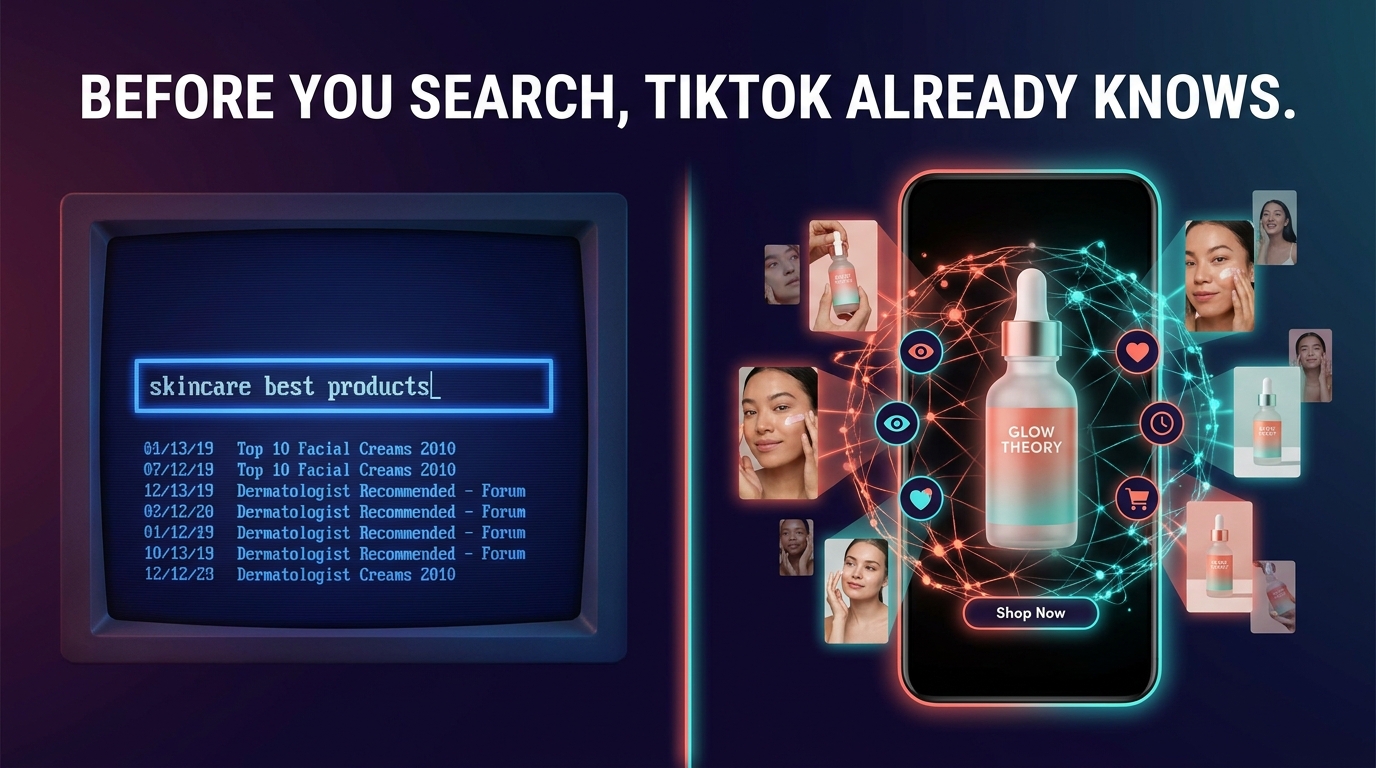

Ask most ecommerce professionals how product discovery works and they’ll describe the same arc: a shopper forms a need, types a query, scans results, clicks a listing. Clean. Linear. Predictable. It’s the model that Amazon built its empire on, and it’s the model that most brands still optimize for.
TikTok’s AI search doesn’t work that way. More precisely, TikTok’s AI search doesn’t always wait for a query at all.
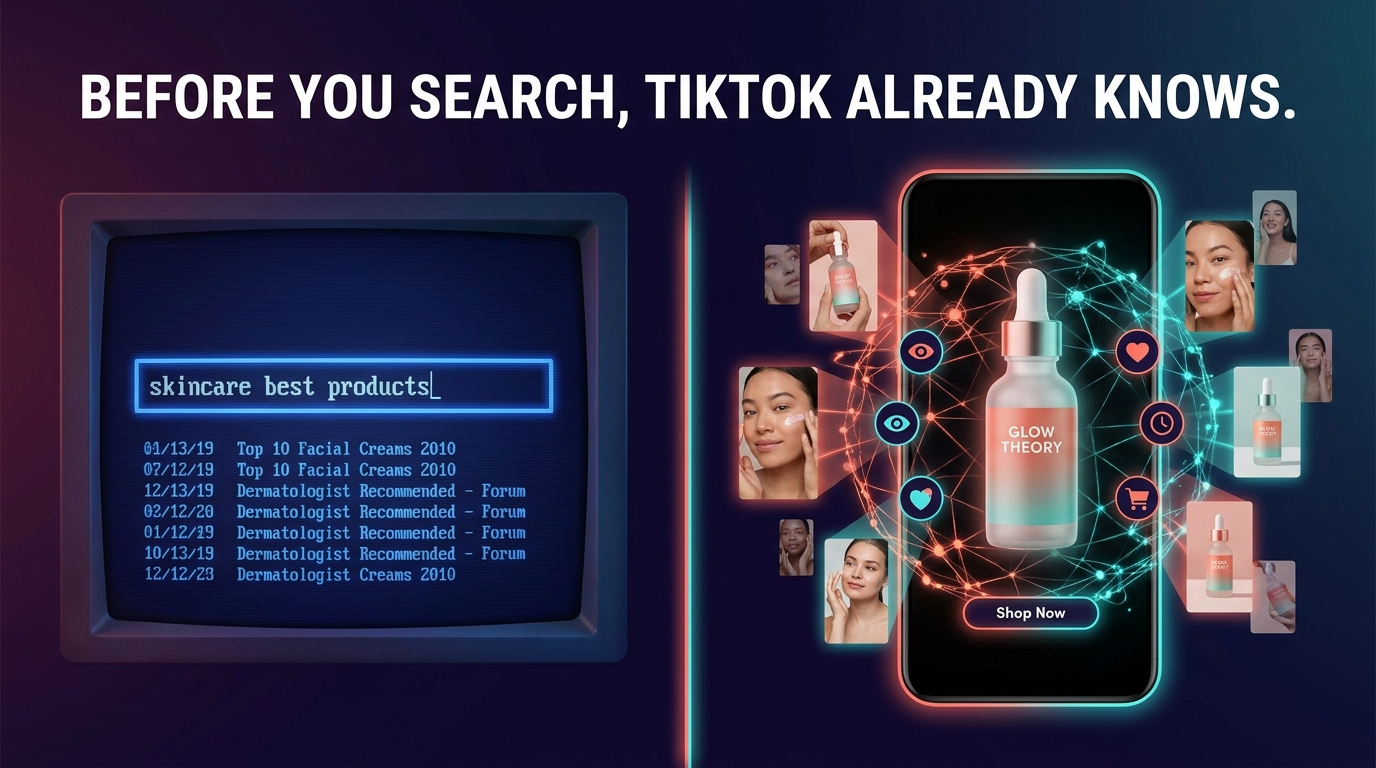
In 2026, TikTok Shop has evolved into something qualitatively different from a social media add-on or a keyword-driven marketplace. It is an intent inference engine — one that observes how long you paused on a skincare reel, which hoodie you rewatched twice, which comment you tapped into, and which product card you hovered over without clicking. From those fragments, it builds a probabilistic profile of what you’re likely to want to buy next. Long before you type a single character into the search bar, TikTok’s AI has already decided which products belong in your world.
That is a fundamentally different problem for sellers to solve. Optimizing for a search engine means feeding it the right words. Optimizing for TikTok’s AI means feeding it the right signals — across video, audio, listing metadata, creator behavior, and real-time engagement. The sellers who understand this distinction are quietly pulling away from those who are still focused on keyword density alone.
This piece is about the mechanics of that distinction. What the system actually reads. How the FYP and the Search tab serve different buyer states in the same purchase journey. How TikTok’s model differs structurally from Amazon’s. And what sellers need to build — in listings, in content, and in measurement — to operate inside an AI-first discovery environment rather than around it.
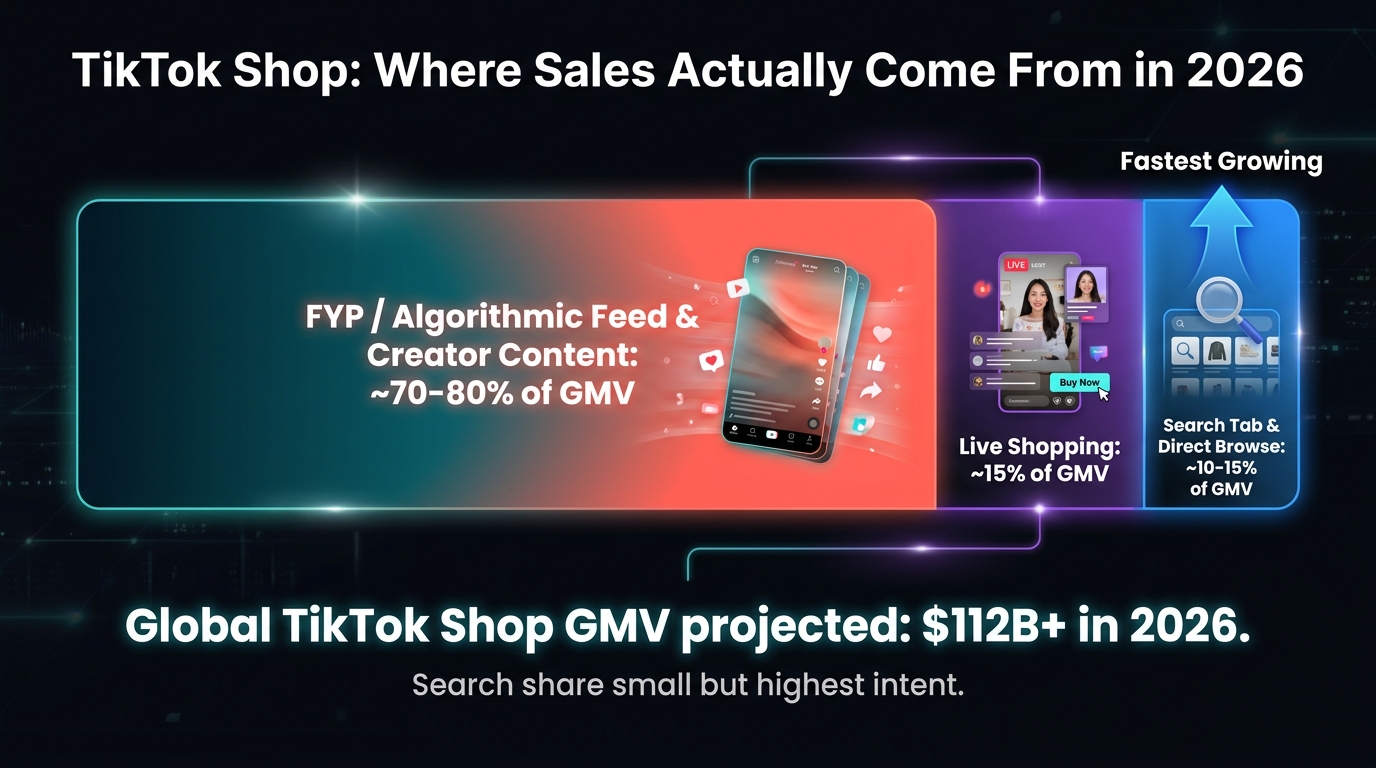
The numbers justify close attention. Global TikTok Shop GMV reached an estimated $64.3 billion in 2025 and is projected to exceed $112 billion in 2026 — nearly doubling in a single year. That growth is not happening because more people are typing things into a search bar. It’s happening because the AI is getting better at finding buyers before they know they’re looking.
From Keyword Engine to Intent Graph — The Architecture Behind TikTok AI Search
The phrase “intent graph” has been circulating in search-industry discussions for years, but TikTok is one of the first commerce platforms to make it feel real at scale. Understanding what it means in practice requires a brief detour into what traditional ecommerce search actually does — and why that model has a ceiling.
The Limits of the Keyword-First Model
Traditional keyword-matching search — whether on Amazon, Google Shopping, or a legacy retail site — operates as a two-step process. First, a user expresses intent explicitly by typing a query. Second, the system matches that query against an index of product metadata: titles, descriptions, attributes, sales history. The ranking algorithm then weights those matches by relevance, conversion probability, and paid placement.
This works well when users know what they want and can articulate it. “Nike Air Max 270 size 10 white” returns exactly what it should. But it breaks down at the edges of awareness — when a shopper is in an earlier phase of the purchase journey, when they’re browsing for inspiration rather than executing a known purchase, or when they can describe a feeling or a use case but not a product name. The query “something that would make my bathroom look more luxurious without spending much” returns garbage results in keyword-first systems. It happens to describe exactly the kind of discovery that TikTok handles better than anyone.
What an Intent Graph Actually Does
TikTok’s AI search architecture — which the platform has not branded with a single public name, though “shopping graph” comparisons with Google’s product knowledge layer are frequently drawn — functions by modeling what a user is likely to want based on accumulated behavioral data rather than waiting for an explicit signal. It treats every interaction with content as a vote: a watch tells it something, a replay tells it more, a skip tells it the opposite, an add-to-cart tells it something very precise indeed.
Over enough interactions, the system constructs a multidimensional preference profile that is far richer than any keyword a user would ever type. That profile is then matched not just against product titles but against a content-level understanding of what’s in videos, what’s being said, which creator personas correlate with certain buying behaviors, and how those signals correlate with real purchase outcomes across millions of similar users.
The result is a system that can serve a skincare product to a user who has never searched for skincare, because it knows that users with similar content consumption patterns — comedy reels at 11pm, home decor saves, replays of transformation videos — buy that specific product category at a meaningfully higher rate. The intent graph turns correlation into prediction, and prediction into discovery.
Why This Matters More Than Most Sellers Realize
For sellers, the practical implication is significant. In a keyword-first model, visibility is largely a function of your ability to match and outbid on specific search terms. In an intent-graph model, visibility is a function of how well the AI understands your product’s category, use cases, and buyer fit — and whether your content generates the kind of engagement signals that the AI uses as quality confirmations. You can’t simply add keywords to win. You have to teach the system, through consistent behavioral evidence, that your product belongs in front of a particular type of person.
The Five Layers of TikTok’s Behavioral Signal Stack
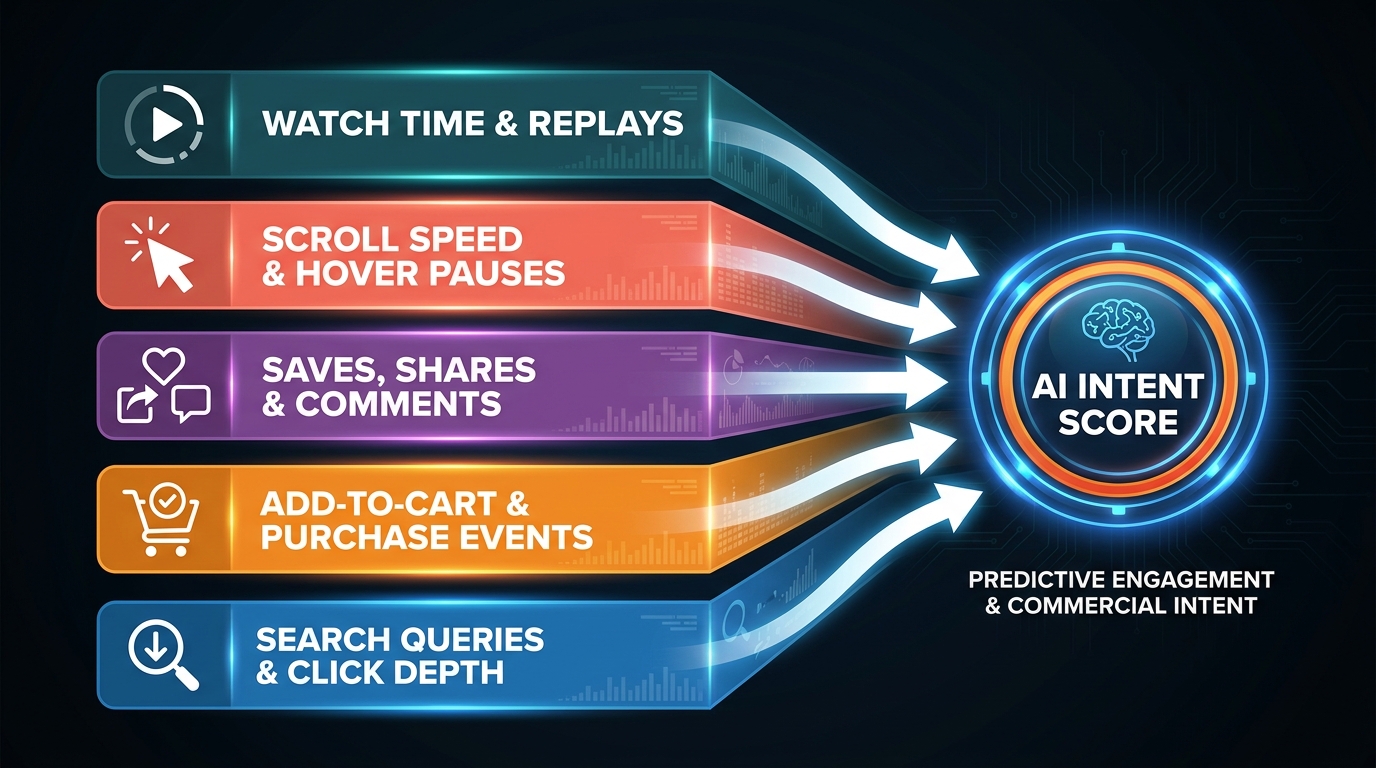
TikTok’s behavioral signal processing isn’t a single algorithm — it’s a layered system where different data types carry different weights and are read at different stages of the buyer journey. Understanding what sits in each layer helps sellers think more clearly about where their optimization efforts will actually move the needle.
Layer 1: Passive Attention Signals
At the base of the stack sit the passive signals — data points that users generate without taking any deliberate action. Watch time is the most widely discussed: how long a user watches a video versus how quickly they scroll away. But TikTok’s AI also reads scroll speed (does a user decelerate as they approach a video?), hover pauses (does their thumb stop, even briefly, on a product card?), and replay behavior (did they watch again, and if so, from the beginning or from a specific timestamp?).
These signals are valuable precisely because they’re unconscious. A user can choose not to like a video, but they can’t fully fake how long they watched it. Passive attention data is therefore treated by the algorithm as a more reliable proxy for genuine interest than any voluntary engagement action.
Layer 2: Active Engagement Signals
Above passive attention sit deliberate engagement actions: likes, saves, shares, comments, and clicks into the comments section. Each carries distinct intent information. A save is a strong future-purchase signal — it implies “I want to find this again.” A share suggests social endorsement. A comment, particularly one that asks a product question or expresses a desire (“I need this”), is an explicit purchase-intent marker. TikTok’s AI weights these signals differently and uses their combination to build intent trajectories, not just snapshots.
Layer 3: Commerce-Specific Actions
The third layer covers in-platform commerce behaviors: clicking a product card, visiting a product detail page, adding to cart, initiating checkout, and completing a purchase. These signals sit at the top of the intent pyramid and carry the most predictive weight. A single add-to-cart event can materially shift how the algorithm categorizes a user’s product preferences and dramatically increase the frequency with which similar products appear across all TikTok surfaces.
Layer 4: Search Behavior
Explicit search queries form the fourth layer. What a user types into TikTok’s search bar — and importantly, how they phrase it — feeds directly into the intent model. TikTok has noted publicly that its users tend to use conversational, problem-based search language rather than product-specific terms. Queries like “what to use for under-eye circles” or “best running shoes for wide feet” are more common than “retinol eye cream 30ml.” This conversational query structure is itself a signal: it tells the AI that the user is in an early-to-mid stage of the purchase journey and that discovery-oriented content is more appropriate than a product grid.
Layer 5: Cross-Session Pattern Recognition
The fifth and most sophisticated layer involves cross-session pattern recognition — the AI’s ability to identify repeating behavioral motifs across days, weeks, and different content contexts. A user who consistently pauses on wellness content, saves budget-living tutorials, and watches skincare transformation videos in the evening has a coherent behavioral profile that spans many individual sessions. TikTok’s AI identifies these patterns and uses them to predict product interest even in categories the user has never explicitly browsed. This is the layer that powers true pre-search discovery — the experience of seeing a product on your FYP and thinking “how did they know?”
Multimodal Matching — How Video, Audio, and Text Feed the Product Index
TikTok’s AI search doesn’t just read user behavior — it also reads content. Every video uploaded to the platform is processed across multiple modalities simultaneously: visual frames are analyzed for objects, faces, environments, and aesthetics; audio tracks are transcribed and parsed for product mentions, use-case language, and sentiment; on-screen text overlays are indexed; and post-level metadata (captions, hashtags, product tags) is structured into the product index. The combination of these signals allows TikTok to build a content-level understanding of what a video is actually about, independent of what the creator manually tagged or described.
Visual Frame Analysis
TikTok’s computer vision layer can identify products within video frames with increasing accuracy. A creator holding a water bottle, applying a serum, or unboxing a gadget generates visual signals that the AI can match against catalog items — even without an explicit product tag being placed in the video. This auto-detection capability is still developing, with TikTok testing it most actively in select non-US markets, but it represents a significant long-term shift in how products get discovered. In a world where the AI can see what’s in a video, the absence of a product tag doesn’t mean the absence of a discovery opportunity.
Audio Transcription and Semantic Parsing
Audio is the underappreciated signal layer. TikTok transcribes spoken content and parses it for semantic intent markers. A creator who says “I’ve been struggling with dry skin all winter and this is the only thing that’s actually worked” is delivering a problem-solution narrative that the AI can match to buyer queries like “what helps with dry skin in winter.” The spoken language in creator content effectively functions as organic, conversational keyword coverage — often matching the kind of problem-based search language that users actually type far better than any engineered product title.
This has a direct practical implication: a product with strong creator content that speaks naturally to buyer problems will outperform a product with excellent keyword-optimized titles but no meaningful content ecosystem. The AI rewards breadth and authenticity of signals over polish of a single data field.
Caption and Hashtag Text as Semantic Context
Written captions and hashtags contribute a third text layer. Contrary to the instinct of some sellers to stuff captions with every possible hashtag, TikTok’s AI appears to read caption text for semantic coherence rather than keyword density. A caption that explains the product’s use case in natural language — “finally a sunscreen that doesn’t leave a white cast on deeper skin tones” — provides richer contextual indexing than a caption that reads “#sunscreen #skincare #beauty #SPF #skincareroutine #TikTokShop.”
The FYP vs. Search Tab Divide — Two Different Buyer States, One Continuous Journey
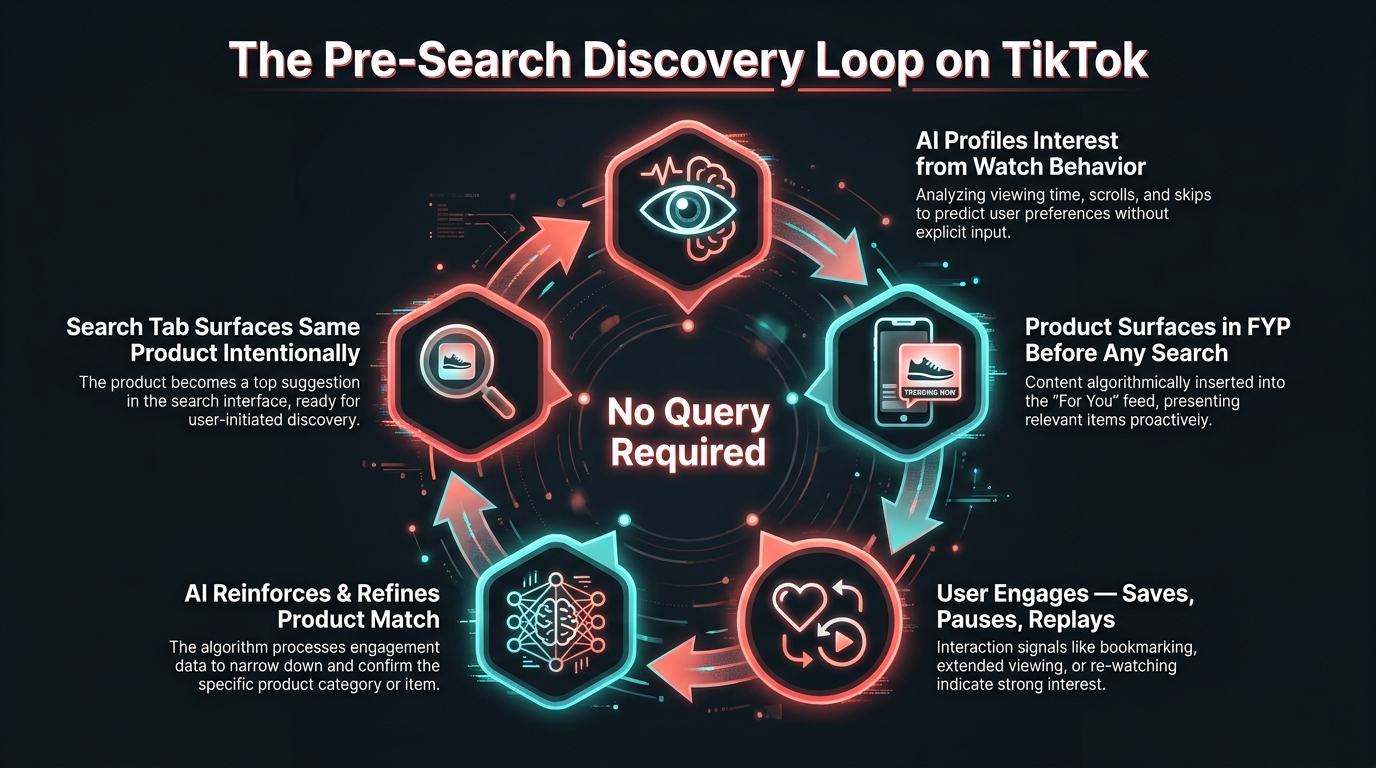
One of the most misunderstood aspects of TikTok’s commerce architecture is the relationship between the For You Page and the Search tab. Many sellers treat them as competing surfaces — as if a user is either browsing their feed or actively searching, and the job is to win on one or the other. The reality is considerably more nuanced.
The FYP as a Demand Generation Surface
The For You Page is where most TikTok commerce journeys begin — and begin passively. Estimates from industry trackers suggest that between 70 and 80 percent of TikTok Shop GMV originates from algorithmically served content: FYP videos, creator posts, and Live shopping sessions. Users on the FYP are in a receptive, open-minded state. They are not looking for a specific product. They are being shown products that the AI believes they will want — and the quality of that prediction determines whether discovery becomes purchase.
In this environment, the key performance question for a seller is not “does my listing have the right keywords?” It is “does my product’s content ecosystem generate the engagement signals that tell the AI this product belongs in front of buyers?” A product that accumulates strong watch times, high save rates, and frequent add-to-cart events from creator content will be pushed more aggressively across FYP surfaces to similar user profiles. The AI is, in essence, using social proof signals to identify and amplify products worth discovering.
The Search Tab as a High-Intent Validation Layer
The Search tab serves a different function and attracts a different buyer state. Data and qualitative research consistently show that TikTok users arrive at the Search tab after some prior exposure to a product or category — typically through FYP content. They are searching to confirm, compare, or deepen their understanding, not to discover from scratch. This makes the Search tab a mid-to-lower funnel surface: lower volume than the FYP, but significantly higher purchase intent per session.
Adobe’s 2026 data indicates that 49 percent of consumers now use TikTok to find information, including 65 percent of Gen Z. Among those, 86 percent of Gen Z use TikTok Search weekly — just four percentage points behind Google for that cohort. The directional story is clear: for a substantial and growing segment of the population, TikTok Search is a primary research and validation tool, not just a content feature.
The Continuous Journey Between Both Surfaces
Critically, TikTok’s AI connects these two states rather than treating them as separate silos. A user who encounters a product on the FYP but doesn’t immediately search for it will see related content weighted higher in their feed over subsequent sessions. When they eventually do open the Search tab — perhaps days later, after continued passive reinforcement — TikTok’s AI has already calibrated their search experience toward the categories and products that generated the most engagement signals. The search results they see are not a neutral index; they are a personalized shortlist shaped by everything the AI learned from their FYP behavior.
This means the FYP and Search tab are not competing surfaces for seller attention. They are sequential touchpoints in an AI-managed buyer journey. A product that performs well in FYP discovery will receive disproportionate visibility when the same user arrives at the Search tab with explicit intent. Seller strategy should reflect this continuity — treating creator content, listing optimization, and search keyword strategy as components of a single unified system, not separate workstreams.
How TikTok AI Search Differs From Amazon’s Keyword-First Model
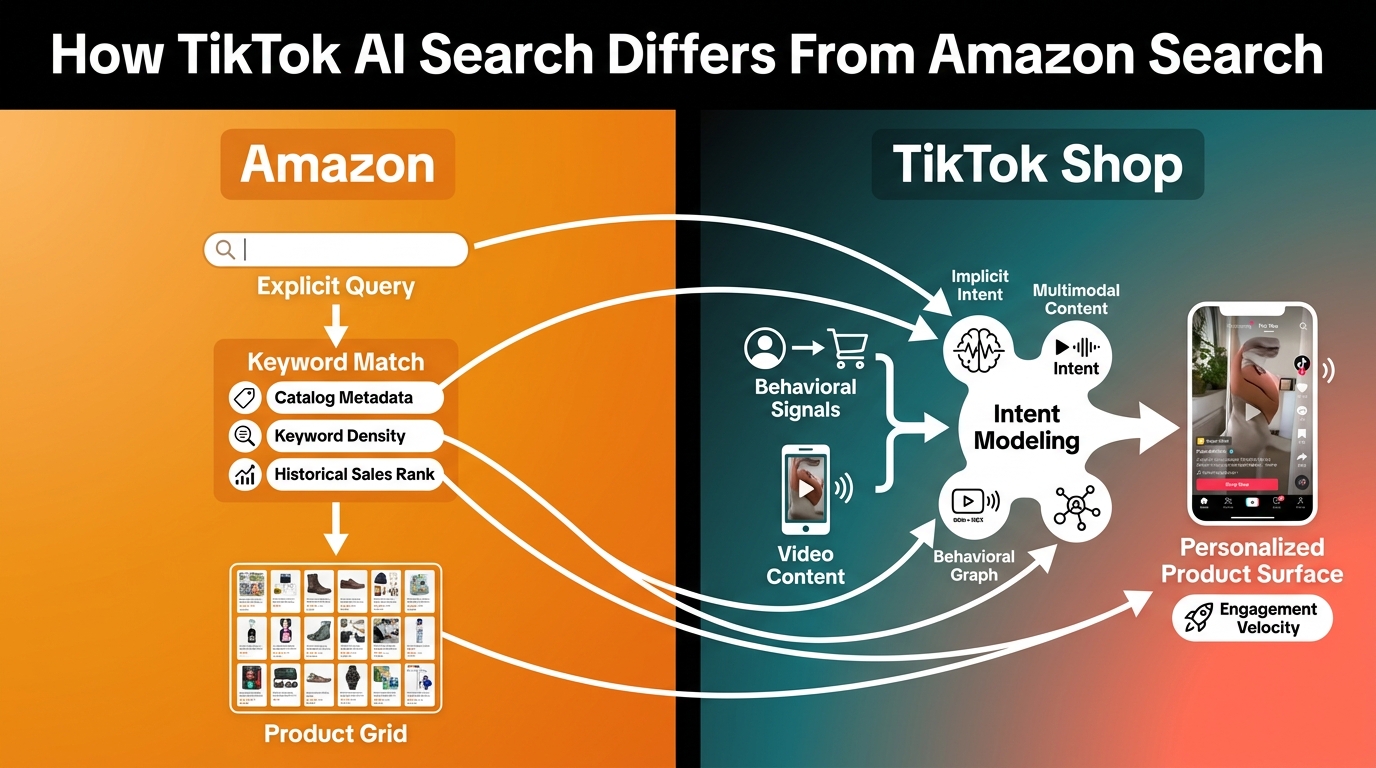
The comparison between TikTok Shop and Amazon is the most instructive structural contrast available in ecommerce right now — not because one is better than the other, but because they represent genuinely different philosophies about where buyer intent lives and how to match it.
Amazon’s Explicit Query Architecture
Amazon’s search architecture was built for a specific type of shopper: one who already knows what they want. The system excels at matching explicit, specific queries against a vast catalog of structured product data. Keyword placement in titles, backend search terms, bullet points, and A+ content drives indexing. Historical conversion rate, sales velocity, and review volume drive ranking. The system assumes that intent is explicit and articulable, and it rewards sellers who can most precisely match their listings to the language buyers use when they know what they’re looking for.
This model is enormously effective for the middle and bottom of the purchase funnel — for buyers who are in comparison-shopping or ready-to-buy mode. It struggles at the top of the funnel, with users who are in inspiration mode or who don’t yet have the vocabulary to describe what they want. Amazon has tried to address this with visual search, recommendation carousels, and Rufus AI, but its core architecture still treats search as the starting point.
TikTok’s Implicit Intent Architecture
TikTok’s model inverts the assumption. It treats intent as largely implicit and inferrable, not explicit and articulable. Rather than waiting for a query and matching against catalog metadata, it continuously models what users are likely to want based on behavioral, content, and cross-session signals — then proactively surfaces products that fit that model. When users do search, TikTok’s AI treats the query as one signal among many, layering it against the user’s behavioral profile to return personalized results rather than a uniform ranked list.
The practical difference for sellers is that TikTok optimization is more holistic and harder to game than keyword optimization. You can reverse-engineer Amazon’s ranking factors with enough data. You cannot simply reverse-engineer TikTok’s intent graph — you have to consistently generate the kinds of engagement signals that the graph uses as quality evidence. That requires better products, more resonant content, and a closer alignment between your target buyer and your creative output.
The Convergence Point: AI Is Moving Both Platforms Toward the Middle
It’s worth noting that the gap is narrowing. Amazon’s Rufus AI and its generative shopping features are pushing the platform toward more conversational, intent-inferred discovery. TikTok, meanwhile, is adding more structured catalog features, keyword search ads, and attribution tooling that feel more Amazon-like. Both platforms are learning from each other. But for sellers operating in 2026, the practical differences remain large enough to require distinct optimization approaches — and the category of seller who treats both platforms identically will underperform on both.
What “Pre-Search Discovery” Actually Means for Sellers
The concept of pre-search discovery sounds like an academic abstraction until you think about its commercial implications. If your product can surface in front of a buyer before they’ve formed an explicit intent — before they’ve typed a word — then the rules of acquisition change significantly.
The Demand Creation vs. Demand Capture Distinction
Traditional paid search, whether on Google or Amazon, is demand capture: you pay to be visible to buyers who already have a defined intent and are actively seeking a solution. TikTok’s FYP-based AI discovery functions more like demand creation: it surfaces your product to someone who didn’t know they were in the market for it, and in doing so, creates a purchase journey that wouldn’t otherwise have existed. This is a different kind of commercial value — harder to measure in last-click attribution models, but real and increasingly significant at scale.
The TikTok Shop model effectively enables brands to create demand among audiences that they wouldn’t reach through search, then capture that demand in the Search tab as intent crystallizes. Brands that understand this flow can build a flywheel: FYP exposure generates brand familiarity and product interest, which generates search behavior, which generates high-intent conversions, which generates review and social proof signals that feed back into the AI’s product quality assessment, which generates more FYP exposure.
Category Incumbency in the AI Layer
One underappreciated consequence of pre-search discovery is the emergence of category incumbency at the AI layer. In a keyword-first model, any seller can bid their way onto the first page for a given search term. In an intent-graph model, the products that have accumulated the strongest and most consistent behavioral signals over time tend to be surfaced more frequently to the profiles that match — creating a compounding advantage for early movers that is difficult for late entrants to displace simply by spending more.
This means that for sellers entering a TikTok Shop category, the urgency of building engagement signals early — through quality creator content, strong listing assets, and competitive product-market fit — is considerably higher than in traditional marketplace dynamics. The intent graph rewards momentum, and momentum is easiest to build from a position of novelty before incumbents have fully captured the category’s behavioral data.
Attribution Complexity as a Side Effect
Pre-search discovery also creates significant attribution complexity. When a user encounters a product on the FYP on Monday, watches three related creator videos over the next four days, and purchases through the Search tab on Friday, standard last-click attribution assigns the conversion entirely to the Search tab. The FYP exposure and creator content that generated the initial interest and sustained the consideration are invisible. This leads brands to systematically underinvest in top-of-funnel TikTok content because their measurement frameworks can’t capture its contribution to conversion.
Sellers who rely on last-click attribution to evaluate their TikTok investment will consistently make suboptimal budget decisions. The better approach is to use TikTok’s native attribution windows, GMV Max campaign data, and cross-channel analysis to build a fuller picture of how discovery content contributes to eventual purchase.
Listing Architecture for the AI-First Index
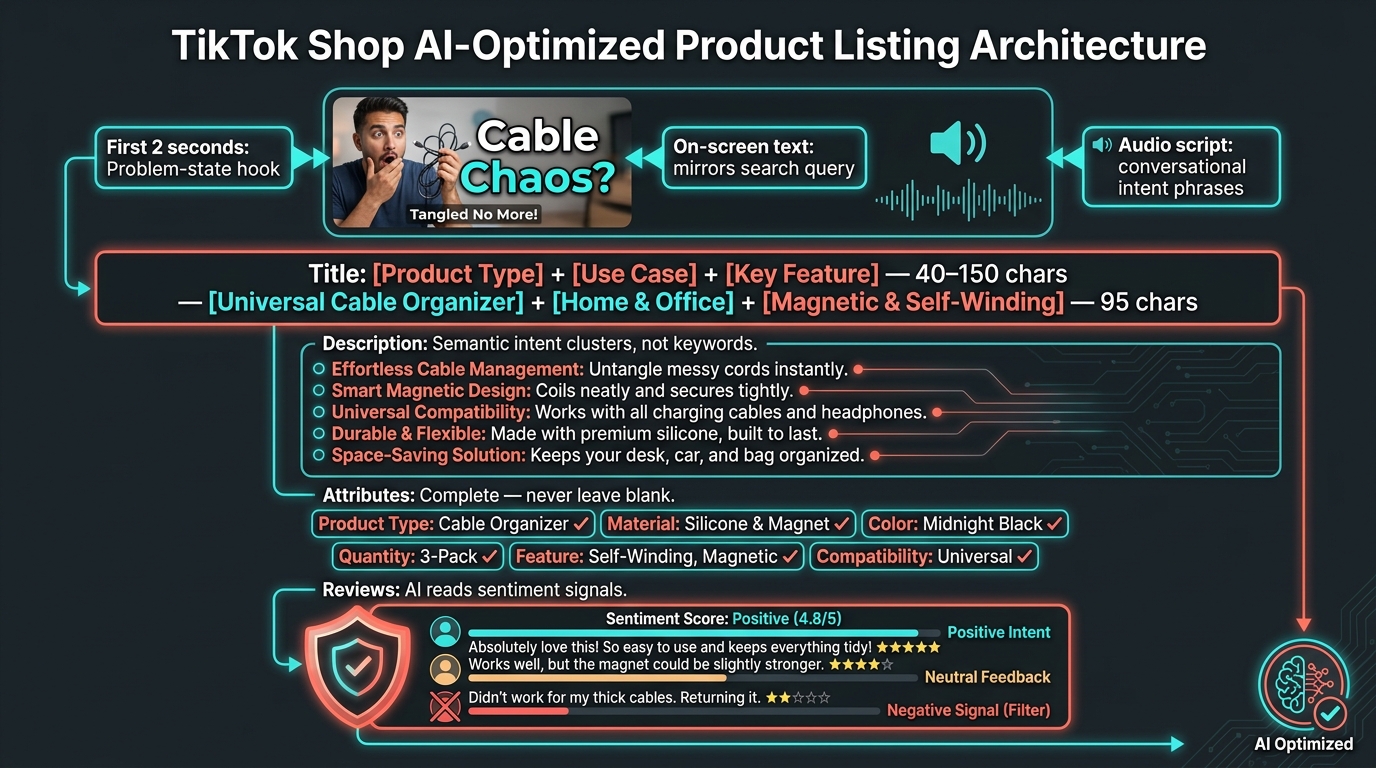
Knowing how the AI reads signals is only useful if it informs how you build your product listings. TikTok Seller Center has published guidance on title structure and listing completeness, but the deeper optimization principles are less visible — and they’re where the gap between average and top-performing sellers tends to widen most sharply.
Title Architecture: Intent-First, Not Keyword-First
TikTok’s recommended title structure is: product type + use case + distinguishing attribute + relevant variation where applicable, within 40–150 characters. The instruction to avoid “repeated words, discount claims, and variant lists” is notable — it suggests the AI penalizes listings that are clearly gaming the keyword count rather than genuinely describing the product.
The more important principle is that titles should map to how buyers describe their problem, not how sellers categorize their inventory. A title like “Hyaluronic Acid Face Serum for Dry Skin — Fragrance-Free, 30ml” performs better in AI discovery than “Best Hydrating Serum Premium Moisturizing Face Skincare Product Hyaluronic Acid Anti-Aging.” The first title matches how someone would describe their need in a conversational search. The second title looks like it was written to satisfy a keyword count, and the AI’s semantic parsing is increasingly good at telling the difference.
Product Descriptions as Semantic Intent Clusters
Rather than writing descriptions as bullet lists of features, the most effective approach treats the description as a collection of semantic intent clusters — passages of natural language that address specific buyer questions, use cases, and objections. “Works well on combination and oily skin types” is a semantic cluster that will match queries like “what serums work for oily skin.” “Lightweight enough to layer under SPF without pilling” matches “serums that don’t pill under sunscreen.”
The AI doesn’t just match keywords; it appears to read descriptions for semantic proximity to buyer intent phrases. A description that addresses five distinct buyer queries in natural language will generate more discovery surface area than one that lists fifteen product features in fragment form.
Attributes: The Invisible Ranking Factor
Attribute completeness is one of the most consistently neglected elements of TikTok Shop listings, and it’s a significant ranking factor. Every unfilled attribute field is a missed signal — a gap in the AI’s understanding of where your product belongs in the product index. Sellers who complete every available attribute (material, skin type, use case, size, color, age range, certifications, and so on) give the AI a richer structured data layer to match against filtered searches and intent profiles. It’s also one of the lowest-effort high-impact optimizations available: a one-time completion task that provides ongoing indexing benefit.
Visual Assets as Discovery Signals
Product images and short video clips in listings contribute visual signals that the AI reads alongside textual data. Clear, well-lit product images with visible product details help the computer vision layer index the item accurately. Lifestyle images that show the product in use — ideally in contexts that mirror the environments and use cases of your target buyer — reinforce the intent matching between product and audience. A skincare product photographed on a bathroom shelf with warm morning light signals something different to the visual AI than the same product on a plain white background, even if the text metadata is identical.
The Creator Content Brief in the Age of AI Search
If listings tell the AI what your product is, creator content tells it how your product lives in the world. And because TikTok’s AI reads creator content through multiple modalities — visual, audio, text — the brief you give creators has a direct and measurable impact on AI discovery performance, not just brand awareness.
Why Scripted Hooks Need to Mirror Search Queries
The first two seconds of a TikTok video determine watch time, and watch time is a primary engagement signal. But the first two seconds also serve an indexing function: the opening hook tells the AI’s audio and text processing layer what problem this video addresses. A hook that opens with “If your skin looks dull even after moisturizing…” is semantically indexing this video for queries about dull skin, moisturization failure, and skincare troubleshooting. A hook that opens with “This product changed my routine” provides almost no indexing signal — it could be any product in any category.
The implication for briefing is specific: opening hooks should be written as problem statements that mirror the kinds of search queries your target buyers actually use. This requires knowing those queries — which is retrievable from TikTok’s native search analytics, Google Trends, and comment analysis on high-performing videos in your category.
Audio as a First-Party Keyword Layer
The spoken content of creator videos functions as a first-party keyword layer that’s unique to TikTok and largely absent from any other ecommerce platform. When a creator spends thirty seconds explaining who this product is for, what problem it solves, and why it works differently from alternatives, they are generating a dense, conversational text layer that the AI can index against buyer queries.
Sellers who brief creators with clear use-case language, key buyer personas, and specific problem scenarios will generate videos with richer audio indexing than sellers who simply provide talking points and allow full creative freedom. Neither pure scripting nor pure freedom is optimal — the goal is giving creators the semantic context they need to speak naturally about buyer problems while preserving the authenticity that makes TikTok content work.
Engagement Velocity as an Amplification Trigger
Creator videos that generate rapid early engagement — high watch-through rates in the first 24–48 hours, strong save rates, comment engagement that the AI can parse as positive sentiment — receive significantly broader distribution. This means the timing and targeting of creator content matters as much as its quality. Posting a product video to a creator audience that closely matches your target buyer profile generates better early engagement signals, which triggers broader algorithmic distribution, which generates more signals, which sustains distribution. Conversely, posting the same video to a mismatched audience results in poor early signals and limited amplification regardless of content quality.
Briefing creators should therefore include guidance not just on content but on which audience segment to address and, where possible, on optimal posting windows based on when their specific audience is most active.
Measuring What’s Working — TikTok’s Native Data Signals
Measurement is where the gap between understanding TikTok’s AI theoretically and capturing its commercial value practically becomes most visible. Most brands arrive at TikTok Shop with attribution models built for Google and Amazon — models that are structurally ill-suited to a discovery-first platform with long, multitouch buyer journeys.
The Metrics That Actually Reflect AI Discovery Health
Within TikTok Seller Center, the metrics that most directly reflect AI discovery health are: product page views (how often TikTok’s AI is surfacing your listing to interested users), video-to-product-page conversion rate (how effectively your content is converting discovery exposure into listing visits), add-to-cart rate (a high-intent commerce signal that feeds the AI’s product quality assessment), and search impression share (how visible your listing is within the Search tab for relevant queries).
Watch through rate on product-tagged videos and save rate are secondary but important leading indicators — they signal that the AI is building positive engagement evidence around your products, which will translate into broader distribution over the subsequent days and weeks. Sellers who monitor these metrics regularly and respond to early anomalies (unusual drop in watch time, declining save rate) can adjust content and listing strategy before broader distribution declines follow.
Using Search Analytics to Map AI-Indexed Intent
TikTok’s search analytics — accessible through the seller-facing analytics dashboard and the broader Creative Center — provide a window into the kinds of queries driving traffic to your product category. Unlike Amazon’s search term reports, TikTok search analytics reflect the conversational, problem-based language that TikTok users actually use. Mining these queries to identify the highest-volume, highest-intent phrases used in your category is one of the most directly actionable data exercises available to TikTok sellers.
The practical use of this data is not just keyword insertion into titles. It’s identifying the semantic clusters that represent how buyers in your category describe their needs — and then using those clusters to shape video scripts, listing descriptions, and creator briefs simultaneously. The more consistently your content ecosystem uses the language your buyers use, the more surface area you generate across TikTok’s AI discovery layers.
The GMV Max Campaign as an AI Optimization Engine
TikTok’s GMV Max campaign type deserves particular attention as a measurement and optimization tool. Unlike manual bidding campaigns, GMV Max uses automated AI to allocate budget across content, product, and audience combinations to maximize revenue outcomes. The data it generates — which content-product pairings drive the best GMV, which audience segments convert at what rates, which time windows yield the strongest returns — is directly applicable to organic content strategy and listing optimization.
Many sellers underutilize GMV Max data as an intelligence source, treating it purely as a paid performance lever. The smarter approach is to run structured GMV Max campaigns specifically to generate product-audience fit data, then use those insights to prioritize which organic content to produce and which creator partnerships to scale. The AI’s paid campaign decisions essentially reveal which signals it considers most predictive of conversion — and that knowledge is genuinely useful for organic optimization.
The Upcoming Shifts: Visual Search, Voice, and Agentic Shopping
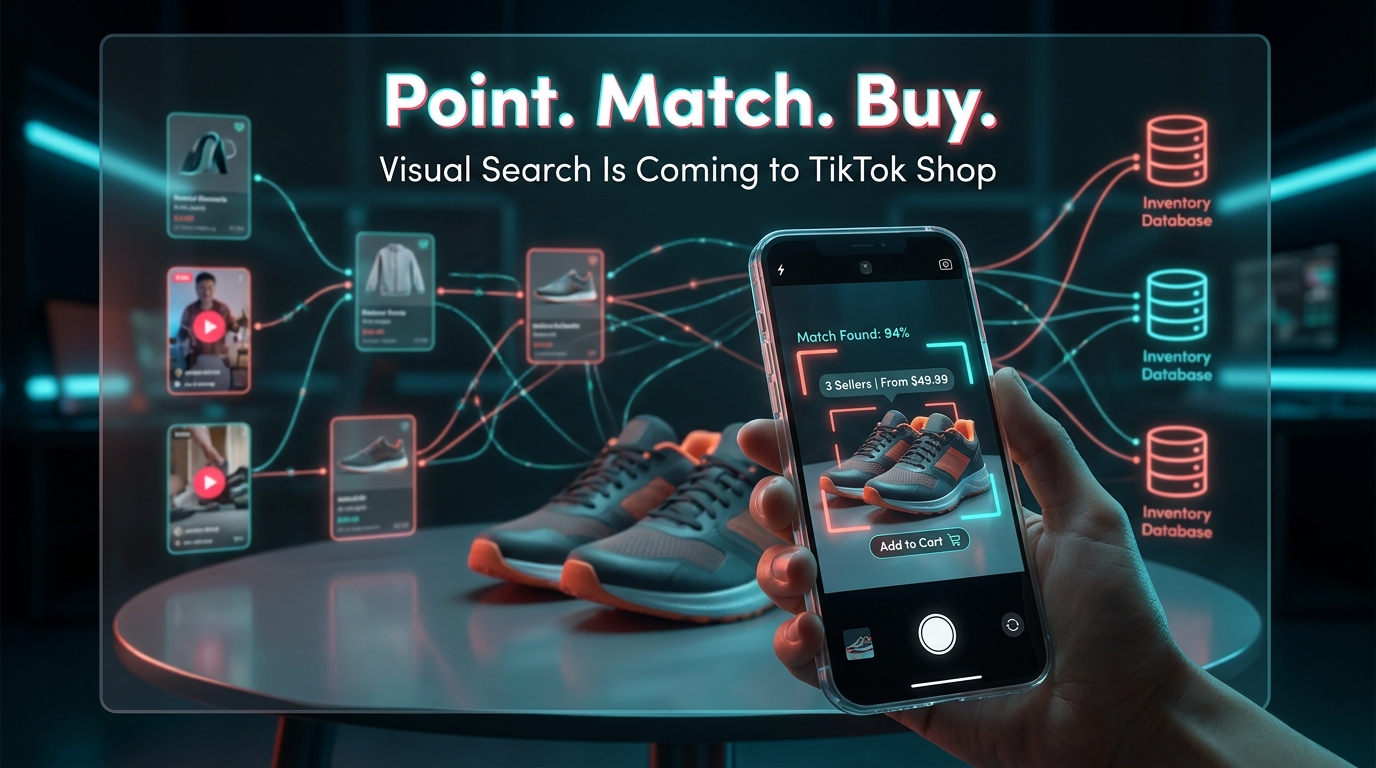
The AI discovery architecture described in this piece represents TikTok Shop’s current state — but the platform is in active development on several capabilities that will extend the discovery model further and create new optimization requirements for sellers.
Visual Search: Still Testing, Significant Potential
TikTok has been testing a visual search tool in its Shop tab that allows users to take or upload a photo and search matching inventory by image. As of mid-2026, this feature remains in testing in select non-US markets, but its eventual broader rollout would represent a meaningful expansion of the “pre-search” discovery concept. A user who photographs a pair of sunglasses worn by someone on the street or a piece of furniture in a magazine spread generates a precise, high-intent discovery signal without ever having to articulate what they’re looking for in words. For sellers, visual search readiness means ensuring that product images are high-resolution, clearly lit, and structurally distinct enough for image-matching algorithms to return accurate results.
Voice Query Behavior and Conversational AI Search
TikTok’s user base increasingly interacts with content in environments where text input is inconvenient — while commuting, exercising, or watching TV simultaneously. Voice query behavior is a natural extension of TikTok’s already conversational search language, and as voice search interfaces become more accessible within the app, the optimization principles for conversational, problem-based queries become even more important. Sellers who have already structured their listings and creator content around natural-language intent phrases will be better positioned when voice query volume increases than those who are still optimizing primarily for typed keyword fragments.
Agentic Shopping: The Furthest Horizon
The most structurally significant near-future shift is the development of agentic shopping — AI agents that can complete purchase journeys on a user’s behalf based on learned preferences and standing instructions. The concept is in early development across multiple platforms, but TikTok’s combination of rich behavioral data, an established shopping infrastructure, and conversational AI capabilities positions it well to develop agentic features. In an agentic shopping environment, a user might instruct their TikTok agent to “find a moisturizer that works for combination skin, under $30, with good reviews, that I haven’t tried before.” The agent then queries TikTok’s product index, cross-references the user’s purchase history, and surfaces options — or completes the purchase automatically.
For sellers, agentic shopping raises the stakes on everything discussed in this piece. An agent evaluating products is less susceptible to visual marketing and creator charisma — it will prioritize structured product data quality, review sentiment, pricing competitiveness, and attribute completeness above all else. Sellers who invest now in the data hygiene, listing completeness, and authentic review generation that the current AI rewards will be building the foundation that the next generation of AI-mediated discovery will require.
What Sellers Should Actually Do Differently Starting Now
The theoretical framework of TikTok’s intent graph is only useful insofar as it changes what sellers build and how they measure it. Across everything covered in this piece, the practical implications converge on a relatively compact set of priorities.
Treat Listings and Content as One System
The single most important mindset shift is abandoning the idea that listings and creator content are separate optimization problems. In TikTok’s AI-first discovery environment, listing metadata, creator video audio, visual frame content, caption text, and engagement signals all feed the same indexing and ranking system. Sellers who optimize these elements in isolation — improving their listing titles without updating their creator briefs, or producing strong content without completing their attribute fields — are leaving signal consistency on the table. The AI rewards coherence across all input layers, and incoherence between layers can actively confuse the indexing process.
Build for the Journey, Not the Touchpoint
TikTok buyers don’t purchase from a single touchpoint. They discover on the FYP, revisit through the search tab, validate through comments, and convert after multiple exposures. Marketing strategies that evaluate performance at the individual touchpoint level will systematically underfund the awareness content that initiates journeys. The practical fix is to incorporate both assisted conversions and view-through attribution in your TikTok measurement framework, and to establish a budget allocation that reflects the full journey rather than last-click outcomes alone.
Invest in Engagement Velocity Early
The intent graph compounds over time. Products that accumulate strong engagement signals early build category incumbency at the AI layer that is difficult for later entrants to displace through spending alone. Every new seller or product launch should prioritize generating genuine early engagement — through quality creator partnerships, competitive pricing during the launch window, and concentrated initial promotion to highly targeted audiences — rather than spreading resources thinly across broad audiences from day one.
Prepare for Visual Search Now
Visual search is not yet fully live across TikTok’s global markets, but the product image quality investments required to perform well in it are the same investments that improve current listing conversion rates. High-resolution, clearly lit, detail-rich product photography that shows the item at multiple angles is not just a visual search readiness move — it’s a conversion rate improvement for current buyers and a stronger signal for the computer vision layer that is already processing listing images. There is no optimization category where “preparing for visual search” conflicts with performing better today.
Conclusion: The Discovery Model Is Already Different — The Question Is Whether Your Strategy Is
The ecommerce search paradigm that most brands spent the last decade optimizing for — keyword density, bid strategy, ranked listings — remains relevant. But it’s increasingly a description of one layer of the purchase journey, not the whole thing. TikTok’s AI search has introduced a layer above that: a system that builds purchase intent before buyers form explicit queries, surfaces products through behavioral inference rather than keyword matching, and rewards sellers who understand that every piece of content, every listing field, and every engagement signal is a vote in an AI-mediated conversation about who your product is for.
The GMV numbers are not small. At a projected $112 billion globally in 2026, TikTok Shop has moved well past the “test and learn” phase for most product categories. The brands that are winning on that platform share a common characteristic: they have internalized that they are not optimizing for a search engine in the traditional sense. They are generating signals — behavioral, multimodal, contextual — that an intent graph uses to decide who sees their product before anyone types a word.
That’s a different craft from keyword optimization. It requires better content, more coherent listing architecture, a closer relationship with creators who understand buyer language, and measurement frameworks that can see across a journey rather than just the final step. None of those are trivial investments. But for a platform growing at TikTok Shop’s trajectory, the cost of building this competency now is considerably lower than the cost of catching up after category incumbency has already been established.
The AI already knows what your buyer wants. The question is whether it knows about your product.