

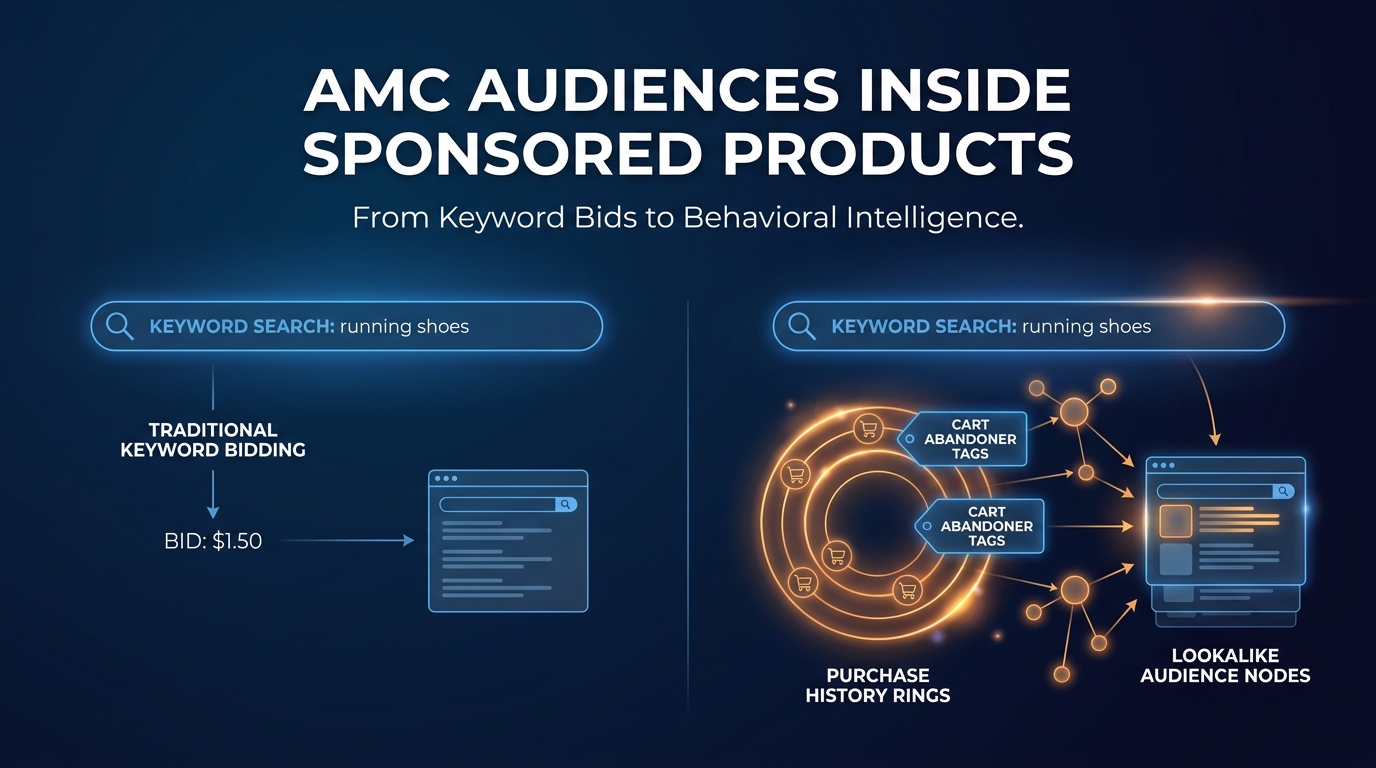

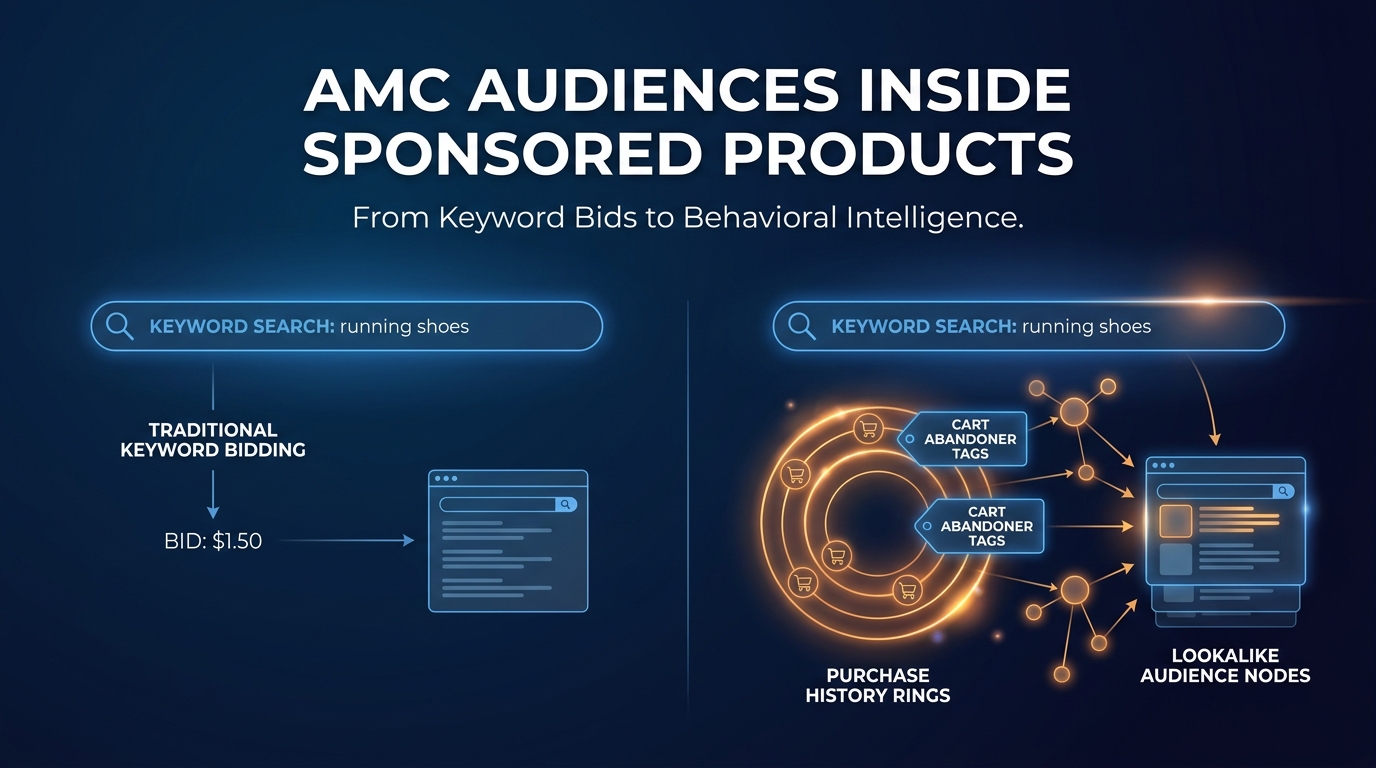
Sponsored Products has always been a keyword game. You pick terms, set bids, win auctions, and show up at the top of search results. That model dominated Amazon advertising for years, and for many sellers it still does. But something has quietly shifted in how the most sophisticated advertisers are using Sponsored Products in 2026 — and the change runs deeper than keyword research or bid automation.
Amazon Marketing Cloud (AMC) audiences are now live inside Sponsored Products. Not as a separate targeting type. Not as a replacement for keywords. But as a behavioral intelligence layer that sits underneath your existing campaigns and dynamically adjusts how aggressively you bid — based on who the shopper actually is, not just what they typed into the search bar.
The gap between advertisers who understand this and those who don’t is widening fast. Documented case studies show ROAS lifts in the 1.5x to 2x range when AMC audience bid boosting is applied correctly. And yet most sellers are either unaware the capability exists, unclear on how it actually functions mechanically, or working with wrong assumptions about what AMC requires to get started.
This article breaks down the full picture: exactly how AMC audiences integrate with Sponsored Products at auction time, what types of audiences you can build and why it matters, the structural implications for your campaign architecture, the real-world performance data, the limitations you need to plan around, and a framework for building and activating this in your own account. This is not a feature overview — it’s a working guide to an advertising capability that most brands are still leaving on the table.
What Amazon Marketing Cloud Actually Is — and What It Isn’t
AMC gets described in a lot of different ways, and the confusion is understandable. Amazon’s own documentation covers it at varying levels of depth, and the platform has changed significantly since it launched. Before getting into audiences and bid boosting, it helps to have a clear model of what AMC actually is.
A Privacy-Safe Clean Room, Not an Ad Platform
Amazon Marketing Cloud is a privacy-safe measurement and analytics environment built on top of AWS Clean Rooms. It holds pseudonymized, event-level data from across Amazon’s advertising ecosystem — including Sponsored Ads impressions and clicks, Amazon DSP exposures, Amazon retail browsing and purchase signals, and streaming data from Prime Video and Twitch. Advertisers can bring in their own first-party data as well, linking CRM records to Amazon’s signals within the clean room.
The key phrase is privacy-safe. AMC doesn’t hand you a list of names and email addresses. It works on hashed identifiers. Outputs are aggregated to protect individual identity. You write SQL queries against the data, or use AMC’s no-code audience builder, and the resulting audiences are exported to Amazon Ads in a form that can be activated — but individual-level data never leaves the environment.
This matters for understanding what AMC audiences actually contain. When you build an “audience” in AMC and push it to Sponsored Products, you’re not uploading a customer list the way you might on Meta. You’re defining a behavioral segment — a set of conditions that describe what a shopper has done — and Amazon matches incoming search traffic against those conditions in real time.
The Shift from Reporting Tool to Activation Platform
For most of AMC’s early life, it was used primarily as a measurement and attribution tool. Advertisers ran SQL queries to understand path-to-purchase, measure overlap between Sponsored Products and DSP, or calculate true new-to-brand share across touchpoints. This was genuinely useful but passive — insights you could act on manually, not signals the system would act on automatically.
That changed when Amazon began enabling audience activation directly inside Sponsored Ads. The audiences you build in AMC — whether rule-based from behavioral queries or algorithmically generated lookalikes — can now be pushed directly into your Sponsored Products campaigns and used to modify bidding in real time. AMC crossed the line from analytics layer to activation layer, and that’s the transition that makes this worth understanding in depth.
Who Can Access AMC in 2026
As of Q4 2024, Amazon removed the requirement that advertisers be active on Amazon DSP to access AMC. This was a meaningful access expansion. Previously, AMC was largely the domain of enterprise brands with DSP spending and agency support. Today, any advertiser running Amazon Ads — including self-serve Sponsored Products sellers — can access AMC.
The practical on-ramp has also improved. AMC’s UI now includes a no-code audience builder alongside the SQL interface, which means you don’t need a data analyst to create usable segments. Pre-built query templates cover the most common use cases: cart abandoners, brand searchers, high-frequency purchasers, and multi-touchpoint shoppers. For more complex segmentation, the SQL environment remains available. Either path leads to the same activation capability inside Sponsored Products.
The Mechanics: How AMC Bid Boosting Works Inside Sponsored Products
Understanding the mechanics here is not optional. The way AMC audiences interact with Sponsored Products is fundamentally different from how audiences work in other digital advertising contexts, and misunderstanding it leads to poor campaign decisions.
It’s a Bid Multiplier, Not a Targeting Switch
The core concept is this: AMC audiences in Sponsored Products function as bid multipliers layered on top of your existing keyword or product targeting. They do not replace keywords. They do not create a separate audience-only targeting mode within Sponsored Products. Your campaigns still run on keyword matching or ASIN targeting as they always have. The audience layer adds a behavioral dimension to bidding — but only when all the existing targeting conditions are met first.
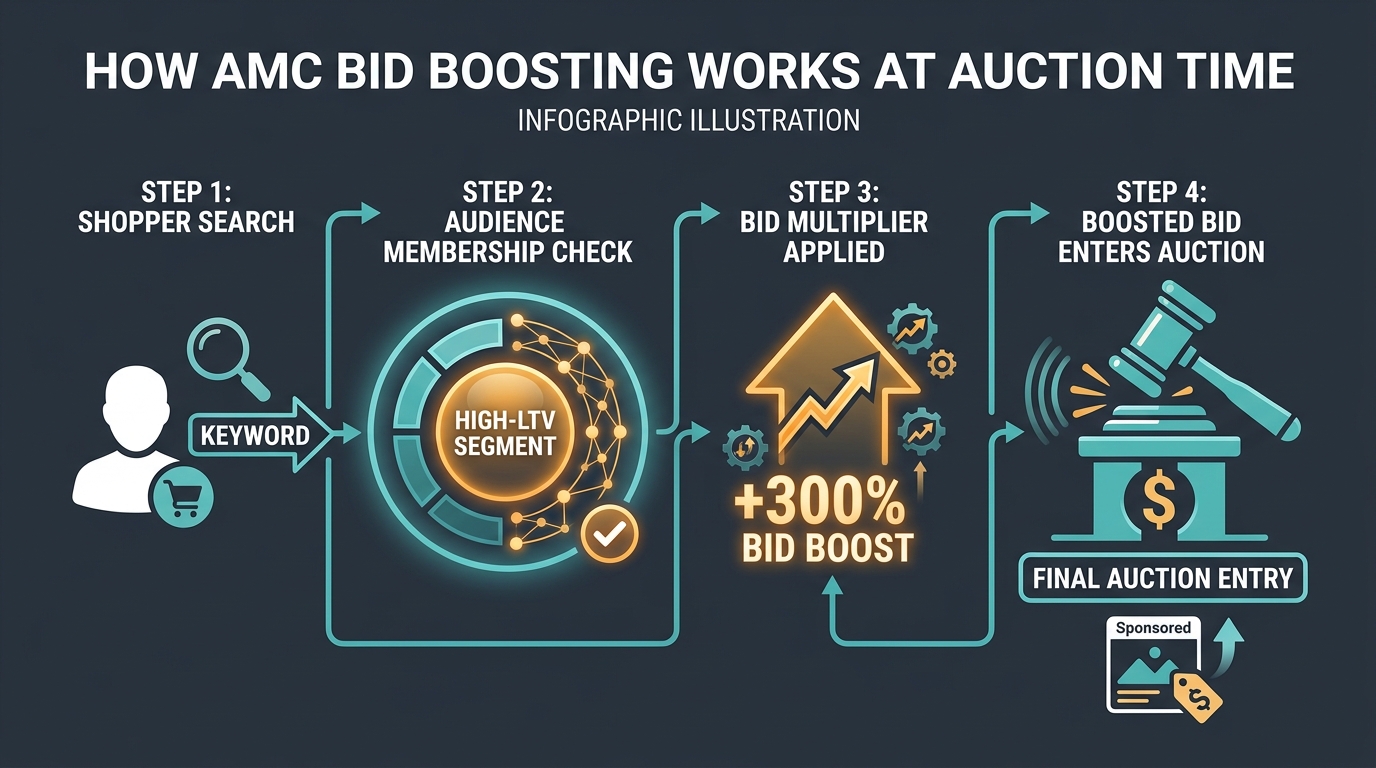
Here’s the sequence at auction time:
- A shopper enters a query that matches one of your targeted keywords.
- Amazon checks whether that shopper’s pseudonymized identifier is a member of the AMC audience attached to your campaign.
- If they are a member, Amazon applies your specified bid multiplier on top of your base keyword bid before entering the auction.
- The boosted bid competes in the auction — improving your probability of winning the impression for that specific shopper.
- If the shopper is not in the AMC audience, your standard keyword bid applies unchanged.
This means the audience layer is essentially an eligibility filter for your bid enhancement. The shopper still has to be searching your keywords — AMC audiences don’t surface you for shoppers who aren’t actively searching. What they do is change how hard you compete for the impression when a high-value shopper is the one doing the searching.
The Bid Multiplier Range
In practice, bid multipliers can range from modest adjustments to extremely aggressive boosts. The platform technically supports multipliers up to 900% — meaning a base keyword bid of $1.00 could become a $10.00 bid when the matched shopper falls within your high-value audience. In real campaign applications, practitioners report using multipliers from 25–50% for broad awareness-stage segments up to several hundred percent for bottom-funnel, high-intent audiences like cart abandoners or lapsed high-LTV customers.
The strategic logic is straightforward: if you know a shopper has previously purchased your product category, placed your product in their cart, or matches the behavioral profile of your best customers, the value of winning that auction is substantially higher than for an anonymous first-time searcher. The bid boost reflects that differential value. You’re willing to pay more to show up in front of someone already primed to convert.
Bid Reduction is Also an Option
While most practitioners focus on bid increases, AMC audiences also support bid reductions. You can apply a negative multiplier to deprioritize certain audience segments — for example, reducing bids for shoppers who recently purchased and are unlikely to repurchase within 30 days, or for very low-LTV segments that historical data shows convert poorly even when they do click. This is essentially a suppression mechanism in the absence of true exclusion controls (which Sponsored Products doesn’t support), achieved by making your bids uncompetitive rather than truly excluding the audience.
The Audience Types You Can Build — and Why the Differences Matter
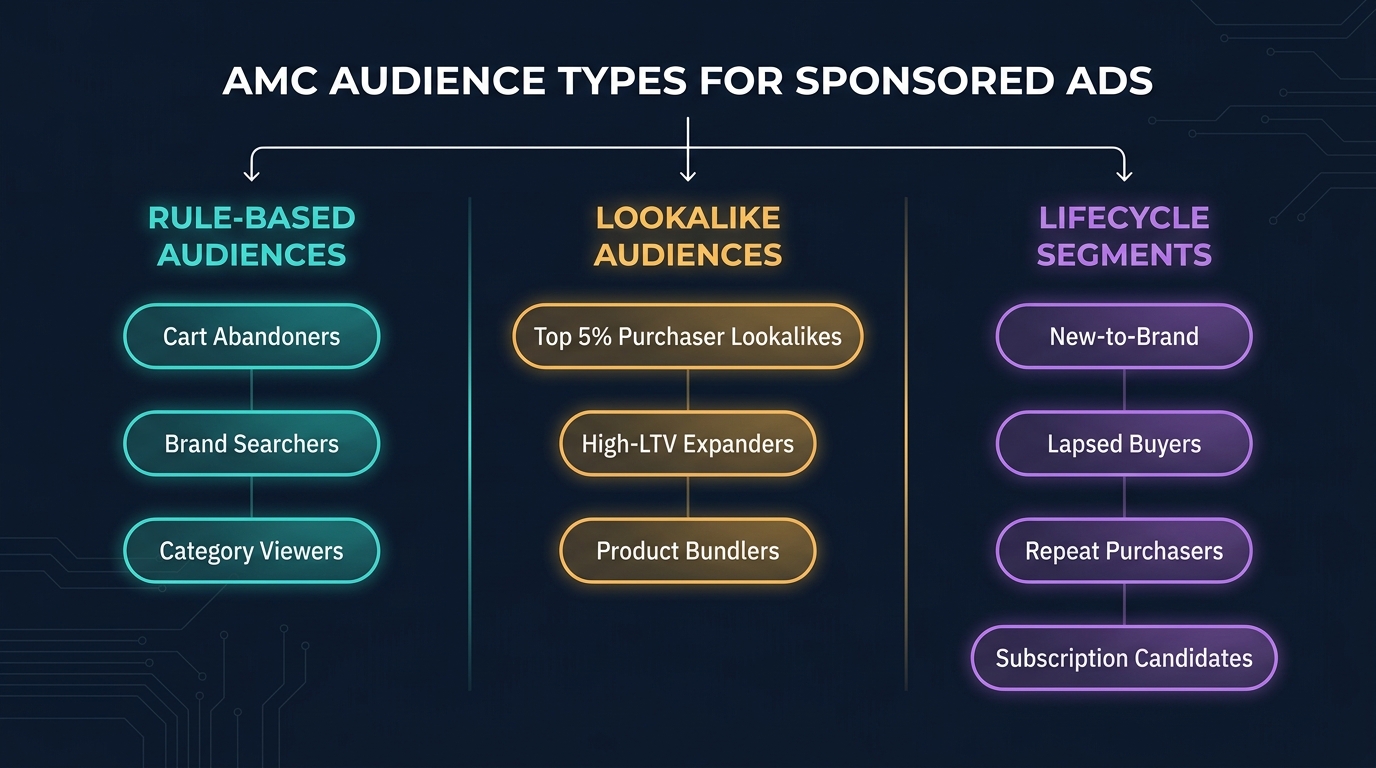
The value of AMC audiences is directly proportional to how specifically and intelligently you define them. Building a vague, broad segment produces vague, modest results. The brands seeing 2x ROAS lifts are building precise behavioral definitions that match their customer economics, not just checking a box to say they’re using AMC.
Rule-Based Audiences
Rule-based audiences are built by writing explicit behavioral conditions against AMC’s event data. These are the most precise and the most commonly used segment type for Sponsored Products bid boosting. Common examples include:
- Cart Abandoners: Shoppers who added a specific ASIN (or category of ASINs) to cart within a defined lookback window but did not complete a purchase. These are typically the highest-intent audience for bid boosting — they’ve already made a decision to consider buying and were interrupted before converting.
- Product Page Viewers: Shoppers who viewed a specific detail page one or more times but didn’t add to cart. A step earlier in intent than cart abandoners, but still more valuable than an unqualified searcher.
- Brand Searchers: Shoppers who searched for your brand name or key brand terms within the lookback window, indicating brand-level awareness and intent.
- Category Browsers: Shoppers who viewed products in your category (including competitors’ products) — useful for intercepting category-aware shoppers who haven’t yet considered your brand.
- Prior Purchasers: Customers who have completed at least one purchase from your brand. Useful for cross-sell campaigns and replenishment-cycle products.
- Multi-Touchpoint Shoppers: Shoppers who have seen both a Sponsored Ad and a DSP ad, or who have interacted across multiple channels. These multi-touch shoppers typically have meaningfully higher conversion rates.
The lookback window is one of the most important variables in rule-based audience construction. A 7-day cart abandoner is a fundamentally different prospect from a 90-day cart abandoner. The 7-day version is probably still in an active purchase consideration phase; the 90-day version may have already bought from a competitor or lost interest entirely. AMC lets you define these windows with precision, and the right window varies by product category, price point, and purchase cycle length.
Lookalike Audiences
AMC supports algorithmically generated lookalike audiences built from a seed segment you define. You provide a set of high-value customers — for example, your top 10% purchasers by lifetime value over the past 12 months — and AMC builds an expansion audience of Amazon shoppers who share similar behavioral patterns to that seed population.
Lookalike audiences are primarily used for prospecting rather than retargeting. The bet you’re making is that shoppers who behave similarly to your best customers are more likely to convert than a random keyword-matched searcher. In high-competition categories where broad keyword bids produce expensive, inefficient prospecting, lookalike audiences can significantly improve the signal quality of your prospecting spend.
For Sponsored Products, the practical application of lookalikes is to assign a moderate bid boost — typically 100–200% — for shoppers who match the lookalike profile. You’re not boosting as aggressively as you would for a cart abandoner (who has explicit purchase intent), but you are prioritizing shoppers who behaviorally resemble your buyers over anonymous newcomers.
Lifecycle Segments
Some of the most strategically powerful AMC audience applications involve mapping segments to customer lifecycle stages and treating each stage with differentiated bid logic. This moves AMC from a single-audience tactic into a full CRM-style approach inside Sponsored Products. Lifecycle segments commonly include:
- New-to-Brand (NTB) Prospects: Shoppers who have never purchased from your brand on Amazon. Used in prospecting campaigns with moderate bid boosts to expand the customer base without overbidding on low-probability converters.
- Recent First-Time Buyers: Shoppers who made their first purchase within the last 30–60 days. High candidates for cross-sell and category expansion campaigns.
- Lapsed Buyers: Customers who purchased historically but haven’t returned within a defined period (e.g., 90–180 days). Often a win-back opportunity with strong ROAS when bid-boosted on relevant replenishment or complementary product searches.
- Subscription Candidates: Shoppers who have purchased a replenishable product multiple times but aren’t on Subscribe & Save. Bid-boosting these shoppers on relevant search terms combined with Subscribe & Save deal pages can meaningfully improve subscription conversion rates.
- High-LTV Cohorts: Historical purchasers identified as high lifetime value by their purchase frequency or average order value. These are worth aggressive bid multipliers even on competitive keywords, because the long-term return on acquisition justifies a higher immediate cost.
Access, Prerequisites, and the End of the DSP Requirement
One of the most consequential changes to AMC in the past 18 months was the removal of the Amazon DSP requirement. Understanding this shift — and its practical limits — is important for sellers evaluating whether AMC audiences are accessible to their business.
What Changed in Q4 2024
Prior to Q4 2024, accessing AMC required an active Amazon DSP account. This effectively restricted AMC to larger brands and agencies with meaningful DSP budgets, since DSP requires direct relationships with Amazon’s ad sales team and typically involves significant minimum spend commitments. The audience activation capability was, in practice, an enterprise-only feature.
Amazon’s Q4 2024 expansion changed this by opening AMC access to all Amazon Ads advertisers. If you’re running Sponsored Products, Sponsored Brands, or Sponsored Display — even purely through the self-serve interface — you now qualify for AMC access. You can register for an AMC instance through Amazon Ads, connect your advertising entity, and begin building audiences and running analytics queries without any DSP requirement.
What DSP Still Unlocks
Access to AMC without DSP is real, but it’s worth being honest about what you do and don’t get in a DSP-free setup. The behavioral signals available in your AMC instance are richer when you’re also running DSP, because DSP activity — programmatic display impressions, video exposures, off-Amazon reach — contributes additional event-level data to AMC’s data tables. Without DSP, your AMC data is largely limited to Sponsored Ads activity and Amazon retail signals (browsing, cart events, purchases).
For most sellers who primarily operate in Sponsored Products, this is sufficient. The retail signals — browsing history, cart behavior, purchase history, search behavior — are the most intent-rich signals anyway, and they’re available regardless of DSP usage. Where DSP becomes essential is for full-funnel measurement (especially upper-funnel awareness campaigns), audience suppression with true exclusion controls, and more granular frequency management. Sponsored Products bid boosting doesn’t require any of that — it works on the retail behavioral signals alone.
Technical Prerequisites for Activation
Setting up AMC audiences for Sponsored Products requires a few pieces to be in place. You need an active Amazon Ads account linked to your Amazon selling entity. You need to register an AMC instance and accept data usage terms. Your advertising data — impressions, clicks, conversions — needs to be flowing into AMC, which typically takes 24–48 hours of initial data population before audiences can be built against meaningful signal.
Once your instance is active, audience creation happens either through the AMC SQL editor (where you write queries against event tables like amazon_attributed_events_by_conversion_time) or through the no-code builder for standard templates. Audiences are then pushed to your advertising entity, at which point they appear as selectable audiences in your Sponsored Products campaign management interface — either within Amazon Ads console or through the API.
The One-Audience-Per-Campaign Rule and What It Means for Campaign Architecture
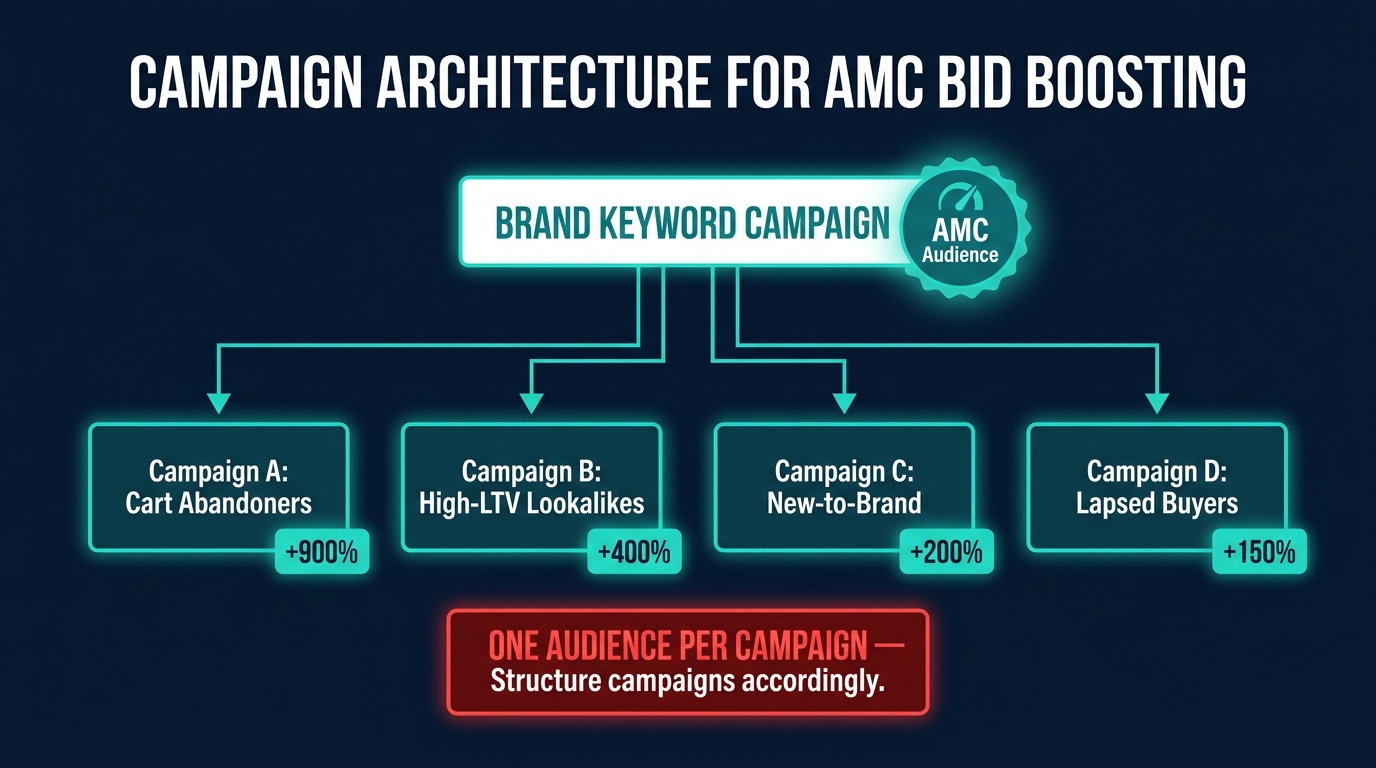
There is one structural constraint to AMC audience bid boosting in Sponsored Products that significantly affects how campaigns need to be built: each Sponsored Products campaign can carry only one AMC audience for bid boosting.
This sounds like a minor technical detail, but it has meaningful implications for campaign architecture that most introductory AMC content glosses over.
Why One Audience Per Campaign Forces Duplication
The one-audience limit means you cannot apply multiple audience bid boosts to the same campaign simultaneously. If you want to test bid boosting for cart abandoners and high-LTV lookalikes on the same set of keywords, you need two separate campaigns running the same keywords — one with each audience attached. If you want to cover four different audience segments, you need four campaign instances.
This creates a campaign multiplication challenge at scale. A brand running 20 keyword campaigns who wants to test three audience segments across each would need 60 campaign variants — plus the original 20 as control benchmarks. Managing 80 campaigns, keeping keyword lists synchronized, tracking budget allocation, and comparing performance across audience segments becomes genuinely complex without the right tooling.
For brands with campaign management resources or access to a third-party bid management platform that supports AMC audience bid boosting, this is manageable. For solo operators or small teams managing campaigns manually, it requires tighter prioritization — identifying the one or two highest-value audience segments and the campaigns most likely to benefit, rather than attempting to test every possible combination.
The Recommended Structural Approach
The most practical campaign architecture recommended by practitioners who have worked extensively with AMC bid boosting typically follows this pattern:
- Maintain a baseline “control” version of each keyword campaign without any AMC audience attached. This campaign runs with standard bidding and serves as your performance benchmark.
- Duplicate the campaign for each audience segment you want to test, attaching one AMC audience per duplicate. Use naming conventions that make audience membership clear (e.g., “Brand Keywords — Cart Abandoners — AMC”).
- Use low base bids on the audience-boosted campaigns combined with high multipliers, rather than high base bids with low multipliers. This concentrates bid strength on the audience matches while keeping costs controlled on non-audience impressions within the same campaign.
- Set budgets proportionally based on estimated audience size. Small audiences with aggressive multipliers can exhaust budgets quickly on a small number of high-value impressions; large lookalike audiences need more budget runway to run meaningful volume.
- Track at the campaign level over 4–8 weeks before drawing conclusions. Audience-level bid boosting can produce volatile early results due to audience size and match rate variability; longer evaluation windows produce more reliable signal.
Balancing Audience Coverage with Budget Efficiency
A common pitfall with AMC bid boosting is aggressively boosting bids on audiences that are too small to generate statistical significance at a reasonable spend level. If your cart-abandoner audience for a specific ASIN contains only 500 people, even with a 900% bid multiplier, you may only serve a handful of impressions per day before exhausting the available audience pool. The campaign looks expensive on a per-impression basis but produces no volume.
A useful threshold is to require at least 10,000–20,000 audience members before running aggressive bid multipliers in a dedicated Sponsored Products campaign. For smaller audiences — particularly for very precise behavioral segments in niche categories — consider pooling related behaviors into a single audience definition (e.g., combining cart abandoners and recent product page viewers) to reach a workable audience size while maintaining reasonable precision.
Real Performance Data: What ROAS and CVR Lifts Actually Look Like
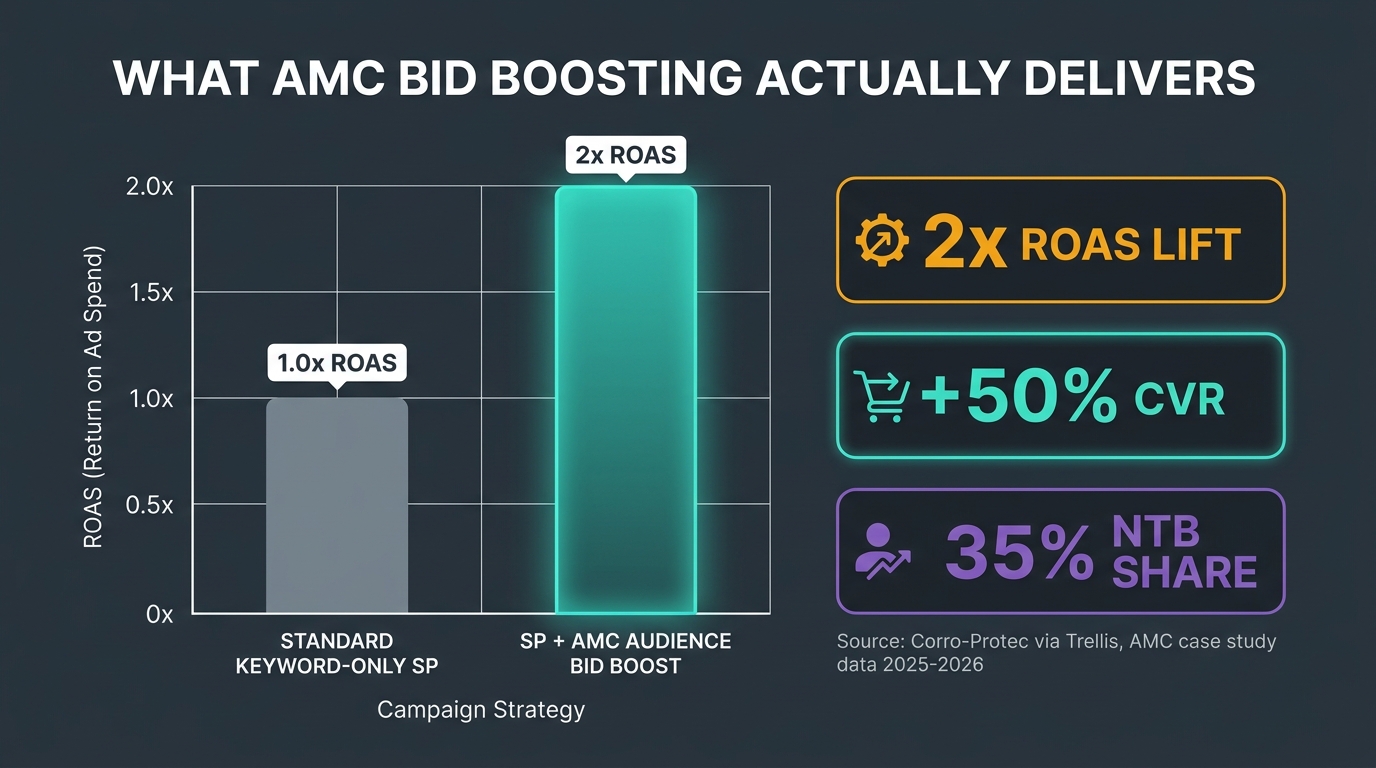
Claims about performance improvements should always be examined carefully. The case studies available on AMC audience performance come from a mix of Amazon’s own reported outcomes and third-party agency documentation, and they reflect best-case implementations — not average results across all advertisers. That said, the consistent direction of the evidence is clear, and the magnitude of reported lifts is significant enough to warrant serious attention.
Documented Case Studies
Corro-Protec (via Trellis): This water heater anode rod brand used custom AMC audiences combined with Sponsored Products bid multipliers targeting high-intent behavioral segments. Reported outcomes included a 2x ROAS lift, a 1.5x increase in engagement rate, and a 2.2x expansion in effective reach at equivalent spend levels compared to baseline campaigns. The audiences were built on product page view and cart behavior signals within 30-day lookback windows.
Global Snack Brand (via Mars United): This program used AMC five-year purchase data to define high-value seasonal and variety-shopper segments. While the primary activation was through Amazon DSP, the AMC audience insights informed Sponsored Products strategy and bid prioritization. The campaign achieved a +90% ROAS improvement versus prior DSP performance, with CPM decreasing by 26% simultaneously — suggesting that better audience targeting reduced wasted spend even as bid efficiency improved.
Ursa Major (via Tinuiti): This personal care brand used AMC audiences in Sponsored Products specifically to re-engage high-intent shoppers and grow new-to-brand (NTB) share. The campaign is cited as a benchmark example for combining retargeting audiences with prospecting lookalikes in a single coordinated Sponsored Products bid strategy.
The Broad Range of Reported Outcomes
Across the wider body of published case studies and agency reports, the typical performance ranges for AMC audience bid boosting on Sponsored Products show:
- ROAS lift: 1.5x–2x+ versus identical campaigns without AMC audience bid boosting
- Conversion rate improvement: 25–60% higher CVR for audience-matched impressions versus non-matched impressions within the same campaign
- New-to-brand share: Meaningful improvements (20–35%+) when lookalike audiences are applied to prospecting campaigns targeting category browsers and competitive shoppers
- Cost-per-acquisition improvement: 20–40% lower CPA on audience-boosted campaigns for retargeting segments like cart abandoners and lapsed buyers
It’s important to note that these outcomes require a well-constructed audience definition, appropriate bid multipliers, and campaigns of sufficient scale to generate meaningful data. Results degrade when audiences are poorly defined, when lookback windows are too long (diluting recency signal), or when bid multipliers are set too conservatively to differentiate meaningfully from base bids.
When AMC Audiences Don’t Move the Needle
Performance improvements are not guaranteed. Common scenarios where AMC audience bid boosting produces flat or marginal results include:
- Audiences that are too broad: Applying a 50% bid boost to a generic “all Amazon shoppers in the category” lookalike audience produces minimal differentiation because the audience doesn’t represent meaningfully higher intent than the keyword match alone.
- Audiences with stale signal: Using a 180-day lookback window for cart abandoners in a fast-moving commodity category means the audience includes people who bought a competitor’s product months ago and have no current purchase intent.
- Categories with inherently high intent signals: In categories where keyword intent is already a strong predictor of conversion (e.g., highly specific branded queries, replacement part searches), the incremental signal from behavioral audiences is smaller because the keyword itself already does the heavy filtering.
- Insufficient audience size: Audiences under a few thousand members don’t generate enough volume for the bid boost to materially affect campaign ROAS, and the small sample makes performance measurement unreliable.
Incrementality Testing: Separating True Lift from Attribution Noise
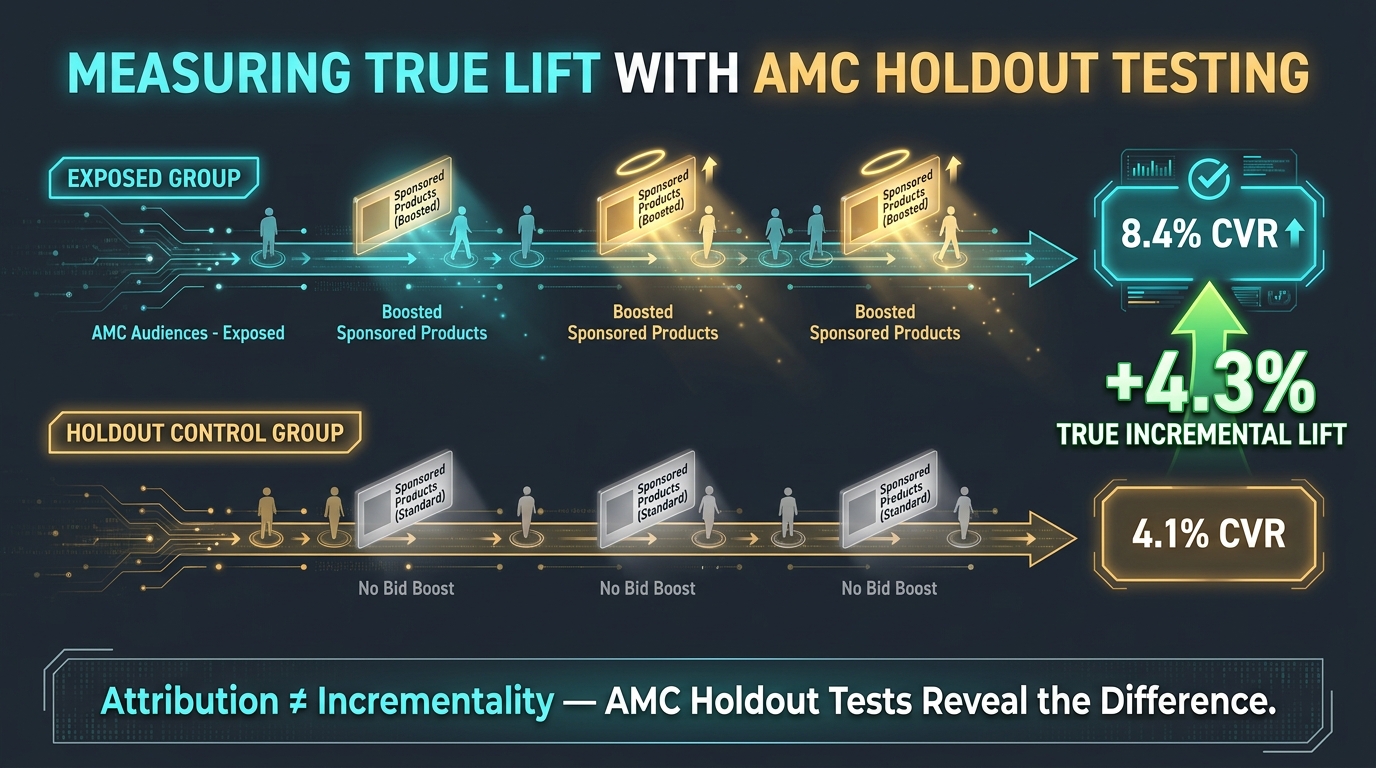
One of the more nuanced — and frequently underappreciated — aspects of AMC audiences in Sponsored Products is that the performance data your campaign reports shows you doesn’t tell the full story. Standard campaign reporting shows you attributed conversions: purchases that occurred after an ad interaction and fell within Amazon’s attribution window. That’s a different number from incremental conversions: purchases that would not have happened without the ad.
The Attribution Problem
When you apply a bid boost to cart abandoners and your campaign reports strong ROAS, the natural interpretation is that the bid boost is driving those conversions. But here’s the confound: cart abandoners are people who already demonstrated high purchase intent by placing a product in their cart. Some meaningful percentage of them would have returned to complete the purchase anyway — without seeing your boosted Sponsored Products ad. If you’re attributing all their conversions to your bid boost, you may be claiming credit for organic reconversions that had nothing to do with your ad being served.
This is attribution noise, and it’s not a small effect. For high-intent audiences like cart abandoners, the organic reconversion rate can be substantial. Inflated ROAS figures from attribution noise can lead advertisers to over-invest in audience bid boosting — setting aggressive multipliers and high budgets on campaigns that appear to be performing brilliantly but are actually producing modest incremental value.
How AMC Holdout Testing Works
AMC provides the tools to distinguish attributed conversions from truly incremental ones through holdout testing. The methodology is an exposed-versus-control experiment:
- Define your target audience segment (e.g., cart abandoners in the last 14 days).
- Randomly split the audience into two groups: an exposed group (who will receive your bid-boosted ads) and a holdout control group (who will be excluded from or deprioritized in your bid-boosted campaigns).
- Run both groups through a defined test period — typically 4–8 weeks for sufficient statistical power.
- At the end of the period, compare conversion rates between the exposed and control groups.
- The difference in conversion rates is your true incremental lift. The conversion rate of the control group represents what would have happened without the bid boost.
AMC’s SQL environment supports this analysis natively. You can query the event tables to build exposed and control cohorts, filter by the test period, and calculate conversion rate differentials. The output tells you the real incremental value of your audience bid-boosting strategy — not the attributed ROAS your campaign dashboard reports.
What Incrementality Testing Actually Changes About Strategy
Brands that run rigorous incrementality testing often find that the true incremental lift from AMC bid boosting is real, but lower than attributed ROAS would suggest. This recalibration is actually useful — it enables more precise bid multiplier decisions. If holdout testing reveals that your cart abandoner audience converts at 15% organically and 22% with bid boosting, the incremental lift is the 7-percentage-point difference. You can use that number to calculate how much the incremental conversion is worth and set a bid multiplier that reflects actual incremental value rather than full attributed credit.
Incrementality testing also helps identify which audience segments deliver the most genuine lift. Counterintuitively, audiences with lower baseline intent (e.g., category browsers who haven’t added to cart) sometimes show higher incremental lift from bid boosting than extremely high-intent segments like recent cart abandoners — because the high-intent shoppers were going to convert anyway, while the moderate-intent shoppers genuinely needed the nudge of seeing your ad prominently placed to make a decision.
Where AMC Audiences Fall Short: Limitations Every Advertiser Needs to Know
Any honest treatment of AMC audiences in Sponsored Products has to cover the constraints and limitations. The feature is genuinely valuable — but it is not the unlimited behavioral targeting toolkit that some enthusiastic coverage implies. There are meaningful capability gaps that affect how much you can do and how precisely you can do it.
No True Audience Exclusions in Sponsored Products
One of the most significant limitations is the absence of true audience exclusion controls in Sponsored Products. In Amazon DSP and in Sponsored Display (which supports AMC audiences more fully), you can genuinely exclude audiences — preventing your ads from being served to recent purchasers, for example, or suppressing your retargeting entirely for specific segments. Sponsored Products doesn’t support this natively when using AMC audiences.
The workaround — applying a very low or zero bid multiplier to an audience you want to deprioritize — is imperfect. Setting a near-zero bid multiplier for recent purchasers on a replenishment product will reduce your odds of winning impressions for that segment, but it won’t eliminate them. If your base keyword bid is competitive, you may still serve ads to people who just bought last week, paying for impressions that have low conversion probability and wasting budget that could go toward higher-value audiences.
One Audience Per Campaign
As covered in the campaign architecture section, the one-audience-per-campaign constraint is a real structural limitation. It forces campaign multiplication that increases management complexity and can fragment budget across too many campaign instances. Advertisers who want to apply nuanced multi-segment bid logic — boosting by different amounts for three or four different audience types simultaneously — need to either run multiple campaign duplicates or accept simpler, cruder segmentation.
Amazon has been incrementally improving the feature set, and there’s reason to expect this constraint may be relaxed in future product iterations. But as of 2026, it remains a concrete limitation that architecture decisions need to account for.
Sponsored Products Cannot Directly Target AMC Audiences
It’s worth being explicit about this because it’s where the most confusion arises: Sponsored Products with AMC audiences is not audience targeting. You cannot create a Sponsored Products campaign that only serves to your AMC audience and ignores everyone else. The format doesn’t support that mode. Every Sponsored Products impression is still won through keyword or ASIN matching — the AMC audience only modifies bid level for matched audience members. Shoppers outside your AMC audience who search the same keyword can still see your ad if you win the auction at the base bid.
True audience-first targeting — where audience membership is the primary eligibility criterion rather than keyword matching — is available in Sponsored Display and Amazon DSP. For advertisers who want to reach their AMC audiences regardless of whether those shoppers are actively searching a matched keyword, those formats are the right tool. Sponsored Products with AMC audiences is an enhancement to keyword-based buying, not a replacement for it.
Audience Freshness and Data Latency
AMC audiences aren’t updated in real time. There is a data latency in AMC’s underlying event tables — typically 24–48 hours — which means a shopper who added a product to cart this morning may not appear in your cart-abandoner AMC audience until tomorrow or the day after. For very fast-moving, short-window retargeting use cases, this latency can erode the effectiveness of your audience definition. A 7-day lookback window for cart abandoners, combined with a 24-hour data lag, means you’re working with a somewhat stale picture of recent intent signals.
Practitioners managing this constraint typically extend lookback windows slightly to account for latency, or focus AMC audiences on longer-window behavioral segments (30-day, 60-day, 90-day) where a 24-hour data lag is a smaller proportion of the total window and doesn’t materially degrade signal quality.
The Full-Funnel Connection: Aligning AMC Audiences Across SP, SB, SD, and DSP
Sponsored Products is one part of a larger Amazon advertising ecosystem, and AMC audiences are designed to work across the full stack. Understanding how the same audience segments behave differently across ad formats helps build a more coherent cross-format strategy — and helps identify where Sponsored Products audience bid boosting fits in the funnel versus where other formats should carry the load.
Sponsored Brands with AMC Audiences
Sponsored Brands supports AMC audience bid boosting using the same mechanics as Sponsored Products — one audience per campaign, bid multipliers on keyword matches, no direct audience targeting. The strategic applications are similar: boost bids for high-intent audiences on branded keyword campaigns, apply lookalike audiences to broad keyword campaigns to improve prospecting efficiency, use lifecycle segments to differentiate bid levels by customer journey stage.
The key difference is placement. Sponsored Brands occupy prominent positions — including the header of search results — and typically command higher base bids and CPCs. Applying AMC audience bid boosting to Sponsored Brands can produce significant impression visibility for high-value audience members, but the higher base CPC means bid multiplication can escalate costs quickly. Multiplier discipline is especially important in Sponsored Brands contexts.
Sponsored Display as the True Audience Targeting Layer
Sponsored Display is where AMC audiences work most differently — and most powerfully in the pure audience-targeting sense. Unlike Sponsored Products and Sponsored Brands, Sponsored Display can directly target AMC audiences as the primary targeting criterion. A Sponsored Display campaign can be configured to show exclusively to your cart-abandoner audience, your high-LTV lookalike audience, or any other AMC segment — regardless of whether those shoppers are actively searching your keywords.
This makes Sponsored Display the right format for upper-funnel retargeting, awareness nurturing of high-LTV segments, and re-engagement of lapsed buyers outside of their active search sessions. The combination that many sophisticated advertisers use is: Sponsored Display to reach AMC audiences passively (browsing Amazon, watching Prime Video), and Sponsored Products with bid boosting to capture those same audience members at the moment they actively search. The two formats reinforce each other — Sponsored Display keeps your brand salient between purchase consideration sessions, Sponsored Products converts when search intent is expressed.
Amazon DSP as the Orchestration Layer
Amazon DSP sits above the sponsored ads stack and enables the most granular audience activation. DSP supports full audience exclusions, advanced frequency capping, off-Amazon reach, and multi-format campaign sequencing. For brands with DSP access, the best practice is to use AMC as the single source of truth for audience definition — building segments once in AMC and then activating them appropriately across DSP for upper-funnel and non-search contexts, Sponsored Display for retargeting, and Sponsored Products/Brands for search intent capture.
This integration across formats — with AMC audiences as the connective tissue — is what distinguishes a full-funnel Amazon advertising strategy from a collection of disconnected channel-specific campaigns. The audiences don’t have to be rebuilt for each format; they’re defined once in AMC and deployed wherever the format supports them.
A Practical Build-and-Activate Framework for AMC Audiences in Sponsored Products
Theory and mechanics are useful, but the most valuable thing most advertisers need is a concrete sequence for actually building and activating this capability. The following framework is designed to take you from starting point to running AMC-audience-boosted Sponsored Products campaigns in a structured, testable way.
Step 1: Register Your AMC Instance and Populate Baseline Data
If you don’t have an AMC instance, start by registering at the Amazon Ads console. Link your advertising entity and accept data usage terms. Allow 24–48 hours for your historical Sponsored Ads data to populate in AMC’s event tables. Once data is flowing, verify it by running a simple query to confirm event volume in your instance before building audiences.
Step 2: Define Your Audience Prioritization
Don’t start by building ten audiences simultaneously. Start with the two or three segments most likely to drive meaningful performance improvement based on your product category and customer economics. A practical starting prioritization:
- Priority 1: Cart abandoners (7–30 day lookback, product-specific or category-level)
- Priority 2: High-LTV purchaser lookalikes (based on top 10–20% purchasers by order value)
- Priority 3: Lapsed buyers (90–180 day since last purchase, replenishment-appropriate products)
Build each audience in AMC, verify minimum size thresholds (aim for 10,000+ members per audience before running), and push to your advertising entity.
Step 3: Build Your Campaign Architecture
For each existing Sponsored Products campaign you want to test, create duplicates — one per AMC audience you’re testing — while maintaining the original as a control. Use clear naming conventions. Set low base bids on the audience-boosted campaigns to concentrate competitive spend on audience matches rather than diluting it across all impressions. Set initial multipliers conservatively (100–200%) and plan to adjust after two weeks of data.
Step 4: Establish an Incrementality Holdout
Before running, split each AMC audience: keep 15–20% in a holdout control (you can simply exclude a random subset from your audience definition using AMC SQL, or reduce bids to near-zero for a sampled portion). This control group will give you the baseline conversion rate needed to calculate true incremental lift after the test period.
Step 5: Run, Measure, and Adjust
Run campaigns for at least 4 weeks before drawing conclusions. At the end of the period, compare:
- Attributed ROAS: audience-boosted campaigns versus control campaigns
- CVR differential: audience-matched impressions versus non-matched within boosted campaigns
- Incremental conversion rate: exposed group versus holdout control
Use these three numbers together to determine the true value of each audience segment. Increase multipliers on segments showing strong incremental lift. Reduce or deprioritize audiences showing minimal incremental difference from the control baseline. Rebuild and expand winning audience definitions over 90-day cycles as behavioral data accumulates and segments grow.
Step 6: Expand Across Formats and Seasonality Windows
Once you’ve validated which AMC audience segments produce genuine incremental lift in Sponsored Products, extend the same audiences to Sponsored Display for retargeting and consider DSP integration if available. Rebuild audiences before peak shopping periods (Prime Day, Q4, category-specific seasonality) using fresh lookback windows that capture the most recent behavioral signals — pre-peak browsing and consideration activity is often the richest audience signal available.
The Bigger Picture: What AMC Audiences Mean for Amazon Advertising Strategy
The introduction of AMC audiences into Sponsored Products represents a genuine architectural shift in how Amazon advertising works — one that has implications beyond individual campaign optimization.
For most of Amazon advertising’s history, the information asymmetry between buyer and seller was stark. You knew what keyword a shopper typed; Amazon knew everything about who that shopper was. Your bidding was necessarily one-dimensional because you had one dimension of signal: search intent. AMC audiences begin to close that gap. They allow you to bring behavioral intelligence — behavioral history, lifecycle position, predicted value — into the bidding decision, shifting Sponsored Products from a pure intent-matching system toward something closer to a behavioral advertising system with an intent overlay.
This shift has competitive implications. Brands that build quality AMC audiences and deploy them with precision will consistently outbid less-informed competitors for the specific shopper segments that matter most to them — not by spending more in aggregate, but by concentrating spend more accurately. The advertiser who knows that a specific shopper is a high-LTV cart abandoner can rationally bid $8 for an impression that an uninformed competitor would only bid $2 for, and win it efficiently.
The counterpart risk is sophistication inflation: as more advertisers adopt AMC audience bid boosting, the auction dynamics for high-value audience segments will become more competitive. Cart-abandoner segments, high-LTV lookalikes, and brand searchers will attract aggressive bid boosts from multiple sophisticated advertisers simultaneously, driving up effective CPCs for those audience matches. The brands who remain ahead are the ones who build the most precise and well-maintained audience definitions — ones that reflect genuine behavioral insight about their specific customers rather than generic high-intent segments everyone else is also targeting.
Conclusion: Actionable Takeaways for Getting Started
AMC audiences in Sponsored Products are not a magic budget lever. They are a precision instrument that rewards careful audience construction, structured campaign architecture, and disciplined measurement. When applied correctly, the evidence consistently shows meaningful improvement in ROAS, conversion rates, and new-to-brand acquisition. When applied carelessly — broad audiences, extreme multipliers, no incrementality testing — they add complexity without proportional return.
Here are the most important takeaways from everything covered above:
- Understand the mechanics first. AMC audiences are bid multipliers, not targeting lists. Every impression still requires keyword or ASIN matching. The audience layer enhances bid competitiveness for specific shoppers — it doesn’t create a separate audience-targeting mode in Sponsored Products.
- DSP is no longer a prerequisite. Any Amazon Ads advertiser can access AMC and build audiences for Sponsored Products bid boosting. If you haven’t registered your AMC instance, the access barrier no longer exists.
- Start with three audiences, not ten. Cart abandoners, high-LTV lookalikes, and lapsed buyers are typically the highest-ROI starting segments. Build and validate these before expanding.
- Respect the one-audience-per-campaign constraint. Plan your campaign architecture accordingly — duplicates are necessary, but manageable with clear naming conventions and budget discipline.
- Build incrementality holdouts from day one. Don’t rely on attributed ROAS to evaluate AMC audience performance. Run holdout tests to separate true incremental lift from conversions that would have happened anyway.
- Treat AMC as cross-format infrastructure. The same audiences you build for Sponsored Products bid boosting can power Sponsored Display targeting and DSP activation. Build once, deploy across the stack.
- Plan for competitive escalation. As AMC audience bid boosting becomes more widely adopted, high-value audience segments will attract more competitive bids. Invest in audience quality — precision behavioral definitions based on your actual customer data — not just audience quantity.
The brands winning on Amazon in 2026 are not winning purely on keyword research and bid automation anymore. They’re winning because they know more about who they’re bidding for. AMC audiences are the mechanism that makes that knowledge actionable at auction time — and Sponsored Products is the format where that advantage plays out at the highest volume and frequency on the platform.