


Most TikTok Shop Live advice starts and ends with the same prescription: go live more often. Stream daily. Add hours. Get more hosts. The assumption is that volume, by itself, is the lever — that if you can just push more content into the algorithm, the GMV will follow.
It won’t. Not reliably, and not at scale.
The brands and operators generating serious, repeatable revenue from TikTok Shop Live in 2026 are not doing so because they stream more hours. They’re doing it because they have built something most casual sellers have never thought to construct: an operating infrastructure. Systems that run before the camera turns on, during the broadcast, and after it ends. Processes that get better with every session because they are designed to learn. Teams structured around performance metrics, not headcount.
This is the gap that separates operators who plateau at a few thousand dollars per stream from those who compound session over session into consistent five- and six-figure live GMV. And it is almost entirely an operational gap — not a talent gap, not a product gap, and not an algorithm problem.
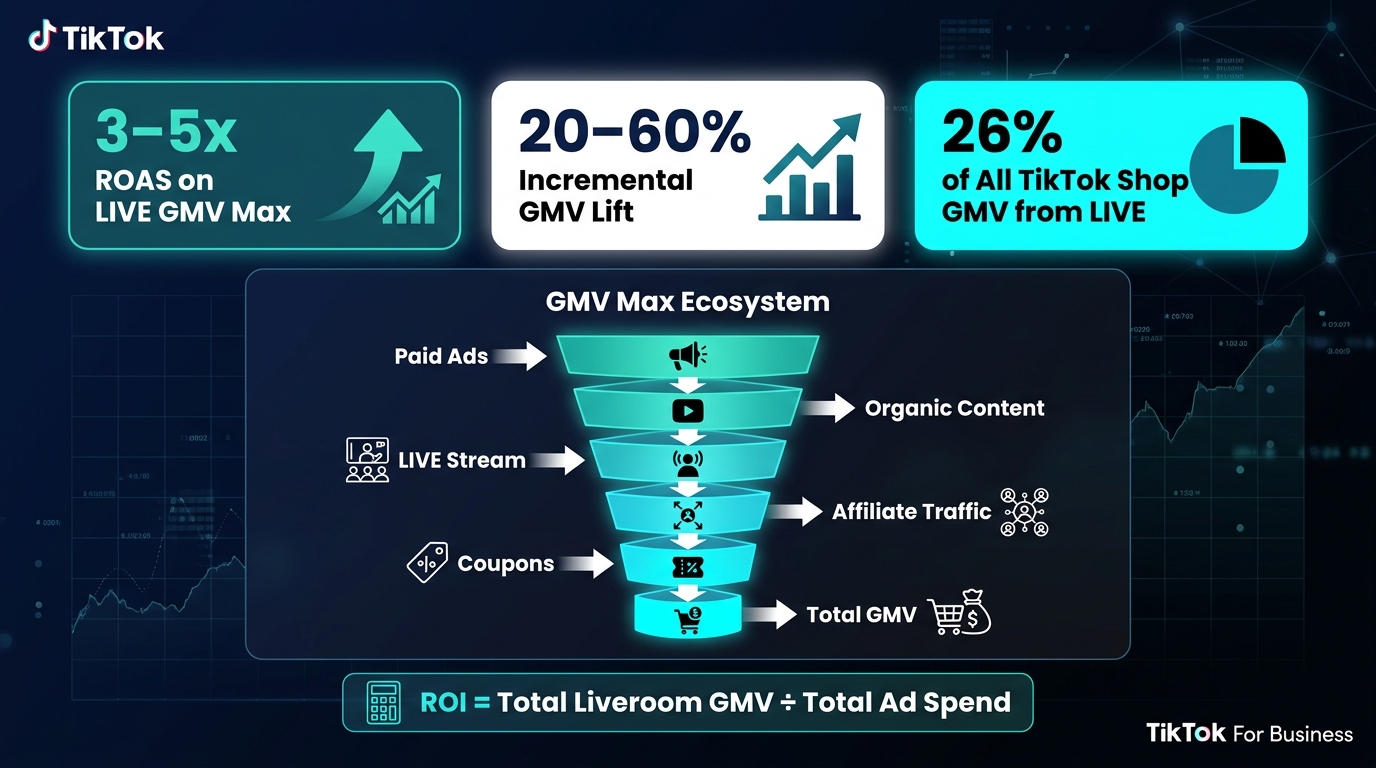
TikTok Shop Live now accounts for roughly 26% of total TikTok Shop GMV globally in 2026, up from 14% in 2024. Global TikTok Shop GMV is projected to hit $112 billion in 2026, with the US market alone forecast at $23.4 billion. Live commerce is a channel that has clearly arrived. The question is no longer whether to participate — it’s whether your operation can handle what scaling it actually requires.
This post is built for sellers and operators who are past the beginner stage. If you’ve run a handful of lives and know the basics, this is the next layer: the infrastructure, cadences, team structures, analytics loops, and daily systems that turn TikTok Shop Live into a repeatable revenue machine.
Why “Stream More” Is the Wrong First Instinct
The instinct to add volume before fixing the unit economics is one of the most common — and most damaging — mistakes in live commerce. Increasing stream frequency without a profitable per-session model doesn’t scale revenue. It scales losses.
The platform itself reinforces this trap. TikTok’s algorithm rewards consistency and frequency, which creates pressure to prioritize showing up over showing up profitably. Many sellers interpret this as a signal to stack hours without interrogating whether those hours are actually working.
The Scaling Trap in Plain Numbers
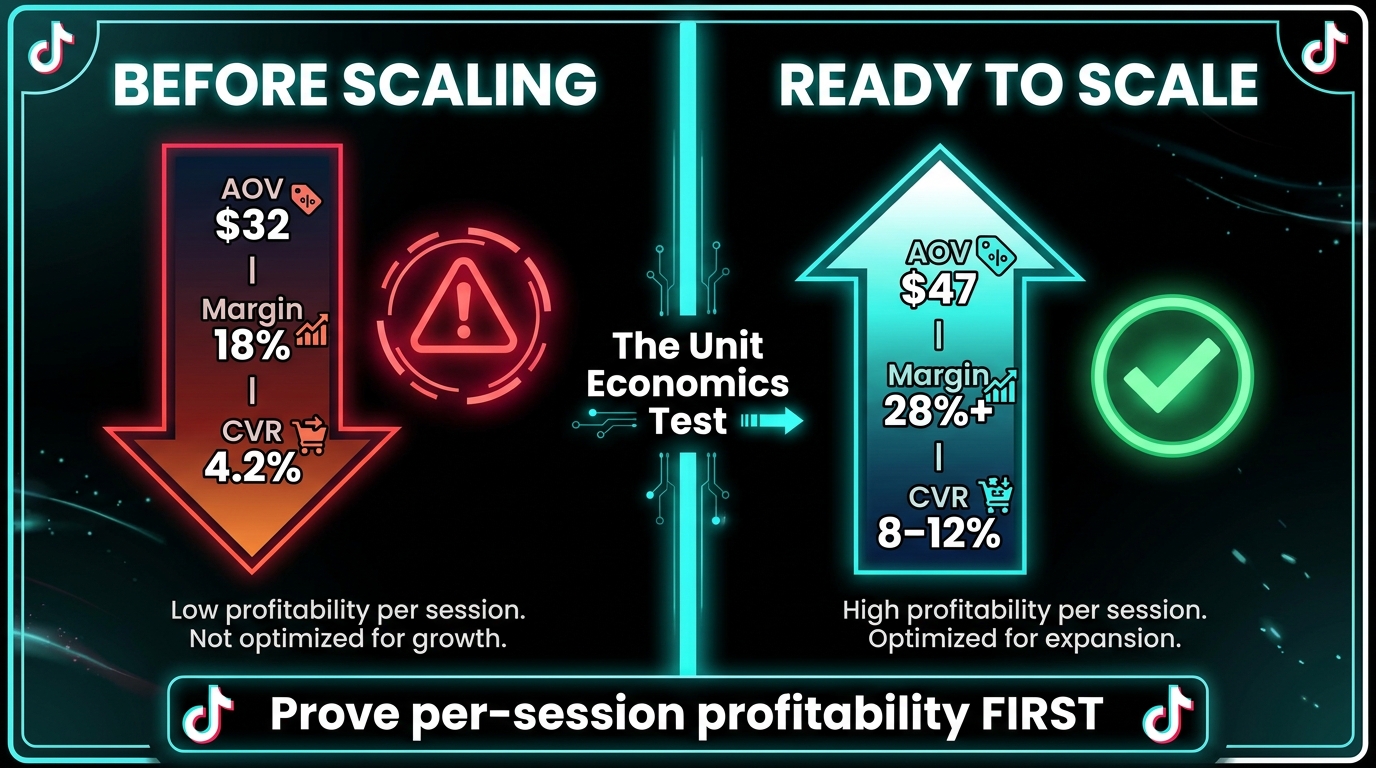
Consider a session that generates $800 in GMV, with a product margin of 18%, a per-session ad spend of $200 (modest for any kind of paid amplification), fulfillment costs, returns averaging 12%, and platform fees. When you run the actual math, that session may be marginally profitable or actively losing money. Streaming five days a week doesn’t fix that — it multiplies it.
The operators who scale sustainably are those who treat each live session as a unit economics experiment first. They are interrogating conversion rate, average order value, return rate, and margin per session before adding frequency, ad spend, or new hosts to the mix. Once the per-session model is profitable and predictable, then frequency becomes a genuine multiplier.
What “Proven” Actually Means Before You Scale
There’s no universal threshold, but practitioners who operate at scale describe a working benchmark for “ready to scale”: a live conversion rate (CVR) consistently in the 7–10% range, an average order value above $40, a session-level margin of at least 25% after fees and returns, and repeatable performance across at least three consecutive sessions on the same product lineup. If you can hit those numbers with a single host and modest ad support, the operating model is proven. Only then does scaling the inputs — more hosts, more hours, more ad spend — predictably compound the output.
The Architecture of a Live Show That Converts
Before building the operational scaffolding around a live, it helps to be precise about what a high-converting live stream actually looks like structurally. The format is not arbitrary — TikTok’s own internal data, surfaced through Seller Center education, points to consistent patterns among top-performing live rooms.
The Opening Hook Window (First 60–90 Seconds)
The first 60 to 90 seconds of a live determine whether the algorithm distributes the session to a wider audience or keeps it contained. This window is where most amateur hosts waste the most opportunity — spending it on greetings, technical checks, and warm-up small talk that neither the algorithm nor the viewer rewards.
High-performing hosts open with a product-specific hook: a bold claim, a visible demo, or an immediate offer tied to urgency. “We have 47 units of this at the lowest price we’ll ever offer — let me show you why this is the one thing worth watching today.” The hook is scripted, not improvised. It is rehearsed. And it is timed.
Operators who train hosts systematically track average watch time in the first 90 seconds as a leading indicator of session performance. Sessions where average watch time in that window exceeds 45 seconds show significantly higher overall conversion rates than sessions where viewers drop off in the first 30.
The Run-of-Show: Product Sequencing Logic
The order in which products are featured during a live is not just a presentation preference — it directly affects GMV. The dominant sequencing logic used by experienced operators follows what’s sometimes called the anchor-demo-close-social proof structure.
- Anchor product first: Lead with your hero SKU — the product with the highest conversion rate, the strongest social proof, and the most compelling demo potential. This builds audience trust and sets a quality standard.
- Middle block — exploration: Introduce secondary and complementary products. Use chat engagement (questions, polls, reactions) to read live audience interest and adjust emphasis in real time.
- Close with urgency: Return to the hero SKU or introduce a live-exclusive offer with hard scarcity. “We have 12 units left at this price, and when they’re gone, they’re gone.” This creates a closing spike that experienced operators can see in real-time GMV dashboards.
- Social proof cycling: Throughout the session, the host and moderators weave in customer reviews, repeat purchase callouts, and live chat confirmations from buyers. This is not unscripted — it is orchestrated.
Session Length and Pacing
Data from TikTok Shop performance reports consistently shows that sessions between 45 minutes and 90 minutes outperform both shorter and longer formats in conversion efficiency. Under 30 minutes rarely gives the algorithm enough signal to push traffic meaningfully. Over two hours, audience attention degrades and per-viewer GMV typically declines even as total viewer count climbs.
The 60-minute sweet spot is where most sophisticated operators anchor their standard session length, with occasional extended sessions (90–120 minutes) reserved for product launches or major promotional periods like sales events.
Building the Live Pod: Team Structure for Operators Who Are Serious
Scaled TikTok Shop Live operations are not solo shows. They are team sports. The “pod” model — a cross-functional unit built around a single recurring live channel — is the dominant structure among top operators in 2026.
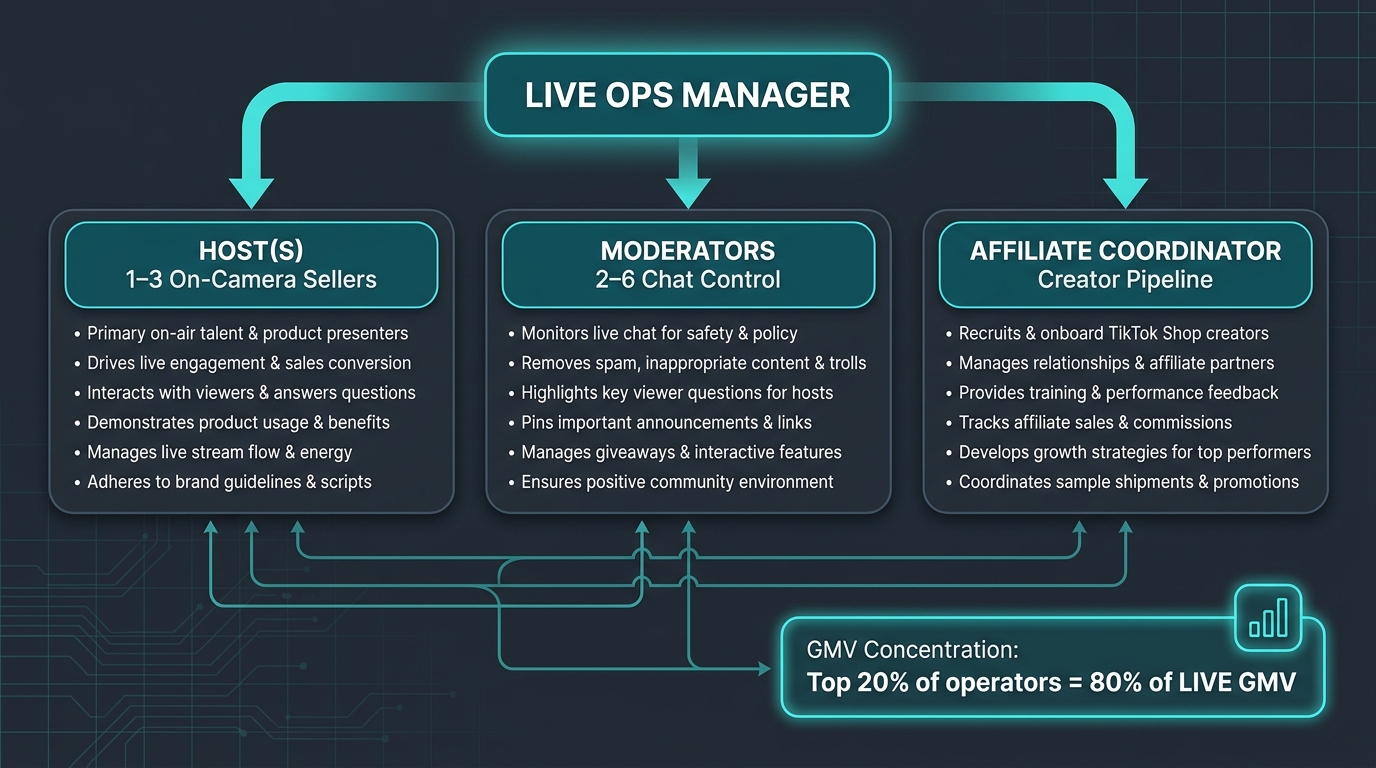
The Live Operations Manager
This is the most underbuilt role in most TikTok Shop Live operations. The Live Ops Manager does not appear on camera. They own everything that happens before, during, and after the stream that isn’t directly hosting. Their responsibilities span:
- Setting the session plan: product lineup, pricing strategy, promotional timing
- Managing real-time GMV and conversion dashboards during the stream and feeding performance signals to the host
- Coordinating inventory readiness with fulfillment teams before each session
- Owning post-stream analytics review and feeding learnings into the next session’s plan
- Serving as the point of escalation for technical issues, policy flags, or moderation problems during a live
In smaller operations, the brand owner or a senior team member fills this role. In scaled operations, it is a dedicated position — sometimes two, for teams running multiple live channels simultaneously.
Hosts: The On-Camera Layer
Well-run operations treat hosts as skilled performers who operate within a defined system, not as freelancers expected to wing it. Host training at scale typically involves:
- Script frameworks for each product category (not word-for-word scripts, but structured talk tracks with key points, objection responses, and urgency phrases)
- Recorded session reviews — watching back their own lives with the Ops Manager to identify pacing issues, missed CTAs, and flat demo moments
- Defined performance metrics: conversion rate per product feature, average comment response time, audience retention curves
Mature operations maintain a host bench — typically two to three hosts per channel — to ensure continuity across scheduling, avoid single-host dependency, and enable A/B testing of host styles against the same product lineup.
Moderators: The Chat Infrastructure Layer
Moderation is the most systematically underestimated role in live commerce. A skilled moderation team does far more than filter spam. They are running a parallel conversion operation in the chat:
- Pinning product links at precisely the right moment in the host’s pitch to maximize click-through
- Amplifying social proof by surfacing positive comments and purchase confirmations during closing sequences
- Answering product questions faster than the host can, keeping the purchase decision process unblocked
- Managing compliance — flagging restricted language, claims that may violate TikTok’s commerce policies, or content that could trigger a room review
The ratio of moderators to concurrent live viewers varies by category and audience size, but a working benchmark for active sessions is one moderator per 200–400 concurrent viewers for effective chat management.
The Affiliate Coordinator
In scaled operations, affiliate activity is not managed ad hoc. A dedicated coordinator manages the creator pipeline — briefing affiliates ahead of live sessions, coordinating promotional timing so affiliate-driven traffic arrives during peak conversion windows, and tracking affiliate-specific GMV attribution. This role is what turns affiliate selling from a passive income stream into an actively managed traffic channel that amplifies live performance.
The Daily Pre-Live System: What Happens Before the Camera Turns On
The quality of a live session is largely determined before it starts. The pre-live system is the operational backbone that separates consistent performers from operators who have good days and bad days for no obvious reason.
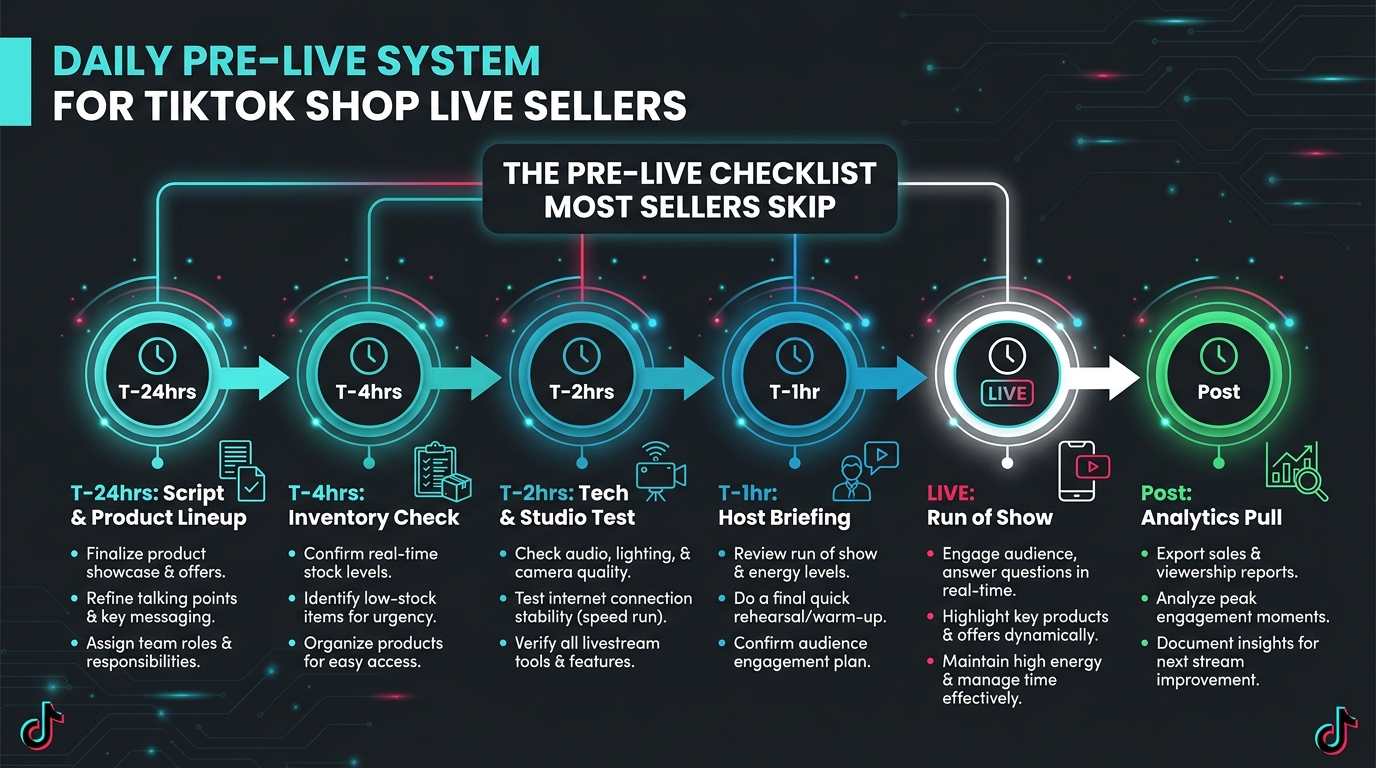
T-24 Hours: Plan and Script
The product lineup for tomorrow’s session is locked today. This means the Ops Manager has reviewed the previous session’s product-level performance data — which SKUs converted above the session average, which underperformed, which generated chat engagement — and used that data to build tomorrow’s run-of-show.
The script framework for each featured product is distributed to the host. This is not optional for scaled operations. TikTok’s own platform education now includes AI-assisted script generation tools within the Live Shopping Bag feature, and third-party platforms offer more sophisticated script frameworks. Either way, a product’s talk track should exist before the session, not be improvised during it.
T-4 Hours: Inventory Confirmation
One of the most avoidable operational failures in live commerce is promoting a product during a session that is out of stock or low on inventory. This creates one of the worst customer experiences possible — viewer places an order during a live, excitement is high, and then they receive a cancellation or delay notification hours later. Return rates spike. Seller score takes a hit. Algorithm trust degrades.
Four hours before every session, the Ops Manager receives a confirmed inventory count for every product on the lineup. Any product below a minimum threshold (typically enough to cover projected session demand with a 30–50% buffer) is either dropped from the lineup, flagged for quantity limiting, or replaced. This is a non-negotiable checkpoint.
T-2 Hours: Technical and Studio Check
Every element of the technical setup is verified two hours before the stream: internet connection stability (livestream operations should be running on wired connection or a dedicated high-speed WiFi band, not shared office Wi-Fi), camera quality, lighting rig, microphone, and studio product staging. TikTok’s LIVE Manager desktop tool is confirmed active and responsive.
Product placement in the studio is deliberate. The products scheduled for feature are staged in the order they will be presented, with clear sight lines for demonstration. This sounds obvious. It is remarkably often skipped.
T-1 Hour: Host Briefing and Mental Preparation
The host reviews the run-of-show, the product talk tracks, and any real-time data from affiliate or organic traffic that might signal audience composition for the session. If there’s a promotion running — a coupon, a live-exclusive discount, a flash offer — the host knows the exact timing for when to introduce it, the exact language to use (within policy), and the exact scarcity framing.
Top-performing hosts also run a brief vocal warmup and energy preparation protocol — often dismissed as unnecessary, but consistently cited by experienced hosts as a meaningful factor in first-five-minutes performance, which, as noted above, is when the algorithm is making its distribution decision.
LIVE GMV Max: When and How to Use Paid Amplification
TikTok’s LIVE GMV Max is the platform’s automated ad format specifically designed to drive traffic to active live streams and optimize for total liveroom GMV. Its ROI calculation is straightforward: total liveroom GMV divided by total ad spend. What makes it powerful — and what makes it dangerous if misapplied — is its automation.
The Sequencing Problem Most Operators Get Wrong
LIVE GMV Max is designed to amplify a converting live session, not to create conversion where none exists. Operators who turn on paid amplification before proving their organic session economics typically find that ad spend inflates traffic while CVR drops — because the new traffic being pulled in by the ads is lower-quality, less purchase-intent audience than the organic TikTok community that already knows the seller.
The correct sequencing is:
- Prove organic session CVR in the 7–10% range consistently
- Introduce LIVE GMV Max at conservative daily budgets ($50–$100/session) to test incremental GMV lift
- Calculate LIVE ROI (liveroom GMV / ad spend) and set a minimum acceptable threshold (typically 3x or higher)
- Scale ad budget incrementally — no more than 20–30% per session — while monitoring ROI floor
- Layer in broader GMV Max (which integrates paid ads, organic content, affiliates, and coupons into a single optimization signal) only when LIVE GMV Max is performing predictably
What the Numbers Look Like When It Works
When LIVE GMV Max is applied to an already-converting live session, benchmarks from practitioners and agency data show 3–5x ROAS as the working expectation for well-run operations, with 20–60% incremental GMV lifts over the session’s organic baseline. The wide range reflects the significant variation in product category, price point, host quality, and session timing.
TikTok’s broader GMV Max ecosystem — which TikTok describes as combining paid ads, organic content, LIVE, affiliates, coupons, and commissions into a unified optimization signal — is where the most sophisticated operators are heading in 2026. Rather than managing each traffic channel as a separate budget line, GMV Max treats the entire funnel as a single system optimizing toward total GMV. The implication for operators is that organic content quality, affiliate activity, and LIVE performance all feed into the same optimization signal, making the quality of each input a lever that affects the efficiency of every other.
ROI Protection: TikTok’s 2026 Update
TikTok expanded ROI protection coverage for GMV Max campaigns in February 2026 and issued further LIVE GMV Max updates in March 2026. The ROI protection feature allows operators to set a minimum LIVE ROI floor — if the campaign cannot deliver that floor, TikTok’s system reduces or pauses delivery rather than spending against unprofitable traffic. For operators with established margin targets, this is a meaningful safeguard against the spend efficiency risk of automated campaigns.
The Post-Live Analytics Loop: What to Track and Why
The post-session analytics review is where most TikTok Shop Live operators leave the most money on the table. The data exists. TikTok surfaces it through the LIVE Diagnosis page within Seller Center (accessible via Analytics → LIVE & Video Analytics → LIVE → LIVE Diagnosis, searchable by LIVE room ID). Most operators glance at it. Few use it systematically.
The Metrics That Actually Predict Next-Session Performance
The metrics worth tracking are not just the headline numbers. GMV per session is an output. The inputs that predict it are more granular:
- Unique viewer count vs. concurrent peak: The ratio between these two numbers tells you whether the algorithm pushed the stream to a broad but shallow audience, or a narrower but more sustained one. High unique viewers with low peak concurrent often signals poor session structure — people arrived and left quickly rather than staying to convert.
- Average watch duration: The single strongest leading indicator of session conversion quality. Top-performing sessions typically see average watch times in the 3–7 minute range. Under 90 seconds signals a structural problem with the hook or pacing.
- Product-level click-through rate (CTR) and conversion rate (CVR): Not all products perform equally in a live context. Post-session product-level data tells you which SKUs convert live viewers efficiently and which ones don’t — regardless of how well they perform on your shop page. Build your lineup around the live-specific CVR data, not your general catalog performance.
- Cart-to-checkout rate: Viewers clicking “add to cart” is not the same as completing a purchase. A high cart rate with a low checkout rate points to friction in the purchase flow — price objections, shipping cost surprise, or a checkout UX problem — rather than a content or host problem.
- Comment engagement patterns: Timestamps of peak chat activity mapped against the session timeline reveal which product segments, host moments, or offer announcements drove the most audience response. These timestamps are the building blocks of the next session’s run-of-show optimization.
The Post-Session Review Cadence
Structured post-session review takes approximately 30–45 minutes and follows a consistent format: the Ops Manager pulls session data, maps it against the run-of-show timeline, identifies the three highest-performing and three lowest-performing product segments, and documents one change to implement in the next session. This is not a debrief discussion — it is a documented log entry that feeds into the next pre-live planning cycle.
Over time, this creates a compound learning effect. Operators who run this cycle consistently for 30 sessions have a rich body of product-level, host-level, and format-level performance data that their competitors — who are still guessing — simply cannot replicate.
The Content Repurposing Engine: One Live, Many Assets
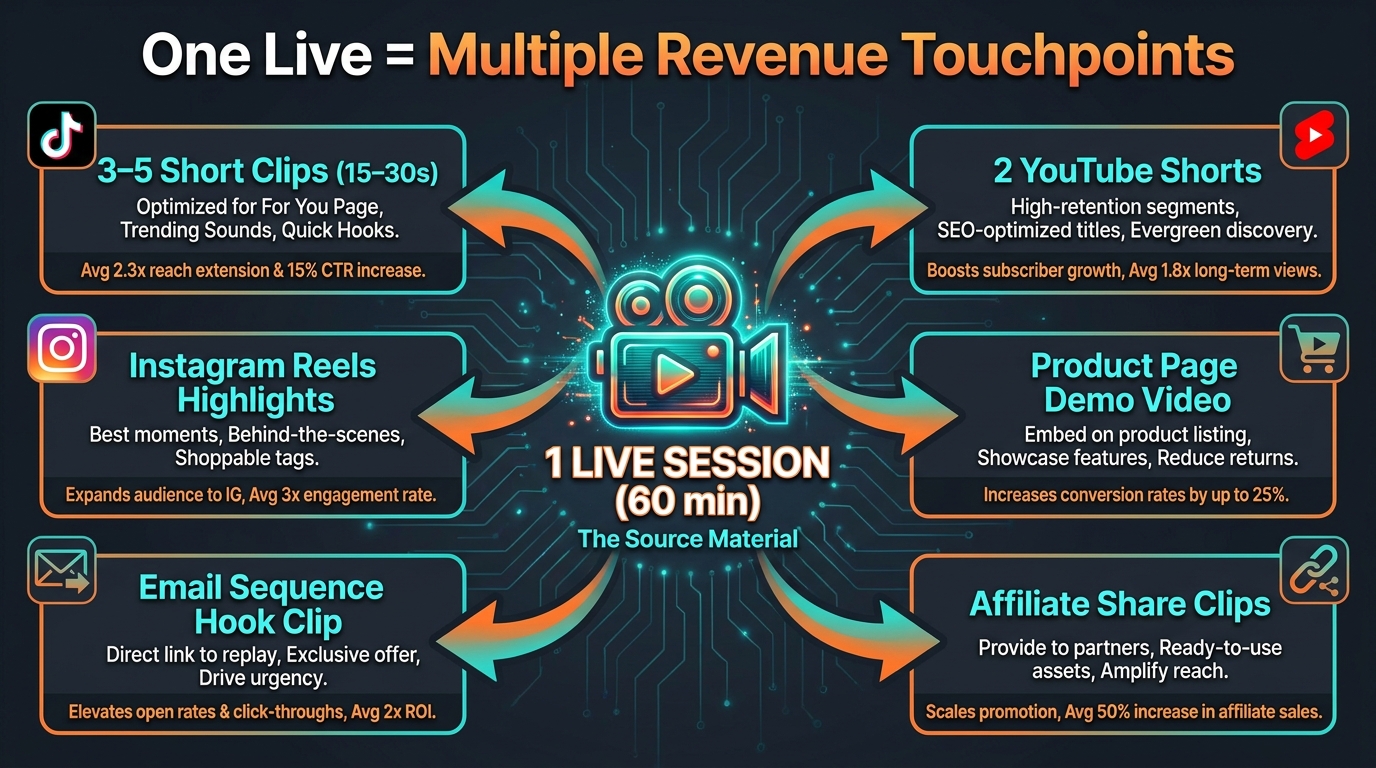
A 60-minute live session is not just a live session. For operators who have built a repurposing workflow, it is a content factory that generates assets used across multiple channels for days or weeks after the stream ends.
The Clip Identification System
Not every moment from a live is worth repurposing. The clips that perform in short-form formats share specific characteristics: they feature a compelling demo, a dramatic result reveal, a strong social proof moment, or a host delivering a hook that doesn’t require context from the rest of the session to land.
The repurposing workflow begins during the live itself. A designated team member (often a moderator or a secondary operator) timestamps notable moments in real time — a particularly strong product demo, a guest review, a viral comment, a conversion spike. These timestamps become the clip extraction guide after the stream.
What Gets Made From Each Session
A structured repurposing workflow targeting 3–5 short clips per live session generates:
- TikTok short-form posts (15–45 seconds): The top two to three clips from the live, edited with captions and posted as regular TikTok content. These often carry shoppable links and can generate organic sales traffic days after the original live. Many operators find that well-edited live clips outperform purpose-made short-form content in both reach and conversion.
- Affiliate share assets: Clips pre-formatted and shared with affiliate creators for their own channels, often with product links embedded. This extends the product’s reach to audiences the brand doesn’t own and generates commission-based sales without additional ad spend.
- Product page video: The best product demonstration from the live replaces or supplements static product images on the TikTok Shop listing. Live-sourced demo videos tend to be more authentic and contextual than staged studio content and often improve listing conversion rates.
- Email or CRM content: A short clip embedded in an email to existing customers or subscribers, framed as “what you missed in our live” — driving repeat consideration without requiring the recipient to have been present for the original broadcast.
The Platform Distribution Map
Repurposed live content can extend beyond TikTok. YouTube Shorts carries live-sourced clips well, particularly for brands building a cross-platform audience. Instagram Reels is viable for beauty, fashion, and lifestyle categories. The principle is that the production cost of the live content has already been incurred — repurposing adds marginal distribution at very low incremental cost.
The key operational discipline here is speed. Clips repurposed and posted within 24 hours of the original live capture residual audience interest while the stream is still in recent memory. Clips posted three days later face a colder audience and typically perform significantly worse.
Inventory and Fulfillment: The Silent Constraint on Live Scaling
Inventory management is where growth-stage TikTok Shop Live operations most commonly hit a ceiling that has nothing to do with content, audience, or ads. A live session that drives 300 orders in 60 minutes is a tremendous success — until the warehouse can’t ship 300 units in the required fulfillment window, and the seller score drops, and the algorithm responds by reducing the next session’s organic reach.
Designing Inventory Around Live Demand Patterns
Live commerce has a fundamentally different demand shape than search-based e-commerce. Search-driven demand is spread across days or weeks, allowing for gradual inventory drawdown. Live-driven demand is spike-shaped: a large percentage of potential orders for a featured product arrive within a 5–15 minute window during the live session, when the host is actively presenting it.
Inventory planning for live must account for this spike structure. Operators who use 7-day or 30-day average sales velocity to forecast live inventory will systematically under-stock or over-stock because neither captures the concentrated demand pattern of a successful live session.
A more reliable approach: use the best comparable previous session’s peak order volume per product as the baseline, apply a 30–50% upside buffer, and set a hard cap at that level for live promotion. If demand exceeds the cap, the moderator pins a “limited to [X] units” message and the host treats the sellout as a scarcity signal — which it is — rather than a fulfillment failure.
Fulfillment SLA Integration
TikTok Shop’s 2026 fulfillment requirements have tightened. Late shipment rates, cancellation rates, and order defect rates are all factored into a seller’s shop score, which directly affects live distribution and search visibility. For live operations specifically, this means the post-session logistics handoff — the moment orders from the live are confirmed and picked — must happen quickly enough to protect shipment SLAs even when live sessions run in the evening or on weekends.
Scaled operators integrate their TikTok Shop order feed directly with their warehouse management system so that live orders hit the fulfillment queue in real time during the session, not in a manual batch export hours later. This integration is often the difference between protecting seller score at scale and seeing it erode as session frequency increases.
Affiliate and Creator Coordination at Scale: Active Management, Not Passive Program
The affiliate model on TikTok Shop is widely understood as a revenue lever. What is less understood is that affiliate performance at scale — particularly in the context of a live selling program — is an actively managed operation, not a passive commission program you set up once and watch compound.
Coordinating Affiliate Traffic Around Live Sessions
One of the highest-leverage tactics in scaled TikTok Shop Live operations is coordinating affiliate content publishing so that affiliate-driven traffic arrives during or immediately before a live session. An affiliate who posts a product video on the morning of a live, with a link that drives to the live room, contributes warm, product-primed traffic at exactly the moment the host can convert it.
This coordination requires a system:
- Affiliates receive a briefing schedule: which sessions are happening, what products are being featured, and what timing windows TikTok Shop Live sessions are running
- Affiliates are given approved messaging frameworks that align with the live show’s product positioning — not for compliance gatekeeping, but to ensure the audience arriving from affiliate content has been primed with consistent information
- Post-session performance data is shared with affiliates whose traffic contributed to sessions, creating a feedback loop that helps them optimize their own content
Commission Structure as a Traffic Signal
TikTok Shop affiliate commission rates — following the structure updates that have played out in 2026 — now play a more direct role in which products affiliates choose to promote. Operators who treat commission rate as a static cost line rather than a dynamic traffic lever miss a significant optimization opportunity.
For a live session featuring a high-margin hero product, temporarily increasing the affiliate commission rate for a defined pre-live window can meaningfully increase the volume of affiliate content published in the days before the session, driving more warm traffic into the live room. When the incremental GMV from that affiliate-primed traffic is modeled against the commission increase, the math is typically favorable for margin-strong products.
The Metrics That Separate Operators Who Scale From Those Who Plateau
The final — and perhaps most important — distinction between live commerce operations that compound over time and those that flatline is not a single tactical advantage. It is a measurement philosophy and review discipline that systematically closes the gap between what a session produces and what it could produce.
The Session Score Framework
Scaled operators don’t evaluate live sessions as pass/fail based on GMV alone. They use a session score — a composite metric that weights multiple performance dimensions to give a single, comparable indicator of session health:
- Conversion rate (CVR): weighted most heavily — the efficiency of the live room
- Viewer retention: average watch duration as a proxy for content and host quality
- GMV per viewer: the revenue efficiency of the audience attracted
- Fulfillment health: post-session cancellation rate, return rate, and shipping SLA adherence
- Margin per session: gross GMV minus costs, tracked at the session level, not the monthly roll-up
Tracking all five dimensions weekly across every session builds a performance curve that makes improvement — and regression — immediately visible. A session that generates higher GMV but lower CVR and higher returns is not a success. A session with lower GMV but higher CVR, better retention, and strong margins is the kind of session worth replicating.
The Weekly Ops Review
The weekly cadence that distinguishes compounding operations from plateauing ones is a structured ops review: the Ops Manager presents the session scorecard for every live run that week, the team identifies the single clearest learning from the data, and that learning is immediately codified into next week’s pre-live system. No learning is left as a conversation. Every identified improvement becomes a documented process change.
Over 12 weeks, this cadence produces a significant and widening performance gap. An operation that makes one targeted, data-driven improvement per week to its live system will have compounded 12 specific improvements into its format, host training, product lineup logic, and operational timing. A competitor running more sessions with no systematic review cycle will have improved primarily through the vague mechanism of “more experience” — which is far less reliable.
What the Data Concentration Reality Tells Us
One of the sharpest realities in TikTok Shop Live in 2026 is the GMV concentration pattern: the top 20% of live operators generate a disproportionate share of total live GMV. This is not a random outcome. It reflects the compounding advantage that systematic, data-driven operations build over time, and it has meaningful implications for operators who are still treating live selling as an ad hoc activity.
The barriers to entry in TikTok Shop Live are still relatively low. The barriers to scale are operational, not platform-based. The sellers who are building robust pre-live systems, tight team pods, post-session analytics loops, and repurposing workflows today are creating structural advantages that become increasingly difficult for late-adopters to close.
Conclusion: Infrastructure First, Volume Second
The clearest way to summarize what separates TikTok Shop Live operations that scale from those that stall is this: the ones that scale are built before they grow. The operational infrastructure — team structure, daily pre-live systems, post-session analytics loops, inventory integration, affiliate coordination, content repurposing workflows — is not a luxury to add once you’re successful. It is the mechanism through which success becomes reproducible.
Going live more often is not a strategy. It is a bet that volume will outrun the cost of inefficiency. For operators with a broken session model, that bet almost always loses. For operators who have proven per-session profitability with a disciplined pre-live system, adding frequency is exactly the right move — because each additional session is now running on a foundation that has been built to work.
The Takeaways Worth Acting On
- Prove the unit economics before scaling frequency. A session CVR consistently in the 7–10% range, AOV above $40, and 25%+ session-level margin after fees is the threshold to clear before adding more hours or ad spend.
- Build the pod before you build the schedule. A Live Ops Manager, a trained host bench, a capable moderation team, and an affiliate coordinator are the four roles that make a scaled operation possible. Skipping any one of them creates a bottleneck that volume will eventually expose.
- Treat the pre-live system as non-negotiable. T-24hr plan, T-4hr inventory confirmation, T-2hr tech check, T-1hr host briefing. These checkpoints exist to eliminate the avoidable failures that erode session performance and seller score.
- Use LIVE GMV Max in sequence, not in desperation. Paid amplification on an unconverting session throws money at the wrong problem. On a proven session, it compounds returns.
- Treat every session as a data asset. The post-stream analytics loop — tracked systematically, documented, and fed back into the next session’s plan — is how the performance gap widens between operators who review and those who don’t.
- Repurpose with urgency. Live clips posted within 24 hours of the session, distributed across TikTok, affiliates, product pages, and email, extend the ROI of production cost that has already been incurred.
TikTok Shop Live 2.0 is not a new feature set. It is a new standard of operational discipline. The sellers who meet that standard in 2026 will find themselves running live channels that compound. The ones who don’t will find that more hours live is simply more exposure to a model that doesn’t work.
The infrastructure comes first. The scale follows.