

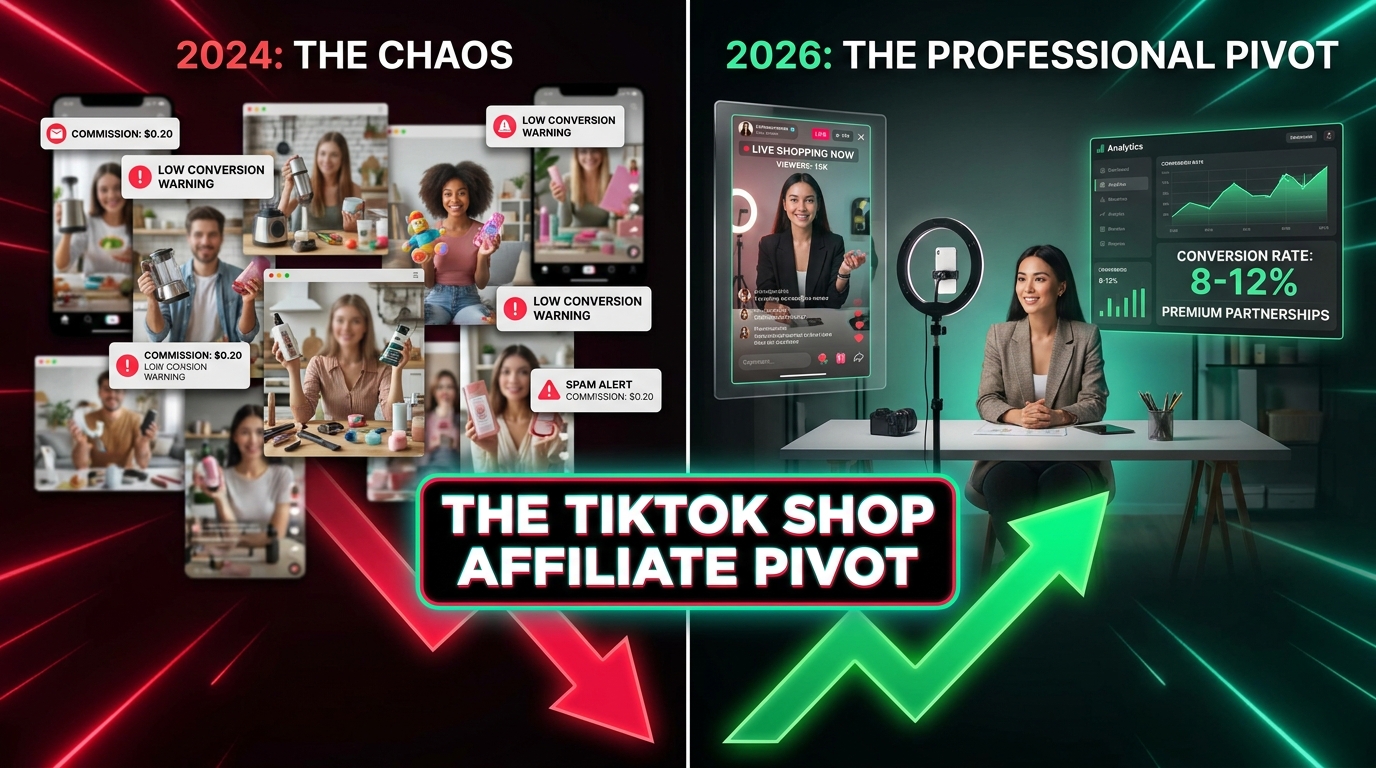

For a window of about 18 months, TikTok Shop affiliate felt like the closest thing to free money the creator economy had ever produced. Post a video, drop a product link, watch commissions roll in while the algorithm did the distribution work for you. Thousands of creators built real income — quickly — on the back of that formula.
That window has not closed. But it has gotten significantly narrower, and the floor has dropped out for anyone who never evolved past “post and pray.”
U.S. TikTok Shop GMV is projected to hit $23.4 billion in 2026, nearly doubling year-over-year. Globally, the platform is tracking toward $80 billion or more. By every macro measure, TikTok Shop is growing faster than almost any e-commerce channel on earth. And yet, across the affiliate tier, the dominant experience is not euphoria — it’s compression. Earnings are concentrating. Margins are tightening. Commission structures that launched products overnight in 2024 now struggle to move the needle against a backdrop of oversupply and smarter brand economics.
The creators, brands, and operators who are still winning have something in common: they stopped treating TikTok Shop affiliate as a passive income strategy and started treating it like a business with defined inputs, measurable outputs, and actual infrastructure. Some have pivoted entirely — launching their own products, running affiliate agency models, or engineering hybrid commission-plus-paid-media funnels that the original model was never designed to support.
This post is about those pivots. What’s actually changing in the economics, what the strategic responses look like in practice, and where the realistic upside is for operators who are willing to rebuild around what the platform actually rewards in 2026.
The Uncomfortable Math: Why the Average Affiliate Is Earning Less Even as the Platform Grows
The paradox of TikTok Shop in 2026 is that aggregate numbers have never looked better, yet individual creator earnings are under more pressure than at any point in the platform’s short history. Understanding why requires looking at how the affiliate ecosystem has changed structurally — not just in scale, but in composition.
The Winner-Take-Most Concentration Problem
TikTok Shop’s affiliate market has shifted from a broadly distributed income opportunity to a sharply tiered one. A small cohort of creators — those with tight audience-product fit, high content velocity, and consistent conversion performance — are capturing a disproportionately large share of GMV. The rest face increasingly marginal returns as more creators flood the same product categories with undifferentiated content.
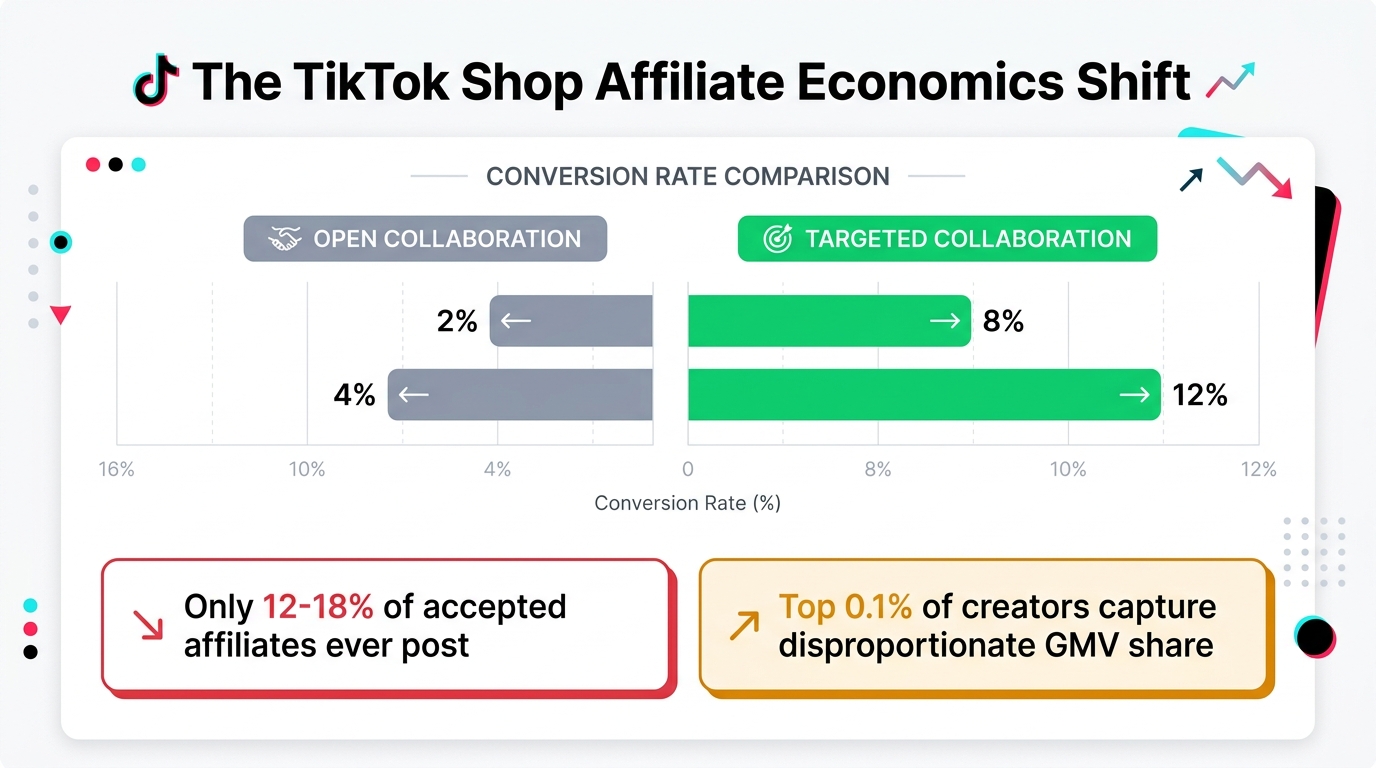
The numbers that reveal this most starkly are not the headline GMV figures. They’re the activation rates. Among affiliates who accept open collaboration requests from brands, only 12 to 18 percent ever actually post. That means for every 100 creators a brand recruits through its open program, somewhere between 82 and 88 never produce a single piece of content. The brands are paying product samples and operational overhead for essentially no return. The creators are leaving commissions on the table. The system is inefficient by design.
Commission Compression Is Structural, Not Cyclical
Brands that were paying 20 to 30 percent commissions in 2024 to acquire new affiliates and seed their programs are now recalibrating. Early-stage programs needed to overpay to build velocity. Now that the TikTok Shop ecosystem has matured, brands have performance data. They know which creator tiers convert, which categories carry margin, and exactly what commission rate is economically defensible on a per-unit basis.
The result is that commission rates for open collaboration programs have in many categories declined to the 10 to 15 percent range, with higher rates reserved exclusively for targeted collaboration deals with proven performers. This is not brands being punitive. It’s brands running affiliate as a proper performance channel with P&L discipline rather than as a marketing experiment.
For creators who built income expectations around early-adopter commission rates in high-margin categories, the math has shifted meaningfully. And the response — whether conscious or intuitive — has been a set of operational pivots that distinguish the durable players from the ones quietly churning out.
Clawbacks, Policy Complexity, and Hidden Costs
One element of the commission compression story that rarely gets covered is the operational friction layered on top of headline rates. Clawback provisions — where commissions are reversed on returns, disputed orders, or policy violations — have become more common and more rigorously enforced as TikTok Shop professionalized its brand partnerships. Creators working at high volume in certain categories (particularly supplements and electronics) have reported effective commission rates materially lower than their stated rates once returns are factored in.
Add to this the increasing complexity of TikTok Shop’s compliance requirements — specific disclosure language, content restrictions, prohibited claim categories — and the operational burden of running a high-volume affiliate business has increased substantially. Creators who treated it as passive income are finding it increasingly requires active management to stay viable.
Open Collaboration vs. Targeted Collaboration: The Performance Gap That’s Reshaping How Brands Build Programs
TikTok Shop simplified its collaboration architecture in recent months, consolidating around two primary modes: Open Collaboration (public, self-serve, available to any creator who meets threshold requirements) and Targeted Collaboration (private, invite-only, brands hand-pick specific creators for specific terms). Understanding the performance differential between these two modes is arguably the most important structural insight in the 2026 affiliate landscape.
Why Open Collaboration Underdelivers on Conversion
Open Collaboration is built for reach and velocity. Brands can make their affiliate programs publicly accessible, set a commission rate, and let any qualifying creator apply to promote their products. It’s efficient for building creator headcount and generating content volume. But that same openness creates a fundamental audience-product fit problem.
When anyone can promote anything, a meaningful portion of affiliate content lands in front of audiences with no genuine interest in the product category. A fitness creator promoting a home organization gadget because the commission rate looked attractive. A cooking channel posting skincare because the brand approved their application. The content may be technically competent, but without genuine audience alignment, it converts poorly.
The data reflects this. Open Collaboration content on TikTok Shop typically converts at 2 to 4 percent. That’s not terrible in absolute terms — many affiliate channels would take 3 percent. But it leaves significant performance on the table when you understand what targeted programs produce.
Targeted Collaboration Economics: The 8–12% Window
Targeted Collaboration flips the model. Brands identify specific creators whose audiences demonstrably overlap with the product’s ideal customer profile, negotiate specific terms (often including sample products, higher commission rates, and content guidance), and build a smaller but far more productive creator cohort.
The conversion rates tell the story: well-executed Targeted Collaboration programs consistently see 8 to 12 percent conversion on creator content. That’s roughly two to four times the open collaboration benchmark. At scale, this difference is the gap between a mediocre affiliate program and a growth engine.
For creators, the implication is equally significant. Being in a brand’s Targeted Collaboration program usually means higher commission rates (brands are willing to pay more for creators they’ve vetted), better product support, and often access to Spark Ads amplification — meaning the brand will pay to boost the creator’s content as a paid ad. For a creator who has invested in building a tight, clearly defined audience, this is the economics they want to be in.
The Practical Shift for Creators Seeking Better Deals
Getting into targeted programs is not passive. Brands are increasingly systematic about how they identify and evaluate creators for these deals. Conversion rate history within TikTok Shop, audience demographic clarity, content quality, and category relevance are all factors. Creators who have been vague about their niche — posting across beauty, food, lifestyle, and fitness depending on what product offers came in — tend to struggle here because they don’t offer a clean audience signal.
The pivot many successful affiliates have made is deliberate positioning: choosing a defined content angle, building a demonstrable track record within a specific category, and actively reaching out to brand partnership teams rather than waiting for open program invitations. Treating affiliate work as a business development function rather than a passive application process.
The Creator-to-Seller Pipeline: Using Affiliate Data as a Product Validation Engine
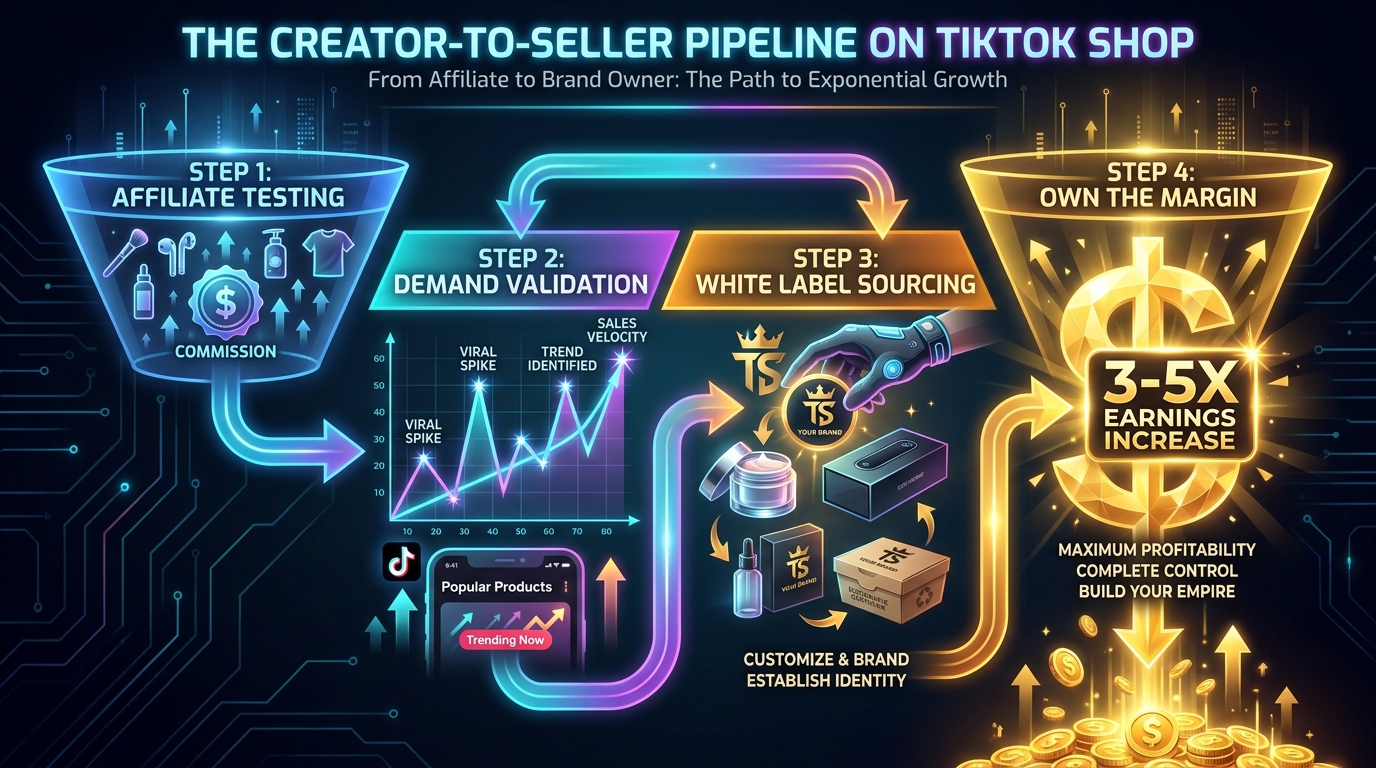
The most structurally significant pivot happening in the TikTok Shop affiliate ecosystem is not a tweak to commission rates or content strategy. It’s a category change: affiliates becoming sellers. And unlike most “just launch your own product” advice that circulates in creator economy circles, this particular version of the transition has a data-driven logic that makes it genuinely compelling.
Why Affiliate History Is Actually a Demand Map
An affiliate creator who has spent 12 to 18 months consistently selling products in a category — say, functional supplements or home organization solutions — has accumulated something most product entrepreneurs never have access to at the start: real conversion data across multiple SKUs, at scale, with a defined audience.
They know which types of products their audience actually buys (not just clicks or adds to cart). They know which price points clear without friction. They know which product claims resonate in video format and which ones require too much explanation to convert efficiently. They know the return objections that show up in their comment sections. This is market research that e-commerce brands pay significant money to acquire, and the affiliate already has it embedded in their performance history.
The creator-to-seller transition, when done methodically, treats this data as a product brief. If a creator has consistently driven strong sales on private-label collagen supplements for three different brands, they have enough signal to evaluate launching a formulation under their own brand. The demand is proven. The channel (their TikTok audience) already converts in that category. The question becomes execution: sourcing, compliance, fulfillment, and brand building.
The White-Label Entry Point
TikTok Shop has made this transition structurally easier than most platforms. Creators can operate both Creator accounts (for affiliate activity) and Seller accounts (for their own SKUs) within the ecosystem. The onboarding for Seller Center, while not trivial, is accessible to creators who are already operating at a professional level on the platform.
White-label sourcing — taking an existing manufacturer’s product formulation and branding it under your own label — has become the fastest and least capital-intensive entry point. In categories like supplements, beauty, and practical home goods, suppliers with established white-label programs can take a creator from product interest to listed inventory in weeks rather than months. The minimum order quantities have come down substantially as suppliers have recognized creator-led brands as a reliable growth segment.
The economics change dramatically at this level. A creator earning 15 to 20 percent commission on someone else’s product is earning the same unit economics as any other affiliate in that program. A creator selling their own product at a 60 to 70 percent gross margin, through their own TikTok audience, has a fundamentally different business. They also have strategic control: over pricing, over quality, over brand positioning, and over where the business goes next.
What the Transition Actually Requires
The path is real, but it’s not frictionless. Creators who have jumped to the seller model too quickly — without sufficient demand validation, with undercapitalized inventory, or without operational infrastructure for fulfillment — have encountered the full complexity of running an e-commerce business on top of a content creation business. Both suffer when neither gets adequate attention.
The operators who have navigated this successfully tend to run a staged model: continued high-volume affiliate activity funds the early product development phase, the creator’s audience validates the product through pre-launch signaling (comments, polls, DM interest), and the first product launch happens with enough inventory to sustain a meaningful launch push. The affiliate business doesn’t disappear — it often continues as a parallel revenue stream while the owned product line scales.
Live Shopping: The Conversion Upgrade Layer That Most Affiliates Are Still Leaving on the Table
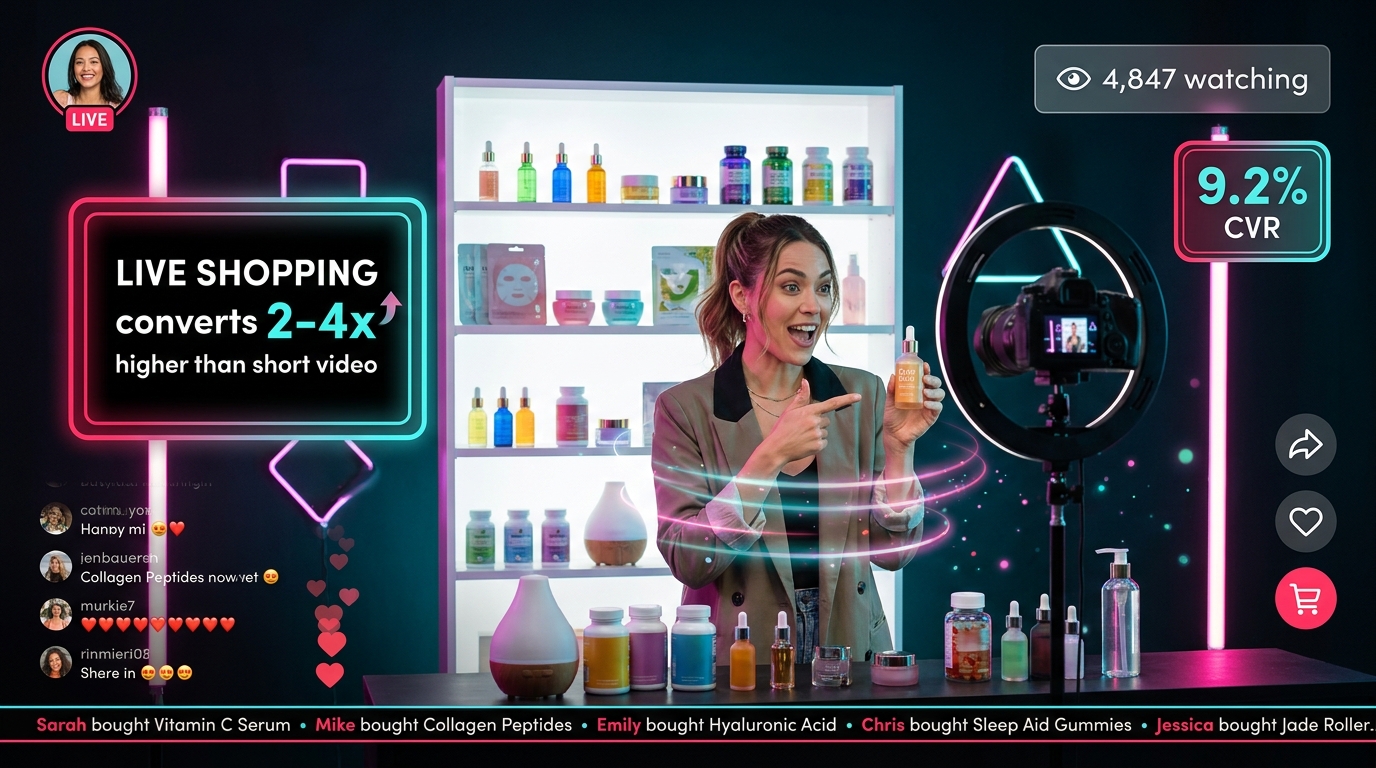
Short-form video built TikTok Shop affiliate. But the data increasingly suggests that short video alone is the lower-efficiency version of a strategy that live shopping can supercharge. The conversion differential is not marginal — it’s structural, and it reflects something important about how purchase intent works differently in real-time versus asynchronous contexts.
Why Live Shopping Converts Differently
Short-form affiliate videos are interruption commerce. A viewer is scrolling their For You page, encounters a product video, and decides in seconds whether the product warrants attention. The content does the heavy lifting of generating interest and intent, but then the viewer has to take a deliberate action — tapping through to the product page, processing pricing and details, and completing a checkout flow — entirely under their own motivation.
Live shopping collapses this. A viewer who joins a live stream is already in a higher-intent posture. They’re spending extended time with a creator they have affinity with, watching real-time product demonstrations, hearing answers to questions that mirror their own. The social proof of watching other purchases happen in real time — the ticker of “[username] just bought [product]” scrolling across the screen — creates a purchase environment that short video can’t replicate.
The conversion data reflects this meaningfully. Where standard affiliate video content averages in the 3 to 6 percent conversion range, live shopping consistently delivers 5 to 12 percent conversion, with well-executed sessions at the higher end of that range. The average order value also tends to be higher in live contexts because creators have time to explain the full value proposition, stack offers (bundle deals, limited-time discounts), and create urgency that a 30-second video cannot sustain.
The Operational Reality of Going Live
The reason most affiliates are still not leveraging live shopping is not ignorance of the data. It’s the operational delta between posting a short video and running a live session. Short video production, while requiring genuine skill to convert well, is asynchronous. A creator can batch-film content, post on a schedule, and manage the rest of their business in parallel.
Live shopping demands real-time presence, preparation, and endurance. A productive live session typically runs 60 to 90 minutes or more. The creator needs products physically on hand, scripted talking points and transitions, a working understanding of the TikTok Shop live interface, and the ability to handle real-time viewer questions while maintaining sales momentum. This is a meaningfully different skill set from short-form content creation.
The strategic operators have solved this by treating live shopping as a scheduled, event-based layer rather than a replacement for short video. Short video runs as the always-on content engine, warming audiences and generating consistent lower-CPE traffic. Live events are scheduled around product launches, seasonal moments, or promotional windows, functioning as high-conversion episodes within a broader content calendar. The two formats reinforce each other: short video drives viewers to upcoming live events, and live sessions generate content clips that perform well as post-event short videos.
Affiliate Live: The Brand Partnership Opportunity
For affiliates specifically, live shopping opens a category of brand partnership that doesn’t exist in the short-video-only model: sponsored live events. Brands will pay meaningfully for a creator to host a live session dedicated to (or heavily featuring) their products, because the conversion efficiency justifies the premium cost. This is structurally closer to a traditional retail event or home shopping network segment than a standard affiliate post — and it commands pricing to match.
Affiliates who have built live shopping infrastructure are finding that a single well-executed product-focused live session can match or exceed the commission earnings from weeks of short-form content. The ceiling is higher, and the commercial relationship with brands becomes more collaborative and more durable when live formats are involved.
Spark Ads: Converting Affiliate Content Into a Paid Performance Channel
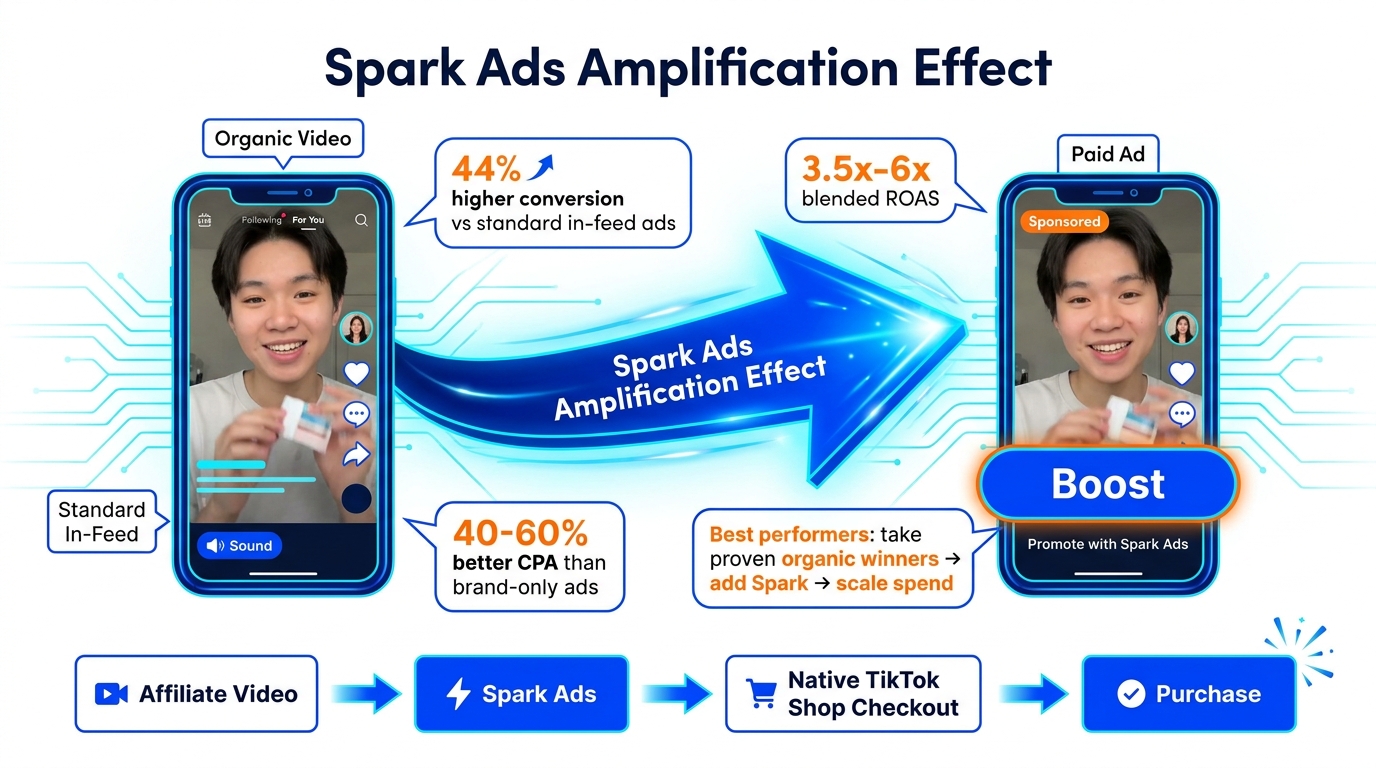
One of the more elegant commercial structures that has emerged from TikTok Shop’s maturation is the Spark Ads amplification model: brands identify top-performing affiliate content, get creator authorization, and run that content as a paid advertisement — with TikTok Shop’s native checkout intact. The economics of this model are compelling enough that it has become a standard operating procedure for sophisticated brand programs.
Why Spark Ads Change the Affiliate Value Proposition
The fundamental limitation of organic affiliate content is that distribution is entirely algorithm-dependent. A great video might reach a large audience or a small one based on factors the creator doesn’t fully control. When a video performs well organically, the window for that performance is typically days to weeks before the algorithm naturally moves on.
Spark Ads take the algorithm’s uncertainty out of the equation for proven winners. When a brand identifies an affiliate video that has demonstrated strong organic conversion — typically evidenced by click-through rate, add-to-cart rate, and purchase data available through the affiliate’s TikTok Shop analytics — they can allocate paid budget to extend that video’s reach systematically. Because the content already proved its conversion ability in an organic context, the paid amplification starts from a quality baseline that brand-produced ad creative often struggles to match.
The performance differential is substantial. TikTok’s own data has indicated that Spark Ads deliver approximately 44 percent higher conversion rates than standard in-feed ads. Brands running affiliate-plus-Spark-Ads strategies report blended ROAS in the 3.5x to 6x range, with the best-structured programs reaching the upper end of that band. CPA improvements of 40 to 60 percent versus brand-only ad campaigns are consistently cited by operators who have moved to this model.
The Creator’s Position in the Spark Ads Ecosystem
For affiliates, Spark Ads create an important negotiating dynamic. A creator who produces high-converting content that a brand then Spark Ads at scale is providing something more valuable than standard affiliate traffic — they’re producing the raw creative asset that powers the brand’s paid media program. Sophisticated affiliates have begun pricing this into their partnership negotiations explicitly.
Rather than accepting the standard affiliate commission as the sole form of compensation, creators with proven Spark Ads-compatible content can negotiate for a usage fee or content licensing component on top of commissions. The brand is, in effect, using the creator’s video as a paid ad creative — which in traditional influencer marketing would command a flat fee for usage rights. Structuring these deals properly is one of the ways that top-tier affiliates are materially increasing their per-partnership economics without needing to produce more content volume.
Building an Organic-to-Paid Content Flywheel
The most durable version of this strategy is systematic rather than opportunistic. Affiliates who have adopted it as a deliberate operating model treat every piece of affiliate content as a potential Spark Ads asset, and structure their content accordingly. They’re tracking performance metrics from the first hours of a video’s life — watch rate, click-through, add-to-cart — and proactively flagging strong performers to brand partners with Spark Ads proposals already drafted.
Over time, this creates a data flywheel. More paid amplification generates more performance data about what creative elements drive conversion. That data informs future organic content production. Better organic content produces better Spark Ads candidates. The virtuous cycle compounds, and the creator’s commercial value to brand partners increases with each iteration.
Niche Architecture: Why Broad Categories Are Losing to Tight Positioning
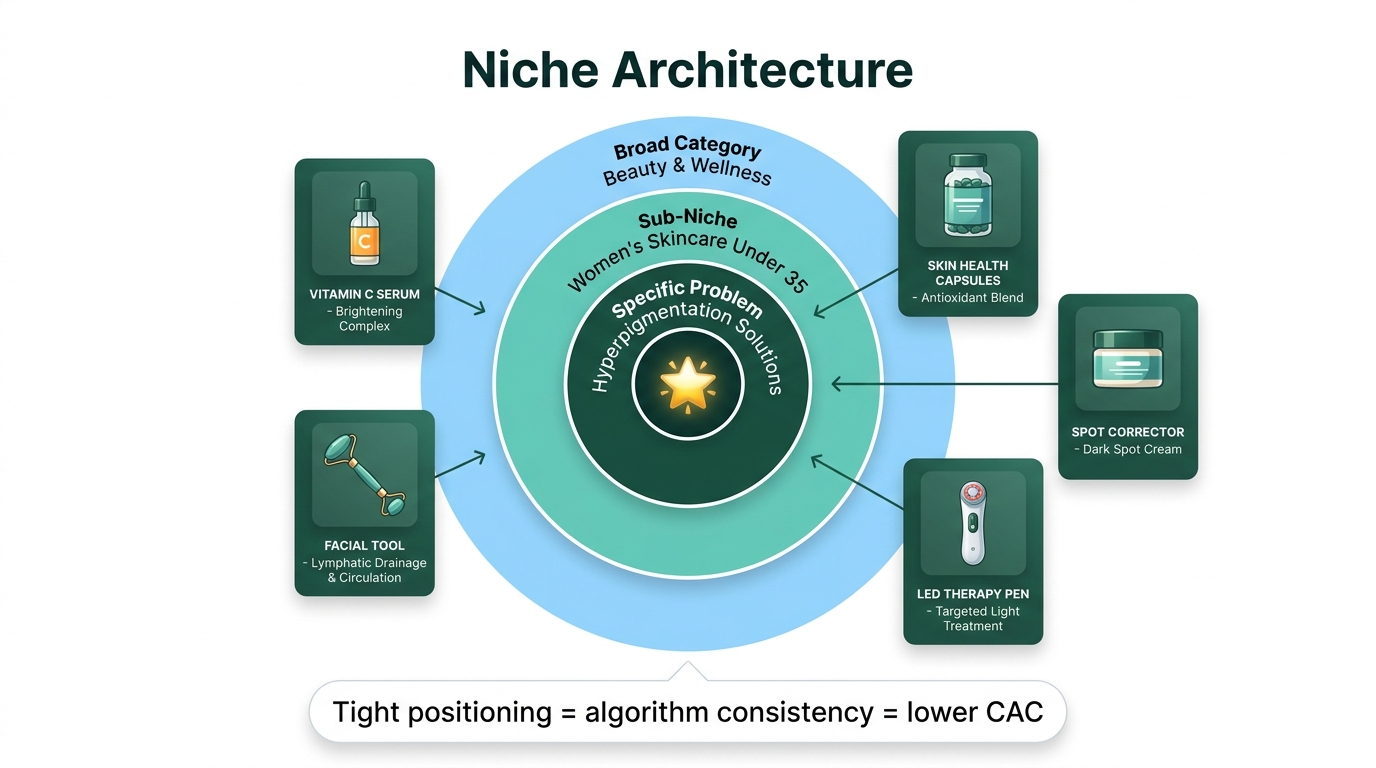
In TikTok Shop’s early growth phase, a “post lots of different products and see what sticks” approach could produce results because the platform rewarded content volume and new creator signal was being generously distributed. That era is over. The algorithm now has enough behavioral data on most categories to be highly selective about which creator content it serves to which audiences — and it rewards consistency over breadth.
How TikTok’s Algorithm Penalizes Niche Vagueness
TikTok’s content recommendation system builds audience profiles based on behavioral signals: what content a user watches fully, what they skip, what they engage with, what they purchase. When a creator posts consistently within a category, the algorithm develops a confident model of that creator’s content and can efficiently route it to the users whose behavioral profiles suggest affinity.
When a creator posts across multiple unrelated categories, the algorithm’s model becomes less confident. The content still gets distributed, but less efficiently — it’s shown to a broader, less targeted audience, which means lower engagement rates, lower conversion, and algorithmically, signals that suggest the content is less relevant. A beauty creator who occasionally posts home gadgets isn’t building two audiences. They’re diluting one.
The practical consequence is that niche consistency is now a distribution advantage, not just a branding preference. Creators with a clearly defined content angle get more accurate audience targeting from TikTok’s recommendations, which produces higher engagement rates, better click-through to product pages, and ultimately stronger conversion data — which in turn makes them more attractive to brand targeted collaboration programs.
The Category Architecture Framework
The approach that works in 2026 is what operators are calling niche architecture: defining a hierarchy from broad category to specific problem, and consistently owning the specific problem while having enough product range within the category to maintain content volume.
The mechanics look like this: a creator might operate in beauty and personal care (broad category), specifically women’s skincare for the 28 to 45 demographic (sub-niche), focused on hyperpigmentation and uneven skin tone solutions (specific problem). Within that problem space, there’s enough product variety — serums, masks, supplements, tools, sunscreens — to post consistently without repeating content. The algorithm knows exactly who to show this creator’s content to. Brands with relevant products know exactly whose audience they want access to.
The best-performing niches in 2026 for this model share specific characteristics. They are visually demonstrable (results or application can be shown clearly on camera in under 30 seconds). They solve a specific, recognizable problem rather than representing a vague lifestyle aspiration. They exist in the $20 to $80 impulse price range that clears without significant deliberation friction. And they carry commission rates in the 15 to 50 percent range that justify the content investment economics.
Beauty and personal care, health and supplements, practical home organization, and problem-solving fitness accessories consistently meet all of these criteria and represent the core of where affiliate earnings concentration is happening in 2026.
When to Expand vs. When to Stay Focused
The counterintuitive element of niche architecture is that expansion — adding a second content category or audience segment — should be treated like a business decision with defined criteria, not a creative impulse. The right trigger for expanding is when a creator has demonstrably maxed out the monetizable audience within their current niche, has strong enough brand relationships in the existing category to fund the expansion period, and has operational capacity to maintain consistency in both areas simultaneously.
Expanding too early is one of the most common ways that successfully positioned affiliates accidentally break their own momentum. The algorithm’s confidence in their content targeting degrades, their existing audience receives less relevant content and disengages, and they end up with a diluted presence in two niches rather than a dominant position in one.
The Off-Platform Imperative: Why Your TikTok Audience Is a Rented Asset
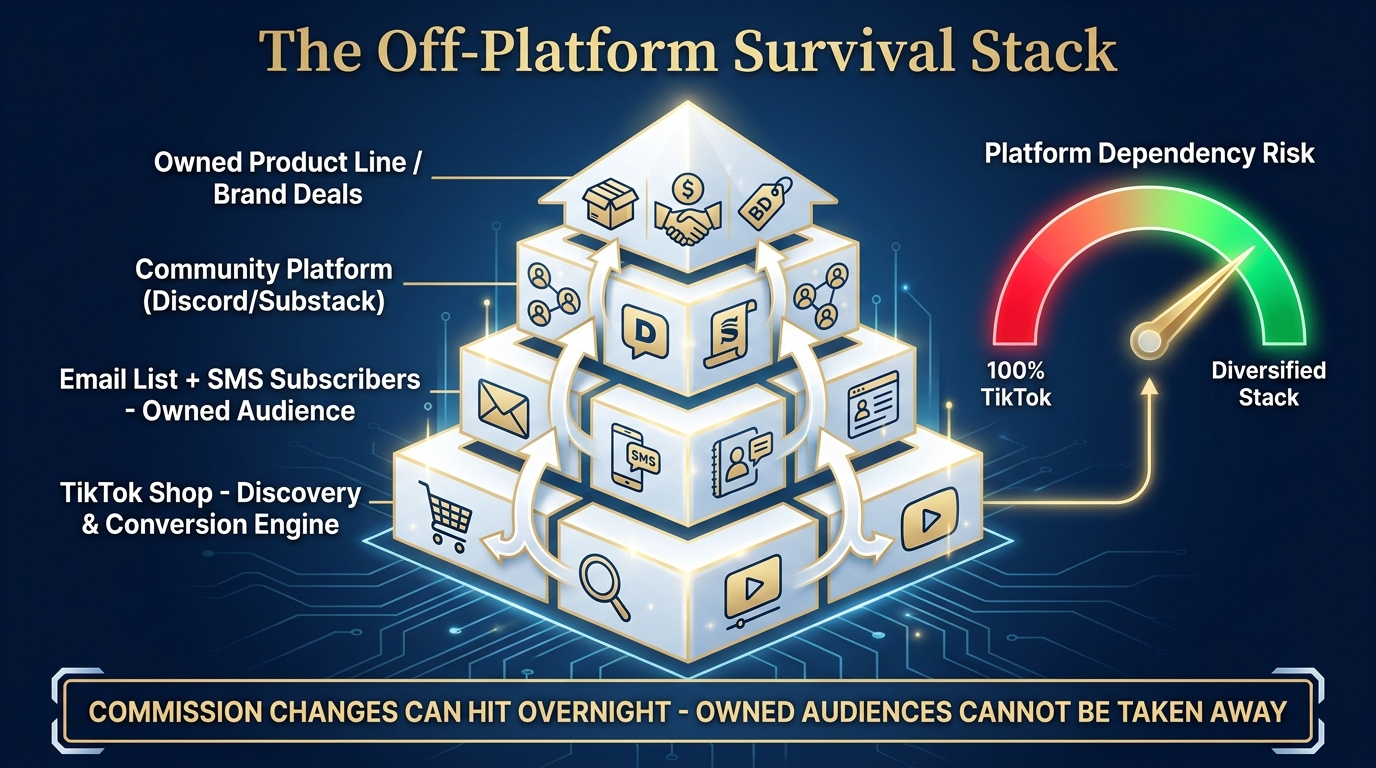
Everything discussed so far assumes that TikTok Shop continues to function as it does today — with current algorithm behaviors, current commission structures, current regulatory status, and current access for U.S. creators. That assumption deserves serious scrutiny. The platform’s regulatory environment has been turbulent enough that building an entirely TikTok-dependent business model in 2026 is a risk profile that most serious operators have stopped accepting.
Platform Risk Is Not Theoretical
The U.S. regulatory pressure on TikTok’s parent company ByteDance has created a documented track record of uncertainty that no other major e-commerce platform has imposed on its seller and creator base. Commission structures can change with relatively short notice — as evidenced by the rate adjustments that have already occurred in 2025 to 2026. Policy changes around promotional content, health claims, and product categories have affected creator programs substantially. And the structural question of long-term U.S. operational status has not been fully resolved, even if the immediate crisis scenarios of earlier years have passed.
For a creator who has built a substantial affiliate income on TikTok Shop, the risk is not abstract. Their earnings are entirely dependent on TikTok’s ongoing willingness to operate the affiliate program under current terms, TikTok’s continued access to the U.S. market, and TikTok’s algorithm continuing to favor their content category. Any of these variables changing is a potential income disruption that they have no ability to influence.
Building the Owned Audience Stack
The strategic response is not to abandon TikTok Shop — the platform’s reach and conversion efficiency make it too valuable to walk away from — but to systematically use TikTok as a top-of-funnel acquisition engine that feeds audience into owned channels. The economic value of a TikTok follower is meaningful but fragile. The economic value of an email subscriber or SMS opt-in is lower in any single interaction but compounding and owned.
The mechanics of this are deliberately simple: every piece of TikTok content should include a call to action that moves high-intent viewers toward an owned capture point. This might be a link-in-bio landing page offering an exclusive discount code or product guide in exchange for an email address. It might be a community Discord or Substack where the creator provides deeper content, recommendations, or early access to product deals. The specific mechanism matters less than the consistency of execution.
Creators who have built email lists of even 10,000 to 20,000 genuinely engaged subscribers from their TikTok audience have a meaningful hedge against platform disruption. Those subscribers can be reached directly, monetized through affiliate programs on other platforms (Amazon Associates, direct brand programs), notified of product launches if the creator moves to the seller model, and retained as an audience even if TikTok’s algorithm changes or availability shifts.
The Community Monetization Layer
Beyond email, the more advanced off-platform plays involve community platforms where the creator can provide ongoing value and monetize that value directly. A supplement-focused creator building a Discord server where members share results, get personalized recommendations, and access exclusive content is creating a business asset that is independent of any algorithm. A skincare-focused Substack covering ingredient science, product reviews, and curated recommendations has subscription monetization potential that doesn’t require anyone to click through and buy anything on TikTok.
These community models take longer to build than an email list and require genuine content investment beyond what goes on TikTok. But they represent the highest-value owned asset a creator can build, because community members have demonstrated willingness to engage on multiple dimensions and have chosen to maintain a relationship with the creator outside the passive scrolling environment of TikTok. Their lifetime value is substantially higher than a standard follower.
The Affiliate Agency Model: Running a Program, Not Just Content
For a subset of creators and operators, the pivot is less about changing what they create and more about changing who they work for. The TikTok Shop affiliate ecosystem has given rise to a growing category of specialized affiliate management agencies — businesses that run creator recruitment, onboarding, performance tracking, and content amplification for brands that lack the in-house capacity to manage these programs effectively.
Why Brands Are Outsourcing This Function
Running a high-performance TikTok Shop affiliate program is operationally demanding in ways that most brand teams underestimated at launch. Recruiting relevant creators requires active outreach, relationship management, and assessment of content quality and audience fit. Onboarding requires clear briefs, product delivery coordination, and performance tracking setup. Active management requires monitoring conversion data across dozens or hundreds of creators, identifying top performers for Targeted Collaboration upgrades, identifying underperformers for program removal, and coordinating content amplification decisions.
Brands with lean marketing teams have found that this function either consumes a disproportionate share of their resources or falls into neglect, with programs becoming stale as the initial creator cohort ages out without systematic replacement. The logical response has been to outsource to agencies that specialize in exactly this function.
The Agency Service Model and Economics
TikTok Shop affiliate management agencies typically structure their commercial arrangements in one of a few ways: a pure retainer model where the agency charges a fixed monthly fee for program management services; a hybrid model combining a lower retainer with a performance fee structured as a percentage of affiliate-driven GMV; or, for larger brands, a fully managed model where the agency takes responsibility for the entire affiliate function including creator payments, compliance oversight, and reporting.
For creators with operational and strategic skills who are less focused on content production, this represents a legitimate business model that leverages their TikTok Shop expertise without the content creation grind. Building a boutique affiliate management operation — managing programs for three to five brands with complementary but non-competing product lines — can generate service revenue that exceeds what the same creator could earn from their own affiliate commissions, with more predictable cash flow and less platform-specific distribution risk.
The agency model also has a natural synergy with the creator’s own affiliate activity. An operator who manages affiliate programs for brands in their category has privileged access to product data, conversion benchmarks, and creator performance information that informs their own content strategy and product selection. The information advantage compounds across both sides of the business.
The Creator Network Flywheel
Agencies that specialize in TikTok Shop affiliate management are increasingly building proprietary creator networks — curated rosters of vetted creators in specific categories whose performance data the agency tracks systematically. When a new brand client needs a creator program stood up quickly, the agency can activate its network in days rather than weeks.
For creators who become part of these networks, the benefit is a steadier flow of brand partnerships and often better commercial terms than they’d negotiate independently, in exchange for the agency taking a commission on deal value. For the agency, the network is the core strategic asset — it grows in value with each well-managed program and each creator whose performance history they own.
What the Top Performers Actually Have in Common — and What Most Analysis Gets Wrong
The dominant narrative about TikTok Shop affiliate success focuses heavily on content tactics: hook structures, video length, product demonstration formats, optimal posting times. These are real variables that matter at the margin. But they’re not what separates the top tier of the affiliate ecosystem from the broad middle. The differentiation at the top is structural, not tactical.
They Treat It as a Business With Infrastructure
The highest-earning TikTok Shop affiliates in 2026 are not creating more content than everyone else. They are running more sophisticated operations. They have systematic processes for product selection that prioritize audience fit and margin before commission rate. They have tracking infrastructure that tells them — per product, per content format, per posting time — what their actual conversion economics are. They have working relationships with brand partnership teams rather than just program portals. They have content pipelines that separate production from publishing to create consistency without burnout.
This infrastructure doesn’t require a large team. Most top individual affiliates are still operating as solopreneurs or with one or two part-time supports. But the infrastructure mentality — treating every variable as measurable and every process as systematizable — is what allows them to iterate effectively rather than reinventing the wheel with every campaign.
They Have Explicit Platform Risk Management
Every top-performing affiliate who has been operating in this space for more than 18 months has a clear answer to the question “what happens to your business if TikTok Shop changes commission structures or algorithm access tomorrow?” The answer isn’t “I’ll figure it out.” It’s a defined plan: existing email list of a specific size, parallel affiliate activity on Amazon, a product line in development, or a brand retainer structure that doesn’t depend on TikTok commissions.
This risk management isn’t defensive pessimism — it’s what allows these operators to invest aggressively in TikTok Shop today without existential anxiety. Knowing the downside is bounded makes the upside capture more deliberate.
They’ve Compressed the Feedback Loop
Perhaps most importantly, the top tier of TikTok Shop affiliates has dramatically shortened the time between posting content and extracting actionable insights from its performance. They’re not waiting for end-of-month reporting to understand what’s working. They’re tracking video performance in the first 2 to 4 hours, making real-time decisions about which content warrants Spark Ads consideration, and adjusting product selection and content format on weekly rather than monthly cycles.
This feedback compression doesn’t require sophisticated technology. It requires disciplined attention to the metrics that actually predict downstream conversion — completion rate, click-through rate, add-to-cart rate — and the analytical confidence to act on early signals rather than waiting for complete data. The operators who move fastest on good signals and cut losses quickly on underperformers accumulate learning advantages that compound over time.
The Pivot Roadmap: What to Actually Do, in What Order
For affiliates currently in the broad middle of the TikTok Shop ecosystem — earning inconsistently, seeing commission compression, feeling the saturation — the question is not whether to pivot but which pivot makes sense given their specific situation. The answer is different for a creator with 50,000 highly engaged niche followers versus one with 500,000 diffuse lifestyle followers versus one with deep operational skills but a modest personal audience.
Step 1: The Positioning Audit
The first step is an honest assessment of whether the creator’s current content positioning gives TikTok’s algorithm a clear signal. Pull the last 60 days of content. What percentage falls within a coherent category and specific problem space? If the answer is less than 70 percent, the first priority is not a new strategy — it’s rebuilding positioning consistency. Everything else, including targeted collaboration access, live shopping conversion, and Spark Ads performance, will work better on a foundation of algorithmic clarity about who the creator’s audience is.
Step 2: The Conversion Audit
Before chasing new product categories or commission rates, audit the actual conversion data on current affiliate products. TikTok Shop’s affiliate dashboard provides per-product data that many creators under-utilize. Which products in the current lineup are converting above the 4.7 percent platform average? Which are below 2 percent despite strong view counts? The products converting poorly are almost certainly misaligned with audience intent — and continuing to promote them is diluting the creator’s performance signals.
Cutting underperforming products from active promotion and doubling down on the high-converting ones is often the single highest-leverage tactical move available before embarking on any more complex strategic change.
Step 3: The Infrastructure Build
Once positioning is clear and product performance is understood, the infrastructure build begins: establishing a live shopping cadence (even monthly initially), setting up an email or SMS capture mechanism linked from the TikTok profile, reaching out directly to brand partnership teams for the two or three brands whose products convert best in the existing lineup, and identifying one Spark Ads proposal to bring to the best-performing brand relationship.
None of this requires significant capital investment. It requires time, organizational discipline, and the willingness to think about the affiliate business as a structured operation rather than a content creation hobby. The creators who make this mental shift — even without changing a single piece of content — typically see material performance improvements within 60 to 90 days as their operational improvements compound into better data, better brand relationships, and better distribution.
Conclusion: The Professional Era of TikTok Shop Affiliate Has Arrived — Whether You’re Ready or Not
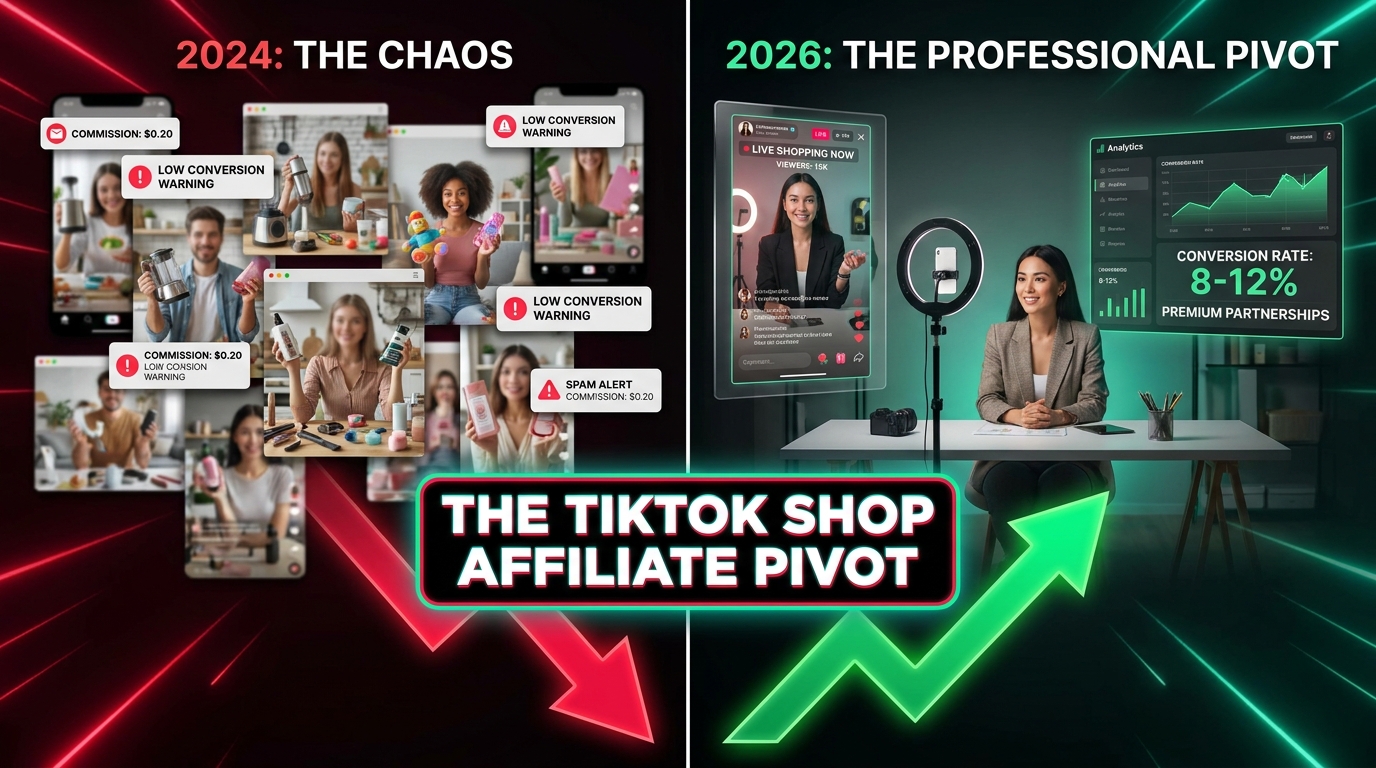
The TikTok Shop affiliate market of 2024 rewarded early movers, high-volume content producers, and anyone willing to experiment with an unproven platform. That era delivered real results for a meaningful number of creators. It also set expectations that the market was never going to sustain at scale.
The market of 2026 rewards something different: operational discipline, audience specificity, platform risk management, and the willingness to evolve the business model when the data demands it. The platform’s GMV growth is real and sustained. The opportunities for affiliates who run their programs as professional businesses are significant. The floor for those who haven’t evolved past the 2024 playbook continues to drop.
The creators and operators who are navigating this shift successfully are not the ones who found a better hack or a higher-commission niche. They’re the ones who accepted that TikTok Shop affiliate had matured from an arbitrage opportunity into a competitive business environment — and then built accordingly. Tighter positioning. Live shopping infrastructure. Spark Ads partnerships. Off-platform audience development. Creator-to-seller pipelines for those with the right validation data and risk appetite.
None of these pivots are simple. All of them are achievable with the data and infrastructure available to any creator operating at a professional level in the current ecosystem. The question is not whether the pivot is necessary. The question is which version of it fits your specific situation — and how quickly you’re willing to move on building the version of this business that actually lasts.
Key Takeaways for TikTok Shop Affiliates in 2026:
- Targeted Collaboration programs convert at 8–12% vs 2–4% for Open Collaboration. Position your content and credentials to get invited into them.
- Live shopping consistently outperforms short video on conversion rate and AOV. Even a monthly live cadence materially changes program economics.
- Spark Ads on proven organic winners deliver 44% higher conversion vs standard in-feed — negotiate for usage fee structures on top of commissions when brands amplify your content.
- Niche architecture (broad category → sub-niche → specific problem) drives algorithmic consistency and makes you an attractive targeted collaboration partner.
- Every affiliate program should include a systematic off-platform audience capture. An email list of 10,000 engaged subscribers changes your risk profile fundamentally.
- If your affiliate conversion data validates demand in a category you own, the creator-to-seller pipeline is worth evaluating seriously. The economics are structurally different.
- Only 12–18% of accepted affiliates ever post. The bar for brand-considered targeted programs is low for creators who operate with professional consistency.