


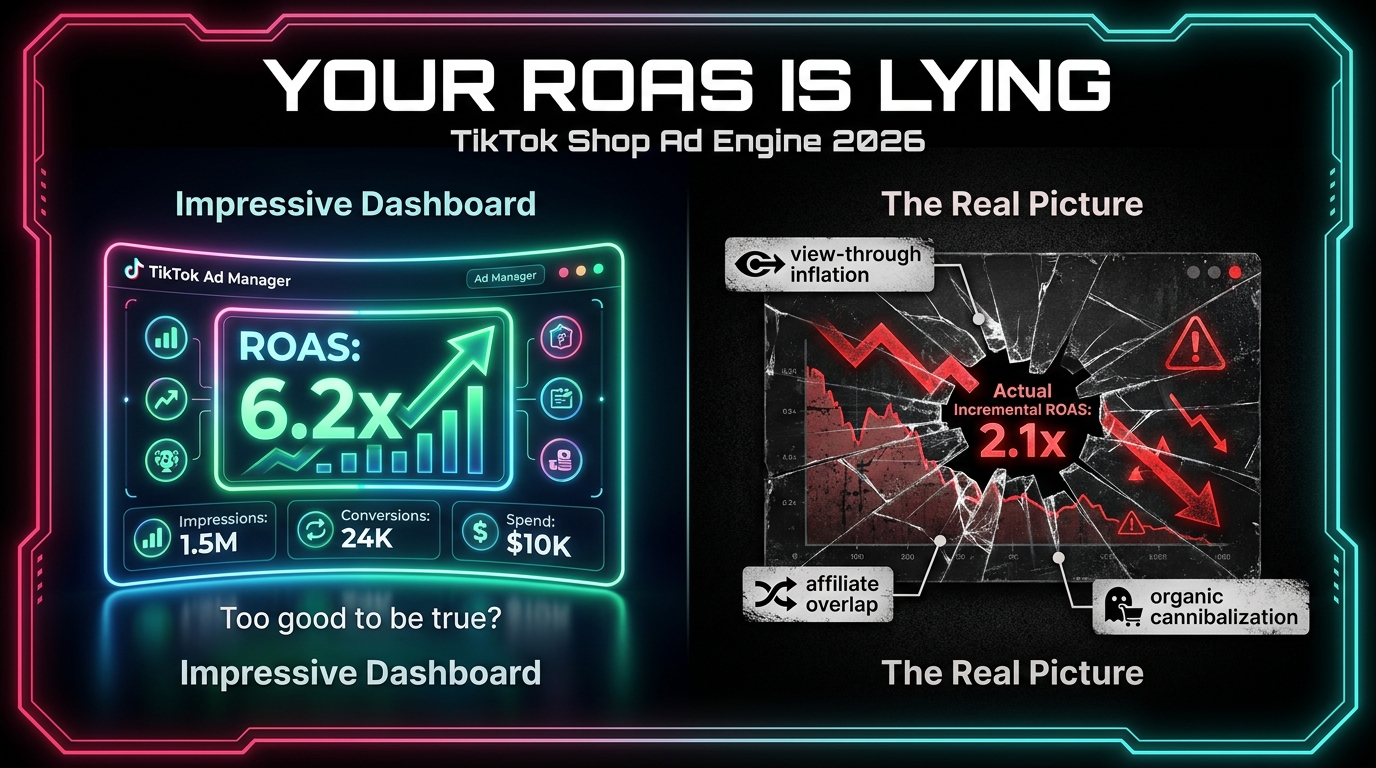

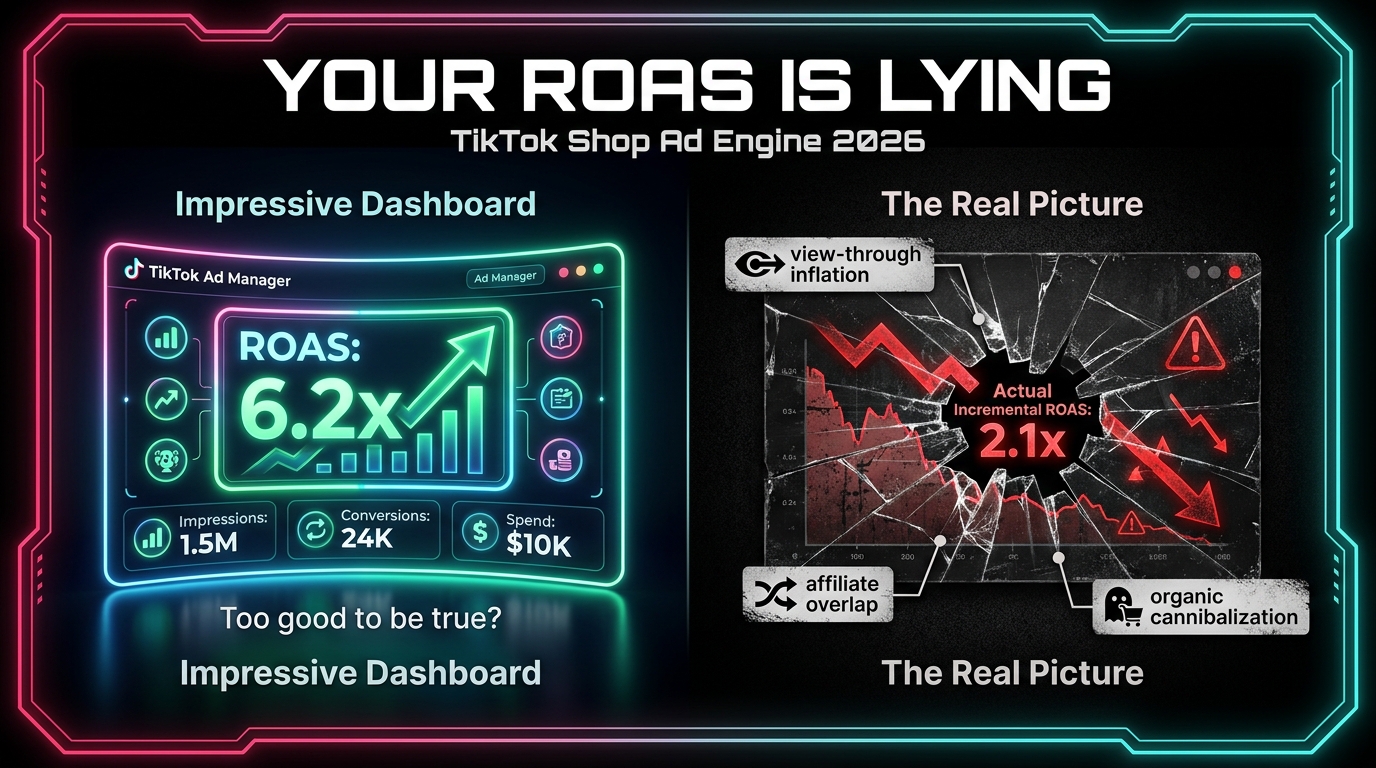
The TikTok Shop Ads Manager dashboard looks extraordinary. Brands running GMV Max campaigns regularly see ROAS figures of 5x, 6x, even 8x — numbers that would make any paid media manager feel like a genius. The account is spending efficiently, orders are flowing, and the algorithm is “working.”
Except, increasingly, the real story is more complicated. Performance marketers who run incrementality tests, triangulate against their Shopify back-end, and audit their attribution windows are finding that their true ROAS — the revenue that wouldn’t have happened without the ads — can be dramatically lower than what TikTok’s dashboard reports. The gap between “platform-reported ROAS” and “actual business impact” has become one of the defining measurement challenges of TikTok Shop advertising in 2026.
This post isn’t about whether TikTok Shop is a good channel. It is, for many categories — often spectacularly so. It’s about understanding how the ad engine works, why it reports what it reports, and where smart operators are pulling ahead by building discipline around what the numbers actually mean. We’ll cover the mechanics of GMV Max, the attribution model’s structural quirks, the creative fatigue problem that’s compressing performance windows, and the measurement infrastructure you need to make confident scaling decisions in 2026.
The brands winning on TikTok Shop right now aren’t just spending more. They’re reading the signals more accurately.
GMV Max: The New Default Engine (and What You Surrendered When It Took Over)

If you set up a TikTok Shop ad campaign today, you’re almost certainly running through GMV Max — whether you chose it deliberately or not. Since July 2025, TikTok made GMV Max the default and effectively the only supported campaign type for TikTok Shop Ads, deprecating the older, more granular manual Shop campaign formats.
GMV Max operates as a Performance Max-style system. Feed it products, a budget, and a target ROI goal — and it handles everything else. Audience targeting, placement selection, creative combination, bidding — the algorithm decides. TikTok’s positioning is that this automation delivers better results than manual campaigns because the system has access to signals that advertisers can’t act on themselves: cross-device behavior, real-time inventory shifts, creator engagement patterns, and historical purchase intent across hundreds of millions of users.
What Changed When GMV Max Became Mandatory
For experienced performance marketers, the transition came with a significant operational shift. Under legacy Shop campaign types, you could segment audiences by interest, device, or demographic. You could manually control placements, isolate video ads from product collection ads, and run structured A/B tests with clean variable separation. You could build campaign architectures that told you, clearly, which audience and creative combination was driving which result.
GMV Max removes most of that granularity. The system pools your budget, your creative assets, and your catalog into a unified optimization engine. You set your ROI floor — the minimum return you want per dollar spent — and the algorithm bids accordingly. If you set no ROI constraint, GMV Max optimizes purely for volume, spending whatever it takes to drive orders and maximize your total GMV number.
This is not inherently bad. For brands with mature shops, rich conversion history, and a deep catalog, GMV Max can genuinely outperform manual setups by finding purchase intent in audiences you’d never have built segments for. TikTok’s own case studies point to 1.7x ROAS lifts for brands transitioning from manual campaigns to integrated GMV Max workflows. Independent agency data broadly corroborates this directionally.
The Levers You Still Have
Understanding where you can still apply advertiser judgment is critical. Within GMV Max, the primary knobs available are: the target ROI value (your ROAS floor), budget allocation between product videos and LIVE shopping, product selection within the campaign, and creative asset inputs. The quality and diversity of your creative feed directly influence what the algorithm has to work with — which is why creative strategy has become more important, not less, in the GMV Max era.
Access to GMV Max is also tied to your primary ad account for the shop. If that primary account changes, TikTok automatically pauses campaigns — a detail that catches multi-account operators and agencies off guard. For teams managing TikTok Shop across multiple brands, understanding this account-level architecture is a prerequisite for stable delivery.
One additional control worth knowing: you can exclude specific products from GMV Max optimization, which lets you protect margin-sensitive SKUs from being auto-promoted at discount-driven conversion rates. For brands running product lines at different margin tiers, this is one of the few remaining strategic levers inside the system.
The Attribution Stack: How TikTok Counts Revenue Across Three Signal Types
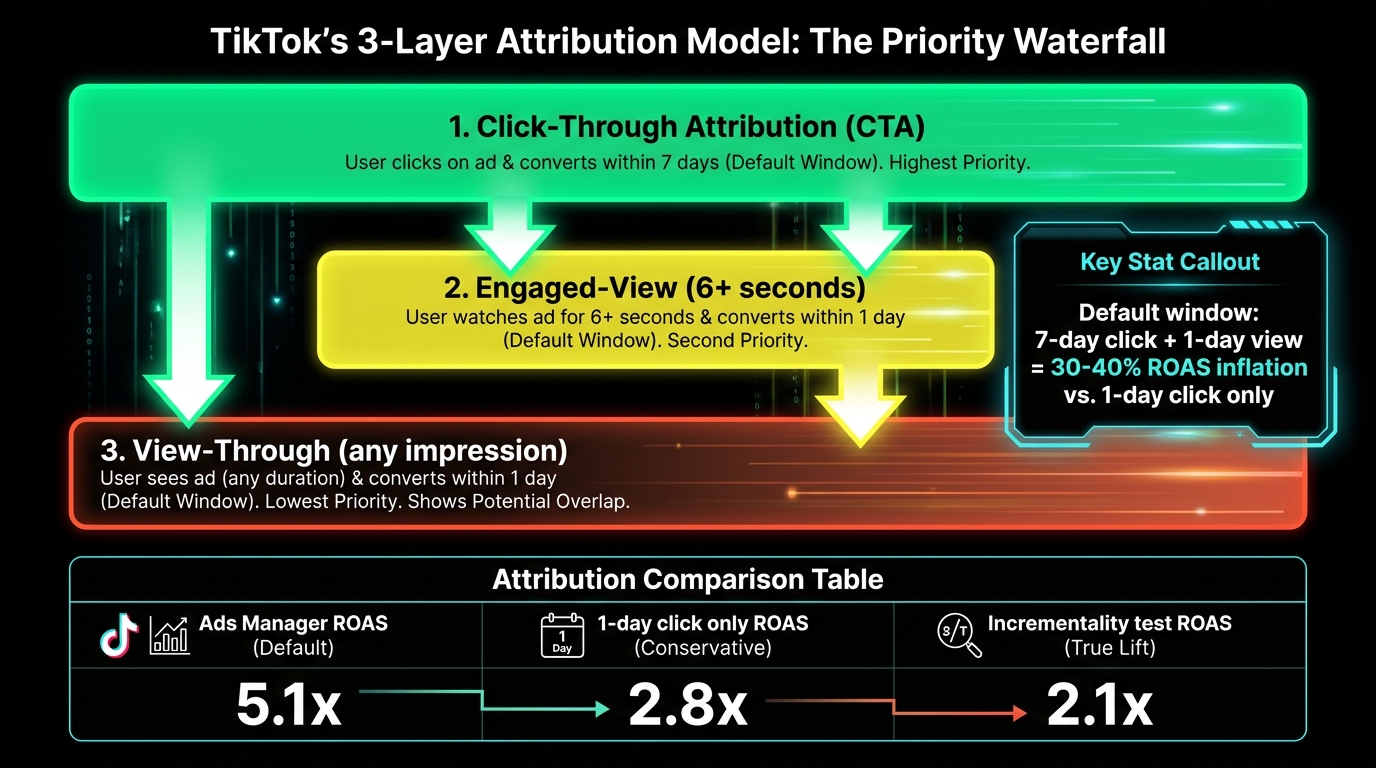
This is where TikTok Shop measurement gets genuinely complicated — and where most brands are operating with a significantly incomplete picture. TikTok’s attribution model for Shop ads uses three distinct signal types, applied in a priority waterfall, across configurable lookback windows. Understanding this architecture is essential to understanding why your ROAS number might not mean what you think it means.
The Three Layers: Click, Engaged-View, and View-Through
TikTok’s attribution system works as follows. When a purchase occurs, the platform first checks whether that customer clicked an ad within the click attribution window (configurable, defaulting to 7 days). If a click is found, it gets the credit — full stop. If no qualifying click exists, the system checks whether the customer watched an ad for 6 or more seconds (engaged-view attribution) within the engaged-view window (configurable, defaulting to 1–7 days). If an engaged-view is found, it gets the credit. Only if neither of those is present does the system fall back to standard view-through attribution — crediting any ad impression the customer received within the view window.
This is a single-touch, priority-order model. Each conversion is attributed to exactly one touchpoint, which prevents double-counting within TikTok’s system. The priority order (click → engaged-view → view) is sensible — it favors stronger engagement signals over weaker ones.
The Window Problem
The challenge isn’t the model logic itself. It’s the window lengths. The default 7-day click window means that if someone clicked a TikTok ad on a Monday and bought your product the following Sunday — perhaps after also seeing emails, Google search ads, influencer posts, and an organic TikTok video in between — your TikTok campaign gets full credit. Your other channels get zero credit in TikTok’s report. And TikTok gets zero credit in any last-click attribution model running in your analytics platform that attributes the purchase to the final touch.
The engaged-view window compounds this. A 6-second video watch triggers a conversion credit window. On a platform where 6-second views happen at enormous scale — that’s a low bar on a native video feed — the number of “assisted” conversions being attributed to TikTok ads via engaged-view can be substantial. For discovery-heavy categories like beauty, fashion, and lifestyle products, where consumers watch TikTok content for weeks before purchasing, engaged-view attribution can inflate platform-reported ROAS significantly relative to any click-only baseline.
What the Gap Actually Looks Like in Practice
Brands that run triangulation exercises — comparing Ads Manager data against Shopify revenue, GA4 session data, and MMP reports — consistently find material discrepancies. A campaign reporting 5.1x ROAS in Ads Manager might show 2.8x under a 1-day click-only view of the same data, and 2.1x under a properly designed incrementality test (geo holdout or conversion lift study). None of these numbers is wrong. They’re measuring different things. The problem is that most teams make scaling decisions based on the 5.1x number without understanding what it actually represents.
The operationally correct posture is to use Ads Manager ROAS as a directional indicator of relative performance — useful for comparing creatives, products, and time periods within the platform — while running periodic incrementality checks and cross-referencing against your back-end revenue data to calibrate your confidence in the absolute numbers.
Why Default Attribution Windows Inflate Your ROAS — and How to Calibrate
The previous section established the mechanics. This section gets into the practical calibration work that separates operators who actually understand their TikTok efficiency from those who are flying on inflated dashboard metrics.
The View-Through and Organic Attribution Problem in GMV Max
GMV Max introduces a specific attribution complexity that goes beyond the standard click/view discussion. The system is explicitly designed to optimize toward total channel ROI — meaning it attributes GMV from paid ads, organic TikTok content, and affiliate-driven sales of your promoted products. When GMV Max runs, and a customer discovers your product through an organic TikTok post but converts after also having been shown a GMV Max ad, that sale can be claimed by the campaign.
This isn’t a bug or a TikTok deception. It reflects how TikTok’s ecosystem actually works — the platform is deeply integrated, and paid and organic traffic are genuinely interconnected for Shop sellers. But it does mean that if your organic TikTok presence is strong, your GMV Max ROAS will be systematically higher than what the paid spend alone would have generated. Brands with large organic audiences should factor this into their interpretation of campaign ROAS, particularly when deciding how much to scale paid spend.
Practical Calibration Steps
Three calibration approaches are commonly used by sophisticated TikTok Shop operators. First, run parallel attribution reporting. Inside Ads Manager, switch your reporting view from the default 7-day click + 1-day view window to a 1-day click-only view. The difference between these two numbers tells you how much of your reported ROAS is being driven by click behavior versus view/engaged-view credits. Seeing that the 1-day click ROAS is 40–50% lower than your default view is not unusual — that’s important information about how much of your “conversion” base is actually just audience exposure.
Second, implement TikTok’s Attribution Portfolio tool, where available. This gives you assisted conversion reporting that shows how many purchases involved TikTok as a touch point but were not the final-touch conversion. Combined with your external analytics, this lets you build a more honest multi-touch picture of what the channel is actually contributing.
Third, run periodic conversion lift studies — available through TikTok’s measurement tools or third-party providers — that use holdout groups to measure true incrementality. These are not operationally cheap, but for brands spending $50,000 or more per month on TikTok Shop ads, the investment in understanding actual incremental ROAS pays for itself many times over in smarter budget allocation decisions.
Setting Your Internal ROAS Target Correctly
Given the attribution inflation built into default settings, many experienced TikTok Shop advertisers apply an internal “discount rate” to platform-reported ROAS when setting their target ROI in GMV Max. If your back-end analysis consistently shows that real business ROAS is 40% lower than Ads Manager ROAS, you might set your GMV Max ROI target at 1.4x your actual needed return. The campaign sees a lower bar, generates the volume you need, and your true economics stay intact. This approach requires regular recalibration as your attribution mix shifts — but it’s far better than optimizing to a number you don’t fully understand.
Catalog and Feed Quality: The Hidden Input That Controls Your Ad Costs
In the GMV Max framework, the product catalog is not a passive data container — it’s a live performance variable. The quality, completeness, and freshness of your catalog feed directly affects which products get promoted, how accurately TikTok can match them to purchase-intent audiences, and what your effective CPMs and conversion costs look like.
Why Catalog Quality Is a Ranking Signal
TikTok’s ad delivery system uses product metadata to match catalog items to user interest signals. The more complete and accurate your catalog attributes — category, brand, color, size, variant structure, product description keywords — the more precisely the algorithm can target impressions. Incomplete or generic product data forces the system to rely more heavily on creative engagement signals and historical conversion data, which limits delivery quality in learning phases and for newer SKUs.
Event match rate is one of the most critical and least-discussed catalog health metrics. This measures how effectively purchase events recorded by your pixel or Events API can be matched back to specific product IDs in your catalog. TikTok explicitly targets 100% event match rate as the optimization goal — and in practice, shops with event match rates below 70% will see degraded targeting quality, less efficient learning periods, and higher effective CPAs compared to well-matched catalogs.
Feed Freshness Matters More Than You’d Expect
TikTok’s guidance recommends daily catalog refreshes to keep pricing and inventory data accurate. This is more than a data hygiene recommendation — stale catalog data that shows products as available when they’re out of stock, or displays outdated prices, actively damages ad performance. If GMV Max runs traffic to a product page that reflects an old price or zero inventory, you absorb the ad spend cost while generating either failed conversions or friction that inflates your funnel abandonment rate.
For Shopify users, a well-configured TikTok app integration handles this automatically. For brands with custom storefronts, direct API integrations, or catalog structures that don’t map cleanly to TikTok’s taxonomy, daily reconciliation should be an operational standard, not an afterthought. It’s a low-effort, high-leverage maintenance task with a direct line to ROAS efficiency.
Image and Video Asset Quality in Catalog Ads
TikTok’s catalog specifications recommend product images at a minimum of 500×500 pixels with clean backgrounds and no promotional overlay text in the primary image field. This isn’t arbitrary — catalog images are surfaced programmatically across product collection ads, search results in TikTok Shop, and automated video generation features. Low-quality or visually cluttered images reduce CTR on catalog-driven placements, which signals lower relevance to the delivery system and can raise your effective CPMs over time.
For categories with strong demonstrability — beauty application, apparel fit, kitchen gadgets — supplementing static catalog images with short video clips significantly improves the algorithm’s ability to serve engaging product experiences, particularly in auto-generated video ad formats.
Creative Fatigue Is Faster Than You Think: The 3–7 Day Cliff
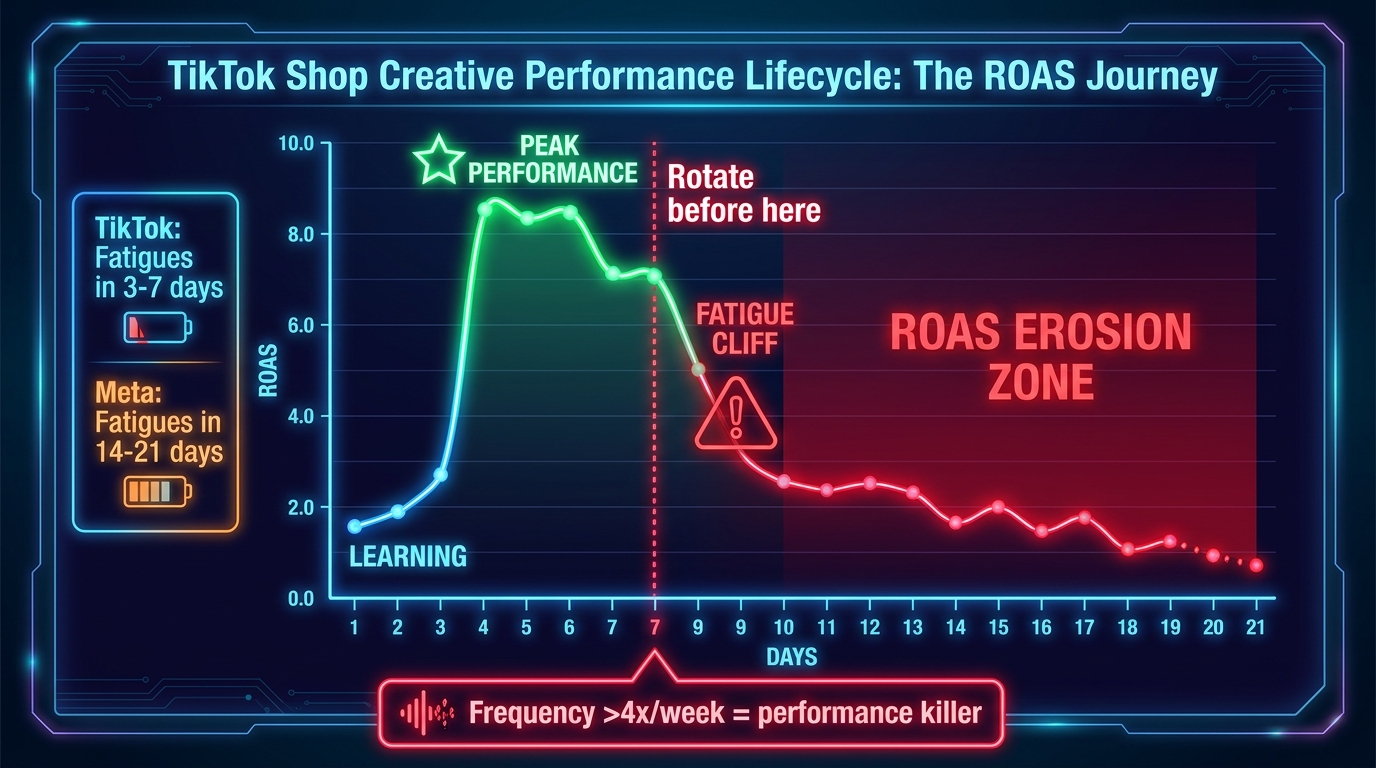
If there’s one operational reality that consistently surprises performance marketers coming from Meta or Google advertising, it’s how fast TikTok creatives lose their effectiveness. The platform’s native, high-velocity content environment means that what feels fresh to a first-time viewer has already been seen dozens of times by your retargeted audience — and what performs brilliantly on day 3 can be a money drain by day 10.
The 3–5 Day Peak Window
Industry analysis of TikTok Shop ad performance in 2026 consistently identifies a 3–5 day peak performance window for most creatives. After launch, a well-constructed video ad typically has a brief learning phase (day 1–2), hits its best CTR and conversion rate combination in days 3–5, and begins showing measurable efficiency deterioration by day 7. By day 10, most creatives are clearly declining — ROAS is down, CPA is rising, and the frequency signal is flashing red.
This is dramatically faster than Meta, where the typical creative lifecycle runs 2–4 weeks before significant fatigue. The TikTok content environment is the reason. Users consume enormous volumes of short-form video daily, and the platform’s algorithm serves personalized content at high frequency to engaged users. An ad that interrupts a native content stream works great the first time — and degrades sharply with repetition.
Frequency as the Leading Indicator
The critical insight for TikTok Shop advertisers is that ROAS decline is a lagging signal. By the time your ROAS numbers visibly drop, the damage has already been happening for several days. The leading indicators are frequency and CTR. When weekly frequency exceeds 3–4 impressions per unique user and your CTR starts declining simultaneously, creative fatigue is already in motion. Waiting for ROAS to confirm it means you’ve already burned several days of budget at degrading efficiency.
Optimal frequency management on TikTok Shop targets a weekly cap of approximately 3–4 impressions per user for performance campaigns. Beyond 6 impressions per week, performance deterioration is pronounced — and often visible in rising thumb-stop ratios (people swiping past the ad immediately) before CTR even moves significantly. Monitoring at the audience-frequency level, not just aggregate ROAS, is the diagnostic approach that keeps you ahead of the cliff.
Building a Creative Pipeline That Sustains ROAS
The operational implication of a 3–7 day creative window is stark: if you’re running active TikTok Shop campaigns, you need a consistent pipeline of new creative to maintain performance. This isn’t about making radical conceptual changes for every new asset — often a winning product hook can be extended through a dozen variations (different opening frames, different talent, different B-roll, different voiceover scripts) without losing its fundamental effectiveness. What it does mean is that creative production cannot be treated as a quarterly project.
Leading TikTok Shop operators have addressed this through three channels. First, UGC (user-generated content) systems that incentivize customers and micro-creators to produce review content at scale — lower cost than studio production, often higher native authenticity. Second, creator affiliate relationships (via TikTok Shop’s Affiliate program) that generate a continuous stream of independently produced content, with no upfront production cost. Third, systematic creative testing frameworks that use GMV Max’s asset inputs to run structured experiments — testing one variable at a time — so learnings compound across the pipeline rather than being siloed in individual campaigns.
The brands that are achieving the highest and most consistent ROAS on TikTok Shop are almost universally those with the highest creative velocity. Not necessarily the highest individual creative quality — but the most consistent supply of fresh, platform-native assets flowing into their campaigns.
Bid Strategy Architecture: When Lowest Cost Destroys Value and When Target ROAS Kills Volume
GMV Max gives you a deceptively simple bidding interface: set a target ROI (or don’t), set your budget, let it run. But the decision of whether to set a target ROI, and at what level, has significant downstream consequences for learning speed, delivery scale, and the quality of the optimization signal you’re building over time.
The Learning Phase Problem
When you launch a new GMV Max campaign or add new products to an existing one, TikTok’s system enters a learning phase. The algorithm is building a model of who converts for these specific products at what price, through which creatives, at which times. During this phase, it needs purchase data — typically a minimum of 20–50 conversion events per week to exit learning and move into stable delivery.
Setting an aggressive target ROI during the learning phase is a common mistake. If you demand 5x ROAS from a campaign that has no conversion history, the algorithm severely constrains its bidding, limits the audience it’s willing to reach, and generates so few purchases that it never accumulates the data it needs to optimize effectively. The campaign gets stuck in a perpetual learning loop, spending slowly, converting rarely, and never building the signal needed to improve.
The recommended approach is to launch with no ROI target (or a low one — say 1x or 1.5x) for the first two to four weeks while the system accumulates conversion data. Accept that early ROAS will be lower than your target. Treat this phase as data acquisition, not profitability. Once you have stable weekly conversion volume and a clear ROAS baseline, gradually increase the target ROI in increments — raising it by no more than 20% at a time to avoid triggering a new learning phase.
Target ROI Gradients and What They Signal to the Algorithm
The target ROI in GMV Max functions as a floor constraint. Set it too high and you choke volume. Set it too low and you scale spend without margin discipline. The practical sweet spot differs significantly by product margin, price point, and competitive landscape.
For consumable goods with repeat purchase economics (supplements, beauty consumables, pet products), a lower target ROI during acquisition makes sense because LTV extends well beyond the first order — a 2.5x ROAS on first purchase from a customer who reorders three times a year at the same economics is excellent business. For single-purchase categories with no clear repurchase cycle (electronics accessories, seasonal gifts), the first-order ROAS needs to carry the entire economic return, requiring a higher floor.
The most sophisticated GMV Max operators segment campaigns by product margin tier, running separate campaigns for high-margin hero products (where they can afford volume-focused low-ROI-target settings) and thin-margin SKUs (where they set tighter floors to protect contribution). This preserves learning data and scale for the products that can absorb it while protecting the economics on the items where profitability is fragile.
LIVE Shopping Ads vs. Video Shopping Ads: The ROAS Tradeoff You Need to Understand
TikTok Shop’s ad formats are not interchangeable. LIVE Shopping Ads and Video Shopping Ads (VSAs) serve fundamentally different roles in the purchase funnel, generate different ROAS profiles, and require different operational investments. Treating them as alternatives rather than complements is one of the most common strategic errors in TikTok Shop advertising.
How LIVE Shopping Ads Work and Why They Convert Differently
LIVE Shopping Ads promote active livestreams to audiences who haven’t discovered the live session organically. When someone sees a LIVE Shopping Ad, they’re dropped into a live broadcast where a host is demonstrating products in real time, answering questions, and — critically — creating urgency through limited-time offers, countdown timers, and live social proof (visible viewer counts, on-screen comments, real-time purchases).
This environment produces dramatically higher conversion rates than passive video ads, for a specific reason: the live session collapses the consideration phase. Instead of watching a 15-second video and then choosing to click through, browse a product page, and decide to purchase — a multi-step journey with significant drop-off at each stage — LIVE viewers are immersed in an environment purpose-built for immediate conversion. The host handles objections live. The social proof is real-time. The urgency mechanics are structural.
TikTok benchmarks suggest LIVE Shopping Ads convert at meaningfully higher rates than Video Shopping Ads for comparable spend, with ROAS typically 15–30% higher when the live content is high quality and runs consistently. Beauty, fashion, and high-consideration categories that benefit from demonstration see the most pronounced lift.
The Operational Cost of LIVE
The tradeoff is operational intensity. Running effective LIVE Shopping requires consistent broadcasting schedules (typically 3–5 sessions per week minimum to build algorithmic momentum and audience familiarity), skilled hosts, production setup, real-time inventory management, and a system for routing ad-driven viewers into sessions without overwhelming organic community dynamics. For a small team, this is a significant commitment — and a half-hearted LIVE program that goes live sporadically will deliver worse results than a well-executed video shopping ads strategy.
Video Shopping Ads, by contrast, are always-on, asynchronous, and scalable without real-time operational overhead. They excel at cold traffic acquisition and top-of-funnel discovery, feeding your shop’s organic audience over time. The most effective TikTok Shop programs use Video Shopping Ads for consistent discovery and pool-building, with LIVE Shopping Ads serving as high-conversion events that monetize the warm audience those VSAs have built. The ROAS profiles of the two formats are thus not directly comparable — they’re measuring performance at different stages of the buyer journey.
Budget Allocation Across Formats
Within GMV Max, you can split budget allocation between product video ads and LIVE promotion. TikTok’s own guidance suggests that brands with active LIVE programs allocate meaningful budget (often 30–50% of total Shop ad spend) to LIVE promotion during active sessions, then shift that budget back to video shopping during non-live windows. This dynamic allocation approach prevents wasted spend on LIVE promotion when there’s no active session while maximizing the conversion advantage of LIVE when it’s running.
iOS Signal Loss and the First-Party Data Infrastructure You Actually Need

Apple’s App Tracking Transparency framework has become a permanent structural feature of digital advertising in 2026 — not a transitional challenge. With iOS opt-in rates running at roughly 25–30% across most app categories, the majority of conversion signals from iPhone users are simply not available through client-side pixel tracking. For TikTok Shop, where a significant share of active users are on iOS, this creates a systematic undercounting problem that gets worse the more iOS-heavy your customer base is.
What Signal Loss Actually Costs You
When TikTok’s optimization system can’t see purchases, it can’t learn from them. A customer who sees your ad, clicks through, and buys via Safari on their iPhone — with tracking consent denied — generates no usable optimization signal. The algorithm doesn’t know that ad worked. It can’t reinforce the targeting that led to it. Over time, if a meaningful share of your conversions are iOS-driven and invisible to the pixel, the system is optimizing on an incomplete and systematically biased subset of your actual customer base. Your delivery logic bends toward the Android and opted-in segment even if your best customers are predominantly on iOS.
Server-Side Tracking as the Non-Negotiable Fix
The operationally correct response to iOS signal loss is implementing server-side event tracking via TikTok’s Events API (CAPI). Unlike the browser pixel, which fires JavaScript on the user’s device and is blocked by tracking restrictions, the Events API sends conversion data directly from your server to TikTok’s measurement system. It doesn’t depend on device-level permission. It doesn’t get blocked by browser privacy features. And it captures the conversion signal regardless of what the user’s ATT consent setting is.
For Shopify brands, TikTok’s native app supports server-side event passing. For WooCommerce, custom storefronts, or more complex multi-channel setups, third-party event management tools or direct API implementation are required. The setup investment is meaningful — typically days to weeks of engineering time — but the ROI is immediate: better optimization data quality, more efficient learning periods, lower CPAs, and more accurate attribution across the full customer base.
The target event match rate under a properly implemented server-side setup should approach 90%+. Brands achieving this level of match quality consistently report faster GMV Max learning phase exits and lower CPAs compared to pixel-only setups — because the system is making decisions on a far more complete picture of actual purchase behavior.
Triangulating Your Measurement Stack
Even with best-in-class server-side tracking, the most reliable measurement posture for TikTok Shop advertising uses three data sources simultaneously. TikTok Ads Manager provides relative performance data — useful for comparing campaigns, creatives, and time periods within the platform. Your Shopify or back-end revenue data provides ground truth on actual orders and revenue. And a mobile measurement partner (MMP) or dedicated attribution tool provides a cross-channel view that can mediate between TikTok’s self-reported numbers and your back-end reality.
The goal isn’t to find the “one true” ROAS number. It’s to understand the gap between what each reporting source says, why the gap exists, and what level of confidence you have in the direction and magnitude of your TikTok Shop performance. Brands that have built this triangulated measurement infrastructure are consistently more confident in their scaling decisions — and make fewer expensive mistakes when a platform’s dashboard numbers diverge from their business reality.
What Real ROAS Benchmarks Look Like by Vertical in 2026
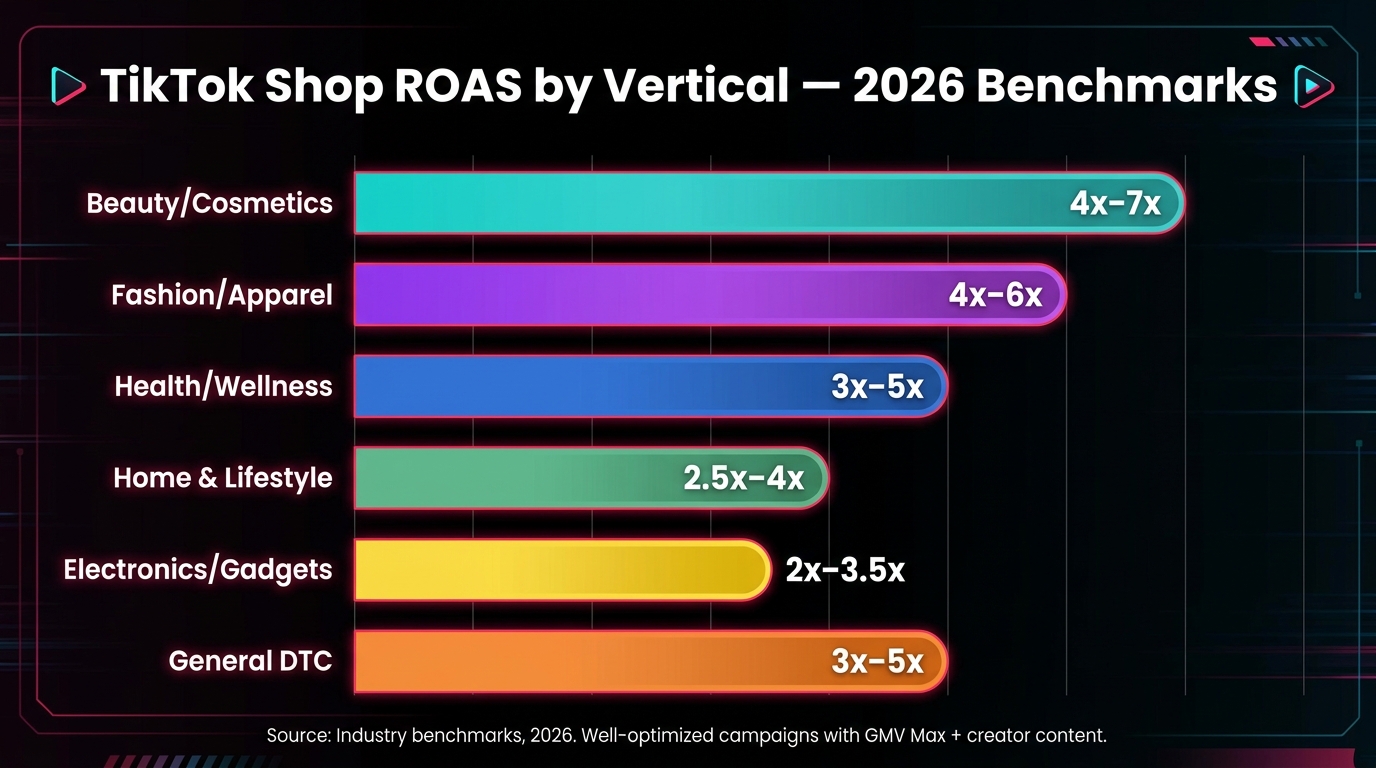
With all the caveats about attribution windows and measurement quality established, it’s useful to understand what the broader market actually looks like for well-operated TikTok Shop programs in 2026. These are not theoretical ideals — they represent the ranges reported by brands and agencies running mature, well-optimized campaigns with proper measurement hygiene.
Vertical-Level Benchmarks
Beauty and Cosmetics: The strongest-performing vertical on TikTok Shop by a significant margin. Well-run beauty brands — particularly those with creator-led content, strong LIVE programs, and high-frequency UGC pipelines — are achieving ROAS in the 4x–7x range under platform-reported attribution. Back-end verified ROAS typically lands in the 2.5x–4.5x range after attribution adjustment. The demonstrability of beauty products (before/after, application tutorials, texture showcases) makes them exceptionally well-suited to TikTok’s video-first format.
Fashion and Apparel: Close behind beauty, with platform-reported ROAS typically in the 4x–6x range for optimized campaigns. Creator try-on content and LIVE try-on sessions drive strong conversion in this category. Cost per order tends to be higher than beauty due to higher average order values, but margin structures are often favorable.
Health and Wellness: A high-growth category on TikTok Shop in 2026, with ROAS benchmarks of 3x–5x for well-positioned products with clear outcome claims that comply with platform policies. Supplements and personal care devices perform particularly well. Brands in this space face higher content compliance scrutiny, which adds creative constraints but doesn’t fundamentally compromise performance for products with legitimate claims.
Home and Lifestyle: More variable performance, with ROAS typically in the 2.5x–4x range. The key differentiator in this category is demonstrability — home products that can be shown solving a clear problem in a short video (cleaning gadgets, storage solutions, kitchen tools) consistently outperform those requiring longer explanation. The viral “wow factor” product dynamic is most pronounced here.
Electronics and Gadgets: Generally the most challenging vertical for ROAS efficiency, with typical ranges of 2x–3.5x. Higher price points mean lower conversion rates from cold traffic, and the consideration period for consumer electronics purchases doesn’t map as naturally to TikTok’s impulse-purchase dynamic. Brands that succeed in this category typically focus on lower-price-point accessories and gadgets rather than high-consideration device purchases.
The LTV Adjustment That Changes the Math
Raw ROAS benchmarks tell an incomplete story for subscription brands, consumables with strong reorder rates, or any category where customer lifetime value substantially exceeds first-order revenue. A beauty brand with a 3x ROAS on first purchase from a customer who reorders the same product four times in the next 12 months has a true LTV-adjusted ROAS of 12x on that acquisition spend. The brands that are most aggressively scaling TikTok Shop ad budgets in 2026 are almost universally those that have modeled their LTV economics and understand that first-purchase ROAS is only part of the picture.
This is particularly relevant for TikTok Shop’s affiliate ecosystem. Brands offering competitive affiliate commissions (typically 10–20% of GMV for competitive categories) are effectively acquiring customers through a commission-only model via affiliate-generated organic content — and ROAS calculations for that traffic look radically different from paid media. Smart operators think about GMV Max paid spend and affiliate commissions as two distinct acquisition budget lines, with different ROAS expectations appropriate for each.
The Discipline of Real TikTok Shop ROAS: Putting It All Together
The brands that are genuinely winning on TikTok Shop in 2026 share a consistent set of characteristics that have little to do with creative magic or algorithm gaming and everything to do with operational discipline and measurement rigor. Here’s what that looks like in practice.
They Build Measurement Infrastructure First
Before scaling spend, they’ve implemented server-side event tracking via the Events API. They’ve reconciled their attribution windows with their back-end revenue data. They know what their “discount rate” is — the gap between Ads Manager ROAS and actual verified ROAS — and they’ve built that factor into their target ROI settings. They run conversion lift studies at regular intervals. This infrastructure is not glamorous, but it is the foundation that prevents the most common and most expensive TikTok Shop advertising mistakes.
They Treat GMV Max as a System to Input Into, Not a Black Box to Surrender To
GMV Max removes many traditional advertiser controls, but it doesn’t remove the operator’s responsibility for what goes into the system. Catalog quality, event match rate, creative asset diversity, and product selection within campaigns are all inputs that directly shape what the algorithm can do. Brands that continuously invest in these inputs — maintaining high-quality feeds, feeding the system fresh creatives weekly, using product exclusions strategically — build a compounding advantage over those who set up GMV Max and treat it as fully autonomous.
They Run Creative Like a Media Desk, Not a Marketing Department
In a 3–7 day creative lifecycle environment, waiting for monthly creative reviews is a guarantee of ROAS erosion. Winning operators have creative pipelines that produce new assets weekly — through UGC programs, affiliate creator networks, or streamlined internal production — and they monitor CTR and frequency daily to rotate before fatigue hits. They use GMV Max’s multi-asset input as a testing engine, systematically learning which creative angles, formats, and hooks perform best for each product, then scaling the winners and replacing them before they plateau.
They Match Bid Strategy to Business Stage
They don’t set aggressive target ROI floors on new products or campaigns in learning phases. They accept lower early ROAS as a data acquisition cost, then tighten the floor incrementally as conversion history builds. They segment campaigns by margin tier, running different ROI targets for hero products versus thin-margin SKUs. And they use LIVE Shopping Ads as a conversion-rate amplifier on warm audiences, rather than as a direct replacement for the always-on Video Shopping Ads that build those audiences in the first place.
Actionable Takeaways for 2026
- Audit your attribution window immediately. Run your Ads Manager reports under both default (7-day click + 1-day view) and 1-day click-only settings. If the gap is more than 40%, you’re overconfident in your absolute ROAS numbers and may be scaling on inflated signals.
- Implement server-side event tracking. If you haven’t connected TikTok’s Events API, this is the single highest-ROI technical investment available for TikTok Shop advertisers right now. Aim for 90%+ event match rate.
- Set a creative rotation trigger, not a timeline. Instead of planning to swap creatives weekly, set CTR drop thresholds (e.g., CTR falls 25% from peak) and frequency alerts (7-day frequency exceeds 4) as your rotation triggers. React to the data, not a calendar.
- Don’t launch with a target ROI. New products and campaigns need 2–4 weeks of unconstrained delivery to build conversion history. Introduce ROI floors gradually and incrementally once the learning phase is complete.
- Audit your catalog event match rate monthly. This single metric has a direct causal relationship with campaign efficiency. Anything below 80% warrants immediate investigation of your pixel and Events API implementation.
- Run a conversion lift study if you’re spending $50K+ per month. Platform-reported ROAS is a useful relative signal. Incrementality testing tells you what TikTok is actually contributing to your business — which is the number that should drive your budget allocation decisions.
TikTok Shop’s ad engine in 2026 is genuinely powerful — capable of delivering strong acquisition economics for the right products, operated with the right discipline. But it rewards operators who understand its mechanics, not those who accept its dashboard at face value. The channel will keep getting more automated, more attribution-complex, and more competitive. The gap between operators who understand what they’re measuring and those who don’t will keep widening. The work of understanding starts with the number that’s already in your Ads Manager right now — and asking, honestly, what it actually means.