


Most brands running TikTok Shop affiliate programs treat whitelisting as an afterthought. They find a creator whose video performs well, request a Spark Ad authorization code, boost it for two weeks, and call the experiment a success. They might do this with five creators. Maybe ten on a good month. And then they wonder why their GMV plateaus.
The brands actually winning on TikTok Shop in 2026 are not thinking about whitelisting as a campaign tactic. They are thinking about it as a production system — a repeatable, data-driven manufacturing operation that processes creators at one end and outputs paid-amplifiable, GMV-generating content at the other, continuously and at scale.
That shift in framing changes everything: how you hire, how you brief, how you measure, and how you manage. A brand running 100+ micro-creators through a whitelisting program is operating a fundamentally different business from one managing ten. The tools, the workflows, the attribution logic, the creator relationships — none of it translates directly. You have to build for volume from day one, or spend six painful months retrofitting.
This post is not about whether micro-creator whitelisting works. The data on that is settled — whitelisted Spark Ads consistently outperform standard brand in-feed ads on conversion rate, cost per acquisition, and ROAS. TikTok’s own figures point to a 2.6% conversion rate for Spark Ads versus roughly 1% for non-Spark, and operators running mature programs report 20–40%+ ROAS improvements when creator content replaces raw brand creative in paid campaigns.
This post is about how you build the machine that captures those gains reliably, at the scale that actually moves the GMV needle — and without the operational meltdowns that kill most programs before they reach their potential.
Why Whitelisting at Volume Is a Different Problem Entirely
When marketers talk about “scaling” their micro-creator program, they usually mean adding more creators. More outreach emails, more product sends, more affiliate codes. But the volume problem in TikTok Shop whitelisting is not primarily a creator acquisition problem. It is an operational complexity problem, and those two things require completely different solutions.
The Complexity Cliff at 20 Creators
Brands consistently report hitting a complexity cliff somewhere around 15–25 active creators. Below that threshold, a spreadsheet, a shared inbox, and a single coordinator can keep things moving. Above it, the same system starts breaking down. Authorization codes expire and nobody notices. A creator’s account goes inactive mid-campaign. A brief sent three weeks ago has been partially followed, misinterpreted, or ignored. GMV attribution overlaps between affiliate tracking links and Spark Ads, and nobody is sure which number to trust.
The cliff exists because the manual coordination load scales roughly linearly with creator count — but the interdependencies between creators, campaigns, content windows, and ad accounts scale super-linearly. Every new creator added to the program does not just add one more tracking row to a spreadsheet. It adds one more set of expiring permissions, one more content approval cycle, one more potential compliance risk, one more variable in your attribution model.
The Volume Threshold That Actually Matters
The real payoff for whitelisting programs comes when the creator pool is large enough to function as a content lottery system — where the sheer volume of seed content created by the pool generates a statistically reliable number of high-performing videos each month, regardless of which specific creators produce them.
Industry practitioners running mature programs point to around 80–120 active micro-creators as the minimum threshold for this lottery effect to work consistently. At that scale, a brand seeding 3–5 products per creator per month generates 240–600 pieces of affiliate content per month. Even with a conservative 5–8% “winner” rate — defined as a video that clears your minimum GMV-per-post threshold — that produces 12–48 pieces of amplification-ready content per month. That is enough inventory to keep a meaningful Spark Ads program running continuously without creative dry spells.
Below 80 creators, you are too dependent on individual creator performance. One creator’s account going quiet, one video underperforming, one product-creator mismatch — and your monthly whitelist content pool takes a material hit. At 100+ creators, individual variance stops mattering. The machine provides.
What “Infrastructure” Actually Means Here
When operators talk about building infrastructure for a whitelisting program, they mean three specific things: a structured intake and onboarding system for creators, a performance-based tier system that determines who gets whitelisted and at what spend level, and a content operations workflow that manages authorization codes, ad setup, and reporting without requiring manual intervention at every step. The rest of this post is a detailed breakdown of how each piece works.
The Two Authorization Modes — and Why Most Brands Use the Wrong One
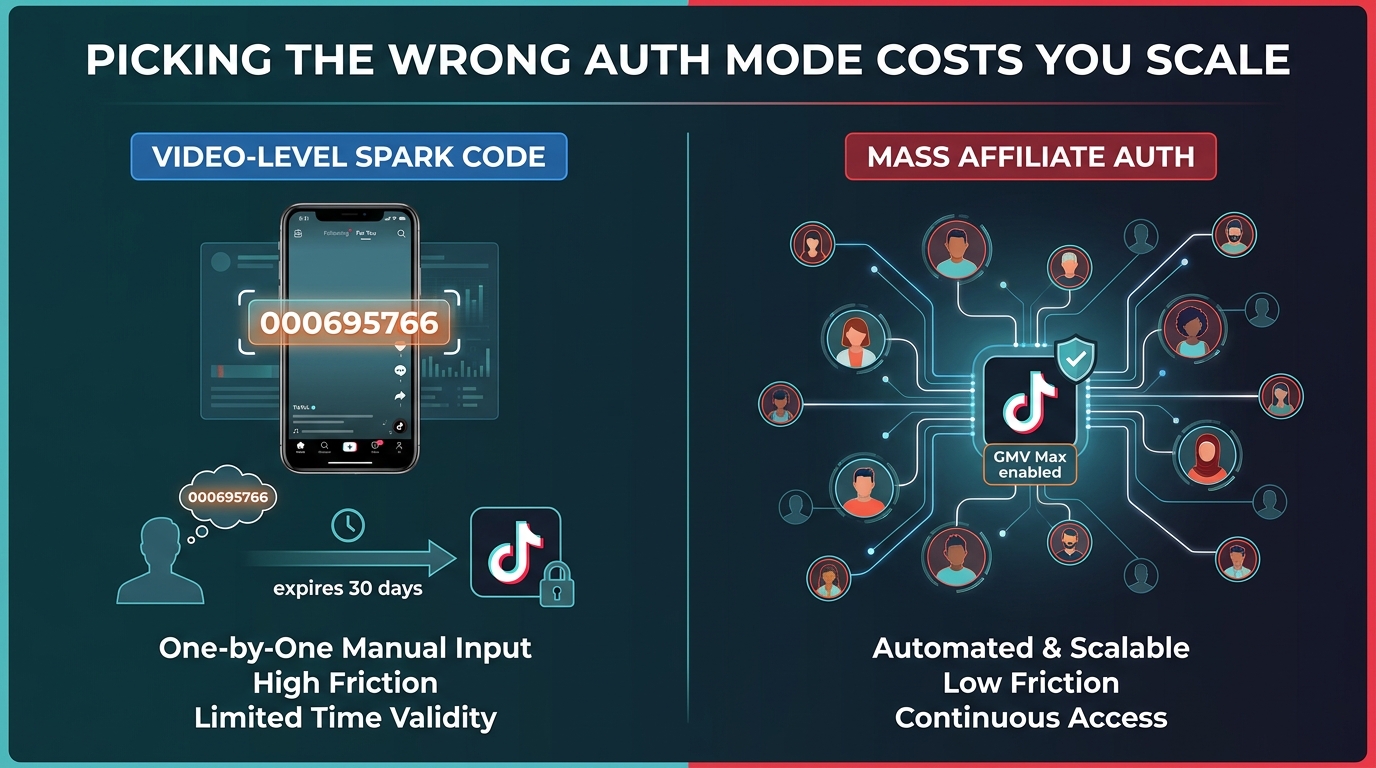
TikTok Shop’s creator authorization system has two distinct modes, and the choice between them has significant downstream consequences for how your entire whitelisting operation works. Most brands default to whichever mode they discovered first, without understanding what they are giving up.
Video-Level Spark Ad Authorization Codes
The more familiar of the two modes is video-level authorization. The creator generates a unique code from a specific TikTok post — either through the TikTok app directly or through the Creator Center — and shares it with the brand’s ad account manager. The brand inputs that code into TikTok Ads Manager and runs a Spark Ad using that specific video as the creative, from that creator’s account handle.
Video-level codes are powerful because they preserve the creator’s authentic handle in the ad unit — which is a meaningful trust signal for viewers. A post showing @healthynaturals_jen with 47.2K followers looks materially different (and more trustworthy) than a brand in-feed ad from @ProteinBrand_Official. The social proof carries, the comments carry, the existing organic engagement carries. These codes expire after a set period (typically 30 days for standard authorization, extendable up to 60 days), which creates a permissions management challenge at scale.
The limitation of video-level codes: they are tied to a single video. If a creator posts three videos this month and you want to whitelist all three, you need three separate authorization requests, three separate code entries, and three separate tracking setups. Multiply that by 100 creators and you are managing hundreds of active codes with staggered expiry dates. Without a dedicated tracking system, codes will expire mid-campaign — killing spend without warning.
Mass / Affiliate Authorization for GMV Max
The second mode — mass authorization — operates at the account level rather than the video level. Under this model, a creator grants the brand’s Business Center account broad permission to use their content in Shop-connected advertising. This is the authorization architecture that underpins GMV Max integration, where TikTok’s AI system can automatically pull in whitelisted creator posts alongside brand content and distribute spend across whatever combination is driving the best real-time purchase outcomes.
Mass authorization is dramatically more scalable from an ops standpoint. Instead of chasing individual codes from 100 creators every 30 days, you manage a list of account-level authorizations that remain active until revoked. The trade-off is that you surrender granular control over which specific videos run. GMV Max decides which content gets budget, optimizing for GMV signals that you may not have full visibility into.
The Right Framework for Choosing
The practical answer for a volume-scale program is to run both modes simultaneously, for different purposes. Use video-level Spark codes for your highest-performing tier of creators — the top 10–15% of your pool whose specific content you actively want to control and amplify. Use mass affiliate authorization for your broader pool to feed GMV Max’s optimization engine. This hybrid approach gives you creative control where it matters most, while automating the scale layer efficiently.
The mistake brands make is using only video-level codes at high creator counts (creating an unmanageable permissions admin nightmare) or using only mass authorization (surrendering all creative insight and control). The two-track system is not optional complexity — it is the architecture that makes volume whitelisting sustainable.
Building the Creator Intake Machine
The quality of your whitelisting output is determined largely upstream, in how you source and qualify creators before they ever post their first video. Most brands treat creator recruitment as a marketing function — find people who seem relevant, send them a DM, ship product. At volume, that approach produces an incoherent pool of creators with wildly different audience profiles, content styles, and engagement quality, making it nearly impossible to predict what whitelist-worthy content looks like in advance.
Sourcing Criteria That Actually Predict Performance
For TikTok Shop micro-creator programs, follower count is the least predictive metric in your sourcing criteria. Engagement rate matters more. Video completion rate matters more still. And for Shop-specific whitelisting programs, the single most predictive proxy metric available before a creator has even posted your product is their existing Shop affiliate activity — specifically, whether they have previously driven purchases through TikTok Shop links for any product.
A creator with 18,000 followers who has a history of converting product reviews into Shop purchases is worth ten times more to a whitelisting program than a creator with 180,000 followers who posts lifestyle content and has never included a purchase-intent CTA. The former has already demonstrated the audience relationship and content behavior required for Shop conversion. The latter is an unknown variable.
When building sourcing criteria, establish minimum thresholds across these dimensions:
- Follower range: 10,000–200,000 (true micro-creator range, where engagement rates are highest and CPMs are still favorable when you whitelist)
- Average video completion rate: Minimum 35–40% across recent posts (signals audience quality, not just size)
- Prior Shop or affiliate activity: At least one documented instance of successful product conversion via TikTok content
- Content cadence: Minimum 3–4 posts per week (indicates they are active and can sustain a content relationship)
- Niche alignment: Not just category-adjacent, but specifically the sub-category your product occupies (a general “fitness creator” is not the same as a “supplement stack reviewer”)
Brief vs. Briefless Approaches at Scale
The brief vs. briefless debate in creator marketing has genuine stakes at scale. Over-briefed creators — given detailed scripts, mandatory talking points, required hooks, and specific pacing requirements — produce content that feels rehearsed and underperforms organically. Under-briefed creators produce content that misses your key product claims, inadvertently violates FTC or TikTok commercial disclosure rules, or simply does not align with your brand positioning.
The working approach for high-volume programs is a structured but minimal brief: a one-page document covering the three product claims you most want communicated, one mandatory disclosure requirement, two or three content formats that have historically worked for your product category, and explicit permission to ignore everything else in favor of authentic storytelling. This brief is not a script. It is a guardrail document that prevents the worst outcomes while leaving creative latitude for the content that actually converts.
At 100+ creators, the brief also functions as a legal compliance instrument. TikTok’s 2026 commercial disclosure requirements — which mandate clear “#ad” or equivalent disclosure on Shop affiliate content — need to be communicated explicitly in the brief, with documented creator acknowledgment. This is not optional. Platform penalties for non-compliant commercial content now include creator account restrictions that can block them from Shop affiliate participation entirely, which directly impacts your whitelisting program.
Onboarding SOPs That Don’t Break at Scale
Your creator onboarding SOP needs to accomplish four things in a single, frictionless flow: establish the commercial relationship (payment terms, commission rates, product send logistics), collect all required compliance acknowledgments (disclosure requirements, content usage rights for whitelisting, brand safety guidelines), set up the affiliate tracking infrastructure (Shop affiliate link generation, UTM parameters, commission structure in TikTok Shop Seller Center), and deliver the brief. Each of these steps becomes a bottleneck if they are handled sequentially and manually. Build them into a single onboarding document or portal flow that a new creator can complete in under ten minutes.
The affiliate link and Shop collaboration setup step is the most commonly broken one in high-volume programs, because it requires actions on both the creator’s side (accepting the collaboration invite in their Creator Center) and the brand’s side (sending the invite through Seller Center, confirming acceptance, verifying the product commission structure is correct). Create an explicit two-day window in your onboarding SOP for this step to be completed and verified before any product ships. Shipping product to a creator who has not yet accepted the Shop collaboration means you will have content posted without affiliate tracking, which is unrecoverable from an attribution standpoint.
The Scoring System That Decides Who Gets Whitelisted
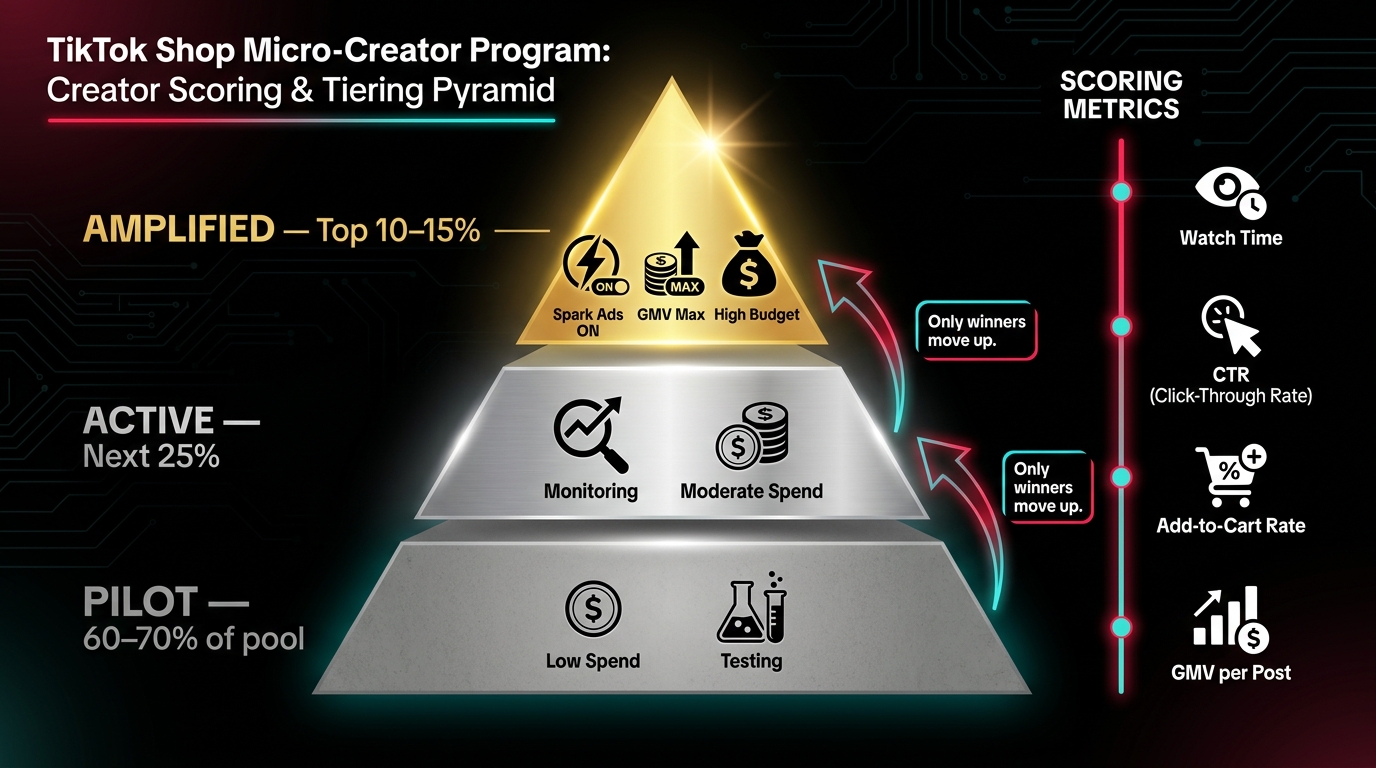
Not every creator in your pool should be whitelisted. And among those who should, not every creator should receive the same ad budget behind their content. The most operationally mature whitelisting programs run a three-tier system that continuously moves creators up and down based on performance data — not gut instinct, not relationship warmth, not follower count.
The Three-Tier Architecture
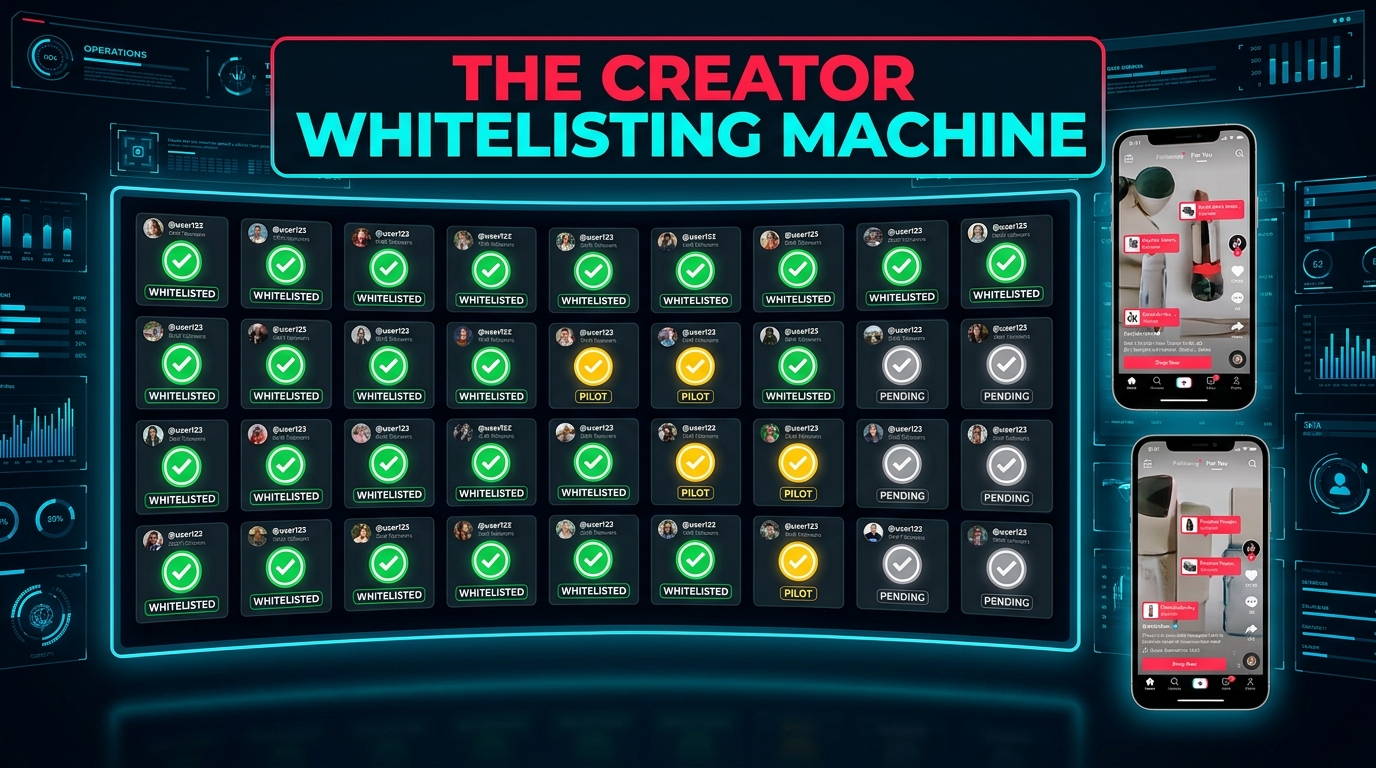
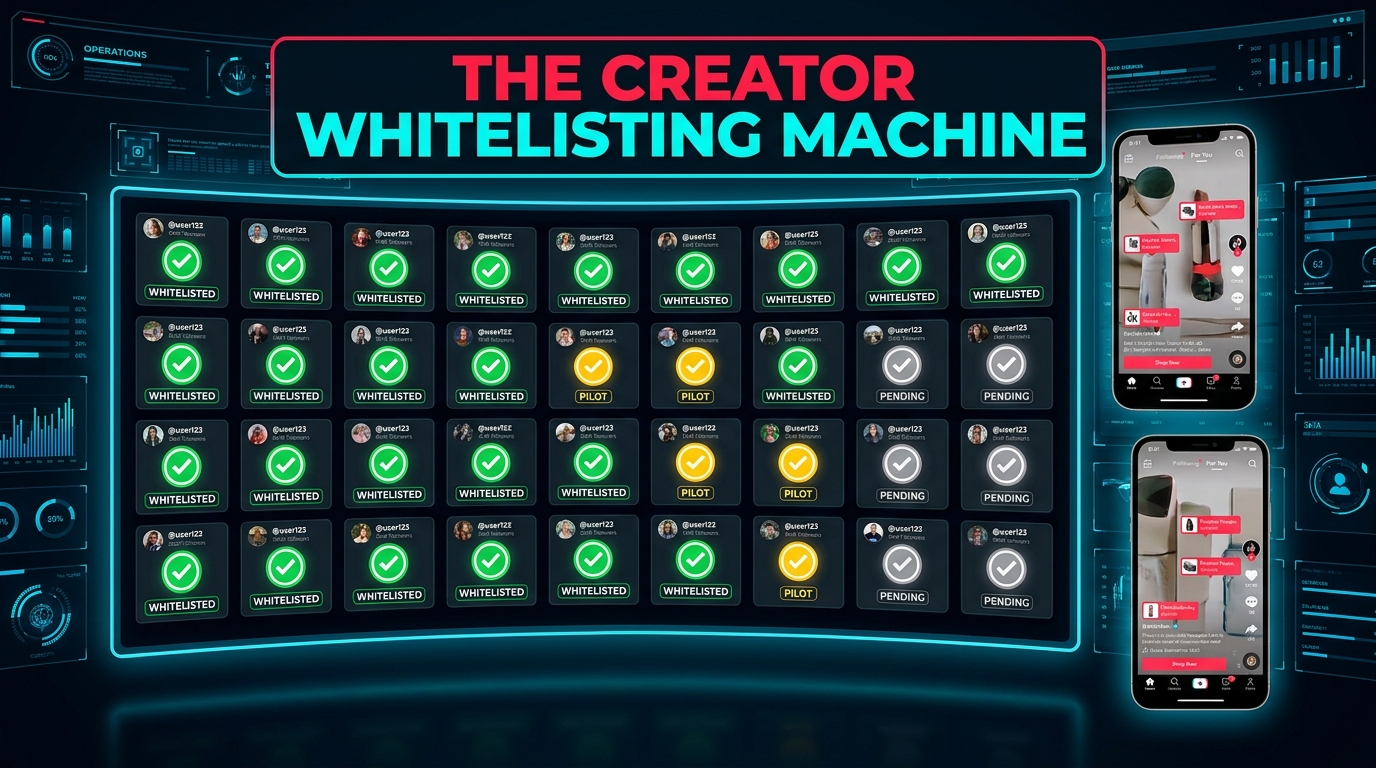
Tier 1 — Pilot (60–70% of your pool): Newly onboarded creators, or creators with insufficient performance data, enter the program at Pilot tier. At this level, there is no paid amplification. The brand provides product, a brief, and affiliate link tracking. Organic performance data accumulates over 2–4 content pieces. This tier functions as your free creative testing pool — the cost is product COGS and coordinator time, not media spend. Think of the Pilot tier as your content lottery tickets. Most will not win. That is expected and fine.
Tier 2 — Active (20–25% of your pool): Creators who clear minimum performance thresholds — typically defined as a video achieving a minimum watch time (45–55% average completion), a minimum add-to-cart rate, and at least one organic purchase conversion — move to Active tier. At this level, the brand requests video-level Spark Ad authorization codes and runs low-spend amplification ($25–$75 per day per creative) to test paid performance. The goal is to confirm that the organic conversion signal holds under paid distribution before committing significant budget.
Tier 3 — Amplified (10–15% of your pool): Creators whose content clears paid performance thresholds — typically a target ROAS floor or a maximum CPA relative to your product margin — reach Amplified tier. This is where meaningful media budget lives. Amplified creators get mass authorization enabled, their content is fed into GMV Max campaigns, and the brand may invest in ongoing product relationships, higher commission rates, or exclusive arrangements to maintain content flow from proven partners.
The Metrics That Drive Tier Movement
Building a creator scorecard requires settling on a small set of metrics that are both predictive and consistently trackable across your entire pool. The most reliable scorecard structure for Shop-focused whitelisting programs uses five weighted metrics:
- GMV per Post (40% weight): The ultimate output metric. How many dollars of tracked Shop purchases does this creator’s content drive per video? This is the number that determines whether amplification pays. Set a minimum GMV-per-post threshold relative to your product’s average order value and margin — for example, a minimum 5x COGS in Shop GMV per organic post before a creator qualifies for Active tier.
- Video Completion Rate (25% weight): The leading indicator of content quality and audience relevance. Higher completion means more viewers reach the product CTA. Anything above 45% on organic distribution is strong for the short-form format. Below 30% means the hook or concept is losing the audience before they reach your product’s key selling points.
- Add-to-Cart Rate (20% weight): Available when the video carries a TikTok Shop product link. Measures intent generated per view. A high completion rate paired with a low add-to-cart rate usually indicates the product presentation is weak, not the content format — the creator is holding attention but not driving purchase intent.
- Comment Sentiment Score (10% weight): A qualitative signal that requires manual review but matters. Comments asking “where can I buy this?” or expressing purchase intent are a strong whitelist signal. Comments expressing skepticism about product quality are a risk signal for paid amplification — once you put spend behind content generating skeptical comments, you are amplifying doubt at cost.
- Creator Reliability Score (5% weight): How consistently does this creator deliver content on schedule, respond to authorization requests, and maintain their compliance requirements? A highly performing creator who responds to Spark code requests four days late, who posts erratically, and who has to be chased for every deliverable creates a hidden operational tax that your scorecard should capture.
Run scorecard updates weekly for Active and Amplified tier creators, and monthly for Pilot tier. Tier movement should be automatic based on threshold rules, not subjective decisions by a coordinator. Systematizing the promotion and demotion process removes the emotional friction that keeps underperforming creators in the program longer than their data justifies — and ensures high-performers get elevated to appropriate budget levels quickly, rather than languishing in Active tier for months.
The Whitelisting Workflow — Permissions at Scale
The mechanics of requesting, collecting, tracking, and renewing creator authorization codes become a significant operational burden at volume. This section deals specifically with the workflow architecture that keeps the permissions pipeline running without constant manual intervention.
The Authorization Request Cycle
Each time a creator in your Active or Amplified tier posts a video that clears your minimum performance threshold for organic content, the trigger fires: initiate authorization request. This means reaching out to the creator with a standardized request — ideally a templated message that tells them exactly which video, why you want to amplify it, what the ad will look like from their end, and the precise steps to generate and share the code.
The message templates matter more than most brands realize. Creators who receive a clear, professional authorization request from a brand they already have a relationship with turn around codes within 24–48 hours. Creators who receive vague or confusing requests — or first-time authorization requests from brands they barely remember agreeing to work with — stall, ignore, or decline. At 100+ creators, the difference between a 70% code response rate and a 90% code response rate is the difference between running a functional paid program and constantly chasing permissions while your creative windows expire.
Build a minimum of three touchpoints into your code request process: an initial request upon performance threshold trigger, a 48-hour follow-up if no response, and a final 72-hour follow-up with a clear deadline. Beyond three touchpoints with no response, move on. A creator who does not respond to three code requests within a week is not a reliable partner for an Amplified tier program — and that unreliability should be reflected in their Reliability Score.
Managing Code Expiry at Volume
Video-level Spark Ad authorization codes expire. The standard window is 30 days, with an optional extension to 60 days available for some accounts and markets. At 100 active creators generating 2–3 whitelistable videos per month, you are potentially managing 200–300 active codes at any given time — each with its own expiry date.
The operational risk is not just administrative annoyance. An expired code kills ad delivery without any platform-side warning. A campaign that stops spending because a code lapsed is invisible in your dashboard unless you have specifically built alerts for it. Brands running mature programs consistently identify this as one of the top three causes of unexpected spend drops — alongside budget exhaustion and creative fatigue.
The solution is a code inventory tracker: a database (a well-structured spreadsheet works at the low end, a proper creator management tool handles the volume better) that records creator name, video URL, code issue date, expiry date, current campaign status, daily spend, and whether a renewal request has been initiated. Set automated reminders for 7 days and 3 days before each code’s expiry. Any code expiring within 7 days that is still actively serving should trigger an immediate renewal request to the creator. Expired but still-serving codes are silent budget killers — find them before they find you.
Error-Proofing the Permissions Pipeline
Beyond code expiry, the permissions pipeline has several other failure points requiring systematic attention. Creator account status changes — a creator getting their account restricted, losing Shop affiliate eligibility, or going private — can silently break campaigns that are technically still active in your Ads Manager. Build weekly account status checks into your coordinator workflow for all Active and Amplified tier creators. This is a five-minute check per creator that catches the kind of account-level issues that otherwise cost you days of unnoticed spend inefficiency.
The other common failure mode is mismatched Business Center connections. TikTok’s authorization system requires that Spark codes be used in the specific ad account connected to the Business Center that the creator authorized. If your brand operates multiple ad accounts — common for brands selling across multiple product lines or markets — a code generated for Ad Account A cannot be used in Ad Account B. Maintaining a clean mapping between creator authorizations, ad accounts, and Business Center connections prevents wasted time chasing code errors that have nothing to do with the creator and everything to do with internal ad account architecture.
GMV Max Integration — The Paid Amplification Layer
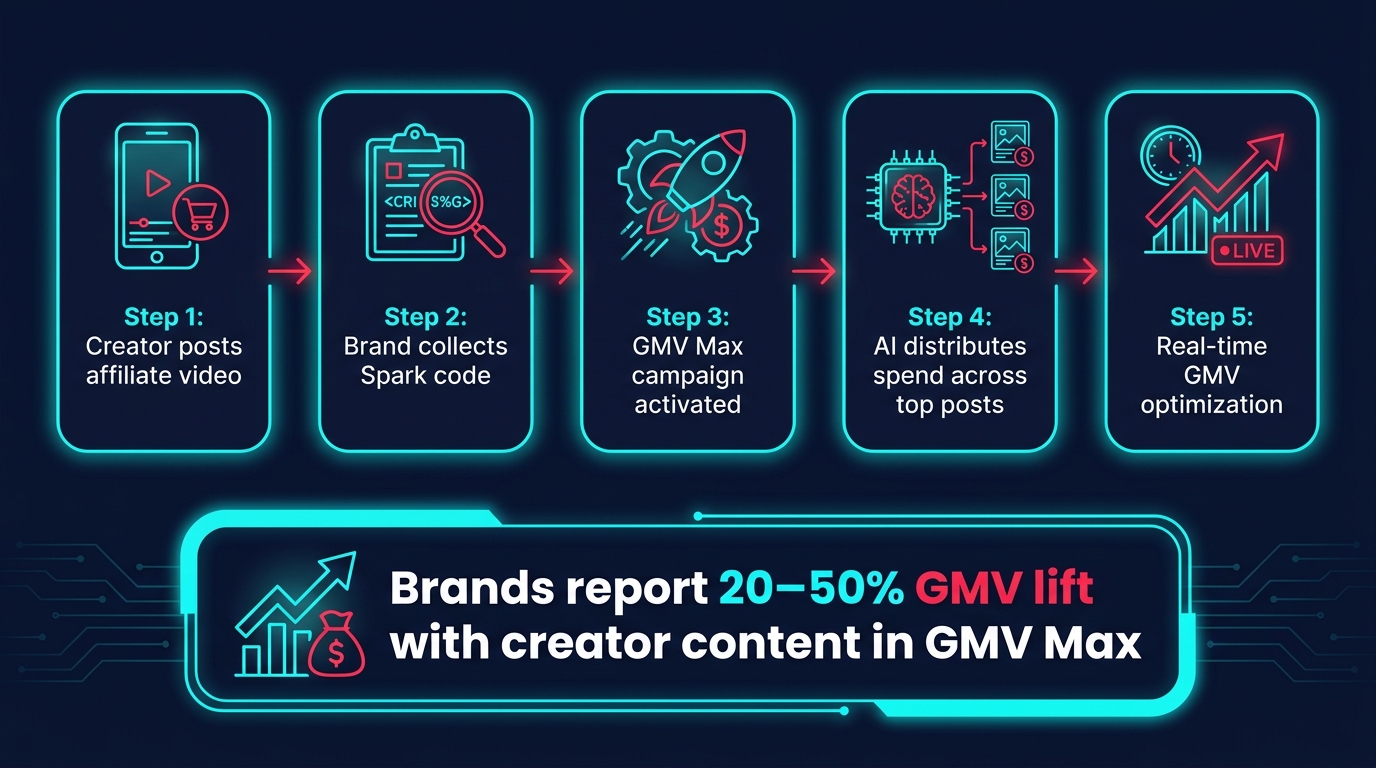
GMV Max is TikTok Shop’s automated campaign type that consolidates organic content, creator affiliate posts, LIVE commerce, and brand ads into a single optimization surface. For brands running high-volume creator programs, it is the natural home for their Amplified tier creator content — and understanding how it works changes how you structure both your creator pool and your ad account architecture.
How GMV Max Reads Creator Content
When a brand’s GMV Max campaign has access to creator content through mass affiliate authorization, TikTok’s AI treats that content as another creative signal in its optimization inventory. It distributes spend across brand videos, creator videos, and product listing pages simultaneously, shifting budget in real time toward whichever content is generating the highest purchase signal at any given moment.
This is why feeding GMV Max a large, diverse pool of creator content is valuable beyond just having “more creatives to test.” GMV Max’s optimization model performs better — reaches learning phase faster and optimizes more confidently — when it has a wider content variation set to work with. A brand feeding 30 creator videos into GMV Max gives the system more signal variation than a brand feeding 5 brand-produced videos, even if the brand videos have individually higher production quality. Volume of creative variation is a genuine performance input, not just a hedge.
The implication for whitelisting strategy: your Pilot tier creator pool is not just a funnel for identifying future Amplified tier creators. It is actively contributing to your GMV Max content diversity, which improves the system’s ability to find and target purchase-ready audience segments. Even Pilot tier content that does not individually clear your whitelist threshold is contributing to the collective signal that makes your paid system smarter.
Budget Allocation Between Controlled Spark Ads and GMV Max
Brands running mature whitelisting programs generally split their creator-related paid budget between two buckets. The first is direct Spark Ads amplification — specific video-level codes run in controlled campaigns where the brand controls targeting, daily spend, and attribution windows. The second is GMV Max budget, where TikTok’s AI controls creative selection and distribution but the brand sets the budget ceiling and target ROAS floor.
A practical starting split is 40% in controlled Spark Ads — for your top 10–15% of performing creator videos, where you want to extract maximum performance data about what works and why — and 60% in GMV Max, for broader distribution of your validated creator content pool. As you accumulate performance data and identify consistently strong content types, gradually shift budget toward GMV Max. It will outperform manual targeting at scale once it has enough signal to work with. The controlled 40% is a learning mechanism; the GMV Max 60% is your volume engine.
TikTok’s own internal testing has reported GMV Max campaigns integrating creator content delivering 20–30% higher GMV compared to equivalent spend in standard product-sales campaigns. That uplift compounds when the creator content pool is continuously refreshed with new Pilot tier graduates — the system keeps encountering novel creative and audience combinations rather than re-optimizing the same stale inventory.
What GMV Max Knows That You Cannot See
One of the practical frustrations of GMV Max for analytical operators is that the system’s optimization logic is partially opaque. Beyond the standard performance metrics visible in Ads Manager, GMV Max incorporates behavioral signals from users who have previously purchased from your Shop, engagement signals from organic distribution of creator content that predates the campaign, and audience affinity data from TikTok’s broader commerce ecosystem.
This means GMV Max can sometimes outperform your manually-selected best creatives — not because your selection was wrong, but because the AI has access to purchase-signal data you cannot directly observe. Resist the urge to over-manage GMV Max campaigns by pausing creator content that appears to be underperforming by surface metrics. Give campaigns a minimum 7-day uninterrupted period before making creative-level decisions, and focus your analysis on campaign-level ROAS rather than per-creative attribution within GMV Max. The system needs room to optimize without interference.
Creative Testing at Scale Using the Whitelisting Pool
One of the most underutilized aspects of a large micro-creator whitelisting program is its value as a creative intelligence engine. When 100 creators are posting product content each month, the resulting variation in hooks, formats, angles, and storytelling approaches constitutes a free creative testing suite that most brands could not afford to produce deliberately.
The Pool as a Creative Laboratory
The standard creative testing discipline in paid social — isolate a variable, run two versions, measure performance difference — works differently in a creator program context. You are not running controlled experiments. Creators differ on dozens of variables simultaneously: their editing style, their hook type, their background environment, their audience demographics, their posting time. What you can extract is pattern-level intelligence rather than variable-isolated conclusions.
Review your top 15% of performing creator posts each month. Look systematically for patterns across multiple performance dimensions: Are the top performers predominantly using demonstration-first hooks (showing the product in use within the first 1.5 seconds) versus testimony-first hooks (leading with a personal outcome statement before showing the product)? Are they using text overlays on the first three seconds? Are they filming in-person or using voice-over on B-roll? Do the high converters tend to be 25–35 seconds long or 45–60 seconds long? Do they use strong final CTAs or let the product listing link do the work? These patterns, when they recur consistently across multiple high-performing creators over multiple months, are real signals worth acting on — not just coincidences in a small sample.
Translating Patterns Into Future Briefs
Once you have identified pattern signals from your high-performing pool, feed them back into the brief for your next cohort of Pilot tier creators. Not as rigid requirements, but as “here is what has worked for this product” guidance. Creators who receive briefs grounded in observed performance data — rather than brand-driven assumptions about what should work — produce content that enters the performance distribution at a meaningfully higher baseline than first-time briefed creators without that context.
This creates a compounding creative intelligence loop that few brands are systematically running. Month one, your creator pool’s performance is essentially random relative to your brief. Month four, your brief reflects three months of pattern data. Month eight, it reflects six months. By the end of a year of consistent operation, your brief is not a guess about what will resonate — it is an empirically validated synthesis of hundreds of real conversion signals from real audiences buying your specific product.
This mechanism is how mature whitelisting programs achieve consistently lower CPA over time — not primarily through better targeting or bid optimization, but through consistently better creative, informed by scale-level data that smaller programs cannot generate. The creative intelligence flywheel is the structural advantage that volume enables and smaller programs cannot replicate.
The Attribution Problem Most Brands Are Getting Wrong
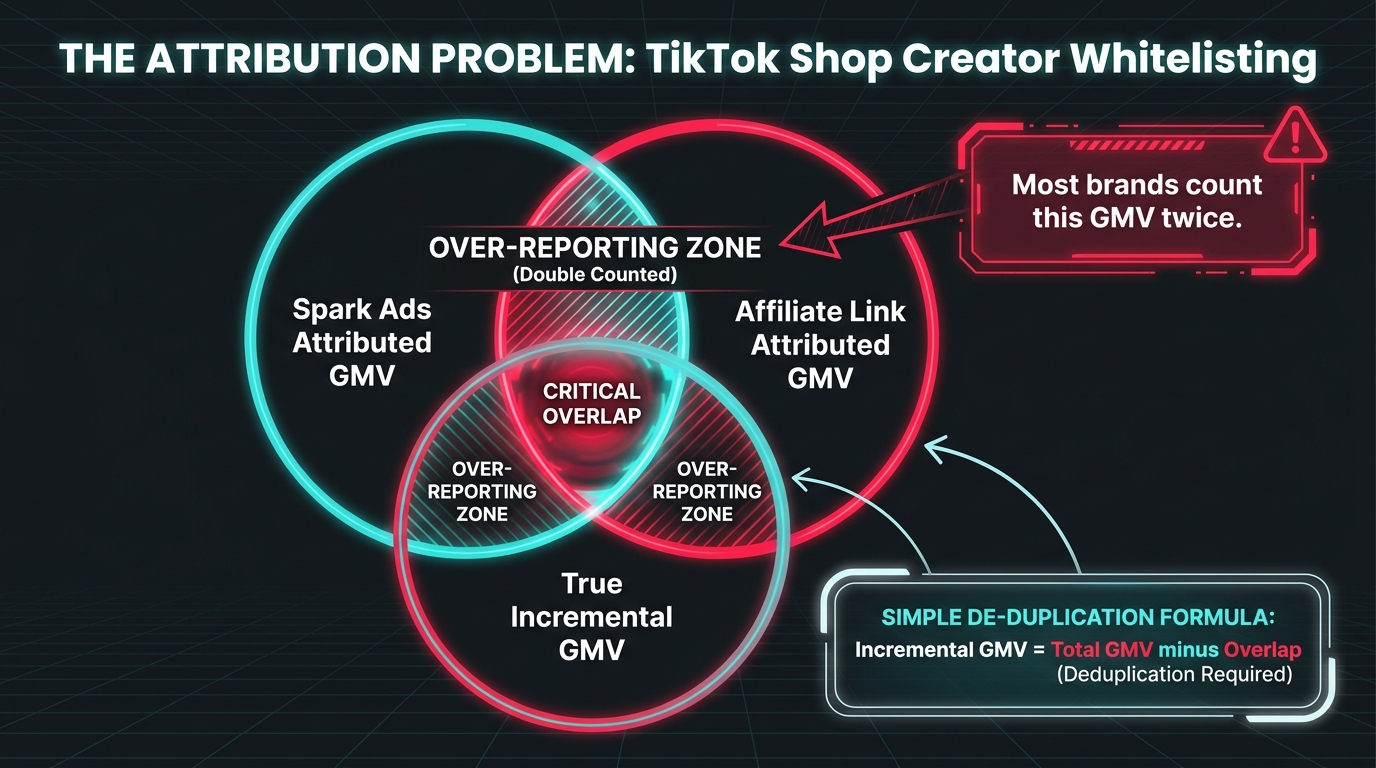
Attribution in a creator whitelisting program is genuinely complex, and most brands are either severely over-counting their creator-driven GMV or flying blind on true incrementality. Getting this right is not an analytical nicety — it determines whether you are profitably scaling a program or confidently losing money on metrics that look good on paper.
The Double-Counting Mechanism
Here is the specific mechanism through which GMV gets counted twice in a whitelisting program. A creator posts a video with an affiliate link (tracked via TikTok Shop’s native affiliate tracking system). A viewer sees the organic post, clicks the affiliate link, and purchases. That purchase is attributed to the creator affiliate channel. The brand then runs that same video as a Spark Ad. A different viewer — or possibly the same viewer on a retargeting path — sees the Spark Ad version and purchases. That purchase is attributed to the paid Spark Ads channel.
So far, so clean. But TikTok Shop’s affiliate tracking system credits a commission to the creator for the duration of their affiliate link’s attribution window — typically 7 days. If a user clicks the organic affiliate post on Monday, sees the Spark Ad version on Wednesday, and purchases on Thursday, both the affiliate channel and the Spark Ads channel may claim that purchase depending on how your attribution windows are configured. The result is a total GMV figure across your channel reports that exceeds actual purchases made.
This overlap is not a system bug — it is an inherent consequence of running the same creator content simultaneously in organic and paid contexts, which is exactly what a whitelisting program does. For most programs running at scale, overlap runs between 15–30% of reported attributed GMV. For a brand reporting $500K monthly in “creator-driven” GMV, that means the real figure may be $350K–$425K. The decision to scale or hold based on that number looks very different depending on which version you are looking at.
Building a Workable De-Duplication Framework
The practical approach for most brands is to use the Shop’s native order management system — actual orders fulfilled — as the GMV denominator. Total confirmed orders times average order value equals your true GMV. This is ground truth. Everything else is attribution logic layered on top of real purchases.
Compare your combined Spark Ads attributed GMV plus affiliate channel attributed GMV against total Shop GMV from confirmed orders. If attributed GMV materially exceeds total Shop GMV, you have overlap. The gap is your double-counting. Track this ratio monthly. If it is stable at around 20%, you can model around it. If it is increasing, something in your attribution window setup is drifting — usually a Spark Ads attribution window extension that was set to 28 days rather than 7 days, resulting in late-purchase attribution claiming orders that affiliate already counted.
The more sophisticated approach — available for brands spending six figures monthly on creator amplification and willing to invest the analytical effort — is TikTok’s incrementality testing framework. Run geographic or audience holdout experiments: expose one matched segment to your full whitelisting program (organic plus Spark Ads) and hold another matched segment back from all paid amplification but allow organic exposure. The GMV delta between the two segments represents your paid whitelisting incrementality. It is the only methodology that genuinely isolates paid contribution from organic lift, and it tends to produce a number that is substantially lower than attributed ROAS suggests — and substantially higher than zero-credit holdout attribution implies. Both extremes are wrong; the incrementality test finds the truth in the middle.
The Creator Churn Problem — Keeping Your Whitelist Fresh
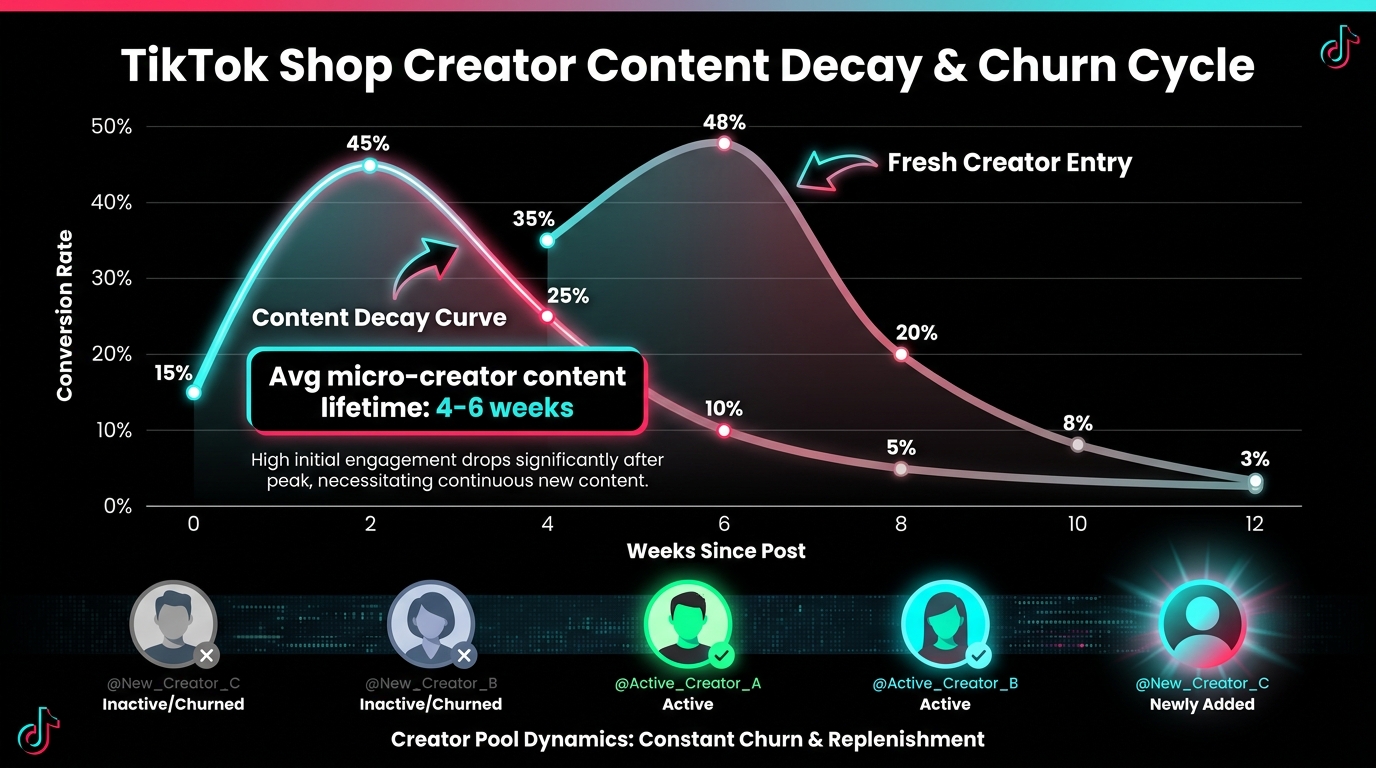
One of the hardest operational problems in high-volume creator whitelisting is managing the natural lifecycle of creator content — and the creators themselves. Even the best-performing creators and videos lose effectiveness over time, and a whitelisting program that does not account for this systematically will find its ROAS eroding slowly and invisibly over the course of months.
Content Decay in Paid Amplification
Creative fatigue in paid social is well-documented: any ad creative, run long enough to the same audience, loses effectiveness as frequency increases. This applies to whitelisted creator content exactly as it applies to brand-produced ads. The difference is that creator content — because it originates as organic content with existing impressions from the creator’s own audience — starts its paid amplification phase with some audience overlap already baked in.
For micro-creators in the 10K–100K follower range, most of the creator’s core audience will have seen the organic post within 48–72 hours of posting. By the time you are amplifying the video as a Spark Ad, the creator’s own followers are already saturated on it. Your paid impressions will primarily reach new audiences outside the creator’s organic reach — which is actually what you want — but if your targeting is not explicitly excluding the creator’s follower base, you are burning spend on already-saturated viewers who have seen that exact video and chosen not to purchase.
Practical content decay management means setting hard maximum run times on individual whitelisted videos — most operators use 4–6 weeks as the standard ceiling, with high-spend videos reviewed for frequency every 2 weeks — and maintaining enough new creative inventory from your Pilot tier to replace fatiguing content without gaps in your active creative library. The moment your active creative rotation drops below 8–10 unique pieces, you are starting to run a fatigue risk whether your frequency metrics show it yet or not.
The Three Modes of Creator Churn
Creator churn in a volume program happens in three distinct modes, each requiring a different management response.
Performance churn is the normal cycle of the tiering system — creators who no longer produce content that clears your minimum thresholds get moved to inactive status and eventually removed from the pool. This is healthy and expected. Process it automatically based on scorecard data, not subjective relationship decisions.
Life churn is when creators become inconsistent due to personal circumstances, platform burnout, or shifting content focus. A creator who was posting five times per week is now posting once a week. Their account is technically active, their previous authorization codes still function, but new content has effectively stopped flowing. This is harder to detect early and harder to manage — track content cadence per creator in your database and flag anyone whose weekly post count drops below two for two consecutive weeks. Reach out proactively before the relationship fully goes cold.
Platform churn is when creators lose Shop affiliate eligibility due to TikTok’s Creator Health Rating system — introduced in early 2026 as a mechanism for gating affiliate benefits based on content quality, commercial disclosure compliance, and engagement authenticity signals. Creators who accumulate compliance violations or engagement quality flags can lose access to Shop affiliate features entirely, which immediately breaks any active mass authorization they have granted. Monitor your Active and Amplified tier creators’ eligibility status weekly. A single Amplified tier creator losing eligibility mid-month can knock a meaningful hole in your GMV Max content inventory if you are not monitoring and responding quickly.
Setting the Right Replacement Rate
A well-run whitelisting program at 100+ creators should be deliberately replacing approximately 15–25% of its pool each quarter through systematic churn management. That means continuously recruiting 15–25 new Pilot tier creators every three months, running them through the intake system, and letting the tiering pipeline determine which ones earn Active status over time.
Brands that stop actively recruiting new creators once they reach their target pool size discover the stagnation problem at the 6–9 month mark, when overall program ROAS starts declining and there are not enough fresh creator entrants to explain why or fix it quickly. The replacement rate is not overhead — it is the mechanism that keeps the creative intelligence flywheel spinning.
The Compliance and Policy Layer You Cannot Ignore in 2026
TikTok’s policy environment for Shop affiliate and creator advertising has changed materially over the past 18 months, and several 2026 updates directly affect how whitelisting programs must operate. Treating compliance as an afterthought is a risk that scales with creator count — one creator’s violation becomes your brand’s policy problem when their content is running as a paid Spark Ad under your ad account.
Commercial Disclosure Requirements in 2026
TikTok’s 2026 commercial disclosure rules require explicit paid partnership disclosure on all content that is created in exchange for payment, free product, or any other consideration, and on all affiliate content that generates a commission. The required disclosure must be visible in the first 5 seconds of the video and included in the caption. Using only a hashtag buried in a long caption no longer satisfies the standard — the disclosure must be prominent.
For your whitelisting program, this creates two distinct compliance points. First, creator-side disclosure at the organic post level — your brief and onboarding acknowledgment must explicitly require this, and you should build a content review checkpoint before requesting Spark Ad authorization codes that confirms the disclosure is present and compliant. Second, ad-level disclosure at the Spark Ad level — TikTok Ads Manager automatically appends a “Paid partnership” label on Spark Ads, so this is handled platform-side, but it is important to understand that the organic post itself must also already be compliant before you whitelist it.
Running a non-compliant post as a Spark Ad does not transfer liability to the platform. The brand and creator remain jointly responsible. A compliance audit of your active Spark Ad inventory — checking that every live piece of whitelisted creator content carries the correct disclosure — should be a standing item in your monthly creator program review.
The Creator Health Rating and Its Implications for Your Program
TikTok’s Creator Health Rating and Promotion Performance Score, formalized in 2026, gate access to Shop affiliate features based on a creator’s history of compliance, content quality, and sales performance. Creators with low Health Ratings cannot participate in Open or Target Collaborations on TikTok Shop, which means they cannot generate the affiliate tracking links your whitelisting program requires.
When building your creator sourcing criteria, add Health Rating status as an explicit qualification check before initiating any collaboration. TikTok shows creators their own Health Rating in Creator Center, and you can request confirmation of Good Standing status as part of your onboarding documentation. Including this as a qualification gate — rather than discovering a new creator’s eligibility problem after you have shipped product and they have posted content — saves significant operational and COGS waste.
Content Removal Risk Mid-Campaign
When TikTok removes a piece of content for policy violations — commercial disclosure failures, prohibited product claims, copyright issues — it does not automatically pause the Spark Ad campaign using that content. The ad account continues attempting to serve, but spend is wasted on non-deliverable inventory. Worse, in some cases, the platform may flag the associated ad account for review alongside the removed content.
Build a content monitoring check into your active campaign workflow: any Spark Ad that suddenly shows a sharp organic reach drop (indicating possible content restriction) should trigger an immediate review of the underlying post’s status. If it has been removed or restricted, pause the associated Spark Ad campaign immediately and request a new authorization code from a replacement piece of content before re-activating spend in that placement.
The Ops Stack — Tools for Managing a Program at Volume
The operational tooling required to run a 100+ creator whitelisting program is not exotic, but it does require intentional architecture. Most brands cobble together a solution from tools that were designed for different purposes, creating friction and gaps that compound at scale.
The Native TikTok Layer
TikTok’s own platform provides the following essential tools for whitelisting program management: TikTok Shop Seller Center (product management, affiliate collaboration management, commission structure setup, affiliate performance analytics), TikTok Ads Manager (Spark Ad campaign setup, authorization code input, campaign performance data), TikTok Business Center (ad account management, user permissions, multiple-account governance), and Creator Center (creator eligibility status, Health Rating, video performance analytics at the creator side).
Native tools are necessary but not sufficient. Seller Center’s affiliate analytics give you creator-level GMV data but do not natively aggregate into a scorecard format. Ads Manager gives you Spark Ad performance data but does not connect it back to creator identity without manual cross-referencing. Business Center manages permissions but does not track expiry dates proactively. The gaps between these tools are where operational complexity lives — and where most brands’ programs start failing as they scale past 30–40 creators.
The Third-Party Layer
Several creator management and influencer marketing platforms now offer TikTok Shop-specific workflow features that address the gaps in TikTok’s native tooling. Platforms in this category — including Grin, Aspire, Creator.co, and newer Shop-native tools — offer varying combinations of creator CRM functionality, automated authorization code tracking, performance analytics aggregation, and outreach workflow management.
The key evaluation criteria for this layer are: native TikTok Shop API integration (so affiliate data and Spark Ad performance data flow into the same view without manual export), authorization code tracking with automated expiry alerts, creator scorecard customization (so your specific tier thresholds can be configured in-platform rather than maintained in a separate spreadsheet), and mass outreach capability with template management.
Not every brand needs a dedicated creator management platform immediately. The threshold for when the investment pays off is roughly 40–50 active creators — below that, a well-designed spreadsheet system with a disciplined coordinator can handle the load. Above it, the time cost of manual tracking starts to exceed the cost of the tooling. Build your spreadsheet system first (it forces you to define exactly what you need to track), then migrate to a purpose-built platform when the data volume justifies it and you have clear requirements to evaluate tools against.
The Spreadsheet-to-System Evolution Path
For brands building their first high-volume whitelisting program, a structured approach to the spreadsheet layer pays dividends before any platform investment is made. The minimum viable tracking architecture requires four interconnected documents: a Creator Master List (identity, tier, contact info, onboarding status, compliance acknowledgments), a Content Performance Tracker (all posted videos, performance metrics, tier qualification status), an Authorization Code Inventory (active codes, issue dates, expiry dates, associated campaigns, renewal status), and a Monthly Scorecard Rollup (aggregate creator performance, tier movement log, cohort GMV contribution).
These four documents, rigorously maintained and reviewed in weekly coordinator check-ins, can support a program of 60–80 creators before friction becomes unmanageable. They also create the data foundation that makes any future platform migration clean and well-informed — rather than importing chaos into a new tool and expecting the tool to resolve it.
Conclusion: Building the Machine, Not Running the Campaign
The central insight of this entire discussion can be stated simply: micro-creator whitelisting at scale is a manufacturing operation, not a marketing campaign. Campaigns have start dates, end dates, and point-in-time success metrics. Manufacturing operations have throughput rates, defect rates, cycle times, and continuous improvement loops. The mental model you bring to this work determines whether you build something that compounds in value over time or something that delivers a few good months and then stagnates.
The brands that are structurally winning on TikTok Shop in 2026 have internalized this framing. They have a defined intake process for new creators, a tier system that automates promotion and demotion decisions, an authorization code pipeline that runs without constant manual intervention, a GMV Max integration that feeds on their creator pool’s output, a creative intelligence loop that makes their briefs smarter every month, an attribution framework that reflects reality rather than flattering their channel reports, and a replacement rate that keeps the whole system fresh.
Building that machine is a 3–6 month project for a brand starting from scratch. The first month is infrastructure: intake SOPs, brief templates, scoring criteria, tracking spreadsheets, Business Center architecture. The second month is Pilot pool seeding: getting 40–60 first-wave creators through onboarding and into content creation. The third month is first whitelist decisions: identifying your initial Active tier cohort from Pilot performance data and running your first Spark Ad tests. By month four or five, you have enough data to make your first informed GMV Max budget allocation decisions and enough creative pattern intelligence to meaningfully improve your brief for the next cohort.
The goal is not to find great creators. Great creators are rare and expensive. The goal is to build a system that reliably converts a large pool of ordinary micro-creators into a continuous stream of purchase-driving content — and then amplifies the fraction of that content that actually converts, at scale, automatically.
That is what a creator whitelisting machine does. And in a TikTok Shop ecosystem projected to hit $23.4 billion in US GMV in 2026, brands that have built the machine are not competing on the same terms as brands still running campaigns.
Key Actionable Takeaways
- Target 80–120 active micro-creators as the minimum pool size for consistent whitelist-ready content output each month
- Run a hybrid authorization model: video-level Spark codes for your top 10–15% of performing creators, mass affiliate authorization for the broader pool feeding GMV Max
- Build a three-tier creator system (Pilot → Active → Amplified) with automatic promotion/demotion based on a five-metric scorecard, reviewed weekly
- Track authorization code expiry proactively — expired codes kill campaigns silently; build 7-day and 3-day alerts into your code inventory tracker
- De-duplicate your GMV attribution against actual confirmed orders, not combined channel-reported figures
- Plan for 15–25% quarterly creator pool replacement to combat content decay, life churn, and platform eligibility churn
- Build the spreadsheet system before buying the platform — know exactly what you need to track before evaluating third-party creator management tools
- Review your Pilot tier’s top performers monthly to extract content pattern signals that improve your brief for the next cohort