


Most brands approach TikTok Shop like they approach other channels: build a content calendar, post a few times a week, track what gets traction, and repeat. If that approach sounds familiar, it also probably sounds like a description of why your shop isn’t moving the needle.
TikTok Shop operates on a fundamentally different competitive math than Instagram, email, or even TikTok’s own paid ad ecosystem. The algorithm is built around discovery — and discovery is, at its core, a volume game. The more quality content you put into the system, the more surface area you create for a single piece to find its audience, trigger purchases, and feed a virtuous cycle back to your other listings and your live sessions.
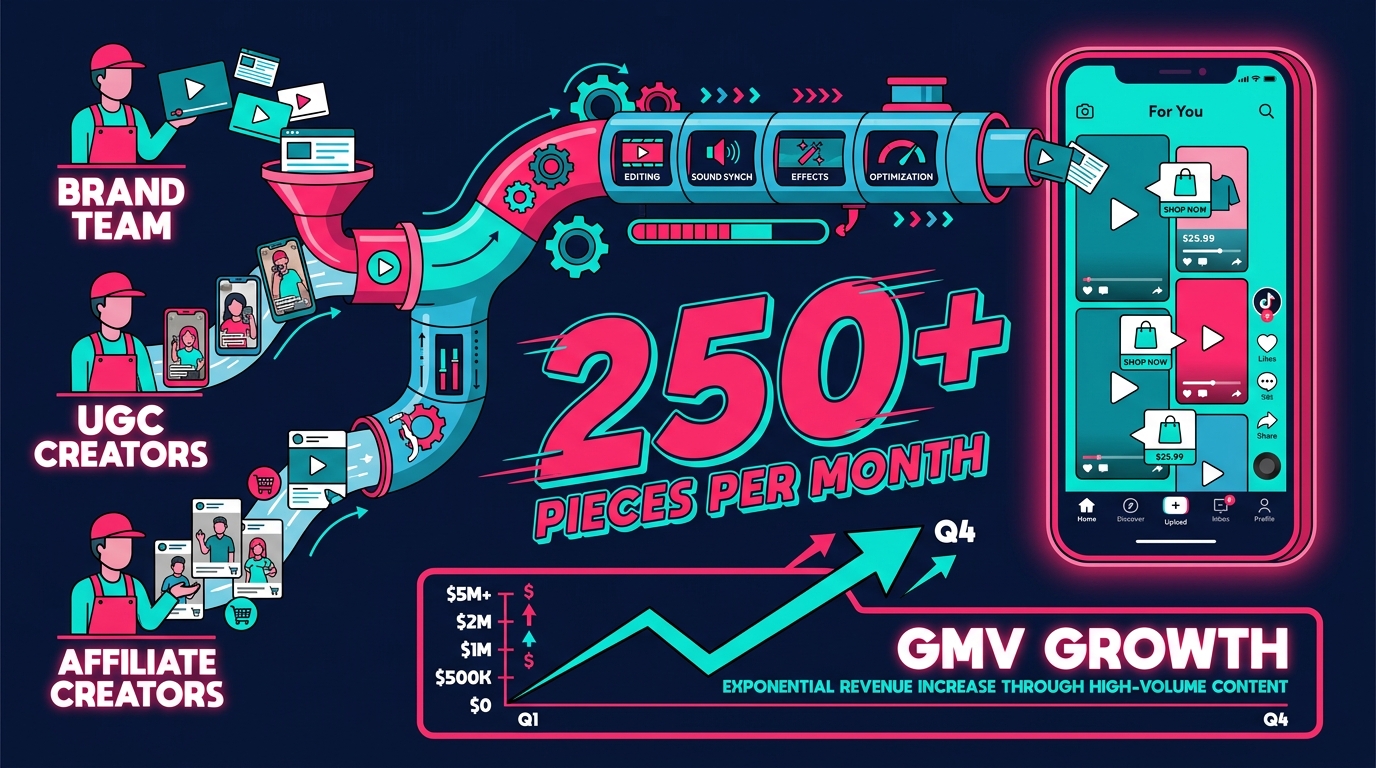
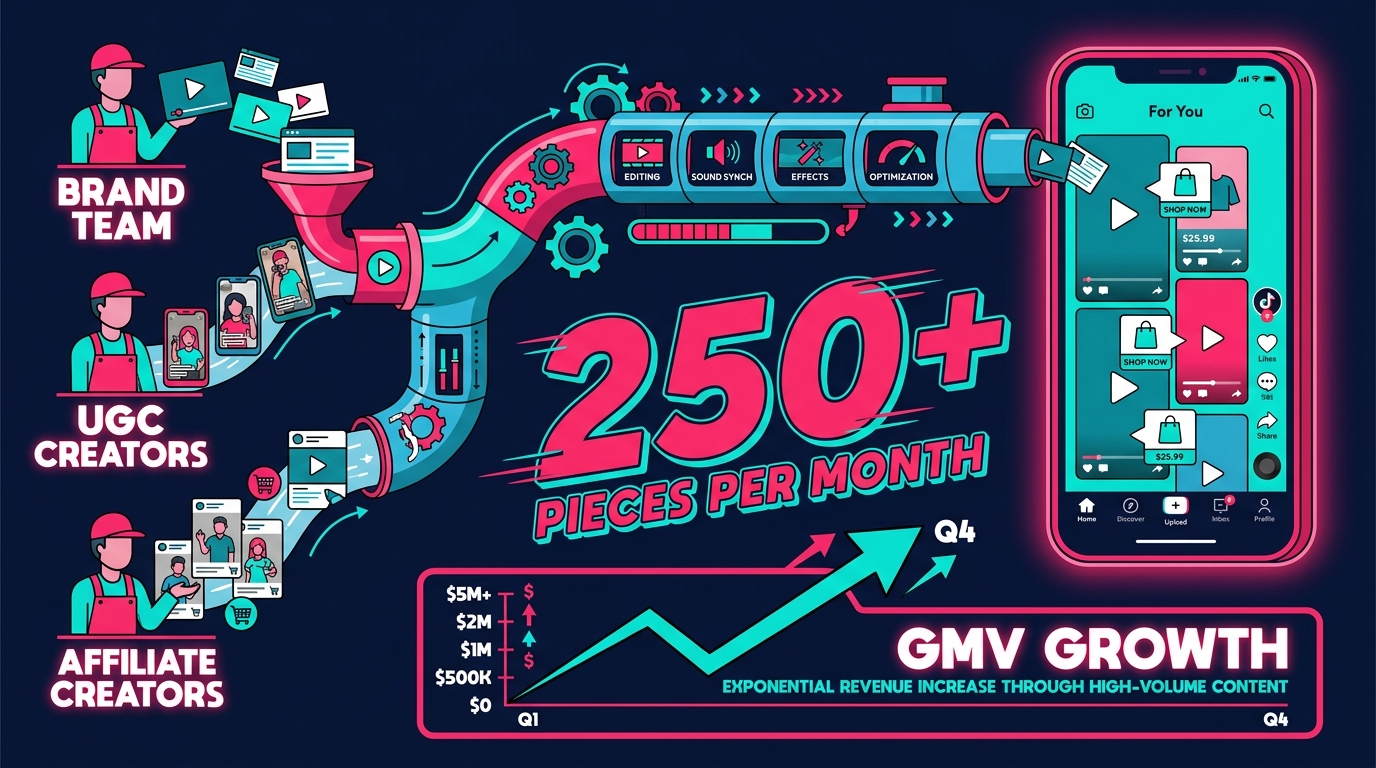
Research from Shortform Nation’s 2026 social commerce analysis found that brands posting fewer than 50 pieces of content per month across their networks are essentially invisible on TikTok Shop. The competitive threshold — the minimum volume to stay in regular algorithm rotation — has climbed to roughly 250 pieces per month across brand, creator, and affiliate content combined. That’s approximately 8–12 pieces of content entering the platform every single day.
For most brand operators, that number triggers one of two reactions: panic or disbelief. Both are understandable, but neither is useful. Because building a content engine that reaches 250 pieces per month isn’t about hiring an army of editors or posting garbage at scale. It’s an operational design problem — and it’s more solvable than it looks from the outside.
This article is about how to design that engine: the team structure, the content layers, the brief formats, the hook frameworks, and the performance loops that turn raw creative output into measurable GMV. If you’ve already covered the basics of TikTok Shop SEO and algorithm mechanics, this is the layer that sits above those foundations — the operational infrastructure that lets you actually capitalize on them at scale.
The Math Nobody Talks About: What 250 Pieces Per Month Actually Looks Like
Before you can build a content engine, you have to demystify the number. “250 pieces per month” sounds enormous in the abstract, but when you break it into component sources, it becomes significantly more tractable.
Where the Volume Actually Comes From
The first thing to understand is that 250 pieces per month is a network total, not an individual account output. No single creator, editor, or brand account is expected to post 8+ pieces of content per day. The number refers to the aggregate volume across every content source associated with your TikTok Shop: your brand-owned account, your gifted UGC creators, your paid collaborators, and your affiliate network.
A realistic breakdown for a mid-size brand with a functioning content engine might look like this:
- Brand-owned account: 3–5 posts per week = ~16–20 pieces per month
- Gifted/paid UGC creators: 15–25 creators posting 2–4 pieces each = ~50–100 pieces per month
- Active affiliates: 50–100 affiliates posting 1–3 pieces each = ~100–150 pieces per month
- Live stream clips repurposed: 2–3 live sessions clipped into 3–5 short videos each = 10–20 additional pieces per month
At the low end of those ranges, you’re at roughly 176 pieces. At the high end, you’re well past 290. The 250 threshold is achievable once your affiliate and UGC programs have enough active participants producing content consistently.
Why Volume Matters More Than You Think It Does
The intuitive objection to high-volume content strategies is quality dilution: if you’re producing 250 pieces a month, surely the average quality drops. And in one sense, that’s true. Not every piece will be a winner. The data from TikTok Shop analytics consistently shows that the top 15–20% of content drives the overwhelming majority of GMV.
But that’s exactly the point. You cannot know in advance which videos will be in that top tier. TikTok’s algorithm is unpredictable in its distribution — a low-production 23-second demo filmed in someone’s bathroom can outperform a beautifully edited 60-second brand video. Volume is the mechanism by which you generate enough data to identify those winners, understand what made them work, and systematically produce more of the same.
Creators posting five or more times per week on TikTok Shop generate 3.2x higher GMV than those posting one to two times per week, according to Shortform Nation’s 2026 analysis. That isn’t primarily because more posts means more individual chances at purchase — it’s because higher-frequency creators accumulate performance data faster, enabling faster creative iteration. The volume is the learning engine.
The Compounding Effect Over Time
TikTok Shop content doesn’t expire the way a promotional email does. A video that lands in someone’s For You Page six weeks after it was posted can still drive significant sales. Older videos that gain social proof (comments, shares, saves) are more likely to be redistributed by the algorithm to new audiences. This means your content engine becomes exponentially more valuable over time: the content you posted in month one is still generating impressions and conversions in month four.
Brands that have been running high-volume content engines for 12+ months describe a “content compounding” effect where their organic GMV continues growing even during weeks when they produce below-average volume — because the existing library is doing ongoing work on their behalf.
The Three-Layer Content Stack
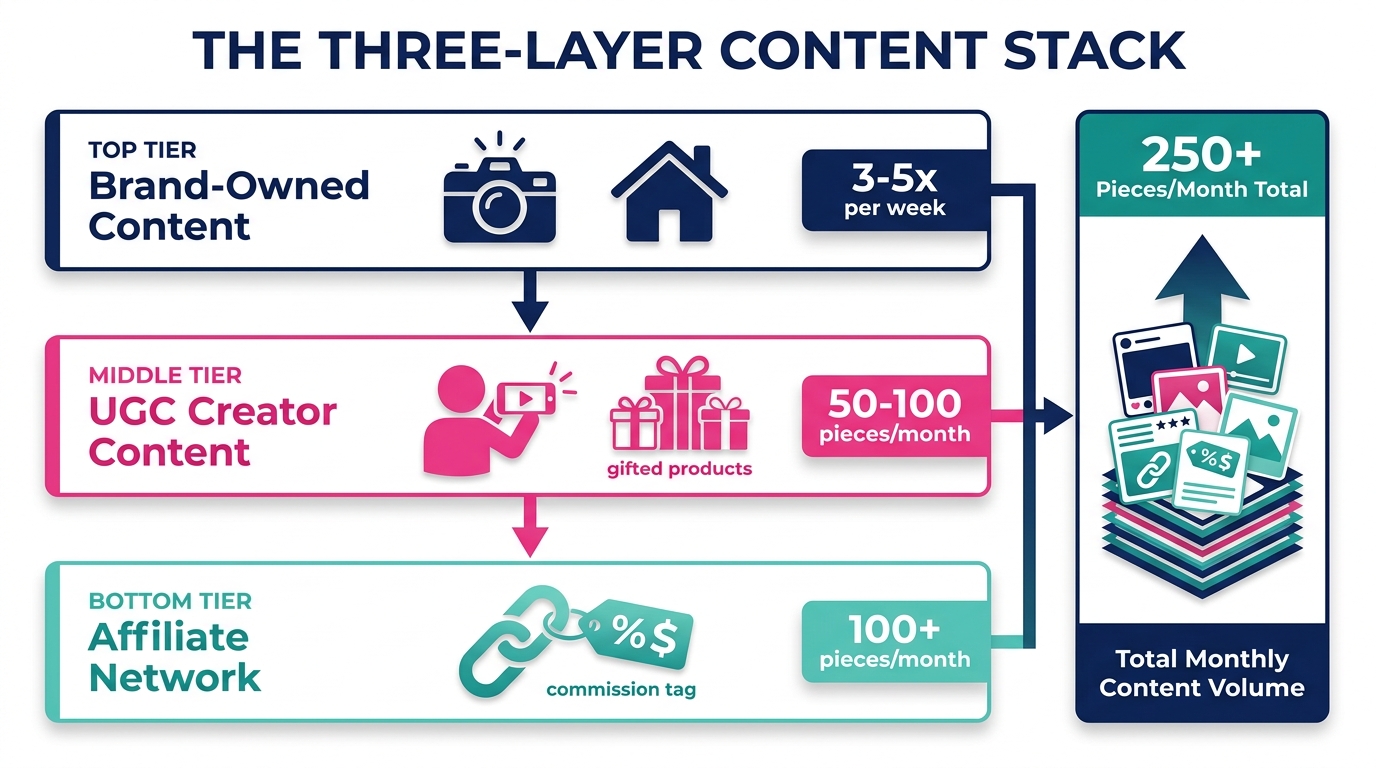
Not all content in your TikTok Shop engine serves the same purpose, and confusing the layers leads to a muddled strategy where each layer underperforms because it’s being asked to do a job it wasn’t designed for. The most effective content engines in 2026 operate with three clearly differentiated content layers, each with distinct objectives, briefs, and performance metrics.
Layer 1: Brand-Owned Content (The Foundation)
Brand-owned content is produced or directly controlled by your team and published from your brand’s TikTok account. Its primary job is not volume — it’s brand coherence, product education, and providing a consistent home base that legitimizes the rest of your content network.
Think of Layer 1 as your editorial voice. This is where you control messaging, introduce product lines, run promotions, respond to comments, and build a direct relationship with your followers. Posting frequency should be consistent rather than explosive: 3–5 times per week is a healthy cadence that keeps the algorithm active on your account without requiring a full production department.
Content types that work well in Layer 1 include founder-story videos, product launch announcements, before-and-after demonstrations, FAQ responses triggered by real customer comments, and behind-the-scenes production footage. The common thread is that these are content types that benefit from brand knowledge and would be difficult for an external creator to produce credibly.
One often-overlooked function of brand-owned content is serving as a brief library for Layers 2 and 3. When a format or hook works on your brand account, that performance data is the clearest possible signal to your UGC and affiliate teams about what to replicate. Your brand account shouldn’t only be audience-facing — it should be functioning as a continuous creative test environment.
Layer 2: UGC Creator Content (The Volume Engine)
User-generated content — produced by creators you’ve gifted, paid, or activated on a per-deliverable basis — is the layer that does the heaviest lifting in a scaled content engine. These creators post from their own accounts, reaching their own audiences, while tagging your products in TikTok Shop. The distribution is theirs; the product cards drive traffic back to your listing.
The most effective UGC programs in 2026 are built around a “creator bench” model rather than one-off influencer campaigns. A bench consists of 20–50 recurring creators who understand your products deeply, have established content styles that work for your category, and are producing deliverables on a monthly retainer or per-video deal. Bench creators don’t need to be re-briefed from scratch every month — they know your products, they know your brand voice, and they can ideate and produce content with minimal hand-holding.
Finding bench creators requires a different recruiting lens than influencer campaigns. Follower count matters less than conversion rate per view, audience demographic alignment, and content production reliability. A creator with 8,000 followers who consistently drives a 6% conversion rate on product links is more valuable to your content engine than a creator with 150,000 followers who posts sporadically and converts at 1.2%.
Budget reality check: Most brands running effective Layer 2 programs spend between $15 and $75 per video on UGC from nano and micro-creators, often combining product gifting (especially for lower-AOV items) with modest cash compensation. For a $30 product with a 30% margin, a single video that generates 25 purchases pays for itself — and the video continues working indefinitely.
Layer 3: Affiliate Content (The Scale Multiplier)
TikTok Shop’s affiliate marketplace allows creators to find and promote your products without any direct relationship with your brand. They earn commission on sales they generate; you get content you didn’t have to brief, produce, or pay upfront for. At scale, a healthy affiliate program is the mechanism that takes your content network from dozens of monthly pieces to hundreds.
The critical difference between a functioning affiliate program and an ineffective one is activation rate. Most brands with TikTok Shop affiliate programs have a long tail of creators who applied, received samples (if applicable), and then never posted. The brands that generate meaningful affiliate GMV invest in creator activation: onboarding sequences, product education, featured commission structures for top performers, and regular communication that keeps your product top-of-mind for the creator’s content planning.
Setting a competitive commission rate is table stakes — the 2026 standard in most categories sits between 10% and 20% for standard affiliates, with performance bonuses for creators who hit GMV thresholds. But commission alone doesn’t activate creators. The brands that consistently see high affiliate content volumes are the ones who make it easy: strong product pages with clear selling points, pre-written hook suggestions, sample scripts, and a creator FAQ that handles the most common content questions before they become friction points.
Building Your In-House Production Cell
The phrase “in-house content team” conjures images of a full studio setup, multiple full-time employees, and a monthly production budget that could fund a small TV pilot. For most TikTok Shop operators, that picture is wrong in every detail. The in-house production cell that powers a high-volume content engine is lean, process-driven, and fundamentally different in structure from a traditional marketing team.
The Minimum Viable Team
The smallest functional in-house team for a TikTok Shop content engine consists of three roles, which can overlap in a small business:
The Content Strategist / TikTok Lead owns the overall content direction. This person watches performance data weekly, decides which formats and hooks to test next, writes creative briefs for UGC and affiliate creators, manages the content calendar, and serves as the liaison between the content engine and the commercial team (GMV targets, promotional calendar, new product launches). In larger organizations, this role is often combined with e-commerce or growth marketing. In smaller brands, it’s frequently the founder.
The Creator / Shooter is responsible for producing the brand-owned content on Layer 1. This isn’t a role for someone who’s never been on camera — TikTok rewards authenticity, and authenticity comes from comfort in front of the lens. The best person for this role is someone who genuinely uses your products, can speak naturally about them, and understands TikTok’s visual language without being instructed to “be more natural.” Production quality requirements are deliberately low: a modern smartphone camera, adequate natural or ring-light lighting, and a basic lapel or shotgun microphone are sufficient for content that consistently performs.
The Editor / Operations Manager handles post-production, creator communications, performance reporting, and workflow management. On the content side, this means cutting raw footage into final assets, adding captions and on-screen text (which TikTok’s algorithm reads for context), and repurposing winning content into additional formats. On the operational side, this person manages the creator CRM, tracks deliverables, processes product shipments to UGC creators, and compiles the weekly performance report that drives brief adjustments.
Physical Setup and Equipment
The equipment floor for a lean TikTok content studio is more modest than most brands expect. A smartphone (recent iPhone or Android flagship), a basic ring light or softbox, a simple fabric or paper backdrop, and a compact wireless microphone are all you need to produce brand-owned content that performs. The total investment for a functional shooting setup is typically under $500.
What matters more than equipment is setup consistency. One of the hidden operational advantages of a dedicated content setup — even a minimal one — is that your production team doesn’t spend time recreating their shooting environment every session. Set it up once in a corner of your office or warehouse, leave it assembled, and anyone on the team can shoot content with minimal prep time. Batch filming sessions of 2–3 hours can yield 8–12 brand videos in a single afternoon.
The Weekly Production Rhythm
Sustainable content engines don’t operate on spontaneous inspiration — they run on predictable weekly rhythms. A functional weekly production schedule for the in-house team looks approximately like this:
- Monday (Data Sprint, ~45 minutes): Review last week’s content performance. Flag top performers for repurposing. Identify patterns in watch-time dropoff. Pull trending sounds and formats from TikTok Creative Center. Update briefs for the coming week.
- Tuesday–Wednesday (Production): Batch-shoot brand content for the week. Aim for 5–8 raw takes, accepting that 4–5 will become final posts. Record live stream preparation and product highlight footage simultaneously.
- Thursday (Edit and Schedule): Edit and caption all brand-owned videos. Schedule posts using TikTok’s native scheduler or a third-party tool. Send the week’s creative brief updates to UGC creators and active affiliates.
- Friday (Creator Operations): Review affiliate submissions, process incoming UGC deliverables, respond to creator questions, and manage product shipments for the following week’s seeding.
This rhythm keeps content production from becoming a crisis. The worst content engines are ones where posting volume is dictated by inspiration and availability rather than a fixed operational schedule. When the schedule slips, the algorithm notices — and rebuilding momentum takes longer than maintaining it.
Creative Briefs That Convert: The Anatomy of a Scalable Brief
A creative brief is the highest-leverage document in your content engine. A well-written brief multiplies across 50 creators simultaneously, maintaining strategic alignment without requiring individual conversations. A poorly written brief produces 50 videos that miss the mark in 50 different ways.
The brief format used by the best-performing TikTok Shop brands in 2026 is notably shorter and more prescriptive than traditional influencer marketing briefs. It doesn’t explain your brand history or describe your target customer in demographic terms. It focuses on exactly three things: the problem to surface, the proof to deploy, and the format to follow.
The Six-Component Brief Framework
1. The Product Truth (1–2 sentences): What is the single most compelling, demonstrable fact about this product? Not a marketing claim — a product truth that could be shown on camera. “This concealer covers dark circles in one swipe” is a product truth. “Our formula is dermatologist-tested” is not.
2. The Target Moment: What specific situation is your customer in when they most need this product? Be precise. Not “someone who wants to look good” but “someone getting ready in 10 minutes who needs their under-eyes to not look exhausted.” The more specific the moment, the more resonant the hook.
3. Required Hook Type: Specify one of three hook categories — Problem Hook (“Tell me you struggle with X”), Curiosity Hook (“I didn’t expect this to work but…”), or Results Hook (“I’ve replaced my [expensive alternative] with this”). Giving creators a hook category rather than a script allows individual creative expression while maintaining strategic focus.
4. Must-Show Moments: List 2–3 specific visual moments the video must include. For a skincare product: “Show the before with no foundation,” “Show the application on the under-eye area,” “Show the after in natural light.” These are non-negotiable visual beats; everything else is the creator’s discretion.
5. Proof Elements Available: What social proof can creators pull from? Star ratings, number of units sold, customer reviews, before-and-after data? Make this specific and easy to reference. Creators who have access to compelling proof data will use it; those who have to hunt for it won’t bother.
6. Video Length and Format: Specify whether this brief calls for a short demo (15–30 seconds), a problem-solution narrative (30–45 seconds), or a longer tutorial format (60–90 seconds). Don’t leave this open-ended — the format choice dramatically affects watch time and completion rate, which are your primary performance levers.
Brief Versioning and Testing
A critical discipline that separates operational content teams from ad hoc ones is brief versioning. Every time you issue a brief to your creator network, you should be testing at least two hook variations. Brief A leads with the problem; Brief B leads with the result. Half your creators receive each version. After 10–14 days of performance data, you’ll know which hook framing drove higher completion and conversion — and that insight rolls into the next brief cycle.
Over time, brief versioning builds a proprietary database of what works for your specific product in your specific category with your specific audience. This is one of the most durable competitive advantages in TikTok Shop — and it’s built entirely through operational discipline, not creative genius.
Hook Architecture: Engineering the First 3 Seconds at Scale
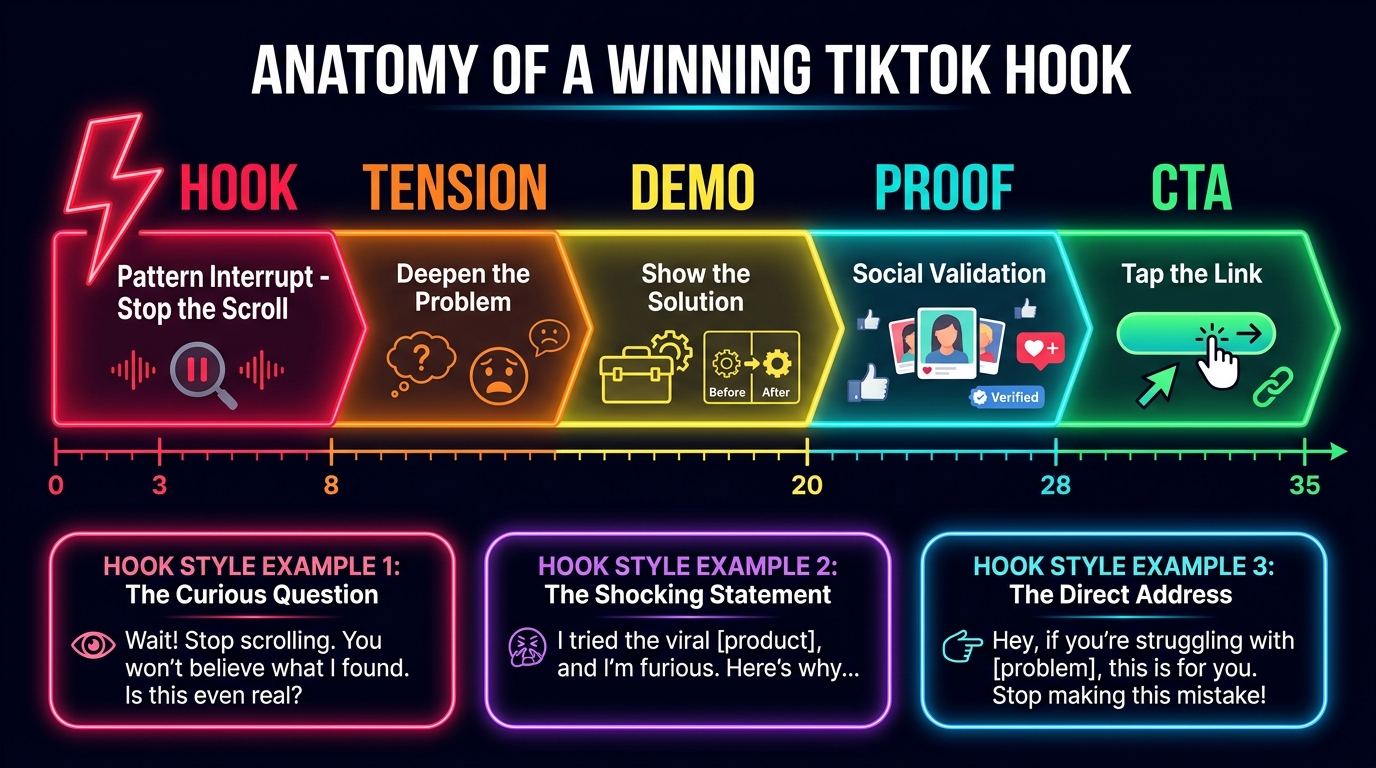
The first three seconds of a TikTok video determine whether everything else you’ve built matters. TikTok users make their watch-or-scroll decision within one to two seconds of a video appearing in their feed. If your hook doesn’t arrest that decision, your demo, your proof, your CTA, and your product card are irrelevant — the viewer is already gone.
At the scale of a 250-piece-per-month content engine, hook quality becomes a systems problem, not a creative problem. You cannot individually review the hook of every piece of content before it goes live. You need a framework that creators can apply independently and consistently.
The Five Hook Archetypes That Drive Stop-Scrolling on TikTok Shop
The Unfinished Statement: Start the video mid-sentence with something that can’t be resolved in the first frame. “The reason I stopped spending $80 a month on…” — the viewer has to keep watching to find out what. The psychological mechanism is the Zeigarnik effect: unresolved statements stay active in working memory. This archetype works best for products replacing an expensive alternative.
The Relatable Embarrassment: Open with a moment of visible frustration, failure, or embarrassment that your target customer has personally experienced. The creator isn’t describing the problem — they’re performing it. A video about dry shampoo opens with the creator visibly distressed about greasy roots and a meeting in 5 minutes. The immediate recognition creates an emotional hook that’s almost impossible to scroll past. This archetype outperforms on beauty, personal care, household, and wellness products.
The Contrarian Claim: Lead with a statement that contradicts what the viewer thinks they know. “This $18 moisturizer performs better than my $120 La Mer” or “Stop buying reusable bags — here’s what you actually need.” Contrarian hooks work because TikTok’s algorithm weights strong engagement signals, and disagreement (whether agreement or pushback) drives comment engagement that the algorithm interprets as positive. Be careful to deliver on the claim — hooks that overpromise and underdeliver drive negative comment sentiment that tanks videos.
The Visual Interrupt: Skip the verbal hook entirely and open with a striking visual — an unexpected before, an extreme close-up, a satisfying transformation caught in the first frame. This archetype is particularly powerful in categories where the product result is visually demonstrable: cleaning products, cosmetics, organization, food. The visual itself is the hook, which means it’s more platform-agnostic and requires no scripting.
The Direct Address Challenge: Open by directly addressing a specific viewer identity: “If you have PCOS, you need to hear this.” “For anyone who’s tried every solution for apartment-sized kitchens.” “People with oily skin are going to want to watch this.” The power is specificity — the more precisely the hook identifies a viewer, the more that viewer feels the video was made exactly for them. Broad addresses (“people who like skincare”) have weaker hold rates than narrow ones (“people who break out when they travel”).
Hook Testing Protocol
For your brand-owned account, run a structured hook test at the start of each month: produce the same core video — same product demo, same proof, same CTA — with three different opening hooks. Publish all three with at least 48 hours between them (to avoid algorithmic cannibalization), and compare 3-second view rate and overall completion rate at the 7-day mark. The winning hook becomes the template for that month’s creator briefs.
This process works because TikTok’s algorithm surfaces content based on early engagement signals. If you can engineer hooks that reliably push past the 3-second view threshold, you’re giving the rest of your content the opportunity to do its job.
The Performance Feedback Loop: Which Metrics Trigger What Actions
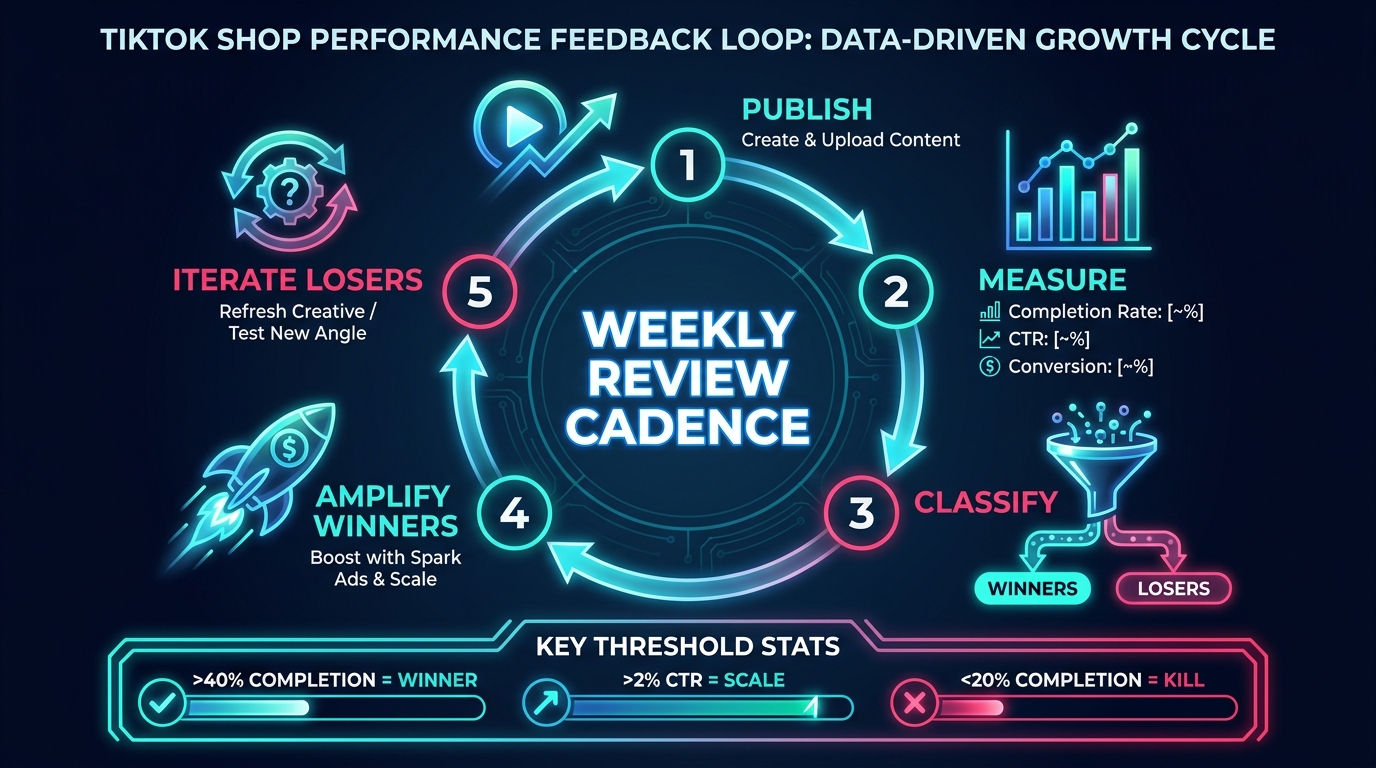
A content engine without a performance feedback loop is just a content treadmill. You’re producing volume with no mechanism to improve over time. The feedback loop is what converts raw production capacity into compounding GMV growth — and it’s arguably the most neglected component in most brands’ TikTok Shop operations.
The Four Performance Tiers
Not all underperforming content should be treated the same way, and not all strong content deserves the same response. The most effective TikTok Shop operators classify every piece of content into one of four tiers after 7–10 days of live performance:
Tier 1 — Scale (Top 15%): Videos with completion rates above 40%, product link CTR above 2%, and conversion rates at or above category average. These videos get amplified immediately through Spark Ads or TikTok Shopping Ads. The creative elements that drove their performance get dissected and documented in your brief library. Tier 1 videos are your best salespeople — put budget behind them.
Tier 2 — Observe (Next 35%): Videos with solid engagement metrics but lower-than-expected conversion, or good conversion but limited reach. These may need more time to accrue social proof before algorithmic redistribution kicks in, or they may be finding the wrong audience. Tier 2 videos get a 14-day observation window before reclassification.
Tier 3 — Diagnose and Re-Cut (Middle 35%): Videos with mediocre metrics across the board. Before abandoning this content, diagnose which part of the funnel broke. High 3-second rate but low completion suggests the hook worked but the content didn’t deliver. High completion but low CTR suggests the product card isn’t compelling or is in the wrong position. Each diagnosis generates a specific re-cut instruction — changing the hook, repositioning the CTA, adding an on-screen text overlay to the product demo moment.
Tier 4 — Archive (Bottom 15%): Videos with sub-20% completion rates, near-zero CTR, and no engagement. These are immediate stops — don’t boost them, don’t use them in ad sets, and don’t try to diagnose what went wrong. The cost of a bad video isn’t just the production time; it’s the negative algorithm signal. Archive and move on.
The Weekly Review Cadence
The feedback loop only works if it’s on a fixed schedule. Every Monday morning, your Content Strategist should run a 45-minute performance review covering the previous week’s content. The output of this review is not a slide deck — it’s a set of actionable brief adjustments for the coming week.
The review answers four questions:
- Which piece of content performed best this week, and specifically why (hook type, product moment, creator style, format)?
- Which hook or format is showing consistent underperformance across multiple creators, suggesting a strategy-level problem rather than an individual execution problem?
- Are there any products showing high completion and low conversion, suggesting a listing problem rather than a content problem?
- Which affiliate or UGC creator had a breakout performance this week, and how do we get more content from them this month?
The answers to these questions directly generate the week’s production priorities. This is the mechanism that turns volume into iteration and iteration into compounding improvement.
The Metrics That Actually Matter (vs. the Vanity Metrics)
TikTok’s analytics dashboard presents a lot of numbers, but not all of them are equally relevant to a TikTok Shop content engine. The metrics that correlate most strongly with GMV outcomes, based on 2026 operator data, are:
- Video completion rate: The single most important signal for algorithmic distribution. Below 20% and the algorithm caps distribution; above 40% and distribution expands significantly.
- Product link click-through rate (CTR): Measures whether the content is successfully bridging from interest to purchase intent. Category benchmarks in 2026 range from roughly 1% in low-engagement categories to 4–5% in high-intent beauty and wellness.
- GMV per video: The ultimate north star. Everything else is a leading indicator for this number.
- Saves and shares: Strong share signals indicate content that viewers find valuable enough to redistribute — which functions as free amplification and is a positive algorithmic input.
Vanity metrics to deprioritize: raw view counts (without context), follower growth from individual posts, and like rate in isolation. None of these have a reliable correlation with TikTok Shop GMV.
Repurposing Winners Without Killing What Makes Them Work
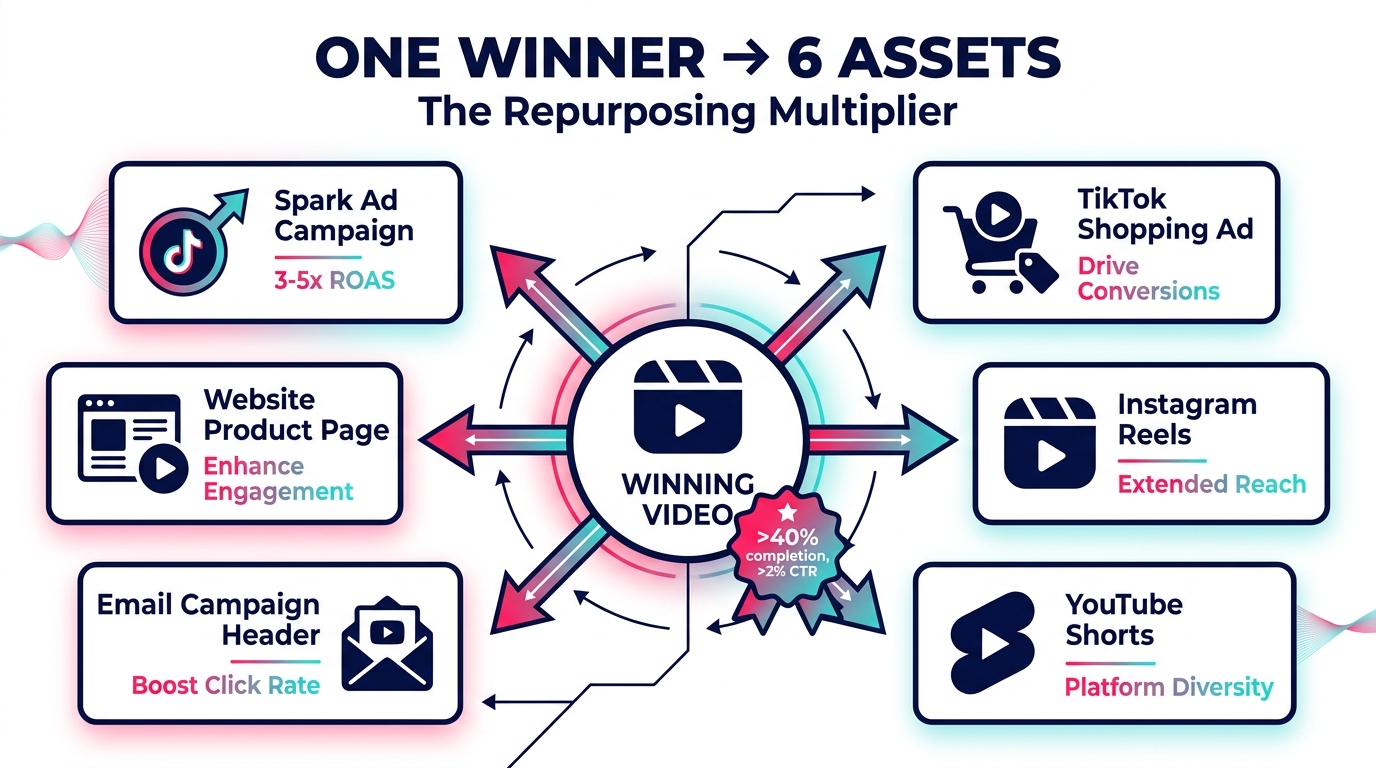
When a piece of content crosses into Tier 1 performance — strong completion, strong CTR, meaningful GMV contribution — the instinct is to treat it as a discovery and let it run. That’s correct for the short term. But the more durable opportunity is to systematically extract the value from winning content across every relevant channel and format, while being careful not to alter the elements that made it succeed in the first place.
What “Repurposing” Actually Means in Practice
Repurposing in the context of a TikTok Shop content engine doesn’t mean downloading a video and uploading it to Instagram. That approach typically produces poor results because platform context changes how content is received — TikTok-native content often feels slightly off-brand on Instagram Reels, and the algorithmic treatment of cross-posted content is generally weaker than native uploads.
Effective repurposing means taking the creative intelligence from a winning video — the hook structure, the product moment, the proof deployment, the pacing — and re-applying it in formats appropriate to each destination. For a TikTok Shop winner, the repurposing map looks like this:
Spark Ads: The most immediate repurposing action for any Tier 1 video. Request a Spark Ad code from the creator (for UGC or affiliate content) or activate directly from your brand account (for brand-owned content). The organic video’s existing engagement (likes, comments, shares) carries over into the ad, making it significantly more credible than a cold creative. Spark Ads consistently outperform equivalent paid video ads in TikTok Shop categories because they inherit social proof.
TikTok Shopping Ads: Repurpose the winning video as a creative in a Video Shopping Ad (VSA) campaign, targeting audiences beyond your organic followers. The same video that drove organic GMV will often drive paid GMV at efficient CPAs, because you know the creative converts — you’re just expanding its reach through paid distribution.
Instagram Reels and YouTube Shorts: Re-shoot or re-cut the same hook and core product demo for these platforms, adapting the format slightly. A 32-second TikTok might work better as a 45-second Reel with slightly more context. The intellectual property — the specific hook, the specific product truth, the specific proof — is what you’re porting, not the raw file.
Email and landing pages: Top-performing TikTok content that demonstrates a clear product benefit can be embedded or linked on email campaigns and product landing pages. Social proof from the TikTok performance (view counts, comment sentiment) can be referenced in copy. MomentIQ’s analysis suggests this repurposing path can reduce cost-per-acquired-customer by cutting the need for separately produced email creative assets.
The “Brief Backward Engineering” Method
Every Tier 1 winner should be reverse-engineered into a new brief for your creator network. This means watching the video frame by frame and answering: What specifically happened in seconds 0–3? What did the creator say or show that created tension in seconds 3–8? At what exact moment did the product become visually compelling? How was proof introduced?
Document the answers as a new brief template — not a request to replicate the video, but a framework for creating videos that use the same structural logic. Distribute this brief to 10–15 different creators and you’ve converted one winner into potentially 10–15 new top-of-funnel content pieces, each with its own individual creator’s authentic voice and audience reach.
This is the core mechanic of how high-volume content engines improve over time. They’re not just producing more content — they’re producing smarter content, because every winner feeds a better brief, and every better brief produces a higher proportion of new winners.
Tools, Tech Stack, and Workflow Automation
Running a 250-piece-per-month content engine without operational tooling is theoretically possible and practically unsustainable. At volume, manual processes — tracking creator deliverables in spreadsheets, communicating via DM chains, manually reviewing each video for performance — become the bottleneck that caps your content output long before your creative capacity does.
Creator Discovery and Outreach
Finding UGC creators and affiliates at scale requires a different approach than traditional influencer marketing. Tools like Stormy AI and similar creator-discovery platforms allow you to search TikTok’s creator ecosystem by category, engagement rate, follower tier, and content style, and automate initial outreach at volume. For brands aiming to build a creator bench of 50+ active contributors, automated discovery and outreach reduces sourcing from a weeks-long manual process to a hours-long systematic one.
The key filtering criteria when building your creator bench: content quality (does the creator’s existing content look like it fits your category?), conversion signals (are they already tagging products in TikTok Shop, and what’s their average engagement per post?), and posting frequency (do they post at least 3x per week on their own account?).
Creator Operations and CRM
Once your creator bench exceeds 20–25 active participants, you need a lightweight CRM to track the status of every relationship: which creators have been shipped product, which have posted deliverables, which are in the brief-review stage, which are overdue. Platforms purpose-built for TikTok Shop creator management (including tools from MomentIQ, Colaba, and others) handle this workflow natively. At smaller scale, a structured Notion or Airtable database can work, though it requires more manual maintenance.
The operations priority is avoiding two failure modes: creators who received product but never posted (unactivated), and creators who are actively producing but not being paid or re-engaged on time (churn). Both waste resources — the first wastes product cost, the second wastes relationship capital that’s hard to rebuild.
Content Scheduling and Publishing
TikTok’s native scheduling functionality handles most brand-account publishing needs without requiring a third-party tool. For larger brands managing multiple accounts or needing more sophisticated analytics integrations, tools like Later or Sprout Social offer TikTok scheduling alongside cross-platform management.
One underused TikTok feature: the duet and stitch functionality as a workflow tool. When a UGC or affiliate creator posts a piece of content that performs, your brand account can duet or stitch it — adding brand context, addressing a common question from the comments, or extending the product demo. This doubles the content’s lifespan, generates additional reach, and signals algorithmic favor for content that prompts brand participation.
Performance Analytics and Reporting
TikTok Shop’s native analytics has improved significantly in 2026 and now provides product-level attribution for videos — so you can see exactly which pieces of content drove which product sales. This data should be pulled weekly and fed back into your brief-writing process.
For brands running Spark Ads alongside organic content, maintaining a clear separation in your analytics between paid and organic attribution is critical. The organic content engine’s value is frequently underestimated because Spark Ad revenue gets attributed to the paid campaign rather than the underlying creative. Track organic GMV (from non-boosted content) separately from Spark Ad GMV to accurately measure the value of your unpaid content infrastructure.
Live Shopping as a Force Multiplier for Your Content Engine
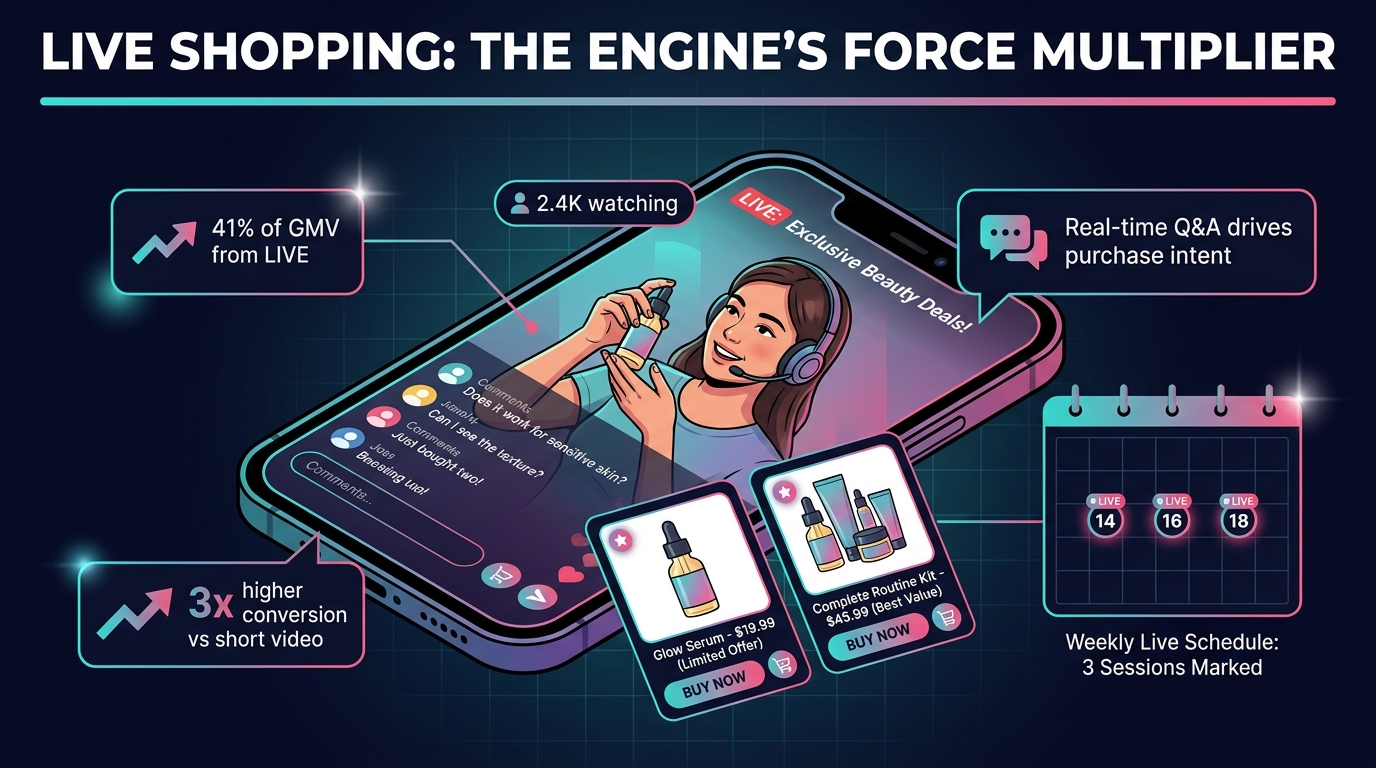
Live shopping represents the single most underutilized component of TikTok Shop for brands outside Asia. According to TikTok’s 2026 commerce data, live shopping accounts for 41% of total TikTok Shop GMV globally — meaning nearly half of all purchases on the platform originate from live content, not short videos or browsing. Yet most Western brands treat live as an optional add-on rather than a core engine component.
The reason live shopping drives disproportionate GMV isn’t mysterious: it compresses the entire purchase consideration cycle into real time. A viewer watching a live session sees the product demonstrated, hears questions from other viewers answered, sees the purchase counter incrementing (social proof in real time), and faces a time-limited offer or bundle that creates urgency. The conversion rate for live shopping — up to 7–12% in high-performing sessions — is roughly 2–3x higher than short video-driven purchases.
How Live Feeds the Short-Video Engine (and Vice Versa)
Live shopping and short-video content are most powerful when they function as a single integrated system rather than separate channels. Each format feeds the other in ways that compound your overall content output.
Short videos serve as pre-live warm-up content. Posts in the 24–48 hours before a live session can tease the products, the host, and any exclusive offers — driving viewers who’ve seen the short content to tune in to the live. Brands that publish two to three pre-live tease videos consistently report higher peak concurrent viewers than brands that go live without organic pre-promotion.
Live sessions generate substantial raw content for post-live clip repurposing. A 90-minute live session is a goldmine of organic product demonstrations, customer question responses, and authentic selling moments that can be cut into 8–15 short-form pieces. A viewer asking “does this work for sensitive skin?” and receiving a detailed live answer is a piece of content that addresses a real customer objection — and that clip will often outperform scripted brand-owned content on completion rate precisely because it’s unscripted and specific.
Building a Live Shopping Cadence
The most important principle for live shopping in a content engine context is consistency over duration. Brands that go live for 45–60 minutes two to three times per week perform better over time than brands that do a single 3-hour marathon session once a month. The algorithm rewards regular live activity: accounts with consistent live cadences get preferential live distribution, meaning more of your followers are notified when you go live.
Start with a minimum viable live cadence of twice weekly, 45–60 minutes per session. Structure each session around 3–5 featured products with dedicated demonstration time, a live-exclusive discount or bundle, and a recurring segment (Q&A, product comparison, behind-the-scenes) that gives returning viewers a reason to come back. As you build your live shopping infrastructure, adding a second host — often a high-performing UGC creator from your bench — can dramatically increase viewer retention and conversion, because the host dynamic creates natural dialogue that feels more engaging than a single presenter.
The Live-to-Affiliate Pipeline
One of the most effective acquisition strategies for expanding your affiliate network is identifying viewers who engage actively in live sessions — asking product questions, commenting positively, tagging friends — and proactively inviting them to join your affiliate program. These individuals have already demonstrated interest in your products and some natural inclination to talk about them publicly. Converting them from engaged viewers to active affiliates is significantly more efficient than cold-recruiting creators who have no existing relationship with your brand.
Scaling Without Losing Brand Coherence
The tension that every brand faces when scaling to high-volume content is the risk of dilution. When dozens of creators are producing content about your products simultaneously, not all of it will represent your brand the way you’d prefer. Some will use messaging that doesn’t match your positioning. Some will show your product in contexts you wouldn’t have chosen. Some will make claims that edge toward compliance issues.
Managing this tension is an operational challenge, not a creative one. The answer isn’t to approve every video before it goes live — that process doesn’t scale and defeats the purpose of a distributed creator network. The answer is to build guardrails that communicate brand standards clearly enough that creators can self-correct.
The Non-Negotiables Document
Every creator in your network — UGC and affiliate alike — should receive a single-page “non-negotiables” document at onboarding. This document doesn’t describe your brand voice in aspirational terms. It specifies, concretely and specifically, what cannot appear in content featuring your products: specific claims that would violate TikTok Shop’s content policies, competitor mentions, certain contexts or settings that conflict with your brand positioning, and any health or safety statements that require regulatory compliance.
Keeping this document to a single page is intentional. Creators who receive a 12-page brand guidebook won’t read it carefully. Creators who receive a half-page list of explicit restrictions will. The document’s power is in its clarity and brevity, not its comprehensiveness.
Brand Consistency Through Brief Design, Not Post-Production Control
The most powerful tool for maintaining brand coherence at scale is brief quality. When your briefs specify the exact product truths to communicate, the exact visual moments to show, and the exact proof elements to deploy, you’ve already established the essential brand standards through the creative direction itself — before a single frame is shot.
Creators working from strong, specific briefs produce content that’s individually varied (authentic to each creator’s voice) but collectively coherent (aligned on core message). That’s the ideal outcome: a network of 50 creators who all sound like themselves but are all making the same core case for your product in their own way.
Conclusion: Building the Engine vs. Running It
The single most important mindset shift for any brand approaching TikTok Shop at scale is moving from “content creator” to “content engine operator.” A creator makes videos. An engine operator designs systems, monitors performance data, maintains the operational infrastructure, and continuously improves the brief library based on what the data shows works.
The 250-pieces-per-month benchmark is not a ceiling — it’s an entry point into the tier of TikTok Shop operators who are using content volume as a genuine competitive advantage. Brands that reach and maintain this threshold consistently report that TikTok Shop begins to function as a self-reinforcing growth system: more content generates more data, more data generates better briefs, better briefs generate more winning content, and winning content drives both organic GMV and the social proof that makes paid amplification more efficient.
Getting there is a six-to-twelve month operational build, not a campaign sprint. The brands that make it are the ones that start building the infrastructure now — the creator bench, the brief framework, the weekly review cadence, the live shopping schedule — before they have the volume to justify it. Because by the time the volume justifies it, it’s already too late to be building the engine.
Key Takeaways
- 250 pieces per month is the network threshold, not an individual account target. It’s achieved through combining brand, UGC, and affiliate content across your entire creator network.
- The three-layer content stack (brand-owned, UGC, affiliate) serves three different functions: brand coherence, volume production, and scale multiplier respectively. Confusing their roles undermines each layer’s performance.
- Creative briefs are your highest-leverage document. A well-structured brief multiplies strategic alignment across 50 creators without requiring individual conversations. Brief versioning builds a proprietary database of what works over time.
- Hook architecture is a system, not a talent. The five hook archetypes (Unfinished Statement, Relatable Embarrassment, Contrarian Claim, Visual Interrupt, Direct Address Challenge) can be tested systematically to identify what works in your category.
- The performance feedback loop converts volume into iteration. The weekly 45-minute review — classifying content into four tiers and generating brief adjustments — is the mechanism that makes your engine improve over time rather than just run in place.
- Live shopping drives 41% of TikTok Shop GMV and feeds your short-video content engine through post-live clip repurposing. Treat it as an integrated channel, not an optional add-on.
- Winning content should be repurposed systematically across Spark Ads, Shopping Ads, and other platforms — but repurpose the creative intelligence (hook structure, proof deployment), not just the raw file.