


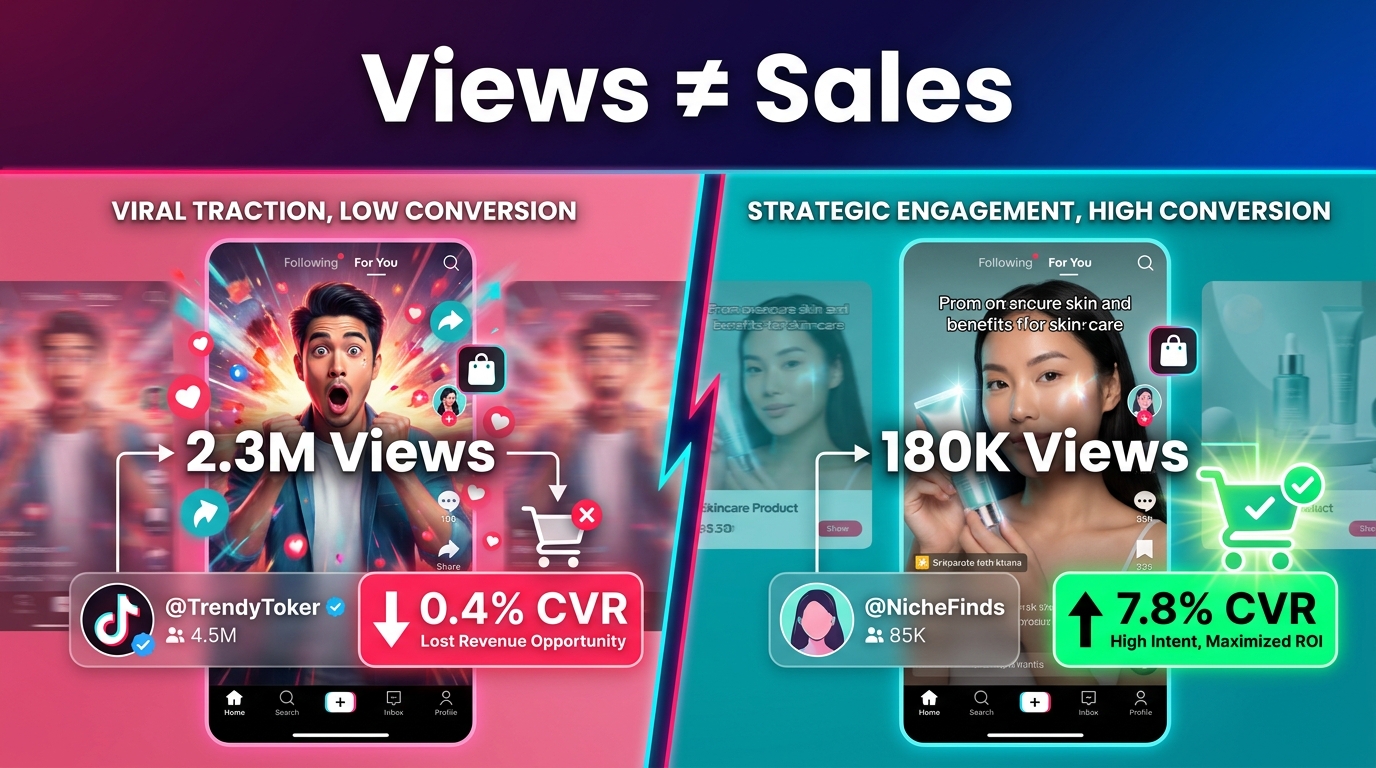

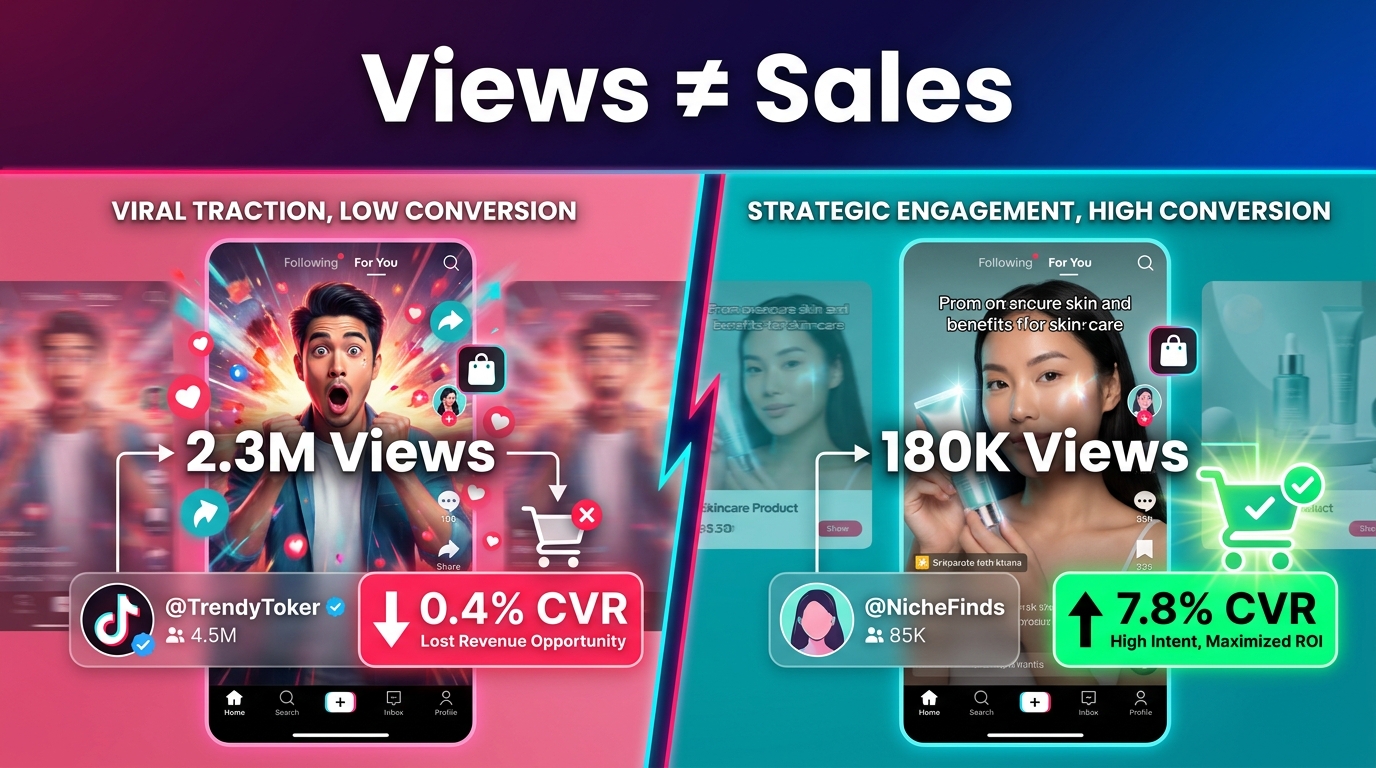
There is a very specific kind of frustration that TikTok Shop sellers rarely talk about publicly: you get a creator with 800,000 followers to post your product, the video racks up 1.2 million views, and your phone buzzes all weekend — with comments, not orders. Maybe 200 units move. Maybe fewer. Meanwhile, a competitor’s product that barely got 60,000 views on a single affiliate clip sold out its first batch in 72 hours.
The gap between virality and sales on TikTok Shop is real, it is consistent, and it is not random. It follows patterns that are knowable — and correctable. But most guides about TikTok Shop products stop at “pick something visual and under $30,” which is the equivalent of telling someone to “just write good content” when they ask about SEO.
This piece is about the actual mechanics: why certain product categories and specific product traits generate conversion rates of 5–12% while others hover at 0.4–1.5% regardless of view count. It covers the price architecture that determines whether impulse buying activates, the structural reasons why some products are permanently camera-friendly but never shoppable, and the under-exploited categories where creator competition is low but buyer intent is measurably high.
TikTok Shop’s projected global GMV for 2026 sits at roughly $84–87 billion — nearly double what the platform did in 2024. But raw platform growth does not distribute evenly. Sellers who understand the conversion mechanics capture disproportionate share. Those who pick products by “vibe” mostly feed the platform’s traffic without getting paid for it.
The Conversion Numbers Most Sellers Have Never Looked At
Most TikTok Shop sellers track views, likes, and follower counts. Very few track conversion rate as a product-level metric. That’s the first problem.
The platform-wide conversion rate for TikTok Shop sits at approximately 2–5% blended across all formats, which is already competitive with traditional e-commerce’s 2–4% average. But that blended number hides massive variance by channel type — and by product type within those channels.
CVR by Content Format
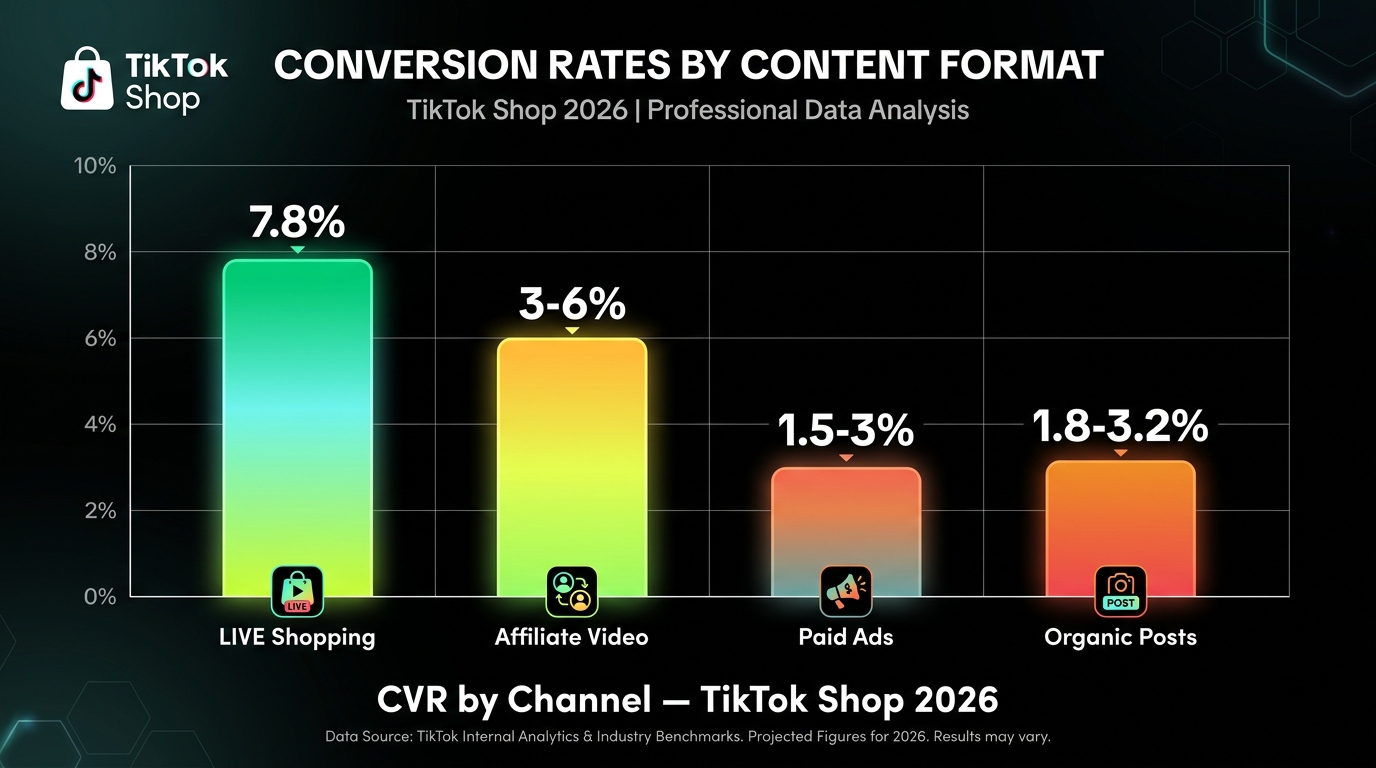
Here’s what the data shows when you break conversion by delivery mechanism rather than by product category alone:
- LIVE Shopping: 7.8% average CVR — the highest format by a wide margin. Some categories hit 12% in LIVE environments because the host can handle objections in real time, create urgency with limited quantities, and demonstrate use cases on camera.
- Affiliate short-form video: 3–6% CVR — the workhorse format. High variance depending on creator type and product-content alignment.
- TikTok paid ads (Shop Ads): 1.5–3% CVR — lower intent at the top, but scales volume efficiently when products have proven conversion in organic first.
- Organic seller content: 1.8–3.2% CVR — highly variable, but often the first proof point before a product gets affiliate distribution.
LIVE shopping deserves special attention: TikTok’s own marketing data claims live shopping conversions can be up to 10x higher than traditional e-commerce checkout flows. Separately, live events convert approximately 22% better than standard product videos on the platform. When TikTok Shop campaigns combine both LIVE and web touchpoints, brands report conversion lift of up to 37% compared to web-only.
What This Means for Product Selection
The format doesn’t operate independently of the product. Some products are structurally better suited to live formats — anything with a demonstration, anything that benefits from live Q&A, anything where the host’s enthusiasm reinforces the purchase decision. Other products (especially repeat-purchase consumables with a clear value proposition) perform reliably in affiliate short-form without needing a live environment.
Understanding which channel your product is built for is not a marketing question — it is a product selection question. If your product cannot generate urgency without a live host walking through it, that’s a meaningful constraint on how it can scale.
The Four Product Traits That Actually Drive Conversion
Most TikTok Shop advice circles around “visual appeal” as the primary product selection criterion. That framing is incomplete and has sent a lot of sellers in the wrong direction. Visual appeal is table stakes. It gets you views. The four traits below are what move those views into cart clicks.
1. The 5-Second Value Proof
The highest-converting TikTok Shop products communicate their core value proposition — specifically and viscerally — within five seconds of a video starting. Not “this serum hydrates your skin,” but the close-up texture transformation as the serum absorbs. Not “this food chopper is fast,” but watching a full onion disappear in three pulls.
The distinction matters because TikTok’s algorithm shows product videos to users in a discovery context, not a shopping context. A viewer did not open TikTok to buy a food chopper. They were watching cooking content. The video has a window of seconds to transform a passive viewer into an active buyer — and that transformation only happens if the value proof is immediate and specific, not abstract.
2. A Problem the Viewer Recognizes Right Now
The strongest-converting products address problems that are both specific and widely shared. “Dry skin” is too broad. “White cast from sunscreen that shows up on darker skin tones” is specific enough to trigger the “that’s me” recognition response in a defined audience. “My dog knocks over their water bowl” is specific enough. “Pet care” is not.
The product does not need to solve an urgent problem — it needs to solve a recognized one. The moment of recognition is the conversion trigger. Products that generate curiosity without triggering recognition tend to get saves and shares but not purchases.
3. Believable Results Within the Viewer’s Trust Window
TikTok viewers have a finely-tuned skepticism filter, especially for health, beauty, and wellness products. Claims that sound too dramatic (“lost 15 pounds in two weeks”) create resistance that kills conversion even when the video performs well. Claims that are credible and verifiable within the content itself (“my skin stopped flaking after three days — I filmed it”) convert because the proof is embedded.
Products where the result is visible within the content — before/after skincare, hair transformation, food being made, cleaning solution removing a stain — have a structural conversion advantage over products where the benefit is delayed, invisible, or requires trusting the seller’s word.
4. A Clean Friction-to-Value Ratio
Every barrier between decision and purchase costs conversion. Complicated setup, confusing sizing, products that require reading a manual, or items that prompt “but will this work for me specifically?” all create hesitation that ends purchases. The highest-converting TikTok Shop products are frictionless to understand and frictionless to use. One click, product arrives, value is immediate.
This is different from product quality — a high-quality product can still fail on this dimension if it’s complicated to understand or if its value is conditional on factors the viewer doesn’t know about themselves (their water type for haircare, their skin undertone for foundation, their fitness level for equipment).
Beauty and Skincare: The Category That Dominates — And Where It’s Already Oversaturated
Beauty and personal care represents approximately 22.5% of TikTok Shop global GMV, making it the platform’s largest single category by a substantial margin. The reasons are structural: the category is highly demonstrable, results are frequently visible on camera, the consumer culture (#SkinTok, #BeautyTok, GRWM content) is already embedded in the platform’s content DNA, and the price points sit comfortably within the impulse-buy range.
None of this is new information for most sellers. Which means the category is no longer the opportunity it was in 2022 or 2023. It’s a mature competitive landscape with specific pockets of remaining opportunity and large swaths that are genuinely difficult to break into without a significant creator budget or a truly differentiated product.
Where Beauty Still Has Room
The sub-categories within beauty that remain relatively open in 2026 are those where the technology or formulation has outpaced creator coverage:
- Skin-tech devices: LED masks, microcurrent tools, and at-home “clinical” gadgets are growing within the beauty GMV but are still under-covered by affiliate creators relative to topical products. The demonstration potential is high and the price points ($45–$120) require trust that most creators haven’t yet established in this sub-niche.
- Inclusive beauty: Products specifically formulated for darker skin tones, textured hair, or underserved complexions have strong community loyalty and word-of-mouth conversion that behaves differently from mainstream beauty. A product solving a problem that mainstream brands have ignored generates organic creator advocacy without aggressive outreach.
- Functional fragrances and body care: Scent products with a clear narrative hook (“smells like X,” pheromone-adjacent marketing, “compliment catchers”) have been generating disproportionate TikTok engagement relative to their category position. The format fits short-form extremely well and the repeat-purchase dynamic is strong.
- Haircare for specific damage types: Color-damaged, heat-damaged, and chemically-treated hair are all problem-specific niches where before/after demonstrations are visually compelling and the audience self-selects with high purchase intent.
Where Beauty Is Effectively Closed
Generic moisturizers, mass-market lip glosses, entry-level makeup sets, and “clean beauty” products without a specific differentiating claim are deeply saturated. The creator ecosystem is flooded with content, the affiliate commissions have been compressed by competition, and the product differentiation required to stand out demands either significant formulation investment or a marketing budget that erases the margin advantage of TikTok’s lower acquisition costs.
The Sleeper Categories: Home, Food, and Pet Products
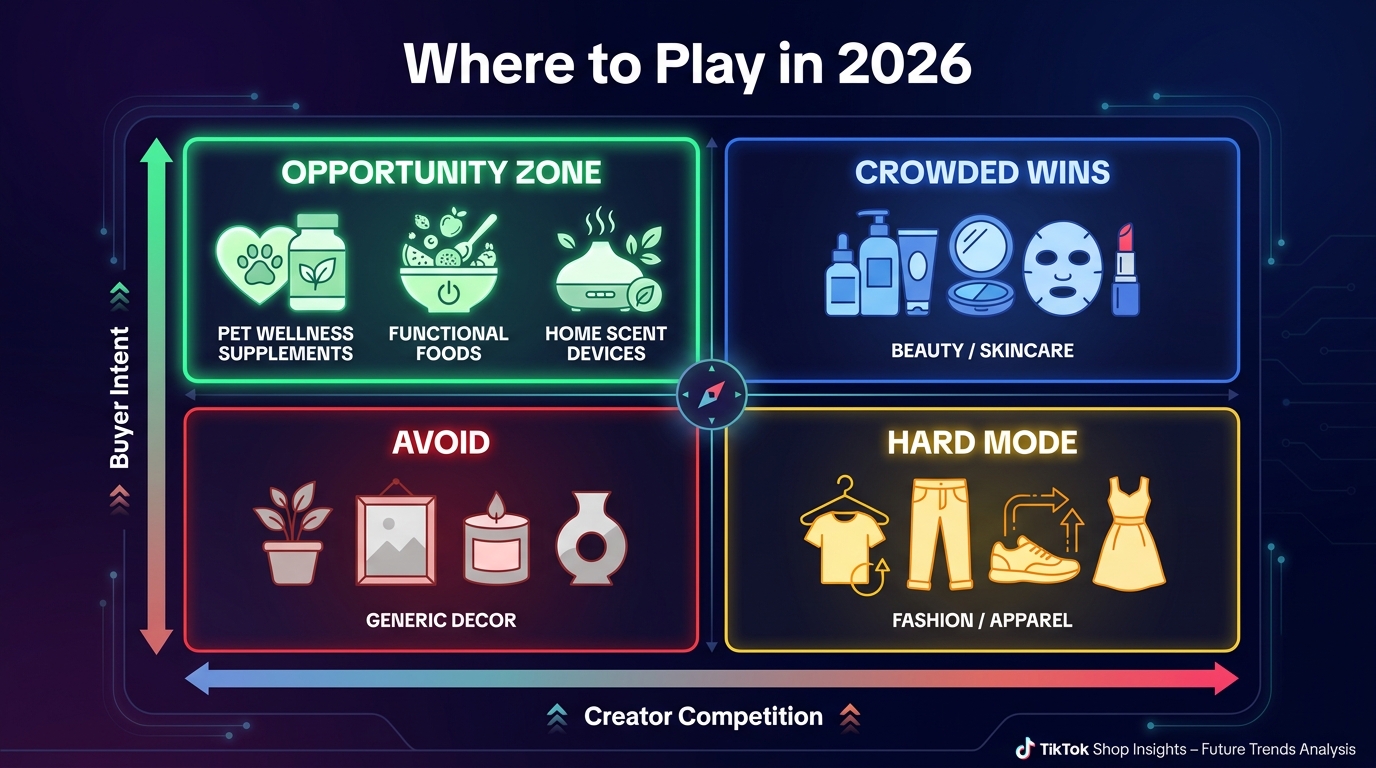
While most sellers pile into beauty and apparel (the platform’s top two categories by GMV share), three other categories are consistently generating strong conversion data with meaningfully lower creator competition. They share a common characteristic: they’re all highly demonstrable, problem-solving, and impulse-priced — but the creator ecosystem hasn’t caught up to the demand.
Home Goods and Kitchen Tools
Home and kitchen products have a conversion advantage that many sellers underestimate: the “I could use that” recognition response triggers across broad demographics. A food chopper, a specific type of storage container, a countertop appliance with a clever design — these products don’t require the viewer to fit a particular body type, skin tone, or lifestyle aesthetic. The audience is universally people who eat food and live in homes.
The demonstration format is inherently satisfying. #CleanTok and cooking content already generate enormous native engagement, and products that integrate with that content — cleaning solutions, food prep tools, organization systems — ride existing creator habits rather than requiring new content formats.
Specific sub-niches showing strong signals in 2026: compact kitchen appliances (single-serving, space-saving formats appeal to apartment demographics that skew young and TikTok-native), home scent systems (diffusers, wax melts, and “home fragrance as mood” content perform well when the creator’s lifestyle is aspirational), and organization products with a satisfying “transformation” reveal.
Food and Beverage
Food and beverage on TikTok Shop is genuinely underutilized relative to its conversion potential. The format advantages are obvious: food looks good on camera, “taste test” content is one of the most-watched categories on the platform, and the repeat-purchase cycle for consumables creates LTV that physical goods rarely match.
The products doing best in this category share a common thread: they have a strong “you haven’t tried this yet” narrative. Specialty sauces, unique snack formats, functional beverages (protein-infused, adaptogen-forward, electrolyte drinks with flavor variety), and culturally-specific food products that mainstream grocery hasn’t adopted all generate strong word-of-mouth conversion.
The constraint for food sellers is primarily regulatory (health claims require care) and logistical (perishability, shipping costs, temperature sensitivity). Brands that solve those operational constraints have access to a category where creator motivation is high (creators genuinely enjoy making food content), viewer intent is strong, and repurchase rates support sustainable unit economics.
Pet Products
Pet products on TikTok convert disproportionately well for a reason that has nothing to do with product quality: the audience is already emotional. People watching pet content are in an engagement mindset, not a critical evaluation mindset. A product that makes a pet visibly happy — a specific toy, a food-dispensing puzzle, a water fountain that a cat clearly prefers — generates the kind of purchase intent that is genuinely impulsive and not analytically filtered.
Pet wellness is the fastest-growing sub-niche: supplements, dental care products, joint support, and digestive health items for pets are following the exact trajectory that human wellness took on TikTok three years ago. Creator competition in pet wellness specifically is still low relative to the buyer intent the category generates. A seller with credible pet wellness products and the operational ability to support affiliate outreach to pet content creators is sitting on a meaningful short-term window before the category matures.
The Price Point Architecture That Determines Whether Impulse Buying Activates
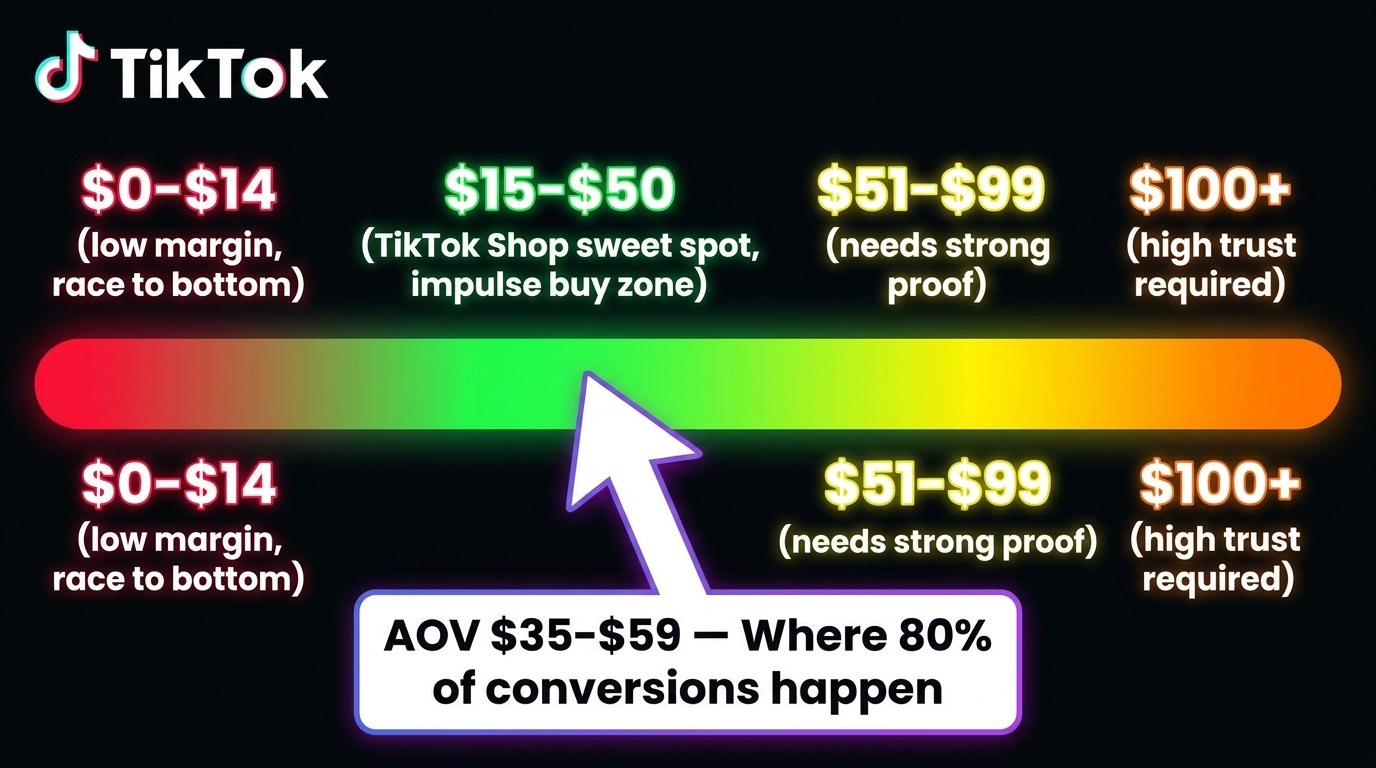
Price is not just a margin lever on TikTok Shop — it’s a conversion mechanism. The relationship between price and purchase decision on TikTok operates differently from both Amazon and direct-to-consumer websites, and misunderstanding this costs sellers significant conversion volume.
The Impulse Window: $15–$50
The platform-wide average order value (AOV) for TikTok Shop in the U.S. sits at approximately $35 by transaction data and $59 by consumer survey data — the gap between those two figures reflects how people perceive their spending versus what they actually do. The $15–$50 range is where impulse buying activates most reliably, and where the conversion rate advantage of TikTok’s in-app checkout (no redirect, no account creation friction) is most meaningful.
Below $15, products face a margin problem: TikTok’s fulfillment fees, affiliate commissions (which can run 5–20%), and paid amplification costs make the unit economics difficult unless volume is very high. Above $50, conversion rates typically drop unless the product has exceptional demonstration value or strong social proof that justifies the spend.
The $50–$100 Zone: Where Trust Architecture Matters
Products priced between $50 and $100 can absolutely convert on TikTok Shop, but they require what might be called a trust architecture that lower-priced products can skip. This means:
- Reviews and ratings that are visible before the purchase decision
- Creator credibility that matches the price point (a skincare creator with a dedicated audience converts a $75 serum better than a general lifestyle creator)
- A demonstration that makes the price feel unambiguously justified — not just appealing, but obviously worth it
- Bundle or value framing that repositions the perceived cost (“three months of product for $75”)
Bundles as a Conversion and AOV Strategy
The beauty and apparel categories are reporting AOVs of $63–$64, which is notably higher than the platform average. The mechanism is bundling: multi-piece skincare sets, outfit bundles, and complementary-product groupings that justify higher spend while maintaining the “complete solution” framing that converts well on TikTok’s visual format.
Bundles also solve a specific TikTok Shop problem: the platform’s attribution model means that a viewer who watches a 45-second creator video and adds to cart is making a decision quickly, without comparison shopping. A bundle pre-answers the “what else do I need” question that might otherwise lead to cart abandonment as the viewer leaves to research complements.
Sellers building bundles should think about visual coherence (the bundle needs to look complete and intentional on camera, not arbitrary), logical complementarity (the products should solve the same problem at different stages), and price-to-value framing that makes the bundle price feel like a discount versus buying separately.
The Camera Candy Trap: Products That Look Great but Don’t Sell
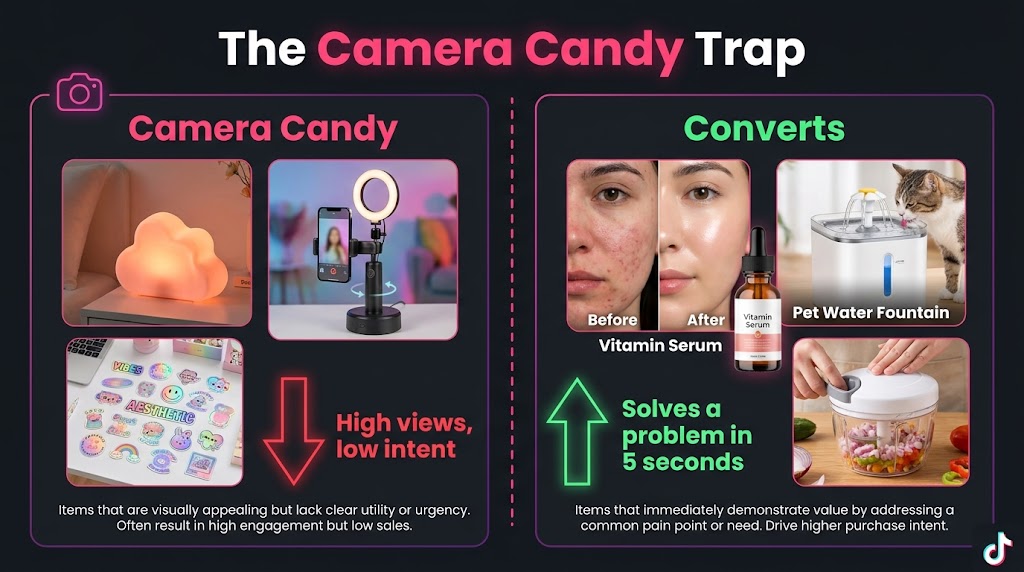
There is an entire category of TikTok Shop products that generate excellent metrics on every dimension except the one that matters: purchases. These are products that have been optimized for virality without being designed for commerce. Understanding this distinction is one of the more valuable things a TikTok Shop seller can internalize.
What Makes a Product “Camera Candy”
Camera candy products share several defining traits:
- Visual novelty over problem-solving: The product is interesting to watch but doesn’t trigger the “I need this” response. LED strips that create pretty room ambiance, intricate desk accessories, gadgets that do one mildly clever thing in a satisfying way — these generate views and comments (“where is this from??”) but struggle to close the purchase.
- Benefits that require explanation: If a creator needs more than seven seconds to explain why the product is worth buying, the core conversion mechanism is already compromised. Complex wellness gadgets, multi-function tools with nuanced use cases, and abstract lifestyle products that “improve your routine in X ways” all fall into this category.
- Intangible or delayed results: Supplements with long-term benefits, productivity tools where the improvement is mental, and fitness equipment where results are weeks away all face the same structural challenge: TikTok’s purchase environment is impulse-driven, and delayed gratification is the enemy of impulse conversion.
- The “perfect gift” trap: Products marketed heavily as gifts generate interest (saves, shares, “sending this to my mom”) without generating individual purchases. Gift intent is high, purchase intent is low, and the conversion timing doesn’t match TikTok’s format.
The Difference Between Virality Intent and Purchase Intent
TikTok’s algorithm optimizes for engagement, not commerce. A video that gets 5 million views because it’s satisfying to watch is generating engagement signal, not purchase signal. The platform has layered shopping features on top of an entertainment algorithm, and those two systems pull in different directions.
Purchase intent on TikTok is most strongly signaled by specific behaviors: product page taps, add-to-cart actions, and affiliate link clicks. Sellers who can access their TikTok Shop backend data should be tracking the ratio of product page views to cart adds — a high view-to-cart ratio with low cart-to-purchase conversion suggests a price or trust problem; a high video-view to product-page ratio suggests a problem-solving failure (the content isn’t generating enough “I need this” response to make someone tap the product link).
Recovering from Camera Candy
If a product has strong view metrics but weak conversion, the options are: reframe the content around a specific problem rather than the product’s features; target a narrower audience that has the specific problem the product solves (so the recognition response is stronger); or acknowledge that the product may be better suited to a different channel (Instagram, Pinterest, or a DTC site where longer-form explanation is possible) and replace it in the TikTok Shop catalog with something that converts.
Emerging Niches with Low Creator Competition and Strong Buyer Intent
The opportunity gap on TikTok Shop in 2026 sits in a specific type of category: one where buyer demand is measurably growing (you can see this in TikTok Creative Center search trend data), but where the creator ecosystem hasn’t yet developed the specialization needed to serve that demand efficiently. These categories are still at the stage where first-mover brands can establish the affiliate relationships and conversion proof points before competition drives up commissions and dilutes creator attention.
Functional Wellness and Targeted Health Products
The general wellness category on TikTok is crowded. But targeted, problem-specific wellness is not. Products addressing specific conditions — sleep quality, hormonal balance, gut health in a specific demographic, joint recovery for active people over 35 — are generating strong search volume growth on TikTok without equivalent creator supply covering them.
The conversion dynamics for targeted wellness products are favorable precisely because the audience is self-selecting. Someone searching “joint support for runners” on TikTok has much higher purchase intent than someone passively encountering a general “take care of your body” wellness video. The challenge is that health and wellness products face stricter claim restrictions on TikTok, which means the content strategy needs to center on demonstration, community testimonials, and lifestyle context rather than medical-style benefit claims.
Home Scent and Sensory Products
Home fragrance is having a moment on TikTok that closely parallels what candles and body care experienced on Instagram five years ago. Wax melt brands, room spray collections, and diffuser products are being built almost entirely on TikTok creator communities, and the format is exceptionally well-suited: “home reset” and “clean with me” content naturally incorporates scent products, the unboxing experience is visually satisfying, and the emotional associations of scent (nostalgia, ambiance, mood) create strong narrative content.
The category is still small enough that new brands can establish differentiation through a specific scent identity or lifestyle narrative without competing against established beauty brands. Priced at $15–$35, these products sit squarely in the impulse zone.
Kitchen and Cooking Accessories with a Specific Use Case
Generic kitchen accessories are saturated. But kitchen accessories with a specific, hyper-defined use case are not. Tortilla presses for home cooks, specialty dumpling molds, tools for a specific type of coffee preparation — these products generate content that is simultaneously educational (teaching a skill) and commercial (showing the tool). The creator motivation is intrinsic: cooking creators genuinely use these tools and naturally integrate them into their content without heavy incentivization.
The conversion mechanism here is aspiration plus convenience. Viewers who engage with specialty cooking content are, by definition, interested in making the dish being demonstrated. The tool becomes part of achieving the aspiration, and the purchase intent is bundled with the content rather than artificially overlaid on it.
Pet Dental, Digestive, and Joint Wellness
Pet wellness is following the human wellness trajectory with approximately a three-year lag. Pet dental products specifically — water additives, dental chews with visible effect, enzymatic sprays — are generating strong engagement from pet content creators who genuinely care about their animals’ health and find authentic content to make. The “before/after bad breath” demonstration is TikTok-native and unmistakably clear. The audience self-selects on care for their pet. The price points are accessible. This is a category where the conditions for organic affiliate marketing success are almost perfectly aligned.
How to Validate a Product’s Conversion Potential Before You List It
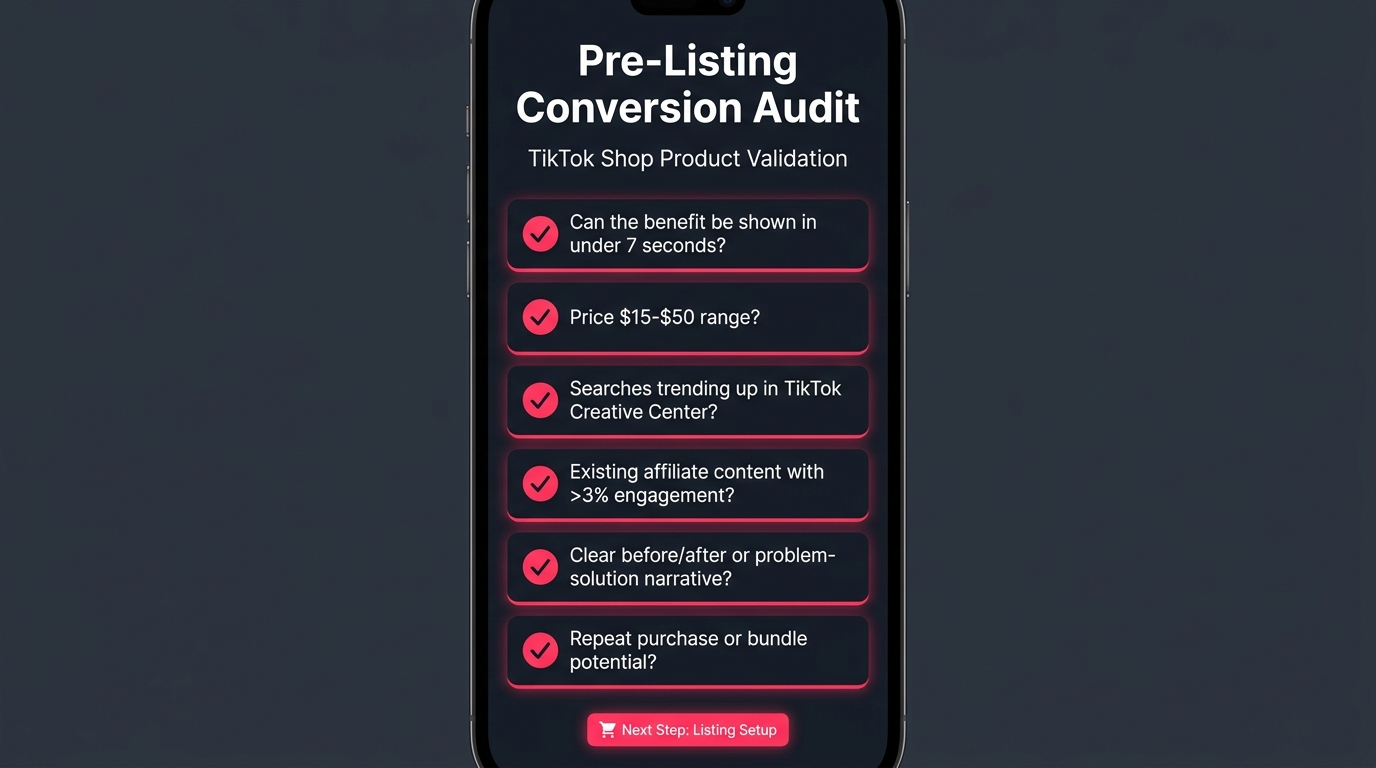
Most TikTok Shop sellers validate products by checking if similar items are selling well on the platform. That tells you the category is viable. It doesn’t tell you whether your specific product will convert — and the difference between a 1.5% CVR and a 6% CVR on the same product is often entirely determined by factors you can identify and address before listing.
The 7-Second Demo Test
Before listing any product, film a rough 7-second demonstration with your phone. No editing, no scripting. Show the product solving its core problem in real time. If you cannot communicate the value proposition clearly in seven seconds of unscripted footage, the product has a fundamental TikTok conversion problem. This isn’t a content strategy issue — it’s a product-content fit issue that no amount of creative optimization will fully solve.
If the demo works but requires some context, that’s addressable with good creator briefing. If the demo is genuinely impossible in seven seconds, reconsider whether TikTok Shop is the right primary channel for that product.
TikTok Creative Center Search Validation
TikTok’s Creative Center (accessible free) shows search volume trend data for keywords. Before listing a product, search its primary problem keyword (“dry scalp,” “small kitchen storage,” “dog breath”) and look for upward trend momentum over the past 60–90 days. A product solving a problem with rising search velocity on TikTok has organic discovery working in its favor. A product solving a problem with flat or declining search suggests the cultural moment may have passed.
Look specifically at whether the trending content in that keyword space is primarily entertainment content (low purchase intent) or problem-solution content (high purchase intent). The same keyword can have very different commercial value depending on how creators are using it.
Competitive Affiliate Content Audit
Search for existing affiliate content for the product category you’re entering. Look at creator-level engagement rates (likes + comments divided by views) for existing product videos. If existing product videos in your category are generating engagement rates above 3%, the content format is working and there’s creator appetite for the category. If engagement on existing product videos is under 1.5%, something in the content-product relationship isn’t working — either the content is poor or the product isn’t generating genuine enthusiasm from creators.
Also note the affiliate commission rates competitors are offering. If the category’s standard commission has been pushed above 15–20%, that signals that sellers are competing aggressively for creator attention — which means the organic creator motivation isn’t strong enough and you’ll need to pay for it. Factor that into your unit economics before listing.
The Repeat Purchase Signal
TikTok Shop’s algorithm rewards products that generate repeat purchases because they indicate genuine customer satisfaction. Before listing, honestly assess whether your product has a natural repurchase cycle. Consumables (skincare, supplements, food products, home fragrance) have it built in. Durables need to be either so good that customers buy for others, or have natural complements that drive subsequent purchases.
Products with no repurchase mechanism are not necessarily bad TikTok Shop products, but they need a very high margin on first purchase to justify the acquisition cost, and they don’t benefit from the algorithmic favorability that repeat purchase rates generate over time.
The Affiliate-Product Fit Problem That Most Sellers Ignore
TikTok’s official guidance emphasizes creator-product matching as a key conversion driver, and the platform provides tools (Find Creators, Creator Health Rating, Promotion Performance Score) to help sellers identify appropriate affiliates. But the matching logic that most sellers use — find a creator with high follower counts in the right general category — misses a more important alignment dimension.
Content-Native vs. Content-Integrated Products
There is a meaningful difference between products that get mentioned in creator content and products that become part of the content itself. The highest-converting affiliate relationships are those where the product is content-native — where the creator’s content literally cannot be made without the product, or where the product represents such a genuine upgrade to the creator’s workflow that their enthusiasm is authentic and visible.
A hair creator who genuinely uses a specific conditioning treatment and notices a difference will produce fundamentally different content than a hair creator who was sent the product and is following a brief. TikTok’s audience is trained to detect the difference, and that detection collapses conversion even when the video is otherwise well-produced.
Micro-Creators and Niche Authority
The conventional wisdom around TikTok Shop affiliates has shifted meaningfully: smaller creators (10,000–100,000 followers) in tightly-defined niches are frequently outperforming large general-audience creators on a per-unit-sold basis. The mechanism is audience trust and specificity. A creator with 35,000 followers who is known specifically for kitchen gadget reviews has an audience that actively trusts their product recommendations. A creator with 800,000 lifestyle followers has a diffuse audience where product recommendations are just content, not trusted input.
TikTok’s Creator Health Rating and Promotion Performance Score now provide sellers with data on historical conversion performance — not just engagement metrics. Using these signals to identify creators with actual CVR track records, rather than selecting on follower count alone, is one of the more concrete ways to improve affiliate-driven conversion rates before a campaign launches.
Commission Structure as a Trust Signal
The commission you offer signals how much confidence you have in the product. Brands that offer strong commissions (10–20%) combined with free samples signal to creators that the product converts and the brand is committed to creator success. Brands that offer 5% commissions with no samples signal the opposite, and experienced affiliates — the ones with actual conversion track records — will skip over those listings in favor of better-structured partnerships.
The practical implication: budget for creator samples as a real cost of goods, not an afterthought. The conversion multiplier from a creator who has genuinely used and loves a product versus one who is guessing at the experience from a brief is difficult to quantify precisely but consistently shows up in campaign performance data.
Building a Product Portfolio That Converts Consistently
Single-product TikTok Shop sellers are exposed to a volatility that multi-product sellers can manage structurally. A product’s conversion rate will decline as content saturation increases, as competitors enter the category, and as the algorithm cycles through content formats. A portfolio approach — with products at different stages of the lifecycle — provides stability that a single hero product cannot.
The Three-Tier Portfolio Structure
Sellers who manage TikTok Shop effectively tend to maintain three tiers of product in their catalog simultaneously:
- Hero products: One or two proven converters that generate the majority of GMV. These are fully affiliate-enabled, price-optimized, and have established content playbooks. Protect these by keeping inventory stable and maintaining affiliate relationships proactively.
- Proving ground products: Three to five products currently being validated through small creator partnerships and organic content testing. These have been selected using the criteria above — 7-second demo test, Creative Center validation, competitive audit — but haven’t yet proven at scale.
- Watching brief products: A longer list of products (10–20) that have passed initial category screening and are being tracked in TikTok’s trending tools, Creative Center, and competitor monitoring, but not yet listed. This ensures the pipeline is always ahead of the curve rather than reactive to trends that have already peaked.
Seasonal and Trend Timing
TikTok’s discovery commerce model means products can go from zero awareness to mainstream demand in days. This creates opportunity for sellers who are tracking Creative Center trend data in advance, but it also creates risk: products that trend on TikTok and aren’t immediately available (out of stock, long shipping times, no active affiliate coverage) lose the conversion window entirely. The inventory and logistics infrastructure to respond to trend velocity is as important as the product selection itself.
Conversion Data as the Portfolio Management Signal
The most important practice change for TikTok Shop sellers building a sustainable portfolio is to treat conversion rate — not view count, not follower reach, not video saves — as the primary metric for every product decision. Which products are removed from the catalog, which receive additional affiliate investment, which get LIVE shopping priority, and which are bundled should all be driven by conversion rate data, not content performance data.
These two metrics are correlated but not interchangeable. A product with strong content performance and weak conversion is a camera candy product and should be managed accordingly. A product with modest content reach but strong conversion is a portfolio anchor that deserves infrastructure investment. The sellers who understand and act on that distinction consistently are the ones building TikTok Shop businesses that compound rather than chase.
Conversion Is a Product Decision, Not Just a Marketing One
The shift in perspective that most TikTok Shop sellers need is not about finding better creators or producing more sophisticated content — it’s about understanding that conversion starts with product selection, not marketing execution. A product with strong conversion traits will convert through multiple channels, with multiple creator types, across different content formats. A product without them will underperform regardless of how much marketing effort is layered on top.
The practical takeaway from everything above is a set of concrete decision criteria: Can it demonstrate its value in seven seconds? Does it solve a specific recognized problem? Is it priced in the $15–$50 impulse window or does it have the trust architecture to justify more? Does it have a repeat purchase mechanism? Is there rising search demand but incomplete creator supply? These are the filters that separate products that convert from products that get views.
TikTok Shop’s GMV trajectory — $84–87 billion in 2026 — represents a platform with serious commercial maturity. The sellers who treat it as a viral marketing channel will continue to generate impressive view metrics and mediocre revenue. Those who treat it as a conversion-first commerce platform, and select their product portfolio accordingly, are the ones who will capture the growth that the next two years of platform expansion will deliver.
Key Actionable Takeaways
- Run the 7-second demo test on every product before listing — if value can’t be shown in 7 seconds unscripted, reconsider TikTok as the primary channel
- Track conversion rate by product (not views) as the primary performance metric
- Prioritize LIVE shopping for products that benefit from live demonstration and real-time urgency
- Use TikTok Creative Center to find rising-demand problems with incomplete creator coverage
- Build a three-tier portfolio (hero, proving ground, watching brief) to manage conversion lifecycle risk
- Evaluate affiliate relationships by Creator Health Rating and Promotion Performance Score, not follower count
- Budget product samples as a real cost of acquisition — genuine creator experience drives the conversion gap
- Use bundles to raise AOV within the trust window rather than listing higher-priced single products without proof architecture