


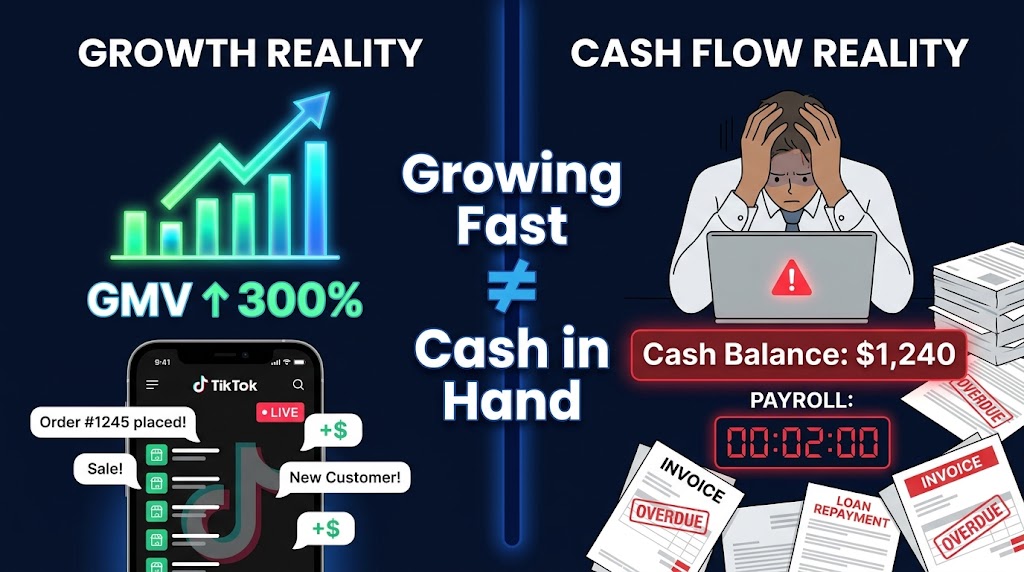

There is a very particular kind of panic that hits a TikTok Shop seller around month three or four of strong growth. Sales are up. Orders are flooding in. The Seller Center dashboard looks like a success story. And then you check your bank account and realize you have almost nothing left to operate with.
This is not a rare edge case. It is the default experience for sellers who scale TikTok Shop operations without building the underlying financial architecture to support the growth. The platform’s core mechanics — payout delays, upfront inventory requirements, rising affiliate commissions, the cost of Live commerce production — are designed in a way that punishes fast-moving operators who haven’t modeled their cash cycle honestly.
The good news is that the math is knowable. The liquidity gaps are predictable. The operational failure points at $10K, $50K, and $150K monthly GMV are different from each other, but they all follow patterns. This post goes through each layer of that math — the real cash conversion cycle, what a full honest unit economics model looks like, how to build operations that survive viral demand spikes, and what financing options are actually available when you need a bridge. Not theory. The specifics operators are using in 2026 to keep growing without running dry.
The Scaling Trap: Why More Sales Can Mean Less Cash
TikTok Shop’s appeal as a growth channel is real. The platform’s global GMV grew approximately 120% year-over-year heading into 2026, with US GMV hitting roughly $5.8 billion in the first half of 2025 alone, crossing $500 million in Black Friday/Cyber Monday weekend sales. That momentum has accelerated into 2026. Sellers who get traction can see meaningful revenue within weeks.
But there is a fundamental mismatch built into the platform’s structure that almost every scaling seller runs into eventually: you spend cash to generate sales days or weeks before TikTok ever sends you that cash back.
This is not unique to TikTok Shop — every marketplace has settlement delays. What makes TikTok Shop particularly acute is the combination of three factors happening simultaneously during growth:
- Payout timing: TikTok Shop’s standard settlement cycle runs approximately 7–15 days after order delivery, not after the sale. With transit time, that means cash for an order placed today may not arrive for 2–3 weeks.
- Inventory front-loading: Viral content can drive 10x–100x baseline order volume within hours. You either have the inventory already paid for and on hand, or you miss the sales. That means stocking ahead of demand, which means cash out before any cash comes in.
- Affiliate and ad spend: Running an affiliate program means creator commissions averaging 13–20% are paid out from your settlement, but the affiliate recruitment, sample gifting, and ad amplification costs come before that content performs.
Layer all three together during a growth phase and you can find yourself in a situation where your Seller Center shows $80,000 in settled payouts coming over the next two weeks — while your supplier invoice for $45,000 is due in five days and your 3PL bill just landed. That is not a sign of a failing business. It is a sign of a business that needs a cash flow architecture designed for the way TikTok Shop actually works.
The Actual Cash Conversion Cycle on TikTok Shop
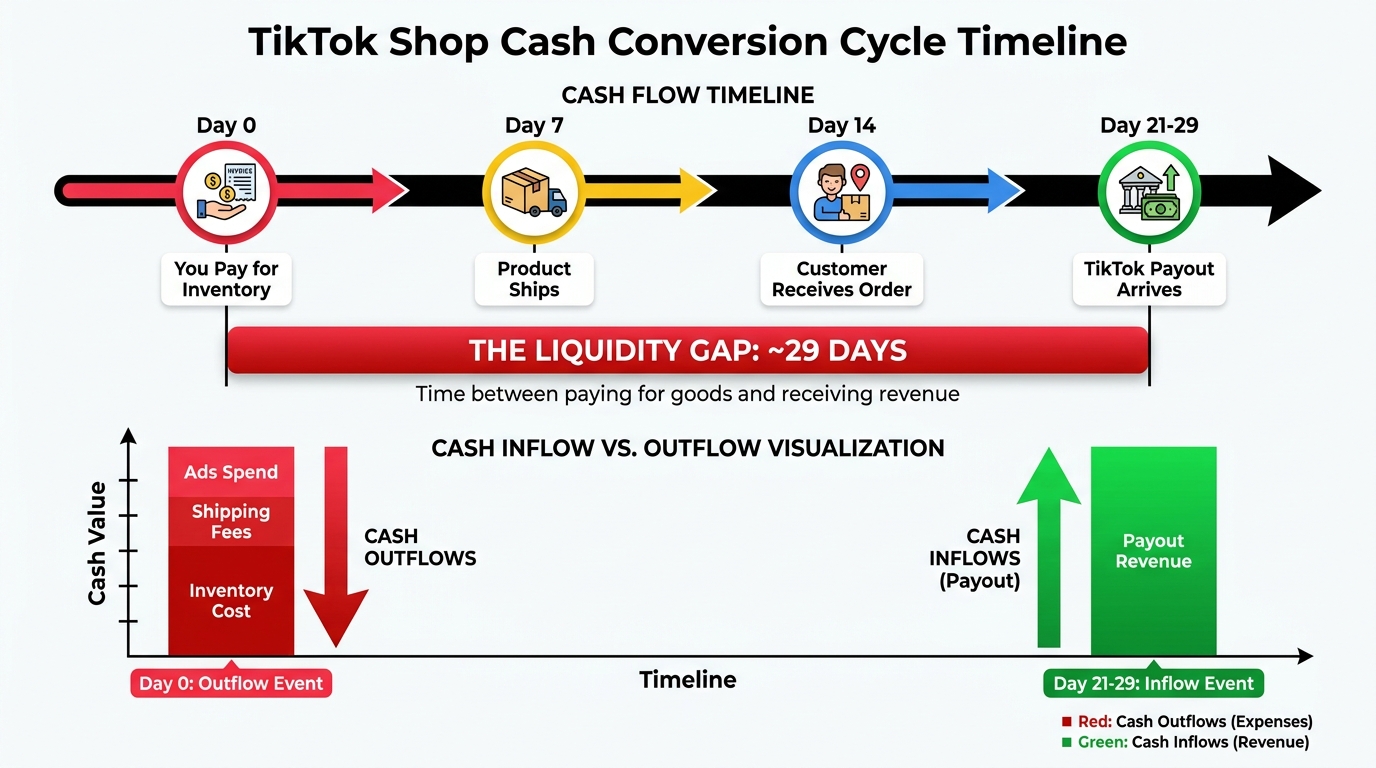
The cash conversion cycle (CCC) measures how long it takes from the moment you spend cash to acquire or produce inventory to the moment you recover that cash from sales. On TikTok Shop, this number is rarely discussed honestly — and it’s far longer than most operators assume when they’re in early growth mode.
Breaking Down Each Component
Days Inventory Outstanding (DIO): This is how long inventory sits before it sells. For most TikTok Shop sellers operating in trend-sensitive categories like beauty, health, or fashion, DIO can range from 7 to 30+ days depending on how well they’ve matched their buy to content timing. If you over-purchase ahead of a campaign that underperforms, your DIO bloats and cash sits tied up in warehouse stock.
Days Sales Outstanding (DSO): On TikTok Shop, this is effectively the time from sale to when cash hits your bank. Standard sellers experience roughly 14–21 days here — the transit window for the order plus TikTok’s 7–15 day settlement cycle. High-volume sellers who have unlocked shorter settlement windows may see this as low as 7–10 days, but the majority of sellers in the $0–$100K GMV/month bracket are working with the longer end of this range.
Days Payable Outstanding (DPO): This is how long you can hold off paying your suppliers. If you’re paying suppliers upfront (net-0 terms), your DPO contribution is zero — meaning it adds nothing to your working capital buffer. Sellers who have successfully negotiated net-30 or net-60 supplier terms effectively buy themselves a 30–60 day buffer that dramatically improves their cash position.
Put the typical numbers together and a mid-stage TikTok Shop seller might realistically have a CCC of 25–40 days. That means for every dollar you spend acquiring inventory, you are waiting roughly a month to get it back. During that window, you still have to pay for shipping, packaging, platform fees, affiliate samples, and any paid ad amplification.
Why Scaling Makes the Gap Worse
Here is the counterintuitive part: the better your sales performance, the more acute your cash gap becomes. If you sell $30,000 in one week after a piece of content goes viral, you need to immediately repurchase $15,000–$20,000 in inventory to sustain that momentum — but the cash from that viral week won’t land in your account for another 14–21 days. Meanwhile, your affiliate creators who drove that content are watching closely. If you go out of stock, they move to the next brand. The window for capitalizing on a viral moment is measured in days, not weeks.
The sellers who scale successfully understand this cycle and plan for it explicitly. They do not treat their Seller Center “earnings” balance as money they have. They model it as money they are owed on a schedule.
Your Full Cost Stack: Building an Honest Unit Economics Model
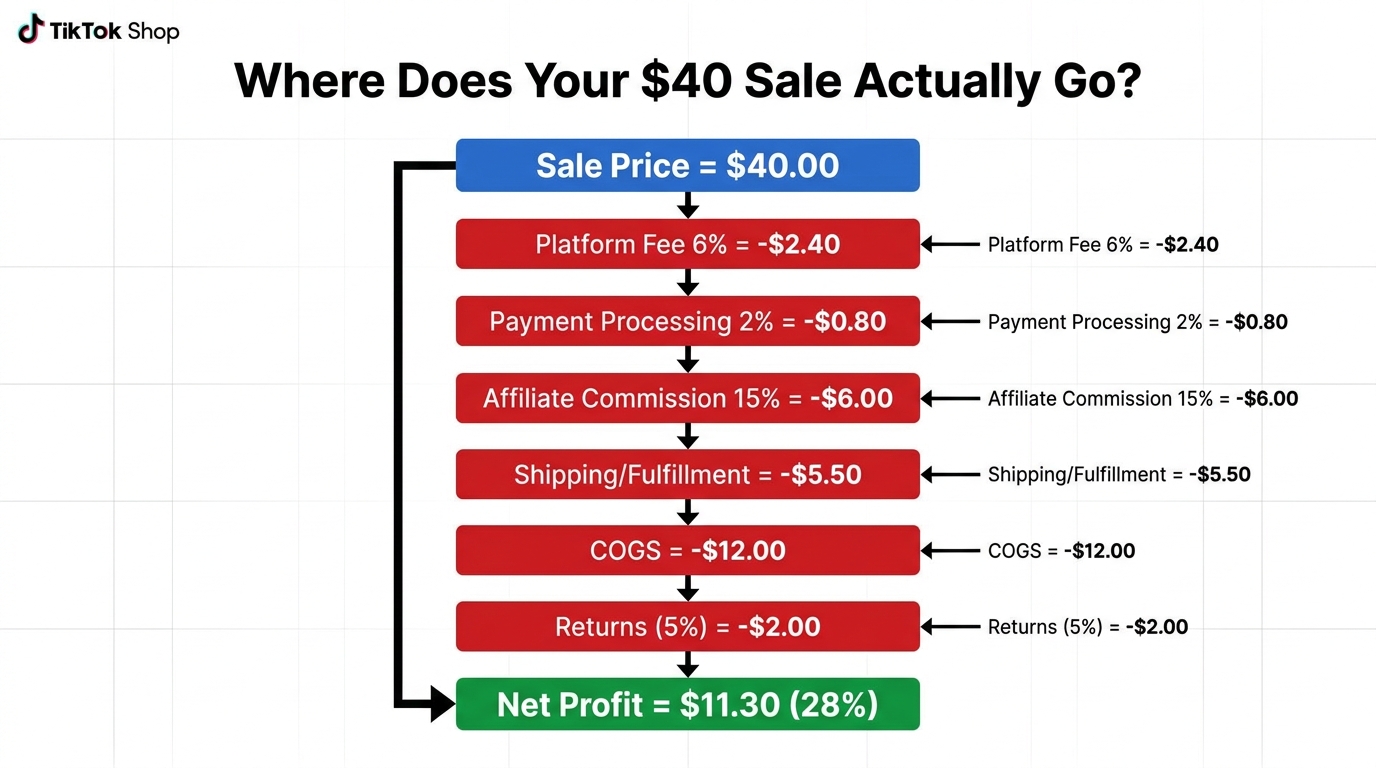
Most operators building their first TikTok Shop P&L model underestimate their total cost stack by 8–15 percentage points. They know their product cost and they know TikTok’s referral fee. Everything else gets rounded down or forgotten entirely. Here is what a complete, honest cost model looks like in 2026.
The Platform Fee Layer
TikTok Shop’s referral fee sits at approximately 6% of the item sale price for most US categories in 2026, with some jewelry categories at 5% and certain high-value electronics potentially at higher rates. Payment processing adds another 1–2% on top, bringing the effective platform take rate to approximately 7–8% in most scenarios. This is lower than Amazon’s typical referral fee structure, which is one reason the economics can work well — but it is only the starting layer.
Affiliate Commissions: The Variable That Wrecks Margins
The platform-wide average affiliate commission on TikTok Shop in 2026 sits around 13%, but competitive categories like beauty, supplements, and wellness regularly see brands offering 15–25% to attract top-performing creators. On a $40 product, a 15% commission is $6.00. On a $25 product, it’s $3.75. This is not a cost most operators internalize at scale.
Here is where sellers get hurt: when you are trying to grow quickly, you raise commissions to attract more creators. Your GMV climbs. You look at the top-line number and feel good. But your contribution margin per unit has quietly dropped from 35% to 18%, and you don’t notice until your next payout hits and it’s $15,000 lighter than you expected.
The discipline here is calculating a “maximum commission rate” for every product — the highest affiliate percentage you can offer while still hitting your target contribution margin. Build that number before you set your affiliate program rates, not after.
Fulfillment and Returns
Fulfillment costs on TikTok Shop vary significantly by model (more on that in the fulfillment section), but a reasonable baseline for a seller using a 3PL in 2026 is $3.50–$6.50 per unit all-in, including pick/pack and last-mile delivery for standard-size products. For heavy or oversized items, this number can double.
Returns deserve special attention. TikTok Shop buyers have high return expectations, particularly in fashion and beauty. A 5% return rate on a $40 product at scale — say 500 units per week — means processing roughly 25 returns, absorbing the reverse logistics cost, and often writing off some percentage of returned product. At $3–5 per return in reverse logistics plus an average 40% product write-down, a 5% return rate effectively adds 2–3% to your cost of goods sold at scale. Most initial models ignore this entirely.
Advertising and Sample Costs
Not all TikTok Shop revenue is affiliate-driven. Many sellers layer in Shop Ads (paid amplification of content, shoppable ads, and product discovery campaigns) to supplement organic and affiliate traffic. For shops that rely on paid advertising, the effective blended Customer Acquisition Cost (CAC) through TikTok’s ad products typically runs $8–25 per customer in competitive categories, though organic-first sellers using pure affiliate strategy can drive this closer to $2–5 per acquired customer at scale.
Sample seeding for affiliates is a real, often under-budgeted line item. If you are outreach-posting 5,000–10,000 affiliate invitations per month and converting 3–5% into active creators who each request a sample, that could mean 150–500 units of product sent for review purposes — all cost, with variable return depending on content quality.
The Viral Spike Problem: Building Ops That Survive 10x Demand
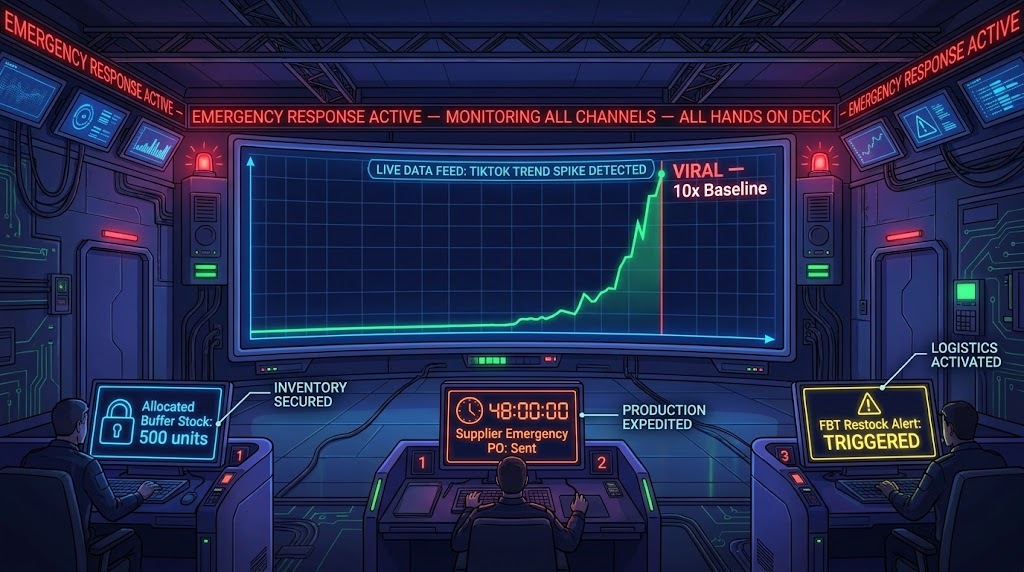
Approximately 70% of retailers have experienced stockouts or significant fulfillment delays directly tied to TikTok virality, according to retail analytics research from First Insight. The damage from a stockout during a viral moment is not just the immediate lost sales — it is the broken momentum that is almost impossible to rebuild. Creators who drove the spike see poor conversion and move on. TikTok’s algorithm notes the high cancellation or out-of-stock rate and penalizes your shop’s visibility.
The solution is not simply “carry more inventory.” That answer trades one cash problem (liquidity gap) for another (capital tied up in dead stock). The answer is building tiered inventory architecture that responds to velocity signals quickly.
Allocated Buffer Stock Strategy
Rather than syncing your entire available inventory count to your TikTok Shop listing, operationally sophisticated sellers maintain a dedicated TikTok Shop allocation — a sub-inventory bucket set aside specifically for the TikTok channel. This prevents scenarios where a surge on TikTok oversells inventory that was supposed to serve your DTC website or Amazon listing simultaneously.
The allocation amount should be calibrated to your current baseline velocity multiplied by a viral multiplier. If your shop averages 50 units per day and you have seen historical viral spikes hit 8x baseline, you want a TikTok allocation buffer of at least 300–400 units before any significant affiliate content campaign launches — enough to cover 7–10 days of a viral spike while your emergency replenishment order moves through the pipeline.
Velocity-Triggered Reorder Points
Manual inventory monitoring fails during viral spikes because the demand signal moves faster than a human’s reaction time. The best-performing TikTok Shop operators in 2026 have automated reorder triggers based on sell-through velocity, not just static reorder points. This means setting up inventory management tools — tools like Inventory Planner, Nventory, or Shopify’s native inventory forecasting for connected shops — to fire purchase orders automatically when daily velocity exceeds a threshold, not waiting until stock reaches a minimum level.
A velocity-based trigger set at “auto-generate PO when 3-day average sales exceed 2x the 14-day average” gives you a 5–10 day head start on replenishment before you actually run out. Combined with a supplier relationship that can execute emergency orders within 48–72 hours (even at a premium unit cost for rush production), this closes most viral stockout risk.
Supplier Relationship Architecture
Operators who treat their supplier as a transactional vendor will never have the replenishment flexibility to survive viral moments. The brands navigating TikTok Shop best in 2026 have explicit conversations with their manufacturers about TikTok-specific demand characteristics: the spike-and-hold patterns, the speed requirements, and the need for suppliers to hold a “safety production run” that can be released within days upon request.
In exchange, you offer the supplier something valuable — more predictable forecasting, longer-term purchase commitments, or a small premium on rush orders. This is a business relationship negotiation, not just a purchasing transaction. The cost of a slightly higher unit price on rush inventory is almost always far lower than the cost of a missed viral moment.
Affiliate Program Scaling Without Letting Margins Erode
The affiliate program is both TikTok Shop’s greatest competitive advantage and its biggest margin risk. Done right, it provides essentially free media — creator-driven content that converts without the CPM cost of paid advertising. Done wrong, it creates a commission structure you cannot walk back without losing creator relationships, while simultaneously training buyers to expect prices at which you cannot profitably operate at scale.
Tiered Commission Architecture
The most effective affiliate programs at scale do not offer flat commission rates. They use tiered structures that reward performance while keeping baseline commission obligations manageable. A typical tiered structure might look like:
- Entry tier (all affiliates): 10–12% commission. Available to any creator who connects with your shop.
- Performance tier ($500+ GMV/month generated): 15% commission plus priority sample access and early access to new products.
- Top creator tier ($3,000+ GMV/month): 18–22% commission, dedicated brand support, co-creation opportunities, and potential guaranteed minimum fees for exclusivity.
This structure means your average blended commission stays closer to 11–13% across the full affiliate base (since most creators will be at entry tier), but your top 5–10% of creators — who may be driving 60–80% of your affiliate GMV — feel appropriately valued and compensated.
The Sample-to-Video Conversion Math
Sample gifting for affiliates is a real cost that deserves explicit modeling. Based on documented creator campaign data, a typical outreach-to-sample rate runs approximately 3–7% (you invite 100 creators, 3–7 request samples). Of those who receive samples, roughly 50–70% will post at least one video. Of those videos, perhaps 15–25% will generate meaningful sales (defined as $200+ GMV).
Running this math on a $15 product with a $12 COGS and sending 300 samples per month: you spend $3,600 in COGS on samples, generate approximately 150–200 videos, and perhaps 30–50 of those videos produce meaningful GMV. The question is whether those 30–50 videos generate enough ongoing affiliate sales to justify the $3,600 in sample cost. For a product with a $5 contribution margin (after all fees) and a 13% commission, you need each “successful” video to generate roughly $55+ in ongoing affiliate GMV just to break even on the sample cost — typically easily achieved if the content has any shelf life.
Managing Commission Creep
Commission creep happens when you raise rates to compete for creator attention without a clear plan to hold the line. Competitors offering 20% force you to match. A top creator asks for 25% “just for you.” You say yes because the GMV they drive is too significant to lose. Six months later, your blended commission rate has drifted from 13% to 17%, and your margin is underwater.
The defense against this is having a hard policy — documented in your affiliate SOPs — that defines the maximum commission rate by product tier based on unit economics, not based on creator pressure. When a creator asks for a rate above your ceiling, the honest answer is: “Our margin structure means we can’t sustainably pay above X% on this product. What we can offer instead is [exclusive access / co-created content / guaranteed post fee].” Non-commission alternatives have real value to creators and cost less than uncapped commissions.
Fulfillment Architecture: Choosing the Right Model for Your Revenue Band
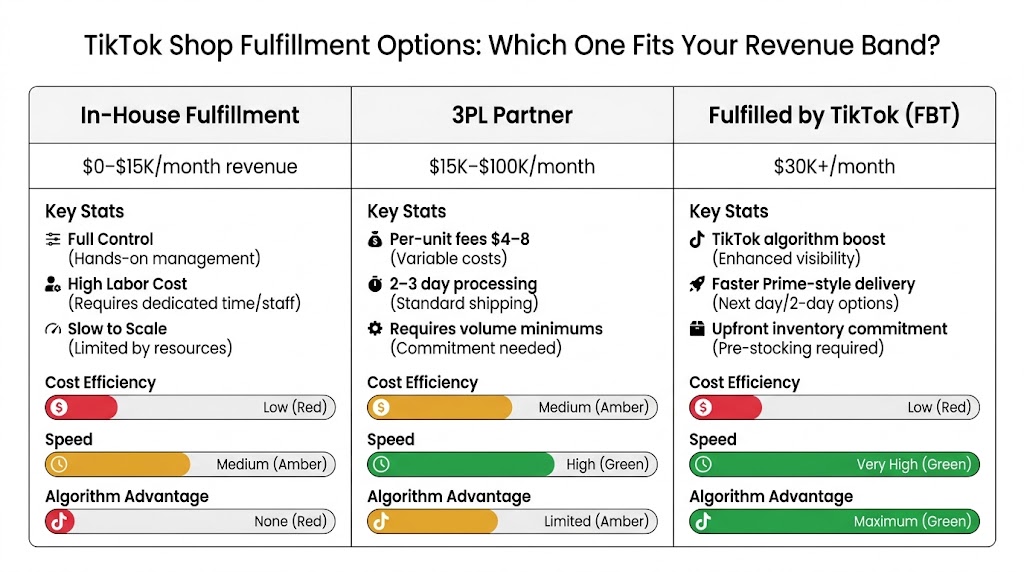
Your fulfillment model is one of the most consequential operational decisions you make on TikTok Shop, and it intersects directly with your cash flow in ways that are not immediately obvious. Here is how the three main options compare at different revenue stages.
In-House Fulfillment: The Sub-$15K/Month Stage
At sub-$15,000 monthly GMV, in-house fulfillment makes practical sense for many sellers. The fixed overhead is minimal, you maintain direct control over packaging and presentation, and you are not paying per-unit 3PL fees on low volumes. The cash flow advantage here is real: you are not pre-funding a 3PL minimum monthly fee before your volume justifies it.
The ceiling on this model hits quickly, though. When orders spike to 50–100+ per day, manual pick/pack becomes a full-time job or two, and your operational bandwidth is consumed by fulfillment instead of growth. The transition point varies by product type and team size, but most sellers find the in-house model starts constraining growth somewhere in the $10K–$20K monthly GMV range.
3PL Partnership: The $15K–$100K/Month Stage
A well-chosen 3PL partner gives you scale without fixed headcount, and the per-unit cost model aligns costs with revenue — which is favorable for cash flow. In 2026, established ecommerce 3PLs typically charge $3.50–$6.50 per order for standard-size products in the US, inclusive of pick, pack, packaging materials, and last-mile handoff to the carrier. Weight/dimension surcharges, storage fees, and returns processing are additional.
The cash flow consideration with 3PLs is that most require net-15 or net-30 payment terms, meaning your 3PL bill for the month is due before some of your TikTok Shop payouts from that month have arrived. This is a manageable gap — but it is a gap you need to plan for explicitly. Some 3PLs offer net-45 payment terms to established clients with a good payment history, which can meaningfully improve your operational cash position.
The selection criteria for a TikTok Shop-specific 3PL should include: experience handling viral demand spikes (ask specifically about their surge capacity and how they handled peak periods for existing clients), real-time inventory API connectivity with Shopify or your shop management software, and a returns processing operation that can handle the category-specific return rates for your product type.
Fulfilled by TikTok (FBT): The Algorithm Advantage Play
TikTok’s own fulfillment program, Fulfilled by TikTok (FBT), operates similarly to Amazon’s FBA in structure: you ship inventory into TikTok’s fulfillment network, and TikTok handles last-mile delivery, customer service on orders, and returns. FBT products receive a designation badge in the shop interface and typically benefit from faster delivery promises — a factor the algorithm weights positively in product discovery.
The cash flow implications of FBT are significant. You commit inventory to TikTok’s fulfillment centers upfront, which means cash out before any sales. If you send 1,000 units at $12 COGS each, that is $12,000 sitting in TikTok’s warehouse. During a velocity dry spell, that cash is locked in a way that is difficult to unwind quickly. Minimum inventory commitments and the inbound shipping costs to TikTok’s fulfillment centers add further upfront investment.
For sellers doing $30,000+ monthly GMV with a consistent product that is not highly volatile in demand, FBT can make strong economic sense — the delivery speed improvement, algorithm advantage, and customer service offload are meaningful operational benefits. For sellers with seasonal or trend-driven SKUs, the inventory commitment risk needs to be modeled carefully before committing.
Working Capital Options Ranked for TikTok Shop Operators
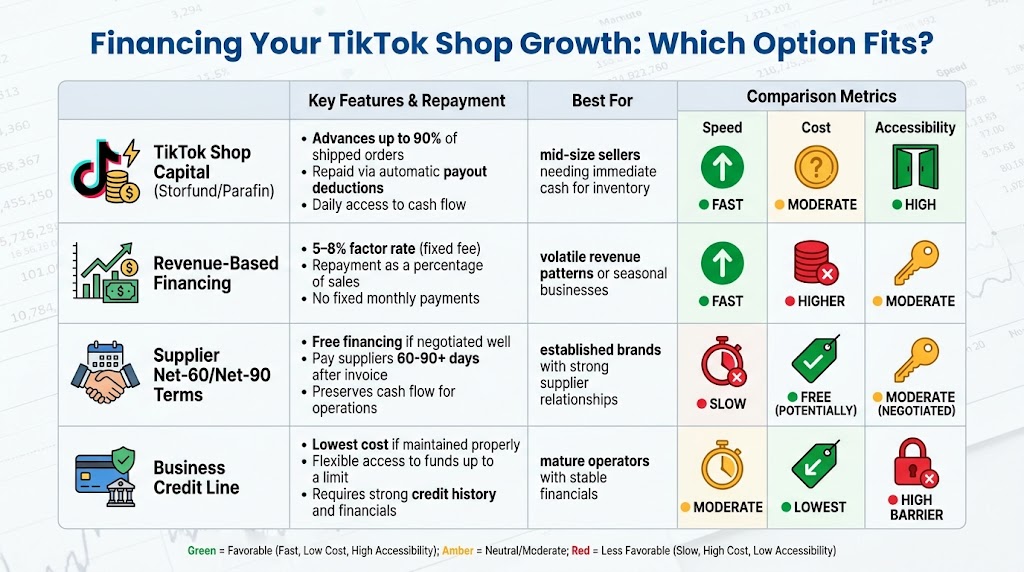
When the cash conversion cycle creates gaps that your current operating cash cannot bridge, you need financing. Here is a ranked breakdown of the options available to TikTok Shop sellers in 2026, from most accessible to most advantageous.
TikTok Shop Capital (Early Settlement / Daily Advance)
The most frictionless option for eligible sellers is TikTok’s own embedded financing program, accessible through Seller Center’s Finances tab. TikTok Shop Capital is invite-only and powered by third-party lending partners including Storfund (Daily Advance product), Parafin (flex financing), and Kanmon. TikTok itself is not the lender.
The core product — Early Settlement — allows eligible sellers to access up to 90% of the value of shipped orders on the morning after shipment confirmation, rather than waiting the standard 7–15 days. Repayment comes automatically via deductions from future TikTok Shop payouts. This is a clean, low-friction solution that directly addresses the payout delay problem without requiring external credit applications.
The cost of this capital varies by provider and offer terms — expect something in the range of 1–3% of the advanced amount for a 10–14 day advance window. At $100,000 in monthly GMV, a 2% advance fee on 90% of that revenue equates to $1,800/month in financing cost. That is a real number, but it needs to be weighed against the cost of the alternative: missing replenishment windows, going out of stock, or losing creator relationships.
Revenue-Based Financing (External Providers)
Several external providers specialize in revenue-based financing for ecommerce sellers, including Clearco, Onramp Funds, and Wayflyer. These products advance capital repaid as a percentage of future revenue — typically 5–12% of daily/weekly revenue until the advance plus a fixed fee (typically a factor rate of 1.05–1.15x) is repaid. The cash flow-friendliness here is significant: you pay nothing in slow weeks and repay faster in good weeks.
The main advantage over TikTok Shop Capital for some sellers is flexibility — you can use the capital for anything (supplier deposits, ad spend, team scaling, 3PL working capital), not just inventory replenishment tied to shipped orders. The application process typically requires 3–6 months of sales history and is relatively fast, often delivering capital within 48–72 hours of approval.
Supplier Term Negotiation (The Best Capital Is Free Capital)
Before taking on any interest-bearing financing, the highest-priority working capital move for any established TikTok Shop seller is negotiating better payment terms with suppliers. A net-60 supplier agreement on $50,000 in monthly inventory purchases effectively gives you $50,000 in free, 60-day working capital — far superior to any financing product in terms of cost.
Supplier term negotiation works best when you have a track record of on-time payments and consistent order volume. The pitch is straightforward: “We’re scaling our TikTok Shop channel and expect to grow our orders by X% over the next 6 months. To support that growth, we need net-60 terms so our settlement cycle can fund the next purchase.” Most suppliers who want the business will negotiate. Some will ask for a small price concession in exchange for extended terms — usually worth it.
Business Credit Lines
A traditional business revolving credit line from a bank or credit union is the cheapest form of working capital available to creditworthy operators — typically Prime Rate + 1–3%, which in 2026’s rate environment means rates in the high single digits to low double digits. The limitation is access: lines of credit require established business credit history, often 2+ years of business tax returns, and meaningful revenue. They are not available to early-stage sellers, but for operators in the $500K+ annual GMV range with strong financial records, establishing a business line of credit is a foundational move that changes the risk calculus of scaling.
Live Commerce Operations: The Cost Center Nobody Budgets For
TikTok LIVE commerce is one of the most powerful converting formats on the platform — internal TikTok data suggests live shopping drives conversion rates of 8–12%, compared to 2–4% for standard product page traffic. Some categories see LIVE conversion run 10x higher than traditional ecommerce benchmarks. That kind of conversion rate is worth investing in. The question is what “investing in” actually costs at scale, because the numbers surprise most brands doing it for the first time.
The Real Cost Structure of a Live Commerce Operation
Running a consistent, high-quality TikTok LIVE commerce operation requires more than pointing a camera at your founder three times a week. At the level where LIVE becomes a meaningful revenue driver, the cost structure typically includes:
- Host talent: A trained, on-camera product presenter who can run 2–4 hour sessions, handle real-time questions, and maintain viewer engagement commands $3,000–$8,000/month for a dedicated part-time host in the US market. Top-performing LIVE hosts are genuinely scarce, and their compensation reflects that.
- Production setup: Camera equipment, lighting, a clean studio space or branded backdrop, and basic audio. A one-time setup in the $2,000–$5,000 range produces professional-quality output. Brands with dedicated Live studios consistently outperform on watch time and conversion metrics.
- Scheduling and promotional coordination: Someone needs to schedule sessions, create pre-live promotional content to build viewership, coordinate flash deals, and manage the product display sequence. At consistent scale, this is a part-time operational role.
- Inventory allocation for LIVE exclusives: Most effective LIVE sessions use exclusive pricing or bundling that is available only during the stream. This requires reserving dedicated inventory for each session — and that inventory commitment sits outside your standard stock allocation.
A modest but consistent LIVE commerce operation — two to three sessions per week, one trained host, basic production, and promotional support — runs approximately $6,000–$12,000 per month in total operational cost before any inventory commitment. The cash flow implications are front-loaded: the team and equipment costs happen regardless of how a given session performs.
The Revenue-to-Cost Threshold
At what point do LIVE operations become cash flow accretive rather than a net cash drain? Based on typical contribution margins and LIVE conversion rates, a shop generating less than $15,000/month from LIVE sessions is likely running LIVE at a loss. The break-even point for a full LIVE operation — properly staffed, consistently scheduled — sits around $20,000–$25,000 in monthly LIVE GMV, assuming a 20–28% contribution margin on the products being sold through the channel.
Below that threshold, a more capital-efficient approach is using contracted host partners on a revenue-share basis rather than hiring in-house, running sessions on a lower frequency (weekly rather than daily), and focusing on LIVE as a brand-building and affiliate recruitment tool rather than a primary revenue driver.
Building SOPs That Don’t Break When Volume Doubles
Operations that work at $20,000 monthly GMV reliably break at $80,000. The processes that a founder can hold in their head and execute personally become the bottleneck the moment they can’t personally supervise every order, every affiliate inquiry, and every customer complaint. The businesses that scale well in 2026 are the ones that had documented, repeatable processes before they needed them.
The Five SOPs Every TikTok Shop Operator Needs
1. Inventory Replenishment SOP: Documented triggers for when POs get placed, who places them, what supplier lead times to assume by category, what the emergency escalation path is for viral spikes, and how to adjust allocations across channels. This SOP should have a version that works when you’re on vacation and someone else is running it.
2. Affiliate Onboarding and Management SOP: How new affiliate creators are screened, how samples are requested and fulfilled, how commission tiers are managed, how content is tracked against GMV performance, and what the criteria are for elevating a creator to a higher tier. Without this, every new team member who touches your affiliate program does it differently.
3. Customer Service Response SOP: TikTok Shop buyers expect fast responses. Response time within 24 hours is a platform metric that affects your shop health score. Your CS SOP should include response templates for the 10–15 most common inquiry types, clear escalation criteria for refunds and replacements, and defined authorization levels for who can approve refunds without manager sign-off.
4. Returns Processing SOP: Returned item inspection criteria, resale vs. write-off decision rules, how returns are reconciled in your inventory system, and how customer refund confirmation is handled in Seller Center. Returns processing that isn’t systematized becomes a mess of untracked items and unresolved disputes that eat into settlement accuracy.
5. Weekly P&L Review SOP: A standing cadence — weekly at minimum — for reviewing GMV, fees, affiliate payouts, fulfillment costs, returns, and net settlement against forecast. This isn’t just an accounting exercise. It’s the early warning system for margin erosion, rising return rates, or commission creep before they compound.
When to Hire vs. When to Automate
One of the most common cash flow mistakes at the $50K–$200K GMV stage is hiring headcount to solve problems that should be automated. Customer inquiry volume? That is automation (chatbots, canned responses, macros in your helpdesk software). Inventory alerts? That is automation (API-connected inventory tools with threshold triggers). Creator commission reporting? That is automation (affiliate platform reporting piped into a dashboard).
Human judgment is needed for supplier relationship management, creator relationship cultivation, product selection, and financial strategy. Almost everything else at that revenue scale can be systematized with tools that cost far less than a full-time hire. This distinction — what requires judgment versus what requires execution — determines whether your operational cost structure scales sub-linearly (good) or linearly (dangerous) with revenue.
The Cash Flow Dashboard Every Scaling TikTok Shop Operator Needs
You cannot manage what you cannot see. Most TikTok Shop sellers are flying operationally blind — they know their GMV from the Seller Center dashboard, but they have no real-time view of their cash position, their 30-day cash requirement forecast, or the gap between incoming settlements and outgoing obligations. Building a simple cash flow dashboard is one of the highest-leverage operational moves available to a scaling seller.
The Five Numbers That Matter Every Week
1. Pending Settlement Balance: Total earnings in TikTok Seller Center that are settled but not yet paid out, organized by expected payout date. This is not “money you have” — it is money you are owed on a schedule. Treat it as a receivable, not cash.
2. Open Purchase Order Obligations: The total dollar value of POs placed with suppliers that have not yet been paid or fully received. This represents known future cash outflows. If your open PO balance exceeds your current cash plus next-7-days settlements, you have a gap that needs addressing before the invoices land.
3. 14-Day Burn Rate: What you are spending on fulfillment, advertising, team, software, and samples in the next 14 days. This is your operational baseline — the number that has to be covered regardless of sales performance.
4. Blended Contribution Margin (Trailing 7 Days): Calculate this weekly on actual settled orders, not projected. If your blended margin is drifting down — whether because of commission creep, rising fulfillment costs, or increasing return rates — you want to see that signal early, not at the end of the month.
5. Net Cash Position + Receivables: Bank balance plus pending settlements minus open payables. This is your real financial position. A business with $5,000 in the bank, $40,000 in pending settlements arriving within 14 days, and $35,000 in supplier invoices due in 10 days is not in trouble — but a business with $5,000 in the bank, $12,000 in pending settlements, and $35,000 in supplier invoices due in 10 days has a serious problem that won’t be visible if you only look at GMV.
Building It Without an Accountant
You do not need sophisticated accounting software to build this dashboard at the $20K–$100K GMV/month scale. A well-structured Google Sheet refreshed weekly, with data manually pulled from Seller Center, your supplier invoice files, and your business banking app, will serve most operators well. The key is discipline of cadence — reviewing it every Monday before any spending decisions for the week, not quarterly when the numbers have become history rather than a guide to action.
For sellers crossing $150K+ monthly GMV, connecting accounting software like QuickBooks Online or Xero with your TikTok Shop data via integration tools like A2X or direct CSV import starts to pay dividends in accuracy and time savings. At that scale, the cost of misreading your cash position is large enough to justify the investment.
Scaling Smart: The Operational Sequence That Actually Works
There is a natural instinct when TikTok Shop starts working to pour gasoline on it — more creators, more ad spend, more SKUs, more LIVE sessions. That instinct is not wrong, but the sequence matters enormously. The sellers who scale without blowing up their cash flow tend to follow a consistent progression.
Stage 1: Prove the Unit Economics Before Scaling Volume
Before you try to scale, you need to know your actual contribution margin per unit on real settled orders, not projected. Run your first 90 days as an intensive data collection exercise. What does your blended CCC actually look like? What is your real return rate? What is your actual affiliate commission landing, not what you set it at? What are your total fulfillment costs per unit at current volume? Build these numbers from actuals before you invest in growth infrastructure.
Stage 2: Lock the Cash Flow Architecture
Once you have real unit economics, build your cash flow bridge before you need it. This means negotiating supplier terms, establishing a relationship with a revenue-based lender before you need to draw on it, setting up Early Settlement with TikTok Shop Capital if you qualify, and maintaining a minimum cash reserve equal to at least 30 days of operating burn. Do all of this while your cash position is comfortable. Financing applications made from a position of distress get worse terms and slower approvals.
Stage 3: Build Systems Before Scaling Headcount
Map every operational process that will break at 3x current volume. Document it. Automate everything that doesn’t require human judgment. Only then hire — and hire for judgment-intensive roles first (affiliate relationship management, product development, financial oversight), not for execution roles that tools can handle.
Stage 4: Scale With Controlled Experiments
Even with solid unit economics and a cash flow bridge, scaling should be treated as a series of controlled experiments rather than a simultaneous push on all levers. Double your affiliate outreach for one quarter and measure the impact on blended margins before adding a paid ad layer. Launch LIVE commerce consistently for 60 days before investing in dedicated host talent. Add new SKUs one at a time with 60-day tracking before expanding the catalog further.
This staged approach is slower than the “scale everything at once” instinct. It is also how brands reach $1M+ monthly GMV without a cash crisis midway through, because each lever’s cost implications are known before the next one is added.
What Sustainable TikTok Shop Scaling Actually Looks Like
The TikTok Shop opportunity in 2026 is real and significant. The platform’s continued GMV growth, the ongoing expansion of its creator ecosystem, and the improving maturity of its seller tools collectively represent a channel that rewards operators who approach it with financial rigor as much as creative instinct.
The sellers who will build durable, profitable businesses here are not necessarily the ones with the best content or the most viral products. They are the ones who understand that TikTok Shop’s financial structure — its settlement cycles, its cost layers, its variable demand patterns — requires a different operational model than traditional ecommerce. They model their cash cycle honestly. They know their unit economics before they scale. They build the cash flow bridge before they need it. And they treat operations as infrastructure, not overhead.
The gap between “running a TikTok Shop” and “running a TikTok Shop operation” is real, and it shows up in the bank account first. Get the financial architecture right, and the growth compounds in a way that builds something sustainable. Skip it, and even a month of exceptional GMV can leave you with a serious cash problem and no clear path to the next purchase order.
Key Takeaways for TikTok Shop Operators:
- Model your actual Cash Conversion Cycle — expect 25–40 days from cash out to cash back at most revenue stages.
- Know your full cost stack: platform fee (~6–8%), affiliate commissions (avg. ~13%), fulfillment ($3.50–$6.50/unit), returns (~2–3% effective COGS impact), and blended CAC.
- Build viral spike protection through allocated buffer stock and velocity-triggered reorder automation — not by blanket overstocking.
- Use tiered affiliate commissions with documented maximum rates per product based on unit economics, not creator negotiation pressure.
- Choose your fulfillment model by revenue band: in-house below $15K/month, 3PL at $15K–$100K/month, evaluate FBT at $30K+ for stable, consistent-demand SKUs.
- Establish working capital options before you need them — TikTok Shop Capital for quick access, supplier terms as your cheapest long-term tool.
- Review your cash position weekly using five numbers: pending settlements, open POs, 14-day burn rate, blended contribution margin, and net cash plus receivables.
- Scale in stages — prove unit economics, lock the cash flow architecture, build systems, then scale volume. Not all at once.