


There is a version of TikTok Shop SEO that most sellers still believe in. You optimize the product title, drop in a few hashtags, tag the right category, and wait for the For You Page to do its job. It worked that way for a while — roughly until 2024 — because TikTok’s commerce engine was still mostly a discovery machine. You needed reach, not relevance.
That era is over.
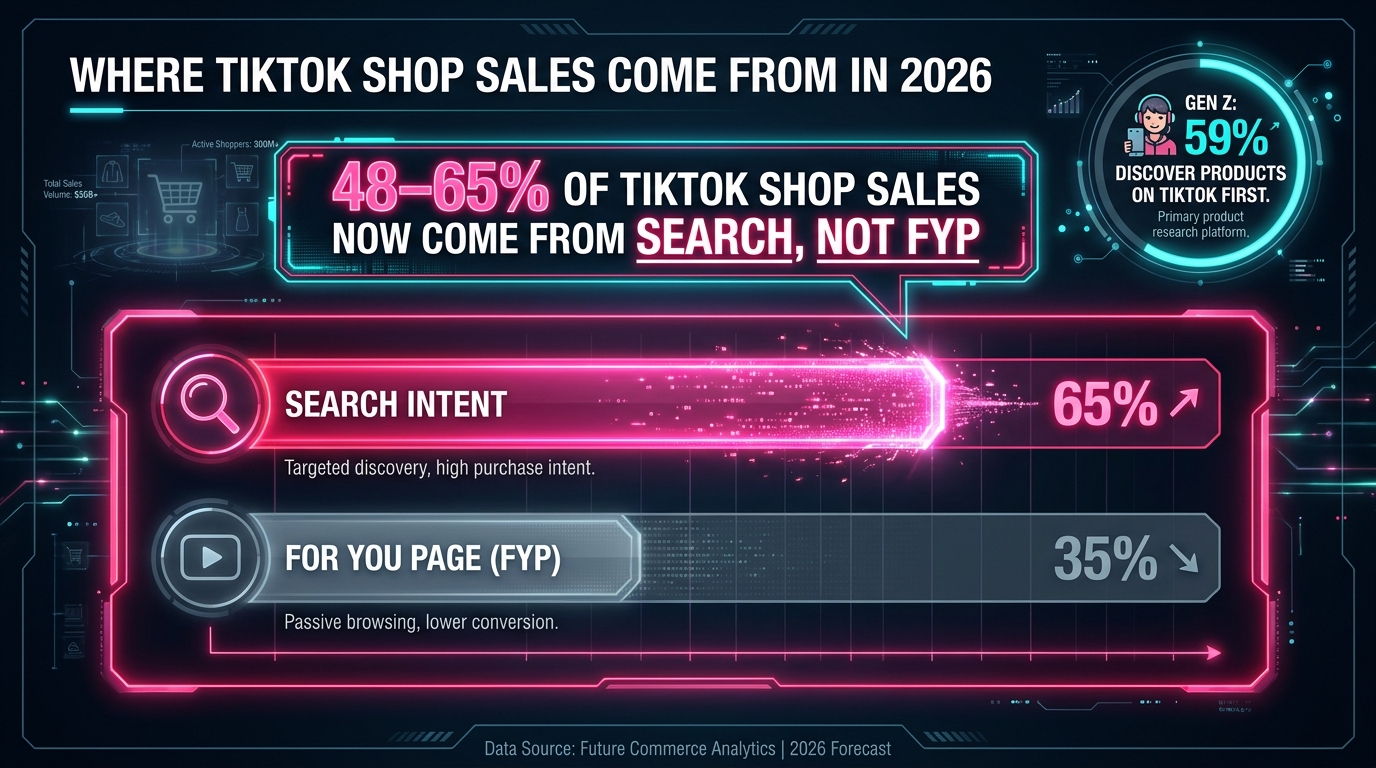
Between late 2025 and mid-2026, TikTok restructured how products get found on its platform in ways that fundamentally change where sellers need to compete. Search is now the dominant discovery channel, accounting for between 48% and 65% of TikTok Shop sales depending on the category. The platform’s internal search behavior has shifted to look and feel more like a product search engine than a social feed — users type intent-driven queries, browse filtered results, compare listings, and convert at rates that rival Amazon for certain verticals.
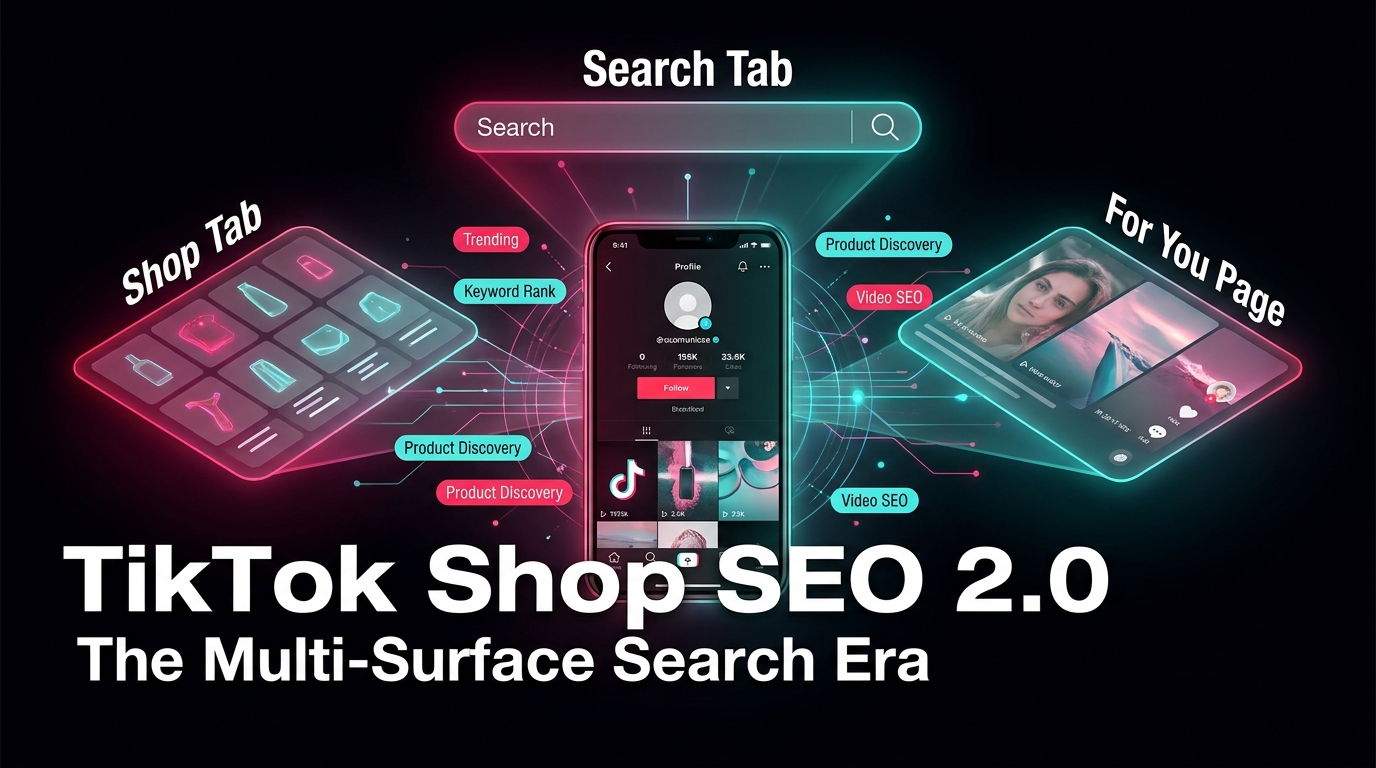
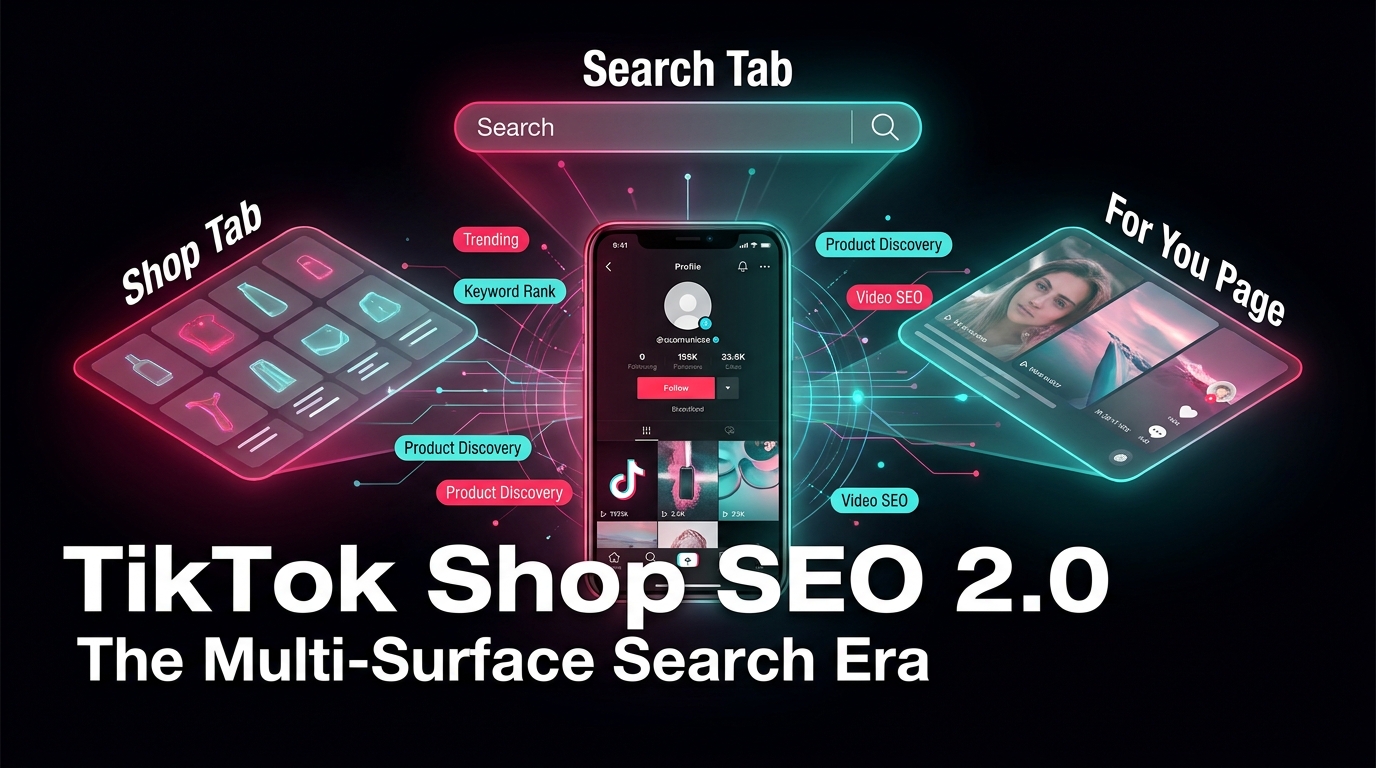
But here is what makes 2026’s version of TikTok Shop SEO different — and harder — than anything that came before: the ranking signals don’t live in one place anymore. A product’s position in search results is not determined by its listing alone. It is shaped by the performance of affiliated creator videos, the trust score attached to the seller account, the quality of spoken audio in live shopping sessions, and — increasingly — whether TikTok content is showing up inside Google’s AI-powered search carousels.
This is multi-surface SEO. And most sellers are optimizing for only one surface at a time.
This piece breaks down what has actually changed, why single-surface optimization is leaving rankings on the table, and what a systematic multi-surface approach looks like in practice.
The Search Era Shift: From FYP-First to Intent-First Discovery
To understand where TikTok Shop SEO stands in 2026, you have to understand the behavioral shift that preceded it. TikTok did not set out to become a search engine. It became one because its users started treating it like one.
How TikTok Became a Product Search Engine
The trajectory started with Gen Z replacing Google for how they research products. Data from Luth Research in 2026 shows that 59% of Gen Z report discovering new products on TikTok. A separate study cited by Autofaceless puts it more starkly: 41% of Gen Z now turn to social media first when searching for information, while only 32% prioritize Google or traditional search engines. For product discovery specifically, over half of Gen Z shoppers most often encounter new products on Instagram (30.4%) and TikTok (23.2%) — compared with just 18.8% naming Google as their primary source.
This behavioral change forced TikTok to build infrastructure to match it. Search prompts above comment sections. “People also searched” modules below videos. Related searches surfaced inside the Shop tab. Autocomplete suggestions that mirror Amazon’s search bar in their specificity. The platform didn’t just accommodate search behavior — it accelerated it by making search more prominent and more rewarding with every major update.
The Implications for How Sellers Think About Discovery
The FYP-first mentality assumed that great content would find its audience through TikTok’s algorithmic distribution. Spend your energy on hooks, trends, and watch time, and the platform’s recommendation engine would handle discovery. That logic still applies — but it now represents a secondary path, not the primary one.
The shift matters because intent-first search and passive scroll-based discovery require fundamentally different optimization strategies. A video optimized purely for FYP performance maximizes watch time and emotional engagement. A product listing optimized for search performance front-loads keywords, matches query language exactly, and converts browsers into buyers with structured information. These two goals are not mutually exclusive — but they cannot be served by the same creative and tactical approach. Sellers who haven’t made that conceptual shift are effectively ignoring the channel that drives the majority of their potential sales.
The statistical evidence is now consistent enough to treat this as fact rather than hypothesis: TikTok Shop has crossed the threshold from social-first discovery to search-first commerce. The SEO playbook needs to reflect that reality.
The Three Surfaces That Actually Rank Products
Before diving into tactics, it is worth being precise about what “ranking on TikTok” actually means — because sellers routinely conflate three distinct surfaces that operate on different signals and serve different user intents.
Surface 1: The Search Tab
The Search Tab is TikTok’s most Amazon-like surface. Users type a query — “water bottle with straw lid insulated,” “silk hair bonnet for curly hair,” “vitamin C serum sensitive skin” — and are served a results page that combines videos, product listings, and creator content. Ranking here is driven primarily by keyword relevance: how well your product title, description, attributes, and associated video captions match the user’s query. Secondary to keyword match, the algorithm weighs performance signals including click-through rate from search results, add-to-cart rate, purchase rate, and review quality.
This is where the most actionable SEO work happens. Getting a product listing ranked in the top five positions on a high-intent search query is the TikTok Shop equivalent of landing on the first page of Amazon results. It delivers consistent, compounding traffic rather than viral spikes that flatten out within 48 hours.
Surface 2: The Shop Tab
The Shop Tab functions as TikTok’s curated commerce storefront. Rather than responding to typed queries, it presents recommended products to users who are browsing with a generalized purchase intent — think of it as a personalized digital mall rather than a search engine. Ranking here is more heavily weighted toward seller and product performance signals: conversion rate, review volume and recency, sales velocity, and the Shop Performance Score (SPS) attached to the seller account.
Critically, category accuracy matters significantly on this surface. A product miscategorized into a broad parent category instead of the correct subcategory will be shown to a broader but less-relevant audience, depressing its conversion rate — which in turn weakens its ranking in both the Shop Tab and the Search Tab. Many sellers underestimate how much taxonomy precision directly affects performance metrics.
Surface 3: The For You Page
The FYP remains important, but its role in the SEO equation is more indirect than sellers often assume. For You Page performance feeds the other two surfaces by generating early engagement signals. A product-tagged video that drives strong watch time, shares, saves, and product-tag clicks tells TikTok’s system that the content is relevant and valuable for a particular topic or audience cluster. Those signals then reinforce the product’s relevance score in search results. The FYP is not an SEO channel in itself — but it is a signal generator that feeds the channels that matter most.
The practical implication: treating FYP optimization and listing SEO as separate silos misses the compounding advantage that comes from aligning them. The sellers outperforming in TikTok Shop search are not just good at creating content or good at listing optimization — they have built systems that make both work together.
Keyword Architecture: Building a TikTok-Native Keyword Hierarchy
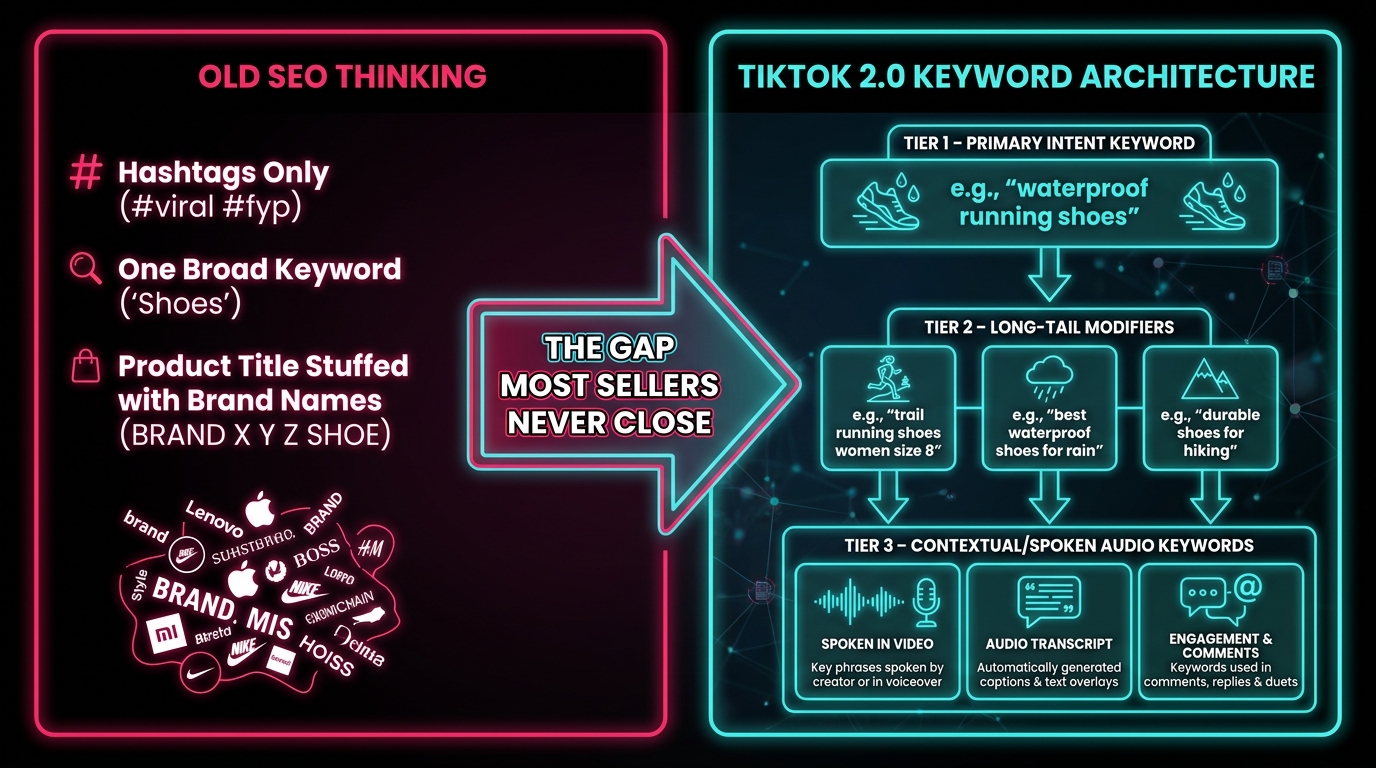
Keyword strategy on TikTok in 2026 looks meaningfully different from keyword strategy on Amazon — and it is different again from how sellers used to think about hashtags on TikTok two years ago. Building the right keyword architecture means understanding how the platform’s search infrastructure categorizes and ranks language.
Tier 1: Primary Intent Keywords
These are the high-volume, high-competition query terms that describe your product at its most basic level. “Wireless earbuds,” “gym water bottle,” “linen jumpsuit.” Tier 1 keywords belong in your product title — ideally in the first three to five words, since TikTok’s own Seller Center documentation explicitly states that front-loading the main search query in the title is a direct ranking lever. The recommended title length is 40 to 150 characters, with most practitioners finding an 80 to 100 character sweet spot that fits primary and one secondary keyword without truncating in search results.
One key difference from Amazon: TikTok’s Seller Center includes a “Product Optimizer” tool that surfaces platform-recommended keywords based on current search demand. These are not generic suggestions — they reflect actual query volume from TikTok’s internal search data. Using these recommended keywords where applicable can accelerate ranking improvement, with TikTok’s own documentation suggesting optimized titles can increase search exposure within approximately seven days of changes.
Tier 2: Long-Tail Modifiers
Long-tail keywords on TikTok work similarly to Amazon’s approach in theory but differ in execution. TikTok users search in more conversational, context-rich language — “wireless earbuds that don’t fall out during workout” rather than “wireless earbuds sport.” This is partly because TikTok functions as a discovery and research tool, not just a transactional one, so users phrase queries as they would describe the problem to a friend.
Long-tail keyword variants belong primarily in the product description — specifically in the first 100 words, which carry the highest relevance weight. They also belong in bullet points or specification fields where provided. The description is not a place to write marketing copy that ignores search language. It is a structured keyword field that also happens to communicate product value. The most effective descriptions open with a problem-solution statement in natural search language, then follow with specifications and use cases, and close with compatibility or context information that captures additional long-tail variations.
Tier 3: Contextual and Spoken Keywords
This is where TikTok’s SEO model diverges most sharply from traditional e-commerce platforms. TikTok’s search algorithm processes audio content from product-tagged videos. The words spoken in a creator’s video — including the hook, product description, and call to action — are indexed as signals that inform product relevance. If a creator says “this is the best travel pillow I’ve used for red-eye flights” and the product is tagged, TikTok associates the listing with queries around travel pillows, red-eye travel comfort, and flight accessories. That audio-to-listing association can strengthen ranking for search terms that are not even present in the listing itself.
This means keyword strategy extends beyond the listing into creative briefs for creators. Brands working with affiliates who can’t control exact language should at minimum ensure that product category keywords, key use-case phrases, and primary intent terms are in the talking points they provide. The gap between sellers who understand this and sellers who don’t shows up directly in search coverage breadth.
Product Listing Anatomy: What Each Field Actually Does for Ranking
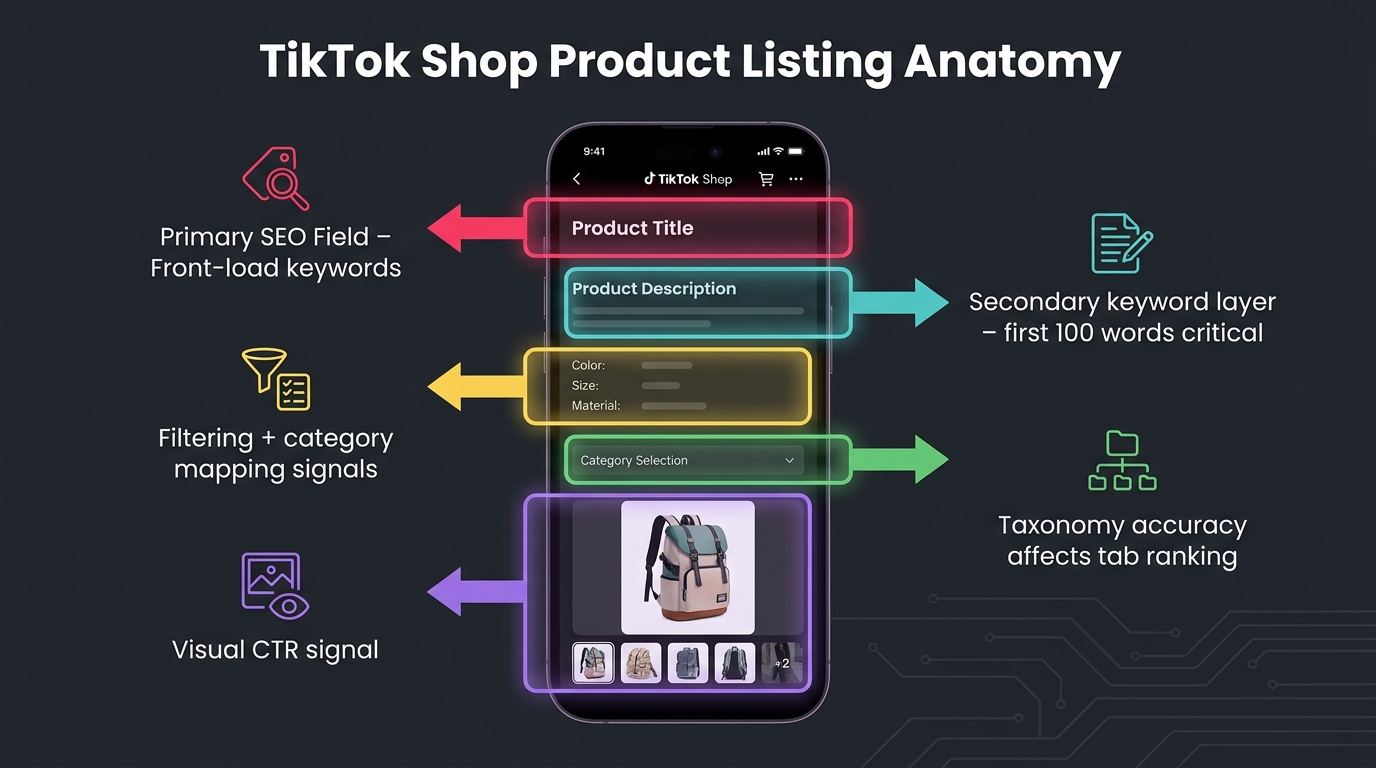
Most sellers treat TikTok Shop product listings as a single unit to be “optimized.” In practice, each field in a product listing performs a distinct function in the ranking system, and failing to understand those distinctions means missing opportunities at multiple points in the product’s discoverability stack.
Product Title: The Heaviest SEO Weight
The title carries more ranking weight than any other single text field. The practical formula: lead with your primary intent keyword, follow immediately with the most specific differentiating descriptor (material, color, function, size, or use case depending on category), and end with a secondary long-tail modifier if characters allow. Avoid brand-name-first titles unless your brand is already a recognized search term — most shoppers do not search for your brand name, they search for what they need.
A weak title looks like: “BrandName Premium Wireless Earbuds v2.” A strong title looks like: “Wireless Earbuds Noise Cancelling 48hr Battery — Gym & Travel.” The difference is not creativity. It is query-matching discipline applied to the field with the highest indexing weight in TikTok’s product search algorithm.
Product Category and Subcategory: The Invisible Ranking Gate
Category selection is one of the most underestimated decisions in the listing process. TikTok’s Shop Tab distributes products within taxonomic buckets — selecting the wrong parent category means your product competes against thousands of loosely relevant items rather than the specific subcategory where your actual buyers are browsing. More concretely, category accuracy affects which filter options appear when users search, and products that fall outside the correct subcategory will not appear when filters are applied.
The correct approach is to identify both the most accurate category and the deepest available subcategory, then verify that the products currently ranking at the top of that subcategory genuinely match your product. If there is a mismatch — competitors in a subcategory are quite different from your product — consider whether the next subcategory up would actually serve you better in terms of competitive density and buyer intent alignment.
Product Attributes and Specifications: The Filter Targeting Layer
Product attributes — size, color, material, compatibility, age group, and similar specification fields — feed directly into the filter functionality that users apply when browsing search results. Incomplete attribute fields mean your product disappears from filtered searches. Since users who apply filters are expressing higher purchase intent than those who simply browse, missing from filtered results means missing your most likely buyers.
Fill every available attribute field. Even attributes that seem peripheral to your core product description contribute to the comprehensiveness of your listing’s indexing footprint. A product with complete attributes ranks in more specific search queries and filter combinations than one with only partial fields filled.
Images: The Conversion-Rate Signal
Images do not directly affect textual ranking signals, but they powerfully affect click-through rate and conversion rate — two performance signals that the algorithm uses to decide whether your listing deserves higher placement. A listing with a strong primary image will generate a better click-through rate from the same search position, which over time feeds ranking improvement. Minimum best practice calls for five high-quality images: a clean product shot on white or neutral background, at least one lifestyle or in-context use image, an infographic-style detail callout, a size or scale reference image, and a before/after or comparison image where applicable.
The Shop Performance Score: The Trust Signal Hiding in Plain Sight
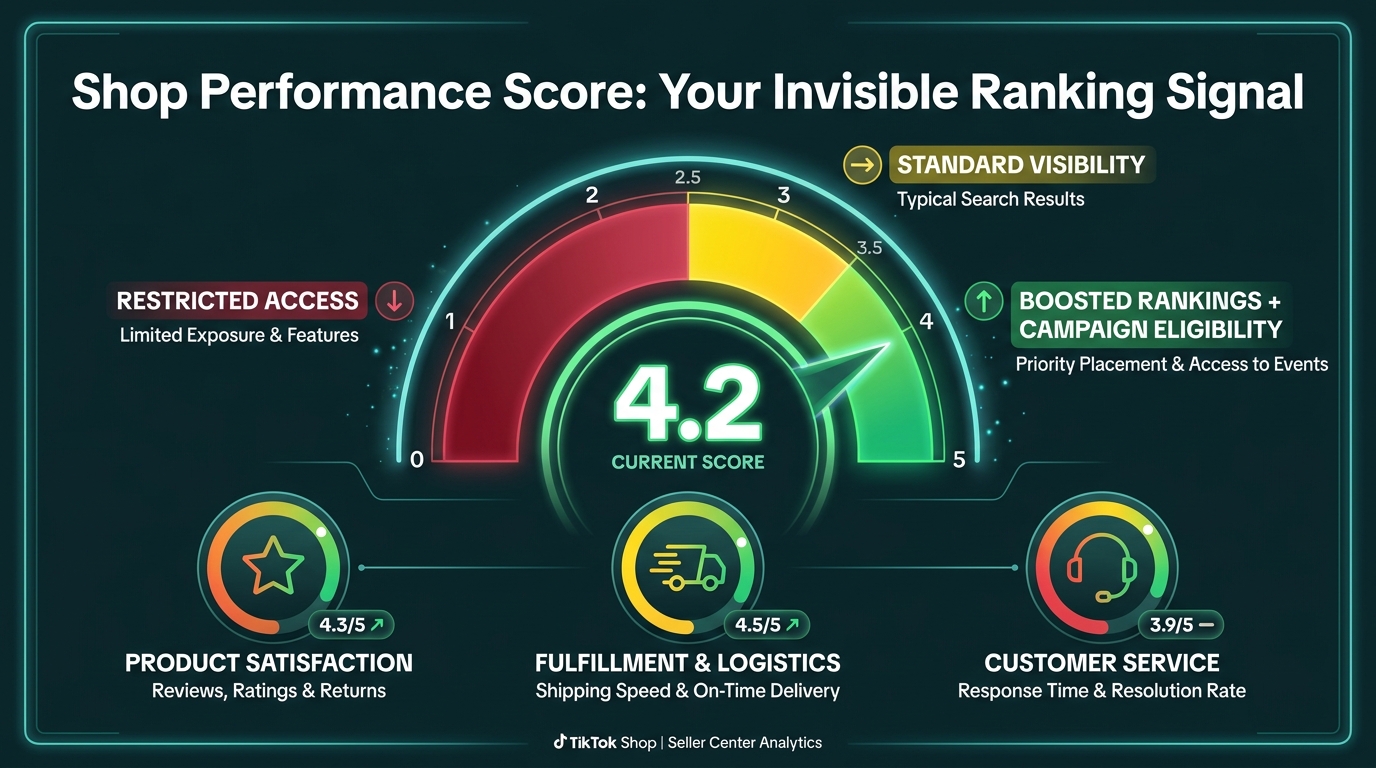
TikTok’s Shop Performance Score — referred to internally as SPS — is one of the most consequential and least-discussed ranking factors in the TikTok Shop ecosystem. Sellers obsess over keyword placement while their SPS quietly determines whether their products are even eligible to rank competitively.
What the SPS Is and How It Works
SPS is a dynamic 0 to 5 rating assigned to seller accounts once they have accumulated 30 or more orders in the preceding 90 days. The score updates daily on a rolling 90-day window, meaning past performance is continuously displaced by recent behavior. According to TikTok’s April 2026 Policy Pulse update, SPS is now the sole performance metric used to determine a seller’s settlement tier and reserve level — which means it directly affects cash flow, not just visibility.
The score is calculated across three primary dimensions: product satisfaction (primarily driven by reviews, ratings, and return or dispute rates), fulfillment and logistics (shipping speed, tracking accuracy, delivery success rate), and customer service (response time, resolution rate, complaint handling). Each dimension feeds a composite score that TikTok’s system uses to calibrate how aggressively it distributes that seller’s products.
How SPS Affects Ranking
The practical impact of SPS on search and Shop Tab ranking is significant. Accounts with scores below 2.5 face restrictions on visibility, promotional access, and the growth tools available inside Seller Center. Accounts between 2.5 and 3.4 receive standard distribution. Accounts above 3.5 — and especially those approaching 4.0 and above — are eligible for enhanced placement in promotional campaigns, priority distribution in the Shop Tab, and the kind of algorithmic boost that makes keyword optimization substantially more effective.
Put differently: excellent keyword work on a listing attached to a low SPS account will underperform the same keyword work on a listing attached to a high SPS account. The trust signal acts as a multiplier on all other ranking efforts. A seller who treats SPS as an operations metric and not an SEO metric is working against themselves.
Protecting Your SPS Without Burning Out Your Team
The fastest way to degrade an SPS is through fulfillment failures and unresolved disputes. The fastest way to build one is through review velocity — systematically encouraging satisfied customers to leave ratings through follow-up messaging, packaging inserts with QR codes, and post-purchase creator content that reminds buyers to share their experience. Review generation is not a soft “nice to have” — it is a ranking lever with direct SPS implications. Sellers who build review collection into their post-purchase workflow rather than treating it as an afterthought see measurably faster SPS improvement.
The Content-Listing Feedback Loop: How Your Videos Feed Your Rankings
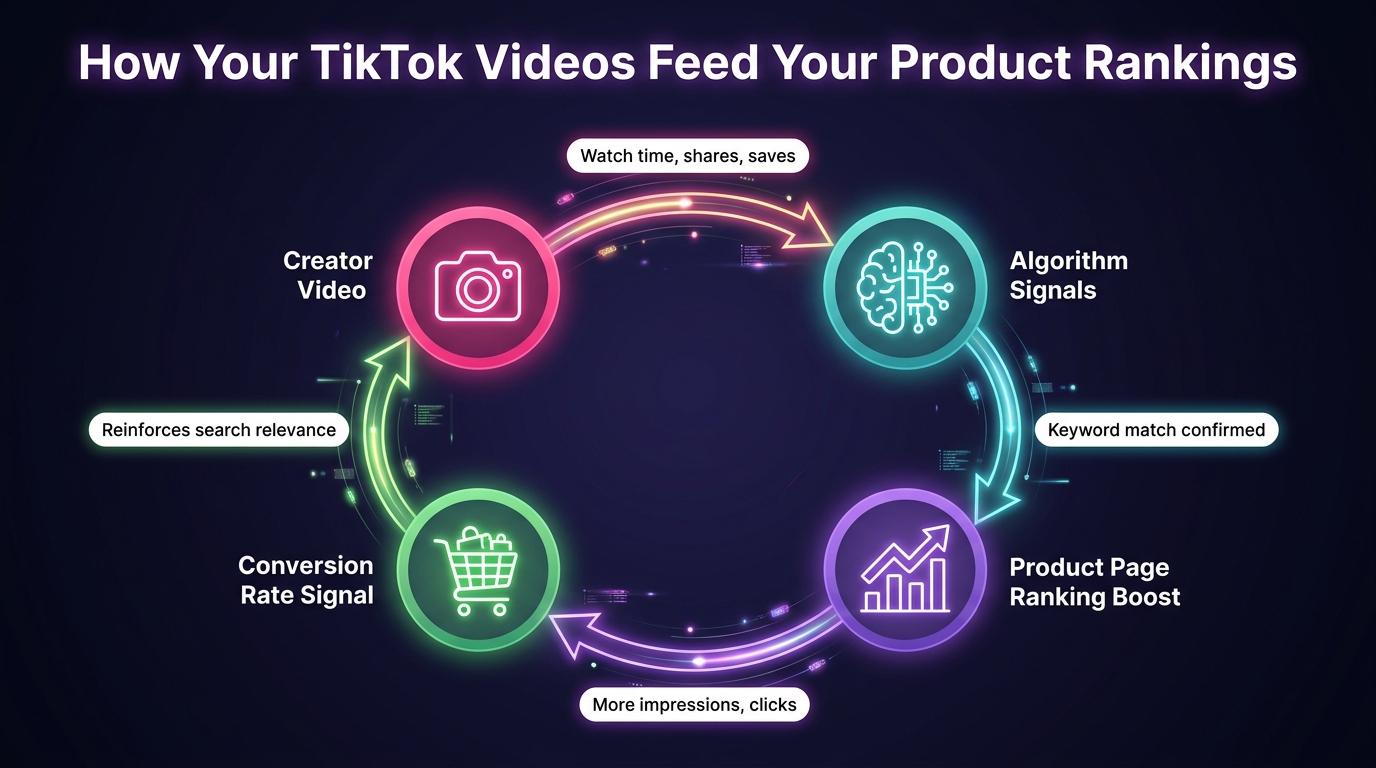
One of the most powerful — and most misunderstood — mechanisms in TikTok Shop’s ranking system is the bidirectional relationship between video content and product listing performance. Listings don’t just sit passively waiting for search traffic. They actively accumulate or lose ranking strength based on the performance of every video and live session associated with them.
How the Signal Flow Works
When a creator posts a video with a product tag linking to a TikTok Shop listing, TikTok’s system monitors a cascade of engagement behaviors: watch time and completion rate, rewatches, shares, saves, comments, profile visits originating from the video, and — critically — product-tag clicks, add-to-cart actions, and purchases that flow from the video to the listing. Each of these signals informs TikTok about how relevant that video is for a particular topic and audience cluster. The more signals confirm relevance and purchase intent, the more the algorithm associates that product listing with the topic and query terms present in the video.
This is why a single well-performing creator video can meaningfully shift a product’s search ranking position. The video essentially acts as a relevance endorsement signal — analogous in some ways to a backlink in traditional SEO, but based on behavioral evidence rather than structural linking. Canopy Management’s analysis of over $3.3 billion in e-commerce transactions found that sellers who systematically aligned their content with their listing optimization saw 340% higher visibility and 156% better conversion rates than those relying on either approach alone.
Maximizing the Feedback Loop
To intentionally activate this feedback loop, the keywords and language in a creator’s video need to align with the keywords in the product listing. This doesn’t mean scripting every creator’s content. It means ensuring that the product’s primary intent keywords appear naturally in talking points, on-screen text overlays, captions, and voiceover descriptions. A product titled “Silk Pillowcase for Hair — 100% Mulberry” benefits most from creator content that naturally uses phrases like “silk pillowcase for curly hair,” “mulberry silk sleep,” or “overnight hair protection” — language that reinforces the listing’s keyword associations in TikTok’s search indexing system.
Live shopping sessions add another layer to this dynamic. Live content is indexed differently from short-form video, but product interaction signals during a live — add-to-carts, purchases, and product-page views — generate strong conversion signals that the algorithm treats as evidence of demand. Brands that run regular live sessions for top products are essentially running a continuous signal-generation engine for those listings’ search rankings.
Affiliate Creator SEO: Turning UGC Into a Ranking Engine
TikTok Shop’s affiliate program — through which creators earn commissions on sales generated by their content — is not just a marketing channel. For sellers who understand its SEO implications, it is a scalable mechanism for generating the content-side ranking signals that a single brand account can never produce at the required volume.
Why Affiliate Content Scales Where Brand Content Cannot
A single brand posting three to five videos per week can generate a modest volume of engagement signals for its listings. A brand with 50 active affiliates posting two to three videos per week each generates an order of magnitude more signal volume across a wider range of audience clusters, query contexts, and content styles. The diversity matters as much as the volume: different creators naturally use different language to describe the same product, which broadens the product’s keyword association footprint in TikTok’s indexing system.
This breadth of language coverage is something that purely listing-based optimization cannot replicate. No matter how thoroughly you optimize a product title and description, you are constrained by the character limits and keyword density limits of those fields. Creator content has no such constraint — each video represents an additional context in which your product’s keywords can be indexed, each one expanding the range of search queries your listing can rank for.
Building SEO-Aware Affiliate Briefs
Most brands treat affiliate briefs as marketing documents — focusing on tone of voice, key claims, visual style, and compliance requirements. SEO-aware affiliate briefs add a layer of keyword guidance that helps creators naturally weave high-value search terms into their content without making it feel scripted or inauthentic.
In practice this means providing creators with a short list of phrases that reflect how the target audience actually searches — drawn from TikTok’s autocomplete suggestions, the Seller Center’s keyword recommendations, and competitor video analysis. You are not asking creators to read a keyword list into a camera. You are giving them context about what their viewers are searching for, which usually helps them frame a more effective, audience-relevant video anyway.
Tracking which creators generate the strongest ranking signal — not just the highest GMV — requires connecting creator content performance (specifically product-page traffic and listing position changes after content goes live) to your broader SEO monitoring. Most sellers only track GMV per creator. The sellers who will dominate TikTok search over the next 18 months will also track ranking contribution per creator, giving more placement and better margins to the creators whose content builds lasting search equity rather than just generating short-term sales spikes.
Hidden Metadata and Manual Keywords: TikTok’s New Creator-Side SEO Control
In mid-2026, TikTok began rolling out a feature that has received relatively little attention from e-commerce operators but carries significant SEO implications. Creators can now add non-public keyword metadata to individual videos — tags that are not visible to viewers as hashtags but are reviewed and approved by TikTok before they are used to categorize and surface the content in search results and recommendations.
What This Feature Does and Why It Matters for Shop Sellers
Traditional hashtags on TikTok serve dual purposes: they communicate content category to the algorithm and they appear as visible elements in the post that can attract viewers browsing hashtag pages. This has always created a tension between algorithm optimization and aesthetic presentation, since stuffed hashtag blocks can reduce the perceived quality of a post and detract from the caption’s SEO value.
The new hidden keyword metadata system decouples these functions. Creators can optimize for algorithmic categorization and search without cluttering the public-facing post. More importantly, the approval-gated nature of these keywords means that TikTok’s system is actively verifying that the metadata accurately represents the content — which suggests these approved keywords carry stronger indexing weight than hashtags, which historically have been gamed and diluted in value.
Strategic Implications for Brands Working With Creators
For brands managing affiliate programs, this development creates a new layer of coordination. The hidden keywords that creators add to product-tagged videos should ideally align with the target keywords in the brand’s product listing. This requires either briefing creators on which keywords to include in their metadata, or — for higher-volume partnership programs — developing a simple keyword list that creators can reference when adding metadata to sponsored content.
The rollout of this feature is ongoing and not yet universally available across all markets as of mid-2026. Sellers should monitor its availability in their target markets through TikTok’s creator tools and build keyword alignment into their affiliate management process now, before it becomes standard practice and the competitive advantage window closes.
Off-Platform Signals: When TikTok Videos Surface on Google and Gemini
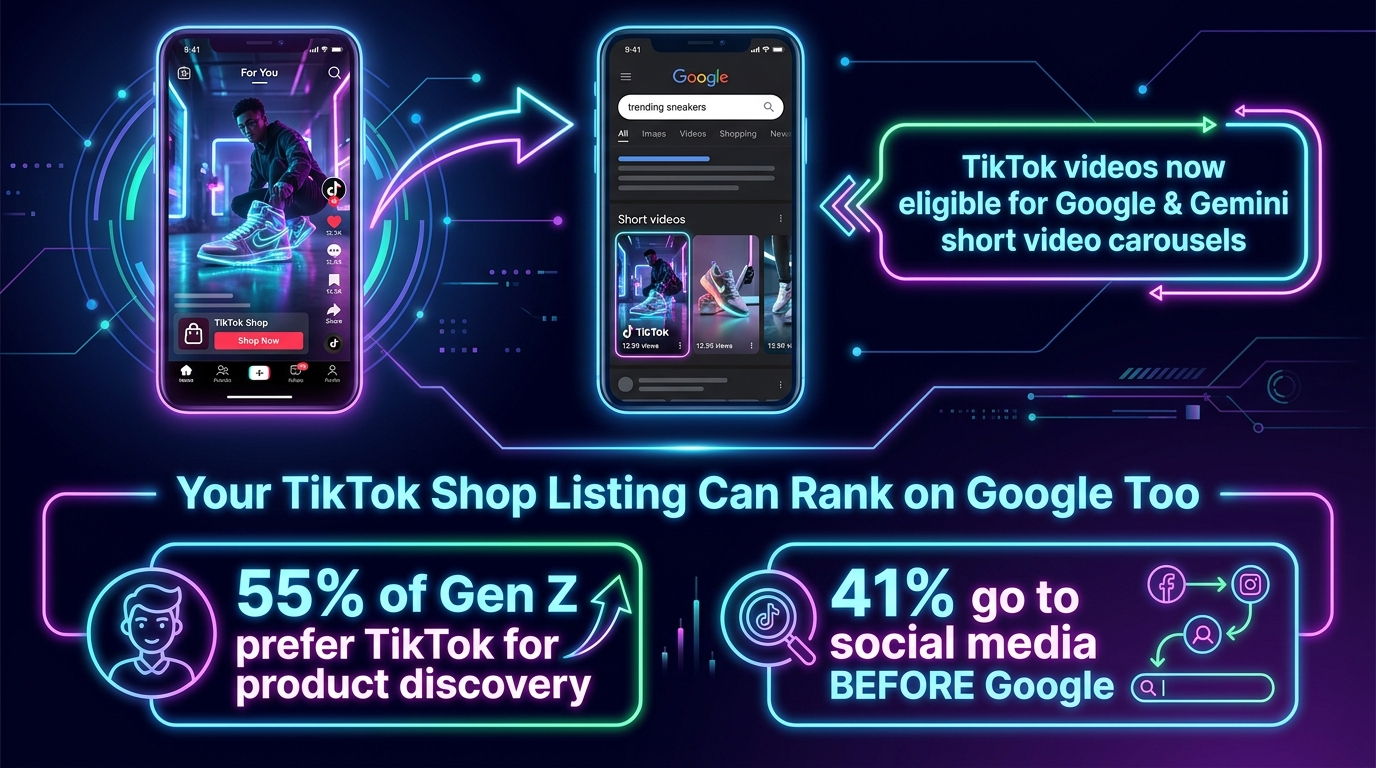
Perhaps the most underappreciated development in TikTok Shop SEO in 2026 is not happening inside TikTok at all. TikTok videos — including product-tagged commerce content — are now eligible to appear in short video carousels inside Google search results and within Google’s Gemini AI-generated answer panels. This changes the SEO calculus for TikTok Shop sellers in a way that many have not yet accounted for.
How TikTok Content Surfaces in Google Search
Google’s “short videos” carousel feature, which has been expanding in scope throughout 2025 and 2026, pulls in publicly available short-form content from platforms including TikTok, YouTube Shorts, and Instagram Reels. When a user searches a product-related query — “best kitchen knife set for home cook,” for example — Google’s results page may include a carousel of relevant short videos from across these platforms. TikTok videos with strong engagement signals and keyword-relevant captions are eligible to appear in these carousels.
For TikTok Shop sellers, this means a well-optimized product video can drive discovery and traffic not just through TikTok’s internal search but through external Google searches as well. The user who clicks through from a Google video carousel to a TikTok product video, and then to the Shop listing linked within it, represents an off-platform conversion that most analytics setups currently fail to track accurately.
Optimizing TikTok Content for Cross-Platform Search Visibility
Making TikTok content Google-eligible is not primarily a technical exercise — it is a quality and clarity exercise. Google’s short video carousels favor content that explicitly addresses the search query in a way that’s apparent from the video’s title, caption, and on-screen text within the first few seconds. This maps closely to best practices for TikTok’s own search algorithm: searchable opening phrases, captions that state the product and use case directly, and on-screen text that reinforces spoken keywords.
The practical action is to review your most important product videos against the question: if a Google user searched “[your primary keyword]”, would this video look relevant and useful in a carousel? If the answer is no — if the video opens with a trend-chasing hook that doesn’t mention the product until the 10-second mark, if the caption is an emoji sequence rather than a keyword phrase, if on-screen text only appears in the latter half — then you are not capturing the off-platform traffic opportunity.
Gemini integration adds another dimension. As Google’s AI overview panels begin incorporating more video and social content citations, TikTok Shop content that addresses specific product questions clearly and directly becomes eligible to appear as a cited source within AI-generated answers. This is still an emerging development, but the sellers building comprehensive, informative product content in 2026 are positioning themselves for a discovery channel that will be significantly larger by 2027.
Measuring What Actually Matters: TikTok Shop SEO Metrics in 2026
Most TikTok Shop analytics dashboards are built around sales metrics: GMV, units sold, revenue per video, affiliate commission payouts. These are outcome metrics. They tell you what happened after your SEO work either succeeded or failed. What most sellers lack is the leading-indicator data that tells them whether their SEO is working before it shows up in sales numbers — and specifically where in the multi-surface system the performance is or isn’t compounding.
The Metrics That Predict Ranking Trajectory
Search impression share: The percentage of searches for your target keywords that result in your product appearing in results. TikTok Seller Center provides some impression data, though it is less granular than Amazon’s equivalent. Track this over time; a rising impression share for target keywords confirms that optimization is being recognized by the algorithm.
Search click-through rate (CTR): Of the searches where your product appears, what percentage of users click on it? A low CTR relative to your position suggests your primary image or title is not compelling enough compared to competitors at the same position. CTR improvements compound quickly because higher CTR feeds ranking improvement, which increases impression share, which generates more clicks.
Product page dwell time: Users who spend meaningful time on a product page before purchasing — or even before bouncing — generate positive relevance signals. Short dwell time followed by a back-button event signals irrelevance or disappointment, which erodes ranking. This metric is partially influenced by content quality (are descriptions complete and engaging?) and image quality (do multiple images give users sufficient information?) rather than being purely an SEO lever.
Add-to-cart rate: Arguably the most direct conversion signal that TikTok’s algorithm uses for ranking. A product with a strong add-to-cart rate from search results is signaling high purchase intent, which the system rewards with more prominent placement. Improving add-to-cart rate through better image sets, clearer pricing, stronger social proof (review count and rating), and precise attribute completion is therefore as much an SEO strategy as a conversion optimization strategy.
Monitoring the Content-Ranking Connection
For sellers running affiliate programs or posting their own product content, it is worth building a simple monitoring practice around the correlation between video publish events and search ranking movements. When a new creator video goes live with product tags and performs well in the first 24 to 48 hours, you should expect to see movement in search position for associated keywords within three to seven days if the content-listing keyword alignment is strong. If you do not see movement, the most likely causes are keyword misalignment between video language and listing language, weak engagement signals on the video itself, or SPS friction limiting the algorithm’s willingness to amplify the boost.
Creating this feedback loop in your analytics — video performance data on one side, listing ranking changes on the other — is not a feature most TikTok Shop analytics tools provide out of the box. Building even a basic manual tracking setup in a spreadsheet creates a data asset that most competitors in your category simply don’t have.
The Multi-Surface Checklist: What a 2026-Ready TikTok Shop SEO System Looks Like
Pulling together everything covered in this piece, here is a practical framework for evaluating whether your TikTok Shop SEO operation is actually built for how the platform works in 2026 — or whether it is still optimizing for a search era that has already passed.
Listing Fundamentals
- Title: Primary intent keyword in first 3–5 words; 80–100 character total; includes one long-tail modifier. Verified against TikTok Seller Center keyword recommendations.
- Description: First 100 words are keyword-rich and structured around a problem/solution frame; specifications in middle section; use cases and contextual keywords in closing section.
- Category: Deepest accurate subcategory selected; verified against top-ranking competitors in that subcategory for category fit accuracy.
- Attributes: Every available attribute field complete; no empty optional fields.
- Images: Minimum 5 images including clean product shot, lifestyle context, infographic detail callout, scale reference, and one comparative or result-focused image.
Trust and Performance Layer
- SPS monitoring: Shop Performance Score tracked weekly; targets above 3.5 maintained.
- Review collection: Post-purchase review solicitation system in place; responding to all reviews including negative ones within 24 hours.
- Fulfillment standards: Shipping speed and tracking accuracy maintained at levels consistent with SPS target; dispute escalations resolved before 48-hour window.
Content-SEO Alignment
- Creator briefs: Include keyword guidance aligned with listing primary terms; provide searchable phrase suggestions not scripts.
- Hidden metadata coordination: Where the feature is available, provide creators with a short list of approved metadata keywords aligned with listing targets.
- Live session keyword integration: Spoken product descriptions in live sessions use primary and secondary listing keywords naturally.
- Ranking-content correlation tracking: Post-video ranking movement monitored for key products to evaluate content-SEO feedback loop effectiveness.
Cross-Platform Opportunity
- Google eligibility audit: Top product videos reviewed for searchable opening phrases, keyword-rich captions, and on-screen text clarity for off-platform discovery.
- Caption strategy: Video captions written as keyword phrases (“Best moisturizer for oily skin — here’s why it works”) rather than pure engagement bait.
Conclusion: SEO Is Now the Core Discipline, Not the Afterthought
The sellers winning TikTok Shop search in 2026 are not the ones with the biggest TikTok followings, the most viral content, or the deepest influencer budgets. They are the sellers who understood early that TikTok’s evolution from social platform to commerce infrastructure required a corresponding evolution in how they think about discoverability.
Multi-surface SEO on TikTok is not complicated in concept. It is demanding in execution because it requires coordination across functions that most e-commerce teams keep separate: listing management, content creation, creator partnerships, operations (for SPS health), and analytics. When those functions are working in alignment — when your listing keywords match your creator brief language match your live session talking points match your SPS trajectory — the compounding effect is measurable and durable. You build ranking that survives algorithm updates because it is earned through genuine relevance and performance signals, not gamed through any single tactic.
The FYP era rewarded the most entertaining sellers. The search era rewards the most systematically relevant ones. Building that system is the real work of TikTok Shop SEO in 2026.
Key Takeaways:
- 48–65% of TikTok Shop sales now originate from Search — prioritize search surface optimization above all else.
- Ranking across all three surfaces (Search Tab, Shop Tab, FYP) requires different signals — build a system that feeds all three.
- Your Shop Performance Score is a ranking multiplier, not just an operations metric. Treat SPS health as part of your SEO strategy.
- Creator content and product listing keywords must align — audio, captions, and on-screen text from affiliated videos feed your listing’s search relevance.
- TikTok videos are now eligible for Google and Gemini search carousels — optimize captions and opening hooks for off-platform discovery.
- The new hidden keyword metadata feature for creators is an emerging SEO lever; build it into affiliate briefs now while the competitive advantage is still available.