

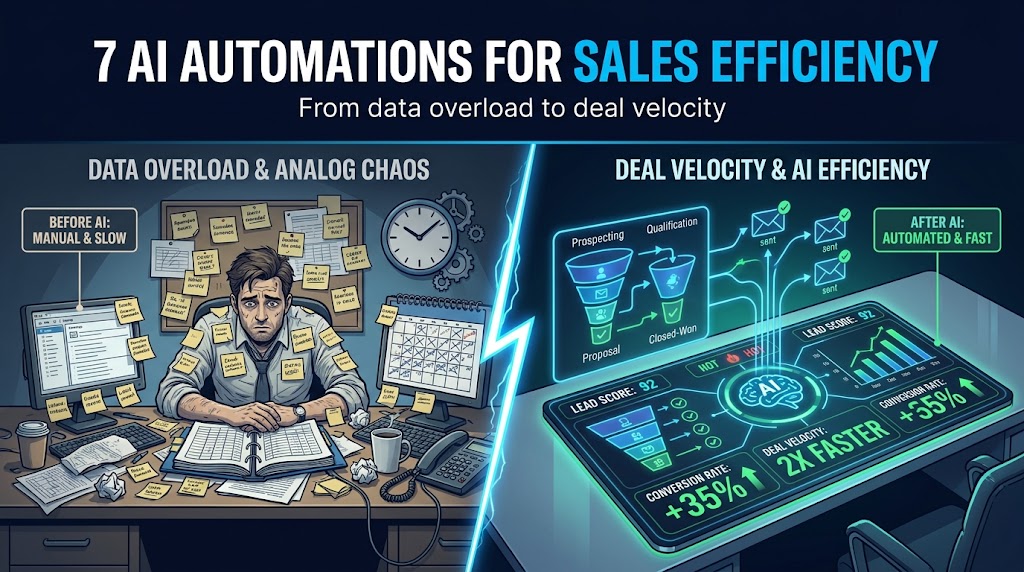

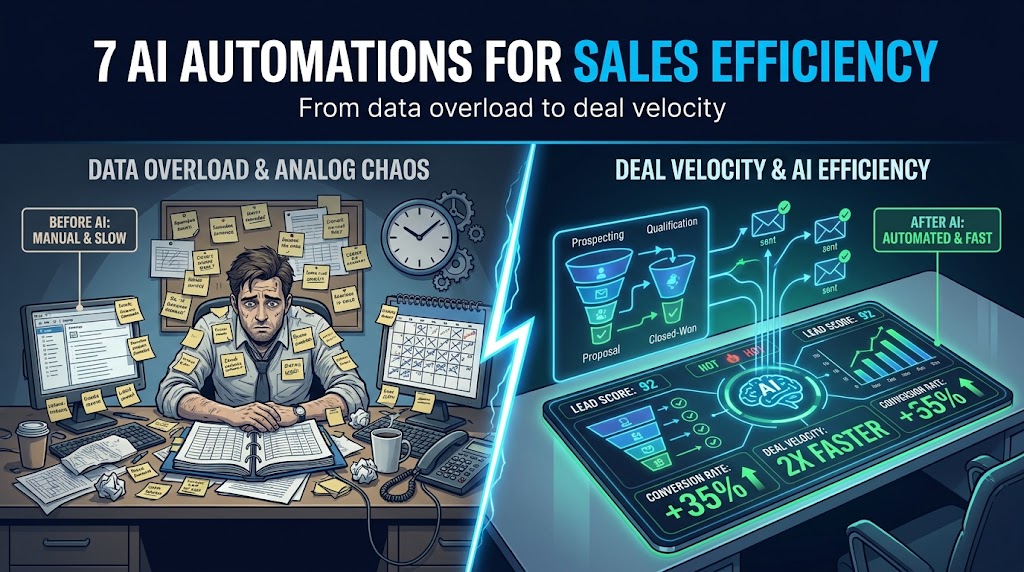
Here is a number worth sitting with: sales reps spend, on average, 65% of their working day on activities that don’t directly involve selling. That’s data entry, note-writing, researching prospects, building decks, updating pipeline stages, and scheduling follow-ups. More than half the working day — gone before a single conversation happens.
AI automation has been positioned as the answer to this problem for several years now. And by 2026, the technology has matured enough that we can actually separate what works from what was marketing copy. The promise of AI in sales isn’t about replacing reps — it never was. It’s about eliminating the administrative drag that keeps talented sellers from doing the one thing they were hired to do: build relationships and close deals.
But not all AI automations are created equal. Some genuinely compress deal cycles, improve conversion rates, and surface opportunities that would otherwise go cold. Others generate a lot of activity noise without moving any real metrics. This article focuses entirely on the former — seven specific automations that have demonstrated measurable impact across B2B sales teams of various sizes, with the data to back them up.
This isn’t a survey of every tool on the market. It’s a ground-level look at the specific automations that are producing results, the mechanics behind why they work, and the implementation pitfalls that cause them to fail. Whether you’re running a 5-person sales team or scaling a 200-rep organization, at least several of these will be directly applicable to your situation right now.
Let’s get into it.
The Productivity Problem That AI Is Actually Solving
Before diving into the seven automations, it’s worth understanding the scale of the problem they’re addressing — because the numbers are larger than most sales leaders intuitively realize.
Research consistently shows that the average B2B sales representative devotes only 35% of their time to actual selling activity. The remaining 65% is absorbed by administrative work: CRM updates, internal meetings, email management, research, and reporting. When you apply that ratio to an average rep’s fully-loaded annual cost of $80,000–$150,000, the math becomes uncomfortable quickly. A significant share of sales compensation is being paid for work that could be automated.
What the Data Actually Shows
The productivity gap isn’t a theory. A 2026 analysis by Optifai across 939 B2B firms found that companies deploying AI sales tools saw reps increase from an average of 15 deals per month to 23 deals per month — a 53% output improvement with the same headcount. Separately, research from Utmost Agency found a 33% overall efficiency jump and a 23% increase in daily call volume among teams using AI automation versus those that weren’t.
The revenue implications compound quickly. When reps can handle more opportunities without sacrificing quality, the pipeline volume grows. When pipeline quality improves through better lead prioritization, conversion rates climb. When deals close faster through automated follow-up and proposal generation, cash flow improves. These aren’t incremental gains — several studies peg the overall revenue impact at 7–25% annual increases once AI automations are properly embedded in the workflow.
Why Most Teams Are Still Behind
Despite the available evidence, adoption remains uneven. The obstacles are real. Poor data quality in existing CRMs means AI systems are trained on garbage and produce garbage outputs. Teams automate individual point solutions without connecting them into coherent workflows. Leaders treat AI as a “set and forget” technology rather than a living system that requires ongoing calibration. And perhaps most commonly, reps resist adoption because tools were chosen without their input and feel like surveillance rather than support.
The seven automations below are presented with these realities in mind. Each section covers not just what the automation does, but the specific conditions required for it to work well — and the warning signs that it’s about to go sideways.
Automation 1: AI Lead Scoring That Reads Behavioral Intent
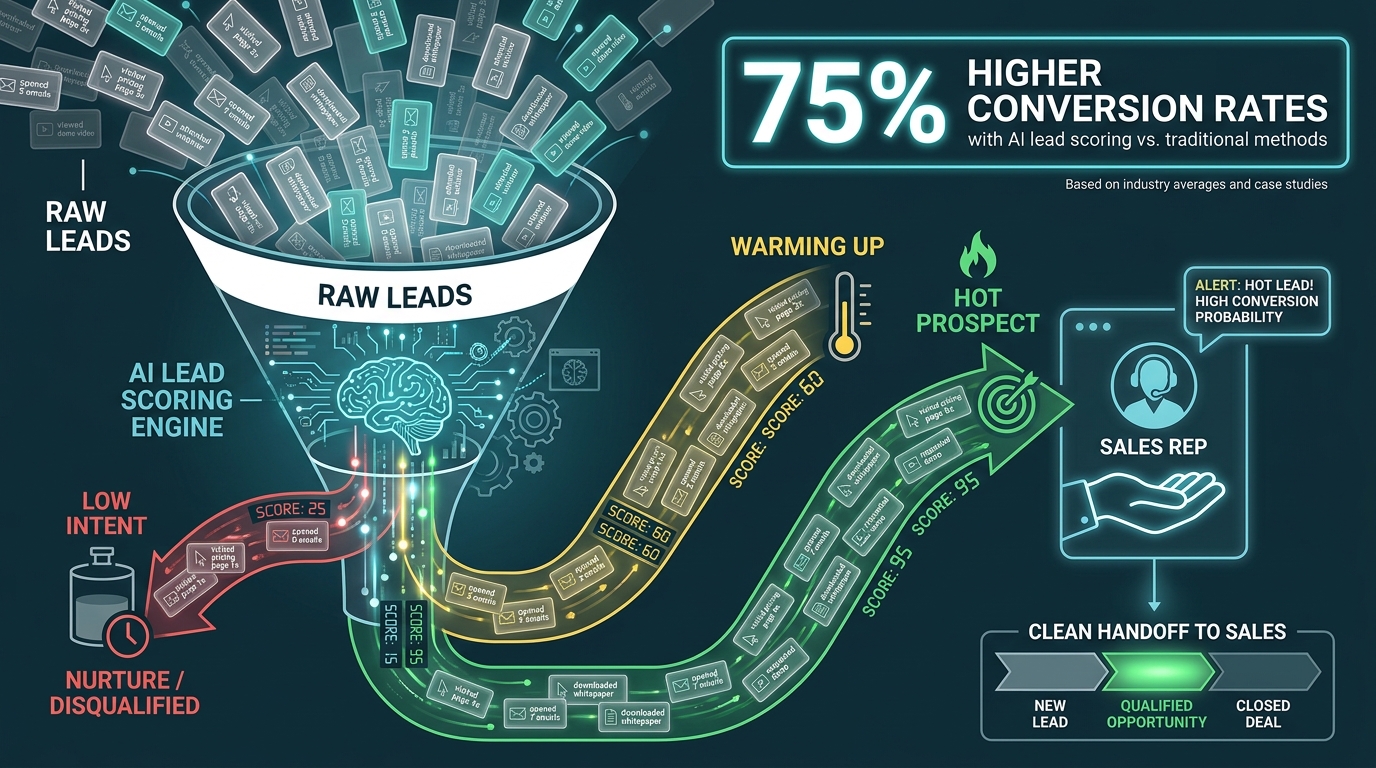
Traditional lead scoring was essentially a manual rubric: assign points for job title, company size, industry, and maybe a few demographic factors. If a lead hit a certain threshold, it went to sales. If not, it sat in a nurture sequence. The problem was that the model was static — it reflected someone’s best guess about what a good prospect looked like, not what actually predicted conversion.
AI lead scoring is fundamentally different. Instead of scoring against a fixed template, machine learning models analyze hundreds of behavioral and contextual signals simultaneously, then continuously update their weighting based on which signals actually correlated with closed deals in your specific pipeline. It’s scoring that improves with every outcome — winning or losing — rather than staying frozen at the moment someone built the rubric.
What the Signals Actually Look Like
The power of AI lead scoring lies in the specificity of signals it can ingest. Beyond the standard firmographic data (company size, industry, revenue range), modern AI scoring systems analyze:
- Engagement depth: Not just “opened email” but “re-opened email three times and clicked the pricing link”
- Website behavior: Which pages were visited, in what order, for how long, and how many times in a rolling window
- Content consumption: Whitepaper downloads, webinar attendance, case study views — and which specific topics they gravitated toward
- Temporal patterns: Whether engagement is accelerating (often signals buying motion) or plateauing
- Third-party intent data: Signals from platforms like Bombora and G2 indicating the prospect is actively researching your category — even before visiting your site
- CRM history: Prior interactions, past deals won or lost with similar profiles, champion movement between companies
The Numbers Behind the Method
The results from AI-driven lead scoring are consistently strong enough to have become a benchmark category. Machine learning lead scoring produces 75% higher conversion rates versus traditional demographic scoring — moving industry averages from approximately 3.2% to around 6% (Involve Digital, 2026). That doubling of conversion rate, applied across a full pipeline, represents a dramatic shift in revenue output without any increase in lead volume.
One specific finding worth highlighting: leads contacted within the first hour of expressing meaningful intent are seven times more likely to qualify than leads contacted later. AI systems can trigger that contact automatically — flagging a rep the moment a prospect exhibits high-intent behavior rather than waiting for a weekly pipeline review. U.S. Bank’s implementation of Salesforce Einstein lead scoring resulted in a 260% increase in conversions and 25% faster deal closure, largely because qualified leads were being routed and contacted dramatically faster than before.
Where It Goes Wrong
Lead scoring AI is only as good as the historical data it learns from. If your CRM contains years of incomplete deal records — missing close reasons, inconsistent stage definitions, contacts without roles — the model will learn from noise and produce unreliable scores. Before implementing AI lead scoring, invest in a data audit. Clean records produce clean models. Garbage in, garbage out remains the cardinal rule.
Also, watch for model drift. A scoring system trained on last year’s buying patterns may not reflect current market conditions — particularly if your ICP has shifted, your product has changed, or macroeconomic conditions have altered buyer behavior. Rebuild or retrain models quarterly at minimum.
Automation 2: Intelligent Follow-Up Sequences That React to Behavior
Follow-up is where most sales opportunities die quietly. Research has long established that the majority of deals require five or more touchpoints before a prospect engages meaningfully, yet the majority of sales reps abandon follow-up after two or three attempts. The reason isn’t laziness — it’s prioritization. When a rep is managing 50 active prospects across multiple stages, deciding who to follow up with, when, through which channel, and with what message is cognitively exhausting. Important follow-ups fall through the cracks not because reps forget but because the workload makes triage inevitable.
AI-powered follow-up sequences solve this at the infrastructure level. Instead of relying on individual reps to remember and act, the system automates cadence management — but with an important distinction from older-generation “drip” tools: these systems are reactive, not just scheduled.
The Difference Between Scheduled and Reactive Sequencing
A traditional email drip sequence fires messages on a fixed calendar regardless of what the prospect does. Message 1 on day 1, message 2 on day 4, message 3 on day 9. The prospect might have opened and forwarded message 1 to three colleagues — a strong buying signal — and still receive a generic “just checking in” on day 4 as if nothing happened.
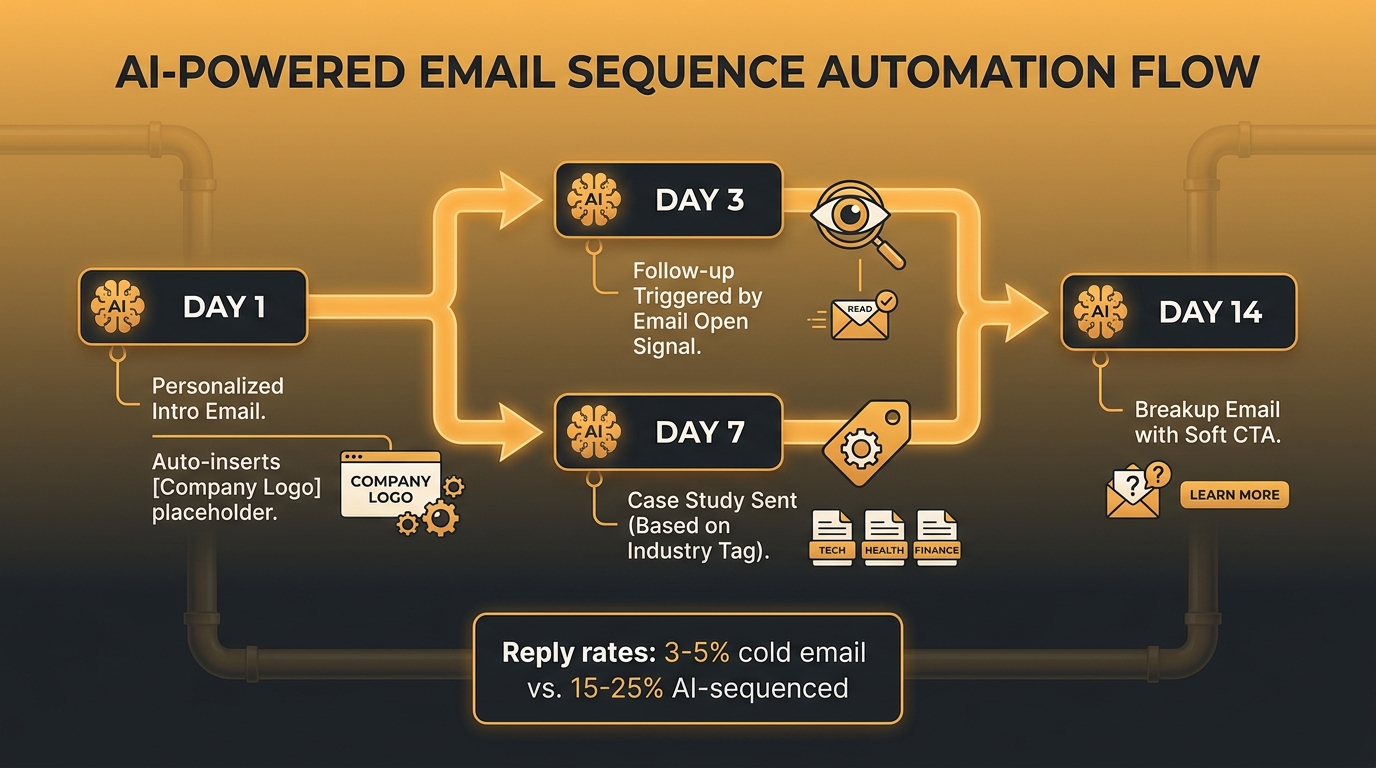
Behavior-triggered AI sequencing changes the logic entirely. When a prospect opens an email and clicks the pricing page link, the system doesn’t send the next scheduled message. It triggers a different branch — perhaps a message containing a case study from a similar company, or a notification to the rep to call now while the prospect is clearly engaged. When a prospect goes completely dark for 14 days, the system triggers a re-engagement sequence rather than continuing the standard cadence. The sequence tree adapts to what the prospect is actually doing, not what the calendar says should happen next.
Reply Rate Improvements Are Significant
The performance gap between static and behavior-driven sequencing is measurable. Standard cold email sequences average reply rates of 3–5%. AI-optimized sequences with personalization and behavioral triggers regularly produce reply rates of 15–25% — a 5x improvement on the high end. A case study from Kairntech found that AI personalization applied to outbound sequences lifted reply rates by 42% compared to their previous approach.
The mechanism behind this is multi-layered. AI optimization tests send times, subject line structures, message length, and CTA phrasing at scale — running continuous A/B experiments that would be impossible to manage manually. It also handles personalization at volume: pulling in company news, role-specific pain points, and industry context to make each message feel written for that specific person rather than pasted from a template.
Multi-Channel Orchestration
The most advanced implementations don’t limit sequences to email. AI orchestration systems coordinate across email, LinkedIn, phone call prompts, and even direct mail or gifting triggers — all based on the same behavioral logic. A prospect who doesn’t open emails might respond to a LinkedIn connection request with a personalized note. A prospect who has engaged twice but never responded might be sent a small personalized gift through a platform like Sendoso, which the system triggers automatically at a defined stage.
Tools like Outreach, Salesloft, and Apollo provide this multi-channel coordination natively. The key implementation detail: ensure rep-facing touchpoints (like call prompts) surface in a prioritized task queue rather than buried in notification menus. If reps have to dig for AI-suggested actions, the system’s value collapses quickly.
Automation 3: CRM Auto-Logging and Meeting Intelligence
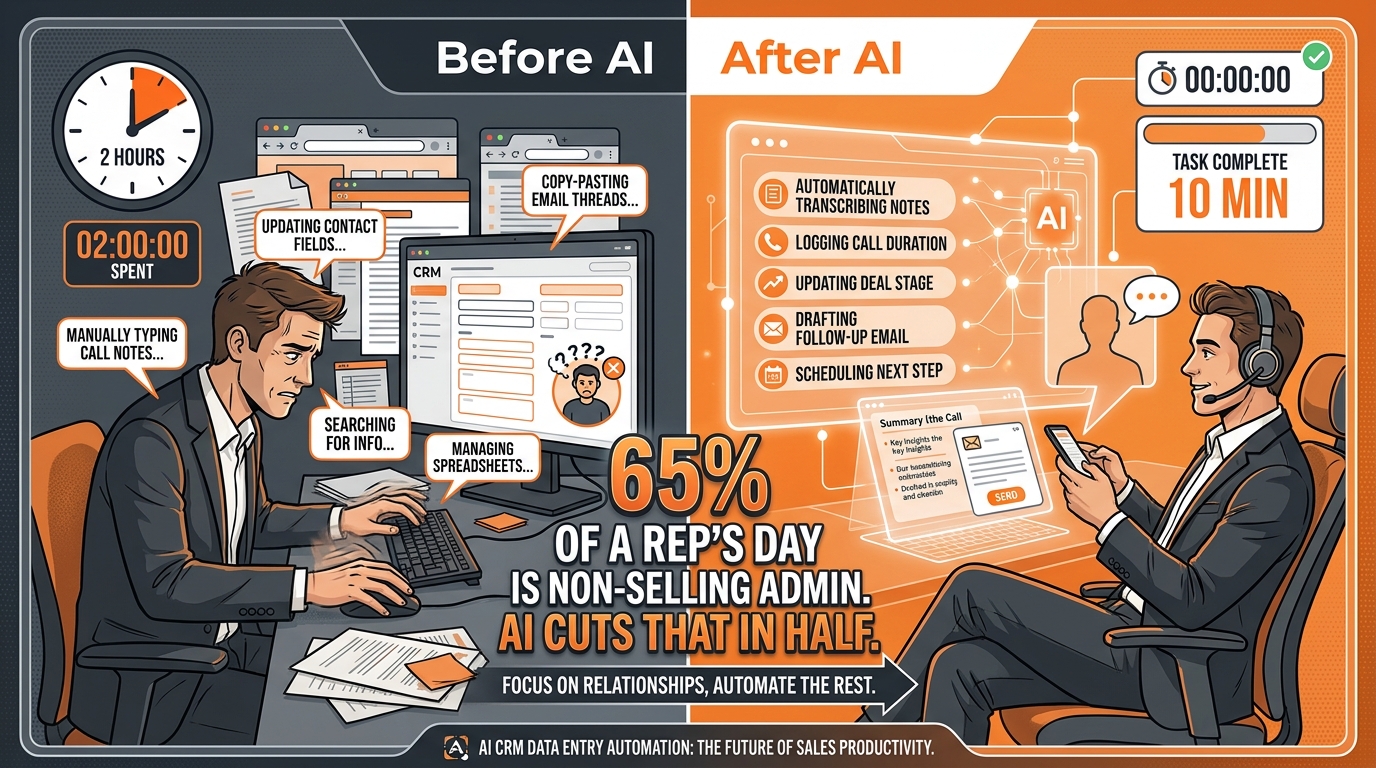
Ask any sales rep what they dislike most about their job and CRM data entry will appear on nearly every list. It’s not that reps don’t see the value in a well-maintained CRM — most understand that pipeline visibility and forecasting accuracy depend on it. The problem is the sheer time cost. Manually logging a 30-minute discovery call takes another 15–20 minutes of structured note-taking, field updating, and follow-up drafting. Multiply that across five calls per day and the math is brutal.
AI-powered meeting intelligence and CRM auto-logging essentially eliminates this friction. The system joins calls (with participant consent), transcribes the conversation in real time, extracts structured data from the discussion, and automatically populates CRM fields — all without the rep lifting a finger after the call ends.
What Gets Captured Automatically
Modern AI meeting tools like Gong, Fireflies.ai, Read AI, and Zoom’s built-in AI Companion go well beyond simple transcription. After a call, the system typically delivers:
- Full transcript with speaker-separated turn-by-turn dialogue
- AI-generated call summary in 3–5 bullet points, capturing the key topics discussed
- Extracted next steps with action item assignments (what rep committed to do, what prospect agreed to)
- MEDDIC/BANT/SPICED framework completion — flagging which qualification criteria were covered and which are still unknown
- Sentiment analysis — flagging moments of positive engagement or skepticism in the conversation
- Competitive mentions — automatically tagging any competitor names discussed for review
- Automatic CRM update — deal stage progression, contact data enrichment, activity log entry
The practical result is that a rep finishes a call and the CRM is already updated. The follow-up email is drafted and waiting for review. The next steps are queued in the task list. What previously took 20 minutes of post-call administration happens in the background while the rep transitions to their next conversation.
The Business Impact Beyond Time Savings
The efficiency gain is obvious — AI cuts post-call admin time by an estimated 40%, and studies show reps recover 5–8 hours per week from CRM automation alone. But the deeper impact is on CRM data quality, which has downstream effects on forecasting accuracy, coaching effectiveness, and territory planning.
When reps manually log calls, they naturally summarize selectively. Important details get omitted — the prospect mentioned they have a board review in Q2, a competitor was brought up and dismissed quickly, there’s a blocker in procurement nobody mentioned in the pipeline notes. AI captures everything the rep said and heard, creating a richer deal record that leadership, AEs taking over accounts, and RevOps teams can actually use.
Lumen Technologies, which deployed AI-assisted call logging across its sales team, reported saving 4 hours per seller per week — amounting to an estimated $50 million in annualized productivity savings across the organization. That figure, even if directionally correct rather than exact, illustrates what scale does to small per-rep efficiency gains.
The Consent and Culture Consideration
Call recording automation requires careful rollout from a trust perspective — both with prospects and with reps. Most jurisdictions require at minimum a consent disclosure at the start of recorded calls. Internally, reps sometimes resist call recording AI because they associate it with surveillance rather than support. The framing matters enormously. Position the technology as saving reps from administrative work and providing coaching resources — not as a monitoring mechanism. Give reps access to their own call analytics before surfacing it in management dashboards.
Automation 4: Predictive Pipeline Management and Deal Risk Detection
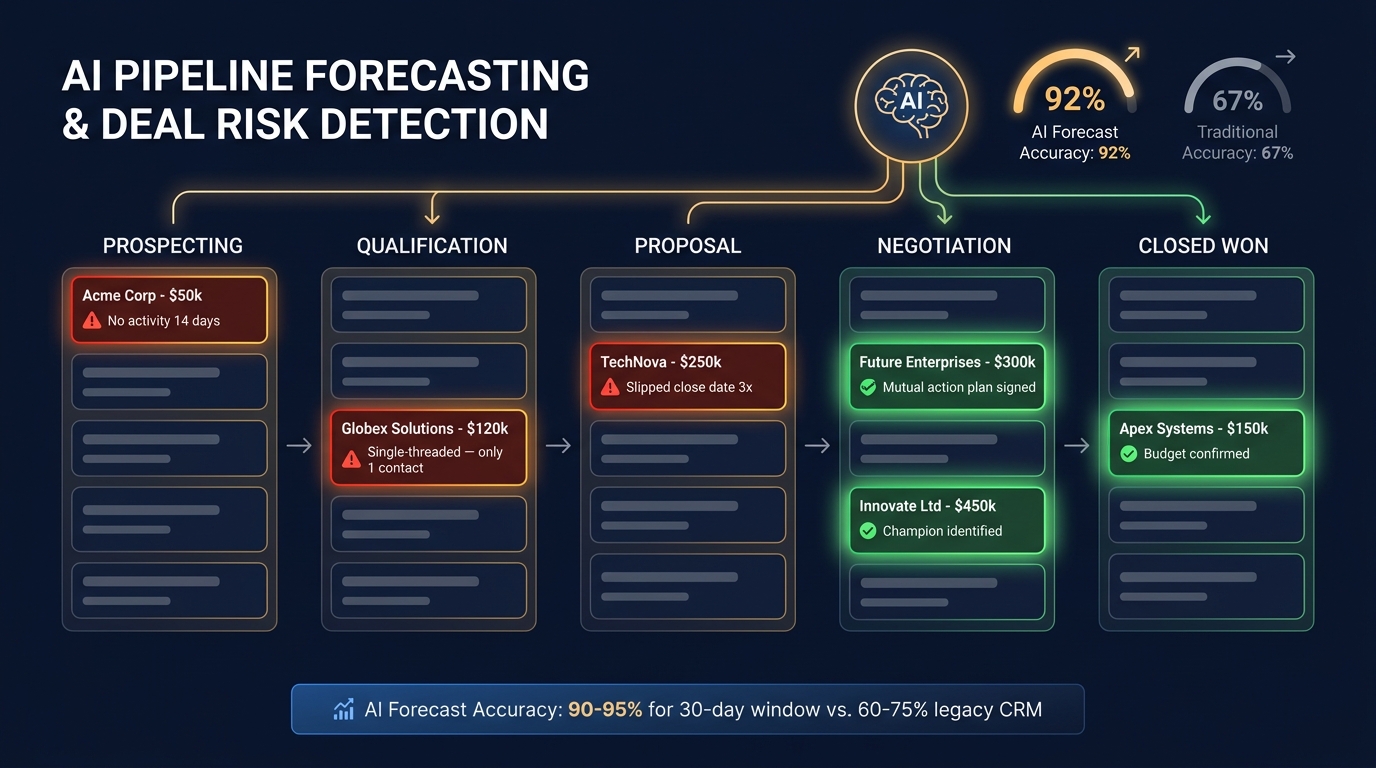
Sales forecasting has historically been part science, part wishful thinking. Reps commit deals based on gut feel and optimism. Managers add their own layer of adjustment. By the time a forecast reaches leadership, it reflects a negotiated number rather than a data-driven one. The industry benchmark for forecast accuracy using traditional methods sits at 60–75% — which means that in the average sales organization, one in three or four forecasted deals doesn’t close as predicted. At scale, that’s a significant planning liability.
AI predictive pipeline management attacks this problem from multiple angles simultaneously. Rather than relying on rep-reported stage data, AI systems analyze actual engagement signals — email response rates, meeting frequency, document views, time between touchpoints — and build independent deal health scores that reflect what’s actually happening, not what the rep entered in the stage dropdown.
How Deal Risk Detection Works
Modern AI pipeline tools like Clari, Gong Forecast, and Salesforce Einstein evaluate each deal against dozens of risk indicators in real time. The most common red flags the system learns to recognize include:
- Single-threaded deals: Only one contact engaged at the prospect company — high risk if that person leaves or goes dark
- Engagement decay: Response times getting longer, email open rates dropping, meeting frequency decreasing
- Close date slippage: A deal that has been pushed past its projected close date two or more times
- Missing decision makers: The economic buyer hasn’t been identified or engaged despite the deal being in late stages
- Competitive pressure signals: Mentions of competitors increasing in call transcripts
- Activity gaps: No meaningful touchpoint in 14+ days on a deal supposedly closing this quarter
When risk signals accumulate, the AI surfaces an alert — not just to the rep, but to the relevant manager — with enough lead time to intervene. This is fundamentally different from discovering a deal is dead during a pipeline review on the last day of the quarter.
Forecast Accuracy Numbers
The accuracy improvement from AI-driven forecasting is substantial. Leading implementations achieve 90–95% forecast accuracy for deals within a 30-day closing window, compared to the 60–75% benchmark for legacy CRM stage-based forecasting (MarketsandMarkets, 2026). Only 7% of sales organizations currently reach 90%+ accuracy with traditional methods — meaning the gap between AI-assisted and manual forecasting represents a meaningful competitive advantage for early adopters.
Clari has reported that customers targeting a 15–20% accuracy improvement and 25% reduction in forecast variance are regularly hitting those targets post-implementation. The practical downstream effect is that leadership can make resourcing, hiring, and investment decisions with significantly more confidence — which is a strategic value that extends well beyond the sales team itself.
The “Inspect What You Expect” Shift
AI pipeline tools also change the nature of manager-rep interactions. Instead of pipeline reviews that ask “where is this deal?” — a question that produces rep justifications and narrative — managers enter reviews already knowing where deals stand from objective signal data. The conversation shifts to “here’s what the AI flags as at-risk — what’s your read, and what’s the plan?” That’s a fundamentally more productive use of everyone’s time, and it tends to surface deal reality more accurately than subjective rep reporting.
Automation 5: AI Conversation Intelligence and Coaching at Scale
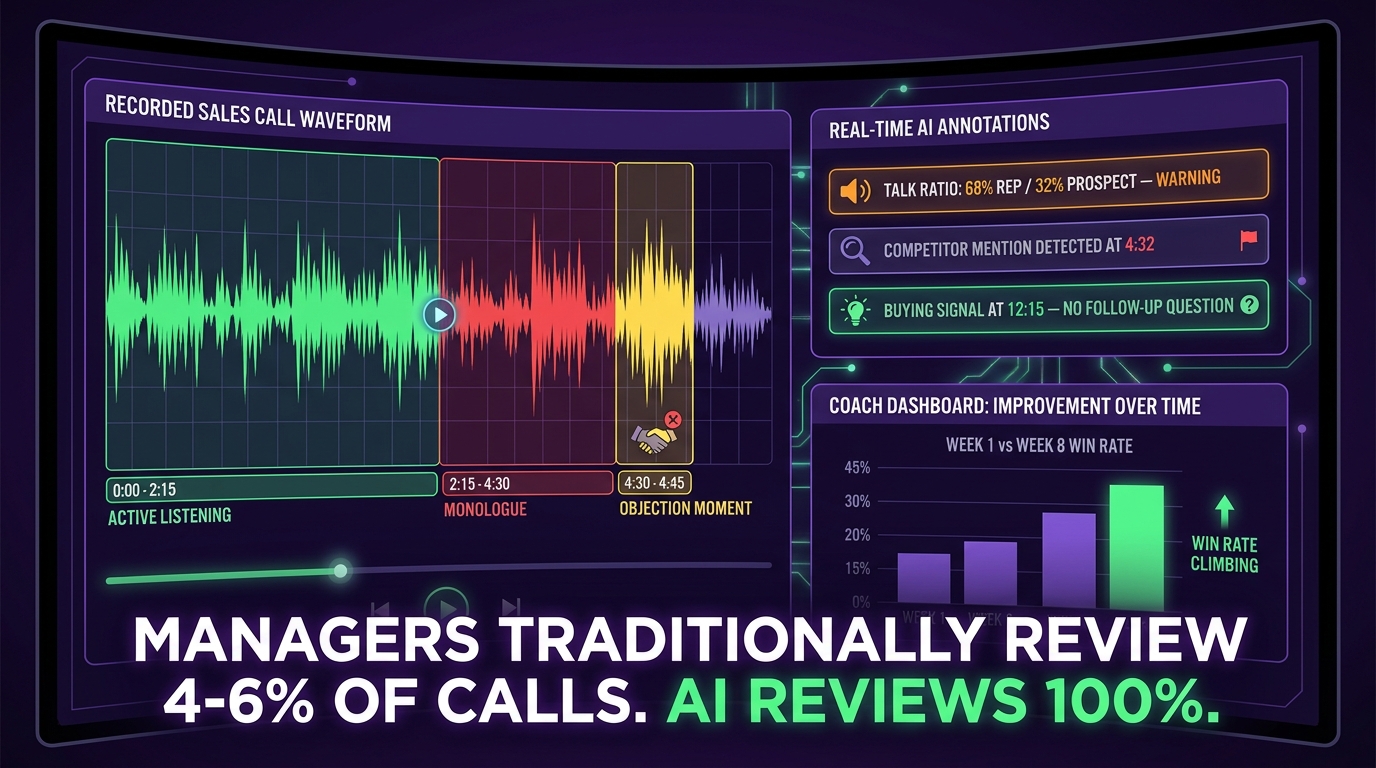
Sales coaching has a structural problem that most organizations never fully acknowledge: the traditional model makes it statistically impossible to improve at scale. Managers typically review 4–6% of rep calls — meaning 94–96% of every sales conversation happens completely outside the view of anyone who could provide feedback. Best practices stay locked in individual reps’ heads. Mistakes repeat across the team. New rep ramp time stretches to 6–9 months because learning happens slowly through the occasional reviewed call, not systematically across thousands of conversations.
AI conversation intelligence doesn’t just record calls — it analyzes every call in the organization and surfaces patterns, trends, and coaching opportunities that would be physically impossible to identify through manual review. This changes the economics of sales coaching entirely.
What AI Finds That Humans Miss
The analytical capability of platforms like Gong, Chorus (now part of ZoomInfo), and Salesloft goes well beyond transcription. These systems track:
- Talk-to-listen ratios: Identifying reps who dominate conversations (typically a negative signal) versus those who ask questions and let prospects talk
- Filler word frequency: “Um,” “uh,” “you know” counts that affect perceived confidence
- Question patterns: Whether reps ask open-ended discovery questions or lead with solution pitching
- Objection handling: How specific objections are handled — and which responses correlate with won versus lost deals
- Pricing discussion timing: When pricing is introduced in the conversation, and how this correlates with outcomes
- Competitor mentions: How reps respond when a competitor is named, and which competitive responses produce better outcomes
- Energy and engagement: Prosodic analysis of vocal tone and pacing
Crucially, the system can compare all of these patterns between won deals and lost deals — identifying the specific behaviors and moments that actually predict outcomes in your specific market.
A Real-World Impact Example
UK-based home improvement retailer Arco implemented Allego’s AI coaching platform and tracked a 75% increase in their “offer rate” — the percentage of calls that included a relevant product offer — in just seven weeks. This translated to 11 additional sales per day across the team, while also halving the time managers spent preparing for coaching sessions. The system gave visibility into call pace, questioning patterns, and specific phrases — and surfaced top-performer calls into a library reps could study on their own time.
Across multiple research sources, AI coaching has been shown to produce:
- 50% faster sales cycles for AI-coached teams
- 28% higher win rates with systematic AI coaching
- 20% reduction in new rep ramp-up time
- 10% improvement in quota attainment across the full team
- ROI exceeding 300% in year one for early adopters (Careertrainer.ai, 2026)
The Coaching Model That Works
The organizations getting the most from AI conversation intelligence combine the technology with a structured coaching cadence. AI surfaces the insight — “this rep consistently skips discovery questions and moves to pricing within the first 10 minutes” — and the manager uses that specific, data-backed observation as the basis for a targeted coaching session. The AI identifies the pattern; the human provides the context and motivation to change it.
Libraries of top-performer calls, accessible to all reps for self-guided learning, are consistently cited as one of the highest-impact features. New reps can listen to 15 examples of how the best AE on the team handles a specific objection — and that’s worth more than any amount of classroom training.
Automation 6: AI Proposal and RFP Generation
In B2B sales, the proposal is often where deals either accelerate or stall. A well-constructed proposal tailored to a specific prospect’s context, pain points, and success criteria can dramatically accelerate executive buy-in. A generic deck with logos swapped and pricing numbers changed does the opposite — it signals that the seller didn’t truly understand the problem.
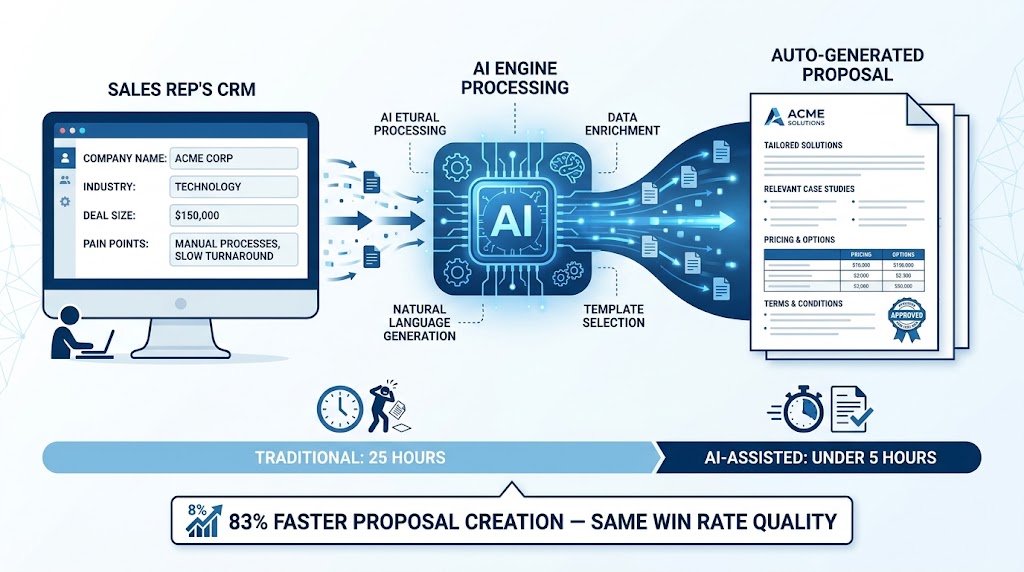
The challenge is that personalized proposals take enormous time to produce well. Senior AEs report spending 3–8 hours per proposal, which at volume becomes a significant drag on selling time. RFPs are even more demanding — a thorough RFP response can consume 25+ hours of work from multiple contributors across sales, product, and legal teams.
AI proposal and RFP generation tools — platforms like Loopio, Responsive (formerly RFPIO), Bidara, and newer point solutions built on large language models — dramatically compress this timeline while maintaining (and in some cases improving) the quality of outputs.
How the Automation Works
The workflow varies slightly by tool, but the core mechanism is consistent. The AI system ingests:
- The prospect’s CRM record (company, industry, deal history, noted pain points)
- The RFP or brief from the prospect
- A library of approved proposal content, case studies, legal language, and technical specifications
- Historical winning proposals from similar deals
From these inputs, the system generates a structured first draft — selecting the most relevant case studies for the prospect’s industry, pulling appropriate technical content, flagging sections that need human input for novelty or sensitivity, and formatting everything against the approved template. The human’s job shifts from creation to review and refinement — a fundamentally different (and faster) cognitive task.
The Time and Win Rate Numbers
The efficiency data for AI proposal generation is striking. Research from Bidara.ai found that RFP response time drops from an average of 25+ hours to under 5 hours — an 83% reduction — enabling teams to respond to 3–5x more RFPs with the same resources. Labor cost savings of $18,000+ per year are achievable for teams managing as few as 30 RFPs annually.
The win rate impact is equally compelling. APMP (Association of Proposal Management Professionals) data shows that well-structured, responsive proposals correlate with 40% higher win rates. The AI’s ability to consistently apply winning proposal structures and pull the most relevant supporting evidence — without the variation that comes from rushed human creation — drives much of this improvement.
One engineering firm case study (Structural Design Solutions) reported their project win rate climbing from 34–45% to 78% after implementing AI proposal automation, with turnaround time dropping from 10 days to 2 days. The compounding effect: more proposals submitted, higher win rate per proposal, faster deals.
The Human-in-the-Loop Requirement
The most effective proposal AI implementations preserve human review at key decision points. AI excels at assembly, structure, and scale. It does not yet reliably produce the subtle competitive differentiation or the relationship-aware language that defines the best proposals. The most successful teams use AI to generate 80% of the document quickly, then invest the remaining time in the specific sections where human judgment genuinely adds value: executive summaries, strategic framing, and pricing rationale.
Treating AI proposal output as ready-to-send without review is a common implementation mistake — and one that occasionally results in factual errors or mismatched case studies making it into client-facing documents. A structured QA step should be part of every AI proposal workflow.
Automation 7: Intelligent Scheduling and Meeting Orchestration
The final automation on this list is the one that teams most consistently underestimate — and the one with perhaps the highest hidden time cost in the average sales workflow. Scheduling meetings sounds trivial. In practice, the back-and-forth email chains required to coordinate a single 30-minute meeting between a rep, a prospect, and two stakeholders can consume 15–20 minutes of real working time and introduce delays of days between when a prospect expressed interest and when a conversation actually happens.
That delay matters more than most sales teams realize. Research consistently shows that speed-to-response is one of the strongest predictors of deal success in outbound sales — leads engaged within the first hour are seven times more likely to convert than those engaged later. Every hour of unnecessary scheduling friction is eroding conversion rate.
What AI Scheduling Actually Does
AI scheduling tools — platforms like Chili Piper, Calendly’s advanced workflows, Reclaim.ai, and Kronologic — go well beyond simple booking links. The most capable implementations offer:
- Auto-routing: Inbound leads are automatically matched to the appropriate rep based on territory, account size, product line, and availability — then booked directly, without any human involvement in the routing decision
- Prospect-facing booking intelligence: AI detects when a prospect is highly engaged (opening multiple emails, visiting pricing pages) and proactively surfaces a booking prompt through the email sequence or website chatbot
- Calendar optimization: AI clusters meetings to protect deep-work blocks for reps, rather than allowing meetings to fragment the day
- Multi-stakeholder coordination: Automated polling across multiple internal and external calendars to find a time that works for everyone, without a single email exchange
- No-show mitigation: Automated reminders, easy rescheduling, and re-engagement sequences triggered when a prospect cancels
The Impact on Deal Velocity
The compound impact of faster scheduling on deal cycle time is underappreciated. In the average enterprise deal, there are anywhere from 8–15 scheduled interactions across the full cycle. If each interaction requires an average of two days of scheduling back-and-forth that gets eliminated, the deal cycle compresses by 16–30 days without any change in the actual sales process quality. For a team with a 90-day average deal cycle, that’s a 17–33% reduction in time-to-close — purely from removing administrative friction.
Kronologic, which operates an AI-driven meeting scheduling platform, has published data showing that AI-initiated meeting scheduling increases outbound meeting booking rates by 40–60% compared to rep-initiated manual scheduling. The difference is response speed and persistence — AI systems respond to inbound signals immediately, follow up systematically, and offer booking options without the awkward human reluctance to send the fourth follow-up email.
Integration Is Everything
For AI scheduling to deliver its full value, it needs to be deeply integrated with your CRM, your email platform, your sales engagement tool, and your reps’ actual calendars. A scheduling tool operating in isolation — where bookings don’t auto-populate in the CRM and meeting context isn’t linked to the deal record — creates more administrative work than it eliminates. Treat integration as a non-negotiable requirement, not an afterthought.
How to Sequence Your Implementation (And Why Order Matters)
Most sales teams that struggle with AI automation aren’t failing because they chose the wrong tools — they’re failing because they tried to do too much at once. Attempting to simultaneously deploy lead scoring, email sequencing, call intelligence, pipeline forecasting, and proposal generation across a 50-person sales team in a single quarter is a recipe for low adoption, confused workflows, and no clean data on what’s actually working.
The sequencing logic that produces the best outcomes consistently follows a similar pattern:
Phase 1: Data Foundation (Weeks 1–6)
Before any AI automation can work reliably, you need clean data. Audit your CRM for incomplete records, inconsistent stage definitions, and orphaned contacts. Standardize deal stages, required fields, and close reason taxonomy. This work is unglamorous but it’s the single biggest predictor of whether your AI investments will perform. Platforms like Validity (for Salesforce) or Cognism’s data enrichment layer can accelerate this process.
Phase 2: Automate the Obvious (Weeks 6–12)
Start with the highest-ROI, lowest-complexity automations: CRM auto-logging and meeting scheduling. These produce immediate, visible time savings for reps — which builds the trust and adoption momentum needed for more complex rollouts. When reps experience what it feels like to finish a call and have the CRM already updated, their appetite for additional automation typically accelerates.
Phase 3: Layer Intelligence (Weeks 12–24)
Once data is clean and adoption is established, introduce lead scoring and AI follow-up sequencing. These depend on data quality to function well, which is why they come after the foundation work. Configure scoring models in consultation with your top-performing reps — their intuition about what makes a good prospect is valuable training data that pure machine learning won’t capture on its own.
Phase 4: Scale Coaching and Forecasting (Months 6–12)
Conversation intelligence and predictive pipeline management require a critical mass of data to produce reliable outputs — typically 90+ days of call recordings and deal outcomes. This is when these systems become genuinely powerful. Introduce them alongside a structured coaching cadence; the technology surfaces insight, but managers need to be trained to act on it consistently.
The Common Thread: Automation That Amplifies, Not Replaces
Every automation covered in this article shares a design principle that the most effective implementations recognize explicitly: the goal is to amplify human capability, not replace human judgment. The sales interactions that actually move prospects from skeptical to committed — building trust, navigating political complexity, understanding the unstated fear behind a stated objection — require human presence and nuance that no current AI system reliably replicates.
What AI does extraordinarily well is eliminate the mechanical work that surrounds those interactions: the logging, the scheduling, the sequence management, the data enrichment, the pattern recognition across hundreds of calls. When that work is automated, reps are freed to invest more genuine attention in the moments that actually matter. That’s not a small shift — it’s a fundamental change in how selling time is allocated.
The teams achieving the most significant results from AI automation share a few characteristics. They started with realistic expectations about the change management involved. They invested in data quality before tool deployment. They gave reps visibility into their own AI-generated insights rather than treating the technology as a surveillance system. And they iterated continuously — treating their AI-powered workflows as living systems that require ongoing tuning, not products installed and forgotten.
What to Watch in the Second Half of 2026
The AI sales automation landscape is moving quickly enough that tools and capabilities available today are materially different from what existed 18 months ago. A few developments worth tracking closely as you build or refine your stack:
Agentic AI in Sales
The most significant near-term development is the emergence of AI agents capable of multi-step, autonomous action across systems. Rather than automating a single task (updating a CRM field, sending a follow-up email), agentic systems can execute full workflows: identify a high-intent prospect, enrich their data from multiple sources, draft and send a personalized outreach message, schedule a meeting when they respond, and brief the rep before the call — all without human input at each step. Outreach, Salesforce, and several emerging players are actively deploying agent-based capabilities. The productivity implications are substantial, but the quality control requirements are higher.
The Salesloft-Clari Merger Integration
The December 2025 merger of Salesloft and Clari created what may become the most integrated sales execution and revenue intelligence platform on the market. As integration deepens through 2026, users of either platform should watch for new orchestration capabilities that combine Salesloft’s sequencing strength with Clari’s forecasting depth into a genuinely unified workflow — rather than the loosely integrated stack that many teams currently maintain.
Tighter Integration Between Conversation Intelligence and Coaching
The next wave of conversation intelligence isn’t just surfacing insights for manager review — it’s delivering real-time, in-call coaching that prompts reps with relevant questions, competitor talk tracks, or pricing responses in the moment rather than after the fact. Tools in this category are early but moving fast. For high-velocity sales environments, real-time coaching AI could be the single highest-impact capability of the next 12 months.
Conclusion: Measure What Moves, Cut What Doesn’t
Implementing AI automation in a sales organization is not a technology decision — it’s an operational decision with a technology component. The tools matter, but the process design, data quality, adoption plan, and measurement framework matter more. Organizations that treat AI as a product to install rather than a capability to build consistently underperform those that invest in the full operational context around the technology.
The seven automations covered here — lead scoring, intelligent follow-up sequencing, CRM auto-logging, predictive pipeline management, AI conversation intelligence, proposal generation, and smart scheduling — represent the current set of AI capabilities with the clearest, most consistent evidence of real sales impact. None of them are magic. All of them require investment, configuration, and ongoing attention to produce their full value.
The starting point doesn’t need to be ambitious. Pick one automation from this list that addresses the most acute pain point in your current sales workflow. Deploy it properly, measure it specifically, and use those results to build the internal confidence for the next step. The teams that tried to automate everything at once are largely the source of the cautionary statistics about AI project failure rates. The teams that started with one working automation and compounded from there are the ones showing up in the success case studies.
The administrative drag on your sales team is real, measurable, and largely solvable with current technology. The question is simply where you start.
Key Takeaways at a Glance:
- Sales reps spend 65% of their time on non-selling work — AI automation directly addresses this structural problem
- AI lead scoring produces 75% higher conversion rates and enables 7x faster response to high-intent prospects
- Behavior-triggered email sequences generate 15–25% reply rates versus 3–5% for static cadences
- CRM auto-logging can recover 5–8 hours per rep per week while dramatically improving data quality
- AI pipeline forecasting achieves 90–95% accuracy on 30-day windows versus 60–75% for legacy methods
- Conversation intelligence allows coaching at 100% call coverage — versus the 4–6% possible manually
- AI proposal tools reduce creation time by 83% and correlate with 40% higher win rates
- Smart scheduling automation eliminates 15–20 minutes of back-and-forth per meeting and compresses deal cycles by eliminating coordination lag
- Sequence implementation: data quality first, simple automations second, intelligence layers third