


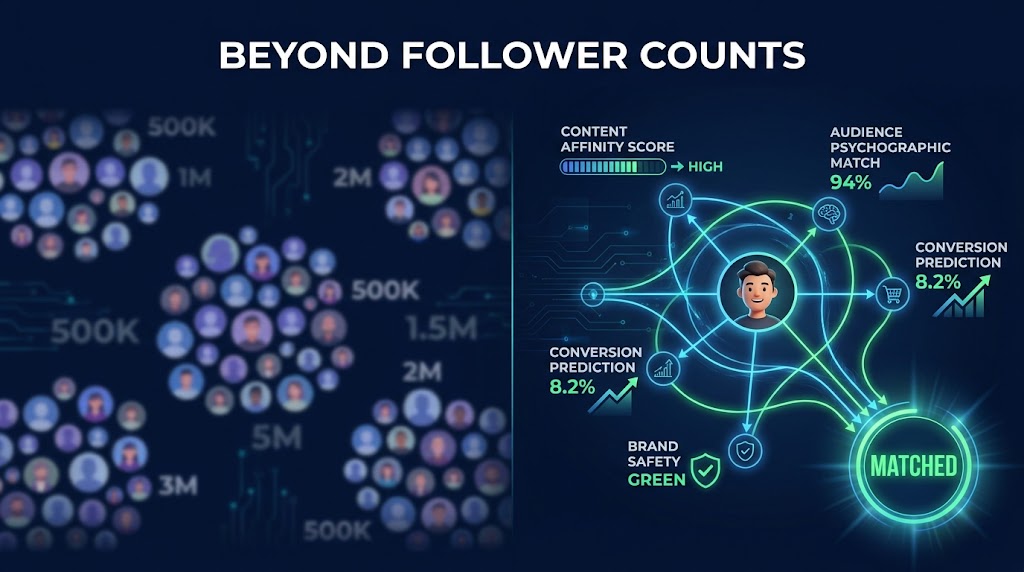

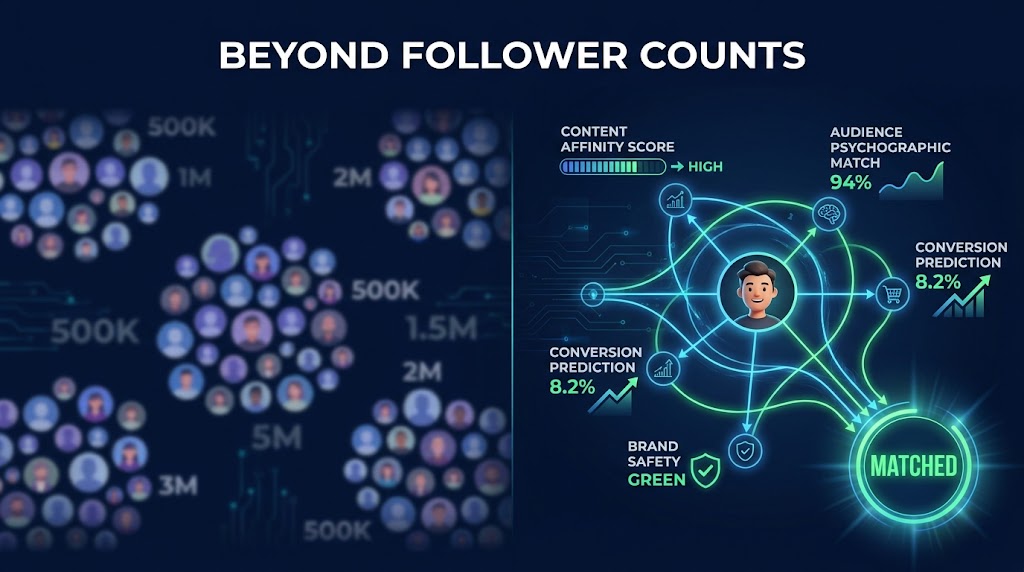
The influencer marketing industry crossed $2 trillion in annual brand investment in 2026. A number that large demands precision. Yet the most common method brands still use to find creators hasn’t materially changed in a decade: search by follower count, filter by category, scroll through feeds, and make a gut call.
That’s an extraordinary mismatch between the capital at stake and the science applied to deploy it. And it shows in the results. Studies consistently find that poorly matched creator campaigns generate 3.2x less engagement than well-matched ones. Up to 60% of influencer partnerships fail outright. Meanwhile, the top 5% of creator-brand pairings drive more than 80% of total GMV generated through affiliate and partnership programs.
The difference between the top 5% and the bottom 60% isn’t follower size. It isn’t even engagement rate in the traditional sense. It’s match quality — a deeply layered concept that AI systems have only recently become capable of measuring at scale.
This article goes inside the matching problem: what AI systems actually analyze when they surface a creator recommendation, where those systems still fall short, and how brands can apply matching intelligence whether they’re using a six-figure enterprise platform or building something themselves from first principles. The goal isn’t to explain that follower counts are unreliable — anyone paying attention already knows that. The goal is to explain what comes after that insight, and why most brands are still getting it wrong.
Why Follower Count Was Always a Proxy — and What It Was Proxying For
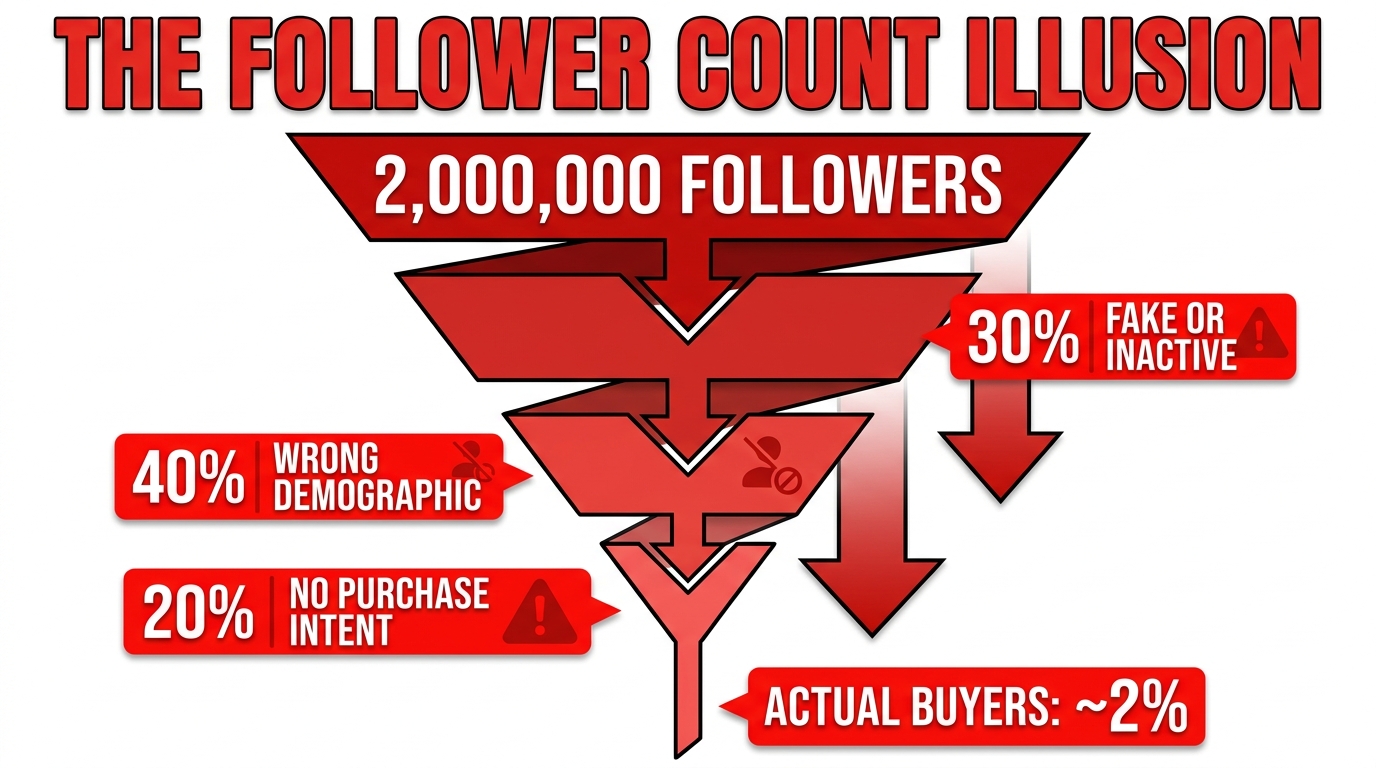
Follower count was never meant to be the end metric. It was always a stand-in — an attempt to approximate reach, which itself was an attempt to approximate audience size, which itself was an attempt to approximate the number of people who might see, trust, and act on a recommendation. That’s four layers of approximation stacked on top of each other, and every layer introduces error.
In the early days of influencer marketing, there was no better option. Engagement analytics were crude, audience demographic data was sparse, and conversion attribution was essentially nonexistent. Follower count was the only signal you could get at a glance for every creator simultaneously. It was imperfect but at least universal and comparable.
The Cascade of Distortions
What’s happened since then is a cascade of distortions that have made the metric progressively less meaningful. First came the fake follower economy. Platforms like Hootsuite estimated in 2026 that approximately 30% of influencers have measurable fake follower activity — not just purchased bots, but inactive accounts, follow-unfollow manipulation artifacts, and engagement pods that inflate surface metrics. Influencer Marketing Hub research has found that around 50% of influencers show at least some fake follower contamination when deeply analyzed.
Then came algorithm changes. Instagram, TikTok, and YouTube all shifted to engagement-first distribution models between 2022 and 2024. A creator with 2 million followers but a 0.3% engagement rate may reach fewer people per post than a creator with 85,000 followers and a 7% engagement rate. Follower count became a historical artifact — a record of past popularity rather than a signal of current reach.
The Engagement Rate Trap
The industry largely responded to this by pivoting from follower count to engagement rate. That was progress, but it introduced its own failure modes. Engagement rate is calculated as total engagements divided by follower count. It tells you something about how active an audience is relative to its size. It tells you almost nothing about whether that audience will buy your specific product.
A creator who makes content about budget travel might have a passionate, highly engaged audience of 25-year-olds with $30,000 annual incomes. Their engagement rate might be 9%. That’s impressive. But if you’re selling a $3,500 luxury watch, the match quality is essentially zero regardless of how high that rate climbs. Engagement without purchase intent is entertainment, not conversion.
The data supports this distinction starkly. Research from ShiftHappens shows nano-influencers (under 10,000 followers) achieve average engagement rates of 1.73% to 3%, while macro-influencers (100,000 to 1 million followers) average just 0.61%. But engagement rate alone doesn’t predict which of those nano-influencers will generate actual sales. That requires a different set of signals entirely.
The Signals AI Actually Reads: What’s Inside the Black Box
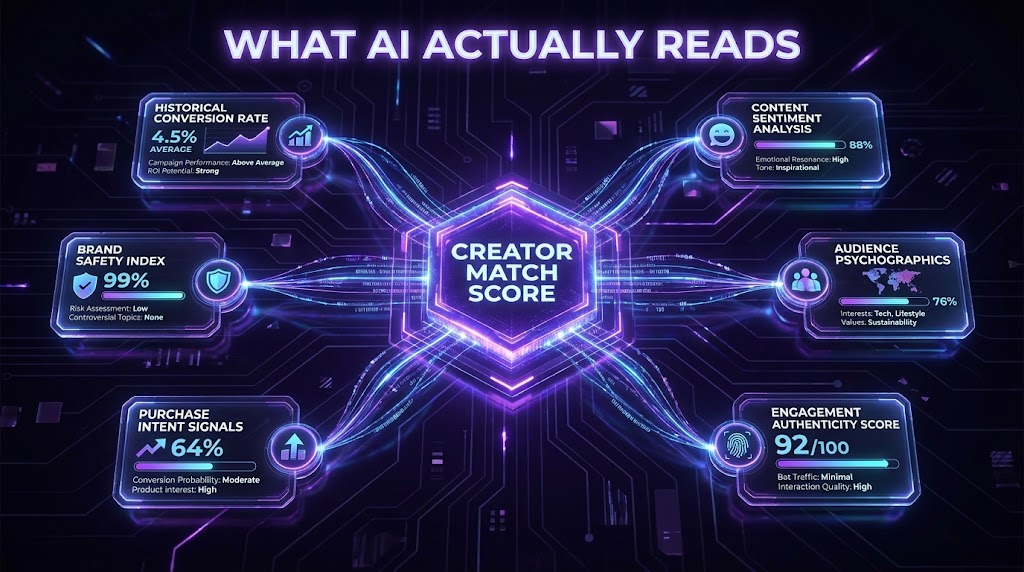
Modern AI matching platforms analyze creators across fundamentally different data dimensions than traditional manual selection. Understanding those dimensions — and why each one matters — is essential to evaluating any tool claiming to do AI-powered matching.
Natural Language Processing of Content
The most foundational layer is semantic content analysis. Platforms like Upfluence, CreatorIQ, and others use NLP models to read creator captions, video transcripts, comment sections, and bio copy. The output isn’t just a category tag (“fitness creator”) — it’s a nuanced topic map that identifies subtopics, tone, vocabulary, and value signals at a granular level.
The practical difference is significant. “Fitness creator” is a category. “Creator focused on low-impact strength training for women over 40 who frequently mentions joint health, sustainable pacing, and functional movement” is a match signal. A supplement brand selling collagen for joint support can immediately identify the second creator as a relevant candidate. A platform only returning category tags cannot make that distinction automatically.
Advanced platforms extend NLP into image and video analysis. Computer vision models scan visual content for product types, brand logos, aesthetic style, color palette, and setting. A creator who consistently appears in clean, minimalist home environments sends different matching signals than one who films in busy urban settings — even if their written content covers similar topics.
Audience Demographic and Psychographic Layering
The second major data dimension is audience composition — and this is where the real complexity begins. Audience demographic data (age, gender, location, language) has been available for several years through creator media kits and platform analytics. What AI adds is two things: first, the ability to verify that data against third-party signals rather than trusting self-reported media kit claims; second, the ability to layer psychographic data on top of demographics.
Psychographic matching looks at what the audience actually cares about, aspires to, and purchases — not just who they are on paper. Platforms increasingly ingest behavioral signals, stated brand affinities, content consumption patterns, and purchase history data (where available and permissioned) to build audience interest profiles. The #paid Creator Signals Report, released in April 2026 and based on data from over 150,000 creators with opted-in brand affinity sharing, found striking psychographic shifts: interest in clean beauty among creator audiences surged from 14% to 32% year-over-year, while travel and vlog consumption rose from 17% to 58%.
Those aren’t just engagement trends. They’re purchase intent signals hiding inside content preferences. A creator whose audience showed early adoption of clean beauty interests in 2025 was already signaling high receptivity to natural skincare products before the category became mainstream.
Engagement Authenticity Scoring
AI platforms now deploy statistical anomaly detection to flag inauthentic engagement patterns that human review misses. The fingerprints of purchased engagement are detectable but subtle: engagement that spikes uniformly within minutes of posting without the normal long-tail decay curve; comment sentiment that is positive but topically disconnected from the content; follower geographic distributions that contradict the creator’s stated niche audience; like-to-comment ratios that fall outside normal human behavior ranges.
The platforms most serious about this — HypeAuditor, Traackr, and GRIN among others — run continuous scoring rather than one-time audits. A creator’s authenticity score updates as their posting behavior and engagement patterns evolve. This matters because engagement pod activity and purchased boost campaigns are often intermittent rather than constant.
Historical Conversion and Performance Signals
Where available, AI platforms pull performance data from previous campaigns — conversion rates, click-through rates, cost-per-acquisition, and revenue generated — and weight those signals heavily in match scoring. This is the difference between predicting performance based on signals and measuring it based on evidence.
Platforms that integrate directly with e-commerce infrastructure (Shopify, WooCommerce, Amazon, TikTok Shop) can close the attribution loop entirely. They know not just that someone clicked through from a creator’s content, but whether that click resulted in a purchase, what the average order value was, and what the return rate looked like. That data, fed back into the matching model, creates a continuously improving performance prediction engine.
Content Affinity vs. Audience Affinity: The Crucial Distinction Most Brands Miss
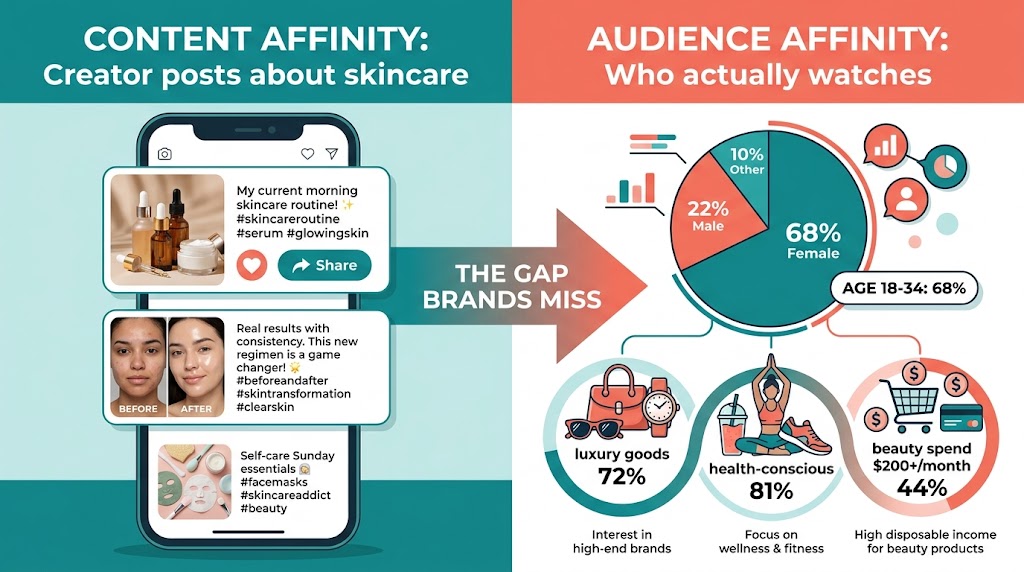
Here is perhaps the most practically important distinction in the entire field of creator matching, and the one that even sophisticated brands most consistently get wrong: the difference between a creator who makes content about your product category and a creator whose audience is primed to buy your product.
These overlap, but they are not the same thing. And the gap between them contains a significant amount of wasted marketing spend.
The Content Affinity Mistake
Content affinity matching is the dominant method used by brands who have moved past raw follower counts but haven’t yet adopted deeper AI analysis. The logic goes: we make kitchen appliances, so we should work with food creators. We make running shoes, so we should partner with fitness influencers. We make skincare, so we should find beauty creators.
This approach is better than follower count sorting, but it leaves enormous value on the table. It operates on the assumption that because a creator discusses a topic, their audience must be interested in purchasing products related to that topic. That assumption frequently doesn’t hold.
Consider a creator who makes elaborate cooking videos. Their content affinity with kitchen appliances is high. But their audience might skew heavily toward people who enjoy watching cooking rather than people who actually cook at home — a distinction that matters enormously for appliance sales. Alternatively, that same cooking creator’s audience might include a surprisingly high concentration of people who work in food service industries, which would make them excellent candidates for professional-grade kitchen tools but poor candidates for consumer home appliances.
Why Audience Affinity Tells a Different Story
Audience affinity analysis asks a different question: what does this creator’s actual audience, as evidenced by their collective behavior and declared interests, want to buy? It’s a question that requires looking past the creator entirely and into the demographic, behavioral, and psychographic data of the people who follow them.
Occasionally, this reveals surprising matches. A personal finance creator whose audience is predominantly young professionals saving aggressively might be an excellent partner for an investment app — obvious — but also for a meal prep service (time-constrained, income-conscious, convenience-seeking), a premium coffee subscription (daily luxury within budget), or a standing desk accessory (home office investment mindset). None of those are finance content. All of them reflect the actual purchase behavior of the audience.
CreatorIQ’s data from 2026 shows that creators generate 11x more impressions and 14x more engagements than equivalent brand-owned content. But that amplification effect only converts when the audience receiving it has the predisposition to act on what they see. Audience affinity is what determines whether amplification becomes conversion or simply becomes noise.
How AI Closes the Gap
Sophisticated AI platforms analyze both dimensions simultaneously and score the overlap between them. A creator who makes skincare content and whose audience has high luxury goods affinity, high spending propensity, and strong prior engagement with skincare-adjacent product posts ranks more highly than a creator with the same content output but a general-interest audience with no discernible purchase intent signals.
The key technical capability here is multi-signal fusion — combining content analysis scores with audience behavioral data to produce a composite match score that neither metric could produce independently. Platforms like NeoReach and Upfluence have built this fusion layer explicitly. Newer platforms are building it from the ground up with audience purchase behavior as the primary signal and content affinity as a secondary filter rather than the other way around.
Psychographic Matching: Reading Creator Lifestyle Signals at Scale
One of the most significant recent developments in AI creator matching is the shift from inferring audience psychographics from indirect signals to collecting them directly — with creator consent — and making them available to brands as a matching input.
The #paid network pioneered this model at scale. Rather than asking brands to guess at what their partnered creators actually care about personally, the platform surveys creators about their own lifestyle habits, daily product usage, brand affinities, aspirational goals, and interests. The results feed into a matching layer that identifies creators based on genuine personal alignment rather than topical proximity alone.
Why Personal Alignment Converts Better
The logic behind psychographic matching at the creator level (as opposed to the audience level) is rooted in authentic advocacy. When a creator genuinely uses and believes in a product, it shows in the content they produce. Vocabulary is more natural, enthusiasm is more convincing, usage demonstrations are more competent, and questions from followers receive more specific and knowledgeable answers.
80% of consumers in recent surveys identified inauthenticity and lack of transparency as the primary factors that destroy trust in creator recommendations. The inverse is equally true: genuine alignment builds trust that compounds over time. A creator who has been using a skincare product for six months before being offered a partnership deal produces content that audiences perceive and respond to differently than a creator who received the product the week before posting about it.
Scaling Authenticity Signals
The challenge is that genuine personal alignment is inherently qualitative and human — which makes it resistant to algorithmic capture. The approaches that work best combine quantitative behavioral signals with qualitative declared preferences.
On the behavioral side, AI platforms can identify creators who have organically tagged or mentioned a product or brand in their content before being approached for a partnership. This is perhaps the strongest authenticity signal available: unpaid advocacy. Platforms that monitor earned media mentions and organic brand references at scale — Traackr and GRIN do this well — can surface creators who are already advocates, making the partnership a formalization of an existing relationship rather than an artificial arrangement.
On the declared preferences side, the creator-survey approach pioneered by #paid has proven that many creators are willing to share detailed lifestyle and affinity data when they understand it will result in better-matched partnerships. Better matches mean more authentic content, higher performance, and better long-term earning potential for the creator. The incentive alignment is genuine.
The 2026 Aspire State of Influencer Marketing report found that 49% of creators are now actively using AI tools to identify products they are genuinely interested in promoting — a dramatic shift from the model of brands pushing product pitches at passive creators. The matching dynamic is becoming bidirectional.
The Authenticity Tax: What Happens When AI Gets the Match Wrong
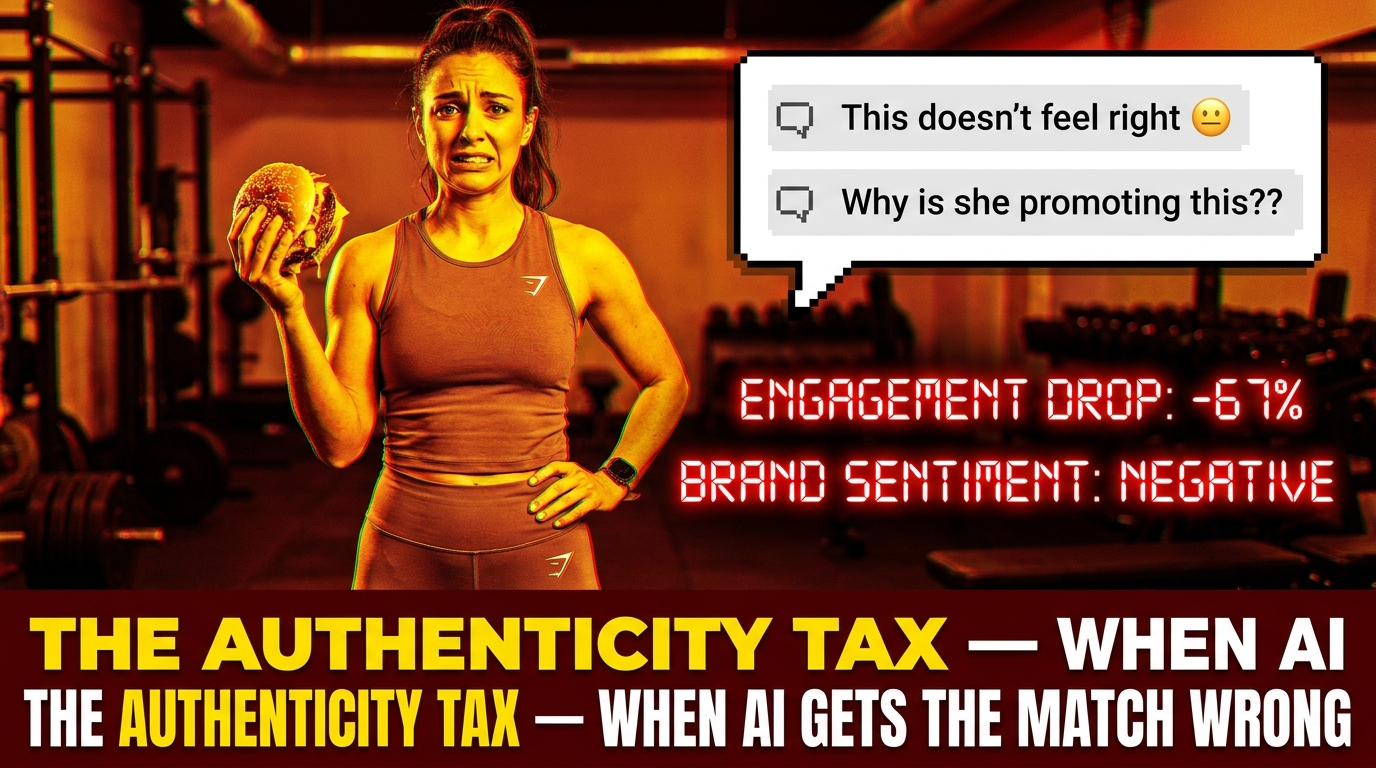
AI systems can make bad matches. This happens when the input signals are incomplete, when the model is trained on insufficient data, when brand-side inputs are too generic, or when the system optimizes for reach or engagement while ignoring fit quality. The consequences are worth understanding in detail, because they tend to be underestimated.
The Immediate Engagement Penalty
When a creator promotes a product that their audience senses doesn’t fit, the first and most visible consequence is an engagement collapse on the sponsored content. Research from Creator.co found that well-matched campaigns generate 3.2x higher engagement than poorly matched ones. The inverse of that ratio is brutal: a mismatched campaign can underperform an equivalent organic post by more than two-thirds.
That underperformance doesn’t stay contained within a single post. Most creator audience members who see a sponsored post that feels inauthentic begin to mentally discount future recommendations from that creator. The trust erosion is slow and cumulative, but it’s measurable. Repeat mismatches can permanently degrade a creator’s commercial value to brands, which is why experienced creators are increasingly selective about what they promote regardless of the fee offered.
The Long-Tail Brand Damage Problem
The more serious and less frequently discussed consequence is long-tail brand damage. A visible creator-brand mismatch becomes documented on the internet permanently. Screenshots of awkward sponsored posts, comment threads mocking brand-creator alignment failures, and compilation accounts dedicated to “terrible brand deals” create durable negative associations that don’t expire when the campaign does.
A 2025 Influencer Marketing Hub survey found that approximately 60% of brands had encountered influencer fraud or partnership failure — yet brand safety remained a low planning priority for most of those same brands. The gap between experiencing consequences and changing behavior is one of the most consistent failure patterns in the industry.
The AI Failure Modes to Watch For
Current AI matching systems fail in predictable ways. The most common: overweighting content affinity while underweighting audience psychographic fit. A system trained primarily on engagement rate as a success metric will surface high-engagement creators regardless of whether that engagement translates to your specific conversion goal. A system trained on past campaign data will reflect the biases present in that data — if the historical campaigns it learned from were themselves poorly designed, the model will perpetuate those failures.
The second common failure mode is category contamination — flagging a creator as a strong match because their content occasionally intersects with your product category even when it’s not their primary content area. A travel creator who occasionally posts about gear might register as a strong match for an outdoor equipment brand when they’re actually best understood as a lifestyle creator whose gear posts are incidental rather than core to their identity.
The third failure mode is freshness lag. Creator audiences evolve. A creator who was an excellent match for a youth-oriented skincare brand in 2024 may have aged up their audience naturally by 2026, making that same product a poorer fit than it would have appeared based on historical data. AI systems that don’t continuously refresh their audience modeling will propagate stale matches.
Dark Engagement Data: The Hidden Signals That Actually Predict Conversion
There’s a category of engagement behavior that most creator analytics surfaces incompletely or not at all — what might be called dark engagement data. These are the actions that indicate the deepest level of audience intent and are the strongest predictors of conversion, yet they’re systematically harder to access than the vanity metrics that dominate most dashboards.
Saves: The Intent Signal Nobody Talks About
On both Instagram and TikTok, saves represent one of the highest-value engagement signals available. When someone saves a piece of content, they are indicating that they want to return to it. In a creator commerce context, this almost always means one of a small number of things: they’re interested in the product but haven’t bought yet, they’re researching for a future purchase, or they want to show the content to someone else before deciding.
A post with 100,000 views and 500 saves indicates a different conversion potential than a post with 100,000 views and 50 saves, even if the total like and comment counts are identical. Yet most brands and many AI platforms still weight saves far below likes in their engagement calculations, largely because saves are harder to access consistently through APIs and creator media kits rarely feature them prominently.
Watch Time and Completion Rate on Video
For video content on TikTok, Instagram Reels, and YouTube, the percentage of viewers who watch a video to completion is a powerful purchase intent signal — particularly when the video features a product demonstration or review. Someone who watches a 60-second product review video to the end has consumed the full commercial message and made a deliberate decision to keep watching rather than scroll past.
Platforms like TikTok weight completion rate heavily in their recommendation algorithm, which creates a virtuous cycle: high-completion content gets distributed more widely, generating more data about which audiences complete which content types. AI systems that can access TikTok’s completion rate data at the creator level can identify creators whose product-focused content consistently retains viewers — a far stronger conversion signal than any follower count.
Comment Sentiment and Question Quality
NLP analysis of comment sections has become increasingly sophisticated. The distinction that matters most isn’t between positive and negative sentiment overall — it’s between active and passive engagement. Comments that include product questions (“does this work on sensitive skin?”, “where can I get the blue one?”, “is this worth it for X use case?”) are conversion-intent signals. Comments that are purely social (“love your energy”, “you’re so pretty”, “this made me laugh”) are engagement without commercial intent.
A creator who generates purchase-question comments on their sponsored posts is demonstrating that their audience is willing to engage commercially with their recommendations, not just socially. Some AI platforms now specifically score for this distinction, flagging creators whose comment ecosystems show high commercial engagement as premium matches for conversion-focused campaigns.
Repurchase and Return Behavior
For brands running affiliate or commission-based programs, the most valuable dark signal is repurchase behavior among customers acquired through specific creators. A creator whose referred customers have a 60% 90-day return purchase rate is more valuable to the brand’s long-term economics than a creator who drives more initial sales but with poor retention. This signal is only visible with proper attribution infrastructure in place, but for brands that have built it, it creates durable matching intelligence that compounds over time.
Platform-Specific Matching Logic: Why One Size Fits None
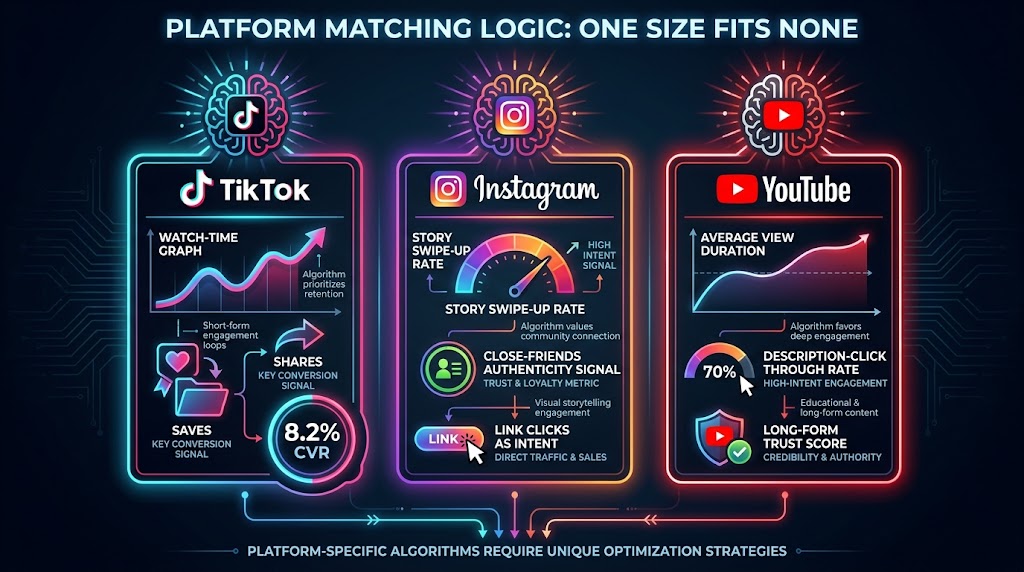
One of the more significant oversimplifications in creator matching is treating creators as platform-agnostic. A creator who performs exceptionally on TikTok may be a mediocre match for the same brand on Instagram, and an outstanding YouTube creator may generate poor ROI for the same product that a much smaller TikTok creator converts brilliantly. Platform architecture determines what kinds of creator-audience relationships form and what kinds of content drive conversion.
TikTok: The Discovery Commerce Model
TikTok’s matching logic is defined by its algorithmic distribution model. Unlike Instagram or YouTube, TikTok distributes content to non-followers based on engagement signals, meaning a creator with 50,000 followers can reach millions if their content performs well. This fundamentally changes what “match quality” means on the platform.
For TikTok Shop specifically, the conversion signals that AI platforms should prioritize include: video completion rate on product-adjacent content, save rate on haul and review content, add-to-cart actions within the native commerce experience, and comment quality (specifically purchase-intent questions). TikTok’s average platform conversion rate stands at 4.7%, but well-matched creators in targeted niches achieve 8-12% — a meaningful difference that is almost entirely explained by match quality rather than creator size.
The key insight for TikTok matching is that virality and sales conversion are almost independent axes. A creator who frequently goes viral may be terrible at converting sales because their viral content attracts a broad, shallow audience rather than a niche purchase-ready one. AI systems matching for TikTok specifically need to separate a creator’s viral potential from their commerce potential — two very different attributes that surface very different signals.
Instagram: The Trust Amplification Platform
Instagram creator-product matching operates on a fundamentally different dynamic. The platform’s primary commercial mechanism is trust amplification — audiences on Instagram have, on average, a longer and more curated relationship with the creators they follow than TikTok’s algorithm-driven discovery model creates. This means Instagram creators who are well-matched can achieve strong results with smaller audiences than their TikTok equivalents would need.
The matching signals that matter most on Instagram include story interaction rate (which is more intimate and conversion-friendly than feed post engagement), direct message response rates (creators who actively respond to product questions from followers demonstrate commerce-capable relationships), and the overlap between a creator’s aesthetic and a brand’s visual identity. Instagram’s visual grammar is strict, and brand-creator aesthetic mismatch creates a cognitive dissonance that suppresses conversion even when other signals look favorable.
YouTube: The Long-Form Trust Investment
YouTube’s matching logic is the most distinct of the three. Long-form video creates a different kind of trust relationship — more like the relationship between a reader and a trusted author than the parasocial relationship common on shorter-form platforms. YouTube viewers invest significant time with creators, and that time investment correlates with purchase consideration in high-ticket categories.
For matching on YouTube, AI systems should weight average view duration heavily (a creator whose audience watches 70% of their videos on average has built something qualitatively different from one whose audience drops off at 20%), along with description click-through rates, comment depth and specificity, and community post engagement. YouTube is also the most effective platform for products that require explanation, comparison, or demonstration — the matching logic should account for a creator’s demonstrated ability to communicate product complexity, not just product enthusiasm.
Building Your Own Matching Intelligence Without Enterprise Tools
Enterprise AI platforms from CreatorIQ, Upfluence, Traackr, and their competitors offer powerful matching capabilities, but they are priced for brands with substantial influencer marketing budgets — typically $2,000 to $25,000 per month at the sophisticated end. That pricing reality means that the brands most in need of better matching methodology — growth-stage brands managing creator relationships in-house — often have the least access to the tools designed to provide it.
But the underlying methodology can be approximated with more accessible tools and disciplined data practices.
Step One: Define Your Buyer Before Your Creator
The most common mistake in DIY creator matching is starting with creator search rather than buyer definition. Before you open any creator discovery platform, build out a specific psychographic profile of your ideal customer. Not just demographics — psychographics. What do they watch when they’re not looking for your product? What other purchases in adjacent categories do they make? What values show up in the content they save and share? What vocabulary do they use when they describe problems your product solves?
This profile becomes your matching template. When you evaluate a creator, you’re asking a specific question: does this person’s audience map onto this profile? Not: does this creator’s content category match my product category?
Step Two: Use Mid-Tier Accessible Data Points
Several platforms offer meaningful creator data at accessible price points. Creator.co and Aspire provide audience demographic and authenticity data at mid-market pricing. Modash offers bulk creator database access with demographic filters at startup-friendly pricing. HypeAuditor provides audience quality scoring on a per-creator basis that can be used selectively for final-stage vetting without requiring a full platform subscription.
For save rate and completion rate data, which is harder to obtain systematically, it’s worth asking creators directly. Creators who are serious about long-term brand partnerships will typically share detailed analytics from their native platform dashboards. A creator who refuses to share engagement breakdown data beyond the summary metrics in their media kit is a red flag worth noting.
Step Three: Build a Test-and-Learn Attribution Ladder
The most durable matching intelligence comes from your own campaign data, not from third-party platforms. Build unique tracking links for every creator partnership, connect them to your e-commerce analytics, and track not just clicks and initial conversions but customer lifetime value, return purchase rate, and return/refund rates by creator source.
Over 12 to 18 months, this data reveals patterns that no external AI platform can provide: which creator types generate your most loyal customers, which content formats correlate with the lowest refund rates (indicating that customers received the product they expected), and which creator-product pairings produce compounding value through customer network effects. This is proprietary matching intelligence that becomes a durable competitive advantage.
The Next Frontier: Agentic AI and Real-Time Creator Matching
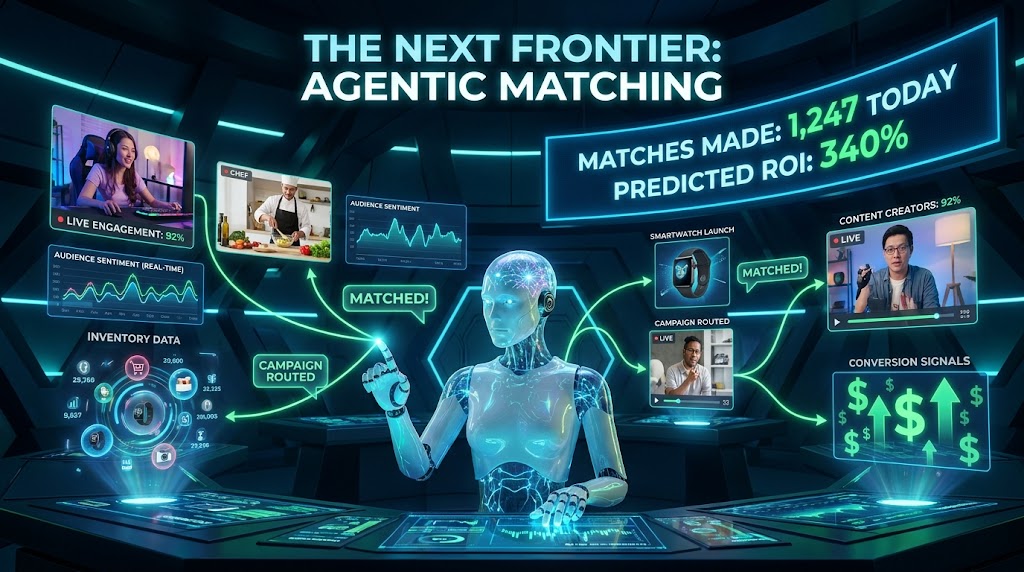
The current generation of AI matching platforms still operates primarily in an advisory mode: the system surfaces recommendations, and a human marketing manager or partnership coordinator makes the final decision, executes outreach, negotiates terms, and manages the relationship. The next wave of development is pushing the boundary of what AI can handle autonomously — and it is moving faster than most practitioners expect.
The Shift to Agentic Matching Systems
Agentic AI systems are designed to take actions rather than just generate recommendations. In the creator matching context, this means systems capable of: continuously monitoring creator content output and audience evolution in real time, proactively identifying matching opportunities as they emerge (including when a previously poor-fit creator’s audience has shifted toward your target), initiating outreach through programmatic messaging, negotiating standardized partnership terms within defined parameters, and spinning up tracking infrastructure automatically.
TikTok Shop’s Open Collaboration system — where brands can list products available for creator promotion and creators can self-select into partnerships — is a rudimentary early version of this model. AI systems that monitor creator performance within the platform’s ecosystem can identify creators who are already generating organic sales for product categories adjacent to yours and proactively initiate commission offers. This reduces the matching cycle from weeks to hours.
Predictive Trend-Creator Alignment
The most ambitious development in the pipeline is predictive trend-creator alignment — systems capable of identifying which creators are positioned to become influential in an emerging category before that category reaches mainstream awareness. This requires integrating trend forecasting models with creator content evolution tracking.
Early signals of this capability are visible in platforms that monitor engagement momentum curves — not just current engagement but the rate of change in engagement quality over time. A creator whose save rate on health-adjacent content is growing 40% month-over-month may be building toward an audience that becomes highly valuable to health brands before any algorithm or category report has flagged the trend.
For brands, this represents a genuine first-mover advantage: reaching creators before they’ve been saturated with competing brand partnerships, when their rates are lower and their openness to collaborative product integration is higher. The brands building the data infrastructure to act on these signals today will hold a meaningful partnership advantage in two to three years.
The Creator-Side AI Layer
It’s worth noting that agentic AI is developing on the creator side simultaneously. The Aspire report found that 49% of creators now use AI tools to manage their brand relationships, identify partnership opportunities, and optimize their content for better brand-fit signaling. As creator-side AI becomes more sophisticated, the matching dynamic shifts further toward bidirectional intelligence: AI systems representing brands and AI systems representing creators, negotiating fit and terms at a speed and granularity no human-managed process can match.
This creates a new set of questions about the role of human judgment in partnership decisions. The likely equilibrium is one where AI handles the identification, preliminary vetting, and initial negotiation phases — compressing what currently takes weeks into hours — while humans retain approval authority for significant financial commitments and creative strategy decisions. The workflow changes substantially; the need for human judgment doesn’t disappear.
What Good Matching Infrastructure Actually Looks Like: A Practitioner’s Checklist
The concepts described throughout this article converge into a set of practical infrastructure decisions that brands and creators can evaluate against their current state. Good matching infrastructure isn’t a single platform purchase — it’s a combination of data architecture, process design, and analytical discipline.
For Brands
The first requirement is closing the attribution loop. Any brand running creator partnerships without unique tracking links and conversion event firing at the checkout level is flying blind. The data generated by proper attribution is the foundation of all other matching intelligence.
The second requirement is separating engagement quality from engagement quantity in all internal KPI discussions. If your team is reporting on total impressions and overall engagement rates without segmenting by conversion-intent indicators — save rate, click-to-purchase rate, customer quality metrics — your reporting is describing activity, not performance.
The third requirement is building a creator database that evolves rather than remaining static. Creator audiences change. A creator vetting decision made six months ago may not reflect current reality. Platforms that support dynamic creator scoring rather than snapshot-based qualification are preferable for any brand running programs at meaningful scale.
For Creators
Creators who understand the matching landscape can position themselves more effectively for well-aligned brand partnerships. This means proactively developing and sharing detailed audience analytics — not just platform demographics but deeper engagement breakdown data. It means cultivating and documenting organic product relationships before approaching or accepting paid deals. And it means thinking explicitly about the fit between their audience’s purchase behavior and the categories they choose to represent.
The 2026 Aspire data showing that 49% of creators now use AI to identify partnership opportunities reflects growing sophistication on the creator side. Creators who bring their own matching analysis to brand conversations — demonstrating specifically why their audience is a strong fit for a product rather than relying on the brand to make that case — are differentiating themselves meaningfully in an increasingly competitive creator supply environment.
Matching Is a Science, Not a Search
Creator-product matching in 2026 is not fundamentally about finding someone in the right content category with enough followers to seem credible. That was the 2016 model. The data accumulated over the decade since has demonstrated clearly that category proximity and audience size are weak predictors of commercial performance.
What the data consistently shows instead is that match quality — the convergence of content authenticity, audience psychographic fit, engagement intent signals, platform behavioral patterns, and personal creator alignment — predicts conversion performance far more reliably than any single metric. And AI systems have reached the point where they can measure and optimize for match quality at a scale that manual human analysis cannot approach.
The practical implication is not that brands should simply buy an AI matching platform and trust the output. It’s that brands should understand what these systems actually measure, what signals carry the most predictive weight, where the systems still fail, and what proprietary data they can build to augment or eventually exceed the intelligence that third-party platforms can provide.
The brands doing this work well in 2026 are not those with the largest influencer marketing budgets. They’re the ones who have treated matching as a technical and analytical discipline rather than a relationship management function — who have built the attribution infrastructure to generate real performance data, the analytical frameworks to extract signal from that data, and the institutional knowledge to act on what they’ve learned.
That is an achievable standard for any brand willing to invest in the methodology. Follower counts require no methodology. Match quality does. That’s precisely what makes it defensible as a competitive advantage — and what makes the gap between brands who approach it rigorously and those who don’t continue to widen.
Key Takeaways
- AI matching systems analyze content semantics, audience psychographics, engagement authenticity, and historical conversion data simultaneously — follower count and engagement rate are inputs at best, not outputs.
- Content affinity and audience affinity are distinct signals that must both be present for high-quality matches. A creator who talks about your product category isn’t the same as a creator whose audience wants to buy it.
- Dark engagement data — saves, completion rates, purchase-intent comments, repurchase behavior — predicts conversion better than standard engagement metrics and is systematically underused by most brands.
- Platform-specific matching logic matters: TikTok, Instagram, and YouTube each require different signal weighting. A creator optimized for one platform may be a poor match on another.
- Building proprietary attribution data is the highest-leverage investment any brand can make in long-term matching intelligence — no third-party platform can replicate your own performance history.
- Agentic AI will compress matching timelines from weeks to hours. Brands building the data infrastructure now will have a durable advantage as those systems mature.