

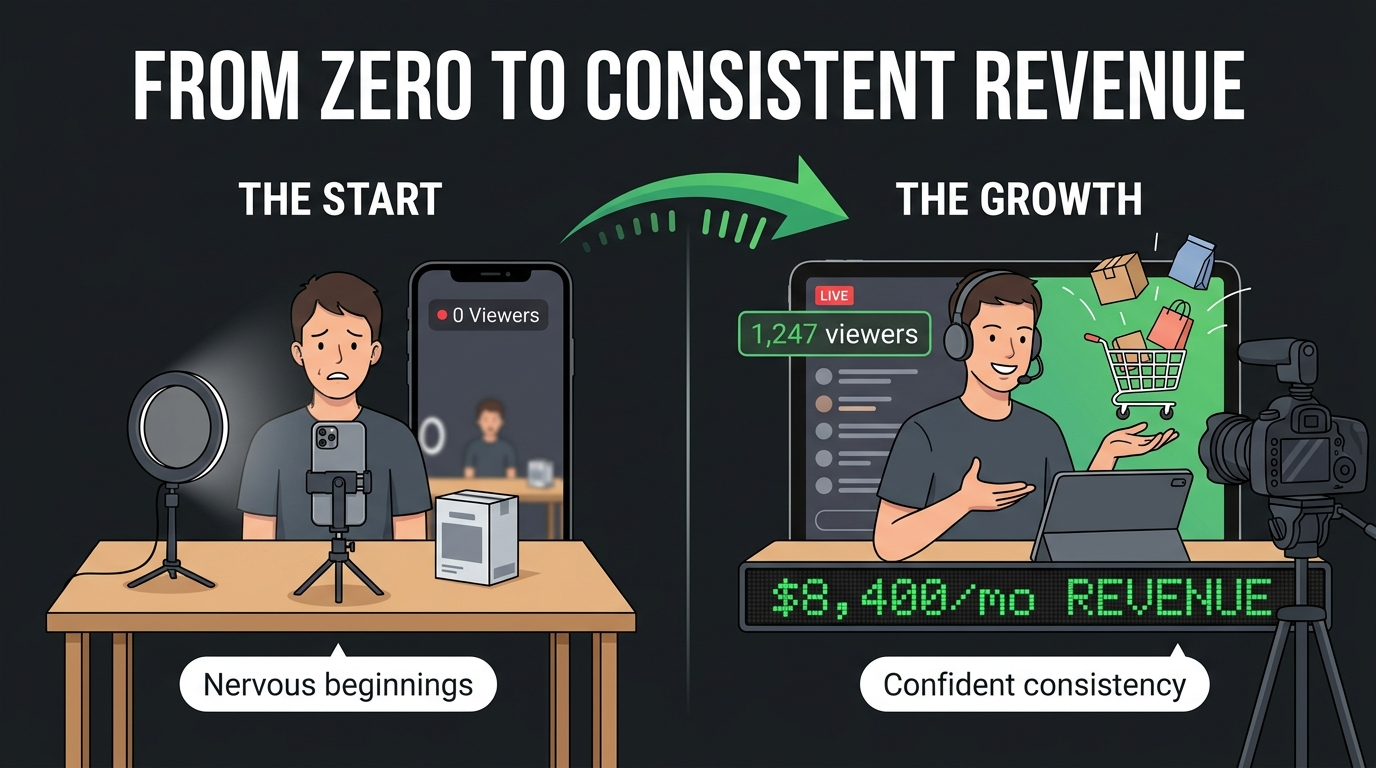

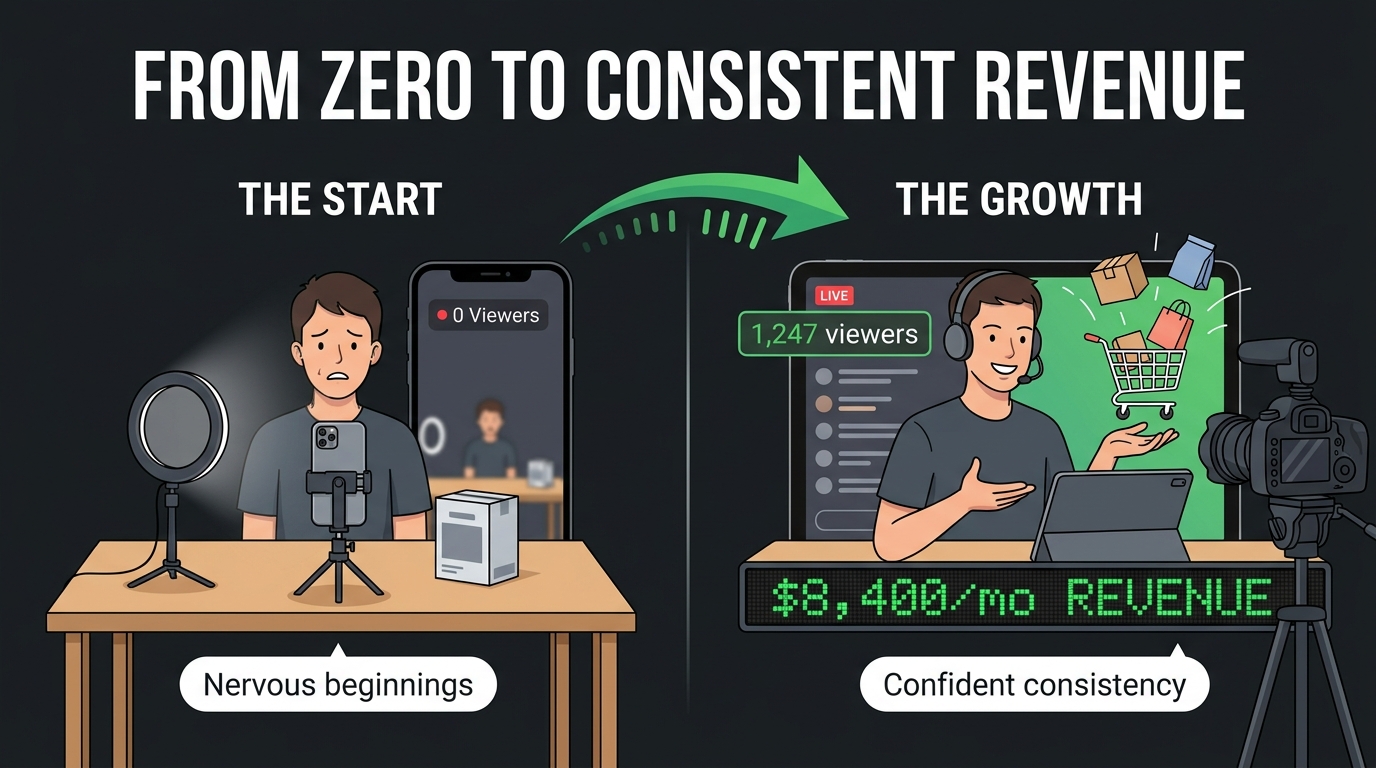
There is a specific kind of discouragement that hits new livestream sellers around day twelve. The setup looked right. The ring light is on. The products are arranged. You hit “Go Live” — and three people join, two of whom are bots and one of whom is your cousin. You push through thirty minutes of product demos into empty air, log off, and wonder if you missed something everyone else already knows.
You didn’t miss a secret. You missed a model.
Most new sellers approach livestreaming the way people approach a first job interview — they prepare what they’re going to say and completely forget to think about what’s going to happen afterward. They show up, perform, and wait for results. But livestream commerce doesn’t work like a single pitch. It works like a relationship business with a discovery algorithm layered on top, and understanding that distinction is what separates the sellers still streaming at month six from the ones who quietly quit at week three.
The US livestream e-commerce market grew nearly 50% in 2025 to $14.6 billion and is projected to reach $55–68 billion in 2026. On Whatnot alone, sellers streaming daily average $60,000 per month in revenue, and $10,000/month sellers doubled year-over-year. Those numbers are real. But they’re the output of a process — not the product of going live and hoping.
This post is about that process. Specifically, it maps a four-phase growth model that takes a seller from their first awkward stream to a repeatable, scalable revenue operation. No shortcuts. No hype. Just the mechanics of how livestream businesses actually get built, phase by phase.
Why the Broadcast Mindset Kills New Sellers Before They Start
Before getting into the model itself, it’s worth diagnosing the core mistake that derails new sellers, because it runs deeper than tactics. It’s a foundational mental model error.
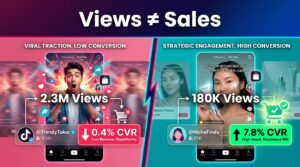
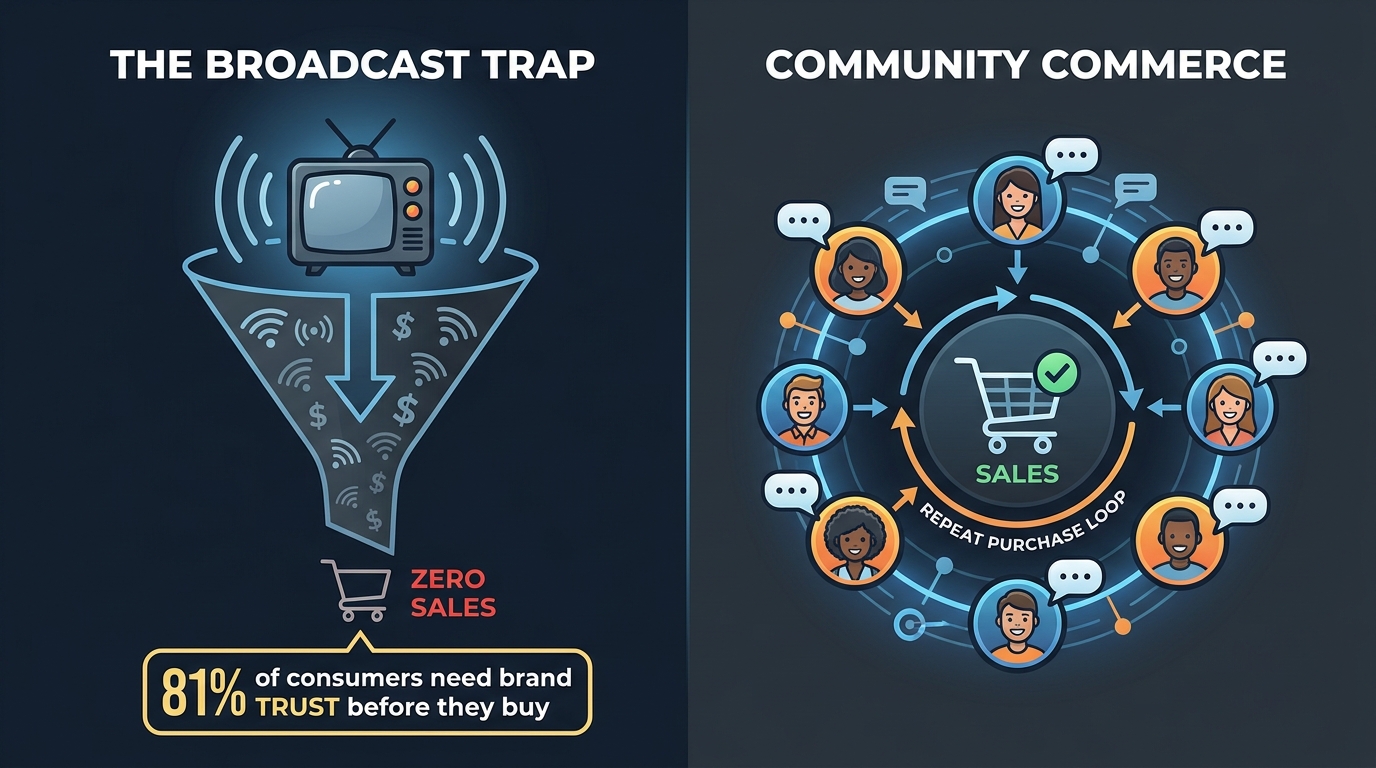
Most new livestream sellers come in with what we can call the broadcast mindset: the belief that going live is a distribution event, like sending an email blast or posting an ad. In this frame, going live = reaching an audience, and reaching an audience = making sales. The job, therefore, is to perform as well as possible during the stream and convert whoever shows up.
This framing is wrong — and it’s specifically wrong in ways that make early failure feel personal.
The Real Nature of Livestream Discovery
Livestream platforms are not passive broadcast networks. They’re active distribution systems that require a feedback signal before they amplify anything. TikTok’s algorithm, Whatnot’s featured stream placement, and Amazon Live’s recommendation engine all function similarly: they test your stream against a small initial audience, measure engagement signals (watch time, comments, add-to-cart actions), and decide whether to push your content further based on those signals.
If your stream is new, your audience is small, and your engagement data is thin. The algorithm has no reason to surface you yet. That’s not a failure state — that’s a baseline state. But sellers who expect broadcast-style reach from day one will read early low viewership as a sign something is broken and either overcompensate (dumping money on ads they’re not ready for) or give up entirely.
Why Trust Changes Everything
Research from Edelman consistently finds that 81% of consumers require brand trust before making a purchase. In livestream commerce, that trust doesn’t come from production quality, price, or even product value alone. Academic research on livestream platforms specifically identifies three trust drivers: streamer expertise (you know your product category deeply), responsiveness (you engage with viewers in real time), and affinity (viewers feel an emotional connection to you as a host). All three are built over time, not in a single session.
This is why the most successful livestream sellers don’t talk about their best stream — they talk about their consistent streams. The business compounds on itself through repeated exposure and deepening trust, not through any single viral moment.
The 43% Problem
Here’s a sobering stat that doesn’t get enough attention: according to eMarketer data, approximately 43% of US digital buyers are currently uninterested in livestream shopping. McKinsey research identifies “inconvenience” as the top barrier, cited by 32% of non-participants — streams are too long, poorly timed, or hard to navigate. This is not a reason to avoid livestreaming. It’s a reason to understand that your job isn’t just to sell products. Your job is to make the format itself compelling enough to convert skeptics — and that requires a different kind of preparation than most sellers bring to their first session.
The Four-Phase Growth Model
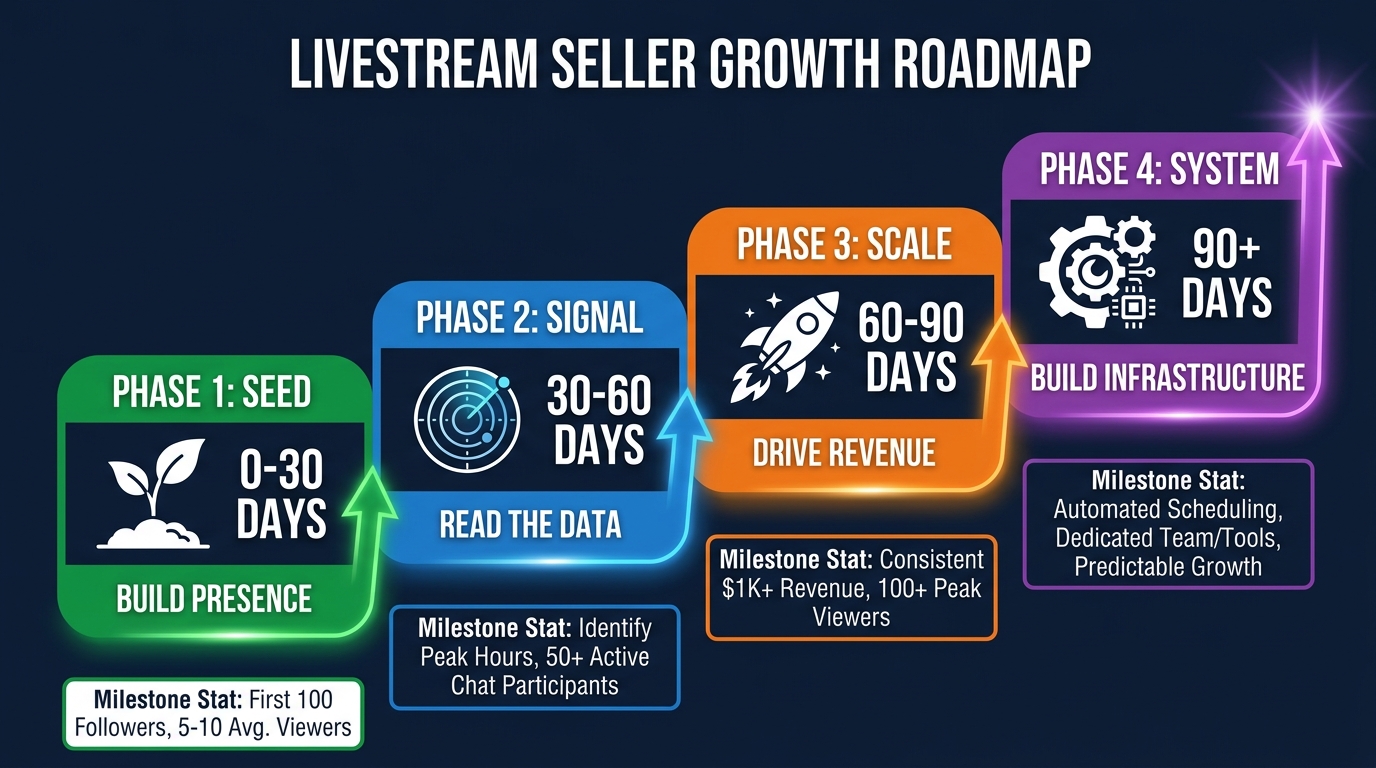
The model below is built around the real behavioral and algorithmic dynamics of livestream commerce. It’s not a rigid timeline — some sellers move faster, some slower — but the phases are sequential in the sense that you cannot safely skip ahead without building the foundation underneath.
The four phases are: Seed (days 0–30), Signal (days 30–60), Scale (days 60–90), and System (day 90 and beyond). Each phase has a primary objective, a set of critical behaviors, and a set of metrics that tell you whether you’re ready to move forward.
The language here is deliberately non-glamorous, because the reality of building a livestream business is mostly unglamorous work done consistently over time. Sellers who understand that enter each phase with appropriate expectations. Sellers who don’t tend to misinterpret normal early-phase friction as permanent failure.
Phase 1 — Seed: Building Your First Audience Without an Audience
The Seed phase is the most psychologically difficult because the feedback is sparse and the rewards are invisible. Your job in this phase is not to make sales — it’s to establish existence. You are teaching the platform that you are a reliable content producer, teaching early viewers who you are and what you offer, and teaching yourself how to perform under the strange pressure of a live camera with no crowd.
The Consistency Contract
The single most important input during the Seed phase is stream frequency. Whatnot’s 2026 Live Selling Report data makes this stark: sellers who stream weekly average $13,000/month; sellers who stream daily average $60,000/month — 100 to 250 times more than monthly streamers. The platform rewards persistence at every level of the spectrum, but the relationship between frequency and revenue starts compounding from your very first month.
For most new sellers, the practical target is 2–3 streams per week. Daily is ideal but not always achievable when you’re building the operation from scratch. What matters more than frequency is predictability. A stream that happens at 7pm every Tuesday and Thursday is worth more to your audience-building than three random streams scattered through the week. Repeat viewers build habits, and habits are what fill streams.
For TikTok Live specifically, peak performance windows are 7–10 PM local time. For Whatnot and Amazon Live, peak timing varies more by category — collectibles and cards trend heavily on evenings and weekends, while home goods and beauty often perform well on weekend afternoons. Study your category’s behavior patterns before you set your schedule, then stick to that schedule for at least 30 days before evaluating it.
The First 15 Minutes Are Non-Negotiable
Livestream platforms use early engagement data — views, comments, and watch duration in the first minutes — to determine algorithmic distribution for the remainder of your stream. This means your opening is not a warm-up; it’s an audition for the algorithm.
The practical structure that works for most new sellers in the Seed phase: start with a high-energy welcome, state clearly who you are and what you sell within the first 60 seconds, give a reason for viewers to stay (an upcoming reveal, a giveaway, or an exclusive deal that happens in 10 minutes), and immediately engage with anyone who comments. Even if you have five viewers, call out names. Ask questions. Build the signal.
Silence on a livestream is not contemplative space — it’s a dropout trigger. Research on streaming behavior shows that roughly 10 seconds of silence causes significant viewer falloff. Have a script, a demo, or a talking point for every product segment. If you run out of things to say, narrate your actions: “I’m just pulling this one out now — let me show you the stitching up close.” Keep the feed moving.
Cross-Promotion Without an Existing Audience
One of the most common questions from new sellers is: “How do I get people to my stream when I have no following?” The answer requires meeting your potential audience where they already are. This means:
- Announcement posts 24–48 hours ahead of each stream across whatever social channels you have, even small ones. A 200-follower Instagram account that announces your stream can drive meaningful early viewership relative to your stage.
- Short-form teaser clips from your products or previous streams posted to TikTok, Instagram Reels, or YouTube Shorts. These don’t need production value — a 15-second “here’s what I’m showing this week” clip with a stack of products can generate genuine interest.
- Engage in community spaces relevant to your product category. Facebook groups, Reddit communities, Discord servers — these are places where your future buyers already congregate. Provide genuine value first; mention your streams second.
Phase 1 Success Signal: You are ready to move to Phase 2 when you have completed at least 8–12 streams, have a consistent schedule, and are beginning to see the same viewer names appearing across multiple sessions. Repeat viewer appearances — not total view counts — are your Seed phase graduation signal.
Phase 2 — Signal: Reading What Your Stream Is Actually Telling You
By the time most new sellers have run 10–15 streams, they have more data than they realize. The problem is they’re usually looking at the wrong numbers. The Signal phase is about learning to interpret your stream data accurately enough to make deliberate optimization decisions — and to stop making adjustments based on gut feeling or single-session outcomes.
The Metrics Hierarchy for Early-Stage Sellers
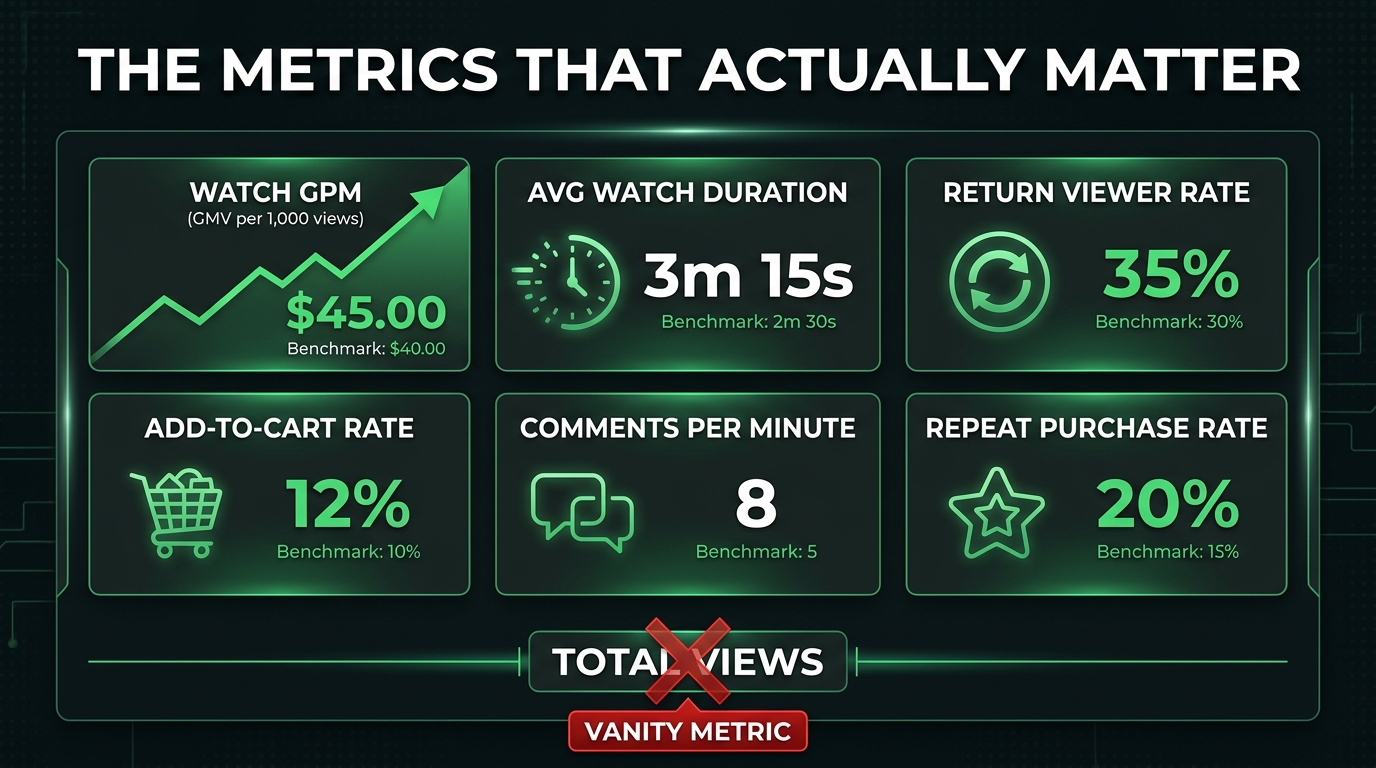
Total views are a vanity metric at this stage. Here’s the hierarchy of what actually matters, ordered by diagnostic value:
- Average Watch Duration — This is your content quality score. If viewers are leaving in the first 3 minutes consistently, you have an opening problem. If they drop at the 15-minute mark, you have a pacing problem. TikTok Studio and most platforms provide this data by session.
- Comments Per Minute — Your engagement density. Low comments relative to viewers means your prompts aren’t landing, your questions aren’t interesting, or your audience is passive. Active sellers track this and use it to gauge whether a product or format is resonating.
- Add-to-Cart Rate — The conversion bridge. If people are watching but not adding to cart, the product presentation isn’t triggering desire — or the price isn’t positioned correctly. Standard e-commerce add-to-cart is around 3%; livestream environments should outperform this significantly.
- Watch GPM (GMV per 1,000 views) — Your monetization efficiency. This is the key metric for comparing performance across streams with different audience sizes. A stream with 200 viewers and a $500 GPM is outperforming a stream with 2,000 viewers and a $40 GPM.
- Return Viewer Rate — Your community health indicator. What percentage of viewers from this stream appeared in a previous stream? This number growing over time is the most important long-term signal you have.
The Pattern-Finding Protocol
During the Signal phase, run a simple review process after each stream. Log five pieces of data: the start time, approximate peak concurrent viewers, your top-selling product that session, the moment in the stream where you saw the biggest spike in engagement, and the moment where you saw the biggest drop. Over 10–15 sessions, patterns emerge that no single stream reveals.
Common patterns new sellers discover during Signal: certain product categories generate comments but not purchases (entertainment, not commerce), certain times of day attract browsers who don’t buy, certain product demo lengths hit diminishing returns around 6–8 minutes, and certain viewer questions, when answered in detail, reliably trigger purchases. These are your signals. They’re the raw material for Phase 3.
The A/B Test Mindset (Without Burning Viewers Out)
The Signal phase is also when deliberate testing becomes possible. But test one variable at a time. Stream format (structured vs. unstructured), opening hook style (product reveal vs. storytelling vs. challenge), pricing display timing (early vs. late in the segment), and call-to-action phrasing all behave differently for different audiences. Changing multiple variables at once makes it impossible to learn anything useful.
A practical testing cadence for Phase 2: commit to the same stream structure for three sessions, change one element for the following three, compare the core metrics. This is not rigorous scientific A/B testing — your audience is too small for statistical significance at this stage — but it develops a testing habit that becomes invaluable when you have the volume to draw real conclusions.
Phase 2 Success Signal: You’re ready to move to Phase 3 when your return viewer rate is growing, your Watch GPM has increased meaningfully from your first five streams, and you’ve identified at least two products that consistently convert at above-average rates. You now have a working model to build on.
Phase 3 — Scale: Turning Consistent Streams Into Consistent Revenue
The Scale phase is where most sellers feel, for the first time, like they have an actual business. You have a schedule, a returning audience, performance data, and a clearer picture of what works. The objective now is to translate consistency into revenue growth — systematically, not sporadically.
Pricing Architecture for Livestreams
Livestream commerce performs best when viewers have a specific reason to buy during the stream rather than afterward. This requires pricing architecture that creates genuine stream-specific value — not manufactured urgency that educated viewers see through immediately.
Effective live pricing structures:
- Live-exclusive bundles: A combination of products available only during the stream, at a price that can’t be replicated in a standard purchase. This works because it creates value (the bundle) and scarcity (the window) simultaneously.
- Tiered time offers: “The first 10 buyers get this for $X; after that, it goes back to list price.” This drives action without devaluing the product permanently, and it creates real-time social proof when viewers see orders coming in.
- Viewer participation pricing: Polling viewers on which product gets discounted or what the drop price should be. This drives engagement (comments spike during polls) and makes viewers feel invested in the outcome — and therefore more likely to purchase.
What doesn’t work: blanket discounts applied to everything in every stream. Habitual broad discounting trains your audience to wait for deals and erodes your margin structure over time. The goal is to make the live experience feel valuable, not to make your products feel permanently underpriced.
Affiliate and Co-Host Strategies for Phase 3 Sellers
At the Scale phase, bringing in additional amplification becomes viable. On TikTok Shop, affiliate creators can promote your products through their own content and receive a commission on attributed sales. This is particularly effective for extending reach beyond your organic audience without requiring paid advertising budget.
The key consideration for new Scale-phase sellers is selecting affiliates whose audiences actually match your product category — not simply the creators with the largest followings. A beauty creator with 50,000 engaged followers is worth more to a skincare seller than a general lifestyle creator with 500,000 passive ones.
Co-hosting — bringing a guest on your stream — serves a different purpose. It introduces novelty (a new voice, a new perspective), can import a small portion of the guest’s audience, and makes longer streams more energetically sustainable. Even a 30-minute guest segment in an otherwise solo stream changes the dynamic meaningfully.
Stream Length and Cadence at Scale
A frequently debated question among sellers in this phase: how long should streams be? The research-informed answer is that longer streams consistently outperform shorter ones — not because more time is inherently better, but because the algorithm continues to distribute to new viewers throughout an active stream, and longer sessions give the algorithm more time to work.
The practical floor for meaningful algorithmic distribution is 30 minutes. Most successful Scale-phase sellers aim for 60–90 minute sessions. Beyond 90 minutes, returns diminish and host energy becomes a limiting factor. Daily sellers on Whatnot typically run 90–120 minute sessions.
Cadence during Scale: aim for at least 3–4 sessions per week. The Whatnot data is unambiguous here — sellers streaming 3–4 times weekly average $13,000/month, compared to irregular sellers who rarely break $1,000. Frequency is your primary lever at this stage.
Phase 3 Success Signal: You’re ready to move to Phase 4 when you have a repeatable monthly revenue figure that doesn’t depend on any single exceptional stream, when your return viewer community has regulars who identify as part of “your” audience, and when the operational load of running streams is beginning to strain your bandwidth. That strain is the signal that systems are needed.
Phase 4 — System: Building Infrastructure So You Can Stop Grinding
Phase 4 is the transition from a seller who livestreams to a business that operates a livestream channel. It’s the least glamorous phase conceptually — it’s about building repeatable processes, light team structures, and operational infrastructure — but it’s what separates sellers who sustain $10,000–$60,000 monthly revenue from those who peak and burn out.
The Three Operational Choke Points
Sellers entering Phase 4 typically hit one or more of three operational ceilings:
- Inventory management: Live selling can move inventory faster than you expect when a stream goes well, and stockouts during a stream are among the most damaging things that can happen to momentum and viewer trust. At this phase, you need a real-time inventory system — even a basic spreadsheet with stock counts updated before each stream — and a reorder protocol that anticipates demand based on your historical stream data.
- Fulfillment speed: Live buyers are impatient in proportion to the excitement of the purchase experience. An order placed during a live session that takes two weeks to arrive is a trust-breaker. At Phase 4, you need a fulfillment process (even a home-based one) that reliably ships within 1–2 business days.
- Content production load: At 3–5 streams per week plus promotional clips, teasers, and community engagement, the content production volume becomes unsustainable for a solo operator. Phase 4 systems might include batch-producing promotional clips once per week, templating your stream setups so prep time drops from 90 minutes to 20, or bringing in even part-time help for shipping and order management.
Building a Light Team Structure
You don’t need employees to run a scaled livestream operation, but you do need role clarity. The roles that matter most at this stage:
- Stream host (almost certainly you, at this stage): responsible for the live session itself — product presentation, viewer engagement, call-to-action delivery.
- Chat moderator: a part-time assistant, often a reliable community member, who monitors and responds to chat comments during streams, flags urgent questions, and manages any community guidelines issues in real time. This alone frees up enormous mental bandwidth for the host during live sessions.
- Order processor: even a few hours of part-time help with packing, labeling, and shipping can make the difference between a sustainable and unsustainable operation at scale.
According to Whatnot’s 2026 data, 1 in 8 live sellers on the platform now operates as a full-time business — up 20% year-over-year. That figure tracks with the pattern above: the sellers who reach full-time viability are largely the ones who built operational infrastructure rather than trying to do everything solo indefinitely.
Platform Selection Matrix: Where Should New Sellers Start?
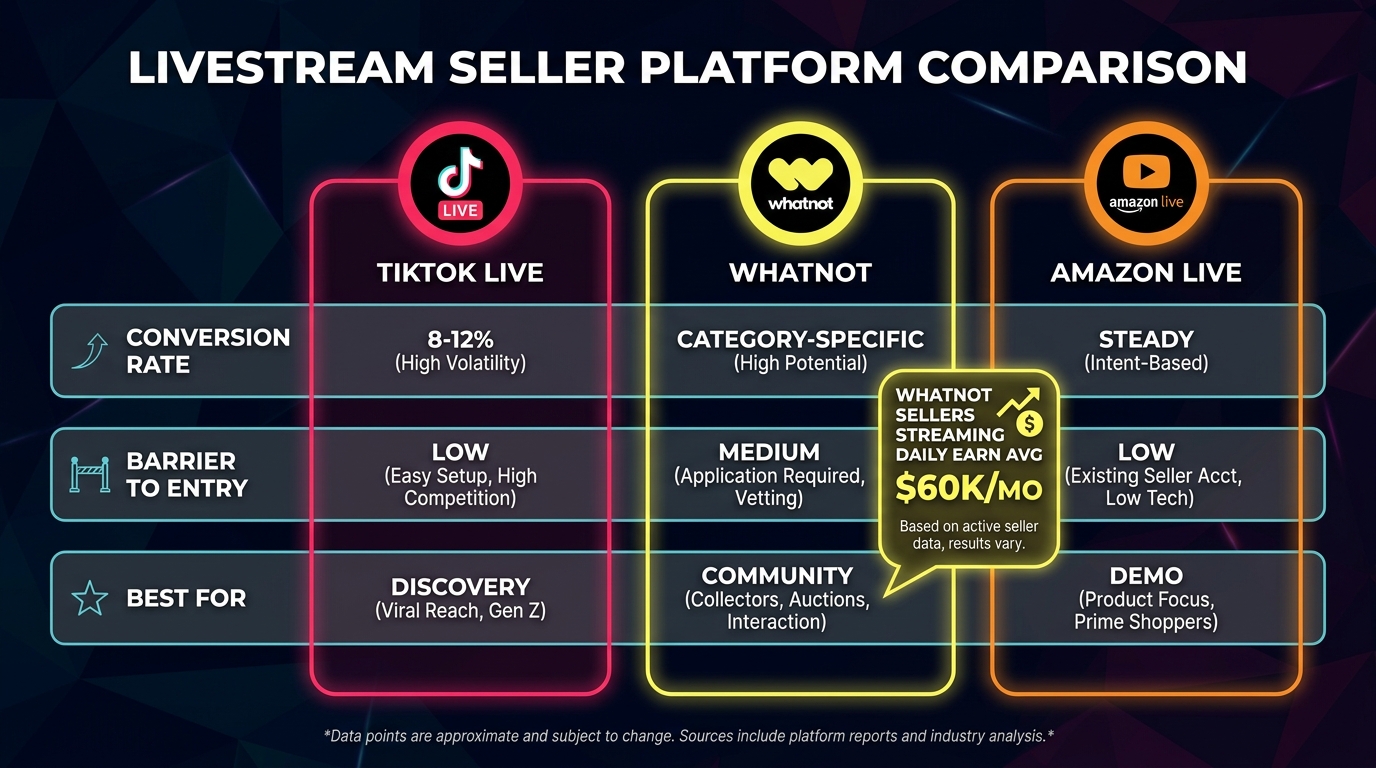
Platform choice is one of the first decisions new sellers face, and it’s more consequential than it appears on the surface. The wrong platform for your product category or audience type can make even good execution look like failure.
TikTok Live: Discovery-First Commerce
TikTok Live’s primary advantage for new sellers is its algorithm-driven discovery potential. Unlike platform-specific marketplaces where you need an existing buyer community, TikTok’s “For You” feed can surface a live stream to new audiences with no prior following — if the content quality and engagement signals are strong enough.
Conversion rates on TikTok Live are among the highest of any livestream platform: 8–12% on average, with top-performing streams reaching 9–30% conversion. Some sources cite figures as high as 10x the conversion rate of standard e-commerce. During Black Friday/Cyber Week 2025, TikTok livestreams drove 84% year-over-year sales growth for participating brands.
The tradeoffs: TikTok requires 1,000+ followers and an approved shop to access live selling features. The audience skews younger (57% Gen Z usage), which suits certain product categories (beauty, fashion, lifestyle accessories, trending consumer goods) and disadvantages others. Platform risk — TikTok’s regulatory environment has been volatile in the US — remains a legitimate consideration for long-term business planning.
Best for: Fashion, beauty, lifestyle goods, trending consumer products, and sellers who can sustain high-energy, entertainment-first streams.
Whatnot: Community-First Commerce
Whatnot is a different kind of platform. It operates as a dedicated live selling marketplace rather than a social network with commerce features grafted on, which means its audience is already primed to buy. Buyers arrive specifically to purchase, not to watch content that might eventually lead to a purchase.
The data from Whatnot’s own 2026 report is striking: the platform holds approximately 60% of the $22 billion North American and European live shopping market, generated $8 billion in GMV in 2025 (doubled year-over-year), and saw active seller counts grow 600% year-over-year in Europe. The 80%+ monthly buyer retention rate indicates the community dynamic is genuinely sticky.
The tradeoffs: Whatnot works best for specific category types — collectibles, trading cards, vintage apparel, toys, comics, sports memorabilia, and similar niche-passion categories. Generic consumer goods don’t perform as well. The competitive environment within categories can also be significant; getting featured requires building a reputation within the platform community.
Best for: Collectibles, trading cards, vintage, niche-passion categories. Sellers who want a buyer-ready audience and are willing to build within a specific community.
Amazon Live: Trust-by-Association Commerce
Amazon Live benefits from the most powerful trust infrastructure in e-commerce: Amazon’s existing buyer relationship. For sellers with products already listed on Amazon, Live sessions connect directly to product pages — a viewer watching your stream can purchase with one click using their existing Amazon account, Prime membership, and saved shipping details.
This removes almost all purchase friction, which is the primary reason Amazon Live tends to work well for product categories that require demonstration (kitchen gadgets, tech accessories, beauty devices, home goods) — categories where seeing the product in use is the primary conversion trigger.
The tradeoff: Amazon Live has less algorithmic discovery power than TikTok and is most effective for sellers with an existing Amazon product presence. As a standalone discovery tool for new sellers without Amazon listings, its value is limited.
Best for: Sellers with existing Amazon product listings, demonstration-heavy product categories, and audiences that skew toward Prime shoppers (broader demographic range).
Product Strategy for Livestream: The Three-Tier Framework
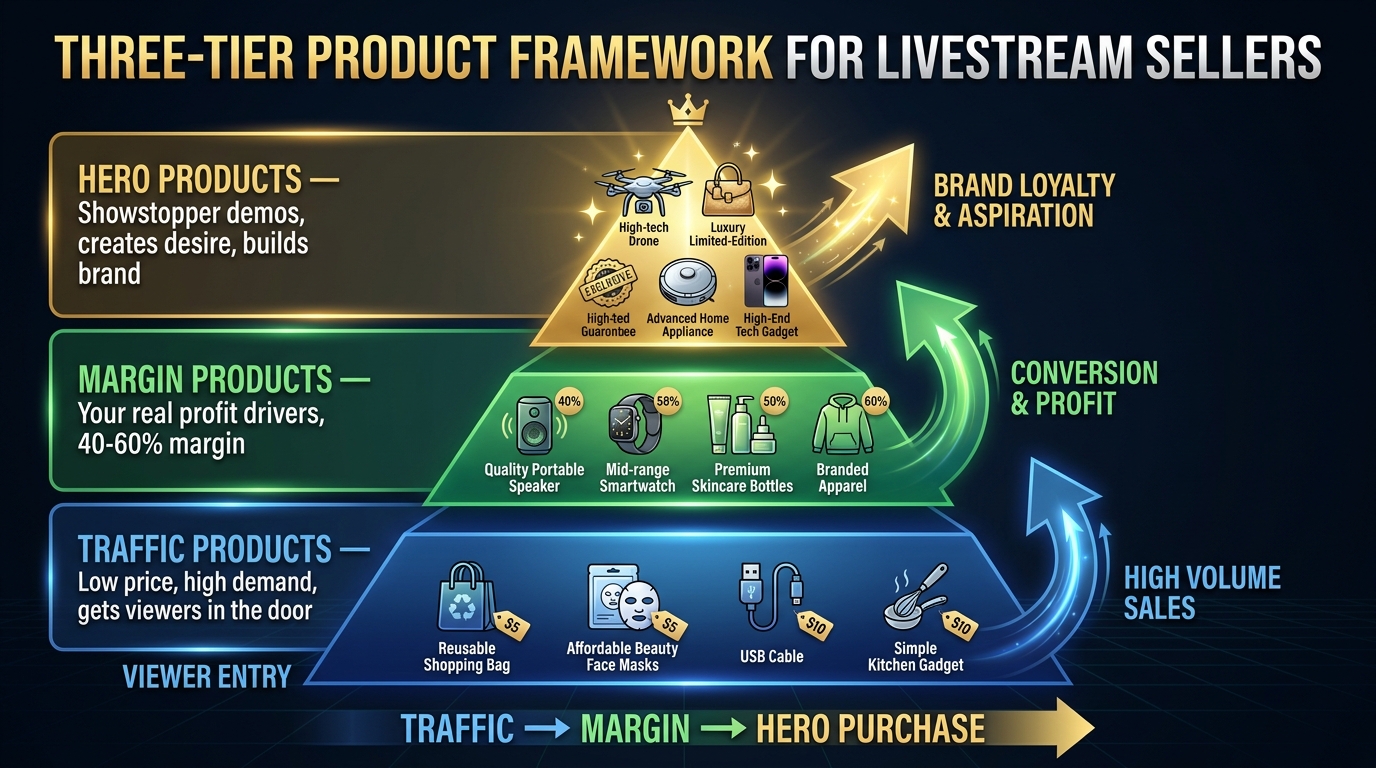
New sellers tend to approach product selection for streams intuitively — they pick what they like, what they have in stock, or what they think looks good on camera. This is a starting point, not a strategy. A structured approach to product selection for live sessions materially improves both engagement and revenue per stream.
The three-tier framework organizes your products by role rather than by revenue. Every stream should, ideally, include products from each tier.
Tier 1: Traffic Products
Traffic products are lower-priced, high-demand items whose primary job is to lower the friction for a first-time buyer and attract viewers who might not otherwise join. They’re accessible price points, recognizable categories, and easy to understand quickly. A $15 skincare accessory, a $20 trading card pack, or a trending $12 household item all function as traffic products.
Traffic products are often sold at thin margins or even as break-even items because their real value is generating the buyer relationship, the first transaction, and the initial trust signal. A viewer who buys a $15 item from you during a stream has crossed a psychological threshold that makes them significantly more likely to buy again — and to buy higher-value items on subsequent streams.
Tier 2: Margin Products
These are your actual profit drivers. Margin products should represent the bulk of your planned stream inventory — they’re items with 40–60%+ margin where you can absorb a live-exclusive discount (typically 10–20%) and still come out meaningfully profitable. The range $30–$150 is a common sweet spot for most live shopping categories, though this varies significantly by niche.
Margin products benefit from live demos more than any other tier. A product that answers the question “but how does it actually work?” in 90 seconds of live demonstration converts dramatically better in a stream context than in a static listing. If your margin products are items that people frequently hesitate on due to uncertainty — “will this really work for me?” — livestream is among the best possible conversion environments you can create for them.
Tier 3: Hero Products
Hero products are your showstoppers. High visual impact, distinctive quality, conversation-starting design, or a demonstration so compelling it makes viewers immediately want to share what they just saw. Hero products often command higher prices, but their primary function in a live stream is less about sales volume and more about brand impression and share-worthiness.
A well-executed hero product segment — where the host spends 8–10 minutes demonstrating something genuinely impressive — generates comments, boosts watch duration (people stay to see it), and often triggers social sharing among viewers. That’s algorithmic signal gold, regardless of whether the hero product itself sells heavily during the session.
The sequencing matters: most experienced sellers open with a strong Tier 1 (builds momentum and early orders), move to Tier 2 products during the peak viewer window (maximum monetization potential), and deploy the Hero product at a natural peak or during a second engagement push if viewer numbers are holding strong.
The Metrics That Actually Matter at Each Stage
Every phase of the growth model has its own primary metrics. Tracking the wrong thing at the wrong phase is as misleading as tracking nothing at all.
Seed Phase Metrics (0–30 Days)
- Stream completion rate: What percentage of your planned sessions did you actually complete? Consistency is the primary input at this stage — your own completion rate matters before anyone else’s does.
- Return viewer count: Even tracking whether the same usernames appear across sessions tells you whether early audience retention is beginning.
- Average watch duration: Are people staying longer on your streams over time? Trend direction matters more than absolute value at this stage.
Signal Phase Metrics (30–60 Days)
- Comments per minute: Engagement density versus passive watching. Target: trending upward from baseline.
- Add-to-cart rate: This is your product-market fit signal. Standard e-commerce benchmarks around 3%; you should be outperforming this in a live environment.
- Per-product conversion rate: Which specific items convert, and which don’t? This tells you your product mix, not just your performance level.
Scale Phase Metrics (60–90 Days)
- Watch GPM: Gross merchandise value per 1,000 views. Your monetization efficiency score across different stream sizes.
- Repeat purchase rate: What percentage of buyers from previous streams are buying again? This is your community health metric and the leading indicator of long-term business viability.
- Revenue per stream: Absolute monthly revenue divided by stream count. Track trend and variance — consistent revenue with low variance indicates a more mature operation than high-average with wild swings.
System Phase Metrics (90+ Days)
- Revenue per hour streamed: Your operational efficiency metric. As you add team members and infrastructure costs, this tells you whether the business is scaling efficiently.
- Customer acquisition cost per stream: If you’re running promotional ads or affiliate programs, this tells you the real cost of each new buyer.
- Lifetime value by acquisition source: Do buyers acquired through organic discovery behave differently (higher LTV, lower return rate) than buyers driven in through promotions? Understanding this determines your promotional investment strategy.
Trust Architecture: Why Repeat Buyers Are the Real Business
There’s a pattern visible in every successful livestream seller’s data: the first purchase from any given viewer is almost always the least profitable transaction in that relationship. The margin is thinnest, the uncertainty is highest on both sides, and the acquisition costs (time, promotional effort, algorithmic investment) are at their peak relative to the return.
The second purchase is where the economics start to shift. The third purchase is where they become genuinely attractive. Whatnot’s 80%+ monthly buyer retention rate is not an accident — it’s the result of what we can call trust architecture, built deliberately by the sellers performing best on the platform.
The Three-Layer Trust Stack
Research consistently identifies three components of live-streamer trust: expertise, responsiveness, and affinity. Sellers who deliberately build all three layers create a qualitatively different viewer relationship than sellers who focus only on product quality and price.
Expertise is built through depth of category knowledge demonstrated during streams. The seller who can answer an unexpected question about their product category with genuine specificity — not a sales pitch, but real information — creates trust in their judgment that transfers to purchasing decisions. This is why the deepest, longest-running successful livestream sellers tend to be genuine enthusiasts in their categories, not just distributors of products.
Responsiveness is the real-time gift that livestreaming offers. A viewer who asks a question and gets a genuine, personal response during a live session has an experience impossible to replicate in any other commercial format. Even with 200 concurrent viewers, calling out names and answering questions creates individual moments of connection that viewers remember and return for.
Affinity — the emotional bond between viewer and host — is the most durable trust layer and the hardest to engineer artificially. Authenticity is the primary mechanism: Shopify’s research notes that viewers prefer a “raw, unscripted backstage-pass vibe” over polished commercial presentation. The sellers who allow personality, humor, genuine reactions, and occasional imperfection into their streams build stronger audience loyalty than those who maintain a permanently polished sales persona.
Community Rituals That Drive Return Rates
Successful livestream communities develop recognizable recurring elements — what might be called community rituals — that viewers return for specifically. These might be: a weekly segment where viewers vote on which product gets the deepest discount, a recurring “mystery box” reveal where the contents are secret until the stream, a signature greeting sequence that regular viewers recognize, or a consistent running segment (unboxing, Q&A, category deep-dive) that forms part of the expected experience.
These elements do something important beyond entertainment: they create a sense that being a regular viewer means something. You get the jokes, you know the format, you’ve built a shared history with the channel. That sense of insider belonging is a retention mechanism more powerful than any discount structure.
“Building community trust takes consistency, not just a one-off event. The ‘one-and-done’ trap is one of the most common reasons live shopping channels plateau early.” — Shopify Live Shopping Research
The Honest Math: What You Can Realistically Expect at Each Phase
Transparency about realistic revenue expectations serves new sellers far better than aspirational projections. The Whatnot and platform data give us genuine benchmarks to work with.
Months 1–2 (Seed and Early Signal)
Realistic revenue expectation: $0–$500/month. This is not failure — this is investment. You are building algorithmic standing, audience familiarity, product knowledge, and operational muscle. Sellers who understand this period as investment, not income, make better decisions: they don’t dump money into ads they’re not ready for, they don’t abandon schedules after one bad stream, and they don’t pivot products every week based on one session’s data.
Months 3–4 (Late Signal and Early Scale)
Realistic revenue expectation: $500–$2,500/month. If you’ve maintained consistency and applied Signal phase learnings, you should begin to see return viewers becoming regular buyers, your Watch GPM trending upward, and occasional sessions that break through to real revenue. This is the phase where early sellers often feel momentum for the first time.
Months 5–6 (Active Scale)
Realistic revenue expectation: $2,500–$8,000/month for sellers streaming 3–4 times per week. This tracks with Whatnot’s data, which shows weekly streamers averaging $13,000/month and the spread between consistent and inconsistent streamers widening sharply at this stage. Sellers hitting the upper end of this range are typically those with well-optimized product selection, an established community, and beginning System-phase infrastructure.
Month 7 and Beyond (System Phase)
Sellers who have built operational infrastructure, established loyal communities, and are streaming at consistent high frequency have a path to $10,000–$60,000/month. Whatnot’s data shows $10,000+/month sellers doubled year-over-year in 2025. These are not outliers at this point — they represent the scaled outcome of doing the foundational work correctly in the earlier phases.
Conclusion: The Model Is the Advantage
The livestream commerce market is in one of the most interesting developmental windows any e-commerce format has experienced in a generation. US buyers are still being introduced to the format at scale. Platforms are still maturing. Algorithms are still rewarding early movers with disproportionate organic reach. The sellers who establish themselves now — who build community, demonstrate expertise, and develop operational infrastructure — will be significantly harder to displace as the market continues to grow.
But the opportunity is only available to sellers who approach it with a genuine model rather than a hope. The four phases — Seed, Signal, Scale, System — are not arbitrary stages. They map to the actual behavioral reality of how livestream businesses grow: through consistent presence, intelligent data interpretation, deliberate revenue optimization, and ultimately operational infrastructure that makes the whole thing sustainable.
The sellers who fail do so almost always in Phase 1 — they mistake early low viewership for permanent low ceiling, abandon their schedule before the algorithm has enough signal to work with, or chase shortcuts (heavy discounting, impulse ad spending, platform-hopping) that short-circuit the compound interest of consistent presence.
The sellers who succeed are, almost without exception, the ones who understood from the beginning that they were building something — not performing in something.
Actionable Takeaways
- Commit to a fixed stream schedule before you start. Two or three sessions per week, same days, same times. Hold it for 30 days without evaluating revenue outcomes.
- Track return viewer names manually in Phase 1. Don’t wait for analytics tools to tell you this — watch for usernames appearing across multiple sessions. That’s your first real data signal.
- Build your product mix using the three-tier framework before each stream. Traffic products open the door, margin products drive the economics, hero products build the brand.
- Switch your primary metric from views to Watch GPM as soon as you have enough sessions to compare. Monetization efficiency matters more than audience size at every stage of this model.
- Plan for Phase 4 infrastructure from Phase 2 onward. Identify your first operational choke point (inventory? fulfillment? content load?) before it becomes a crisis that disrupts your consistency.
- Treat the first purchase from any viewer as an investment in a longer relationship. Design the post-purchase experience (packaging, delivery speed, follow-up communication) to maximize the probability of a second transaction.
- Pick one platform and go deep before expanding. The data consistently shows that platform mastery — knowing the algorithm, the community norms, the category dynamics — outperforms multi-platform dilution at early and mid stages.
The market is real. The model is proven. The work is consistent. That’s the full picture — and for sellers willing to operate inside it rather than around it, the opportunity in 2026 is genuinely significant.