


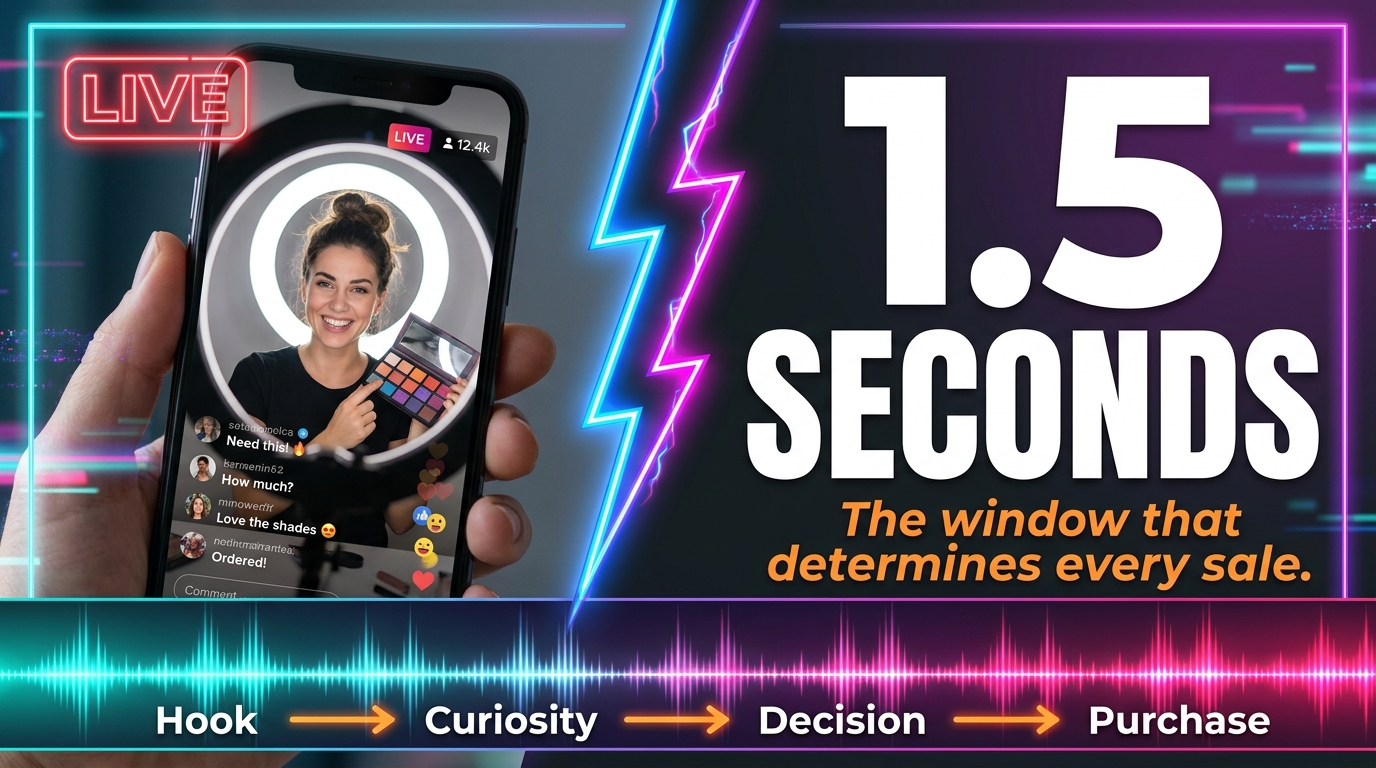
Most TikTok Live sellers think they lose viewers at the end of a stream — when energy drops or products run out. The truth is far more brutal: the battle is almost entirely decided in the first ninety seconds, and often in the first three.
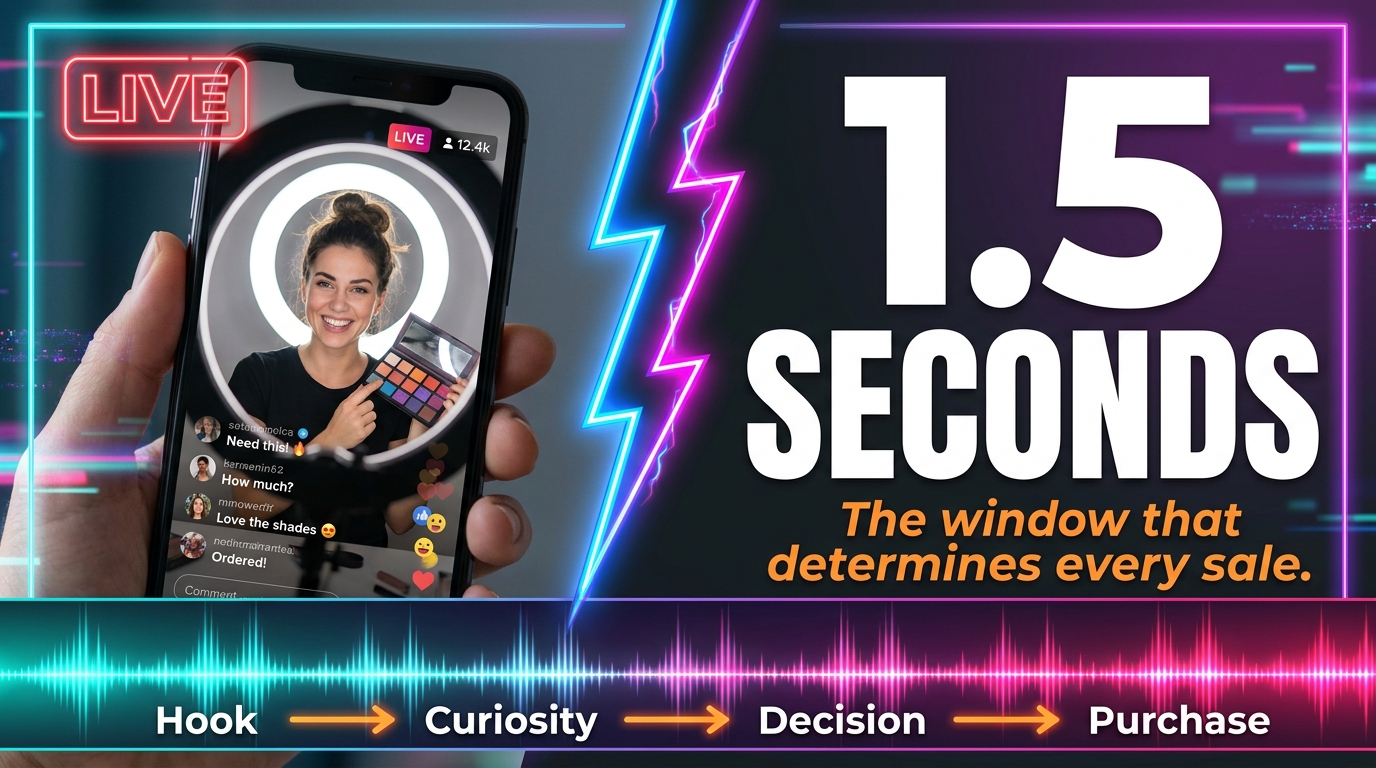
TikTok’s algorithm runs its initial distribution decision approximately 1.5 seconds into a viewer’s encounter with your stream. If that window produces a hold — a viewer who stays rather than swipes — the algorithm widens your reach. If it doesn’t, you’re essentially broadcasting to the void, regardless of how compelling your product is or how low your price drops later on.
This isn’t a creativity problem. It’s a structure problem. Most Live sellers treat hooks the same way they treat video hooks: a punchy opening line, maybe a visual gimmick, and then straight into the pitch. But TikTok Live is a fundamentally different environment. Viewers can drop in and out at any second. The algorithm is watching in real time. And crucially, you’re not just competing for attention — you’re competing for a purchase decision, and those two objectives require different tools.
This guide is about the architecture of hooks across an entire Live session — not just the opener. It covers what distinguishes a hook that retains from one that converts, how to write opening formulas that work across product categories, how to re-engage a room mid-stream before drop-off kills your reach, and how to close with enough urgency to capture the buyers who’ve been watching for twenty minutes but haven’t clicked yet.
TikTok Live commerce generated over $33.1 billion in GMV in the trailing twelve months as of early 2026, with Live shopping accounting for roughly 41% of total platform GMV. That revenue isn’t distributed evenly. It concentrates heavily in the hands of sellers who understand how hooks work — not as one-time openers, but as a continuous, deliberate rhythm running through every minute of a session.
Why TikTok Live Hooks Are Fundamentally Different From Video Hooks
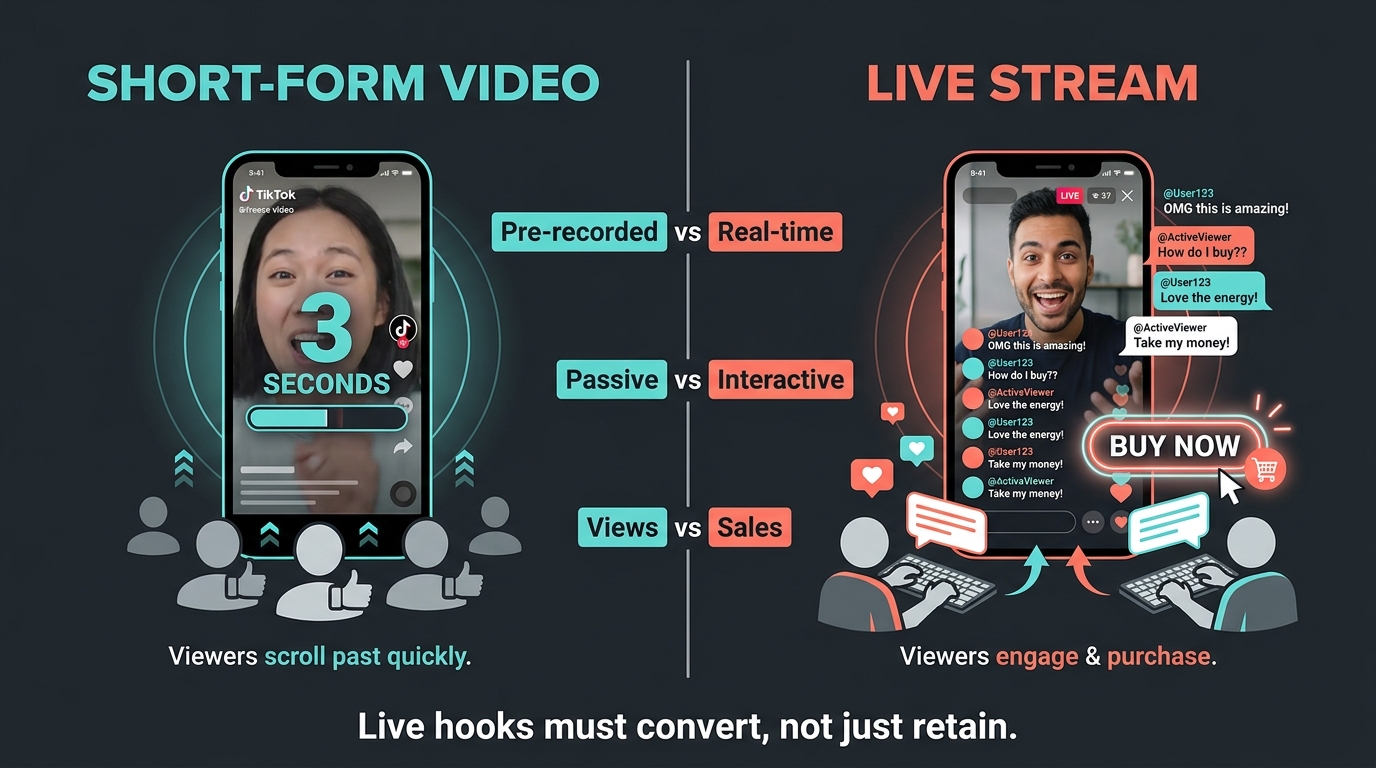
The language of “hooks” comes primarily from short-form video, where the job is simple: hold someone long enough to watch a clip they didn’t ask for. In that context, a hook succeeds if it generates views, saves, and shares. Purchase is a secondary outcome — often happening off-platform or much later in the customer journey.
TikTok Live collapses that journey. Discovery, consideration, and purchase all happen in the same session, often within the same three minutes. That compression changes what a hook needs to do.
Four Ways Live Hooks Operate Differently
1. A Live hook must serve two masters simultaneously. In video, your hook serves the algorithm first (hold rate, completion rate) and the viewer second. In Live, it serves both the algorithm and the purchase funnel at the same moment. A hook that generates curiosity without signalling product value will retain viewers who never buy. A hook that pitches product without creating curiosity will be skipped before the pitch lands.
2. You’re hooking mid-journey viewers, not blank-slate scrollers. Most people entering your Live have already been on TikTok for a while. They’re warmed up to the platform but completely cold on you. They didn’t search for you — the algorithm inserted them. That means your hook can’t assume any context, any prior brand knowledge, or any preexisting intent to buy. You’re essentially a pop-up conversation, and you have to earn the right to have it.
3. The stakes of failure are algorithmically compounding. When a video underperforms, it simply doesn’t spread. When a Live session bleeds viewers in the first three minutes, the algorithm responds by reducing reach in real time — meaning fewer people get pushed into your stream, which reduces engagement further, which reduces reach further. It’s a downward spiral that a great mid-stream product won’t rescue. The opening hook has to work.
4. Repetition is not only acceptable — it’s required. In video, you have one hook. In Live, you need a new hook every eight to twelve minutes. New viewers join throughout a session. Existing viewers need re-engagement. The algorithm rewards streams that maintain consistent interaction. A static, non-hooking broadcast will perform worse at the forty-minute mark than it did at the ten-minute mark, purely because the hook cadence has slowed.
The Conversion Advantage That Makes Hooks So Important
TikTok Live achieves a conversion rate of roughly 7.4% to 8% — more than three times the industry average for traditional e-commerce and significantly higher than both short-form video (2–4%) and Shop Tab browsing (1.5–3%). That conversion edge doesn’t come from the products. It comes from the real-time, presence-based selling environment that hooks enable. Hooks keep people in the room. Room time produces trust. Trust produces purchases. Remove the hooks and the conversion rate collapses toward short-form video levels.
The Hook Architecture: Opening, Mid-Stream, and Closing Are Three Separate Skills
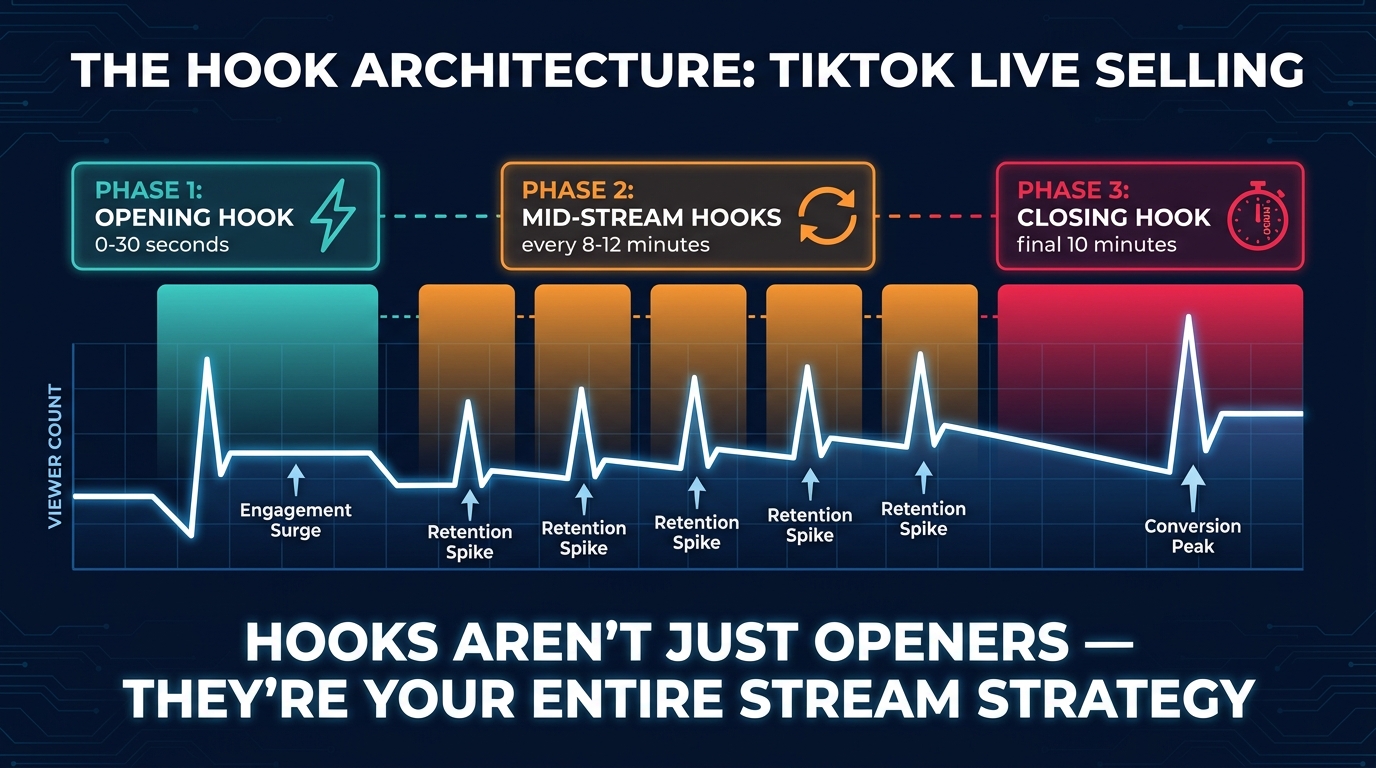
One of the most common errors in TikTok Live selling is treating hooks as a single tool: the opening line. In reality, a profitable Live session has three distinct hook phases, each with a different objective, a different audience state, and a different psychological lever.
Phase 1: The Opening Hook (0–90 Seconds)
The opening hook’s job is not to sell a product. Its job is to answer the unconscious question every new viewer asks the moment they land: “Should I stay or keep scrolling?”
This window is uniquely compressed. Research shows that TikTok’s algorithm makes its first distribution decision at approximately 1.5 seconds, using early hold rate as its signal. Content that loses viewers immediately enters what analysts call a “cold start” — reduced reach that is extremely difficult to recover from during the same session. This means your opening hook has to work in the first breath before it even has a chance to sell anything.
The opening hook must do three things in the first thirty seconds: stop the scroll, create a reason to stay, and signal that something of value is coming. It does not need to close a sale. The product pitch comes immediately after the hook has done its job.
Phase 2: Mid-Stream Re-Engagement Hooks (Every 8–12 Minutes)
This phase is what separates sellers who produce consistent revenue from those who have one great first fifteen minutes followed by a rapidly emptying room. Mid-stream hooks exist to solve a specific problem: viewer drop-off is constant and natural in Live environments. People leave for notifications, interruptions, boredom. The question is whether your stream pulls new viewers in fast enough and re-engages existing ones often enough to maintain the room size that the algorithm needs to keep boosting your reach.
A mid-stream hook is triggered — not improvised. The best Live sellers embed hook triggers into their session plan at regular intervals: a product reveal, a chat challenge, a price drop announcement, a “wait for it” tease about an upcoming item. These aren’t organic moments; they’re engineered ones, designed to spike interaction metrics exactly when the algorithm is measuring them.
Phase 3: The Closing Hook (Final 10–15 Minutes)
The closing hook targets a specific buyer profile: the viewer who has been watching for a significant period of time but hasn’t purchased yet. This person is interested — proven by their watch time — but hasn’t found sufficient urgency to act. The closing hook’s job is to provide that urgency without feeling manipulative.
Effective closing hooks typically combine genuine scarcity (not manufactured), explicit deadlines, and a restatement of the core value proposition. They also often address the specific objection that’s been keeping the hesitant buyer watching rather than clicking: price, fit, trust, or timing.
The 7 Opening Hook Formulas That Work (With Category-Specific Examples)
There is no universal opening hook that works across all product categories, all audience sizes, and all host personalities. What exists instead is a set of underlying formulas — structural approaches that consistently produce holds — that can be adapted to almost any context. Here are the seven that top-performing Live sellers use most consistently.
1. The Outcome Showcase Hook
This is the single highest-performing hook type by viewer retention data, averaging approximately 2x the initial hold rate of the lowest-performing alternatives. The concept is simple: lead with the result, not the product. Show the transformation, the before-and-after, the finished state — before you’ve said a single word about what created it.
Beauty example: Hold up the finished makeup look before explaining any of the products. “You’re going to see exactly how I got this in eight minutes” is a hook. “Welcome to my Live, today I’m going to show you some makeup” is not.
Fitness example: Hold the product next to a visual representation of the result — a journal filled with tracked results, a progress photo on a second phone screen. “This is what forty days with this band looks like” creates a reason to stay.
Home example: Start with the organized shelf, the before-and-after cabinet, the finished room. “I want to show you what this looks like installed before I show you the price” — that’s a hook with a built-in promise.
2. The Open Loop Hook
Open loops exploit one of the brain’s most reliable quirks: it cannot comfortably leave a question unanswered. An open loop hook raises a question or begins a story without resolving it immediately, creating a cognitive tension that compels viewers to stay until the loop closes.
Example: “I’m going to show you the one product I actually use every single day — but I’m going to start with the one thing everyone gets wrong about it.” The viewer now has two loops to resolve: what is the product, and what’s the mistake?
Example: “Last week I had a customer message me with a photo of her results and I honestly wasn’t expecting it. I’m going to show you that message in about five minutes.” Now the viewer is waiting for a specific payoff, with a defined time horizon that manages their patience.
3. The Pattern Interrupt Hook
A pattern interrupt works by doing something physically or verbally unexpected in the first 1.5 seconds. It hijacks the viewer’s passive scrolling state and forces conscious attention. In a Live context, pattern interrupts need to be visual, verbal, or both.
Visual pattern interrupt: Holding a product in an unexpected way (upside down, next to something unusually large or small for scale), using an unexpected background that doesn’t match beauty/fitness/home category norms, or appearing in an unexpected setting.
Verbal pattern interrupt: “Don’t buy this.” Full stop. Then pause for one second before continuing. The brain processes the imperative to not-buy in the context of a shopping stream and immediately generates curiosity about why. “Don’t buy this unless you’re ready for everyone to ask where you got it” is a complete hook in fourteen words.
4. The Controversy or Contrarian Hook
Contrarian hooks work because human beings are cognitively wired to challenge claims that contradict held beliefs. If you lead with a statement that contradicts what most of your audience thinks is true, they will stay to evaluate — and often to argue — which generates the comment and interaction signals TikTok’s algorithm rewards most heavily.
Example: “Every skincare brand is lying to you about this ingredient and I’m going to prove it in the next two minutes.”
Example: “The most expensive gym equipment in this category is actually the worst investment most people make. Here’s what you should be buying instead.”
The critical constraint: the contrarian claim must be defensible. You’ll face a chat full of skeptics who want to poke holes in your argument. If you can’t back it up with product demonstration or evidence, this hook type backfires into credibility damage.
5. The Scarcity-First Hook
Leading with inventory scarcity triggers FOMO before the viewer has even evaluated the product. It creates an asymmetry: they might be interested, but if they wait to find out whether they are, they might miss the chance to decide.
Example: “I have exactly twenty-two of these left. I had forty-seven when I went live thirty minutes ago. So I’m going to show you what it is.”
Example: “I’m only going to show this deal once today and I will not bring it back. If you’ve been waiting, this is the moment.”
The scarcity-first hook works best when the scarcity is real and verifiable (visible stock counter, product being shown running low) and when it’s used sparingly enough that it retains credibility. Streams that cry scarcity on every single product train viewers to ignore it.
6. The Social Proof Hook
Social proof hooks reference third-party validation — reviews, customer results, viral moments, waitlists — before the product pitch. They borrow credibility from people who aren’t the host, which reduces the viewer’s natural resistance to sales messaging.
Example: “This product has 14,000 five-star reviews and I want to show you exactly why, because I tested it myself for three weeks before I agreed to carry it.”
Example: “Someone in last night’s Live bought this and messaged me this morning — I’m going to read that message right now.”
7. The Direct Address Hook
This is the most underused high-performer in Live commerce. Rather than addressing a general “you,” the direct address hook speaks to a specific type of person, creating an immediate sense of personal relevance that stops viewers who match that profile.
Example: “If you’re someone who’s been looking for a moisturizer that doesn’t leave that greasy film — stay. I found it.”
Example: “Anyone who has ever bought a resistance band and watched it snap — I want to show you what I have right now.”
The targeting mechanism is specific enough that it feels personal. People who identify with the described problem feel spoken to directly, which dramatically increases hold rate for the relevant segment.
Pattern Interrupts: The Physical and Verbal Techniques That Freeze the Scroll
Pattern interrupts deserve their own section because they operate at a different level than hook formulas. While the formulas above are primarily about what you say, pattern interrupts are about how you appear — the sensory break that forces a viewer’s passive thumb to pause before their conscious mind has made a decision.
Physical Pattern Interrupts
Movement is the most reliable physical interrupt. The human visual system is wired to detect motion — it’s a survival mechanism that predates conscious thought. Sudden movement in the first frame of your Live captures a viewer’s eye before their brain has processed whether to care. This is why hosts who open their streams already mid-action (demonstrating, gesturing, applying, or building) consistently outperform those who start stationary and talking.
Scale contrast is another powerful physical interrupt. Placing a product next to an unexpected reference object — something that makes its size, texture, or color more striking than a standard product shot — creates visual curiosity that text and words can’t generate as quickly. A skincare product next to a coin to show its true size. A supplement container next to a household item most people recognize. These aren’t gimmicks; they’re information delivery tools that hold attention while communicating a product attribute.
Lighting and background changes are underused interrupt tools. Most Live selling environments are samey: ring light, neutral background, host holding product. A deliberate departure from that norm — different location, natural light, unusual background — reads as novel to a scrolling viewer whose brain has already categorized and dismissed a dozen similar-looking streams.
Verbal Pattern Interrupts
The three most effective verbal pattern interrupts share a common structure: they violate the viewer’s expectation of what a seller should say.
The anti-sell opener (“Don’t buy this,” “I’m not trying to sell you anything right now,” “I’ll tell you honestly, this isn’t for everyone”) disarms sales resistance before it activates. Viewers who’ve been in a dozen shopping Live sessions have conditioned resistance to sales language. Breaking that conditioning through apparent anti-salesmanship resets the relationship.
The admission of limitation (“This has one flaw I need to tell you about”) creates trust by signalling honesty in a selling context where honesty is not expected. It also creates an open loop — the viewer needs to know what the flaw is before they can evaluate whether it matters to them.
The time-specific claim (“In the next ninety seconds I’m going to show you something that will make you understand why this sold out three times last month”) combines a specific time commitment with a social proof reference, giving the viewer both a reason to stay and evidence that others have found it worth staying for.
Warm vs. Cold Audience Hooks — Why One Script Can’t Do Both Jobs
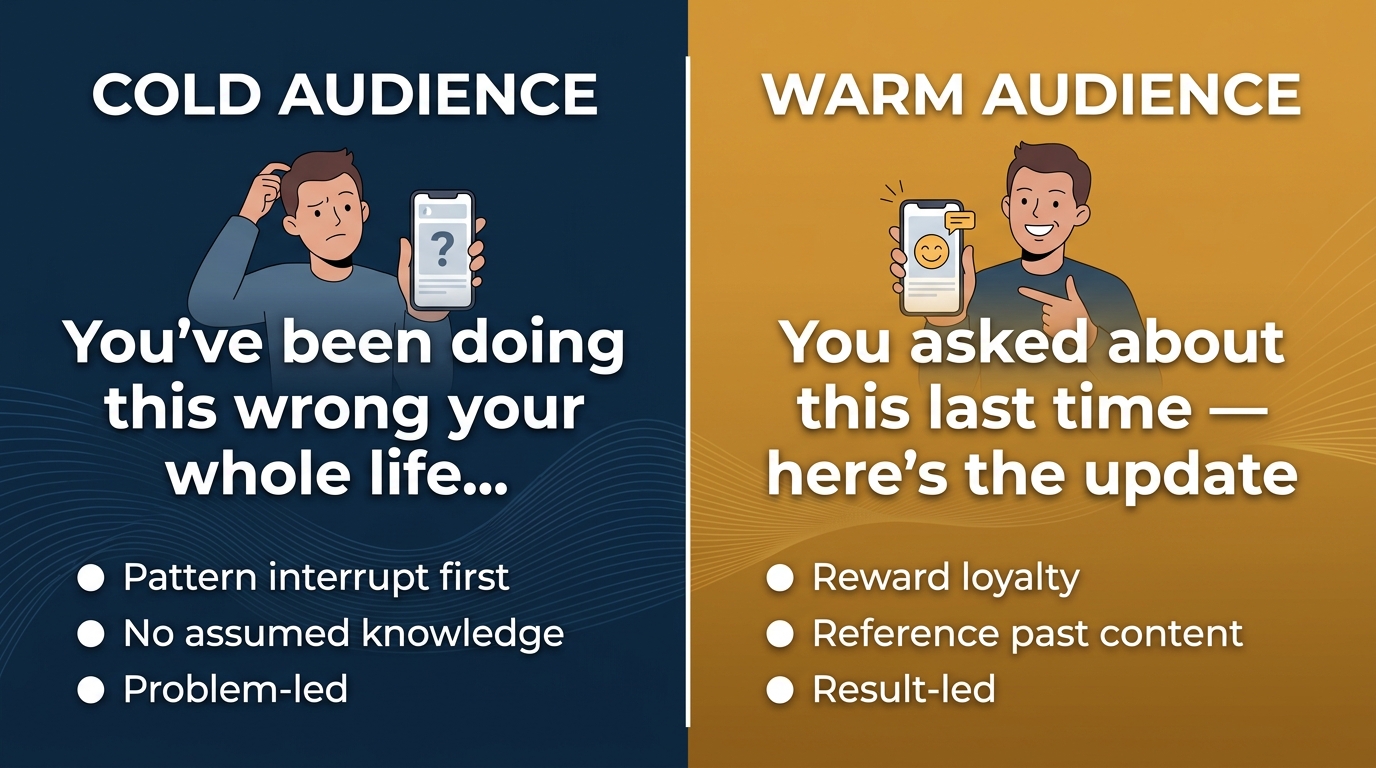
One of the most persistent mistakes in TikTok Live is running the same hook script regardless of who’s in the room. A warm audience hook deployed to cold viewers falls flat. A cold audience hook used on loyal repeat buyers feels condescending. Understanding who is likely to be in your room at any given point in a session changes which hook formula you reach for.
Cold Audience Hook Principles
Cold audience viewers have zero context about you, your brand, or your products. They’ve been dropped into your stream by the algorithm and have no loyalty to stay. For these viewers, hooks need to lead with problem recognition before any mention of product or brand.
The cold audience hook should:
- State a problem the viewer recognizes before mentioning a solution. “If you’ve ever tried X and been disappointed by Y…” establishes that you understand their experience.
- Establish credibility in the first fifteen seconds — not through self-promotion but through demonstrated knowledge. Saying something technically specific and accurate about a product category signals expertise faster than any bio description.
- Use pattern interrupts first, benefit statements second. Cold viewers need to be stopped before they can be persuaded. A cold hook that opens with a benefit claim sounds like advertising. A cold hook that opens with a pattern interrupt sounds like content.
- Avoid brand-specific references. Phrases like “as I always say” or “you know I only carry brands I trust” are meaningless to someone who’s never seen you before. They create alienation rather than rapport.
Warm Audience Hook Principles
Warm audience viewers — people who’ve seen your content before, follow your account, or have purchased from you — bring context, pre-existing trust, and often a specific expectation. They’re not asking “should I stay?” They’re asking “is there anything new for me here?”
The warm audience hook should:
- Reference the relationship explicitly. “You’ve been asking me about this for weeks and I finally have it” is a hook that only makes sense to someone who has been watching. It rewards their loyalty by making them feel heard.
- Lead with results or updates, not problems. Warm viewers already trust that you solve problems. They need a reason to believe this specific session has something new or better than the last one.
- Use exclusivity language. “I’m only announcing this here first” or “I’m saving this for people who come to the Lives” creates a tangible benefit to their loyalty that reinforces the behavior of returning.
- Acknowledge returning viewers directly. Calling out usernames from chat (“I see [username] is back — I’ve been waiting to show you this”) creates a deeply personal moment in a public space that generates intense loyalty and social proof for new viewers watching the interaction.
Managing Mixed Rooms
In practice, most Live sessions contain a mixture of cold and warm viewers at any given moment. The professional approach is to layer the hook: open with a pattern interrupt or problem statement that works for cold viewers (the first fifteen seconds), then pivot to a warm-audience acknowledgement that rewards returning viewers (seconds fifteen to thirty). This structure ensures neither audience feels bypassed, and it models the kind of community that makes cold viewers want to become warm ones.
Mid-Stream Re-Engagement: The Retention Loop Strategy Every Hour of Your Live Needs
The first hook gets viewers in the door. Mid-stream re-engagement keeps them inside long enough to buy. This is the most technically demanding aspect of Live selling and the one most hosts underinvest in — which is precisely why mastering it produces such a disproportionate competitive advantage.
The Viewer Drop-Off Reality
Viewer counts in TikTok Live sessions naturally decay over time. This is true even for highly experienced hosts with loyal audiences. The question isn’t whether drop-off will happen; it’s whether the session’s architecture replaces those viewers fast enough and re-engages drifting ones before they leave.
TikTok’s algorithm uses consistent interaction signals — comments, shares, product clicks, reactions — as continuous inputs for reach decisions throughout a session. A stream that produces a spike of engagement at minute two but goes flat at minute twenty will receive progressively reduced distribution in the second half. The platform interprets declining interaction as declining content quality and stops pushing the stream to new viewers.
Mid-stream hooks exist specifically to spike those interaction signals at regular intervals, tricking the algorithm into treating the session as consistently high-quality throughout its duration.
The FABES Presentation Framework
The most reliable mid-stream re-engagement structure for product selling is the FABES framework: Features, Advantages, Benefits, Evidence, Scarcity. This isn’t a pitch framework — it’s a retention framework. Each element serves a different viewer psychology:
- Features satisfy analytical viewers who want specifications and need to understand what they’re buying before they’ll engage further.
- Advantages establish competitive context — why this over alternatives. This appeals to comparison shoppers who are likely to leave the stream to check other options unless you address it directly.
- Benefits connect the product to the viewer’s life. This is where emotional engagement increases and where drifting viewers re-focus.
- Evidence — reviews, real results, live demonstrations — activates social proof at the moment the viewer is evaluating whether to trust the claim.
- Scarcity provides urgency. Without it, buyers delay, and delayed buyers rarely return.
Running a full FABES cycle for each major product, spaced roughly eight to twelve minutes apart, creates a natural cadence of re-engagement hooks throughout the session. The scarcity element at the end of each cycle also generates a natural spike in comments and chat activity that signals high engagement to the algorithm.
Engineered Interaction Moments
Beyond product presentations, mid-stream hooks can be built around engineered interaction triggers: questions that invite single-word chat responses (“type 1 if you’ve ever had this problem, type 2 if not”), polls about upcoming products, giveaways tied to sharing or commenting, and direct viewer shoutouts. These aren’t filler; they’re algorithmically functional moments designed to generate the comment and share signals that maintain reach distribution.
The most effective versions are tied to the product journey rather than being detached audience-participation games. “Tell me in the chat — has anyone here tried the original version of this? I want to know if you noticed the same thing I did” is a hook that generates comments, creates social proof, and feeds directly into the product narrative. It’s simultaneously engagement, hook, and testimonial-gathering.
Chat-Activated Hooks: Using Comments to Pull Viewers Back In
Chat is the most underutilized re-engagement tool in Live commerce. Most sellers treat chat as a feedback stream — something to glance at occasionally for questions to answer. The better approach is to treat chat as a hook trigger: a mechanism for generating interaction that pulls departing viewers back and signals sustained engagement to the algorithm.
The Pinned Comment Strategy
The pinned comment is one of the highest-leverage tools in a Live seller’s technical toolkit. A well-constructed pinned comment functions as a persistent hook — visible to every viewer who enters or re-enters the stream — and should be updated regularly to reflect the current session state.
High-performing pinned comment structures include:
- The offer prompt: “Comment DEAL to see today’s exclusive offer” — this generates a stream of identical comments that creates social proof and activity visibility for new viewers entering the stream.
- The question prompt: “What’s the #1 problem you want me to help you solve today?” — this generates high-quality comments that feed the interaction algorithm and give you real-time intelligence on what your audience wants next.
- The countdown hook: “We’re revealing the special bundle price in 10 minutes — stay tuned” — this creates a reason for current viewers to stay and for new viewers to understand there’s something worth waiting for.
Live Reading Chat Comments Aloud
The act of reading and responding to chat comments live is itself a hook. When viewers see or hear their comment being addressed by the host, they experience a micro-moment of recognition that is disproportionately engaging — they feel seen in a way that passive content consumption never produces. This creates loyalty in the individual and demonstrates community health to every other viewer watching.
Professional Live sellers develop the skill of reading and responding to chat without breaking the product narrative — a two-track communication style that keeps the core pitch moving while acknowledging individual viewers. It’s technically demanding but becomes natural with practice, and it’s one of the clearest observable differences between Live sellers who achieve 200+ concurrent viewers consistently and those who plateau at thirty.
Chat Challenges and Call-and-Response
Chat challenges — requests for viewers to type a specific word or emoji in response to a question — generate immediate, visible activity in the chat feed that functions as social proof for all viewers. “If you’ve ever bought something on a Live and loved it, drop a 🔥 in the chat” creates a visual flood of engagement that tells every viewer: other people here are buyers. The herd instinct this triggers is one of the most reliable conversion levers in Live commerce.
The Closing Hook and the Final 10 Minutes — Where Most Sellers Leave Revenue Behind
The final ten minutes of a Live session are, counterintuitively, the highest-conversion window for a specific buyer profile: the viewer who has been present for most of the session but has not yet purchased. This person has already demonstrated intent through their watch time. What they lack is sufficient urgency. The closing hook’s entire job is to provide it.
Why Long-Watch-Time Non-Buyers Exist
Viewers who watch for thirty or forty minutes without purchasing are not necessarily unconvinced. More often, they are waiting for one of three things: a signal that the price will not drop further (so they know buying now is optimal), direct resolution of a specific objection they haven’t voiced, or an explicit permission to buy that feels personal rather than generic.
Understanding this changes how closing hooks are constructed. The generic “last chance!” announcement addresses none of these needs. A well-structured closing hook addresses all three in sequence.
The Three-Element Closing Hook
Element 1: The Price Floor Signal. “I’m not dropping this price further today — this is the lowest it’s going to be this session.” This removes the waiting game. Buyers who’ve been holding out for a better deal now know one isn’t coming, which forces a decision.
Element 2: The Objection Audit. “If you’ve been watching and you’re still not sure — tell me why in the chat. I’ll answer every single question before we wrap.” This directly invites the objections that have been keeping hesitant buyers watching rather than clicking. Addressing them in real time removes the barriers to purchase more effectively than any scripted pitch.
Element 3: The Personal CTA. “If you’ve been here for more than fifteen minutes, you already know this is worth it. Don’t let the hesitation win.” This is a direct address to long-watch-time viewers that makes them feel identified and challenges them with their own behavior (their watch time as evidence of interest). It’s not aggressive selling — it’s reflecting their own signals back at them.
The Countdown Mechanism
A visible or announced countdown in the final ten minutes is one of the simplest and most reliable urgency tools in Live selling. “I’m going live off in ten minutes” or “We have this deal open for the next nine minutes and then I’m pulling it” creates a specific, bounded time horizon that converts drifting consideration into action.
The key is specificity. “Going soon” is not a closing hook. “Eight more minutes” is. Specific time creates real urgency. Vague language creates passive awareness that rarely converts.
The Psychology Stack: FOMO, Social Proof, and Scarcity in the Right Order
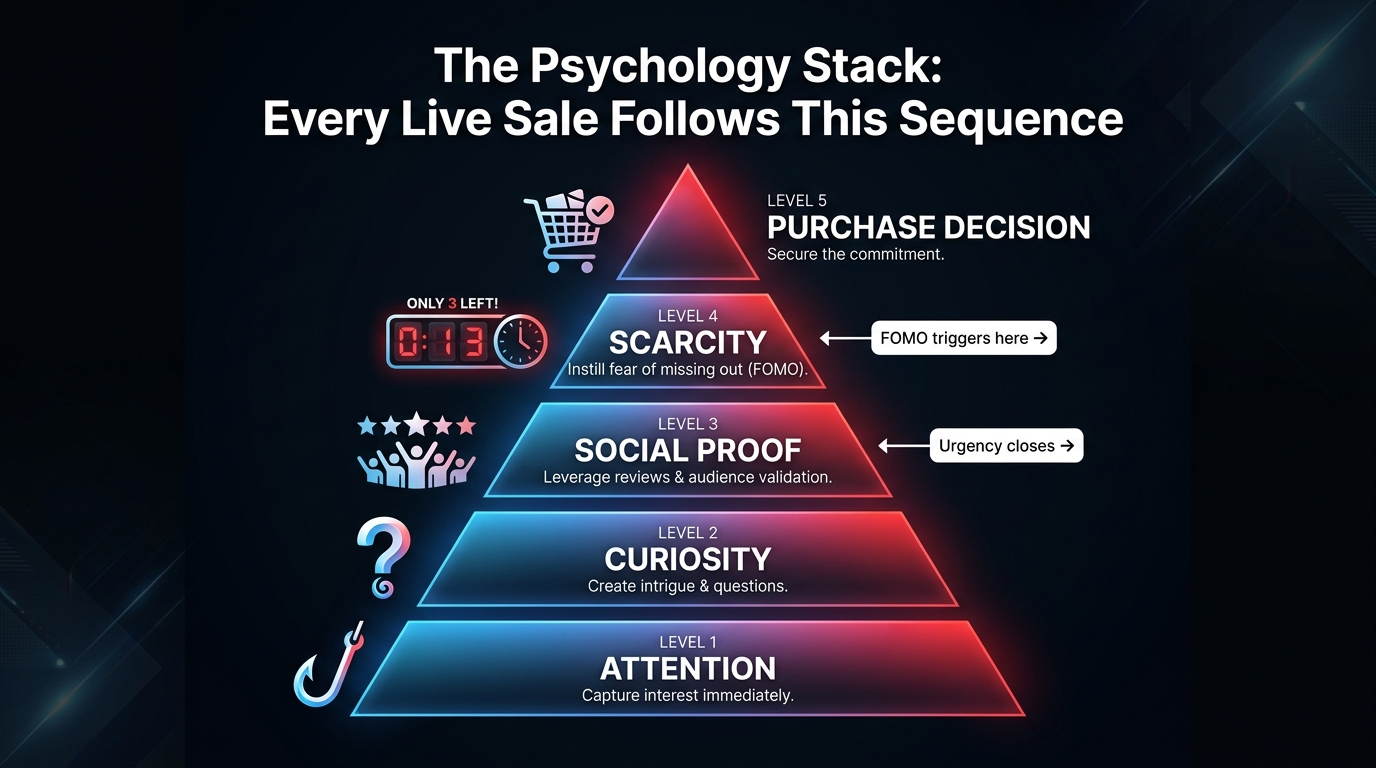
The psychological tools available to a Live seller — FOMO, scarcity, social proof, authority, reciprocity — are well-documented. What’s less often discussed is the sequence in which they need to be deployed. Used in the wrong order, these tools either cancel each other out or trigger resistance. Used in the right order, they compound into a purchase decision that feels natural rather than coerced.
The Correct Sequence
Step 1: Attention (Hook). Nothing else works until this is established. The viewer has to be present before any psychology can operate. This is the opening hook’s job, and it precedes all persuasion.
Step 2: Curiosity Gap. Once you have attention, the curiosity gap keeps the viewer present long enough for evidence to accumulate. The open loop hook creates this state. The viewer stays to resolve the tension rather than because they’ve made a decision to consider buying.
Step 3: Social Proof. With the viewer present and curious, social proof is deployed — reviews, customer results, visible purchase activity in the stream, chat testimonials. Social proof works at this stage because the viewer is open to information gathering. It doesn’t work in the first three seconds because a viewer who doesn’t yet have a reason to care won’t find other people’s opinions relevant.
Step 4: FOMO Trigger. FOMO lands after social proof has established that other people find this worth buying. “400 people bought this last night” followed by “only forty left” is FOMO built on a social proof foundation. Without the social proof, the scarcity claim is just pressure. With it, it’s evidence-based urgency.
Step 5: Scarcity and Urgency (The Close). The final push — specific inventory counts, time-bounded pricing, closing countdown — is the trigger that converts the decision that all preceding steps have been building. Scarcity deployed before steps two through four creates resistance. Scarcity deployed after them creates action.
Reciprocity as a Pre-Hook
One psychological principle that deserves special mention is reciprocity — the human impulse to return value for value received. Live sellers who begin each session by genuinely teaching something, solving a common problem, or sharing useful information before pitching any product create a reciprocity debt in their audience. Viewers feel, consciously or not, that buying is a way of returning the value they’ve received. This pre-hook state makes every subsequent hook and pitch more effective, because the viewer arrives at the product presentation already positively disposed toward the seller.
What Bad Hooks Look Like — Common Mistakes and How to Fix Them
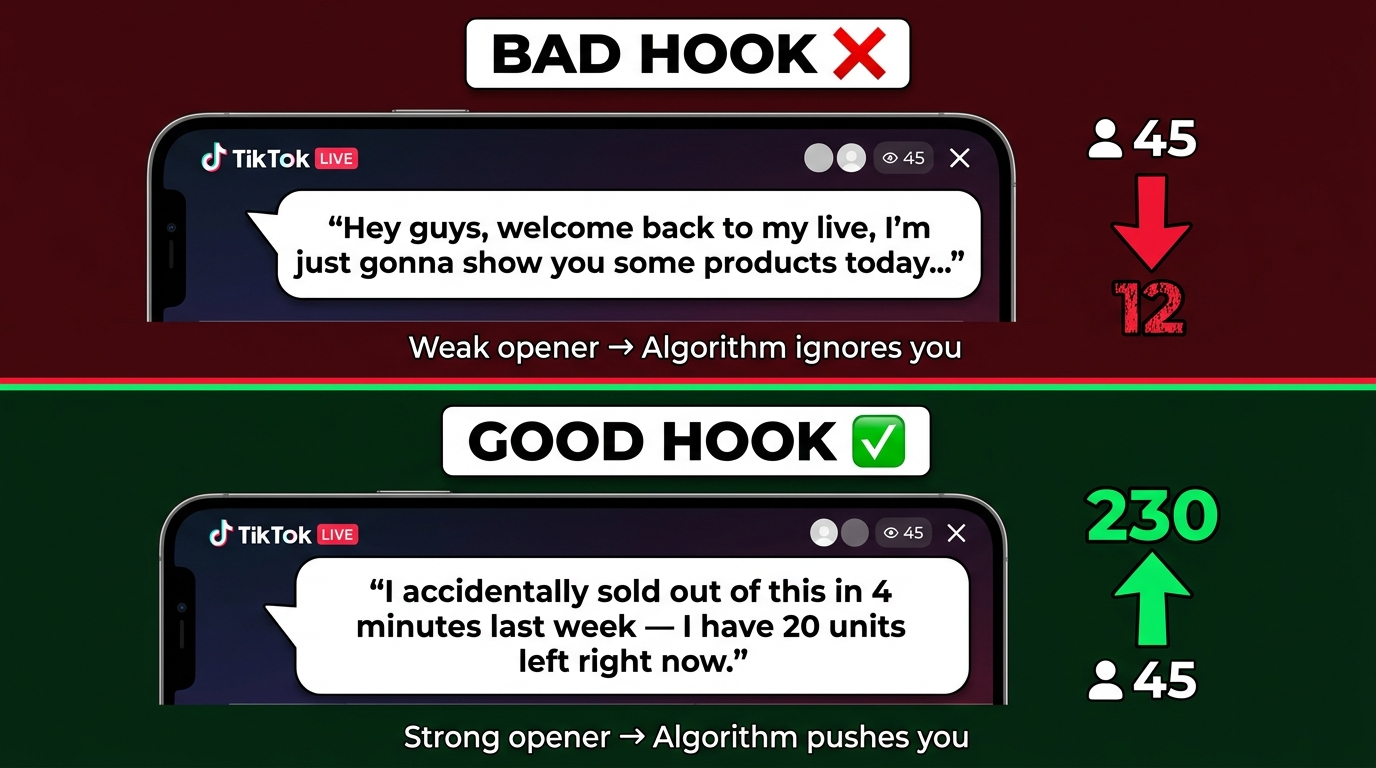
Understanding what works requires equally clear visibility into what doesn’t. The most common hook failures in TikTok Live selling fall into five recognizable patterns, each with a specific fix.
Mistake 1: The Welcome Loop
What it looks like: “Hey guys! Welcome! Good to see everyone coming in! What’s everyone up to today? Let me wait for a few more people to join before I get started…”
Why it fails: This is the single most damaging opening pattern in Live selling. It signals to the algorithm that nothing is happening — no engagement, no interaction, no reason for distribution. It tells cold viewers there’s nothing happening yet, so leaving is fine. And it trains your audience that your openings are dead time to be skipped.
The fix: Start in action. Begin with the product in hand, mid-demonstration, with an open loop already running. Acknowledge arrivals mid-stream, not at the beginning. The Live started the moment you went live — act like it.
Mistake 2: The Feature Dump
What it looks like: “This is our XYZ moisturizer. It has hyaluronic acid, vitamin C, niacinamide, it’s fragrance-free, it comes in a 50ml and 100ml size, it’s dermatologist-tested…”
Why it fails: Feature lists require the viewer to do the work of connecting features to benefits. Most won’t, because they haven’t yet been given a reason to care. Feature dumps also feel like reading a product spec sheet aloud — low energy, low engagement, algorithmically dead.
The fix: Lead with a benefit that solves a specific, named problem. Follow with one or two features as evidence for that benefit. Save the full feature list for the objection-handling phase, when viewers who are evaluating the product will actually find it useful.
Mistake 3: False or Overused Scarcity
What it looks like: “This is going to sell out any minute, I only have a few left!” — used for every product, in every session, regardless of actual stock levels.
Why it fails: Viewers who have seen this in previous sessions learn that the scarcity is theater. Once this credibility is lost, genuine scarcity claims are also disbelieved, removing one of the most powerful closing tools from your arsenal.
The fix: Reserve explicit scarcity language for situations where it’s genuinely true. Where inventory is healthy, use time-based urgency (deal available this session only) rather than stock-based urgency. Credibility is a compounding asset; protect it.
Mistake 4: Ignoring Audience Composition
What it looks like: Running a hook designed for loyal followers in a session that the algorithm has pushed to a large cold audience, or vice versa.
Why it fails: A hook that assumes familiarity — “you know I’ve been testing this for six weeks” — means nothing to a viewer who arrived thirty seconds ago. It creates a sense of exclusion rather than inclusion.
The fix: Monitor viewer count and comment quality in real time. When you see a surge of new viewers (often visible through comment names you don’t recognize), pivot immediately to a cold-audience hook to capture and contextualize them before addressing your returning base.
Mistake 5: The Pitch-Only Close
What it looks like: “Link is in the bio, get it while you can, last few left, going now, grab it, grab it, grab it!”
Why it fails: Urgency without context is just noise. Viewers who haven’t been persuaded yet won’t be persuaded by faster talking and more exclamation marks. Viewers who have been persuaded already know where to click.
The fix: Treat the final ten minutes as a compressed version of the full hook architecture. Brief re-hook (product benefit reminder), social proof repeat (quick testimonial reference), specific scarcity signal, personal CTA. Four elements in two minutes is more effective than two minutes of pitch repetition.
Building a Hook Library: How to Test, Iterate, and Own Your Best Performers
The sellers who dominate TikTok Live over months and years are not more creative than their competitors. They are more systematic. A hook library — a documented, tested, categorized collection of opening statements, mid-stream triggers, and closing formulas — is the structural advantage that prevents creative fatigue and enables deliberate improvement.
What Goes Into a Hook Library
A functional hook library contains three categories of entries:
Proven Performers: Hooks that have demonstrably produced higher early hold rates, stronger comment volumes, or above-average session conversion. These are documented verbatim, along with the context in which they work best (product category, audience size, session timing).
Active Tests: Hooks being evaluated in current sessions. Each test hook is tracked against a baseline metric — typically the percentage of viewers who remain past the ninety-second mark — and assessed over a minimum of three sessions before any conclusion is drawn.
Retired or Contextual: Hooks that worked once but have shown declining effectiveness, likely because the audience has become familiar with them, or hooks that only work in specific contexts (high-follower sessions, specific product categories, certain seasonal moments).
How to Test Without Burning Sessions
Hook testing should be structured to minimize risk. The recommended approach: test new opening hooks on your first product presentation of the session, where the cost of a mediocre hook is an initial hold rate dip rather than lost conversion on a product already in mid-pitch. Mid-stream hooks can be tested more liberally because the consequence of a weak re-engagement hook is lower than a weak opening hook.
Track at minimum: concurrent viewers at the 90-second mark, comment volume in the first three minutes, and product click-through rate in the five minutes following the hook. These three metrics give a useful picture of whether the hook is generating hold, interaction, and purchase intent respectively.
The Iteration Mindset
The most important operational truth about hook development is that no single hook works forever. As your audience grows and returns across multiple sessions, familiarity erodes the pattern interrupt effect of previously novel hooks. A hook that generated significant comment activity in its first three sessions may produce nothing by session fifteen. This is not failure — it’s the natural lifecycle of a hook, and it’s why the library model matters more than the individual hook.
Plan for a library refresh cycle: aim to retire or adapt your top three performing hooks every four to six weeks, replacing them with tested variations or new formulas. This keeps your sessions feeling fresh to returning viewers and maintains the pattern interrupt quality that cold viewers require.
Learning From Your Highest-Converting Sessions
Your own session data is the most valuable hook research you have access to. When a session dramatically outperforms your average — in concurrent viewers, conversion rate, or revenue per viewer — the correct response is to analyze the first ninety seconds in detail. What did you open with? What was the first product? What happened in the chat at minute three? The answers almost always contain the hook that drove the result, and that hook belongs in your library immediately.
Conclusion: The Hook Is Not Your Opening — It’s Your Operating System
The sellers who treat TikTok Live hooks as a single technique — a clever opening line before the real selling begins — will always plateau. The sellers who treat hooks as a continuous operating system running throughout every session will compound their advantage with every stream they go live.
The data supports the investment. TikTok Live achieves 7–8% conversion rates because of the environment it creates — a real-time, high-attention, high-trust space where purchase decisions happen quickly. But that environment doesn’t maintain itself. It’s built and rebuilt every few minutes by hosts who understand that attention is not a resource you collect at the start of a session; it’s one you have to keep earning.
The framework in this guide gives you the full architecture: opening hooks that match your audience composition, pattern interrupts that work visually and verbally, a structured approach to warm versus cold viewers, mid-stream retention loops that protect your algorithmic reach, chat-activated engagement that pulls drifting viewers back, closing hooks that convert long-watch-time hesitators, and a library system that turns great individual sessions into compounding institutional knowledge.
None of this requires a large following. It requires deliberate structure, consistent practice, and the discipline to test rather than assume.
The single most actionable step you can take after reading this: Write three opening hooks for your next Live session — one outcome showcase, one open loop, and one direct address. Go live with all three in sequence across your first product. Track which one generates the highest comment volume in the first three minutes. That’s the beginning of your hook library.
TikTok Live commerce will keep growing in 2026. The question is whether you’ll be selling into that growth or watching it happen from the sidelines. The answer starts in the first 1.5 seconds of your next session.