





There is a version of TikTok Shop that sounds like a marketer’s dream: post a video, watch orders roll in, scale to six figures without a warehouse. That version exists — but it is not the whole story, and sellers who chase it without understanding the mechanics beneath it tend to burn through margin fast and wonder what went wrong.
The fuller picture is more interesting, and ultimately more useful. TikTok Shop is now a serious commercial infrastructure — one projected to hit $112.2 billion in global GMV in 2026, with US gross merchandise value estimated between $20 and $23.4 billion. The number of active US TikTok Shops grew from just 4,450 in July 2023 to over 231,000 by mid-2026. That is not a novelty channel. That is a marketplace.
What makes TikTok Shop genuinely different from every other platform a seller might already use is not the audience size or the viral potential — it is the content-to-commerce architecture. Products are not listed and discovered through search the way they are on Amazon or Etsy. They surface inside entertainment. Someone is already watching when they encounter your product. That changes everything about how you list, price, promote, and fulfill.
This guide covers the operational and strategic reality of selling on TikTok Shop in 2026 — from fee math and catalog construction, to live commerce, the new Account Health Rating system, GMV Max advertising, and the 90-day framework serious sellers use to scale past $10,000 per month. No hype. Just the mechanics.
Why the TikTok Shop Numbers Deserve Your Attention
Before going deep on tactics, it helps to understand why TikTok Shop has moved from “interesting experiment” to “channel you can’t afford to ignore” in the span of about three years.
The conversion rate story
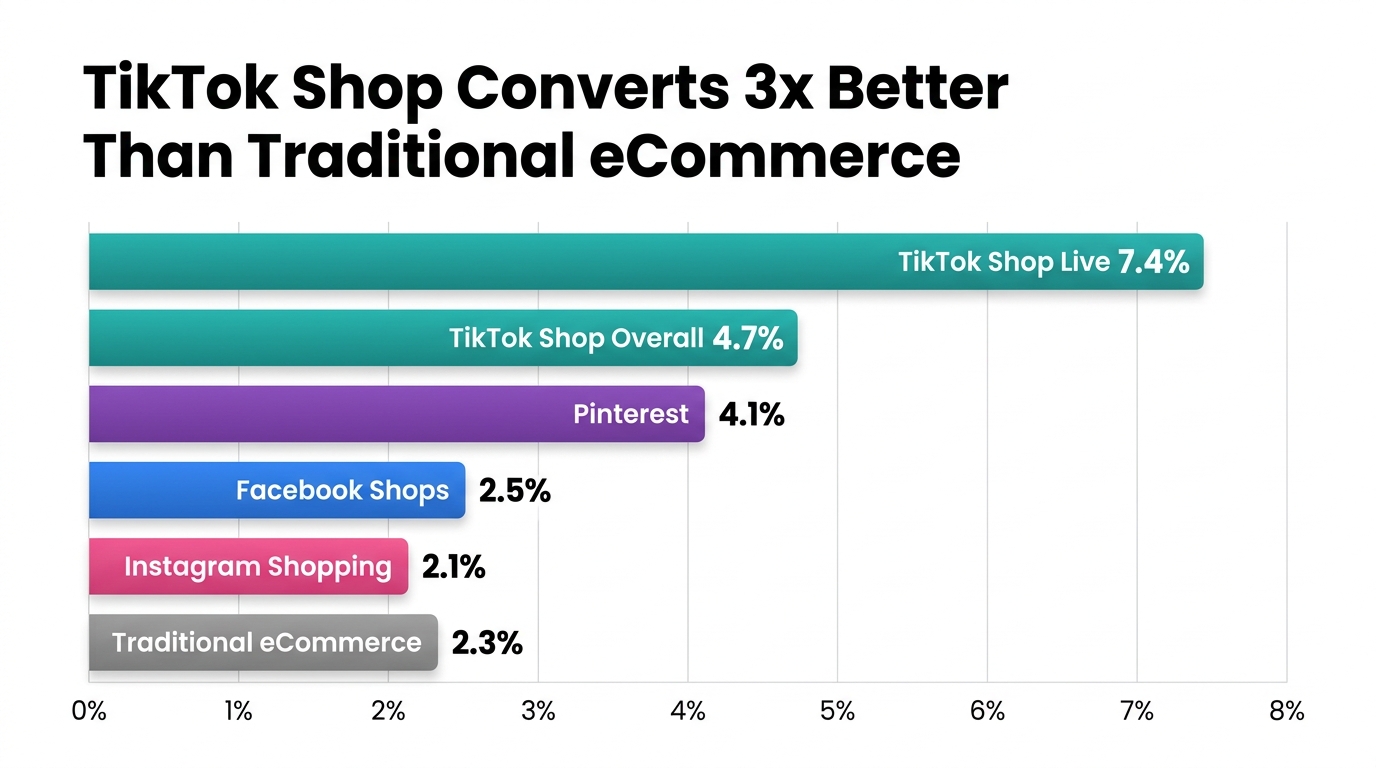
Most ecommerce channels live or die by their conversion rate. By that metric, TikTok Shop is doing something unusual. The platform’s overall conversion rate averages 4.7% — more than double Instagram Shopping’s 2.1% and significantly ahead of Facebook Shops at 2.5%. For live shopping specifically, that number climbs to 7.4%, which is more than three times the average for traditional ecommerce.
These figures are not flukes. They reflect a structural advantage: the user is already engaged and entertained before the purchase decision happens. When someone watches a creator demonstrate a product for 90 seconds and then sees a one-tap in-app checkout button, the friction between desire and transaction is almost nothing. Compare that to a search ad click that lands a skeptical user on a product page they have never seen before.
The customer acquisition cost advantage
TikTok Shop sellers who run paid ads report a 47% lower customer acquisition cost compared to Google Shopping, with an average CPA of $14.30 and a ROAS of 5.7x for TikTok Shop ads. The average order value sits around $58 — which places it squarely in the impulse-buy sweet spot for most consumer categories.
The repeat purchase rate of 38% also suggests that TikTok Shop is not purely a one-hit discovery channel. Buyers do come back, particularly when sellers have a recognizable shop presence and maintain active content.
Category distribution matters
Beauty and Personal Care leads TikTok Shop with $2.49 billion in GMV, driven primarily by short-form video, which accounts for roughly 58–60% of total sales. Live streaming contributes approximately 10% of overall GMV — a smaller share than many assume, but one that punches well above its weight in conversion efficiency. In-app shop browsing accounts for the remaining 30–32%.
Understanding where your category sits in this distribution should inform your content strategy before you spend a single dollar on ads.
Building a Catalog That the Algorithm — and Buyers — Actually Want
One of the most consequential decisions a TikTok Shop seller makes is which products to list, and how many. The instinct, especially for established brands, is to load the full catalog. This is a mistake.
Start lean, go deep
Across consistent 2026 seller guidance, the recommendation is to begin with 5 to 10 hero products — your bestsellers, your most visually demonstrable items, and products that solve a clear pain point quickly. If you have a larger catalog to eventually deploy, expanding to 50–150 SKUs in the first month is reasonable, but only after you know which heroes are generating traction.
The algorithm favors high-demand, high-velocity inventory for early discovery. A fragmented catalog of 500 mediocre listings will not outperform 10 listings that each generate consistent daily orders. The platform’s recommendation engine needs momentum data to serve your products in the For You feed. Give it a small, concentrated signal to work with.
What makes a product TikTok-native
Not every product sells on TikTok Shop, even if it sells well everywhere else. The platform rewards items that share certain characteristics:
- Visual transformation: Products that show a before/after in under 60 seconds — cleaning solutions, skincare, hair tools, home organization.
- Instant understandability: A viewer who has never heard of your brand should grasp the value proposition within the first three seconds of seeing it.
- Impulse-friendly price point: Items under $50 convert at the highest rates. Above $100, buyers typically need more convincing than a short-form video can provide.
- Creator-demonstrable: A product a creator can show, wear, taste, apply, or use on camera. Abstract B2B products and complex SaaS tools have limited TikTok Shop relevance.
- Repeatability or replenishment logic: Consumables, refillables, and bundled goods encourage return purchases.
Listing optimization for the content-commerce environment
Your product title and description need to serve two masters simultaneously: TikTok’s search algorithm and the impulse-driven browsing behavior of the platform’s users. This means keyword-rich titles that also read like recommendations rather than spec sheets, and descriptions that lead with benefits rather than features.
Enabling sample eligibility for creators in your listings increases discoverability by an estimated 2.5 to 4 times, according to seller data compiled in early 2026. Creators actively search for sample-eligible products to review and promote — and the content they generate becomes organic social proof that compounds over time.
Short demo videos attached directly to listings also outperform static images, providing the same entertainment-first cue that the broader platform runs on.
The Real Fee Math: What Margin Looks Like After the Platform Takes Its Cut
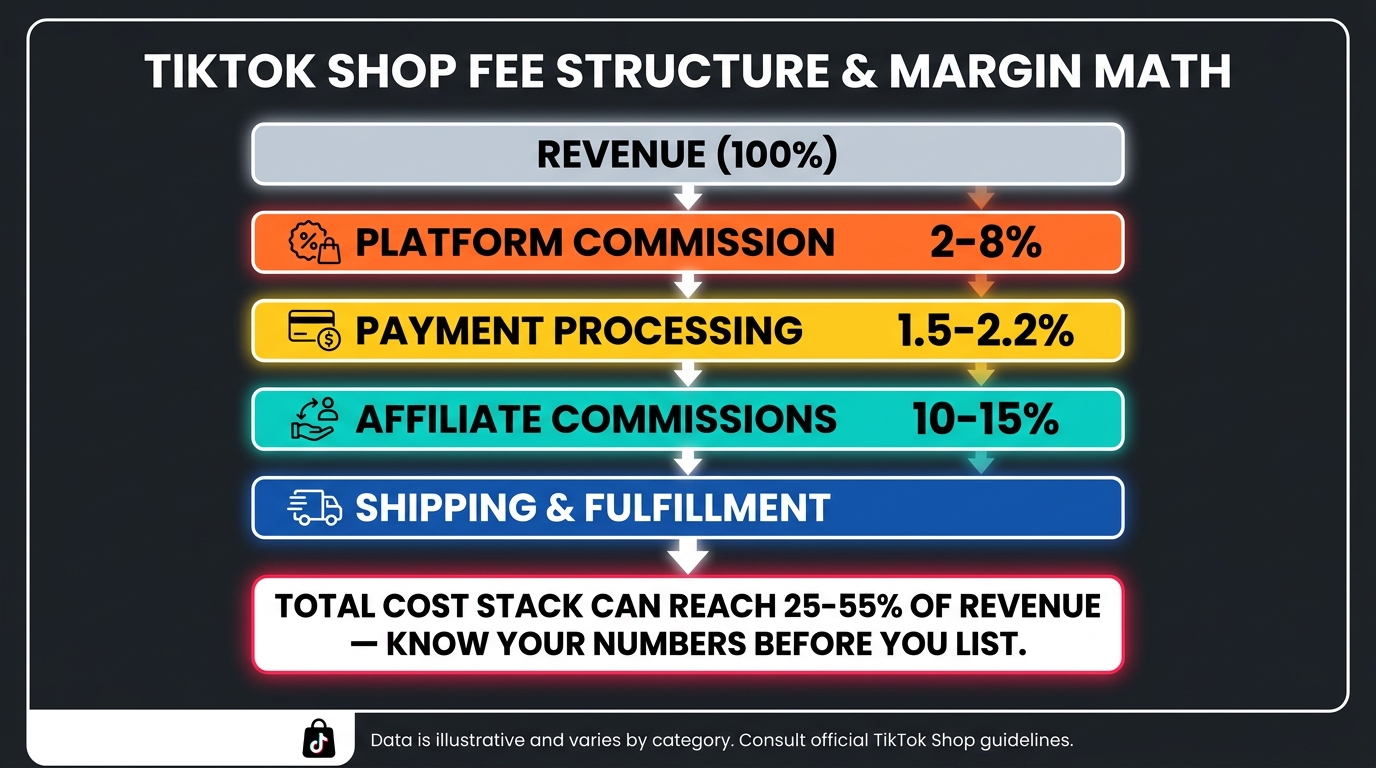
TikTok Shop is frequently cited as a low-fee platform, and at the platform commission level, that is true. But sellers who look only at the headline commission rate routinely underestimate their actual cost structure. Here is how the fees actually stack.
Platform commission
The platform takes a referral commission of 2–8% depending on category, with most sellers in competitive categories landing around 5–6%. New sellers often receive reduced rates of 0–1% for the first 30–60 days as an incentive to list. There are no listing fees and no monthly subscription costs, which keeps the barrier to entry low.
Payment processing
Add 1.5–2.2% for payment processing on most transactions (some cases reach 2.9% + $0.30 per transaction depending on payment method). This is deducted automatically from payouts, making it easy to overlook in your margin calculations.
Affiliate commissions
Here is where the math becomes non-trivial. If you are running an open affiliate plan — which most sellers do to generate organic creator content — starting commissions run 10–12%, with many sellers offering 15–20% to attract higher-quality creators. For a product with a 40% gross margin before platform fees, a 15% affiliate commission does not leave much room for advertising, returns, and profit.
Advertising costs
If you run GMV Max campaigns or Video Shopping Ads, advertising typically costs between 15–30% of revenue when running at meaningful scale. Early-stage campaigns at $50–$100 per day may run at higher effective percentages while the algorithm learns your product.
Putting it together
On a $50 product with a $15 cost of goods, here is what your margin stack might look like in a moderately aggressive scaling scenario:
- Platform commission (6%): $3.00
- Payment processing (2%): $1.00
- Affiliate commission (12%): $6.00
- Shipping to customer: $4.50
- Ad allocation (10% of revenue): $5.00
- Total costs: $34.50
- Net profit: $15.50 (31%)
That 31% is achievable — but only if you have engineered your pricing and affiliate rates carefully. Sellers who price reactively and offer high commissions to attract creators without modelling the impact will find their margin compressed far below that.
The standard formula used by experienced sellers: Final Price = (COGS + TikTok fees + affiliate commission + shipping) ÷ (1 – target profit margin). Run this calculation before you set a single price on the platform.
The Three Traffic Engines: Organic, Affiliate, and GMV Max
TikTok Shop gives sellers three distinct channels for driving traffic to their listings, and understanding which to prioritize — and when — is one of the most important decisions you will make.
Organic video: the foundation, not the ceiling
Organic short-form video accounts for roughly 58–60% of TikTok Shop GMV, making it the dominant sales channel. But most sellers misunderstand what “organic” means in this context. It does not mean posting randomly and hoping for virality. It means creating consistent, product-demonstrating content that is optimized for the For You feed algorithm.
The algorithm rewards watch time, saves, and shares over pure follower count. A shop account with 2,000 followers can outperform one with 200,000 if its content holds attention better. Every video should lead with a hook that identifies the problem your product solves, demonstrate the solution visually within 15–30 seconds, and include a clear call to action directing viewers to the shoppable link.
Affiliate marketing: the performance channel most sellers underuse
The affiliate program is where TikTok Shop diverges most sharply from traditional ecommerce channels. Instead of buying ads and hoping they work, you offer a commission to creators who promote your product to their audiences — and only pay when a sale happens.
Done well, affiliates drive 40–50% of revenue growth for scaling TikTok Shop sellers. Affiliates generate 3x higher ROI than paid ads on average, and creator-led shop content delivers 96% higher ROAS than brand-produced content in direct comparisons.
The two affiliate structures you need to know are: the open plan (any creator can apply to promote your product at your listed commission rate) and the targeted plan (you proactively invite specific creators, often with higher commissions, exclusive samples, or performance bonuses). Most sellers start with an open plan at 10–12% to generate initial creator content, then layer in targeted outreach for creators whose audiences align with their buyer profile.
GMV Max: the ads engine built for TikTok Shop
As of July 2025, GMV Max became TikTok’s default and sole campaign type for Shop Ads, replacing Video Shopping Ads and Product Shopping Ads. It is an AI-driven system that automatically blends organic content, affiliate posts, and paid placements to maximize gross merchandise value.
Best practices for GMV Max in 2026 include:
- Having at least 50 creator videos live before launching a GMV Max campaign — the algorithm needs creative to work with.
- Creating separate campaigns per major product or category to maintain independent budget control and performance data.
- Starting with a minimum daily budget of $50–$100 (recommended $200+ for meaningful learning speed) and allowing 2–4 weeks of sales history before scaling.
- Allocating 70–80% of your ad budget to GMV Max, reserving 20–30% for manual web campaigns targeting high-value segments or new launches.
- Setting conservative ROI targets initially and expanding spend only when ROAS stabilizes above 3x.
The case study data for GMV Max is compelling: brands running properly structured campaigns have reported ROAS ranging from 5.7x to 14x, though these results reflect optimized accounts with significant creative volume behind them.
Live Selling: The Operational Blueprint Behind the Numbers
Live commerce is TikTok Shop’s most efficient conversion channel — 7.4% conversion rates against a 3.2% traditional ecommerce baseline — but it is also the most operationally demanding. Most sellers who try live selling and abandon it do so because they treat it as a content format rather than a retail operation.
The scheduling and frequency baseline
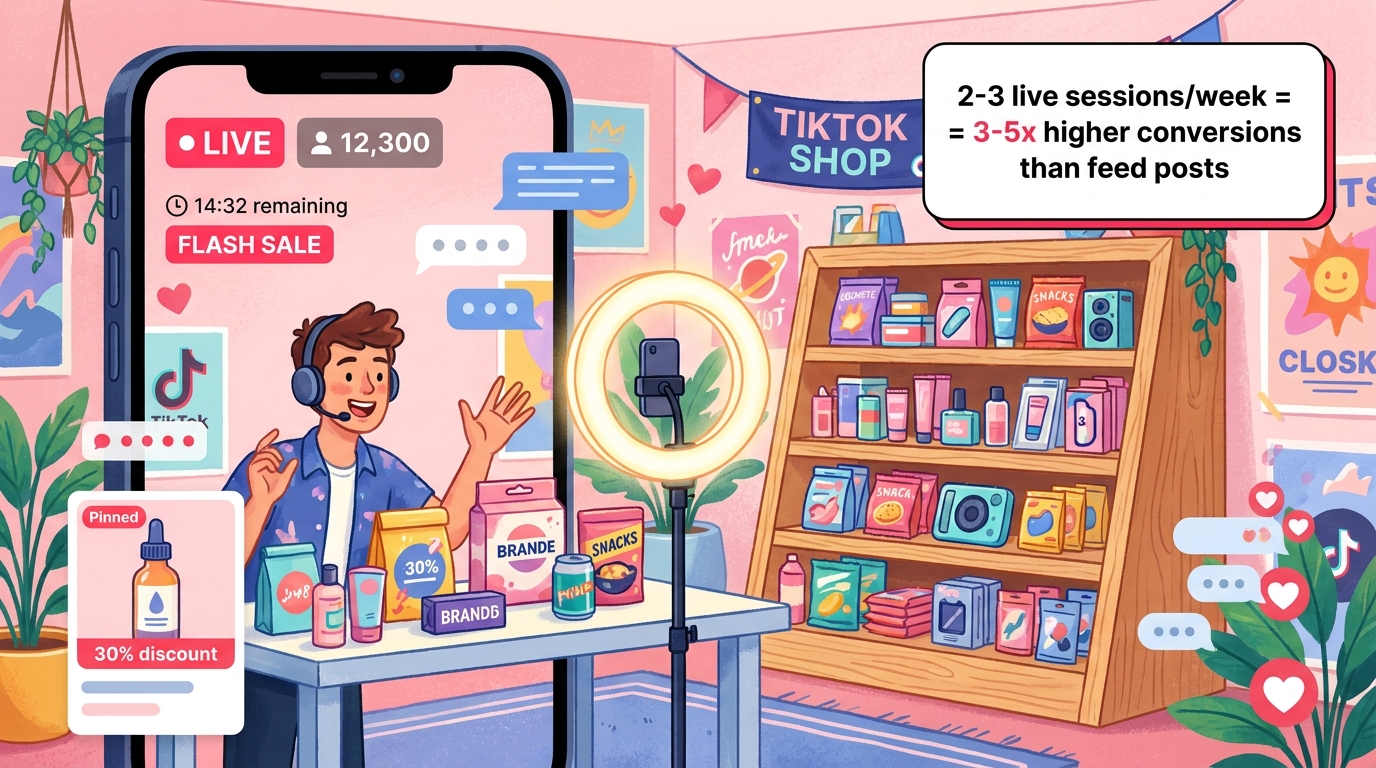
Sellers with consistent live revenue run 2 to 3 sessions per week, each lasting a minimum of 2 hours, scheduled during peak engagement windows of 7–10 PM local time. This frequency is not arbitrary — TikTok’s algorithm favors live accounts that demonstrate consistent scheduling, and audiences build habitual viewing patterns when the schedule is predictable.
Below this threshold, live sessions tend to function as one-off events rather than a reliable channel. Above it — particularly at 5 or more sessions per week — the returns can be significant, but the operational demands scale accordingly.
The mechanics of a high-converting live
The structure of a well-run live session mirrors retail sales psychology more than it resembles a traditional livestream:
- Product pinning: Pin the featured product at the top of the product tray so viewers can tap directly to purchase without searching.
- Flash discounts with countdown timers: Time-limited offers create urgency that static listings cannot. A 20% discount available for the next 10 minutes converts faster than a permanent sale price.
- Stock urgency signals: Verbal and visual cues like “only 8 units remaining at this price” trigger loss aversion — a well-documented purchasing motivator.
- Real-time Q&A: Actively reading and answering viewer questions during the live session builds trust and addresses purchase objections in the moment. Comment sections on a live are essentially an objection-handling feed.
- Segment structure: Rotate between featured products every 10–15 minutes to maintain viewer engagement across the full session duration.
What you need before you go live
Equipment and setup matter more for live commerce than for recorded video. A consistent, high-quality live needs: a ring light or softbox lighting setup that eliminates shadows on the product, a stable internet connection (Wi-Fi with at least 10 Mbps upload), a clear product display area with organized inventory within reach, and either a dedicated host or a confident brand representative who can speak fluently about the product range.
Sellers who generate $20,000+ monthly from live streams typically have a dedicated live team — a host, a moderator watching comments, and a logistics support person managing inventory calls. That overhead is real, and it needs to be factored into your unit economics before you build a strategy around live as your primary channel.
The Account Health Rating: The Metric That Can End Your Shop
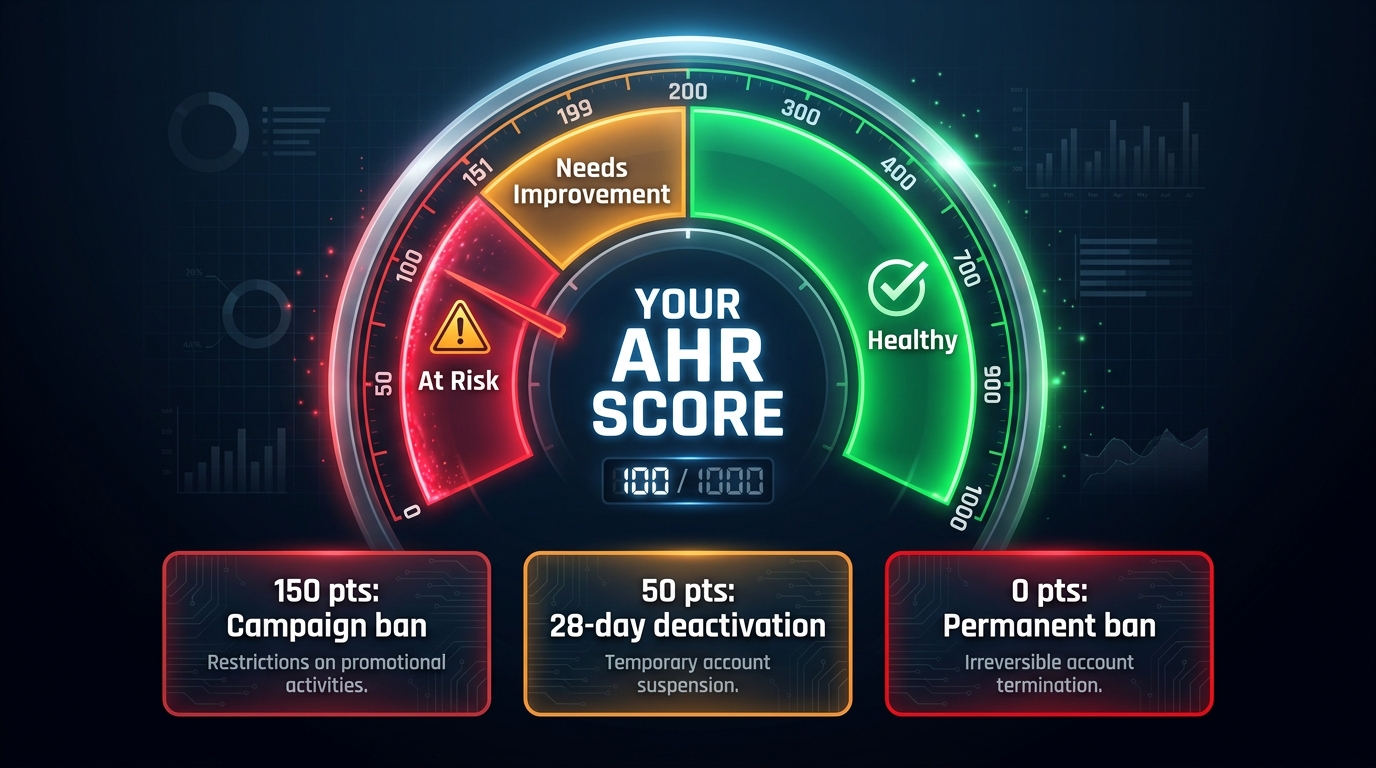
In July 2026, TikTok Shop replaced its Violation Points system with the Account Health Rating (AHR) — a 0 to 1,000 point score that governs what features you can access, whether your campaigns run, and ultimately whether your shop stays active.
How the AHR is calculated
Your AHR score is built from a 90-day rolling calculation:
Base Points (200) + Points Earned from Completed Orders − Points Deducted for Policy Violations = Your AHR
Completing orders adds points; policy violations subtract them. The severity and frequency of violations determine how many points are deducted per incident. Scores reset after 90 days, and the calculation excludes the most recent 7 days to give the system time to process recent orders.
What the score levels mean
- 200–1,000 (Healthy, green): Full platform access with no restrictions. This is where you need to stay.
- 151–199 (Needs Improvement, orange): No immediate restrictions, but a warning signal that violations are accumulating and intervention is needed.
- 1–150 (At Risk, red): Milestone enforcements trigger progressively. At 150 points, advertising campaigns are paused. At 100 points, additional features are restricted. At 50 points, a 28-day shop deactivation is triggered. At 0 points, the shop faces permanent closure.
What causes AHR to drop
The most common AHR violations that sellers accumulate — often without realizing it — include: listing prohibited or inaccurate product claims, shipping delays that breach platform SLAs, high cancellation rates, counterfeit or intellectual property violations, and misleading pricing (such as artificially inflating a pre-sale price to manufacture a “discount”).
Selling in regulated categories — supplements, electronics, cosmetics — without proper documentation is another fast path to violations. Every claim you make in a listing or live session is subject to TikTok’s content and commerce policy enforcement, which uses a combination of automated flagging and human review.
The practical implication: maintain clean listings, respond to policy notices within 72 hours, and appeal any deductions you believe are incorrect before they compound. A single overlooked notice can cascade into a series of deductions that pushes you into the At Risk zone before you have had a chance to course-correct.
Fulfillment Logistics: The Metrics That Determine Whether You Stay on the Platform
TikTok Shop’s operational demands are stricter than most first-time sellers expect. The platform operates a performance measurement system for sellers that functions similarly to Amazon’s account health metrics — and falling below threshold on key KPIs can trigger account restrictions or suspension.
The four metrics you must maintain
The core fulfillment metrics TikTok Shop monitors are:
- On-Time Delivery Rate (OTDR): Must remain at or above 80%, calculated weekly. This measures the percentage of orders delivered by the expected date.
- Late Dispatch Rate (LDR): Must stay below 4%. Orders must be dispatched with valid tracking within your stated SLA — ideally same-day, with a maximum window of 48 hours. Orders without tracking after 4 business days are auto-cancelled.
- Seller-Fault Cancellation Rate (SFCR): Must remain below 2.5%. Cancellations you initiate, caused by stockouts or operational failures, count against this metric.
- Returns processing speed: Returns must be processed within defined windows to avoid customer complaints that feed into your AHR score.
The viral spike problem
One of the most dangerous scenarios for TikTok Shop sellers is a product going viral unexpectedly. What sounds like a dream scenario can become an operational nightmare within 48 hours if inventory is not pre-positioned for rapid shipping at volume. A spike in orders that your fulfillment setup cannot absorb will drive your OTDR and LDR metrics into violation territory before you can respond.
Sellers operating at scale maintain a minimum of 30 days of safety stock for hero products and have a pre-agreed overflow arrangement with a 3PL (third-party logistics) provider. For products that have shown any sign of viral potential, the safety stock standard is closer to 60 days.
The packaging rule sellers keep violating
Using competitor-branded packaging — specifically Amazon FBA boxes or packaging with Amazon branding — is a violation on TikTok Shop. It sounds obvious until you realize how many multi-channel sellers still have Amazon-branded materials in their supply chain. TikTok calls this the “Frown Factor,” and it carries a measurable violation deduction. Neutral packaging is not optional; it is an operational requirement.
The 2026 logistics policy shift
Early 2026 brought a significant policy development: TikTok Shop initially mandated its own logistics services (FBT — Fulfilled by TikTok, Upgraded Shipping, and Cross-Border Transport) starting February 25, effectively ending self-shipping options. After significant seller backlash, TikTok reversed the mandate on February 17, retaining seller control over shipping. However, integration with TikTok’s logistics systems remains a strong recommendation for sellers who want to minimize delivery time variances and maintain OTDR compliance.
Managing Creator Affiliates as a Revenue System
The creator affiliate program is not a marketing add-on — for the most successful TikTok Shop sellers, it is the central revenue engine. But treating it as one requires a different operational mindset than most sellers bring to influencer relationships.
Open plan vs. targeted outreach
The open affiliate plan sets a commission rate (typically 10–12% to start) that any eligible creator can accept and begin promoting your product. The advantage is scale — your product can appear in creator content across hundreds of channels without active management. The disadvantage is quality variance: some creators will produce high-performing content; many will not.
The targeted plan involves proactively identifying and inviting specific creators whose audience demographics, engagement rates, and content style align with your product. These relationships typically involve higher commissions, product samples sent at your cost, and in some cases performance bonuses for hitting GMV thresholds. The time investment is higher, but the output quality and conversion consistency are dramatically better.
Most scaling sellers run both simultaneously — an open plan to generate broad content volume and a curated targeted list of 10–20 high-performing creators who receive premium treatment.
The sample economics
Sending product samples to creators is a direct cost. On a product with a $15 COGS, sending 50 samples costs $750 before shipping — and not every creator who receives a sample will post content. A realistic posting rate for unsolicited samples is 30–40%. For targeted creators who have agreed to post in exchange for the sample, the rate is higher, typically 70–85%.
The way to think about sample costs is as a CPM buy — you are purchasing the potential for organic content distribution, not guaranteeing output. Sellers who track their cost-per-creator-post and compare it to their ROAS from that creator’s content can make data-driven decisions about which creator relationships merit ongoing sample investment.
Performance-based commission tiers
The most sophisticated sellers in 2026 are moving toward automated, threshold-based commission management — raising commissions for creators who consistently convert above benchmark, and pausing relationships with creators whose conversion rate drops below a defined floor for 14 or more consecutive days. This approach ties your creator spend directly to revenue outcomes rather than follower counts or subjective content quality assessments.
TikTok Shop vs. the Competition: An Honest Platform Comparison
TikTok Shop does not perform equally well against every alternative in every context. Understanding where the platform has genuine structural advantages — and where others hold the edge — helps you allocate inventory and budget intelligently across channels rather than going all-in based on excitement alone.
Where TikTok Shop wins clearly
TikTok Shop’s advantages are sharpest for:
- Discovery-driven categories: Products that benefit from being shown rather than searched for — beauty, wellness, home, food. If buyers need to see it to want it, TikTok Shop’s content-first model has no equal.
- Sub-$50 impulse items: The combination of entertainment-driven discovery and one-tap checkout creates the highest impulse conversion environment available in ecommerce.
- Customer acquisition cost: At 47% lower CAC than Google Shopping and significantly below Meta for low-AOV products, TikTok Shop is the most efficient acquisition channel for consumer goods brands in this price range.
- Creator-to-commerce conversion: When you have strong affiliate relationships, no platform produces comparable results — the affiliate 3x ROI advantage over paid ads is consistent across category data.
Where other platforms maintain advantages
Meta (Facebook and Instagram) consistently delivers higher median ROAS (2.2x vs. TikTok’s 1.4x median) for considered purchases — products in the $100–$500 range where buyers want to research before committing. The targeting precision and retargeting depth of Meta’s ad ecosystem still outperforms TikTok for complex purchase journeys.
Amazon remains the dominant platform for intent-driven search — buyers who already know what they want and are comparing prices. TikTok Shop creates demand; Amazon captures it. The two channels are not substitutes. Many successful sellers use TikTok Shop to introduce products to new audiences and Amazon to capture the subsequent branded search volume that TikTok exposure generates.
Instagram Shopping has lower conversion rates (2.1% vs. TikTok’s 4.7%) but benefits from stronger brand aesthetics and longer content shelf life. For premium brands where visual presentation drives brand equity, Instagram’s format can be worth the conversion rate trade-off.
The 90-Day Scaling Framework for Reaching $10K+ Monthly GMV
Sellers who consistently reach $10,000 per month on TikTok Shop within their first quarter tend to follow a phased approach that builds commercial infrastructure before investing heavily in advertising. Here is how that framework breaks down.
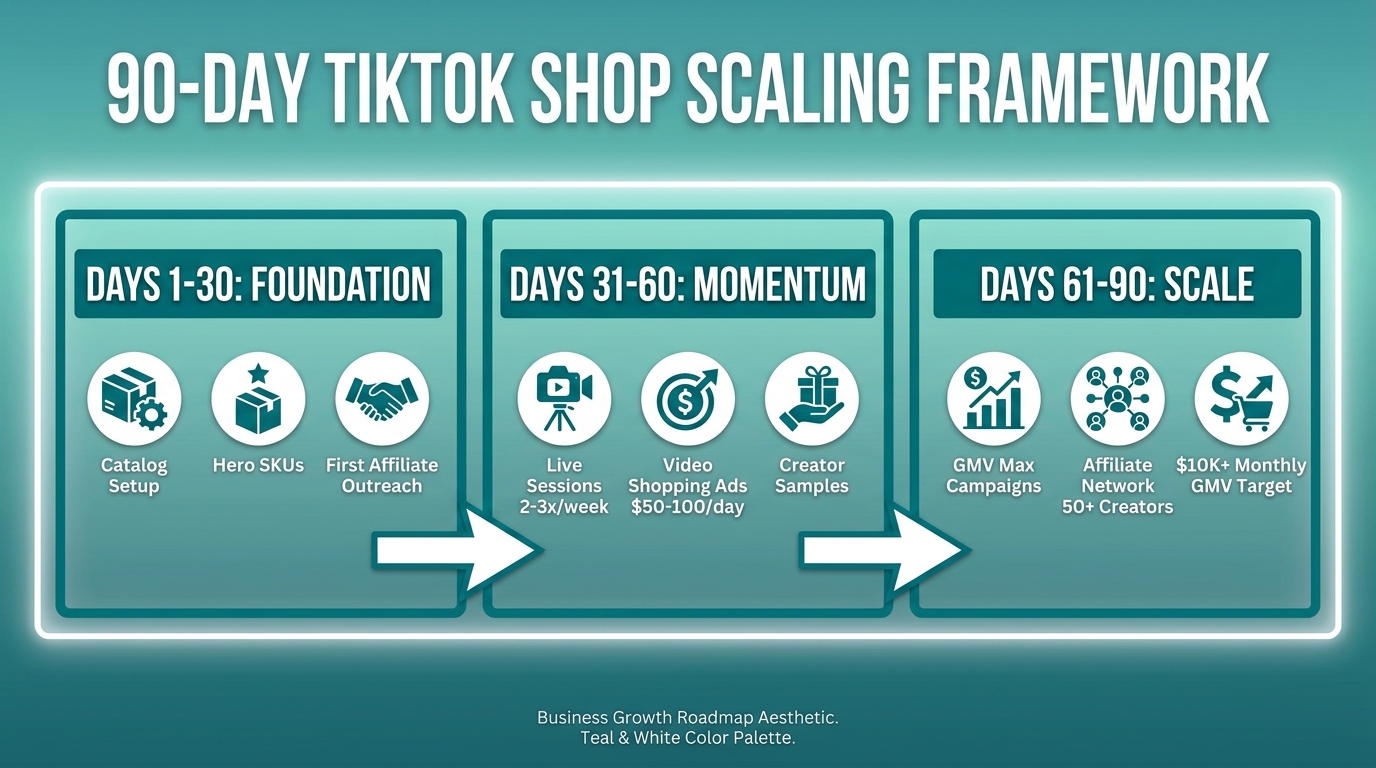
Days 1–30: Foundation
The first month is entirely about building the commercial infrastructure that later phases depend on. Key objectives:
- Publish your catalog with 5–10 hero products, fully optimized listings (keyword-rich titles, benefit-focused descriptions, short demo videos).
- Enable sample eligibility on your top products and begin reaching out to 20–30 creators in your category for targeted affiliate relationships.
- Post organic content from your brand account at a minimum of 5 times per week to start building the account’s content history.
- Set up your open affiliate plan at 10–12% commission and let initial creator content begin generating data.
- Establish your fulfillment process and confirm your OTDR and LDR capabilities — making sure you can hit 80% on-time delivery and stay below 4% late dispatch before order volumes increase.
Do not launch paid ads in Month 1. You need organic and affiliate data before GMV Max has enough signal to optimize effectively. Spending on ads without that foundation wastes budget and produces misleading performance data.
Days 31–60: Momentum
With initial creator content live and your first weeks of sales data in hand, Month 2 focuses on layering in active channels:
- Launch live sessions 2–3 times per week at peak hours (7–10 PM). Maintain consistency for the algorithm to build your live account history.
- Introduce a conservative GMV Max campaign at $50–$100 per day to begin generating paid traffic data.
- Expand your targeted creator list to 20–30 relationships, prioritizing creators who have already generated organic sales for similar products.
- Review your first 30 days of listing analytics — double down on the SKUs generating velocity, and consider replacing or repricing the bottom performers.
Days 61–90: Scale
By Day 61, you should have 4–6 weeks of performance data across organic, affiliate, and paid channels. This is when scaling becomes systematic rather than experimental:
- Increase your GMV Max budget in 20–30% increments every 7–10 days as long as ROAS stays above your target threshold.
- Expand your affiliate network to 50+ active creators, with your top 10 relationships on performance-based commission tiers.
- Introduce flash sale events or platform promotions to generate concentrated sales velocity — this data improves your algorithm standing and can be used to qualify for platform-sponsored promotion slots.
- Review your AHR score and fulfillment metrics weekly to catch any compliance issues before they compound into violations.
Sellers who execute all three phases with discipline report reaching $10,000–$15,000 monthly GMV by Day 90, with a clear path to $30,000+ in months four through six as creator content compounds and ad algorithms mature.
Building TikTok Shop Into Your Long-Term Business Architecture
The sellers who extract the most long-term value from TikTok Shop are those who understand it not as a standalone channel, but as a demand-generation engine that feeds the rest of their commercial ecosystem.
The brand flywheel effect
When a product goes viral on TikTok Shop, the effects extend well beyond the platform. Branded search volume on Google typically increases within 48–72 hours of a significant TikTok moment. Amazon listings for the same product often see conversion rate increases as buyers who discovered the product on TikTok seek it out through familiar purchasing channels. Email capture rates from TikTok Shop traffic tend to outperform email capture from paid search, because the buyer arrives already engaged rather than already skeptical.
Brands that recognize this dynamic build their TikTok Shop strategy around maximizing that brand awareness amplification — not just the direct GMV on the platform.
Data ownership considerations
One of the structural limitations of TikTok Shop, relative to owned ecommerce channels like a Shopify store, is customer data ownership. TikTok controls the customer relationship and does not provide sellers with buyer email addresses by default. Your repeat purchase strategy on-platform must therefore be built around platform-native tools — follow notifications, shop favorites, and live session reminders — rather than email flows.
For sellers who want to build a durable customer relationship asset, driving initial discovery on TikTok Shop and then converting customers to an email list through value-added follow-up (exclusive content, loyalty programs, early access to new products) is a deliberate strategy worth building from Day 1.
The multi-channel inventory reality
Running TikTok Shop alongside Amazon or Shopify requires robust inventory management. Overselling — taking orders you cannot fulfill because your inventory counts across platforms are out of sync — is one of the fastest ways to damage your SFCR metric and trigger AHR violations. Real-time inventory sync between your channels is not a nice-to-have; it is an operational requirement at any meaningful volume.
Tools like Linnworks, Skubana, or a Shopify-TikTok integration handle this sync automatically. Building inventory management into your tech stack before you hit viral volume is far less disruptive than retrofitting it afterward.
What Separates Sellers Who Build Something Durable
The clearest pattern across successful TikTok Shop sellers in 2026 is not virality, creative talent, or even product selection — it is operational discipline applied to a platform that rewards consistency. The metrics are visible, the thresholds are published, and the playbook is increasingly well understood.
What separates sellers who build something durable from those who generate a few good weeks and fade is the decision to treat TikTok Shop as a business system rather than a creative experiment. That means running the fee math before setting a price. It means maintaining fulfillment infrastructure before going viral, not after. It means managing the AHR proactively rather than responding to crisis. And it means building creator relationships based on conversion data rather than follower counts.
The platform’s projected $112.2 billion in global GMV for 2026 is not primarily driven by lucky one-hit products. It is driven by the growing cohort of sellers who have figured out the system — and are working it deliberately.
Key takeaways for serious TikTok Shop sellers in 2026:
- Model your full cost stack (commission + processing + affiliates + ads + shipping) before setting prices — total costs can reach 25–55% of revenue.
- Start with 5–10 hero SKUs, not your full catalog. Give the algorithm a concentrated signal to work with.
- Do not launch GMV Max until you have 50+ creator videos live and 2–4 weeks of organic sales data.
- Keep your AHR above 200 by maintaining OTDR ≥80%, LDR <4%, and SFCR <2.5%.
- Build live selling on a consistent weekly schedule — 2–3 sessions of 2+ hours — rather than sporadic events.
- Use TikTok Shop as a demand generator, not a replacement for owned channels. The brand awareness it creates extends across your entire business.
The infrastructure is there. The audience is there. The conversion rates are among the strongest in social commerce. What you bring to it — the operational discipline, the margin awareness, the consistent content — is what determines the outcome.