


Amazon is no longer just the world’s largest online retailer — it is, for millions of entrepreneurs, the most accessible and powerful sales channel on the planet. In 2026, Amazon is projected to capture 60% of all U.S. online sales, a figure that would have seemed almost unbelievable a decade ago. With 185 million Prime members in the United States alone — each spending an average of $1,400 per year — the platform represents a built-in audience that no independent e-commerce website can replicate overnight.
Yet despite the enormous opportunity, selling on Amazon successfully requires far more than simply listing a product and waiting for orders. The marketplace has grown more competitive, more algorithm-driven, and more fee-intensive. Third-party sellers now drive 60–62% of all unit sales on Amazon, meaning you are competing against millions of other merchants vying for the same customers. The sellers who thrive in 2026 are those who approach Amazon strategically — with a clear business model, a data-backed product selection process, and a disciplined approach to advertising and operations.
This guide covers everything you need to know to build or grow a profitable Amazon business in 2026. Whether you are just getting started or looking to sharpen a business that is already generating revenue, the sections below break down every critical element — from choosing your selling model and fulfillment method, to optimizing your listings and managing your advertising spend. Let’s get into it.
The Amazon Marketplace in 2026: Opportunity by the Numbers
Before diving into tactics, it is worth understanding just how large and dynamic the Amazon marketplace is in 2026. The scale of the platform shapes every decision you will make as a seller — from the products you choose to the margins you target.
Market Size and Seller Landscape
Amazon and its sellers moved an estimated $830 billion in gross merchandise volume (GMV) in 2025, with third-party marketplace sales accounting for approximately $575 billion globally — a 15% year-over-year increase. As of 2026, the platform has approximately 2.5 million active sellers worldwide. While that sounds like a daunting number of competitors, it is important to note that the vast majority of sellers are small operations, and category-level competition varies enormously.
Independent U.S. sellers averaged over $290,000 in annual sales in recent reporting periods. More than 55,000 sellers surpassed the $1 million annual sales mark, and roughly 50% of sellers earn more than $10,000 per year. About 25% exceed $100,000 annually, and the top 10% surpass $500,000. These figures confirm that while Amazon is not a get-rich-quick channel, it is a genuinely viable business platform for sellers who execute well.
What’s Changed in 2026
The Amazon marketplace of 2026 is more mature and more demanding than the platform of five or ten years ago. Several key shifts define the current environment:
- New seller growth has slowed: Only around 165,000 new sellers registered in 2025 — the lowest figure in a decade, down 44% year-over-year. This reflects a market that is maturing and consolidating rather than expanding chaotically.
- FBA usage remains dominant: Approximately 82% of active sellers use Fulfillment by Amazon (FBA) for at least part of their business, underlining how central Amazon’s logistics network has become.
- Brand-led selling is winning: Amazon’s algorithms and tools increasingly favor sellers who operate as genuine brands — with trademarks, A+ content, Brand Stores, and high review velocity — over generic resellers.
- Fees have increased: FBA fulfillment fees rose by an average of $0.08 per unit in early 2026, and inbound defect penalties jumped significantly. Sellers who do not account for these costs carefully will see margins erode quickly.
Understanding this landscape is the foundation for making smart decisions at every subsequent step of building your Amazon business.
Choosing Your Amazon Selling Model
One of the first and most consequential decisions you will make is choosing how you want to source and sell products. There are four primary business models used by Amazon sellers, each with distinct advantages, capital requirements, and risk profiles.
Private Label
Private label is the most popular model among serious Amazon sellers — roughly 54% of sellers use it. The concept is straightforward: you source a product (typically from a manufacturer in China, India, or domestically), apply your own branding, and sell it as your proprietary product. Private label gives you full control over pricing, listing content, and brand identity.
The upside is significant. Because you own the listing, you never share the Buy Box with other sellers. You can build brand equity over time and potentially sell the business for a multiple of annual earnings. The downside is that it requires upfront capital — typically $2,000 to $10,000 or more for the initial inventory run — and carries real inventory risk if the product does not sell as expected.
In 2026, successful private label sellers are moving away from the “copy the bestseller” approach that flooded categories with near-identical products. The winning strategy now emphasizes genuine product differentiation, niche positioning, and passion-driven product selection backed by data tools like Helium 10 or Jungle Scout.
Wholesale
Wholesale sellers purchase branded products in bulk directly from manufacturers or authorized distributors and resell them on Amazon. Unlike private label, you are selling established brands — which means existing demand — but you are sharing the Buy Box with other sellers carrying the same product.
This model suits sellers with strong capital and operational systems. Margins are typically lower (often 10–20%), but volume can be high. The key competitive advantage in wholesale is building direct relationships with suppliers to secure better pricing, exclusive listings, or distribution agreements that limit competition.
Retail and Online Arbitrage
Arbitrage involves purchasing discounted or clearance products from retail stores or online marketplaces and reselling them on Amazon at a higher price. It is the lowest-barrier model to start — you can begin with just a few hundred dollars — and many sellers use it to learn the Amazon platform before transitioning to wholesale or private label.
The limitation is scalability. Arbitrage is heavily time-dependent (constant sourcing), inconsistent, and increasingly difficult as competition has intensified. It remains viable as a part-time income stream or a learning phase, but it rarely grows into a large, sustainable business on its own.
Dropshipping
Dropshipping allows sellers to list products without holding inventory — when an order is placed, it is fulfilled directly by the supplier. Amazon permits dropshipping under strict conditions: you must be the seller of record, and supplier packing slips or invoices cannot reference a third-party retailer.
Dropshipping on Amazon is technically viable but operationally challenging. Shipping times are often incompatible with Prime expectations, margins are slim, and account health risks are higher due to less direct control over fulfillment quality. Most experienced Amazon advisors recommend other models for sellers focused on long-term growth.
FBA vs. FBM: Choosing the Right Fulfillment Method
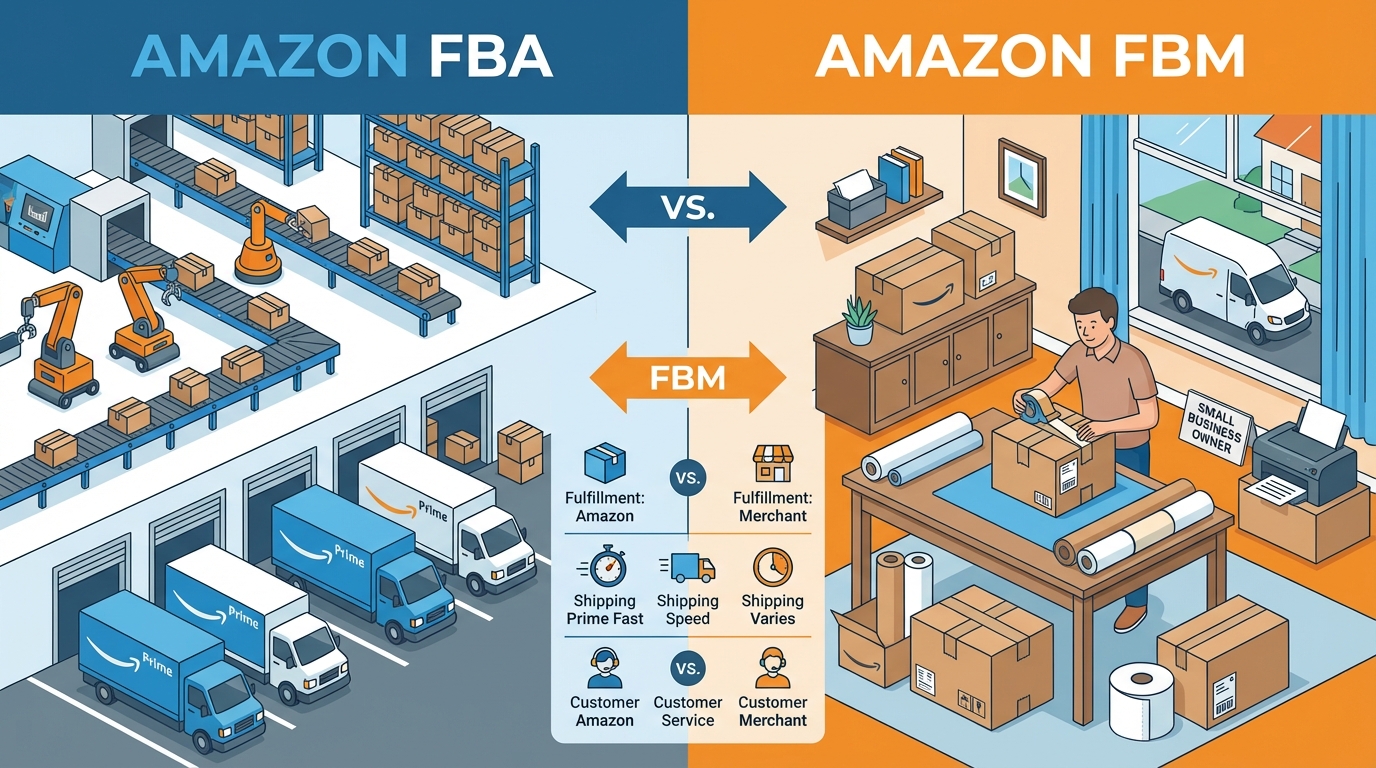
After choosing your business model, your next major decision is how orders will be fulfilled. Amazon offers two primary options: Fulfillment by Amazon (FBA) and Fulfillment by Merchant (FBM). The right choice depends on your product type, sales volume, margins, and operational preferences.
Fulfillment by Amazon (FBA)
With FBA, you ship your inventory to Amazon’s fulfillment centers, and Amazon handles the storage, picking, packing, shipping, and customer service for every order. Your products automatically become Prime-eligible, which is one of the single biggest conversion drivers on the platform.
The numbers tell a compelling story for FBA: sellers using FBA win the Buy Box 3 to 5 times more often than FBM sellers at identical pricing. With 82% of active sellers using FBA, it has become the default model for good reason. The Prime badge alone can increase conversion rates significantly, because Prime members expect — and receive — fast, reliable two-day delivery.
FBA is particularly well-suited for:
- Small, lightweight products with high sales velocity
- Sellers who want to minimize day-to-day logistics management
- Products in the $20–$80 price range where FBA fees represent a manageable percentage of revenue
- Sellers targeting Prime members as their primary customer base
The downsides of FBA include fulfillment fees that can erode margins (especially for heavy or oversized items), monthly storage fees, long-term storage surcharges for slow-moving inventory, and inbound placement fees for directing inventory to Amazon’s network. In 2026, FBA costs have risen modestly — the average fulfillment fee increase was $0.08 per unit — but these costs compound across a large catalog.
Fulfillment by Merchant (FBM)
With FBM, you store your own inventory and handle all shipping, returns, and customer service. This gives you complete control over the fulfillment experience, packaging, and customer communications — and it eliminates FBA storage and fulfillment fees.
FBM typically delivers 8–30% higher margins per unit compared to FBA for the same product, because you are not paying Amazon’s fulfillment infrastructure charges. It is the better option for:
- Large, heavy, or bulky items where FBA fees would be prohibitively expensive
- Low-volume, high-margin products
- Sellers with existing warehouse infrastructure or 3PL relationships
- Slow-moving products where long-term FBA storage fees would accumulate
The challenge with FBM is qualifying for Prime status. Without the Prime badge, conversion rates typically suffer. Amazon offers Seller Fulfilled Prime (SFP) as a pathway to Prime eligibility for FBM sellers, but the requirements are strict: sellers must maintain a 99% on-time delivery rate, use Amazon-approved carriers, and meet a range of performance metrics. SFP is viable for experienced sellers with strong logistics systems, but it is not a realistic starting point for most new sellers.
The Hybrid Approach
Many successful sellers in 2026 use both FBA and FBM strategically — a hybrid approach that optimizes for profitability across a mixed catalog. Fast-moving, lightweight products go through FBA for maximum Prime visibility, while large or slow-moving items are fulfilled through FBM to avoid excessive storage fees. This flexibility is often the most economically rational strategy for sellers with a diverse product range.
Setting Up Your Amazon Seller Account
Getting started on Amazon requires setting up a Seller Central account. The process is straightforward, but understanding which account type to choose and what information you will need is important before you begin.
Individual vs. Professional Account
Amazon offers two account tiers for sellers:
- Individual Plan: $0.99 per item sold, with a 40-item monthly sales cap. No access to advertising, A+ content, or bulk listing tools. Appropriate only for very casual or exploratory sellers.
- Professional Plan: $39.99 per month flat fee, unlimited sales, full access to all selling tools including PPC advertising, A+ Content, Brand Registry, and bulk inventory management. This is the account type virtually all serious sellers use from day one.
If you plan to sell more than 40 units per month — which is the goal for any real business — the Professional plan is the economically rational choice from the start. The monthly fee is offset after just 40 sales, and the access to advertising and listing tools is essential for growth.
What You Need to Register
To create a Seller Central account, you will need:
- A business email address or existing Amazon customer account
- A chargeable credit or debit card
- Government-issued photo ID (passport or driver’s license)
- Bank account information for receiving disbursements
- Tax information (SSN for individuals, EIN for business entities)
- A phone number for two-step verification
Amazon has significantly tightened its verification process in recent years to combat fraud. The identity verification step includes document upload and sometimes a video call. Most sellers complete the full registration process within one to three business days.
Choosing a Business Structure
While you can sell on Amazon as a sole proprietor, most advisors recommend setting up a formal business entity — typically an LLC or S-Corp — before scaling. A formal structure provides liability protection, simplifies accounting, and is required for opening a dedicated business bank account. Consulting with a business attorney or accountant before registering is a worthwhile investment for any seller planning to grow beyond a side income.
Product Research: Finding Winning Products
Product research is arguably the single most important activity in building an Amazon business. The right product in the right category at the right time can make everything easier — advertising costs are lower, reviews accumulate faster, and organic ranking comes more naturally. The wrong product choice can doom an otherwise well-executed business before it ever gets off the ground.
The Eight Criteria for a Strong Product
Experienced sellers and research tools consistently point to a similar set of criteria for identifying products with strong potential:
- Price range of $20–$80: Products in this range generate enough revenue to absorb FBA fees and advertising costs while remaining accessible to impulse buyers. Below $20, margins become extremely tight. Above $80, conversion rates typically fall and return rates increase.
- Steady demand: Look for products with consistent search volume year-round (or predictable seasonality). Target a minimum of 200–300 unit sales per month across the top competing listings.
- Low-to-moderate competition: The ideal scenario is a category where the top 10 results have fewer than 300–500 reviews, no dominant national brands (such as Nike or Philips) control page one, and listings show clear room for quality improvement.
- Small and lightweight: Products that weigh under 2–3 pounds and fit in a standard box dramatically reduce FBA fulfillment fees and shipping costs from suppliers.
- Simple manufacturing: Complex electronics, products requiring certifications, or items with many breakable components add supplier risk and potential return rate issues.
- Margin target above 20–30%: After accounting for all costs — product cost, FBA fees, referral fees, advertising, and returns — aim for a net margin of at least 20–30% to ensure the business is profitable and financially resilient.
- Differentiation opportunity: Look for existing products with poor images, weak bullet points, unresolved customer complaints in reviews, or missing features that buyers frequently request. Your version of the product should solve those problems clearly.
- No brand lock-in: Avoid categories dominated by a single brand that controls most of the page-one real estate. Fragmented categories with many smaller sellers offer far more opportunity for a new entrant.
How to Use Research Tools
Manual research on Amazon’s search results can surface ideas, but professional-grade tools are indispensable for validating data. The two most widely used platforms are Helium 10 and Jungle Scout. Both offer features for:
- Estimating monthly sales volume for specific ASINs
- Analyzing keyword search volumes and competition scores
- Identifying trending or emerging product categories
- Tracking competitor prices, reviews, and ranking history
- Calculating profitability after fees
A sound research workflow typically starts with broad category exploration, narrows to specific product ideas using demand and competition filters, validates those ideas against the eight criteria listed above, and then conducts supplier research to confirm achievable landed costs before committing to an order.
Hot Categories in 2026
Data from recent marketplace analyses highlights several categories with particularly strong growth trajectories in 2026:
- Arts, Crafts & Sewing: Revenue up approximately 26% year-over-year
- Home Appliances: Unit sales up roughly 20%
- Beauty & Personal Care: Consistently high demand with strong brand-building potential
- Pet Supplies: Loyal, repeat-purchase customer base with strong subscription potential
- Sports & Outdoors: Broad category with numerous niche entry points
These are directional signals, not guarantees. Subcategory competition and margin profiles vary significantly within each. Always validate at the subcategory and keyword level before committing capital.
Amazon Listing Optimization and SEO
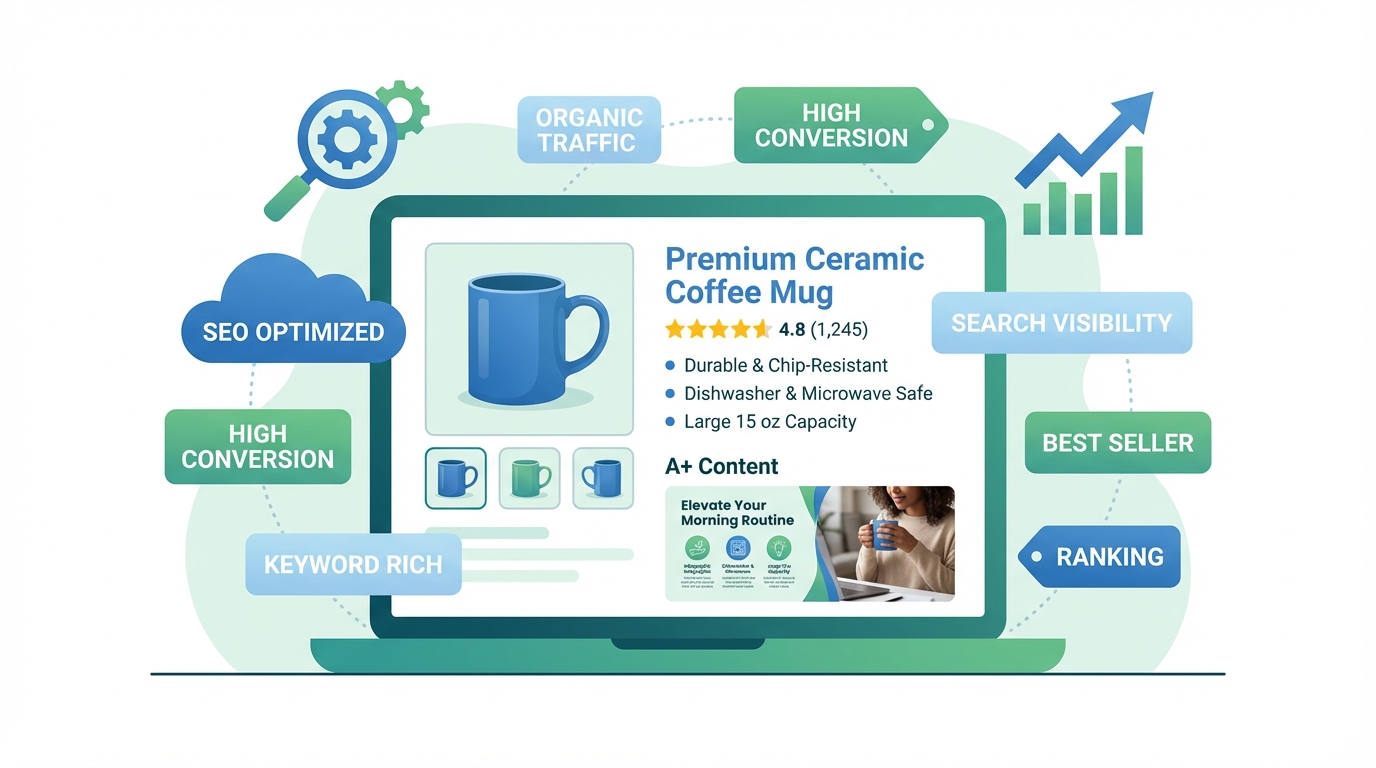
Once you have a product and a supplier, the quality of your listing determines how discoverable your product is — and how many visitors you convert into buyers. Amazon’s search algorithm (commonly referred to as A10) rewards listings that are both relevant and high-converting.
Keyword Research for Amazon SEO
Amazon SEO starts with thorough keyword research. Unlike Google, Amazon’s search intent is almost entirely transactional — shoppers are looking to buy, not just browse. This makes keyword placement in specific listing fields critically important.
The primary keyword fields are:
- Product Title: Your most important SEO real estate. Include your primary keyword, key features, brand name, size, and material where relevant. Keep it readable — Amazon penalizes keyword-stuffed titles that harm the customer experience.
- Bullet Points (Key Product Features): Five bullet points are the standard. Each should highlight a key benefit, address common buyer concerns, and naturally incorporate secondary keywords.
- Product Description: Supports keyword indexing and provides space for more narrative-style content. For brand-registered sellers, this is replaced by A+ Content (covered in a later section).
- Backend Search Terms: Hidden from shoppers but indexed by Amazon’s algorithm. Use this space for synonyms, alternate spellings, and long-tail keyword variations not included in the visible listing.
Product Images: The Conversion Driver
On Amazon, images are arguably the single highest-leverage element of a listing. Shoppers make split-second decisions based on the main image before even reading a word of your copy. Amazon’s minimum image requirements call for a white background main image at 1000×1000 pixels or larger (to enable zoom), but that is merely the floor, not the standard.
High-performing listings typically include:
- A crisp, professional hero image on a pure white background
- Lifestyle images showing the product in use by real people in realistic settings
- Infographic images with text callouts highlighting key features and dimensions
- Comparison charts positioned against competitor products
- Close-up detail shots highlighting quality, materials, or certifications
- Packaging images if relevant to the customer decision
Product photography is one area where cutting corners consistently costs conversions. Investing in professional photography or high-quality 3D renders pays dividends across every aspect of performance — organic rank, advertising click-through rate, and overall sales velocity.
Winning the Featured Offer (Buy Box)
Amazon’s Featured Offer — previously known as the Buy Box — is the prominent “Add to Cart” button on any product page. Winning it is essential, as the vast majority of purchases go through it rather than the secondary seller list. Amazon’s algorithm in 2026 evaluates several factors for Buy Box eligibility:
- Competitive landed price: The total cost to the customer including item price and shipping. Free shipping from FBA is a strong advantage here.
- Fulfillment method: FBA sellers win the Buy Box 3–5 times more often than FBM sellers at the same price point, due to Prime eligibility and fulfillment reliability.
- Seller metrics: Order defect rate (below 1%), late shipment rate (below 4%), and pre-fulfillment cancellation rate (below 2.5%) are key thresholds.
- Inventory depth: Consistent in-stock status signals reliability to the algorithm. Frequent stockouts reduce Buy Box share.
- Customer feedback score: Higher seller ratings and review velocity support Buy Box eligibility, particularly in contested multi-seller scenarios.
Amazon Advertising: A Practical Guide to PPC
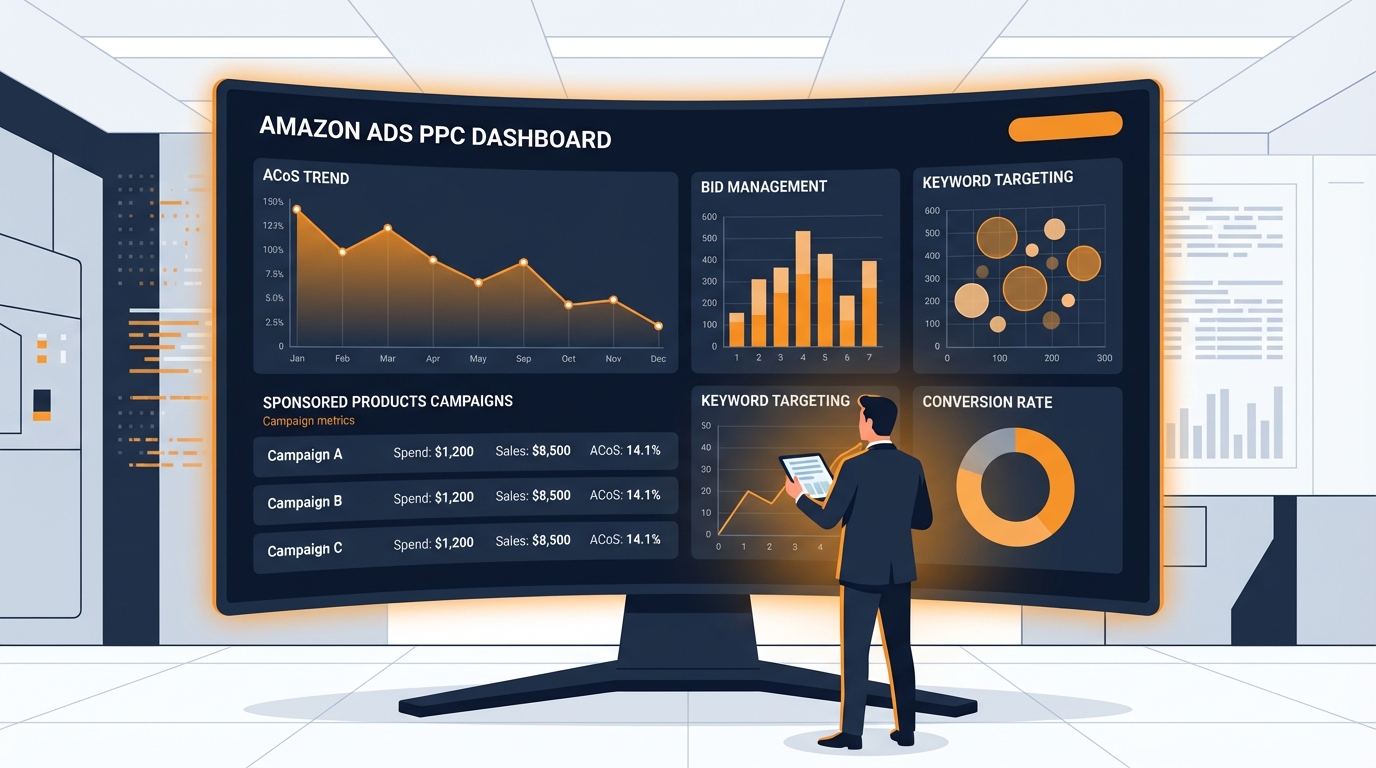
Pay-per-click (PPC) advertising on Amazon is no longer optional for most sellers. In 2026, organic ranking alone is insufficient to achieve meaningful visibility in competitive categories, and advertising directly influences organic rank by driving sales velocity. Understanding Amazon’s ad ecosystem is a core skill for any serious seller.
Sponsored Products: The Foundation
Sponsored Products are the most important and widely used ad format on Amazon. They appear within search results and on product detail pages, are triggered by keywords or ASIN targeting, and operate on a cost-per-click model. Sponsored Products account for approximately 60–70% of total Amazon ad revenue and deliver the strongest return on ad spend (ROAS) of any Amazon ad type.
Key statistics for Sponsored Products in 2026:
- Average conversion rate: 9–11% platform-wide (up to 11.55% for PPC-driven clicks)
- Average cost-per-click (CPC): $0.91–$1.80 depending on category and competition
- Projected 2026 conversion rate: 10.2–10.5%
Expert consensus for 2026 recommends allocating 70–80% of your total ad budget to Sponsored Products, using the remaining 20–30% for Sponsored Brands and Sponsored Display.
Campaign Structure Best Practices
A well-structured Sponsored Products account separates campaigns by purpose:
- Auto campaigns: Use these for keyword discovery. Amazon’s algorithm identifies which search terms trigger your ads automatically. Review auto campaign data weekly for new keyword opportunities and negative keyword additions.
- Broad/phrase match campaigns: Use harvested keywords from auto campaigns to expand reach at moderate targeting specificity. Good for building impressions and identifying high-performers to push to exact match.
- Exact match campaigns: Reserve your highest bids for proven, high-converting keywords. Exact match minimizes wasted spend and maximizes ROI on your best terms.
- Product targeting campaigns: Target competitor ASINs or complementary products directly. Product targeting campaigns often achieve ACoS (Advertising Cost of Sales) as low as 12% when targeting high-priced competitors.
Sponsored Brands and Sponsored Display
For brand-registered sellers, Sponsored Brands ads appear as banner ads at the top of search results and feature your brand logo, a custom headline, and multiple products. Sponsored Brands Video ads — short-form videos that autoplay in search results — deliver a click-through rate of 0.89%, which is approximately 2.6 times higher than static Sponsored Brands ads.
Sponsored Display ads allow sellers to reach customers both on and off Amazon, retargeting shoppers who viewed your product or competitor products. While conversion rates are lower than Sponsored Products, they play a valuable role in maintaining visibility throughout the buying journey.
Managing ACoS and ROAS
ACoS (Advertising Cost of Sales) measures ad spend as a percentage of attributed sales. Your target ACoS depends on your product margin and whether you are in a launch phase (where higher ACoS is acceptable to drive velocity) or a profitability phase (where you tighten bids to maximize net margin). A product with a 40% gross margin might target a break-even ACoS of 30–35%, leaving room for net profit after other fees.
ROAS (Return on Ad Spend) is the inverse metric — the revenue generated per dollar of ad spend. Tracking both metrics weekly and adjusting bids based on performance data is the fundamental discipline of Amazon PPC management. In 2026, many sellers are incorporating automation tools and Amazon’s own dynamic bidding features to manage this process at scale.
Understanding Amazon Seller Fees in 2026
One of the most common mistakes new Amazon sellers make is underestimating the full cost of selling on the platform. Amazon’s fee structure is multi-layered, and each element must be factored into your pricing and margin calculations before you commit to a product.
The Five Main Fee Categories
Here is a breakdown of every fee type you will encounter as an Amazon seller in 2026:
-
Account Subscription Fee:
- Individual: $0.99 per item sold
- Professional: $39.99 per month (flat fee, unlimited sales)
- Referral Fees: Amazon charges a percentage of the total sale price for every item sold. Rates range from 6% to 45% depending on category, with most categories at 8–15%. Electronics typically carry a 8% referral fee, while categories like jewelry can reach 20% or more. There is a $0.30 per-item minimum referral fee.
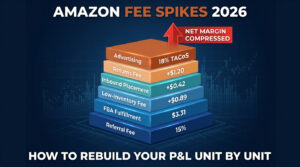
- FBA Fulfillment Fees: Charged per unit fulfilled by Amazon, based on the product’s size tier and weight. In 2026, fees range from approximately $3.22 for the smallest standard-size items to $16+ for large standard or oversized products. The average increase in 2026 was $0.08 per unit for standard items — a modest rise Amazon described as representing less than 0.5% of the average item price.
- Storage Fees: Amazon charges monthly storage fees based on the cubic footage of space your inventory occupies. Standard rates range from $0.56 to $2.40 per cubic foot, with higher rates during peak Q4 months (October–December). Products stored longer than 181 days trigger additional aged inventory surcharges starting at $0.32 to $5.72 per unit.
- Optional and Variable Fees: These include inbound defect fees (for improper shipment preparation, now ranging from $0.32 to $5.72 per unit), returns processing fees, high-volume listing fees, and advertising costs. Not every seller incurs all of these, but they must be understood.
Calculating True Profitability
A reliable profitability calculation for an FBA product might look like this for a $35 item:
- Sale price: $35.00
- Referral fee (15%): -$5.25
- FBA fulfillment fee: -$5.65
- Product cost (COGS): -$8.00
- PPC advertising (10% ACoS): -$3.50
- Miscellaneous (returns, storage, packaging): -$1.50
- Estimated net profit: ~$11.10 (31.7% net margin)
This example illustrates a healthy product. But change the variables — a higher COGS, more aggressive ad spend, or a heavier product triggering higher FBA fees — and margins can compress quickly. Running these numbers before ordering inventory is not optional; it is the first discipline of a viable Amazon business.
Amazon Brand Registry and A+ Content
For sellers serious about building a long-term Amazon business, Amazon Brand Registry is one of the most important programs available. By early 2026, over 800,000 brands had enrolled — a 20% increase from 2025 — reflecting the growing recognition that brand protection and enhanced tools are essential for competitive selling.
What Brand Registry Provides
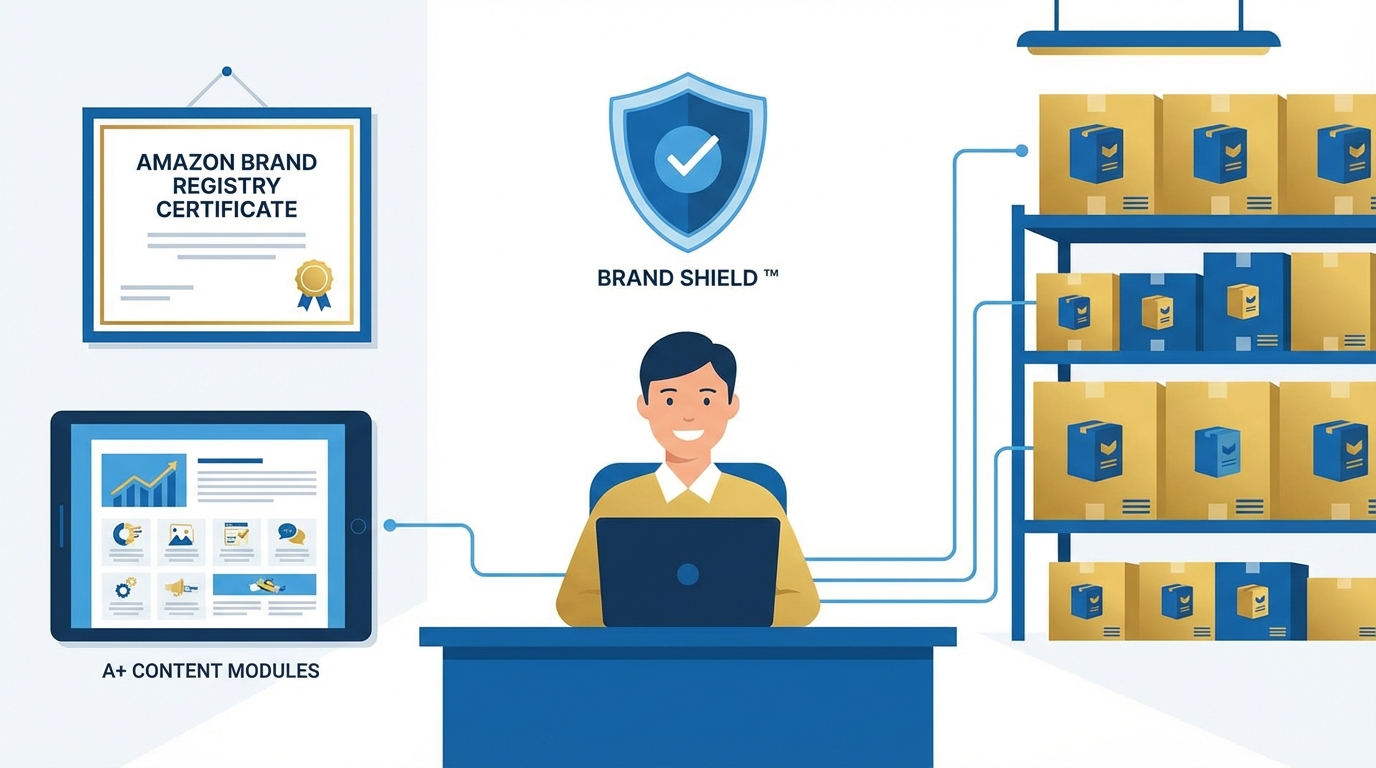
Amazon Brand Registry requires a registered or pending trademark for your brand, which must appear on your products and packaging. Once enrolled, you gain access to:
- A+ Content: Enhanced listing content with rich media modules, lifestyle images, comparison charts, and brand storytelling that replaces standard text descriptions.
- Brand Store: A customizable multi-page storefront within Amazon, functioning as a dedicated brand destination for customers.
- Sponsored Brands ads: Available only to brand-registered sellers, these high-visibility banner ads build awareness and drive traffic to your Brand Store.
- Proactive IP protection: Amazon’s systems proactively block 99% of infringing listings before they become visible, protecting your brand from counterfeiters and hijackers.
- Brand Analytics: Access to search frequency rank data, customer demographics, purchase behavior insights, and competitive market basket analysis.
The Impact of A+ Content
Sellers using A+ Content see an average 8% revenue increase compared to standard listings in the same category. Premium A+ Content — which includes video, interactive hotspots, and enhanced comparison charts — delivers even stronger results, with some brands reporting conversion lifts of up to 20–30%.
Effective A+ Content goes beyond simply improving aesthetics. It tells a brand story, preemptively addresses common objections, highlights differentiating features through comparison modules, and cross-promotes complementary products within the same catalog. For a brand with multiple SKUs, A+ Content is also one of the most efficient tools for increasing average order value through in-listing upsells and bundles.
Building Your Brand Store
Brand Stores give registered brands a dedicated, ad-free space on Amazon that mimics the experience of a standalone e-commerce site. Stores generate roughly 40% higher engagement compared to standard product pages, and they serve as the destination for Sponsored Brands traffic. A well-structured Brand Store organizes products by category, features seasonal promotions, and tells the brand’s origin story in a way that builds customer loyalty across repeat purchases.
Inventory Management Best Practices
Poor inventory management is one of the most common — and most preventable — causes of profit loss for Amazon sellers. Both extremes — running out of stock and holding too much inventory — carry real financial consequences that compound over time.
Avoiding Stockouts
Running out of stock is not just a missed sales opportunity. When a product goes out of stock on Amazon, its organic search ranking drops — sometimes dramatically — because the algorithm interprets the stockout as a signal of poor availability. Rebuilding ranking after a stockout requires additional advertising spend and time, making prevention far more cost-effective than recovery.
Best practices for preventing stockouts include:
- Setting automated reorder alerts based on sales velocity and supplier lead times
- Maintaining a safety stock buffer of 30–45 days of supply above your reorder point
- Tracking seasonal demand patterns and pre-positioning inventory for Q4 peaks
- Using inventory management software (such as RestockPro, SoStocked, or Inventory Lab) for automated forecasting
One documented case study found that a seller who implemented real-time inventory sync and automated forecasting reduced stockouts by 85% in three months, resulting in a 40% increase in sales — a strong illustration of how operational improvements compound directly into revenue.
Managing Aged Inventory and Storage Costs
On the opposite end, holding too much inventory in Amazon’s fulfillment centers creates a different kind of cost drain. Amazon reduced FBA storage limits by up to 75% for some sellers in 2026, with capacity now allocated based on sales history, Inventory Performance Index (IPI) score, product type, and warehouse availability.
To manage storage costs effectively:
- Monitor your IPI score in Seller Central regularly — a score below 400 can result in capacity restrictions
- Use the Aged Inventory report to identify slow-moving ASINs before they trigger surcharges
- Run promotions or adjust pricing to accelerate the movement of aging inventory
- Consider removing inventory that has been in Amazon’s warehouses for more than 180 days if it is not selling at a rate that justifies storage costs
- Diversify storage by using third-party logistics (3PL) providers for overflow inventory, replenishing FBA stock in smaller, more frequent shipments
The End of Commingling: What It Means for Sellers
A significant policy change effective March 31, 2026, is Amazon’s elimination of its stickerless commingling program. Under the old system, certain products from different sellers could be stored together in the same bin, with units shipped interchangeably. This carried counterfeit risk, as inferior units from other sellers could be shipped in place of yours.
With the end of commingling, all sellers are now required to apply FNSKU (Fulfillment Network Stock Keeping Unit) labels to every unit before sending inventory to Amazon. This adds a labeling step to the inbound process, either at your supplier (recommended for cost efficiency) or at an Amazon prep center. The upside is stronger product authentication and accountability throughout the fulfillment chain.
Common Mistakes Amazon Sellers Make (And How to Avoid Them)
Understanding the pitfalls that trip up other sellers can save you months of lost momentum and thousands of dollars in avoidable costs. Here are the most consequential mistakes made by Amazon sellers at all experience levels.
Choosing Products Based on Gut Feeling Alone
Passion for a product category is valuable — it sustains motivation through the inevitable challenges of building a business. But passion alone is not a product research strategy. Committing to inventory without validating demand, competition, and margin data is the most common reason new sellers fail. Every product should pass a quantitative screening process before a single dollar is spent on samples or manufacturing.
Underpricing to Chase Sales Volume
Many new sellers reflexively price low to generate initial sales velocity. While competitive pricing matters, pricing below profitability is destructive. A product priced too low trains the algorithm to expect that price point, destroys margin before reviews even accumulate, and attracts comparison shoppers rather than the loyal buyers that build long-term revenue. Price for your target margin from the beginning, and let advertising drive initial volume.
Neglecting Account Health Metrics
Amazon can suspend or deactivate seller accounts for violations of its policies, and the process of reinstating a suspended account can take weeks or months. Staying proactive about account health means monitoring your Order Defect Rate, Late Shipment Rate, and Policy Violations dashboard in Seller Central daily. A single spike in any key metric — often caused by a supplier error or a burst of inauthentic reviews — can trigger account action if not addressed quickly.
Ignoring Reviews and Customer Feedback
Social proof is a primary purchase driver on Amazon. Products with fewer than 10–15 reviews convert at a fraction of the rate of similar products with 100+ reviews. Actively — and compliantly — soliciting reviews through Amazon’s “Request a Review” button, optimizing your product to minimize quality complaints, and responding professionally to negative feedback are all standard practices for competitive sellers.
Over-Reliance on a Single ASIN or Channel
Building a business around a single product or an Amazon-only channel creates concentration risk. A competitor copying your product, a policy change affecting your category, or an ASIN-level suppression can dismantle revenue overnight. Successful sellers in 2026 maintain a diversified catalog and are increasingly building off-Amazon channels — their own Shopify stores, social commerce presence, and email lists — to reduce dependence on any single platform.
Failing to Account for All Costs
Many sellers calculate margin based only on product cost versus sale price, ignoring the compounding effect of referral fees, FBA fees, advertising, returns, storage, and inbound penalties. The result is a business that looks profitable on the surface but is actually cash flow negative. Use Amazon’s FBA Revenue Calculator or a dedicated profit tracking tool like Sellerboard or SellerApp to maintain accurate, real-time visibility into true margins across your catalog.
Building a Long-Term, Sustainable Amazon Business
The most successful Amazon sellers approach the platform not as a quick income opportunity but as a long-term brand-building exercise. The sellers generating $500,000+ per year consistently in 2026 share a set of habits and strategic priorities that distinguish them from the majority who plateau or exit the marketplace.
Invest in Your Brand Identity
Registering your trademark, enrolling in Brand Registry, and building out A+ Content and a Brand Store are not optional extras — they are foundational investments that compound in value over time. Brands with cohesive visual identities, clear value propositions, and consistent customer experiences attract repeat buyers, earn more reviews organically, and command pricing power that generic resellers cannot achieve.
Build an Off-Amazon Audience
Amazon’s customer data belongs to Amazon, not to you as a seller. You cannot directly email customers, retarget them on social media, or build a CRM from your Amazon sales data. Forward-thinking sellers address this by driving traffic to their Amazon listings from external channels — social media, influencer partnerships, email campaigns, and content marketing — while simultaneously building their own direct-to-consumer presence. This external traffic also provides an organic ranking signal that Amazon’s algorithm rewards.
Focus on Customer Lifetime Value
Products with natural replenishment cycles — supplements, consumables, personal care items, pet supplies — offer the opportunity to build Subscribe & Save revenue, which creates predictable, recurring cash flow. Even outside of consumables, thinking about how to serve the same customer with complementary products expands the average order value and improves the economics of customer acquisition through advertising.
Systematize and Delegate
The sellers who scale beyond $1 million in revenue are rarely doing everything themselves. Systematizing your processes — from inventory ordering to listing creation to PPC management — and delegating or outsourcing routine tasks to virtual assistants or agencies frees you to focus on the highest-leverage activities: product development, supplier relationships, and strategic planning.
Conclusion: Your Amazon Selling Roadmap for 2026
Selling on Amazon in 2026 is a substantial business opportunity — but it is a genuine business, with all the complexity, capital requirements, and strategic demands that implies. The days of casually listing products and watching passive income roll in are largely behind us. The sellers succeeding today are the ones who treat Amazon with the same rigor and discipline they would apply to any other serious commercial venture.
Here are the key takeaways to carry forward as your action plan:
- Choose your model carefully. Private label offers the most long-term upside but requires capital and patience. Match the model to your resources, risk tolerance, and goals.
- Default to FBA unless your product economics specifically favor FBM. The Prime badge and Buy Box advantages are difficult to replicate through merchant fulfillment.
- Validate every product with data before spending a dollar on inventory. Use professional research tools and apply consistent quantitative criteria.
- Optimize your listings fully before spending heavily on advertising. Images, titles, bullet points, and backend keywords all work together to convert traffic into sales.
- Invest in advertising strategically. Allocate 70–80% of your ad budget to Sponsored Products, structure campaigns by match type and intent, and manage ACoS against your true margin targets.
- Know your numbers. Every fee, every cost, every margin calculation matters. Build a real P&L model for each product and review it regularly.
- Enroll in Brand Registry as soon as you have a trademark. The access to A+ Content, Brand Store, and proactive IP protection is worth the investment in time and legal fees many times over.
- Manage inventory proactively. Stockouts hurt rankings. Overstocking drains cash. Build forecasting systems and review inventory health weekly.
- Think long-term. Build a brand, diversify your product catalog, develop off-Amazon channels, and work toward a business that has value independent of any single product or platform.
The Amazon marketplace in 2026 rewards preparation, discipline, and a long-term perspective. For the seller willing to invest in learning the platform properly and executing with consistency, it remains one of the most accessible paths to building a genuinely significant e-commerce business.