




When someone talks about "Amazon account management," they’re not just talking about the day-to-day admin tasks. It’s the full-stack, strategic job of overseeing your brand’s entire life on the platform—from advertising and inventory to customer service and staying on the right side of Amazon's rules.
Think of it less like simple channel management and more like being the CEO of your brand's most demanding, high-potential franchise. Every single operational detail has to be geared towards one thing: profitable growth. For example, a great Amazon account manager doesn't just restock inventory; they analyze sales velocity and lead times to create a precise reordering schedule that prevents stockouts during peak seasons, like Prime Day, which can make or break a quarter's profits.
What Is Amazon Account Management Really About?
Your Amazon store isn't just another sales channel. It's a complete, self-contained business ecosystem with its own set of rules, quirks, and customer expectations. For DTC brands used to controlling every pixel of their customer journey, this can be a huge mental shift. You have to learn to play in Amazon's sandbox.
The secret to long-term success on Amazon isn't just about throwing money at ads. It's about building a rock-solid operational foundation first, before you even think about scaling.
This proactive, foundation-first mindset is everything. In Q3 2025, third-party sellers drove a staggering 62% of total sales on Amazon. That's a massive jump from just 45% back in 2015. The numbers don't lie: US-based sellers now average over $290,000 in annual sales, and more than 55,000 of them have blown past the $1 million mark.
Competition is fierce. With 9.7 million total seller accounts out there, mastering the fundamentals of account health—from pristine listings to flawless FBA logistics—is the only way to grab market share and not get buried. You can dive deeper into the Amazon marketplace seller statistics to really see the scale of this opportunity.
Build Your Foundation Before Chasing Growth
You wouldn't start building the 50th floor of a skyscraper before pouring a deep, reinforced concrete foundation, right? The exact same logic applies to your Amazon business. Before you crank up your ad spend or drop a new product line, you have to get your operational house in order.
This is the unsexy but absolutely critical work:
- Logistics Mastery: Making sure your Fulfillment by Amazon (FBA) prep is perfect and your inventory is managed so tightly that you never have a costly stockout. For example, this means ensuring every unit has a scannable FNSKU label and is poly-bagged according to Amazon's specific guidelines to avoid costly penalties or delays at the fulfillment center.
- Compliance and Account Health: Proactively handling returns, answering customer questions quickly, and keeping up with Amazon’s ever-changing policies to keep your account out of the penalty box. A practical example is setting up a daily 15-minute routine to check the Account Health Dashboard for new alerts and respond to all buyer messages, ensuring the 24-hour response time metric is always met.
- Brand Protection: Locking down your intellectual property with programs like Amazon Brand Registry to keep hijackers and counterfeiters off your listings. This involves actively using Brand Registry tools to report infringing listings as soon as they appear, rather than waiting for them to steal your sales.
Trying to scale before this foundation is set is like building on sand. One surprise account health issue or a poorly timed inventory crisis can bring your sales momentum to a screeching halt, wiping out months of hard work overnight.
This "foundation-first" approach is the essential mindset shift. It moves your strategy from chasing quick, short-term sales spikes to building a resilient, profitable, and long-term asset on the world's biggest marketplace.
The Pillars of Proactive Amazon Management
Running a successful Amazon account isn't about doing one thing perfectly; it's about skillfully balancing several critical business functions at once. Think of it like conducting an orchestra. If the strings (your listings) are out of tune or the percussion (your logistics) misses a beat, the whole performance falls flat. To get that standing ovation—and achieve sustainable success—your strategy needs to be built on a few core pillars that work in perfect harmony.
The diagram below shows how a solid foundation is essential for supporting real growth within the massive Amazon ecosystem.
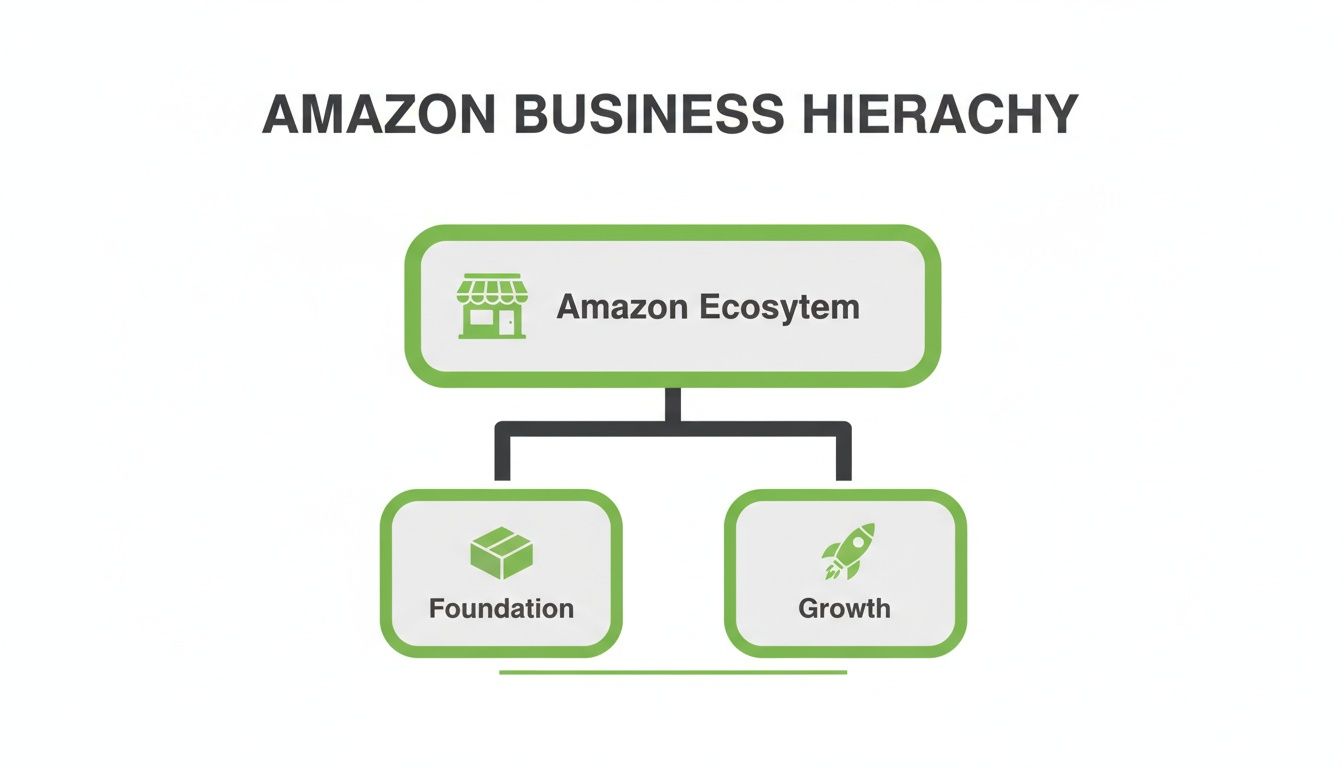
The key takeaway is simple: you can't build a skyscraper on a shaky foundation. Scalable growth only happens when your operations are rock-solid.
Cultivating a Powerful Brand Presence
On Amazon, your brand presence is everything. It's not just a product page; it's your digital storefront, brand story, and primary sales engine, all rolled into one. Getting this right means mastering Amazon SEO so customers can actually find you in a marketplace that gets more crowded by the day.
This involves a few key things:
- Keyword-Rich Listings: Weaving the exact search terms your customers use naturally into your titles, bullet points, and descriptions. For example, instead of just "yoga mat," a keyword-rich title would be "Extra Thick Non-Slip Yoga Mat for Men & Women – 6mm TPE Eco-Friendly Mat for Pilates, Workout, and Floor Exercises."
- A+ Content: Going beyond basic text with enhanced images and compelling copy to tell a richer brand story, answer questions upfront, and crush purchase objections before they even form. For instance, using a comparison chart in your A+ Content to show how your product stacks up against competitors on key features.
- Amazon Brand Stores: Building out a dedicated, multi-page storefront to showcase your entire catalog. This lets you create a true brand experience, not just sell one-off items. A great example is creating a "Shop by Concern" page within your skincare brand's store, guiding customers to products for acne, anti-aging, or hydration.
A classic mistake is just listing features. A bullet point that says "Made with 100% organic cotton" is a feature. We need to turn that into a benefit: "Sleep soundly on breathable, hypoallergenic organic cotton that's gentle on your skin and the planet." See the difference? One states a fact; the other connects with a customer's desires. A huge part of this is also brand protection, which starts with unlocking Amazon Brand Registry benefits.
Driving Growth with Profitable PPC Campaigns
Amazon Pay-Per-Click (PPC) is an incredible tool for growth, but it can also become a black hole for your budget if you're not careful. The goal isn't just to get clicks or even sales; it's to drive profitable sales. This demands a structured, data-driven approach that's way more sophisticated than just cranking up bids on your best keywords.
A smart Amazon management strategy revolves around a continuous cycle of discovery, testing, and optimization. A great example of this is a keyword harvesting workflow, which helps you constantly find new, profitable search terms.
A Simple Keyword Harvesting Workflow:
- Launch an "Auto" Campaign: Let Amazon’s algorithm do the heavy lifting by automatically showing your ads for a wide range of search terms related to your product. For a new product, let this run for at least 7-14 days to gather enough data.
- Analyze the Search Term Report: After a week or two, dive into the data. In Seller Central, go to Advertising > Campaign Manager > Select your Auto Campaign > Search Term Report. Look for which actual customer search terms drove clicks and, more importantly, sales with a good ACoS.
- Harvest Winning Keywords: Take the high-converting search terms you found and move them into a new "Manual" campaign. For example, if the search term "waterproof hiking socks for men" converted twice, add it as an exact match keyword to your manual campaign. Here, you can set precise bids and have total control over your spending.
- Add Negative Keywords: Find all the irrelevant or poorly performing search terms in that report? Add them as "negative keywords" in your auto campaign to stop wasting money on clicks that don't convert. For instance, if you sell premium socks and see clicks from "cheap socks," add "cheap" as a negative exact match keyword.
This simple loop ensures your ad budget gets smarter and more efficient over time. To really nail the basics, you can learn more about how Amazon Sponsored Ads work in our complete guide.
Building Bulletproof Logistics and Inventory Management
You could have the most beautiful listing on Amazon and the most dialed-in ad campaign ever created, but if you run out of stock, it's all for nothing. Bulletproof logistics are the operational backbone of any serious Amazon business. This means mastering your inventory health and picking the right fulfillment strategy for your brand.
Inventory management is a constant balancing act. Order too much, and you're hit with long-term storage fees and tied-up capital. Order too little, and you face a stockout, lose sales velocity, and your Best Seller Rank plummets.
Key decisions here often come down to a few options:
- Fulfillment by Amazon (FBA): Using Amazon's world-class logistics network is the key to Prime eligibility and fast shipping, but it means playing by their rules and meeting strict FBA prep guidelines.
- Fulfillment by Merchant (FBM): This gives you full control over your own packing and shipping. It can be more cost-effective for large or heavy items but requires serious operational discipline to meet Amazon's shipping standards.
- Third-Party Logistics (3PL): A hybrid solution where an external partner handles storage, FBA prep, and fulfillment. This can offer the best of both worlds—flexibility and expertise without having to manage a warehouse yourself.
Protecting Your Account Health and Compliance
Finally, maintaining stellar account health isn't just a good idea; it's non-negotiable. Amazon holds its sellers to incredibly high standards. Drop the ball, and you could face suppressed listings, lose the Buy Box, or even get your entire account suspended. This pillar is all about proactive customer service and following Amazon's rules to the letter.
This means you have to obsessively monitor key metrics like your Order Defect Rate (ODR), which absolutely must stay below 1%. It also means handling returns efficiently to protect your margins and responding to every single customer message within 24 hours. Staying compliant isn't just about avoiding punishment; it's about building trust with Amazon and your customers, which is the only way to build a business that lasts. For example, if a customer sends a message at 8 PM on a Friday asking about product dimensions, a response must be sent by 8 PM on Saturday to avoid a negative mark on your account health.
Tracking KPIs That Actually Drive Profitability
Successful Amazon account management is all about tracking the right data. It’s incredibly easy to get lost in a sea of numbers, but focusing on a handful of key performance indicators (KPIs) is what separates the brands that thrive from those that just survive. These are the metrics that don't just look pretty on a report; they directly pump up your profitability.
Think of these KPIs as the instrument panel on an airplane. Each gauge tells you something critical about your business's health, helping you make small adjustments to stay on course and dodge any turbulence.
Beyond ACoS: The Power of TACOS
Almost every seller knows their Advertising Cost of Sale (ACoS), but this metric only tells half the story. ACoS measures your ad spend against the sales generated directly from ads. The problem? It completely ignores the powerful "halo effect" that advertising has on your organic sales.
This is where Total Advertising Cost of Sale (TACOS) comes in. This metric measures your total ad spend against your total sales—both ad-generated and organic. It answers a much more important question: "Is my ad spend efficiently lifting my entire business, or am I just buying sales?"
A decreasing TACOS over time is a huge win. It's a clear signal that your advertising is successfully boosting your organic rank and brand visibility. It shows you're building real momentum, not just renting traffic.
To get a clearer picture of campaign performance, you need a solid strategy. You can start by reviewing our guide on maximizing your advertising success with Amazon PPC management to ensure your ad spend is working as hard as possible.
Maintaining Flawless Account Health
While sales metrics are exciting, nothing can derail your business faster than poor account health. Two of the most critical KPIs to watch here are your Inventory Performance Index (IPI) and Order Defect Rate (ODR).
- Inventory Performance Index (IPI): This is Amazon's report card for how well you manage your FBA inventory. A score above the required threshold (usually 400) means you get unlimited storage. Dip below it, and you'll face strict storage limits and painful overage fees. To improve your IPI, you can run a sale on slow-moving inventory or create a removal order for products that haven't sold in over 180 days.
- Order Defect Rate (ODR): This is the ultimate measure of your operational excellence. It lumps together negative feedback, A-to-z Guarantee claims, and credit card chargebacks into one unforgiving number.
Amazon's benchmark for ODR is a razor-thin 1%. The top performers, however, consistently aim for under 0.5%. They know this single metric is the key to avoiding suspensions and keeping the Buy Box. If your ODR starts creeping up, it’s a red alert to pause everything and fix whatever is broken in your fulfillment process.
A Real-World ODR Failure
Imagine you sell premium coffee beans. A new batch of packaging arrives, but the seal is a little weak. You decide to ship it out anyway. What could go wrong?
Within days, a handful of customers receive broken bags and file A-to-z claims. Your ODR, which was a healthy 0.2%, suddenly spikes to 1.1%. Overnight, you lose the Buy Box on your best-selling product. Sales plummet from 50 units a day to just five.
That single operational mistake, reflected in one KPI, just cost you thousands in revenue and torpedoed your product's sales rank. It creates a long-term problem that will take weeks, if not months, to fix. This is exactly why disciplined Amazon account management is non-negotiable.
Leveraging AI for Smarter Account Management
Artificial intelligence isn't just another tech buzzword—it's become a serious competitive edge for anyone managing a modern Amazon account. The best way to think about AI isn't as a replacement for human strategy, but as a super-powered assistant. It can crunch data, spot trends, and handle tasks at a scale and speed that's just not possible for a person or even a small team.
Instead of getting swamped by repetitive manual work, you get to focus on big-picture strategy and growth. This isn't just a fringe concept anymore; recent data shows that 65% of businesses are already using AI in their day-to-day operations, with account management agencies leading the charge.
AI-Driven Listing Optimization at Scale
One of the first places you'll feel AI's impact is in product listing optimization. A good human copywriter might spend a whole day researching and writing two or three solid versions of a product title and bullet points. An AI tool? It can spit out dozens of unique, keyword-rich variations in just a few minutes.
This completely unlocks your ability to A/B test your copy on a massive scale. By quickly deploying different versions of your listing, you can gather real-world performance data to find out which phrases and benefits actually connect with customers and get them to click "buy." What used to take months of educated guessing can now be dialed in within a few weeks.
Intelligent and Automated PPC Management
AI also brings a whole new level of precision to your Pay-Per-Click (PPC) advertising. Managing bids manually is fine, but it’s almost always reactive. You see a problem, you fix it. AI algorithms, on the other hand, can adjust your bids in real-time, 24/7, based on tiny data points a human would almost certainly miss.
Think about it: AI can spot subtle patterns, like a competitor suddenly running out of stock or a weird dip in conversion rates at 3 AM on a Tuesday. It can then instantly adjust your ad spend to either seize the opportunity or stop wasting money. It’s a proactive approach that ensures your advertising dollars are always working as hard as they can.
From Manual Tasks to Automated Operations
Beyond just marketing, AI is an absolute workhorse for streamlining the complex operational tasks that are the backbone of great Amazon account management.
- Inventory Forecasting: AI tools can look at your historical sales data, factor in seasonality, and analyze market trends to predict future demand with scary accuracy. This helps you avoid both costly stockouts and painful overstock fees. For instance, an AI tool might analyze the last three years of Q4 sales for your winter gloves, see an upward trend, and recommend ordering 15% more inventory than last year, two weeks earlier than you normally would.
- Customer Service Automation: AI-powered chatbots can handle the routine customer questions—like "Where's my order?"—instantly. This frees up your human support team to deal with the more complex issues that actually need a person's touch.
Practical Workflow: AI-Powered Competitor Analysis
Here’s a simple AI workflow that can turn a full day of research into an hour-long task. This is how you can use an AI writing tool to break down top competitor listings and generate better copy variations:
- Gather Your Inputs: Find the top three to five competitor listings for your main keyword. Copy and paste their titles, bullet points, and product descriptions into a document.
- Craft Your Prompt: Tell the AI tool to act like an expert Amazon copywriter. Ask it to "analyze the provided competitor copy for a [your product type]. Identify common keywords, recurring customer benefits, and the primary tone of voice. Then, list the top 5 unique selling propositions mentioned."
- Generate Variations: Now, command the AI to "using the insights above, generate five unique, high-potential copy variations for my product, a [brief description of your product]. Incorporate the strongest keywords and benefits while highlighting that my product is [your unique selling proposition, e.g., more durable, eco-friendly]."
- Review and Refine: The AI gives you a fantastic starting point. Pick the best options it generated and tweak them to perfectly match your brand's unique voice and tone before you push them live for testing.
Expanding Your Brand Beyond the Amazon Marketplace
Think of a dominant Amazon presence as a launchpad, not the final destination. Once you've mastered the intense operational discipline needed for top-tier Amazon account management, you haven't just built an Amazon store—you've built a world-class e-commerce engine. All those tough lessons in FBA prep, inventory forecasting, and lightning-fast fulfillment give you a massive leg up on the competition, no matter where you sell.
This is the perfect moment to leverage your hard-won success. It's time to branch out into new, high-growth channels. One of the biggest opportunities right now for direct-to-consumer (DTC) brands is social commerce, especially TikTok Shop. The goal isn't to ditch Amazon, but to build a powerful, complementary sales channel that meets customers right where they're discovering new things. If you're weighing your options, checking out a comprehensive comparison of Amazon and Shopify for e-commerce brands can help clarify different platform strategies.

A Workflow for Integrating Amazon with TikTok Shop
Connecting your well-oiled Amazon machine to a new frontier like TikTok Shop isn't something you want to wing. You need a clear, step-by-step game plan. This ensures you keep control, avoid expensive mistakes, and deliver a seamless brand experience no matter where someone buys. It’s all about taking what you've perfected on Amazon and translating it to a totally new environment.
The heart of the strategy is syncing up your inventory, reimagining your creative assets for a new audience, and building a fresh marketing engine fueled by creators. Let's walk through how to pull it off.
Step 1 Sync Inventory to Prevent Overselling
Overselling is the cardinal sin of multi-channel commerce. There's nothing worse than taking an order on TikTok for a product you just sold out of on Amazon. The good news is, all the habits you built maintaining a high IPI score on Amazon apply directly here.
- Use a Centralized Hub: Get a multi-channel inventory management tool (like Sellbrite, Linnworks, or Webgility). Think of it as your single source of truth, automatically updating stock levels across Amazon, TikTok Shop, and anywhere else you sell in real-time.
- Set Buffer Stock: When you're starting out, set a small safety buffer. For instance, if you have 100 units in your warehouse, your software will only list 95 as available. That little cushion is your best friend during a flash sale.
- Align Fulfillment: Decide how you'll ship. You can use your existing 3PL to handle TikTok orders or even use Amazon's own Multi-Channel Fulfillment (MCF) service to ship orders from your FBA inventory.
Step 2 Adapt Content for a New Audience
Your Amazon A+ Content and professional product videos are gold, but you can't just copy and paste them onto TikTok. The mindset here is to adapt, not duplicate. Imagine turning your slick, static image carousel into a raw, viral unboxing video. That's the shift.
On Amazon, content answers questions to close a sale. On TikTok, content entertains to start a conversation. You have to break down your polished assets into authentic, bite-sized, short-form videos.
Here’s a practical way to start:
- Deconstruct A+ Content: Grab the lifestyle images and benefit-focused graphics from your A+ modules. Use a simple video editing app like CapCut to stitch them into a quick 7-second slideshow set to trending audio.
- Repurpose Product Videos: That polished product demo video? It's a goldmine. Chop it into three or four 15-second clips, with each one highlighting a single, powerful feature or use case. Add text overlays to call out the benefit in each clip.
- Create Raw, Authentic Content: Go behind the scenes. Use your phone to film a quick video showing how an order is packed, or do a "day in the life" of your product being used. This low-fi content often crushes the high-production stuff on platforms built around authenticity.
Step 3 Launch a TikTok Creator Affiliate Program
The final piece of the puzzle is to build an army of advocates. On TikTok, creators are the gatekeepers to your ideal audience. An affiliate program is the smartest, most scalable way to partner with them.
You can start with a simple framework:
- Set Clear Commission Rates: Offer a competitive commission—10-20% is a common range—on any sales they drive through their unique link or code.
- Provide a Creator Brief: Give them a simple one-pager that covers key product benefits, who you're trying to reach, and basic "do's and don'ts." The key is to then give them the creative freedom to talk to their audience in their own voice. For example: "DO show the product in a real-life setting. DON'T just read the features from the box."
- Track Performance: Use the affiliate tools built right into TikTok Shop or a third-party platform to see who's driving results. Find your top performers and focus on building deeper, long-term relationships with them. They're your new brand champions.
How to Choose the Right Amazon Management Agency
Picking the right partner to manage your Amazon account can be a total game-changer, turning untapped potential into real, measurable profit. But with a sea of agencies all promising the moon, you need a solid vetting process that cuts through the noise. It’s about digging into their actual strategy, their day-to-day processes, and what they really consider a win.
Your goal is to find a team that feels like a true extension of your own. Someone who treats your business with the same urgency and care that you do. This means you have to push past the polished sales pitches and ask the tough questions that reveal how they truly operate.
Critical Questions to Ask Potential Partners
When you’re vetting an agency, your questions need to force them to show their expertise, not just talk about it. Forget starting with, "What are your fees?" and jump right into questions that expose their core philosophy and operational chops.
Here are a few essential questions to get the conversation started:
- Profitability Metrics: "How do you define and measure profitability for your clients? I'm not just talking about revenue growth. Walk me through the specific KPIs you prioritize beyond TACOS, like unit session percentage and net profit margin after all Amazon fees."
- Account Health Scenarios: "Let's say we get hit with an urgent Account Health Warning, like a sudden spike in our Order Defect Rate. What's your exact process for handling that, step-by-step? Who on your team is responsible, and what is the first email you would send to Amazon?"
- Strategic Alignment: "Looking at our brand and our product catalog, what do you see as our single biggest opportunity on Amazon right now? And what’s our most immediate threat?"
- Onboarding Process: "What does your typical 90-day onboarding plan look like? I want to understand the journey from the initial audit to our first major strategic review meeting. What specific deliverables can I expect in the first 30 days?"
The quality and detail in their answers will tell you everything you need to know. As you build your shortlist, you can also explore curated lists to find the top Amazon agencies near you to find your best match.
Understanding Agency Pricing Models
Agency fees aren't one-size-fits-all, and that's a good thing. Getting a handle on the different pricing structures is key to finding a model that lines up with your budget, cash flow, and growth ambitions. Each one has its own trade-offs, depending on where your business is today.
The right pricing model creates a true partnership where both you and the agency are motivated by the same goal: profitable growth. A mismatched model can create friction and misaligned priorities from day one.
So, let's break down the most common structures you'll run into. This table gives you a quick snapshot to help you weigh your options.
Comparing Amazon Agency Pricing Models
An overview of common pricing structures for Amazon account management services, helping brands understand the pros and cons of each.
| Model Type | Best For | Potential Downside |
|---|---|---|
| Percentage of Sales | High-growth brands with predictable revenue streams. | Can become very expensive as you scale, potentially eating into margins. |
| Flat Monthly Fee | Brands seeking predictable monthly costs and budget stability. | The fee is fixed regardless of performance, offering less incentive for rapid growth. |
| Hybrid Model | Brands wanting a balance of stability and performance-driven incentives. | Can be more complex to structure and track, requiring clear performance tiers. |
Ultimately, the best model depends on your comfort with risk and your growth trajectory. A performance-based model keeps everyone hungry for results, while a flat fee offers predictability. The hybrid approach tries to give you the best of both worlds, but it requires clear communication and well-defined goals to work effectively.
Answering Your Top Questions About Amazon Management
If you're thinking about getting professional help for your Amazon store, you've probably got a few questions swirling around. That's a good thing. Making a smart decision means getting straight answers, so let's tackle some of the most common questions we hear from brands just like yours.
What’s This Going to Cost Me?
This is usually the first question, and the answer is: it depends on the model. Agency pricing isn't one-size-fits-all. It usually breaks down into one of three structures, each with its own pros and cons depending on where your business is at.
- Monthly Retainer: You pay a flat fee every month for an agreed-upon scope of work. This is perfect for brands that need predictable monthly expenses and a steady, reliable hand managing their account. For example, a brand with stable sales might pay a $3,000 monthly retainer for full account management.
- Revenue-Share: Instead of a flat fee, the agency takes a slice of your Amazon sales. This is a big favorite for brands on a serious growth trajectory because it ties our success directly to yours. For example, an agency might take 5% of total monthly sales. When you win, we win.
- Hybrid Model: This is the best of both worlds—a smaller monthly retainer paired with a lower percentage of sales. It gives you some budget stability while still keeping everyone motivated by performance. A common structure is a $1,500 base retainer plus 3% of sales.
Should I Keep This In-House or Hire an Agency?
This is a classic "it depends" situation, but the decision really hinges on your brand's complexity, your team's bandwidth, and your growth ambitions.
Going it alone gives you total control, which some founders love. But it’s a massive commitment. You’re not just investing time; you’re investing in deep, specialized training for a constantly changing platform.
An agency becomes the obvious choice when the moving parts—PPC, logistics, inventory, and staying compliant—start to feel like a full-time job in themselves. You get instant access to a team of specialists and proven systems without the headache and overhead of building it all from scratch.
Bringing in an agency frees up your team to do what they do best: building a great brand and creating amazing products. You can leave the daily grind of the marketplace to the pros.
What's the Very First Thing We Should Do to Boost Sales?
Before you even think about spending money on ads, you need to do one thing: a comprehensive listing audit. This is, without a doubt, the single most impactful first step you can take.
Think of it this way: your product page is your digital salesperson. If it’s not convincing, pouring ad traffic onto it is like sending customers to a salesperson who doesn't know how to close a deal.
We’re talking about a deep dive into your titles, bullet points, backend keywords, images, and A+ Content. Everything needs to be loaded with the right keywords and sharp, benefit-driven copy that turns browsers into buyers. For example, a quick win from an audit might be realizing your main keyword is missing from your title, or that your primary image doesn't clearly show the product's scale. Fixing just those two things can increase your click-through rate overnight. A solid listing is the foundation for everything else.
How Long Until We Actually See Results?
Everyone wants to see the needle move yesterday, and while some quick wins are definitely possible, real, sustainable growth on Amazon is a marathon, not a sprint. A realistic timeline is 3 to 6 months to see significant, measurable changes.
The first month is all about diagnosis and setup—auditing, planning strategy, and fixing any foundational cracks. Months two and three are where we implement and start optimizing campaigns. By the six-month mark, you should be looking at clear, positive trends in sales, profitability, and organic search rank. For example, after 30 days, you might see an improved conversion rate from listing optimization. After 90 days, your ACoS should be trending down. By 180 days, your organic sales should make up a larger percentage of your total sales.
Ready to stop guessing and start growing? The team at ZonFlip provides end-to-end Amazon account management designed to build a profitable, resilient brand on the world's largest marketplace. Learn how we can help you sell more and work less.
Article created using Outrank