


Before you send a single outreach email, the fate of your affiliate program is already being decided. Top-tier affiliates—the ones who can actually move the needle for your brand—are incredibly selective. They won’t even look at a generic, uninspired program.
This is where you lay the groundwork. You need to build something irresistible before you start recruiting. It all comes down to defining your ideal partner, creating a compelling offer, and setting up a commission structure that makes sense for everyone. Get these three things right, and the best affiliates will want to work with you.
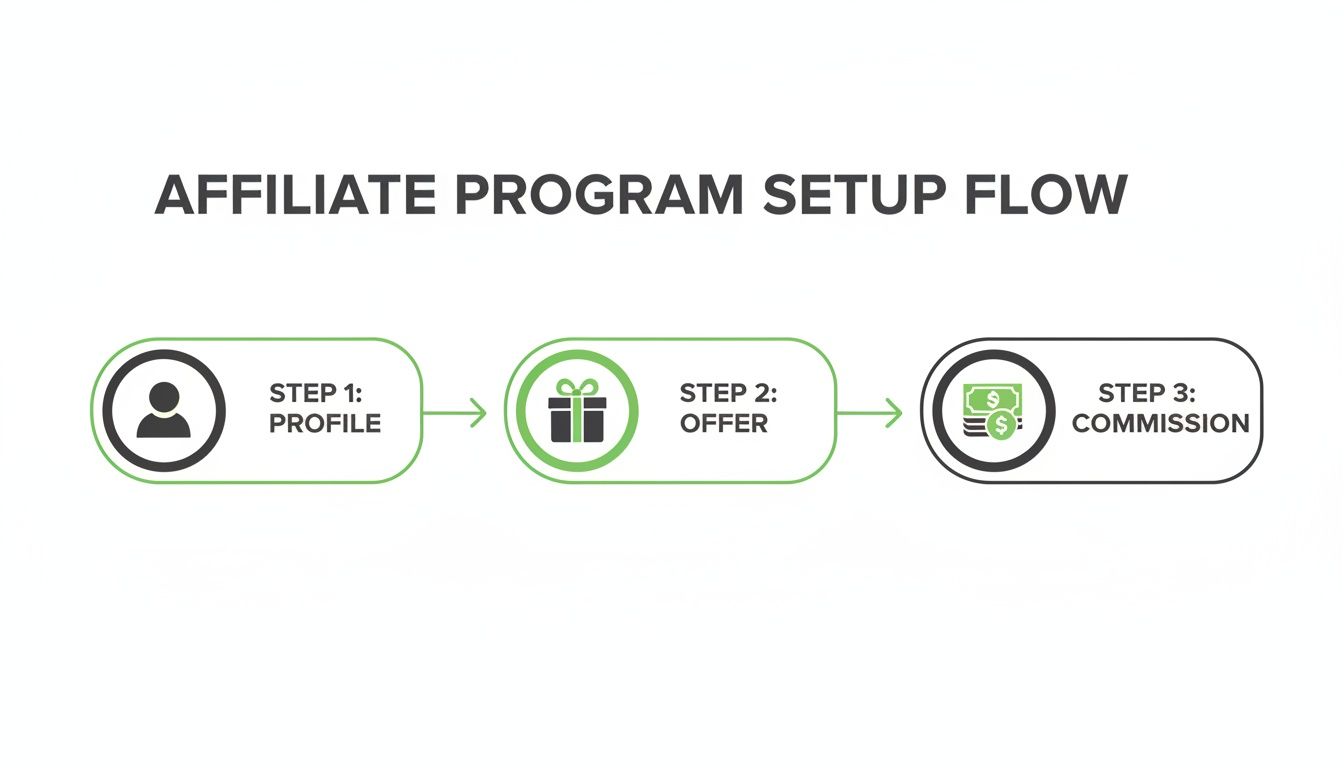
Think of this as your blueprint. A solid program structure is non-negotiable if you want to attract real talent.
Define Your Ideal Affiliate Profile
First things first: stop thinking about finding affiliates and start thinking about who you're looking for. You need an Ideal Affiliate Profile (IAP)—a detailed picture of the perfect partner for your brand. Without one, you're just casting a wide net and hoping for the best, which usually means recruiting partners whose audiences don't care about your products. That's a recipe for wasted time and dismal results.
So, who are these potential partners? They usually fall into a few buckets:
- Niche Bloggers: These are the masters of detailed, long-form content like in-depth product reviews and step-by-step guides. For an eco-friendly cleaning supply brand, a blogger who writes about sustainable home goods and has an audience of 25-45 year old homeowners is a perfect match.
- Social Media Influencers: Creators on platforms like TikTok and Instagram have built communities that trust their recommendations. Imagine a DTC makeup brand like ZonFlip partnering with a TikTok creator known for authentic "Get Ready With Me" videos. The sales potential through TikTok Shop is huge.
- B2B Thought Leaders: If you're selling a SaaS product or a B2B service, you need credibility. Partnering with industry experts on platforms like LinkedIn is a powerful move. A well-respected cybersecurity consultant who hosts a popular podcast would be an ideal affiliate for new encryption software.
It’s also crucial to understand the difference between Affiliate Marketing vs Influencer Marketing. They aren't the same thing, and knowing which model fits your goals will shape your entire strategy.
Build a Value Proposition Beyond Commissions
A competitive commission is table stakes—it’s expected. But on its own, it’s rarely enough to attract the best of the best. Your value proposition is the real reason they should partner with you over a competitor. And make no mistake, it’s a competitive market. U.S. affiliate marketing spend is set to rocket past $12 billion by 2025. This growth means affiliates have more options than ever, so your offer has to stand out.
You have to think beyond the payout. What perks can you offer that will genuinely help your partners succeed?
- Exclusive Product Access: Give your top affiliates a sneak peek at new product launches. For example, a tech gadget brand could send a new drone to its top 10 affiliates a month before the public release.
- Co-Marketing Opportunities: Feature your best partners on your brand's social media channels or blog. It's a win-win. A practical example would be a joint Instagram Live Q&A session with a fitness affiliate to discuss workout recovery, featuring your protein powder.
- Performance Bonuses: Set up tiered bonuses with cash or gift cards for hitting specific sales milestones. A common structure is a $100 bonus for reaching $1,000 in sales, a $250 bonus for $2,500, and so on.
Key Takeaway: The best affiliate programs operate like true partnerships. When you invest in your affiliates' success and offer value that goes beyond a simple payout, you build loyalty. That loyalty is what motivates them to go the extra mile for your brand.
If you're new to this world, it helps to see things from the other side. Our guide on how to start affiliate marketing can give you that perspective. Understanding what potential partners are looking for will make your recruitment strategy ten times more effective.
Craft a Competitive Commission Structure
Your commission structure is the financial engine of your affiliate program. It needs to be attractive enough to recruit top talent but sustainable enough for your business model. There's no one-size-fits-all answer here; the right model depends on your products, profit margins, and industry standards. A high-ticket SaaS product can support a much different commission than a low-cost DTC consumable.
Let's break down the most common models to help you decide.
Affiliate Commission Model Comparison
| Model Type | Best For | Example Commission | Pros | Cons |
|---|---|---|---|---|
| Percentage of Sale (PPS/PPA) | E-commerce, DTC brands with varied product prices. | 10-25% of the total sale amount. | Simple to understand and implement. Directly ties rewards to revenue. | High-volume, low-margin products can yield small payouts for affiliates. |
| Flat-Rate Per Sale (PPS) | Brands with a single product or service, or a small range of similarly priced items. | $50 for every new subscription sold. | Predictable costs for the brand and clear earnings for the affiliate. | Doesn't incentivize upselling or promoting higher-ticket items. |
| Tiered Commissions | Programs looking to motivate high performance and reward top sellers. | 10% for 1-10 sales/mo, 15% for 11-25 sales/mo, 20% for 26+ sales/mo. | Encourages affiliates to increase sales volume to unlock higher rates. | Can be more complex to manage and track. |
| Pay-Per-Click (PPC) | Driving top-of-funnel traffic and building brand awareness. | $0.10 – $0.50 per unique click. | Rewards affiliates for traffic generation, not just sales. | Susceptible to click fraud; doesn't guarantee conversions. |
| Pay-Per-Lead (PPL) | Service-based businesses, B2B, or brands with long sales cycles. | $5 – $10 for each qualified lead (e.g., demo request, free trial sign-up). | Aligns incentives with lead generation goals. | Lead quality can be inconsistent; requires a strong vetting process. |
Ultimately, the best commission model is one that creates a win-win scenario. It should be generous enough to attract and retain high-quality partners while ensuring profitability for your brand. Don't be afraid to start with one model and adapt as you gather data on what motivates your specific affiliates. A little flexibility can go a long way.
Uncovering High-Potential Affiliate Partners

Alright, you've built the foundation of your affiliate program. Now for the fun part: finding the right people to join. The best affiliates aren't just sitting around waiting to be found; they're already active in the communities you want to reach.
Once your program is solid, the real challenge is figuring out how to find affiliates who will actually move the needle on sales.
Your mission is to pinpoint creators and publishers whose audience is a mirror image of your Ideal Affiliate Profile (IAP). This isn't about casting a wide net and hoping for the best—it's about precision targeting.
Tapping into Niche Communities
Your best partners are already out there making content where your customers hang out. You just need to meet them on their home turf.
Think smaller. Go deeper than the big, obvious platforms. Dive into the subreddits, private Facebook groups, or niche forums that live and breathe your industry. If you sell high-end coffee gear, you should be a regular in /r/espresso or coffee-lover Facebook groups, taking note of the most respected voices.
Here's a practical workflow:
- Identify 3-5 keywords related to your niche (e.g., "sustainable yoga," "eco-friendly yoga," "cork yoga mat").
- Use these keywords to search on platforms like LinkedIn, Reddit, and Facebook Groups.
- On LinkedIn, use a search operator like
("yoga instructor" OR "wellness blogger") AND ("sustainability" OR "eco-friendly")for a curated list. - On Reddit, find relevant subreddits (like r/yoga) and look for users who consistently post helpful, high-quality content.
- Create a spreadsheet to track potential partners, noting their name, platform, audience size, and a link to their profile.
Analyzing Your Competitors' Affiliates
Let's be honest, one of the smartest ways to recruit is to see who's already crushing it for your competitors. They've done the legwork of finding and vetting relevant partners, handing you a proven list to start with.
Tools like Ahrefs or Semrush are your best friends here. Just plug a competitor's domain into their Site Explorer and head to the "Referring Domains" report. You'll see exactly which websites are sending them traffic, and many of them will be affiliate blogs and review sites.
Pro Tip: Keep an eye out for domains named something like "best[product]reviews.com" or "[niche]insider.org." These are almost always high-intent affiliate sites. For example, if you sell air purifiers and see a competitor getting traffic from
bestairpurifiersforpets.com, that's a prime recruitment target. Check out their content—if you think your product is a better fit, reach out with a killer offer.
Leveraging Affiliate Network Directories
If you've joined a network like ShareASale, Impact, or ClickBank, their directories are absolute goldmines. These platforms are packed with publishers who are actively looking for new programs. The sheer volume can be a lot to handle, so you need a strategy.
Get familiar with the network's filters to narrow your search. I recommend starting with:
- Category or Niche: Match this to your product (e.g., "Health & Wellness," "Software").
- Performance Metrics: Look for affiliates with strong stats like Network Earnings or a high EPC (Earnings Per Click). This shows they know how to drive sales.
- Promotional Methods: Filter for the types of partners you want, whether that’s content blogs, review sites, or social media creators.
This approach helps you zero in on affiliates with a proven track record in your specific vertical. For brands on newer platforms, this is even more crucial. For more on this, check out our guide on how to become a TikTok Shop affiliate partner.
Turning Customers into Brand Advocates
Don't sleep on the most powerful recruitment pool you have: your own customers. These people already know your products, love them, and trust your brand. They are your most authentic potential partners.
It's easy to set up a simple system to spot your biggest fans. Look for people who leave glowing reviews, tag your brand on social media, or buy from you over and over again. A simple post-purchase email inviting them to your affiliate program can have an amazing conversion rate.
Example workflow: Set up an automated email in your e-commerce platform (like Shopify or Klaviyo) that triggers 14 days after a customer's second purchase. The email can say: "Hey [Customer Name], we noticed you're a fan! As a thank you, we'd love to invite you to our exclusive affiliate program where you can earn cash for sharing the products you love."
The ROI here is undeniable. On average, businesses earn $6.50 for every dollar they put into affiliate marketing, and this channel is responsible for 16% of all online orders in the U.S. Turning happy customers into affiliates is one of the most cost-effective ways to get a piece of that action.
Crafting Outreach That Actually Gets a Response

So you've got a killer list of potential affiliates. These are the creators and publishers who could be perfect partners for your brand. Now comes the part where most brands stumble: the first message.
Let’s be real. A generic, copy-paste email is a one-way ticket to the trash folder. To get top-tier affiliates on board, your outreach has to cut through the insane amount of noise they deal with every single day.
Top affiliates are constantly bombarded with partnership requests. Your goal isn't just to pitch them—it's to start a real conversation. That means you need to ditch the boilerplate templates and spend a few minutes personalizing your message. Show them you see a partner, not just another number on a spreadsheet.
The Anatomy of a Perfect Pitch
A killer outreach message that gets opened and answered boils down to three things: a personalized hook, a clear value prop, and a simple call-to-action. Each piece builds on the last to show you respect their time and actually understand what they do.
First up, the personalized hook. This is non-negotiable. It’s your proof that you’ve done your homework. Mention a recent blog post they wrote, a TikTok that made you laugh, or a specific point they made on a podcast. It immediately shows this isn't a mass email blast.
Next is the value proposition, and here’s the key: frame it around their audience, not just your product. Instead of saying, "We want you to promote our stuff," shift the angle. Try something like, "I saw your review of Product X and thought your audience would really get behind our eco-friendly version because…" That small change in perspective makes all the difference.
Finally, your call-to-action (CTA) needs to be as low-friction as possible. Don’t hit them with a link to a complicated application form. A simple question like, "Would you be open to hearing more about our partner program?" is way more effective and much less intimidating.
Outreach Templates You Can Actually Use
Think of these as a starting point, not a script. The goal is to adapt them to your brand voice and the specific person you're contacting.
Formal Email Outreach Example (For a Niche Blogger):
- Subject: Loved your post on sustainable travel gear!
- Body: Hi [Affiliate Name], My name is [Your Name] from [Your Brand]. I just finished reading your guide to packing for a minimalist backpacking trip—your tip about solid toiletries was brilliant. I noticed you recommended a few travel backpacks, and I thought our collapsible, recycled daypack could be a fantastic addition for your audience. It aligns perfectly with the eco-conscious values you promote. We offer a competitive commission and provide our partners with early access to new products. Would you be open to learning more?
Casual Social Media DM (For a TikTok Creator):
- Hey [Affiliate Name]! Your latest TikTok Shop haul was awesome—that gadget looked so cool. We loved your energy and think our [Product Name] would be a perfect fit for your style. Your followers would get a kick out of it. We have a great affiliate program for creators. Let me know if you’re interested in the details!
Key Insight: The best outreach feels like a natural conversation. Personalization isn't just dropping their name in a template; it's about making an authentic connection between your product and their content that makes immediate, intuitive sense.
Vetting Affiliates: Looking Beyond the Follower Count
Getting a "yes" from your outreach is just the start of the race, not the finish line. Now you need a solid vetting process to make sure you're partnering with people who actually align with your brand and can drive real results.
Vanity metrics like follower counts can be incredibly misleading. A creator with 10,000 highly engaged followers who trust their recommendations is infinitely more valuable than one with 100,000 passive followers who barely pay attention.
Your vetting process is your program's quality control. If you rush this step, you risk brand damage from partners who use spammy tactics, misrepresent your products, or just aren't a good fit for your company's values.
The Affiliate Vetting Checklist
To avoid costly mistakes, use a structured approach to evaluate every potential affiliate. This checklist will help you look past the surface-level numbers and dig into what really matters for a successful partnership.
Affiliate Vetting Checklist
| Vetting Criteria | What to Look For | Red Flags to Avoid |
|---|---|---|
| Audience Engagement | High comment-to-like ratio, thoughtful replies from the creator, genuine questions from followers. | Follower counts that seem inflated, generic "nice post" comments, disabled comment sections. |
| Content Quality & Brand Fit | High-quality images/videos, well-written copy, a tone and style that matches your brand's voice. | Poor production value, frequent spelling/grammar errors, content that feels completely off-brand. |
| Promotion History | A history of promoting complementary (but not directly competing) products in your niche. | A feed that's 90% sponsored posts, partnerships with sketchy or low-quality brands. |
| Disclosure & Transparency | Clear use of #ad, #sponsored, or other FTC-compliant disclosures on paid content. | No clear indication of which posts are sponsored, attempts to hide partnership details from their audience. |
Taking the time to do this right ensures you build a network of credible, effective partners. By combining personalized outreach with a diligent vetting process, you're not just growing an affiliate program—you're building one that will thrive for the long haul.
Getting Your Affiliates Started on the Right Foot
Getting a "yes" from a top-tier creator is a great feeling, but that's just the start of the race, not the finish line. Honestly, this is where a lot of affiliate programs begin to fall apart. A clunky, confusing start kills all that initial excitement.
What separates a thriving partnership from one that fizzles out is a seamless, well-thought-out onboarding process. Your entire goal is to remove any and all friction. You want to arm your new partner with everything they need to start promoting your brand effectively from day one. When you have everything ready before they even have to ask, it shows you’re a professional partner worth their time.
Build Your Affiliate Mission Control
The single most valuable thing you can create for your partners is a centralized resource hub. Think of it as their mission control—a one-stop shop for everything they could possibly need to represent your brand well.
Instead of burying them in a welcome email with a dozen attachments, give them one link. This could be a password-protected page on your site or a portal within your affiliate software like Refersion or UpPromote.
Here’s what to pack into it:
- Brand Guidelines: Simple, clear rules. How to use your logo, what colors to stick to, the general vibe of your brand's voice, and—crucially—any specific claims they can or can’t make about your product.
- Creative Assets: A well-organized library of high-res logos, slick product photos, lifestyle shots, and even some pre-made banners or graphics.
- Swipe Copy: Give them some ready-to-go copy for different channels. Think email newsletter blurbs, social media post ideas, and short blog snippets. This makes it incredibly easy for them to get their first post live.
- Product Cheat Sheets: Detailed one-pagers, feature lists, and notes on your target audience. This helps them truly understand who they’re talking to and why your product is the answer.
This resource center isn't just a content dump. It’s about making your affiliate's job as easy as humanly possible. The less time they spend hunting for a logo, the more time they spend creating content that drives sales.
Make Sure Tracking is Bulletproof
Nothing will kill a new affiliate relationship faster than them suspecting they’re missing out on commissions because of shoddy tracking. Before you bring a single person on board, you need to be 100% confident your tracking and attribution system is flawless.
Their unique affiliate link is their direct line to getting paid. It has to work, every single time.
Most modern affiliate platforms will handle this for you, generating a unique link for each partner the second they’re approved. Your job is to double-check that those links are attributing sales correctly and that the cookie duration (how long the tracking lasts after a click) matches what you laid out in your terms.
My Two Cents: Before you launch, run a few test purchases yourself. Click an affiliate link in a private/incognito browser window, go through the whole checkout process with a test credit card or 100% discount code, and make sure you see the commission pop up in the test affiliate's dashboard. This simple check can save you from a world of headaches and broken trust later on.
Automate Your Welcome Sequence
A killer onboarding experience can feel personal, even when it’s automated. Set up a simple welcome email sequence that fires off the moment an affiliate gets approved. This little journey guides them through the first few days and makes them feel like they’ve truly joined the team.
Your automated flow should look something like this:
- The "You're In!" Email: This first message confirms their approval. It must contain their unique affiliate link and the link to your resource hub. A short, personal welcome video from you or the affiliate manager here can make a massive difference.
- The Quick-Start Guide: A day or two later, send a follow-up with a super simple, step-by-step guide. Tell them the top three things to do first, like grabbing their link, checking out the creative assets, or giving the brand guidelines a quick scan.
- The Community Invite: Your last automated email should invite them into your private communication channel—be it a dedicated Slack channel, a private Facebook Group, or a Discord server. This opens up a direct line for questions and lets them connect with other affiliates, which helps build a real sense of community.
By systemizing this kickoff, you guarantee every single partner gets a consistent, high-quality start that sets them up to win with your brand for the long haul.
Getting Your Affiliate Program Firing on All Cylinders
Getting affiliates to sign up is a huge win, but it's just the starting block. A program left on autopilot will eventually lose steam. The real growth engine kicks in when you stop focusing solely on recruitment and start activating the partners you’ve worked so hard to get.
Think of it this way: consistent engagement is what turns a simple list of names into an active, revenue-generating community. Your job is to keep your brand top-of-mind and give your partners every reason to promote you over the dozens of other brands knocking on their door.
Build Real Relationships Through Consistent Communication
Radio silence is the fastest way to kill an affiliate program. Strong partnerships are built on a foundation of regular, valuable communication that makes your affiliates feel like they’re truly part of the team. A monthly newsletter is one of the best tools you have for this.
But don't just send out a generic "here's our new product" blast. Make it genuinely useful.
- Share Success Stories: Spotlight a top-performing affiliate and break down exactly what they did to crush it. For example: "Congrats to @YogaWithAdriana for being our top affiliate in May! Her 'Top 5 Morning Stretches' video, which featured our eco-friendly mat, drove over $5,000 in sales. Great work!"
- Give a Heads-Up: Let your partners know about upcoming sales, holidays, or promotions. "Heads up, team! Our annual Black Friday sale starts November 24th with 30% off sitewide. Get your content ready!"
- Provide Product Intel: Go beyond the basics. Share insights on new features or best-sellers, complete with talking points they can weave into their content.
This isn't just about sending emails; it's about equipping your partners for success and showing you're invested in their growth. If you're looking to dive deeper into building these powerful connections, check out our other guides on ecommerce affiliate marketing.
Light a Fire with Contests and Incentives
A little friendly competition can work wonders. Running periodic contests is a fantastic way to spark a surge of activity and reward your most dedicated partners, which often motivates everyone else to raise their game.
For instance, you could roll out a "Summer Sales Sprint." Announce a 30-day contest where the top three affiliates who drive the most revenue win bonus cash or a bundle of your best products. To really turn up the heat, post a live leaderboard in your affiliate Slack channel.
Pro Tip: Your rewards don't always have to be cash. Things like exclusive co-marketing opportunities, a one-on-one strategy call with your marketing director, or a full set of your entire product line can be just as motivating and do more to strengthen the long-term relationship.
Know Your Numbers: Tracking Key Performance Indicators
You can't scale what you don't measure. To really manage and optimize your program, you need to be tracking the right Key Performance Indicators (KPIs). These metrics are your dashboard—they tell you what’s working, who your star players are, and where you can make improvements.
At a minimum, keep a close eye on these KPIs:
- Conversion Rate (CR): What percentage of clicks are turning into sales? A high CR is a dead giveaway that an affiliate's audience is a perfect match for your products.
- Average Order Value (AOV): How much is the average customer spending? Affiliates who bring in a high AOV are attracting high-value buyers.
- Earnings Per Click (EPC): This metric boils it all down to the average revenue you make for every single click an affiliate sends your way. It’s a great way to gauge the overall profitability of a partner's traffic.
When you start analyzing this data, you'll likely find that your top 20% of affiliates are driving 80% of your results. This allows you to double down on supporting your superstars while using their winning strategies to coach up the rest of the pack.
Next-Level Scaling Strategies
Once you’ve got some solid momentum, it's time to pull out the advanced plays to unlock the next level of growth. These strategies are all about re-engaging partners who've gone quiet and rewarding your most valuable players.
One of my favorite tactics is creating a VIP tier for top-performing affiliates. Once a partner consistently blows past a certain sales threshold (e.g., $10,000 in referred sales per quarter), they unlock exclusive perks. This could be anything from a higher commission rate (e.g., bumping from 15% to 20%), custom creative assets, to a dedicated account manager. Not only does this reward loyalty, but it also gives every other affiliate a clear and aspirational goal to shoot for.
It's this kind of smart management that explains why 74% of brands generate 11-30% of their total revenue from affiliates. A well-oiled program isn't just a marketing channel; it's a massive growth engine. And with the global affiliate market projected to hit $31.7 billion by 2031, there's never been a better time to get serious about scaling.
Common Affiliate Recruitment Questions
Diving into affiliate marketing always kicks up a few key questions, especially when you’re building your roster from scratch. Getting these fundamentals right from the start is the difference between a thriving program and one that just spins its wheels. Let's dig into the big ones we hear from brands all the time.
How Much Should I Pay Affiliate Marketers?
This is the million-dollar question, isn't it? The honest answer is: it depends. There’s no universal rate that works for everyone. What makes sense for a SaaS brand with high margins would be a disaster for a DTC brand selling physical products.
For physical goods, you're typically looking at a commission somewhere between 5% and 30%. Digital products, on the other hand, often have much higher margins, so their rates can climb into the 20% to 50% range. Sometimes a flat fee per sign-up makes more sense.
My Advice: Don't just pick a number out of thin air. Start by sleuthing what your direct competitors are offering. Then, do your own math. You need to know your Customer Lifetime Value (CLV) and Customer Acquisition Cost (CAC) inside and out to land on a number that’s a win-win—attractive enough for top-tier partners and still profitable for you.
Should I Use an Affiliate Network or an In-House Program?
This is the classic "control vs. convenience" debate. Both options have their place, but they serve different needs and business stages.
Using an affiliate network like ShareASale or Impact is like plugging into an existing ecosystem. You get immediate access to a massive pool of vetted affiliates. Plus, they handle all the technical headaches—tracking, reporting, and payouts—which is a huge relief when you're just getting started. The trade-off? You'll pay network fees, and your connection with affiliates can feel a bit impersonal.
Running an in-house program with software like Rewardful or FirstPromoter puts you in the driver's seat. You own the relationships, build direct connections, and skip the network fees. But be warned: you're on the hook for everything else, from recruitment and management to all the technical setup.
- Go with a network if: You’re new to the game and want to hit the ground running without a ton of upfront work.
- Go in-house if: You're more established, cherish direct partner relationships, and want total control over your program's destiny and profitability.
How Do I Track Affiliate Sales on Amazon or TikTok Shop?
Tracking on third-party marketplaces is a different beast because you don't control the checkout. You have to work within their systems.
For Amazon, the main tool in your belt is the Amazon Associates program. It provides the unique affiliate links you need for basic tracking. Many savvy brands don't stop there; they'll create custom landing pages on their own site or use unique vanity discount codes to attribute traffic before sending a shopper over to Amazon.
TikTok Shop's native affiliate tools are surprisingly powerful. Creators can tag your products directly in their videos and live streams, which makes tracking seamless and transparent for everyone involved. When you’re vetting affiliate management software, make sure it has solid integrations for these channels. You can’t afford to fly blind.
Ready to stop guessing and start growing? ZonFlip offers end-to-end management for Amazon and TikTok Shop, turning complex marketplace challenges into profitable growth. Let our expert team handle the details so you can focus on your brand. Visit us at https://www.zonflip.com to learn how we can accelerate your sales.