



If you’ve ever sold on Amazon, you know it’s a bit like a massive, sprawling city. Some streets are wide open, letting anyone set up shop. Others are exclusive, members-only districts with a bouncer at the door. That’s the simplest way to think about Amazon gated and ungated categories. Ungated areas are those open streets, while gated ones are the exclusive districts you need permission to enter.
What Are Amazon Gated and Ungated Categories

At its core, "gating" is Amazon's quality control system. It's a series of restrictions they place on certain product categories, sub-categories, or even specific brands to make sure customers have a safe and reliable shopping experience. These aren't just random roadblocks; they're in place for a very good reason.
Ungated categories are where most new sellers start. The barrier to entry is low, and you can get your products listed without jumping through too many hoops.
- Practical Example: Categories like Books, Home & Kitchen, and Office Products are largely ungated. A new seller could source a generic kitchen spatula, create a listing, and start selling it almost immediately without needing special approval.
Gated categories, on the other hand, are the VIP lounges. To sell products in these restricted zones, you need to go through an approval process, which sellers call "ungating." This usually means providing official documents to prove you and your products are the real deal.
- Practical Example: The Dietary Supplements category is gated. To sell a Vitamin C supplement, you would need to submit invoices from the manufacturer and a Good Manufacturing Practice (GMP) certificate to prove the product is safe and authentic.
The Purpose Behind Gating
So, why does Amazon do this? It's all about protecting customers and maintaining trust. Gating is designed to weed out counterfeit goods, ensure products are safe, and keep quality high, especially in categories where it matters most.
You'll find that categories directly impacting customer health and safety are almost always gated. This makes perfect sense when you're talking about items that people ingest or apply to their bodies.
Gating acts as a critical filter, ensuring only verified and credible sellers can offer products in high-risk categories. This builds consumer confidence and protects brand integrity across the platform.
Some of the most common gated areas include:
- Dietary Supplements: To guarantee products are safe for consumption and meet all health regulations.
- Baby Products: To make sure every item meets strict safety standards for infants and young children.
- Fine Jewelry & Watches: To stop the sale of fake or misrepresented luxury goods.
- Automotive Parts: To confirm that parts are genuine and meet vehicle safety specs.
An Opportunity for Serious Sellers
While the ungating process takes some work, it’s also a huge strategic advantage. Once you're approved for a gated category, you’ll be dealing with far less competition than you would in the crowded, ungated spaces. Fewer sellers often lead to more stable prices and, ultimately, higher profit margins.
For any seller, new or established, getting a handle on the difference between Amazon gated and ungated categories is fundamental. It's not just about getting past a barrier—it's about spotting opportunities to thrive in less saturated, more profitable corners of the marketplace. This knowledge is key for anyone serious about building a sustainable business on Amazon.
Why Amazon Restricts Certain Products And Brands
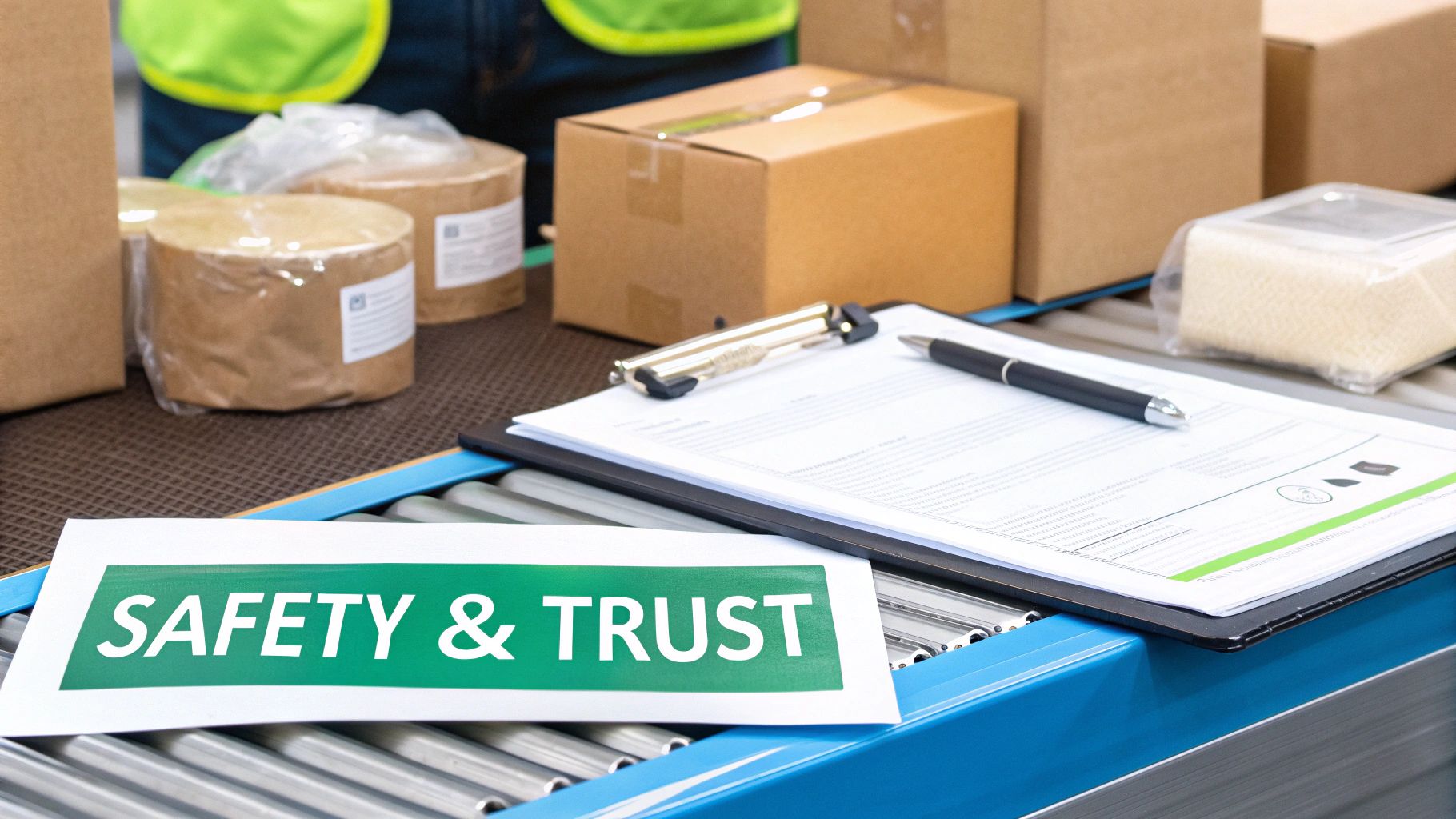
To really get the hang of Amazon gated and ungated products, you have to understand why Amazon puts up these walls in the first place. Gating policies aren't just random roadblocks. They’re a carefully designed system built on three core pillars: customer trust, product safety, and brand protection.
Think of gating as Amazon’s quality control for its massive marketplace. With millions of sellers, these rules are crucial to prevent a total free-for-all, which would kill customer confidence and flood the site with shoddy or even dangerous products.
Once you grasp this logic, you start to see the approval process not as a bureaucratic hassle, but as a system that actually creates a more stable, trustworthy environment for serious sellers committed to quality.
Protecting Customers and Ensuring Safety
Everything Amazon does circles back to the customer. Product safety is a massive deal, especially for things people eat, put on their skin, or give to their kids. This is exactly why categories like Dietary Supplements and Baby Products are locked down so tightly.
For instance, if you want to sell a new vitamin, you can't just throw up a listing. You’ll need to provide real documentation, like a Certificate of Analysis (COA) or proof the product was made in a facility with Good Manufacturing Practice (GMP) certification. This is Amazon's way of making sure what’s in the bottle is safe and matches the label.
Amazon's primary motivation for gating is risk mitigation. By vetting sellers in high-stakes categories, the company protects consumers from potential harm and itself from liability, reinforcing its reputation as a trusted retailer.
It's the same story in the Automotive & Powersports category. Every part sold, from brake pads to engine components, has to meet strict safety standards. Selling a faulty car part could be catastrophic, so gating helps Amazon ensure that only legitimate, authorized sellers are in the game.
Preserving Brand Integrity and Exclusivity
Beyond safety, Amazon uses gating to guard the reputation and intellectual property of major brands. Think about it: global names like Nike, Apple, or LEGO spend billions building their brand and controlling how their products are sold. Brand gating stops their stuff from being cheapened by a flood of fakes or unauthorized resellers.
- Practical Example: To sell LEGO sets, you would likely need a Letter of Authorization directly from LEGO or an invoice from one of their handful of approved distributors. A receipt from a retail store like Walmart would be rejected because it doesn't prove you are part of their authorized supply chain.
This protection works both ways. It helps the brand hold its value and also shields legitimate sellers—who've invested in authentic inventory—from being undercut by shady competitors. Without these gates, the marketplace could quickly turn into a swamp of knockoffs, wrecking both the brand's image and customer trust.
Maintaining Marketplace Quality
Finally, some categories are gated simply to keep the quality and authenticity high. The Fine Art category is a perfect example. To get in, you have to prove you're a reputable dealer. This isn't to be difficult; it's to prevent forgeries and uphold the integrity of the art market on the platform.
The Watches category operates on a similar principle. By making sellers prove their sourcing and authenticity, Amazon makes sure that when a customer shells out for a luxury timepiece, they get the real deal—not a convincing fake. This dedication to quality in specialized areas lifts the entire shopping experience.
At the end of the day, these restrictions all serve one purpose: to build an ecosystem people can trust. For sellers who are willing to do the work and meet the requirements, this system actually creates a less crowded and more profitable playing field, turning a compliance hurdle into a real business advantage.
How To Get Approved For Gated Categories
Getting approved for a gated category on Amazon isn't about finding a secret loophole. It's about preparation. Think of it like getting a visa—you need the right paperwork, filled out perfectly, to get that stamp of approval. Amazon's review team is looking for cold, hard proof that you're a legitimate business with authentic products.
This whole process can feel a bit mysterious, so let's break down exactly what you need to put together a winning application. While every category has its own little quirks, a few key documents are almost always on the checklist.
Nailing these requirements is your ticket to unlocking some of the most profitable, and less crowded, corners of the Amazon marketplace.
The Core Documentation You Will Need
Before you click "apply," your first job is to build a professional, verifiable paper trail. Amazon uses a mix of automated systems and human reviewers, and they'll instantly reject anything that looks sketchy, altered, or doesn't line up perfectly with your account info.
Here are the heavy hitters you’ll almost always need:
- Professional Wholesale Invoices: This is the big one. We're talking about a real-deal invoice from a manufacturer or an authorized distributor. A retail receipt, pro-forma invoice, or a simple order confirmation won't cut it.
- Letter of Authorization (LOA): If you're trying to get ungated for a specific brand, this is your golden ticket. It's a formal letter from the brand owner giving you their blessing to sell their products on Amazon.
- Product and Packaging Photos: Get ready for a photoshoot. You'll need to submit clear, real-world pictures of your product and its packaging from every angle. These photos have to clearly show the brand name, model number, and any safety or compliance markings.
Pro Tip: The number one reason applications get denied is a simple mismatch. The business name, address, and contact info on your invoices have to match your Amazon Seller Central account details to the letter.
Decoding the Invoice Requirements
Not just any invoice will do. Amazon has a very specific idea of what a "valid" invoice looks like, and a receipt from your local big-box store will get your application tossed out immediately.
Here’s what the review team is checking for:
- Dated Within 180 Days: The invoice must be recent. This shows Amazon you have an ongoing, active relationship with your supplier.
- Seller and Supplier Information: It needs to clearly display your business name and address (the one on your Seller Central account) and the supplier’s name, address, phone number, and website.
- Minimum Purchase Quantity: You need to show a purchase of at least 10 units of the exact product you're applying to ungate.
- Legible and Unaltered: The document has to be a crisp, high-quality scan or a clean digital original. Any handwritten notes, blacked-out sections, or obvious edits are red flags that will lead to a swift rejection.
The ungating process often requires a real investment upfront. For a deeper dive, a comprehensive guide on navigating Amazon's restricted categories and unlocking new opportunities, delve into strategies on how to get ungated on Amazon. The cost can start around $500 for simpler categories and climb past $2,000 for high-stakes areas like dietary supplements, since sellers have to prove they're buying legitimate inventory from authorized distributors.
Category-Specific Compliance Documents
Beyond the standard invoices, the really sensitive categories demand another layer of proof. These aren't optional—they're required to show your products meet federal and industry safety standards. Thinking about how these product and brand restrictions affect your overall presence? We touch on this in our guide on how to make an Amazon storefront.
Here are a few common examples you might run into:
- Good Manufacturing Practice (GMP) Certification: A must-have for Dietary Supplements. This certificate proves your products were made in a facility that adheres to strict quality and safety standards.
- Certificate of Analysis (COA): For products like supplements or topical creams, this is a lab report that verifies the identity and purity of the ingredients.
- Children’s Product Certificate (CPC): If you're selling in the Baby category, this document certifies that your product complies with all applicable safety rules for children's products. For example, to sell a baby teething toy, you'd need a CPC to prove it's free of harmful chemicals and doesn't pose a choking hazard.
Yes, gathering all this paperwork is a grind. But having everything in order before you start your application is the absolute key to making the ungating process as smooth and painless as possible.
A Step-By-Step Workflow For Amazon Ungating
Knowing what documents you need is one thing. Actually navigating the maze of Amazon’s ungating process is a whole different ballgame. Turning that knowledge into a successful approval requires a clear, repeatable workflow.
This step-by-step guide breaks down the entire journey. Think of it as your pre-flight checklist before takeoff, transforming a potentially confusing task into an actionable plan that dramatically increases your chances of getting a first-time approval. It’s all about minimizing those common errors—like mismatched info—that lead to frustrating rejections.
Step 1: Perform An Account Health Check
Before you even think about applying, your very first stop must be the Account Health page in Seller Central. Amazon’s decision to grant you access to a gated category is heavily influenced by your track record. They need to see that you're a reliable and trustworthy seller who plays by the rules.
Make sure your performance metrics are sparkling clean. Key areas to review include:
- Order Defect Rate (ODR): This absolutely has to be well below 1%. A high ODR is a massive red flag for Amazon.
- Late Shipment Rate: Keep this under 4% to prove you fulfill your orders on time, every time.
- Valid Tracking Rate: Aim to keep this above 95% across all your shipments.
- No Unresolved Policy Violations: Clear up any outstanding dings on your account before you apply.
A healthy account is your golden ticket. It shows Amazon you’re a serious seller, making them far more likely to greenlight your request.
Step 2: Identify Your Target And Start The Application
Next up, pinpoint the exact product you want to sell. My advice? Don't just apply for a broad category if you can help it. Instead, apply for a specific ASIN (Amazon Standard Identification Number) within that category. This focuses your application and makes the documentation requirements crystal clear.
Here’s how to kick things off:
- Log in to your Amazon Seller Central account.
- Navigate to Inventory and choose Add a Product.
- Search for the specific ASIN you want to list.
- If it’s gated, you’ll see a “Show limitations” link.
- Click that link, then hit the Request Approval button to get the ball rolling.
This simple navigation starts the formal request and tells you exactly what Amazon needs for that specific item.
Step 3: Assemble Your Documentation Package
This is where the magic happens. Your goal here is to create a professional, undeniable package of evidence. Gather high-resolution digital scans or original PDF files of all your documents. Seriously, low-quality photos snapped on your phone will almost certainly be rejected.
This flow diagram breaks down the core documents you'll often need.
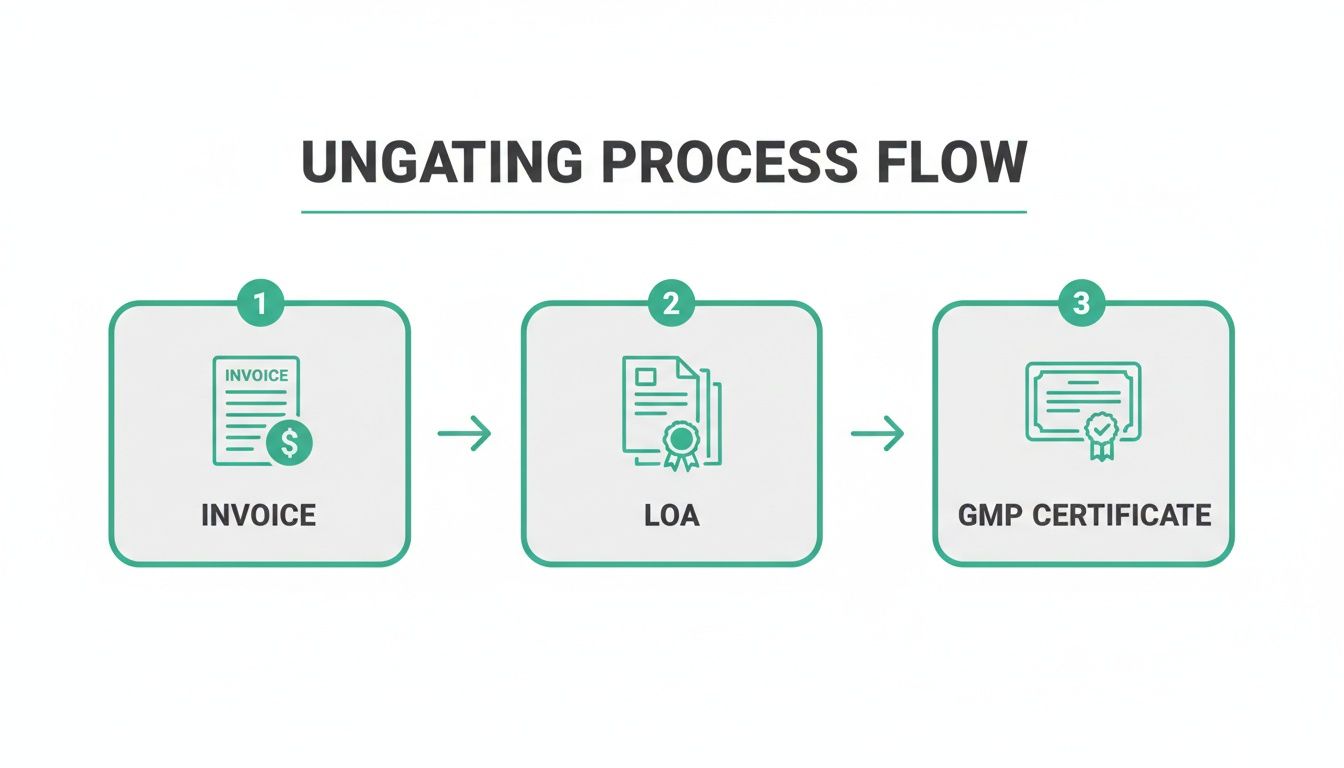
As you can see, having your invoice, Letter of Authorization (LOA), and any required certifications like GMP ready to go before you submit is crucial.
Crucial Tip: The name and address on your invoices must perfectly match the business name and address listed in your Seller Central account. I mean perfectly. Any discrepancy, no matter how tiny, is grounds for an instant denial. For more tips on managing your operations, our guide on how to sell on Amazon FBA offers some great operational insights.
Step 4: Submit And Follow Up Professionally
Once your document package is complete, upload everything through the application portal. Before you hit submit, double-check that every file is clear, legible, and meets all the criteria we've discussed. After submitting, take a deep breath and be patient. The review process can take anywhere from a few hours to several weeks.
If your application gets denied, don't panic. This is common. Amazon will typically provide a reason for the rejection. Read their feedback carefully, fix the specific issue they flagged, and resubmit your application.
And if you need to contact Seller Support? Always be polite, professional, and concise. A clear, well-documented case will always be more effective than an emotional appeal.
Gaining A Strategic Advantage Through Ungating
Getting into gated categories on Amazon isn't just about adding a few new products to your catalog. It's a calculated business move that can define your long-term growth and carve out a serious competitive moat for your brand.
Think about it: when you successfully navigate the ungating process, you’re stepping into a less crowded room. With fewer sellers approved to list in these protected spaces, you immediately sidestep the frantic, bottom-dollar price wars that plague the open marketplace. This stability is where healthy, sustainable profit margins are born.
Building Your Path To Profitability
The smartest way to approach ungating is to see it as a two-phase journey. It doesn’t start with a sprint toward the most restricted categories. Instead, it begins by building a rock-solid foundation in the accessible, ungated spaces first.
This initial phase is your training ground. You need to focus on generating a strong sales history, keeping your seller metrics pristine, and truly mastering the fundamentals of how Amazon works. A stellar track record is the single most valuable asset you have when you decide it’s time to level up.
Once you’ve proven you’re a reliable seller who keeps customers happy, you can cash in that credibility to get approved for the more exclusive—and profitable—gated categories. This methodical approach turns ungating into a pivotal milestone, elevating your business from the crowded general marketplace to a more protected, profitable tier of selling.
The Financial Upside Of Exclusivity
This strategy isn't just theory; it’s backed by real numbers. While it's easier to list ungated products, they often come with 30-40% lower profit potential simply because of the sheer number of sellers competing for the same sale.
This reality has pushed countless sellers to adopt the two-phase approach: build credibility first, then strategically move into gated categories. It's become standard practice for anyone serious about growth on the platform.
By successfully getting ungated, you are essentially buying your way into a more exclusive market. The barrier to entry filters out casual sellers, leaving you to compete with a smaller, more professional pool of competitors.
This exclusivity does more than just protect your margins—it builds trust. Shoppers often see gated products as higher-quality and more authentic because they know Amazon has vetted the sellers. This perception boost can lead to better conversion rates and more loyal customers. Of course, to capitalize on this, you need to ensure your listings are top-notch. If you need help there, check out our guide on how to optimize Amazon product listings.
A Long-Term Competitive Moat
Ultimately, mastering the ungating process is about more than a short-term profit bump. It’s about building a resilient, defensible business on Amazon. Each new category you unlock adds another protective layer to your competitive advantage.
Here’s how that strategic workflow looks in practice:
- Establish Your Foundation: Spend at least 3-6 months building an impeccable seller reputation with excellent metrics in ungated categories. Example: Successfully sell 100+ units of office supplies or home goods with a 98% positive feedback rating and an Order Defect Rate below 0.5%.
- Target Strategically: Pinpoint a moderately restricted category that fits your business model and start the ungating process there. Don't go for the hardest one first. Example: Instead of jumping straight into Dietary Supplements, start with the Topicals sub-category, which has strict requirements but may be less intensive.
- Leverage Your Success: Use each successful ungating approval as a credential. It strengthens your account's authority and makes every subsequent application that much easier.
This process transforms your business from one that’s just reacting to market saturation into one that proactively seeks out and secures more profitable, protected territory. It’s the difference between just selling products and building a real, enduring Amazon enterprise.
Frequently Asked Questions About Amazon Gating
Even with a solid game plan, diving into the world of Amazon gated and ungated categories is bound to bring up some questions. Let's tackle the most common ones we hear from sellers, so you can move forward with confidence.
How Long Does The Approval Process Take?
Honestly, the timeline for getting ungated on Amazon can be all over the map. Sometimes, for less restricted categories, you might get an automatic green light almost instantly or within a few hours. This usually happens if you're a seasoned seller with a squeaky-clean account and stellar metrics.
But for the heavy-hitters like Dietary Supplements, Automotive parts, or Fine Jewelry, the process is a whole different beast. Amazon's internal teams will manually scrutinize every single document you send over. This detailed review can take anywhere from a few days to several weeks, so patience is key once you hit "submit."
What Should I Do If My Application Is Denied?
First off, don't panic. Getting a denial is a super common part of the process and it’s almost never the final word. The trick is to see it not as a rejection, but as a request for more information. Amazon will almost always point you toward the problem.
Don't view a denial as a failure. See it as a specific set of instructions from Amazon on how to perfect your application for the next round.
Read their feedback carefully to pinpoint exactly what went wrong. Usually, it's one of a few common culprits:
- Illegible Documents: The scans or photos of your invoices were blurry or hard to make out.
- Information Mismatch: The name or address on your documents didn't perfectly match what's in your Seller Central account. Every detail has to be identical.
- Unrecognized Supplier: The wholesaler you bought from isn't on Amazon's list of trusted distributors.
Once you’ve identified the issue, fix it. Get crystal-clear scans, double-check that every piece of information lines up, and then resubmit your application.
Can A Brand New Seller Get Ungated?
While it’s technically possible for a brand new seller to get approved in some of the easier categories, it's a serious uphill battle. So much of Amazon's decision comes down to your account’s history and overall health. A new account simply doesn't have a track record to prove it can be trusted.
That's why we highly recommend that new sellers spend at least a few months selling in ungated categories first. Focus on building a solid sales history and keeping your account metrics perfect. This shows Amazon you're a serious, reliable seller and dramatically boosts your chances of getting approved when you finally apply for those gated categories.
Is There A Fee To Get Ungated?
Here’s some good news: Amazon itself does not charge a fee just to apply for ungating. The submission process is completely free.
However, that doesn't mean it's cost-free. You'll definitely have some associated costs to budget for. The main expense is the inventory itself. To get the wholesale invoices Amazon requires, you have to make a real purchase of at least 10 units of the product from an authorized supplier. On top of that, some of the more sensitive categories might require you to pay for third-party lab testing or specific safety certifications, which can add to your upfront investment.
Navigating the complexities of Amazon gated and ungated categories is a critical step toward building a profitable and defensible brand. If you need an expert partner to manage this process and accelerate your growth, ZonFlip provides end-to-end account management to help you sell more and work less. Learn more about our proven strategies at https://www.zonflip.com.