


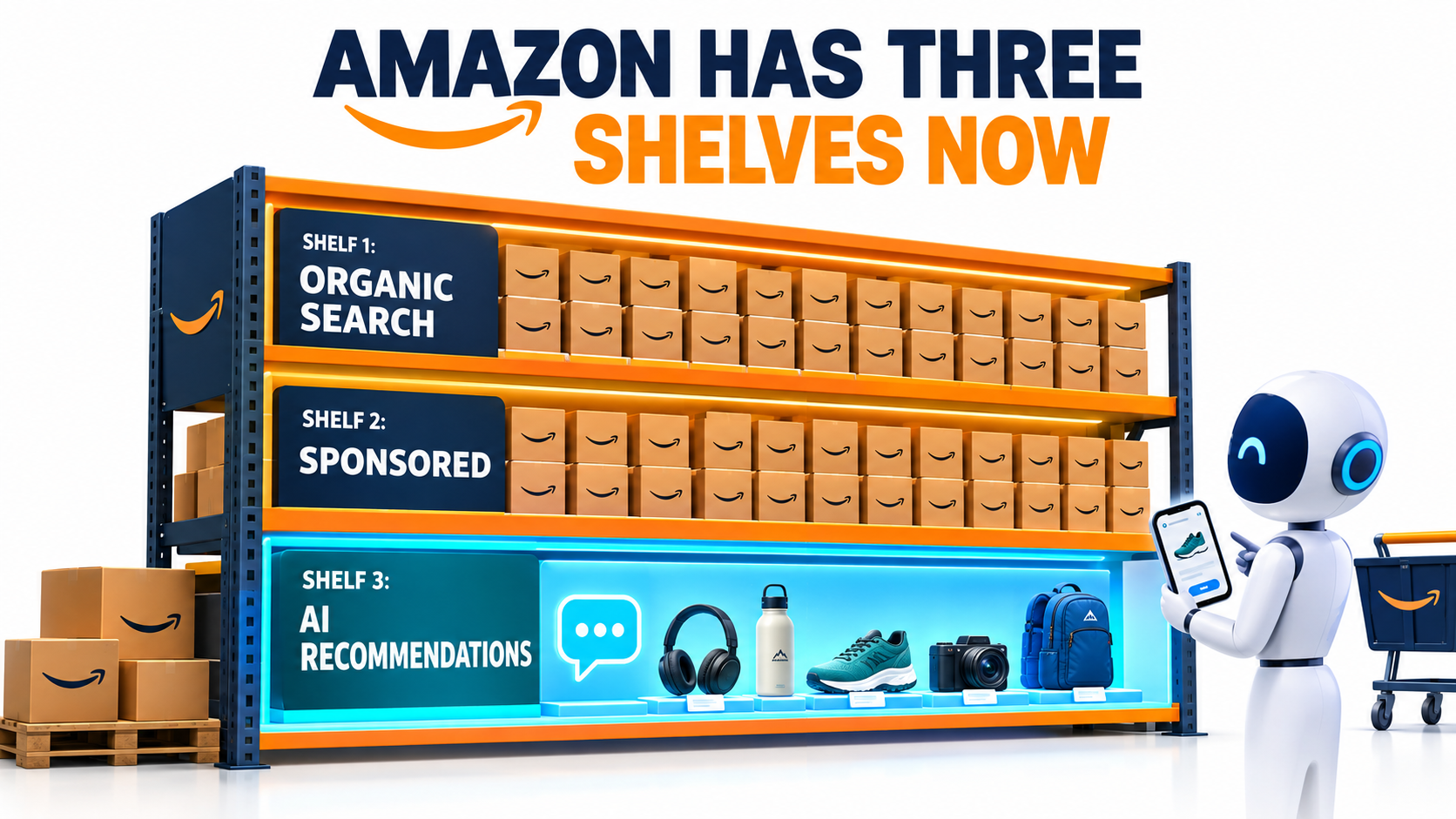

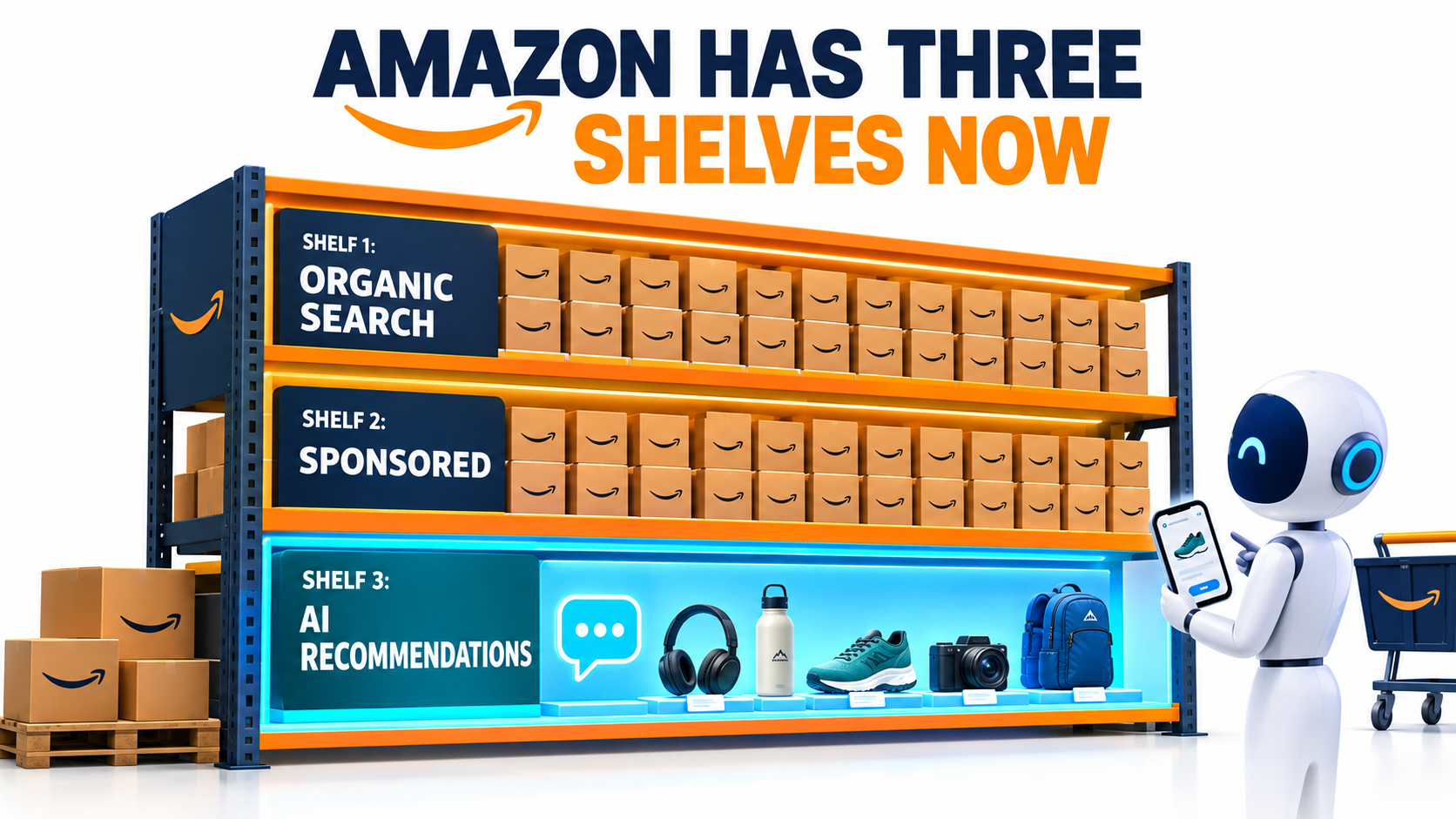
For most of Amazon’s history, there were two ways to get in front of a shopper. You could earn a spot in organic search by building sales velocity and reviews over months. Or you could buy one at auction with Sponsored Products. Nearly every seller dashboard, agency report, and PPC strategy of the last decade was built around those two shelves.
In 2026, a third one showed up, and the early data says it doesn’t play by the rules of the other two.
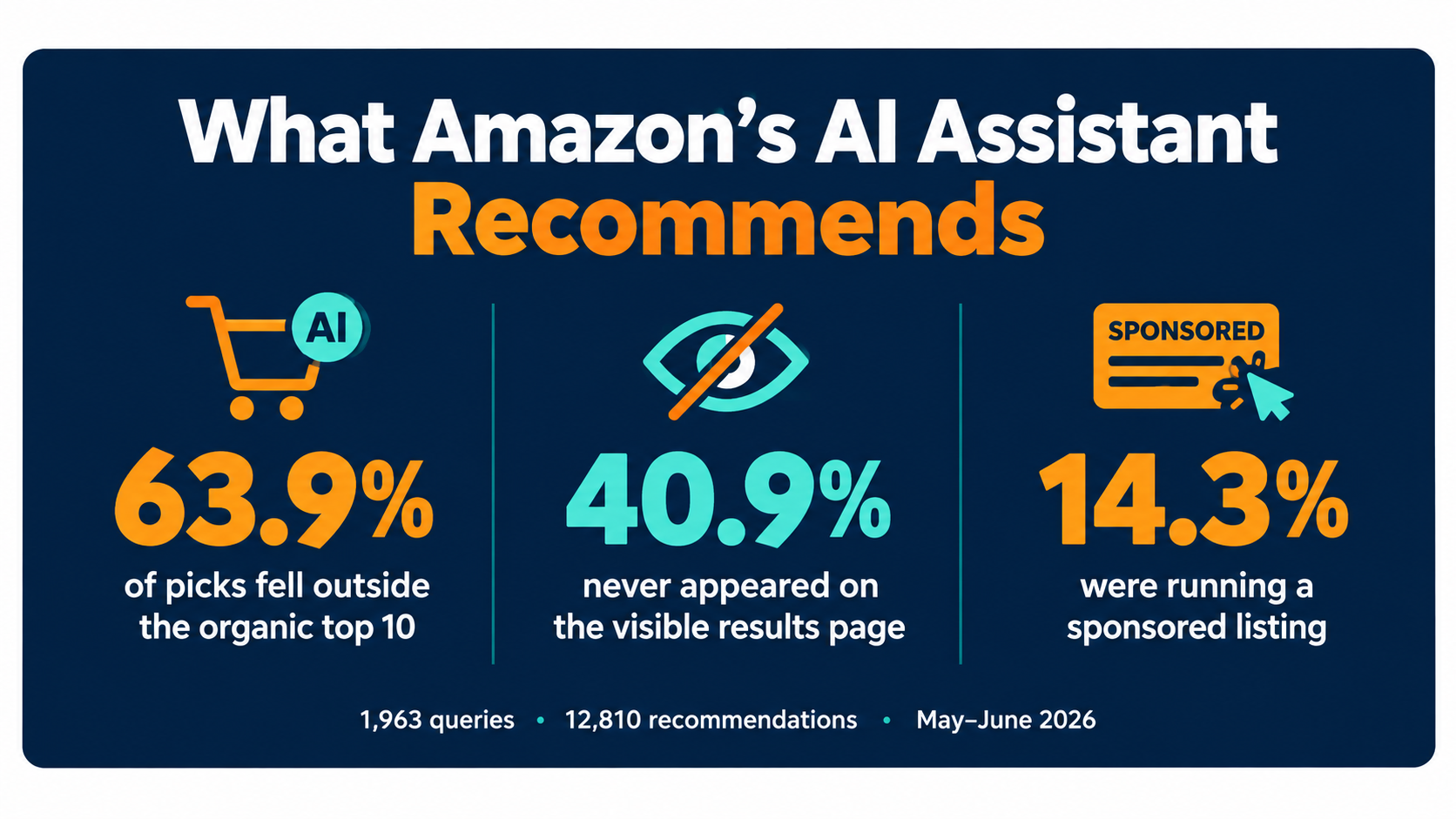
When researchers asked Amazon’s AI shopping assistant for its best recommendation in a category, 63.9% of its picks came from outside the organic top 10 for the matching search term. Four in ten never appeared on the visible results page at all. Only 14.3% were products running a sponsored listing on that page. The products that search rank rewards and the products the assistant recommends turned out to be two very different lists.
That matters because the assistant is no longer a side feature. Amazon credited Rufus with an estimated $12 billion in incremental sales. Monthly active users rose 115% year over year, and engagement was up nearly 400%. In May 2026, Amazon renamed Rufus to Alexa for Shopping and folded it into a broader assistant.
This article isn’t another list of listing tips. It’s a look at how the Amazon selling landscape has changed underneath sellers this year. We’ll cover the AI shelf, the ad model already moving toward it, the shrinking and shifting seller base, the demand coming in from TikTok, and Amazon’s new push to become the control panel for every other marketplace. Most importantly, we’ll cover what a working seller can actually do about each of them.
1. The Study That Split Search From Recommendation
The clearest evidence for a third shelf comes from one of the first large-scale studies of what Amazon’s assistant actually recommends. As reported by Marketplace Pulse, Autopilotbrand.com, a vendor that sells AI-visibility services, captured 1,963 non-branded queries and 12,810 recommendations from Alexa for Shopping in May and June 2026.
How the test was built
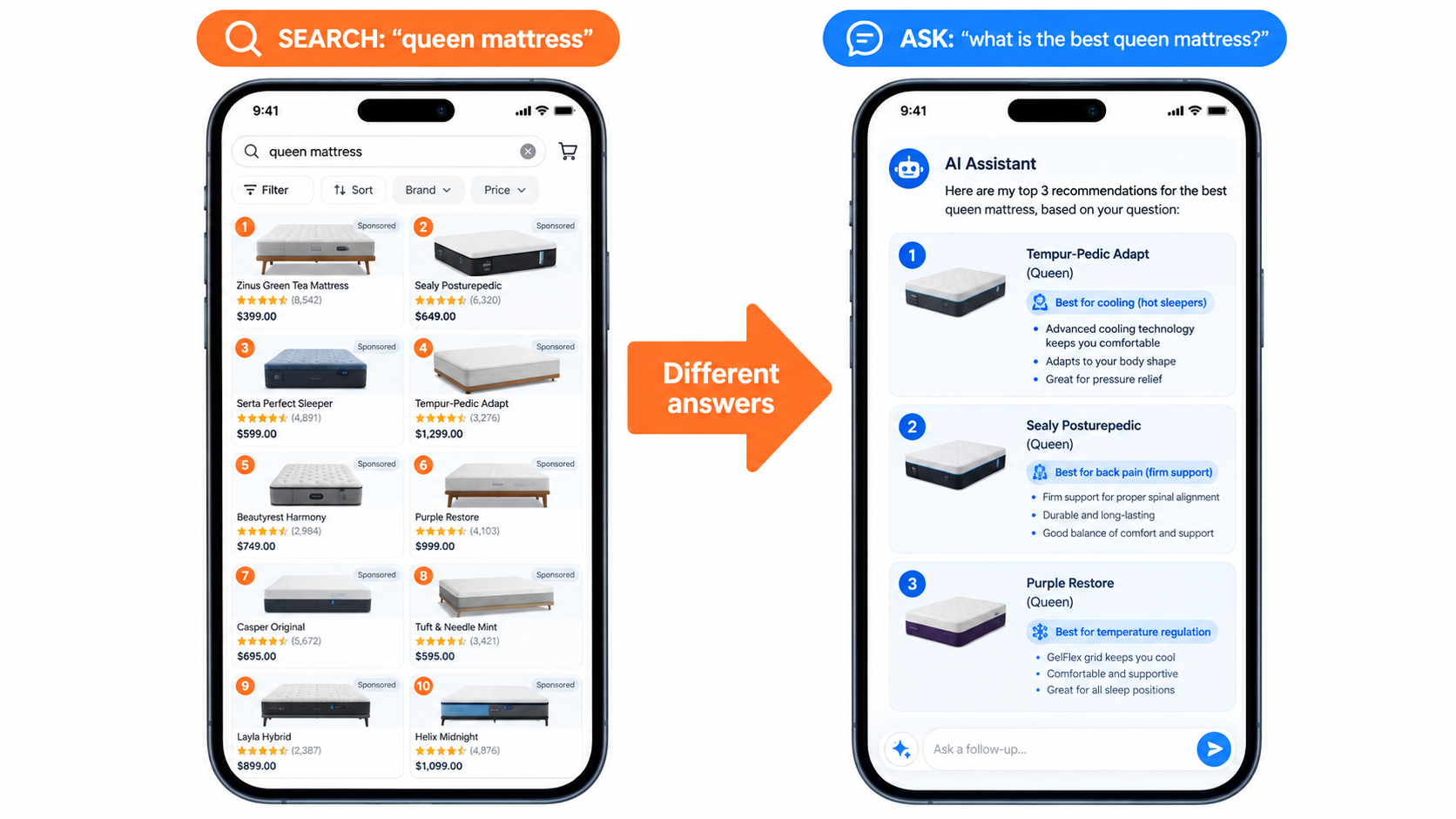
The design was simple and useful. For each category, the researchers asked the assistant a “best of” question, such as “what is the best queen mattress?” They then compared its answer against the plain category search, “queen mattress.”
That setup measures one specific thing. It shows whether a product’s position on the search results page predicts whether the assistant will recommend it when a shopper asks for advice instead of a list.
What came back
- 63.9% of the assistant’s picks were outside the organic top 10 for the matched search term.
- 40.9% never appeared on the visible search results page at all.
- 14.3% of picks were products running a sponsored listing on that search page.
- 83% of those sponsored picks already ranked organically anyway, which suggests the ad itself wasn’t what earned the recommendation.
Put plainly, neither of the two traditional levers seems to reliably move a product into the assistant’s answer. Organic rank is earned slowly through sales velocity, and ads are bought outright. Rank is the bigger surprise, because it’s the metric Amazon teams track most closely.
The caveats worth keeping in mind
This is one snapshot, captured from a single US account, early in the assistant’s life. The vendor behind the study also sells services built around the finding. None of that makes the data wrong, but it does mean you should treat it as a strong signal, not a settled law.
Christian Umbach, Autopilotbrand’s co-founder and CEO, described the result as “the emergence of a third shelf alongside organic search and paid placements.” In his words: “Brands cannot simply buy or rank their way onto it; they need to give Amazon’s AI Alexa enough context to understand when and why their product is the right recommendation.”
That framing is the organizing idea for the rest of this article. If rank and ad spend don’t decide placement here, something else does. Sellers who figure out what that is early will have an edge that won’t last forever.
2. How the Assistant Got Here: From Link Reprinter to Recommender
It helps to remember how unremarkable the assistant was at first. When Rufus launched, it mostly returned links to searches a shopper could have typed themselves. Marketplace Pulse later described it as having grown “more confident but not more intelligent.”
A system that just repackages search results will naturally recommend whatever ranks well in search. The 2026 data shows the assistant has stopped doing that. A two-thirds split from search rank means it’s now building its own view of the catalog.
The 2026 milestones
- Scale: In its 2025 results, Amazon credited Rufus with an estimated $12 billion in incremental sales.
- Growth: Amazon’s Q1 2026 disclosures showed Rufus monthly active users up 115% year over year and engagement up nearly 400%.
- Monetization: Sponsored Products and Sponsored Brand Prompts launched inside the assistant in Q1 2026.
- Rebrand: In May 2026, Rufus became Alexa for Shopping, merging the recommendation engine into Amazon’s broader assistant.
Why shopper behavior makes this urgent
Consumers are adopting AI shopping faster than most sellers expected. Adobe Digital Insights reported a 393% year-over-year increase in AI-driven retail traffic in Q1 2026. More telling, AI-referred visitors now convert 42% better than non-AI traffic, a complete reversal from a year earlier when they converted at roughly half the rate.
Revenue per AI visit now runs 37% higher than non-AI visits. A year before, non-AI visits were worth 128% more. McKinsey and ICSC forecast US agentic commerce reaching $1 trillion by 2030, citing 68% of consumers who used at least one AI tool for shopping in the prior three months.
The results aren’t all in one direction. Walmart reported that purchases completed inside a chat interface converted at about a third of the rate of shoppers who clicked through to its website. OpenAI pulled its Instant Checkout feature in March 2026, citing execution challenges. The shopping-by-assistant model is still being worked out.
Still, the direction is clear enough. Shoppers who ask an assistant for help tend to be closer to buying, and they’re getting a different set of answers than the ones search returns.
3. Why Search Rank Doesn’t Carry Over
The gap between search and recommendation makes sense once you look at what each system is built to do.
Search answers “what matches?”
A search results page responds to a query like “queen mattress” by listing products that match the terms and have performed well for them. Sales velocity, conversion rate, and relevance all feed in. Ad placements are layered on top.
That system rewards incumbency. A product that has sold well for a term keeps selling well for it, which keeps it ranked. That’s why established rank has been such a strong moat for so long.
The assistant answers “what fits?”
A question like “what’s the best queen mattress for a hot sleeper with back pain?” isn’t a keyword match. It’s a request to reason about fit. The assistant has to decide which products suit a specific use, a specific constraint, and a specific person.
Even a bare “best of” question pushes the system toward judgment rather than listing. It has to explain why it’s recommending something. A product with a clear, well-documented reason to exist for a certain buyer gives it something to work with. A product whose listing is mostly a keyword string gives it much less.
What that means for the long tail
The 40.9% figure is the most interesting number in the study. It means the assistant often recommends products most shoppers would never scroll far enough to find. For a seller stuck on page three of a crowded category, that’s a real opening.
For a category leader, it’s a warning. A top organic position that took years of ad spend to build doesn’t guarantee a spot in the assistant’s answer. As Marketplace Pulse put it, the AI shelf is “the rare surface where rank incumbency is a weaker moat.”
A practical reframe
For years, the main question in Amazon selling has been “how do I rank for this keyword?” The assistant adds a second question: “For which shoppers, in which situations, is my product the right answer, and does my catalog data make that obvious?”
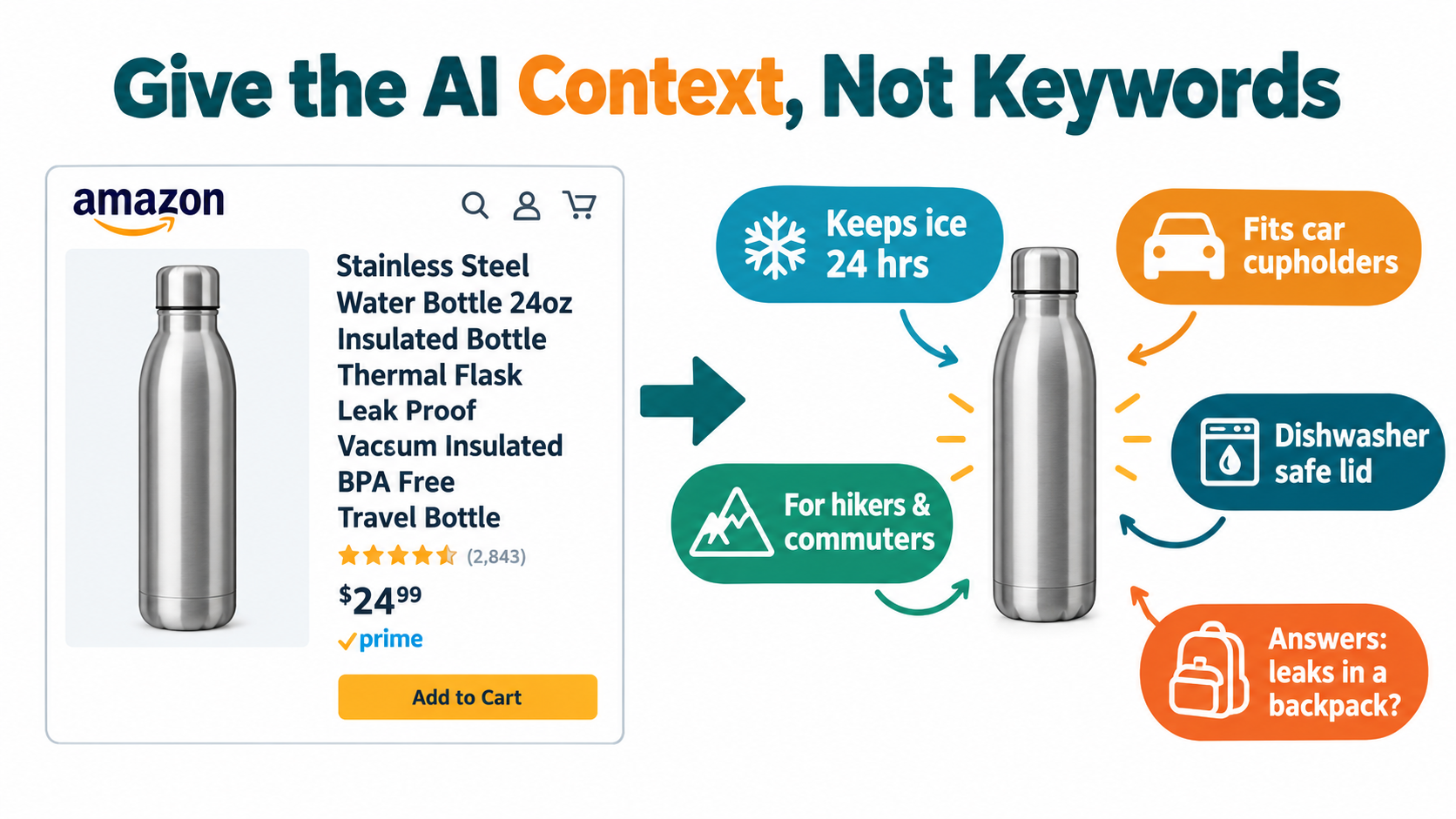
Those questions overlap, but they aren’t the same. A listing can rank well for “water bottle” and still give an assistant no reason to recommend it to “a commuter who needs something leakproof in a laptop bag.”
4. The Ad Clock Is Already Running
Before anyone gets too excited about a free shelf, it’s worth looking at how quickly Amazon is monetizing the assistant. Organic search looked like open ground once too, before ads filled it in.
Amazon’s advertising machine
Amazon generated $68.6 billion in advertising revenue in 2025, up 22%. By Q1 2026, the trailing twelve-month figure passed $70 billion, with advertising again growing faster than Amazon’s total revenue. For comparison, Walmart’s ad business grew 46% in 2025, but to $6.4 billion.
That growth is coming from a smaller active seller base than a year earlier. More ad money, from fewer sellers, is chasing the same shopper attention.
Ads inside the assistant
Sponsored Products and Sponsored Brand Prompts launched inside Rufus in Q1 2026. On the Q1 earnings call, Amazon said nearly 20% of shoppers who interact with a sponsored brand prompt continue the conversation about that brand.
Two caveats apply. Andy Jassy said directly that “it is early.” And the metric measures whether shoppers keep talking about a brand, not whether they buy. Still, it’s one of the first concrete performance numbers any major platform has shared for ads inside an AI shopping interface.
The non-ad alternative disappeared
For a few months, ChatGPT looked like it might offer a different model. Its Instant Checkout charged merchants a 4% transaction fee rather than making ads the main discovery lever. That’s gone now.
OpenAI launched ads in ChatGPT in February 2026 for select US advertisers and dropped Instant Checkout in March. In May, it opened its ads manager to all US advertisers and removed its $50,000 minimum spend. As Marketplace Pulse summarized it, agentic commerce is “settling into an ad-supported model.”
What this means for timing
Right now, the study suggests ads and rank don’t strongly shape what the assistant recommends organically. That won’t necessarily last. Sponsored placements inside the assistant already exist, and the economics of this shelf are still being written.
The practical takeaway is to treat the current window as a learning period. Sellers who understand how the assistant chooses products now will be the first to notice when the rules change. They’ll also be better placed to judge whether sponsored prompts are worth paying for, instead of buying them blind.
5. Who You’re Competing Against in 2026
The AI shelf isn’t opening up in a vacuum. The Amazon seller base has shifted sharply, and those changes shape who is best positioned to win the new surface.
Fewer sellers, more traffic each
According to Marketplace Pulse data, active sellers across Amazon’s 23 marketplaces fell 16% in the past year to under 1.56 million. Combined web traffic grew nearly 5% to 5.5 billion monthly visits over the same period.
The result is that average traffic per active seller rose 25% to 3,544 monthly visits. In the US, traffic per seller rose 19%. In Brazil, Mexico, France, Poland, and the Netherlands, it rose between 40% and 57%.
Concentration at the top
Fewer than 8,000 sellers now generate half of Amazon’s US third-party GMV. Less than three years ago, that took about 15,000 sellers. Operations that can handle rising costs, heavier ad competition, and more complex tooling are taking a bigger share.
Sellers feel the pressure. Marketplace fees rank as the top margin concern among Amazon sellers, followed closely by ad spend. Jungle Scout’s State of the Amazon Seller 2025 survey found 38% citing higher shipping costs as a top challenge, 34% struggling with the cost of goods, and 32% worried about growing ad expenses.
The China–US split
Among the top 10,000 sellers on Amazon.com, Chinese sellers now hold 55.9% of positions, up from 42.5% in July 2020. US sellers fell from 53.7% to 40.5%. Chinese sellers gained 1,342 positions over that period, while US sellers lost 1,320.
Headcount isn’t the whole picture, though. US sellers still produce 65.3% of this cohort’s GMV, compared with 28.6% for Chinese sellers. At the very top, US sellers make up 81.4% of the top 100 and generate 93.2% of its GMV. Average selling prices tell a similar story: $47.62 for US sellers in the top 100, against $22.03 for Chinese sellers.
Why this matters for the AI shelf
Marketplace Pulse noted that factory-direct entrants arrive with AI tooling that has “erased the listing-quality gap” that once protected domestic sellers. Well-written copy and polished images aren’t a differentiator anymore. Almost everyone has them.
What’s harder to copy is genuine, specific product knowledge. That means knowing which customers a product serves, what problems it solves, where it falls short, and how it compares to alternatives. A seller who can put that into catalog data is giving the assistant exactly what it seems to need. And that advantage doesn’t depend on who can spend the most at auction.
6. What the Assistant Needs From Your Catalog
Amazon hasn’t published a ranking guide for Alexa for Shopping, and nobody outside the company knows exactly how it chooses products. Be skeptical of anyone who says otherwise. What we can do is reason from how recommendation systems work and from what the study found.
If the assistant is recommending products that search doesn’t favor, it’s probably drawing on signals beyond sales velocity and keyword relevance. The most likely candidates are the parts of a listing that describe fit: attributes, use cases, customer questions, and review content.
Structured attributes
Backend attributes such as material, dimensions, capacity, compatibility, and intended use are machine-readable facts. For a system trying to match a product to a constraint like “fits a 13-inch laptop sleeve” or “safe for cast iron,” those fields are direct evidence.
Many sellers treat attribute fields as a compliance chore and leave optional ones blank. Consider auditing every optional attribute in your category’s template and filling in anything that’s accurate and relevant. It’s unglamorous work, and that’s partly why it’s still an opening.
Explicit use cases
A bullet that says “premium quality stainless steel” tells an assistant almost nothing. A bullet that says “keeps drinks cold for a full workday shift and fits standard car cupholders” gives it two specific situations where the product fits.
Think in terms of who, when, and why. Who is this for? In what situation do they use it? Why is it a better choice than the obvious alternative for that person?
Honest limitations
This is counterintuitive for sellers used to marketing copy. A recommendation engine trying to match products to people benefits from knowing who a product is not for. “Best for light daily use; not designed for commercial kitchens” helps the assistant avoid a bad recommendation, and helps the right buyer trust a good one.
It also cuts returns and negative reviews, which feed back into every shelf.
Reviews and Q&A as context
Customer reviews describe real use in real language. “I use this on long flights” or “great for my toddler’s lunchbox” are exactly the kind of fit signals an assistant can pick up. You can’t write your reviews, and you shouldn’t try to manipulate them. But you can make sure your listing, inserts, and follow-up materials describe clear use cases, which tends to shape how customers talk about the product.
Customer questions work the same way. They show you what shoppers are actually unsure about. Recurring questions are a direct map of the context your listing is missing.
7. Rewriting Listings for Intent, Not Just Keywords
None of this means abandoning keyword work. Organic search and ads still drive most Amazon sales, and they’ll continue to. The goal is to add a layer of intent-based content that serves the assistant without hurting search performance.
Step 1: Build an intent map
Start by listing the questions a shopper might ask an assistant about your category. Skip the keywords and write actual questions:
- “What’s the best [product] for [specific person]?”
- “Which [product] works with [specific device, space, or situation]?”
- “What’s a good [product] under [price] that doesn’t [common complaint]?”
- “Is [product type] or [alternative] better for [use]?”
Pull raw material from your own customer questions, your reviews, competitor reviews, and category forums. The goal is 20 to 40 realistic questions per core product.
Step 2: Score your listing against the map
For each question, ask whether your current listing contains the information needed to answer it with your product. Would someone reading only your title, bullets, description, and attributes know that your product fits?
Most sellers find big gaps. The listing is built to rank for “insulated water bottle 32 oz” but never mentions the gym, the commute, or the dishwasher.
Step 3: Close the gaps in the right places
- Attributes: Put hard facts here first, including compatibility, dimensions, materials, and certifications.
- Bullets: Lead each bullet with a benefit tied to a situation, then support it with a spec.
- Description and A+ content: Use comparison modules and use-case sections to explain who the product is for and how it differs from alternatives.
- Images: Show the product in the situations you’ve named. Captioned lifestyle images reinforce the same context.
Step 4: Keep it current
Umbach’s comment about “continuous updates as seasonal use cases and product differentiators evolve” is worth taking seriously. A cooler that’s a beach product in July and a tailgating product in October should say so at the right time.
A quarterly listing review tied to your intent map is a reasonable rhythm for most catalogs.
A note on AI-written content
According to the Marketplace Pulse 2026 Seller Index, 83.4% of sellers now use AI somewhere in their operations, averaging 3.2 use cases each. Listing work (63.5%) and image and video creation (49.2%) lead the list. Yet the single most common answer about impact was that no area had delivered measurable results yet, at 25.4%.
The likely reason is that AI tends to produce generic copy when it’s fed generic inputs. If you use AI to draft listings, give it your intent map, your customer questions, and your real product knowledge. It’s much better at organizing specifics than inventing them.
8. Demand From Outside: Why TikTok Feeds Amazon
The assistant decides which products get recommended once a shopper is on Amazon. A growing share of those shoppers, though, arrive already knowing what they want, because they saw it somewhere else.
The one-way street
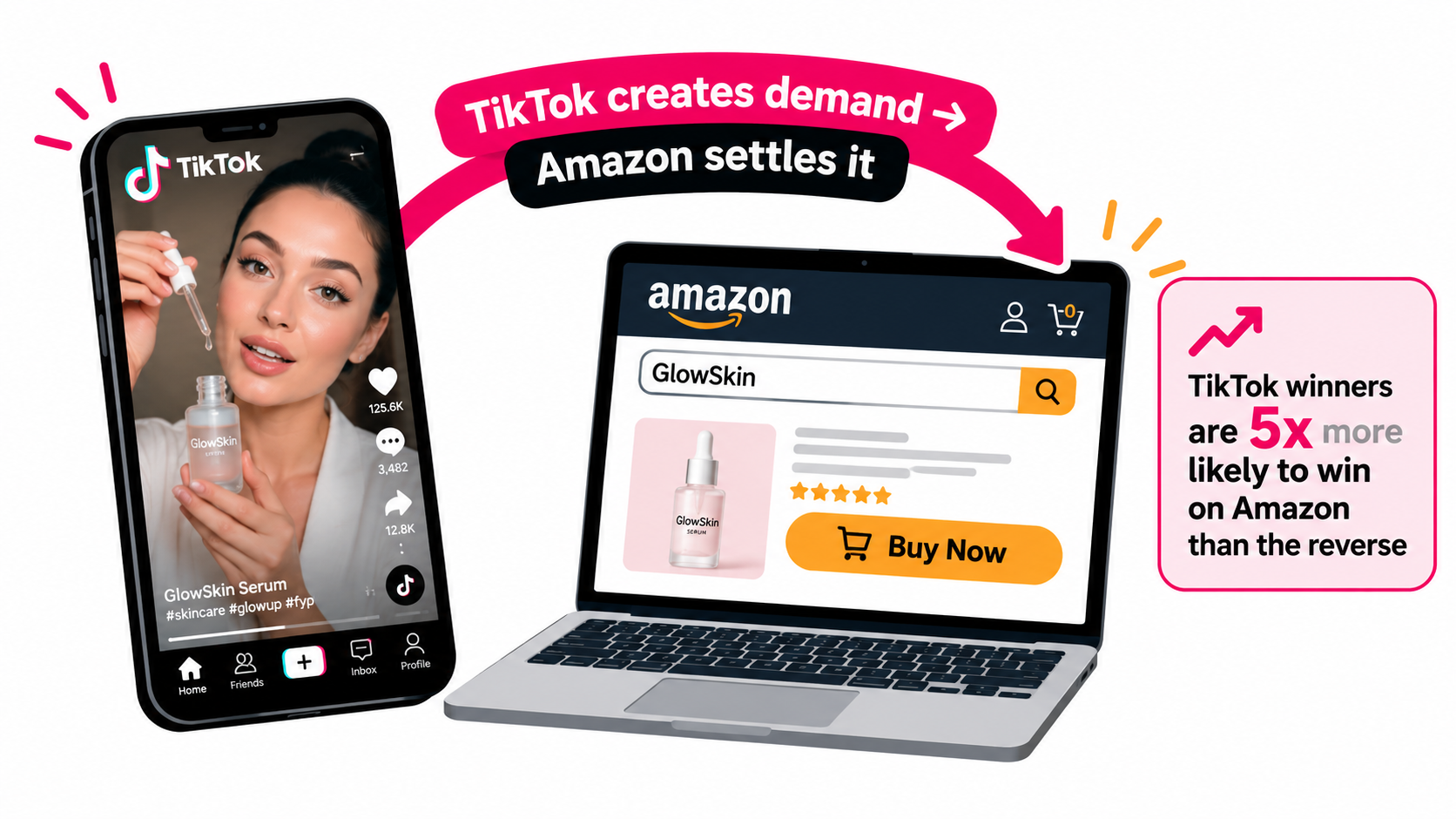
Marketplace Pulse matched the 10,000 largest sellers on Amazon and TikTok Shop by business name. Only 498 appeared on both lists, about 5% of either. Among TikTok Shop’s 100 largest US sellers, one in five also ranked in Amazon’s top 10,000. Among Amazon’s 100 largest, only one in 25 ranked in TikTok Shop’s top 10,000.
That makes a brand that wins on TikTok five times more likely to also win on Amazon than the other way around. The explanation is behavioral. TikTok makes people want things, and Amazon is where they buy them. Shoppers who see a product demonstrated in a video often open Amazon, type the brand name, and buy where their card, Prime delivery, and trusted reviews already are.
Which products it works for
This path doesn’t work for every product. Among TikTok Shop’s top 1,000 US products by lifetime sales, more than two-thirds of revenue comes from things that are worn, applied to the body, or consumed. These are products whose results a creator can show on camera in fifteen seconds.
A replacement charging cable, a set of storage bins, or printer paper don’t pass that test. People search for those products. Nobody films them. The market is also concentrated: on TikTok Shop, the top 1% of sellers drive 60% of US GMV.
How to measure it properly
For an existing Amazon seller, Marketplace Pulse argues TikTok’s value is best measured in Amazon branded searches, not TikTok Shop orders. If you fund creator content, track branded search volume and branded-term conversions in Amazon Brand Analytics alongside TikTok sales.
There’s a link to the AI shelf here too. Shoppers who arrive with a brand in mind still frequently ask the assistant to compare options. A listing with rich context makes it easier for the assistant to confirm the choice rather than steer the shopper somewhere else.
The practical decision
- Demonstrable product: Fund creators, expect much of the return to show up on Amazon, and make sure your Amazon listing picks up the story the videos tell.
- Search-driven product: Don’t force TikTok. Put that budget into catalog depth, the AI shelf, and search.
9. Seller Central as the Hub: Convenience and Its Cost
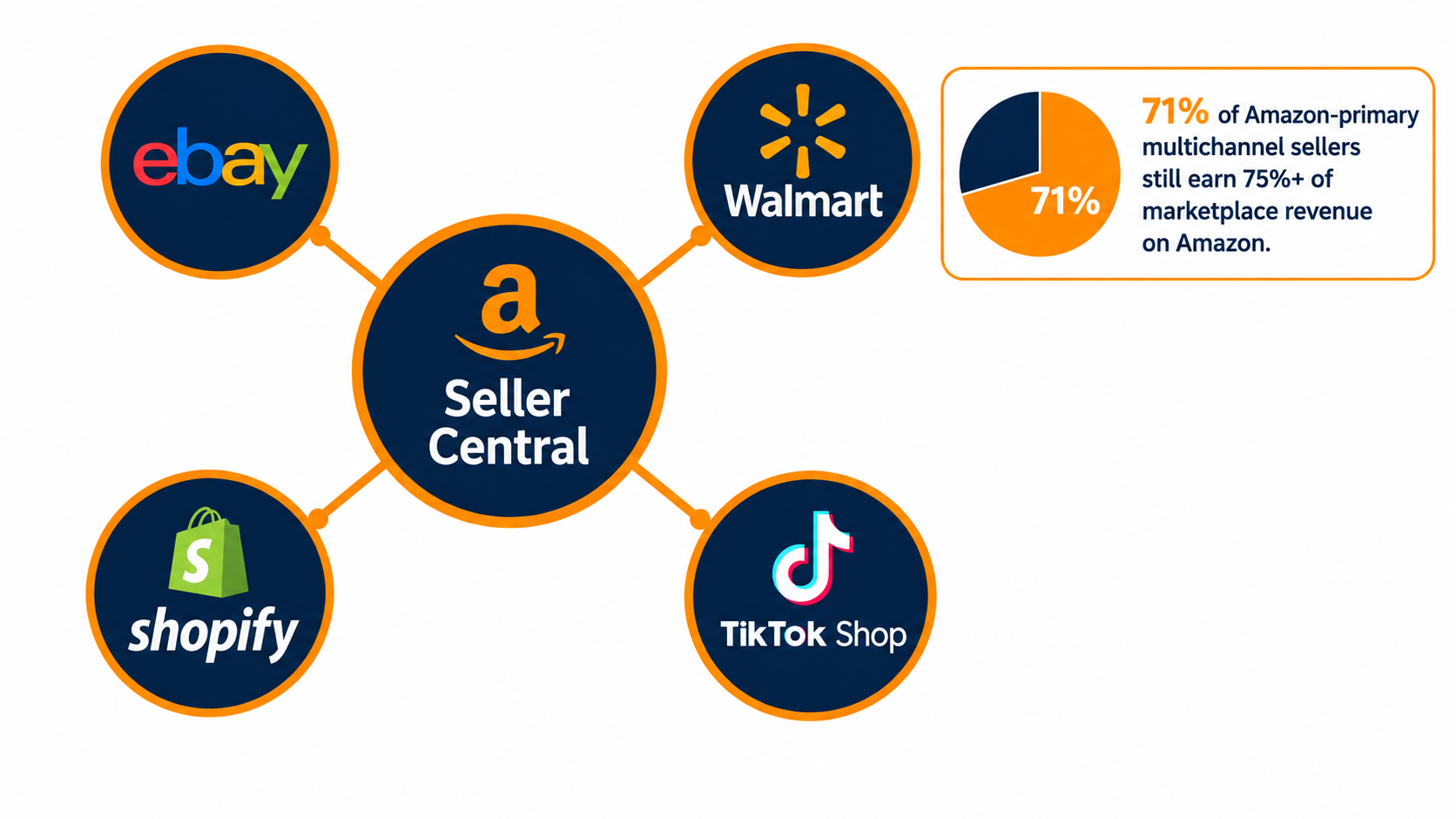
In September 2026, at its annual Accelerate conference, Amazon announced that sellers will be able to manage their eBay, Shopify, TikTok Shop, and Walmart businesses from inside Seller Central. The tools are rolling out gradually to US sellers at no extra cost.
What the tools do
- Edit a product description once, and Amazon reformats and publishes it to linked listings on eBay, Walmart, and Shopify.
- See Shopify and Walmart orders alongside Amazon orders and fulfill them through Amazon in a few clicks.
- View product-level profitability across every connected channel.
This is the latest step in a long reversal. Five years ago, Amazon policy made multichannel selling harder. FBA charged more to ship off-Amazon orders, and products priced lower elsewhere could be suppressed, as they still can be today. Then came Buy with Prime, Multi-Channel Fulfillment growth (more than 200,000 US sellers by 2024, with order volume up 70%), and MCF integrations with Walmart and Shein in 2025.
The dependence problem
Amazon says more than 95% of its sellers sell on multiple channels. But being on several channels isn’t the same as being diversified. According to the Marketplace Pulse 2026 Seller Index, 71% of Amazon-primary sellers who are active on at least one other marketplace still earn 75% or more of their marketplace revenue from Amazon.
Amazon says the cross-channel data won’t inform its retail business. Even so, it now has visibility into how much its sellers sell elsewhere, not just what they charge. A seller trying to reduce reliance on Amazon who runs every other channel through Amazon’s software has, in a real sense, deepened that reliance.
The other channels are worth a look
Amazon remains dominant, with an estimated $300 billion in US third-party sales, more than seven times eBay’s. But Walmart’s US marketplace grew nearly 50% in the first quarter of its fiscal 2027, its fastest pace in years. US e-commerce overall grew 12.2% in Q2 2026, its fastest in five years, and reached a record 17.1% of retail spending.
How to use the hub without being trapped by it
- Use the unified profitability view. Channel-level margin data is useful regardless of where it lives.
- Keep your master product data, including the intent map and attributes from earlier sections, in a system you control. Then push it to Amazon’s tools, not the reverse.
- Keep direct relationships with each channel’s account team and policies. Don’t let Amazon become your only window into Walmart or TikTok Shop.
- Watch your price parity. Amazon can still suppress offers priced lower elsewhere, and unified tools make pricing changes easy to push everywhere at once.
10. Measuring a Shelf That Has No Dashboard
The hardest part of the AI shelf is that there’s no report for it. Seller Central shows search term performance, ad metrics, and Brand Analytics. It doesn’t show how often the assistant recommends your product in an organic answer.
Run your own spot checks
You can build a rough picture manually. Take the intent map from Section 7 and ask Alexa for Shopping those questions on a regular schedule. Log which products it recommends and whether yours appears.
- Use a consistent set of 20 to 50 questions per category.
- Include both “best of” questions and constrained ones (“best for X under $Y”).
- Record the date, question, products recommended, and the reasons the assistant gives.
- Repeat monthly, and after any significant listing change.
Keep in mind the limits the study itself had. Results from a single account may reflect personalization, and one-off answers can vary. Look for patterns over time rather than reacting to single results.
Read the assistant’s reasons
The assistant usually explains why it recommends something. Those explanations are the most useful data you’ll get. If competitors are recommended for “cooling” or “quiet operation” and your product has those qualities but your listing doesn’t say so clearly, you’ve found a gap to close.
Watch indirect signals
- Sessions vs. search impressions: Traffic growth that isn’t explained by search rank or ad changes may be coming from other surfaces, including the assistant.
- Conversion by traffic source: AI-referred shoppers tend to convert better, based on Adobe’s data. Unexplained conversion improvements are worth investigating.
- Customer question patterns: Fewer repeat questions after a listing update suggests the context is landing.
Test sponsored prompts carefully
If you try Sponsored Brand Prompts, set clear goals and a small budget first. Amazon’s “nearly 20% continue the conversation” figure measures engagement, not sales. Compare it against your own conversion and new-to-brand data before scaling up.
11. A 90-Day Plan for the Three-Shelf Marketplace
Here’s how the ideas in this article fit into a practical sequence for an established seller.
Days 1–30: Baseline and audit
- Pick your top 10 to 20 ASINs by revenue or margin.
- Build an intent map of 20 to 40 shopper questions for each core product or category.
- Run a baseline spot check in Alexa for Shopping and log the results.
- Audit every optional attribute in your category templates and fill in accurate values.
- Pull 12 months of customer questions and review themes, and tag them by use case.
Days 31–60: Rewrite and reinforce
- Rewrite bullets to lead with situation-specific benefits, keeping your core search terms in place.
- Add comparison and use-case modules to A+ content, including honest “best for / not for” guidance.
- Update lifestyle images to show the situations named in your intent map.
- If your products are demonstrable, brief creators on the same use cases so off-Amazon content and on-Amazon listings tell the same story.
- Set up branded search tracking in Brand Analytics.
Days 61–90: Measure and decide
- Repeat your assistant spot checks and compare them against the baseline.
- Review sessions, conversion, and branded search trends for the updated ASINs.
- Run a small, controlled test of Sponsored Brand Prompts if it fits your category.
- Connect secondary channels through the new Seller Central tools if helpful, while keeping master data in your own system.
- Schedule a quarterly refresh cycle for seasonal use cases.
What not to do
- Don’t cut search or ad investment to chase the AI shelf. Search still drives most sales.
- Don’t stuff listings with invented use cases. Inaccurate context produces bad recommendations, returns, and poor reviews.
- Don’t treat one study as gospel. Build your own evidence.
Conclusion: The Window Is Open, and It Won’t Stay That Way
For a decade, Amazon selling came down to two questions: how to rank and how much to bid. Both still matter. Organic search and sponsored placements carry most of the revenue, and Amazon’s $68.6 billion ad business isn’t slowing.
But 2026 added a third question: when a shopper asks for advice, does the assistant understand why your product is the right answer? The early evidence says that question has a different answer than the first two. Nearly two-thirds of the assistant’s picks came from outside the organic top 10, and four in ten came from products shoppers would never have scrolled to.
That creates a rare kind of opening. Sellers who aren’t category leaders get a path to visibility that doesn’t depend on out-spending incumbents. Category leaders learn that rank alone may not protect them.
It also comes with a clock. Sponsored prompts are live, ChatGPT has shifted to an ad model, and the history of Amazon search suggests open ground doesn’t stay open. As Marketplace Pulse noted, “search looked like that once too, before the ad load found it.”
Key takeaways
- Treat the AI shelf as a real channel. Rufus, now Alexa for Shopping, drove an estimated $12 billion in incremental sales, and AI-referred shoppers now convert better than other traffic.
- Rank and ads don’t appear to transfer. Only 14.3% of assistant picks were sponsored, and 63.9% were outside the organic top 10.
- Context is the lever you control. Attributes, use cases, honest limitations, and clear comparisons give the assistant reasons to recommend you.
- Product knowledge is the moat. AI tooling has made good copy common. Specific, accurate insight into who your product serves is still hard to copy.
- Measure it yourself. There’s no dashboard, so build a spot-check routine and read the assistant’s stated reasons.
- Use outside demand wisely. For demonstrable products, TikTok feeds Amazon branded search. For search-driven products, invest in catalog depth instead.
- Use the hub without handing it the keys. Seller Central’s multichannel tools are convenient, but keep your master data and channel relationships under your own control.
Almost every seller has the first two shelves covered by now. The ones who learn the third shelf while it’s still mostly organic will be the first to notice when that changes.