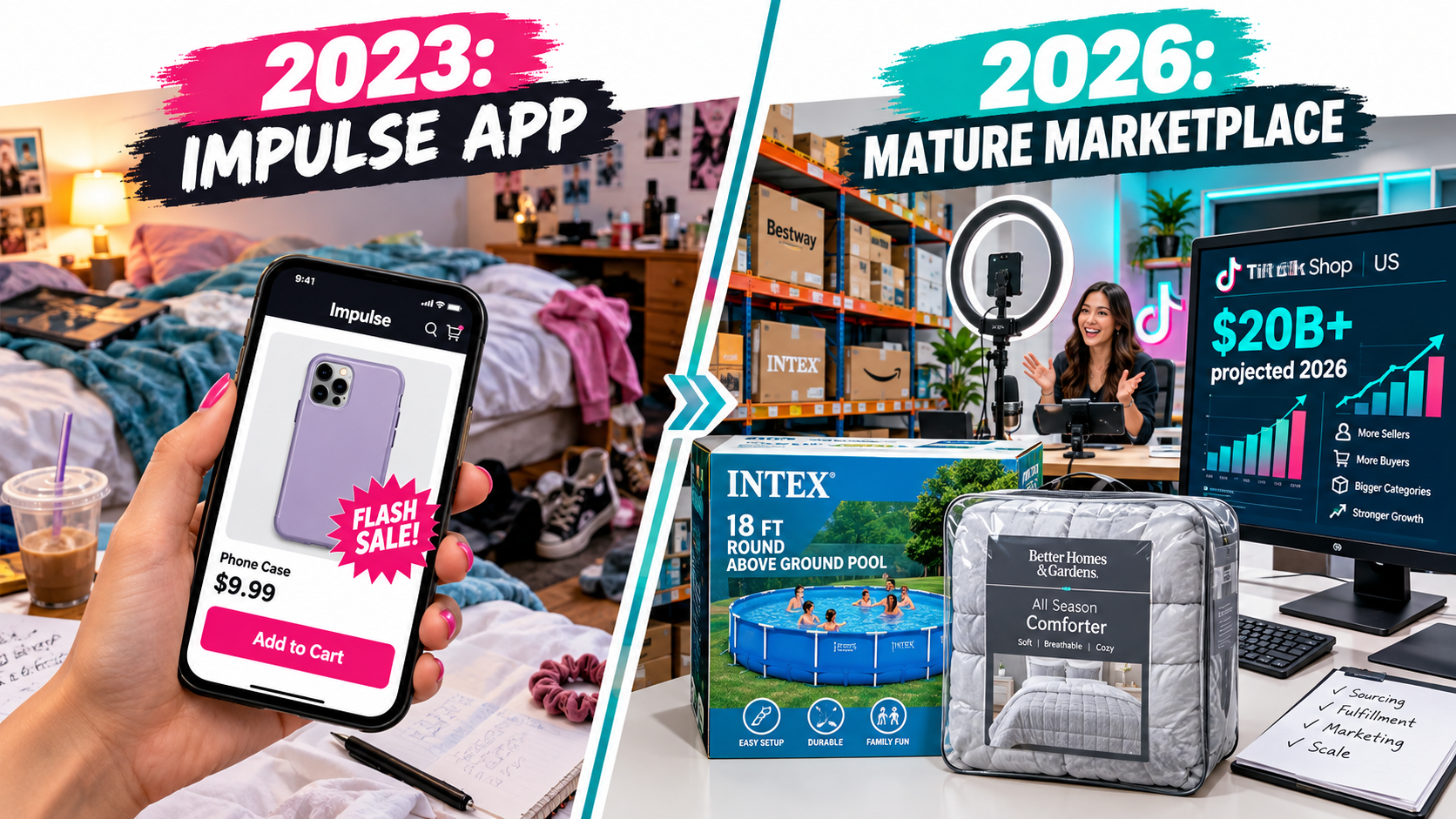

For its first two years in the U.S., TikTok Shop had a reputation it could not quite shake. It was where you bought a $12 gadget you did not need at 11 p.m. because a stranger in a car demoed it with a lot of enthusiasm. Sellers treated it the same way: a fast, cheap experiment you ran on the side while the “real” business happened on Amazon or your own site.
That framing is now out of date. In 2026, shoppers are buying $85 comforters, $150 above-ground pools and $2,000 saunas through the app. Brands like Samsung, Ralph Lauren, Disney, Ulta Beauty and Best Buy have opened storefronts. TikTok has taken control of order fulfillment for U.S. sellers. And companies are hiring a new kind of executive, the “Head of TikTok Shop,” to run the channel as its own business unit.
That changes the question sellers need to ask. It is no longer “Can I go viral on TikTok Shop?” It is “Can my business run the way TikTok Shop now needs it to?” Those are very different questions. The second one covers logistics, margin structure, creator operations, live production and staffing, not just content.
This article skips the ranking algorithm and fee-schedule details, which we have covered elsewhere. Instead, it looks at the operating model TikTok Shop selling requires in 2026. We’ll cover what the platform’s growth data actually shows, what the end of independent shipping means for your costs, which categories have opened up, how affiliate programs and LIVE selling became core infrastructure, and how to decide whether the channel fits your business at all.
Throughout, we draw on reporting from Modern Retail, eMarketer forecasts, TikTok Shop’s own disclosures and a GlobalData consumer survey commissioned by TikTok Shop. Where a figure comes from the platform itself, we say so.
The Numbers That Show TikTok Shop Has Matured
Before looking at operations, it helps to see how big the channel has become and who is driving its growth. The data points in one direction: TikTok Shop is now a mainstream retail channel, not a novelty.
Market size and share
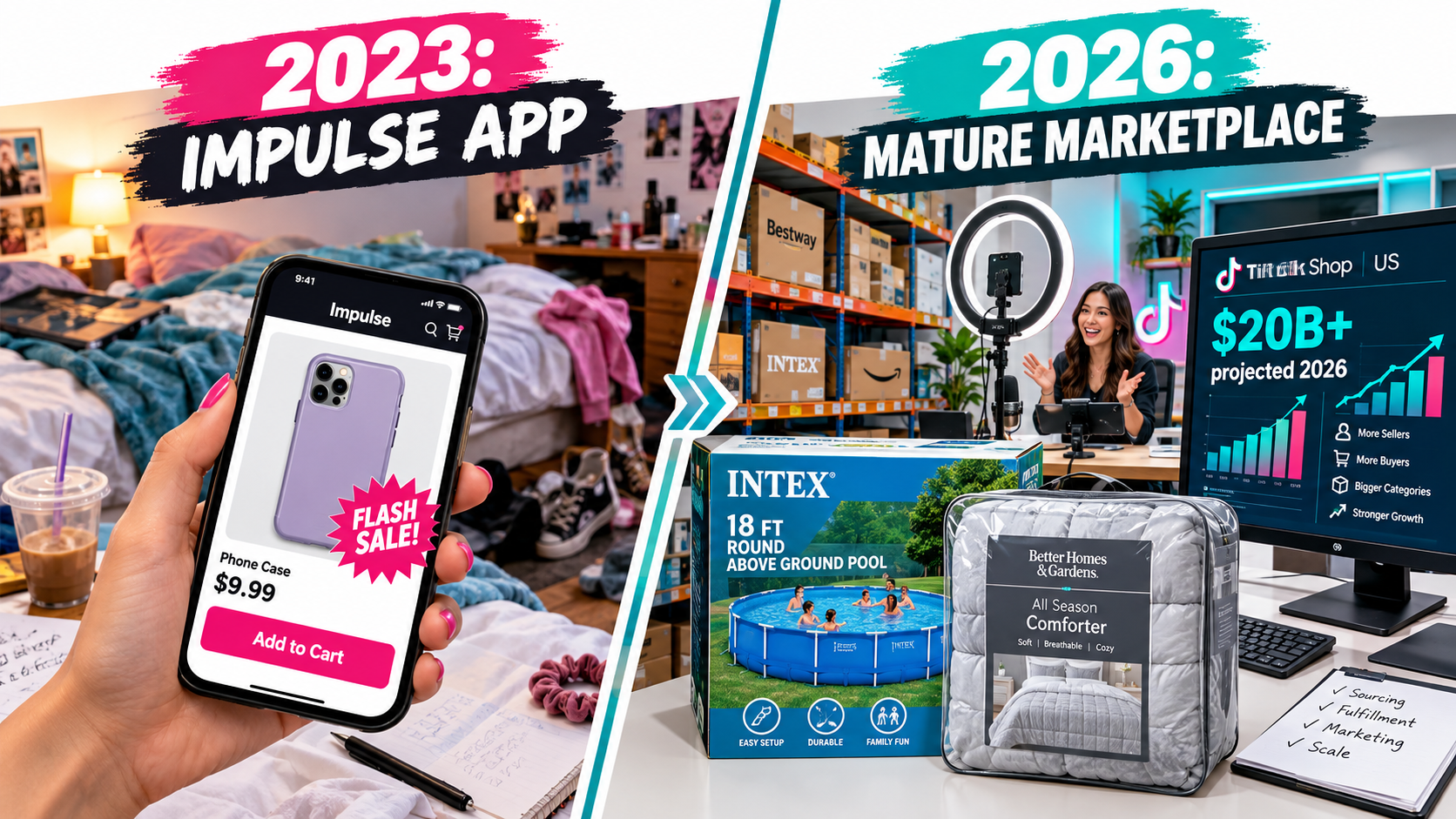
According to eMarketer data cited by Modern Retail, TikTok Shop now makes up roughly 20% of all U.S. social commerce sales, with Meta accounting for most of the rest. eMarketer’s December research projected that TikTok Shop sales would pass $20 billion in 2026 and reach more than $30 billion by 2028.
Peak-season numbers tell a similar story. Wikipedia’s summary of the platform notes that TikTok Shop generated more than $100 million during Black Friday 2024. A year later, the platform drove about $500 million in sales across the four days from Black Friday to Cyber Monday. For context, when TikTok Shop launched globally in September 2023, daily sales averaged about $7 million.
Growth across seller sizes
What stands out in 2026 is that both ends of the seller base are growing together:
- Large brands: Sales from brands with at least $30 million in annual revenue rose 97% year over year in 2025, according to TikTok Shop.
- Small businesses: U.S. sellers with less than $15 million in annual revenue grew sales 66% in 2025, the platform told Modern Retail.
- Seller count: More than 215,000 small businesses are actively selling on TikTok Shop in the U.S., up 25% year over year.
- Creator supply: The number of creators earning commissions through TikTok Shop grew 146% year over year.
Why the growth mix matters
When big brands arrive on a marketplace, smaller sellers often get squeezed on price, visibility and creator attention. So far, TikTok says that has not happened. Patrick Nommensen, head of strategic initiatives at TikTok Shop, described it as “an ecosystem and a platform where brands of all sizes can be successful.”
Treat that statement with some caution, since it comes from the platform. Still, the mix has effects that are easy to see. Modern Retail reported that the influx of larger companies has raised average unit prices across the platform. Higher average prices, bigger brands and more creators all push the same way: TikTok Shop is starting to work like a full marketplace, with the operating standards that come with one.
Takeaway: If your mental model of TikTok Shop is still “cheap impulse buys,” your pricing, product selection and operations plan are probably calibrated to a channel that no longer exists.
The Logistics Mandate: Why Independent Shipping Ended
The most important operational change for U.S. sellers in 2026 has nothing to do with content. It is about who ships the box.
What changed
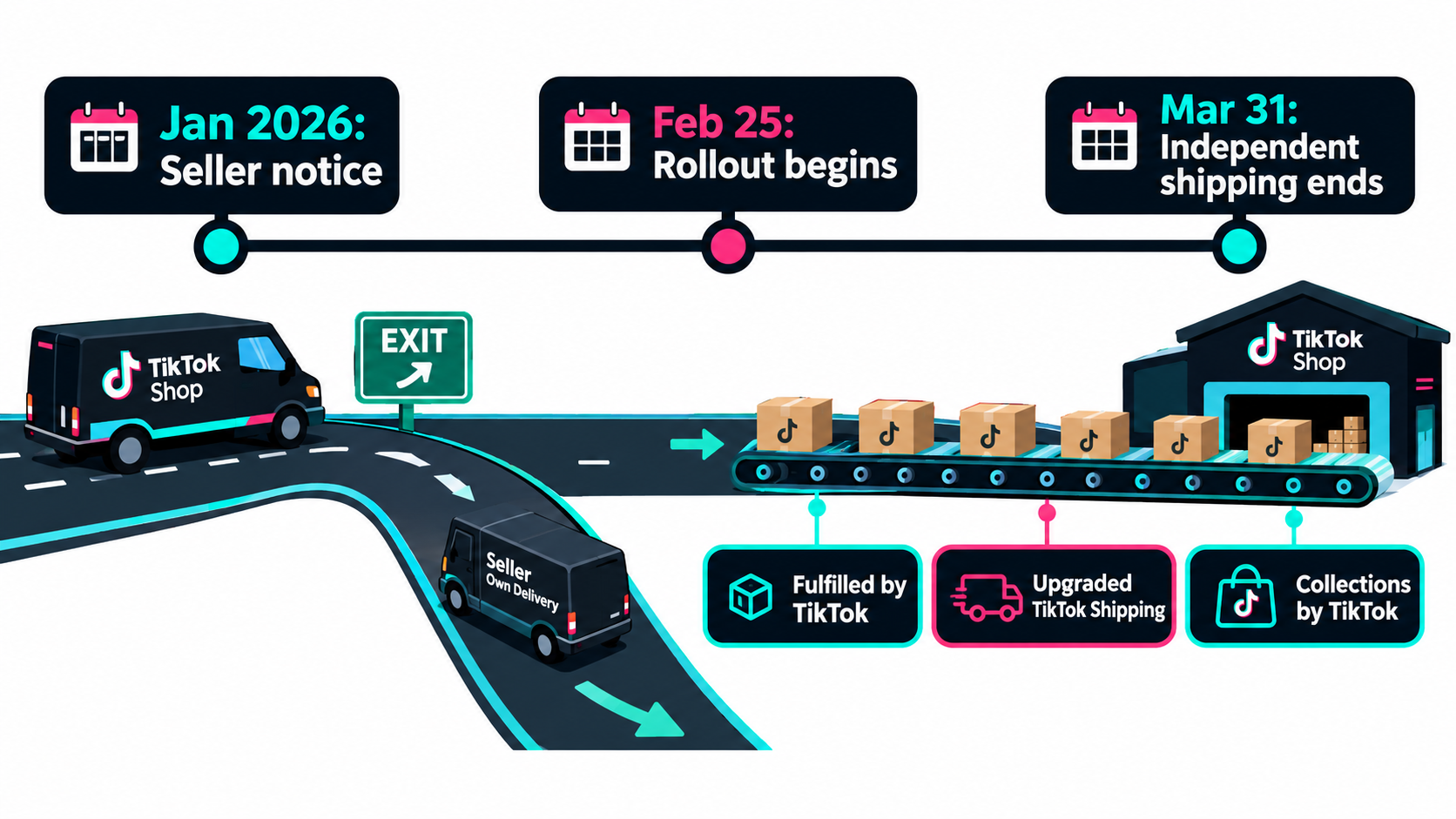
In January 2026, TikTok Shop emailed U.S. merchants to say it was discontinuing independent shipping. According to the memo, reviewed by Modern Retail, the change rolled out in stages starting February 25 and was expected to be complete by March 31. Since the U.S. launch in 2023, sellers had been free to handle fulfillment themselves. That option is now gone.
Sellers now have to fulfill through TikTok Shop’s own logistics services:
- Fulfilled by TikTok (FBT): Merchants send inventory to TikTok’s warehouses. TikTok handles storage, picking, packing and shipping for a fee based on the number of items sold and their physical size.
- Upgraded TikTok Shipping: The seller still ships, but TikTok automatically chooses the carrier.
- Collections by TikTok: A door-to-door pickup service.
Some approved third-party software is still allowed, including AfterShip, 4Seller and ShipHero, but only when fully integrated with TikTok’s logistics system. Sellers who had not moved over by the end of the rollout risked losing access to a channel that reaches about 170 million U.S. users.
TikTok’s reasoning
TikTok Shop said the change is meant to improve delivery reliability and order tracking and to give shoppers a more consistent experience. That fits the platform’s broader direction. A marketplace that wants people to buy pools and saunas cannot have delivery quality that swings from one seller to the next. Amazon made the same bet years ago with FBA and Prime.
How sellers reacted
Not everyone went along with it. Modern Retail talked with five brands and three consultants who together advise hundreds of TikTok Shop sellers. Some merchants said they planned to cut the number of products they list, pull back on promotions, or leave the marketplace entirely.
The clearest example was Matching, a pajama brand launched by Nadya Okamoto, whose other brand, August, grew quickly on TikTok. Matching was small and fulfilled orders itself. It did not carry enough inventory to justify FBT’s costs and complexity. “It just doesn’t make sense for the size of the business,” Okamoto said. “We would rather just have people go to our site than TikTok Shop.”
Consultants raised other concerns. TikTok’s logistics services have historically been uneven, with merchants reporting operational errors, shipping delays and limited support when things go wrong. Some also worried that moving inventory into TikTok’s network would raise costs and make it harder to offer the steep discounts TikTok shoppers expect.
Takeaway: Before 2026, logistics on TikTok Shop was something you chose. Now it is a condition of selling there. Every seller needs a deliberate fulfillment strategy, and for some very small brands, the honest answer may be that the channel no longer fits.
Doing the Fulfillment Math: FBT vs. Platform-Controlled Self-Shipping
Since some form of TikTok logistics is now required, the real decision is which option fits each SKU. There is no single right answer. Sellers operating at scale are already running hybrid setups.
What real sellers are doing
Two examples from Modern Retail’s reporting show the range:
- Mellow Sleep, a sleep brand selling $50 pillows and comforters from $85, uses a hybrid model. Some orders go through FBT and others are fulfilled in-house, depending on the customer’s location. Founder Chad Keller said FBT is “still in its infancy” and the experience “somewhat choppy.” He also noted that TikTok’s requirement to dispatch domestic orders within two business days is not always realistic for smaller brands shipping bulky items.
- Spreetail, a multi-brand seller and fulfillment partner focused on home, outdoor furniture and lawn and garden, fulfills its own orders because it already has deep logistics experience. It pointed to faster delivery as the biggest improvement on the platform over the past year.
A decision framework by SKU
Without published fee tables in front of us, the most useful approach is a framework rather than a formula. For each product, weigh these factors:
- Velocity. FBT charges by units sold and size, so it tends to suit products that sell steadily and predictably. Slow movers sitting in a TikTok warehouse tie up cash and may add storage costs.
- Size and weight. Because FBT fees scale with physical dimensions, bulky items need a careful comparison against your own 3PL or warehouse rates through Upgraded TikTok Shipping.
- Dispatch SLA risk. If you often miss the two-business-day dispatch window, FBT can protect account health metrics that would otherwise suffer.
- Inventory depth. Splitting stock between your warehouse and TikTok’s adds planning overhead. Brands with thin inventory, like Matching, feel that most.
- Discount headroom. TikTok shoppers respond to promotions. If fulfillment costs rise, check whether your planned discount depth still leaves a contribution margin.
Building a landed-cost view
The mistake many sellers make is judging TikTok Shop on gross revenue. A realistic per-order model should include:
- Product cost (COGS)
- Platform referral and transaction fees
- Affiliate commission, which varies by creator and campaign
- Fulfillment fees (FBT) or label costs plus your own pick-and-pack
- Promotion and voucher costs you fund
- Sample and seeding costs spread across attributable orders
- Returns and refunds
- Paid amplification spend
Keller said he would like TikTok Shop’s fees to become simpler as brands move deeper into FBT, and added that TikTok “seems willing to work with brands and actually take feedback.” That is encouraging, but plan around the fees that exist today, not the ones you hope for.
Takeaway: Put each SKU through a fulfillment decision, not just your catalog as a whole. Hybrid setups by product and region are normal, and they are often the most economical option.
High-Ticket Categories Are Now Viable
One of the clearest signs that TikTok Shop has matured is what people are willing to buy there. Modern Retail reports that shoppers are increasingly buying comforters, LED face masks and even above-ground pools through the app. That is a real shift for a channel long tied to fashion, beauty and wellness impulse purchases.
The Spreetail data
Spreetail’s numbers are some of the most specific available. According to CMO Amit Dodeja, among the brands Spreetail works with:
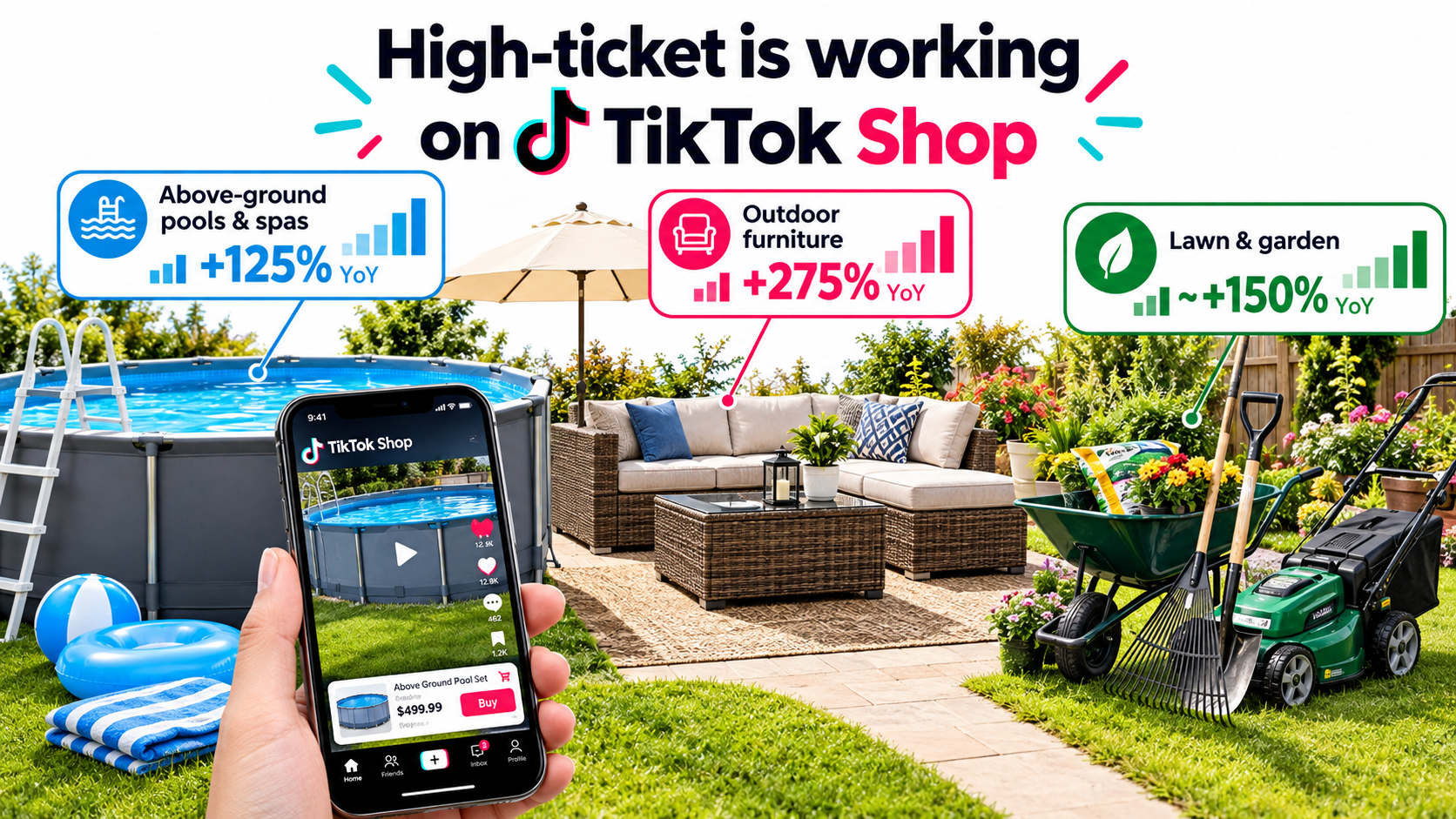
- Above-ground pools and spas grew 125% year over year on TikTok Shop, which Dodeja said was five times the growth seen on other marketplaces. Pools start around $150 and saunas around $2,000.
- Outdoor furniture grew about 275% year over year.
- Lawn and garden grew nearly 150%.
“Our price points are probably four to five times higher than the average price point on TikTok Shop, and that continues to do well for us,” Dodeja said.
Why bigger purchases work now
Three things seem to be behind the change:
- Trust. “Consumers feel TikTok Shop is far more trustworthy given that the marketplace has matured over time,” Dodeja said. Keller made a similar point: well-known brands like Pacsun and Skims joining the platform gave the marketplace credibility.
- Visual explanation. Products that need research, such as furniture, saunas and pools, benefit from video. “The visual nature of TikTok is actually helping a lot of consumers understand what these products are,” Dodeja said. A 30-second clip of a family setting up a pool answers questions a static listing can’t.
- Better logistics. Faster delivery makes people more willing to order bulky items, which ties directly back to TikTok’s fulfillment push.
The Mellow Sleep example
Mellow Sleep launched on TikTok Shop in fall 2025, just months after the brand itself launched. In under a year, it says it has collected more than 50,000 reviews from organic creators and more than 20,000 five-star customer reviews. Its CloudAlign pillow and MarshMellow comforter have held the top spot in their TikTok Shop categories since launch.
One creator went from generating $80,000 a month in GMV for the brand to $1.5 million a month over about ten months. Keller also mentioned a benefit that doesn’t show up in sales data: early-adopter brands are getting more direct rep support from TikTok, which he said has become harder to get on Meta.
Takeaway: If you sell in home, outdoor, sleep, beauty devices or other considered-purchase categories and have avoided TikTok Shop because you assumed it only works for cheap items, look again. Just plan carefully for bulky-item fulfillment and dispatch timelines.
Affiliates Are the Sales Force Now
On most marketplaces, the brand drives sales through search placement and ads. On TikTok Shop, a large share of sales comes through other people’s content. Delaney Del Mundo, SVP of account strategy for TikTok and Amazon at agency PLTFRM, told Modern Retail that affiliates drive 75–85% of sales for some brands on the platform.
The Portland Leather Goods blitz
Portland Leather Goods is a useful case because it is an established company, not a TikTok-native startup. It has passed $500 million in total revenue over seven years, has brought in more than $100 million a year for at least two straight years, and operates 17 retail stores. It joined TikTok Shop quietly in February 2026 and was selling about $1,200 a day.
In late March, it ran a seven-day affiliate “blitz”:
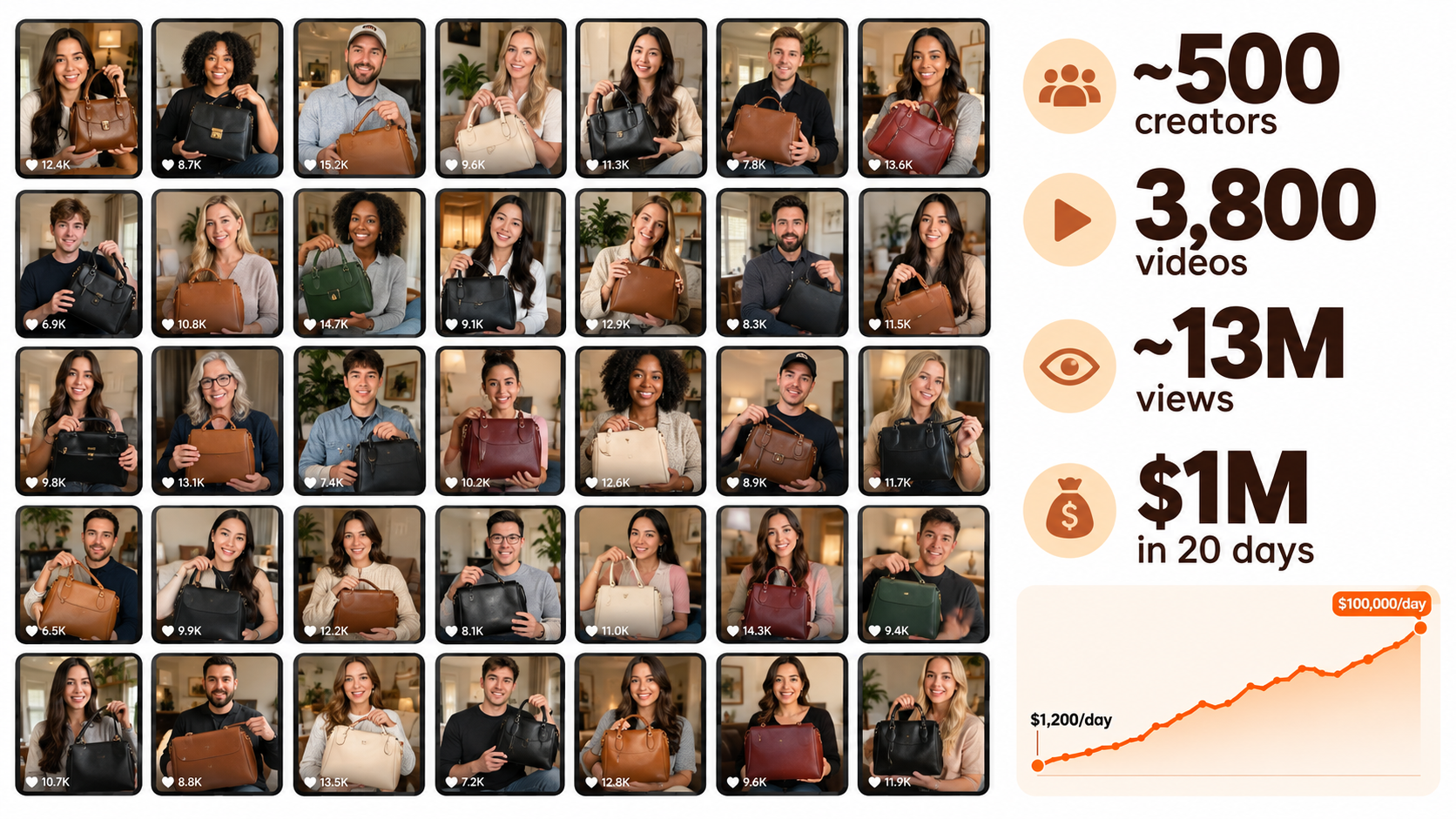
- About 500 creators were signed up, approved and sent product if they didn’t already own it.
- The first 20 creators to post 10 videos with at least 100 views each received $1,000.
- A GMV contest paid $2,000 to $10,000 to the top three performers.
The results: close to 13 million views across 3,800 videos, the brand’s first $100,000 day, and $1 million in total sales within 20 days of starting the blitz.
What made it work
CMO MacCoy Merkley described content that would never get through a traditional brand approval process: “We have people in their living rooms holding up bags they’ve had for years and talking about why they love their bags. That’s the magic we’re after.”
Three principles stand out:
- Volume first. The incentive rewarded posting frequency at a low view threshold, which put a large number of videos into the feed quickly.
- Performance second. The GMV contest then rewarded the creators who actually drove sales.
- Relationships over time. After the blitz, the brand kept its top affiliates close through WhatsApp groups and one-on-one conversations, asking for feedback on what would “keep them happy.”
How incentives are escalating
Del Mundo said affiliate strategies require “meaningful incentives,” whether cash or brand credit. She has seen brands offer down payments on homes and Teslas. Established brands have more room to compete this way, which is one reason big companies have been able to catch up quickly.
Merkley credits TikTok’s design: “TikTok did it better than anyone else, making affiliates a native function of their platform.” Creators can manage brand relationships, sales and earnings in one hub, which lowers the barrier for regular fans to become affiliates.
Takeaway: Treat your affiliate program as your sales team, with recruiting, onboarding, incentive design and retention. Budget for creator incentives alongside commissions, and track cost per acquired customer rather than cost per video.
LIVE Selling Has Become Trust Infrastructure
Livestream shopping used to be seen as a Chinese-market import that U.S. shoppers might never adopt. In 2026, LIVE has become one of the main ways TikTok Shop builds buyer confidence, especially for expensive, variable or easily counterfeited products.
The luxury resale signal
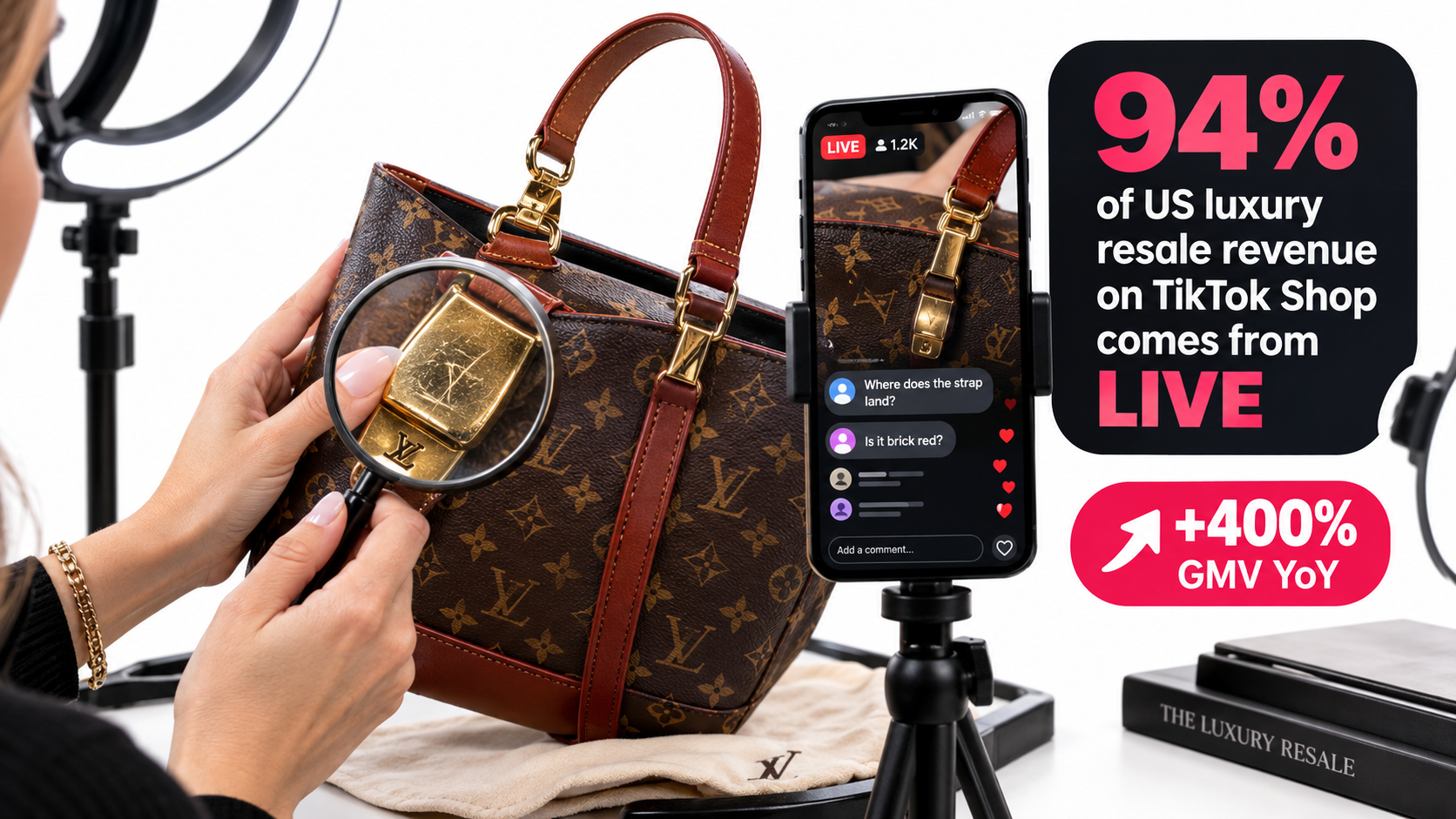
At its first Luxury Resale Summit in New York, TikTok Shop said that year to date, 94% of U.S. luxury resale revenue on the platform comes from LIVE. The category’s GMV rose 400% year over year, driven mostly by handbags and watches.
The category is tightly controlled. Sellers must be invited and must work with one of five authentication partners: Entrupy, Legitmark, CheckCheck, Legit App or Real Authentication. Even with those safeguards, buyers still want to see the item in real time.
“To convey trust, there needs to be a conversation. But where is that conversation happening? It’s happening on live.” — Rainee Walker, head of category for luxury resale, TikTok Shop U.S.
Walker gave a simple example. She is five-foot-ten, so a crossbody bag will sit differently on her than on someone five-foot-three. On a livestream, she can ask the host where the strap falls, or whether a red is “more brick red” or “a little bit more orange.” Condition terms like “scratched hardware” or “stained lining” are subjective in text. On camera, they are obvious.
LIVE beyond luxury
The same logic applies elsewhere:
- Crocs ran its U.S. TikTok LIVE 24/7 for the entire month of October last year.
- Stila Cosmetics built a livestream studio in its office to support TikTok Shop sales.
- Fashionphile runs several lives a day through “Fashionphile TV.” TikTok Shop accounts for a little over 25% of its U.K. business.
- MyGemma says TikTok and other livestream channels make up about 15–20% of its revenue.
LIVE as entertainment
Mavwicks Fragrances is the most dramatic small-business example. Before TikTok Shop, founder Megan Reep said the company did about $300,000 to $400,000 a year. “The first year we were on TikTok Shop, we jumped to $32 million in sales,” she said.
Mavwicks runs its lives like events. In one session, every bundle purchase meant her husband got dropped into a dunk tank. “Keeping exciting things happening on screen” helps keep people engaged and watching, Reep said. It sounds silly, but it works for a reason: LIVE competes with every other video in the feed, so being watchable is part of converting viewers into buyers.
Takeaway: If your product involves questions about fit, condition, authenticity, color or scale, LIVE is not optional in 2026. Build a recurring schedule, set up a dedicated space, and give hosts enough product knowledge to answer detailed questions on the spot.
Big Brand vs. Small Brand: Two Playbooks, One Marketplace
Large and small brands now sell side by side on TikTok Shop, but the same approach does not work for both. On the Modern Retail Podcast, reporters explained why the tactics that built early TikTok Shop winners may not suit a multinational, and the reverse.
What small brands have going for them
GlobalData’s survey of 6,000 U.S. consumers, commissioned by TikTok Shop, found that discovery is the platform’s main strength, and small brands benefit the most:
- 67% of consumers go to TikTok Shop to discover new products and brands, compared with 57% for Amazon.
- 66% of TikTok Shop users discovered a new brand on the platform in the past year.
- 72% of the brands those users discovered had less than $15 million in annual revenue.
- 58% of consumers who found a small brand on TikTok Shop later bought from it there. More than half bought within days, and about one in five bought the same day.
- 70% of TikTok Shop consumers have bought a product a creator recommended.
Because the survey was commissioned by TikTok Shop, treat these as directional. Even so, they fit what sellers report. Neil Saunders, managing director of GlobalData, put it this way: “One of the things that really helps the smaller brands on TikTok Shop is authenticity.” When founders show up on camera and talk directly to customers, that kind of content tends to do well.
What large brands have going for them
Big companies usually can’t post as often or as casually as a founder-led brand, because corporate approval processes slow everything down. They do have other advantages:
- Price competition: Scale gives them more room for discounts.
- Bigger incentive budgets: As Del Mundo noted, established brands “have more to give” when recruiting affiliates.
- Halo effects: The podcast pointed out that large brands may see spillover sales in other channels from shoppers who discover them on TikTok but buy elsewhere. Modern Retail has separately reported brands using TikTok Shop to grow Amazon sales.
TikTok’s courtship of big brands
TikTok has worked hard to bring large sellers on board. It has offered co-branded partnerships where it covers part of a major discount or free-shipping offer. It also ran Project Horizon, which rewarded agencies for onboarding large brands doing at least $10 million a year on competing platforms. As the platform matures, the podcast noted, incentives like these may become less common, so the terms available to early big-brand entrants may not last.
Takeaway: Small brands should lean into founder presence, fast content and live personality. Large brands should compete on affiliate incentive budgets, pricing and cross-channel halo measurement, and loosen approval workflows enough to keep up with TikTok’s posting pace.
The Rise of the “Head of TikTok Shop”
When a channel matters enough, it gets its own leader. Modern Retail has reported that more brands are looking for a head of TikTok Shop as they try to define a social commerce strategy, and that many are creating dedicated roles because the channel has become central to their business.
Why the role exists
TikTok Shop doesn’t fit neatly into a traditional org chart. It touches:
- Marketing (content, creators, paid amplification)
- Ecommerce (listings, pricing, promotions)
- Operations (FBT inventory, dispatch SLAs, returns)
- Partnerships (affiliate recruiting and retention)
- Production (LIVE studios and hosts)
When those responsibilities sit in five departments, nobody owns the P&L. Affiliate incentives get approved without regard for fulfillment costs. Promotions get planned without checking inventory in TikTok’s warehouses. A dedicated leader connects those decisions.
What the function typically covers
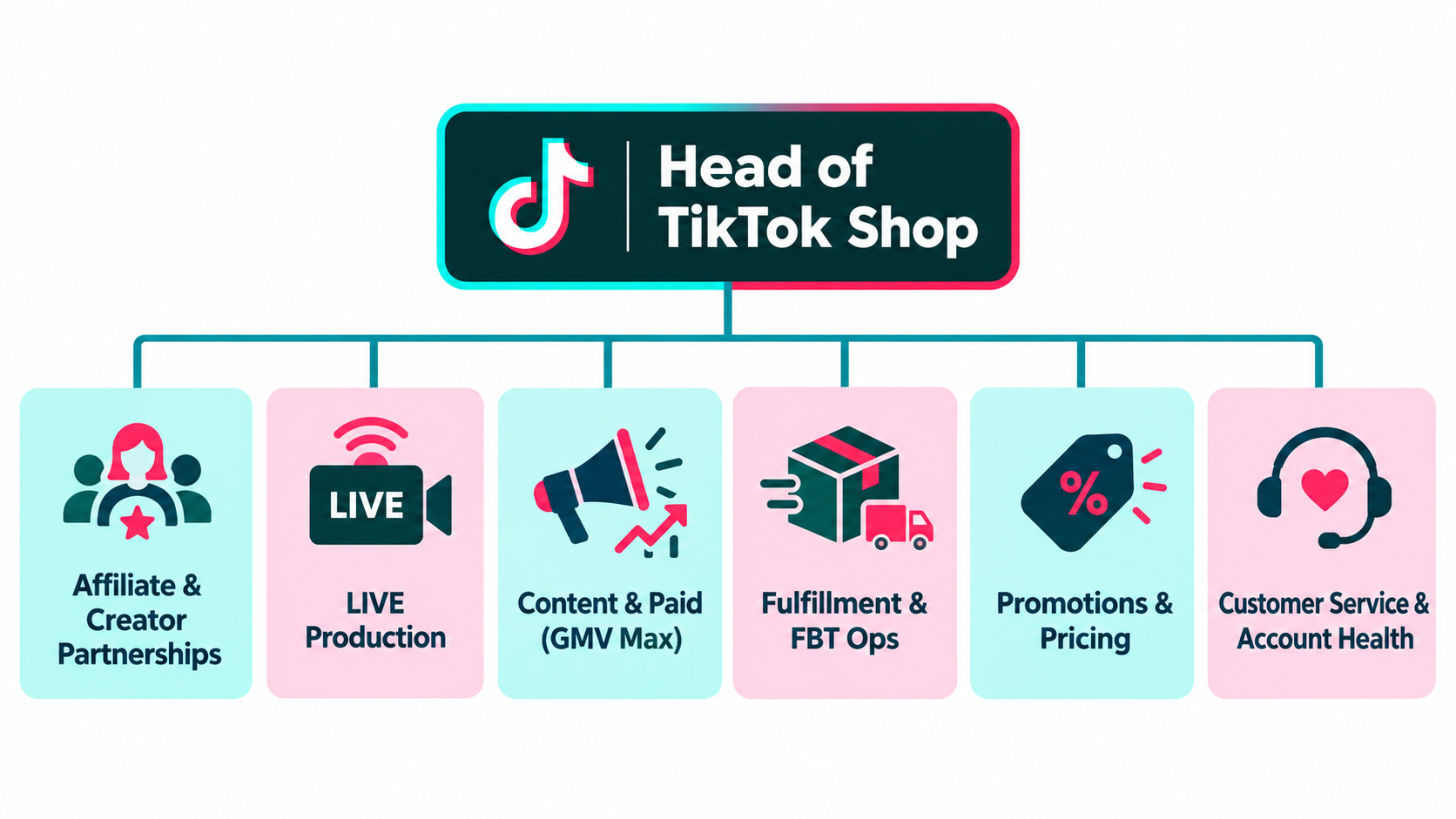
Based on the operating demands described throughout this article, a complete TikTok Shop function usually includes:
- Affiliate and creator partnerships: recruiting, sampling, incentive programs and relationship management, such as Portland Leather’s WhatsApp groups.
- LIVE production: scheduling, hosts, studio setup and run-of-show planning.
- Content and paid: brand-owned short video plus paid amplification of the best creator content.
- Fulfillment operations: deciding FBT vs. self-ship by SKU, replenishing TikTok warehouses, and monitoring dispatch SLAs.
- Promotions and pricing: planning around campaign calendars and platform events while protecting margin.
- Customer service and account health: response times, returns and policy compliance.
Right-sizing for smaller sellers
A $2 million brand doesn’t need six hires. It does need someone accountable for all six areas, even if that is a founder or one operator using agencies for LIVE production or affiliate management. The point is ownership, not headcount.
Takeaway: If TikTok Shop is more than about 10% of your revenue or growth plan and nobody owns its full P&L, fix that before scaling spend.
Risks and Failure Modes Sellers Underestimate
The success stories are real, but they are not the whole picture. Several risks deserve as much attention as the growth numbers.
1. Margin erosion
The podcast discussion was blunt: companies are “still losing margin by selling on a different platform,” so they need to be sure they can absorb it. Referral fees, affiliate commissions, creator incentives, funded discounts and now required TikTok logistics all add up. A channel that looks strong on GMV can still lose money on contribution margin.
2. Cannibalization
Are TikTok Shop sales new, or are they customers who would have bought on your site or on Amazon anyway? The podcast raised this directly. Without holdout tests or at least trend analysis across channels, you can’t tell whether the channel is adding revenue or just moving it around.
3. Discount dependence
TikTok shoppers are used to promotions. Consultants told Modern Retail that higher fulfillment costs could make it harder to offer the steep discounts TikTok shoppers often expect. If your conversion rate only holds up during heavy promotion, your economics are fragile.
4. Uneven logistics execution
Merchants have described TikTok’s logistics as historically uneven, citing operational errors, shipping delays and limited support. Now that sellers can’t opt out, any failure in TikTok’s network becomes your customer experience problem.
5. Retention
Merkley said the “next challenge” for Portland Leather is turning TikTok Shop buyers into loyal customers. The platform is excellent at discovery and first purchases. Repeat purchasing is less proven, and you have less control over the customer relationship than on your own site.
6. Platform and governance risk
The threat of a U.S. ban has faded now that TikTok has finalized a joint venture handing parts of its U.S. business to a consortium including Oracle, Silver Lake and MGX. But policy can still change quickly, as the shipping mandate showed. Modern Retail also noted users ran into technical issues around the time of the transition. Relying heavily on one platform, with policies you don’t control, is a structural risk.
7. Trust and content quality
TikTok Shop has faced criticism over product misinformation and AI-generated reviews. For legitimate sellers, the risk is both reputational, if shoppers group you with low-quality listings, and regulatory, if affiliate claims about your product go too far. Give creators clear guidelines on what they can and can’t claim.
Takeaway: Put a risk review on the calendar every quarter. It should cover contribution margin by SKU, channel incrementality, promotion dependence, fulfillment error rates, repeat purchase rate and policy exposure.
A 90-Day Operating Plan for TikTok Shop in 2026
Whether you’re launching or resetting an underperforming shop, here is a practical sequence based on what’s working for sellers now.
Days 1–30: Foundation and economics
- Build a per-SKU landed-cost model covering COGS, platform fees, expected affiliate commission, fulfillment costs, promotion funding, sampling and returns. Remove SKUs that don’t work at realistic discount levels.
- Choose fulfillment by SKU. Send fast, compact movers to FBT. Test bulky or slow items through Upgraded TikTok Shipping from your own warehouse or 3PL. Consider regional splits like Mellow Sleep’s.
- Stress-test the two-business-day dispatch requirement for any SKU you ship yourself.
- Assign a single owner for the TikTok Shop P&L.
- Set baselines for DTC and Amazon sales so you can measure cannibalization and halo effects later.
Days 31–60: Creator engine
- Recruit affiliates from your existing fans first. Portland Leather found that customers who already loved the product made the most convincing content.
- Design a two-part incentive, with a volume reward for early posting and a performance reward based on GMV.
- Sample deliberately. Send product after approval and track which creators actually post.
- Set up a communication channel, such as a group chat, newsletter or Discord, to keep top affiliates engaged and gather feedback.
- Write claim guidelines so creator content stays accurate and compliant.
Days 61–90: LIVE and amplification
- Start a recurring LIVE schedule. Consistency matters more than length. A few set weekly slots are better than occasional marathons.
- Script the trust moments. Plan close-ups, fit demonstrations and condition checks around the questions buyers actually ask, as in the luxury resale example.
- Add entertainment. It doesn’t have to be a dunk tank, but give viewers a reason to stay: limited bundles, reveals, guest creators.
- Put paid spend behind proven creator content instead of producing new ads from scratch.
- Run your first quarterly risk review using the metrics from the previous section.
Metrics that matter
| Metric | Why it matters |
|---|---|
| Contribution margin per order | Shows whether GMV is actually profitable after fees, commissions, fulfillment and promotions |
| Affiliate share of GMV | Shows dependence on creators, which can reach 75–85% for some brands |
| Active posting affiliates / total approved | Measures how well sampling and incentives turn into content |
| LIVE GMV per hour | Tells you whether LIVE production is worth the cost |
| On-time dispatch rate | Protects account health under TikTok’s dispatch requirements |
| Repeat purchase rate | Addresses the retention question Merkley raised |
| Cross-channel sales trend | Separates halo effects from cannibalization |
Is TikTok Shop a Must-Have or a Nice-to-Have?
Modern Retail’s podcast ended on this question, and the honest answer is that it depends on your business. The evidence suggests a few patterns.
Strong fit
- Products that are visually demonstrable, where video answers questions a listing can’t.
- Brands with an existing base of enthusiastic customers who can become affiliates.
- Considered-purchase categories where LIVE builds trust, such as resale, jewelry, beauty devices and home goods.
- Businesses with enough inventory depth and margin to absorb platform fulfillment and promotional pricing.
- Brands that want discovery and new-customer acquisition and can measure halo effects on other channels.
Weaker fit
- Very early brands with thin inventory, for whom FBT’s overhead doesn’t pencil out. Matching is the clearest example.
- Low-margin products that can’t survive commission plus discounting.
- Organizations whose approval processes make frequent, informal content impossible, unless they’re willing to change.
- Brands whose main goal is owning the customer relationship and building repeat purchase data directly.
Conclusion: Treat It Like a Real Channel, Because It Is One
TikTok Shop’s first chapter in the U.S. was about novelty: viral videos, impulse buys and founders who got lucky. The chapter playing out in 2026 is about operations. TikTok controls fulfillment. Higher-priced products are selling. Affiliates act as a distributed sales force. LIVE has become a way to build trust. Large brands compete with founder-led startups for the same feed.
The winners aren’t just the best at making content. They’re the sellers who have figured out how the pieces fit together, including SKU-level fulfillment choices, incentive programs that turn fans into affiliates, LIVE formats that answer real buyer questions, and one person accountable for the whole P&L.
Key takeaways
- Update your assumptions. With eMarketer projecting more than $20 billion in 2026 sales and about 20% of U.S. social commerce, TikTok Shop is a mainstream channel, and average prices are rising.
- Treat logistics as strategy. Independent shipping is gone. Decide between FBT and platform-controlled self-shipping for each SKU, and model the full landed cost.
- Revisit high-ticket products. Pools, saunas, furniture and bedding are growing quickly where video explains the product.
- Build an affiliate program like a sales team. Recruit fans, reward volume and then performance, and keep top creators close.
- Use LIVE to build trust. Anywhere fit, condition, authenticity or scale matters, a recurring LIVE schedule makes a difference.
- Give the channel an owner. Whether it’s a full Head of TikTok Shop or a founder wearing that hat, someone needs to own the P&L.
- Watch the risks. Margin erosion, cannibalization, discount dependence, logistics errors, retention and platform policy changes should all be on your quarterly review.
TikTok Shop now rewards businesses that run it with the same discipline they’d bring to Amazon or their own site. The sellers who make that shift in 2026 will be in a better position when the channel crosses $30 billion, and the ones still treating it as a side experiment will likely wonder why their results stopped growing.