



Every week, a new case study surfaces. A seller made $80,000 in a single live stream. A first-time entrepreneur moved 5,000 units in 48 hours with one viral video. TikTok Shop’s $23.41 billion projected US sales figure for 2026 gets passed around like gospel. The platform is growing fast — that part is real.
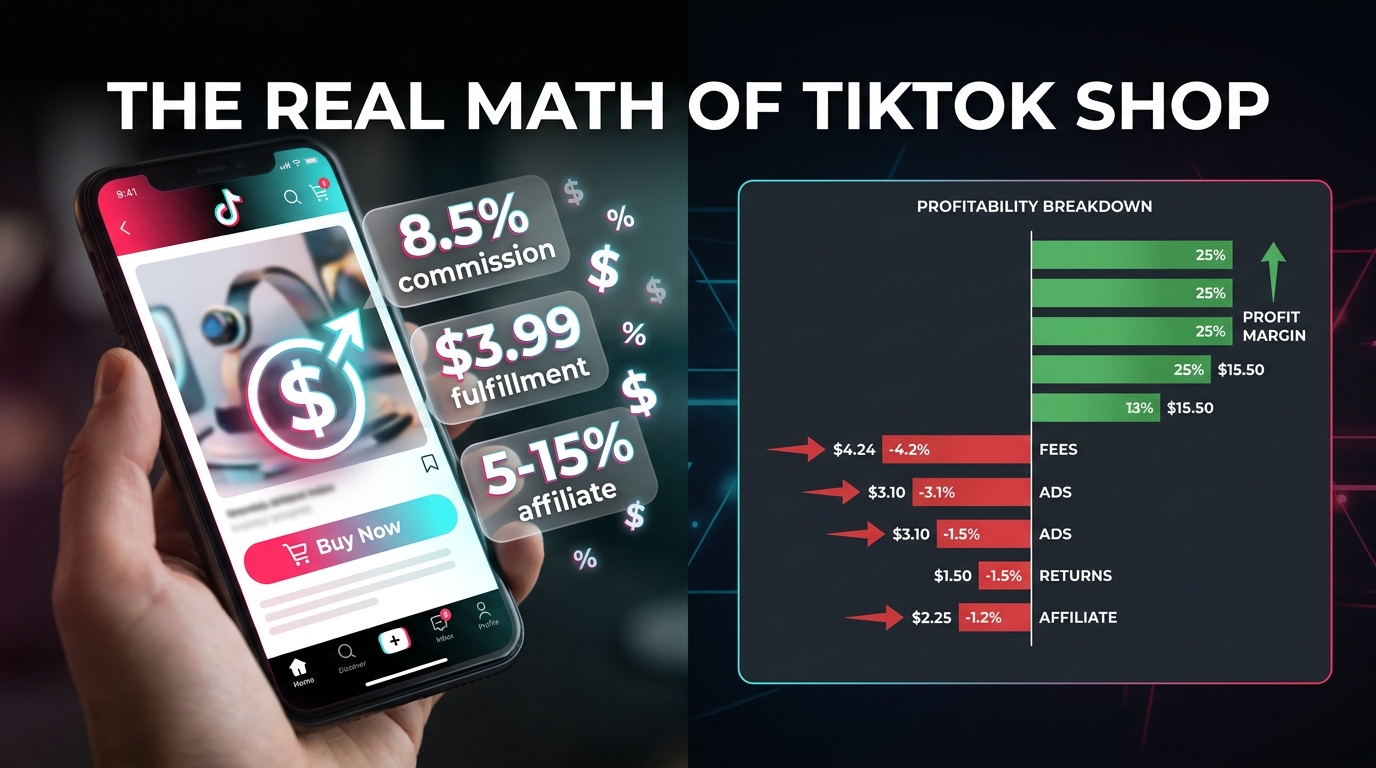
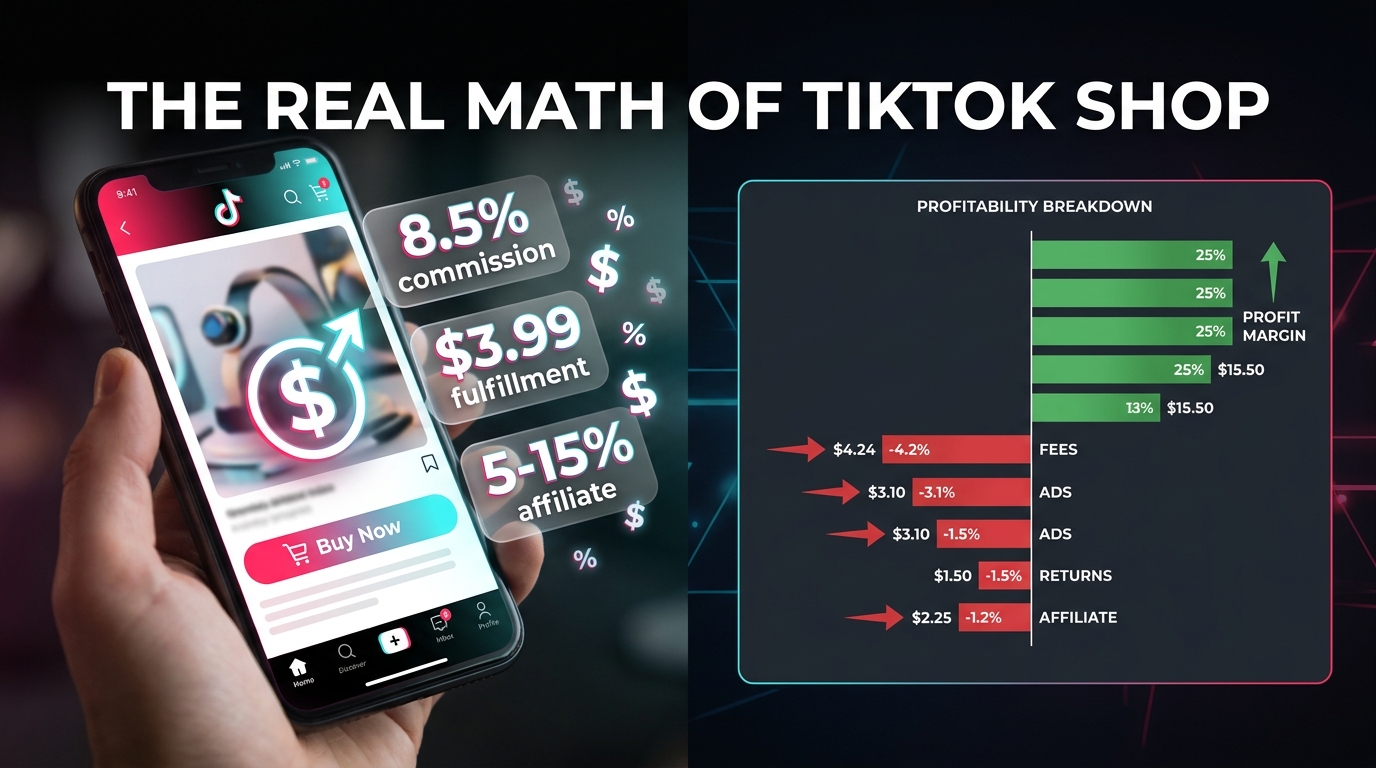
What the case studies don’t show is the seller who moved 500 units, paid 8% platform commission, offered 15% affiliate commissions to drive traffic, ran $2,000 in GMV Max ads, absorbed $1,200 in returns, and ended the month with a 4% net margin on $18,000 in gross revenue. That’s not a failure story — it’s a typical early-stage TikTok Shop story. And without understanding those numbers going in, “typical” can start to feel like a disaster.
This post isn’t about whether TikTok Shop works. It does. It’s about understanding the full financial and operational picture so you can build a store that’s actually profitable — not just busy. We’ll walk through every cost layer, explain what products actually fit the platform, break down how the content algorithm feeds commerce, and give you a realistic model for what scaling looks like from $5K to $100K+ per month.
If you’ve already read the “how to set up your shop” guides, this is what comes next.
The TikTok Shop Fee Stack: Every Cost You’re Actually Paying
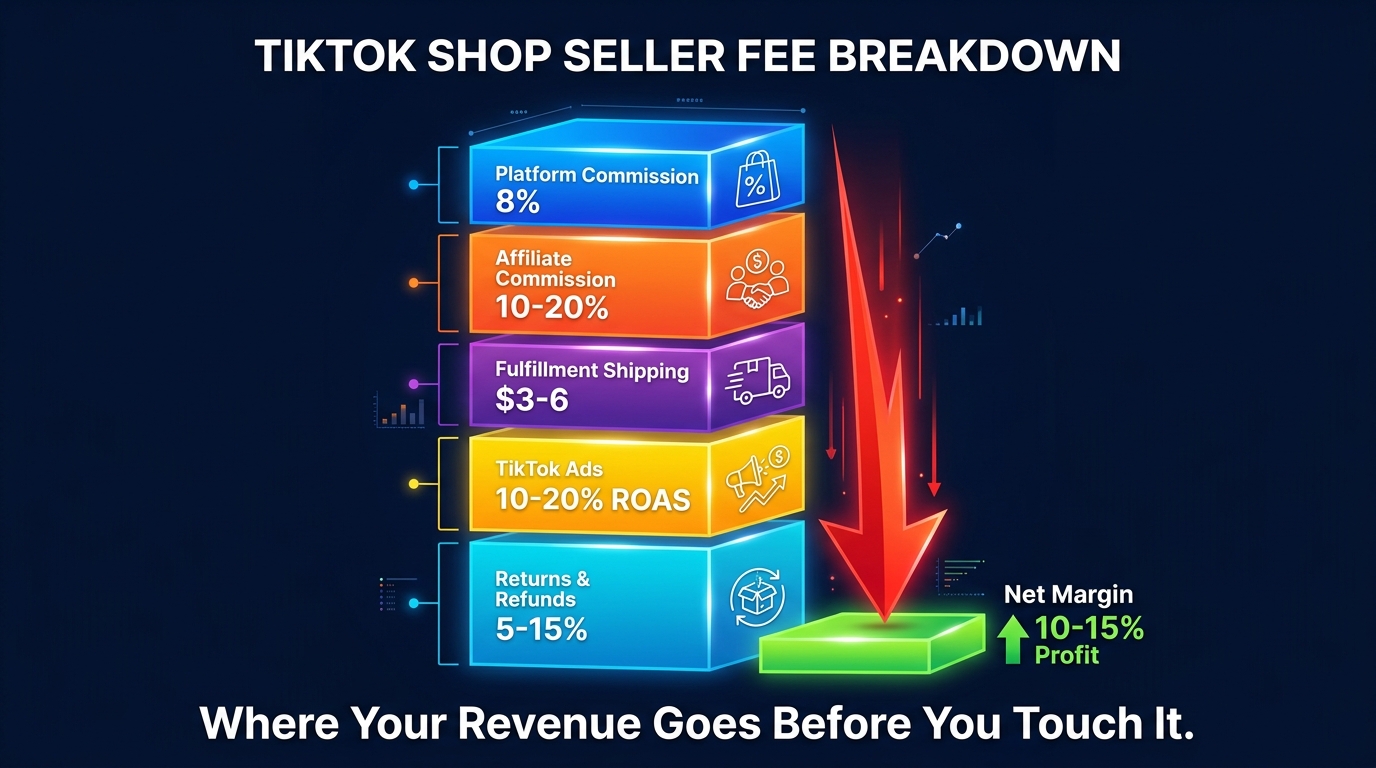
Before any strategy conversation happens, you need to understand what TikTok is taking from every transaction. Most sellers enter the platform thinking in terms of one fee — the commission rate — and miss four or five other cost layers that compound on top of it.
Platform Commission
TikTok Shop charges sellers a commission on every completed order. In the US market, this has been structured on a tiered basis during the platform’s growth phase, with introductory rates as low as 2% for new categories, but the standard commission rate for established sellers in most product categories sits at 8%. Some categories — particularly electronics and beauty — may have slightly different structures. The important thing to know is that TikTok has publicly stated its intention to bring commission rates in line with the broader e-commerce market as the platform matures, meaning these rates are not locked in.
Referral and Transaction Fees
On top of commission, TikTok charges a payment processing fee — typically around 2–3% of the transaction value — to cover the cost of handling payments within its ecosystem. This is often bundled into the commission figure in seller dashboards, but reading your payout statements line by line will reveal it as a separate deduction.
Fulfillment Costs
If you’re using Fulfilled by TikTok (FBT) — TikTok’s equivalent of Amazon’s FBA program, operated in partnership with third-party logistics providers — you’ll pay fulfillment fees that typically range from $3.50 to $6.50 per unit depending on weight, dimensions, and category. Self-ship sounds cheaper in isolation, but when you factor in your own labor, packing materials, and the customer experience risk from slower or inconsistent delivery, FBT’s cost looks more reasonable for volume sellers.
Affiliate Commissions
This is where a lot of sellers get surprised. TikTok Shop’s affiliate model — where creators promote your products in exchange for a percentage commission on sales — is one of the most powerful traffic drivers on the platform. It’s also one of the most significant cost lines. Competitive affiliate commissions for products in high-demand categories start around 10% and commonly run 15–20% for the kind of mid-tier creators who can actually move volume. Set your rate too low and creators won’t pick up your product. Set it too high without sufficient margin and you’re subsidizing someone else’s income at a loss.
The Cumulative Picture
Stack these numbers against a $30 product with a $10 cost of goods and the margin picture changes fast:
- Revenue: $30.00
- Cost of goods: –$10.00
- Platform commission (8%): –$2.40
- Payment processing (2%): –$0.60
- Fulfillment (FBT): –$4.50
- Affiliate commission (15%): –$4.50
- Gross profit before ads and returns: $8.00 (26.7%)
That’s before any paid ads, before returns, and before returns-related shipping costs. A 20–25% gross margin is workable — but not if you’re spending another 10–15% on GMV Max ads on top. The sellers who thrive on TikTok Shop are those who understand this math before they set their retail prices, not after their first payout statement lands.
What This Means for Pricing Strategy
The practical implication: a product needs to carry enough gross margin to absorb platform fees, affiliate commissions, and paid traffic simultaneously if you’re going to scale aggressively. As a general rule of thumb, most experienced TikTok Shop sellers target a minimum 60–65% gross margin on cost (i.e., a product that costs $10 to land should retail for no less than $25–28) before factoring in platform costs. Products at lower price points — under $15 retail — typically can’t carry the fee stack without running at a loss per unit.
Product-Market Fit on TikTok: Why Amazon Winners Often Fail Here
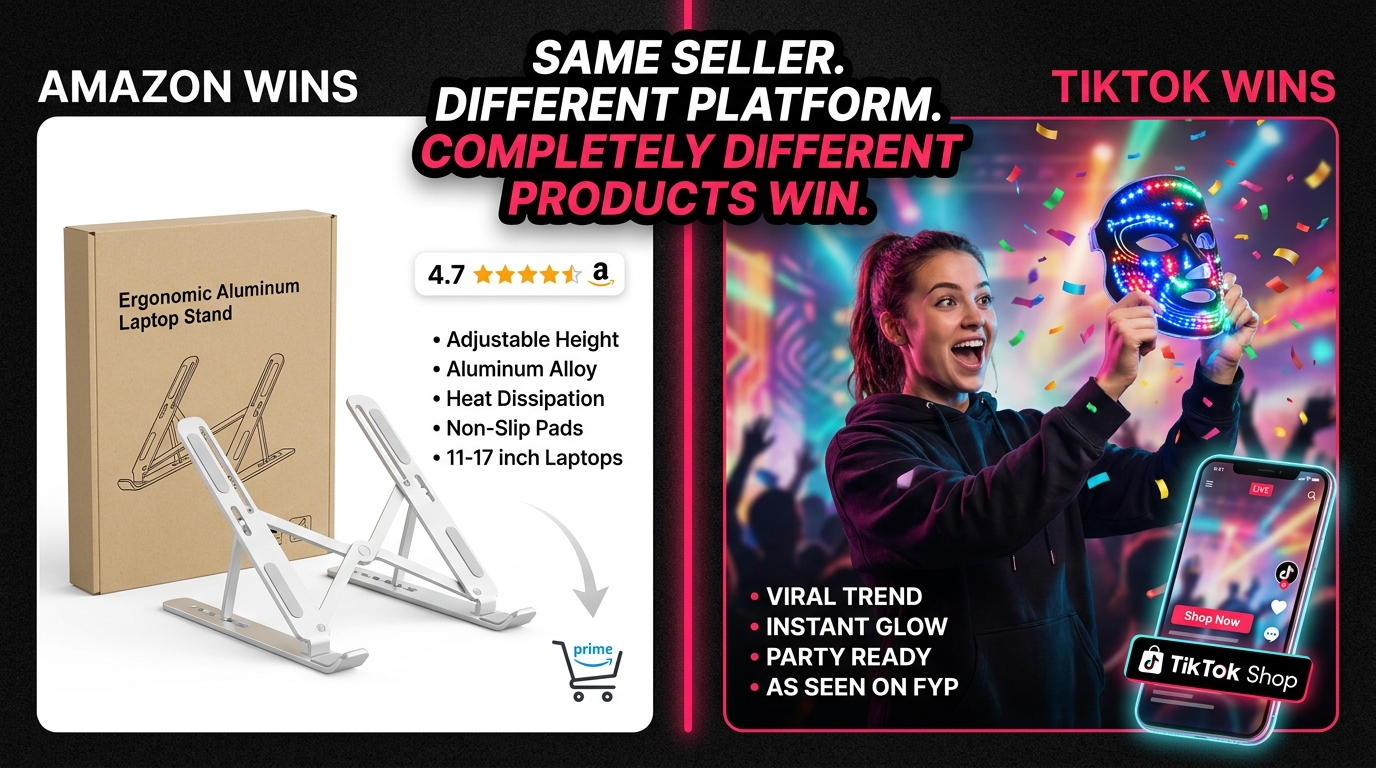
One of the most repeated mistakes in TikTok Shop is when established Amazon sellers move their catalog directly to the platform and expect the same results. The products that dominate Amazon — rational, utility-driven, search-triggered purchases — are often exactly the wrong fit for TikTok’s impulse-driven, entertainment-first environment.
The Discovery vs. Search Intent Split
Amazon is a search engine. Buyers arrive knowing broadly what they want and they’re comparing options. They respond to specs, reviews, and price. TikTok is a content feed. Buyers didn’t arrive looking for anything — they were entertained into wanting something. These are fundamentally different psychological moments, and the products that bridge entertainment into desire are a very different set from those that win a spec comparison.
A high-quality cable management kit that sells 3,000 units a month on Amazon may get zero affiliate traction on TikTok because there’s no compelling 30-second moment in the product. By contrast, a stain remover that visibly removes marks in real time, a vitamin supplement with a before/after transformation narrative, or a portable blender that produces satisfying visual content are all highly TikTok-native.
What TikTok-Native Products Actually Look Like
The common threads among products that consistently perform on TikTok Shop are:
- Visible transformation or demonstration: The product does something you can see happen in under 30 seconds. Cleaning products, skincare, cooking gadgets, and beauty tools live here.
- Emotional hooks: The product makes the buyer feel something — curiosity, desire, humor, aspiration. A product that makes someone laugh or say “I need that” mid-scroll is already halfway to a sale.
- Narrative potential: Creators need a story to tell. Products with an origin story, a problem they solve dramatically, or a satisfying result give creators something to work with in organic content.
- Impulse price point: The sweet spot for TikTok Shop purchases is generally $15–$65. Below $15, the margin structure is too thin. Above $65, most users aren’t ready to make an impulse purchase without significant social proof.
- Repeat purchase potential: Products that get consumed or worn out — supplements, cleaning supplies, beauty consumables — have compounding LTV that justifies higher affiliate commissions on the first sale.
The “Boring but Brilliant” Exception
There are exceptions, and the example of premium sunflower seeds is a good one. A product that sounds mundane can still win on TikTok if the content angle is right. Seeds became a lifestyle statement; the unboxing ritual, the quality story, the “you’ve been eating the wrong snack” hook gave creators a narrative. The lesson: product fit isn’t about the category, it’s about whether a 30-second story can be built around it.
Researching What’s Actually Working
TikTok’s Creative Center and the Shop tab’s trending products section are the starting point for product research, but the real signal is in affiliate marketplace data. Products with high commission rates attracting significant creator applications are ones the platform’s own ecosystem has already validated. Look for products with 500+ creator collaborators as a threshold for proven demand, and study the top-performing videos for each — what’s the hook, what’s the demonstration, what’s the call to action?
The Content-Commerce Loop: How the Algorithm Feeds Your Store
TikTok’s algorithm is fundamentally a content recommendation engine. But when commerce is layered on top — as it is in TikTok Shop — that recommendation engine starts making decisions that directly impact your sales volume. Understanding this loop is the single biggest operational advantage a seller can build.
How Organic Content Drives Shop Visibility
Every shoppable video tied to your product listing generates a signal. Views, saves, shares, comments, and — most importantly — click-throughs to your product page all feed back into how aggressively TikTok distributes that video. The platform prioritizes content that keeps users engaged and converts, because conversion is one of the clearest signals of content quality in a commerce context.
This creates a flywheel: content that converts gets pushed to more users, which drives more conversions, which earns even more distribution. The challenge for sellers is getting the initial signal strong enough to trigger that flywheel. This is why the first 72 hours of a new video matter so much — the algorithm makes a rapid-fire series of distribution decisions in that window based on early engagement metrics.
The Organic-to-Paid Signal Feedback Loop
Here’s the piece most sellers miss: TikTok’s paid advertising system — particularly GMV Max — draws on the same algorithmic signals as organic content. When a video performs well organically (high completion rate, strong click-to-cart ratio), GMV Max can amplify it with paid distribution at significantly lower cost per acquisition than it would take to push a cold, unproven video.
This means your organic content strategy isn’t separate from your paid strategy — it’s upstream of it. The brands winning on TikTok Shop in 2026 are treating their video library as a performance asset to be tested and optimized, not just a creative output. They post consistently, monitor early signal data, and divert ad spend toward the 10–15% of videos that show organic pull.
Cadence and Content Volume
How much content do you actually need? The honest answer is more than most sellers want to produce. High-performing TikTok Shop brands are typically posting 2–5 pieces of organic content per week from their own account, while simultaneously running an affiliate program that produces another 20–50 pieces of creator content per month. The volume is what creates the statistical surface area to find the videos that catch. You’re not looking for every video to go viral — you’re looking for the 5% that do and building your paid strategy around them.
Product Listing Quality and Its Algorithm Effect
Your product listing page — not just your content — is part of the algorithmic signal. TikTok’s Shop tab uses product-level data to decide which items get featured in personalized recommendations. Listings with strong imagery, complete attribute data, competitive pricing, and healthy review velocity get more algorithmic surface area. Treat your TikTok Shop listing with the same care you’d give an Amazon detail page: title optimization, complete bullet points, high-resolution images that work at thumbnail scale, and an active review solicitation strategy post-purchase.
Live Commerce vs. Shoppable Videos: Reading the Conversion Data
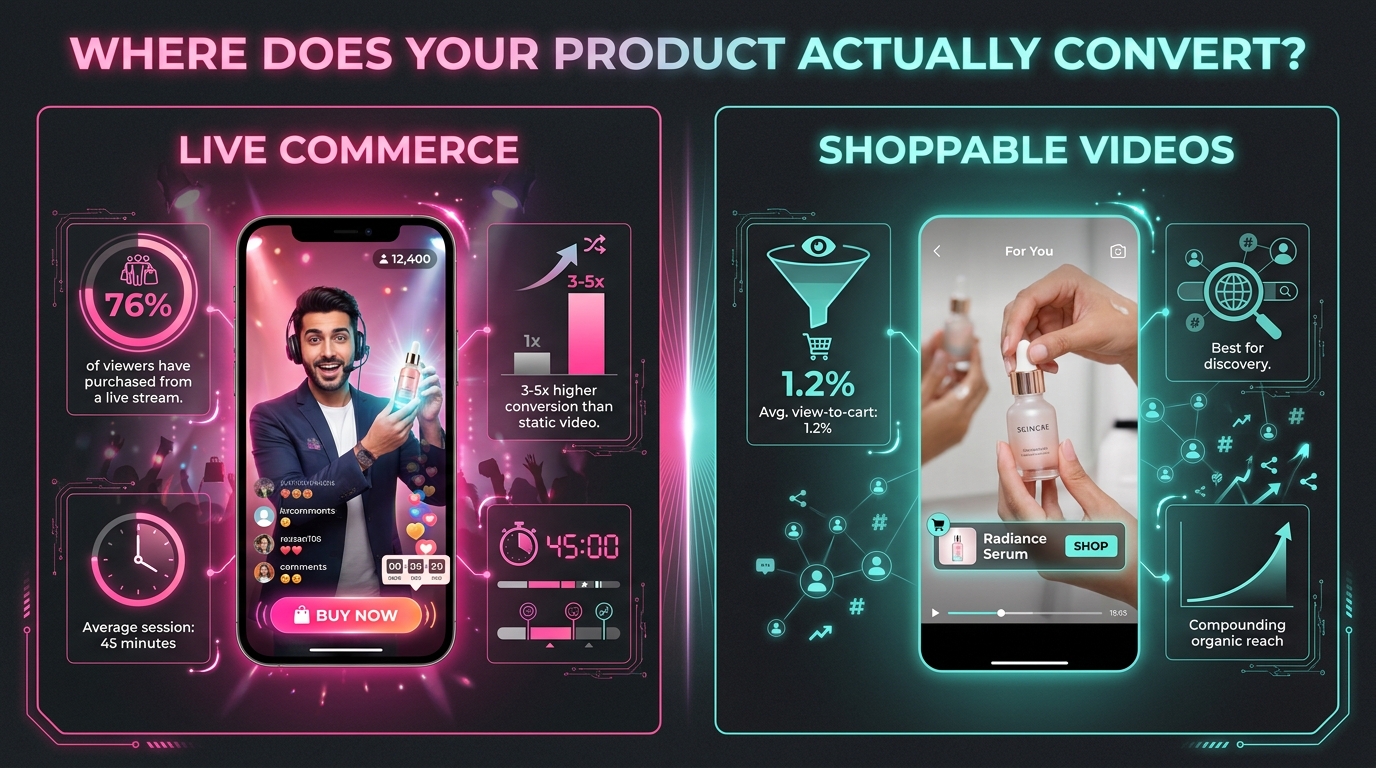
TikTok Shop has two primary commerce surfaces: shoppable videos (short-form content with embedded product tags) and TikTok Live (real-time streams with purchasable product pins). Most sellers pick one and ignore the other. The data suggests that’s a costly choice either way.
Why Live Commerce Converts at a Different Level
A GlobalData survey found that 76% of TikTok Shop users who watched a live stream made a purchase from one in the prior year. That’s an extraordinary conversion statistic by any e-commerce benchmark. The reason isn’t magic — it’s psychology. Live streaming creates urgency (limited-time offers, countdown timers), social proof (visible viewer count, real-time comment reactions), and an interactive relationship between host and buyer that no static video can replicate.
For products that benefit from demonstration, Q&A, and real-time social validation — particularly in beauty, health, and household categories — live commerce consistently outperforms shoppable video on a per-viewer conversion basis. The trade-off is the operational demand: successful live streams require a compelling host, a consistent schedule, product inventory pre-staged for rapid fulfillment, and typically 45–90 minutes of live time to build momentum.
When Shoppable Videos Win
Shoppable videos don’t convert at the same rate as live streams on a per-viewer basis, but they have a structural advantage that live streams don’t: they compound. A live stream ends. A video stays in the feed, gets pushed by the algorithm to new audiences, and can drive purchases weeks or months after it was first posted.
Shoppable video is the better format for:
- Discovery-phase products — items buyers didn’t know they needed until they saw them
- Affiliate-driven traffic — creators make videos on their own schedules and you benefit from the long tail of distribution
- Brands without live stream hosting capabilities — not every seller has a charismatic on-camera presence
- New product launches — building an initial library of social proof before going live
The Combined Strategy
The most sophisticated TikTok Shop operators use both: shoppable video for top-of-funnel awareness and affiliate-driven discovery, and live streams for conversion events around specific product pushes or promotional periods. Think of it as a funnel: video builds familiarity, live streams close the sale for the audience that’s already warm. Running weekly or bi-weekly live sessions while maintaining a consistent shoppable video cadence — from both your own account and your affiliate network — is the model that shows up repeatedly among sellers hitting $50K+ per month.
Production Quality vs. Authenticity
One consistent finding across TikTok commerce data: raw, authentic content frequently outperforms polished production. The platform’s native aesthetic rewards content that feels real and unfiltered. This is good news for sellers who can’t afford a video production team, but it also means the skills required are performance and storytelling rather than technical production. Your worst-performing content is often your most overproduced.
The Affiliate Equation: Commission Math, Creator Quality, and What Good Looks Like
TikTok Shop’s affiliate program is one of the platform’s most powerful commerce mechanisms — and one of the most misunderstood by new sellers. The concept is straightforward: you list your product in the affiliate marketplace with a commission rate, creators apply to promote it, and you pay commission on each sale they generate. In practice, the decision-making is far more nuanced.
Setting the Right Commission Rate
Commission rates are the first signal creators see when evaluating whether to promote your product. A rate that’s too low means your product sits in the marketplace unnoticed while higher-commission products get the creator attention. Too high, and you’ve either burned your margin or trained creators to expect unsustainable rates.
The general framework that holds across product categories:
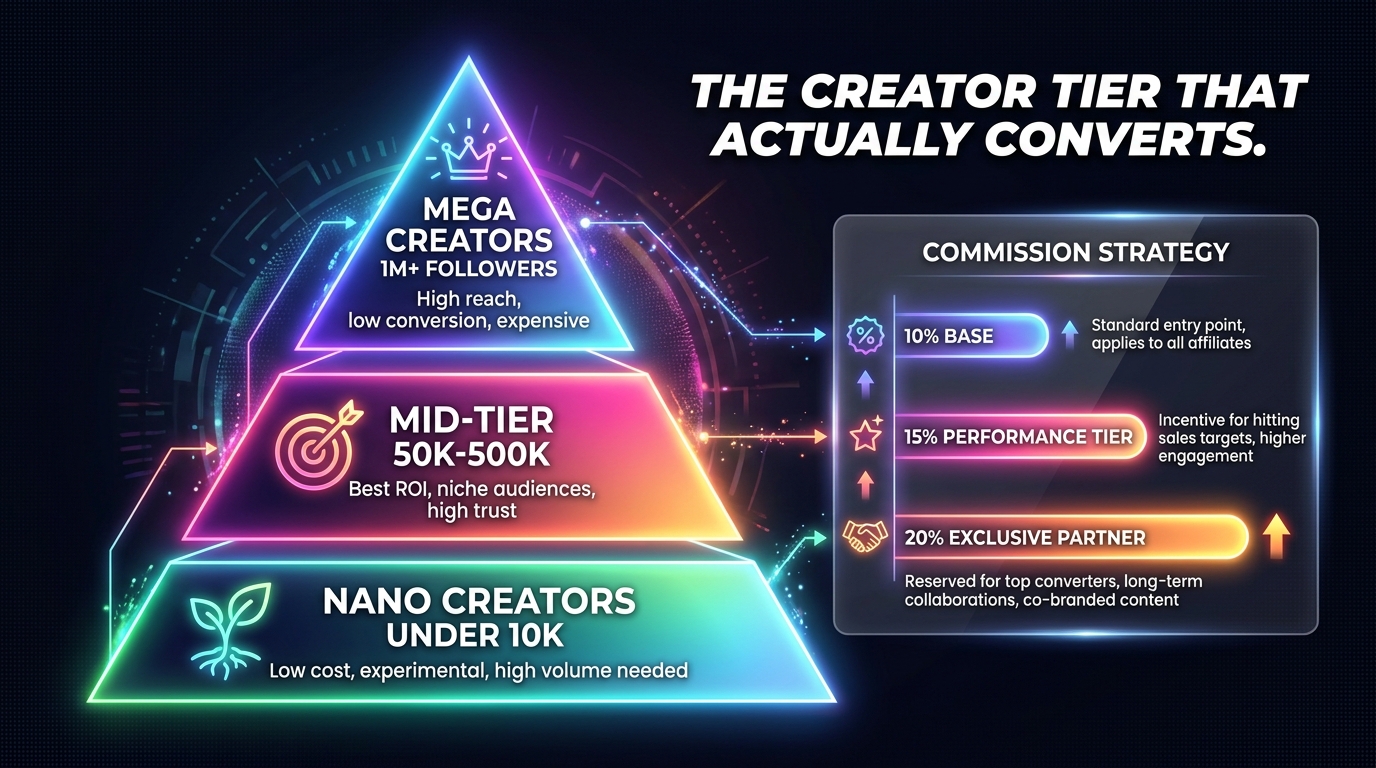
- 10% minimum: Below this, most credible creators in competitive categories won’t bother
- 15% standard rate: Competitive across beauty, health, and lifestyle categories; sufficient to attract mid-tier creators
- 20%+ performance rate: Reserved for top-performing creators via direct partnership agreements or tiered commission structures
- 25%+ launch rate: Sometimes used as a time-limited boost during product launches to accelerate initial creator adoption
Understanding Creator Tiers
Not all creator traffic is equal, and matching creator tier to product type matters more than follower count alone.
Mega creators (1M+ followers) have massive reach but often low engagement-to-conversion ratios in commerce contexts. Their audiences are broad, passive, and may not trust product recommendations the way smaller creator audiences do. They’re also expensive — many require guaranteed fees on top of commission, regardless of platform affiliate structure. Best used for brand awareness, not direct conversion.
Mid-tier creators (50K–500K followers) are the sweet spot for most TikTok Shop sellers. They have large enough audiences to generate meaningful volume, niche-specific authority their audience trusts, and typically work purely on commission without guaranteed fees. A well-matched mid-tier creator in the right niche can outperform a mega creator by a significant margin on a cost-per-sale basis.
Nano creators (under 10K followers) are high-effort, low-predictability. Some will drive nothing; occasionally one will produce a viral video that generates thousands of sales from a small base. Running a high volume of nano-creator outreach can work as a seeding strategy, but it requires operational bandwidth to manage and set realistic expectations — most nano-creator videos will not deliver meaningful sales individually.
Proactive vs. Passive Affiliate Strategy
Many sellers list their product in the affiliate marketplace and wait for creators to apply. This is the passive approach — and for most new sellers with limited social proof, it’s slow. The more effective model is proactive outreach: using TikTok’s creator marketplace and third-party tools to identify creators who have already made content in your category, reviewing their past affiliate performance data if available, and initiating direct partnership conversations with a sample product offer and commission proposal.
Sending physical product samples to 20–30 targeted creators per month — with a clear brief, a proposed commission rate, and creative freedom to produce content in their style — consistently outperforms passive listing for sellers in the first six months of their TikTok Shop operation.
Tracking What’s Actually Driving Revenue
TikTok’s Seller Center provides affiliate performance data at the creator level, showing which creators are generating clicks, views, and conversions. Review this data weekly and apply a simple rule: creators who produce more than 2% conversion rates on their traffic deserve fast commission escalation and proactive re-engagement. Creators who generate views but no conversions are traffic that isn’t costing you much in absolute terms but may be pulling attention away from more profitable partnerships.
GMV Max and Paid Ads: When They Work, When They Burn Budget
TikTok Shop’s paid advertising ecosystem has evolved rapidly. In 2026, the primary tool most sellers interact with is GMV Max — an automated campaign type that uses TikTok’s machine learning to optimize ad delivery specifically for gross merchandise value (i.e., total purchase value, not just clicks or impressions). Understanding how GMV Max actually functions — and where it consistently underperforms — is essential before you commit budget.
What GMV Max Actually Does
GMV Max is a fully automated campaign format. You provide a product, set a daily budget, and TikTok’s system decides how to allocate spend across different inventory types — in-feed ads, search results, shop tab placements — to maximize the total value of purchases it can attribute to your campaign. You have limited control over creative selection or audience targeting; the system makes those decisions based on its own optimization signals.
The upside: when GMV Max finds its signal — typically after a learning period of 7–14 days and 50+ conversion events — it can deliver efficient, scaling purchase volume with minimal hands-on management. Sellers report finding sustainable ROAS of 3–5x in categories where the algorithm has sufficient data to work with.
The Learning Period Problem
The risk is the learning period. During the first 1–2 weeks of a GMV Max campaign, TikTok’s system is spending money to learn. It’s testing creatives, audiences, and placements. Cost per acquisition during this period is typically significantly higher than steady-state performance. Sellers who pull campaigns in the first week because the numbers look bad often kill campaigns that were days away from finding efficiency.
The practical guidance: launch GMV Max with a budget you can sustain for at least 14 days without cutting it short. Treat that initial spend as a data acquisition cost, not a sales cost. Review results only after the campaign has achieved 50+ purchase events — before that threshold, the data isn’t statistically meaningful.
When Paid Ads Don’t Work Yet
GMV Max and TikTok’s broader ad ecosystem work best when there’s already a foundation of organic and affiliate signal. A product with zero reviews, no organic content history, and no affiliate traffic record gives the algorithm very little to optimize from. Sellers who launch paid campaigns before establishing any organic or social proof typically find their cost per acquisition is too high to be profitable.
The sequencing that consistently works: build 30–60 days of organic content, secure your first 10–20 affiliate partnerships, accumulate 50+ product reviews, and then layer in GMV Max to amplify what’s already showing demand. Paid ads on TikTok are most powerful as an accelerant — not as an ignition source.
TikTok Shop Ads vs. Standard TikTok Ads
It’s worth distinguishing between TikTok Shop-specific ad units and standard TikTok ads that drive to a landing page outside the app. Shop-specific ads — which route buyers directly to your in-app product page — consistently outperform external destination ads for purchase conversion, because they eliminate the friction of leaving the platform. If you’re running paid traffic specifically to drive TikTok Shop sales, always use in-app destinations. External traffic sends people to your website, which may convert at a higher rate for some products, but loses the algorithm’s ability to attribute and optimize on in-app purchase events.
Fulfillment Architecture: FBT vs. Self-Ship vs. 3PL Hybrid
How you fulfill TikTok Shop orders has a direct impact on seller account health metrics, customer experience, and ultimately your algorithm ranking. TikTok’s internal signals weight seller performance — shipping speed, tracking upload compliance, delivery success rates — as ranking factors for Shop tab placements. Choosing the wrong fulfillment model doesn’t just hurt your operations; it hurts your visibility.
Fulfilled by TikTok (FBT)
FBT is TikTok’s managed fulfillment program, operating in partnership with logistics providers including ShipBob in the US. You send inventory to FBT warehouses; TikTok handles pick, pack, and ship on your behalf. Orders fulfilled through FBT benefit from faster promised delivery windows and tend to receive preferential treatment in Shop tab rankings — similar to how FBA Prime designation works on Amazon.
The cost, as noted in the fee section, runs $3.50–$6.50 per unit for standard items. The real questions to evaluate are inventory minimums, category eligibility (not all product types are accepted), and lead time to get inventory into warehouses. For sellers doing consistent volume in eligible categories, FBT typically delivers a better customer experience at a comparable total cost to self-ship once labor is accounted for.
Self-Ship
Self-ship means you handle your own fulfillment — packing orders and uploading tracking numbers. It’s lower direct cost per unit but carries significant operational risk at scale. TikTok Shop requires tracking information to be uploaded within specific time windows; missing these deadlines triggers seller account health warnings that can limit your visibility in the algorithm. At 20 orders per day, self-ship is manageable. At 200 orders per day after a viral moment, it becomes an emergency.
Self-ship is appropriate for early-stage testing, low-volume categories, or products that FBT doesn’t accept. Plan your transition point to FBT or a 3PL before volume forces your hand — not after.
Third-Party Logistics (3PL) Hybrid
Many mid-scale sellers use a 3PL — a dedicated fulfillment warehouse that stores and ships their inventory — as an alternative to both FBT and self-ship. A good 3PL provides the operational control and flexibility that FBT doesn’t allow (custom packaging, kitting, bundling) while removing the execution burden from the seller. The cost structure is comparable to FBT at volume.
The hybrid model that appears most frequently among $50K+/month TikTok Shop sellers: FBT for core SKUs with consistently high velocity, 3PL for custom-packaged or specialty items, and self-ship only as an absolute last resort during testing phases.
Returns Processing and Its Hidden Costs
Wherever your fulfillment model sits, returns need their own process. TikTok Shop’s return policy is buyer-friendly — customers can initiate returns within 30 days for most categories, and TikTok’s seller policy requires you to accept returns that meet basic criteria. Return rates vary significantly by category: electronics and apparel see higher return rates (10–20%+) than consumables or single-use items (typically under 5%). Build your return rate assumption into your margin model before launch, not after your first month’s payout statement.
Account Health, Reviews, and the Metrics That Control Your Visibility
TikTok Shop has a seller scoring system — similar in concept to Amazon’s account health dashboard — that determines how much visibility your products receive in the Shop tab, search results, and algorithmic recommendations. Most sellers don’t check these scores until something goes wrong. By then, the damage is already limiting their revenue.
The Key Account Health Metrics
TikTok’s Seller Center tracks several performance indicators at the shop level:
- Order Fulfillment Rate: The percentage of orders fulfilled within your stated handling time. Scores below 90% trigger algorithmic penalties.
- Tracking Upload Rate: Whether you upload tracking numbers within required windows for self-ship orders. Non-compliance is heavily penalized.
- Cancellation Rate: Orders you cancel due to inventory issues or operational failures. High rates signal supply chain instability to the algorithm.
- Return Dispute Rate: Seller-initiated disputes against return requests. Excessive disputes flag a poor buyer experience and draw TikTok scrutiny.
- Product Rating Score: Aggregate star ratings across your catalog. Products with below-4.0 average ratings receive reduced algorithmic placement.
Building Review Velocity Systematically
Reviews on TikTok Shop work differently from Amazon. You cannot send direct email sequences post-purchase (TikTok controls that messaging layer), but you can use TikTok’s in-app review request features, include packaging inserts that guide buyers to the review flow, and — for live stream sellers — verbally prompt purchases to leave reviews mid-stream. Review velocity in the first 30 days post-launch has an outsized impact on early Shop tab placement.
A target framework: aim for 25+ reviews in your first 30 days, 4.5+ average rating, and make review acquisition a formal part of your post-purchase operational process, not an afterthought.
How Policy Violations Affect Visibility
TikTok Shop’s compliance framework is active and evolving. Product listing violations — inaccurate claims, prohibited category items, counterfeit-adjacent descriptions — result in listing suppression and, at repeated offense, shop-level penalties. The platform’s enforcement has become more sophisticated through 2025 and into 2026, with automated scanning of listing content and AI-assisted review of high-flag categories. Medical claims, supplement efficacy statements, and comparative advertising language are particularly scrutinized.
The practical rule: treat your TikTok Shop listing compliance with the same rigor as Amazon. Read the prohibited content guidelines before listing, not when your listing gets suppressed.
Scaling Beyond $10K/Month: What Changes and What Doesn’t
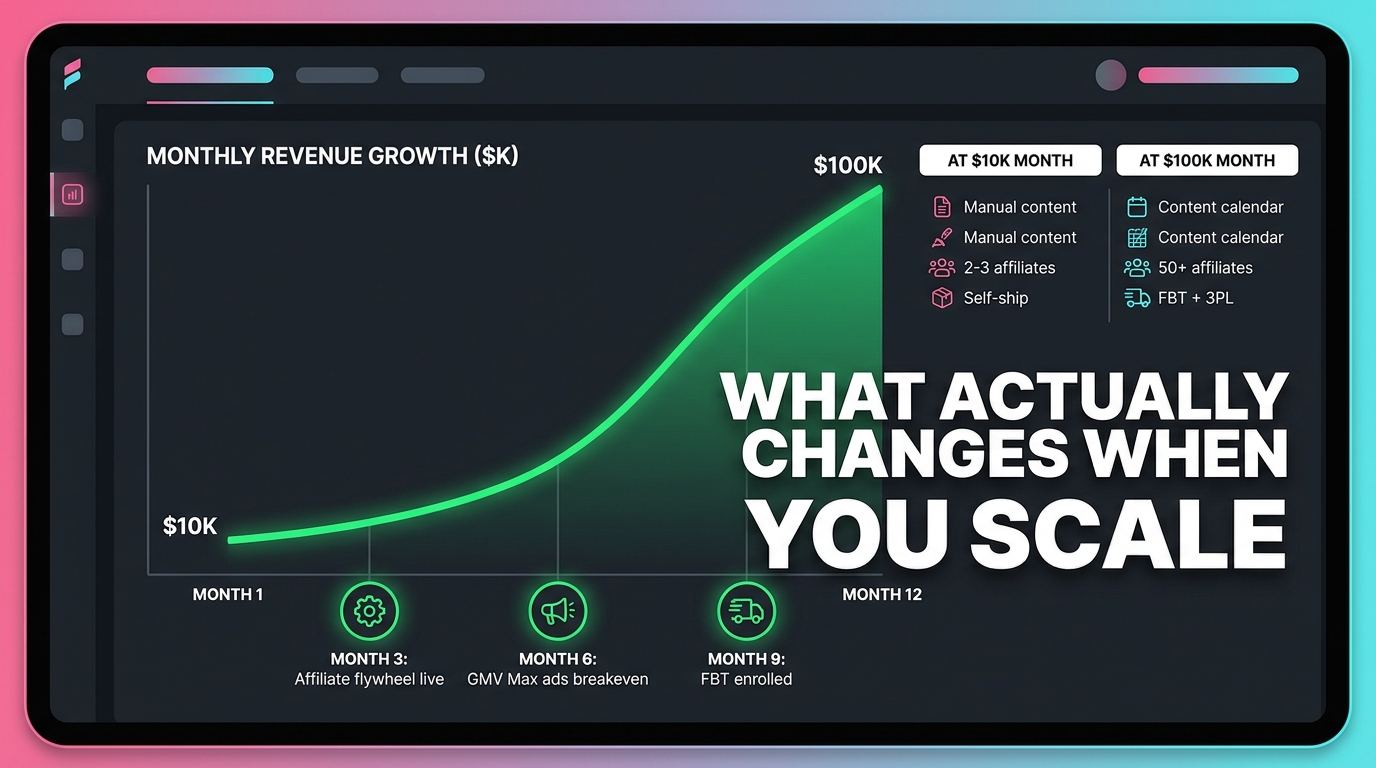
There’s a specific inflection point that most TikTok Shop sellers hit around $8K–$15K per month where the tactics that got them there stop scaling. What worked at low volume — personal outreach to every creator, posting content yourself daily, manually processing all orders — becomes a ceiling rather than a foundation. Understanding what needs to change is what separates sellers who plateau from those who break through.
The Content Operation Shift
Below $10K/month, most sellers are making their own content. Above that threshold, the sellers who scale successfully shift to a content operation model — a planned content calendar, potentially a part-time content creator or UGC agency relationship, and a systematic affiliate seeding program that generates a predictable volume of creator content each month without requiring the founder’s direct time on every video.
This doesn’t require a large team. Many $50K+/month TikTok Shop operations run on a content team of two to three people, combined with an affiliate program that produces the majority of content through external creators. The founder or brand owner transitions from content maker to content director — setting strategy, reviewing performance, and making decisions about what to amplify rather than producing everything personally.
The Affiliate Flywheel at Scale
At scale, the affiliate program becomes a self-reinforcing system. Products with proven sales history attract better creators, who produce more conversion-driving content, which drives more sales, which attracts more creators. Getting into this flywheel is the single biggest leverage point in TikTok Shop — but it takes typically 60–90 days of consistent affiliate outreach before the system starts to run on its own momentum.
Sellers who reach this flywheel stage typically have 50+ active affiliate creators across their catalog, a tiered commission structure that rewards top performers, and a monthly process for identifying and onboarding new creators in adjacent niches. The management of this program — which at scale involves tracking creator performance, sending replacement samples, negotiating exclusive content arrangements, and maintaining commission structures — is effectively a dedicated part-time role.
SKU Rationalization vs. Catalog Expansion
A common mistake at the scaling stage is expanding the product catalog too aggressively. More SKUs mean more affiliate outreach, more inventory management complexity, more listing maintenance, and more customer service surface area. The sellers who scale most efficiently do so with a small number of core SKUs that carry enough margin to absorb the full cost stack and generate strong account health metrics across the board.
The framework: identify your top two or three products by margin-adjusted profit (not just revenue), build your affiliate, content, and paid strategy entirely around those products for the first year, and resist expanding the catalog until you have operational and financial systems that can support additional SKUs without degrading the performance of your core items.
Cash Flow Management at Scale
One of the most underappreciated operational challenges of scaling TikTok Shop is cash flow. TikTok’s payout schedule — typically weekly or bi-weekly depending on your tier — means there’s a lag between when sales happen and when you receive payment. When you’re also investing in inventory, affiliate samples, ad spend, and FBT replenishment simultaneously, the timing mismatch can create meaningful cash pressure even for sellers who are technically profitable.
Sellers scaling past $30K/month commonly use a combination of business credit facilities and planned inventory purchasing cycles to manage this gap. Understanding your cash conversion cycle — how long from inventory spend to payout receipt — is essential financial planning, not a detail to figure out later.
The Honest Comparison: TikTok Shop as Part of a Multi-Channel Stack
TikTok Shop is not a replacement for Amazon, Shopify, or any other sales channel. It’s a channel with specific advantages and specific limitations, and the sellers who extract the most value from it treat it as one component of a multi-channel strategy rather than a standalone business.
What TikTok Shop Does Better Than Amazon
- Discovery at zero cost: Organic content can drive meaningful sales without any paid spend — something that’s essentially impossible on Amazon in 2026 without PPC.
- Creator distribution network: The affiliate program gives you access to thousands of micro-distribution channels you’d have to build individually on other platforms.
- Lower barrier to brand building: Content and community build brand recognition faster on TikTok than any purely transactional platform can.
- Impulse purchase conversion: For the right product, TikTok’s entertainment-to-purchase pathway converts impulse buyers at rates that search-intent platforms can’t match.
What Amazon Still Does Better
- Search-intent capturing: Buyers who know what they want and are ready to compare and purchase go to Amazon, not TikTok.
- Review ecosystem maturity: Amazon’s review infrastructure still carries more consumer trust for considered purchases than TikTok’s newer review system.
- Fulfillment reliability at scale: FBA’s depth of fulfillment coverage and two-day delivery reliability remains ahead of FBT’s current infrastructure in most markets.
The Cross-Platform Amplification Effect
The most underrated dynamic in running both platforms simultaneously: TikTok awareness drives Amazon search volume. Brands that build TikTok Shop presence consistently report increases in branded Amazon searches and organic Amazon rank for their hero products. The platforms are complementary, not competitive. Running TikTok Shop can actually accelerate Amazon performance for the same product — a dynamic that makes the economics of TikTok content investment look different when you account for its downstream effect on your full business.
Building a Profitable TikTok Shop Operation: A Realistic Framework for 2026
Enough theory. Here’s the operational and financial framework that gives TikTok Shop sellers the best chance of building a genuinely profitable business in 2026 — not just a busy one.
Phase 1: Foundation (Months 1–2)
- Select 1–2 hero products with 60%+ gross margin on cost, retail price $20–$60, strong demonstration potential
- Build product listings with complete data, professional imagery, and clear compliance-reviewed copy
- Post 3–5 pieces of shoppable video content per week from your own account
- Reach out proactively to 15–25 creators per week in your category with sample offer and 15% commission
- Set up self-ship with tight operational SLAs; plan FBT onboarding before you need it
- Target: 50 reviews, 4.5+ rating, 10+ active affiliate creators, $3K–$8K GMV
Phase 2: Momentum (Months 3–6)
- Launch GMV Max campaigns for your best-performing organic videos with a 14-day learning budget
- Transition primary fulfillment to FBT or qualified 3PL
- Scale affiliate outreach to 30–50 creators per month; introduce performance-tiered commissions for top performers
- Begin weekly live stream sessions — 1–2 per week, minimum 45 minutes
- Target: 50+ active affiliates, $15K–$40K GMV, GMV Max ROAS 3x+
Phase 3: Scale (Months 6–12)
- Build content calendar and bring on content support (UGC agency, part-time creator, or dedicated team member)
- Formalize top-10 affiliate partnerships with exclusive arrangements and elevated commission tiers
- Evaluate 1–2 additional SKUs against the same margin and fit criteria as Phase 1 selection
- Establish cash flow management systems to handle the inventory-to-payout gap at higher volume
- Target: $50K–$100K+ GMV, 15%+ net margin, sustainable content and affiliate operations
The One Metric That Predicts Long-Term Success
If you could only track one metric for TikTok Shop health, it would be contribution margin per order — the revenue you keep after subtracting platform fees, affiliate commissions, fulfillment, and return costs, but before allocated overhead and ad spend. If this number is consistently positive and growing, your model is sound. If it’s thin or negative, you cannot ad-spend your way to profitability — you need a pricing, sourcing, or product mix adjustment first.
Profitable TikTok Shop businesses aren’t built on viral moments. They’re built on understanding these economics at the unit level, selecting products that fit the platform’s conversion mechanics, and building the content and affiliate infrastructure that makes the algorithm work in your favor — consistently, not occasionally.
TikTok Shop’s growth trajectory is real. The $23.41 billion US GMV projection for 2026 means there’s genuine market to be captured. But that number belongs to sellers who understand the full picture — not just the highlight reel.