


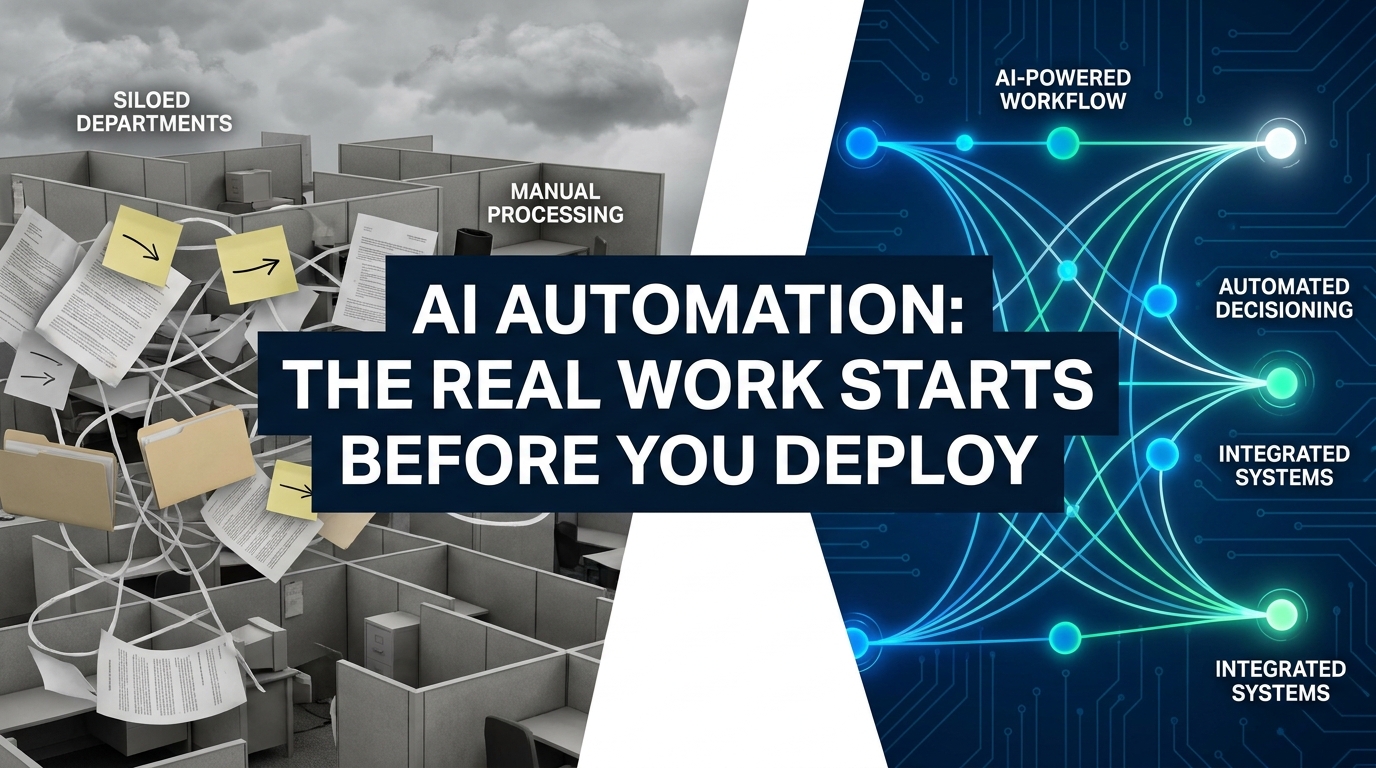

There is a question that almost every business leader asks when they start thinking seriously about AI automation. It sounds like this: “What can we automate?”
It is the wrong question. And the consequences of starting there — of leading with the technology instead of the architecture — are visible in the gap between what AI automation promises and what most organizations are actually getting from it.
In 2026, it is no longer a question of whether AI automation is real. The tools exist. The use cases are proven. Large language models, robotic process automation, computer vision, and intelligent workflow orchestration are no longer experimental — they are commercially available, increasingly affordable, and demonstrably effective in specific contexts. The question has shifted.
The right question is this: “Is our organization designed to benefit from AI automation?”
That distinction — between asking what can be automated versus whether the firm is structured to capture value from automation — is the central insight of the 2026 Microsoft Work Trend Index, authored in part by Harvard Business School professor Karim Lakhani. The report argues that the most consequential change underway in business is not the adoption of new AI tools. It is the emergence of a fundamentally new operating model for how work is organized, executed, and governed.
This post is about that operating model. It is about the structural decisions, governance design, sequencing logic, and change management challenges that determine whether AI automation delivers lasting competitive advantage — or just adds another layer of complexity to an already complicated business.
If you have already deployed an AI automation tool and wondered why the results feel smaller than expected, this is where to look. If you are about to start, this is what to do first.
The Tool Is Not the Transformation
Every major technology wave produces the same pattern. The technology arrives. Early adopters deploy it. Results are mixed. A subset of organizations pulls dramatically ahead. Everyone else tries to figure out what they did differently.
The pattern repeats because the gap is almost never about the technology itself. It is about organizational design. And AI automation in 2026 is following the same script.
Operating models vs. business models
A business model describes how a company creates and captures value — what it sells, who it sells to, and how it charges for it. An operating model describes how that value is actually delivered: through workflows, roles, decision rights, governance structures, and the everyday architecture of how work gets done.
When a new technology is powerful enough, it does not just improve the existing operating model. It makes a new operating model possible — and makes the old one less competitive. That is where we are with AI automation today.
The firms that are winning are not the ones that automated the most tasks. They are the ones that redesigned their operating models around what AI automation now makes possible. Those are two very different activities.
Why “deploy more tools” is not a strategy
A 2026 analysis from Microsoft’s WorkLab research — drawing on data from trillions of signals across its Microsoft Graph — found that productivity gains at the edge of an organization (from individual tool adoption) do not automatically become enterprise transformation at the core. The language is worth sitting with: productivity gains at the edge do not automatically become enterprise transformation at the core.
This is the mechanism behind the widespread frustration with AI automation pilots that look promising in isolation but fail to compound into organizational advantage. Individual employees using AI tools more effectively is genuinely useful. But it does not change how the business operates. It does not alter workflows, eliminate bottlenecks, improve decision velocity, or shift where human judgment is concentrated.
Only deliberate operating model redesign does that. And that work has to happen before — or at least alongside — tool deployment, not after.
The Four Layers of Business Automation (And Why Most Companies Are Stuck at Layer One)
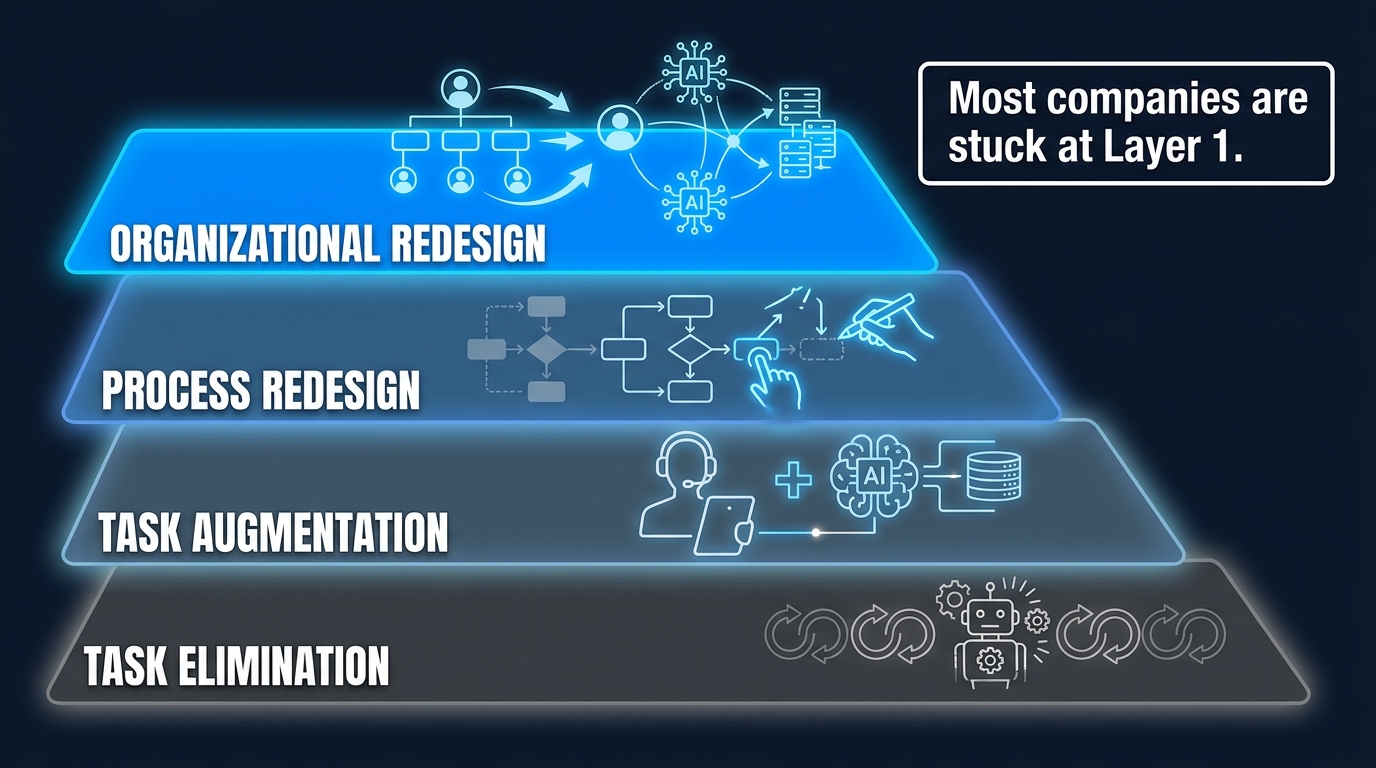
Not all automation is created equal. There is a meaningful difference between automating a task, augmenting a human, redesigning a process, and restructuring an organization. Each level requires more organizational commitment, delivers more durable value, and demands different design thinking.
Layer 1: Task elimination
This is the entry point for most businesses. Task elimination targets simple, repetitive work — data entry, invoice processing, report generation, form routing, email classification. A rules-based automation system, or a lightweight AI model, executes these tasks without human intervention.
The time savings are real. A process that took a human seven hours to complete manually might take a well-designed automation five minutes. PayPal, for example, moved 65% of its message-based customer inquiries to AI-powered chatbots during peak periods, freeing its human agents for higher-complexity issues. YouTube deployed content moderation automation to handle volume that would have required many times the human reviewer headcount.
But task elimination alone has a ceiling. It reduces cost and cycle time for specific tasks, but it does not change how work flows through the organization. The surrounding processes remain the same. The bottlenecks downstream remain the same. The organizational structure remains the same.
Layer 2: Task augmentation
Augmentation is where AI starts to work alongside humans rather than simply replacing discrete tasks. A customer service agent supported by an AI system that gauges user intent, classifies the problem, and surfaces likely resolutions before the human speaks — that is augmentation. A financial analyst using an AI tool that processes 10,000 transactions in the time it would take to review 100 — that is augmentation.
The defining characteristic of augmentation is that human judgment remains in the loop, but the information and context available to that human are vastly richer. Work gets faster and more accurate. Individual productivity rises substantially. IBM’s automation research describes augmentation as the stage where “the most powerful form of task augmentation is when humans and AI systems work hand-in-hand.”
Most businesses that describe themselves as “using AI” are operating at Layers 1 and 2. That is not a criticism — these layers create measurable value. But they represent the beginning of the automation journey, not the competitive advantage.
Layer 3: Process redesign
Layer 3 is where the real structural work begins. Process redesign means taking a workflow that was built around human constraints — human attention spans, human processing speeds, human availability — and rebuilding it around what AI-augmented execution makes possible.
Consider a hiring workflow. A traditional process: candidate applies, HR screens resume, recruiter calls candidate, hiring manager interviews, panel interviews, decision. Each step was designed around the bottleneck of human time. A redesigned AI-augmented process might: automatically analyze application fit across hundreds of signals, schedule preliminary screening via conversational AI, surface ranked candidate summaries to the recruiter, and generate structured interview guides — compressing a six-week process to under two weeks while improving consistency and reducing bias in early screening.
The point is not just that AI speeds things up. It is that the workflow itself is restructured. Steps are eliminated, reordered, or handed to AI — not because the old steps were bad, but because they were designed for a world where human attention was the primary constraint. In an AI-augmented world, it is often not.
Layer 4: Organizational redesign
The most ambitious level — and the least commonly reached — is redesigning the organizational structure itself. This means rethinking roles, team configurations, decision rights, and reporting structures to match the realities of AI-augmented work.
In a traditional organization, hierarchy exists partly to aggregate information upward so that decisions can be made at the right level. When AI systems can synthesize information continuously and surface relevant signals automatically, the information aggregation function of management changes substantially. Some management layers that existed primarily to compile and relay information become unnecessary. New roles emerge — people who are skilled at orchestrating AI agents, evaluating AI outputs, and making the judgment calls that AI cannot yet handle reliably.
This is the level at which AI automation produces sustainable competitive advantage. It is also the level that requires the most courage from leadership, because it means changing how the business is organized — not just adding new tools to the existing structure.
Where Human Judgment Still Lives — And Why You Need to Protect It
One of the most practically important things an organization can do before deploying AI automation at scale is to explicitly map where human judgment is irreplaceable — and then design automation that concentrates human attention there, rather than spreading it thin across tasks that AI can handle.
The judgment premium rises as execution scales
Professor Lakhani’s 2026 Work Trend Index foreword captures this dynamic precisely: “As execution becomes more scalable, the premium on judgment rises.” This is not an abstract principle. It has direct operational implications.
When AI handles execution — processing invoices, triaging tickets, generating first drafts, scheduling logistics — the bottleneck shifts upstream to the decisions that require genuine contextual understanding, ethical reasoning, stakeholder navigation, and creative problem-solving. If your organization has automated execution but not reorganized to concentrate human talent on those upstream judgment tasks, you have freed up time but not redirected it effectively.
What AI currently cannot reliably do
Without overstating permanent limitations — AI capabilities are evolving rapidly — there are categories of work where human judgment is currently non-substitutable at scale:
- Novel ethical trade-offs: Decisions where the right answer requires weighing values that are not fully captured in training data or predefined rules — such as how to handle a customer dispute that involves both contractual terms and genuine hardship.
- High-stakes relationship management: Enterprise sales negotiations, executive communications, and conflict resolution all depend on reading subtle interpersonal dynamics and building trust in ways that current AI systems handle poorly in high-stakes contexts.
- Strategic direction-setting: AI can model scenarios and surface data. It cannot decide what the company should become or why that matters.
- Accountability: When something goes wrong in an automated process, a human needs to be accountable for why the process was designed that way and for fixing it. Accountability cannot be automated.
- Managing AI itself: Someone needs to evaluate whether the AI is producing good outputs, catch systematic errors, update prompts and rules as conditions change, and make the call about when to escalate from AI to human. This is a growing category of high-judgment work that did not previously exist.
Design for judgment concentration
The practical design principle here is straightforward but underused: when you automate a workflow, explicitly specify where human review points will be, what triggers a human escalation, and how much time you expect humans to spend on each review. If an automation saves 20 hours of data entry per week but the humans freed from that work are not directed toward higher-judgment tasks, the productivity gains are real but the strategic upside is missed.
Tokenomics Is the New Headcount: Rethinking Capacity in an Automated Business
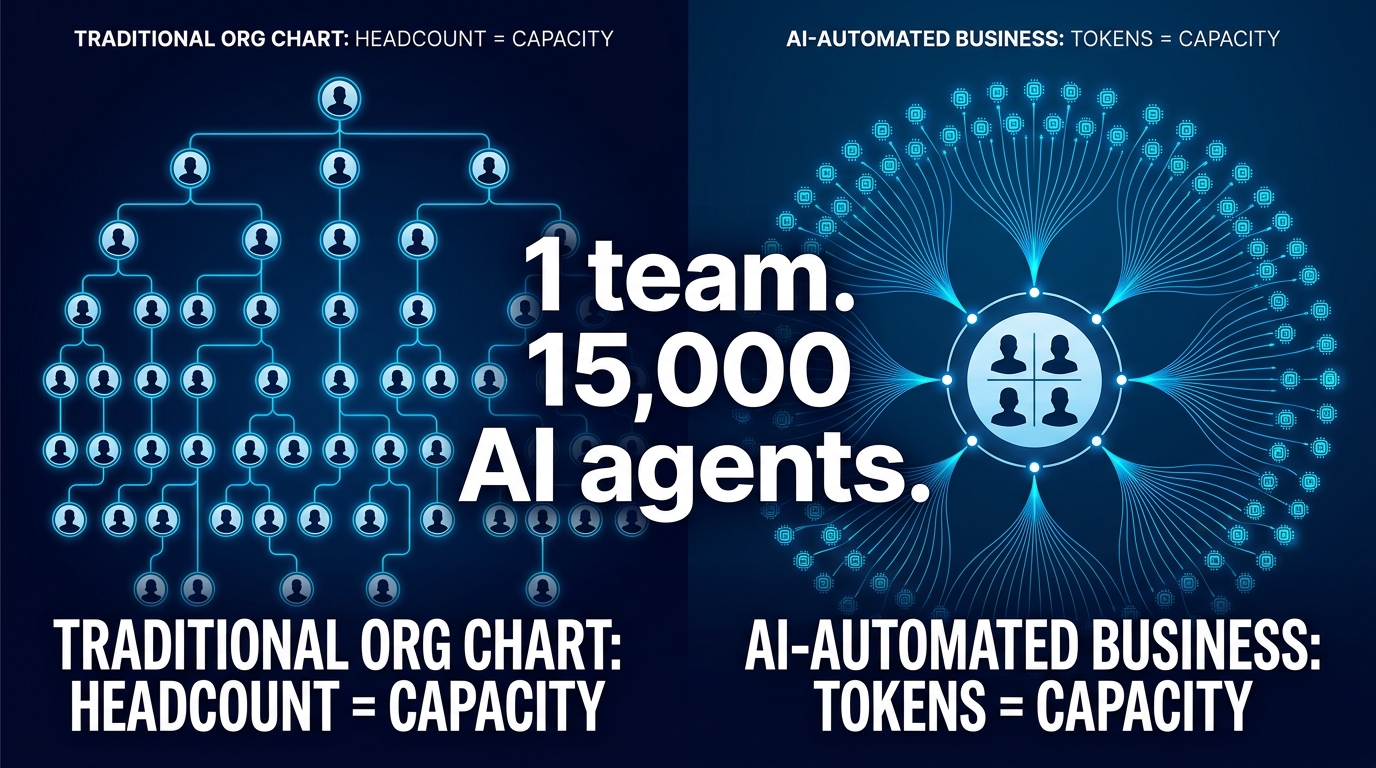
For most of business history, organizational capacity was measured in headcount. Need more output? Hire more people. Need to cut costs? Reduce headcount. The equation was simple because human labor was the primary input to most business processes.
AI automation breaks that equation. And one of the clearest signals of where advanced organizations are heading is a concept that Microsoft’s WorkLab researchers have started describing as tokenomics — the idea that the relevant unit of organizational capacity is no longer heads, but AI processing tokens.
What tokenomics means in practice
A token, in the AI context, is the fundamental unit of computation that large language models and AI agents consume when processing inputs and generating outputs. When a business deploys an AI agent to handle customer inquiries, review contracts, or analyze sales data, it is spending tokens — at a cost per thousand that is orders of magnitude lower than the equivalent human labor.
This creates a fundamentally different capacity planning model. Instead of asking “how many people do we need to handle this workload?” the question becomes “how many tokens do we need, what do they cost, and how do we govern where they are deployed?”
Microsoft’s own operations provide a real-world illustration. The company has deployed what its researchers describe as 15,000 AI agents across internal workflows — not to replace its workforce, but to extend the capacity of its existing teams into areas that would previously have required significant additional headcount. The headline number matters less than the principle: AI agents are a new form of organizational capacity, measurable and manageable in ways that were not possible with human-only teams.
The CFO conversation is changing
For finance leaders, tokenomics reframes the automation investment conversation. The traditional ROI model for automation was: calculate the labor cost of the manual process, compare to the cost of the automation tool, measure time-to-payback. Clean and simple.
The tokenomics model adds a new dimension: the cost of AI agent execution scales with usage, not with fixed capacity. As AI models become more capable, the cost per token tends to fall. As businesses get better at designing efficient prompts and workflows, they can process more value per token. This creates a compounding cost advantage that does not exist in traditional headcount-based operations — but it also creates new financial risks if token usage is not actively managed and governed.
Implications for workforce planning
Tokenomics does not mean headcount goes to zero. It means the composition of headcount changes. Organizations that are thinking carefully about this are already seeing a shift toward roles that did not exist at scale three years ago: AI workflow designers, prompt engineers, AI output reviewers, automation governance analysts. The total headcount may not change dramatically in the near term, but the mix — and the skills that are valued — is changing substantially.
Which Processes Actually Belong in an AI Automation
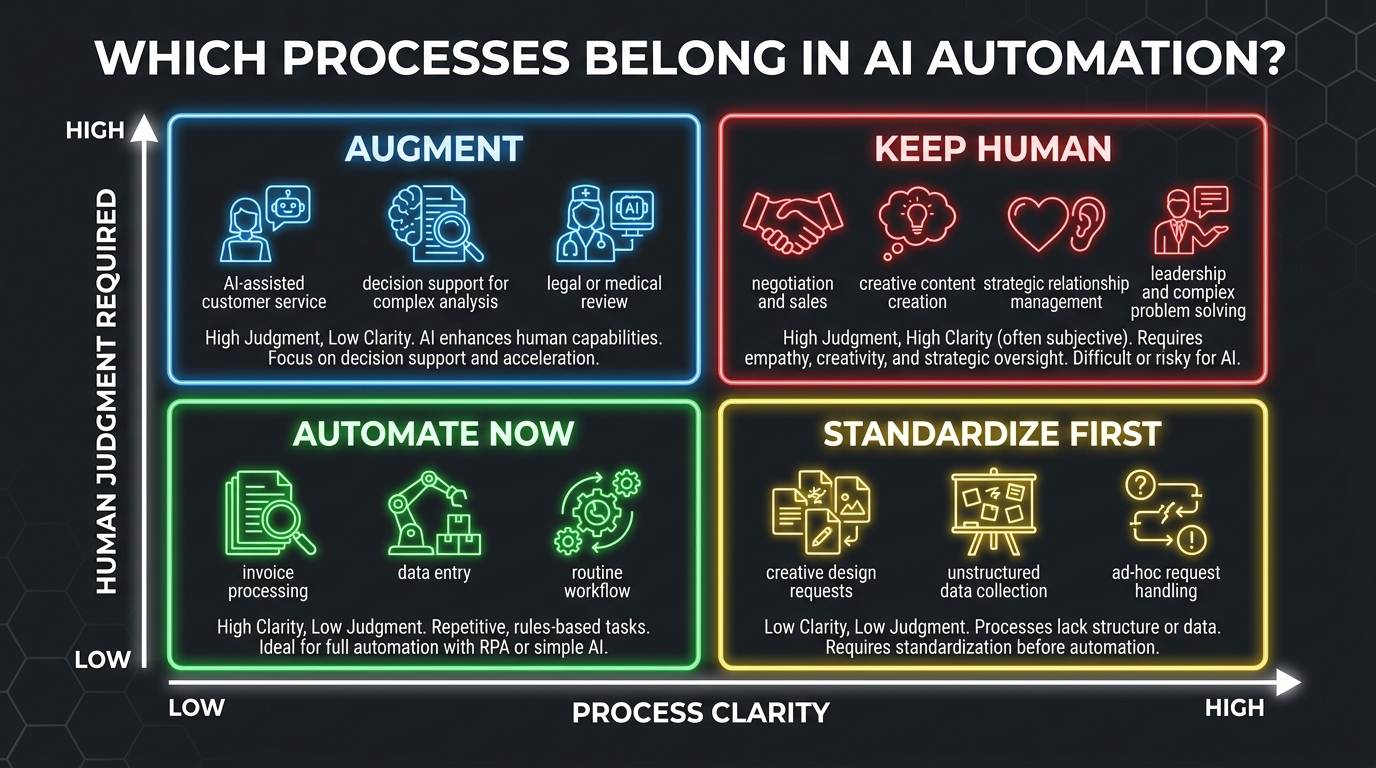
Not every process is a good candidate for AI automation. One of the most common and expensive mistakes organizations make is automating a process that should not be automated — either because it involves too much contextual judgment, because the underlying process is too poorly defined, or because automating it at the wrong time locks in a broken workflow at machine speed.
The two-axis assessment
A useful framework for evaluating automation candidates maps processes across two dimensions:
Process clarity: How well-defined is the process? Are the inputs consistent? Are the decision rules explicit? Is there a clear definition of a correct output? High process clarity means the logic can be expressed in a way that AI can reliably follow. Low process clarity means the process itself needs to be designed before automation can be built on top of it.
Human judgment required: How much does this process depend on contextual reasoning, ethical trade-offs, or relationship dynamics that AI cannot reliably replicate? High judgment requirements mean human oversight is essential at minimum; low judgment requirements mean AI can handle execution independently with periodic review.
Mapping processes across these two dimensions produces a practical prioritization grid:
- High clarity, low judgment → Automate now. These are your best early automation candidates. Invoice processing, data entry, standard report generation, appointment scheduling, routine email classification. The ROI is fast and the risk is low.
- High clarity, high judgment → Augment the human. The process is well-defined enough to structure, but the outputs require human review and contextual decision-making. Legal contract review, performance evaluation, medical record analysis. AI handles the heavy lifting; humans make the calls.
- Low clarity, low judgment → Standardize the process first. The process is too ambiguous to automate effectively, but it does not inherently require human judgment — it is just poorly designed. Fix the process first. Document the inputs, outputs, and decision logic. Then automate.
- Low clarity, high judgment → Keep human-led. Strategic planning, crisis communications, complex stakeholder negotiations. AI can provide analysis and options, but the execution should remain with experienced humans until process clarity improves significantly.
The “standardize first” trap
The low-clarity quadrant deserves special attention because it is where the most expensive automation mistakes happen. When a business tries to automate a poorly defined process, one of two things occurs. Either the automation fails outright — producing inconsistent or incorrect outputs that quickly lose user trust — or the automation succeeds technically but enshrines a broken process at machine speed.
The second outcome is particularly dangerous. A human executing a flawed process makes errors at human speed. An automated system executing the same flawed process produces errors at scale, often without the contextual awareness to recognize that something has gone wrong. The damage compounds before anyone notices.
The discipline of process standardization before automation is boring. It requires workshops, documentation, disagreements about edge cases, and decisions about exception handling. But it is the work that separates organizations that get lasting value from automation from those that spend 18 months building a system they eventually have to rebuild from scratch.
AI Automation Across the Business: Function by Function
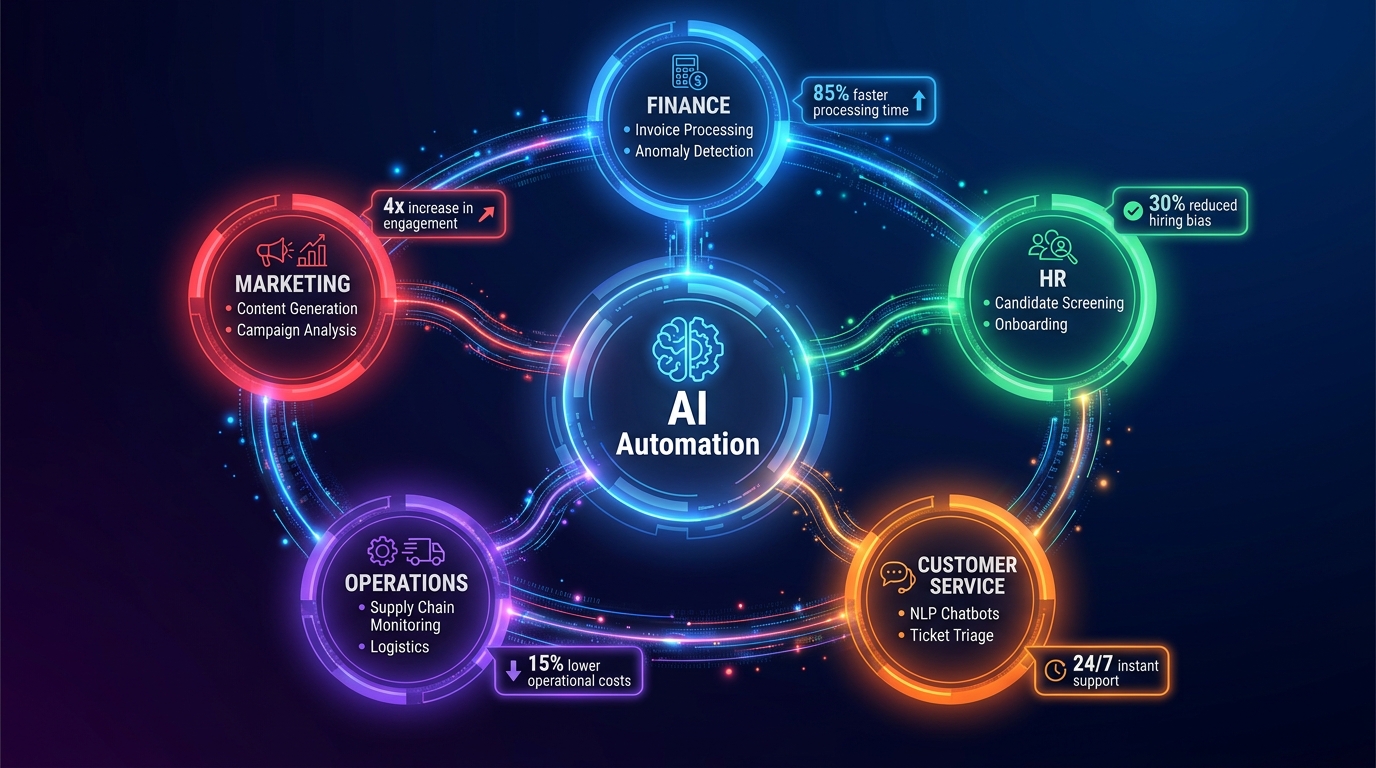
The most practically useful AI automation is function-specific. Abstract claims about “automating work” are less useful than understanding exactly what automation looks like in finance, HR, customer service, operations, and marketing — and what the real limitations are in each domain.
Finance and accounting
Finance is one of the most mature areas for AI automation, both because financial processes tend to have high clarity (transactions have defined fields, rules, and expected outputs) and because the volume of data is vast enough that human processing is inherently limited.
Invoice processing and accounts payable: AI systems can now read invoices in unstructured formats — PDFs, scanned images, email attachments — classify them correctly, match them to purchase orders, flag discrepancies, and route exceptions for human review. Organizations that have deployed this report reductions in processing time of 60–80% compared to purely manual workflows, with error rates that are lower than human review at comparable speeds.
Anomaly detection in transactions: Machine learning models trained on historical transaction data can flag unusual patterns — potential fraud, policy violations, duplicate payments — faster and more consistently than rule-based systems, because they can identify combinations of factors that would not trigger any single rule but together indicate elevated risk.
Financial forecasting: AI models can process far more variables — market data, economic indicators, internal operations data, historical patterns — than traditional spreadsheet-based forecasting allows. The outputs are probabilistic ranges rather than point estimates, which is actually more accurate and more useful for decision-making than false precision.
Where human judgment stays essential: Audit interpretations, tax strategy, capital allocation decisions, investor communications, and any financial decision with significant reputational or regulatory stakes. These require contextual reasoning and accountability that cannot be embedded in an automated system.
Human resources and talent
HR automation is advancing rapidly in some areas while remaining deeply constrained in others — a distinction that matters enormously because the consequences of getting it wrong in HR are both human and legal.
Candidate screening: Natural language processing can now analyze resumes and application materials at scale, identifying candidates whose profiles match defined criteria more consistently than human reviewers — who are demonstrably susceptible to biases based on name, school, and formatting. However, AI screening systems trained on historical hiring data can also perpetuate historical biases, which makes governance and regular auditing non-negotiable.
Onboarding automation: New hire onboarding involves a predictable sequence of tasks — document collection, system access provisioning, training assignment, introductory meeting scheduling — that are ideal candidates for workflow automation. Companies that have automated onboarding sequences report higher new-hire satisfaction in the first 90 days and meaningfully lower HR administrative load.
Benefits administration and HR inquiry handling: AI chatbots trained on HR policy documentation can answer the majority of employee questions about benefits, leave policies, and compliance requirements without routing to a human HR representative. Research shows that support ticket triage using AI — classifying the nature of the inquiry and routing to the right handler — reduces resolution time significantly compared to manual queuing.
Where human judgment stays essential: Performance improvement conversations, terminations, compensation negotiations, discrimination or harassment investigations, and any HR matter involving employee dignity or legal exposure. The consequences of automation errors in these domains are severe enough that human judgment should remain central.
Customer service
Customer service is simultaneously one of the highest-value and highest-risk areas for AI automation — high-value because service interactions are numerous and costly, high-risk because a bad automated experience can damage customer relationships at scale.
The most effective deployments are those that use AI to handle the volume of simple, high-frequency inquiries — order status, return initiation, password reset, FAQ response — while routing complex, emotional, or high-stakes interactions to human agents with full context provided by the AI system. PayPal’s use of chatbots for 65% of message-based customer inquiries during peak periods is a representative example of this approach done well.
The key design principle is that the handoff from AI to human must be smooth and context-rich. The most common customer frustration with AI-powered service is not the AI itself — it is being transferred to a human agent who has no context from the preceding AI conversation and requires the customer to start over. Automation that creates this handoff failure often produces worse customer satisfaction than no automation at all.
Sentiment analysis — using NLP to gauge the emotional state of a customer based on their language in an inquiry — is a particularly useful augmentation tool. It allows automated systems to identify customers who are frustrated, escalate proactively, and ensure that the human agent who receives the escalation understands the emotional context before the conversation begins.
Operations and supply chain
Operations and supply chain automation has been advancing for over a decade through traditional rule-based systems, but AI adds qualitatively new capabilities: the ability to process unstructured data inputs, model non-linear relationships between variables, and adapt to novel conditions rather than only executing predefined rules.
Demand forecasting: AI models incorporating external signals — social media trends, weather data, macroeconomic indicators, competitor pricing — alongside historical sales data can produce more accurate demand forecasts than models that rely only on internal data. For retailers and manufacturers, even small improvements in forecast accuracy translate to significant reductions in inventory carrying costs and stockout rates.
Logistics optimization: Route planning, carrier selection, and delivery scheduling are computationally intensive optimization problems that AI handles more effectively than human planners working with spreadsheets — particularly when conditions change dynamically and plans need to be adjusted in real time.
Quality control: Computer vision systems trained on images of defective and acceptable products can inspect production output faster and more consistently than human inspectors. The technology is mature enough that it is deployed across manufacturing industries ranging from food processing to semiconductor fabrication.
Marketing and revenue
Marketing may have the highest density of AI automation use cases of any business function — partly because marketing generates and consumes enormous volumes of content and data, and partly because the outputs are more measurable than in many other functions.
Content generation — first drafts of emails, ad copy, social posts, product descriptions — is a legitimate time-saver when used as a starting point for human refinement rather than as a finished output. The organizations getting the most value from generative AI in marketing are those that use it to accelerate iteration and testing, not to eliminate the human creative judgment that distinguishes effective messaging from generic content.
Campaign analysis and audience segmentation are areas where machine learning has been producing value for years. The ability to identify customer segments that behave similarly without being explicitly defined — and to predict which segment a new customer is most likely to belong to — is genuinely powerful for personalization at scale.
The Hidden Governance Problem: Brittle Processes and Unclear Decision Rights
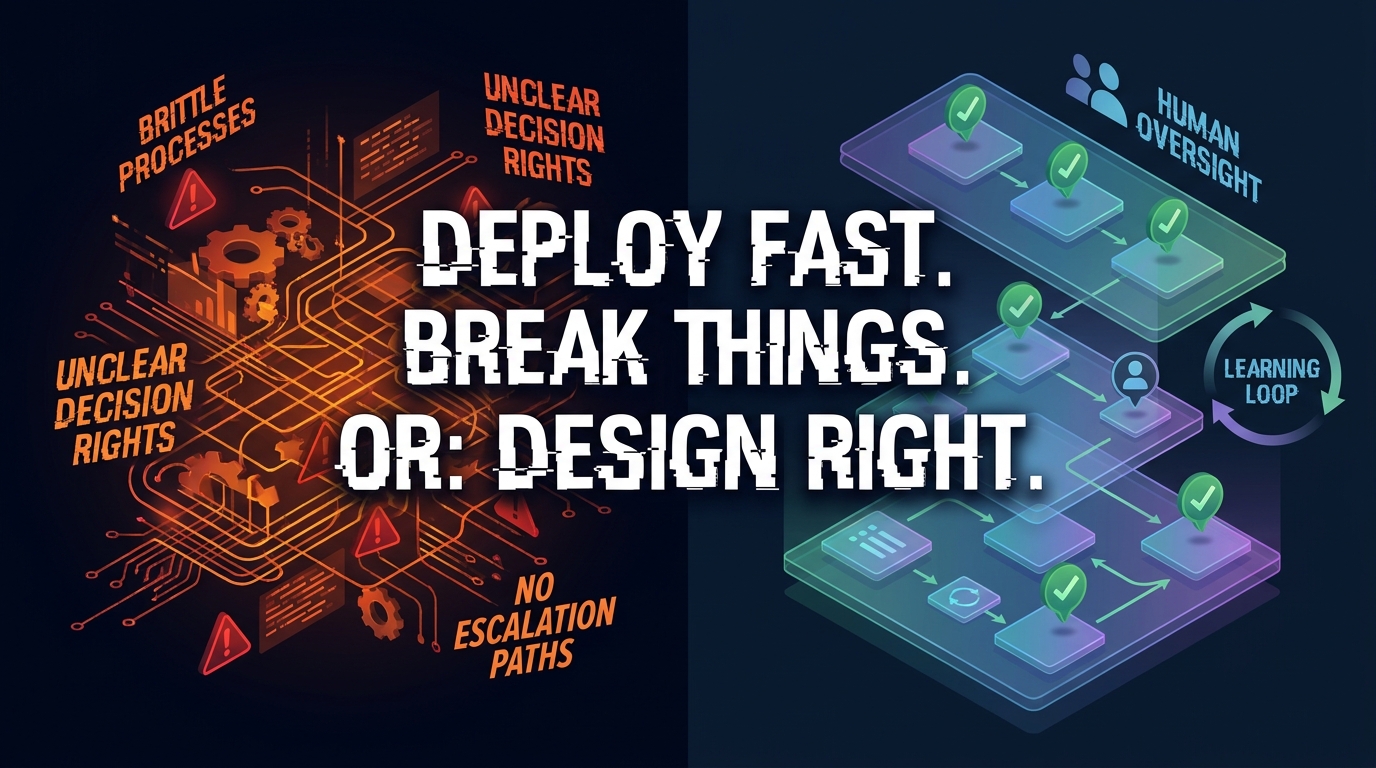
The governance conversation is the one that most AI automation discussions skip — and it is the one that most reliably determines whether an organization gets durable value from automation or spends significant money on systems that eventually fail, get bypassed, or produce liability.
What brittle processes look like at scale
A brittle process is one that works under normal conditions but breaks — or produces wrong outputs — when conditions deviate from what the design assumed. Every business process has brittle edge cases. Human workers handle them intuitively, applying judgment to recognize that this situation is not quite like the standard case and adjusting accordingly.
When a brittle process is automated, those edge cases produce automated errors. And because automation operates at speed and scale, edge case errors can propagate widely before anyone notices. A manual invoice processing error might affect one payment. An automated invoice processing error could affect hundreds of payments before a downstream reconciliation check catches it.
The discipline of identifying brittleness before automating — mapping the edge cases, deciding how each will be handled, and building explicit exception-handling into the automation design — is painstaking but essential. It is also the work that separates automation deployments that last from those that require emergency fixes six months after go-live.
Decision rights: Who owns what the AI decides?
Every automated process makes decisions. When an AI system classifies a support ticket as low-priority, it has decided something. When a loan application screening AI declines a borderline application, it has decided something. When a marketing automation tool decides not to send a re-engagement email to a customer, it has decided something.
Who owns those decisions? Who is accountable when they are wrong? Who has the authority to override the system, and under what conditions? Who is responsible for auditing whether the system is making decisions that are consistent with organizational values and legal requirements?
These are decision rights questions, and the absence of clear answers to them is one of the most common sources of AI automation failure. Organizations that deploy automation without explicit decision rights governance find themselves in uncomfortable positions: AI systems making decisions that no human would sanction if asked directly, with no clear process for catching or correcting them.
Escalation paths and human override design
Every well-designed automation should have defined escalation paths: the conditions under which the system stops executing autonomously and routes to a human, and the mechanism for that routing. This is not optional risk management. It is fundamental system design.
The threshold for escalation should be set based on the cost of false positives (escalating something that the AI could have handled fine) versus false negatives (not escalating something that required human judgment). In high-stakes domains — medical, legal, financial — the cost of false negatives is typically much higher, so the escalation threshold should be set conservatively. In lower-stakes domains, a higher autonomy threshold is appropriate.
Building AI Automation That Learns — Not Just Executes
The difference between static automation and intelligent automation is learning. A traditional rules-based automation system executes the same logic forever, unless someone manually updates it. An AI-powered automation can improve its performance over time as it processes more data and receives feedback — but only if it is designed to do so.
Closing the feedback loop
IBM’s framework for AI-powered automation — what it describes as “Automation 2.0” — centers on a closed-loop process where data patterns are continuously discovered and analyzed, decisions are made, actions are taken, and the outcomes of those actions feed back into the next cycle of pattern discovery. The key word is closed. The loop has to actually close. The outputs of the automation have to feed back into data that updates the model’s behavior.
In practice, this means designing two things that are often treated as afterthoughts: feedback capture mechanisms and model update processes. Feedback capture means recording, at decision time, what the AI did — and then recording, at some later time, whether that decision was correct. This sounds simple but is operationally demanding. The ground truth for whether the AI made a good decision is often not immediately available, and capturing it requires deliberate process design.
Human-in-the-loop as a training asset
One of the most underutilized assets in AI automation is the human review that already happens. When a human reviewer looks at an AI output and decides to accept it, modify it, or reject it, that is training data. Most organizations do not capture it systematically. They process the output and move on, losing the signal that would allow the AI system to learn from the reviewer’s judgment.
Designing automation to capture reviewer decisions — and making it easy for reviewers to annotate why they are modifying or rejecting an AI output — turns the human review process into a continuous training data pipeline. Over time, a well-designed system gets better at the specific decisions your organization cares about, calibrated on your specific data, your specific edge cases, and your specific standards.
Drift detection and model maintenance
AI models trained on historical data can become less accurate as the world changes. A fraud detection model trained on 2023 transaction data may miss 2026 fraud patterns that look different from what it was trained on. A demand forecasting model trained before a major market shift may produce systematically wrong predictions afterward. This is called model drift.
Managing drift requires monitoring model performance continuously — tracking whether the outputs that the AI produces are as accurate as they were when the model was deployed — and having a process for retraining or updating the model when performance degrades. This is not glamorous work. It is infrastructure maintenance. But it is the difference between an automation that stays valuable for years and one that quietly becomes unreliable.
The Change Management Piece Nobody Wants to Talk About
Every AI automation project is also a change management project. The technical implementation is often the easier part. The harder part is getting the people whose work is affected by the automation to trust it, use it correctly, and provide the feedback that makes it better over time.
Why adoption fails even when the technology works
There is a consistent pattern in failed AI automation deployments: the system works technically but users do not adopt it. They find workarounds. They continue the old process in parallel “just to check.” They override the AI’s recommendations systematically, even when the AI is correct, because they do not trust it. Or they apply the AI’s outputs uncritically, abdicating judgment they should be exercising.
Both failure modes — wholesale rejection and uncritical acceptance — reflect the same root cause: inadequate change management. Users who do not understand why the automation was deployed, how it makes decisions, what its limitations are, and what their role is in the new workflow will default to their existing behaviors. That is not stubbornness. It is a rational response to uncertainty.
What effective change management for AI automation looks like
It starts with involvement before deployment, not communication after. The people whose workflows will change should be part of the process design, not just the recipients of a finished system. They know where the edge cases are. They know which parts of the old process the automation design team have not considered. Their involvement improves the system and builds the trust that drives adoption.
It includes honest communication about what the automation does and does not do. Users who understand that the AI is accurate 94% of the time in category X but less reliable in category Y know when to trust the output and when to apply more scrutiny. Users who are simply told “the AI will handle this” apply either too much or too little trust.
It establishes clear new role definitions. If a person’s job used to involve a task that is now automated, their job has changed. The change management process should make explicit what their job now involves instead — ideally, higher-judgment work that the automation has freed them to focus on. People who feel that automation has taken away their work without giving them something meaningful in return will resist it, actively or passively.
The 5Cs of essential human skills in an AI-automated world
Microsoft’s WorkLab research has identified what its researchers describe as the five essential human skills for working effectively in AI-automated environments — a useful framework for thinking about how to develop your team alongside automation deployment:
- Critical thinking: Evaluating AI outputs rather than accepting them uncritically. Knowing when to push back and when to follow the system’s lead.
- Communication: Expressing ideas clearly enough to direct AI systems effectively, and translating AI outputs into communication that human stakeholders can act on.
- Creativity: Bringing genuinely novel ideas to problems that AI cannot solve through pattern recognition — because creativity draws on lived experience and values, not just data.
- Collaboration: Working effectively in teams that include both human and AI participants, understanding how to orchestrate across both.
- Curiosity: Continuously learning as AI capabilities evolve, rather than assuming that what is true about AI automation today will be true in 18 months.
How to Sequence Your AI Automation Rollout
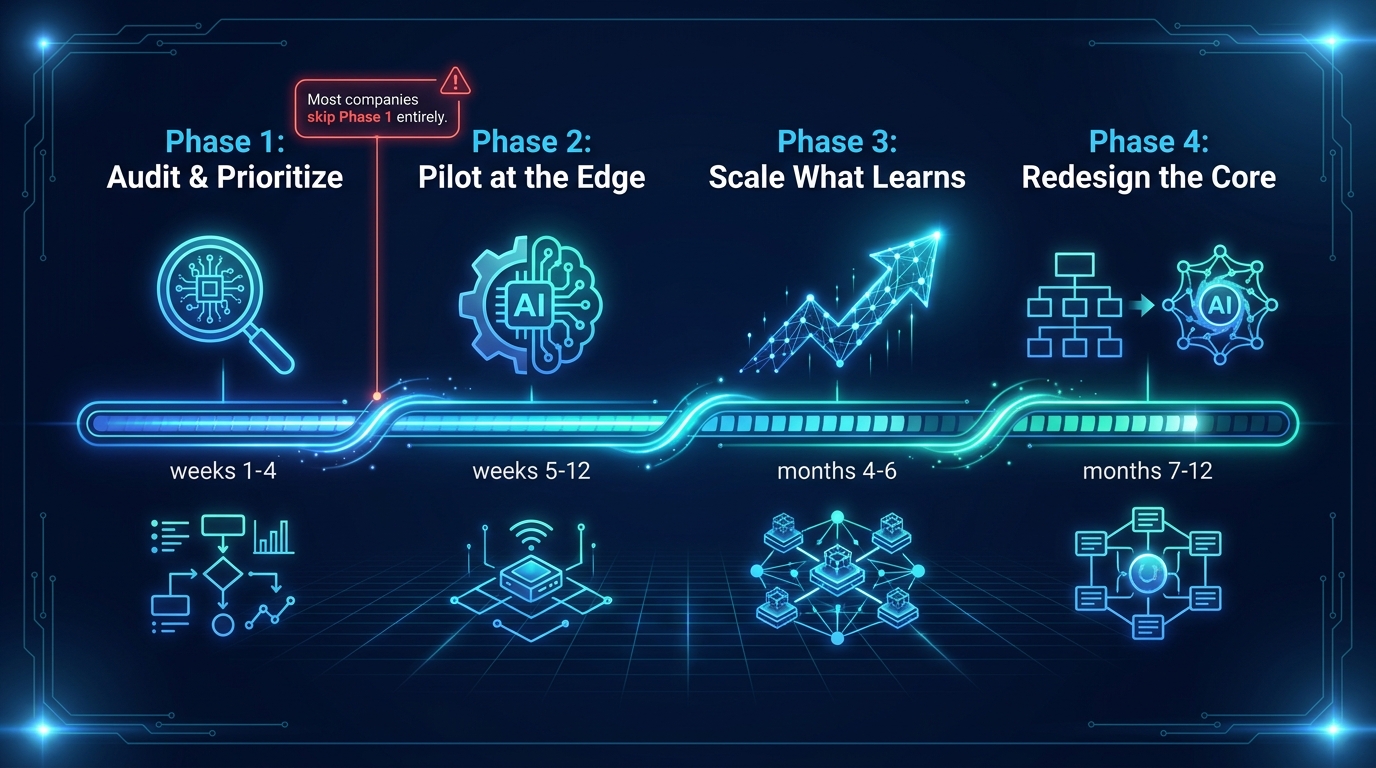
Given everything above, the sequencing question becomes: where do you start, and how do you build from early wins to organizational transformation without overbuilding, overreaching, or burning organizational goodwill on a project that fails publicly?
Phase 1: Audit and prioritize (Weeks 1–4)
Before touching any technology, map your processes against the two-axis framework described earlier. Identify your best automation candidates — high clarity, low judgment required — and your highest-value augmentation candidates. Document the current state of each process: inputs, outputs, decision rules, volume, error rates, and cost. Identify your brittleness points and edge cases. Establish your governance baseline: who currently owns each decision, and what the decision rights should look like post-automation.
Most organizations skip this phase or compress it dramatically. It is the least visible phase — there is no technology to demo, no feature to announce — but it is the one that determines whether subsequent phases succeed. The organizations that get the most from automation are consistently those that invested the most in understanding their own processes before trying to change them.
Phase 2: Pilot at the edge (Weeks 5–12)
Start with the processes that scored highest in Phase 1: clear, low-judgment, high-volume, and relatively self-contained so that errors are bounded. Deploy automation in a controlled environment. Measure performance against the baseline established in Phase 1. Capture feedback from users. Identify where the automation underperforms expectations and why. This phase produces both validated learnings about what works and early wins that build organizational confidence and funding for subsequent phases.
The “at the edge” framing matters. Do not start by automating your most critical or most complex processes. Start where the stakes are lower and the learnings are fastest. Demonstrated success at the edge creates the organizational appetite and political capital to invest in more ambitious automation later.
Phase 3: Scale what learns (Months 4–6)
After Phase 2, you have evidence — not projections, but actual performance data — about which automations are working and which need refinement. Scale the ones that are working. Refine the ones that are close. Retire the ones that are not delivering. This phase is also where you begin building the institutional infrastructure for ongoing automation management: monitoring systems, feedback capture processes, retraining workflows, and governance forums.
Phase 4: Redesign the core (Months 7–12)
With edge-level automation running and institutional infrastructure in place, Phase 4 is where you apply the lessons from the periphery to your core processes — and begin asking the Layer 3 and Layer 4 questions about process redesign and organizational structure. This is where AI automation shifts from cost-saving initiative to competitive differentiator.
The 12-month framing is a guideline, not a guarantee. Organizations with more complex processes, more regulatory constraints, or more fractured IT infrastructure will take longer. Organizations with simpler operations and stronger digital foundations may move faster. The sequencing logic — audit, pilot, scale, redesign — remains valid regardless of pace.
What “Learning Organizations” Actually Means in the Age of AI Automation
One of the most important — and most actionable — conclusions from the 2026 Work Trend Index is that the firms that will lead in the AI automation era are not the ones that deploy the most tools fastest. They are the ones that learn fastest: organizations that capture what works, codify it, and diffuse it across the enterprise more effectively than competitors.
Local gains vs. institutional advantage
A pilot that works in one department creates local gains. The same pilot, documented and diffused across the organization, creates institutional advantage. The difference is whether the organization has mechanisms for capturing what it learns and systematically applying it elsewhere.
This sounds obvious. In practice, it is rare. Most organizations that run automation pilots leave the learnings inside the team that ran the pilot. The next team to tackle a similar automation starts from scratch, makes similar mistakes, discovers similar solutions, and takes almost as long as the first team. The organization invests multiple times in the same learning without accumulating institutional knowledge.
The organizations that compound their automation advantage are the ones that treat pilot documentation as seriously as pilot execution, that run structured retrospectives after each automation deployment, that create internal communities of practice where automation designers share what they learned, and that build internal knowledge bases of tested automation patterns, edge case solutions, and governance frameworks.
The orchestration skill is the new leadership skill
As AI handles more execution and agents take on more workflow steps, the critical leadership skill is orchestration: the ability to coordinate across humans and AI agents, understand what each is capable of, design work accordingly, and make the judgment calls about where automation ends and human decision-making must begin.
This is different from the traditional management skill set, which centered on directing human teams. It is also different from the technical skill set of building AI systems. It sits between them — a blend of organizational design thinking, AI literacy, process knowledge, and human leadership. It is the skill that the leaders of the next decade’s most successful businesses will be defined by.
Conclusion: The Design of Judgment Is the Work of This Era
The question that opened this post was not “what can we automate?” The right question was “is our organization designed to benefit from AI automation?” After thousands of words, the answer to both questions has a common thread.
What you can automate is determined by process clarity and judgment requirements. Whether your organization benefits from automation is determined by whether you have redesigned your operating model — your workflows, roles, decision rights, governance structures, and feedback loops — to capture the value that automation makes available.
The technology is available. The use cases are proven. The tools are affordable. What is scarce, and what represents the real competitive advantage in 2026, is the organizational capability to design the judgment layer: to know which decisions should be automated, which should be augmented, which should remain with humans, and how to govern the boundaries between them.
As Harvard Business School’s Karim Lakhani put it in the 2026 Work Trend Index: “If earlier eras of management were defined by the design of scale, this one will be defined by the design of judgment, learning, and coordinated action across humans and machines.”
That design work is hard. It requires confronting uncomfortable questions about which processes are actually well-defined, where decision rights are unclear, which management layers exist primarily to aggregate information rather than add judgment, and how the organization will need to change as AI takes over execution. None of those questions have comfortable answers.
But the organizations that ask them — and answer them honestly — are the ones that will look back at this period and recognize it as the moment when they built something durable. Not just faster processes. A better-designed business.
Actionable takeaways
- Start with process mapping, not technology selection. Before choosing an AI tool, document your target processes, their decision rules, their brittleness points, and their current performance metrics.
- Use the two-axis framework (process clarity × judgment required) to prioritize your automation candidates and set realistic expectations for each.
- Design governance before you deploy. Define decision rights, escalation paths, and human override mechanisms as part of the automation design, not as an afterthought.
- Close the feedback loop. Build feedback capture and model update processes into every AI automation from the start. Static automation decays. Learning automation compounds.
- Treat change management as core, not peripheral. Involve affected teams in design. Communicate honestly about capabilities and limitations. Redefine roles explicitly. Build the 5Cs into your development culture.
- Sequence deliberately. Audit → Pilot at the edge → Scale what learns → Redesign the core. Skipping phases is how organizations end up with expensive systems that underdeliver.
- Measure institutional learning, not just task savings. The organizations that compound their automation advantage are the ones that document, diffuse, and build on what they learn — not just the ones that deploy the most tools.