
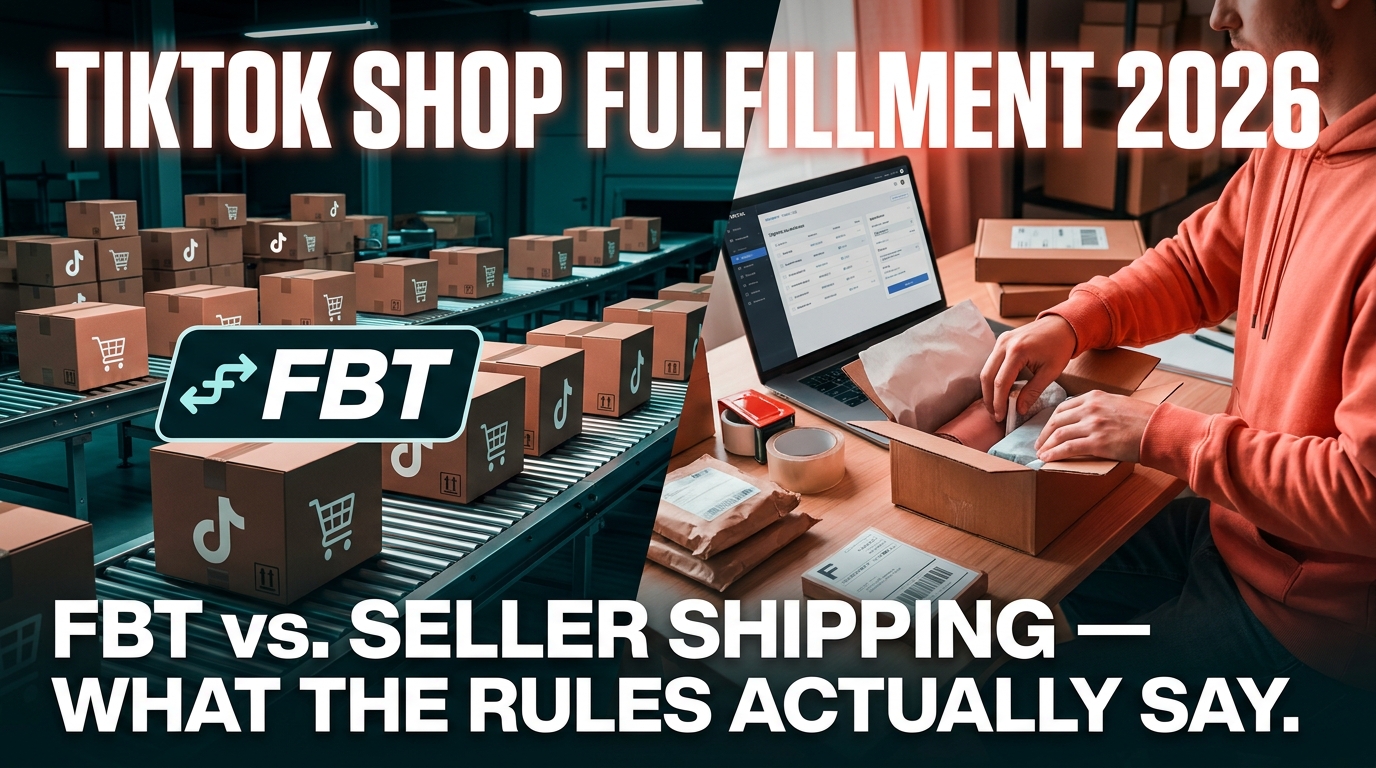

Few moments in TikTok Shop’s short U.S. history generated as much operational anxiety as the six weeks between January and mid-February 2026. Sellers who had built their entire logistics stack around self-fulfillment suddenly received notice that their setup would be invalid by March 31. Third-party logistics providers scrambled to pitch TikTok-compatible integrations. Fulfillment consultants issued emergency webinars. And then, almost as abruptly as the mandate arrived, TikTok reversed course — announcing on February 17 that “Seller Shipping remains unchanged.”
The whiplash left a residue of confusion that persists today. Ask ten TikTok Shop sellers what the current fulfillment rules are, and you’ll likely get ten different answers. Some believe they’re already non-compliant. Others think the original mandate is still coming back. Many simply stopped paying close attention to policy communications entirely — which is arguably the most dangerous position of all.
This guide cuts through the noise. It covers what the rules actually say as of mid-2026, how the compliance metrics work in practice, what FBT’s true cost structure looks like after three separate fee revisions, and — critically — how to build a fulfillment operation that doesn’t break the next time TikTok changes direction. Because that next change is coming. The platform’s intent is clear, even if the timeline has shifted.
The Policy Whiplash: What TikTok Shop Announced vs. What Sellers Actually Faced
To understand where TikTok Shop’s fulfillment rules stand today, you have to understand what happened at the start of 2026 — because the reversal didn’t erase the underlying intent, and it created a compliance psychology problem that still affects how sellers operate.
The Original Mandate
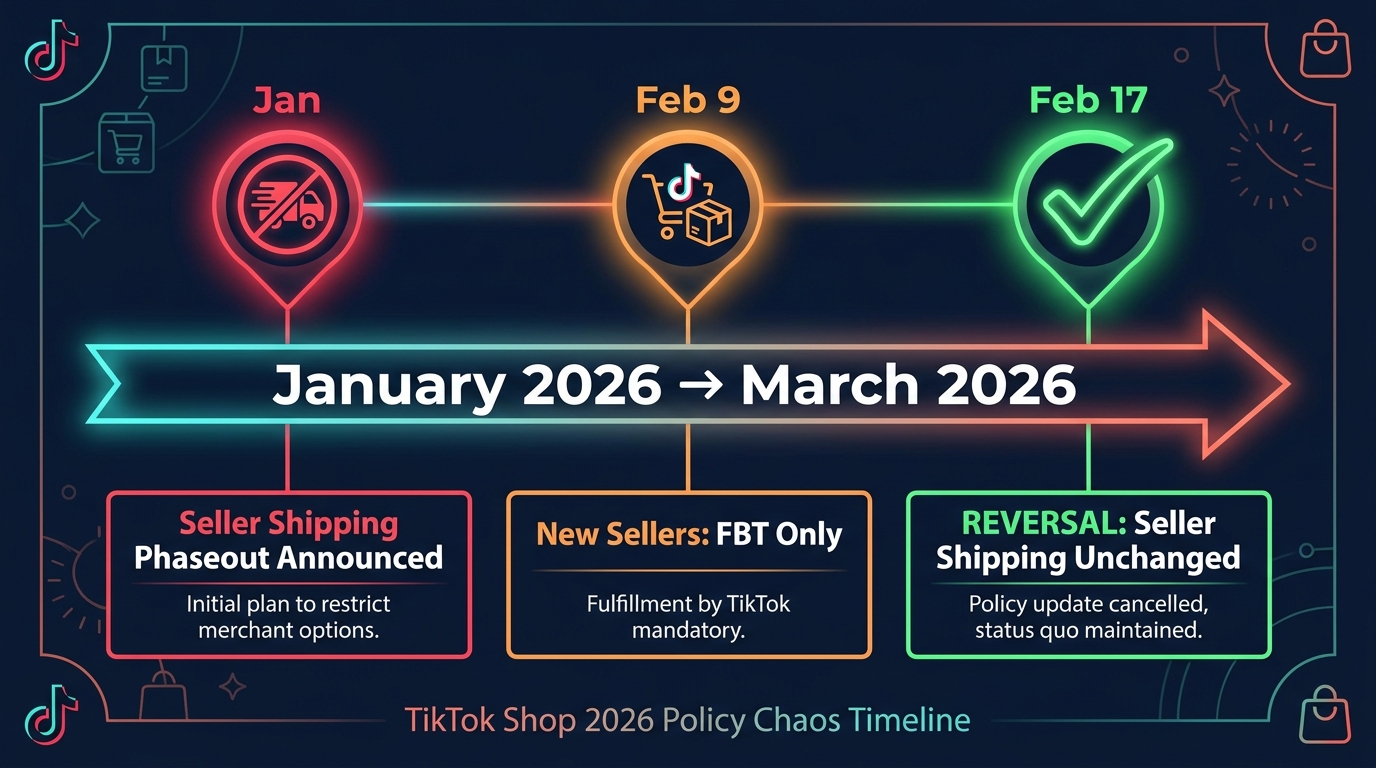
In January 2026, TikTok Shop communicated to U.S. sellers that independent seller-fulfilled shipping would be phased out. The timeline laid out was specific: new sellers joining from February 9 onward would be required to use TikTok-managed logistics from day one, while existing sellers would have until February 25 to begin transitioning. The full cutoff for self-managed Seller Shipping was set at March 31, 2026.
The stated alternatives were clear: sellers would need to move to Fulfilled by TikTok (FBT), Upgraded TikTok Shipping, or Cross-Border TikTok logistics (CBT) depending on their seller type. The message was unambiguous — TikTok was centralizing logistics control, and Seller Shipping’s days were numbered.
The Reversal
On February 17, 2026 — just eight days before the first transition date was set to take effect — TikTok sent another communication. The message: “Seller Shipping remains unchanged.” The previously announced deadlines would not go into effect. Sellers could continue operating as they had been.
No full public explanation was offered. Industry observers pointed to seller backlash, operational unreadiness in TikTok’s own logistics network, and the political complexity of a mandate that would effectively require all U.S. sellers to route packages through TikTok-controlled infrastructure. Whatever the reason, the enforcement stopped before it started.
What the Reversal Actually Means
The reversal is not a signal that TikTok has abandoned its logistics ambitions. The platform’s long-term model — visible in how it operates in markets like China, Indonesia, and the UK — involves deep control over the fulfillment chain. The U.S. pause is better interpreted as a timing adjustment than a strategic retreat.
For sellers, the practical lesson is this: the fact that you can use Seller Shipping right now does not mean your current setup is future-proof. The metrics, enforcement mechanisms, and incentive programs TikTok is actively running all push in the direction of platform-managed fulfillment. Understanding those forces is more important than any single policy announcement.
The Current Fulfillment Landscape: All Three Options Explained
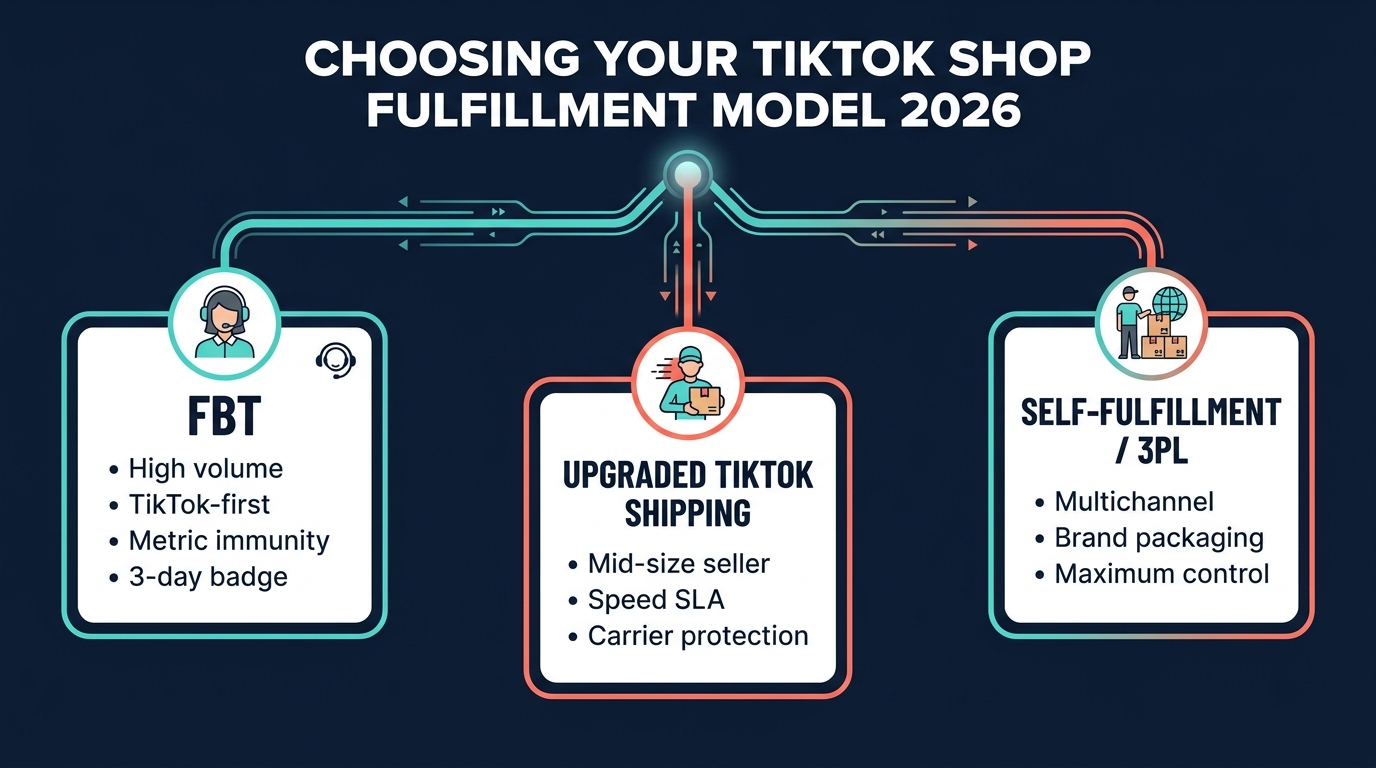
As of mid-2026, U.S. TikTok Shop sellers have three primary fulfillment paths available to them. The key differences go beyond cost — they affect how compliance metrics are calculated, how your listing ranks, and how much operational risk you carry.
Option 1: Fulfilled by TikTok (FBT)
FBT is TikTok’s warehouse-and-ship program, analogous in structure to Amazon FBA. Sellers send inventory to TikTok-operated fulfillment centers; TikTok picks, packs, ships, handles tracking, and manages returns. For eligible orders, TikTok offers a “3-day delivery” badge that appears on product listings — a conversion signal that matters in a scroll-driven, impulse-purchase environment.
The platform benefits of FBT extend beyond badging. FBT orders are largely exempt from the standard OTDR (On-Time Delivery Rate) and VTR (Valid Tracking Rate) compliance metrics — meaning your Account Health Rating is insulated from carrier delays that are outside your control. TikTok’s own figures cite shipping cost savings of 20–35% for eligible FBT items compared to baseline carrier rates, though actual savings depend heavily on product weight and volume.
The tradeoffs are real. You lose control over packaging and branding. Inventory is locked inside TikTok’s network, making multichannel order management more complex. And FBT’s fee structure — which has changed multiple times in 2026 alone — requires careful, ongoing margin calculation.
Option 2: Upgraded TikTok Shipping
This is TikTok’s managed-label shipping product. Sellers fulfill from their own warehouse or 3PL, but use TikTok-provided carrier integrations and shipping labels rather than arranging their own carrier contracts. It sits between FBT and self-fulfillment in terms of platform control.
A significant operational advantage of Upgraded TikTok Shipping emerged in mid-2026: TikTok updated its OTDR policy to protect sellers using this option from carrier-delay penalties when the seller dispatched on time. In other words, if a carrier misses the delivery window but you shipped within your SLA, the late delivery no longer counts against your metrics. This is a meaningful protection for sellers in regions with inconsistent carrier performance.
Option 3: Self-Fulfillment and Approved 3PLs
Seller Shipping — fulfilling from your own warehouse or a third-party logistics provider using your own carrier accounts — remains available as of mid-2026. This is the maximum-control option. You choose carriers, manage inventory across channels, maintain brand packaging, and negotiate your own shipping rates.
The compliance burden under this option is the highest. Every metric — LDR, VTR, OTDR, SFCR — applies fully and without platform-side exemptions. Sellers who choose this path need robust carrier integrations, reliable fulfillment SOPs, and active monitoring of their Seller Center performance dashboard to stay within thresholds.
For brands selling on multiple channels (Amazon, Shopify, Walmart Marketplace), 3PL fulfillment often makes more operational sense than bifurcating inventory into a TikTok-specific network. The key is ensuring your 3PL can hit TikTok’s dispatch SLAs reliably — because the metrics don’t care about your provider’s excuses.
The Numbers That Run Your Shop: LDR, VTR, OTDR, and SFCR Decoded
Most sellers know they’re supposed to ship fast. Fewer understand the specific numeric thresholds TikTok uses to evaluate performance — or the distinction between metrics that trigger automatic penalties and those that simply influence your account trajectory. Here’s how each metric works.
Late Dispatch Rate (LDR)
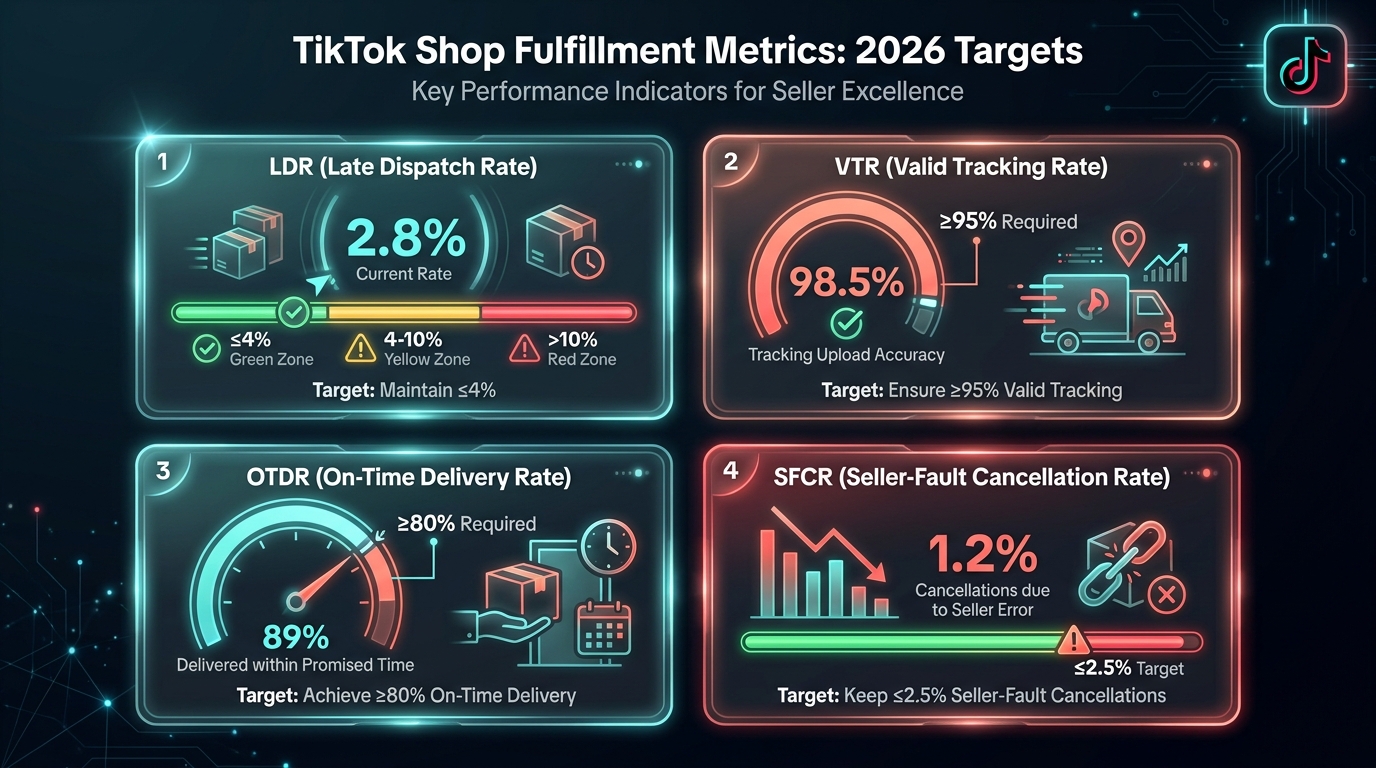
LDR measures the percentage of non-FBT orders that were not marked “In Transit” within the required dispatch window. The standard dispatch window is 2 business days from the order entering “Awaiting Shipment” status — effective since January 26, 2026.
TikTok’s current enforcement structure uses two thresholds. The recommended operating target is LDR ≤ 4%. When LDR exceeds 10%, formal enforcement actions may begin. Between 4% and 10%, you’re in a yellow zone — not yet penalized at the account level, but your trajectory is being observed and minor restrictions can apply. Note that FBT orders are included in the denominator of the LDR calculation but are never late by definition (since TikTok controls their dispatch), which makes FBT volume a passive buffer for your LDR score.
Valid Tracking Rate (VTR)
VTR is simple in concept: it’s the share of shipped packages that carry a valid, carrier-linked tracking number. TikTok requires VTR ≥ 95%. A tracking number is considered “valid” only when it is recognized and scannable by the carrier system — manually entered numbers that don’t correspond to real carrier records will not count.
For most sellers, VTR violations happen because of workflow gaps, not deliberate non-compliance. Common failure points include orders fulfilled through disconnected tools that don’t push tracking to TikTok Seller Center automatically, manual data entry errors, or using shipping services that TikTok’s carrier network doesn’t recognize. FBT and Upgraded TikTok Shipping orders automatically meet VTR requirements since TikTok controls the tracking chain.
On-Time Delivery Rate (OTDR)
OTDR evaluates whether orders are marked “Delivered” by the platform-assigned deliver-by date. The required threshold is OTDR ≥ 80%. Sellers using Upgraded TikTok Shipping now receive a degree of OTDR protection for carrier-caused delays when the seller dispatched on time — a policy update from mid-2026. Self-fulfilled sellers using their own carrier accounts carry full OTDR exposure for any delivery miss, regardless of cause.
Seller-Fault Cancellation Rate (SFCR)
SFCR tracks cancellations that are attributed to the seller — inventory issues, incorrect listings, inability to fulfill, or similar operational failures — as a percentage of total orders. The target is SFCR ≤ 2.5%. Persistent SFCR above this threshold triggers AHR deductions, and if seller-fault cancellations reach 90% or above for 30 consecutive days, the enforcement risk becomes severe.
SFCR is often the metric sellers underestimate. A cancellation feels like a minor incident; repeated across a catalog, it signals systemic inventory or listing management problems. The fix is almost always upstream: better inventory sync, tighter listing accuracy, and more conservative stock levels on volatile SKUs.
Account Health Rating: How Fulfillment Performance Moves the Score
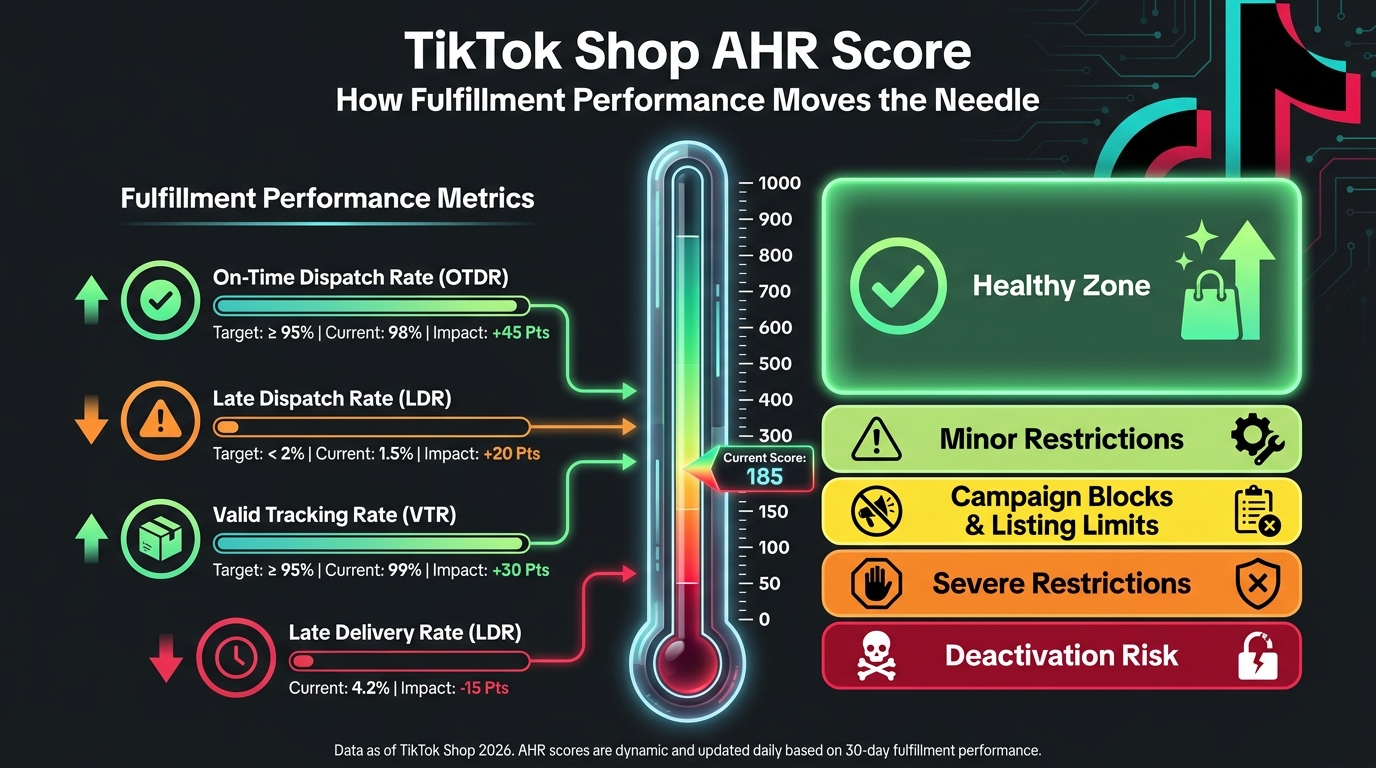
TikTok Shop’s Account Health Rating (AHR) is the enforcement architecture that sits above all individual metrics. Understanding how it works — and how fulfillment performance feeds into it — is essential for any seller managing at scale.
How the AHR System Is Structured
AHR is scored on a 0–1,000 point scale. Sellers start with a 200-point base. Points are added through completed orders (rewarding volume and consistency) and deducted through policy violations, fulfillment failures, and threshold breaches. The rolling window for AHR evaluation is the last 180 days of activity.
Enforcement escalates at four specific milestone thresholds:
- Below 150 points: Initial restrictions applied — may include limits on new product listings or reduced campaign eligibility.
- Below 100 points: Escalated restrictions — possible mega-campaign blocks, extended settlement periods, and order volume caps.
- Below 50 points: Severe restrictions — access to key platform features may be suspended, and the account enters a formal remediation track.
- 0 points: Potential permanent deactivation of the seller account.
How Fulfillment Violations Feed the AHR
The connection between your fulfillment metrics and your AHR score is direct and continuous. Each late dispatch event, each order missing valid tracking, each seller-fault cancellation generates AHR point deductions. These aren’t one-time penalties — they accumulate across the rolling 180-day window, which means a bad fulfillment month in April is still affecting your score in September.
Conversely, consistent order completion is the primary mechanism for building AHR points above the 200-point baseline. High-volume FBT sellers tend to have the most resilient AHR scores precisely because every completed FBT order adds points while contributing minimal violation risk (since TikTok controls dispatch and delivery).
Why This Changes the Strategy Calculus
Sellers who treat AHR as a background metric they check quarterly are playing a dangerous game. The 180-day rolling window means recovery from a serious compliance breach is slow — you can’t simply fix the problem in month four and expect your score to immediately improve. You need to be consistently above-threshold for months before the violation-era data ages off.
The strategic implication: fulfillment decisions are account-level risk decisions. The cheaper carrier that misses delivery windows 15% of the time isn’t just a customer experience problem — it’s a direct threat to your ability to run campaigns, list new products, and ultimately operate on the platform at all.
FBT in 2026: The Real Cost Math, Weight Tiers, and Fee Changes
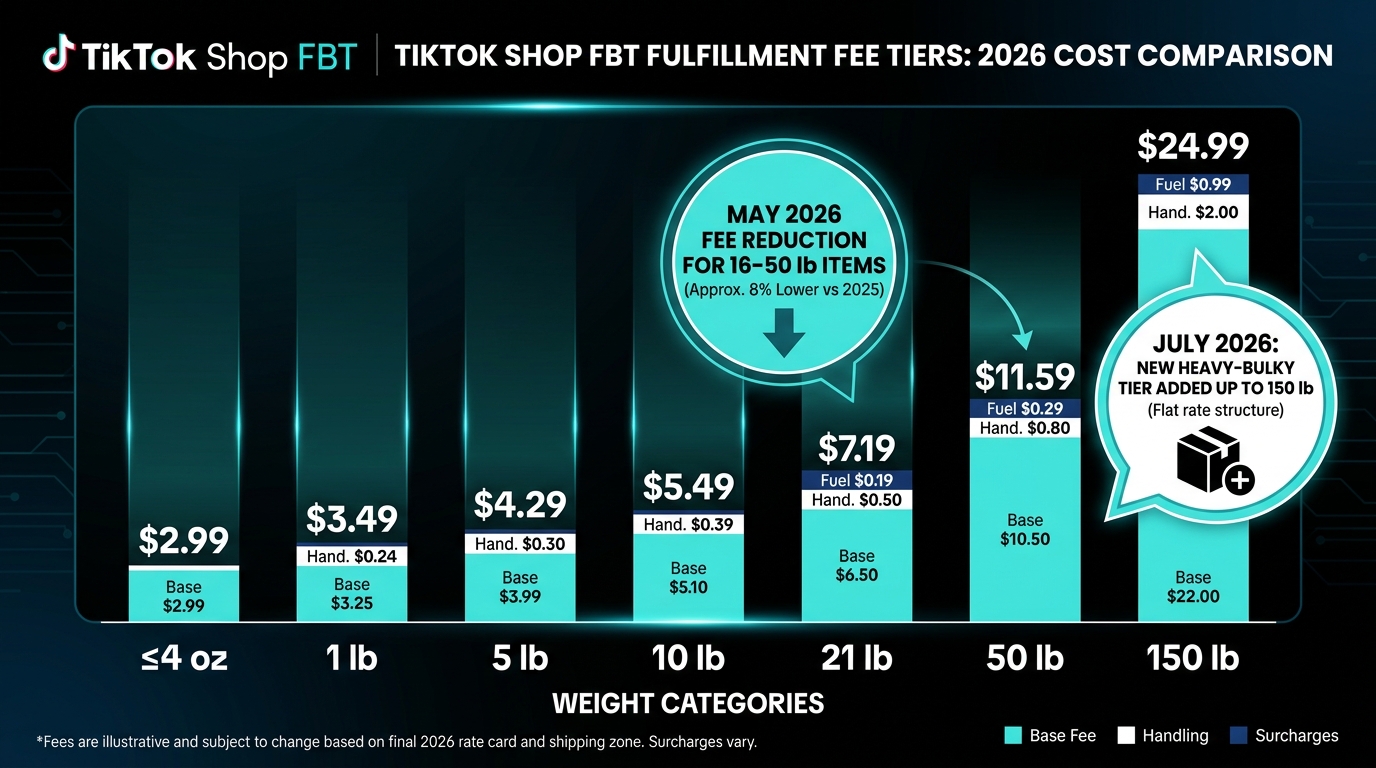
TikTok’s FBT fee structure has changed three times in 2026 — in January, May, June, and July — which is an unusually high rate of adjustment for a fulfillment program. Understanding the current structure and where the changes landed is essential before deciding whether FBT makes margin sense for your catalog.
The Core Fee Structure
FBT fees are tiered by unit weight and the number of units in an order. Single-unit fees start at approximately $4.28 for items weighing 4 oz or less and rise through weight tiers. The structure through the standard range looks roughly like this:
- ≤4 oz: ~$4.28 per unit
- ~1 lb: Fees scale through the $5–$7 range
- 5–10 lb: Fees in the $9–$14 range
- 10–21 lb: Fees escalate into the $14–$18 range
- 20–50 lb: $18.00 + $0.40 per lb above 21 lbs
- 50–150 lb (new heavy-bulky tier, effective July 13, 2026): $41.32 + $0.75 per lb above 50 lbs
The 2026 Fee Changes and What They Mean
Three specific adjustments stand out for sellers planning their FBT strategy:
May 20, 2026 — Reduction for single-unit 16–50 lb items. TikTok lowered per-unit fees in the 16–50 lb single-unit range. This was a positive development for sellers of heavier consumer goods — home goods, fitness equipment, and kitchen appliances — who had been priced out of FBT economics. The reduction effectively opened FBT to a wider product category that couldn’t justify it previously.
June 18, 2026 — Higher multi-unit fees for 5–20 lb orders. The June change moved in the opposite direction: fees for multi-unit orders in the 5–20 lb range increased. Sellers who frequently ship multiple units per order (bundle products, sets, or multi-pack SKUs) in this weight class need to recalculate their per-order fulfillment cost — the June revision will have narrowed or eliminated margins for some.
July 13, 2026 — New heavy-bulky tier up to 150 lb. Before this change, FBT effectively had an upper limit around 50 lbs. The new heavy-bulky tier extends FBT eligibility to products up to 150 lbs, opening TikTok’s logistics network to furniture, large appliances, and exercise equipment for the first time. This is a significant catalog expansion for certain seller categories.
The Margin Math
The raw FBT fee is only part of the cost equation. Sellers also pay inbound shipping to TikTok’s fulfillment centers, storage fees for inventory held beyond standard periods, and return handling costs. The platform’s claimed 20–35% shipping cost savings versus self-fulfilled baseline rates are most accurate for lighter, high-velocity items in TikTok-served metro areas — they become less reliable for heavier items, slow-moving SKUs that accrue storage costs, or sellers whose existing carrier contracts are already competitive.
The clearest candidate for FBT is a product that is light (under 2 lbs), fast-moving (turns in 30 days or less), and heavily TikTok-dependent (not being sold at high volume on other channels). The worst FBT candidates are bulky products with erratic demand, items requiring custom packaging, and multi-SKU kits where inventory positioning is complex.
The FBT Incentive Program: How to Qualify and What You Actually Earn
TikTok is actively running a financial incentive to accelerate FBT adoption through September 30, 2026. The program structure rewards volume growth rather than flat enrollment — understanding the mechanics is necessary to know whether it’s worth pursuing.
How the Program Works
The 2026 FBT Quarterly Incentive Program offers a 10% reimbursement on FBT fulfillment fees for eligible incremental delivered units. “Incremental” is the key word: the reimbursement only applies to units above your baseline, where your baseline is defined as your February 2026 delivered FBT unit count.
Each incentive month, TikTok calculates whether your delivered FBT volume exceeds your February 2026 baseline by at least 600 units. If it does, every unit above that threshold qualifies for the 10% fee reimbursement. The reimbursement is capped at $1 per unit and has a maximum of 600,000 units per month per Seller ID. Settlement typically occurs within approximately 60 days of the qualifying month.
Who Benefits Most
The incentive structure disproportionately benefits sellers who were already doing modest FBT volume in February 2026 and are now growing. If your February baseline was zero (you weren’t on FBT at all), your baseline is zero — meaning you start accumulating eligible incremental units from unit 601 in any given month. For a seller hitting 2,000 FBT units per month, at an average fee of, say, $5.50 per unit, the 10% reimbursement on the 1,400 incremental units above the 600-unit floor adds up to roughly $770 back per month — not trivial, but not transformative at that volume.
At 10,000 monthly FBT units with a zero February baseline, the math looks significantly better: 9,400 incremental units × $5.50 average fee × 10% = $5,170 per month, capped at the $1/unit limit — so actually $9,400 returned. At that scale, the incentive program functions as a meaningful margin subsidy during the April–September window.
The Opt-In Requirement
The program is not automatic. Sellers must actively opt in through Seller Center under the relevant Growth Opportunities or mission flow. Sellers who qualify but haven’t registered forfeit the reimbursement — there’s no retroactive enrollment. If you’re already FBT-enrolled and haven’t checked whether you’ve registered for the incentive program, that’s the first thing to do after reading this.
Upgraded TikTok Shipping and CBT: The Middle Options Most Sellers Ignore
Between full FBT and raw self-fulfillment sit two options that don’t get enough attention in seller discussions: Upgraded TikTok Shipping for domestic orders and Cross-Border TikTok logistics (CBT) for international flows. Both carry specific advantages that make them the right choice for particular seller profiles.
Upgraded TikTok Shipping
Upgraded TikTok Shipping is best described as a managed-label program. You retain physical control of your inventory and fulfillment operations, but you use TikTok-provided carrier integrations rather than your own carrier accounts. The labels flow through TikTok’s carrier network, which gives TikTok real-time tracking visibility and allows the platform to apply its mid-2026 OTDR protection policy.
That OTDR protection is the standout feature: for Upgraded TikTok Shipping orders, carrier-caused delivery delays no longer count against your On-Time Delivery Rate if you dispatched within your SLA window. This is a significant operational risk transfer. For sellers in markets where carrier reliability is variable — particularly in rural zones or during peak periods — Upgraded TikTok Shipping may offer better metric protection than self-fulfilled carrier contracts, even at similar per-label costs.
The limitation is that Upgraded TikTok Shipping doesn’t give you the listing-level “3-day delivery” badge that FBT does, nor the same degree of compliance metric immunity. It’s the right choice for sellers who want to maintain 3PL or warehouse control while reducing OTDR exposure.
Cross-Border TikTok (CBT)
CBT is TikTok’s managed logistics path for cross-border sellers entering or expanding within TikTok Shop markets. It’s not a broadly available self-service option — it’s tied to approved warehouse zones, volume thresholds, and designated carrier or handover workflows. Sellers interested in CBT need to apply through TikTok’s seller onboarding process for cross-border, and the operational requirements are stricter than domestic FBT.
Where CBT applies, it functions as the cross-border equivalent of FBT in terms of platform treatment: metric exemptions, TikTok-controlled tracking, and eligibility for faster delivery badging where available. For established cross-border sellers with sufficient volume, it’s the correct path. For smaller sellers dipping into international markets for the first time, the compliance requirements can make CBT onboarding disproportionately complex.
Building a Fulfillment Stack That Survives the Next Policy Flip
The February 2026 reversal was instructive not just for what it said about TikTok’s operational readiness, but for what it revealed about how sellers should think about platform logistics risk. Building a fulfillment setup that assumes TikTok’s rules will stay exactly as they are today is building on sand.
Principle 1: Separate Your Inventory Strategy from Your Compliance Strategy
These are two distinct problems. Inventory strategy is about where stock lives, how it flows, and how it’s positioned for multichannel demand. Compliance strategy is about hitting metrics regardless of where inventory lives. Conflating the two leads sellers to make poor inventory decisions (locking everything in FBT to “solve” compliance) when the real answer is building dispatch and tracking reliability at the operational level.
A seller who runs a well-integrated 3PL with automated tracking sync and sub-24-hour dispatch can have better compliance metrics than a sloppy FBT seller who frequently runs out of stock and generates seller-fault cancellations while waiting for replenishment to clear intake. The method matters less than the execution.
Principle 2: Build Metric Monitoring into Weekly Operations, Not Monthly Reviews
Given the 180-day rolling window of AHR and the speed at which LDR and SFCR can deteriorate during peak periods, weekly (or daily) monitoring of your Seller Center performance dashboard is the baseline. Specifically, you should track:
- Your current LDR against the 4% and 10% thresholds
- Any orders in “Awaiting Shipment” status approaching the 2-business-day window
- VTR status for any orders using non-standard carriers
- Your current AHR score and velocity (whether it’s rising or falling)
Principle 3: Use FBT Selectively, Not as a Blanket Solution
FBT’s metric exemptions and delivery badge make it attractive, but not every SKU belongs in TikTok’s warehouse. The most effective approach is a hybrid model: enroll your highest-velocity, lightest, most TikTok-native SKUs in FBT (where you capture the badge and metric immunity), and fulfill everything else via Upgraded TikTok Shipping or a compliant 3PL.
This approach also hedges against TikTok’s fee structure changes. When TikTok adjusts FBT fees — as it did three times in 2026 — sellers with 100% FBT inventory have no alternative routing. Sellers with a hybrid stack can selectively shift SKUs based on new margin math.
Principle 4: Treat Any TikTok Policy Communication as Operationally Significant Until Proven Otherwise
The February 2026 reversal tempted many sellers to stop taking TikTok’s policy communications seriously. That’s a mistake. The reversal happened; the underlying direction hasn’t changed. The platform’s incentive programs (the FBT rebate), its metric structures (AHR, LDR, OTDR protection tiers), and its fee revisions all signal continued movement toward TikTok-controlled logistics.
The next mandate announcement — when it comes — will likely give less lead time and arrive with more operational support infrastructure in place. Sellers who have gradually adapted their stacks will have options; sellers who spent the reversal period doing nothing will be scrambling.
What the Seller-Shipping Reversal Reveals About TikTok’s Logistics Ambitions
The February 2026 reversal was not a sign of weakness in TikTok’s logistics strategy. It was a sign of operational honesty — the platform acknowledged it wasn’t ready to absorb all U.S. seller volume into its logistics network at the pace it had announced. That’s a meaningful distinction.
The Longer Arc
TikTok’s approach to commerce logistics globally follows a recognizable pattern. In markets like China (where Douyin Shop operates), platform-controlled fulfillment is heavily integrated into discovery, ranking, and seller scoring. Faster delivery, better tracking, and more reliable returns all correlate with better platform placement. TikTok has no strategic reason to operate differently in the U.S. once its logistics infrastructure can support it.
The February reversal bought sellers time. It did not change the destination. The internal TikTok metric that matters here is coverage — what percentage of U.S. TikTok Shop volume runs through TikTok-managed logistics. That number is rising, quarter by quarter, through FBT incentives, Upgraded Shipping adoption, and the gradual friction-reduction of onboarding sellers into the TikTok network.
The 3PL Opportunity
One underappreciated consequence of the 2026 fulfillment environment is the growing importance of 3PLs that have built TikTok-specific integrations. A 3PL that can offer automatic TikTok Seller Center tracking sync, guaranteed 24-hour dispatch SLAs, and compliance reporting is worth more to a TikTok Shop seller in 2026 than a 3PL competing on cost alone. The market for TikTok-compliant fulfillment services is still early-stage — which means sellers who evaluate and contract with the right 3PL partners now have a structural advantage before the market consolidates.
What This Means for Multichannel Sellers
For brands selling on Amazon, Walmart, and TikTok simultaneously, the pressure toward TikTok-controlled fulfillment creates genuine tension. Amazon’s FBA and TikTok’s FBT both want your inventory inside their networks — and those networks aren’t interoperable. Multichannel sellers need to make deliberate choices about which SKUs go into which network, rather than defaulting to “put everything in the cheapest fulfillment option.”
The emerging best practice for multichannel brands is to maintain a 3PL as the primary inventory hub and selectively stage fast-moving, platform-specific SKUs into FBA or FBT as demand signals warrant. This keeps the bulk of inventory flexible while capturing the platform-specific benefits of each network where the unit economics justify it.
Operational Checklist: Your 30-Day Fulfillment Compliance Sprint
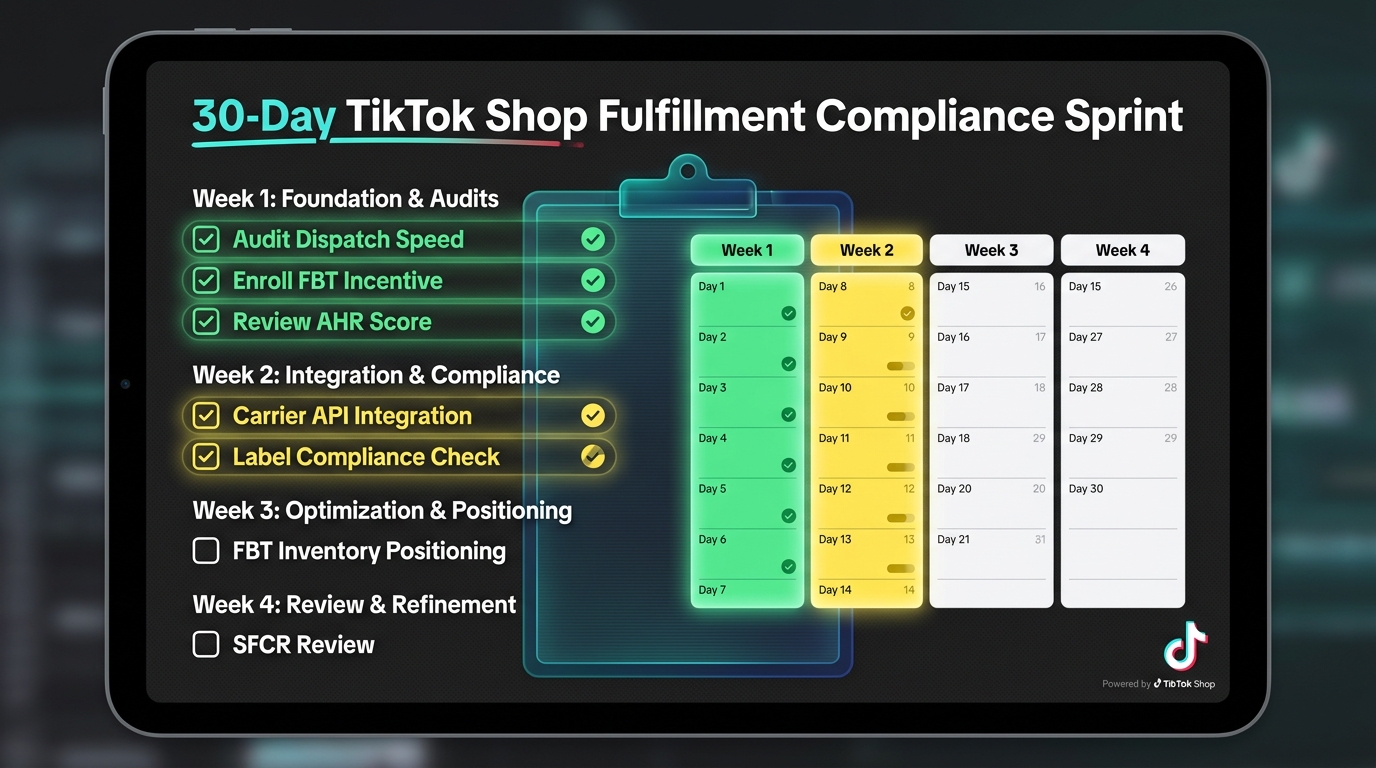
Knowing the rules is different from acting on them. If you’ve read this far and are now thinking about what to actually change, this section is a practical starting point. The tasks below are ordered by urgency — start at week one and work forward.
Week 1: Diagnose
- Pull your current AHR score from Seller Center. Note the number and whether it’s trending up or down over the past 30 days.
- Check your LDR for the past 30 days. Is it below 4%? Between 4–10%? Above 10%? The answer determines your urgency level.
- Review your VTR. Identify any orders that were fulfilled without valid carrier-linked tracking. Map the workflow gap that caused them.
- Audit your SFCR. Identify the top three reasons for seller-fault cancellations in the past 90 days. These are always fixable upstream.
- Check the FBT incentive program registration in Seller Center. If you’re FBT-enrolled and haven’t opted in, do it now before the September 30 cutoff.
Week 2: Fix Infrastructure
- Implement or audit your tracking sync. Every order fulfillment event should automatically push a valid tracking number to TikTok Seller Center. If this is happening manually or inconsistently, fix the integration before anything else.
- Establish a dispatch SLA internally. The platform requires 2 business days. Your internal SLA should be 1 business day or less to create a buffer. Document it, communicate it to your fulfillment team or 3PL, and measure it.
- Review your carrier mix for OTDR risk. If you’re self-fulfilling, look at which carriers have the worst delivery performance rates in your primary shipping zones. Consider switching volume to Upgraded TikTok Shipping for your highest-risk lanes.
Weeks 3–4: Optimize
- Run FBT unit economics on your top 20% by volume SKUs. Use the current weight-tiered fee structure to calculate whether FBT is margin-positive versus your current fulfillment method. For SKUs that qualify, begin FBT enrollment and inbound shipping planning.
- Set up a weekly AHR and metric review. This doesn’t need to be a long meeting — 15 minutes reviewing the Seller Center dashboard, flagging any metric moving in the wrong direction, and assigning a corrective action is sufficient.
- Map a contingency plan for the next policy change. What would you do if TikTok reinstated the Seller Shipping phaseout with 30 days’ notice? Having a documented answer to that question before the announcement is infinitely better than improvising under pressure.
Conclusion: The Fulfillment Rules Aren’t the Destination — They’re the Floor
TikTok Shop’s 2026 fulfillment environment is more complex than it looks from the outside. The announced mandate. The reversal. The incentive programs. The fee revisions. The metric thresholds. The AHR enforcement architecture. Each of these is a piece of a larger picture: a platform actively reshaping how it controls its supply chain, using both carrots (FBT rebates, metric exemptions, delivery badges) and sticks (AHR penalties, campaign blocks, settlement extensions) to move sellers in the direction it wants them to go.
The sellers who come out ahead in this environment aren’t the ones who waited for the rules to finalize before acting. They’re the ones who understood the direction of travel early, built flexible fulfillment stacks that could adapt to policy changes without crisis, and maintained the operational discipline to stay above compliance thresholds even during the periods of maximum uncertainty.
Compliance is the floor. The ceiling is a fulfillment operation that uses the platform’s own incentive programs to reduce cost, uses metric structure to gain competitive ranking advantages, and uses policy intelligence to make faster decisions when the next announcement drops. That’s not a passive posture — it’s an active one, and it starts with the diagnostic work described above.
TikTok Shop’s logistics rules will change again. The only question is whether your operation will be ready when they do.