





For most of the past three years, the dominant conversation in enterprise AI has been about capability. Can the model reason across long contexts? Can the agent handle multi-step workflows? Can it access the right tools and make decisions in real time?
Those questions haven’t gone away. But in 2026, a different problem has quietly become the harder one: not whether your AI agents can act, but whether your organization can actually control what they do.
The gap between agent deployment speed and governance maturity is now measurable — and alarming. A recent Deloitte survey found that only 21% of enterprise leaders say their organization has a mature governance model for agentic AI. That means roughly 80% of enterprises deploying autonomous agents are doing so without the identity controls, decision boundaries, monitoring infrastructure, or audit trails needed to run them safely at scale.
Meanwhile, agents aren’t waiting. Pilot-to-production conversion rates for agentic AI workflows jumped from 18% to 31% in a single quarter earlier this year. The agents are shipping. The governance isn’t.
This article isn’t another overview of why AI governance matters in theory. It’s a detailed look at where the specific, practical bottlenecks actually live in 2026 — from identity management and shadow agent proliferation, to human approval queues becoming throughput ceilings, to what regulatory timelines genuinely require from your teams right now. And more importantly, what the organizations that are getting this right are actually doing differently.
The Adoption-Governance Gap Is Wider Than Most Teams Realize
The headline statistic is stark enough on its own: 79% of enterprises have adopted AI agents in some form, but only 51% run them in production, leaving a 28-point gap between deployment intent and operational reality. Governance and security concerns account for 38% of that gap, second only to infrastructure readiness at 41%.
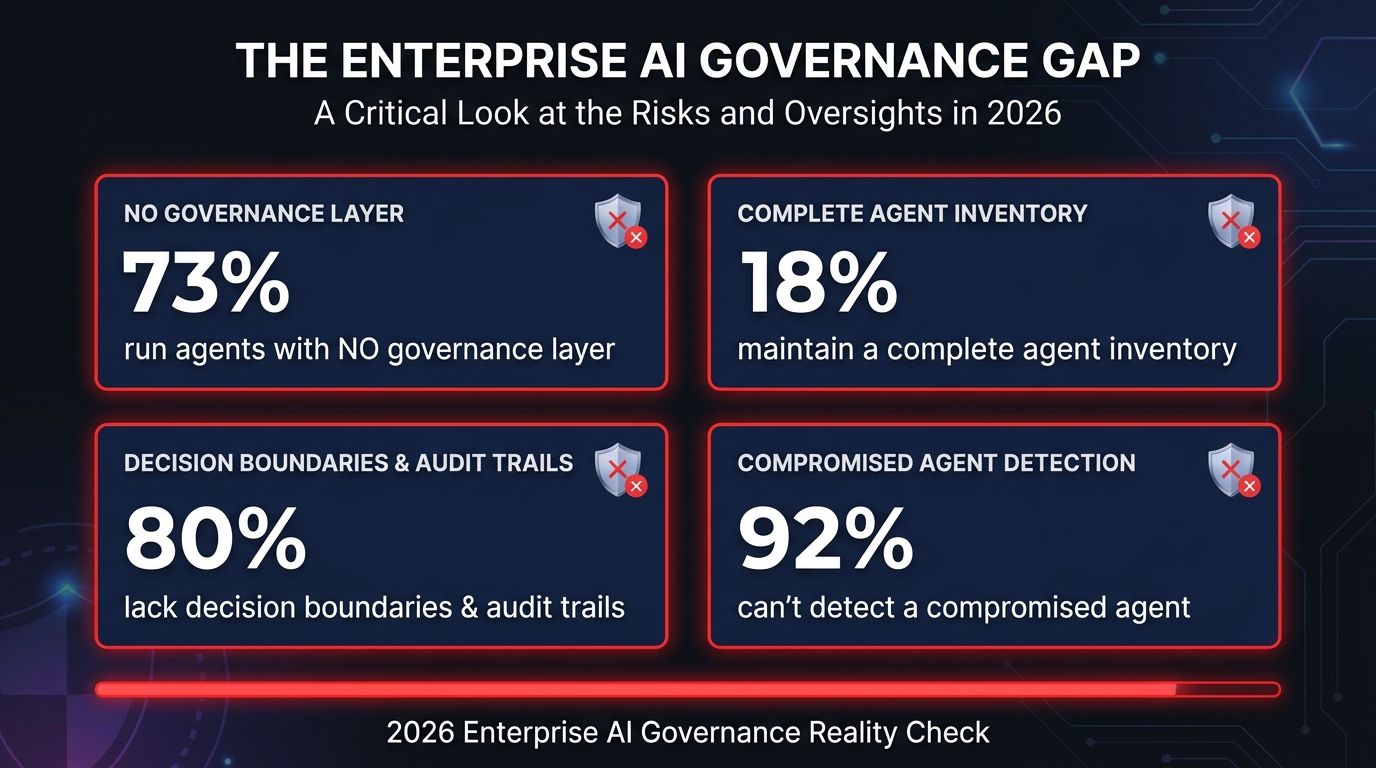
But the more revealing number is this: 73% of enterprises currently running AI agents in production have no formal governance layer in place. Not a lightweight one, not an incomplete one — none at all. These are autonomous systems making decisions, calling external APIs, accessing internal databases, and taking actions that may be difficult or impossible to reverse, operating entirely outside a structured oversight framework.
What the Gap Looks Like in Practice
The gap isn’t abstract. It shows up in specific, concrete ways that governance teams are encountering daily:
- No agent inventory: Only 18% of enterprises maintain a complete inventory of the AI agents operating in their environment. The majority of organizations cannot answer the basic question: “What agents do we have, and what can they do?”
- No centralized management: Just 12% of enterprises use a centralized management platform for their agents. Most agents are deployed BU by BU, team by team, with no unified oversight layer.
- No visibility into agent identities: 92% of CISOs and CIOs surveyed in 2026 reported lacking full visibility into AI agent identities within their organizations.
- No confidence in containment: 95% of security leaders say they doubt they could detect or contain a compromised agent operating within their network.
These aren’t edge cases or small-company problems. This data comes from surveys of large enterprises — organizations that have dedicated security, compliance, and IT functions, and that have been deploying software systems for decades.
Why Governance Fell Behind Deployment
The reason the gap exists isn’t negligence. It’s structural. The tools to deploy AI agents became available — and became genuinely useful — faster than the frameworks, standards, and tooling to govern them. When a developer can spin up an autonomous workflow in an afternoon using a platform like LangGraph, CrewAI, or Microsoft Autogen, the organizational reflex is to ship first and govern later.
That reflex made sense when AI agents were novelties running in sandboxed experiments. It doesn’t make sense when those agents have production access to CRM systems, financial databases, customer-facing communications channels, and operational infrastructure. The deployment clock and the governance clock are running at radically different speeds — and the gap between them is where organizational risk accumulates.
What “Agent Governance” Actually Means at Runtime — Not Just on Paper
Part of why governance has lagged is a definitional problem. When most organizations talk about “AI governance,” they mean policy documents, ethics guidelines, responsible AI principles, and approval processes for model selection. That layer is important, but it’s insufficient for agentic systems.
Policy-layer governance tells you what agents should do. Runtime governance enforces what they actually do, in the moment they’re doing it. These are fundamentally different disciplines — and most organizations have invested in the former while neglecting the latter.
The Four Dimensions of Runtime Governance
Singapore’s IMDA published the most operationally useful framework for agentic AI governance in January 2026, and updated it to version 1.5 in May 2026. It identifies four pillars that every agent deployment needs:
- Assess and bound risks upfront: Before an agent is deployed, its risk profile needs to be defined based on autonomy level, data sensitivity, access to external systems, and the reversibility of its actions. An agent that can draft emails is categorically different from one that can send them, execute payments, or modify production databases.
- Meaningful human accountability: Every agent must have a named human owner — not a team, not a department, a person — who is accountable for the agent’s behavior, authorized to modify it, and responsible for retiring it. Diffuse accountability is no accountability.
- Technical controls and processes: This is the runtime layer: unique agent identity, scoped permissions enforced at the system level, real-time monitoring of tool invocations, and an immutable audit trail that can reconstruct any sequence of agent decisions after the fact.
- End-user responsibility: When agents interact with external users — customers, partners, regulators — those users need to know they’re interacting with an automated system and understand what the agent is authorized to do. Transparency isn’t just an ethical requirement; it’s increasingly a legal one.
Why Existing Frameworks Don’t Cover Agents
The Cloud Security Alliance, NIST, and multiple independent security researchers have all noted the same problem: existing AI governance frameworks were designed for AI systems that produce outputs and leave the action to a human. They don’t translate cleanly to agents that act autonomously, chain tool calls together, spawn sub-agents, and operate across distributed environments.
NIST launched the AI Agent Standards Initiative in February 2026 specifically because of this gap — the NIST AI RMF 1.0 framework, while excellent for model risk, doesn’t adequately address the identity, authorization, delegation, and real-time enforcement challenges that agentic systems create. The standards are still being developed, which means organizations can’t simply wait for a finalized rulebook. They need to build runtime governance infrastructure now, using the best available guidance.
The Identity Problem — AI Agents Without a Face in IAM
Ask most enterprise security teams to show you their AI agent inventory, and you’ll get one of two responses: a blank look, or a spreadsheet that’s already three months out of date. The reason isn’t a lack of interest — it’s a fundamental gap in how identity and access management (IAM) was designed.
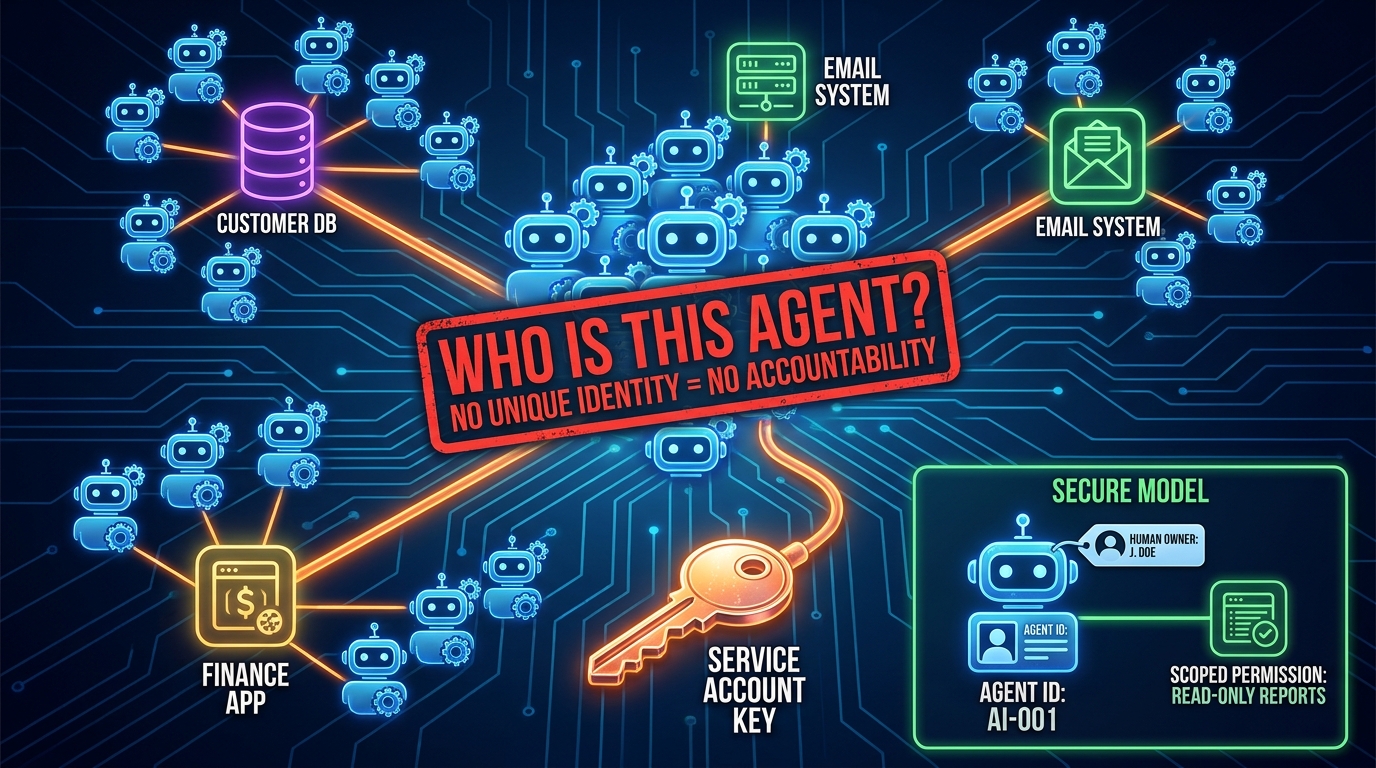
Traditional IAM systems were built for human users and, to a lesser extent, software services. AI agents occupy an awkward middle ground. They act like services — they call APIs, execute code, query databases — but they make judgment calls that no human authorized in advance. When they’re given access to systems, they’re typically issued the same credentials as the human or service account that deployed them, inheriting permissions that may be far broader than the agent’s actual task requires.
The Credential Inheritance Problem
Only 18% of security leaders say they are highly confident their IAM systems can manage AI agent identities. Only 21% maintain a real-time registry of the agents operating in their environment. The most common alternative is a shared service account — a single set of credentials that multiple agents (or a mix of agents and automated scripts) use to access systems.
This creates several compounding problems:
- No attribution: When a shared service account takes an action, you cannot determine which agent — or which human-initiated request — caused it.
- Over-privilege: Service accounts tend to accumulate permissions over time. An agent using that account inherits all of them, not just the ones its specific task requires.
- No lifecycle management: When an agent is retired or modified, its credentials often persist in systems it no longer needs to access.
- Delegation opacity: When an agent delegates tasks to sub-agents, the credential chain becomes untraceable. Security teams cannot determine which agent acted on behalf of which human authority.
What Proper Agent Identity Looks Like
The emerging consensus — from the IMDA framework, NIST guidance, and enterprise security practitioners — is that every AI agent must be treated as a distinct non-human identity with its own unique identifier, explicit purpose definition, a named human owner, scoped permissions limited to what the task specifically requires, short-lived credentials rather than persistent keys, and a documented lifecycle covering creation, modification, and retirement.
This isn’t just a security best practice — it’s becoming a compliance baseline. Organizations that cannot produce an auditable record of which agent took which action, on whose authority, with what permissions, will struggle to satisfy regulators under frameworks like the EU AI Act, and will face genuine liability exposure when agents cause harm.
The shift from static role-based access control to context-aware, just-in-time authorization for agents is already underway at mature organizations. It requires investment in agent-aware IAM tooling, but it’s also the foundation on which everything else in governance sits. Without identity, there is no auditability. Without auditability, there is no accountability.
Shadow Agents: The Governance Crisis Already Inside Your Organization
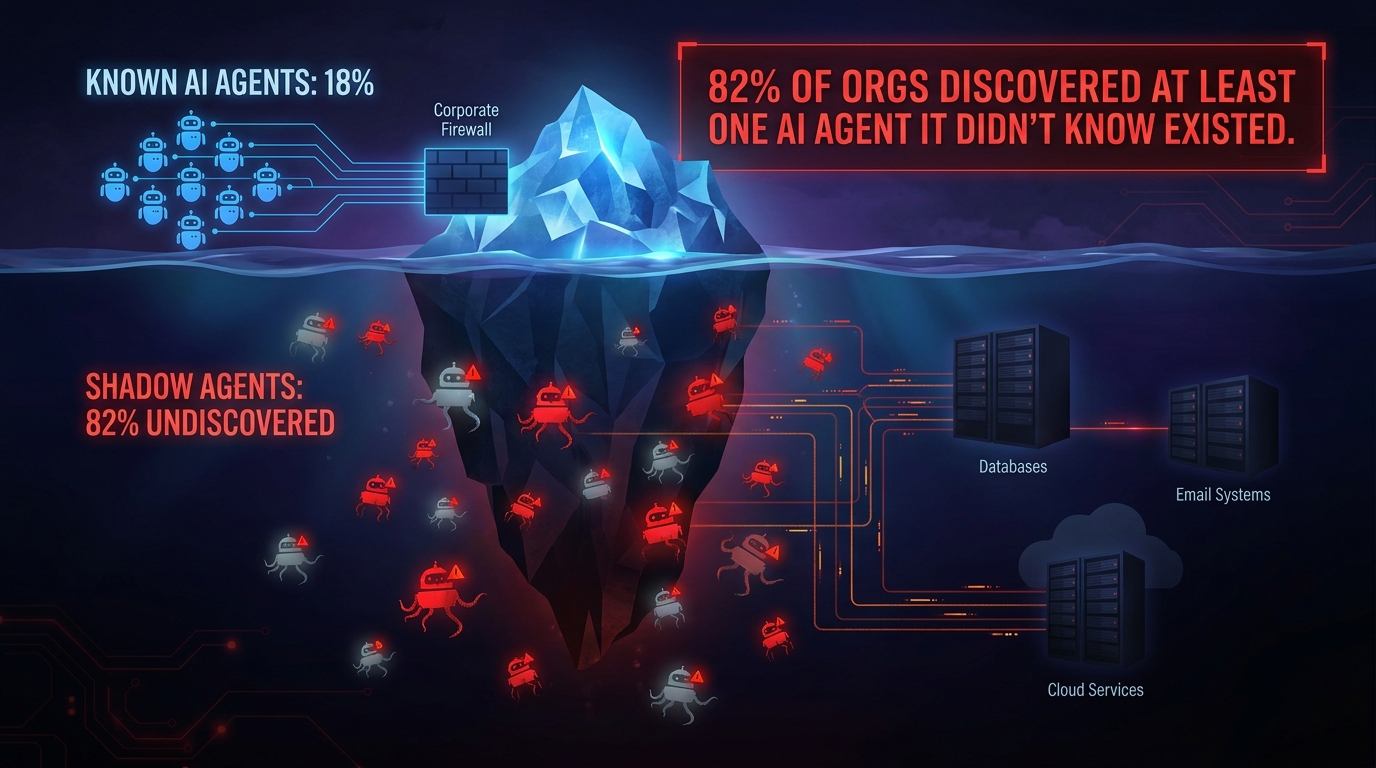
There’s a governance problem your security team almost certainly already has — they just may not know its full scope yet. 82% of organizations discovered at least one AI agent or automated workflow operating in their environment that their IT or security function had no prior knowledge of. That’s not a minority finding. That’s the base case.
Shadow agents emerge the same way shadow IT always has: developers and business teams with access to capable tools and fast deployment paths will use them to solve problems, and they’ll do it without waiting for central approval processes that feel slow relative to the pace of their work. The difference with AI agents is the potential blast radius. A rogue spreadsheet macro is a nuisance. A rogue AI agent with access to customer data, communication systems, and financial workflows is a material risk.
What the Incident Data Shows
65% of organizations that have deployed AI agents report at least one AI agent security incident in the past year, with data exposure and operational disruption as the most common outcomes. The Cloud Security Alliance documented ten separate agentic AI incidents between late January and mid-March 2026 alone — a roughly 49-day window that included supply-chain compromises, credential theft through agent tool access, unauthorized resource use, and opaque agent-to-agent communications that bypassed human oversight entirely.
In nearly every case, the contributing factor was agents operating at autonomy levels 3 through 5 without the governance controls that those autonomy levels require. Most organizations hadn’t classified their agents’ autonomy levels at all. They’d simply deployed them.
The Air Canada Precedent and What It Signals
The liability picture for shadow agents is sharpening. The Air Canada chatbot case — in which a tribunal held the airline liable for incorrect bereavement-fare advice given by its autonomous support agent, even though Air Canada argued the chatbot was a “separate legal entity” responsible for its own statements — established a critical precedent: organizations are accountable for what their agents do, regardless of whether those agents were operating with proper governance oversight at the time.
Applied to shadow agents, this creates a significant exposure: if a developer deploys an autonomous agent without IT’s knowledge, and that agent takes an action that harms a customer or exposes regulated data, the organization is still the responsible party. “We didn’t know it was running” is not a defensible governance posture under any regulatory framework currently in force.
How to Surface Shadow Agents
Eliminating shadow agents requires a combination of technical discovery and cultural change. On the technical side, organizations need network traffic analysis that can identify AI API calls (to OpenAI, Anthropic, Google, and similar), access log auditing across systems that agents commonly integrate with, and scheduled credential sweeps to find service accounts or API keys associated with undocumented automation.
On the cultural side, the goal is to make it easier to register an agent than to hide one. Approval processes that take weeks are an invitation to circumvention. Approval processes that take hours — with lightweight self-service registration for low-risk agents — bring shadow agents into visibility without requiring teams to slow down.
Human Approval Loops Are Becoming the Throughput Bottleneck
There’s an irony embedded in how many organizations have responded to AI agent risk: they’ve added human approval requirements to agent workflows as a governance measure, and in doing so, they’ve created a new bottleneck that can negate much of the efficiency benefit the agent was deployed to deliver.
AI agents operate at machine speed. A sophisticated multi-agent workflow can generate dozens of action proposals, decision branches, and task completions per hour. If each of those requires a human reviewer to assess and approve before the agent proceeds, the human’s review capacity becomes the throughput ceiling — not the agent’s capability.
The Queue Problem
Enterprise teams deploying agents with mandatory human approval at every step frequently describe the same experience: initial productivity gains are quickly eroded as approval queues grow faster than reviewers can clear them. The agent sits idle waiting for sign-off. Reviewers, overwhelmed by volume, begin rubber-stamping approvals without genuine review — introducing the worst of both worlds: the governance overhead without the actual oversight.
One enterprise panel discussion from Q2 2026 described AI agents generating so many task proposals that they were “overwhelming” human decision-makers, effectively turning the approval workflow into a bottleneck that negated the agent’s value. The solution they implemented wasn’t to remove oversight — it was to redesign which decisions required human approval and which didn’t.
Risk-Based Approval Routing: The Fix That’s Actually Working
The organizations navigating this most effectively have moved from blanket human approval requirements to risk-stratified approval routing. The framework is straightforward in principle:
- Routine, reversible, low-stakes actions within pre-approved policy boundaries proceed without human approval — the agent executes and logs the action for post-hoc audit.
- Non-routine or policy-adjacent actions trigger an automated flag with a short review window — the agent pauses, a notification is sent to the designated owner, and if no response is received within the defined window, the action is either auto-approved or escalated.
- High-stakes, irreversible, or policy-exceeding actions require explicit human authorization before the agent can proceed, with no auto-approval fallback.
The key is defining the boundaries precisely in advance and encoding them into the agent’s policy constraints, not into an external approval queue that every action routes through. This requires upfront work to map action types, assess reversibility, and define what “within policy” means for each agent’s specific function — but it pays off in throughput that actually reflects the agent’s capability rather than a reviewer’s bandwidth.
63% of organizations currently cannot enforce purpose limitations on AI agents at the system level — they rely on policy documents and hoped-for compliance instead. Risk-based routing only works when the boundaries are technically enforced, not just documented.
What the Regulatory Clock Actually Looks Like in 2026
Regulatory timelines for AI governance in 2026 are less linear than many compliance teams expected. The EU AI Act — the most consequential piece of AI regulation in force globally — treats AI agents not as a distinct legal category but as AI systems or GPAI models subject to the Act’s existing framework based on use case and risk classification.
The practical timeline for 2026 is more complex than a single enforcement date:
What’s Active Now: Transparency Obligations
From August 2, 2026, the EU AI Act’s transparency obligations apply to any AI agent that interacts with natural persons or generates content visible to end users. This means organizations must ensure that users know they are interacting with an automated system, that the agent’s purpose and limitations are disclosed, and that clear human escalation paths are available.
For enterprises deploying customer-facing agents — support bots, sales assistants, document-processing agents with user-facing outputs — this requirement is not future-proofing. It is current compliance work.
High-Risk Obligations: The Shifting Timeline
The full Chapter III high-risk AI system obligations — covering risk management, data governance, logging, human oversight, technical documentation, and post-market monitoring — are now subject to a more complex timeline following the EU’s Digital Omnibus adjustments. Some Annex III high-risk obligations have been deferred to December 2027, with Annex I categories extending to August 2028.
This deferral has led some organizations to deprioritize governance build-out. That’s the wrong read. The deferral changes when enforcement begins, not when compliance infrastructure needs to exist. Enterprises deploying agents in healthcare, financial services, HR decision-making, education, and law enforcement contexts — all Annex III high-risk domains — need their governance infrastructure built, tested, and documented before enforcement dates, not as a response to them.
NIST and U.S. Federal Frameworks
In the United States, the NIST AI Agent Standards Initiative — launched in February 2026 — represents the first dedicated federal-level standards effort focused on autonomous agent governance. The initiative is building on the NIST AI RMF 1.0 with agent-specific additions covering identity, authorization, runtime monitoring, and incident response. Final standards are not yet published, but the initiative has issued guidance that organizations can use as a baseline now.
Singapore’s IMDA framework (version 1.5, May 2026) remains the most operationally complete governance guidance available globally, with over ten real-world case studies covering multi-agent systems, third-party agent orchestration, and automation bias risks. Even for organizations outside Singapore’s jurisdiction, it’s the most useful practical reference currently available.
Building an Agent Registry — The Minimum Viable Control Plane
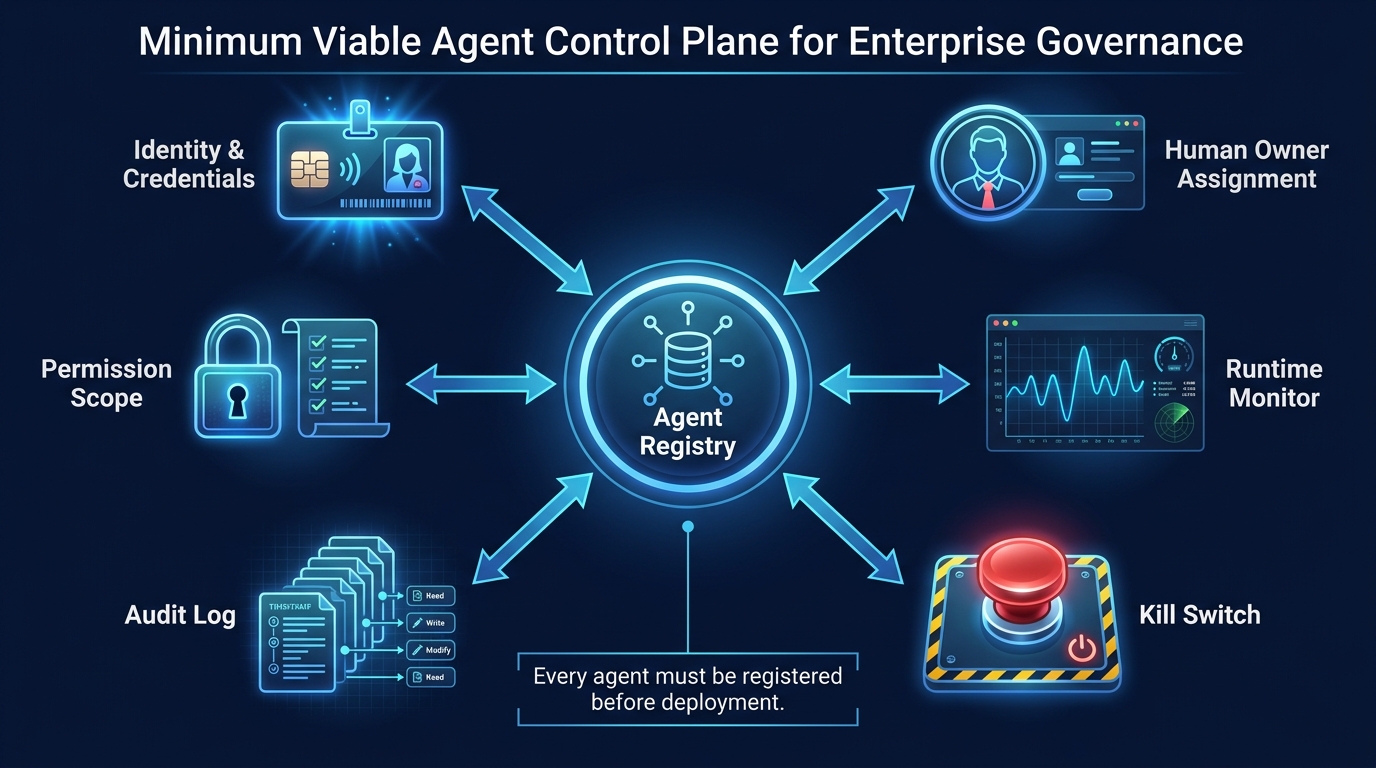
If governance frameworks, regulatory timelines, and security guidance all converge on one structural requirement, it’s this: you cannot govern what you cannot see. The minimum viable starting point for agent governance is a complete, maintained, authoritative inventory of every AI agent operating in your environment.
This isn’t a spreadsheet. It’s a structured system of record — an agent registry — that serves as the control plane for your entire agent ecosystem.
What an Agent Registry Must Contain
A functional agent registry needs to capture and maintain several categories of information for each agent:
- Identity: A unique, system-assigned identifier for the agent — not the model version, not the deployment name, but a persistent ID that tracks the agent across its lifecycle.
- Purpose: A clear, one-sentence description of what the agent is authorized to do and what it is explicitly not authorized to do.
- Human owner: A named individual — not a team — who is accountable for the agent’s behavior, can authorize changes to its permissions, and is responsible for its retirement.
- Data access: A documented list of every data source, database, API, and system the agent can access, with the permission level for each.
- Tool inventory: Every tool, function call, and external integration the agent can invoke.
- Autonomy level: A classification of the agent’s operational autonomy (see the following section on autonomy frameworks).
- Lifecycle status: Whether the agent is in testing, production, suspended, or decommissioned — and when each status change occurred.
- Incident history: Any flagged actions, policy violations, errors, or escalations associated with the agent.
Making Registration the On-Ramp, Not the Roadblock
The failure mode for agent registries is the same as any compliance requirement: if registration is burdensome, teams will route around it. The most effective implementations treat the registry as an enabling infrastructure, not a gatekeeping one.
This means providing self-service registration for low-risk agents, with automated validation of the required fields and a lightweight policy acknowledgment from the human owner. Higher-risk agents trigger a more detailed review, but the process is time-bounded: a defined SLA for governance review means teams know how long it will take, and can plan around it rather than working around it.
AWS, Microsoft Azure, and SAP have all released or updated agent management platforms in 2026 that provide registry infrastructure out of the box. For organizations building on these stacks, integrating with vendor-provided control planes is faster than building from scratch — though the governance policies that determine what the registry tracks and how access decisions are made still require organizational definition.
Six Levels of Autonomy and the Governance Controls Each One Requires
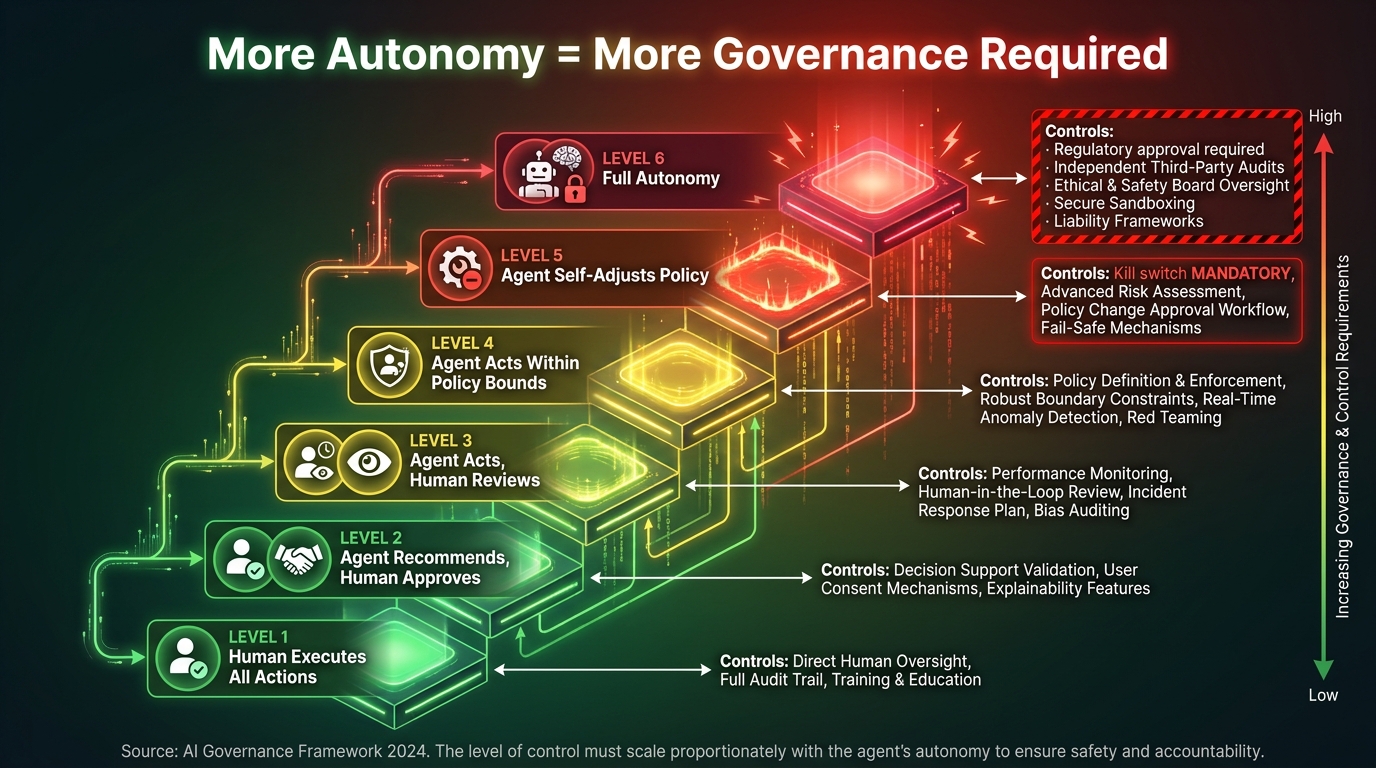
One of the most practically useful frameworks to emerge from agentic AI governance work in 2026 is the autonomy classification model — a six-level scale that maps agent behavior to corresponding governance requirements. The framework is becoming a de facto standard for determining what oversight an agent needs before it can be deployed to production.
Levels 1–2: Human-Directed Operation
Level 1 systems generate outputs but rely entirely on a human to execute any action — think a report generator, a recommendation engine, or a summarization tool. Level 2 agents make recommendations and propose specific actions, but require explicit human approval before any action is taken. These levels require the fewest governance controls: standard data access policies, logging of outputs, and a documented approval process are sufficient.
Levels 3–4: Supervised Autonomy
Level 3 agents take actions and present them to a human for review — the human can intervene, reverse, or approve after the fact. Level 4 agents operate within pre-defined policy boundaries without real-time human review, but flag actions that approach or exceed those boundaries for human attention. These levels require significantly more governance infrastructure: runtime policy enforcement, real-time monitoring, a clear boundary definition, and a tested rollback capability for reversible actions.
Most enterprises currently deploying “production” AI agents are operating at Levels 3 and 4 without the governance infrastructure those levels require. This is where the highest concentration of governance debt exists.
Levels 5–6: High Autonomy
Level 5 agents can adapt their own operating parameters and policy boundaries within meta-constraints set by a human principal. Level 6 represents full autonomy — the agent can modify its own objectives, initiate new tasks, and operate without human checkpoints.
For Levels 5 and 6, the IMDA framework and NIST guidance converge on the same requirement: these autonomy levels should not be deployed in production environments without a tested kill switch, a real-time monitoring capability with automatic escalation triggers, regulatory review in high-risk domains, and organizational sign-off at the board or executive level. In regulated industries, Level 6 autonomy is not currently deployable under any framework in force — it would require explicit regulatory approval that no jurisdiction has yet established a pathway for.
The practical governance takeaway is straightforward: before deploying any agent, classify its autonomy level honestly. Then map the required controls to that level. If the controls aren’t in place, the agent isn’t ready for production — regardless of how capable the model is.
What Runtime Governance Actually Looks Like in Practice
The phrase “runtime governance” is widely used and unevenly understood. To be specific: runtime governance is the set of technical controls that enforce policy on agent behavior as it happens, in real time, rather than relying on pre-deployment review alone or post-incident audit.
Only 38% of organizations currently monitor AI traffic end-to-end across prompts, tool calls, and outputs. Only 17% continuously monitor agent-to-agent interactions. These numbers mean that even organizations with formal governance policies in place are largely relying on those policies being followed voluntarily at the model level — with no enforcement layer to catch deviations.
The Four Components of Runtime Governance
1. Tool call monitoring: Every external action an agent takes — every API call, database query, file operation, or message sent — should be logged with the agent’s identity, the timestamp, the specific action parameters, and the outcome. This is the audit trail that allows incident reconstruction and compliance demonstration. OpenTelemetry’s stable support for AI agent observability, including trace-level visibility into reasoning steps, memory access, and tool invocations, makes this technically feasible for teams already using OpenTelemetry infrastructure.
2. Policy guardrails with real-time enforcement: Policy rules need to be encoded at the system level — not just documented in a governance policy — so that agents cannot take actions outside their approved boundaries regardless of what their model reasoning produces. Guardrails AI, LlamaGuard, and similar safety layers allow organizations to define action constraints that are enforced at the execution layer, not just at the prompt level.
3. Anomaly detection and escalation: Runtime monitoring should include automated detection of actions that deviate from an agent’s established behavioral baseline — unusual access patterns, unexpected tool invocations, action frequencies outside normal parameters, or attempts to access systems outside the agent’s approved scope. These signals should trigger automatic escalation to the agent’s human owner and, depending on severity, automatic suspension of the agent pending review.
4. Kill switch capability: Every production agent must have a tested, documented, and accessible kill switch — a mechanism that immediately suspends the agent’s ability to take new actions, preserves its current state for investigation, and notifies relevant stakeholders. “Tested” is the critical qualifier: a kill switch that exists on paper but has never been exercised in a drill is not a functioning control. Organizations treating kill switches as box-checking exercises rather than operational readiness requirements are not prepared for the incidents that will eventually occur.
The Observability Gap
Perhaps the most underappreciated aspect of runtime governance is that observability needs to cover not just individual agents but agent-to-agent interactions in multi-agent systems. When an orchestrator agent delegates subtasks to specialized sub-agents, and those sub-agents make tool calls on behalf of the original task, the governance chain has to extend across the entire hierarchy.
Only 17% of enterprises monitor agent-to-agent communications. This means that in a multi-agent system, the orchestrator’s actions may be logged while its delegates operate entirely invisibly — creating exploitable blind spots and making incident reconstruction impossible when something goes wrong at the sub-agent level.
The Accountability Gap — Who’s Liable When an Agent Causes Harm
Legal accountability for AI agent actions is the governance question that boards are increasingly asking — and that the legal profession is still working to answer definitively. What’s clear in 2026 is that the “the machine did it” defense does not hold up under any existing legal framework, and organizations are learning this through enforcement actions, litigation, and regulatory guidance rather than proactive preparation.
The Accountability Chain in Multi-Agent Systems
Accountability in agentic AI systems has to follow a clear chain: from the agent, to its human owner, to the organizational entity that authorized its deployment. When that chain is well-documented — when there is a named owner, a clear purpose definition, a governance record of the deployment approval, and an audit trail of the agent’s actions — accountability can be assigned and defended.
When the chain is broken — when the agent was a shadow deployment, when the owner is listed as “IT team” rather than an individual, when the audit trail is incomplete or non-existent — accountability becomes diffuse and legally dangerous. Courts and regulators will not accept organizational vagueness as a defense; if anything, it amplifies the finding of negligence.
The Delegation Problem
A specific accountability challenge that governance frameworks are still grappling with is the delegation problem in agentic systems: when a human delegates authority to an AI agent, and that agent sub-delegates to further agents, the original authorization may not legally extend through the delegation chain. An employee who is authorized to take a specific action cannot necessarily delegate that authority to an AI agent as if it were another employee — the legal basis for the delegation may not exist.
Organizations need to explicitly map which human authorizations underlie each agent’s actions, and ensure that those authorizations are documented, specific, and legally valid — not just implied by the fact that the agent was deployed. This is particularly important in regulated industries where specific human professionals hold licensed authority that cannot be transferred to automated systems.
What Governance Documentation Needs to Cover for Legal Defense
For any AI agent operating in a context where its actions could cause material harm, legal defensibility requires documentation of: the agent’s specific authorized scope at the time of the incident, the human approval process that authorized its deployment, the monitoring infrastructure in place at the time, the response taken when the incident was detected, and the steps taken to prevent recurrence. Organizations that have built this documentation infrastructure — not as a retrospective exercise but as a standard part of the deployment process — are the ones that will be able to demonstrate reasonable governance even when incidents occur.
From Policy Paper to Control Plane: The Path Forward
The organizations that are navigating AI agent governance most effectively in 2026 share a common characteristic: they treat governance as an engineering problem, not a policy problem. Policy documents matter — they define the rules. But rules without enforcement are suggestions, and in the context of autonomous systems operating at machine speed, suggestions aren’t governance.
The practical path forward has a clear sequence:
Step 1: Discover Before You Govern
You cannot govern what you cannot see. The starting point is always a discovery exercise — using technical tools to surface every AI agent, automated workflow, and AI-enabled integration currently operating in your environment. Expect to find more than you expect. The 82% statistic on shadow agent discovery is not an outlier; it is the typical experience of organizations that do this work honestly.
Step 2: Classify Every Agent by Autonomy Level and Risk
Once you know what you have, classify each agent on the six-level autonomy scale and assess its risk profile based on data sensitivity, action reversibility, external system access, and user-facing impact. This classification drives the governance controls required — don’t apply the same oversight level to a report-generation agent and a payment-processing agent.
Step 3: Build the Registry as Infrastructure
Stand up an agent registry as a first-class piece of organizational infrastructure, not a governance side project. Define the required fields, assign ownership for maintaining it, and make registration a mandatory step in the agent deployment process — enforced technically, not just procedurally. Leverage vendor control plane infrastructure where it exists; build custom solutions where it doesn’t.
Step 4: Implement Runtime Controls in Priority Order
Start with the highest-autonomy, highest-risk agents and work down. For each agent, implement: unique identity and scoped credentials, real-time tool call logging feeding into your audit infrastructure, policy guardrails enforced at the execution layer, anomaly detection with defined escalation triggers, and a tested kill switch. Don’t attempt to implement all controls across all agents simultaneously — prioritize by risk and build the pattern correctly before scaling it.
Step 5: Design Approval Workflows for Throughput, Not Just Oversight
Replace blanket approval requirements with risk-stratified routing. Define which action categories can proceed within policy without human approval, which trigger a time-bounded review, and which require explicit authorization. Encode these boundaries technically. Measure the throughput impact — both of the agent’s work and of the review process — and adjust boundaries as confidence in the agent’s behavior increases.
Step 6: Build Governance into the Deployment Pipeline
Ultimately, the highest-leverage change is upstream: making governance review a standard gate in the agent deployment process, the same way security review is a gate in software deployment. This means governance teams need to define what “approved for deployment” means at each autonomy level, build automated checks into CI/CD pipelines where possible, and create clear SLAs for manual review so teams can plan around governance rather than treating it as an unpredictable bottleneck.
The organizations that do this well aren’t the ones with the most restrictive governance — they’re the ones with the most predictable governance. Teams can move fast within a framework they understand. What slows deployment isn’t oversight; it’s the uncertainty about what oversight requires.
The Competitive Dimension
There’s a competitive argument for getting governance right that tends to get less attention than the risk argument but may ultimately matter more. The enterprises that build robust, well-instrumented agent governance infrastructure in 2026 will be able to deploy higher-autonomy agents faster — because they have the controls in place to do so safely. Organizations operating without governance are limited to low-autonomy agents or are taking on unquantified risk. Neither position is sustainable as agentic AI becomes a standard operational tool rather than an experimental one.
Governance isn’t the thing that stops your agents from running. It’s the thing that lets you run them at the autonomy levels that actually deliver value — because you can demonstrate, to regulators, to boards, and to customers, that you know exactly what they’re doing and why.
The real bottleneck in enterprise AI adoption in 2026 is not model capability, compute cost, or integration complexity. It’s the gap between the speed at which organizations are deploying autonomous agents and the speed at which they’re building the controls to govern them. The gap is measurable, the risks are concrete, and the path to closing it is well-defined. The question is whether governance gets treated as infrastructure — or as paperwork.