



Most sellers approach TikTok Shop the same way they approached every platform before it: find the right product, list it, run some ads, watch the numbers. Some of them even get decent early results doing exactly that. Then the growth flatlines, the ads start costing more, the creator posts stop converting, and the account health warnings start appearing in the dashboard.
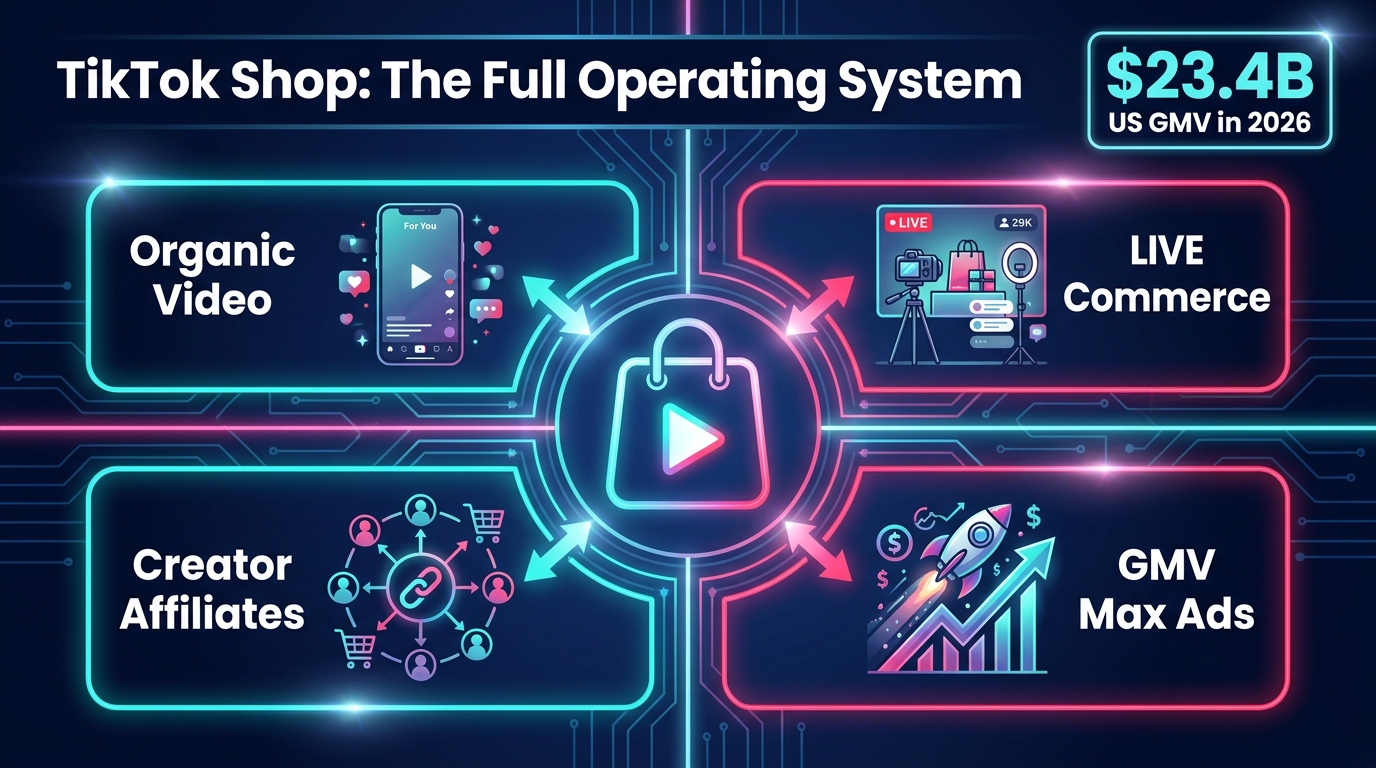
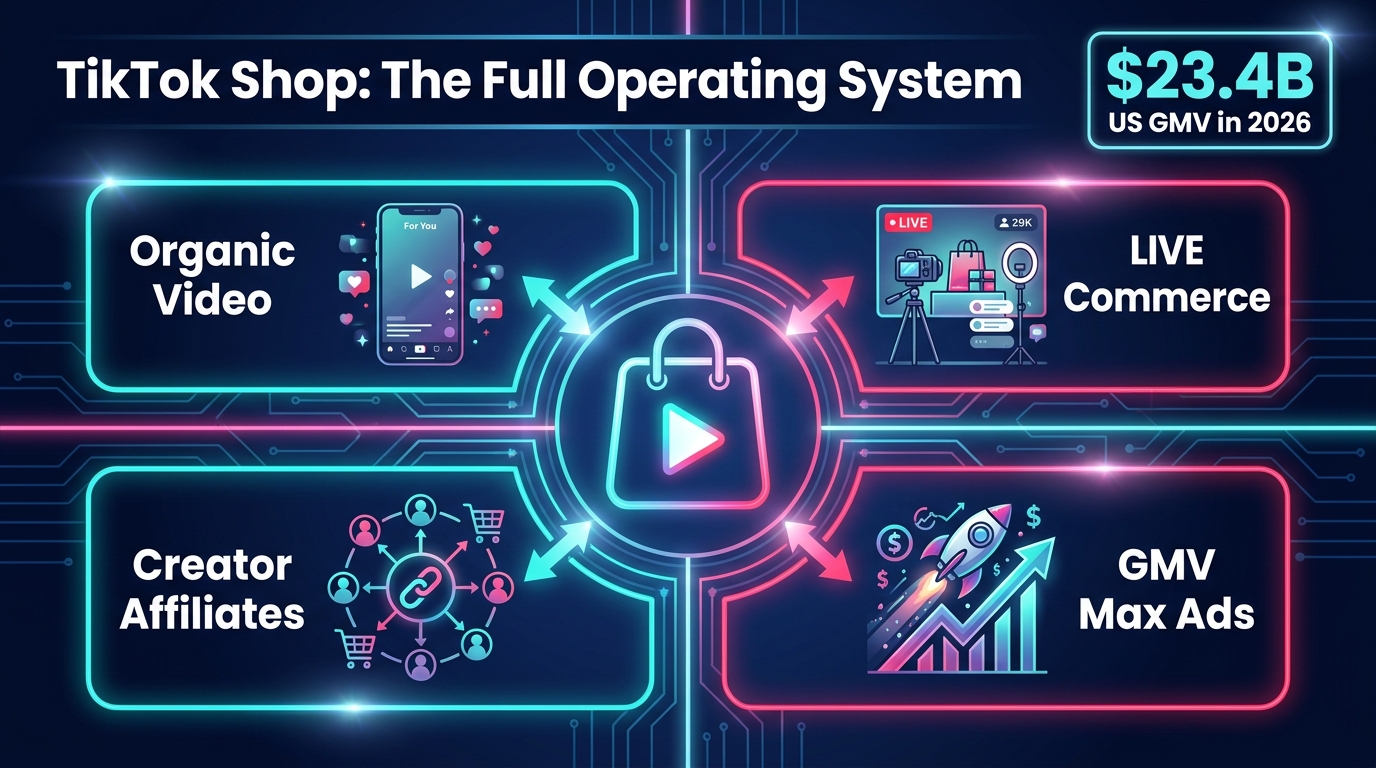
The problem isn’t the product or the ads or the creators. The problem is the mental model. TikTok Shop is not a listing platform with a video feature bolted on. It is not Instagram Shopping with better demographics. It is a fully integrated commerce operating system — one where organic content, affiliate-driven creator volume, live-stream commerce, and programmatic paid amplification are not separate tactics but interdependent components of a single machine. When one pillar is weak, it drags the others. When they all work together, the compounding effect is dramatic.
That is the context behind the numbers. TikTok Shop is projected to reach $23.41 billion in U.S. GMV in 2026 — a 48% year-over-year increase from roughly $15.8 billion in 2025, according to eMarketer. Its live-shopping channel alone now accounts for approximately 26% of total platform GMV. These are not early-mover statistics from a platform still proving itself. They are the operational benchmarks of a mature, scaled commerce environment that rewards sellers who understand how its parts connect.
This guide breaks down how TikTok Shop actually works as an integrated system — the four pillars, the category economics, the live-show mechanics, the affiliate margin math, the ad layer, and the compliance infrastructure that can quietly restrict your account if you ignore it. If you have been treating any one of these as your entire TikTok Shop strategy, this is the recalibration that changes how you see the platform.
The Four-Pillar Architecture Every Serious TikTok Shop Seller Needs to Understand
Before diving into individual tactics, it is worth mapping the whole terrain. TikTok Shop’s commercial ecosystem runs on four interconnected distribution channels, each with its own mechanics, costs, and performance metrics — but all feeding into the same conversion infrastructure.
Pillar 1: Seller-Owned Organic Video
This is the foundation layer. Short-form product videos posted directly from the brand’s own TikTok account — shoppable, linked to the catalog, and distributed through TikTok’s algorithmic For You feed. Organic video serves two simultaneous functions: it drives direct purchases from existing followers and discovery-based buyers, and it acts as a proving ground for creative angles before any money is spent amplifying them.
The key distinction here is that organic video on TikTok Shop is not the same as organic content on Instagram or YouTube. Because the video is linked directly to a product listing, every metric — watch time, saves, shares, click-through to product page, add-to-cart, purchase — feeds back into both the content algorithm and the product’s conversion signal. A video that drives purchases is not just a successful piece of content; it is a piece of creative infrastructure that the rest of the system can be built around.
Pillar 2: Creator Affiliate Volume
TikTok Shop’s Affiliate Marketplace allows sellers to list their products for independent creators to promote on commission. When a creator’s video generates a sale, they earn a commission — typically ranging from 10% to 30% depending on category and seller configuration, with the U.S. average sitting around 13.02%. This is the volume engine of TikTok Shop. While the brand account might post 5–10 videos per week, an active affiliate program can generate hundreds of product-linked videos from creators of varying audiences and niches.
The leverage here is enormous, but so is the risk of poor management. A high-volume affiliate program that ignores contribution margin can look spectacular in GMV reports while quietly destroying actual profit. We will cover the economics in detail later.
Pillar 3: TikTok LIVE Shopping
Live shopping on TikTok is the channel that most sellers either underinvest in dramatically or treat as an occasional promotional event. Both approaches leave revenue on the table. LIVE now drives approximately 26% of TikTok Shop’s total GMV, and live sessions consistently convert at rates between 7.8% and 12% — compared to the 1%–3% typical of standard ecommerce browse-and-buy flows. LIVE is not supplemental; it is a core revenue channel that requires its own infrastructure, staffing, and operational discipline.
Pillar 4: Paid Amplification via GMV Max and Spark Ads
The paid layer on TikTok Shop is where proven content gets scaled. GMV Max — now the default and only supported campaign type for TikTok Shop Ads — is an automated full-funnel campaign format that uses TikTok’s machine learning to optimize for shop-wide revenue across all placements including in-feed, search, detail pages, and affiliate posts. Spark Ads, while not Shop-exclusive, allow brands to boost organic and creator posts directly, preserving authentic engagement signals while amplifying reach.
These four pillars are not just parallel strategies — they are sequentially and causally related. Organic video proves creative angles. Proven organics enable smarter affiliate briefs. LIVE sessions drive urgency purchasing that raises overall conversion signals. GMV Max scales the winners that all three channels have already validated. Run them in silos and you are running four mediocre strategies. Run them as one machine and each pillar multiplies the impact of the others.
Category Selection: Where the Platform’s Revenue Actually Concentrates
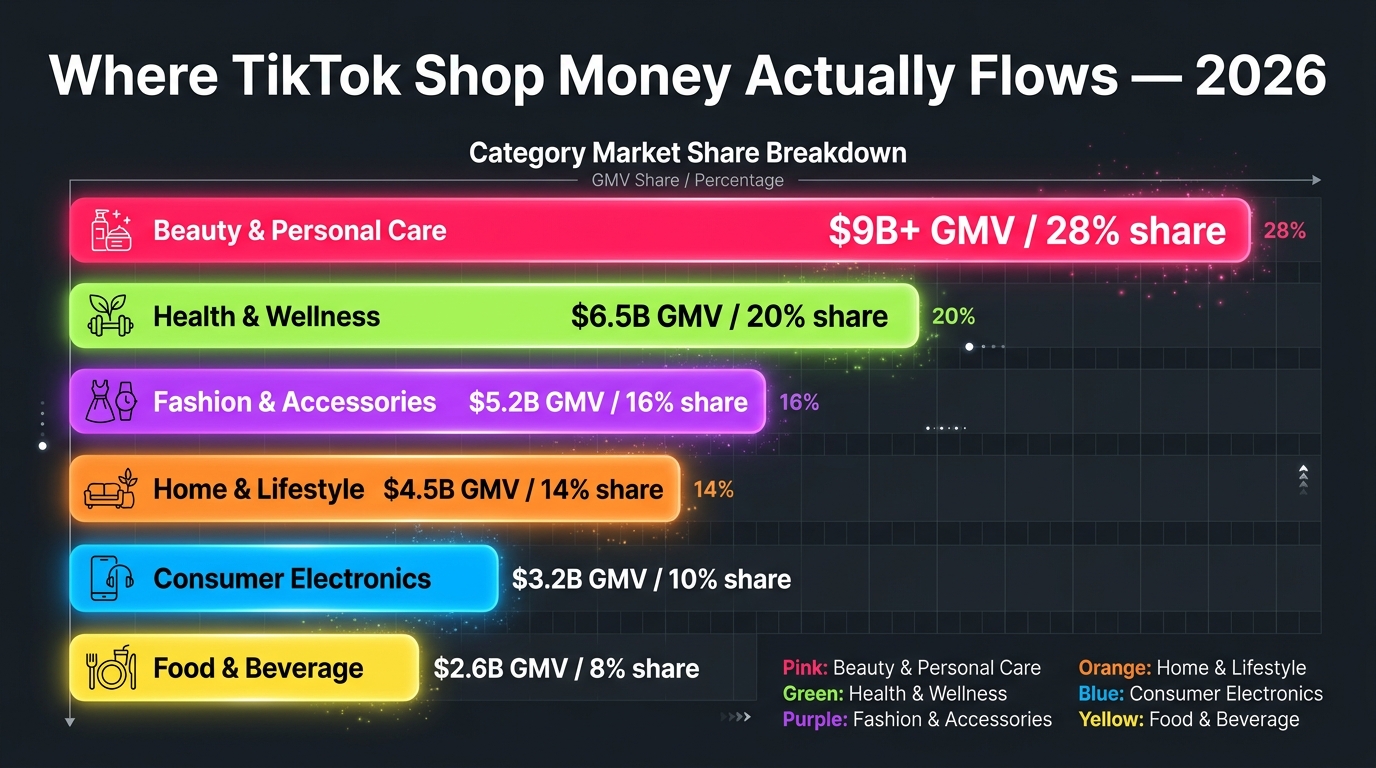
Not all product categories perform equally on TikTok Shop, and the reasons are more structural than they might appear. TikTok Shop’s format — short video, live demo, affiliate creator posts, impulse-friendly checkout — creates a natural selection pressure toward products that share specific characteristics. Understanding which categories benefit from that structure, and why, tells you more than any trending-product list.
Beauty and Personal Care: The Dominant Category
Beauty and personal care is unambiguously TikTok Shop’s leading category. Q2 2026 data places its U.S. GMV above $9 billion, representing approximately 22.5%–28% of total shop sales depending on the measurement source. The reasons are structural, not accidental. Beauty products are visually demonstrable in seconds — a serum being applied, a concealer blending, a lip gloss catching light — and the before-and-after format maps perfectly onto TikTok’s short-form video grammar. Creator credibility is high in this space; audiences trust a real person showing real results over a brand claiming them.
The competitive intensity is also significant. New beauty entrants need differentiation beyond the product itself — a specific problem being solved, a novel format or texture, a clinical claim that creates a memorable demo hook. Products without a clear visual payoff in under 15 seconds will struggle to break through, regardless of quality.
Health and Wellness: The Fastest-Growing Adjacent Category
Health and wellness — covering supplements, posture and sleep products, fitness accessories, and personal health devices — has seen accelerating growth through Q2 2026, particularly in areas where creators can document personal transformation or clinical outcomes. The structural fit is similar to beauty: a problem is named, a product is introduced, a result is shown or described with credibility. Commission rates in health tend to be higher than in beauty, which makes the category attractive for creators and can help sellers recruit strong affiliate volume.
The regulatory nuance here is important. TikTok has tightened its policies on health claims, and listings that include unsubstantiated medical language or before-and-after images that imply clinical results can trigger compliance holds. Sellers in this category need precise claim management — not just for TikTok’s policies, but because incorrect health claims carry legal exposure beyond the platform.
Fashion, Home, Electronics, and Food: The Supporting Tier
Fashion and accessories perform strongly through try-on content and fit-check formats — categories where the social proof of a real human showing fit, feel, and styling generates conversion signals that static product images cannot replicate. Home and lifestyle products have benefited from the rise of “clean home” and “organization” content aesthetics. Consumer electronics and phone accessories thrive on demo-based content where capabilities and features can be shown rather than told. Food and beverage is the fastest-accelerating category in early 2026, driven by cooking content, flavor reaction videos, and the growth of DTC food brands finding audiences through creator affiliate posts.
The Structural Characteristics That Predict Performance
Across all categories, the products that consistently outperform on TikTok Shop share four traits: they are visually demonstrable in a short clip, they address a specific and recognizable problem, they have impulse-accessible price points (typically $15–$80 for standalone products, higher for bundles), and they are creator-brief-friendly — meaning a creator with no prior product knowledge can generate convincing content after a short onboarding. Products that require long explanations, professional installation, or complex context rarely survive the format.
Building a Repeatable Content Machine: Structure Before Volume
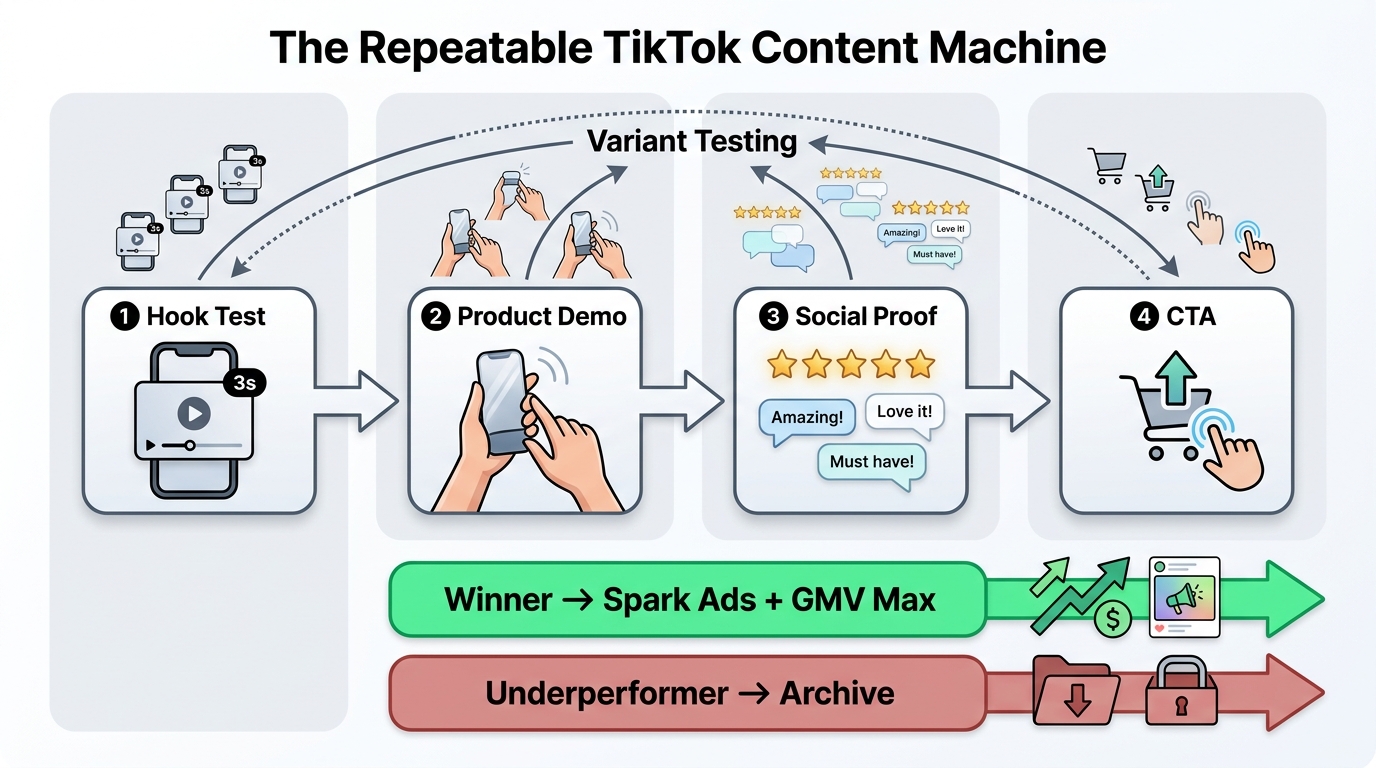
The most common content mistake TikTok Shop sellers make is treating volume and quality as a trade-off. Post more content or post better content. The answer is neither of those framings. The correct model is to build a system that produces structured variants at high volume — and then measure each one against commerce metrics, not entertainment metrics.
The Core Content Framework
High-converting TikTok Shop content follows a consistent four-beat structure, regardless of product category or creator style. The beats are: Hook (capture attention in the first 1–3 seconds with a problem statement, a surprising visual, or a bold claim), Product Demo (show the product in use, not just in shot — the transformation or function must be visible), Social Proof (reviews, user count, creator endorsement, or before-and-after evidence), and CTA (a direct, friction-free instruction to tap the product link or visit the shop). This is not a creative straightjacket. It is a conversion scaffold that the best-performing content on the platform consistently matches, even when it doesn’t look formulaic on the surface.
The critical shift in 2026 platform guidance is that TikTok now penalizes low-quality posting bursts. Flooding the account with technically formatted but visually cheap or deceptive content can trigger distribution limits — a form of algorithmic suppression that lowers reach across the account, not just on the flagged posts. Volume must be structured volume, not spray-and-pray.
Variant Testing as the Core Operating Principle
Once the four-beat structure is locked in, the production system’s job is to generate variants of each proven format — not entirely new content from scratch, but methodical variations on what is already working. A hook variant changes only the opening three seconds while keeping the rest constant. A proof variant swaps in different social evidence. A CTA variant tests urgency framing versus direct instruction.
Measuring these variants on commerce metrics — specifically click-through rate to the product page, add-to-cart rate, and GMV per video asset — is what separates a functioning content machine from a content calendar. Views and engagement rate tell you something about audience resonance, but they do not tell you which creative drives purchases. Commerce metrics do, and they should be the primary evaluation lens for every piece of content the brand account produces.
The Creator Brief as System Infrastructure
When brand-owned organic content identifies winning hooks and formats, that intelligence needs to flow directly into the creator brief system for the affiliate program. A brief that says “demo the product and be authentic” is not a brief — it is an abdication. A functioning brief specifies the hook category that has been proven to drive add-to-carts, the specific product feature to demonstrate, the proof type that has resonated with the audience, and the CTA instruction. Creators operating from structured briefs generated by brand-side performance data consistently outperform creators given open-ended instructions, even when the latter are more experienced or have larger audiences.
Content Cadence and Account Distribution Health
A reasonable baseline cadence for brand-owned organic content on a scaling TikTok Shop account is 5–10 posts per week — enough to generate meaningful test data without posting frequency dropping so low that the algorithm deprioritizes the account. For seller accounts with active affiliate programs, the brand account’s output can be lower because creator volume supplements total content exposure. However, the brand account should always maintain active posting, both to sustain algorithmic favor and to continue generating first-party test data that the affiliate program can use.
TikTok LIVE as Revenue Infrastructure, Not a Broadcast Event
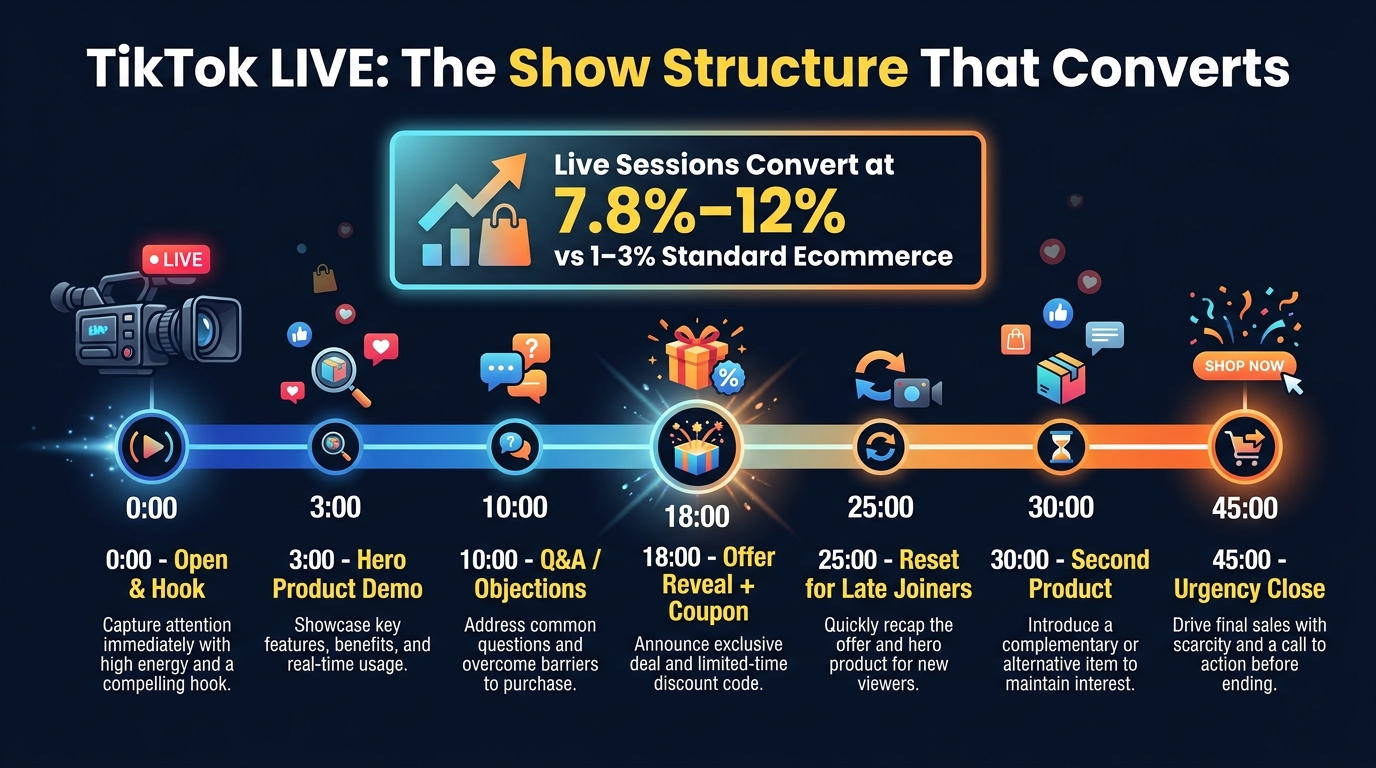
The data point that most reshapes how sellers should think about TikTok LIVE is this: live sessions now drive approximately 26% of total TikTok Shop GMV, and they do so at conversion rates between 7.8% and 12% — roughly three to ten times higher than standard ecommerce browse-and-click flows. One GlobalData survey found that 76% of consumers who had used TikTok Shop bought something from a livestream in the prior year. These are not fringe metrics. They are performance benchmarks that demand LIVE be treated as core infrastructure, not an occasional activation.
Revenue per stream varies enormously by account size and execution quality — from around $800 for early-stage sellers to $48,000 or more for established brands with strong audiences — but the conversion rate advantage holds across the range. The lever is not audience size; it is show structure and host quality.
Show Structure: The Run-of-Show That Converts
The highest-converting live shopping shows on TikTok follow a structured format that is closer to a well-produced home shopping segment than an improvised product demo. The structure that appears most consistently in high-performing seller programs in 2026 follows this pattern:
- Minutes 0–3 — Opening Hook: Open with energy. State immediately what viewers will see and what they can get. Do not ease into it — late arrivals scan past slow openings, and the algorithm demotes streams that fail to hold viewers in the first three minutes.
- Minutes 3–10 — Hero Product Demo: Show the first product in hands, in use, with a live demonstration that shows function rather than just appearance. Answer one imagined objection (“I know what you’re thinking — does this actually work on oily skin?”) before chat asks it.
- Minutes 10–18 — Q&A and Objection Handling: Read chat actively. Identify the skeptical questions and answer them on-screen with product in hand. This phase is where purchase decisions get made — buyers who are unsure need to see their specific concern addressed before they will tap the link.
- Minutes 18–25 — Offer Reveal: Introduce a time-limited coupon, bundle, or live-only discount. Single, clear offers outperform complicated discount stacks. The offer should feel like a reward for staying in the stream, not a random price change.
- Minutes 25–30 — Reset for Late Joiners: Repeat the hero product demo from scratch for the portion of viewers who just joined. Live streams see continuous audience turnover; a mid-stream reset recaptures people who arrived after the opening.
- Minutes 30–45 — Second Product Cycle: Repeat the core demo → Q&A → offer structure for a second product, ideally complementary to the first. Pin the second product to the live shopping cart.
- Final 10 minutes — Urgency Close: Countdown language, reminder of the live-only coupon expiry, final demo beat, strong CTA. Close the stream deliberately — a weak ending leaves conversion on the table.
Host Selection: The Single Biggest Lever
The host is the most significant variable in live shopping performance, more influential than production quality, offer depth, or stream length. The qualities that correlate with high conversion are specific and somewhat counterintuitive: the best hosts are not necessarily the most polished or attractive, but the most knowledgeable and naturally conversational. They can answer product questions accurately without breaking the demo flow. They can handle a skeptical comment in chat with a demonstration rather than a defensive response. They can maintain energy through a 60-minute stream without the performance level visibly declining.
Many brands make the mistake of assigning live hosting to whoever is available, or to the person with the most social media experience. The better approach is to treat live host selection as a performance-critical hire — audition candidates, measure their conversion output in controlled test streams, and invest in coaching and product-knowledge training before deploying them to live audiences.
Offer Architecture: Simplicity Outperforms Complexity
There is a persistent temptation in live shopping to stack multiple discounts, bundles, free gifts, and coupons simultaneously on the assumption that more value equals more conversions. The data from high-performing shows in 2026 points in the opposite direction. Single, clearly framed, time-limited offers consistently outperform complicated discount structures, because cognitive load kills impulse purchasing. If a viewer has to think about whether the bundle plus the coupon plus the cashback adds up to a good deal, the moment passes. A single “live-only 20% off, this session only” offer with a visible countdown creates urgency without confusion.
The Creator Affiliate Program: Running It for Margin, Not Just GMV
TikTok Shop’s creator affiliate program is one of the most powerful distribution tools available to product sellers in 2026 — and one of the most reliably mismanaged. The reason is a persistent category error: sellers evaluate affiliate programs on GMV and video count, when the correct evaluation lens is contribution margin after all costs.
The ROI Reality: What the Numbers Actually Show
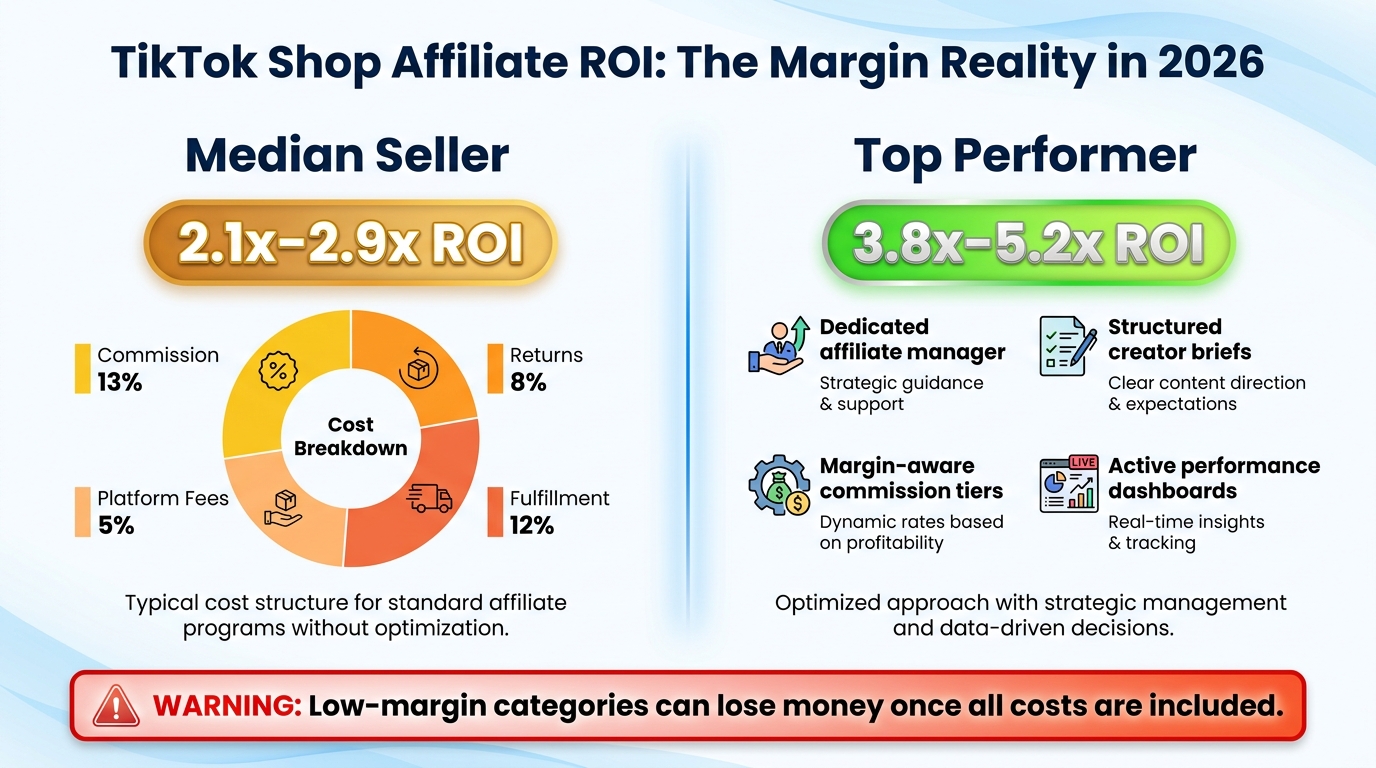
Industry benchmarks from 2026 paint a wide range of affiliate program performance. Median sellers report ROI in the range of 2.1× to 2.9× on commission spend — meaning $1 spent on affiliate commissions generates $2.10 to $2.90 in GMV. Top-performing sellers with disciplined affiliate management programs report ROI in the range of 3.8× to 5.2×. The gap between median and top performance is not primarily a function of product quality or creator quality. It is a function of operational management.
The sellers hitting the higher range are running dedicated affiliate management operations — not just listing products in the marketplace and waiting for creators to pick them up. They have dedicated affiliate managers who actively recruit, onboard, brief, and measure creator performance. They have structured creator briefs that translate brand-side content performance data into specific instructions. They review performance dashboards weekly, not monthly, and rotate out underperforming creators before commission spend accumulates on content that isn’t converting.
The Contribution Margin Calculation Every Seller Must Run
The platform-reported GMV from an affiliate program is not the number that should drive strategic decisions. The number that matters is contribution margin — what is left after every cost layer is removed. For a typical TikTok Shop affiliate-driven sale, those layers include:
- Affiliate commission: Average 13.02% in the U.S., though category averages vary considerably. Fashion often runs lower; health and supplements often run higher, sometimes reaching 20%–30% for highly competitive creator categories.
- TikTok platform fees: Referral fees ranging from approximately 2%–8% depending on category, plus additional fees for fulfilled-by-TikTok products.
- Fulfillment costs: Shipping, packaging, and handling — typically 8%–15% of selling price depending on product weight and shipping speed tier.
- Return rate impact: Fashion categories can see return rates of 20%–35%. Health and beauty average lower but still meaningful. Returns do not just eliminate the margin on the returned sale — they create reverse logistics costs that eat into the margin on all adjacent sales.
- Product COGS: The cost of goods themselves, obviously, but often underrepresented in seller calculations that focus on platform-side economics.
When all of these are modeled together, the net margin on an affiliate-driven TikTok Shop sale can compress to single digits for low-margin categories. Some sellers in the 10%–20% gross margin range are running affiliate programs that appear highly successful in GMV terms while actually generating near-zero or negative net contribution. The 2026 shift among sophisticated operators is to set commission rates as a function of the product’s contribution margin budget — not as a competitive response to what the market is offering creators.
Tiering Creators by Performance, Not by Follower Count
One of the most consequential structural decisions in a TikTok Shop affiliate program is how to segment and invest in creators. Follower count is a poor proxy for affiliate performance because TikTok’s algorithmic distribution means a micro-creator with 15,000 highly engaged followers in the right niche can generate more conversions per dollar of commission than a macro-creator with 500,000 broadly distributed followers posting outside their area of authority.
The practical framework that emerges from high-performing programs is to tier creators into three groups: test tier (new or unproven creators who receive product samples and standard commission, with no additional investment until data comes in), performance tier (creators who have delivered two or more converting posts and receive active brief support, performance bonuses, and expedited product access), and partner tier (consistently high-converting creators who justify dedicated management time, higher commission rates, and co-creation investment). Promoting creators between tiers based on commerce metrics — not follower growth or content quality in isolation — keeps the program financially disciplined.
GMV Max: The Automated Scaling Layer and How to Feed It Correctly
As of 2026, GMV Max is TikTok’s default and only supported campaign type for TikTok Shop Ads. It is a fully automated campaign format that optimizes for shop-wide GMV across all available placements — in-feed video, search results, product detail pages, LIVE streams, and affiliate content — without requiring manual ad group targeting. For sellers accustomed to the granular control of Meta or Google campaigns, this level of automation can feel either liberating or alarming, depending on how well they understand what the system actually needs to function.
What GMV Max Is and Is Not
GMV Max is best understood as an amplification layer, not a testing layer. It does not discover new winning products or creative directions — it accelerates what is already working. Sellers who deploy GMV Max on weak products, thin catalogs, or unproven creative are asking the automation to solve a product-market fit problem, which is not what the system is designed for. The result is typically wasted spend and a corrupted data signal that makes it harder to identify what actually converts.
A common misreading of GMV Max performance is the attribution issue. GMV Max’s reported ROAS often appears significantly higher than Spark Ads ROAS for the same products — but this comparison is frequently misleading. GMV Max blends paid-attributed orders with organic and affiliate-attributed orders in its reporting, inflating the apparent efficiency. Sellers who compare GMV Max’s reported 3×–4× ROAS against Spark Ads’ reported 4×–8× ROAS without accounting for this attribution difference are making strategic decisions on incomparable numbers.
The Correct Input Stack for GMV Max
For GMV Max to perform at its ceiling, it requires a specific set of inputs to be in good condition:
- Clean catalog with proven SKUs: Separate GMV Max campaigns by major product or category. Mixing high-margin hero products with low-margin tail SKUs in a single campaign allows the automation to spend heavily on products where contribution economics are poor. The platform optimizes for GMV, not your profit margin.
- Sufficient creative volume: GMV Max requires multiple video assets to test across placements. Entering a campaign with a single video or two forces the algorithm into a constrained optimization that limits its learning. A functioning GMV Max setup should have at least 5–10 tested creative assets in the campaign.
- Conservative initial ROI targets: Setting ROI targets too aggressively at campaign launch prevents the algorithm from accumulating the purchase data it needs to optimize efficiently. Start conservatively, let the algorithm stabilize over 7–14 days, and incrementally tighten the target in small steps.
- Budget stability: Frequent budget changes — especially large upward or downward swings — reset the algorithm’s learning phase. The 2026 practitioner consensus is to change budgets by no more than 20% in any given 48-hour window.
The Organic-to-Paid Escalation Sequence
The sequencing that appears consistently across high-performing TikTok Shop operator playbooks in 2026 follows a structured escalation: first, let organic posts run for 48–72 hours to generate initial performance data. Posts that show strong CTR to product page and add-to-cart rates (not just views) get elevated to Spark Ads, which boosts reach while preserving the organic engagement signals. Only after a Spark-amplified post has further demonstrated purchase conversion does it get added to a GMV Max campaign as a tested creative asset. This sequence ensures that GMV Max is never asked to scale creative that hasn’t been validated at smaller spend levels.
Account Health Rating: The Compliance Overhaul That Took Effect in 2026
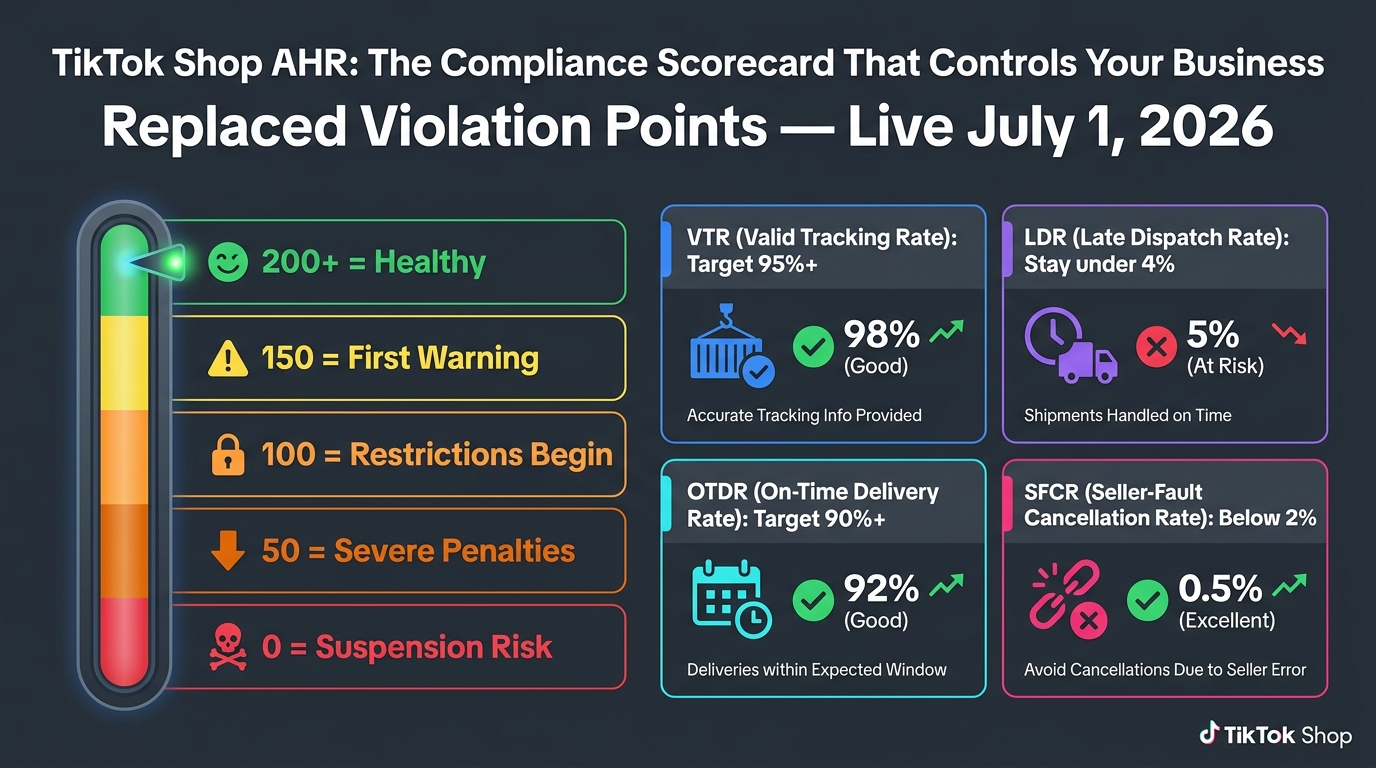
On June 15, 2026, TikTok Shop replaced its legacy Violation Points system with a new framework called the Account Health Rating (AHR). The full rollout to all sellers was completed by July 1, 2026. If you are operating a TikTok Shop account and have not reviewed your AHR metrics since that transition, this section is the most operationally urgent part of this article.
How the AHR System Works
AHR is a composite score that evaluates seller performance across policy compliance, listing accuracy, and fulfillment operations. The score runs from 0 to 200+, and enforcement actions are triggered at four thresholds: 150, 100, 50, and 0. At 150 points, first warnings appear in the AHR Warning Records section of the Seller Center — these are advisory notices that do not carry immediate penalties. As the score falls below 150, enforcement actions escalate from feature restrictions and listing suppression to order limits and, at the lowest scores, account suspension.
The structural difference between AHR and the old Violation Points model is important for sellers to understand. Violation Points worked as a penalty accumulation system — you started clean and points were added for infractions. AHR works as a dynamic score that reflects ongoing performance across multiple operational dimensions simultaneously. You can improve your AHR score by improving operational metrics, not just by avoiding policy violations. This makes it both more nuanced and more responsive to operational quality.
The Four Fulfillment Metrics That Drive AHR
Beyond policy compliance, the AHR score is heavily influenced by four operational metrics that sellers must monitor continuously:
- Valid Tracking Rate (VTR): The percentage of orders shipped with valid, scannable tracking information uploaded before the dispatch deadline. TikTok’s safe zone requires VTR of approximately 95% or higher. Sellers who use manual fulfillment processes or third-party logistics partners with poor API integration are most vulnerable to VTR degradation.
- Late Dispatch Rate (LDR): The percentage of orders dispatched after the promised dispatch window. LDR caution signals begin around 2%–4%, with formal enforcement reported above 10%. During promotional periods and campaign surges — exactly when a seller most needs account health to be solid — order volume spikes frequently expose LDR weaknesses in fulfillment operations.
- On-Time Delivery Rate (OTDR): The percentage of orders delivered within the promised delivery window. Target is approximately 90%+. This metric is influenced by both dispatch speed and carrier performance, meaning sellers need both reliable dispatch processes and vetted carrier relationships.
- Seller Fault Cancellation Rate (SFCR): The percentage of orders cancelled due to seller-side issues — typically out-of-stock situations, pricing errors, or listing mismatches. The safe threshold is below 2%. SFCR problems are usually catalog management failures: listing products as in-stock when inventory has depleted, or maintaining active listings on products that have been discontinued.
Why AHR Matters Beyond Penalty Avoidance
The operational stakes of the AHR system extend beyond the direct enforcement consequences. TikTok Shop uses account health signals as inputs into promotional access decisions — sellers with degraded AHR scores are deprioritized for platform-wide promotional events, featured placement opportunities, and the Shop tab’s recommendation algorithm. This means that an account with a declining AHR score is not just risking enforcement actions; it is progressively losing access to the platform’s organic distribution benefits at the precise moment when other sellers with clean AHR scores are gaining them.
For sellers operating TikTok Shop alongside other channels — Shopify, Amazon, Walmart — the fulfillment discipline required by TikTok’s AHR system is broadly additive. The operational improvements that keep VTR, LDR, OTDR, and SFCR inside safe zones tend to reduce customer service volume and return rates across all channels simultaneously. AHR compliance is not just a TikTok problem to manage; it is an operations quality signal with platform-wide business value.
The Unit Economics Reality: What Sellers Are Actually Making
One of the more uncomfortable truths about TikTok Shop’s rapid growth is that GMV and profit are not the same thing, and the gap between them is wider on this platform than most sellers initially model. The platform’s fees, commission structures, fulfillment standards, and return economics create a cost architecture that requires explicit modeling before a TikTok Shop business can be called genuinely profitable.
The Full Cost Stack
Here is the cost architecture that a TikTok Shop seller needs to model for each product category:
- Platform referral fee: Typically 2%–8% of order value, varying by category. Fashion is at the higher end; electronics accessories tend to be lower.
- Affiliate commission: If using the affiliate marketplace, 10%–30% of the sale price, with the U.S. market averaging around 13%. This is not a fee you pay to TikTok — it is a performance cost paid to the creator — but it belongs in the unit economics model regardless.
- Paid amplification cost: GMV Max and Spark Ads spend attributed to the sale. If your blended paid ROAS is 3.5×, you are spending approximately 28 cents on ads for every dollar of GMV. That needs to be in the model.
- Fulfillment cost: Shipping, packaging, and handling. Highly variable but typically 8%–18% of selling price for standard product weights and delivery windows.
- Return rate loss: The cost of returns includes not just the refunded sale but the reverse logistics, inspection, restocking or disposal, and any buyer-side bad experience that reduces repeat purchase probability. For fashion, modeling a 20%–30% return rate as a baseline is prudent.
- Product COGS: Including all supplier costs, quality control, and inbound shipping.
When these costs are stacked against the selling price, a product with a 40% gross margin that looks highly profitable in isolation can yield 8%–12% net contribution after the full TikTok Shop cost architecture is applied. That is not necessarily a bad outcome — 10% net contribution at TikTok’s GMV scale can be a substantial business — but it is a number that needs to be modeled explicitly, not discovered accidentally after a quarter of strong GMV and weak bank balance.
Pricing for TikTok Shop Economics
The pricing discipline that separates profitable TikTok Shop operators from GMV-chasing ones is building the full cost architecture into the pricing model before going live, not reverse-engineering it after the fact. This means determining the minimum gross margin required to reach acceptable net contribution after all platform costs — and rejecting any product where achieving that margin requires a price point that TikTok’s impulse-friendly audience will not accept. The sweet spot is products with 50%–70%+ gross margins sold at impulse-accessible prices, which is precisely why beauty, supplements, and accessories dominate the category tables. The structural economics of those categories allow sustainable net margins even after the full TikTok cost architecture is applied.
How the Best Operators Connect All Four Pillars
The real competitive advantage on TikTok Shop in 2026 belongs to sellers who have stopped treating the four pillars as separate strategies and started running them as a single, data-connected system. The practical difference shows up in how information flows between pillars — and how quickly winning signals in one channel generate action in the others.
The Intelligence Loop
In a well-connected TikTok Shop operation, the content testing layer and the affiliate layer are in continuous dialogue. Brand-owned organic posts are monitored at the 48-hour mark for commerce metrics — specifically CTR to product page and add-to-cart rate. Posts that outperform the account baseline on both metrics are immediately flagged for two actions: elevation to Spark Ads to extend reach, and documentation as a “proven hook” to be written into the next batch of creator briefs.
Creator briefs are updated on a rolling basis — weekly in high-volume operations — as new performance data comes in from both the brand account and the affiliate posts themselves. This creates a feedback loop where the brand account’s testing output continuously improves the quality of affiliate content, and the volume of affiliate content generates a broader data pool that helps identify new angles to bring back into brand testing.
LIVE as the Conversion Pressure Valve
Scheduled LIVE sessions serve a specific function in the connected system: they are the high-conversion event layer that amplifies the purchase intent built up by organic and affiliate content. A viewer who has seen a creator affiliate post about a product, added it to their cart but not converted, and then encounters the product being demoed in a LIVE session with a live-only coupon is a buyer who needed one more moment of decision pressure. LIVE provides that pressure. The best-performing operations deliberately coordinate LIVE session timing with affiliate content release windows — scheduling live streams for the day after a high-volume affiliate drop to capture the audience that was warmed but unconverted.
GMV Max as the Scaling Multiplier
With organic video proving hooks, affiliate volume proving formats, and LIVE demonstrating product desirability at conversion scale, GMV Max campaigns fed from this data stack are working with validated assets across every input dimension. The automation is not guessing at audience targeting or creative effectiveness — it is amplifying a system that has already proved its outputs at lower cost. This is why the gap between the best TikTok Shop operators and median operators is so large despite both using the same tools: the tools themselves are not the variable. The connected discipline with which those tools are deployed is.
Practical Integration: What a Weekly Operating Rhythm Looks Like
For sellers looking to move from parallel pillar management to integrated system operation, a weekly rhythm provides the operational structure:
- Monday: Review previous week’s organic content commerce metrics. Flag winners for Spark Ad elevation. Identify new hooks for creator brief updates.
- Tuesday: Update creator briefs with new winning hooks. Push updated briefs to performance-tier and partner-tier creators.
- Wednesday: Review GMV Max campaign performance. Make any budget adjustments (max 20% change). Add new Spark-validated creatives to active campaigns.
- Thursday: LIVE session planning — review product list, confirm host prep and product knowledge, finalize offer structure for the session.
- Friday: Run scheduled LIVE session. Capture session metrics (peak concurrent viewers, conversion rate, revenue per stream) for performance record.
- Saturday/Sunday: Review AHR score, VTR, LDR, OTDR, SFCR in Seller Center. Flag any metrics approaching warning thresholds. Process any fulfillment backlog to protect dispatch rate.
This rhythm is not prescriptive — it will compress or expand depending on team size and revenue scale — but it illustrates the operational density that a connected TikTok Shop system requires. It is not a set-and-forget platform. It is a performance operating environment that rewards weekly operational attention across all four pillars simultaneously.
Conclusion: Building the Machine, Not Just Running the Tactics
The sellers who will look back on 2026 as the year TikTok Shop compounded their business are not the ones who found the best trending product or hired the most influential creator. They are the ones who understood the platform as what it actually is: a commerce operating system where four interdependent pillars — organic content, affiliate creator programs, LIVE shopping, and automated paid amplification — generate outsized results only when they are connected, data-informed, and operationally maintained.
TikTok Shop’s projected $23.41 billion in U.S. GMV in 2026 is real, and it is growing at 48% year-over-year. But that number is the aggregate result of a very small percentage of sellers who have built the machine correctly, not the broad average performance of everyone who opened an account. The platform is not a rising tide that lifts all boats equally. It is a merit-weighted operating environment where structural advantage is built deliberately and defended through operational discipline.
The Actionable Takeaways
- Audit your pillar coverage this week. If you are running organic content without an affiliate program, you are leaving distribution volume on the table. If you have an affiliate program without LIVE, you are missing the channel with the highest conversion rate on the platform. If you are running GMV Max without proven creatives, you are scaling unvalidated spend.
- Build the contribution margin model for every product before scaling. Add platform fees, affiliate commission, fulfillment, return rate, and ad cost. If the net margin is too thin to sustain growth, fix the pricing or the product selection — not the marketing.
- Check your AHR score and all four fulfillment metrics immediately if you have not reviewed them since the July 1 rollout. VTR, LDR, OTDR, and SFCR all need to be inside safe zones before your next promotional event, because degraded AHR reduces access to the platform’s distribution benefits at exactly the moment you need them most.
- Treat LIVE as scheduled infrastructure, not an occasional event. One structured LIVE session per week, with a trained host, a clear run-of-show, and a single focused offer, will compound significantly over a quarter. Revenue per stream improves with repetition and audience familiarity.
- Connect your content data to your creator briefs. Every winning hook from the brand account’s organic testing is a brief update waiting to happen. This is the highest-leverage, lowest-cost improvement most affiliate programs can make immediately.
- Run the organic → Spark → GMV Max escalation sequence rather than launching GMV Max cold. Scaling validated creative is categorically different from scaling creative that hasn’t been tested, and the performance difference in your GMV Max campaigns will be measurable within two weeks.
The platform is still growing rapidly, and the window for early-system advantage is still open. But it is not open indefinitely. As more sophisticated operators mature their four-pillar systems, the cost of building that infrastructure — in creator relationships, content volume, LIVE show quality, and operational compliance — will rise. The time to build the machine is before the machine is required. For most TikTok Shop sellers, that time is now.