


There is a six-hour window on TikTok Shop that most sellers have never seen close up — because by the time they realize a window existed, it’s already shut. A sound starts getting pulled into videos. A product category starts spiking. A format gets remixed four, then fourteen, then four hundred times. The algorithm notices. It starts distributing content that joined early with outsized reach. Sellers who were already set up — product linked, video live, creator posted — capture that reach. Everyone else watches the numbers from the outside.
This isn’t about being lucky enough to stumble across a trend at the right moment. It’s an infrastructure problem. The sellers who consistently win in the first six hours aren’t faster at scrolling TikTok — they’ve built systems that shorten the gap between “trend detected” and “shoppable video live” to the point where six hours feels like plenty of time.
This post is about that infrastructure: the detection stack, the pre-built creative and operations systems, the hour-by-hour execution discipline, and the failure modes that kill the play even when teams move fast. It’s also about when not to jump — because saturating alongside a hundred other sellers chasing the same sound is worse than sitting one out entirely.
If you’ve read general advice about “acting fast on TikTok trends,” this isn’t that. This is the operational layer underneath — what fast actually requires, built as a repeatable system rather than a one-off scramble.
What “Trend Hijacking” Actually Means in 2026 (And What Most Sellers Get Wrong)
The phrase “trend hijacking” sounds more aggressive than it is. In practice, it means identifying an emerging content format, sound, challenge, or cultural moment on TikTok and producing shoppable content that participates in that trend before it reaches peak saturation — while tagging your products so that the algorithmic distribution boost carries viewers directly to a purchase path.
What most sellers get wrong is treating it as a content strategy rather than a commerce strategy. They see a trend, they rush to make a video that fits the format, they post it — and then they wonder why it didn’t drive sales. The answer is almost always one of three things: they were too late, the product fit was forced, or the content lacked a clear purchase trigger.
The Misconception About “Going Viral”
Trend hijacking is not about going viral. Virality is a byproduct, not a goal — and chasing it directly almost always produces the wrong kind of content. What you’re actually trying to do is insert your product into a fast-moving traffic stream at the moment when that stream is at its most algorithmically favorable and least competitive.
TikTok’s For You Page algorithm in 2026 operates on velocity signals: watch time completion rates, shares, comments, saves, product link clicks, add-to-cart actions, and purchases. Videos that accumulate these signals quickly get pushed to broader audiences. The six-hour window matters because the FYP is running micro-tests in the first 30 to 60 minutes after a post goes live — and if those early signals are strong, the algorithm scales distribution in subsequent windows (roughly at the 3-hour, 6-hour, and 12-hour marks).
This means that a video posted at hour one of a trend — when organic engagement is highest and competition is lowest — will accumulate those velocity signals faster than the same video posted at hour 48, when the FYP is already saturated with similar content and engagement is fragmenting across dozens of competitors.
What “Hijacking” Requires Productwise
Not every product can be trend-hijacked effectively. The ones that work share a few characteristics: they’re visually demonstrable in under 30 seconds, they solve a visible problem (or create visible delight), they’re priced for impulse purchase (typically under $50), and they can be shipped quickly. Products that require lengthy explanation, high consideration, or complex sizing decisions are poor candidates for trend-speed commerce — the impulse window closes before the customer reaches the checkout.
The sweet spots in 2026 remain beauty and skincare, kitchen gadgets, wellness accessories, fashion accessories, and home organization — categories where a 15-second demonstration is genuinely convincing. If your product can be shown working in the first three seconds of a video, it can probably be trend-hijacked effectively.
The Anatomy of a TikTok Trend Lifecycle — From Spark to Saturated in 72 Hours
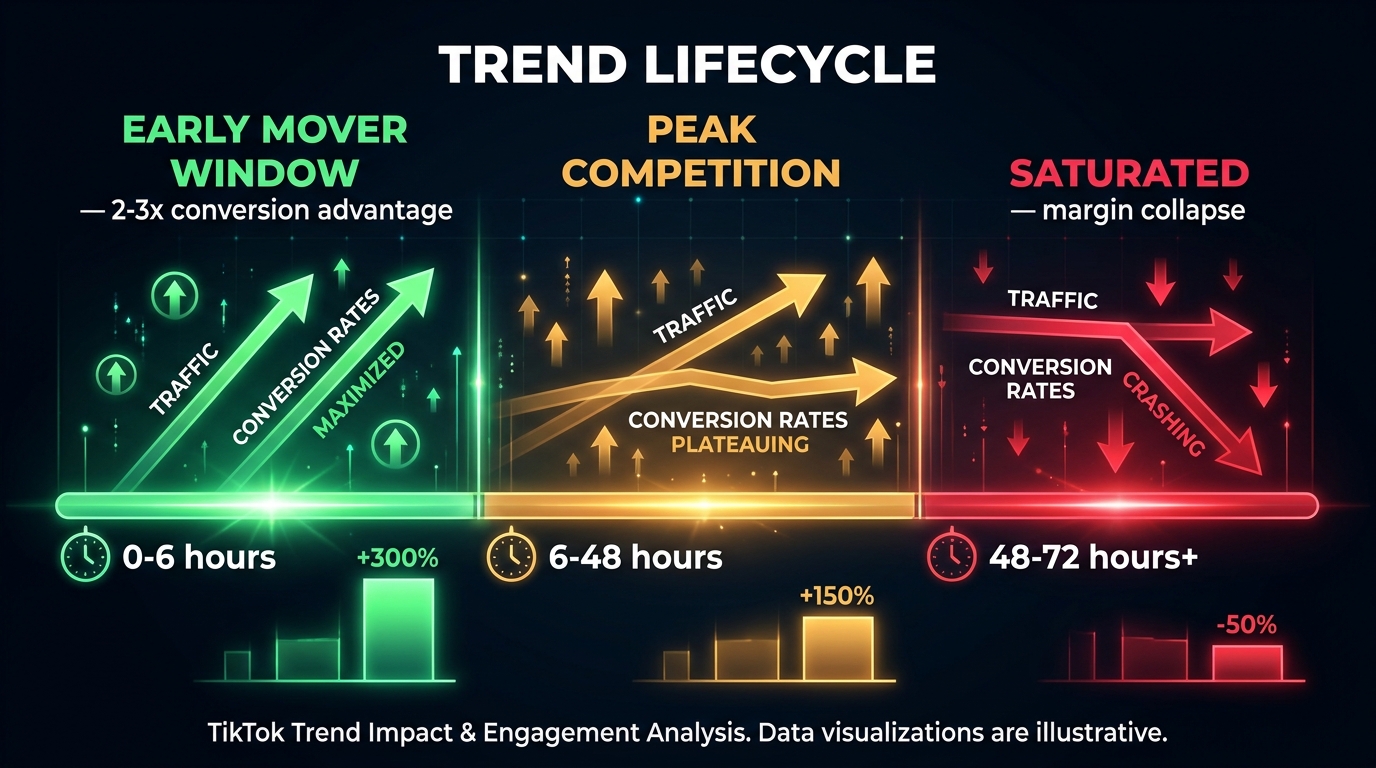
Understanding the lifecycle of a TikTok trend in granular detail is the foundation of the whole play. Most sellers think of trends as on/off switches — something either is trending or it isn’t. The reality is a curve with distinct phases, each with different competitive dynamics and conversion economics.
Phase 1: The Spark (Hours 0–6)
A trend almost always begins with a single creator or a small cluster of creators who independently hit on the same format, sound, or idea. In the spark phase, the total volume of videos using the trend is low — often in the dozens, not the thousands. Engagement on those early videos is high relative to the creator’s follower count, which is the signal the FYP algorithm uses to decide whether to start pushing the format to wider audiences.
This is the six-hour window. Sellers who enter here face essentially no competition, benefit from the algorithm’s eagerness to test the format on new audience segments, and can capture outsized shares of early traffic. Conversion rates during this phase are consistently cited as two to three times higher than during the peak competition phase, precisely because buyers are discovering the trend for the first time rather than seeing their fifteenth variation of the same content.
Phase 2: The Wave (Hours 6–48)
Once the FYP algorithm confirms the trend has strong engagement signals, it begins distributing trend-adjacent content broadly. This is when most sellers notice the trend — because their own For You Page starts serving it, or because it appears in trending hashtag tools. The wave phase is when volume explodes: hundreds, then thousands of videos using the same sound or format. Engagement per video drops as attention fragments, and the best commercial positions in the trend are increasingly occupied by the early movers who posted hours ago.
Entering during the wave phase is still viable, but the margin for error is much smaller. You need a stronger product fit, better creative execution, and — increasingly — paid amplification to compete with early movers who already have organic momentum. The wave phase is also when most fast-follower competitors arrive, compressing pricing and adding to viewer fatigue.
Phase 3: Saturation (Hours 48–72+)
By the 48-hour mark, most TikTok trends in 2026 are effectively over as commerce opportunities. Viewer fatigue sets in quickly: audiences who’ve seen the same format dozens of times scroll past without stopping, completion rates drop, and the FYP algorithm deprioritizes content that’s no longer driving engagement. Sellers who enter at this phase are essentially paying to reach an audience that has already been served the trend by someone else, often multiple times.
The key data point here: the average viral trend shelf life in 2026 is 48 to 72 hours. Some product micro-trends can sustain commercial relevance for 7 to 14 days, but the content format that launched them is usually burned out much faster. The implication is that you can sometimes keep selling a product that a trend introduced, but you can’t keep recycling the same content format that drove the initial spike.
The Real Signals That Tell You a Trend Is Breaking (Not Already Broken)
The single most common failure in trend hijacking is misidentifying when a trend is in the spark phase versus the wave phase. By the time a trend shows up in the “trending” section of most tools, it’s usually already two to six hours into the wave — past the optimal entry window. Detecting the spark requires monitoring different signals than the ones most sellers track.
Volume Velocity, Not Volume
The mistake is watching absolute numbers: how many videos are using this sound, how many views is this hashtag getting. What actually matters is the rate of change — is this sound being used by 200 creators now and was it 20 creators four hours ago? That 10x growth rate in a short window is the spark signal. A sound with 50,000 videos but flat growth from yesterday to today is already in or past its wave phase.
Tools like Kalodata and FastMoss surface hourly GMV velocity and sales growth rates for specific product categories, which are often better leading indicators than content volume alone. A product that generates $5,000 in GMV in the first two hours of a trend appearing is a much stronger signal than one that shows up in a weekly trending products list.
Creator Adoption Patterns
Early trend signals often appear first with mid-tier creators (100K to 500K followers) before large creators pick them up. Large creators tend to follow proven formats, not lead them — so if you’re waiting to see a creator with 5 million followers use a sound or format, you’re at least 12 to 24 hours behind the spark. Monitoring mid-tier creator adoption of new sounds and formats is a faster early warning system.
TikTok’s Creative Center shows trending sounds with growth rate indicators, but it typically lags behind real-time by several hours. More actionable is monitoring specific creator accounts in your niche who tend to be early adopters, and tracking sound adoption in your product category through third-party tools that pull data more frequently.
Sound vs. Format vs. Product Trend — Know Which One You’re Tracking
These three signal types have different implications for sellers. A trending sound is content infrastructure — it’s a vehicle that many different products can ride. A trending format (a specific video structure, transition, or challenge mechanic) is similar. A trending product, by contrast, is a direct commerce signal: specific demand for a specific item.
Sound and format trends have broader applicability — almost any product can be attached to the right sound if the fit is genuine. Product trends are more narrowly valuable: if a specific item is trending, you need to have that item (or a close variant) in your catalog and available to ship. The detection strategy for each is slightly different, and the speed requirements for product trends are even more compressed — because once a specific product is trending, every supplier of that product type is immediately competing for the same demand.
Your Detection Stack — Tools, Workflows, and What to Actually Monitor
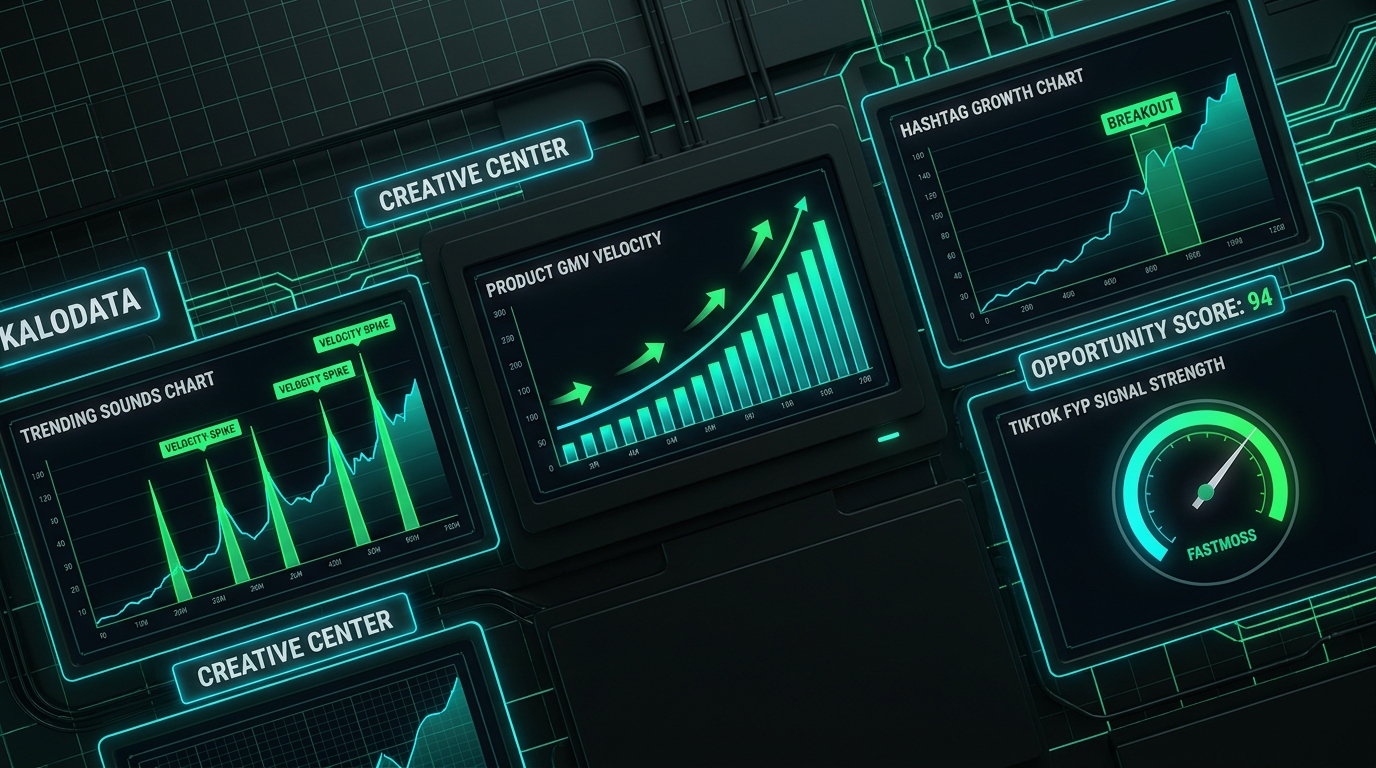
A functional detection stack in 2026 combines TikTok’s own native tools with third-party analytics platforms, and the key is setting them up to surface signals continuously — not as a manual checking activity you do once a day. The sellers who reliably catch trends in the spark phase have monitoring systems running in the background at all times, not tab-switching habits.
TikTok Native Tools: Your Free First Layer
TikTok Creative Center is the starting point. Its trending sounds, hashtags, and video analytics are updated frequently and are organized by region and industry vertical. The “Breakout” filter — which surfaces content with unusual acceleration rather than just high volume — is the most useful feature for spark-phase detection. Set your vertical filters for your product category and check the Breakout section at least three times a day: morning, midday, and evening, since trend sparks don’t keep business hours.
TikTok Opportunity Center surfaces product-specific demand signals and is particularly useful for identifying when search demand for a product type is spiking before content volume catches up. This is a genuinely underused tool — most sellers focus on content trends rather than search demand trends, which means early product demand signals often go unnoticed.
TikTok Shop’s own seller analytics provide GMV velocity data for your specific product categories. If a category you sell in is showing sudden GMV acceleration, something in that category is trending — even if you haven’t identified the specific trigger yet.
Third-Party Tools: Adding Velocity and Depth
FastMoss and Kalodata are the most commonly used third-party TikTok Shop analytics tools, and both offer GMV velocity tracking that can surface trending products before they appear in native TikTok tools. FastMoss specifically tracks daily sales rank changes across TikTok Shop product categories, which is useful for catching product trends in the spark-to-wave transition.
Pentos and TrendTok Analytics focus more on content-side signals — sound adoption rates, hashtag growth velocity, and creator trend adoption. These are more useful for format and sound trend detection than for direct commerce signals.
Scavio and EchoTik offer cross-signal analysis that combines content and commerce data, which is the most comprehensive view — but also the most expensive tier. For sellers at scale (generating more than $100K monthly on TikTok Shop), the cost of these tools is typically justified by a single well-timed trend capture.
The Human Layer: Your Niche Creator Network
No tool replaces having a genuine network of creators in your product niche who you communicate with regularly. Early-adopter creators often spot trends before any tool surfaces them — because they’re embedded in creator communities where formats spread peer-to-peer before the algorithm amplifies them publicly. Brands with established creator relationships get informal early warnings that no analytics platform can match.
Building this layer takes longer than buying a tool subscription, but it compounds in value. A creator who sends you a voice note at 7am saying “this sound is blowing up, you should use it” is worth more than any dashboard alert.
Setting Up Monitoring That Runs Without You
The operational discipline of detection is building alerts rather than manual checks. Most third-party tools allow custom alert thresholds: notify me when a product in [category] shows 50%+ GMV growth in under 4 hours, or when a sound in [industry vertical] doubles its adoption rate in under 2 hours. These alerts are what enable spark-phase entry — because by the time you manually check a tool, the signal has often aged.
Dedicate a specific team member or a specific block of each day specifically to monitoring. The sellers who consistently catch trends early treat detection as a role, not a task that gets squeezed around other work.
The Infrastructure You Need BEFORE a Trend Hits
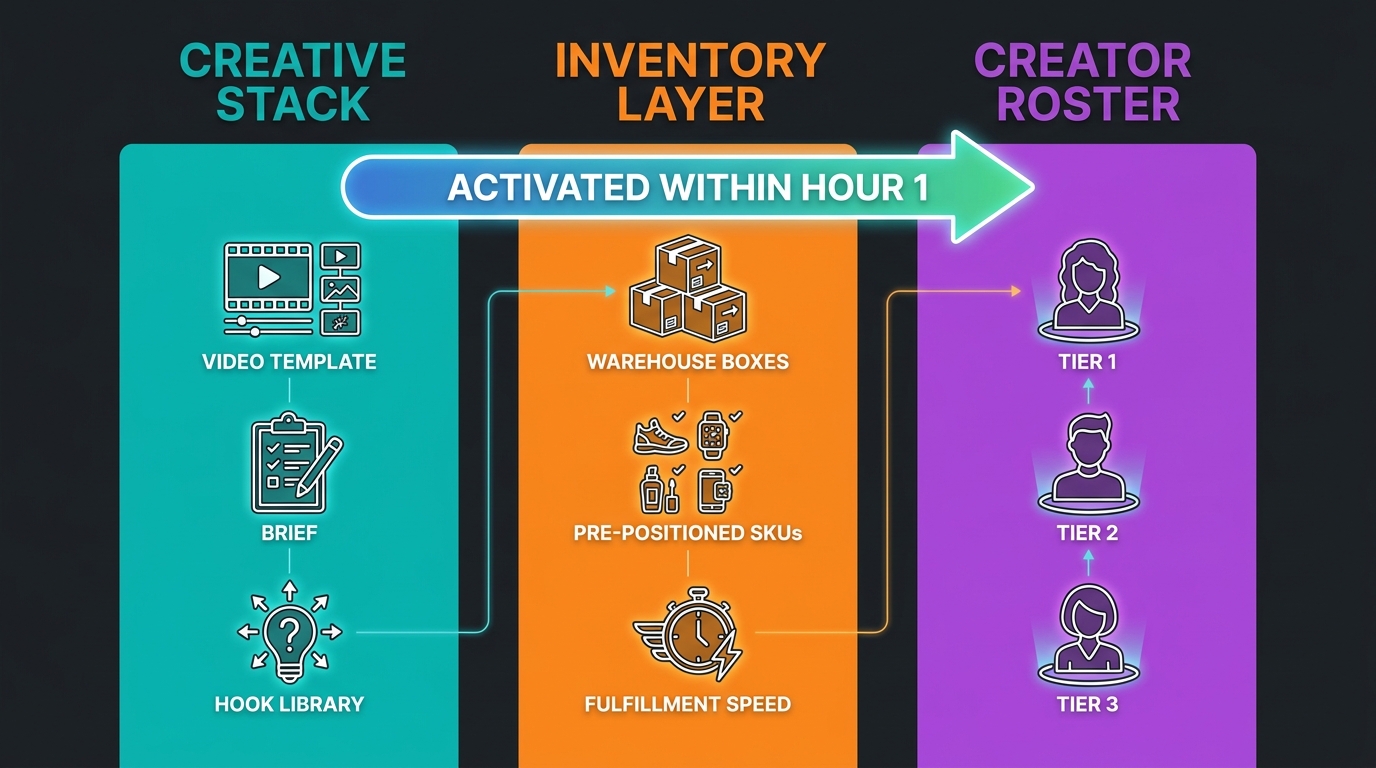
This is where most sellers fundamentally misunderstand why they keep missing windows. The six hours aren’t spent building the capability to respond — they’re spent executing a response using capability that already exists. Sellers who scramble to find creators, shoot content, build product listings, and figure out how to set up Shop links when a trend breaks are already behind before they’ve started. The infrastructure has to be in place first.
The Creative Stack: Templates, Not Blank Canvases
Your creative infrastructure for trend hijacking is a library of pre-built, adaptable video templates — not finished videos, but structural frameworks that can be quickly customized to fit a new trend. These templates define the hook format (first three seconds), the product demonstration sequence, the call-to-action, and the caption structure. When a trend breaks, your team isn’t starting from scratch — they’re adapting a known-working structure to a new format.
Maintain a minimum of five to eight adaptable templates covering different trend types: transformation formats, comparison formats, testimonial formats, “day in my life” formats, and challenge response formats. Each template should have a clear brief document that a creator can pick up and execute in under two hours without a briefing call.
Your hook library is equally important. A bank of proven opening lines and visual hooks — sorted by product type and emotional trigger — means your creative team isn’t writing from zero under time pressure. The first three seconds of a TikTok video determine whether viewers stay or scroll, and producing them under trend-speed time pressure without a library to draw from almost always results in generic, ineffective hooks.
The Inventory Layer: Pre-Positioned SKUs
Speed of content is irrelevant if speed of fulfillment is too slow. One of the most expensive mistakes in trend hijacking is driving a surge of orders for a product that then ships in 7 to 14 days — at which point buyer intent has evaporated, cancellation rates spike, and the refund cycle erodes the margin from the sales you did make.
Pre-positioning inventory means having your most trend-likely SKUs in regional fulfillment centers before you need them. This requires identifying your “likely viral” product portfolio in advance — typically 8 to 15 SKUs that have the visual and category characteristics that make them trend-compatible — and maintaining elevated stock levels for those items continuously. The cost of carrying that extra inventory is almost always lower than the cost of missing fulfillment windows on a trend.
If you sell products with longer production cycles, the inventory pre-positioning logic extends to sourcing: identify trend-compatible products and ensure your supply chain can respond in 24 to 48 hours with surge inventory if needed. Sellers using TikTok Shop’s Fulfilled by TikTok (FBT) program have a structural advantage here, since FBT stock is already positioned for rapid dispatch without manual fulfillment coordination.
The Creator Roster: Warm Relationships, Not Cold Outreach
When a trend breaks, you have no time for creator discovery, contract negotiation, or onboarding briefings. The creators you need are the ones you’ve already worked with — people who understand your products, know your brand expectations, and can receive a two-paragraph brief and produce content the same day.
Maintain a tiered creator roster specifically for trend response. Tier 1 is a small group of three to five high-trust creators who can turn content around in two to four hours and have audiences that align well with your primary buyer profile. Tier 2 is a larger group of ten to twenty creators with slightly slower turnaround (six to twelve hours) but higher volume. Tier 3 is a backup bench of fifty or more creators for amplification once the initial trend content is live and showing velocity signals.
Keep these relationships warm with regular communication, early product seeding, and predictable payment timelines. Creators who trust that you pay on time and treat them professionally will prioritize your briefs when you send them on short notice. Creators who have been treated as transactional tend to deprioritize brands they don’t have relationships with when multiple brands are suddenly competing for their attention during a trend window.
The Listing Infrastructure: Shoppable From Day One
Every product in your trend-likely portfolio needs a live, optimized TikTok Shop listing before a trend breaks — not a draft, not a placeholder, but a fully live listing with quality images, product video, accurate descriptions, and proper categorization. TikTok’s April 2026 AI Smart Listing Optimizer has reduced the time to build quality listings significantly, but even with that tool, building a listing from scratch under trend-speed time pressure is a risk you don’t need to take.
The specific operational task: audit your trend-likely SKU portfolio monthly and confirm all listings are live, optimized, and have current inventory counts that accurately reflect what you can fulfill.
The 6-Hour Execution Playbook — Hour by Hour
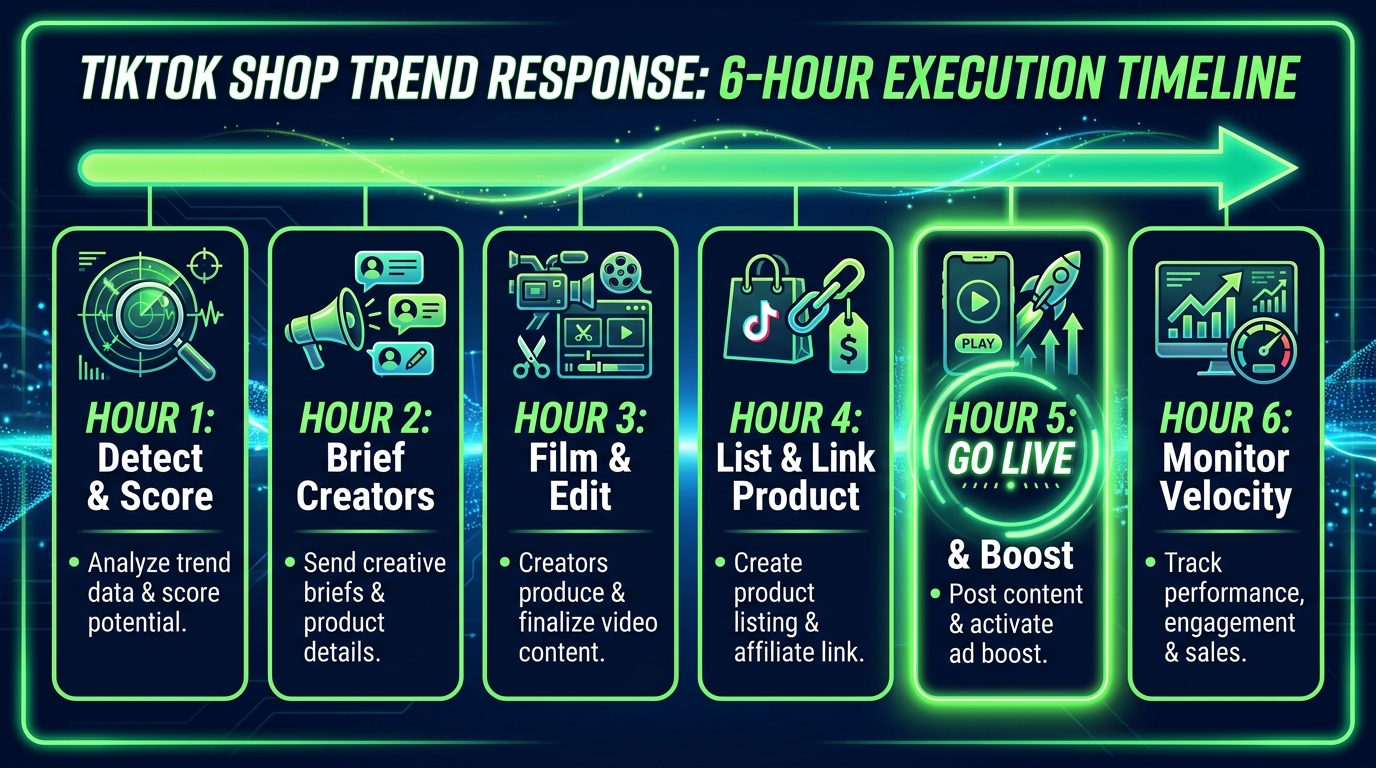
With your infrastructure in place, here is what the actual six-hour execution sequence looks like. These timings assume a small-to-medium team (one to three people with operational responsibilities) and a Tier 1 creator on standby.
Hour 1: Detect, Qualify, and Decide
The trend signal comes in — from an alert, from your monitoring team member, or from a creator in your network. Before anything else, the first question is whether this trend actually fits your product and brand. Not every trending sound or format is a viable vehicle for every product. The qualification framework should take no more than ten minutes:
- Is this in the spark phase? Check content volume: under 500 videos using the sound or format suggests you’re early enough.
- Does our product fit authentically? Would a native TikTok creator plausibly use this format to showcase this product without it feeling forced?
- Is the trend appropriate? Cultural context check — does the trend have any associations that would be problematic for your brand or your audience?
- Can we fulfill? Is inventory live and adequate for a potential surge?
If the answer to all four is yes, activate the response. If the product fit is questionable, the correct decision is to pass. Forced fit trend content performs poorly and — worse — can actively damage brand perception when TikTok’s audience reads it as opportunistic.
Hour 2: Brief Your Creator
Using your pre-built brief template, send your Tier 1 creator a brief that includes: the trend (with a link to example videos), your product (they should already know it), the specific hook you want used, the key product demonstration to include, the call-to-action, and the caption/hashtag direction. The brief should be receivable and actionable without a call — if your creator needs to ask for clarification, your brief needs work.
Confirm their availability and estimated turnaround. For Tier 1 creators with whom you have a strong working relationship, this conversation often takes three to five minutes. Set an expectation for delivery at Hour 4 at the latest, giving buffer time for revisions and posting before Hour 6.
Hour 3: Prepare the Commerce Layer
While the creator is filming, your team is handling the commerce setup. Confirm the product listing is live and accurate. Check that the product link is correctly connected to TikTok Shop. If you’re planning paid amplification (Spark Ads), draft the campaign structure now so it’s ready to activate the moment the video goes live. Pre-stage any promotional mechanic — a limited-time coupon, a bundle offer, or a Shop Flash Deal — that can be activated alongside the content to sharpen the purchase trigger.
This is also when you brief your Tier 2 creators if the Tier 1 qualification call showed strong potential. Earlier briefing of Tier 2 means their content can follow within two to four hours of the first video, creating a content cluster that gives the algorithm multiple velocity signals to feed on.
Hour 4: Review, Approve, and Optimize
The creator delivers their content. Review against two criteria only: does it feel authentically native to the trend format, and does the product demonstration clearly create desire? Do not over-direct. The most common approval mistake is requesting changes that make the content feel more like a brand ad and less like organic TikTok — which kills performance. If the hook works and the product moment lands, approve it.
Attach the product link. If your product listing has a video field, ensure it’s populated (TikTok’s algorithm weights listings with native video content more favorably than image-only listings). Confirm caption length (keep it concise — 150 characters or under performs best for shoppable content) and hashtag selection: two to three trend-specific hashtags plus one to two product category hashtags.
Hour 5: Publish and Activate
Post the video. Activate any Spark Ads amplification immediately if you’re using paid support — the earlier the paid signal layer goes in, the more it compounds with organic velocity. Notify your Tier 2 creator roster that the trend is confirmed and active; their content should be live within the next four to eight hours to extend the window.
Do not publish and walk away. The first 30 minutes after posting are the most critical monitoring window. TikTok’s algorithm runs its first distribution test in this period — checking completion rate, engagement rate, and commerce click rate on a seed audience. If those numbers are strong, distribution accelerates. If they’re weak, the video gets limited reach regardless of trend timing.
Hour 6: Read the Signals and Adapt
At Hour 6, you have enough data to make the first key decision: scale or adjust. If the video’s completion rate is above 50%, click-through rate to the product is strong (above 3%), and add-to-cart actions are climbing — scale the Spark Ads budget and activate more creator posts. If the numbers are weak, diagnose why before spending more. Common culprits at this stage: the hook didn’t land (viewers are dropping in the first three seconds), the product link placement was awkward, or the trend format has already started saturating faster than expected.
The Hour 6 decision is also about the next wave: do you brief additional creators now to extend the play into the next 12 to 24 hours? This depends on whether the trend signal still shows growth or is starting to flatten. Tools like FastMoss’s hourly volume tracking will tell you whether new video creation in the trend is accelerating (extend the play) or decelerating (the window is closing).
Content That Converts vs. Content That Just Gets Views
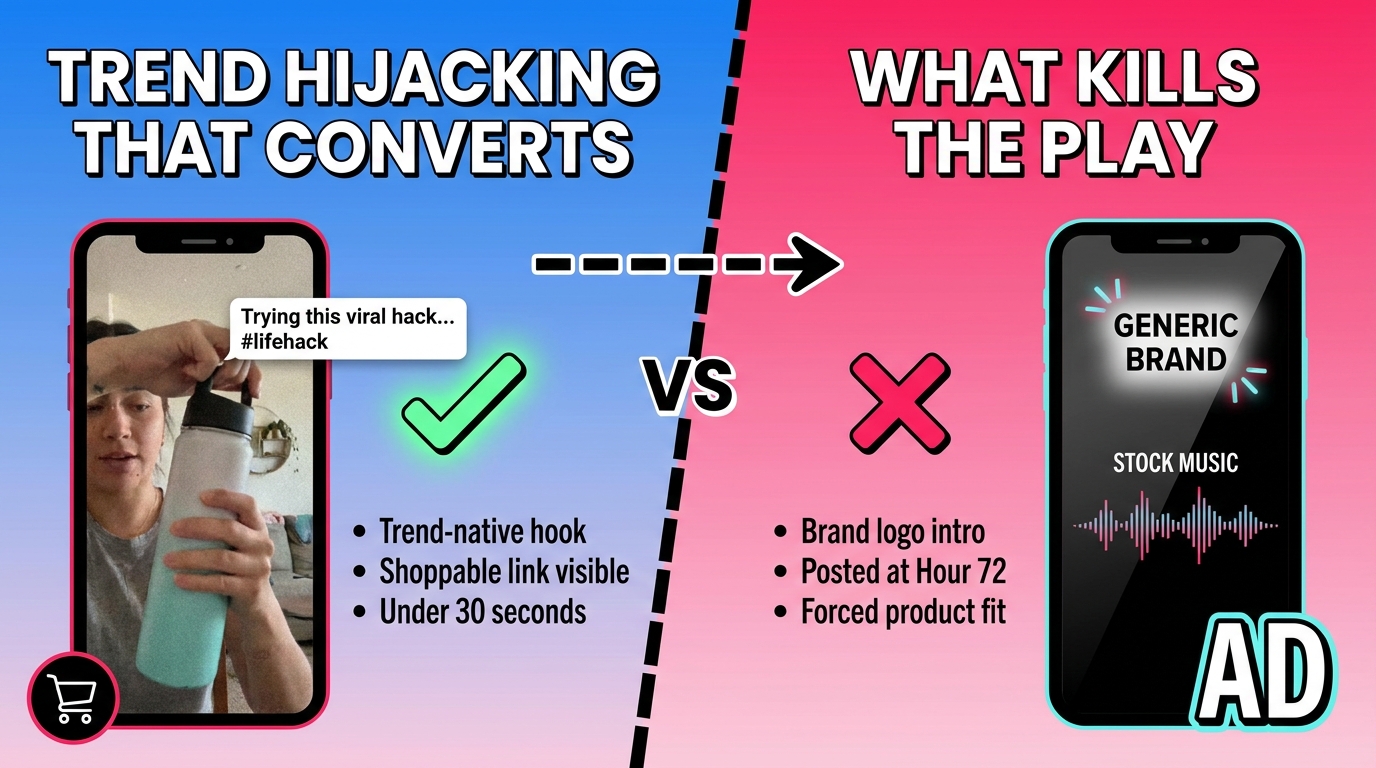
View counts and sales are not the same metric, and trend-hijacking content that conflates them is a common source of wasted effort. A video can accumulate hundreds of thousands of views while driving essentially zero purchases — and in a six-hour execution window where every decision has a cost, optimizing for views instead of commerce signals is an expensive mistake.
The Commerce-First Hook
The first three seconds of a TikTok Shop video need to accomplish two things simultaneously: fit the trend format well enough to get watch time, and establish a purchase-relevant context immediately. This is the tension that makes trend-hijacking content harder to produce than it looks. Pure trend content optimizes for entertainment; pure product content optimizes for conversion. The best trend-hijacking content finds the overlap.
In practice, this usually means opening with the trend’s audio/visual language for one to two seconds, then immediately transitioning to a product demonstration that feels like a natural extension of the trend rather than an interruption. The transition is everything. If it feels like a commercial break, viewers scroll. If it feels like the trend naturally led to the product moment, they stay — and they buy.
The Product Demonstration Window: Seconds, Not Minutes
For TikTok Shop content, product demonstrations should be short, specific, and sensory. Show the product working, not the product being explained. A serum being applied and a visible texture result. A gadget solving a clear problem in real time. A fashion item being styled in a way that produces an immediate “I want that” response. The demonstration should take no more than five to eight seconds — which means you need to select the single most compelling moment of the product experience, not a comprehensive overview.
Longer isn’t better. In fact, for impulse-driven purchases (which is what trend-speed commerce produces), shorter demonstrations with sharper emotional triggers consistently outperform longer, more comprehensive ones. The goal is desire, not education.
The Call to Action That Doesn’t Feel Like One
Explicit calls to action (“link in bio,” “tap to shop”) perform worse in trend-hijacking content than organic-feeling closers that assume purchase rather than requesting it. Phrases like “available now in the comments” or creators saying “I got mine through TikTok Shop, linking it” work better precisely because they mimic organic creator behavior rather than brand advertising. The purchase action should feel like the natural next step after a compelling demonstration, not a request that reminds the viewer they’re watching a sales piece.
Authenticity Signals the Algorithm Rewards
TikTok’s algorithm in 2026 applies multiple content quality signals beyond engagement metrics — including whether a video appears to be native creator content or produced advertising. Over-produced content (professional lighting setups, brand logo interludes, polished transitions) consistently underperforms authentic-feeling content in organic distribution, regardless of production quality. This is a strategic advantage for sellers who brief creators to shoot in their natural environment rather than in studio settings — it produces content that the algorithm treats more like organic TikTok and less like a paid placement.
When to Bail — Recognizing Saturation Before You Waste Spend
Knowing when to stop is as operationally important as knowing when to start. The temptation when a trend looks exciting is to keep pushing — more creators, more ad spend, more variations — even as the commercial window is closing. The ability to read saturation signals early and disengage cleanly is what separates sellers who maintain healthy margins from those who chase trends into negative ROI territory.
The Four Saturation Signals
Video creation rate plateauing or declining: When the number of new videos being posted using a trend’s sound or format stops growing, the trend’s creative energy is exhausted. New entries into a stalled trend get proportionally less algorithmic distribution because the FYP has less reason to keep testing new variations of a format that’s no longer accelerating.
Completion rate dropping: If your trend-hijacking videos were showing 55%+ completion rates at Hour 2 but are showing 35% by Hour 18, viewer fatigue is setting in. The format has become familiar enough that audiences are no longer watching to the end. This directly impacts the velocity signals that drive FYP distribution, creating a compounding decline.
Add-to-cart rate falling without change in content: If the same creative is driving fewer add-to-cart actions per thousand views than it was six hours ago, it’s not a creative problem — it’s a demand problem. The trend-driven impulse is fading, and the urgency that drives rapid purchase decisions during spark-phase exposure is gone.
Competitor saturation becoming visible: If you open TikTok and see three to five versions of the same trend-product combination from competing sellers in a single scroll session, you’re past the prime window. You can continue to run efficiently if your creative and pricing are competitive, but the margin on new spend is declining with each passing hour.
The Exit Protocol
When saturation signals appear, the clean exit strategy is: pause new creator briefs, cap Spark Ads budgets at current levels (don’t increase), allow current content to run its natural distribution cycle, and redirect attention to the next trend signal. Do not discount aggressively to clear remaining trend-period stock — it trains your audience to wait for discounts and erodes the perceived value of products that should be selling at full margin.
The Mistakes That Kill the Play
The failure modes in trend hijacking are predictable. The same mistakes appear repeatedly across sellers at every scale, and most of them are operational rather than creative.
Mistake 1: Mistaking Trending For Timely
A trend that’s been on the Featured Sounds list in TikTok Creative Center for 24 hours is not a spark-phase trend. It’s a wave-phase trend that’s heading toward saturation. Sellers who see a trend featured in TikTok’s own trending tools and treat that as an early-mover signal are systematically entering late — because TikTok’s curation of “trending” sounds is inherently backward-looking. Use velocity data from third-party tools to make entry decisions, not TikTok’s featured lists.
Mistake 2: The Mismatched Product-Trend Pairing
Forcing a product into a trend because the trend is big — not because the fit is genuine — is the fastest way to generate views that don’t convert. TikTok’s audience is remarkably quick at identifying when a brand is using a trend as a vehicle rather than participating in it authentically. The reaction is rarely neutral: mismatched trend-jacking content often generates negative comments, which the algorithm reads as engagement but which actively damages brand perception and purchase intent.
The rule is simple: if you have to explain why this product fits this trend, it doesn’t. The connection should be immediately obvious to a first-time viewer with no prior knowledge of your brand.
Mistake 3: Over-Approving Content Into Blandness
Multiple rounds of internal review and revision under time pressure consistently produce content that is technically correct but creatively neutered. Brand safety reviews that flag authentic creator language, legal reviews that remove claims, and marketing reviews that add brand messaging all erode the native quality of the content. For trend-hijacking content specifically, native quality is the performance variable — and every approval layer that makes content safer also makes it less effective.
Establish a streamlined approval track specifically for trend-speed content. One person with authority to approve, two criteria (brand safe and authentic), and a maximum of 20-minute review time. Any more process than that is incompatible with the speed requirements.
Mistake 4: No Paid Amplification Plan
Organic trend-hijacking alone produces inconsistent results. The sellers who consistently capture trend windows at scale combine organic creator content with immediate Spark Ads amplification — using the creator’s organic post as the ad creative, which preserves all the social proof (likes, comments, shares) while adding paid distribution reach. Having a Spark Ads campaign structure pre-built and ready to activate means amplification can begin within minutes of a video going live, rather than hours later after building a campaign from scratch.
Mistake 5: Celebrating the View Count, Not the Revenue
Post-mortems on trend plays need to track GMV, conversion rate, average order value, and fulfillment cost — not views or follower gains. A trend-hijacking campaign that drove 2 million views and $8,000 in revenue with $6,000 in creator fees and ad spend is not a success story, regardless of how impressive the view count looks in a report. Build your success criteria around contribution margin before you run the play, so you’re not reverse-justifying poor commercial results with impressive vanity metrics after the fact.
Building a Repeatable System vs. Chasing Trends One-Off
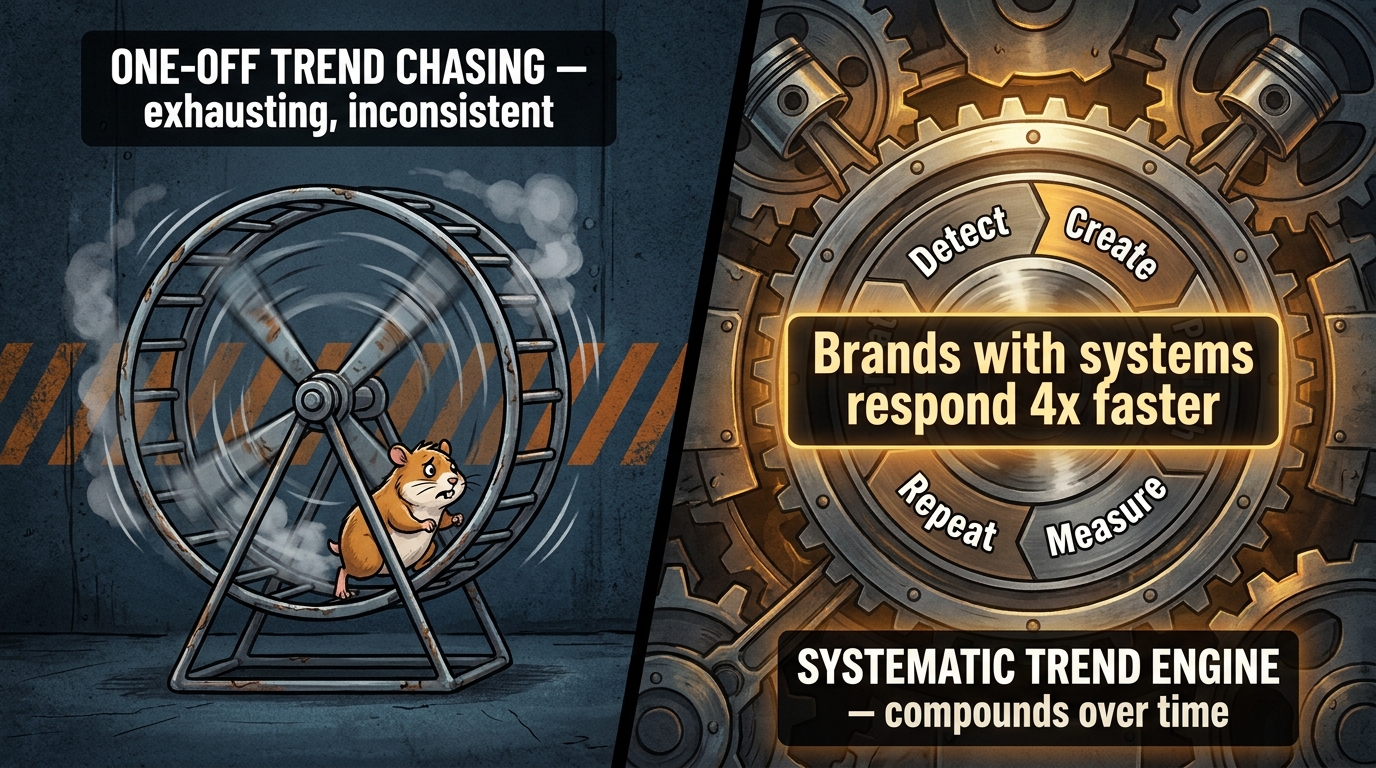
The difference between sellers who win on TikTok Shop consistently and those who win occasionally is almost always systemic. One-off trend chasers get lucky sometimes — they happen to be scrolling TikTok at the right moment, they have a product that fits, and they scramble something together in time. But the execution is painful, the results are inconsistent, and the team burns out on the uncertainty of it.
Systematic trend operations are fundamentally different. They’re built on the same infrastructure week after week, which means the execution gets faster over time as the team becomes more practiced. Each trend captured generates data — what product fits worked, which creator formats converted, which signals were most predictive — that makes the next response better. Brands with established trend-hijacking systems respond four times faster on average than those operating ad hoc, and they maintain better creative quality under pressure because they’re executing against known templates rather than inventing from scratch.
The Weekly Trend Operations Rhythm
Systemizing trend hijacking means building a weekly operating cadence that prepares for the next trend even while running the current one. This looks like: a Monday trend review that assesses what worked last week and updates the hook library, a Wednesday creator relationship touchpoint that seeds product samples for potential trend-relevant items, a Friday brief library audit that ensures templates are current for the trending format styles of the moment, and daily detection monitoring that runs as an always-on background function.
This rhythm means the team is never caught flat-footed. When a trend breaks on a Tuesday morning, the detection protocol, brief templates, creator relationships, and inventory are all already current — not last month’s version of each.
The Post-Trend Debrief as a Learning System
Within 48 hours of each trend play concluding, run a structured debrief that captures: the detection signal that flagged the trend (was it an alert, a creator tip, or manual checking?), the time from detection to video live, the time from video live to first sale, completion rates and conversion rates at the 6-hour, 12-hour, and 24-hour marks, total GMV generated, total spend (creator fees plus ad spend), and contribution margin. Over time, this data builds a pattern library that dramatically improves your ability to predict which trends are worth the execution cost and which ones to pass on.
The pattern library also helps identify your most predictive detection signals — maybe GMV velocity spikes in your category are more reliable than sound adoption rates, or maybe mid-tier creator adoption in your niche is consistently the earliest usable signal. This institutional knowledge is a genuine competitive advantage that can’t be purchased from a tool provider.
Scaling the Operation Without Losing Speed
As the operation scales, the primary risk is adding process layers that slow execution back down toward the pace of a one-off scramble. The protection against this is keeping the trend-speed decision track narrow and empowered: one person who can say yes, pre-cleared relationships with creators and ad platforms, and standing purchase orders or agreements with creators that eliminate the need for new contracts each time.
The Tier 1 creator relationship is especially important here. Structuring an ongoing arrangement — a monthly retainer that includes guaranteed trend response briefs, with a per-video fee for execution — is more effective than individual campaign negotiations, which introduce contract friction exactly when you can least afford it. Creators who know what they’re getting paid and have a pre-agreed working relationship respond faster and more reliably than those being negotiated with under deadline pressure.
The Operational Edge Most Sellers Never Build
There is a version of TikTok Shop trend hijacking that is genuinely competitive at scale, and it looks almost nothing like the “post more content” advice that most sellers receive. It’s an operations function — built on detection infrastructure, pre-positioned inventory, pre-warmed creator relationships, pre-built creative templates, and pre-staged commerce mechanics — that activates as a coordinated system the moment a trend signal appears.
The sellers who have built this function don’t experience the six-hour window as a sprint. They experience it as an execution sequence they’ve run dozens of times, each time faster and more precisely than the last. The window feels comfortable because the infrastructure was ready before the clock started.
The entry cost for building this infrastructure is lower than most sellers expect. It doesn’t require a large team — it requires clear roles, standing relationships, and well-documented processes. A two-person operation with strong creator relationships and good monitoring habits can execute the full six-hour play more effectively than a twenty-person marketing team that hasn’t built the underlying system.
What it does require is the discipline to build the system before you need it — which means investing in creator relationships when you’re not in a trend window, auditing your product listings before a trend breaks, and keeping inventory pre-positioned for SKUs that haven’t trended yet. That forward-facing operational investment is exactly what most sellers deprioritize in favor of reactive effort — and it’s the gap that explains why the same brands keep winning the same windows, while everyone else watches from the outside.
What to Do This Week
The six-hour window won’t wait for you to build the perfect system. Here’s where to focus first, in priority order:
- Audit your detection stack. Are you running any velocity-based alerts, or are you checking tools manually? Set up at minimum one automated GMV velocity alert in FastMoss or Kalodata for your primary product category. Start there before adding more tools.
- Identify your trend-likely SKUs. Which five to ten products in your catalog have the visual clarity, price point, and demonstrability for trend-speed commerce? Confirm all of them have live, optimized TikTok Shop listings with current inventory counts.
- Message three creators today. Not to brief a trend — just to maintain the relationship. Send a product sample, ask for feedback, share something from their recent content you genuinely liked. Warm relationships don’t happen in the six-hour window; they happen in the weeks before it.
- Build one brief template. Take your best-performing TikTok Shop video, reverse-engineer the brief that would have produced it, and document it as a reusable template. That’s your starting creative infrastructure.
- Define your go/no-go criteria. Before the next trend breaks, write down the four or five questions your team will use to decide whether to activate the play. A decision framework used under pressure is worth ten times a decision framework built during the trend itself.
The brands that win the six-hour window consistently aren’t faster thinkers. They’re more prepared operators. The time to build that preparation isn’t when a trend breaks — it’s right now, while nothing is moving yet.