


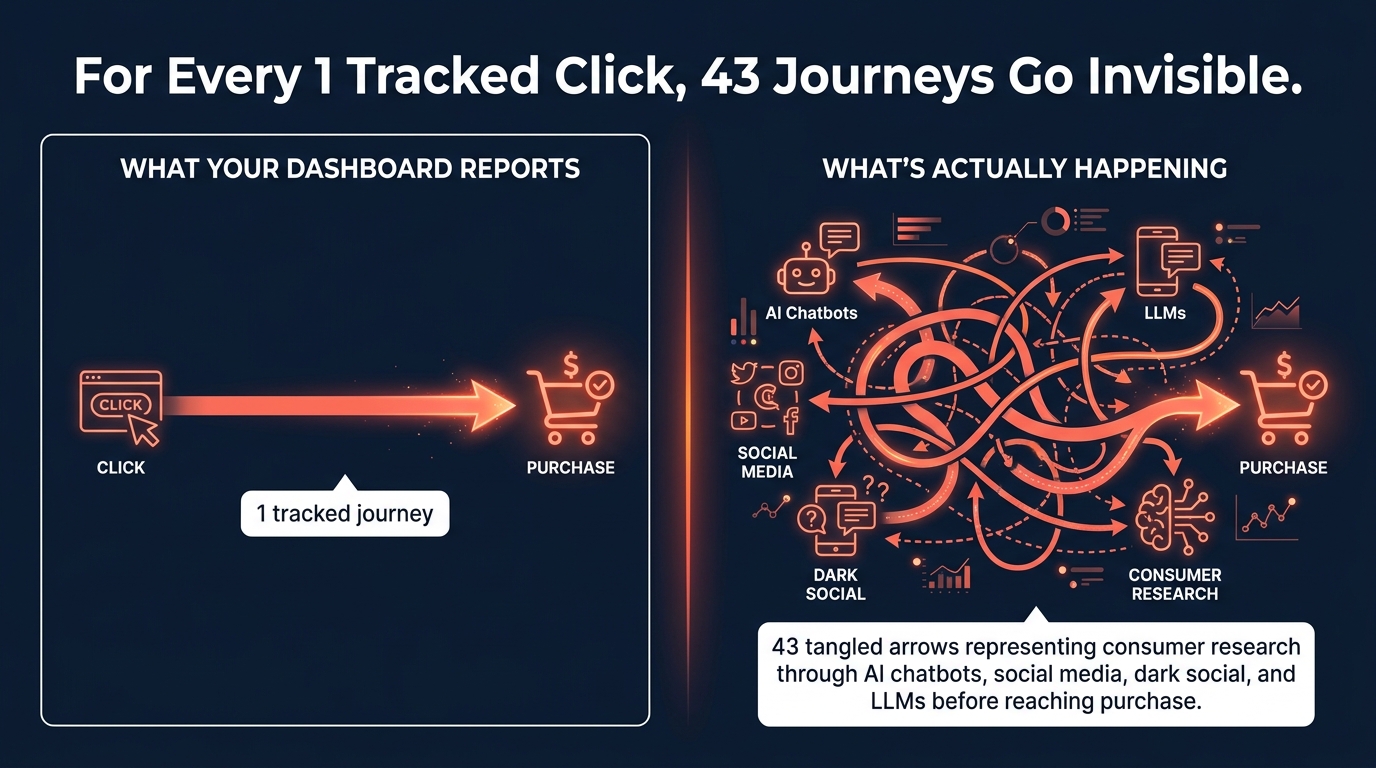

Your affiliate dashboard looks fine. Commissions are paying out, partner traffic is converting, and the CPA numbers are within range. Everything appears to be working.
That appearance is costing you money — quietly, consistently, and at a scale most sellers don’t discover until they run a proper audit.
Affiliate attribution in 2026 is operating under a set of structural failures that didn’t exist five years ago. Third-party cookie deprecation is now eliminating 30–50% of browser-based tracking signals on affected traffic. AI-mediated discovery — through LLMs, AI Overviews, and chat interfaces — is generating enormous consumer influence that produces zero trackable clicks. Fraud is consuming an estimated 8–15% of gross affiliate spend in programs that haven’t updated their detection. And last-click logic, still the default model across most networks, is systematically misattributing credit between partners who drive awareness and partners who merely show up at checkout.
This isn’t a gradual drift. These are compounding failures happening simultaneously, and the result is that the data your program runs on has become an unreliable proxy for what’s actually driving your revenue. Sellers who don’t intervene are overpaying the wrong partners, underpaying the right ones, losing conversion data at scale, and making budget decisions on attribution reports that have never been less accurate.
This article breaks down exactly where attribution is breaking, why it’s breaking now, and what a working fix looks like in practice.
The 43-to-1 Problem: Last-Click’s Catastrophic Blind Spot
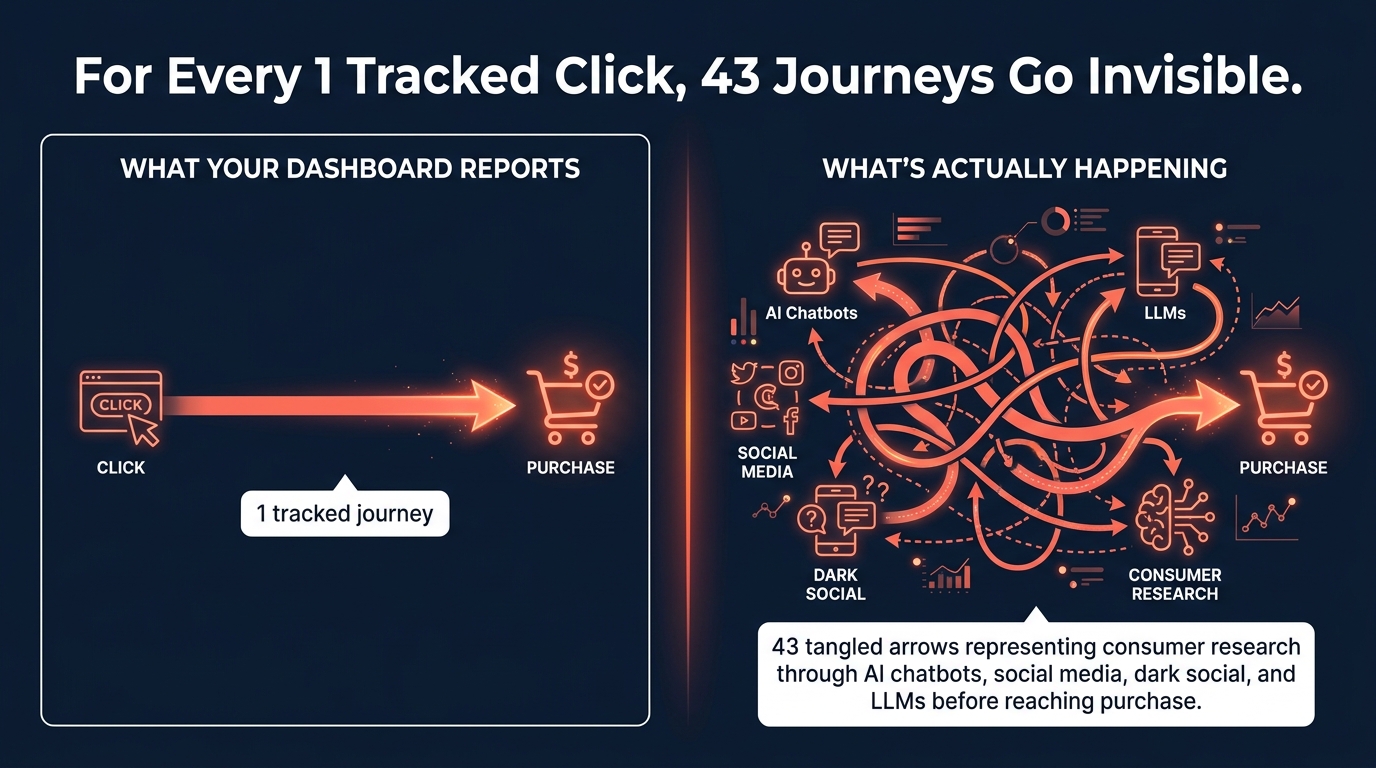
The most revealing data point in affiliate attribution research right now came from an internal analysis by loveholidays, presented at Partnership Day London in July 2026. The finding was stark: for every single tracked, last-click conversion their affiliate program recorded, 43 separate consumer journeys were happening in the background — journeys the program was completely blind to.
Those 43 journeys weren’t idle browsing. They were consumers conducting deep research inside AI interfaces, reading publisher content, watching creator videos, and forming purchase intent — all before arriving at the brand with a decision already made. The click that triggered the last-click conversion was essentially the final administrative step of a purchase that had been decided elsewhere, by influences the program never measured and never compensated.
Why Last-Click Survives Despite Its Failures
Last-click attribution has remained the default in affiliate programs not because it’s accurate, but because it’s operationally simple. A click happens, a cookie fires, a conversion is recorded, a commission pays out. There are no disputed credit splits, no complex modeling requirements, no arguments between partners about fractional allocations. For the infrastructure of 2015, it worked well enough.
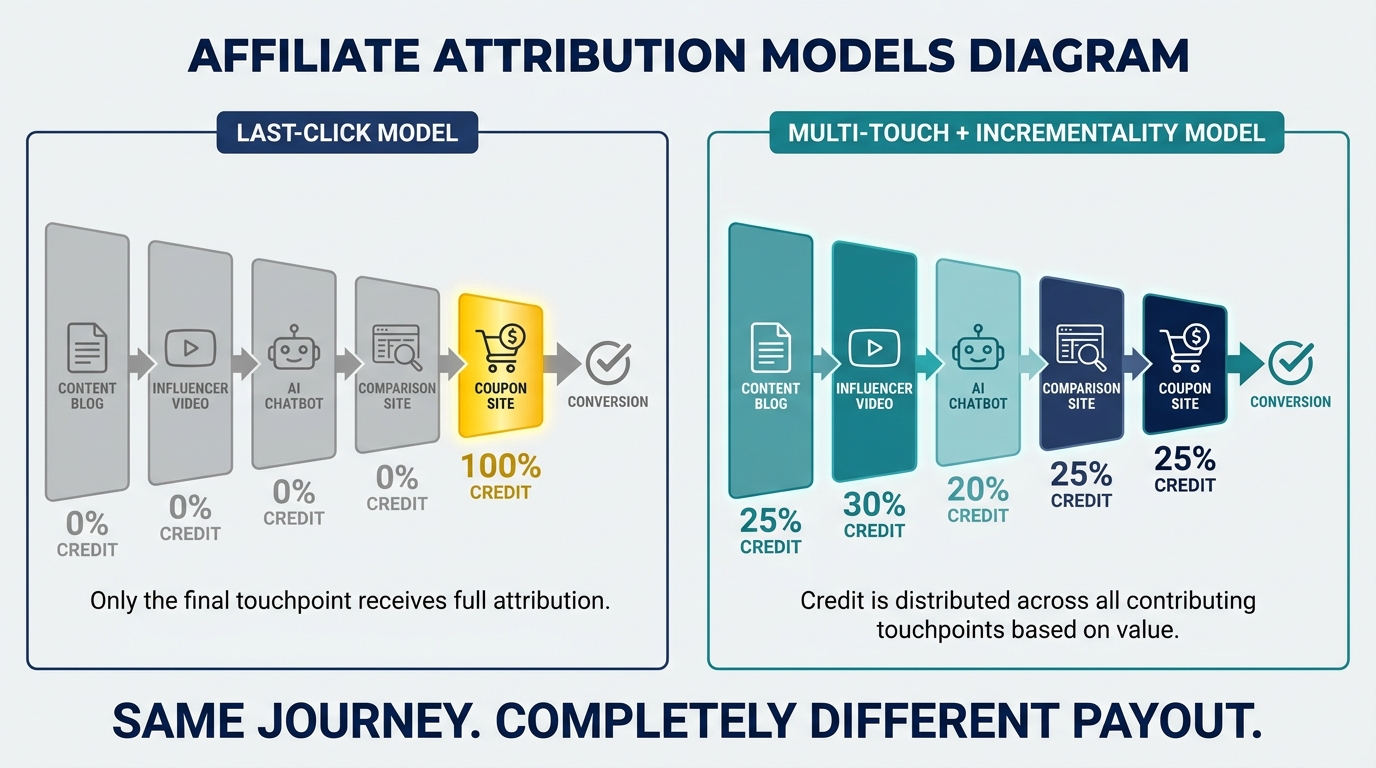
But the consumer journey has fundamentally changed. Industry data from mid-2026 now shows that content publishers are frequently responsible for 60–70% of a brand’s overall conversions when influence is properly measured, yet they’re credited for far less under last-click. In luxury markets, the under-attribution rate for content partners runs between 30–60%. In travel, publishers responsible for more than half of all conversion influence routinely receive credit for a fraction of that.
The structural problem isn’t just unfairness to publishers. It’s that last-click creates a perverse incentive structure. Programs optimized around last-click systematically fund coupon and cashback sites — which intercept the final step of already-decided purchases — while starving the content partners and creators who actually generated the purchase intent in the first place. Over time, this degrades the program’s ability to drive genuinely new demand, because the partners best at doing that are earning the least.
The Numbers Behind the Misallocation
Research across 2024–2026 has put quantitative shape on what this misallocation costs. Companies that switch from last-click to properly implemented multi-touch attribution report:
- 15–30% higher marketing ROI from the same budget
- 14–36% improvement in cost per acquisition
- 18–22% average gain in budget efficiency as spend shifts to under-credited upper-funnel partners
These aren’t theoretical improvements. They reflect real budget reallocation — money moving away from coupon sites that were capturing already-converted customers, toward content and creator partners who were generating conversion intent that the program was never measuring.
The flip side of that gain is that every month a program stays on last-click represents that difference in misallocated spend. The question isn’t whether to fix attribution — it’s how quickly the cost of inaction compounds.
Cookie Deprecation’s Real Toll: 30–50% of Conversions Going Dark
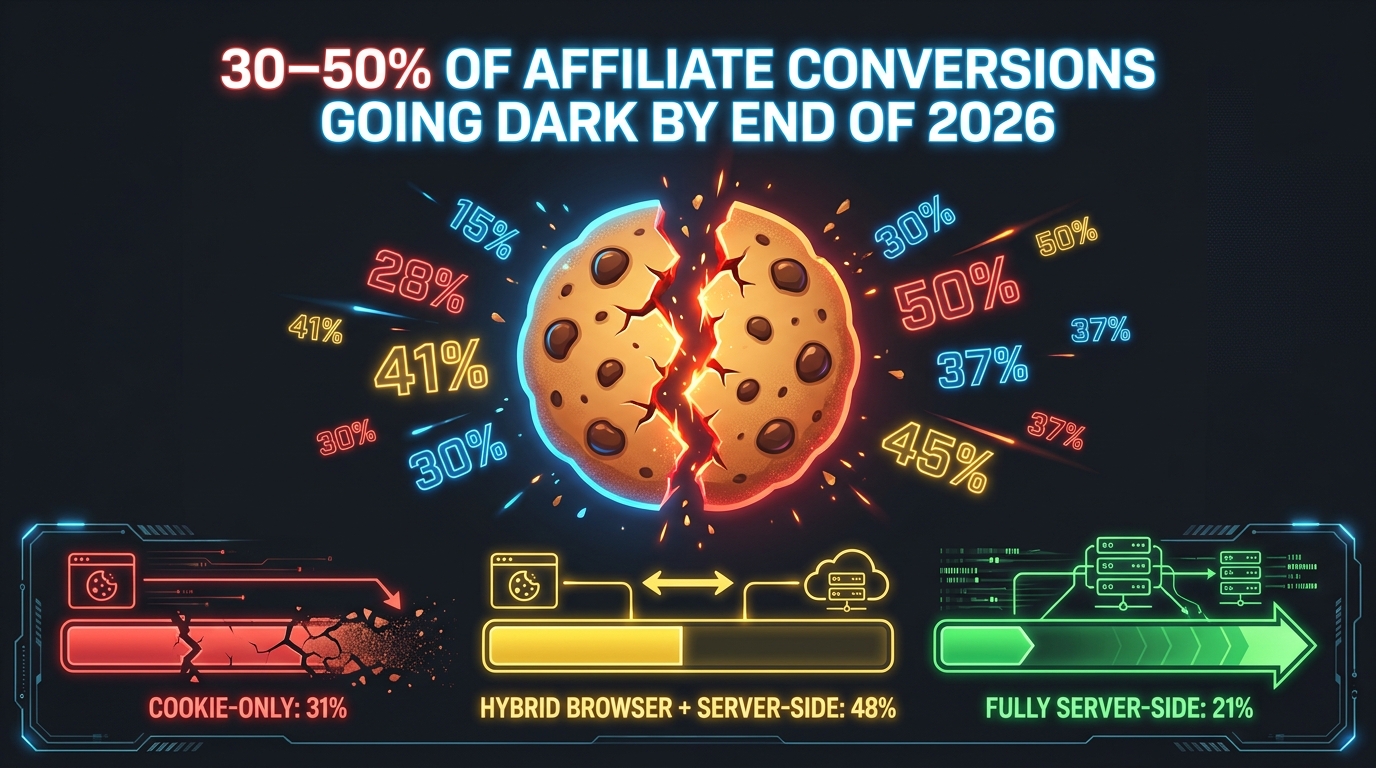
Chrome’s Privacy Sandbox completed third-party cookie deprecation across the majority of its user base in Q3 2026, affecting approximately 65% of web traffic. For affiliate programs that haven’t updated their tracking infrastructure, this isn’t a future problem — it’s already happening at scale.
The conversion loss figures are significant. Programs relying primarily on browser-based cookie tracking are experiencing 20–35% conversion loss under standard measurement conditions. For programs with no server-side backup, attribution accuracy has declined by 30–50% on affected browser traffic. What this means in practice: a seller running a $500,000 annual affiliate program on cookie-only tracking may be operating with an accurate view of only half to two-thirds of actual performance.
The Multi-Browser Problem
Chrome gets most of the attention, but the cookie problem was never exclusively a Chrome issue. Safari’s Intelligent Tracking Prevention (ITP) has been blocking third-party cookies since 2017, and its restrictions have tightened progressively since. Firefox has had equivalent protections in place for years. By the time Chrome’s deprecation completed, a substantial portion of affiliate traffic was already tracking-impaired — the deprecation simply closed the last major gap that kept the problem manageable.
Cross-device journeys compound the issue further. A consumer who discovers a product on their phone via an influencer post, switches to a desktop to research, then converts on a tablet creates three separate tracking sessions with no reliable mechanism to join them under browser-based attribution. That journey produces an attributed conversion for whichever touchpoint happened to set the most recent valid cookie — typically the last site the user visited before converting, regardless of where the actual purchase decision was made.
What the Adoption Data Shows
The industry has been adapting, but unevenly. Current tracking method distribution across affiliate programs shows:
- Hybrid browser + server-side backup: 48% of programs (up from 24% in 2022)
- Purely server-side (S2S postback primary): 21% of programs (up from 5% in 2022)
- Cookie-only or predominantly browser-based: Remainder, still a significant minority
The trend is clear. Programs that haven’t begun migration toward hybrid or fully server-side tracking are now in a structural minority, and their competitive disadvantage in attribution accuracy is growing with every passing quarter. Awin’s Conversion Protection Initiative, implemented in response to browser restrictions, demonstrated the scale of the recovery opportunity: programs that adopted server-side tracking recovered conversion data that had been systematically missed, improving measured performance without any actual change in underlying traffic quality.
The Zero-Click Commerce Threat: AI Discovery Breaks the Click-Track-Pay Loop
The most structurally novel attribution problem of 2026 isn’t cookie deprecation — that problem has a known fix. It’s the emergence of AI-mediated discovery that generates purchase intent through mechanisms that produce no trackable click at all.
Similarweb’s most recent data puts zero-click searches at 68% of all Google searches. Google’s AI Overviews and competing LLM interfaces are now answering product and purchase questions directly within the search experience, giving consumers recommendations, comparisons, and buying guidance without ever sending them to a publisher site. The publisher’s content may have informed the AI’s response. The consumer’s purchase may be directly influenced by it. But the traditional click-to-track chain never forms, so from the affiliate program’s perspective, that influence simply doesn’t exist.
Publishers Losing Traffic While Driving Conversions
The impact on content publishers has been severe and is materially distorting affiliate program data. Traditional content publishers are reporting an average 40% decline in organic site traffic driven by Google’s algorithm updates combined with AI Overview rollouts. The traffic that used to flow through their content pages — traffic that carried trackable affiliate links — is being absorbed by AI interfaces that synthesize their content without forwarding the click.
Ed Hutchinson of The Independent put the dynamic plainly at Partnership Day London: “All of the inputs and content we spend money to create are being sucked into LLMs to surface answers, but because the click is gone, the publisher isn’t recognized in legacy dashboards.”
What makes this particularly damaging from a seller’s perspective is the asymmetry: the publisher’s influence on the purchase is real and measurable through incrementality testing, but it generates no affiliate commission under standard tracking. Programs operating on click-based attribution are getting real conversion lift from publisher content they aren’t paying for — which seems beneficial until you recognize that those publishers have no financial incentive to keep producing that content, because they can’t demonstrate the value to their advertisers.
The AI Citation Volatility Problem
One emerging workaround has been to track AI citations — instances where an LLM or AI Overview references a publisher in its response. Partnerize’s VantagePoint platform has been among the tools attempting to bridge this gap, and early data is striking: one high-street retailer discovered they had 27 times more influence from a premium publisher partnership than their standard affiliate dashboard was surfacing.
But citation tracking introduces its own instability. A major AI chat interface removed publisher citations entirely overnight without warning in mid-2026, then quietly reinstated them days later. Programs that had begun building attribution models around citation counts discovered their data had simply vanished and then returned, with no explanation and no way to predict whether it would happen again. This mirrors the existential crisis publishers faced when Facebook abruptly stopped surfacing news content — and suggests that building attribution architecture around any single AI platform’s behavior is inherently fragile.
The more durable approach emerging from leading programs is probabilistic modeling: using behavioral signals, session data, and incrementality testing to estimate influence rather than trying to capture it through deterministic clicks that may never happen.
Where the Fraud Hides: 8–15% of Spend Quietly Disappearing
Affiliate fraud has evolved significantly from its earlier, more obvious forms. Cookie stuffing and simple click injection are now baseline detection targets for most networks. The fraud that continues to evade detection in 2026 is more sophisticated, more distributed, and more expensive to programs that haven’t updated their screening.
The current cost estimates are sobering. Industry analysis from mid-2026 puts affiliate fraud at 8–15% of gross program spend for programs operating with manual or outdated fraud detection. Some exposed programs, particularly those in high-margin verticals with inadequate controls, report even higher loss rates. Across the affiliate industry, fraudulent commissions are estimated at $3.4 billion or more annually — a figure that has grown as the channel itself has grown and as fraud techniques have become more difficult to distinguish from legitimate activity.
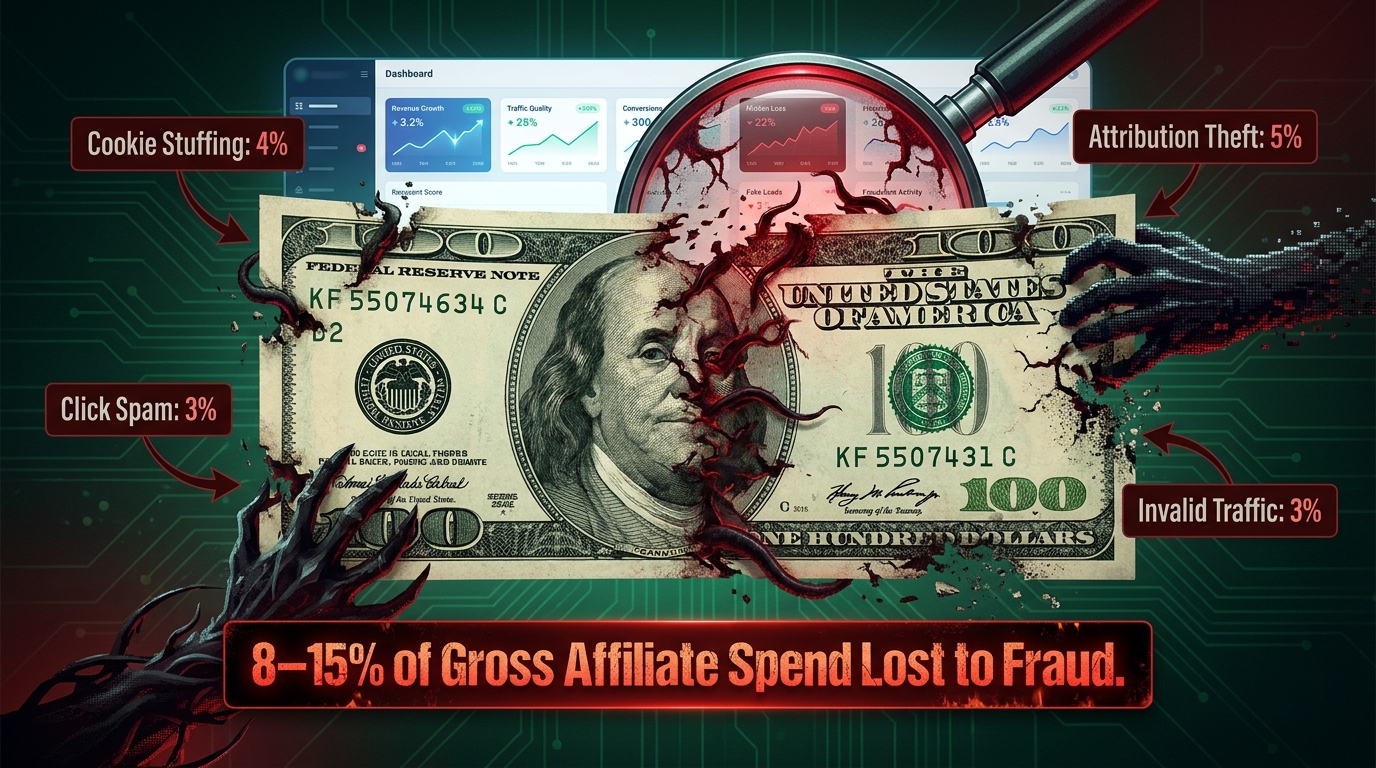
The Four Fraud Vectors That Matter Most in 2026
Click spam and invalid traffic injection remains the highest-volume fraud type. Automated systems generate clicks against affiliate links at scale to inflate conversion rates for specific partners. Even in programs with AI fraud screening in place, 7.7% invalid traffic rates have been reported — suggesting that programs without AI screening are likely operating at significantly higher exposure.
Attribution theft is the more sophisticated cousin of cookie stuffing. Rather than simply stuffing cookies at mass scale, modern attribution theft involves precisely timed link interactions that overwrite legitimate cookies just before purchase. The fraudster’s affiliate ID replaces the legitimate partner’s ID for the commission, while the conversion itself is genuine. The fraud is nearly invisible in conversion data because the purchase happened — the only evidence is in the timing patterns of the attribution change.
Coupon code leakage and unauthorized distribution represents a different fraud category that’s grown alongside influencer and creator programs. Codes intended for specific partners get distributed through unauthorized channels — coupon aggregators, browser extensions, loyalty apps — where they’re used by customers who were never influenced by the intended partner. The code attributes the conversion, the partner collects the commission, and neither party contributed to the sale.
Incremental fraud is perhaps the hardest to detect. This involves generating non-incremental conversions — sales that would have happened anyway — through affiliate links, effectively claiming commission for organic purchases. It’s not detectable through click analysis alone; it requires incrementality measurement to identify.
Why Last-Click Makes Fraud Worse
It’s worth noting that last-click attribution doesn’t just fail to detect fraud — it actively makes certain fraud types more profitable. When 100% of commission goes to the last click, the incentive to manipulate that last click is maximized. A fraudster who can reliably overwrite the last pre-conversion click earns the entire commission, regardless of what legitimate partners did earlier in the journey. Multi-touch models reduce this incentive by distributing credit across touchpoints, making the marginal value of stealing the final attribution lower.
Server-Side Tracking: Why It’s Now the Baseline, Not a Bonus
Three years ago, server-to-server (S2S) postback tracking was a sophisticated upgrade that larger programs implemented for additional resilience. In 2026, it is the minimum viable architecture for accurate affiliate measurement. Programs that treat it as optional are now operating with structurally impaired data.
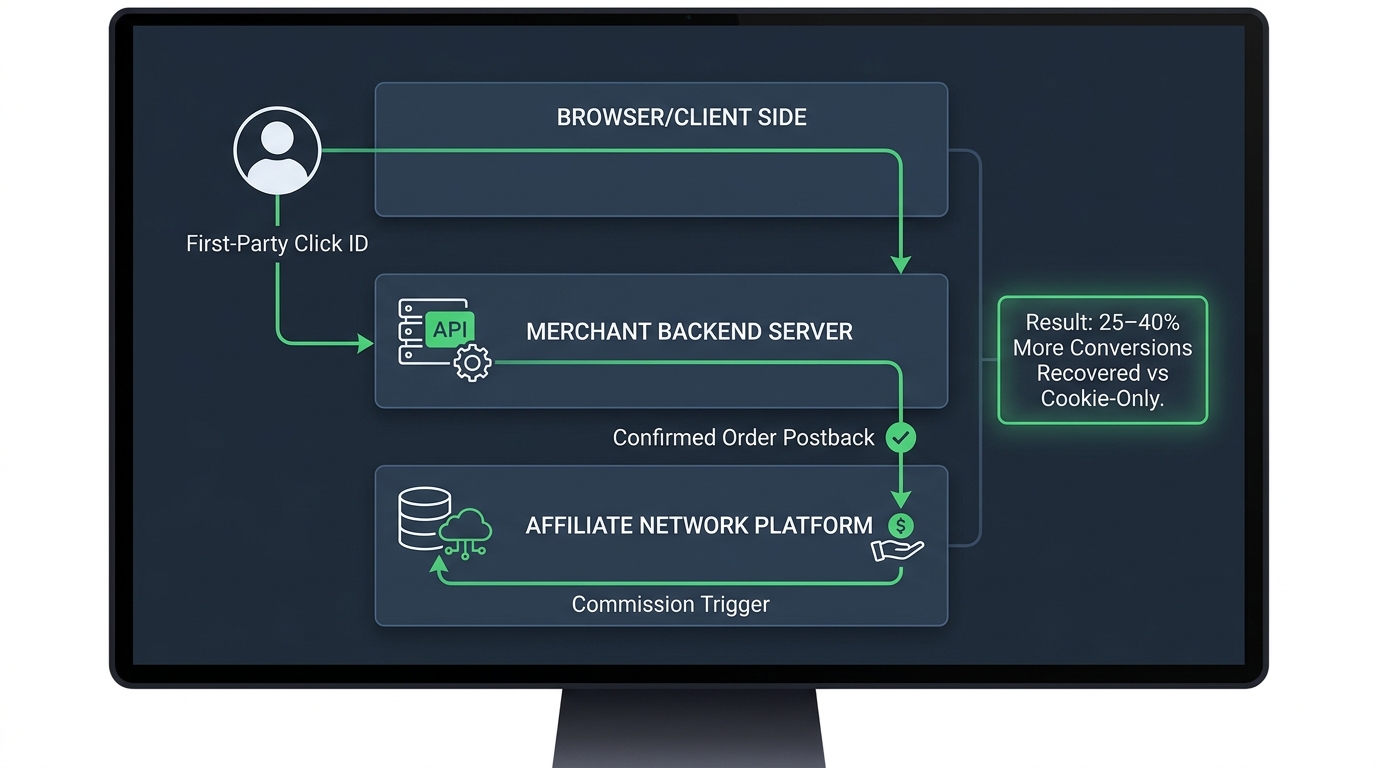
The mechanics of S2S tracking solve the core cookie problem directly. Rather than relying on a browser cookie to bridge the gap between click and conversion, S2S tracking works like this:
- When a user clicks an affiliate link, a unique click ID is generated and stored in a first-party cookie on the merchant’s own domain — not a third-party cookie, which means it’s not affected by browser restrictions
- When a conversion occurs, the merchant’s backend server reads that click ID from their own first-party storage
- The server sends a direct API postback to the affiliate network, confirming the conversion and attributing it to the correct partner
- Commission is triggered based on this server-confirmed event, not a browser-side pixel fire
Because no third-party cookies are involved and the conversion signal moves server-to-server rather than through the browser, this approach is not affected by ITP, Chrome’s Privacy Sandbox, or ad blockers. It also provides a cleaner signal: conversions recorded through S2S postbacks are confirmed by the merchant’s own backend systems, which means refunds, cancellations, and voided orders can be reflected accurately in affiliate payouts rather than being hidden by pixel-only tracking.
What Recovery Looks Like in Practice
The performance recovery from migrating to server-side tracking has been consistently documented across programs of different sizes. Programs that completed S2S implementation have reported recovering 25–40% of previously “dark” conversions — sales that were happening but not being attributed to any affiliate partner. This doesn’t represent new revenue; it represents revenue that existed but wasn’t visible in the tracking data.
That distinction matters for how programs respond. A 30% conversion recovery doesn’t mean the program suddenly grew 30%. It means the program’s CPA calculations, partner performance scores, and commission accuracy were all running 30% understated. Partners who were generating real results were getting underpaid. Partners who happened to be better at avoiding tracking loss — often coupon sites whose conversion flow doesn’t depend on multi-session attribution — were being relatively overpaid.
The Hybrid Architecture Case
Fully server-side implementation solves the attribution problem for conversions that happen through a merchant’s owned checkout flow, but it doesn’t address every scenario. App conversions, in-store attribution, and some marketplace flows require additional tracking layers. This is why 48% of programs have moved to hybrid architectures that use S2S postback as the primary attribution method with supplementary tracking for edge cases.
The practical advice from 2026 implementations is clear: treat S2S postback as the source of truth, treat client-side pixels as confirmation backups, and plan explicitly for the conversion scenarios that fall outside both — app events, offline conversion, marketplace orders — before assuming your attribution is complete.
Multi-Touch vs. Incrementality: Two Different Questions You Need to Answer
One of the most common attribution strategy mistakes sellers make is conflating multi-touch attribution (MTA) and incrementality testing, treating them as competing approaches to the same problem. They aren’t. They answer fundamentally different questions, and a well-functioning affiliate program needs both.
Multi-touch attribution asks: Among the touchpoints that preceded this conversion, which ones should receive credit and how much? It’s a credit allocation problem — useful for understanding which partners contributed to customer journeys and paying them accordingly.
Incrementality testing asks: Of the conversions this partner receives credit for, how many would have happened without them? It’s a causal question — useful for understanding which partners are generating genuinely new demand versus capturing existing purchase intent.
These are not the same question, and they don’t produce the same answer. A partner can look excellent in multi-touch attribution — appearing frequently across customer journeys, receiving distributed credit across many conversions — while delivering low or even negative incremental lift. This happens when that partner consistently appears in journeys that would have converted anyway.
The Non-Incrementality Problem at Scale
BCG’s 2026 research on next-best-action programs found that 20–40% of active affiliate partners may deliver marginal to negative lift when rigorous incrementality testing is applied. A 2026 industry analysis found that 18–24% of attributed affiliate conversions were not truly incremental in structured tests. This means that in a typical affiliate program, between one in five and one in four commissioned conversions is paying for a sale that would have happened regardless of the affiliate’s involvement.
The most common culprit is the same one that shows up in last-click analysis: coupon and cashback partners at the bottom of the funnel. A customer who has decided to buy and is now looking for a discount code finds one on a coupon aggregator site, clicks through, and converts. The coupon site receives commission. But the purchase decision was made before that customer ever visited the coupon site — the affiliate didn’t cause the conversion, they just intercepted it. Incrementality testing, done rigorously with a holdout group of similar customers who don’t receive the coupon, reveals this pattern clearly.
Practical Incrementality Testing Methods
Three testing designs are most commonly used in affiliate incrementality measurement:
Holdout experiments divide audiences into a group that is exposed to the affiliate’s influence (seeing their content, receiving their codes, clicking their links) and a control group that is deliberately excluded. Comparing conversion rates between the groups reveals the affiliate’s true causal contribution. This is the gold standard but requires sufficient traffic volume to achieve statistical significance.
Geo experiments run affiliate activity in some geographic markets while holding others flat, then compare outcomes. Useful when individual-level holdouts are technically difficult, but introduce confounding variables that require careful control.
Pause tests switch off a specific partner or partner type for a defined period and measure the impact on total program conversions. Simple to implement, but can create competitive gaps and are difficult to interpret cleanly if other program variables change during the pause period.
The industry direction in 2026 is toward always-on incrementality measurement rather than point-in-time experiments — using continuous geo holdouts or persistent audience exclusions to generate an ongoing stream of lift data rather than quarterly snapshots.
Coupon Code Attribution: The High-Risk Middle Ground
Coupon and promo code attribution deserves dedicated attention because it sits at the intersection of every attribution problem discussed so far: it’s highly susceptible to last-click distortion, particularly prone to fraud through unauthorized code sharing, increasingly affected by dark social distribution, and often delivering the lowest incremental lift in the program while appearing to perform well in dashboard metrics.
The mechanics create a structural problem. When a coupon code is assigned to a specific partner, any order using that code attributes to that partner — regardless of whether the customer found the code through that partner’s channel, saw it on a coupon aggregator, received it from a friend, or found it via a browser extension that automatically applies discount codes at checkout. The code becomes a tracking mechanism that’s completely decoupled from influence.
Browser Extensions: The Attribution Drain Most Sellers Miss
Automatic coupon extension tools — browser plugins that surface and apply discount codes at checkout without the consumer actively seeking them — represent one of the fastest-growing sources of code attribution distortion. A customer who clicked through from a content partner’s affiliate link, selected a product, and reached checkout may have their final commission hijacked if the extension fires and overwrites the attribution with its own affiliate ID moments before conversion.
This isn’t edge-case behavior. Browser-based coupon extensions have hundreds of millions of users across major platforms, and their code-application logic is specifically designed to activate at the highest-value moment in the purchase flow — checkout. Programs that don’t explicitly monitor for extension-related attribution interference can find significant portions of their content partner revenue being redirected to extension operators who contributed nothing to the purchase journey.
The Right Way to Use Coupon Attribution
Coupon codes remain legitimate and useful attribution tools when deployed with appropriate controls:
- Time-limited codes reduce the window during which a code can leak to unauthorized aggregators and still drive conversions that attribute to the wrong partner
- Partner-specific codes with usage monitoring can identify anomalous redemption patterns — a code distributed to an audience of 10,000 followers suddenly generating 200,000 redemptions signals unauthorized sharing
- Stacking controls at the checkout level can prevent extension-applied codes from overriding link-based attribution when both are present
- Incrementality testing on coupon programs provides the clearest picture of whether code distribution is driving genuinely new purchases or simply converting revenue that was already coming
The deeper strategic question for sellers running both link-based and code-based affiliate programs is whether they’re measuring the two systems together or separately. A code-based influencer program that appears to have a strong CPA may be cannibalizing link-based conversions from the same customer base rather than generating additive revenue. Only proper holdout testing can answer that with confidence.
Building a Fraud-Resilient Attribution Stack
The fraud problem and the attribution accuracy problem are connected. A program that can’t accurately measure what’s driving conversions can’t reliably distinguish between a high-performing legitimate partner and a high-performing fraudulent one. Fixing attribution and fixing fraud detection are therefore complementary work — both depend on having a clean, server-confirmed signal at the conversion level.
Current best-practice fraud stacks in 2026 affiliate programs layer multiple detection mechanisms rather than relying on any single signal:
Layer 1: Traffic Quality Screening
Real-time traffic scoring on incoming affiliate clicks, flagging patterns associated with bot traffic, click farms, and injection attacks. AI-based screening is now the norm for programs above a certain scale; the 7.7% invalid traffic rate reported for programs with AI screening suggests that manual or rule-based systems would allow significantly more fraud through. Traffic scoring should evaluate click velocity, device fingerprinting consistency, geographic distribution, and time-of-click patterns against known fraud signatures.
Layer 2: Conversion Pattern Analysis
After the click, conversion patterns for each partner should be continuously monitored for anomalies. An affiliate whose conversion rate suddenly spikes from 2% to 18% hasn’t improved their content — they’ve likely found a way to generate fraudulent conversions. Conversion timing distributions (conversions clustering immediately after clicks suggest injection; legitimate retail conversion windows are typically distributed across minutes to hours), return rates by partner, and average order value by source all provide signals that distinguish legitimate from fraudulent performance.
Layer 3: Attribution Timing Audits
Server-side tracking enables precise timestamps on attribution events. Programs that regularly audit the time gap between a partner’s click and the conversion it receives credit for can identify attribution theft patterns — legitimate last-click conversions typically have variable time distributions, while cookie-stuffing and late attribution injection often cluster at characteristically short intervals.
Layer 4: Commission Holding Periods
Building a holding period into commission payouts — typically 30–60 days aligned with return and refund windows — provides a final fraud filter. Fraudulent conversions that are reversed before payout simply don’t generate a commission. This doesn’t address all fraud types, but it eliminates the financial incentive for conversion-reversal schemes and allows time for pattern-based fraud detection to flag suspicious batches before payment clears.
The Fix in Practice: A 90-Day Attribution Audit Framework
Understanding the problems is the easier half. Putting a fix in place within a real program, with live partner relationships and existing infrastructure dependencies, requires a sequenced approach that doesn’t break things while it’s fixing them.
Based on the implementation patterns that have produced the strongest recovery outcomes in 2026, here is a practical three-month framework for sellers ready to repair their attribution.
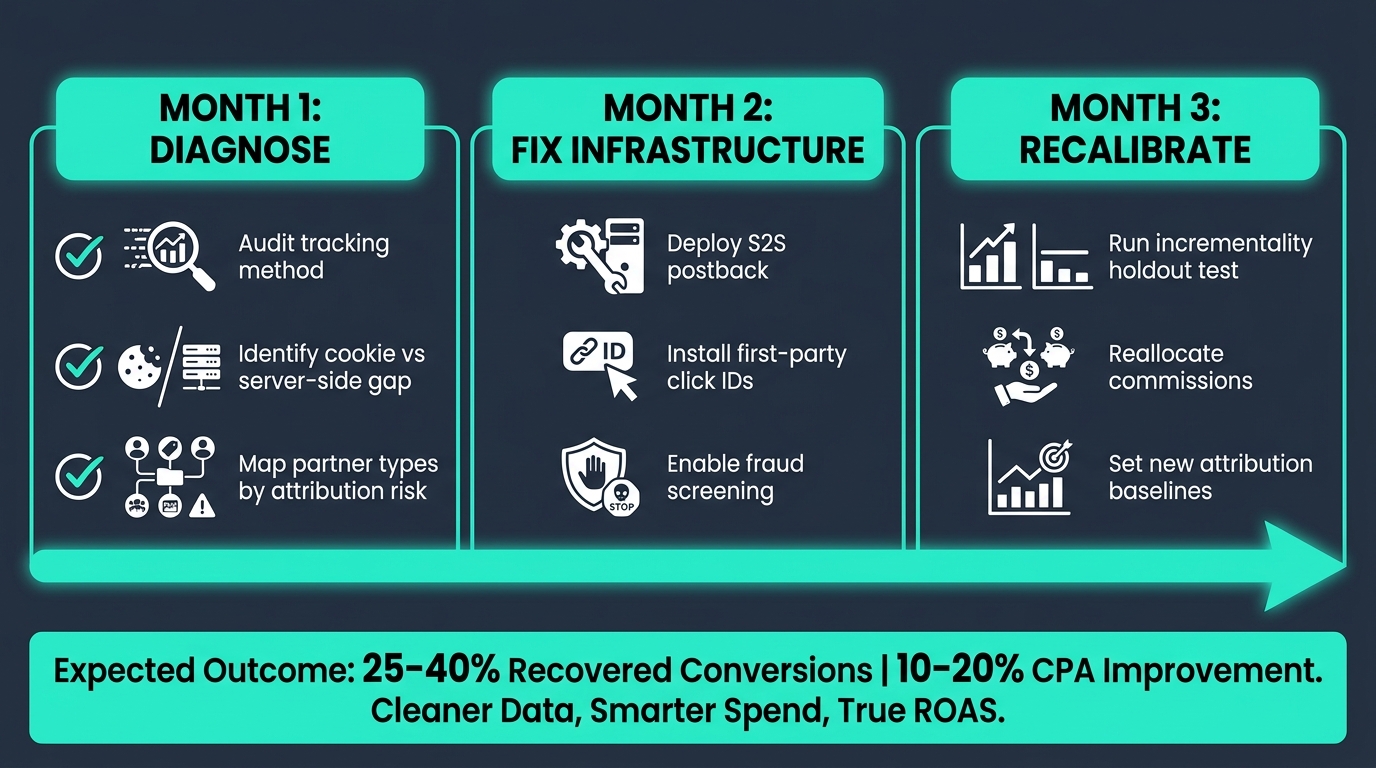
Month 1: Diagnose
Before changing anything, understand your current state. This phase involves four parallel workstreams:
Tracking method audit: Document every conversion path in your program and identify which ones rely on browser cookies vs. server-side confirmation. This will reveal your exposure to cookie deprecation and tell you where the S2S implementation work needs to focus.
Partner segmentation by attribution risk: Classify your current active partners into categories — content/SEO publishers, influencer/creator, coupon/cashback, loyalty/rewards, comparison/review, paid social — and assess the attribution accuracy risk profile of each. Coupon and cashback partners are highest risk for non-incrementality; content publishers are most likely to be under-credited in last-click models.
Baseline measurement: Pull 90 days of conversion data and calculate: conversion rate by partner type, new vs. returning customer ratio by partner type, return/refund rate by partner, and conversion timing distribution by partner. These baselines will let you measure the impact of changes made in months two and three.
Fraud exposure assessment: Run your click and conversion data through traffic quality analysis. Most major affiliate networks offer this as a service; standalone fraud detection platforms include Pixalate, TrafficGuard, and CHEQ. Identify partners or traffic sources with anomalous click-to-conversion timing, unusually high conversion rates, or geographic patterns inconsistent with their claimed audience.
Month 2: Fix the Infrastructure
With a clear picture of where attribution is failing, month two focuses on the technical fixes:
Deploy S2S postback tracking: Work with your affiliate network to implement server-to-server conversion postbacks as your primary attribution method. Most major networks — Impact, Awin, ShareASale, Rakuten Advertising — have S2S postback infrastructure available. The implementation requires backend development to fire the postback on confirmed conversion events from your order management system.
Install first-party click ID capture: Set up first-party cookie storage for click IDs on your own domain, providing the persistence layer that bridges clicks to eventual conversions without relying on third-party cookies. This is the session persistence mechanism that S2S postbacks depend on.
Enable real-time fraud screening: If not already in place, implement AI-based traffic quality screening at the click level. Configure automatic flagging for conversion anomalies at the partner level. Set up commission holding periods appropriate to your refund window.
Implement mobile app event tracking if applicable: App conversions have been a persistent blind spot in affiliate tracking. Platforms like Partnerize’s Mobile SDK or integration with AppsFlyer/Adjust allow in-app conversion events to be properly attributed to affiliate partners — a significant gap for sellers with meaningful app-driven revenue.
Month 3: Recalibrate and Rebalance
With accurate infrastructure in place, month three uses the new data to recalibrate the program economics:
Run a first incrementality test: Design and execute a holdout experiment on your highest-cost, lowest-incremental-risk partner type (typically coupon/cashback). The test needs sufficient volume for statistical significance — generally 1,000+ conversions across the test period. Measure new customer rate, total revenue, and AOV between exposed and holdout groups.
Review partner credit allocation: With S2S tracking now providing a cleaner conversion signal, compare the new attribution picture to the old one. Partners whose credited conversion volume increased (likely content publishers and creators) were being under-measured. Partners whose volume decreased are likely benefiting from the attribution cleaning rather than from genuine performance.
Adjust commission structures: Use the new data to recalibrate commission rates by partner type. Most programs implementing proper attribution for the first time find they need to increase rates for content and creator partners while reducing or restructuring rates for lower-incrementality partners. Blanket rate changes are less effective than category-level or partner-level adjustments informed by actual lift data.
Set new baselines: The numbers from month one are now outdated — they reflected an impaired attribution system. The data you’re now generating from S2S tracking and accurate fraud filtering is your new baseline. Future performance measurement should reference this, not the pre-fix period.
What Sellers Who Have Done This Are Actually Finding
The practical outcomes from programs that have completed attribution overhauls in 2026 follow consistent patterns, and they’re instructive both for what improves and what gets harder.
On the positive side: programs consistently report recovering 25–40% of previously invisible conversions through S2S postback implementation. They find that content and creator partners have been materially under-credited — in some cases driving 2–3x more measurable influence than their attributed revenue suggested. Fraud rates measurable through proper conversion analysis typically reveal that 10–20% of previously paid commissions were recoverable through better detection. And incremental lift testing almost universally reveals a subset of coupon/cashback partners generating negative or near-zero lift that can be renegotiated or removed without measurable impact on total revenue.
On the more complex side: fixing attribution creates internal friction. Partners who were being over-credited resist commission changes, even when the data is clear. Budget owners who were comfortable with the old CPA numbers face new figures that may look worse on first inspection — because the program is no longer claiming credit for organic conversions that were happening anyway. And incrementality testing requires statistical sophistication and data volumes that not every team has in-house.
These are solvable problems, but they require organizational commitment alongside the technical implementation. Attribution accuracy fixes aren’t purely an engineering project — they change the economics of every partner relationship in the program.
Conclusion: The Attribution Bill Is Coming Due
Affiliate attribution has been structurally deteriorating for several years. The compounding effects of cookie deprecation, AI-mediated zero-click discovery, more sophisticated fraud, and the persistent dominance of last-click models have collectively produced a situation where most sellers’ affiliate programs are running on measurement that is materially inaccurate — not slightly off, but off by factors of 20–50% in key metrics.
The cost of inaction isn’t abstract. It’s the wrong partners being paid the wrong amounts, budget being misallocated between partners who generate demand and partners who harvest it, fraud running at 8–15% of spend without detection, and strategic decisions about the channel being made on data that doesn’t reflect reality.
The fixes are known and increasingly well-documented:
- Server-side S2S postback tracking as the primary attribution method, with first-party click ID persistence
- Layered fraud detection combining real-time traffic screening, conversion pattern monitoring, and commission holding periods
- Multi-touch credit distribution to stop systematically under-paying upper-funnel partners
- Incrementality testing to identify which partners are driving genuinely new revenue vs. capturing organic purchases
- Probabilistic influence modeling for AI-discovery and zero-click attribution that no deterministic system can capture
None of these fixes requires building something from scratch. The infrastructure exists. The testing methodologies are documented. The platforms support it. What they do require is treating attribution as a strategic priority rather than a technical backlog item — because the programs that solve this in 2026 will have a materially more accurate picture of what their affiliate channel is actually doing, and that accuracy compounds directly into better decisions, better partner relationships, and better program economics.
The bill for ignoring attribution accuracy has been accruing silently. The sellers who run the audit will finally see what they’ve been paying.