


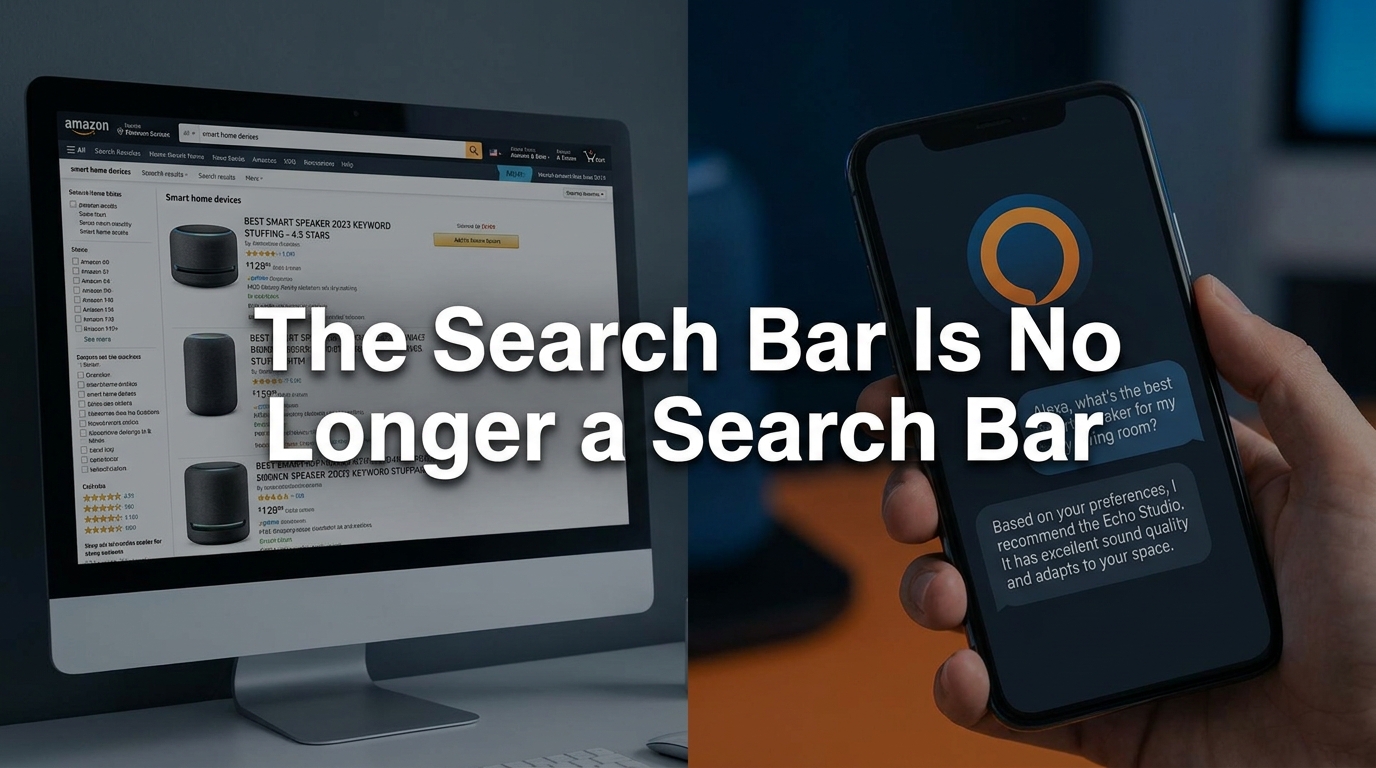

For the better part of a decade, winning on Amazon came down to a relatively simple formula: put the right keywords in the right places, bid aggressively enough to get visibility, and iterate on conversion. The search bar was a matching engine. Keywords in, results out.
That model is now structurally broken — not because Amazon changed its algorithm in some incremental way, but because the search bar itself has changed what it does. Alexa for Shopping, which absorbed the Rufus shopping assistant on May 13, 2026, has turned Amazon’s entry point into a conversational layer. Shoppers no longer just type queries and scroll results. They ask questions, get curated answers, and buy — often without ever touching a traditional product detail page in the old sense.
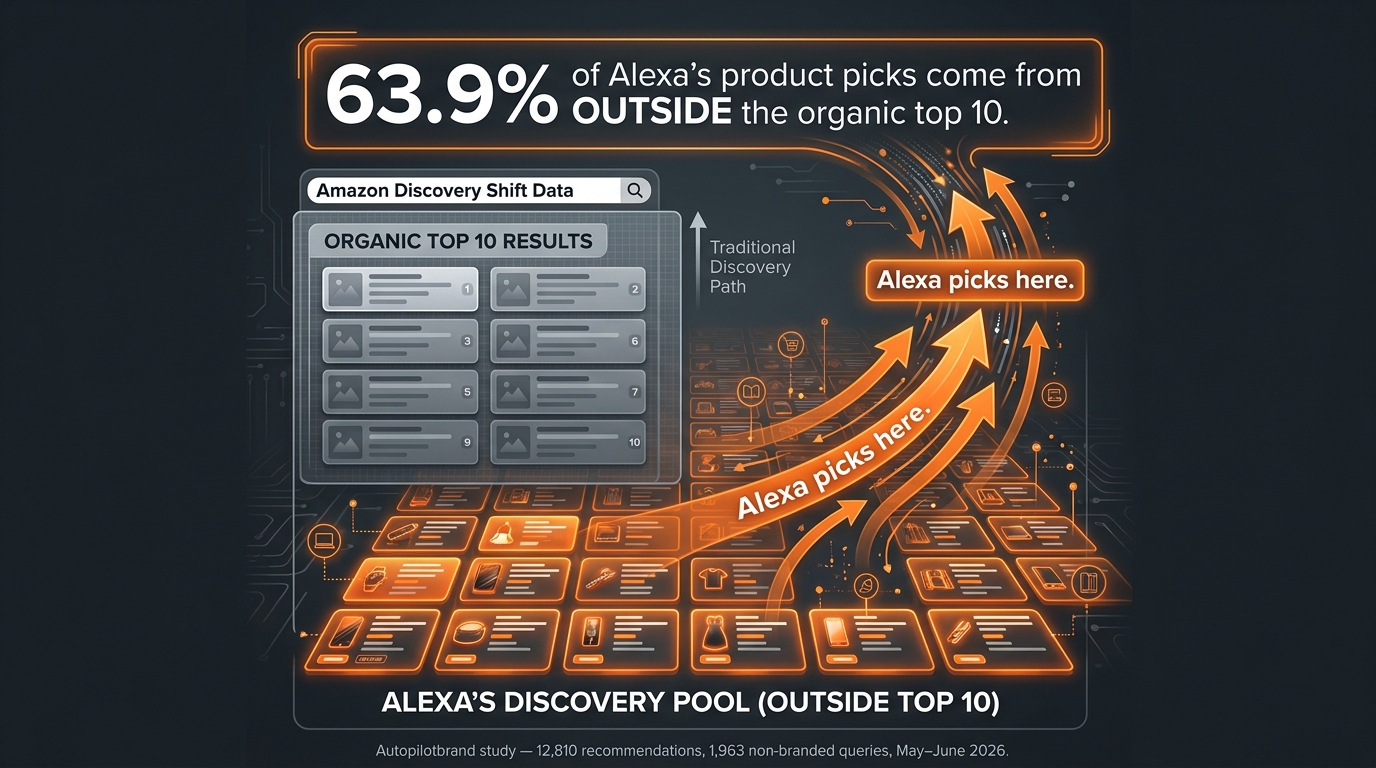
The implications for listings are significant and not yet fully understood by most sellers. A landmark study from Autopilotbrand, covering 12,810 Alexa recommendations across 1,963 non-branded queries, found that 63.9% of those recommendations came from products sitting outside the organic top 10 search results. Another 40.9% came from products that didn’t appear on the visible search results page at all. That isn’t a small margin of error — that is a parallel discovery system operating by different rules.
This post is about those rules: what Alexa for Shopping actually looks for, how it retrieves and recommends products, and what sellers need to change in their listings to get picked. Not in some theoretical future state — right now, in mid-2026, where the system is already live and already routing a material share of shopping traffic.
We’ll cover the mechanics of the Rufus-to-Alexa transition, the specific listing fields that now matter most, the new title constraints that took effect in July 2026, and a practical triage framework for catalogs of any size. There’s no one tweak that fixes this. But there is a clear direction — and sellers who move in that direction now are building an advantage that keyword-first competitors simply cannot replicate by bidding harder.
From Rufus to Alexa for Shopping — What Actually Changed on May 13, 2026
Amazon launched Rufus in early 2024 as a standalone shopping assistant — a conversational AI embedded in the Amazon mobile app that could answer product questions, compare options, and help narrow down decisions. It was an important experiment, but it lived at the edges of the shopping experience. Most sellers treated it as a novelty.
On May 13, 2026, Amazon folded Rufus into Alexa for Shopping and embedded that combined system directly into the main Amazon search bar across the app, web, and Echo devices. That change is not cosmetic. It means the conversational AI layer is now the primary entry point into Amazon search for hundreds of millions of users — not a sidebar feature that power shoppers ignore, but the box they type into when they want to buy something.
The Architecture Underneath
Alexa for Shopping doesn’t just pass queries to the existing A10 keyword index and pretty up the results. It runs a distinct retrieval and recommendation process built on a semantic understanding of what the shopper is trying to accomplish. It interprets intent — “I need a lightweight blender I can take camping” — not just the words in the query.
The underlying model draws on Amazon’s COSMO (Common Sense and Commonsense-based Multi-task Object/Knowledge) semantic system, which maps products to scenarios, use cases, and shopper intent rather than literal keyword co-occurrence. When a shopper asks a question, COSMO and Alexa’s recommendation layer look for products that satisfy the scenario described — which requires listings to actually describe scenarios, not just accumulate keywords.
Rufus’s recommendation logic was folded into this system, not discarded. The combined engine now handles multi-turn conversations: a shopper can ask an initial question, refine based on Alexa’s response, and complete a purchase inside that conversation flow, potentially never visiting a traditional search results page.
What Didn’t Change
It’s worth being precise about what the merger preserved. The core ranking signals for traditional search — sales velocity, conversion rate, price competitiveness, inventory availability, click-through rate, and review volume — still apply. Alexa for Shopping and A10 don’t operate on entirely separate tracks; they share foundational product data from the same catalog.
What changed is the weighting and retrieval logic on top of that shared data. For AI-mediated recommendations, structured completeness and conversational relevance now outweigh raw keyword density. A listing that ranked third for a primary keyword but has fully populated attributes, scenario-based bullets, and a rich Q&A section may now surface in Alexa recommendations more reliably than the listing ranked first by keyword matching alone.
That is the core tension sellers need to hold in their heads: traditional SEO still matters, but it no longer guarantees AI visibility. And AI visibility is where an increasingly large share of the conversational queries — and the high-intent shoppers behind them — are being routed.
The Study That Should Worry Every Amazon Seller
The Autopilotbrand study of Alexa for Shopping recommendations, published in May–June 2026, is the clearest quantitative picture we currently have of how Alexa’s recommendation layer actually behaves. The sample was large and non-branded, which makes the findings particularly relevant for the broad middle of the Amazon catalog rather than just brand-driven searches.
What the Numbers Say
Across 1,963 non-branded queries and 12,810 total product recommendations, the study found:
- 63.9% of Alexa’s recommended products came from outside the organic top 10 search results for that query. Traditional SEO rank was not a reliable predictor of AI recommendation.
- 40.9% of recommended products did not appear on the visible search results page at all. These products had organic ranks beyond the first page, yet Alexa surfaced them based on semantic and attribute relevance.
- Only 14.3% of Alexa recommendations were sponsored listings on the corresponding search page. PPC investment alone was not driving AI placement.
Read those numbers carefully. The majority of what Alexa recommends isn’t on page one. Nearly half isn’t even on the visible search results page. And paid media is largely absent from the recommendation set. This means the optimization playbook that governs organic rank and PPC performance is, at best, only partially applicable to the AI discovery layer.
Why This Happens — The Retrieval Logic
Alexa for Shopping retrieves products through semantic matching to the shopper’s stated intent, not through organic rank position. A product sitting at rank 47 for “camping blender” might have a fully populated attribute set, explicit use-case language in its bullets, a strong Q&A section with camping-specific answers, and positive review language about portability. That product might be a far better semantic match to “What’s a good blender I can use outdoors without power?” than the product ranked first, even if the ranked product has more reviews and better conversion.
The practical implication is that Alexa for Shopping opens up a second track of visibility that is largely decoupled from organic rank — and that track is governed by content quality, attribute completeness, and conversational relevance rather than keyword saturation and bid strategy.
What This Means for Your Catalog Strategy
For sellers with large catalogs, the study suggests that lower-ranked ASINs may actually be your biggest Alexa opportunity. Products that rank modestly in keyword search but have a strong use-case story — and can be optimized for semantic retrieval — may punch well above their weight in AI recommendations. The question is whether your listings are giving Alexa enough to work with.
How Alexa for Shopping Actually Decides What to Recommend
Understanding the recommendation logic isn’t just academic — it tells you which listing levers to pull and in what order. Based on 2026 practitioner analyses and Amazon’s own documentation of COSMO and Alexa for Shopping, the recommendation process works across several interlocking signals.
Signal 1: Structured Attribute Completeness
Before content or keywords are evaluated, Alexa needs to be able to categorize and contextualize the product. This happens through structured attributes — the specific data fields in Seller Central that describe a product’s material, dimensions, color, compatibility, age range, use case type, and dozens of other variables depending on category.
Structured attributes are machine-readable in a way that copy isn’t. When a shopper asks “What are the best stainless steel water bottles for kids under age 10?” the recommendation engine looks for products with explicit attribute entries for material (stainless steel), target age group (children), and capacity specifications — not products that use those words somewhere in a paragraph of description text.
Missing attributes don’t just limit discoverability — they can functionally exclude a product from appearing in filtered conversational queries entirely. In COSMO’s semantic model, an incomplete attribute set signals an incomplete or unverifiable product record. The algorithm has a strong prior toward recommending products where it can confidently answer the shopper’s question with structured, verifiable data.
Signal 2: Semantic Relevance of Copy
Once a product passes the attribute eligibility threshold, Alexa evaluates the semantic content of the listing — how well the title, bullets, and description answer the shopper’s actual question. This is different from keyword matching. Semantic relevance asks: does this listing’s text, treated as a whole, address the intent behind this query?
A listing that uses natural language to describe who the product is for, what problem it solves, and in what context it performs well will tend to score higher on semantic relevance than a listing with identical keywords but no narrative structure. COSMO’s commonsense reasoning layer is looking for scenario alignment — does this product make sense as an answer to what this person is trying to accomplish?
Signal 3: Review Content and Sentiment
Amazon’s recommendation AI doesn’t just look at star ratings and review count. It processes the text content of reviews to extract real-world use cases, performance signals, and audience fit information. A product with 400 reviews that include specific, scenario-rich language — “used this every day for meal prep,” “held up for six months of daily gym use,” “my 7-year-old can operate it independently” — gives the AI more semantic evidence to work with than a product with 1,200 reviews full of generic five-star praise.
This creates a compounding dynamic: well-optimized listings attract the right buyers, who leave relevant reviews, which strengthen the product’s semantic profile for future AI recommendations. The reverse is also true — mismatched reviews from buyers who misunderstood the product’s use case can actively weaken the AI’s confidence in recommending it for the right queries.
Signal 4: Sales Velocity and Inventory Reliability
Alexa for Shopping won’t reliably recommend products with stockout histories, suppressed listings, or erratic inventory patterns. The recommendation engine carries implicit reputational stakes — if Alexa tells a shopper to buy something and it arrives late or out of stock, that reflects on the interaction quality. Inventory reliability and consistent sales velocity remain baseline signals for AI recommendation eligibility, even as content signals gain relative weight.
The 75-Character Title Deadline — And What It Really Means for AI Readability
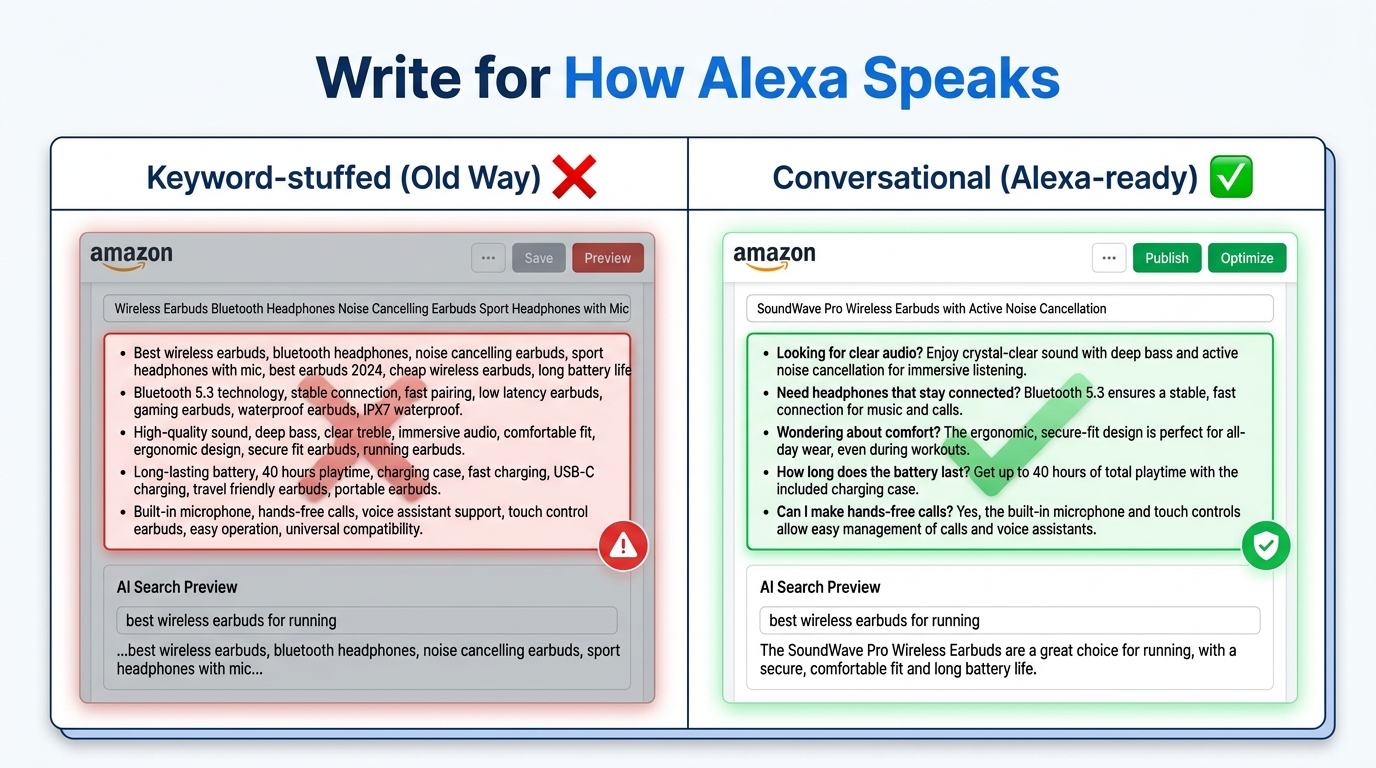
In July 2026, Amazon implemented a 75-character title limit across most non-media categories in the US marketplace. For sellers who had been running 200-character keyword-stuffed titles for years, this wasn’t just a formatting change — it was a forced reorientation of the title’s function in the listing.
Why Amazon Made the Change
The official rationale cited readability and customer experience, but the underlying driver is clearly AI compatibility. A title like “Stainless Steel Water Bottle 32oz BPA Free Insulated Vacuum Sealed Leak Proof Wide Mouth with Straw Lid for Gym Sports Camping Travel Hiking Kids Adults” is not how any human being would describe a product in conversation — and it’s not how Alexa processes or reads a product title either.
When Alexa reads a product title as part of constructing a spoken recommendation or a chat response, it needs a clean, natural-language description of what the product is. The 75-character limit forces titles into a format that Alexa can actually use: Product Type + Key Differentiator + Size or Key Specification. That’s roughly the structure of how any person would name a product in a conversation.
The Right Title Formula for 2026
With 75 characters to work with, the hierarchy of information matters enormously. The title should lead with what the product fundamentally is — the noun phrase that captures its category and primary function — followed by the single most important differentiator, followed by a quantitative spec if space allows.
Examples of the approach:
- “Kids’ Insulated Water Bottle — 12oz, Leak-Proof Straw Lid” (56 characters)
- “Lightweight Camping Blender — Cordless, 1000ml” (46 characters)
- “Anti-Fatigue Kitchen Mat — ¾-inch Thick, Non-Slip” (50 characters)
Notice what’s absent: keyword repetition, generic descriptors like “high quality” or “premium,” and competing use-case language. Those belong in bullets, not the title. The title’s job is to give Alexa a clean, speakable product name that can function inside a conversational recommendation without sounding like a machine generated it.
What Happens to Your Keywords
The most common seller concern about the 75-character limit is keyword coverage. The short answer is that keywords belong primarily in bullets, attributes, the description, and the backend search terms field — and in a world where Alexa’s retrieval is increasingly semantic, keyword-matching in the title was already becoming less critical as a standalone signal.
The bigger risk is the opposite one: sellers who try to cram as many keywords as possible into 75 characters will produce titles that are stilted and hard for Alexa to parse naturally. Alexa for Shopping surfaces product names inside spoken and written conversational responses. A title that reads awkwardly in that context doesn’t just perform poorly aesthetically — it may be deprioritized by the recommendation engine when competing with a listing that produces a cleaner, more credible-sounding recommendation.
Amazon’s Enforcement Approach
Amazon has been actively suppressing listings with non-compliant titles in categories where the 75-character limit is enforced, in some cases replacing seller-supplied titles with system-generated alternatives pulled from product attributes. A system-generated title is almost always worse than what a seller could write — but it will be compliant. Getting ahead of this enforcement and writing your own clean, AI-readable title is significantly better than letting Amazon write it for you.
Writing Bullets That Alexa Can Actually Use
Bullet points are the section of a listing that sellers have historically treated as keyword repositories — a place to surface secondary and tertiary search terms with enough context to pass manual review. That approach produces bullets that are technically readable but functionally useless as answers to conversational questions.
Alexa for Shopping treats bullets as the primary source of descriptive information about what a product does, who it’s for, and why it performs. When a shopper asks a comparative question — “Which of these would be better for someone with a small kitchen?” — Alexa draws on bullet content to construct its answer. Bullets that answer real questions get used. Bullets that list features without context don’t.
The Question-Answer Structure
The most effective bullets for AI optimization are structured as implicit answers to common shopper questions. Each bullet should correspond to a real question a buyer in your category would ask, and should answer that question in the first phrase of the bullet.
Instead of: “Premium non-stick coating for easy food release”
Try: “Food releases cleanly with no oil needed — the ceramic non-stick coating holds up through 300+ uses without flaking, tested in commercial kitchen conditions”
The second version answers “Does the non-stick coating actually work long-term?” It includes a specific claim, a use-case reference, and verifiable context. Alexa can extract that as a confident answer to a durability question. The first version is a feature declaration — Alexa has less to work with.
Use Cases Over Features
Every bullet should make the use case explicit. This doesn’t mean adding “perfect for camping!” to everything — it means describing the scenario in which the product’s feature becomes relevant and valuable. Features without scenarios are half-information. Scenarios without specific features are marketing fluff. The combination is what Alexa’s semantic model can actually map to a shopper’s stated need.
Consider these two bullets for a portable power bank:
Feature-only: “20,000mAh high-capacity battery with dual USB-A ports and 18W fast charging”
Scenario-based: “Charge two phones from 0 to 100% twice over during a full weekend camping trip — 20,000mAh capacity with 18W fast charging keeps multiple devices powered when outlets aren’t available”
When a shopper asks Alexa “What’s a good power bank for a camping weekend?”, the second bullet is a match. The first one requires inference. The recommendation engine favors the explicit answer.
Bullet Order and Front-Loading
In Alexa’s spoken and chat responses, the system often reads or quotes from early bullet text rather than scanning the full list. The first two bullets carry the most weight for AI retrieval. Lead with your strongest use-case answer — typically the primary occasion or problem the product solves — rather than generic category claims or brand statements.
Keep bullets under 200 characters each. Longer bullets get truncated in AI responses and on mobile product pages. Shorter, punchy, scenario-answer bullets are both more readable and more reliably extracted by AI processing.
Attributes Are the New Keywords
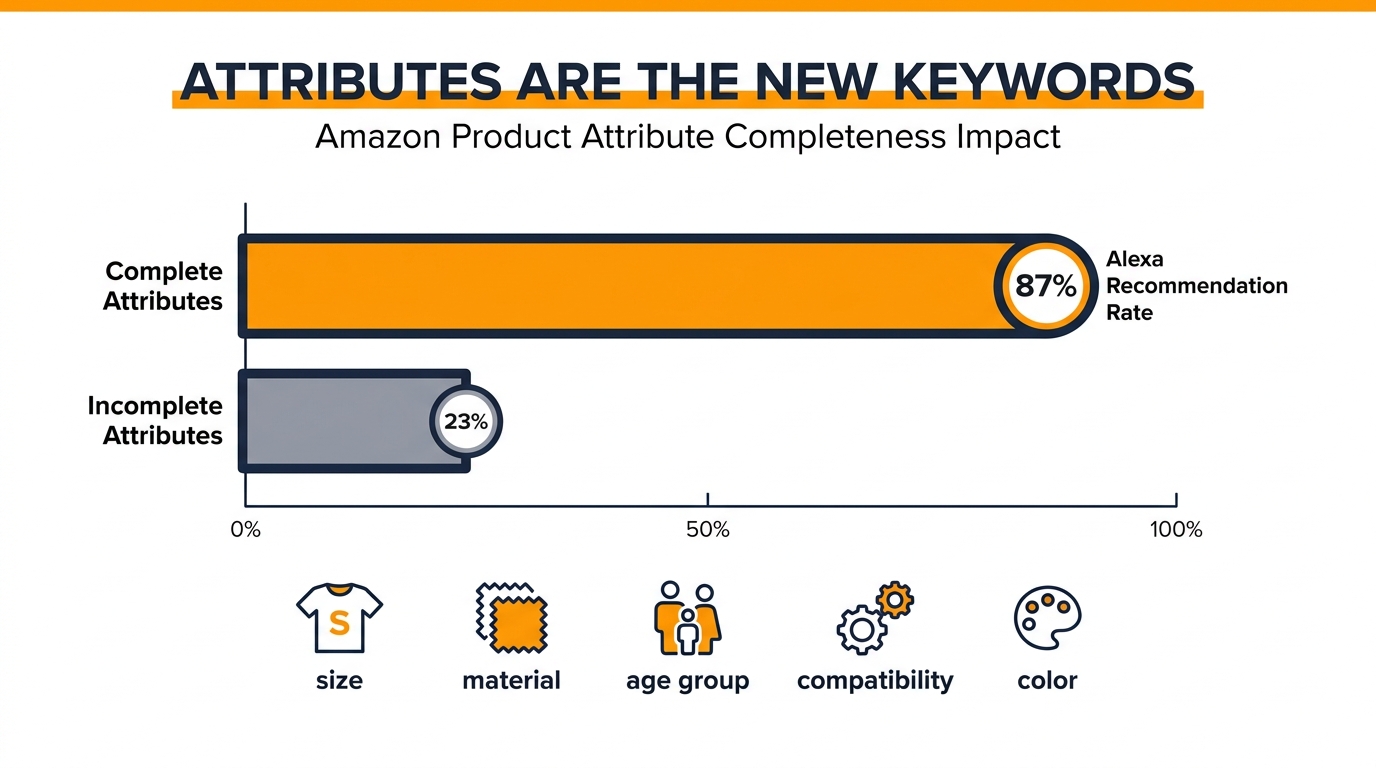
If there is a single optimization action that returns the highest value per hour of effort for most sellers in mid-2026, it’s filling out product attributes — not the obvious ones that most listings already have, but the full set of category-specific attributes that sellers typically skip because they don’t seem to affect organic rank.
They don’t affect organic keyword rank, at least not directly. But they are the primary structured data layer that Alexa for Shopping uses to match products to filtered, faceted, and conversational queries.
Why Attributes Beat Keywords for AI
When a shopper asks Alexa “What are the best hypoallergenic pillows for stomach sleepers?” the recommendation engine needs to confirm, with confidence, that a given product is hypoallergenic and appropriate for stomach sleeping. That confirmation can come from copy — but copy is unstructured text that the AI must interpret. It can alternatively come from an explicit attribute field: Material=Hypoallergenic Fill, Sleeping Position=Stomach.
Structured attribute data is unambiguous. The AI doesn’t need to infer or interpret — it reads a declared value. Products with complete, accurate attribute sets can be matched to filtered queries with a degree of confidence that copy-only listings simply cannot achieve. This is why the recommendation engine shows a strong preference for attribute-complete listings even when those listings rank lower in traditional keyword search.
The Categories Where This Matters Most
Attributes vary dramatically in depth and volume across Amazon’s category tree. Some categories have 15–20 relevant attributes; others have 60 or more. The categories where attribute completeness has the highest Alexa impact tend to be those where shoppers commonly use qualifier-heavy queries: baby and children’s products, health and household, kitchen and dining, sports and outdoors, and home improvement.
In these categories, buyers are frequently asking questions like “Is this safe for children under 3?” or “Will this fit a standard US outlet?” or “Is this BPA-free?” Those qualifiers map directly to attribute fields. If your attribute fields are empty, Alexa cannot confidently say yes — and it won’t recommend a product it can’t confidently vouch for.
How to Audit and Fill Attributes
In Seller Central, the Listing Quality Dashboard now surfaces attribute completeness scores at the ASIN level, including flags for which missing attributes are considered high-impact by Amazon’s own classification. Start with the flagged fields for your highest-revenue ASINs — these are the gaps Amazon has identified as most likely to affect discoverability and recommendation eligibility.
For large catalogs, flat file exports through Seller Central allow bulk attribute population. The process is tedious, but the per-ASIN payoff in AI recommendation visibility is real. Prioritize: specific use type/application, material and material composition, compatibility and fit attributes, and any audience or demographic attributes that apply to your category.
What Happened to Backend Keywords
Amazon has been removing generic backend keyword fields from US flat file templates and Seller Central category interfaces throughout 2026. This is a deliberate architectural move reflecting the shift from keyword-match to semantic retrieval. Backend keywords still exist in some categories and still carry some weight, but they are no longer the primary hidden optimization lever they were in 2023–2024.
The replacement for backend keywords, in functional terms, is comprehensive attribute population. Where sellers used to stuff backend fields with variations, synonyms, and long-tail phrases, the 2026 playbook calls for completing every attribute field with accurate, specific values. That structured data does more work for AI retrieval than a string of comma-separated keywords ever did.
Q&A as a Discovery Channel — The Underused Optimization Lever
Amazon’s customer Q&A section — the “Customer Questions & Answers” panel on the product detail page — is probably the most underutilized optimization surface on the entire listing. Most sellers treat it reactively: answer when a question comes in, flag misleading ones, and otherwise ignore it.
For Alexa for Shopping, the Q&A section is an active semantic input. When a shopper’s conversational query closely matches a question in the Q&A database for a given product, Alexa can draw on the answer as a basis for its recommendation. A well-curated Q&A section is essentially a pre-loaded set of conversational answers that Alexa has license to surface.
Seeding Q&A Proactively
There’s nothing in Amazon’s policy that prevents sellers from asking Amazon-verified buyers — through post-purchase communication — to submit questions they actually had before purchasing. And sellers can answer questions directly, as the brand, without waiting for another customer to weigh in.
The practical tactic: identify the 10–15 most common pre-purchase questions in your category by reviewing competitor Q&A sections, your own customer service emails, and any sales call recordings or chat transcripts if you sell direct as well. Then ensure those questions — or very close equivalents — exist in your product’s Q&A section, with complete, specific, verifiable answers provided by you as the brand.
What Good Q&A Looks Like
Vague answers don’t help Alexa — or real shoppers. Compare these two answers to the same question about a travel stroller:
Question: “Does this fit in an overhead bin?”
Weak answer: “Yes, it’s very compact and travel-friendly!”
Strong answer: “Yes — when folded, the stroller measures 20″ x 11″ x 10″, which fits in the overhead compartment on most major US carriers including Delta, United, and American Airlines. It also qualifies as a gate-check item at no extra charge on most domestic flights.”
The second answer gives Alexa a specific, verifiable dimension, a relevant use case, and airline-specific context. When a shopper asks “What’s a good travel stroller that fits in overhead bins?”, the second answer provides a confident basis for a recommendation. The first one just introduces more ambiguity.
Ongoing Q&A Maintenance
Q&A sections can drift over time if incorrect community answers — from other customers who may not know the product well — override or confuse your brand answers. Review your Q&A quarterly. Flag and dispute incorrect answers. Ensure that the most important questions have clear, brand-verified answers near the top of the list, since Alexa and on-page algorithms tend to weight highly-voted or recently active Q&A threads.
Reviews, Social Proof, and the Signals Alexa Trusts
Reviews have always mattered on Amazon — for conversion, for organic rank, and for buyer confidence. In the Alexa for Shopping era, their role expands into a direct semantic input to the recommendation engine. Understanding how Alexa interprets and uses review data changes how sellers should think about review strategy.
Reviews as Semantic Evidence
Amazon’s recommendation AI doesn’t just look at star ratings and review count. It processes the text content of reviews to extract real-world use cases, performance signals, and audience fit information. A product with 400 reviews that include specific, scenario-rich language — “used this every day for meal prep,” “held up for six months of daily gym use,” “my 7-year-old can operate it independently” — gives the AI more semantic evidence to work with than a product with 1,200 reviews full of generic five-star praise.
This has an important implication: attracting the right reviewers matters as much as attracting more reviewers. Buyers who purchased the product for the exact use case it’s designed for, and who leave specific, detailed reviews, contribute more to AI recommendation strength than buyers who purchased for a tangential use case and left a one-line review.
Post-Purchase Messaging and Review Quality
Sellers can influence review quality — within Amazon’s terms — through their post-purchase communication. Request for Review messages that arrive while the product experience is still fresh tend to produce more detailed, scenario-rich reviews than requests sent weeks later. Packaging inserts (where permitted) that prompt buyers to describe their specific use case in a review can shift the vocabulary of reviews toward the kind of specific, use-case language that Alexa’s semantic model values.
None of this means gaming the review system or soliciting biased reviews — Amazon’s enforcement of review policy is real and the consequences severe. It means making it easy for genuine buyers to leave the kind of detailed, specific review that is valuable both to future shoppers and to AI recommendation systems.
Addressing Negative Review Patterns
A cluster of negative reviews mentioning the same deficiency — say, “the lid leaks” or “the battery dies after two uses” — isn’t just a conversion problem. It’s an active signal to Alexa’s recommendation engine that the product may not reliably satisfy the use case being advertised. The AI picks up on review sentiment and specific failure mentions as counterweights to positive attribute signals.
Sellers who resolve the underlying product issue and then see a natural improvement in review sentiment over subsequent months will typically see a corresponding improvement in AI recommendation frequency — not immediately, but as the semantic profile of the review corpus shifts. Treating product quality as an optimization input to AI discovery isn’t a stretch: it’s how the system is designed.
Agentic Ads — The New Conversion Layer Inside the Conversation

Alexa+ Agentic Ads represent Amazon’s attempt to monetize the conversational layer it has built — and they introduce a new paid-visibility channel that operates alongside, but distinctly from, traditional Sponsored Products and Sponsored Brands.
How Agentic Ads Work
Agentic Ads appear inside Alexa conversations as brand-prompted interactions. When a shopper’s query matches a brand’s targeting parameters, the ad triggers a prompt within the conversational flow — Alexa might say “Would you like to see what [Brand] has for that?” or surface a product card with an in-conversation purchase option. The conversion path goes from question to recommendation to checkout, all within the chat interface, without requiring a click-through to a traditional product detail page.
Amazon’s early data on Sponsored Brands prompts within conversational interfaces shows that approximately 20% of shoppers who receive a conversational prompt continue the interaction, and conversion rates for those continuing interactions are roughly 6% higher than equivalent non-prompted flows. These are early numbers from a feature still in expansion, but they suggest meaningful conversion lift when the ad experience aligns with the shopper’s stated intent.
What Listing Quality Means for Agentic Ad Performance
This is where listing optimization and paid strategy converge in a new way. An Agentic Ad surfaces product information — title, key attribute, image, price — inside a conversational context. The quality and clarity of that information determines whether the shopper continues toward purchase or dismisses the prompt. A clean, scenario-relevant title and a high-quality primary image do more work inside an in-conversation product card than they do on a traditional search results page, because there’s far less surrounding context to help the shopper evaluate the recommendation.
Sellers running Agentic Ads on listings that haven’t been optimized for conversational readability are likely to see lower engagement rates — not because the ad targeting is wrong, but because the product presentation inside the conversation is confusing or incomplete. Listing optimization is now a direct input to paid campaign performance in the conversational channel.
Budgeting for the Transition
Agentic Ads are currently a small percentage of total Amazon ad spend for most brands — the format is in expansion, not yet at scale. The strategic question for 2026 is how to allocate testing budget alongside traditional Sponsored Products investment. The practical answer for most sellers is to treat Agentic Ads as an incremental test layer: set a limited budget, run it on your best-optimized ASINs (the ones with clean titles, complete attributes, and strong Q&A sections), and measure engagement-to-purchase rate as the primary KPI rather than traditional ROAS.
As the format scales, the combination of strong listing quality and Agentic Ad presence is likely to be significantly more effective than either alone — because the ad gets shoppers to engage, and the listing quality keeps them moving toward purchase.
Voice Search Optimization — Writing for How People Actually Speak
Voice-initiated shopping through Echo devices and Alexa-enabled phones accounts for approximately 10–11% of digital buyer interactions with Amazon search in 2026, according to available market-level estimates. That’s not a majority — but it’s a growing minority that skews heavily toward specific shopping occasions: reorders of household consumables, last-minute gifts, and categories where the buyer already has strong product preferences.
Voice queries are structurally different from typed queries, and those structural differences have concrete implications for how listings should be written.
Voice Query Patterns
Typed queries tend to be fragments: “insulated water bottle 32oz.” Voice queries tend to be full sentences or questions: “Alexa, order me a 32-ounce insulated water bottle that fits in my car cup holder.” That shift from fragment to sentence changes what the AI is looking for in a listing.
Full-sentence voice queries include more context, more constraints, and more implicit preferences. The car cup holder specification in the example above requires a diameter-specific product attribute and ideally a bullet point that explicitly names cup holder compatibility. Without those elements in the listing, the recommendation engine has to guess — and it tends to recommend products where it doesn’t have to guess.
Naturalness as a Quality Signal
One way to test your listing’s voice-readiness is to read it aloud — or paste it into a text-to-speech tool — and listen for awkward phrasing. Keyword-stuffed titles that read smoothly as text (“32oz Insulated Stainless Steel Water Bottle Vacuum Sealed BPA Free”) sound broken when spoken and would be nearly unworkable as a voiced product recommendation. Clean titles and natural bullet phrasing sound confident when read aloud, which is the context in which Alexa actually uses them.
Naturalness isn’t just about aesthetics — it affects the AI’s confidence in surfacing a product as a recommendation. A listing that parses cleanly in natural language processing is a listing the AI can use with confidence. One that requires significant NLP interpretation introduces uncertainty, which the recommendation engine resolves by favoring a competitor listing it can parse more cleanly.
Brand Name Compatibility
For voice search specifically, how your brand name sounds matters. If your brand name is difficult to pronounce, abbreviation-heavy, or composed of characters that don’t map to natural speech, voice shoppers attempting to reorder from your brand by name will hit friction. This is an edge case for most sellers, but for brands that have built reorder loyalty through voice — particularly in consumables — brand name phonetic clarity is a genuine search optimization variable in the Alexa era.
Prioritization Framework — Where to Start When You Have 500 ASINs
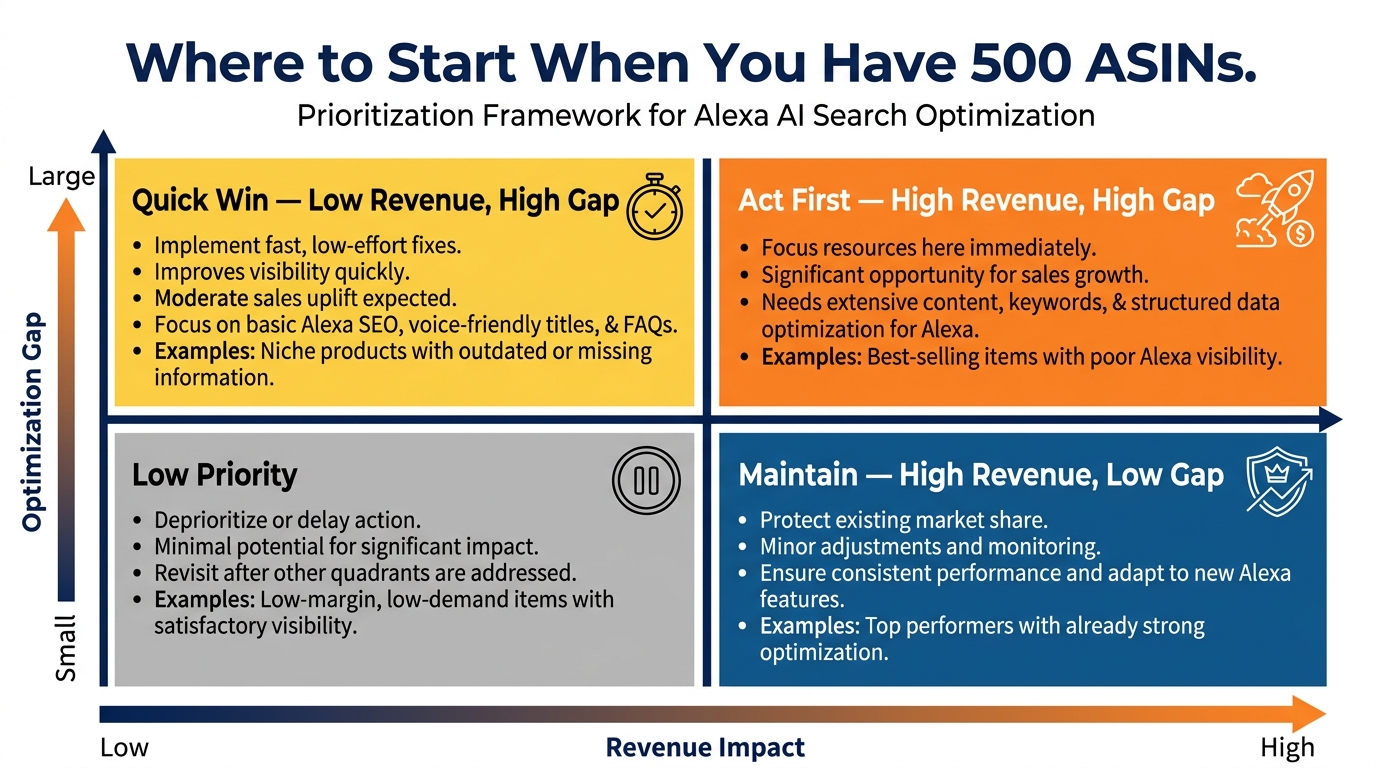
The optimization changes covered in this post — title rewrites, bullet restructuring, attribute population, Q&A expansion, and review strategy — represent a significant body of work for any seller with a catalog of meaningful size. No one completes all of it in a single sprint. The question is where to start and how to sequence the effort for maximum impact per hour invested.
Step 1: Revenue-Weight Your Catalog
Begin by sorting your ASINs by revenue contribution over the last 90 days. The top 20% of ASINs likely account for 70–80% of revenue for most sellers — this is where full optimization delivers the highest absolute return. Title rewrites and attribute audits on high-revenue ASINs should be the first sprint regardless of how many other ASINs need work.
Step 2: Identify High Optimization Gap ASINs
Use the Listing Quality Dashboard in Seller Central to identify ASINs with the largest attribute and content completeness gaps. Cross-reference this against your revenue sort. ASINs that are high-revenue AND have significant optimization gaps are your highest-priority targets — they represent the biggest performance upside with the most certain improvement path.
Separately flag mid-revenue ASINs with large optimization gaps. These may have been underperforming in organic search precisely because their listing quality was limiting Alexa recommendation eligibility. Improving these could move them from modest performers to catalog standouts — particularly relevant for the “lower organic rank but strong AI opportunity” dynamic revealed by the Autopilotbrand study.
Step 3: Sequence the Work
For each ASIN in your priority set, work through optimization in this order:
- Attributes first. Fill every relevant attribute field completely and accurately. This is the eligibility gate for AI recommendations. Nothing else matters if the product can’t pass structured retrieval.
- Title second. Write a compliant 75-character title using the Product Type + Differentiator + Spec formula. Check for naturalness when read aloud.
- Bullets third. Rewrite bullets using the question-answer structure. Prioritize the first two bullets as your highest-traffic answers. Ensure each bullet includes an explicit use case and at least one specific claim.
- Q&A fourth. Identify your top 10 pre-purchase questions and ensure they’re covered in the Q&A section with brand-authored answers that include specific, verifiable details.
- Review strategy fifth. Audit recent review language for use-case specificity. Adjust post-purchase messaging timing and framing to encourage more scenario-specific reviews from genuine buyers.
Step 4: Measure the Right Things
Traditional listing optimization metrics — organic rank, session volume, conversion rate — don’t fully capture AI recommendation performance. Add these to your tracking dashboard:
- Traffic source composition: Monitor whether voice and AI-mediated sessions are growing as a share of total ASIN traffic. Seller Central’s Traffic by Source report increasingly distinguishes these channels.
- Glance views from non-search sources: AI recommendations and voice purchases often produce glance views that don’t trace back to a keyword search. Growing non-search glance view share is a positive indicator of AI recommendation activity.
- Q&A engagement rate: If your Q&A answers are receiving upvotes and the section is seeing increased engagement, it’s a signal that the listing is being surfaced in contexts where pre-purchase questions are active — which often correlates with AI recommendation traffic.
Step 5: Sustain the Optimization Loop
Alexa for Shopping’s recommendation logic will continue to evolve through the rest of 2026 and beyond. Build a quarterly listing review cadence that checks for new attribute fields Amazon has added to your categories, flags Q&A threads where incorrect community answers have accumulated, and evaluates whether recent review language is still aligned with your optimization targets.
This isn’t a one-time project. It’s a maintenance discipline — and sellers who build it into their operational routine will compound an advantage over those who treat it as a campaign they run once.
What the Winning Listings Have in Common
Across all of the research, practitioner analysis, and study data from 2026, the pattern that appears in listings consistently appearing in Alexa recommendations — regardless of their organic keyword rank — is strikingly consistent. These are not necessarily the best-optimized listings by traditional SEO metrics. They are the listings that Alexa trusts most.
Trust, in this context, means the AI can confidently use the listing’s data to answer a shopper’s question. Complete attributes give the AI structured, unambiguous facts. Scenario-based bullets give it natural-language evidence. A curated Q&A section gives it pre-validated answers. A specific, use-case-aligned review corpus gives it real-world confirmation. And a clean, natural title gives it something it can actually say aloud or present in a chat without sounding broken.
The brands winning in Alexa’s recommendation layer in mid-2026 didn’t get there by gaming a new algorithm. They got there by making their listings genuinely more useful to a buyer who wants a specific question answered, not a results page to scroll through.
That orientation — writing for the question, not for the keyword — is the actual shift the Alexa era requires. And it’s a shift that, once made, tends to improve performance across every surface on Amazon simultaneously: organic search, conversational recommendations, voice queries, and ad performance. Clean, complete, scenario-anchored listings serve both algorithms and humans better. That’s the point of the whole system, and it’s the durable advantage that keyword-first thinking was never built to deliver.
Key Takeaway: The sellers who will own AI recommendation share in late 2026 and beyond aren’t the ones who spend the most on bids — they’re the ones who give Alexa enough information to confidently recommend their products over a competitor’s. Complete attributes, conversational bullets, and a curated Q&A section are the investment. The payoff is visibility in a discovery channel that keyword optimization simply cannot access.