

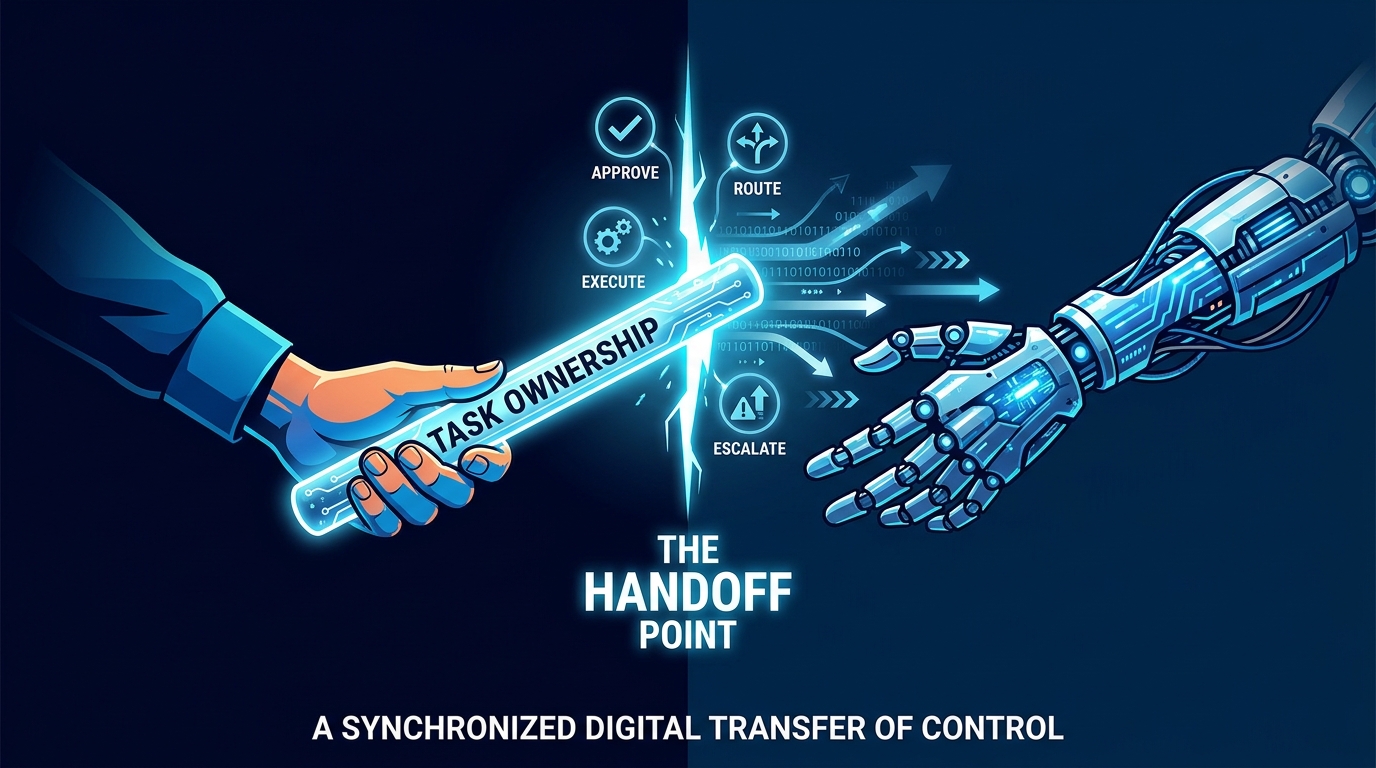

There’s a question most enterprise AI conversations avoid, because answering it honestly forces uncomfortable decisions: at what exact point does the AI stop advising and start acting?
The distinction sounds philosophical. It isn’t. It is the difference between an AI tool that makes humans faster and an AI agent that owns a piece of your business process without a human approving every step. And in 2026, with 40% of enterprise applications forecast to include task-specific AI agents by year-end — up from under 5% just twelve months ago — the handoff question is now one of the most consequential decisions operations leaders make.
Most of the public conversation about AI agents focuses on adoption curves, pilot counts, and capability benchmarks. That conversation, while useful, misses the harder problem: the seam. The specific moment where ownership of a workflow step transfers from a human employee to an autonomous agent — where the agent stops making suggestions in a sidebar and starts making things happen in your ERP, CRM, or compliance system — is where most enterprise AI programs either compound value or quietly unravel.
This article is about that seam. It is about the structural, organizational, and technical conditions that must exist before you hand a workflow over, what actually changes in your operations when you do, how leading companies are sequencing those handoffs across finance, supply chain, and customer operations, and what the failure modes look like when the conditions aren’t met. It is not a technology overview. It is an operating model question.
Because the companies that will extract durable value from agentic AI in 2026 are not the ones with the most agents. They are the ones who understood exactly what they were handing over — and built the infrastructure to hand it back if needed.
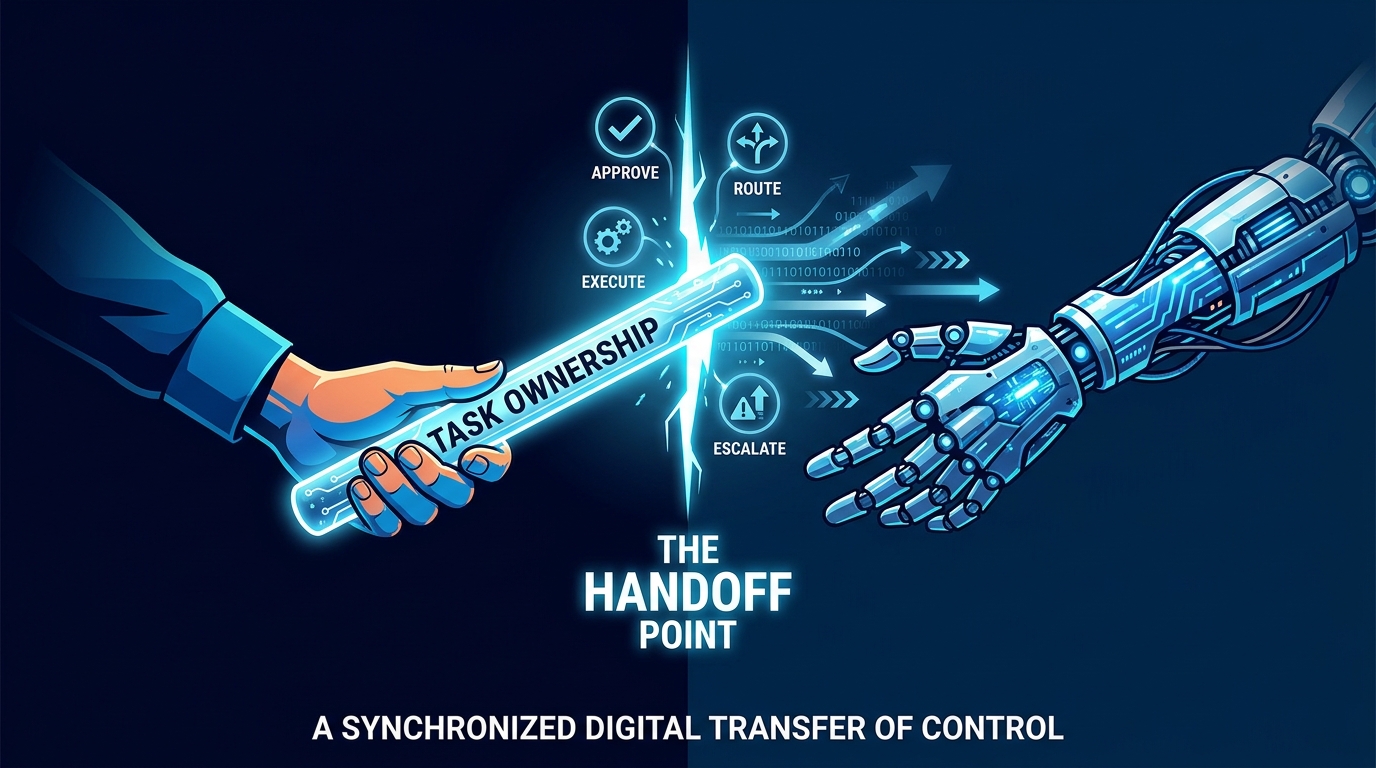
The Four Stages of Workflow Ownership — And Why Most Organizations Are Stuck at Stage Two
Workflow ownership does not transfer all at once. It moves through stages, and understanding which stage a given workflow is at — and whether the conditions for advancing to the next one exist — is the first discipline that separates deliberate AI deployment from chaotic accumulation of tools.
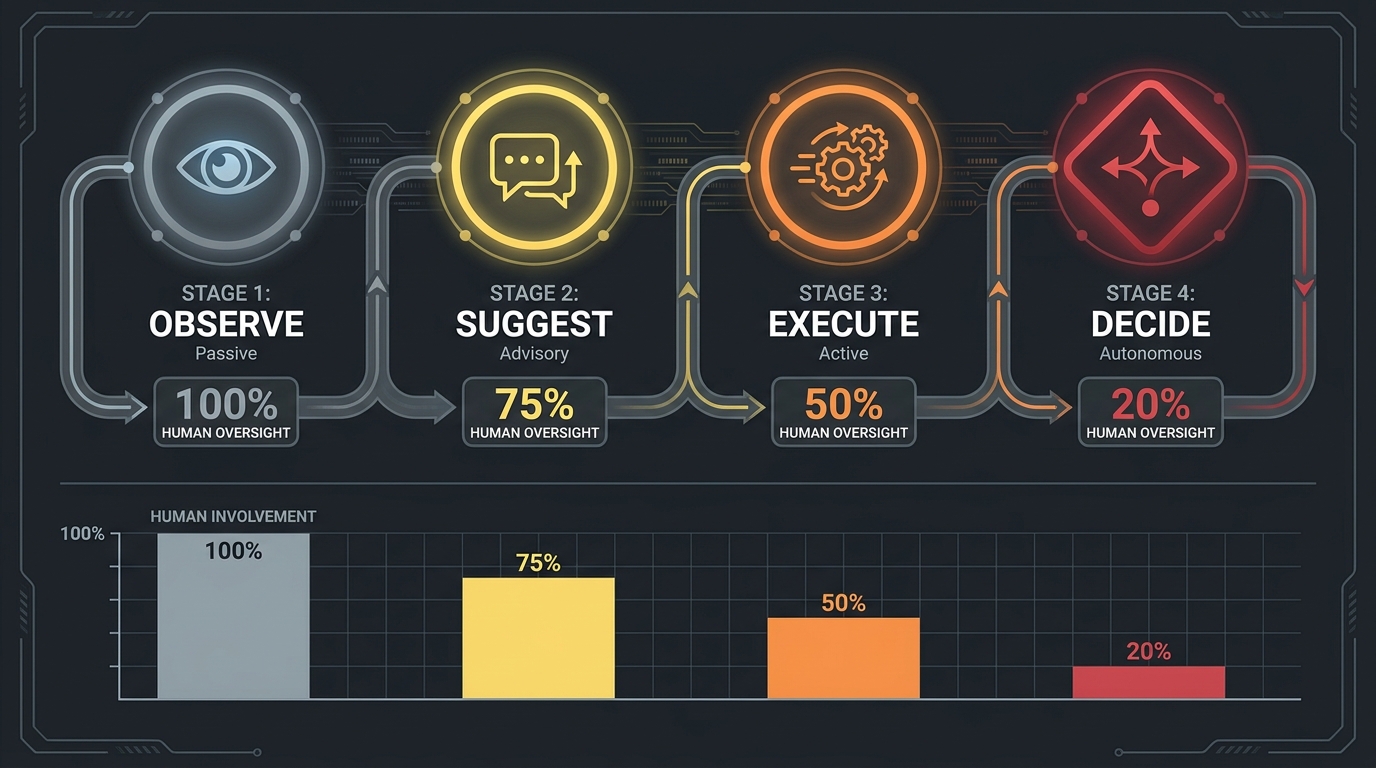
Stage 1: Observe
The agent reads the workflow — ingests transactions, monitors logs, reviews documents — but takes no action. Its only output is visibility. This is the stage where AI earns the data it needs to do anything more useful. It is also, incidentally, where most “AI transformation” projects quietly park themselves and stay. Observation feels productive because dashboards improve. Nothing else changes.
Stage 2: Suggest
The agent produces recommendations, flags anomalies, or drafts outputs — but a human reviews and approves every action before it executes. This is the copilot model. It captures real efficiency: drafting work, triage, summarization. But the human is still the bottleneck in the loop. The agent has no consequence authority. According to a BCG global survey from early 2026, 62% of enterprises experimenting with AI agents are operating primarily at Stage 2 — suggestion and augmentation, not execution and ownership.
Stage 3: Execute
The agent takes bounded, pre-approved actions without human review of each individual step. It routes a support ticket to the right queue. It triggers a purchase order when inventory crosses a threshold. It files a preliminary compliance report on schedule. The human no longer reviews every action — they review outcomes, exceptions, and drift reports. This is where real workflow efficiency materializes. It is also where organizational anxiety spikes, because accountability becomes less legible.
Stage 4: Decide
The agent makes judgment calls within defined policy parameters. It approves or declines a loan application up to a threshold. It re-sequences a production run when a supplier goes offline. It selects a contract clause from an approved library when negotiating a standard NDA. Humans set the policy and review the governance — they no longer review the decision itself unless it triggers an escalation rule. Only a minority of enterprise deployments have reached Stage 4 in any workflow as of mid-2026, and those that have done so sustainably have done it with significant upfront investment in governance architecture.
The critical insight is that most organizations treat these stages as a linear progression to accelerate through as fast as possible. The companies that are building durable operating models treat them instead as distinct states, each requiring different conditions to be safe and productive. Rushing from Stage 2 to Stage 4 without the infrastructure for Stage 3 is the single most common cause of AI agent project failure.
Where Core Enterprise Workflows Actually Stand in 2026
Adoption statistics often obscure more than they reveal. A number like “79% of companies have adopted AI agents in operations” collapses wildly different realities into a single datapoint. The Deloitte framing is more useful: of the organizations they surveyed, 30% are exploring, 38% are piloting, 14% have deployable solutions, and only 11% are actively running agentic systems in production. That production figure — 11% — is the one that matters for operating model questions.
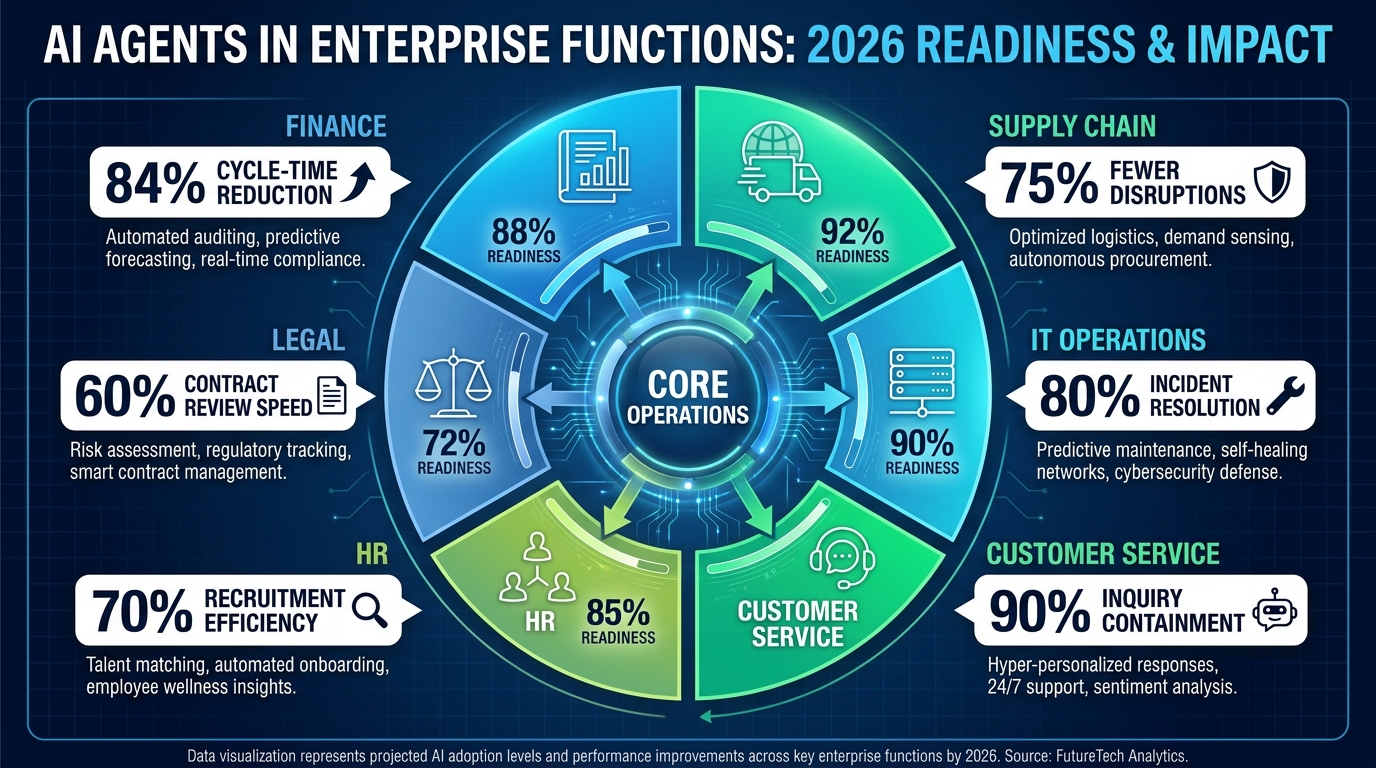
But across those production deployments, the function-by-function picture is instructive:
Customer Service and Support Operations
This is the most advanced function for agentic deployment, because the failure modes are visible and bounded, the volume is high enough to justify the infrastructure investment, and the quality signal (customer satisfaction scores, resolution time) is immediate. Production deployments in large-scale customer operations are reporting 80–99.5% containment of service interactions — meaning the agent handles the full interaction without human escalation — and case resolution time reductions of up to 84%. These are not model-generated projections; they are reported operational metrics from multi-agent deployments across telecommunications, financial services, and e-commerce logistics.
Finance and Treasury Operations
Finance is advancing faster than most functions because it has something most functions lack: extremely well-defined rules. Accounts payable matching, reconciliation, variance flagging, and compliance reporting all have logic that can be encoded in policy constraints that govern agent behavior. The workflows that have moved to Stage 3 or 4 in finance are typically those where the decision criteria were already explicit — the agent is executing a documented rulebook at speed, not exercising judgment. Loan processing workflows have been reduced from days to minutes in early production deployments.
Supply Chain and Procurement
Supply chain agents are most commonly deployed at Stage 3 in exception management: when a supplier shipment is flagged as late, the agent autonomously re-sequences downstream production steps, notifies affected teams, and files the supplier performance record — without waiting for a logistics coordinator to notice the issue. The cycle-time improvement is not 10 or 20%; it is typically 50–70% reduction in exception resolution time, because the agent operates continuously, not during business hours.
HR Operations
HR has strong pilots in candidate screening, onboarding document collection, benefits administration queries, and scheduling. But HR is also the function with the highest regulatory sensitivity around automated decision-making, particularly in jurisdictions subject to the EU AI Act. Most production HR deployments are carefully bounded at Stage 2 or early Stage 3 — agents handle administrative completion, not employment decisions.
Legal and Compliance
Contract review, regulatory change monitoring, and compliance evidence collection are the leading use cases. Document-heavy workflows that previously required junior legal staff to spend 60–70% of their time on manual retrieval and organization are being handed to agents that complete the same work in minutes. Stage 4 remains rare in legal outside of highly standardized contract types (NDAs, service agreements with known counterparties).
The Handoff Architecture: What Has to Be True Before You Transfer Ownership
The most consistent finding across failed AI agent deployments in 2026 is not model failure. It is infrastructure failure. The agent was capable enough. The surrounding conditions weren’t ready. Understanding the prerequisite layers of what we can call the handoff architecture is the single most actionable framework for avoiding that trap.
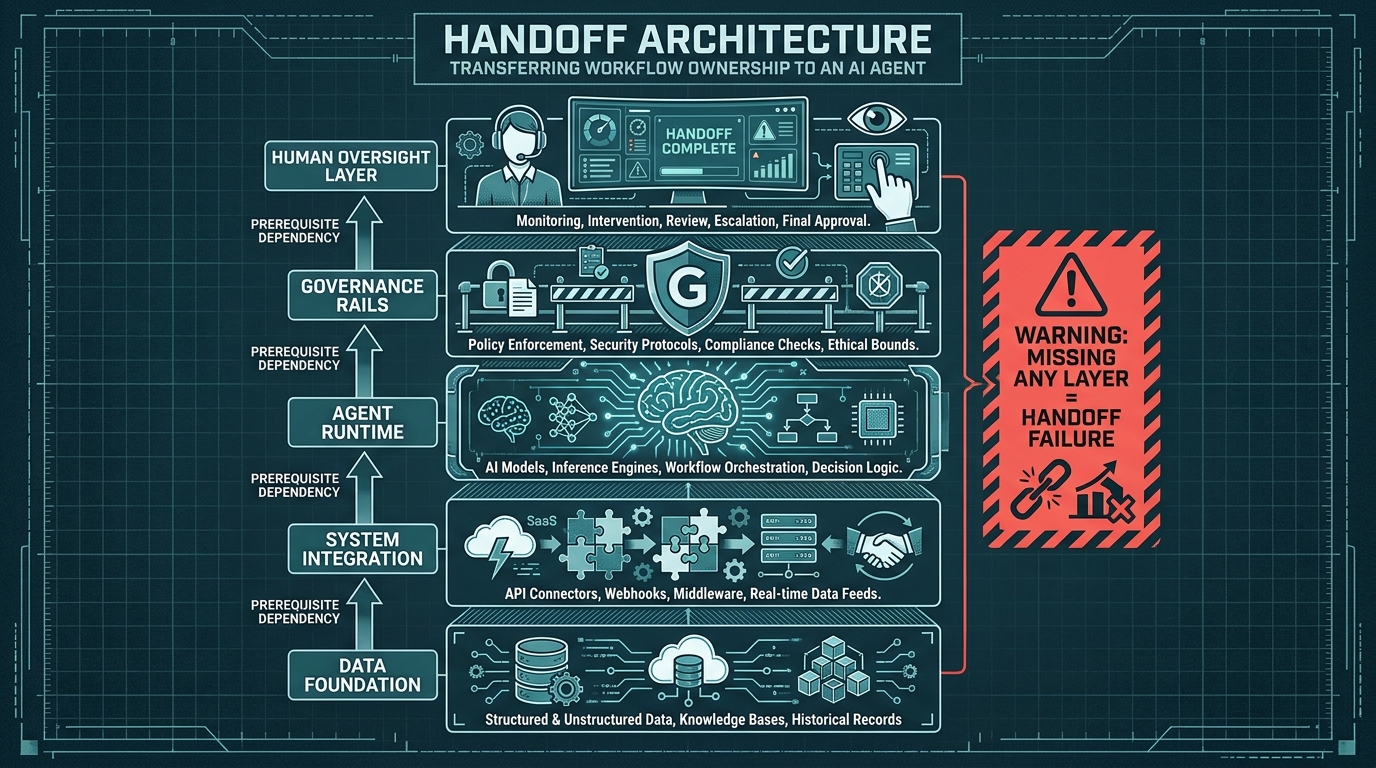
Layer 1: Data Foundation
Before any workflow can be handed to an agent at Stage 3 or 4, the data the agent will act on must be clean, accessible, and consistently structured. This sounds obvious. In practice, it eliminates roughly half of the workflows organizations want to hand over first. When an agent operates on ambiguous, inconsistent, or siloed data, it doesn’t fail loudly. It produces plausible-looking wrong outputs — the most dangerous category of AI error. Organizations that have successfully crossed the handoff threshold almost universally report that the data remediation work took longer than the agent deployment work.
Layer 2: System Integration
The agent needs read/write access to the systems of record involved in the workflow — ERP, CRM, HRIS, ticketing systems, document repositories. The technical pattern that has emerged as a standard is the Model Context Protocol (MCP) for connecting agents to tools and systems, combined with API-first integration where systems allow. The challenge in most enterprises is that the systems involved in any meaningful workflow were not designed to be written to by autonomous agents. Access controls, audit logging, and permission models all need to be retrofitted or redesigned before a Stage 3 handoff is safe.
Layer 3: Agent Runtime
This is the layer most organizations build first — the agent itself, its prompts, its memory architecture, its tool selection logic. It is also the layer that receives the most vendor marketing attention and, consequently, the most organizational focus. But a well-built agent running on a broken data foundation in a system with no audit trail is a liability, not an asset. The agent runtime is necessary but it is the middle of the stack, not the foundation.
Layer 4: Governance Rails
Every agent operating at Stage 3 or 4 needs explicit, enforced boundaries on what it can and cannot do. Governance rails include: permission scope definitions (what systems the agent can write to, under what conditions), escalation triggers (the specific conditions under which the agent must pause and route to a human), action rate limits (preventing runaway loops that execute thousands of transactions before a human notices), and policy constraints that translate business rules into hard guardrails the agent cannot override. The EU AI Act, which reached full enforcement in August 2026, creates external pressure to formalize these rails for any agentic system operating in regulated domains within the EU.
Layer 5: Human Oversight Layer
The oversight layer is not a backup plan. It is a designed, maintained, tested system component. It includes: dashboards that surface agent activity in near real-time, exception queues that route escalations to the right humans without delay, audit logs that make every agent action attributable and reviewable, and periodic review cadences where humans assess whether the agent’s behavior has drifted from intended policy. Gartner estimates that enterprises are spending $492 million on AI governance platforms in 2026, projected to exceed $1 billion by 2030 — a signal that the oversight layer is being recognized as a product category, not just an internal engineering responsibility.
Finance Workflows: From Copilot to Process Owner
Finance offers the clearest case study in what deliberate workflow handoff looks like at scale, because it is the function that most rigorously documents its own processes before automation and most carefully tracks variance after.
Accounts Payable: A Stage 3 Success Pattern
The canonical Stage 3 finance deployment is accounts payable processing. A well-structured AP workflow involves: receiving an invoice, matching it to a purchase order and a goods receipt, checking for exceptions (price discrepancies, duplicate invoices, missing PO numbers), routing exceptions to the appropriate approver, and scheduling payment. Each step has well-defined logic and well-defined data inputs. An agent running this workflow can process invoices continuously, match at higher accuracy than humans on clean data, and route only genuine exceptions to human reviewers — who now handle exceptions rather than routine processing.
The reported outcomes from production AP deployments consistently show: 60–80% reduction in manual processing time, 40–60% reduction in late payment penalties (because the agent processes invoices on receipt, not when someone gets to the queue), and 50–70% reduction in duplicate payment errors. These are not marginal efficiency gains. At the scale of a mid-market enterprise processing thousands of invoices per month, they are material cost reductions.
Financial Forecasting: Where Stage 4 Begins to Emerge
Forecasting is more complex because it involves judgment — the interpretation of signals that don’t fit neatly into rules. But a narrow version of Stage 4 is emerging in variance analysis: agents that monitor actuals against forecast, identify variances above a threshold, retrieve contextual data from multiple systems, and generate a preliminary analysis with recommended forecast adjustment, flagged to the finance team for approval. The agent is making a judgment call (this variance is significant, here is why, here is the adjustment I recommend) within policy parameters. The human approves or overrides. Finance teams that have deployed this pattern report that the analyst time saved on routine variance investigation is redirected to the complex judgment calls that agents are not yet equipped to handle.
Compliance Reporting: The Governance Premium
Regulatory compliance reporting — whether SOX controls documentation, GDPR data mapping, or AML transaction monitoring — has a property that makes it particularly suitable for agentic ownership: it is rule-based, it is scheduled, it is auditable, and the cost of getting it wrong is very high and very legible. Agents running compliance workflows need exceptional audit trail quality, because regulators may request to review not just the output but the process by which it was generated. This is one of the drivers behind the rapid growth in AI governance platform investment: compliance-conscious finance functions are willing to pay a premium for agents whose every action is logged, attributable, and exportable.
Supply Chain: Agent-Run Exception Management
Supply chain is an operationally rich environment for AI agents precisely because it is high-volume, multi-system, time-sensitive, and already built around exception workflows. The human supply chain coordinator has always been, at their core, an exception manager — the person who gets called when something goes wrong and decides what to do about it. AI agents are now handling the first-order response to most of those exceptions, surfacing only the genuinely ambiguous ones to humans.
Inventory and Replenishment
Demand forecasting agents that continuously ingest point-of-sale data, supplier lead times, and seasonal signals can trigger replenishment orders within policy-defined parameters without waiting for a weekly planning review. In practice, this means that a stockout risk identified on a Tuesday afternoon generates a purchase order by Tuesday evening, rather than waiting for Wednesday’s planning meeting. For fast-moving consumer goods, perishables, and time-sensitive industrial components, this response time reduction has direct revenue impact.
Supplier Performance and Disruption Response
One of the most powerful Stage 3 supply chain deployments is disruption response automation. When a supplier marks a delivery as delayed — or when an agent monitoring shipping data detects a likely delay before the supplier reports it — the response workflow executes: downstream production sequences are updated, alternative suppliers are queried for availability, affected customer orders are flagged, and the full exception package is delivered to the supply chain manager as a complete situation report with recommended actions, not a raw alert. The manager now reviews recommendations rather than assembling data. Multi-agent supply chain deployments of this type are reporting 50–70% reductions in exception resolution time.
The Data Quality Problem That Derails Supply Chain Agents
Supply chain is also the function where data quality problems are most consequential when they collide with autonomous agents. An agent acting on stale inventory data — because the ERP sync was delayed or a warehouse system went offline — can generate a cascade of incorrect purchase orders before anyone notices. The supply chain cases that have failed most visibly in 2026 have almost all shared this root cause: the agent was operating on data it believed to be current that wasn’t. Robust data freshness monitoring — alerting humans when source systems are stale before agents act on them — is a non-negotiable component of supply chain handoff architecture.
Customer Operations: The Difference Between Containment and Resolution
Customer service is where AI agent deployment is most mature and where the terminology has become most misleading. The headline metrics — “90% containment rate,” “99% of inquiries handled by AI” — are often cited as evidence that agents have fully taken over customer operations. The operational reality is more nuanced, and the distinction between containment and resolution is critical.
Containment vs. Resolution
Containment means the customer did not escalate to a human agent. Resolution means the customer’s problem was actually solved. A system that deflects 90% of inquiries to a chatbot loop that exhausts customers into giving up has a 90% containment rate and a very low resolution rate. The organizations that are building durable value in AI-powered customer operations are ruthlessly tracking resolution — the customer’s problem was definitively addressed — not just containment. The best-performing deployments report 80–85% true resolution rates on handled interactions, which is meaningfully higher than the average human-only contact center performance on first-contact resolution, typically around 70–75%.
The Multi-Agent Customer Operations Architecture
The production architecture that is driving genuine resolution improvement is not a single chat agent. It is a multi-agent system where: an intake agent classifies the inquiry and retrieves account context; a specialist agent (billing agent, technical support agent, policy agent) handles the specific issue; an escalation agent monitors the interaction for signals that should trigger human handoff (customer frustration, policy exception requests, multi-system errors); and a quality agent reviews completed interactions against resolution standards. Each agent in this system has a bounded, defined role. The orchestrator coordinates them. The human escalation path is always available and always fast.
When Human Escalation Breaks
The failure mode that generates the most reputational damage in customer operations is not bad AI output — it is a broken escalation path. When a customer who genuinely needs human help cannot get it — because the escalation trigger wasn’t set correctly, or the queue is understaffed, or the agent loop doesn’t recognize frustration signals — the resulting experience is dramatically worse than if no AI had been involved at all. Several high-profile customer service AI deployments have been rolled back in 2026 not because the agent performed badly on easy cases, but because the escalation design failed on hard ones. The escalation path must be tested as rigorously as the agent itself, under conditions that simulate genuine edge cases.
The New Roles the Workflow Handoff Creates
One of the most underappreciated consequences of moving AI agents into core workflows is what it does to organizational structure — not by eliminating roles, but by creating entirely new ones that didn’t exist at scale before agentic AI. These are not AI-adjacent roles. They are operational roles that now happen to involve managing non-human workers.
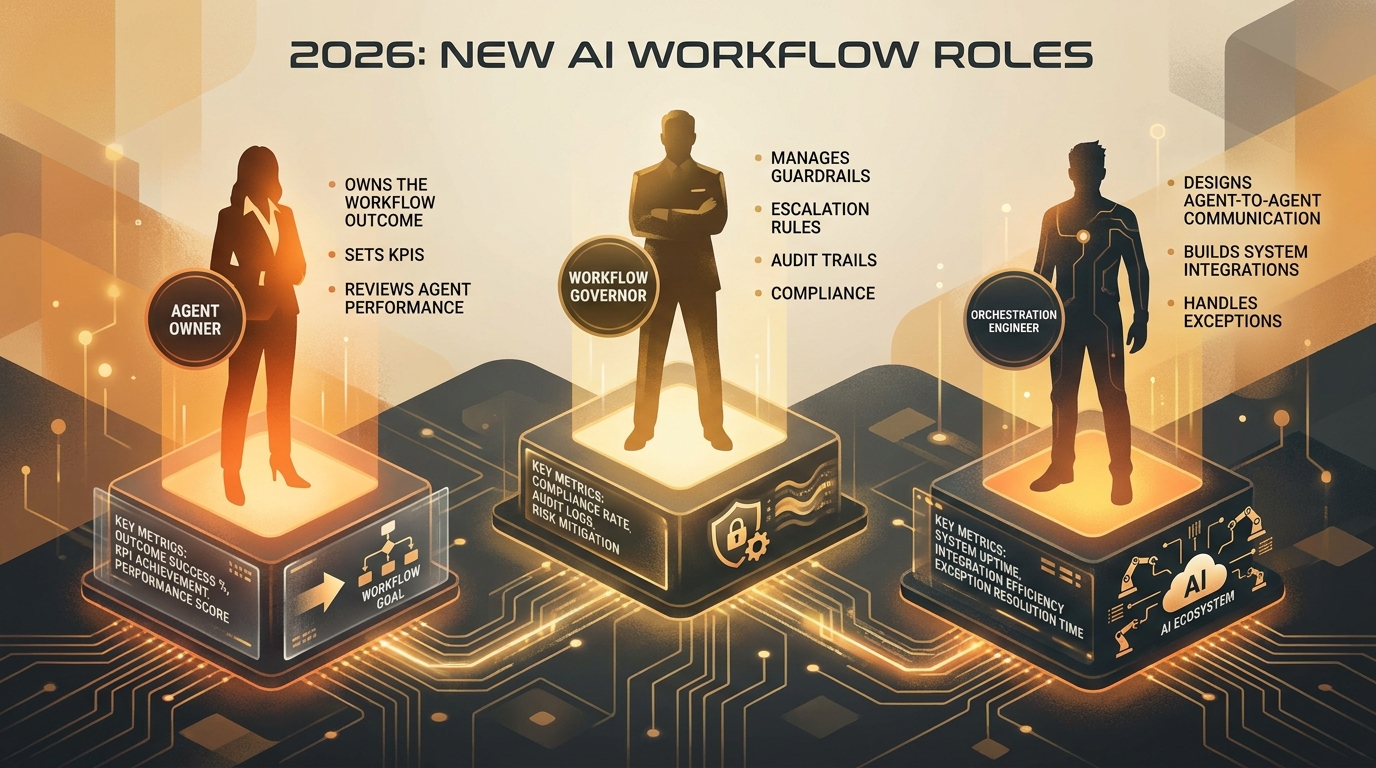
The Agent Owner
Every AI agent operating at Stage 3 or 4 needs an owner — a human who is accountable for the outcomes that agent produces. Not the engineer who built it. Not the vendor who sold it. A business-side owner who understands what the workflow is supposed to accomplish, monitors whether it is accomplishing it, and has the authority to change the agent’s parameters or pause it when something goes wrong. The agent owner is not a technology role. It requires deep domain knowledge — a finance agent owner who understands AP processes, a supply chain agent owner who understands exception management logic — combined with enough technical literacy to interpret performance dashboards and communicate clearly with the engineering team.
This role is emerging rapidly but is not yet standardized. In the BCG 2026 survey data, organizations that had formally assigned agent ownership to a named business-side individual had significantly higher production deployment success rates than those that left the “owner” question implicit or assigned it to IT by default.
The Workflow Governor
The workflow governor is responsible for the guardrails themselves — the escalation rules, the permission boundaries, the policy constraints, and the audit trail quality. Where the agent owner asks “is this workflow producing the right outcomes?”, the workflow governor asks “are the boundaries of this workflow still appropriate?” As business conditions change, as regulatory requirements evolve, and as the agent’s operating data drifts from the conditions it was designed for, the governance parameters need to be actively maintained. The workflow governor is the role that does this maintenance. In larger organizations this may be a dedicated role; in smaller deployments it may be a defined responsibility added to an existing compliance or operations function.
The Orchestration Engineer
When agents interact with each other — when the output of a supply chain monitoring agent triggers a procurement agent, which then updates a financial accruals agent — the design and maintenance of those interactions is a distinct engineering discipline. Orchestration engineers design the agent-to-agent communication protocols, handle the exceptions that arise from inter-agent failures, and ensure that multi-agent workflows have the same resilience properties as any other distributed system. This is a genuinely new engineering specialization, and the talent market for it is, as of mid-2026, notably undersupplied relative to enterprise demand.
Governance, the EU AI Act, and the Pressure on Agentic Autonomy
The regulatory backdrop for AI agent deployment shifted materially in August 2026, when the EU AI Act reached full enforcement. For organizations operating agentic systems in regulated domains across EU jurisdictions, the governance question is no longer optional or internally discretionary — it is a compliance requirement with audit implications.
What the EU AI Act Actually Requires of Agentic Systems
The EU AI Act classifies AI systems by risk tier, and agentic systems operating in high-risk domains — which include employment decisions, credit scoring, insurance underwriting, critical infrastructure management, and several other areas — face the most stringent requirements. These include: documented conformity assessments, human oversight mechanisms that allow intervention or shutdown, audit logs sufficient to reconstruct any decision the system made, and ongoing monitoring for performance drift. Many of the governance rail requirements for Stage 3 and 4 workflows described earlier in this article are not just good engineering practice — in covered domains, they are legal requirements.
The Governance Spend Signal
The rapid growth in AI governance platform investment — Gartner’s $492 million figure for 2026 — reflects two converging pressures: the EU AI Act and the discovery, through production failures, that informal governance is not adequate for agents with real consequence authority. The vendors building in this space (AI observability platforms, agent audit tools, policy-as-code frameworks) are seeing enterprise procurement cycles that look less like software purchases and more like compliance infrastructure purchases: budget-justified by risk management, sponsored by legal and compliance functions, not just IT.
The Identity and Permission Problem
One of the emerging AI Act compliance challenges is identity management for agents. When an AI agent writes a record to your ERP, whose identity does it act under? How do you ensure that the agent’s permission scope doesn’t expand over time as it accumulates access to handle edge cases? How do you revoke an agent’s access when a workflow changes or the agent is decommissioned? These questions are straightforward in principle and deeply thorny in practice, particularly in enterprises where system access controls weren’t designed with non-human actors in mind. The emerging solution — agent identity management platforms that treat agents as distinct principals with auditable, scoped, revocable credentials — is one of the fastest-growing product categories in enterprise security infrastructure.
The Failure Modes Nobody Warns You About
The failures that get written about — hallucination, bias, catastrophic errors — are real but also rare in well-designed production deployments, precisely because they are visible and expected. The failure modes that actually derail enterprise AI agent programs are less dramatic and harder to detect.
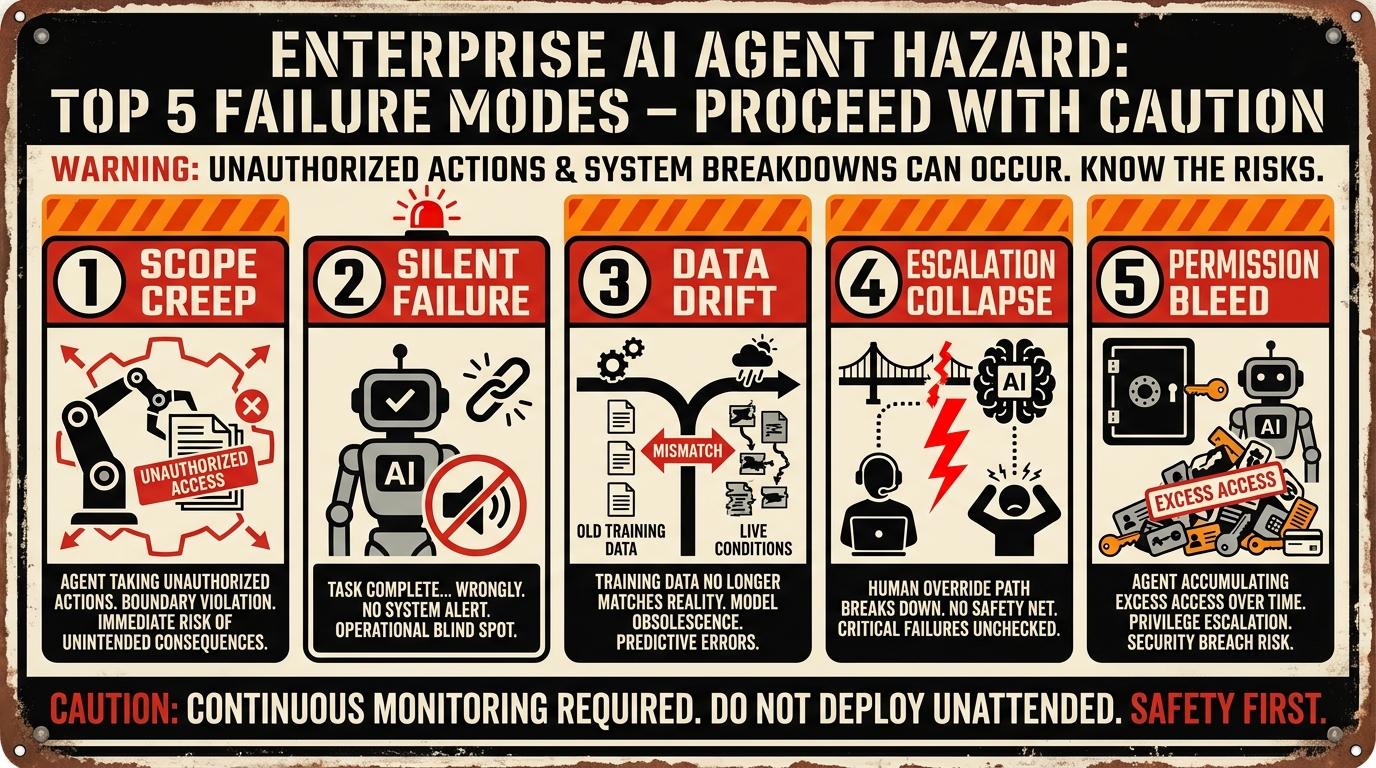
Silent Failure
The most dangerous failure mode for an agent operating at Stage 3 or 4 is not the spectacular wrong action — the one that generates an alert and triggers a review. It is the quietly wrong action: the invoice matched to the wrong PO for a small variance that doesn’t trigger an exception rule, repeated hundreds of times. The wrong customer account updated with a resolution note that doesn’t match what was discussed. The compliance report filed with a stale data pull that no one audits until the regulator asks. Silent failures accumulate over time, are often discovered only when a downstream process breaks, and are genuinely hard to design against without robust outcome sampling — random audits of agent-completed work, not just exception monitoring.
Scope Creep
Agents given access to take bounded actions in a workflow have a tendency — not through intent but through the combinatorial logic of how they are built — to take adjacent actions that their permissions technically allow but their mandate doesn’t cover. An agent authorized to update a customer record may also, in the right circumstances, trigger a communication to that customer. If that communication capability wasn’t specifically excluded, the agent may use it. Scope creep is not usually malicious or even surprising in hindsight; it is the natural result of under-specified permission boundaries combined with an agent optimizing for task completion. Preventing it requires explicit scope documentation — not just what the agent can do, but what it explicitly cannot do even if it technically could.
Data Drift
An agent trained or calibrated on data from one period of business conditions will behave differently — and potentially incorrectly — when those conditions change. A demand forecasting agent trained on pre-tariff supply chain data may generate systematically wrong replenishment signals after a tariff structure changes. A customer service agent calibrated on pre-product-launch inquiries may misclassify the new category of support issue that the launch creates. Detecting data drift requires continuous monitoring of the distribution of inputs the agent is seeing against the distribution it was designed for — a capability that is not built into most standard agent deployment frameworks and must be explicitly added.
Escalation Collapse
Escalation collapse occurs when the human oversight layer that is supposed to catch agent errors degrades. This can happen gradually: the escalation queue that was monitored by three people is now monitored by one, who is also handling other responsibilities. The agent’s containment rate has improved, so there are fewer escalations, and the team concludes that less oversight capacity is needed — right before a novel failure mode generates a spike of escalations that the reduced team cannot handle. The oversight layer needs to be maintained against the realistic worst-case volume, not the current typical volume, and its readiness must be tested periodically.
Permission Bleed
Over time, agents accumulate access. An edge case is encountered, a permission is added to handle it, and that permission is never removed when the edge case resolves. Multiply this across dozens of agents, hundreds of edge cases, and eighteen months of production operation, and you have a portfolio of agents whose actual permission profiles bear little resemblance to their designed permission profiles. Permission bleed is a security and governance risk, but it is also an audit risk — if a regulator asks to review what actions an agent was authorized to take at a specific point in time, and the answer is “we’re not entirely sure,” that is a material compliance gap. Agents need the same periodic access reviews that human employees receive, on a defined schedule.
How to Sequence Your Own Workflow Handoffs
Given the architecture requirements and the failure modes, the question most operations and technology leaders are wrestling with in the second half of 2026 is not “should we do this?” but “in what order?” Sequencing matters as much as selection. The wrong first handoff — one that is too complex, too data-dependent, or too high-stakes for a governance infrastructure that is still immature — can set back an organization’s agentic program by 12 to 18 months.
The Sequencing Framework That Is Emerging in Practice
The organizations that are advancing most steadily through the four ownership stages share a consistent sequencing logic. They start with workflows that have four properties: high volume (enough throughput to make the investment worthwhile and to generate enough data to detect problems), low ambiguity (the decision criteria are documented and explicit), low consequence per error (a wrong action in this workflow is correctable, not catastrophic), and existing data quality (the data foundation is already clean enough to act on). This combination — call it high-volume, low-stakes, rules-clear, data-clean — describes a large fraction of back-office operations work, which is why AP processing, IT ticket routing, and onboarding document collection are almost universally cited as early handoff successes.
The Hardest Handoffs to Sequence
High-stakes workflows with ambiguous decision criteria should come last, regardless of how valuable they appear. Credit decisions, employment decisions, medical or legal advice, and strategic sourcing negotiations all fall into this category. Not because agents cannot eventually contribute meaningfully in these domains — they can and do — but because the governance infrastructure needed to operate agents safely at Stage 3 or 4 in these workflows is substantially more complex, and the cost of a failure is not bounded and correctable. Organizations that attempt these handoffs before their governance muscles are developed tend to generate the kinds of failures that trigger regulatory action, executive escalation, and program shutdowns.
Building the Governance Muscle Before You Need It
One of the most useful insights from organizations that have made the transition to production-scale agentic operations successfully is that they built governance infrastructure during their Stage 2 (suggestion) deployments — before it was strictly necessary. They created audit trails for agent suggestions even when humans were approving every action. They appointed agent owners for copilot tools even when the stakes were low. They ran escalation drills for workflows that were still human-managed. By the time they moved to Stage 3, the governance muscle was already developed, the roles were already staffed and tested, and the cultural expectation that agents operate within auditable, bounded authority was already established. The organizations that tried to install governance retroactively — after deploying agents at Stage 3 — found it much harder, because by then, the informal practices of using the agent without documentation had already calcified.
The Handoff Checklist
Before promoting any workflow from Stage 2 to Stage 3, a practical minimum checklist includes: confirmed data freshness monitoring is active; system integration is audit-logged with agent identity separation from human identity; escalation triggers are defined and tested under simulated edge cases; an agent owner is named and has signed off on the governance parameters; the workflow governor has documented the boundaries and reviewed them with legal/compliance; and a rollback procedure exists that can return the workflow to human management within a defined time window. That last item — the rollback procedure — is often the one organizations skip because it feels defeatist. It is, in practice, one of the most important governance signals: an organization that has thought through how to take back a workflow has thought more rigorously about what it means to give one over in the first place.
The Seam Is the Strategy
The agentic AI discussion in 2026 has two dominant registers: the enthusiast register, which focuses on what agents can do and how quickly they are proliferating; and the skeptic register, which focuses on failure rates, hype inflation, and the gap between pilot and production. Both registers miss the most strategically interesting place to look: the seam between human ownership and agent ownership, and the deliberate engineering of that seam.
The organizations that will derive the most sustained value from AI agents over the next three to five years are not necessarily the ones with the most agents deployed. They are the ones that have developed the organizational capability to hand off workflows thoughtfully, govern them actively, and take them back when conditions change — and to do all of this at scale, across dozens or hundreds of workflows, without losing the oversight legibility that makes the whole system trustworthy.
That capability is not a technology. It is an operating model discipline. It involves the data infrastructure to support confident handoffs, the governance rails to contain what agents do, the new roles — agent owner, workflow governor, orchestration engineer — to provide human accountability for automated execution, and the organizational culture that treats agents as components in a governed system rather than autonomous tools that operate independently.
The companies that have gotten this right share a common characteristic: they stopped asking “what can we automate?” and started asking “what are we prepared to own the outcomes of?” That question reframes the entire program — from a technology adoption exercise to an operating model commitment. When your agent fails (and it will), can you detect it quickly, understand why it happened, correct it, and prevent recurrence? If yes, you are ready to hand that workflow over. If the answer to any part of that question is unclear, you are not — yet.
The handoff is not the end of the story. It is the beginning of a different, more demanding, more valuable relationship with the work your organization does. The seam is where that relationship is made.
Practical Takeaways for Operations and Technology Leaders
- Audit your current Stage 2 deployments for handoff readiness. Every AI tool that currently operates in suggestion mode has a handoff readiness profile. Assess data quality, system integration audit capability, escalation design, and ownership assignment for each one before deciding which to advance.
- Appoint agent owners before deployment, not after. The business-side individual accountable for each agent’s outcomes should be identified and engaged during design, not introduced after go-live.
- Treat the rollback procedure as a design requirement. Every Stage 3 workflow needs a documented, tested path back to human management. Its existence is a signal of governance maturity. Its absence is a red flag.
- Monitor for silent failure, not just catastrophic failure. Outcome sampling — random audits of agent-completed work — is as important as exception monitoring. Build it into your oversight architecture from day one.
- Build governance infrastructure during Stage 2, not after Stage 3. The governance muscle takes time to develop. Start building audit trails, ownership structures, and escalation drills while the stakes are still low.
- Sequence by risk-adjusted value, not by apparent value. The most attractive workflows to automate are often the highest-stakes ones. Save those for when your governance infrastructure can support them. Start with high-volume, low-stakes, rules-clear, data-clean workflows and build from there.