


For the better part of three years, the pitch for AI in revenue operations followed a familiar arc: feed your CRM data into a machine-learning model, surface a ranked list of at-risk deals, and let your reps decide what to do. The system observed. Humans acted. That was the deal.
The deal has changed. In 2026, the most competitive RevOps teams have moved decisively past the “insights layer.” Their AI agents don’t just flag a stalled deal — they reassign the follow-up task, draft the re-engagement email, update the CRM record, and ping the account executive, all without a human ever touching a keyboard. The shift from AI-assisted to AI-executed is not a roadmap item anymore. It is happening in production, right now, at companies across every vertical.
But that shift carries a hidden trap. Most organizations treating AI agents as a “point and click” upgrade to their existing RevOps stack are discovering, often expensively, that autonomous agents amplify whatever is already broken in your process — bad data, murky ownership, undefined workflows — at machine speed and machine scale. A misconfigured routing rule that a human would catch in an afternoon can now quietly misdirect hundreds of leads before anyone notices.
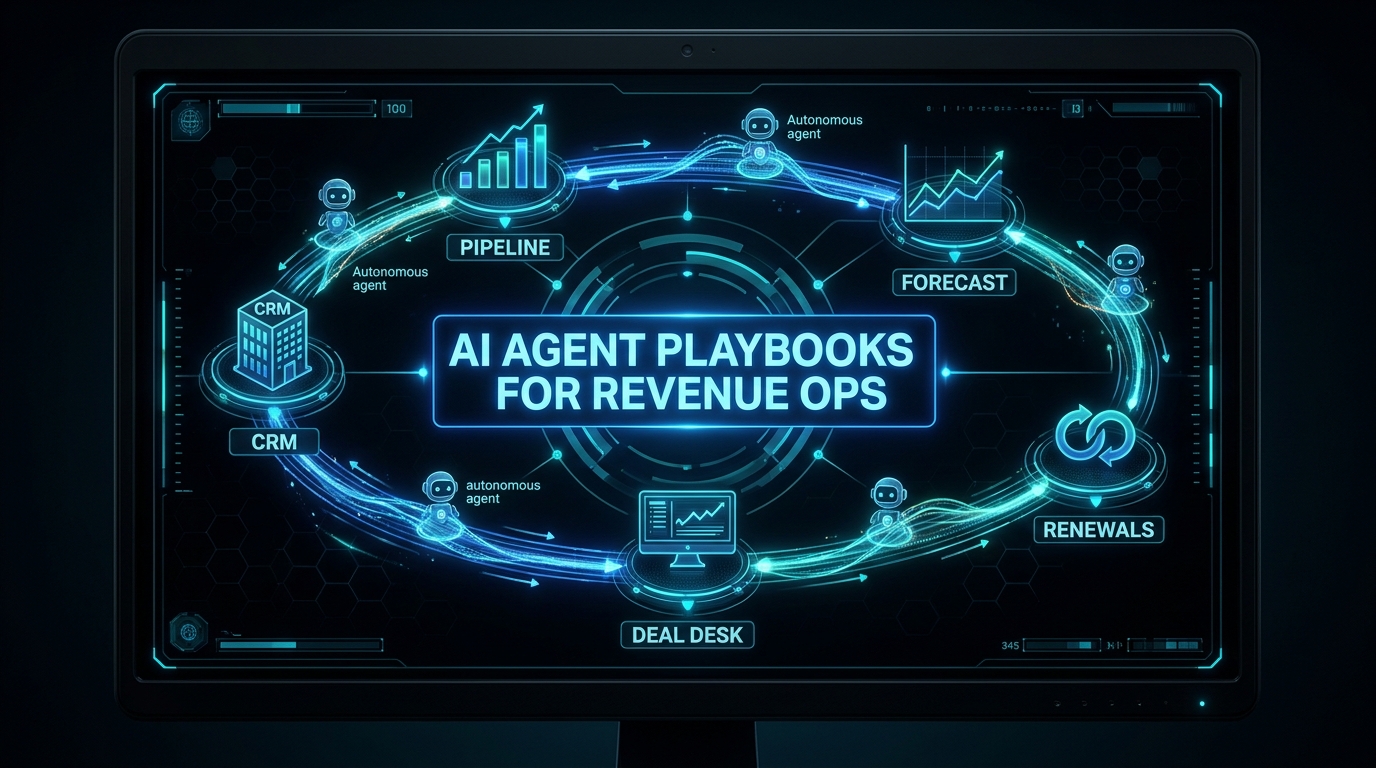
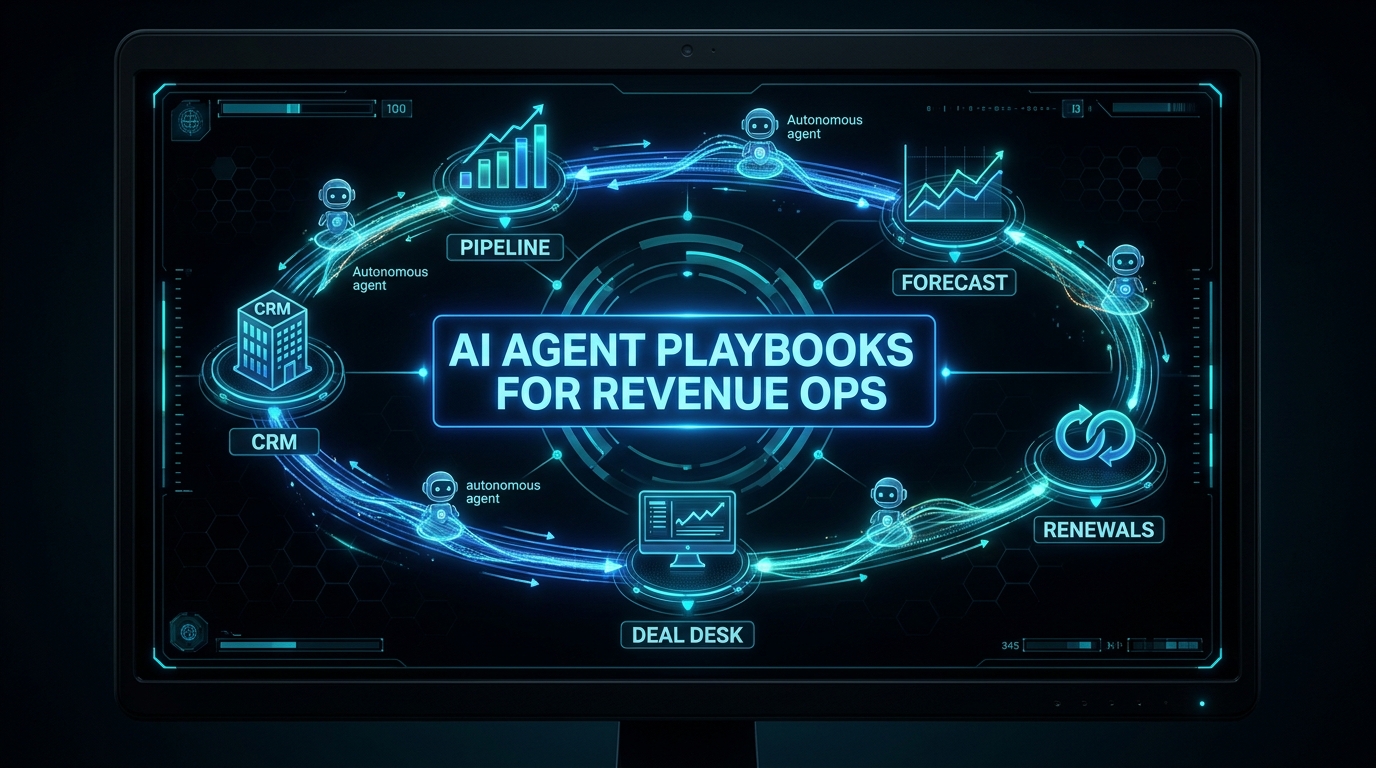
This post is not about the theory of AI agents in revenue operations. It is about the precise engineering of playbooks — scoped, governed, measurable AI agent workflows — that produce repeatable revenue outcomes without blowing up your pipeline in the process. We will cover the anatomy of a well-built playbook, the five failure modes that kill deployments before they scale, and five specific agent playbooks you can build or adapt today, from pipeline risk detection to renewal automation.
If you have been waiting for the revenue ops AI conversation to get concrete and operational, this is that conversation.
What a RevOps AI Agent Playbook Actually Is
Before building anything, it helps to be precise about what a playbook actually is — because the word gets used to mean everything from a Notion doc to a fully autonomous multi-agent orchestration system.
For the purposes of this post, a RevOps AI agent playbook is a narrowly scoped, governed workflow in which an AI agent monitors a defined set of signals, makes a bounded decision based on explicit conditions, executes a specific set of actions across one or more systems, and reports back into a human-readable audit trail.
That definition matters because it rules out two common failure patterns on either end of the spectrum: the “AI as a better spreadsheet” approach, where agents only surface information but never act on it, and the “AI does everything” approach, where agents are given broad permissions without adequate guardrails and begin making consequential decisions outside their intended scope.
The Five-Part Anatomy Every Playbook Needs
Every robust RevOps agent playbook can be reduced to five structural elements. Think of these as the engineering spec you write before you configure the agent, not after.
- Trigger: The specific, measurable condition that activates the agent. Good triggers are binary and data-driven. “A deal has had no logged activity for 14 consecutive calendar days” is a trigger. “The deal feels stuck” is not.
- Condition: The secondary filter that determines whether the trigger is actionable in this specific context. A 14-day stall in a 90-day enterprise deal cycle may be expected; the same stall in a 14-day SMB transactional cycle is critical. Conditions add the business logic that prevents false positives.
- Action: The exact operation the agent executes — update a CRM field, send an internal Slack alert, assign a follow-up task, generate a draft email, escalate to a manager, or some sequence of the above. Actions should be atomic (one discrete operation) and logged.
- Guardrail: The boundary the agent cannot cross without human approval. No autonomous outbound email to a customer without a rep’s sign-off. No discount applied without deal desk review above a defined threshold. Guardrails are not optional — they are the load-bearing walls of the playbook.
- Checkpoint: The scheduled human review of what the agent has done since the last cycle. Weekly audits, anomaly alerts, and variance reports ensure the agent has not drifted from its intended behavior and that its outputs are producing the intended business result.
Why “One Playbook, One Workflow” Is the Right Starting Principle
The instinct when standing up an AI agent program in RevOps is to go broad. There are so many painful workflows to fix — why not fix them all at once? The answer is control. A single agent running a single, well-defined workflow is observable, debuggable, and improvable. An agent trying to manage pipeline health, CRM hygiene, and renewal risk simultaneously creates attribution problems: when something goes wrong — and it will — you will not know which workflow caused it or how to fix it.
The teams seeing the fastest time-to-ROI from RevOps agents in 2026 are those that launched their first agent on one high-volume, measurable pain point, validated results within 30 to 60 days, and then used that proof point to fund and sequence the next deployment. Breadth comes after depth.
The Five Failure Modes That Kill RevOps Agent Deployments Before They Scale
The data is worth stating plainly: across RevOps AI deployments tracked in the first half of 2026, the majority of initiatives that stalled or failed to deliver measurable revenue impact did so not because the underlying models were inadequate — the models are good enough — but because the organizational and operational foundations were weak. Here are the five failure modes that appear most consistently.
1. Dirty Data as a Foundation
An AI agent in RevOps is, at its core, a decision-making system running on your CRM data. If that data has missing fields, duplicate records, inconsistent stage definitions, or contact records that have not been touched in 18 months, the agent will act on those inaccuracies with the same confidence it applies to clean records. The result is misfired alerts, incorrect routing, and forecast models built on sand.
The practical implication: before deploying any AI agent in your revenue stack, you need a data quality audit scoped specifically to the fields the agent will use. If your pipeline risk agent relies on “last activity date,” “deal stage,” and “estimated close date,” those three fields need to be populated, standardized, and trusted. Everything else in the CRM can wait.
2. Unclear Workflow Ownership
Who owns the pipeline risk agent — the VP of Sales, the RevOps lead, or the sales operations analyst who built it? This question sounds administrative. It is actually existential. When an agent takes an action that surprises a sales rep — flags a deal they consider healthy, reassigns a follow-up they were planning to handle, or surfaces a customer at renewal risk to a CSM who was already managing it — the agent’s credibility depends on there being a clear owner to receive that feedback, adjudicate it, and update the agent’s logic accordingly.
Agents without human owners become orphaned processes. They continue running, sometimes for months, without anyone responsible for their outputs. By the time someone traces a forecasting anomaly or a wave of mis-routed leads back to the agent, the damage is already done.
3. Agents Without Guardrails — Or With Guardrails That Are Too Broad
This failure mode has two flavors. In the first, agents are given execution permissions that are far too expansive for the actual maturity of the workflow. An agent that can send customer-facing emails, update deal values, and modify territory assignments without human review is not a productivity tool — it is a liability. In the second flavor, guardrails exist on paper but are set so broadly that they provide no real protection: “require human approval for any action above $1 million” sounds prudent until you realize your median deal size is $800,000.
Effective guardrails are calibrated to the actual distribution of outputs the agent will produce. If the agent handles discount approvals, the guardrail threshold should be set at a level that catches a meaningful percentage of cases for human review — typically 20 to 30 percent of volume, not two percent.
4. Silent Errors at Scale
This is the most dangerous failure mode because it is the least visible. An AI agent running at scale will make errors — that is a feature of probabilistic systems, not a defect. The problem is not that errors occur. The problem is when there is no mechanism to detect, surface, and remediate them quickly.
A mis-categorized lead that a human would catch in a daily review can be replicated across 300 records before the weekly audit. A forecast model that has drifted due to a data schema change can quietly understate pipeline risk for weeks. Silent errors compound. The antidote is proactive anomaly detection baked into the agent’s checkpoint process — not as an afterthought, but as a core design requirement from day one.
5. Deploying Too Many Agents Too Quickly
The final failure mode is one of ambition outpacing operational readiness. Organizations that launch five or six AI agents simultaneously in their RevOps stack — pipeline risk, CRM hygiene, deal desk, churn alerts, forecasting — before any of them have been validated in production create a complexity problem that is extremely difficult to unwind. When performance degrades, it is impossible to isolate the cause. When agents interact with each other across shared data, edge cases multiply.
The solution is explicit sequencing: one agent, one workflow, validated results, then expand. This discipline feels slow. It is actually the fastest path to a mature, functioning AI RevOps program.
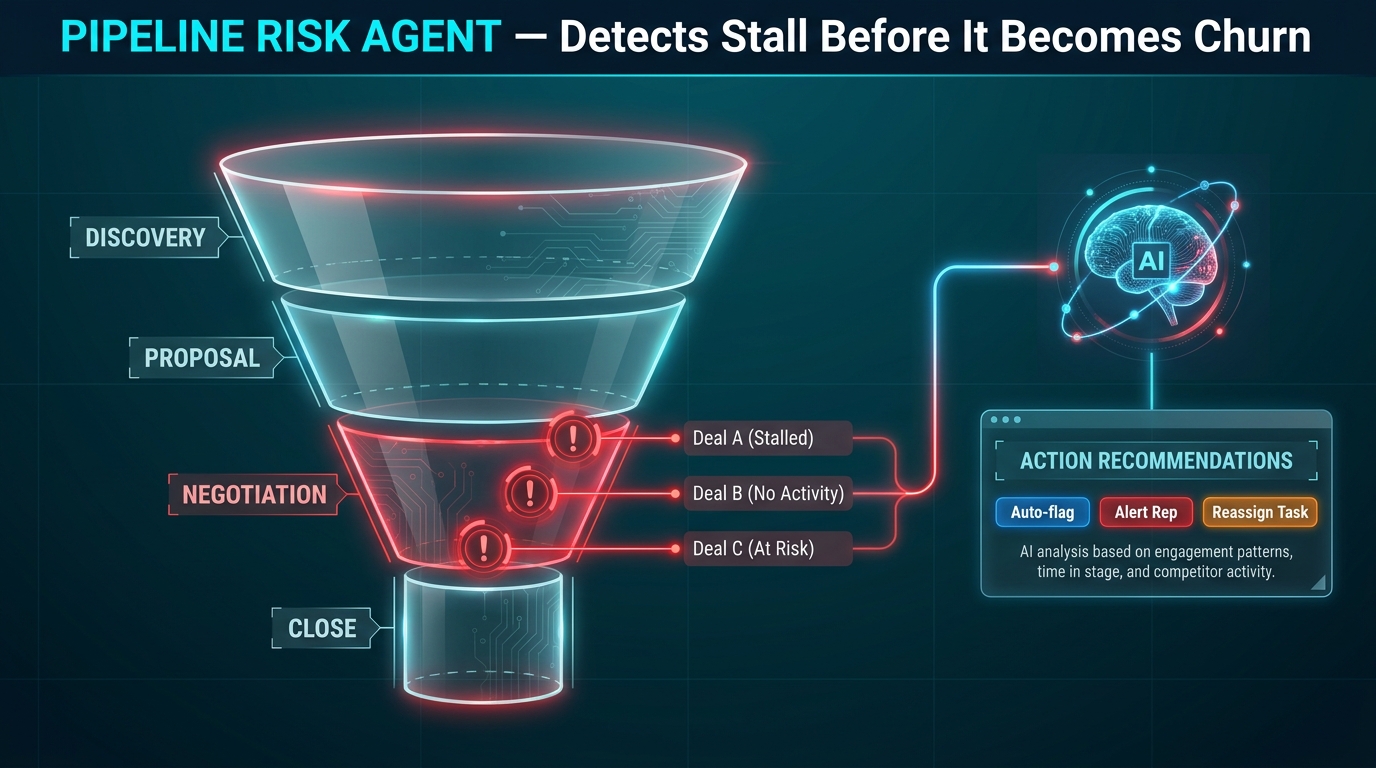
Playbook #1 — The Pipeline Risk Detection and Auto-Triage Agent
Pipeline risk detection is the most common first deployment for RevOps AI agents, and for good reason: it operates on data that most CRMs already capture, the trigger conditions are easy to define, and the business value is immediate and measurable.
What It Does
The pipeline risk agent continuously monitors every open opportunity in the CRM against a set of defined health signals: days since last logged activity, number of stakeholders engaged, deal stage progression velocity, engagement signals from email and meeting data, and historical win-rate patterns for similar deals at the same stage. When a deal crosses a risk threshold, the agent does not just flag it in a report — it takes action.
Trigger → Condition → Action → Guardrail → Checkpoint
- Trigger: A deal has had zero logged activity for 14 or more calendar days, OR has been in the current stage for more than 150% of the historical average stage duration.
- Condition: The deal is above $10,000 in value AND is in the Proposal, Negotiation, or Verbal Commit stage. (Discovery-stage stalls are handled by a separate lead nurture workflow.)
- Action: The agent automatically assigns a follow-up task to the deal owner with a priority tag; updates the deal’s health score in the CRM from “On Track” to “At Risk”; generates a one-paragraph deal brief summarizing the stall and recommends a re-engagement approach based on similar historical wins; sends an internal Slack notification to the deal owner and their manager.
- Guardrail: The agent does not send any external communication to the prospect. It does not change the deal value, close date, or assigned owner. All actions are internal and advisory unless explicitly extended.
- Checkpoint: Weekly pipeline review where RevOps audits flagged deals versus actual outcomes — did the re-engagement task resolve the stall? Did the deal close, lose, or continue to stagnate? This data refines the trigger thresholds over time.
What Results Look Like
RevOps teams deploying pipeline risk agents in 2026 are reporting meaningful improvements in win rates on at-risk deals — largely because the intervention is earlier and the brief gives reps a structured re-engagement frame rather than a cold “hey, just checking in.” The key metric to track is not just how many deals the agent flags, but how many of those deals close after agent-triggered re-engagement versus a control group of manually managed at-risk deals. That delta is your agent’s contribution to revenue.
Playbook #2 — The CRM Hygiene and Data Integrity Agent
CRM hygiene is unglamorous, consistently underfunded, and absolutely foundational to every other AI initiative in your stack. A CRM data integrity agent does not generate revenue directly — but it determines whether every other agent in your RevOps program can generate revenue at all. Think of it as the infrastructure play that makes everything else possible.
What It Does
The hygiene agent runs continuously in the background, scanning CRM records for a defined list of data quality violations: missing required fields, duplicate contacts or accounts, mismatched data across integrated systems (CRM versus marketing automation versus billing), stale records that have not been touched beyond a defined threshold, and stage definitions that have been manually overridden in ways that break downstream reporting.
Trigger → Condition → Action → Guardrail → Checkpoint
- Trigger: A CRM record is created, updated, or imported; OR a daily batch scan completes and identifies records violating hygiene rules.
- Condition: The violation falls into one of the defined hygiene categories AND the record is associated with an active opportunity, account, or contact in an active marketing sequence. (Inactive historical records are queued for separate review.)
- Action: For missing fields with deterministic data (company size from an enrichment provider, industry classification from LinkedIn), the agent automatically populates the field and logs the enrichment source. For ambiguous fields (deal stage, account owner), the agent creates a flagged task for the record owner. For confirmed duplicate records, the agent proposes a merge and routes it to the RevOps admin for one-click approval.
- Guardrail: The agent does not auto-merge records without human approval. It does not delete any record. Enrichment from third-party sources is tagged with the source and confidence level, allowing humans to override. All automated writes are logged with a timestamp and revertable.
- Checkpoint: A monthly data health score report tracking overall field completion rate, duplicate rate, and enrichment accuracy. The score is compared month-over-month to verify the agent is moving the needle rather than just rearranging the same problems.
The Compounding Effect of Clean Data
Here is the business case that is easy to understate. Every percentage point improvement in CRM data completeness has a multiplying effect on the accuracy of every other AI model built on that data — your forecasting agent, your churn prediction model, your deal scoring system. A team that gets CRM field completeness from 60% to 90% is not just improving data hygiene. It is improving the effective intelligence of their entire AI stack by an order of magnitude. The hygiene agent often delivers its highest ROI indirectly, by making every other agent work better.
Playbook #3 — The Quote-to-Cash Acceleration Agent
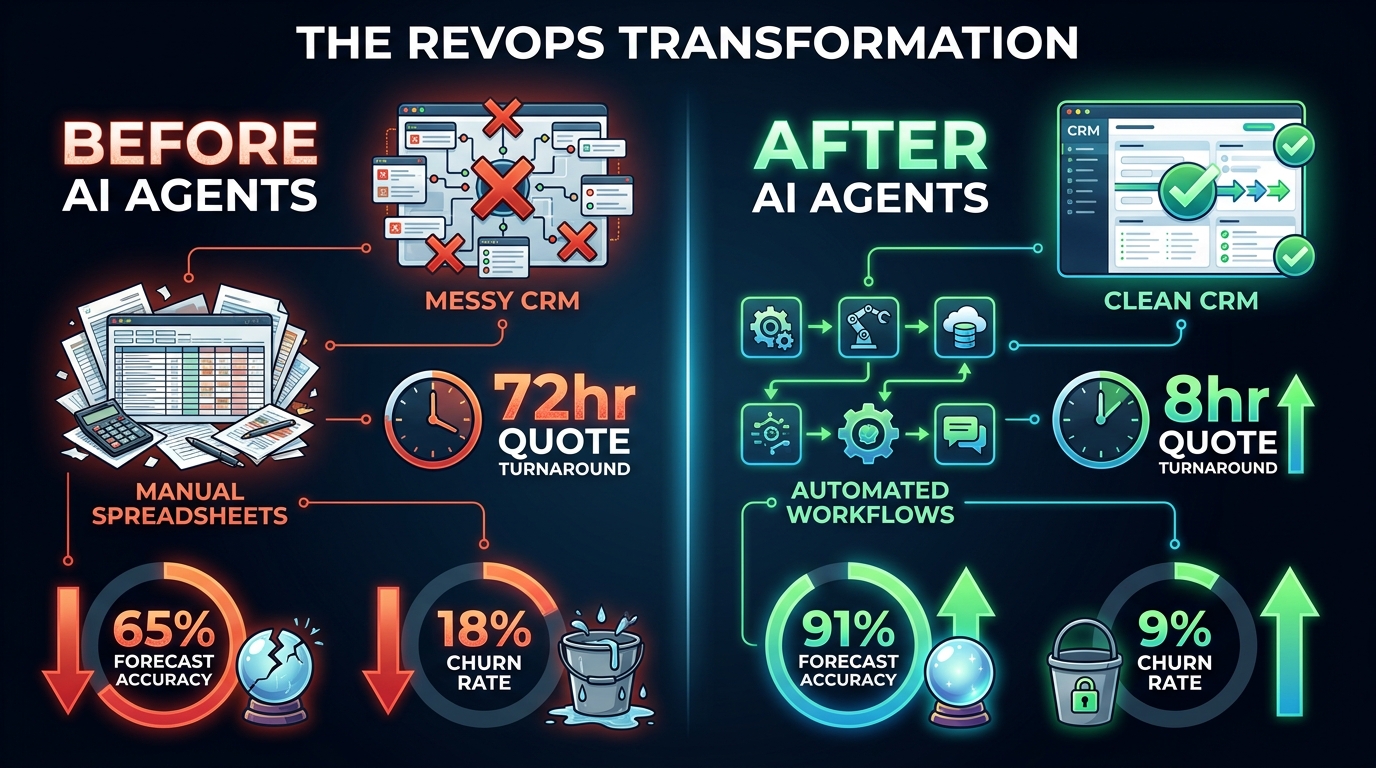
The quote-to-cash process — from the moment a rep prepares a commercial proposal to the moment cash hits the bank — is one of the most friction-dense workflows in the modern B2B revenue cycle. Manual quote preparation, multi-stakeholder approval chains, contract redlines, and billing system updates each represent a potential delay point. In complex enterprise deals, the cumulative delay can stretch weeks. AI agents are now compressing this cycle in ways that deliver both revenue acceleration and significant cost reduction.
What It Does
The quote-to-cash agent sits across the intersection of your CRM, CPQ (Configure, Price, Quote) system, contract management platform, and billing system. It monitors quote requests, validates pricing and discount parameters against policy rules, routes approvals based on deal attributes, flags contract terms that deviate from standard, and triggers billing system updates upon contract execution — all without requiring manual handoffs between systems.
Trigger → Condition → Action → Guardrail → Checkpoint
- Trigger: A rep submits a quote request in the CPQ system, or a contract is returned with redlines from the prospect.
- Condition: For pricing: the requested discount is within pre-authorized ranges for the rep’s tier AND the deal meets the minimum qualifying criteria (revenue threshold, product mix, contract term). For contracts: the redlined clauses are flagged against a library of pre-approved alternative language.
- Action: For within-policy quotes: the agent auto-approves and generates the proposal document, triggers CRM stage advancement, and notifies the rep for delivery. For out-of-policy requests: the agent routes to the deal desk team with a structured summary of the deviation and comparable historical approvals for reference. For contract redlines: the agent cross-references against approved language libraries and either auto-accepts standard variations or escalates non-standard clauses to legal with a recommended position.
- Guardrail: No discount beyond the rep’s pre-authorized ceiling is applied without deal desk approval. No contract with non-standard liability, IP, or exclusivity clauses is auto-approved. The agent cannot execute changes to billing or revenue recognition without a signed contract record.
- Checkpoint: Monthly deal desk review comparing quote cycle time, approval rate, and average discount depth before and after agent deployment. The key metric is not just speed — it is whether faster quotes are also better quotes (higher win rates, lower post-close churn from mis-sold terms).
The Numbers on Quote Cycle Compression
The operational impact here is well-documented in 2026 deployments. RevOps teams running automated deal desk agents are reporting quote-to-approval cycle time reductions of 60% to 70% — compressing what was a 2-to-5-day process into hours for within-policy requests. For a sales team closing 50 deals a month, even a two-day reduction per deal represents a material improvement in close-rate given the compounding effect of momentum in late-stage deals. Buyers who have to wait rarely improve their offer in the interim.
Playbook #4 — The Churn and Renewal Risk Agent
The economics of SaaS and subscription revenue make churn prevention and renewal optimization among the highest-leverage activities in the entire revenue cycle. Acquiring a new customer costs five to seven times more than retaining an existing one. An AI agent that reliably identifies renewal risk weeks before the customer formally signals intent to cancel — and that triggers the right intervention at the right time — can move the needle on net revenue retention more directly than most top-of-funnel activities.
What It Does
The churn and renewal risk agent monitors a set of leading behavioral and contractual signals across your customer base: product usage frequency and depth, support ticket volume and sentiment, NPS or CSAT score trends, stakeholder engagement patterns, contract renewal date proximity, and expansion or contraction signals. It synthesizes these signals into a renewal health score and triggers intervention workflows calibrated to the risk level.
Trigger → Condition → Action → Guardrail → Checkpoint
- Trigger: A customer’s renewal health score drops below a defined threshold, OR a customer’s product usage drops by more than 30% over a rolling 30-day window, OR a renewal is within 90 days and no renewal conversation has been logged in the CRM.
- Condition: The customer is in the current contracted base (not already in a churn or offboarding workflow). The risk signal is corroborated by at least two independent data sources (usage + support volume, or NPS score + stakeholder engagement drop).
- Action: High-risk accounts (below the critical threshold): the agent immediately alerts the CSM and their manager, creates a renewal save plan task with a structured brief that includes the customer’s usage history, support issues, and recommended talking points based on similar successful saves. Medium-risk accounts: the agent drafts a proactive outreach sequence for the CSM to review and send. Low-risk accounts within 90 days of renewal: the agent generates an auto-populated renewal summary for the CSM, reducing manual prep time.
- Guardrail: The agent does not send customer-facing communications without CSM review and approval. It does not offer pricing concessions or contract modifications. Any account flagged as high-risk is escalated to human handling within 24 hours — the agent does not autonomously manage a save conversation.
- Checkpoint: Quarterly churn cohort analysis comparing predicted versus actual churn, and measuring the intervention success rate: of all accounts the agent flagged as high-risk and triggered interventions for, what percentage renewed? This data refines the model’s signal weighting over time.
The Compound Effect on Net Revenue Retention
What makes the churn agent particularly high-value is that its impact compounds in both directions. It reduces revenue lost to churn, and when calibrated correctly, it also surfaces expansion signals — accounts using product deeply, adding users, or asking support questions that indicate readiness for an upsell conversation. The best renewal agents in 2026 are functioning as a signal layer for both retention and growth, making them double contributors to net revenue retention.
Playbook #5 — The Forecast Accuracy Agent
Forecasting is the RevOps function that keeps executives up at night. Most B2B organizations are operating with forecast accuracy in the 60 to 70 percent range — meaning that between 30 and 40 percent of what sales leadership commits to the board at the start of a quarter is either pulled forward, slips, or vanishes entirely. An AI forecasting agent does not just produce a number. It actively monitors the inputs that determine whether that number is going to hold.
What It Does
The forecast accuracy agent ingests data from across the revenue stack — deal stage distribution, stage velocity, historical win rates by segment and rep, engagement signals from call transcripts and emails, and macroeconomic signals where relevant — to produce and continuously update a weighted forecast model. Critically, it also identifies the specific deals and signals that pose the greatest threat to forecast accuracy and surfaces them for human review before they become misses.
Trigger → Condition → Action → Guardrail → Checkpoint
- Trigger: Weekly forecast cycle begins (time-based), OR a deal in the current quarter’s commit category changes stage, loses a key stakeholder, or misses a defined milestone.
- Condition: For routine weekly cycle: all deals in commit and best-case categories are included. For event-based triggers: the deal is in the current quarter’s forecast AND represents more than a defined revenue threshold.
- Action: The agent produces a three-scenario forecast (commit, upside, risk) with explicit deal-level breakdowns and confidence intervals. It generates a “forecast risk brief” — a prioritized list of the top 5 to 10 deals most likely to slip, with the specific signals driving that prediction and a recommended action for each. It compares the current forecast to the prior week and flags deals that have moved more than one stage in either direction as requiring rep validation.
- Guardrail: The agent produces forecast recommendations — it does not submit forecast numbers to executive leadership or board reporting without explicit human validation and sign-off. Rep- and manager-submitted forecasts are an input to the agent’s model, not an output that the agent overrides unilaterally.
- Checkpoint: Monthly forecast variance analysis: what did the agent predict versus what actually closed? Which signal types were most predictive? Which were misleading? This is the most important feedback loop in the entire RevOps AI program because it directly measures whether the agent is improving the quality of commercial decision-making.
From 65% to 91%: What Improved Forecasting Actually Delivers
The business impact of tighter forecasting accuracy reaches well beyond the RevOps function. Organizations that achieve forecast accuracy above 90% can make better hiring decisions, more confident inventory and capacity planning, and more credible investor communications. They also create a virtuous cycle in their sales culture: when reps know the forecast is accurate and their commits are taken seriously, they become more disciplined about what they put into commit — which makes the forecast more accurate still. The agent is not just a prediction tool. It is a cultural forcing function.
The Human-in-the-Loop Architecture: Where Agents Stop and Humans Start
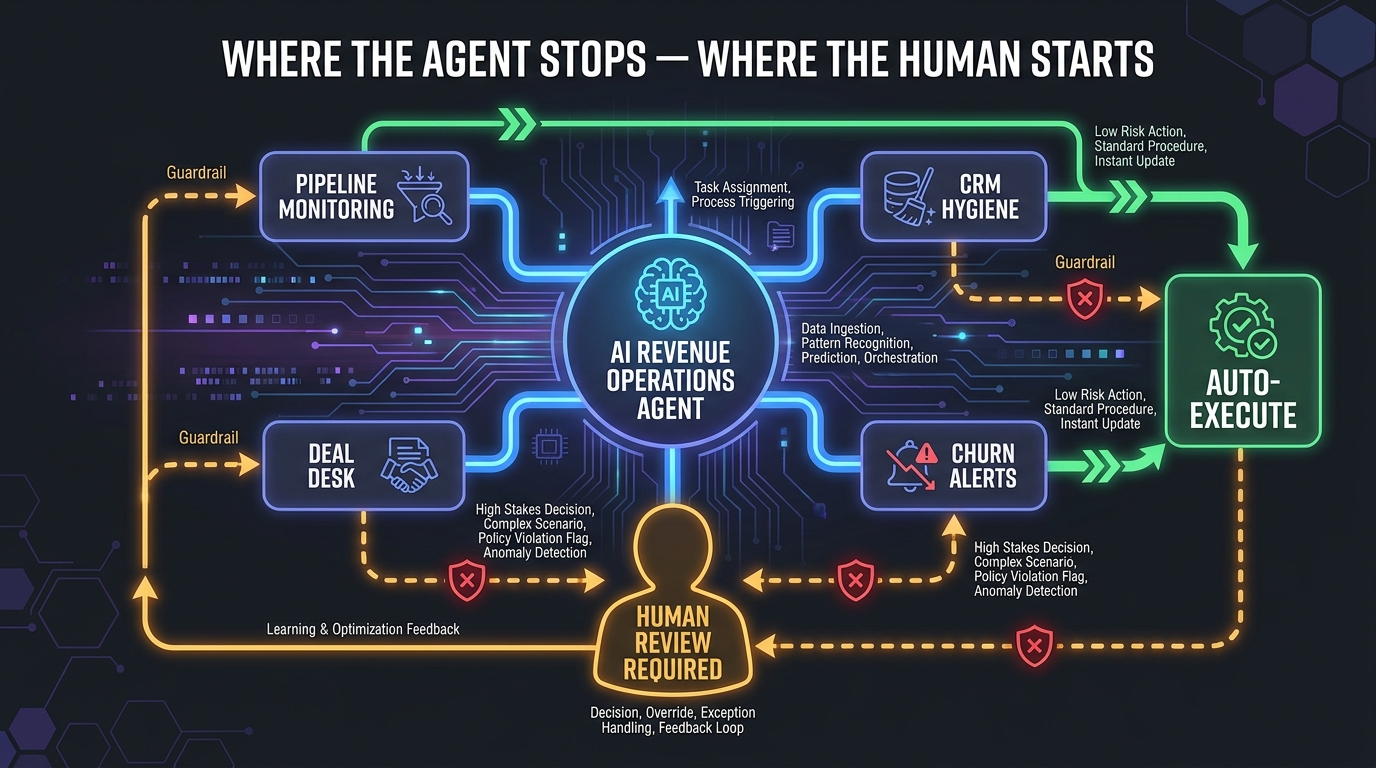
The question that sits underneath every RevOps AI agent deployment is: exactly which decisions should the agent make autonomously, and which ones should be routed to a human? Get this wrong in either direction — too much autonomy or too much oversight — and you either create liability or negate the efficiency gains entirely.
The Decision Classification Framework
A practical framework for classifying decisions across three tiers has emerged as the most commonly adopted approach among mature RevOps AI programs in 2026:
- Tier 1 — Fully Autonomous: High-volume, low-stakes, deterministic decisions where the rules are clear and the cost of an error is low and easily corrected. CRM field enrichment, duplicate flagging, routine task assignment, internal notification generation. The agent executes without human review but logs every action.
- Tier 2 — Human-in-the-Loop: Medium-stakes decisions where the agent prepares a recommendation or takes a preparatory action, but a human validates before any external or consequential output. Quote generation within policy, draft renewal briefs for CSM review, re-engagement email drafts for rep review and sending. The agent does the 80% prep work; the human does the 20% judgment call.
- Tier 3 — Human-Initiated with AI Assistance: High-stakes decisions where the agent provides structured analysis and recommendations but the human both initiates and executes the action. Out-of-policy discount approval, contract language deviations, executive escalations, churn save conversations. The agent is an advisor, not an actor.
Why the Tier Lines Shift Over Time
One of the more nuanced realities of operating AI agents in RevOps is that the tier classification of a given decision type is not fixed. As agents accumulate a track record of accurate, consistent outputs on a specific decision type, it becomes defensible — with appropriate governance — to move that decision type from Tier 2 to Tier 1. The reverse is also true: an agent that shows degraded accuracy on a category of decision should have that category moved to a higher tier until root cause is identified and resolved.
This dynamic calibration is what separates teams that are genuinely operating mature AI programs from those running static automations that slowly drift out of alignment with business reality.
How to Measure Whether Your RevOps Agents Are Actually Working
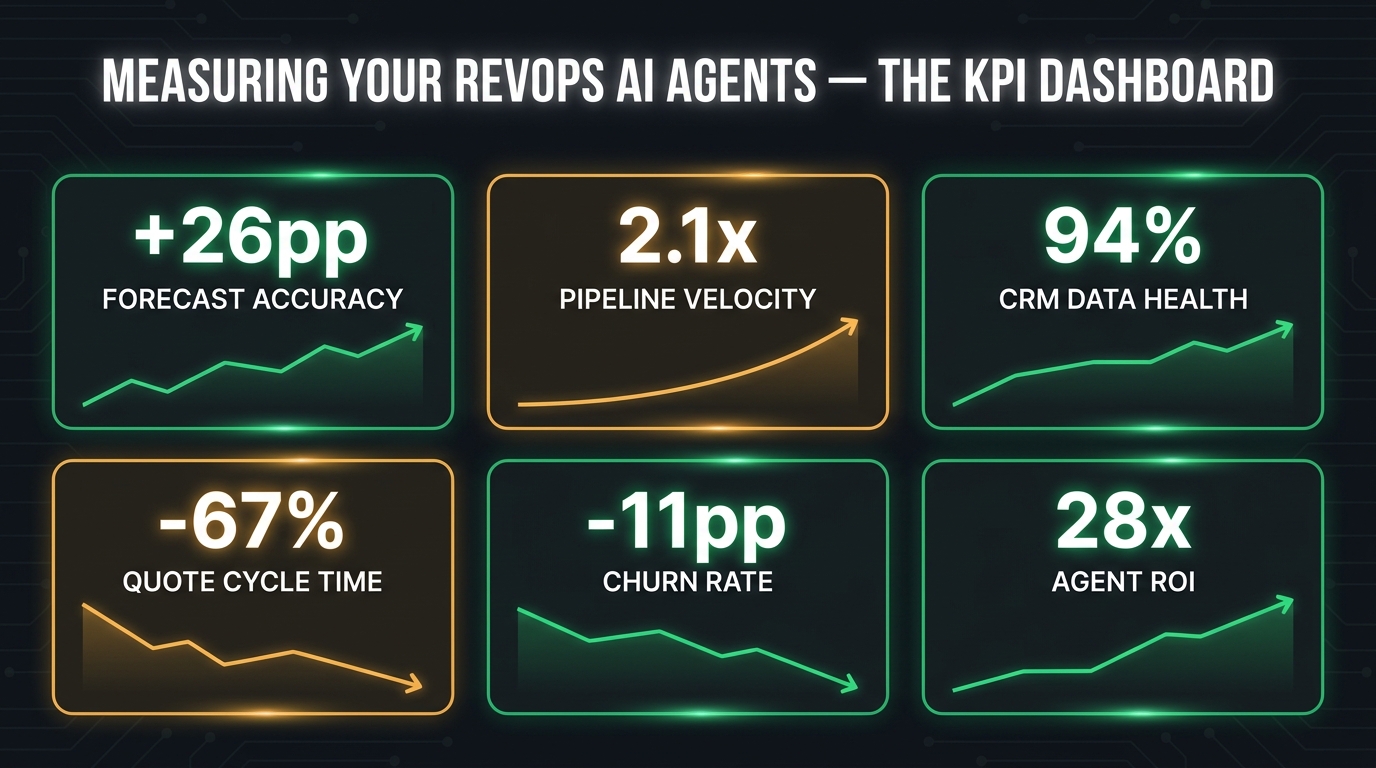
The most common measurement mistake RevOps teams make with AI agents is tracking agent activity metrics — number of tasks created, records updated, alerts fired — instead of revenue outcome metrics. Activity tells you the agent is running. Outcomes tell you the agent is working.
The Dual-Lens Metric Stack
A well-instrumented RevOps AI program measures two distinct layers simultaneously: the revenue outcome metrics that existed before the agent, and the AI-specific operational metrics that tell you whether the agent layer itself is healthy.
Revenue Outcome Metrics — these are your primary measures of whether the agent is actually contributing to the business:
- Win rate on agent-flagged at-risk deals versus win rate on non-flagged deals of similar size and stage. This is the purest measure of your pipeline risk agent’s contribution.
- Forecast accuracy variance — percentage difference between the agent’s weekly commit prediction and actual quarter close. Track this week-over-week within a quarter and quarter-over-quarter across multiple periods.
- Quote-to-cash cycle time — measured in calendar days from quote request to executed contract. Track at the median and 90th percentile; tail performance often matters as much as average performance.
- Renewal rate on agent-monitored accounts versus accounts managed without agent support. The control group discipline here is important — you need a comparable cohort, not just an aggregate before/after comparison.
- Net revenue retention — the ultimate downstream indicator of whether your churn and expansion agents are moving the needle.
AI Operational Metrics — these tell you whether the agent itself is functioning correctly:
- Data integrity score — field completion rate, duplicate rate, and enrichment accuracy across the CRM fields the agents depend on. Benchmark monthly.
- Agent action accuracy rate — of all autonomous actions the agent took in a defined period, what percentage were validated as correct by human checkpoint review? Target 95%+ for Tier 1 actions.
- False positive and false negative rates — for risk detection agents, how often does the agent flag a deal as at-risk that closes on time (false positive), and how often does a deal slip that the agent did not flag (false negative)?
- Checkpoint escalation rate — what percentage of agent-generated recommendations result in human override? A very high override rate (above 40%) suggests the agent’s logic is misaligned with how humans actually make the decision. A very low rate (below 5%) may suggest guardrails are set too conservatively and the agent is not being used to its potential.
Setting Baselines Before You Deploy
The single most important measurement discipline is establishing clear baselines before the agent goes live. This sounds obvious and is consistently skipped. Without a pre-deployment baseline for forecast accuracy, win rates, quote cycle time, and CRM data quality, you will not be able to attribute improvements (or degradations) to the agent with any confidence. Three months of baseline data is the minimum. Six months is better, especially for metrics with seasonal patterns.
The Right Order to Deploy Your RevOps Agent Stack
The sequencing question — which agent to build first, second, and third — is not just a matter of priority. It is a matter of dependency. Some agents require clean data before they can function. Some require validated workflows before their outputs are trustworthy. Getting the order wrong is one of the most common reasons RevOps AI programs underdeliver in their first year.
The Recommended Deployment Sequence
Based on the dependency structure of the five playbooks described above, and the failure modes that most commonly derail early deployments, here is the recommended sequencing for a RevOps team standing up an AI agent program from scratch:
- Month 1-2: CRM Hygiene Agent first. Before any other agent can produce reliable outputs, the data layer needs to be clean. The hygiene agent is the prerequisite for everything that follows. It also tends to generate early organizational wins — visible, tangible improvements in data quality that build confidence in the broader program.
- Month 2-3: Pipeline Risk Detection Agent second. With cleaner data as a foundation, the pipeline risk agent can now operate with meaningful signal-to-noise. This is also the agent that tends to generate the most visible, immediate business impact for sales leadership — which builds internal support for the broader program.
- Month 3-5: Forecast Accuracy Agent third. The forecasting agent benefits from having pipeline risk detection already running, because risk-flagged deals are important inputs to forecast confidence scoring. With two to three months of pipeline risk data already accumulated, the forecasting agent has a richer historical dataset to work from.
- Month 4-6: Churn and Renewal Risk Agent fourth. Customer health data is typically in better shape than pipeline data in most organizations — but the renewal agent still benefits from the data quality disciplines established by the hygiene agent. This agent also requires cross-functional alignment between RevOps and Customer Success, which takes time to establish.
- Month 5-7: Quote-to-Cash Acceleration Agent fifth. The deal desk agent touches the most systems — CRM, CPQ, contracts, billing — and has the most complex cross-functional stakeholder map (sales, legal, finance). It deserves to be deployed last, when the team has accumulated operational experience with the other agents and established the governance muscles needed to manage a more complex workflow.
Why Data First Is Non-Negotiable
Every point in the sequencing above flows from one foundational principle: AI agents are only as good as the data they operate on, and the data layer must be addressed before, not during, the deployment of revenue-critical agents. Organizations that skip the hygiene step and deploy pipeline risk or forecasting agents first into a dirty data environment are not saving time. They are building on a foundation that will eventually require them to pause, clean the data, and recalibrate their agents — at a point when leadership has already formed opinions about the program’s effectiveness based on unreliable outputs.
RevOps as Orchestrator, Not Operator — A Practical Conclusion
There is a narrative about AI and revenue operations that gets the causality exactly backwards. In this narrative, AI agents replace RevOps functions — forecasting agents make the forecast, pipeline agents manage the pipeline, deal agents close the deals, and RevOps professionals become supervisors watching screens. This is not what is happening in the organizations building these programs well.
What is actually happening is a role elevation. As agents absorb the high-volume, rules-based operational work — the CRM updates, the risk flagging, the data enrichment, the approval routing — RevOps professionals are freed to do something more important: design better systems, set better thresholds, interpret variance between what the agents predict and what the business actually produces, and translate those insights into process improvements that make the next quarter more predictable than the last.
This is RevOps as orchestrator rather than operator. The agents handle the execution layer. Humans handle the judgment layer — which is, not coincidentally, the layer where the highest-value decisions actually live.
Three Principles for the Teams Just Getting Started
If you are at the beginning of this journey — assessing your CRM data, evaluating agent platforms, preparing internal stakeholders — three principles from the organizations doing this well are worth carrying into every conversation:
- Start with the data, not the agent. The most sophisticated AI agent built on a dirty data foundation is a sophisticated problem generator. Spend real time on data quality before you spend budget on AI.
- Name the owner before you name the agent. Every agent in your RevOps stack needs a human owner — a specific person who is responsible for its outputs, accountable for its errors, and empowered to refine its logic. This is not a committee. It is a person.
- Measure outcomes, not activity. The agent’s job is not to fire alerts. Its job is to improve win rates, compress cycle times, and sharpen forecast accuracy. Track those metrics from day one, with baselines established before deployment, and let the numbers tell you whether the investment is working.
The revenue operations teams that will look back on 2026 as the year they materially changed how their companies generate and retain revenue are not the ones with the most sophisticated AI technology. They are the ones who built the clearest playbooks, maintained the tightest governance, and stayed disciplined about measuring what actually matters. The technology is ready. The question is whether the organization is.