
There is a version of TikTok Shop that looks like a dream: hundreds of creators posting shoppable videos about your product, affiliate commissions rolling in on autopilot, and a content flywheel spinning faster every week. Then there is what actually happens when most brands try to build it — a mess of unanswered DMs, off-brand videos, creators who vanished after receiving free product, and a spreadsheet that stopped making sense sometime around creator number forty.
TikTok Shop crossed $33.2 billion in global GMV in 2024, accelerated past an estimated $64 billion in 2025, and is on a trajectory toward $100 billion or more by the end of 2026. Roughly 42% of U.S. TikTok Shop GMV is being driven directly by affiliate creator content. That is not a marketing channel — it is a revenue infrastructure. And like all infrastructure, it only delivers value when it is engineered, not improvised.
The operational question every serious TikTok Shop brand faces is not “how do we get more creators?” It is “how do we manage more creators without the program collapsing under its own weight?” This post is the operational answer to that question — a ground-level breakdown of how to build a UGC production system that scales from 10 creators to 200 and beyond, without losing brand consistency, attribution accuracy, or your team’s sanity.
This is not a beginner’s guide to TikTok Shop affiliates. It assumes you have already tested the channel, you know it works for your product category, and now you need the infrastructure to do it at volume.
Why Adding More Creators Makes Things Worse Before Better
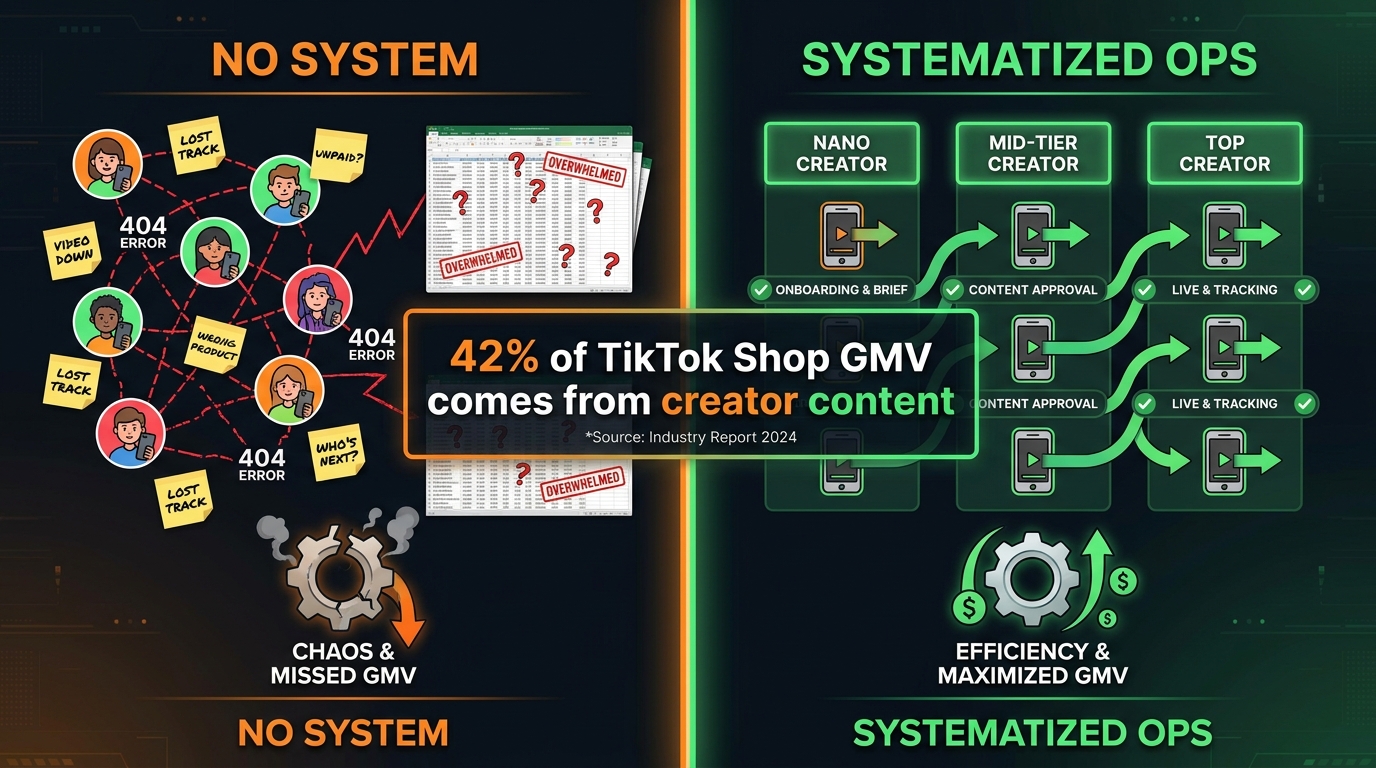
Most brands hit a predictable wall around the 30-creator mark. Before that point, the program feels manageable. You know each creator by name, you can track posts in a shared spreadsheet, and communication stays relatively tight. Then someone decides to scale — and everything breaks.
The Volume-Complexity Curve
Adding creators does not scale linearly. It scales exponentially in operational complexity. When you go from 30 creators to 100, you are not adding 70 pieces of communication — you are adding 70 separate onboarding flows, 70 separate product shipment tracks, 70 separate content review queues, and 70 separate affiliate link verifications. Without systems in place, each new creator adds overhead faster than they add revenue.
The most common failure modes that emerge at volume are predictable and avoidable. Creator ghosting typically spikes because there is no structured relationship cadence — creators receive product, post once, and never hear from the brand again. Off-brand content proliferates because briefs were vague or non-existent. Attribution breaks because affiliate links were never properly verified before the creator went live. And compliance exposure accumulates because no one is checking FTC disclosures at scale.
The “More is Better” Trap
The instinct to recruit more creators when GMV plateaus is understandable but often counterproductive. Brands that measure creator count as a proxy for program health consistently underperform brands that measure GMV-per-creator and content-to-conversion rate. A program with 50 highly engaged, well-briefed creators operating on a clear system will outperform a program with 300 loosely managed ones producing unpredictable content.
This is the core operating principle: creator quantity is a lag indicator. Creator quality and system clarity are the lead indicators. You have to build the system before you scale the headcount — not after.
What the Leading Operators Do Differently
Operators running the highest-performing TikTok Shop creator programs share a few common structural traits. They treat creator management as a pipeline with defined stages, not an ongoing relationship that exists in email threads and DMs. They have explicit qualification criteria that a creator must meet before receiving product. They have written SOPs that govern what happens at each stage. And they have a single source of truth — whether that is a project management tool, a CRM, or a custom Airtable base — that tracks every creator’s status in real time.
The gap between the brands that are winning at TikTok Shop UGC and the ones still stuck in chaos is not budget, audience size, or product quality. It is the presence or absence of an operational system that can process volume without requiring constant human intervention at every step.
The Creator Ops Stack: What Must Exist Before You Scale
Before you add a single new creator to your roster, there are five operational components that need to be in place. Think of these as the foundation under the building — you can build as high as you want, but if the foundation is missing, the whole structure becomes unstable past a certain point.
1. A Defined Creator Pipeline
Every creator relationship should move through defined stages: Sourced → Vetted → Invited → Onboarded → Active → Evaluated → Retained or Exited. Each stage has a clear definition of what is required to move forward, who is responsible for that action, and what the timeline expectation is. Without this, creators pile up in ambiguous “in conversation” states that no one can manage effectively.
This pipeline does not need to be sophisticated technology. Many high-performing programs use a well-structured Notion database or Airtable base with views for each stage. What matters is that the pipeline exists, is used consistently, and is visible to everyone on the team managing creators.
2. A Structured Onboarding Flow
Onboarding is where most programs lose creators before they ever post. A good onboarding flow has three components: a welcome communication that sets expectations clearly, a product education document that tells the creator what they need to know, and a brief that gives them creative direction without scripting them into robotic content.
The onboarding communication should confirm the product is on its way, specify when the creator is expected to post, confirm the affiliate link and commission structure, and give them a clear next step. Ambiguity at onboarding is where ghosting begins. A creator who is uncertain what is expected of them will default to inaction.
3. A Product Seeding Tracker
At volume, product seeding becomes a logistics operation, not just a goodwill gesture. You need to know exactly which product variant went to which creator, when it was shipped, when it was delivered, and what posting status it generated. Without this, you will regularly discover creators who received product three weeks ago and have not posted — with no system to trigger a follow-up.
The seeding tracker should integrate with your shipping workflow so that tracking numbers are automatically populated. It should trigger a follow-up sequence at 5 days post-delivery if no content has been submitted or posted. And it should flag creators who have received two rounds of product without generating GMV for a review decision.
4. A Communication Channel With Broadcast Capability
One-to-one DMs do not scale past 50 creators. You need a communication channel that supports both group broadcast and individual conversation. Discord has emerged as the dominant choice for many TikTok Shop creator programs because it allows you to push program-wide announcements, share trending audio and hook ideas, run tiered channels for different creator segments, and maintain individual threads when needed — all within one interface.
The structure of a creator Discord typically includes a #program-updates channel for announcements, a #content-inspiration channel where you share trending formats, a #wins channel where you celebrate creator results publicly, and a #questions channel that creates community self-support. This architecture reduces inbound support volume significantly because creators learn from each other rather than routing everything through your DMs.
5. A Content Review Process
Every piece of content needs to pass through at least a light quality gate before you decide whether to amplify it with Spark Ads. The review process does not need to be a committee — it should be one person with a checklist that takes five minutes per video. The checklist covers: affiliate link included and working, FTC disclosure present, no false product claims, hook is on-brand, product is shown clearly, and basic video quality meets threshold. This five-minute gate prevents a significant percentage of content compliance issues before they become problems.
Building a Creator Bench That Does Not Ghost You
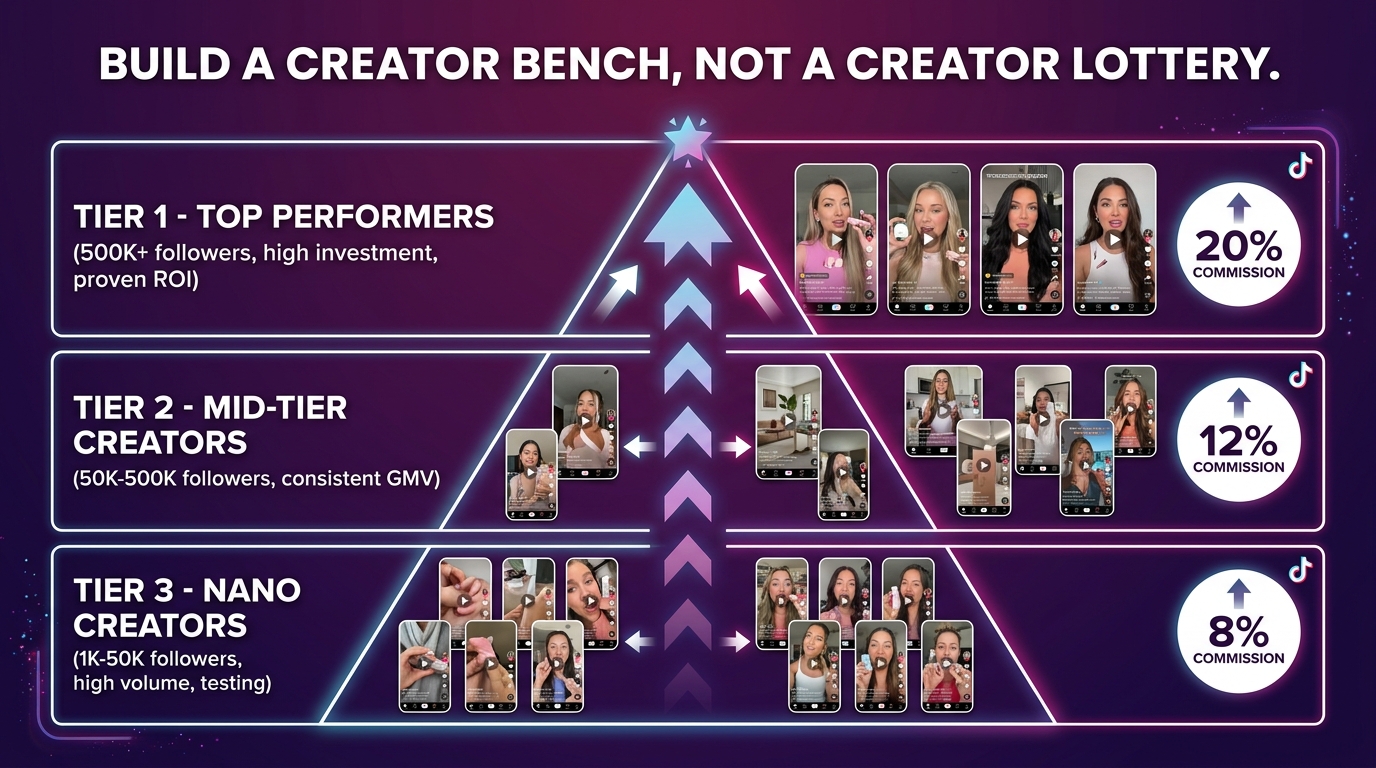
Creator ghosting — where a creator accepts product, disappears, and never posts — is the most expensive problem in TikTok Shop UGC programs that lack systems. At small scale, a few ghosted creators is an irritating cost of doing business. At large scale, it can consume thousands of dollars in product costs and dozens of hours of follow-up labor. The solution is not to find “better” creators — it is to build a system that makes ghosting structurally difficult.
Sourcing Channels That Produce Reliable Creators
TikTok’s native Affiliate Marketplace (accessible through TikTok Shop Seller Center) is the primary sourcing tool for most programs. It allows filtering by category, follower count, engagement rate, historical GMV, and content volume — giving you performance data before you ever reach out. Creators who already have TikTok Shop GMV history are significantly more reliable than cold outreach to creators with no commerce track record.
Inbound creator applications via a public program page or a landing form often produce higher-quality applicants than outbound outreach, because creators who apply have already self-selected for brand fit and program interest. A well-structured inbound application asks the creator to provide their TikTok handle, their average video views over the last 30 days, the product categories they typically cover, and a brief note on why the product fits their content. This filters out low-effort applicants and gives you useful data before the first conversation.
Referrals from existing creators are consistently one of the highest-quality sourcing channels. Creators know other creators. A creator who is already performing well for your program is motivated to refer people from their network who they believe will also perform — and they self-police referral quality because their reputation is attached to it. Building a formal referral structure with a small bonus (additional product, commission bump, or cash incentive) into your program can generate a meaningful percentage of your new creator intake.
Vetting for Reliability, Not Just Reach
The vetting mistake most brands make is optimizing for follower count. For TikTok Shop UGC, the metrics that actually predict posting reliability and GMV are different: 30-day video posting frequency, average engagement rate, shop video percentage in recent content, and historical GMV if available. A creator with 15,000 followers who posts five times a week, has a 7% engagement rate, and has already generated $2,000 in GMV for other brands will outperform a creator with 200,000 followers who posts sporadically and has never made a shop video.
Posting frequency is the single most reliable predictor of whether a creator will follow through on commitments. Low posting frequency creators ghost at dramatically higher rates — not necessarily out of bad faith, but because content creation is not yet habitual for them. High posting frequency signals that the creator is operationally capable and has already built a creation workflow into their life.
Setting Expectations Before Product Ships
The moment a creator agrees to participate in your program — and before a single item ships — they should receive a written confirmation that covers: the exact product they will receive, the expected posting date range (typically 7–14 days post-delivery), the minimum deliverable (one post is standard, with notes on whether additional posts are welcome), the commission structure, and how they will receive their affiliate link. This written confirmation creates a low-stakes accountability moment — the creator has acknowledged the terms, which changes the psychology of the relationship from a favor to a professional commitment.
Brief Architecture: Writing Creative Direction That Gets Followed
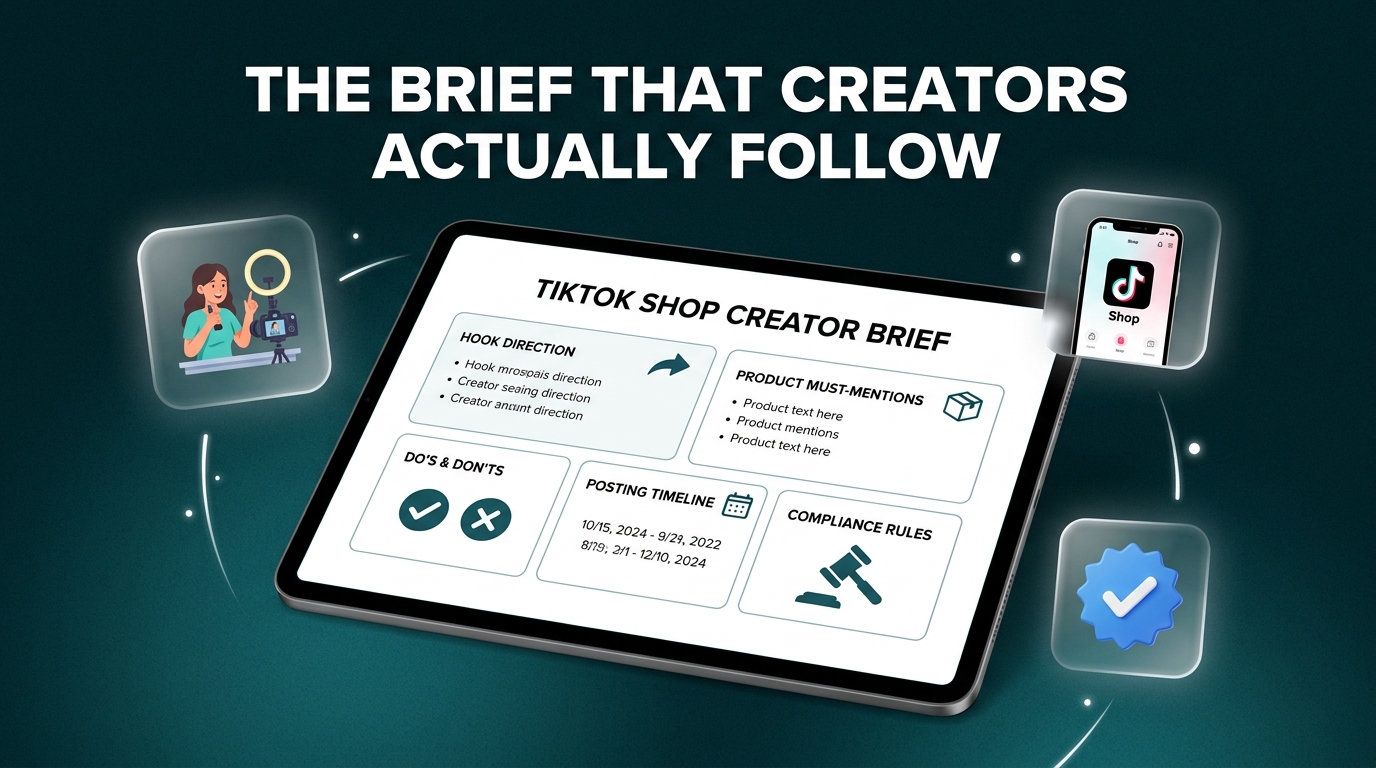
The creator brief is where most TikTok Shop UGC programs fail even before the content is created. Briefs are either so vague that creators produce whatever comes to mind — resulting in off-brand or low-converting content — or so prescriptive that creators produce lifeless, scripted videos that perform poorly because they feel like ads. The effective brief sits precisely between these two failure modes.
The Architecture of an Effective TikTok Shop Brief
A high-performing TikTok Shop UGC brief has five core components, each serving a distinct purpose:
1. Campaign Context (3–5 sentences) — A brief explanation of the product, who it is for, and what the brand is trying to accomplish with this content cycle. This is not a marketing pitch — it is operational context that helps the creator understand the purpose of the content they are about to make.
2. Hook Direction (not a hook script) — Two to three example hook concepts that the creator can adapt or be inspired by, rather than read verbatim. Providing hook inspiration without scripting it preserves the creator’s natural voice while pointing them toward proven formats. For example: “Start with a problem you had before finding this product,” or “Open with an unexpected comparison that shows the value.” These directions produce varied, native-feeling content rather than thirty videos with identical openings.
3. Product Must-Mentions (3 items maximum) — The three things that the creator absolutely must communicate in the video. Not ten. Not seven. Three. When you give creators more than three required talking points, compliance with all of them drops sharply. Prioritize the points that are most directly connected to purchase intent: the key use case, the most compelling product differentiator, and the call to action to the TikTok Shop link.
4. Do’s and Don’ts (brief, specific) — A short list of creative guardrails. Do’s might include: “Use natural lighting,” “Show the product in use, not just in hand,” “Tag the product link in the first frame of the video.” Don’ts might include: “Do not make specific clinical claims about results,” “Do not compare by name to competitor products,” “Do not use background music with copyrighted tracks.” These are not restrictions — they are risk management and quality floors.
5. Compliance and Disclosure Requirements — Explicit instructions for FTC disclosure, including where in the video to include it (“mention your affiliate status verbally in the first 30 seconds, and include #TikTokShop in the caption”). This section should exist in every brief without exception. At scale, leaving disclosure to creator judgment creates material compliance exposure.
Tiering Your Briefs by Creator Experience Level
One brief does not fit all creators. Nano creators with limited commerce content experience need more directional guidance in their brief — more detail in the hook direction section, more explicit product must-mentions, and more structured posting requirements. Experienced mid-tier creators who already have TikTok Shop track records need less direction and more creative latitude. Giving an experienced TikTok Shop creator an overly restrictive brief is one of the fastest ways to damage the relationship and get mediocre content.
Maintain at least two brief versions: a guided brief for newer creators and an open brief for proven performers. The open brief retains the compliance and disclosure sections but provides significantly more creative freedom in hook and format selection. This differentiation respects the creator’s expertise while still protecting the brand’s essential requirements.
The Three-Tier Creator System: Managing Volume Without Equal Treatment
One of the operational errors that creates chaos at scale is treating all creators the same regardless of performance. Sending the same cadence of follow-ups, the same product allocation, the same communication volume, and the same commission structure to a creator generating $500/month in GMV and one generating $15,000/month is inefficient and ignores the data your program is generating.
The three-tier system creates a structured framework for resource allocation, relationship investment, and performance expectations that scales with creator volume without requiring equal energy expenditure across the entire roster.
Tier 3: The Discovery Pool
This is your high-volume, low-investment testing layer. Tier 3 typically includes nano and micro creators (1,000–50,000 followers) who are new to your program. They receive one product unit, a guided brief, access to your Discord, and two automated follow-ups if they have not posted within the expected window. Your investment per creator is low, your expectations are calibrated accordingly, and your goal is simply to identify which creators generate any GMV at all.
The Tier 3 pool is where you discover your future top performers. Most will generate modest results. A small percentage — typically 10–20% — will surprise you with outsized performance relative to their follower count. These are the creators you move up.
Tier 2: The Active Core
Tier 2 creators have demonstrated posting consistency and at least baseline GMV. They receive higher commission rates, more frequent product access (including new product launches before public availability), and more personalized communication from your team. The relationship here shifts from automated pipeline to managed relationship. Someone on your team should know each Tier 2 creator by name and have communicated with them personally within the last 30 days.
Tier 2 creators are the stable engine of your program. They may not generate the highest individual GMV numbers, but their consistency and reliability make them the foundation of your predictable content output. A program with 30 active Tier 2 creators operating well is worth more than a program with 300 Tier 3 creators in various stages of ghosting.
Tier 1: Top Performers
Tier 1 is reserved for creators who have demonstrated sustained, meaningful GMV generation — typically your top 5–10% by revenue contribution. These creators receive the highest commission rates your economics can support, priority access to product, potential for paid amplification of their content via Spark Ads, and direct access to decision-makers at your brand. The investment per creator at Tier 1 is high, but the expected return justifies it.
Critically, Tier 1 should be actively managed, not just rewarded. These creators should be getting feedback on their content, input into upcoming product development, and a direct communication line that is faster and more responsive than the general creator Discord. A Tier 1 creator who feels like just another affiliate will not maintain the same energy for your program as one who feels like a genuine brand partner.
Movement Between Tiers
The tier system only works if movement is explicit and communicated. Creators should know that performance leads to advancement. Communicate tier-up moments clearly and positively — it reinforces the performance incentive and makes the creator feel recognized. Movement down (or out) should be handled respectfully and without drama; creators who stop performing should exit the active roster cleanly, with no hard feelings and the option to reapply if their content activity increases.
Quality Control at Volume: Gates, Reviews, and the 80/20 of Good UGC
Quality control is the part of TikTok Shop UGC operations that most brands either over-engineer or ignore entirely. Over-engineering leads to approval bottlenecks that slow your content pipeline to a crawl. Ignoring it leads to off-brand, non-compliant, or low-converting content proliferating across TikTok with your product linked. The practical solution is a tiered QC model that applies more scrutiny where the stakes are higher.
The Three-Gate Model
Gate 1: Pre-Post Review (for select creators only) — Mandatory pre-post review of every piece of content is not operationally viable at volume. Reserve pre-post review for three scenarios: Tier 3 creators on their first posting, any creator making a claim about product efficacy or ingredients, and any creator who has previously submitted content that required correction. For all other content, trust the brief and move to post-publication review.
Gate 2: Post-Publication Checklist — Within 24 hours of posting, a member of your team or a trained VA runs every new post through a five-minute checklist: affiliate link present and functional, FTC disclosure visible, no factually inaccurate claims, product shown clearly, and content does not violate TikTok’s community guidelines or Shop policies. This gate catches most compliance issues before they become enforcement issues.
Gate 3: Performance Review (Weekly) — Once a week, review the previous week’s content by performance metrics: views, engagement rate, click-to-shop rate, and GMV generated. Content that performs above threshold in the first 48 hours should be flagged as a Spark Ads candidate. Content that performs below baseline after 72 hours should be deprioritized for amplification. This gate is less about quality and more about resource allocation — you should be putting paid amplification behind content that has already demonstrated organic signal.
The 80/20 Reality of UGC at Scale
One of the mental model shifts required to run a healthy high-volume UGC program is accepting that most content will be average. The Pareto principle applies aggressively to TikTok Shop UGC: in a well-run program, roughly 20% of content generates roughly 80% of the GMV. The job of the QC system is not to make all content excellent — it is to ensure all content is compliant, to identify the top 20% quickly, and to amplify that top 20% with additional investment.
This means your quality standards should be calibrated to a floor, not a ceiling. The floor is: compliant, on-brand, shows the product, has a working affiliate link. Everything above the floor is bonus. The content that rises significantly above the floor gets amplified. The content that meets the floor but does not perform gets left to organic reach. The content that does not meet the floor gets flagged for correction or removal.
Trying to push every piece of content to excellence through extensive notes and revision requests is expensive, slow, and often produces worse results than letting the creator iterate on their own. Trust your brief, maintain your floor, amplify your winners.
Attribution and Performance Tracking: Knowing What Is Actually Working
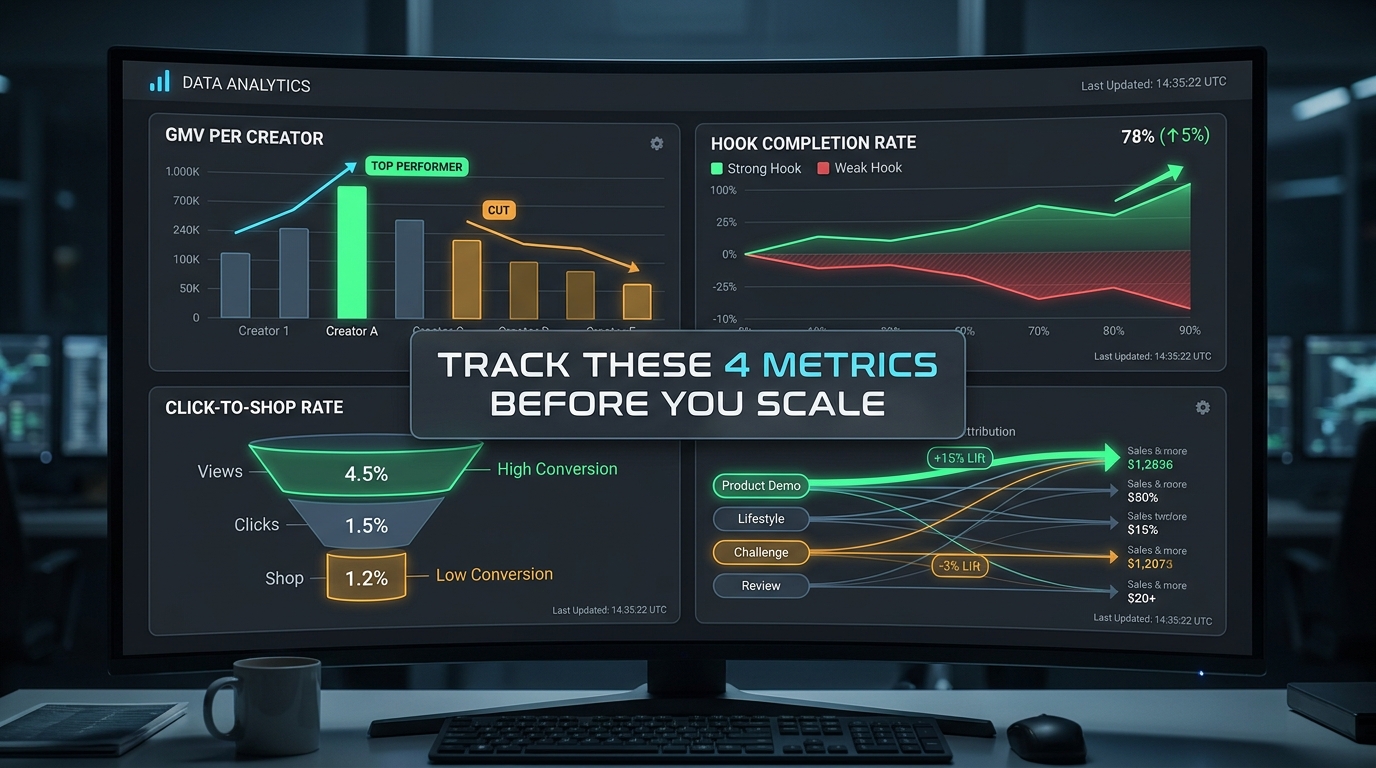
Attribution in TikTok Shop UGC is simultaneously easier and more complicated than most brands expect. TikTok’s native affiliate tracking provides direct GMV attribution at the creator level — which is a significant advantage over most other UGC channels where purchase attribution requires complex UTM setups and cross-platform data stitching. But native attribution only tells part of the story, and the brands that use it as their only signal make consistently poor resource allocation decisions.
The Four Metrics That Actually Predict GMV
1. Hook Completion Rate (0–3 second retention) — This is the percentage of viewers who watch past the three-second mark. For TikTok Shop content, a low hook completion rate tells you the content is being scrolled past before the product is even introduced. This is the most actionable early signal because it can be observed within hours of posting, long before purchase data is meaningful. Benchmarks vary by category, but content with sub-20% hook completion is unlikely to drive significant GMV regardless of the creator’s follower count.
2. Video Completion Rate — The percentage of viewers who watch to the end. For TikTok Shop content, completion rate is correlated with purchase intent because the call to action and product link are typically delivered in the back half of the video. Low completion on otherwise high-view-count content suggests the video is getting surface-level discovery but losing the audience before the conversion message lands.
3. Click-to-Shop Rate — The percentage of viewers who click the product link after viewing the video. This is the critical handoff metric from content to commerce. A high view count with a low click-to-shop rate indicates that the content is generating awareness but not purchase intent — which may mean the product presentation, pricing, or offer is not connecting, rather than the creator’s content being the problem.
4. GMV Per Content Piece — The actual revenue generated, tracked at the individual video level through TikTok Shop’s affiliate reporting. This is your outcome metric. Everything else is a diagnostic. When a creator with relatively low view counts consistently generates strong GMV per video, it tells you their audience is unusually high-purchase-intent — and that is worth more than raw reach.
Building a Creator Performance Dashboard
Every TikTok Shop UGC program at scale needs a performance dashboard that aggregates these metrics at the creator level and makes them visible to whoever is managing the program. The minimum viable version is a spreadsheet updated weekly with each active creator’s 30-day GMV, content volume, average hook completion, and tier status. The more sophisticated version uses a tool like Airtable, Notion database with formulas, or a purpose-built creator management platform that pulls data via TikTok Shop’s API.
The dashboard serves two functions: it tells you where to allocate additional investment (product, paid amplification, relationship energy), and it tells you where to reduce investment or exit the relationship. Both decisions should be data-driven, not gut-driven.
Understanding the Attribution Gap
TikTok Shop affiliate attribution captures direct click-through purchases, but it does not capture the halo effect of UGC on brand searches, direct-to-site traffic, or other channel sales that result from TikTok exposure. This attribution gap is real and should inform how you evaluate creators who drive strong engagement metrics but modest direct TikTok Shop GMV. Some content drives discovery that converts on other channels — and eliminating creators based purely on TikTok Shop attribution can cut off a meaningful revenue stream that simply is not visible in your native dashboard.
A practical approach to measuring this halo effect is to track brand search volume (via TikTok’s search insights or Google Search Console) during periods of high creator activity versus low creator activity. A measurable lift in branded searches during active UGC periods is evidence of attribution that is not being captured in direct affiliate data.
Tooling Without Over-Engineering: The Lean Creator Ops Stack
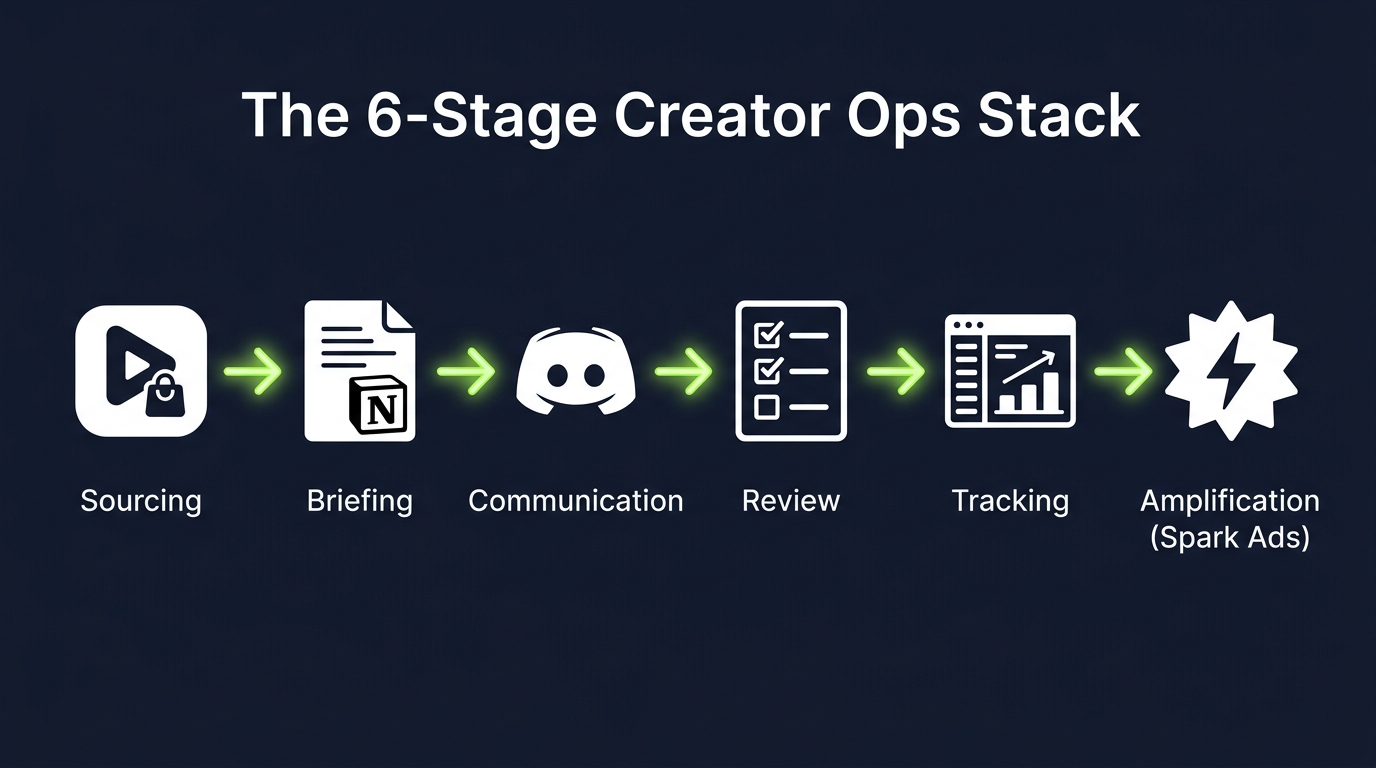
The creator ops software market has expanded rapidly in the last two years, and brands are increasingly tempted to solve operational problems by adding technology. Sometimes this is the right move. More often, it creates a different kind of complexity — a stack of tools that do not talk to each other cleanly, require significant setup time, and add vendor management overhead without meaningfully reducing creator management work.
The guiding principle for tooling in a TikTok Shop UGC program should be: solve the workflow problem with the simplest tool that reliably does the job. Most programs can function at 200+ creators with a remarkably lean stack.
The Lean 6-Stage Stack
Stage 1 — Sourcing: TikTok Shop Affiliate Marketplace (Native) — TikTok’s own Affiliate Marketplace within Seller Center provides creator discovery with filtering by category, follower count, engagement, GMV history, and content type. For most programs, this is sufficient for creator sourcing without a third-party tool. The data quality here is strong because it comes directly from TikTok’s platform, not scraped approximations.
Stage 2 — Pipeline and CRM: Airtable or Notion — A well-structured database in either Airtable or Notion can manage creator profiles, pipeline stages, product seeding status, posting dates, tier assignments, and performance notes at 200+ creator scale without additional tooling. The key investment is setup time — building the right fields, views, and automations at the start pays dividends for the life of the program.
Stage 3 — Communication: Discord — For community-level communication, Discord is the standard. Its channel structure, tiered access (via roles), and combination of broadcast and direct messaging make it purpose-built for managing creator communities. Many programs create creator-tier-specific channels with restricted access so Tier 1 creators receive information and engagement that Tier 3 creators do not, reinforcing the tier incentive structure.
Stage 4 — Brief Delivery: Notion or Google Docs — Briefs should live in a consistent, shareable format with a stable link. A Notion page or Google Doc with clear section formatting works well. Avoid sending briefs as PDF attachments — they are harder to update, create version control issues, and cannot be tracked for opens in the same way as a link.
Stage 5 — Content Review and Tracking: Spreadsheet + TikTok Shop Analytics — A shared Google Sheet with columns for video URL, post date, hook completion rate, 24-hour views, click-to-shop rate, and GMV handles the tracking function for most programs. TikTok Shop Seller Center provides the underlying data. For programs exceeding 100 active creators posting weekly, platforms like GRIN, Aspire, or Creator.co can accelerate this stage by aggregating analytics across creators in one interface.
Stage 6 — Amplification: TikTok Ads Manager (Spark Ads) — Spark Ads allow you to amplify organic creator content with paid budget while preserving the native UGC format. The amplification workflow should be triggered by performance gate criteria: content that reaches a defined hook completion and GMV threshold within 48 hours of posting becomes a Spark Ads candidate. This creates a data-driven selection mechanism that removes subjectivity from the paid amplification decision.
When to Consider Platform-Level UGC Software
Dedicated creator management platforms (GRIN, Insense, Billo, Aspire) become genuinely valuable at 300+ active creators or when your team is spending more than 15 hours per week on creator communication and tracking tasks. Below that threshold, the platform costs and integration complexity often exceed the efficiency gains. The decision to upgrade your tooling should be driven by a documented workflow bottleneck, not by the appeal of new software features.
When to Scale vs. When to Consolidate Your Creator Pool
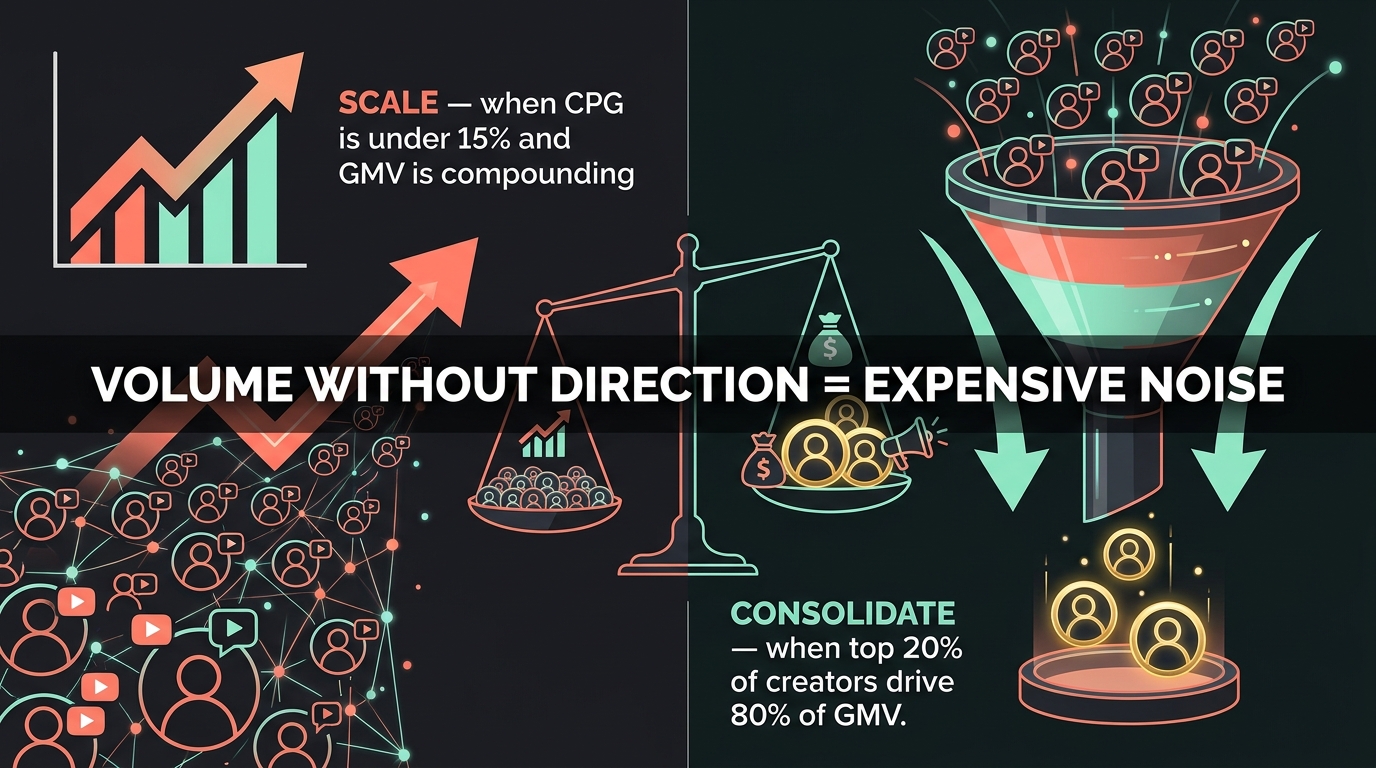
One of the most important and most ignored decisions in TikTok Shop UGC management is knowing when to stop adding creators and start deepening the relationships you already have. More creators is not always the answer — and there are specific signals that tell you which mode you should be operating in.
When to Scale: The Growth Signal Checklist
Scale your creator pool when the following conditions are met. First, your current active creators are consistently posting and you have positive GMV trends at the program level. Second, your cost-per-GMV (product cost plus fulfillment plus team time divided by attributed GMV) is below your target threshold. Third, you have capacity in your operations team — either through people or automation — to absorb the additional onboarding and management load. Fourth, your brief and QC system is working reliably on your current creator base, meaning the infrastructure can absorb new volume without breaking.
If all four conditions are met, additional creators will compound your current momentum. The program is ready for the input, and the marginal creator is likely to generate positive returns.
When to Consolidate: The Red Flag Signals
Consolidate — or at minimum, pause new creator intake — when you see any of these signals. Creator ghosting rate is above 30% of seeded creators in the last 90 days. Your team is spending significant time chasing non-posting creators rather than supporting active ones. Attribution data is degrading because affiliate links are being shared improperly, creating commission disputes. Content quality is trending down despite maintained brief standards. Program GMV growth has stalled even as creator count has grown — which is the clearest signal that you have a depth problem, not a volume problem.
In consolidation mode, the right move is to exit the bottom-performing 20–30% of your roster, increase investment in Tier 1 and Tier 2 creators, and tighten your brief, onboarding, and QC systems before reopening intake. This kind of deliberate pruning feels counterintuitive — removing creators from a program that is supposed to be growing — but it consistently produces better outcomes than continuing to add volume to a system that cannot handle it cleanly.
The Compounding Value of Depth Over Breadth
The most undervalued dynamic in TikTok Shop UGC programs is the compounding value of a deep relationship with a proven creator versus a shallow relationship with many untested ones. A creator who has been in your program for six months, has made 30+ videos about your product, and has a community that trusts their recommendation of your brand is worth dramatically more per piece of content than a new creator encountering your product for the first time. Tenure builds authenticity. Authenticity builds conversion.
This is why the best TikTok Shop UGC programs do not treat their creator roster as a revolving door. They treat their top performers as long-term brand partners and invest accordingly. Commission structures that reward longevity — for example, a percentage bump after six consecutive active months — early access to new products, and genuine collaboration on content strategy are all tools for deepening creator relationships in ways that compound over time.
The Metrics That Actually Predict GMV Before the Sale Happens
Most brand operators managing TikTok Shop UGC programs spend the majority of their measurement time looking at lagging indicators — GMV, orders, revenue per creator. These are essential numbers, but they tell you what happened last week, not what is going to happen next week. The brands that run their creator programs most effectively use a set of leading indicators that predict GMV outcomes 24–72 hours in advance of actual purchase data becoming meaningful.
The 3-Hour Signal Window
TikTok’s algorithm distributes content most aggressively in the first three hours after posting. The view velocity, engagement rate, and comment sentiment in this initial window are highly predictive of whether the algorithm will continue distributing the content to new audiences. For UGC that is intended to drive TikTok Shop purchases, the three-hour signal window tells you which videos to watch and potentially amplify before they either stall or take off organically.
Within three hours of a creator posting, a basic tracker should capture: total views, like-to-view ratio, comment count and initial comment tone, and whether the Shop product link is getting any clicks. A view-to-engagement ratio above roughly 5% in the first three hours is a strong positive signal. Early Shop link clicks — even a handful — are a very strong signal that purchase intent exists in the current audience.
Content Format as a Predictive Variable
Across TikTok Shop categories, certain video formats consistently outperform others for commerce conversion, and these patterns are measurable and replicable. Problem-agitation-solution (PAS) hooks — where the creator opens with a problem they experienced, intensifies it briefly, then introduces the product as the resolution — consistently generate higher hook completion rates than straightforward product demonstrations. Comparison videos that show the product against a common alternative drive strong click-to-shop rates because they contextualize value explicitly. Before-and-after formats work particularly well in beauty, home, and wellness categories because the transformation is visually immediate.
Tracking format-level performance (not just creator-level) allows you to include format guidance in your briefs that is grounded in your own program’s data rather than generic best practices. Over time, you accumulate a proprietary view of which formats work for your specific product and audience — and that knowledge is genuinely competitive.
Engagement Quality vs. Engagement Quantity
Comment quality is one of the most predictive but least-tracked indicators of UGC purchase intent. Comments asking “where can I buy this?” or “does this actually work?” are direct purchase intent signals. Comments that are entirely complimentary of the creator without referencing the product (“love your energy!”) are engagement without commerce signal. Comments that express skepticism or feature questions may indicate an opportunity to respond and convert hesitant viewers, which creators can do directly.
Training your creators to monitor and respond to comments in the first 24 hours after posting — particularly to product questions and purchase intent signals — can meaningfully lift click-to-shop rates. TikTok’s algorithm also treats comment responses from the creator as engagement signals that extend distribution, so this doubles as an algorithmic benefit.
Common Scaling Mistakes That Set Programs Back by Months
Documenting what works in TikTok Shop UGC scaling is important. But the patterns of what consistently breaks programs — sometimes irrecoverably — are equally instructive. These are the mistakes that experienced operators encounter most frequently when inheriting or auditing struggling creator programs.
Mistake 1: Seeding Product Before Systems Are Ready
The most expensive scaling mistake is sending product to 100 creators before you have an onboarding flow, a tracking system, or a brief ready to go. The product ships, creators receive it, and without clear direction or follow-up systems, the majority simply do not post. You have spent the product cost with no attribution, no content, and no data. Worse, creators who received product without a clear brief sometimes post anyway — creating unclaimed, off-brand content attached to your Shop that you cannot easily modify or remove.
The rule is simple: systems before seeds. The pipeline, the brief, the tracking sheet, the Discord, and the onboarding communication all need to exist before the first package ships.
Mistake 2: Using One Commission Structure for All Creators
A flat commission rate applied to all creators regardless of tier, posting history, or GMV contribution is a structural disincentive for your highest performers. When a Tier 1 creator generating $20,000 per month earns the same percentage as a Tier 3 creator who has made $50 total, the Tier 1 creator has no financial reason to prioritize your program over another brand offering tiered incentives. Variable commission structures — with explicit and achievable criteria for advancement — are not just fair; they are operationally essential for creator retention at the top end of your roster.
Mistake 3: Treating UGC and Spark Ads as Separate Programs
Many brands manage their organic UGC creator program and their paid TikTok advertising in completely separate silos, without a workflow connecting the two. This severs one of the highest-value feedback loops available: organic UGC performance as a creative signal for paid advertising. Content that has already proven its ability to stop scroll and drive Shop clicks organically is the best possible input for paid campaigns — but accessing that insight requires a defined workflow between your creator ops team and your paid ads team. Building this connection is one of the highest-leverage operational improvements available to a scaling TikTok Shop brand.
Mistake 4: Not Pruning the Roster
Most brands add creators over time without ever formally exiting underperforming ones. The result is a roster that balloons in size while the operational overhead of managing it grows — without a proportional increase in GMV. A quarterly pruning of creators who have not generated meaningful GMV or posted consistently is essential hygiene for a scaled creator program. The exit process should be respectful and clean: a message acknowledging the relationship, an offer to reconnect if their content activity increases, and removal from the active program communications.
Building the Content Machine: Putting It All Together
Everything described in this post — the pipeline stages, the creator tiers, the brief architecture, the QC gates, the performance metrics, the lean tool stack — is individually actionable. But the real value comes from assembling these components into a coherent operating system that runs with minimal per-creator intervention at volume.
The content machine is not a metaphor. It is a literal operational architecture with defined inputs (creator recruitment), defined processes (onboarding, briefing, review, tracking), defined outputs (compliant, shoppable UGC), and defined optimization loops (performance data feeding back into brief iteration, tier movement, and Spark Ads selection). When these components are connected cleanly, the program becomes self-improving — each week’s performance data makes the next week’s content strategy marginally better, and those marginal improvements compound over months into a genuinely differentiated competitive advantage.
The Phased Build Approach
Not every brand can build the full system before launching a creator program. A practical phased approach allows you to start simply and add infrastructure as volume demands it.
- Phase 1 (1–30 creators): Basic pipeline in a spreadsheet, single brief template, manual follow-ups, Discord channel.
- Phase 2 (30–100 creators): Airtable-based pipeline with automation, tiered briefs, structured Discord with roles, weekly performance review, and explicit tier criteria.
- Phase 3 (100–300 creators): Full three-tier system, automated onboarding sequences, dedicated creator ops hire or agency support, formal QC process, and Spark Ads workflow connected to organic performance data.
- Phase 4 (300+ creators): Platform-level creator management software, API-based attribution tracking, multi-person creator ops team, formal creator advancement and exit protocols.
The Compounding Content Advantage
There is a final dynamic worth naming explicitly. The TikTok Shop brands that build systematic UGC programs early accumulate an increasingly durable competitive advantage over time. Their library of shoppable content grows. Their creator relationships deepen. Their brief templates get refined based on real performance data. Their Spark Ads creative pool improves continuously as organic winners are amplified. And their team’s expertise in managing creator programs at volume compounds into institutional knowledge that is genuinely difficult for a competitor to replicate quickly.
The brands that stay in reactive mode — running UGC programs campaign by campaign, without building the underlying system — will find that gap widening every quarter. TikTok Shop is not a trend to experiment with. For product categories where it works, it is becoming a primary commerce channel, and the infrastructure investment required to compete in it effectively is real.
Build the machine first. The volume will follow.
Key Takeaways for TikTok Shop UGC Operators
- Systems before scale: Build your creator pipeline, onboarding flow, brief templates, and tracking infrastructure before adding creator volume — not after.
- Three tiers, not equal treatment: Differentiate your creator roster by performance and invest proportionally. Flat treatment of all creators destroys incentives for top performers.
- The floor, not the ceiling: At volume, your QC goal is compliance and brand safety, not perfection. Identify the 20% that rises above the floor naturally, then amplify those.
- Hook completion rate predicts GMV: Track this metric in the first three hours after every post. It is the earliest available signal of whether content will convert.
- Spark Ads should be earned, not scheduled: Only amplify content that has already demonstrated organic signal. Use performance data to trigger Spark Ads decisions, not editorial judgment.
- Prune intentionally: A smaller, more engaged creator roster consistently outperforms a larger, diffuse one. Planned roster pruning is not failure — it is precision.
- Connect organic UGC to paid advertising: The feedback loop between organic creator performance and paid creative selection is one of the highest-leverage operational improvements available on TikTok Shop.
- Creator depth compounds: A creator who has been in your program for six months and has thirty videos about your product is worth more per piece of content than a new creator at the same follower count. Invest in tenure.