


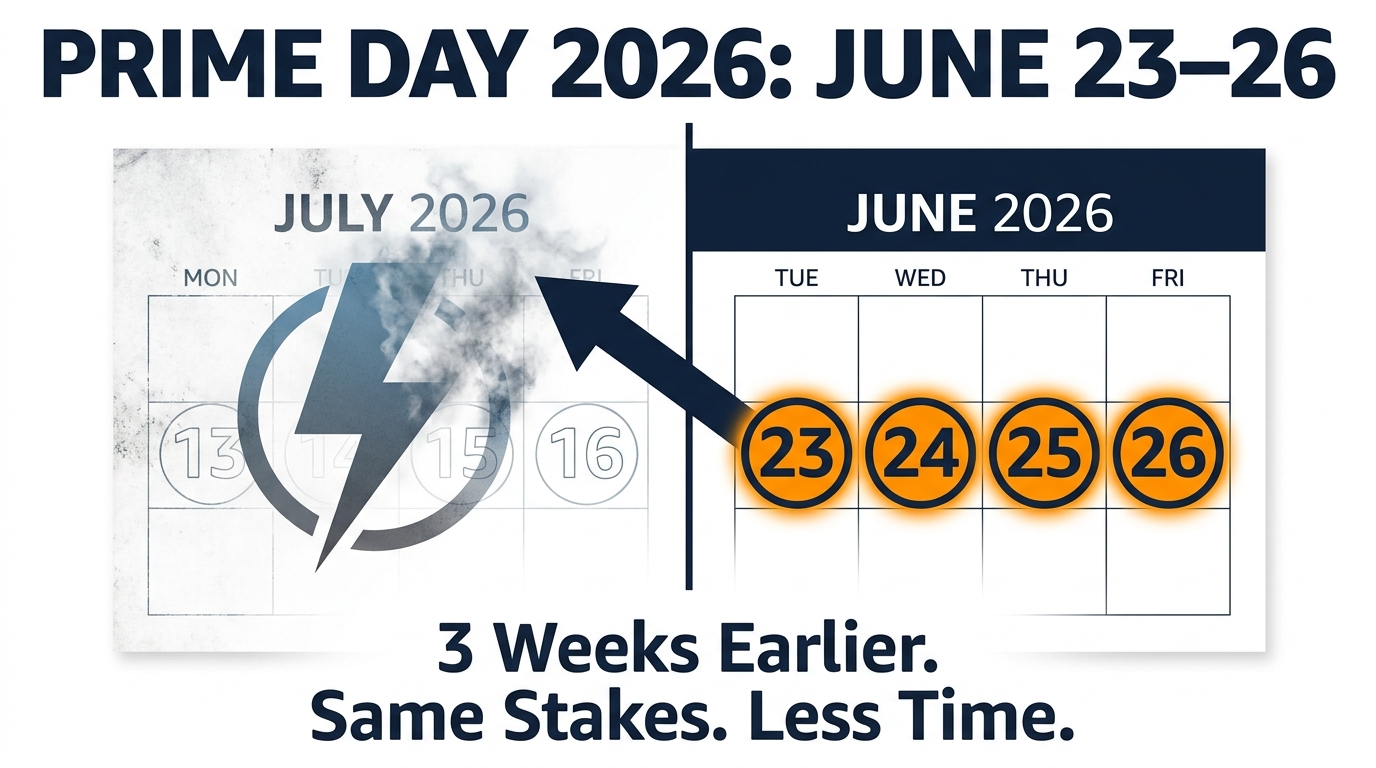

For a decade, Amazon Prime Day lived in July. Sellers planned around it. Brands built annual budgets around it. Agencies set retainer scopes around it. Inventory teams built reorder schedules around it. The mid-July drop of Prime Day was, for the ecommerce calendar, as reliable as the fiscal year.
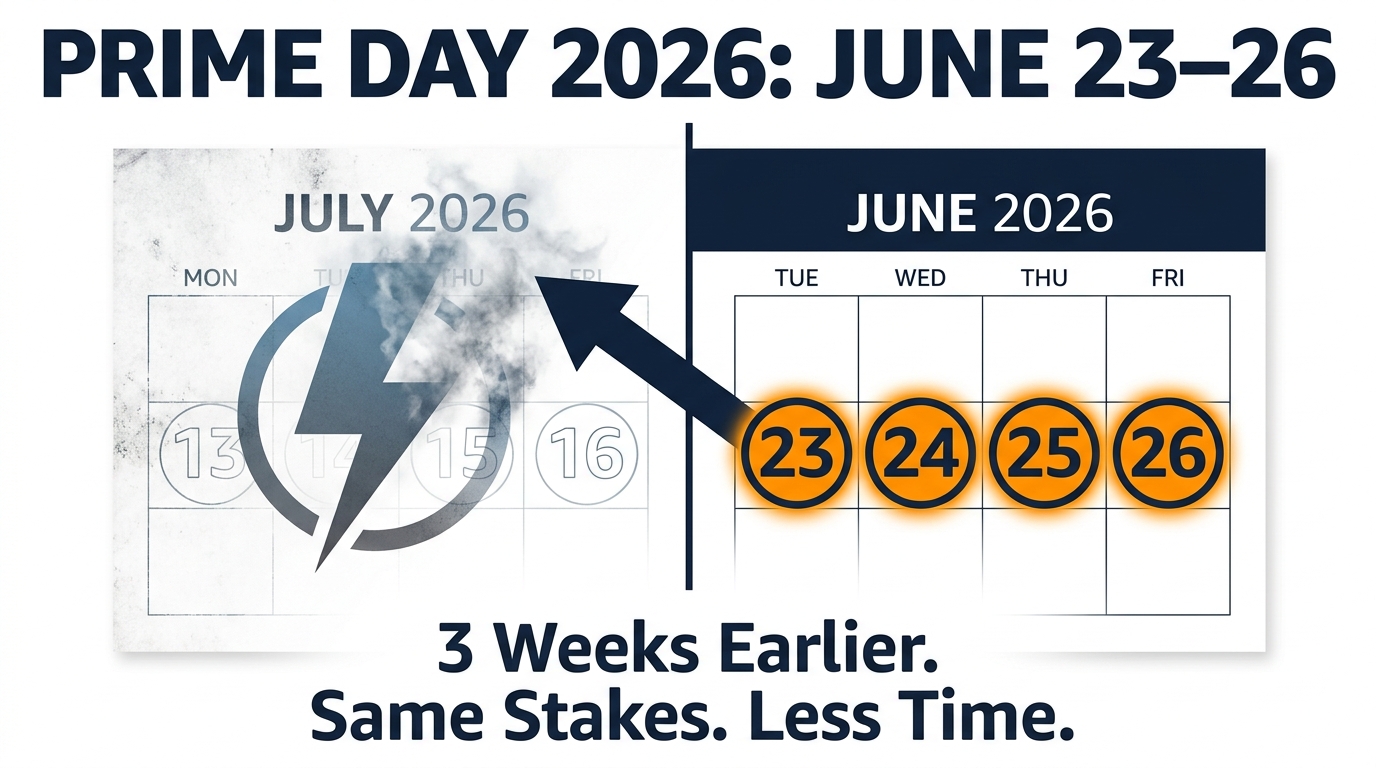
Then, on April 29, 2026, Amazon officially confirmed what industry insiders had suspected for weeks: Prime Day 2026 would run June 23–26 — the first time the summer event has landed in June since 2021, and the most consequential calendar shift Amazon has made in years.
Three weeks sounds small. It isn’t. Moving Prime Day from mid-July to late June doesn’t just adjust a date on your marketing calendar — it reshuffles your entire Q2 operational structure. FBA inventory deadlines moved up. Ad budgets need to be deployed earlier. Cash flow timelines compress. Demand forecasting models built on five years of July data suddenly need recalibration. And the back-to-school season, which used to follow Prime Day at a comfortable distance, now begins overlapping with it.
This post isn’t about which deals to run or which keywords to target. Those conversations happen after you’ve solved the operational problems that a June Prime Day creates. This is about the structural realities — the cash, the inventory, the advertising mechanics, the competitive landscape — that will determine whether your Prime Day 2026 is a win or a very expensive miss. Let’s work through them, one by one.
The Historical Context: Why Amazon Keeps Moving the Date

Amazon has never committed to a fixed Prime Day date. Understanding why requires understanding what Prime Day actually is from Amazon’s perspective: not primarily a sales event, but a Prime membership acquisition and retention vehicle that happens to generate massive revenue. The date has always been set to serve that broader goal, not the other way around.
A Brief Timeline of Prime Day Timing Shifts
Prime Day launched on July 15, 2015 as a single 24-hour event timed to Amazon’s 20th anniversary. From 2016 through 2019, Amazon kept it in mid-July, gradually extending the event to 30 hours, then 36, then 48. The July window worked well: it sat in a traditionally slow retail period, which meant less advertising noise and easier category domination.
Then COVID arrived. The 2020 event shifted to October 13–14, compressing into Q4 and running uncomfortably close to Black Friday planning cycles. Despite the awkward timing, it generated an estimated $10.4 billion in global GMV — a sign that the event had grown strong enough to drive demand regardless of the calendar slot.
In 2021, Amazon pulled Prime Day back to June 21–22, delivering what was then the biggest two-day selling period for third-party sellers in the platform’s history. More than 250 million items sold worldwide. The June timing tapped early summer consumer enthusiasm and marked the beginning of Amazon’s interest in pulling Q2 demand forward. But the next year, Amazon returned to July — and stayed there through 2025.
The 2026 return to June isn’t an accident or a pandemic-era workaround. It’s a strategic choice, and it signals something important: Amazon is prioritizing Q2 revenue pull-forward over the operational comfort of its seller base.
Why June 2026 Specifically?
Several factors appear to be driving the timing decision. First, the back-to-school season has been creeping earlier for years. Retailers like Walmart, Target, and Best Buy have been launching BTS promotions in late June since at least 2023. By moving Prime Day into that window, Amazon plants its flag at the start of the BTS cycle rather than letting competitors own those first consumer touchpoints.
Second, there’s a capital markets dynamic. Moving a multi-billion-dollar revenue event from Q3 into Q2 improves Amazon’s Q2 earnings optics — and likely makes Q3 guidance conversations easier when analysts aren’t comparing against a same-quarter Prime Day spike. Third, Amazon’s expanding international presence in markets where summer retail patterns differ from North America makes a late-June timing more universally efficient.
The lesson for sellers: don’t expect July to reliably return. The June shift is likely to become the new baseline, at least for the foreseeable future.
What June 23–26 Does to Your Q2 P&L
The financial implications of moving Prime Day from July to late June go deeper than a calendar adjustment. For sellers who report on calendar quarters, this is a structural change to how their biggest annual event flows through their income statement.
Revenue Lands in Q2, Not Q3
Under the July model, Prime Day revenue hit in Q3. For most sellers, that meant Q2 was a build-up quarter — inventory procurement, ad spend pre-loading, deal curation — and Q3 captured the payoff. The P&L shape was: heavy Q2 costs, strong Q3 revenue, moderate Q4 lead-in to holiday.
Under the June model, both the costs and the revenue land in Q2. That changes several things. If you’re managing toward a Q2 revenue target, Prime Day now gives you a weapon you didn’t have before. But it also means your Q3 starts in a post-event trough, without the momentum injection that a July Prime Day used to provide going into late summer.
For brands that report to investors or operate under board-level quarterly scrutiny, this is worth modeling explicitly. A June Prime Day that delivers $2M in revenue sounds great for Q2 — but if it cannibalizes July velocity and you’ve already spent your Q3 marketing budget, you may end up with a strong Q2 and a soft Q3 that doesn’t reflect well on annual run rates.
The Cash Conversion Cycle Problem
Here’s a number that doesn’t get enough attention in Prime Day coverage: Amazon’s standard payout cycle runs DD+7, meaning revenue from Prime Day sales doesn’t land in your bank account until roughly a week after the event closes. For a June 23–26 event, that means funds arrive in early July at the earliest.
Meanwhile, your inventory was funded in April or May. Your advertising spend is deploying in June. Your logistics costs were paid weeks before the event. You are running a cash-flow deficit for 6–10 weeks before any Prime Day revenue lands. In a July Prime Day scenario, that same gap existed — but the entire sequence started later, giving you more time to arrange working capital or use Q1 revenue to fund it. In a June Prime Day, that cycle collides directly with Q2 tax obligations, vendor payment terms, and any other working capital demands you already had in the first half of the year.
The operational implication is clear: sellers who haven’t secured working capital or a credit facility before April 2026 are entering Prime Day preparation with a structural disadvantage. This is especially acute for mid-sized sellers who rely on Amazon payouts as the funding mechanism for their next inventory cycle.
FBA Inventory Deadlines: The New Timeline That Changes Everything
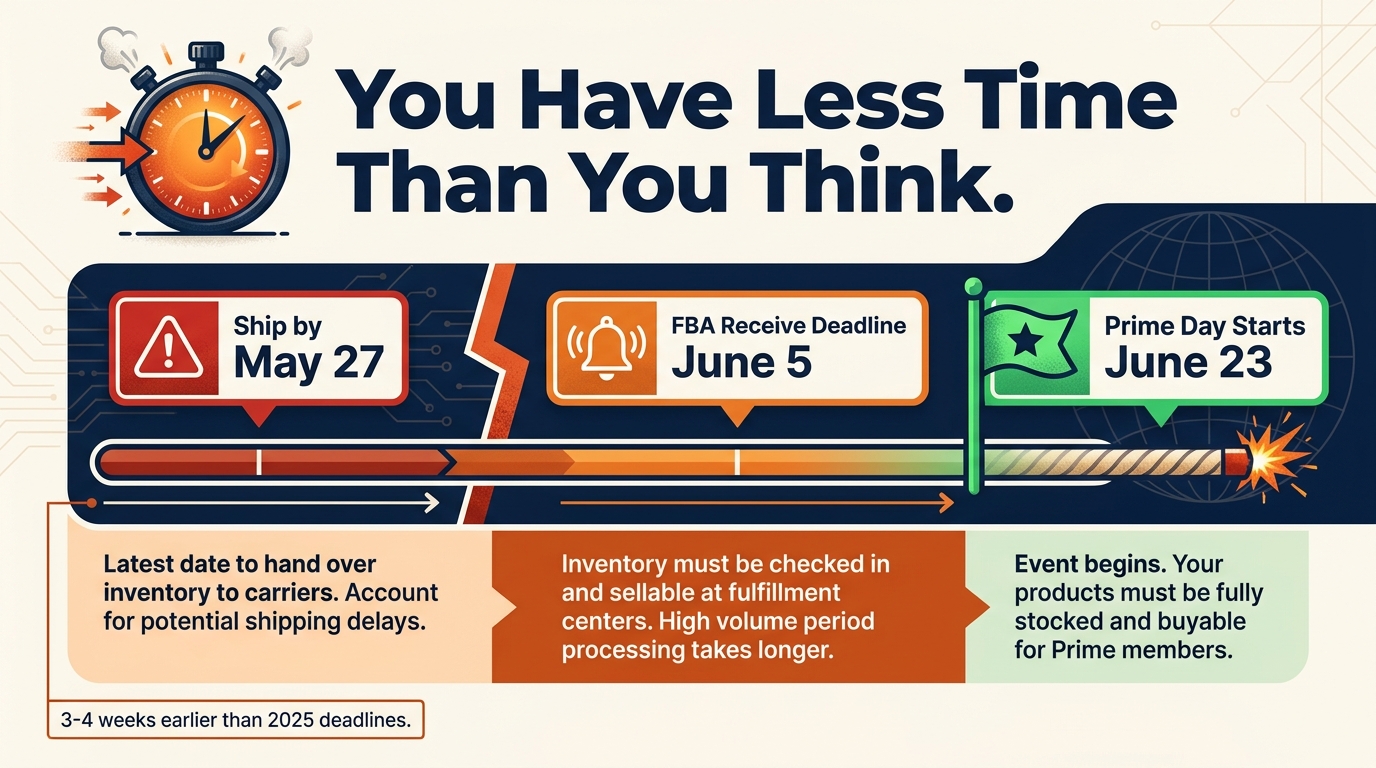
If there’s a single operational area where the June timing shift creates the most immediate damage for unprepared sellers, it’s FBA inventory logistics. Amazon’s Seller Central communications confirmed two critical deadlines for Prime Day 2026: a shipping deadline of May 27 and an FBA receive deadline of June 5.
Let that land for a moment. In a typical July Prime Day year, you would have had until late June to ship inventory and early July to confirm receipt. The 2026 deadlines pull both of those milestones nearly a full month earlier.
What Happens If You Miss the Deadlines
Missing the June 5 receive deadline doesn’t mean your inventory disappears. It means it won’t be Prime-eligible or properly positioned for Prime Day deal visibility during the June 23–26 window. Your products may still be available for purchase, but they’ll lack the deal badge, the event-specific placement, and the algorithm prioritization that drives the majority of Prime Day volume.
For sellers running Lightning Deals or Prime Exclusive Discounts, the consequences are even more immediate: those promotional structures require inventory availability confirmation well before the event. If Amazon’s system can’t verify you have sufficient quantity in the FC (fulfillment center) network by the deadline, your deal simply won’t run.
Reorder Point Calculations Need to Move Up
Most FBA sellers calculate reorder points based on lead time from supplier to fulfillment center. For a July Prime Day, that calculation started with a mid-June inbound ship window, which for overseas suppliers (primarily China-based manufacturers shipping by sea) meant a reorder trigger in late April or early May.
For a June Prime Day, the same sea freight timeline now requires a reorder trigger in late March or early April — which, for many sellers, is before Q1 is even closed. If your inventory planning is built on historical summer reorder cycles, your supplier lead times almost certainly don’t accommodate this new reality without deliberate restructuring.
Air Freight as a Risk Mitigation Tool (With Real Cost Implications)
Sellers who miss the May 27 ship deadline have a narrow window to use air freight as a recovery mechanism — but at a cost premium of 4–6x sea freight rates. For high-margin products where Prime Day velocity justifies the expense, air freight can save the event. For commodity products with thin margins, it often creates a net-negative scenario where Prime Day revenue barely covers the expedited freight bill.
The decision rule is straightforward: calculate your Prime Day projected net margin per unit, multiply by the realistic units you’ll sell if you make the deadline, and compare that against the air freight premium. If the math works, expedite. If it doesn’t, accept that your Prime Day 2026 will be limited to existing on-hand inventory and focus energy on the pre-event halo period instead.
Split Inventory Across FCs: The Placement Fee Reality
Amazon’s inventory placement program has been evolving in 2026, and Prime Day logistics add another layer of complexity. Sellers sending large quantities of a single ASIN may be required to split shipments across multiple fulfillment centers — a practice Amazon has been expanding. Each split adds handling costs, complicates tracking, and creates risk that inventory doesn’t land in the right geographic FC to serve your primary customer base before the event.
Working with a 3PL (third-party logistics provider) that has experience with Amazon’s Inbound Placement requirements can meaningfully reduce this risk, particularly for sellers with complex catalogs or high-velocity SKUs.
Cash Flow Realities: Working Capital in a Front-Loaded World
The cash flow implications of a June Prime Day deserve their own section because this is where sellers get blindsided — not by the strategy, but by the timing of real dollars. The structural challenge is this: everything costs money before Prime Day, and everything pays back after it. In a July event, that gap was manageable because it partially overlapped with Q2 revenue. In a June event, it’s entirely front-loaded into Q2 — before most Q2 revenue has materialized.
The Cost Timeline for a June Prime Day
Here’s a realistic cost deployment timeline for a seller preparing for Prime Day 2026:
- February–March: Supplier purchase orders placed and deposits paid (typically 30–50% upfront). This is 3–4 months before Prime Day.
- April: Balance payments to suppliers on completion. Sea freight costs committed and paid. This is 2–3 months before Prime Day.
- Late April–May: Amazon FBA fees begin accruing as inventory enters the network. Deal submission fees for Lightning Deals paid.
- June 1–22: Pre-event advertising ramp. PPC budgets begin scaling up 2–3 weeks before the event. Sponsored Brand video campaigns, DSP campaigns, and external traffic costs all deploy here.
- June 23–26: Peak ad spend (3–5x normal daily rates). Prime Day event live.
- July 1–7: Amazon payout window. Revenue from Prime Day event hits seller bank accounts.
That’s a cash gap of roughly 90–120 days between first dollar out and first dollar in from Prime Day. For sellers operating on thin working capital, this isn’t a planning inconvenience — it’s an existential risk.
Accessing Working Capital Before the Crunch
Sellers have several options for bridging the gap, each with distinct trade-offs:
Amazon Lending offers inventory-backed loans directly within Seller Central. Approval is based on sales history, and rates are competitive for qualified sellers. The downside is that repayment begins immediately from Amazon payouts, which can create cash pressure in the weeks immediately after Prime Day before revenue catches up.
Revenue-based financing from providers like Clearco, Wayflyer, or SellersFunding offers advances against projected revenue. These can be structured to give sellers the inventory and advertising capital they need without the traditional bank credit requirements. However, fees can be significant on short-term capital.
Supplier payment term negotiation is often overlooked but highly effective. Many overseas manufacturers will extend 60–90 day net terms to established buyers. Negotiating net-60 supplier terms effectively closes most of the cash flow gap for a June Prime Day without requiring any external financing at all.
PPC and Advertising: Executing Under Compressed Timelines
The advertising market around Prime Day is unlike any other period in the Amazon calendar. Demand for placements spikes. CPCs jump. Competition from both endemic Amazon sellers and off-Amazon brands pouring ad dollars into the retail media ecosystem creates a uniquely hostile bidding environment. And in 2026, with the event moved to June, that hostile environment arrives three weeks sooner than your historical models suggest.
The CPC Reality: What the Numbers Actually Look Like
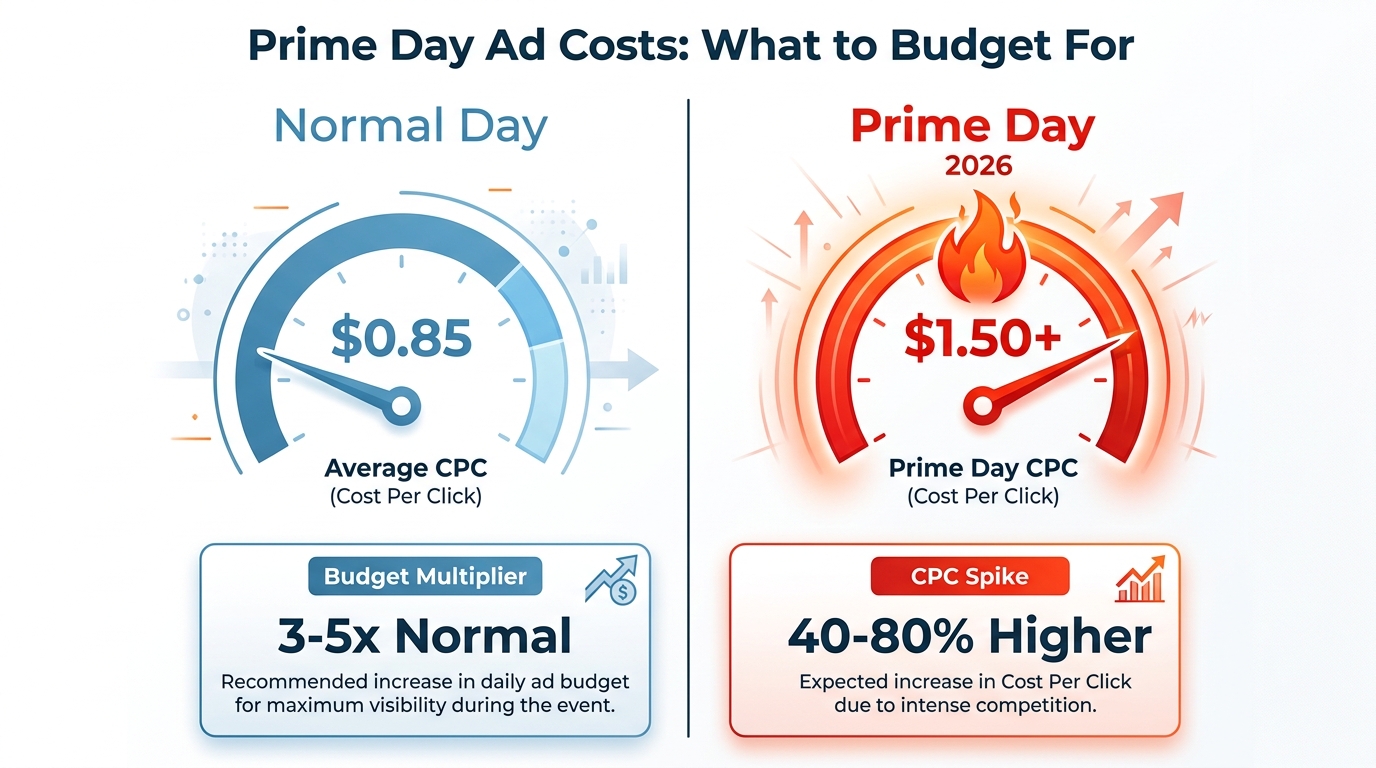
Based on industry benchmarks and seller data from recent Prime Day events, here’s what sellers should expect for advertising costs during Prime Day 2026:
- Average Amazon CPC in a normal 2026 week: approximately $0.75–$0.95 per click across categories.
- Prime Day CPC range: $1.35–$1.70+ per click on average, representing a 40–80% increase above baseline.
- Top-keyword CPCs in competitive categories (electronics, supplements, home goods): $2.50–$8.00+ per click during peak Prime Day hours.
- Overall ad budget recommendation: 3–5x your normal daily ad spend across the event window.
These aren’t small increases. A seller spending $500/day on advertising in a normal week needs to budget $1,500–$2,500/day for Prime Day just to maintain equivalent visibility — before accounting for the increased competition that will still drive them off the top of page 1 in many categories.
The Pre-Event Advertising Window: June 1–22
One of the most consistently underutilized opportunities around Prime Day is the pre-event advertising window. Consumers begin deal-hunting and wishlist-building 2–3 weeks before Prime Day officially opens. Traffic to Amazon surges noticeably starting June 1, and click-through rates on deal-oriented content rise significantly.
CPCs in the June 1–22 window are still elevated relative to baseline but nowhere near the Prime Day peak. This makes it one of the highest-value advertising periods of the year: high consumer intent, moderately elevated costs, and full product availability (inventory already in FCs). Sellers who invest heavily in this window — building browser history, wish list adds, and cart abandonment signals — set up Prime Day conversions at better economics than those who only advertise during the event itself.
Specific tactics for this window include: running Sponsored Brand video ads focused on category awareness, deploying Deal of the Day visibility for products not in your Prime Day deal structure, and increasing Sponsored Display retargeting budgets to capture consumers who visited your PDPs in late May and early June.
Budget Pacing During the Event
The single most common Prime Day advertising mistake is front-loading budget to Day 1 morning and burning through the daily cap before afternoon traffic peaks. Prime Day traffic is not uniform across the four-day window. Historically, Day 1 mornings generate enormous traffic spikes — but conversion rates on Day 1 afternoon and Day 2–3 tend to be strong as well, often without the full CPC spike.
For a four-day event like Prime Day 2026, the recommended approach is: allocate 35% of your total event budget to Day 1 (with aggressive morning bidding followed by a pull-back after 2pm), then distribute the remaining 65% across Days 2–4 with a slight back-weighting toward Days 3–4, where remaining-inventory urgency drives strong conversion rates.
Defensive Advertising: Protecting Your Brand During Competitor Surge
Prime Day is also when your competitors, who have been patiently building toward this event, will spend aggressively on your branded terms. Competitive Sponsored Product campaigns targeting your ASINs will spike. Sponsored Brand takeovers in your category will multiply.
Defensive advertising — specifically, branded keyword campaigns at elevated bids and ASIN-targeting Sponsored Display ads on your own product detail pages — is not optional during Prime Day. These placements prevent competitors from poaching your high-intent visitors at exactly the moment those visitors are most likely to convert. Budget for defensive campaigns separately from your offensive growth budget: typically 15–20% of your total Prime Day ad spend should go toward brand defense.
The Back-to-School Overlap: Threat and Opportunity by Category
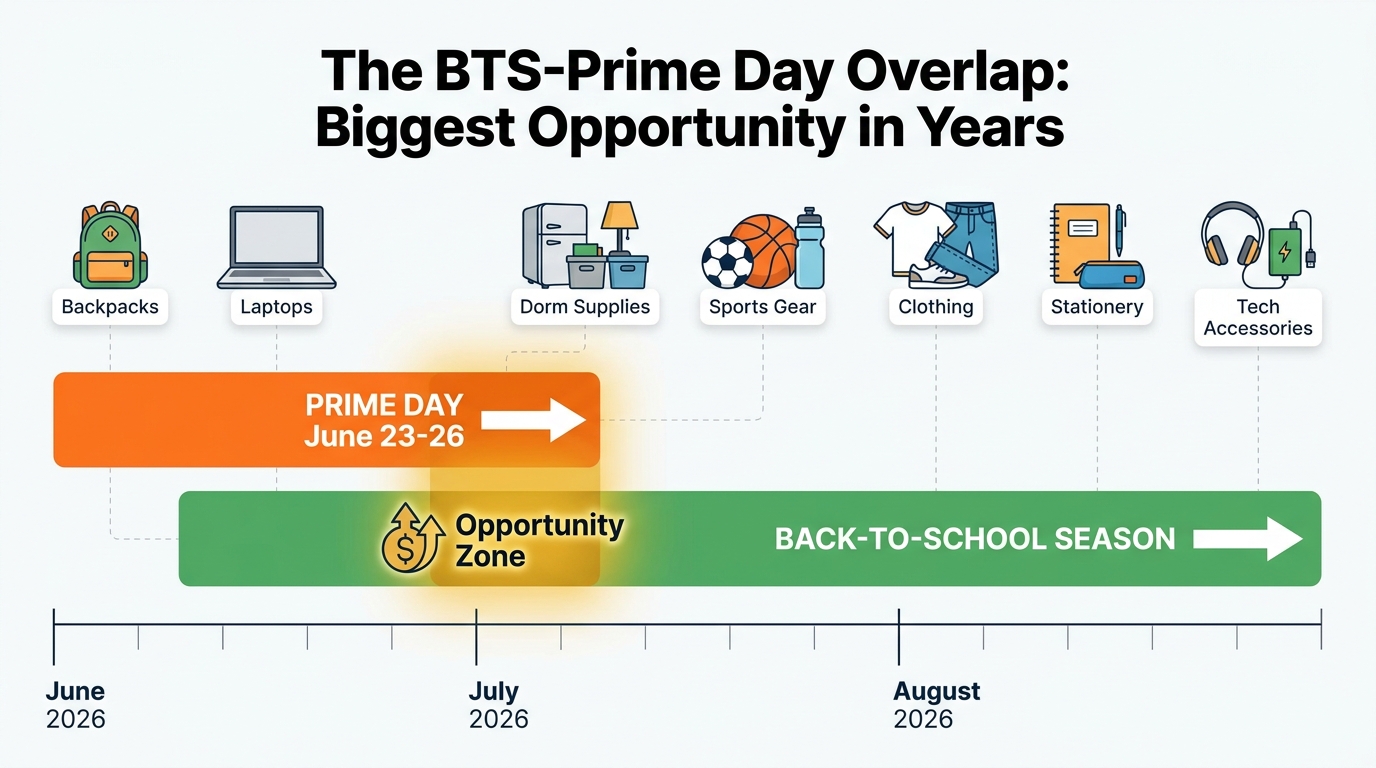
The NRF has documented for several years that 85% of back-to-school buyers actively plan to shop Prime Day or equivalent summer sale events. What’s changed in 2026 is that Prime Day no longer precedes the BTS season — it now is the starting gun for it. For sellers in the right categories, this is one of the most significant demand convergence opportunities in recent ecommerce history. For sellers in the wrong categories, it creates competitive noise that elevates ad costs without delivering proportional conversion lift.
Categories That Benefit Most from the Overlap
Electronics and computing are the clearest winners. Laptops, tablets, headphones, and peripherals that serve both the “great deal” Prime Day shopper and the “back to school” parent are perfectly positioned in this convergence window. Expect significantly higher category competition from major brands (Apple, Dell, Samsung, Lenovo through their Amazon storefronts), but also higher consumer intent and willingness to spend.
Dorm and home essentials — bedding, storage solutions, small appliances, bath accessories — represent one of the highest-growth BTS subcategories in recent years. College move-in typically runs August to September, but purchasing peaks in July. A June Prime Day now captures parents and students who are researching and purchasing a full 6–8 weeks before move-in, which is earlier than the historical BTS purchase window would suggest.
Sports and outdoor recreation benefits from both summer demand and the physical activity interests of the back-to-school demographic. Athletic gear, fitness equipment, and outdoor storage products see strong Prime Day performance when the event occurs in summer months.
Clothing and apparel has a more complex relationship with the overlap. Prime Day has historically driven strong apparel sales, but back-to-school apparel is often purchased in July–August rather than June. Sellers in this category may find that the June Prime Day captures early planners but misses a substantial portion of their BTS audience.
Categories Where the Overlap Creates Noise Without Lift
Grocery, consumables, and home cleaning products traditionally perform well on Prime Day because of discount-driven pantry stocking behavior. The BTS overlap adds limited incremental demand to these categories, but it does add significant advertising competition from brands targeting the BTS shopper persona. Sellers in these categories should be particularly disciplined about bid caps and target ROAS floors during Prime Day to avoid overspending against inflated CPCs without matching conversion rate uplift.
Competing Retailers and the June Event War
Amazon’s Prime Day has never existed in a competitive vacuum, and the June 2026 timing creates a specific dynamic worth understanding. Walmart, Target, Best Buy, and Wayfair have all developed competing “deal day” strategies that time parallel promotions to coincide with Prime Day. In a July Prime Day, this produced a predictable pattern: Amazon dominated traffic while competitors picked up customers who wanted deals but either weren’t Prime members or wanted to avoid Amazon.
A June Prime Day changes the competitive geometry in several ways.
How Retailers Are Likely to Respond
Walmart has been the most aggressive Prime Day counter-programmer of any major retailer, and its Walmart+ Week event has run in close proximity to Prime Day since 2021. For a June 23–26 Prime Day, expect Walmart to launch a parallel promotion in the same week — and possibly to extend it through the first week of July to capture post-Prime Day traffic as Amazon’s event winds down.
Target’s answer to Prime Day — Target Circle Week — has similarly been timed to overlap with Amazon’s event window. Target’s strength in the apparel and home categories means it offers a genuine alternative for the BTS shopper who doesn’t find what they need on Amazon. In a June timeframe, Target’s early BTS promotions and Prime Day counter-programming will likely merge into a single extended promotional period.
Best Buy occupies a unique position because it sells the same electronics SKUs that anchor Prime Day. The June timing puts Best Buy’s promotions squarely in the sweet spot of its BTS laptop and tablet sales cycle, meaning consumers will be genuinely price-shopping between Amazon and Best Buy in real time. For Amazon sellers in electronics who have reseller agreements with Best Buy, understanding channel pricing strategy becomes critical in June in a way it wasn’t when Prime Day was in July.
What This Means for Amazon-Only Sellers
If your products are exclusively sold on Amazon, the multi-retailer competitive environment is background noise more than a direct threat. But it does mean that the advertising spend you’re competing against during Prime Day includes budgets from Walmart and Target who are actively trying to intercept your customers before or after they visit Amazon. Digital advertising costs on Google, Meta, and programmatic channels rise during Prime Day week precisely because competing retailers are bidding against Amazon’s gravity.
The strategic response is to lean hard into Amazon’s owned ecosystem — Sponsored Brands, DSP, and Posts — rather than diversifying to external channels during the event window. Competing retailers can outbid you on Google; they can’t outbid you on Amazon’s own ad inventory in your own category.
Demand Forecasting When Your Historical Data Is Wrong
This is a problem that doesn’t get discussed nearly enough in Prime Day planning content: your historical Prime Day demand data was generated by a July event. Every regression model, every seasonal index, every demand planning algorithm that your inventory or operations team uses is calibrated to summer consumer behavior in mid-to-late July. June consumer behavior is meaningfully different.
The Consumer Behavioral Differences Between June and July Shoppers
June shoppers are still in active summer mode. School hasn’t ended in many markets (particularly in the US South and Southwest, where school years end in late May to early June). Discretionary spending is robust. Vacations are being planned. The consumer is in a different psychological state than a July shopper who has already settled into summer rhythms.
The 2021 June Prime Day data offers the best available proxy for what to expect in 2026. Key behavioral observations from that event include: higher first-day traffic spikes but slightly lower conversion rates compared to July events, suggesting consumers are browsing more deliberately; stronger small business and independent seller performance relative to Amazon’s own product lines; and a more measured purchasing path where consumers added to carts and wishlists but converted over a longer window rather than in the immediate heat of Day 1 deals.
Recalibrating Your Forecast Models
If your demand forecasting uses the past 3–5 years of Prime Day data, the most defensible approach for 2026 is to apply a discount factor of 10–15% to your July-based demand projections and use the 2021 June event as a cross-check. Don’t blindly rely on 2021 data either — the event was much shorter (two days vs. four in 2026) and the ecommerce market was in a very different state — but its June timing makes it the closest behavioral analog available.
For category-specific forecasting, use the BTS overlap as an additive demand signal for electronics, dorm, and school supply categories specifically. Those categories should be forecast at or above July equivalents because of the demand convergence effect. Other categories — seasonal outdoor, summer-specific products — should be forecast more conservatively, as June may capture slightly less of their peak summer demand than a July event would.
The Post-Prime Day Q3 Gap: What Happens When July Goes Quiet
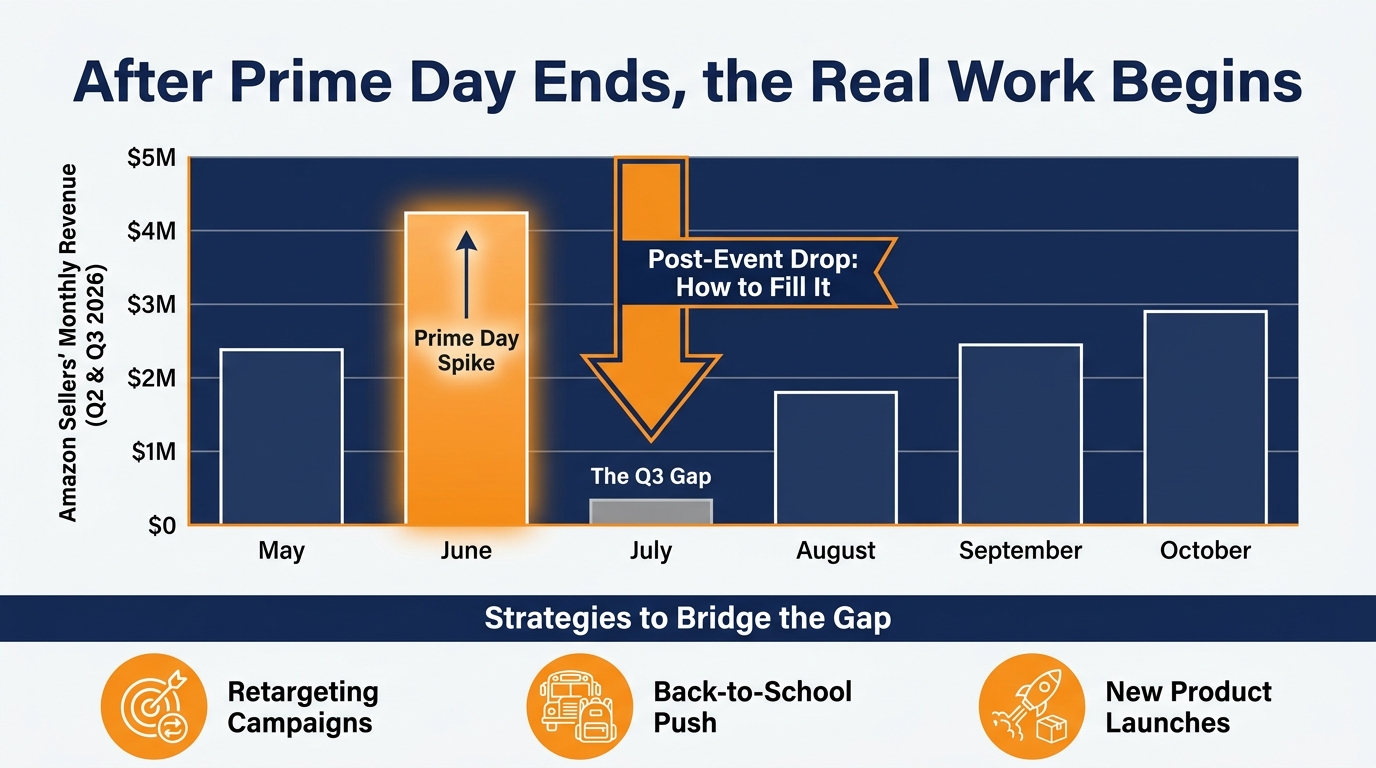
In previous years, the Prime Day halo effect carried into late July and early August. Organic rank improvements earned during Prime Day sustained elevated traffic for 3–6 weeks post-event. New customers acquired during the event re-engaged with brands through remarketing. Q3 started with momentum from a July Prime Day.
A June Prime Day creates a different Q3 shape. The halo period ends in early July. The advertising machine downshifts. New customers acquired during Prime Day settle into non-event browsing behavior. And sellers face a 6–8 week gap between the end of Prime Day velocity and the beginning of meaningful back-to-school peak purchasing in July–August.
How to Actively Fill the July Gap
Sustained retargeting campaigns are the first line of defense. Customers who visited your PDPs during Prime Day but didn’t purchase are high-intent targets in the weeks immediately following the event. Sponsored Display retargeting to these audiences typically delivers strong conversion rates at normal (non-Prime Day) CPC levels — making July one of the better ROAS windows of the year if you’re disciplined about audience targeting.
New product launch cadencing deserves serious consideration. The 30 days following Prime Day represent a window where organic rank competition is lower (everyone pulled back their bids), consumer attention is still elevated from the event halo, and review accumulation from Prime Day sales can fuel new listing credibility. Sellers who have product launches queued up should strongly consider scheduling them in the first two weeks of July rather than waiting until back-to-school peak.
Subscribe & Save acceleration is particularly powerful in the post-Prime Day window. Customers who tried a consumable or replenishable product during Prime Day can be converted to Subscribe & Save enrollments through email flows (if you have brand data) or coupon structures that incentivize auto-enrollment. Every S&S enrollment captured in July becomes recurring Q3 and Q4 revenue — a compounding return on your Prime Day customer acquisition investment.
Planning Toward Prime Big Deal Days
Amazon’s fall event — Prime Big Deal Days, which typically runs in October — provides the Q4 bookend to Prime Day. For 2026, with Prime Day in June, the gap between the two events stretches to approximately four months rather than three. That’s a long runway that requires active inventory and advertising management to bridge without significant revenue troughs.
The smart approach is to treat July and August as a deliberate funnel-building period for Prime Big Deal Days. Use the post-Prime Day weeks to grow your review count, improve your organic rank through moderate advertising support, and build a wishlist and cart audience that you can activate when Prime Big Deal Days promotions open. Prime Day and Prime Big Deal Days aren’t independent events — they’re a two-act structure, and June Prime Day sellers who plan June through October as a single strategic arc will outperform those managing each event in isolation.
Building a Timing-Agnostic Event Strategy for Future Stability
The June 2026 shift is likely not the last Prime Day calendar change Amazon will make. The 2020 October anomaly, the 2021 June experiment, and now the 2026 return to June demonstrate that Amazon will move the event when it serves Amazon’s strategic interests — regardless of the planning cycles it disrupts for sellers.
The sellers who will consistently outperform through future timing changes are those who build what might be called a timing-agnostic event architecture — operational systems and financial structures that can absorb a 4–6 week timing shift in either direction without requiring a complete replanning effort.
The Four Elements of a Timing-Agnostic Architecture
Rolling inventory buffer: Rather than building inventory specifically timed to Prime Day deadlines, maintain a 90-day rolling inventory buffer that is always FBA-ready. This eliminates the deadline crunch problem entirely — whether Prime Day is in June or July, your inventory is already in the network. The cost of maintaining higher average inventory levels is real, but it’s typically lower than the cost of air freight recovery or missed deal eligibility.
Pre-approved working capital facility: Establish a working capital line of credit or revenue-based financing relationship before you need it, not during a crunch. Having a $200K–$500K facility available (depending on your business size) that you can draw on at any time gives you the ability to absorb a timing shift without scrambling for emergency capital. The availability of capital matters more than whether you actually use it.
Evergreen deal structures: Develop deal templates — discount percentages, bundle structures, coupon mechanics — that can be activated within a 2–3 week window with minimal lead time. Many Lightning Deal and Prime Exclusive Discount structures require only a few weeks of lead time for Amazon’s deal team to review and approve. If your deal SKUs, pricing floors, and promotional mechanics are pre-established, you can respond to a timing shift announcement quickly enough to participate fully.
Quarterly advertising calibration: Rather than building Prime Day advertising plans from scratch each year, develop a quarterly advertising model that includes a “Prime Day mode” configuration — specific campaign structures, bid modifier rules, and budget allocation percentages — that can be activated regardless of which month the event falls in. The mechanics of Prime Day advertising don’t change with the calendar date; only the timing does. Pre-built campaign architectures reduce the planning burden significantly.
The Competitive Advantage of Operational Agility
It’s worth stating this plainly: most Amazon sellers will not build timing-agnostic systems. They’ll adapt this year to June, build July-calibrated systems again by 2027, and be disrupted again if Amazon moves the event. The sellers who invest in operational agility — even when it means carrying slightly higher inventory or pre-paying for a credit facility they may not need — will consistently capture more Prime Day value than their competitors because they won’t be losing weeks of preparation time to reactive replanning.
In a market where the difference between a good Prime Day and a great one can be $500K or more in revenue, the investment in operational flexibility pays for itself many times over.
The Pre-Event Checklist: A Practical Rundown for June 23–26
To make this concrete, here is a working pre-event checklist structured around the June timeline. Use this as a diagnostic — gaps here are your highest-priority action items.
60+ Days Before (April 2026 and Earlier)
- Supplier purchase orders placed and production confirmed for all Prime Day hero SKUs
- Working capital facility established or line of credit secured
- Deal submission for Lightning Deals and Prime Exclusive Discounts submitted in Seller Central
- FBA inventory inbound plan created and shared with freight forwarder
- Demand forecast reviewed and adjusted for June consumer behavioral differences vs. July
- Prime Day advertising campaign structures built (not activated — built)
30–60 Days Before (May 2026)
- Sea freight departed origin by May 20 (to accommodate May 27 Amazon ship deadline with buffer)
- Pre-event advertising window campaigns activated (June 1 target start)
- Product listing quality audit completed: main image, A+ content, bullet copy, and enhanced brand content all review-ready
- Review count and rating check: any ASIN below 3.8 stars should be excluded from deal structures
- Competitive price monitoring activated for the 30 days leading to Prime Day
1–3 Weeks Before (June 1–22)
- FBA inventory confirmed received by June 5 deadline
- Deal badges and Prime Exclusive Discount pricing confirmed active in Seller Central
- Pre-event PPC campaigns running and performance data available for bid optimization
- Defensive branded keyword campaigns at elevated bids and active
- Post-event retargeting audience setup complete (Sponsored Display, DSP if applicable)
- Customer service team briefed on Prime Day volume and response time expectations
During the Event (June 23–26)
- Hourly budget pacing check: no campaign should burn its full daily cap before 2pm
- Bid adjustment triggers ready: if CPC spikes beyond target ROAS floor, pause and redirect budget to converting campaigns
- Inventory level monitoring every 4 hours for hero SKUs — stockout equals lost deal badge
- Seller feedback and review request automation active for all Prime Day orders
Conclusion: The Clock Shifted — Did Your Playbook?
Amazon moved Prime Day to June because it serves Amazon’s interests. That’s the honest framing. The June 23–26 date wasn’t designed with seller convenience in mind — it was designed to pull Q2 revenue forward, capture the front edge of the back-to-school cycle, and further cement Prime Day’s position as the de facto kickoff event for summer retail.
As a seller, you don’t control the calendar. What you control is how quickly and completely you adapt your operations, your cash flow planning, your advertising architecture, and your demand forecasting to the reality that the calendar presents. Sellers who treated the April 29 announcement as a minor adjustment and kept their July playbooks intact will find June 23 arriving with compressed inventory, strained cash, underbuilt advertising, and missed deal deadlines.
Sellers who recognized the June shift for what it is — a structural change to the operational calendar that requires structural responses, not just tactical tweaks — have a genuine advantage over those who are still mentally anchored to July.
The specific actions that matter most for June 23–26 come down to four priorities:
- Get inventory into FBA early. The May 27 / June 5 window is not flexible. Miss it and you miss the event.
- Secure working capital before April. The cash gap in a June Prime Day is 90+ days. Plan for it explicitly.
- Build your advertising architecture in advance. Pre-event campaigns starting June 1 are as important as event-day campaigns. Don’t wait until June 23 to start spending.
- Plan through Q3, not just through Prime Day. The July gap is real. The retargeting window, the new product launch opportunity, and the Subscribe & Save conversion moment are all sitting there waiting to be captured in the post-event weeks.
Prime Day 2026 is June 23–26. That’s the new reality. The sellers who adapt their entire operational playbook — not just their deal list — will be the ones with the results worth talking about when July arrives.