
You open Seller Central on a Tuesday morning. There’s a notification waiting — not the usual pricing alert or a return request. This one is different. It’s a formal notice informing you that one or more of your ASINs will be deactivated within 30 days unless you take corrective action.
For thousands of Amazon sellers in 2026, that’s not a hypothetical. Since May 2026, Amazon has been issuing exactly these notices at scale, targeting listings that violate what the company calls its ASIN Creation Policy. The enforcement is automated, it’s moving fast across categories, and the consequences — lost Buy Box eligibility, suppressed search rankings, stranded FBA inventory — are severe enough to disrupt any business that depends on these listings for revenue.
What makes this crackdown different from the routine account health warnings sellers have navigated for years is its breadth and the speed at which Amazon is expanding it. The first wave hit Home, Beauty, and Grocery in May. Electronics and Apparel followed in June. If your catalog hasn’t been reviewed, it’s not because your listings are safe — it may simply mean your category hasn’t been swept yet.
This guide breaks down exactly what Amazon is targeting, why it matters even to sellers who think they’re compliant, how to audit your catalog before the clock runs out, and how to write an appeal that actually moves the needle when it does get denied. No jargon, no padding — just what you need to know and do.
How We Got Here: The Policy Timeline Behind the 2026 Enforcement Wave
Amazon’s ASIN Creation Policy isn’t new. The core principle — that every ASIN must represent a single, distinct, active product created or authorized by that product’s brand or manufacturer — has existed in Seller Central documentation for years. What changed in 2026 is enforcement at scale, backed by automated detection systems that can scan entire catalogs and flag violations without human review.
The Pre-Enforcement Signals (January–February 2026)
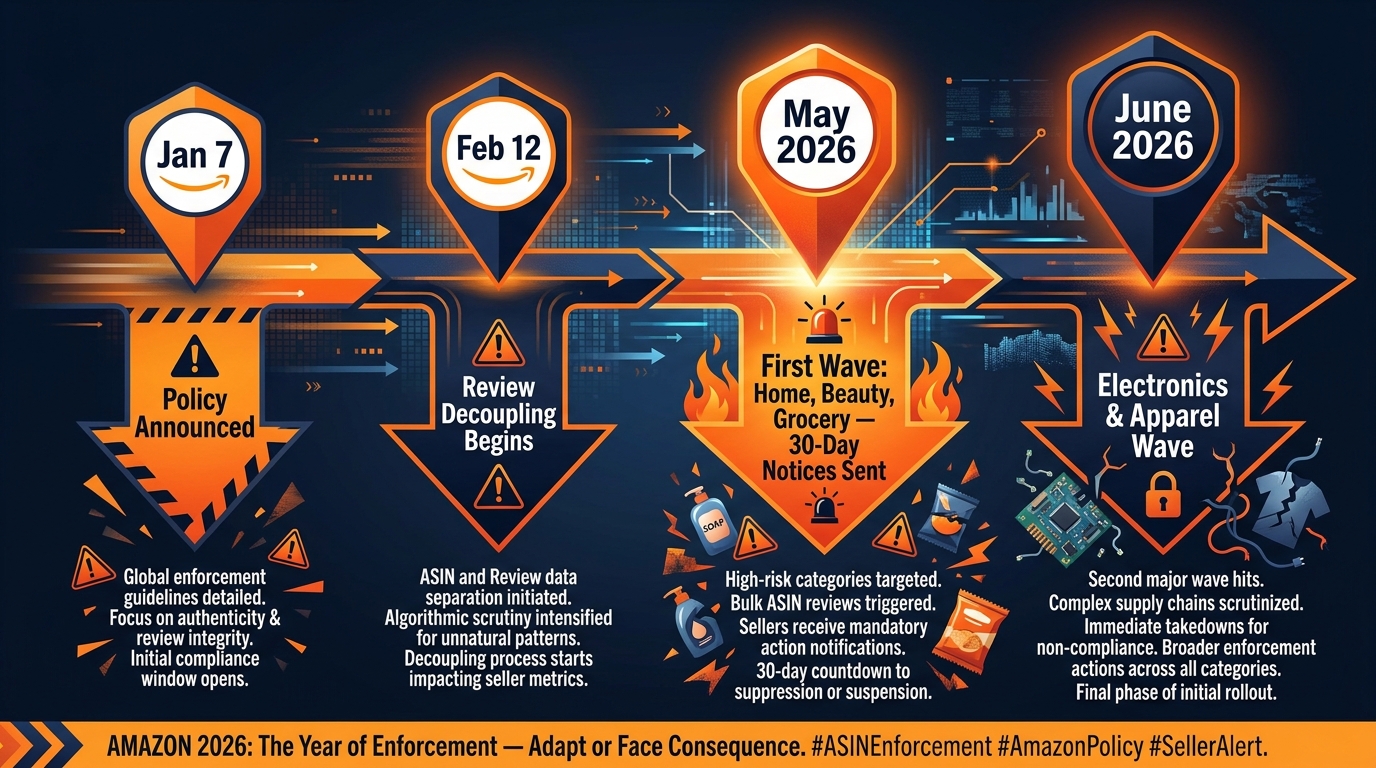
The formal announcement that Amazon was tightening ASIN creation enforcement came on January 7, 2026. At the time, most sellers treated it as background noise — another policy update buried in the Seller Central news feed. But a second, related change arrived on February 12, 2026, which should have set off alarms: Amazon began decoupling reviews from variation listings where child ASINs had “significant functional differences.”
The February review-decoupling change rolled out progressively across categories through May 31, 2026. Under the new rules, only minor aesthetic variations — such as color differences in the same exact product — are permitted to share reviews across a variation family. Variations involving significant differences in size, flavor, specification, or function are no longer allowed to pool reviews. Child ASINs in these families could drop to zero reviews overnight.
That single change should have been the canary in the coal mine. It signaled that Amazon was done looking the other way at catalog manipulation tactics that had been quietly widespread for years. The ASIN Creation Policy enforcement wave that launched in May was the next logical step.
The May 2026 Enforcement Launch
Starting in May 2026, Amazon’s automated systems began issuing 30-day deactivation notices through Seller Central’s Performance notifications. The notices are formal — they cite specific ASINs, identify the policy basis for the flag, and set a precise deadline for resolution. Sellers who receive them have 30 days to either fix the violation or submit a successful appeal; failure to do either results in the ASIN being deactivated.
The first categories swept were Home, Beauty, and Grocery — three high-volume, high-competition spaces where catalog abuse had been particularly common. Electronics and Apparel enforcement followed in June. Industry observers expect the sweep to continue expanding into additional categories through the second half of 2026.
The Spring 2026 policy environment also introduced a related change: Amazon now mandates Brand Registry enrollment for FBA sellers using manufacturer GS1 UPC barcodes. Sellers without Brand Registry enrollment must instead use Amazon FNSKUs, increasing the practical pressure to get enrolled and get registered.
The Three Violations Amazon Is Actually Targeting
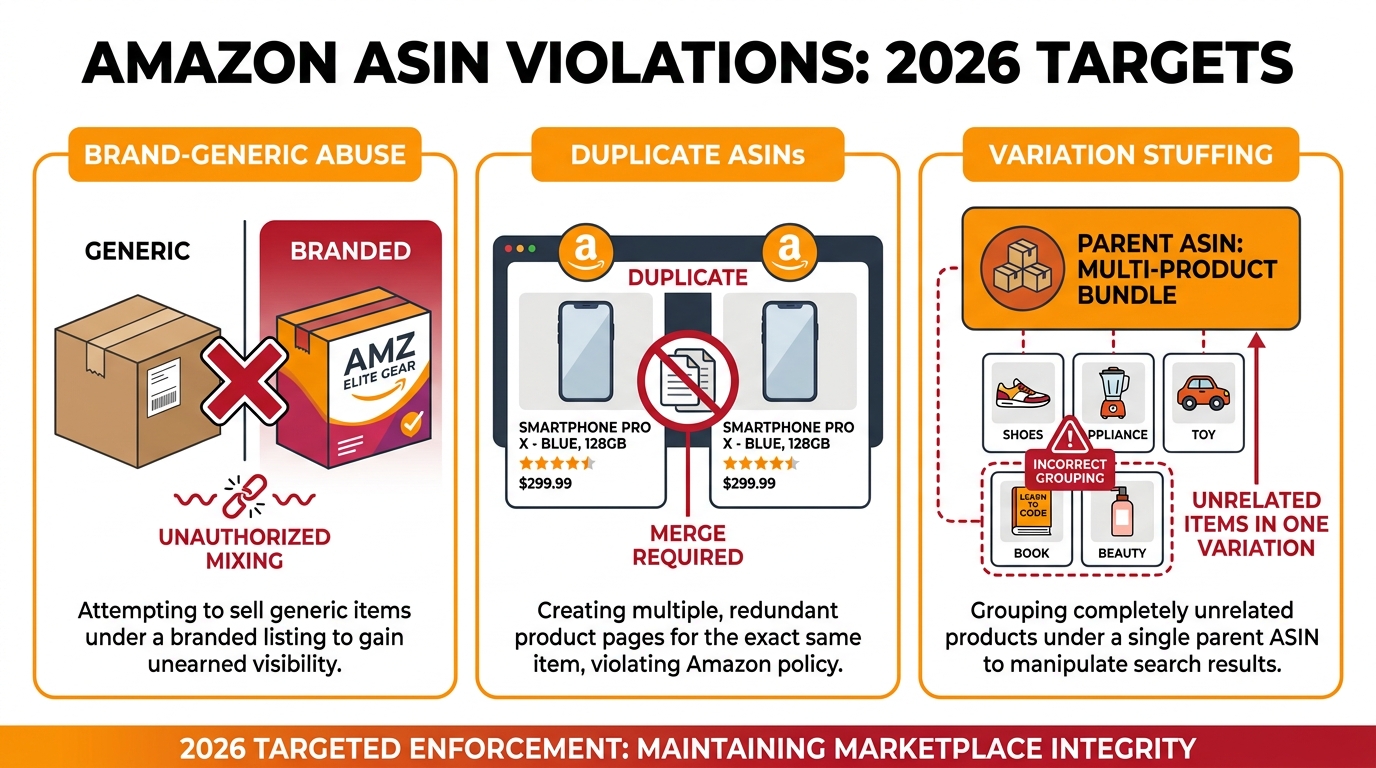
Amazon’s automated enforcement isn’t scanning broadly for “bad” listings. It’s hunting for specific, well-defined patterns — and if your catalog contains any of the three primary violation types, the probability of receiving a 30-day notice is high. Understanding exactly what these violations are (and how they developed as tactics in the first place) is the foundation of everything else in this guide.
1. Brand-Generic ASINs
A Brand-Generic ASIN is created when a seller lists a product under the brand label “Generic” while the product is actually tied to an existing brand’s intellectual property. This practice arose as a loophole: sellers would source products that use patented designs, trademarked logos, or proprietary packaging from established brands, then list them under “Generic” to avoid brand restrictions or authorization requirements.
Amazon’s policy is clear — if you create an ASIN for a product that belongs to a recognizable brand, you cannot label it Generic. You must list it under the correct brand name, and in most cases, you need documented authorization from that brand (a Letter of Authorization, invoice, or purchase agreement) to create or contribute to that ASIN.
The automated systems Amazon deployed in 2026 cross-reference product identifiers — GTINs, UPC codes, image hashes, and title keywords — against its brand catalog to identify these mismatches. Listings where “Generic” is used alongside product content that patterns against a known brand IP are flagged first.
2. Duplicate ASINs
Duplicate ASIN creation occurs when a seller creates a new ASIN for a product that already has an existing ASIN in the Amazon catalog. The motivation for doing this has historically been review manipulation: a product that has accumulated negative reviews gets abandoned in favor of a fresh ASIN for the identical product, giving sellers a clean review slate.
This directly harms buyers, who lose the benefit of authentic historical review data, and it harms honest sellers whose products appear on genuinely clean ASINs. Amazon’s policies have long prohibited this, but enforcement was inconsistent. The 2026 crackdown treats duplicate ASIN creation as a first-tier violation warranting an immediate 30-day deactivation notice.
Detection is sophisticated. Amazon compares product images, UPC codes, title structures, and attribute sets to identify functionally identical products listed across multiple ASINs. Sellers found managing duplicate ASINs — even if they didn’t create the duplicate themselves — can be flagged. If you’re a reseller who joined a listing only to find a near-identical ASIN existed, that history may now become a liability.
3. Variation Stuffing
Variation stuffing is arguably the most complex violation in the enforcement wave because it existed on a spectrum that wasn’t always clearly abusive. At its worst, variation stuffing involves attaching entirely unrelated products to a successful parent ASIN purely to inherit its accumulated reviews and traffic. A seller might, for example, attach a new kitchen gadget as a “variation” of a popular book accessory ASIN — products that have nothing in common — to instantly inherit thousands of reviews for the new product.
More subtle versions involve sellers adding products that are loosely related but functionally dissimilar enough to violate Amazon’s variation policies. The February 2026 review-decoupling change specifically targeted this: Amazon now only allows review sharing among variations with minor aesthetic differences (like color). Size differences, flavor differences, specification differences, and functional differences no longer qualify for shared review inheritance.
For sellers who built entire catalog strategies around variation families, this is the change that stings the most. Child ASINs that previously benefited from a parent’s 500+ review count may now display zero reviews if Amazon determines the variation relationship involves significant functional differences. Those same listings are now subject to deactivation notices if the variation group itself is flagged as improperly constructed.
The 30-Day Clock: What Happens If You Do Nothing
The 30-day window Amazon provides feels generous. It isn’t. The cascade of consequences that follows a failure to act within that window is more damaging than the original notice, and the damage compounds in ways that are difficult to reverse.
Immediate Consequences at Deactivation
The moment an ASIN is deactivated, it is removed from search results entirely. The listing disappears — no Buy Box, no organic impressions, no sponsored placements. Any advertising campaigns running against that ASIN stop spending, but budget doesn’t automatically redirect to other products. Sellers who don’t proactively pause campaigns tied to deactivated ASINs can find themselves spending against ghost listings.
Any reviews accumulated on a deactivated ASIN are not deleted, but they become inaccessible while the ASIN remains inactive. If the deactivation leads to a full ASIN removal rather than just suppression, those reviews may be lost permanently. For listings that had 200, 500, or 1,000 reviews built up over years, that loss represents significant intangible value that cannot be recovered.
The FBA Inventory Problem
FBA sellers face a particularly sharp consequence: stranded inventory. When an ASIN is deactivated, any FBA inventory associated with it is stranded — it’s sitting in Amazon’s fulfillment centers with no active listing to sell through. Stranded inventory has a direct negative impact on your Inventory Performance Index (IPI) score, which determines your storage limits and future restock capacity.
Sellers who ignore stranded inventory long enough face disposal fees or removal order charges to get their stock back. In categories with long restocking lead times, the combination of deactivated listings and stranded inventory can mean weeks or months of zero revenue from affected products — during which time competitors take over ranking positions that are extremely expensive to reclaim.
The Account Health Escalation Risk
Deactivated ASINs don’t stay in isolation within your account metrics. Amazon’s Account Health Rating (AHR) incorporates policy compliance as a key signal. Unresolved ASIN deactivations raise your policy violation count, which feeds into AHR degradation. An AHR that drops below 200 enters the “At Risk” zone; below 100 triggers full account deactivation — a complete halt to all selling activity across every listing you own.
Sellers who receive multiple ASIN deactivation notices simultaneously (because automated sweeps often flag entire batches of similar listings at once) can see their AHR drop rapidly. The 30-day window for each ASIN isn’t independent if your account is being flagged for systematic policy violations — Amazon may escalate to account-level action faster than the individual ASIN timelines would suggest.
Who Gets Hit Hardest: A Seller-Type Risk Assessment
Not every Amazon seller faces equal exposure in this crackdown. Your risk profile depends heavily on your business model, how your catalog was built, and the category you operate in. Understanding where your specific exposure lies is the first step in prioritizing your response.
Resellers and Wholesale Sellers
Resellers are among the hardest-hit groups — particularly those in the Grocery, Beauty, and Home categories that received the first wave of notices. Resellers often work with many different brands’ products, which means they need documented authorization for each brand they list. Letters of Authorization (LOAs) and valid purchase invoices are the primary proof of authorization required.
The challenge for resellers is volume. A catalog of 500+ ASINs across dozens of brands requires significant administrative infrastructure to maintain clean authorization records. Resellers who rely on distributor invoices rather than direct brand relationships may find that Amazon doesn’t accept distributor paperwork as sufficient authorization evidence — a problem that often only surfaces when a deactivation notice arrives.
Private Label Sellers
Private label sellers operate under their own brand names, which should theoretically make them lower risk for brand-generic violations. But private label sellers are highly exposed to variation stuffing flags — especially those who built out large variation families with many child ASINs to maximize listing real estate and review consolidation.
For private label sellers, the February 2026 review-decoupling change is the more immediately painful enforcement. If your product line includes variations with significant functional differences — different sizes that function differently, different formulations, different technical specs — those variations may have already had their reviews decoupled, and the underlying variation structure may now be flagged for a 30-day notice.
Arbitrage and Dropship Sellers
Online arbitrage and retail arbitrage sellers face a structural risk: they frequently add themselves to existing listings as additional sellers, but they sometimes also create new ASINs for products that already exist in the catalog — either accidentally or as a deliberate strategy to separate their offer from negative-review listings. Both behaviors are now squarely in Amazon’s enforcement crosshairs.
New and Emerging Sellers
Newer sellers who followed outdated tutorials or sourcing guides that recommended creating new ASINs to “get a fresh start” are particularly vulnerable. A significant portion of bad advice circulated in seller communities from 2020 to 2024 involved catalog manipulation tactics that are now enforcement targets. Those who acted on that advice may be receiving notices for decisions made years ago.
The False Positive Problem: When Amazon’s Systems Get It Wrong
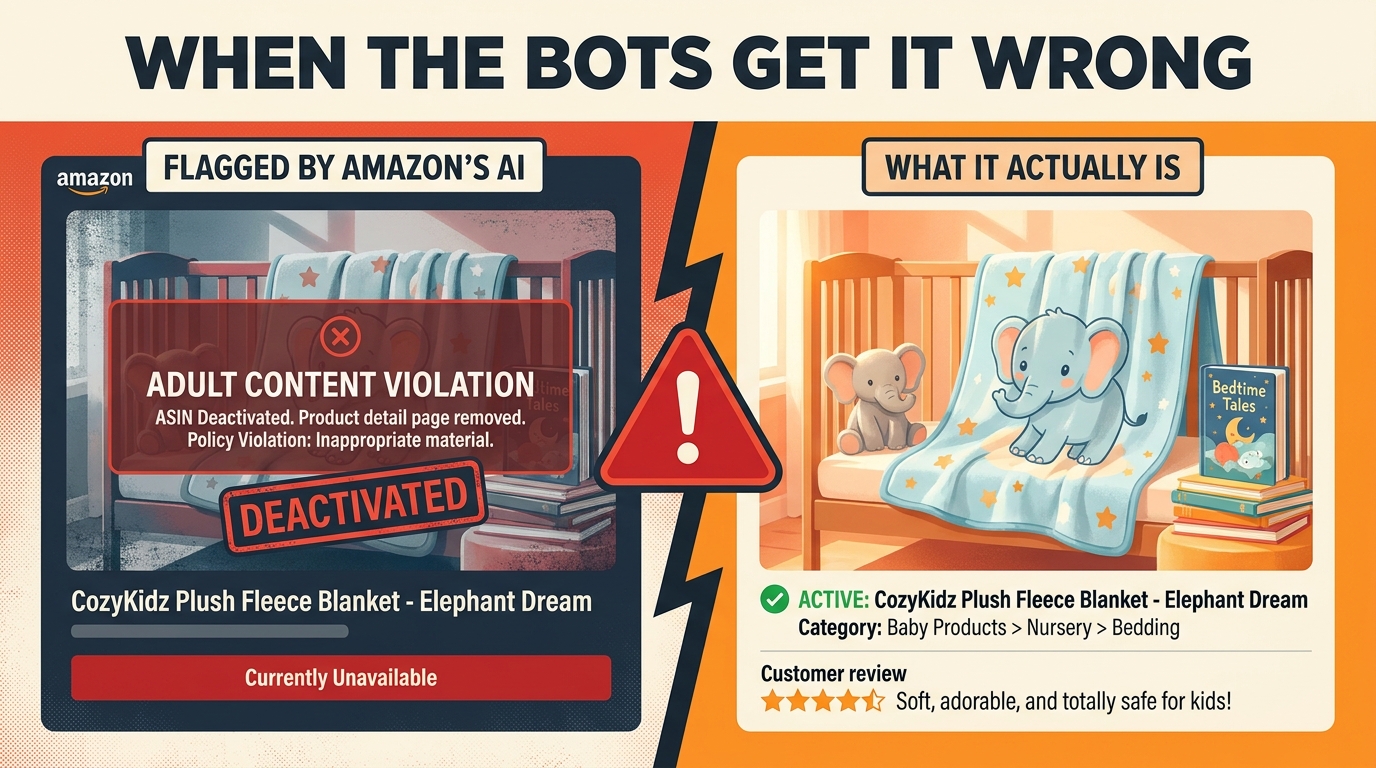
This is the aspect of Amazon’s enforcement wave that sellers find most infuriating — and for good reason. Automated detection systems are powerful, but they’re not infallible. A meaningful portion of the 30-day deactivation notices being issued in 2026 are false positives: legitimate, compliant listings flagged by Amazon’s automated systems based on surface-level pattern matches that don’t hold up under scrutiny.
How False Positives Happen
Amazon’s detection systems work primarily by cross-referencing product attributes, brand signals, and catalog patterns against known violation signatures. The problem is that legitimate listings can share surface features with violation patterns without actually being violations.
A classic example documented by sellers and reinstatement consultants: children’s products flagged as “adult content violations” because keywords in the listing — perfectly appropriate for the product — happen to match word patterns that the automated system associates with inappropriate content. A children’s blanket with the word “plush” and certain size descriptors gets misclassified. A shoe listing flagged as a “pesticide product” because chemical resistance is mentioned in the material description.
Brand-generic false positives are particularly common. A seller who legitimately manufactures an unbranded product may label it “Generic” entirely appropriately — there is no underlying brand IP involved. But if the product’s images or title keywords pattern-match against an existing brand’s product catalog, the system may flag it as a Brand-Generic ASIN violation anyway.
The Systemic Problem Behind False Positives
According to reinstatement consultants who work daily with affected sellers, the underlying issue is that Amazon’s enforcement systems were built to catch bad actors at scale, but were not designed with adequate false-positive filtration. The stated enforcement philosophy appears to be: cast a wide net, issue notices broadly, and let the appeal process sort out the legitimate cases. The burden of proof is placed on the seller, not on Amazon’s systems.
This creates a serious asymmetry. Amazon can issue thousands of automated notices with minimal internal cost. Each notice requires a seller to invest time, documentation, and often professional assistance to resolve — even when the underlying listing is entirely compliant. Smaller sellers without dedicated compliance resources are disproportionately harmed by this asymmetry.
Why You Must Still Respond to Every Notice
Even if you’re confident a notice is a false positive, ignoring it is not an option. Amazon’s systems don’t automatically clear notices that go unaddressed, regardless of whether the underlying violation is real. A notice that expires without resolution leads to deactivation — even if the listing was always compliant. Document your position, gather your evidence, and submit an appeal whether you believe the flag is legitimate or not.
Your 30-Day Catalog Audit Action Plan
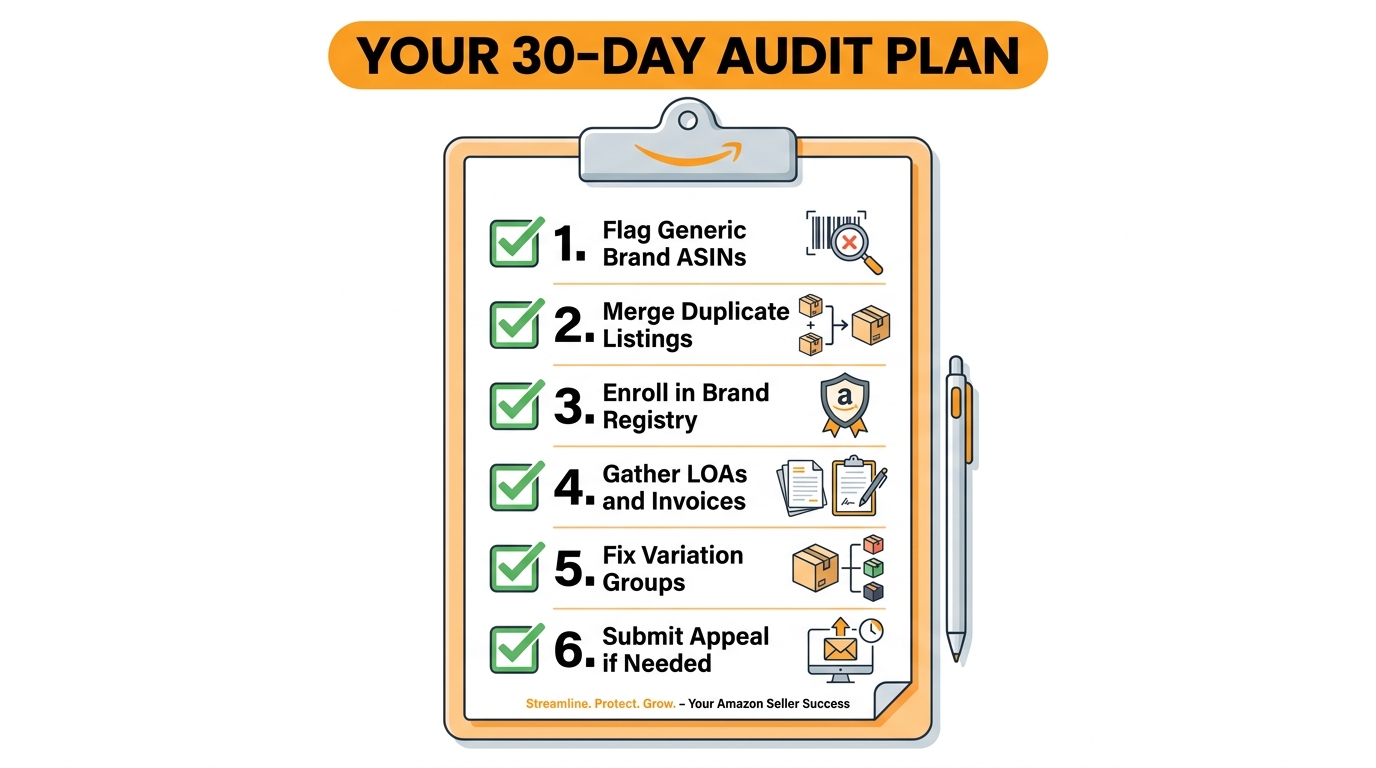
Whether you’ve already received a notice or are proactively reviewing your catalog before one arrives, the following audit framework covers the critical areas. Don’t wait for a notification — if your category has been swept, your listings should already be reviewed. If it hasn’t been swept yet, you have a short window to get ahead of the enforcement.
Step 1: Pull Your Complete Catalog Report
Begin with a full export of your catalog from Seller Central. Navigate to Reports > Inventory Reports and download the All Listings Report. This gives you every ASIN in your account alongside key attributes: brand name, category, ASIN identifier, UPC/EAN, and listing status. Export this to a spreadsheet — it becomes the working document for your entire audit.
Sort by brand field first. Any listing where the brand is labeled “Generic” is your first review priority. Not all of these are violations — but all of them need individual review to confirm there is no underlying brand IP attached to the product. If the product is truly unbranded and generic (manufactured without brand association), Generic is appropriate. If the product features any branded elements, it needs to be relabeled or removed.
Step 2: Identify and Resolve Duplicate ASINs
The most reliable way to check for duplicate ASINs is to search the Amazon catalog for your own products by UPC, EAN, or product name. If you find an existing ASIN for a product you also have a separate ASIN for, you have a duplication situation that needs resolution.
Resolution options include: contributing to the existing ASIN instead of maintaining your own (for resellers), submitting a catalog merge request through Seller Support (to consolidate two ASINs for the same product), or removing your newer ASIN and redirecting inventory to the original. Each path has tradeoffs — merging ASINs can affect review counts and rankings during the process, but it’s generally preferable to waiting for a deactivation notice.
Step 3: Audit Your Variation Families
For every parent ASIN in your catalog, review the variation structure against Amazon’s updated 2026 variation policy. Ask yourself: do the child ASINs in this family differ only in minor aesthetic ways (color, pattern), or do they differ significantly in function, size class, specification, or purpose?
If the differences are functional, your variation family is at risk. Review each child ASIN individually. For those that legitimately belong in the family under the new rules, no action is needed. For those whose differences are significant enough to require standalone status, separating them into independent listings before a deactivation notice arrives is far less painful than doing it under enforcement pressure.
Step 4: Gather Documentation for Every Branded Product
For every product in your catalog that carries a brand name (other than your own), assemble the documentation that proves your authorization to list under that brand. This typically means:
- Letter of Authorization (LOA) from the brand owner, naming you as an authorized reseller
- Purchase invoices from the brand or an authorized distributor, showing the branded product
- Distributor agreements if applicable, confirming the chain of authorization
Store these documents in a named, organized folder structure. When a deactivation notice arrives — if it does — you need to be able to pull the right documentation within hours, not days. Disorganized documentation is one of the most common reasons otherwise valid appeals fail.
Step 5: Verify GTIN and Brand Registry Alignment
Amazon’s Spring 2026 policy change mandates Brand Registry enrollment for FBA sellers using manufacturer GS1 UPC barcodes. If you’re using manufacturer barcodes on FBA shipments but haven’t enrolled in Brand Registry, you’re exposed to both this policy violation and to the broader ASIN creation crackdown risks that Brand Registry enrollment helps mitigate.
Check that every ASIN’s UPC or EAN is validated against the GS1 database. Mismatches between the barcode in your listing and the GS1 record for that barcode are a common trigger for ASIN flags. If you have non-GS1 barcodes in your catalog, explore the GTIN exemption process through Seller Support — this is a legitimate path for private label sellers who don’t have GS1 barcodes and sell exclusively on Amazon.
Step 6: Proactively Remove or Relist At-Risk ASINs
For listings that audit reveals as genuinely non-compliant, proactive removal before receiving a notice is almost always better than waiting. Self-remediation reduces your policy violation score impact and gives you control over the timing, which matters for inventory management and sales velocity.
For FBA inventory tied to listings you’re removing, create removal orders before closing the listing to avoid stranded inventory. If the product will be relisted under a corrected ASIN or brand configuration, coordinate the removal and relist timing to minimize the gap in availability.
Writing an Appeal That Actually Works
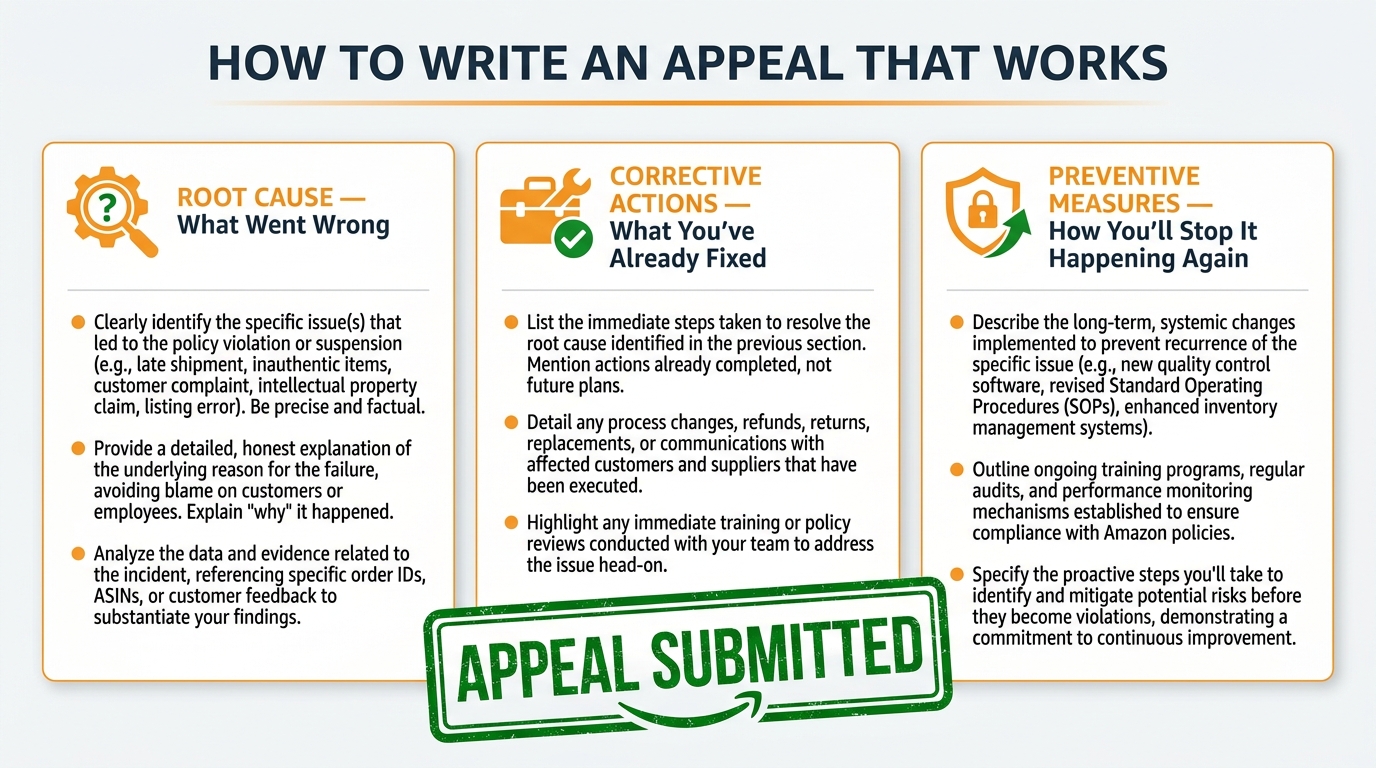
Amazon’s appeal process for ASIN deactivations runs through the Account Health dashboard in Seller Central (Performance > Account Health). You’ll see the deactivation notice alongside a “Submit Appeal” button for each flagged ASIN. What you write in that appeal — specifically the Plan of Action (POA) — is everything.
Amazon’s review team processes large volumes of appeals. Generic appeals that simply say “we didn’t do anything wrong” are routinely denied. Appeals that follow a specific structure and provide concrete evidence move forward. Understanding that structure before you write is non-negotiable.
The Three-Part POA Structure
Part 1: Root Cause Analysis. This section identifies exactly what happened — from Amazon’s perspective and from yours. If the notice is for a legitimate violation you created, describe the specific decision or process that led to the non-compliant listing. If it’s a false positive, describe specifically why the listing does not match the violation type cited, with reference to the product’s characteristics and brand relationship.
Be precise and factual. Amazon’s reviewers aren’t looking for narrative — they’re looking for specificity. “The listing was flagged as a Brand-Generic ASIN, however the product is a privately manufactured item with no brand IP association. The brand field was correctly labeled ‘Generic’ per Seller Central guidance for unbranded products” is stronger than “We believe this was flagged in error.”
Part 2: Corrective Actions Already Taken. This is where you document what you’ve already done to fix the issue before submitting the appeal. For legitimate violations, this might mean: updating the brand field, submitting a catalog merge request, or removing duplicate ASINs. For false positives, this might mean attaching the invoice, LOA, or GS1 GTIN documentation that proves authorization.
The phrase “already taken” is important. Appeals that describe planned future actions are weaker than appeals that show Amazon you’ve already resolved the underlying issue. Take the remediation steps first, then appeal with documentation of those completed steps.
Part 3: Preventive Measures. Describe the specific policy, process, or system change you’ve implemented to prevent this type of violation going forward. This section demonstrates to Amazon that you understand the policy well enough to avoid future violations — it’s a credibility signal that reviewers weight heavily.
Evidence Packaging
Documentation attached to the appeal should be clean, clearly labeled, and directly relevant to the specific ASIN cited in the notice. Don’t include unnecessary documentation that dilutes the signal. For each ASIN under appeal, your evidence package should include:
- A copy of the deactivation notice (PDF, saved from Seller Central)
- Relevant invoices or LOAs dated with the ASIN’s creation or sale history
- GS1 GTIN validation records if the flag involves barcode mismatches
- Screenshots of your Manage Inventory or flat file showing the current listing status
- Any correspondence with the brand owner confirming authorization, if applicable
Realistic Expectations on Timelines
Amazon states a 3-5 business day turnaround for appeals, though well-documented cases have seen reinstatement in 24-48 hours. Cases involving intellectual property claims or authenticity verification typically take longer. If your appeal is denied on first submission, you can submit a revised appeal — reviewers expect to see additional evidence or a more thorough root cause analysis in subsequent submissions.
Listing-level appeals (targeting a single ASIN) keep all your other listings active during the review process. Account-level enforcement is different and halts all selling — distinguishing between the two when you receive a notice is critical, because the urgency and strategy differ significantly.
Brand Registry: Why It’s No Longer Optional

Across every seller type and category, the single most consistent piece of advice that reinstatement specialists and experienced sellers give in the context of this crackdown is this: enroll in Brand Registry. It’s not a silver bullet — even Brand Registry-enrolled sellers can receive deactivation notices — but it changes your risk profile, your appeal success rate, and your long-term catalog security in ways that matter.
What Brand Registry Actually Does
Amazon Brand Registry (ABR) ties your brand’s trademarked identity to your Seller Central account through a verified trademark registration. Once enrolled, Amazon recognizes your brand as the authoritative source for your ASINs. You gain the ability to report and remove incorrect content from your listings, access enhanced listing features, and — critically for the 2026 enforcement context — benefit from preferential treatment in the appeal process when violations are alleged against your ASINs.
Brand Registry enrollment also provides access to IP protection tools that allow you to proactively report and remove listings that infringe on your brand — meaning you can prevent competitors from creating Brand-Generic ASINs using your brand’s IP, rather than discovering them after the fact.
Requirements for Enrollment
To enroll in Brand Registry, you need an active trademark registration (or pending application in many countries) that exactly matches the brand name on your Amazon products. The trademark must be registered with a national trademark authority — in the US, that means a USPTO registration or pending application. The brand name on your products, trademark, and Seller Central account must match precisely.
For the UPC/barcode component, Brand Registry doesn’t automatically exempt you from GTIN requirements — but it does give you access to the GTIN exemption application process, and enrolled brands can apply for exemptions that allow listing without GS1 barcodes for private-label products sold exclusively on Amazon. If GS1 fees ($250+ for an initial allocation) are a concern, the exemption path is legitimate and straightforward to apply for through Seller Support.
The FBA Mandate That Changes Everything
Amazon’s Spring 2026 policy change that requires Brand Registry for FBA sellers using manufacturer UPC barcodes is the policy change that has pushed many sellers from “Brand Registry is advisable” to “Brand Registry is effectively mandatory for serious FBA operations.” Non-enrolled sellers must use Amazon FNSKUs — which adds operational complexity and removes the flexibility to sell the same inventory through other channels using the same barcode.
For sellers with multi-channel operations — Amazon FBA plus their own website, wholesale accounts, or other marketplaces — the shift to FNSKU-only labeling for non-enrolled sellers creates friction that makes Brand Registry enrollment the path of least resistance. The enrollment process typically takes 2-4 weeks from trademark verification to full approval.
The Deeper Catalog Hygiene Mindset You Need Going Forward
The 30-day deactivation wave of 2026 is a forcing function. Many of the ASIN structures being flagged today were built years ago, under a permissive enforcement environment that led sellers to optimize for short-term gaming rather than long-term catalog health. That environment is gone. The enforcement architecture Amazon has put in place in 2026 suggests this level of scrutiny is the new baseline, not a temporary crackdown.
Treat Your Catalog as Infrastructure, Not Inventory
Sellers who’ve been most resilient through this enforcement wave are those who had already been managing their catalog with the same rigor they apply to their financials. Every ASIN is a business asset — it has an associated risk profile, authorization documentation, and compliance status that should be reviewed on a regular schedule, not just when a notice arrives.
Establish a quarterly catalog review cadence. Pull the All Listings Report, check for Generic brand assignments, verify variation families against current policy, and confirm that authorization documentation for branded products is current. Thirty minutes per quarter prevents the kind of accumulation of marginal listings that creates large-scale deactivation exposure.
Build Documentation Systems That Scale
One of the structural vulnerabilities this enforcement wave has exposed is that many sellers — even large, sophisticated ones — don’t have organized systems for maintaining brand authorization documentation. LOAs expire. Distributor relationships change. Brand owners update their authorized seller lists. A documentation system that was accurate two years ago may no longer reflect current authorization status.
Build a documentation tracker that includes: brand name, authorized reseller status (yes/no), date of last verification, LOA expiry date if applicable, and the specific ASIN group covered by each authorization. Review this tracker whenever you onboard a new brand and set calendar reminders to verify ongoing authorization annually.
Vet New Listing Strategies Against Current Policy
The seller communities and YouTube channels that distribute Amazon selling advice have been slow to update their guidance to reflect 2026 enforcement realities. Tactics that were commonly taught as valid growth strategies — building out large variation families, creating listings under “Generic” for products with brand associations, strategic ASIN creation to separate offers from negative reviews — are now deactivation triggers. Any new listing strategy you consider implementing should be explicitly checked against Amazon’s current ASIN Creation Policy before execution.
When in doubt, search the existing Amazon catalog first. If the product you’re listing already has an ASIN, join that listing rather than creating a new one. The cost of a duplicate ASIN creation isn’t just a deactivation notice — it’s a policy violation that permanently affects your account health record and increases your risk profile for future enforcement actions.
Monitor Account Health as a Daily Practice
Amazon’s Account Health dashboard is the early warning system for everything described in this guide. Check it daily during any active enforcement period — and in 2026, every period is an active enforcement period. The dashboard provides specific violation details, affected ASINs, and deadline countdown timers for each open issue.
Set up performance notification alerts in Seller Central preferences so that any new deactivation notice generates an immediate email. In enforcement waves where Amazon issues notices in batches, sellers who check their account daily rather than weekly have materially better outcomes — they act while 25 days remain on the 30-day clock rather than discovering notices with 3 days left.
What This Enforcement Wave Signals About Amazon’s Direction
Reading the 2026 ASIN crackdown purely as a compliance event misses the larger story. Amazon is making a deliberate, strategic argument with these enforcement actions about what kind of marketplace it intends to run — and the sellers who understand that argument will be better positioned to build durable businesses on the platform going forward.
The three violation types being targeted — Brand-Generic abuse, duplicate ASINs, and variation stuffing — all share a common thread: they’re tactics that artificially inflate the apparent quality or legitimacy of a listing at the expense of accurate buyer information. Brand-Generic abuse hides brand association. Duplicate ASINs discard authentic review history. Variation stuffing inflates review counts for new products. All three degrade buyer trust in the Amazon catalog.
Amazon’s business model depends on buyer trust more than it depends on any individual seller’s success. When the catalog is polluted with manipulated listings, conversion rates across the board decline. Returns increase. Buyer satisfaction erodes. The enforcement actions of 2026 are, from Amazon’s perspective, an investment in the health of the marketplace that makes the platform more valuable for the sellers who play by the rules.
That’s cold comfort if you’re navigating a stack of deactivation notices right now. But it’s a useful frame for deciding how to build your business going forward. Catalog integrity isn’t just a compliance requirement — it’s an alignment with the long-term direction of the marketplace. Sellers who build compliant, documented, well-structured catalogs today are building on firmer ground as Amazon’s enforcement infrastructure continues to mature.
The 10 Things to Do Right Now
If there’s one thing this guide should prompt you to do today, it’s to open Seller Central and check your Account Health dashboard. Then work through this priority list:
- Check your Account Health dashboard immediately — identify any open deactivation notices and note their deadlines.
- Export your All Listings Report — create a spreadsheet that becomes your catalog audit working document.
- Flag every Generic brand ASIN for individual review — confirm no brand IP is attached to any of them.
- Search the Amazon catalog for your own products by UPC/EAN to identify potential duplicate ASINs.
- Audit your variation families against the February 2026 review-decoupling policy — restructure if needed.
- Organize your authorization documentation — LOAs and invoices for every branded product, stored in a retrievable system.
- Verify GS1 GTIN validity for every ASIN using manufacturer barcodes.
- Enroll in Brand Registry if you haven’t — or check that your enrollment is current and complete.
- Submit appeals with full POA documentation for any notices already received — don’t let deadlines lapse.
- Set daily Account Health monitoring as a non-negotiable habit — treat new notices as 24-hour priority items.
The 30-day deactivation notice is a countdown, not a death sentence. But it requires action — fast, specific, documented action. Sellers who treat the notice as an opportunity to get their catalog right will come through this enforcement wave with cleaner operations and stronger long-term account health than they had before. Those who wait will find that the 30 days go faster than they expected.