



Ask most TikTok Shop sellers how they think about SEO and you’ll get a variation of the same answer: post good videos, use trending sounds, hope the algorithm picks you up. That’s a content strategy. It is not an SEO strategy — and the difference is costing sellers thousands of dollars in missed organic visibility every single month.
Here’s the number that changes everything: 48 to 65% of TikTok Shop sales now originate from search, not the For You Page. That’s not a footnote — it’s a structural reality of how TikTok has evolved as a commerce platform. For every buyer who stumbles onto your product via a viral video, there’s at least one (and often two) who typed something into the TikTok search bar and made a purchase decision from the results.
The sellers winning on TikTok Shop in 2026 are not necessarily the ones with the best content. They are the ones who have figured out TikTok’s search ranking system — a technically sophisticated, multi-signal engine that operates on completely different logic than either traditional e-commerce platforms like Amazon or social media algorithms like Instagram. It reads your videos. It listens to your audio. It processes your captions with natural language understanding. And it scores your shop’s trustworthiness on a dynamic point system that directly gates your visibility.
This post is not about getting more views on TikTok. It’s about understanding the technical architecture of TikTok Shop’s ranking system and using that understanding to build durable, compounding organic search visibility. Whether you are launching a product from scratch or trying to figure out why an existing listing has flatlined, the mechanics covered here are the ones that actually matter.
Why TikTok Shop Is a Search Engine — And Why That Changes Everything
The conventional framing of TikTok as a pure discovery platform — where content goes viral unpredictably and the algorithm decides who sees what — is becoming less accurate every year. TikTok has been deliberately engineering a search behavior layer on top of its recommendation engine, and the results are reshaping how buyers actually shop on the platform.
In 2026, TikTok’s internal data and third-party seller audits consistently report that search now accounts for between 48% and 65% of TikTok Shop transactions. This is not primarily FYP-driven impulse purchases converting after the fact. These are users who opened TikTok, typed a query — “best vitamin C serum for dark spots,” “portable blender for smoothies,” “linen pants that don’t wrinkle” — and bought from the results page.
The Shift in User Behavior
TikTok’s user base has matured. Early adopters who used the platform primarily for entertainment have grown into habitual shoppers who trust TikTok’s search results for product discovery in the same way a younger generation might trust Google for research or Amazon for transactional searches. The platform’s investment in its search infrastructure — including autocomplete, trending searches, category browse, and a dedicated Shop tab — has trained users to search with intent rather than just scroll for inspiration.
This matters enormously for sellers because search traffic behaves fundamentally differently from FYP discovery traffic. A user who found your product through a viral video watched it passively and may or may not click through. A user who searched for your product type and found your listing is already in a buying mindset. Conversion rates reflect this: search-driven traffic on TikTok Shop converts at approximately 4.5% on average, compared to roughly 1.8% for organic FYP-driven traffic.
The Page-One Premium
Top-ranking products in TikTok Shop search capture 38 to 52% of all clicks on a given results page. Moving a product from page 3 to page 1 of search results has been documented to increase traffic by 300% to 500%. Sellers ranking in the top five positions achieve conversion rates 2 to 3 times higher than those ranked lower — not only because of more visibility, but because ranking high creates a social proof signal in itself. Users assume the top results are the best products.
This is the search engine reality that makes TikTok Shop SEO a discipline worth understanding at a technical level — not just as a content tip, but as a core business lever.
How TikTok’s Multi-Modal Indexing System Actually Works
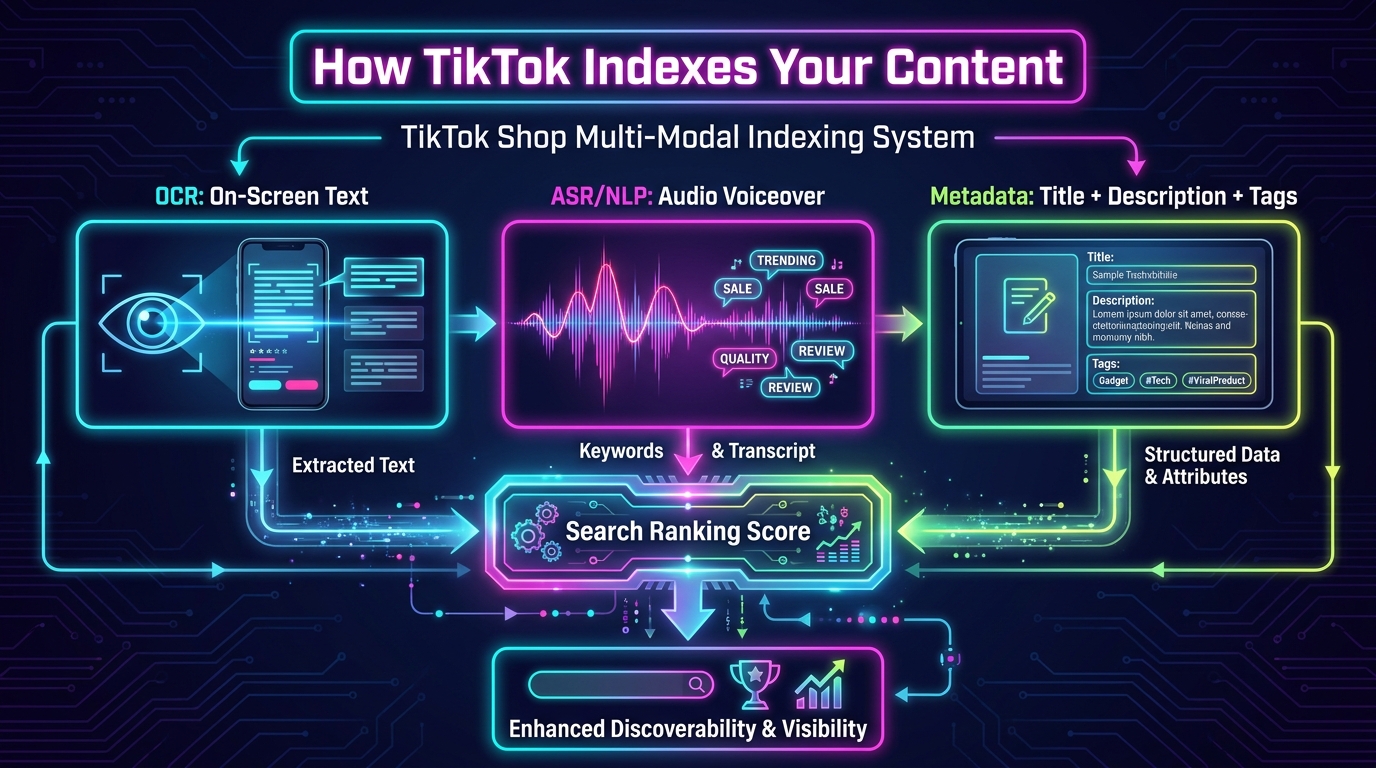
This is where TikTok Shop diverges most dramatically from every other e-commerce SEO framework. On Amazon, the algorithm indexes text: your title, bullet points, description, and backend keywords. On Google Shopping, it indexes your product feed data. TikTok does all of that — and then it also indexes your videos, your audio, and your on-screen visual text.
TikTok’s search algorithm operates a multi-modal indexing system that simultaneously processes three types of signals from every piece of content connected to a product listing.
Channel 1: OCR — Optical Character Recognition
TikTok’s algorithm uses OCR technology to “read” text that appears on screen in your videos. When you add a text overlay to your TikTok video — the bold caption that appears in your first three seconds, the product name you’ve superimposed over a demo clip — TikTok is scanning and indexing those words just as it would index text in a product description.
This creates a powerful but underused SEO surface area. Most sellers think of on-screen text as a viewer experience decision. In reality, it’s also a keyword indexing opportunity. If your primary keyword appears in your on-screen text in the first three seconds of your video, the algorithm registers a strong, immediate relevance signal before a single viewer has finished watching.
The practical implication: every video linked to your TikTok Shop product should begin with a text overlay that includes your primary target keyword. Not a clever headline. Not an emoji. Your actual keyword, stated plainly in high-contrast, readable text.
Channel 2: ASR/NLP — Audio Speech Recognition and Natural Language Processing
TikTok’s algorithm transcribes the spoken audio in your videos and processes that transcript using natural language understanding to determine the semantic topic of your content. This is not a simple keyword match. It is genuine NLP — meaning the algorithm understands context, synonyms, and semantic relationships between terms.
When a creator says “this is my go-to moisturizer for dry, flaky skin in winter,” TikTok’s NLP engine doesn’t just index “moisturizer.” It extracts the intent cluster: dry skin care, winter skincare, hydrating moisturizer, flaky skin treatment. That semantic breadth is what causes a well-spoken video to rank for keyword variants the seller never explicitly targeted.
The reverse is also true: if your voiceover is vague, product-agnostic, or keyword-free, the audio channel contributes almost nothing to your search relevance. “You’re going to love this!” does not help you rank for anything.
Channel 3: Metadata — Titles, Descriptions, Attributes, and Tags
The third channel is the most familiar to anyone with e-commerce experience: the structured metadata attached to your product listing in Seller Center. This includes your product title, description, product attributes, category selection, and any tags. Unlike the video channels, metadata is static, directly editable, and entirely within the seller’s control at the time of listing creation.
TikTok weights the metadata channel heavily for initial indexing — the algorithm makes its first determination of what a product “is” primarily from the title and category before any video engagement data exists. This makes listing metadata the foundation on which all other SEO signals build. Get it wrong and the other channels are fighting uphill.
How the Three Channels Combine
The algorithm aggregates signals from all three channels to produce a relevance score for a given search query. A product with a keyword-optimized title, a video with that keyword spoken in the first five seconds, and an on-screen text overlay that displays that same keyword in the opening frame will generate a strong three-channel alignment signal. That alignment is what separates products that rank on page one from those that drift to page three and below.
Importantly, the three channels are additive, not redundant. Each channel contributes independently to the overall relevance score. Optimizing just one or two of the three leaves ranking potential on the table.
The Product Title Formula: Why Your First 15 Characters Decide Everything
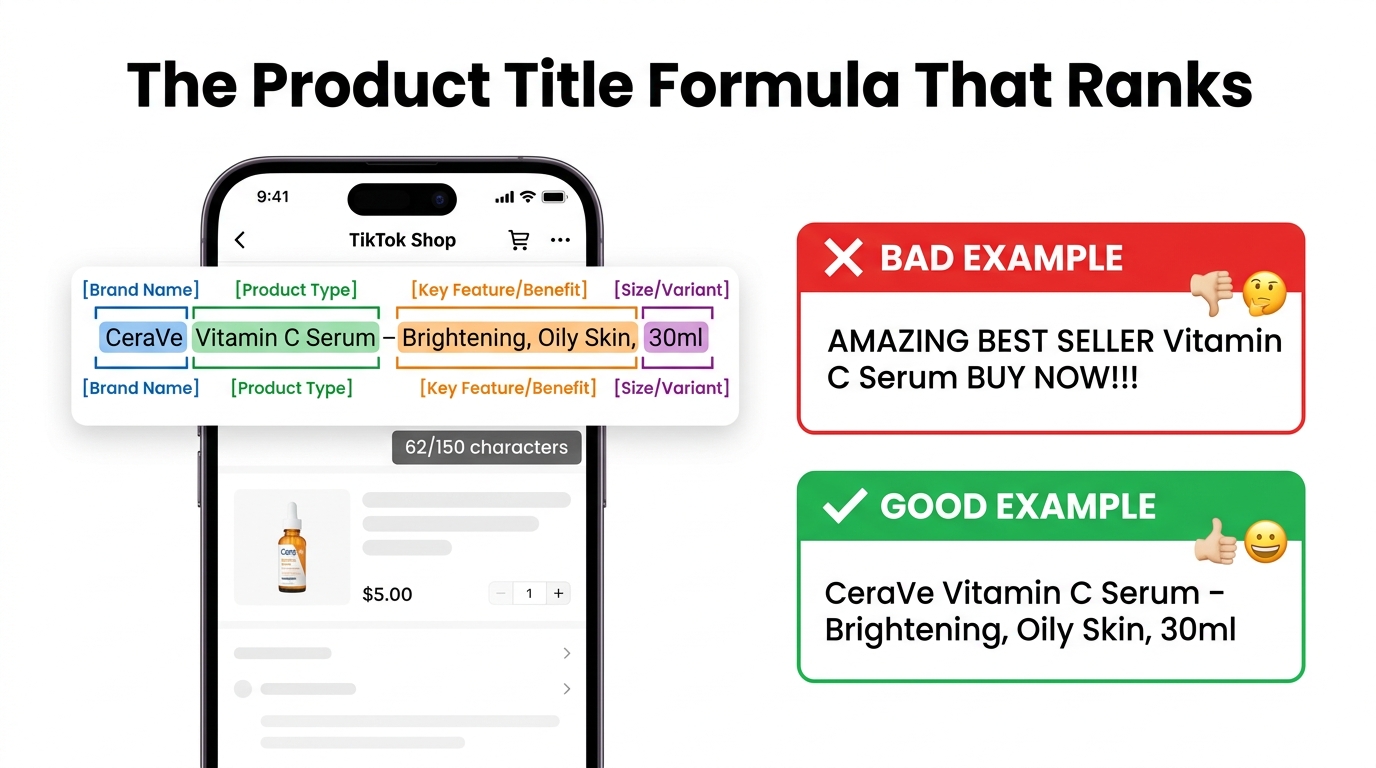
The product title is the single highest-weight metadata field in TikTok Shop’s search ranking system. TikTok’s algorithm applies disproportionate weight to the first three to five words of your title — roughly the first 15 characters — when determining relevance to a search query. This front-loading principle is not cosmetic; it reflects how the algorithm parses titles for exact and partial keyword matches.
The Technical Constraints
TikTok Shop product titles have a character range of 25 to 200 characters, with most optimization guidance pointing to a working sweet spot of 40 to 80 characters for displayed listings. Titles that extend beyond roughly 80 characters are often truncated in search result displays on mobile — the primary browsing context — meaning buyers may never see the latter half of a longer title. The SEO weight of those truncated characters is also lower.
Beyond character limits, TikTok’s content guidelines prohibit several common mistakes that sellers carry over from other platforms: no promotional language (“Best Seller,” “50% OFF,” “Limited Time”), no all-caps words, no emojis, no vague descriptors like “amazing” or “premium,” and no seller contact information in the title field. Listings that violate these rules face suppression in search results — a penalty that is often silent and difficult to diagnose without auditing the listing directly.
The Title Architecture That Works
The formula that consistently outperforms in TikTok Shop search rankings follows a logical hierarchy:
[Primary Keyword / Product Type] + [Key Benefit or Feature] + [Differentiator] + [Size, Volume, or Variant if applicable]
The critical discipline is placing your primary keyword first — not your brand name, not a modifier, not an adjective. The primary keyword should be the exact term a buyer would type into TikTok search to find your product category. For example:
- Weak: “SkinGlow Premium Anti-Aging Formula with Vitamin C – For All Skin Types”
- Strong: “Vitamin C Serum for Dark Spots – SkinGlow Brightening, Oily & Dry Skin, 30ml”
In the strong version, the algorithm immediately identifies “Vitamin C Serum” and “Dark Spots” — the highest-intent search terms — before processing anything else. The brand name moves to a supporting position, where it still contributes to branded search visibility without sacrificing the primary keyword slot.
Long-Tail Keyword Placement in Titles
One advanced tactic that separates sophisticated TikTok Shop sellers from the rest is the deliberate use of long-tail keyword phrases within the title rather than generic category terms. “Moisturizer” is a high-volume term with high competition. “Moisturizer for dry skin overnight repair” is a long-tail phrase with lower competition but much higher buyer intent — the user typing this phrase has a specific problem and a purchase decision already forming.
TikTok’s NLP capabilities mean the algorithm can identify that “overnight repair moisturizer” and “moisturizer for dry skin overnight” are semantically related, giving your listing relevance for multiple related queries from a single well-constructed title. Front-load the most specific, high-intent variant of your target phrase to maximize this semantic coverage.
Description Architecture: The 500-Character Floor and the 4,000-Character Ceiling
Product descriptions are the most underutilized SEO surface area in TikTok Shop. The majority of sellers write a few lines — enough to technically fill the field — without recognizing that TikTok’s algorithm uses description text as a secondary keyword indexing source with genuine NLP processing, not just a place to put product copy for humans to read.
TikTok Shop requires a minimum of 500 characters in the description field for a listing to achieve “Good” quality tier status — a designation that directly influences search ranking eligibility. Descriptions can extend to 4,000 characters. The gap between 500 and 4,000 characters represents a substantial keyword indexing opportunity that most sellers leave empty.
The Structural Framework That Performs
High-converting, high-ranking TikTok Shop descriptions follow a five-part structure that balances keyword density for algorithm indexing with human readability for conversion:
- Hook sentence (first 1-2 lines): State the primary problem your product solves, using the target keyword naturally. This is the most heavily weighted section for NLP indexing. Example: “Struggling with dry, flaky skin that no moisturizer seems to fix? This overnight repair cream was formulated specifically for severely dry skin types.”
- Key Features (3-5 bullet points): Each bullet point should contain at least one semantic variant of your target keywords. Avoid generic features (“high quality,” “great for everyone”) and instead write specificity into each point: ingredients, clinical claims, functional outcomes, compatibility.
- Social Proof or Context: A brief reference to use cases, user demographics, or real results. TikTok’s algorithm weights content that mirrors the language of actual user queries — phrases like “perfect for college students who need a quick skincare routine” signal relevance to a segment of buyers who search in similar natural language.
- Logistics and Trust Signals: Shipping expectations, return policy summary, certifications, or safety information. These reduce post-purchase friction and contribute to the engagement signals (lower return rates, higher review scores) that feed back into the ranking algorithm.
- Call to Action: Brief and direct. “Tap ‘Add to Cart’ and get free shipping on orders over $35.” The CTA should close the description with action-oriented language that reinforces purchase intent.
Keyword Density and Variation
For description SEO, the goal is natural keyword variation — using your primary keyword, related semantic phrases, and long-tail variants throughout the description without repeating the same exact phrase more than two or three times. Exact-match keyword stuffing triggers TikTok’s content quality filters and can actually suppress a listing’s ranking. The platform’s NLP is sophisticated enough to reward semantic breadth over repetitive exact matching.
A practical approach: identify three to five semantically related phrases around your primary keyword and ensure each appears at least once in the description. For a vitamin C serum, this might include: dark spot treatment, uneven skin tone, brightening serum, hyperpigmentation, and skin brightening routine. These variants give the algorithm multiple semantic signals that build a richer relevance profile than a single keyword repeated eight times.
Video SEO: The Rule of 3s
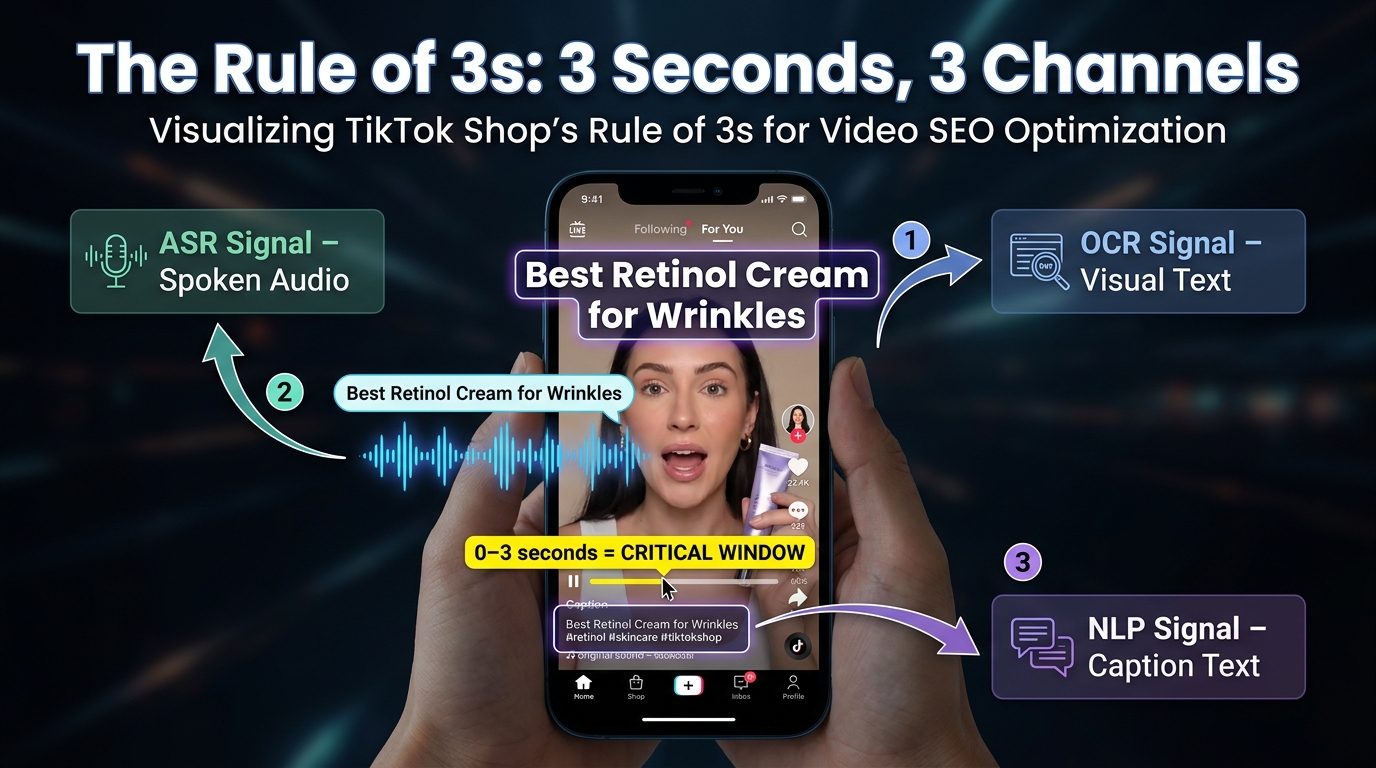
If the product listing is your SEO foundation, video content is the SEO amplifier. Every organic video linked to a TikTok Shop product creates an additional indexing event — a new set of OCR, ASR, and engagement signals that either reinforce or dilute the product’s search ranking. Sellers with one well-optimized listing and ten SEO-optimized videos linked to it are building a compounding relevance signal that a single listing can never achieve alone.
The framework most consistently validated by seller testing in 2026 is the Rule of 3s: optimize across three channels, in the first three seconds, with three keyword types.
The Three Channels in the First Three Seconds
The first three seconds of any video are the highest-weight window for TikTok’s indexing system. This is when the algorithm scans for its initial relevance signals before processing the rest of the content. Three things should happen simultaneously in those three seconds:
On-Screen Text (OCR Channel): Display your primary long-tail keyword as a text overlay immediately. Not a teaser, not a question, not a branded message — your target keyword phrase, in bold, readable type, high contrast against the background. “Best Retinol Cream for Fine Lines” appearing at frame one gives the OCR scanner an unambiguous indexing signal.
Spoken Audio (ASR/NLP Channel): Say your primary keyword in the first spoken words of the video. If the on-screen text says “Best Retinol Cream for Fine Lines,” the voiceover should begin with something like: “This retinol cream for fine lines has genuinely changed my skin…” TikTok’s speech recognition transcribes from frame one, and early audio keyword placement correlates with stronger relevance scoring.
Caption (Metadata Channel): Begin the video caption with your target keyword within the first ten words. The caption is processed as metadata, not as audio or visual content, and carries independent NLP weight. A caption that begins “Retinol cream for fine lines review — I tested this for 30 days…” establishes keyword relevance in the metadata layer before a single view is counted.
The Three Keyword Types
Not all keywords carry the same SEO value in TikTok Shop video content. The most effective video SEO strategy uses three types of keywords in combination:
- Primary Exact-Match Keywords: Your core product category term with specific modifiers. This is the phrase you are explicitly targeting for search ranking and should appear in all three channels in the first three seconds.
- Long-Tail Intent Keywords: Problem-solution phrases that mirror how buyers actually search. “Retinol cream for beginners with sensitive skin” is a long-tail intent keyword that captures a specific buyer segment. Use these in the body of your video voiceover and caption — the NLP engine will associate them with your primary keyword cluster.
- Buyer Signal Keywords: Words and phrases that indicate purchase readiness — “review,” “before and after,” “does it work,” “worth it,” “best for [problem].” TikTok’s search algorithm applies higher commercial intent weighting to content containing these signals because they correlate with purchase-stage user behavior.
Video Length and Format Considerations
For TikTok Shop SEO specifically — as opposed to general TikTok virality — the optimal video length in 2026 is 60 to 90 seconds. This length is long enough to include meaningful keyword repetition across the voiceover and on-screen text without triggering drop-off penalties, but short enough to maintain the completion rate signals that feed back into the algorithm’s engagement scoring.
Videos shorter than 30 seconds carry lower keyword density by nature, and ultra-short clips rarely achieve the semantic richness that NLP processing rewards. Videos longer than 90 seconds, unless they maintain very high completion rates, often generate watch time patterns that signal lower relevance to the algorithm’s engagement filters.
Keyword Research for TikTok Shop: Tools, Intent, and Long-Tail Strategy
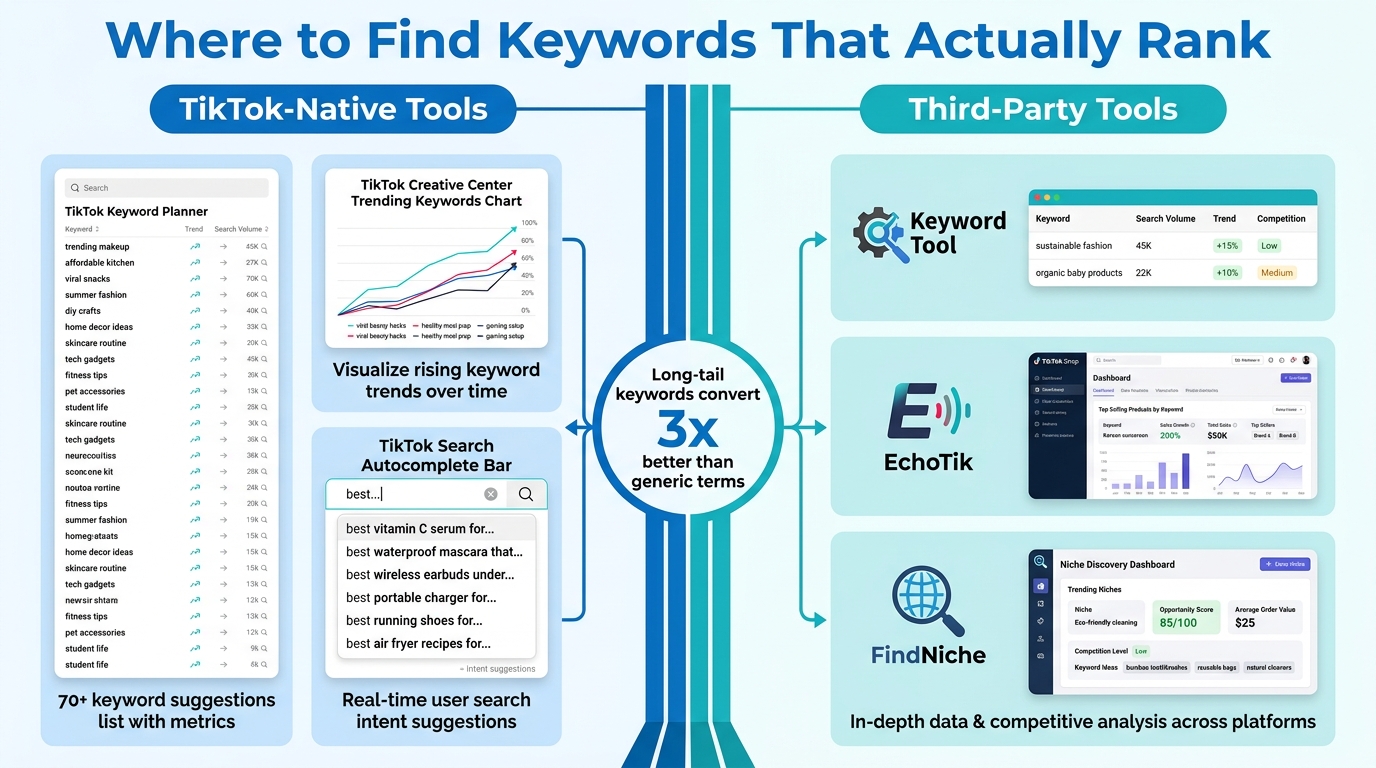
The most consequential mistake in TikTok Shop SEO is importing keyword strategy from another platform. The keywords that drive volume on Amazon are not necessarily the keywords buyers use when searching on TikTok. The language register is different. The intent signals are different. The demographic and cultural context embedded in high-performing TikTok search queries reflects the platform’s specific user base — predominantly 18-34, trend-aware, video-native, and highly responsive to problem-solution framing.
TikTok’s Own Keyword Tools
The most reliable source of keyword data for TikTok Shop SEO is TikTok’s own native tooling, which has expanded significantly in 2026.
TikTok Keyword Planner: Accessible via a free TikTok Ads account under Tools > Search Center, the Keyword Planner is TikTok’s most direct window into actual search volume and competition data. Enter a seed term and receive 70 or more keyword suggestions with relative volume indicators and competition scores. The 2026 version represents a major upgrade from earlier iterations that returned only three keyword suggestions. For TikTok Shop SEO, this is your primary research starting point.
TikTok Creative Center: The Creative Center (ads.tiktok.com/business/creativecenter) shows trending keywords, top-performing searches by region and category, and content patterns correlated with high engagement. For product keyword research, the trending search data is particularly valuable — it reveals which search terms are gaining momentum before they become saturated, giving early-optimizing sellers a relevance advantage.
TikTok Search Autocomplete: The most underrated keyword research tool is TikTok’s own search bar. Type your primary product category term and observe the autocomplete suggestions — these are TikTok’s direct readout of what real users are actually searching for right now. These autocomplete terms are gold for long-tail keyword research because they represent actual buyer language, not keyword planner estimates.
Third-Party Research Tools
Several third-party tools have built TikTok-specific keyword and product research capabilities worth incorporating into a more thorough research process:
- Keyword Tool.io: Generates TikTok search suggestions using autocomplete data, organized by volume tier. Particularly useful for building comprehensive long-tail keyword lists from a single seed term.
- EchoTik: Provides product and shop analytics including what search terms are driving visibility for competing products in a given category. Useful for competitive keyword gap analysis — finding the terms competitors are ranking for that you have not yet targeted.
- FindNiche: Focuses on product trend identification but includes keyword data that surfaces high-velocity search terms before they appear in TikTok’s own tools.
Intent-Driven Keyword Classification
For TikTok Shop SEO, it helps to classify target keywords by intent stage rather than just volume:
Awareness keywords (e.g., “best skincare for beginners”) reach users in early research mode. They generate visibility but lower immediate conversion. These belong in video content and descriptions but not necessarily in primary title positions.
Consideration keywords (e.g., “vitamin C serum vs niacinamide”) reach users actively comparing options. High value for video content that positions your product in comparison context.
Purchase keywords (e.g., “vitamin C serum for dark spots buy,” “affordable retinol cream that works”) signal immediate buying intent. These should be front-loaded in titles and first-three-seconds video content. They drive the conversion rates that feed back into TikTok’s ranking signals.
A complete TikTok Shop keyword strategy uses all three categories — purchase keywords in title and video hooks, consideration keywords in descriptions and mid-video content, awareness keywords in hashtags and caption text to build topical authority over time.
Shop Health Scoring: The Hidden Gate on Your Search Rankings
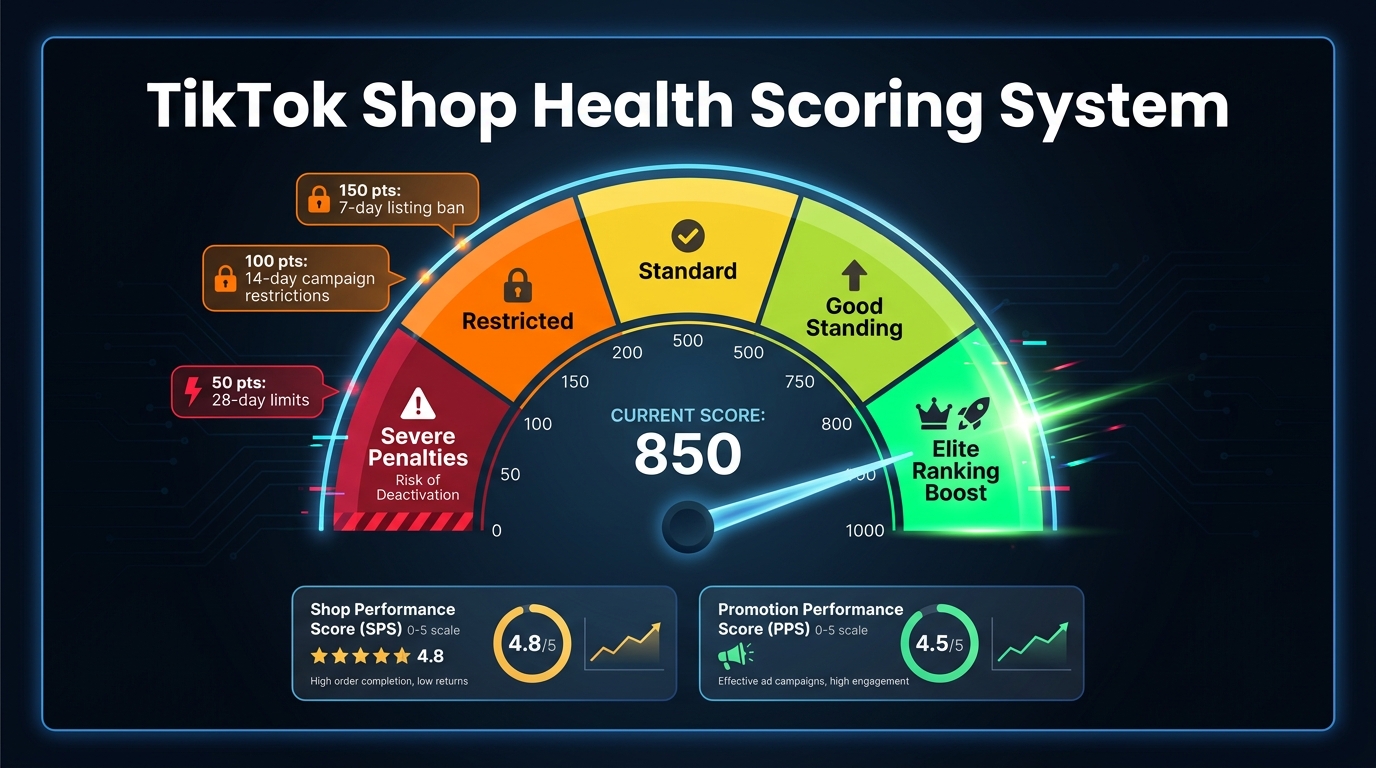
Here is a dimension of TikTok Shop SEO that almost no content about the platform covers in technical depth: your search rankings are not just a function of keyword relevance and engagement metrics. They are gated — actively controlled — by your shop’s health scoring system. A listing can be perfectly optimized for keywords and video SEO and still rank poorly if the shop it lives in is flagged with a low health score.
In 2026, TikTok Shop operates a suite of interconnected health scores that assess seller trustworthiness, compliance, and operational quality. These scores function as ranking multipliers — they can boost visibility for high-performing shops or suppress it entirely for shops that fall below threshold levels.
Account Health Rating (AHR)
The Account Health Rating is TikTok Shop’s primary seller compliance score, operating on a 0 to 1,000 point scale. All sellers start at a neutral baseline, and the score moves based on policy compliance, violation history, and operational behavior. TikTok began previewing a redesigned AHR system in May 2026, with full rollout expected to replace the older Violation Points system by July 2026.
The penalty thresholds that directly affect search rankings and listing operations are:
- 150 points: 7-day ban on creating new product listings
- 100 points: 14-day restrictions on campaign creation and listing management
- 50 points: 28-day limits on promotional tool access and advertising
- 0 points: Permanent e-commerce capability suspension (subject to appeal)
At any of these threshold levels, existing listings experience organic reach reduction — TikTok’s algorithm deprioritizes products from lower-health accounts in search results. The SEO work you’ve done on your listings becomes largely irrelevant if the AHR is suppressing your overall shop visibility.
Shop Performance Score (SPS)
The Shop Performance Score operates on a 0 to 5 scale and measures operational quality: fulfillment speed, cancellation rates, return rates, and customer complaint resolution. An SPS below 2.5 blocks access to Flash Deals and paid advertising. An SPS below 3.5 restricts affiliate program access. Both of these are significant because advertising and affiliate content generate engagement signals that feed back into organic search ranking.
In practical terms: a seller with good keyword optimization but a 2.2 SPS is losing on two fronts. Their listings rank lower organically due to the shop quality penalty, and they cannot use advertising or affiliate programs to build the engagement signals that would have boosted organic rankings anyway. The SPS creates a compounding disadvantage that keyword work alone cannot overcome.
Operational Metrics That Drive Score Changes
The specific operational behaviors that move these scores — both up and down — are:
Return rate — TikTok Shop’s algorithm is particularly sensitive to return rates because returns signal product misrepresentation. Listings with misleading titles or descriptions that generate buyer disappointment will accumulate returns, which drops the SPS and triggers a listing quality review. Target: below 5% return rate. Optimized shops run below 3%.
Cancellation rate — Orders cancelled due to stock-out or fulfillment failure are among the fastest ways to drop health scores. A single stock-out event generates a 14-day organic reach reduction penalty for the affected listing, independent of keyword optimization quality.
Review score — A product rating of 4.5 stars or higher correlates with top-tier search ranking performance. Below 4.0, listings begin to lose visibility as the algorithm treats lower ratings as a conversion risk signal. Actively managing review quality — follow-up messaging, prompt dispute resolution, accurate listing content that sets correct expectations — is SEO work as much as it is customer service work.
Prioritizing Health Scores in Your SEO Workflow
The practical implication of TikTok Shop’s health scoring architecture is that SEO optimization must be preceded by a shop health audit. Before investing time in keyword research and video content optimization, check your current AHR and SPS in Seller Center. If either score is below the thresholds that limit your advertising or affiliate access, address those issues first. Keyword optimization built on a compromised health foundation produces minimal results.
Affiliate Content as a Compound SEO Signal
One of the most structurally underappreciated SEO mechanisms in TikTok Shop is the contribution of affiliate creator content to product search rankings. When an affiliate creator posts a video featuring your product with a linked Shop tag, that video enters TikTok’s indexing system as a new content event for your listing — contributing OCR, ASR, and engagement signals that accumulate on top of your own content.
The SEO implications are significant. A brand with 20 active affiliate creators posting about a single product is generating 20 independent video indexing events, each with potentially different keyword angles, audience segments, and engagement patterns. The algorithm aggregates these signals when determining the overall search relevance and authority of the product listing.
Directing Affiliate Content for SEO Alignment
The challenge with affiliate content is that creators will default to their own content style and language — which may or may not align with your SEO keyword strategy. Left unguided, affiliates might create great-performing videos that use completely different search language than what your listing is optimized for, creating a semantic mismatch that dilutes rather than reinforces your ranking signal.
The solution is providing affiliates with a brief SEO guidance document alongside your standard product brief. This doesn’t mean scripting their content — creators need creative freedom to produce authentic content. It means specifying:
- The one or two primary keywords you want them to use in the first three seconds of on-screen text
- The two or three problem-solution phrases that have shown strong search volume for your product category
- Buyer signal words (“worth it,” “honest review,” “before and after”) that carry high commercial intent weighting in TikTok’s algorithm
Brands running 20 or more affiliate creators with this level of SEO coordination outperform brands relying on unguided affiliate content by 3 to 5 times in revenue, according to seller performance data. The difference is not the number of creators — it’s the keyword coherence of their collective content.
Niche-Fit vs. Volume Affiliate Strategy
From an SEO standpoint, niche-fit creators — those whose audience specifically overlaps with your product’s buyer profile — are more valuable per video than high-follower general creators. Niche-fit creators achieve 8 to 12% conversion rates from linked affiliate content compared to 2 to 4% for broad-audience creators. Higher conversion rates generate stronger engagement signals, which feed back into the product’s organic search ranking. The search algorithm interprets high conversion rates from content as a relevance and quality signal — it infers that users who find this product after watching this type of content tend to buy, which reinforces the listing’s ranking for similar search queries.
Category Selection, Product Attributes, and Hidden Ranking Levers
Several listing elements that sellers treat as administrative formalities are actually active SEO variables in TikTok Shop’s ranking system. Category selection and product attributes in particular carry algorithmic weight that is not obvious from the Seller Center interface.
Category Selection as a Relevance Signal
Category selection determines which search result pools your listing is eligible to appear in. An incorrectly categorized product is effectively invisible to buyers browsing or searching within the correct category — regardless of how well optimized its title and description are. TikTok’s algorithm uses category as a primary filter before keyword matching, meaning a correctly categorized listing with mediocre keyword optimization will outrank a miscategorized listing with perfect keyword optimization for category-scoped search queries.
The common error is defaulting to the broadest available category for fear of over-narrowing reach. In practice, TikTok Shop’s search algorithm rewards precise categorization because it improves the algorithm’s ability to match your listing to specific buyer intent signals. A skincare product listed under the general “Beauty & Personal Care” category will rank lower for specific searches than the same product correctly listed under “Skincare > Face Serums” because TikTok’s category-specific relevance scoring is more granular than most sellers assume.
Product Attributes: The Underused Keyword Field
Product attributes — the structured fields that describe specifications like material, target skin type, age range, ingredient highlights, size, and color — function as a secondary keyword indexing layer that most sellers leave incomplete or filled with generic values.
Each attribute field completed accurately is a semantic data point that TikTok’s search algorithm uses to match listings to filtered searches. When a buyer searches “moisturizer for sensitive skin fragrance-free,” the algorithm checks attribute fields for “skin type: sensitive” and “fragrance: fragrance-free” as part of its relevance scoring. A listing with these attributes correctly filled will rank higher for that specific query than a listing with the same keyword in the title but empty attribute fields.
The practical directive is straightforward: fill out every attribute field available for your product category, using specific, accurate values rather than generic placeholders. For listings in categories with many attribute fields (electronics, beauty, health), this alone can produce meaningful ranking improvements for filter-qualified searches.
Product Images as Engagement Rate Signals
While product images are not directly indexed by TikTok’s text-based SEO systems, they are a conversion rate driver — and conversion rate is a first-order ranking signal. Listings with higher click-through rates from search results and higher add-to-cart rates from listing pages receive algorithmic ranking boosts as positive engagement signals.
TikTok Shop research consistently shows that main product images against white or plain backgrounds with clear product visibility outperform lifestyle images as the primary listing thumbnail in search results. This is counterintuitive for sellers with backgrounds in social commerce, where lifestyle imagery typically wins — but in TikTok Shop’s search results specifically, product clarity and immediate recognizability drive higher click-through rates, which feed into the SEO feedback loop.
Tracking, Testing, and Iterating: How to Actually Measure TikTok Shop SEO
SEO without measurement is wishful thinking. TikTok Shop’s Seller Center provides enough data to support meaningful SEO testing and iteration — but sellers need to know which metrics to track, how to structure tests, and how to interpret the signals the platform provides.
The Core SEO Metrics Dashboard
Within TikTok Shop Seller Center’s analytics, the metrics that directly reflect SEO performance are:
Organic impressions: The number of times your listing has appeared in organic search results without paid promotion. Rising organic impressions indicate improving search ranking. Flat or declining impressions despite keyword optimization activity often indicate a shop health score issue suppressing visibility.
Search click-through rate: The percentage of search result impressions that resulted in a click to the listing page. A low CTR with high impressions indicates that your listing’s title and main image are not compelling relative to competing listings at similar rank positions — a conversion optimization problem that compounds into an SEO problem because low CTR signals to the algorithm that buyers prefer other listings.
Product conversion rate (CVR): Purchases divided by listing page visits. TikTok Shop’s platform average sits at 2 to 5%, with well-optimized shops achieving 5 to 8%. CVR is the most powerful SEO feedback signal because TikTok’s algorithm heavily weights conversion behavior when determining ranking. A listing that converts at 7% will rank above a listing that converts at 2% for the same keyword, even if the lower-converting listing has stronger keyword optimization on paper.
Return and refund rate: As discussed in the shop health section, return rates directly affect health scores and therefore organic ranking. Track this at the listing level, not just the shop level — a single product with an unusually high return rate is a ranking liability.
A/B Testing Methodology for TikTok Shop
Unlike platforms with formal split-testing tools, TikTok Shop SEO testing requires a disciplined manual approach. The cleanest testing structure:
- Change one variable at a time. Test your product title in isolation before changing the description, or vice versa. Multiple simultaneous changes make it impossible to attribute performance shifts to a specific optimization.
- Allow 14-day observation windows. TikTok’s search ranking algorithm takes time to re-index and re-score listings after changes. Evaluating title changes after 48 hours produces noise, not signal. Two weeks of stable posting volume is the minimum viable observation period.
- Use consistent posting volume during test periods. Video posting frequency is an independent ranking variable. If you change your title and simultaneously increase your posting frequency from two to five videos per week, any ranking improvement is attributable to either variable — or both. Control posting volume during active tests.
- Document baseline metrics before any change. Screenshot or export your current organic impressions, CTR, and CVR before making an optimization change. Without a documented baseline, there is no meaningful before/after comparison.
Using Video Performance Data for SEO Feedback
The engagement metrics on individual videos linked to your Shop products provide direct feedback on which keyword angles, content formats, and viewer experiences are producing the strongest SEO signals. Sort your linked video library by watch-time completion rate and search-driven click-through. Videos with above-average performance on both metrics are demonstrating keyword-content alignment that TikTok’s algorithm is rewarding — these are your templates. Analyze what keywords appear in the first three seconds of your best-performing linked videos and ensure those keywords are replicated in future content and listing optimization.
Videos with high view counts but low product click-through rates reveal a different problem: the content is entertaining but not commercially aligned. It is attracting an audience that isn’t in a buying mindset for your product. These videos may be good for brand awareness but are not building the search-ranking signals that matter for TikTok Shop SEO. The ratio of product clicks to video views — not raw view count — is the metric that matters for search ranking purposes.
Putting It Together: A Practical TikTok Shop SEO Audit Framework
The architecture described across this post can feel overwhelming when applied to an active shop with dozens of listings, ongoing video production, and affiliate relationships to manage. What follows is a prioritized audit framework — a structured approach to assessing and improving TikTok Shop SEO that works through the most impactful variables first.
Step 1: Health Score Audit (Do This First)
Before touching a single keyword, open Seller Center and check your Account Health Rating and Shop Performance Score. If your AHR is below 200 or your SPS is below 3.5, fix those issues before investing in keyword optimization. The health scores gate everything else. Audit your recent violation history, identify the specific behaviors driving score degradation (return rates, cancellation rates, policy flags), and address them operationally.
Step 2: Title Audit
Review your top 10 products by organic impressions. For each one, identify whether the first three to five words contain the primary buyer-intent keyword for that product. If not, revise. Check for prohibited elements: promotional language, all-caps, emojis, vague descriptors. Confirm character count falls between 40 and 80 characters for optimal display and keyword density.
Step 3: Description Audit
Check that every active listing has a description of at least 500 characters (to meet the Good tier quality threshold). For priority listings, expand descriptions to 1,000 to 2,000 characters using the five-part structure outlined above. Ensure your primary keyword and at least three semantic variants appear naturally in the description body.
Step 4: Category and Attribute Audit
Verify that each listing is in the most specific sub-category available rather than the broadest category. Complete all product attribute fields, using specific values. For listings with incomplete or generic attribute data, prioritize the fields most likely to be used in filtered searches by your target buyer.
Step 5: Video Content Audit
Review the last 10 videos linked to your top product. For each video, check: Does your primary keyword appear as on-screen text in the first three seconds? Is it spoken within the first five seconds? Does the caption begin with the keyword in the first ten words? Videos that fail any of these three checks should either be re-edited or replaced with new content that meets the Rule of 3s criteria.
Step 6: Affiliate Brief Update
If you have active affiliates, update their product briefs with specific keyword guidance for the top two or three search terms you want associated with each product. Make this guidance clear and simple — a single “please mention [keyword phrase] in your first few seconds of video” instruction is sufficient and will not compromise creator authenticity.
Step 7: Measurement Setup
Document your current organic impressions, CTR, CVR, and return rate for each priority listing before making any changes. Establish a 14-day baseline tracking cadence and commit to changing only one variable per listing per testing cycle.
Conclusion: SEO Is Not a Hack — It’s the Infrastructure
The sellers who will build durable, defensible positions in TikTok Shop’s search results over the next two to three years are not the ones chasing algorithm updates or looking for shortcut tactics. They are the ones who understand the underlying architecture — the three-channel indexing system, the health score gating mechanisms, the intent hierarchy of keyword types — and build systematic optimization practices on top of it.
TikTok Shop SEO is still early enough that basic technical competence produces dramatically outsize results. Moving a product from page three to page one in a competitive category requires less sophisticated work on TikTok than the equivalent move would require on Amazon, Google Shopping, or even Etsy — because most of your competition hasn’t thought through what you’ve just read.
The multi-modal indexing system reads your videos, listens to your audio, and processes your metadata simultaneously. The health scoring system gates your visibility based on operational trustworthiness. The keyword intent hierarchy determines which search queries you can realistically rank for and which ones are noise. Together, these systems form the actual mechanics of TikTok Shop SEO — and the sellers who know them have a compounding structural advantage over those who don’t.
Start with the audit framework. Fix the health score first. Rebuild your titles with purchase-intent keywords in the leading position. Rewrite your descriptions with semantic keyword variation and proper structure. Then — and only then — build the video content layer that will amplify the listing foundation you’ve created. Apply the Rule of 3s to every video linked to your Shop products going forward, and guide your affiliates to do the same.
TikTok Shop’s search results reward the disciplined more than the talented. That’s a fair game — and now you know the rules.