


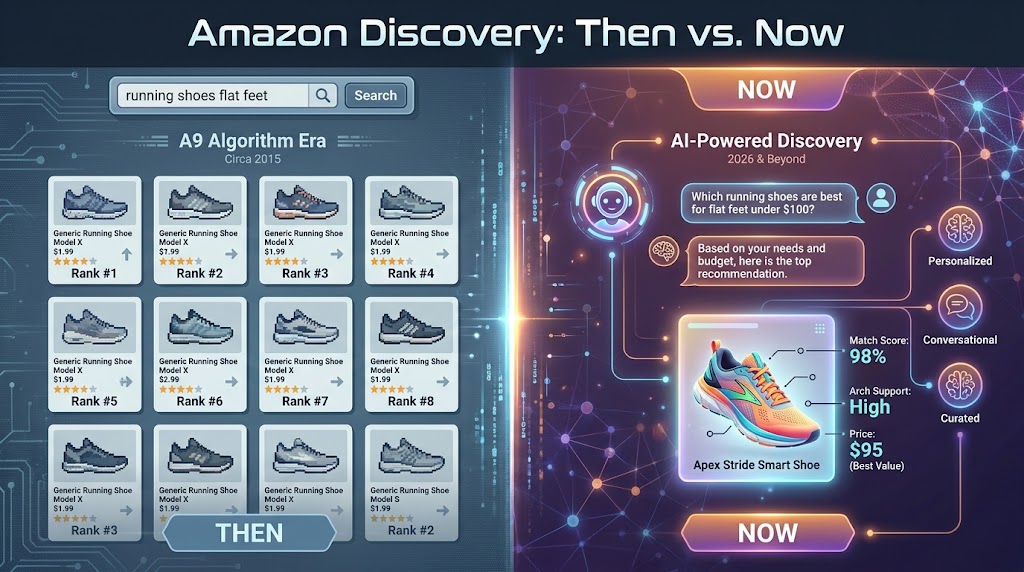

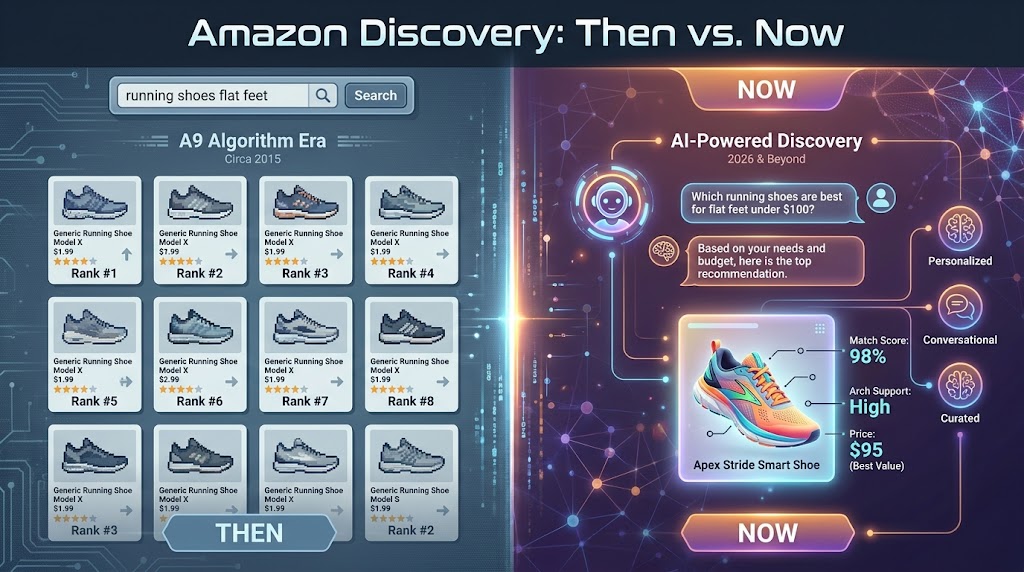
Ask most Amazon sellers how their products get found, and you’ll hear a variation of the same answer: keywords, PPC, and rank. And for a long time, that answer was essentially correct. The A9 algorithm rewarded sellers who packed their titles with the right search terms, bid aggressively on sponsored placements, and climbed the page-one ladder through sheer sales velocity. That model worked. Many sellers built real businesses on it.
But Amazon’s discovery engine has shifted — quietly, incrementally, and with enormous consequences for anyone still operating on 2022 assumptions. In 2026, a product doesn’t just get found through a keyword match. It gets evaluated, compared, and recommended by an AI assistant. It surfaces through a voice query that sounds like a sentence, not a search term. It earns trust through behavioral signals that keyword density can’t manufacture.
This post is about that shift. Not fees, not margins, not business model comparisons — those conversations have been had. This is about the fundamental mechanics of how Amazon now connects buyers to products, what that means for sellers at every stage of the journey, and how to build an operation that doesn’t just survive the algorithm but is genuinely built around it. Whether you’re launching your first ASIN or managing a catalogue of fifty SKUs, understanding the new discovery stack isn’t optional anymore. It’s the job.
The Algorithm Isn’t What It Was
For most of Amazon’s seller-facing history, ranking was a relatively legible system. Sales velocity, conversion rate, keywords in the listing, PPC spend — these inputs produced a rank, and rank determined visibility, and visibility determined revenue. It was a flywheel sellers could understand and, to a significant degree, control.
The A9 algorithm still exists. Sales velocity still matters. But layered on top of it — and in some contexts, operating independently from it — are discovery mechanisms that work on entirely different logic. Rufus, Amazon’s generative AI shopping assistant, now mediates an estimated 15–20% of all mobile shopping queries as of Q1 2026, and that figure is climbing quarter by quarter. Voice search accounts for roughly 28% of total Amazon queries. Together, these two channels represent nearly half of the mobile discovery environment.
Why This Changes Everything for Sellers
Here’s the critical detail: Rufus recommendations have only a 22% overlap with traditional first-page search results. That means a product ranking #1 for a given keyword may not even appear in the Rufus recommendation set for a related conversational query. Two completely different algorithmic logics are operating in parallel, and most sellers are only optimizing for one of them.
The practical implication is significant. A seller who has diligently optimized their listing for keyword density may be invisible to the 15–20% of shoppers using Rufus — and those shoppers are converting at 3.5x the rate of non-Rufus sessions. Rufus-assisted purchases drove 66% of Black Friday 2025 purchases despite representing only 40% of sessions. These aren’t casual browsers. They’re buyers.
The shift also changes what “listing optimization” means. Rufus synthesizes information from your entire product page — title, bullets, description, A+ content, customer reviews, answered Q&As, and backend attributes — and uses that holistic picture to answer a shopper’s specific question. A listing optimized purely for keyword insertion may score well on traditional search but fail the Rufus evaluation because it lacks the contextual, conversational depth that the AI needs to confidently recommend the product.
The Voice Search Dimension
Voice queries on Amazon are structurally different from typed searches. They average 2.4 times longer and follow natural language patterns rather than fragmented keyword strings. Instead of “dog supplement joint,” a voice searcher says “what’s the best joint supplement for older large-breed dogs?” That query carries intent, specificity, and context that keyword-matched listings may not answer — and voice-optimized listings show conversion rates 28% higher than standard text-optimized ones.
The combined effect of Rufus and voice search is a marketplace where product discovery is increasingly driven by intent interpretation rather than keyword matching. Sellers who adapt their thinking accordingly are positioning themselves for visibility gains that their competitors aren’t even aware they’re missing.
The Three-Layer Discovery Stack
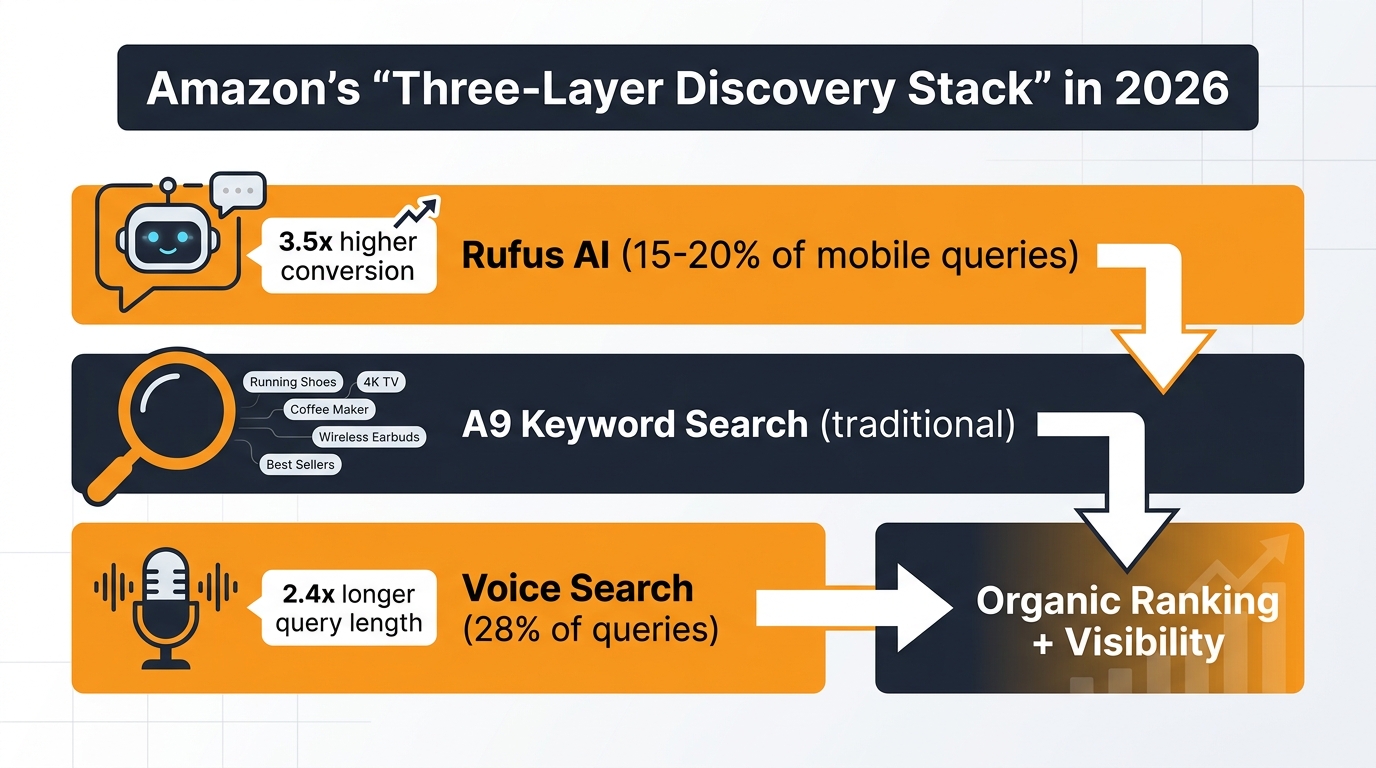
Understanding Amazon’s current discovery architecture means understanding three distinct layers — each with its own logic, its own audience, and its own requirements for seller optimization. Treating them as one unified system is one of the most common strategic errors in 2026.
Layer One: Traditional A9 Keyword Search
The A9 algorithm remains the backbone of Amazon’s search infrastructure. It processes typed keyword queries and ranks results based on relevance signals (keyword match, listing completeness, category alignment) and performance signals (sales velocity, conversion rate, click-through rate, PPC performance). This layer still drives the majority of Amazon search traffic and is the most mature optimization battleground.
What’s changed within A9 is the increasing weight given to engagement quality signals over pure keyword density. Listings that generate strong click-through rates from search results, that convert visitors into buyers at above-average rates, and that accumulate positive behavioral signals (time on listing, add-to-cart events, low return rates) are favored over listings that simply contain the right words. The algorithm has become harder to game with technical tactics alone.
Layer Two: Rufus AI
Rufus operates more like a research assistant than a search engine. When a shopper asks “what’s a good gift for someone who does hot yoga?” or “which protein powder is easiest to digest for lactose intolerance?”, Rufus doesn’t return a list of keyword-matched products. It synthesizes your product’s entire data ecosystem — listing content, customer reviews, Q&A responses, A+ content, size/material/compatibility attributes — and generates a recommendation narrative.
This means that products with thin listing content but good keyword coverage can score well on A9 while being essentially invisible to Rufus. Conversely, products with rich, question-answering content — even if they rank lower on traditional keyword searches — may appear prominently in Rufus recommendations for high-intent conversational queries. The conversion advantage of Rufus-mediated sessions (8–14% CVR versus the Amazon average of 9.5–10%) makes this a visibility channel worth specifically optimizing for.
Layer Three: Voice Search
Voice search occupies an interesting middle ground. Like Rufus, it uses natural language queries. Unlike Rufus, it typically returns a smaller, more decisive set of results — often just one recommendation. This winner-takes-all dynamic makes voice search optimization both high-stakes and high-reward. A product that earns the voice recommendation for a popular query receives traffic with no competition at the point of delivery.
Optimizing for voice means thinking about how your ideal customer would describe their problem out loud, then ensuring your listing contains the language and context that would make your product the natural answer. Long-tail keyword phrases that mirror conversational question structures — particularly those in the 5–8 word range — are the currency of voice search performance.
Product Research Has a New First Step

Traditional Amazon product research started on Amazon. You opened Helium 10, ran a search, sorted by sales volume, checked competition density, and looked for gaps. That process still has value. But in 2026, the most sophisticated sellers begin their product research off-platform — specifically on social media — and use Amazon data to validate rather than to discover.
Step One: Social Signal Detection
TikTok has become one of the most reliable leading indicators of Amazon demand. Products that gain organic traction on TikTok — demonstrated through views, saves, and purchase intent comments — frequently translate into surging Amazon search volume within weeks. The sell-out pattern of “TikTok made me buy it” products is well-documented, but the strategic application goes beyond chasing viral moments.
Sophisticated sellers monitor TikTok not for what’s already viral but for what’s gaining traction in smaller, niche communities before it breaks through to mass awareness. A product appearing repeatedly in specialized hashtags — #petcare, #sleephacks, #kitchengadgets — with genuine engagement signals (saves more than likes, comments expressing purchase intent) represents an early demand signal. The question isn’t “is this trending?” but “is this the kind of thing that will trend on Amazon in six weeks?”
This approach allows sellers to get into a category before competition density peaks on Amazon. By the time a product achieves bestseller status and five competitors have launched near-identical versions, the opportunity window for a new entrant is substantially narrower than it was during the early demand phase.
Step Two: Amazon Demand Validation
Social signals tell you that demand exists. Amazon’s own data tells you whether that demand has migrated to the marketplace and how strong it is. Amazon’s Search Query Performance (SQP) report — available to registered brand owners — shows you actual search volume, impression share, and conversion data for your target keywords. Brand Analytics provides market basket analysis, demographic data, and purchase behaviour patterns at a category level.
The validation test is straightforward: does Amazon search volume for queries related to this product show upward momentum? Is the search-to-purchase conversion rate strong (indicating the category converts, not just browsed)? Is the review gap between existing listings and a potential new entrant bridgeable within a reasonable timeline? If the social signal is real but Amazon volume hasn’t followed yet, you’re potentially early. If Amazon volume is rising alongside social traction, the window is open but closing.
Step Three: Risk-Adjusted Margin Assessment
The final filter before committing to a product is a rigorous, unromantic assessment of margin potential. The threshold most experienced sellers cite for private label viability in 2026 is a post-FBA, post-PPC margin of at least 20%, with a landed COGS that leaves room to absorb the 3.5% fuel surcharge, rising storage fees, and PPC costs that routinely run 25–35% of revenue during launch phases. Products that barely hit 20% at zero ad spend rarely survive the economics of a real launch.
AI-powered margin calculators have made this step faster and more accurate. Tools that integrate FBA fee estimators with real-time COGS inputs, historical PPC benchmarks by category, and shipping cost projections give sellers a defensible pre-investment read on whether a product can work before a dollar is spent on samples or inventory.
Choosing Your Selling Model: A Decision Framework Beyond the Hype
The debate between private label, wholesale, and retail/online arbitrage generates enormous amounts of content, most of it framed as a competition with a clear winner. The reality is less interesting and more useful: each model suits a specific combination of capital availability, risk tolerance, and time horizon. The right model isn’t the most hyped one — it’s the one that matches your actual situation.
Private Label: High Ceiling, Long Runway
Private label offers the highest margin potential (25–40%) and the most defensible long-term position. A well-built private label brand with strong reviews, registered trademark, Brand Registry access, and a recognizable identity is harder to copy than a wholesale listing and represents genuine business equity that can be sold. The exit multiples for well-established private label brands on Amazon remain attractive.
The trade-off is investment size and timeline. A credible private label launch requires upfront investment in inventory, product development, packaging, photography, A+ content, and PPC — often in the $5,000–$15,000+ range per SKU. The path to profitability is measured in months, not weeks. During the launch phase, before organic rank is established, ad spend will consume a large share of revenue. Sellers who don’t have the capital to sustain 60–90 days of above-break-even ad spend while building velocity frequently abandon products before they have a fair chance to succeed.
Wholesale: Lower Risk, Faster Proof
Wholesale — buying established brand inventory in bulk and selling on Amazon — offers lower margins (10–20%) but substantially lower risk. The demand is already proven. The brand recognition already exists. Your job is to win or share the Buy Box and fulfil at a competitive cost structure. For sellers who are earlier in their Amazon journey, wholesale provides faster cash flow feedback and a lower penalty for errors while skills are being developed.
The ceiling for wholesale is lower, however. You’re operating on someone else’s brand equity, competing with other wholesale sellers (and often the brand itself) for the same Buy Box, and your margin is always subject to the brand’s pricing policy. Wholesale portfolios scale through breadth — many SKUs at modest margin each — rather than depth, which creates its own operational complexity.
Arbitrage: Entry Point, Not Destination
Retail and online arbitrage — buying discounted products from retail or other online sources and reselling on Amazon — generates quick ROI (10–30%) but is difficult to scale and operationally intensive. It requires constant sourcing effort, and profitable opportunities erode quickly as other sellers identify the same sources. Arbitrage can be a legitimate entry point for building Amazon operational knowledge and generating early revenue, but most sellers who treat it as a long-term destination find themselves on a treadmill: always sourcing, rarely building.
The Hybrid Approach
In practice, many successful sellers blend elements of multiple models. A wholesale operation that generates cash flow funds a private label development pipeline. A private label seller uses online arbitrage during inventory gaps to maintain selling velocity and account health. The models aren’t mutually exclusive, and the sellers who are most resilient are often those who can switch between them based on what the market and their financials dictate at a given moment.
Building a Listing That Wins on Three Fronts
Given the three-layer discovery stack described earlier, listing optimization in 2026 is no longer a single-objective exercise. A listing needs to perform well on A9 (keyword relevance and conversion signals), on Rufus (contextual richness and question-answering depth), and on voice search (natural language specificity). These objectives aren’t in conflict, but they require intentional architecture rather than instinctive keyword stuffing.
Title and Bullets: Serving Multiple Masters
Your product title needs to contain primary keywords for A9 ranking — that hasn’t changed. But the way those keywords are arranged matters more than it used to. A title that reads naturally (“Adjustable Resistance Bands Set for Women — Non-Slip, Home Workout, 5 Resistance Levels”) serves A9’s keyword matching, communicates clearly to a human reader, and contains the kind of contextual phrase structure that voice search recognizes as a relevant match. A title that reads “Resistance Bands Women Workout Home Gym Fitness Set Training Loop” hits keywords but fails readability and voice relevance.
Bullet points are where Rufus does much of its reading. Each bullet should address a specific customer concern or use case in full-sentence, conversational language. Think of each bullet as answering a likely Rufus question: “Is this safe for kids?” “Does this work for people with sensitive skin?” “What size should I choose?” The more specifically your bullets preempt actual customer questions, the more useful your listing becomes to the AI assistant tasked with answering those questions on Amazon’s behalf.
A+ Content and the Q&A Section
A+ content — the enhanced brand content available to registered sellers — is increasingly important not for its visual appeal but for the additional textual and contextual information it contains. Rufus indexes A+ content, and a well-constructed A+ module that addresses comparison questions, use case scenarios, and technical specifications gives the AI significantly more to work with when evaluating whether your product matches a shopper’s intent.
The Q&A section is frequently underestimated. Every question answered on your listing is indexed content that Rufus can draw from when generating recommendations. Sellers who actively answer their own product questions — honestly, helpfully, and in the language their customers actually use — are essentially training the AI on why their product is the right answer for specific problems. This is free optimization that most sellers neglect entirely.
Images and Video: Conversion Signals That Feed the Algorithm
Images don’t directly influence keyword ranking, but they drive conversion rates — and conversion rate is one of the strongest ranking signals the A9 algorithm evaluates. Main images that stop the scroll in search results, infographic images that address common objections, and lifestyle images that help shoppers visualize the product in their own lives all contribute to conversion improvements that compound into ranking improvements. A listing with a 12% conversion rate will outrank an equivalent listing with an 8% conversion rate over time, even if the keyword optimization is identical.
The Product Launch Sequence That Still Works in 2026
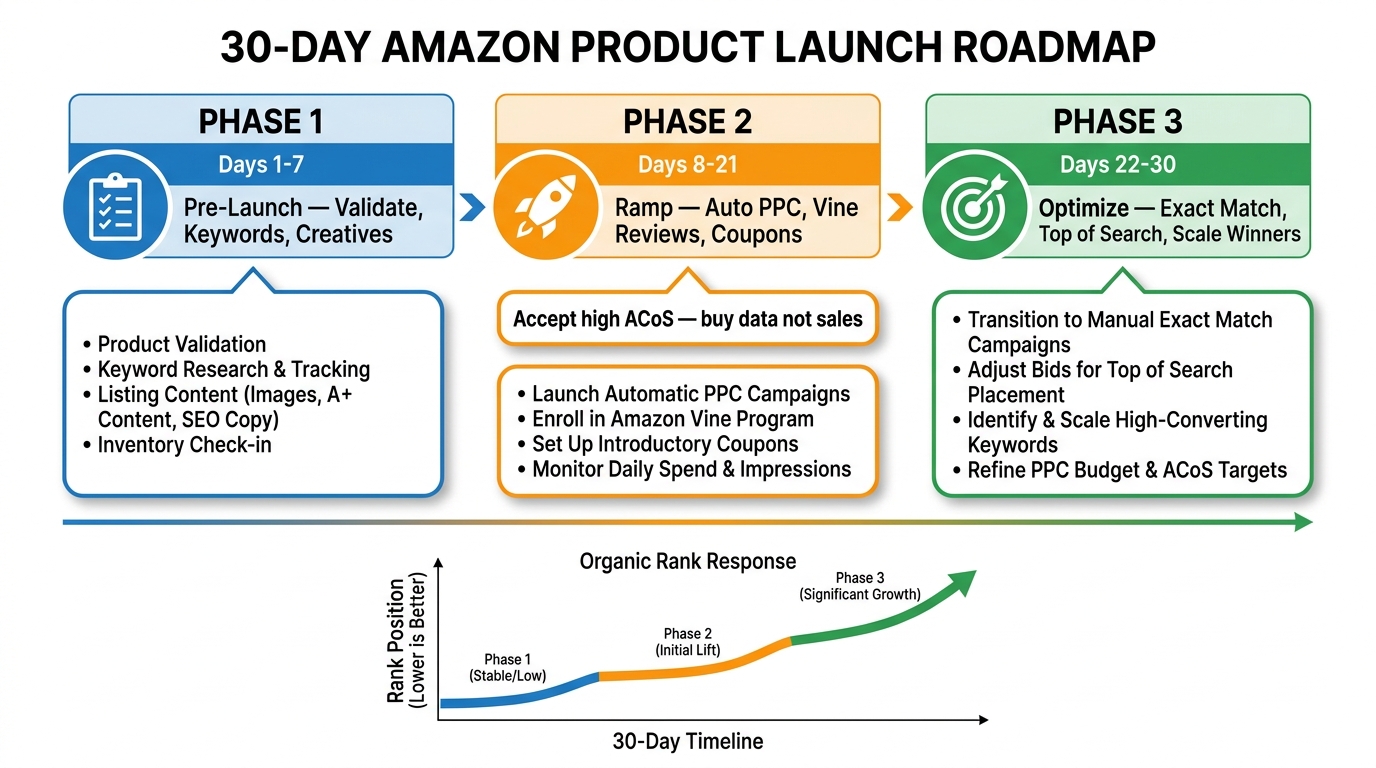
Launching a new ASIN in 2026 follows a recognizable logic — but the nuances of execution matter more than ever as ad costs have risen and the tolerance for imprecise spend has narrowed. The 30–90 day launch window is a real concept: Amazon’s algorithm gives new products an implicit “honeymoon” period where it’s more willing to test your listing’s performance across various placements. Wasting that window is an expensive mistake.
Phase One: Pre-Launch (Days 1–7)
Before your ASIN goes live with any meaningful ad budget, the foundational work must be complete. Listing fully optimized across all three discovery layers. Main image tested for click-through rate in a competitive context (A/B testing tools like PickFU allow this before launch). Keyword map built from both Helium 10 / Amazon data and Rufus-oriented long-tail phrase research. Backend attributes — material, size, compatibility, use case — filled completely.
Many sellers skip or rush this phase, eager to generate sales. This is operationally backwards. Every dollar of PPC spend during the ramp phase is landing on a landing page (your listing), and if that landing page isn’t converting at a strong rate, you’re paying for traffic that doesn’t buy. The conversion rate you establish in the first weeks of a launch becomes the baseline the algorithm uses to evaluate your listing’s fitness. A weak start requires significantly more spend and time to reverse.
Phase Two: The Ramp (Days 8–21)
The ramp phase is where most of your launch budget is deployed. The goal during this phase is sales velocity and data collection — not profitability. Launch auto-targeting and broad-match Sponsored Products campaigns with moderate budgets. Accept high ACoS (advertising cost of sales) during this period; you’re buying data and rank, not margin. Use Brand Tailored Promotions (BTP) and coupons to generate purchase momentum. Enroll in Amazon Vine to begin building authentic reviews from the program’s trusted reviewer pool.
The critical discipline during Phase Two is resisting the urge to optimize prematurely. Many sellers see high ACoS in week two and start turning off campaigns or reducing bids before they have statistically meaningful data. This interrupts the velocity signal Amazon’s algorithm is using to evaluate your listing’s potential. Give campaigns at least two to three weeks before making structural changes.
Phase Three: Optimize (Days 22–30+)
With data in hand, Phase Three shifts from velocity to efficiency. Identify the exact-match keywords that generated the most conversions during the broad-match phase and move them into dedicated exact-match campaigns with top-of-search bid adjustments. Negative-match the irrelevant queries that consumed budget without converting. Analyse which customer segments, device types, and time-of-day patterns show the strongest conversion rates and optimize bids accordingly.
By Day 30, a well-executed launch should have organic rank established for primary keywords, a baseline of Vine reviews, and a PPC structure that is moving toward a sustainable ACoS. The work doesn’t stop here — the next 60 days involve continued bid refinement, keyword expansion, and A+ content optimization — but the foundation for a self-sustaining ASIN is in place.
Buyer Psychology: Why Problem-Solving Authority Beats Brand Loyalty
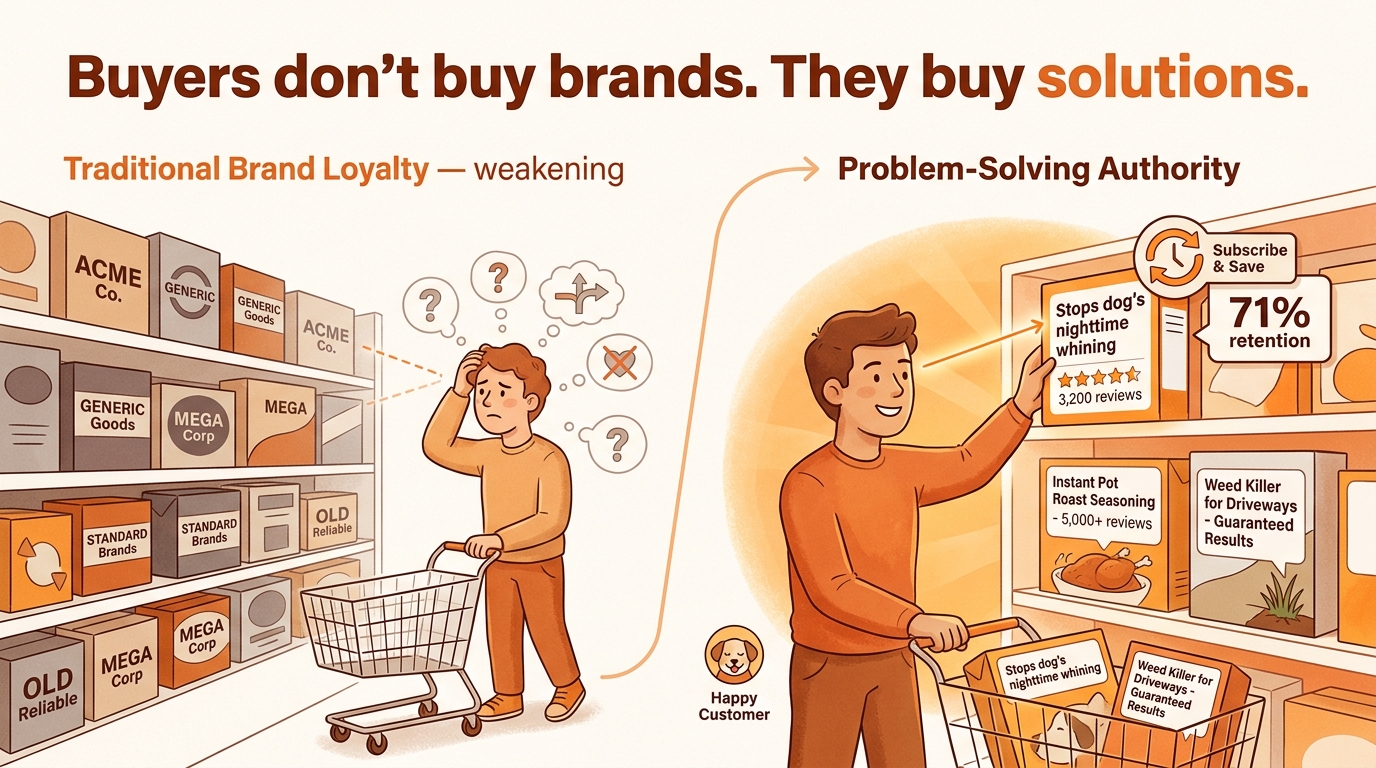
One of the most counter-intuitive findings to emerge from Amazon behaviour research in recent years is the diminishing role of brand recognition in purchase decisions. On a platform where an unknown brand can rank above a household name, and where shopper attention is dominated by reviews and problem-specific search queries, traditional brand equity functions differently than it does in brick-and-mortar or broadcast-advertising environments.
The Problem-Solution Purchase Cycle
Amazon shoppers in 2026 increasingly follow a predictable psychological sequence: they identify a specific problem, conduct a hyper-targeted search using language that describes that problem, evaluate solutions based on reviews and listing content, and reorder the same ASIN when the solution works. This is the problem-solution purchase cycle, and it has profound implications for how sellers should position their products.
The operative question is not “how do I build brand recognition?” but “am I the most authoritative solution to a specific problem in my category?” A product positioned as “the joint supplement for large-breed senior dogs” will consistently outperform a product positioned as “premium dog supplements” — not because the first is better, but because it speaks directly to the purchase intent of a specific buyer at the exact moment they’re searching.
Subscribe & Save data makes this dynamic especially visible. Categories with high repeat purchase rates — consumables, supplements, personal care, pet care — show 90-day reorder rates of 30–61% when the product genuinely solves a recurring problem. The retention mechanism isn’t brand loyalty in the traditional sense; it’s problem-solution lock-in. Once a shopper finds something that works for a specific chronic problem, the activation energy to switch is low enough that they stay subscribed without strong brand affinity. Subscribe & Save, combined with a genuinely effective product, can boost retention by up to 71%.
Price Sensitivity and the Conversion Rate Spectrum
Buyer psychology also plays out predictably across price points, and understanding this spectrum helps sellers set realistic conversion benchmarks. Products under $20 convert at 15–25%; products in the $20–$50 range convert at 10–18%; products between $50–$100 see 8–15% conversion; and products over $300 typically convert at 3–8%. These figures are averages — category, listing quality, and review density all create significant variance — but they set reasonable expectations for what “good” looks like at different price points.
The implication for pricing strategy is nuanced. Pricing a product at $27.99 instead of $24.99 does not necessarily mean lower conversion if the listing communicates superior value — but it does mean that the listing needs to work harder to earn that conversion. Sellers who price at the high end of their category range without corresponding listing quality pay twice: lower conversion rate and lower PPC ROI on the traffic they do attract.
The Role of Social Proof at Scale
Amazon reviews function as the platform’s primary trust mechanism. A product with 3,200 reviews and a 4.8-star rating carries social proof that a new competitor cannot manufacture overnight. The psychological weight of review count is disproportionate: research consistently shows that conversion rates increase significantly between 0–50 reviews, improve more modestly between 50–500, and continue to compound — but more slowly — beyond 500. Getting to 50 authentic, quality reviews is the single most impactful early milestone for a new ASIN.
Beyond quantity, review content matters for Rufus optimization. Reviews that specifically address use cases, describe the problem the product solved, and mention attributes in natural language are the reviews Rufus draws on when generating its recommendations. Sellers who use insert cards, follow-up email sequences, and Vine enrollment to encourage detailed, specific reviews are inadvertently (or deliberately) building better Rufus training data for their own product.
The Common Failure Points Sellers Keep Hitting
With over 90% of new Amazon sellers reportedly failing within their first year, the failure modes are well-documented — and yet they persist at scale because the marketplace consistently attracts optimistic new entrants who believe their situation is different. The following failure patterns aren’t anecdotal edge cases. They’re structural, predictable, and avoidable with the right preparation.
The Inventory Timing Trap
One of the most common ways experienced sellers lose money is not on bad products but on good products with bad inventory timing. Running out of stock during a period of strong organic rank destroys the velocity signal the algorithm has built over weeks of PPC investment. When you return to stock, you often return to a lower rank than you left — having spent the ad budget to build that rank in the first place. Conversely, over-ordering slow-moving inventory generates monthly storage fees that, combined with the rising FBA long-term storage penalties, can erode margins on products that were theoretically profitable on paper.
The solution is forecasting discipline rather than gut-feel inventory ordering. Amazon’s own inventory management tools, combined with third-party forecasting software, give sellers lead time requirements, projected sales velocity, and reorder point calculations that eliminate most stock-out scenarios. The sellers who get this wrong are typically those who treat inventory as a one-time decision rather than a continuous operational discipline.
The Honeymoon Phase Misread
New ASINs receive elevated algorithmic testing during their first 30–60 days — Amazon is gathering conversion data, so it tests listings in more placements and with more keyword variety than it would for an established, stable ASIN. This often creates an inflated early sales pattern that sellers misread as sustainable organic performance. When the honeymoon period ends and the algorithm stabilizes the listing at its earned rank, sales often drop — not because the product has failed, but because the inflated early visibility was always temporary. Sellers who have been reducing ad spend (expecting organic to sustain), increase spend again too late and at higher bids than their margins support.
The Compliance Cliff
Account health issues — whether from listing policy violations, review manipulation flags, intellectual property complaints, or document mismatches — represent perhaps the highest-stakes failure mode because they can zero out an entire business overnight. Amazon’s compliance requirements are detailed, frequently updated, and enforced unevenly enough that sellers can sometimes operate in grey areas for extended periods before consequences arrive. The sellers who build resilient businesses treat compliance as a foundational discipline rather than a bureaucratic obstacle. This means brand registry enrollment, trademark protection, IP monitoring, meticulous document alignment from account setup, and staying current with policy changes through Amazon’s official seller news channels.
The Single-ASIN Concentration Risk
A business built on one product, no matter how well that product performs, is structurally fragile. A single negative viral review, a competitor with deeper pockets who decides to own your keyword, a supply chain disruption, or an Amazon policy change that affects your category can take a single-ASIN seller from profitable to paralyzed in weeks. Diversification — across ASINs, across categories, and eventually across channels — is the risk management strategy that most early-stage sellers defer because they’re focused on making the first product work. The time to start building the second product is when the first is profitable, not when it’s struggling.
Building Off-Amazon Equity While Selling on Amazon
Amazon is a channel, not a business. This distinction sounds obvious but is frequently violated by sellers who measure their business health purely by Amazon metrics. Amazon controls the customer relationship, the data, the fee structure, the policies, and ultimately the terms on which you operate. Building equity that exists independent of Amazon is not a distraction from your Amazon business — it’s the hedge that makes your Amazon business worth building in the long term.
The Customer Data Problem
Amazon does not share customer data with sellers. You don’t know who bought your product. You can’t email them. You can’t build a retargeting audience from your Amazon buyers. This is a deliberate design choice by Amazon that protects its customer relationships — and it represents a fundamental limitation on the equity value of an Amazon-only operation.
The sellers who address this most effectively build data-collection mechanisms that legally and compliantly move customers from the Amazon relationship into a direct relationship. Product inserts that direct buyers to a warranty registration page or an email list (for genuinely useful content, not purely promotional communication) can generate direct customer relationships at meaningful scale. Amazon’s Brand Referral Bonus program even incentivizes sellers to drive external traffic to their Amazon listings, paying a 10% referral bonus on sales generated through seller-driven external links.
Amazon Marketing Cloud and LTV Measurement
For brand-registered sellers using Amazon advertising, Amazon Marketing Cloud (AMC) provides a data environment for understanding customer lifetime value at an aggregate (anonymized) level. AMC’s LTV reports track 12-month revenue per customer cohort, allowing sellers to understand the long-term revenue value of customers acquired through different campaign types and to justify higher customer acquisition costs for cohorts that demonstrate strong retention. Brands using AMC data to guide bidding strategy — shifting from pure ROAS optimization to LTV-adjusted bidding — are operating with a significant analytical advantage over sellers who manage campaigns purely on 7-day or 30-day attribution windows.
Multi-Channel Presence as Operational Insurance
The most resilient Amazon sellers in 2026 are not exclusively Amazon sellers. Whether through a Shopify store, retail distribution, Walmart Marketplace, or international Amazon marketplaces, distribution diversification reduces the catastrophic downside risk of an Amazon account suspension, policy change, or category disruption. The operational investment to maintain a presence on a second channel is significant, but the risk reduction it provides — particularly as a business grows to a scale where an Amazon disruption would have real financial consequences — justifies the effort.
Competitive Moats That Actually Compound Over Time
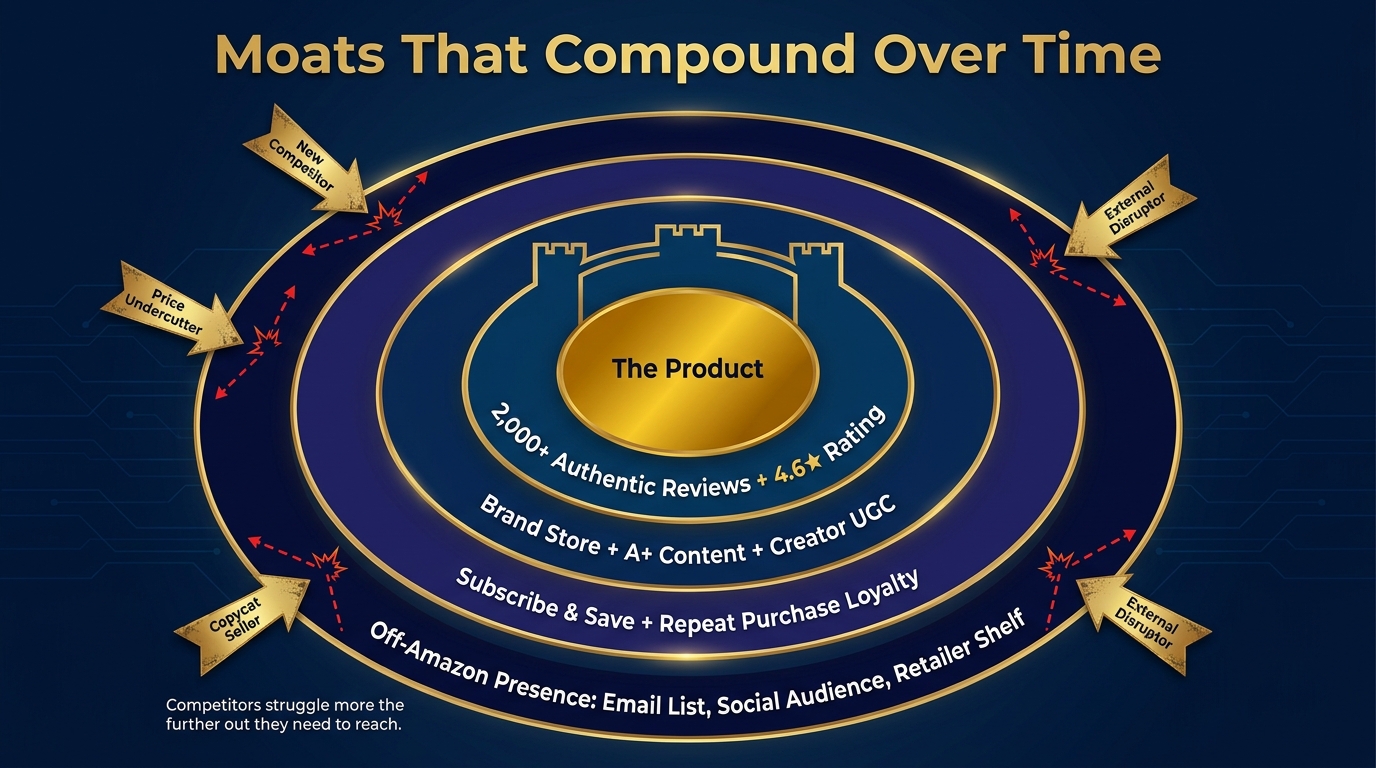
The Amazon marketplace is low-barrier to entry by design. Starting a seller account, sourcing a product from Alibaba, and creating a listing takes days. The structural challenge for any seller building a real business is that the ease of entry is also the ease of replication. If you find a profitable product, others will find it too — and they’ll find it faster as tools for competitive intelligence become more sophisticated.
The answer to this challenge is building moats — competitive advantages that take time to develop and are structurally difficult to replicate even when competitors can see exactly what you’re doing.
The Review Moat
A product with 2,000+ authentic reviews and a 4.6-star rating or above enjoys a conversion advantage that a new entrant cannot bridge in weeks or months. Review accumulation is the most durable moat available to Amazon sellers because it compounds over time, directly influences both A9 ranking and Rufus recommendation frequency, and requires sustained customer satisfaction to maintain. A competitor can copy your product, undercut your price, and outspend you on PPC — but they cannot copy your review history.
The operational implication is that review quality matters as much as review quantity. A product with 2,000 reviews and consistent complaints about shipping damage or product quality is actually more vulnerable than a product with 500 reviews and a consistent theme of problem-solved, highly satisfied customers. Amazon’s algorithm — and human shoppers — can read the sentiment distribution of your reviews. Protecting that distribution through rigorous quality control, proactive customer service, and honest product representation is a moat-building activity, not an overhead cost.
Brand Registry and IP Protection
Amazon Brand Registry provides access to Sponsored Brand ads, A+ content, the Brand Store, Brand Analytics, and the ability to report and have counterfeit or infringing listings removed. These tools collectively represent a significant advantage over non-registered sellers in both defensive (IP protection) and offensive (marketing capability) terms. Obtaining a trademark and enrolling in Brand Registry is not a complex or expensive process relative to its strategic value, yet many sellers operating at meaningful revenue levels still haven’t done it.
Creator UGC as a Living Moat
User-generated content from verified buyers and creator partnerships builds social proof that neither competitors nor Amazon can replicate on your behalf. Real photos of real people using your product in real contexts are psychologically more compelling than studio photography — and they serve a dual purpose as both on-Amazon listing content and off-Amazon marketing material. Sellers who build systematic processes for collecting and leveraging UGC — through follow-up email sequences, creator outreach programs, and review incentive structures (within Amazon’s guidelines) — are building a content asset that improves conversion rates while continuously refreshing the listing’s visual relevance.
Subscribe & Save and the Loyalty Loop
For products in consumable or regularly-replaced categories, Subscribe & Save is a moat-building tool that operates invisibly to competitors. A customer enrolled in Subscribe & Save for your product is no longer in the active market — they’re not price-shopping, not evaluating alternatives at each purchase cycle, and not visible to competitor PPC campaigns. Building a high Subscribe & Save enrollment rate (above 15–20% of eligible repeat buyers) creates recurring revenue with dramatically lower CAC than the initial acquisition and represents one of the most valuable forms of business equity available on the platform.
Thinking Long-Term in a Short-Term Marketplace
Amazon’s architecture rewards short-term performance. The algorithm responds to sales velocity in days. PPC feedback loops are measured in hours. The temptation to optimize exclusively for immediate metrics — ACoS, page rank, BSR — is understandable because those metrics are visible, responsive, and tied directly to revenue. But the sellers who have built genuinely valuable Amazon businesses are the ones who made long-term decisions when short-term logic would have argued against them.
Quality Investment as a Long-Term Yield
Spending more on product development, packaging, and quality control than strictly necessary to hit a minimum viable standard is one of the most consistently ROI-positive decisions a seller can make — not because it shows up in this month’s metrics, but because it drives the review sentiment, return rate, and repeat purchase rate that determine the economics of the next twelve months. The incremental cost of improving a product from “acceptable” to “genuinely excellent” is typically small relative to the long-term review and retention benefit it generates.
Catalogue Depth vs. ASIN Count
Scaling an Amazon business through sheer ASIN count — launching many products in the hope that some will succeed — is a resource-intensive strategy that often produces a portfolio of mediocre performers rather than a small number of strong ones. The alternative approach — going deep on a narrower catalogue, building each ASIN to its full potential through ongoing listing optimization, review management, and PPC refinement — tends to produce more durable revenue with lower operational overhead. The business that has 8 ASINs each doing $500K annually is typically more resilient, more manageable, and more valuable at exit than the business with 80 ASINs averaging $50K each.
The Exit Perspective from Day One
Amazon businesses are acquisible assets. Aggregators and strategic buyers evaluate them on metrics including revenue consistency, margin stability, catalogue concentration risk, account health history, trademark registration status, and off-Amazon diversification. Sellers who run their business with an eventual exit in mind — even if that exit is years away — make better operational decisions, because they’re managing for business health rather than just this month’s revenue. Maintaining clean bookkeeping, protecting account health, building Brand Registry and trademark protection, and avoiding grey-area tactics that deliver short-term results but create long-term liability are all disciplines that look different when you’re building something worth selling rather than just running a hustle.
Conclusion: The Rulebook Has Changed — Build Accordingly
The Amazon marketplace in 2026 is not a harder version of the 2020 marketplace. It’s a structurally different one. The discovery mechanisms are more complex. The optimization targets are more numerous. The competitive density in most categories means that average execution no longer produces above-average results. And yet, the opportunity is genuinely significant for sellers who approach it with the right framework.
That framework, as laid out across this post, rests on several core principles:
- Understand all three discovery layers. Optimize for A9 keyword search, Rufus AI conversational recommendations, and voice search simultaneously — they require different but compatible approaches.
- Start product research off-platform. Social signals + Amazon validation + rigorous margin assessment is a more reliable pipeline than marketplace data alone.
- Choose your model honestly. Match your selling model to your capital, skills, and risk tolerance — not to what’s currently generating the most YouTube content.
- Build listings that answer questions. Rufus and voice search reward depth, specificity, and problem-solving language. Keyword density alone is no longer sufficient.
- Launch with discipline. Respect the phases, accept early ACoS as investment, and don’t optimize before you have data.
- Position as a solution, not a brand. Problem-solving authority converts and retains better than brand-building in Amazon’s specific psychology environment.
- Build moats from day one. Reviews, Brand Registry, UGC, Subscribe & Save — these compound. Start building them earlier than feels necessary.
- Own what Amazon doesn’t. Customer relationships, email lists, and off-platform channels are the equity that makes your Amazon revenue worth something beyond its trailing 12-month multiple.
Amazon will keep changing. The algorithm will shift. Fees will adjust. New tools will emerge. The sellers who thrive through those changes aren’t the ones who perfectly optimized for this year’s conditions — they’re the ones who built operations flexible enough to adapt and brands durable enough to matter when the conditions shift again.
Build the business, not just the listing. That distinction, more than any tactic or tool, is what separates sustainable Amazon sellers from those who are perpetually starting over.