





By 2026, 94% of marketers plan to use AI for social media content creation. AI usage among social media teams has surged nearly 180% since 2023. Businesses are generating an average of 48% of their social media content with generative AI tools — up from 39% just two years ago.
Those numbers look like a success story. But zoom in a little closer and a different picture emerges.
Despite all that volume, 52% of consumers report reducing their engagement when they detect AI-generated content. Platforms are increasingly rewarding deep signals — comments, saves, shares — over surface-level likes. And 30.6% of marketing teams are actively struggling to maintain a consistent brand voice as AI tools flood their channels with generic, interchangeable copy.
The problem isn’t that AI social media content generators don’t work. They work extremely well — at producing content. The problem is that most teams are using them as a volume machine when they should be using them as a precision instrument. There’s a meaningful difference between publishing more and publishing better, and in 2026, the algorithms, the audiences, and the analytics are all starting to enforce that distinction hard.
This guide is for practitioners who want to use AI tools to build a genuinely stronger social media presence — not just a busier one. We’ll cover how these tools actually work, where they break down, how to configure them for your specific brand voice, which platforms demand what, how to build repurposing workflows that generate compounding returns, and how to measure whether any of it is actually performing. No fluff. Just the mechanics.
The State of AI Social Media Content Generation in 2026
The AI social media content market has crossed into maturity fast. The AI-in-social-media segment is valued at $3.87 billion in 2026, expanding at a compound annual growth rate of 32.6% through 2033. Content creation tools hold 23.5% of that market share — making them the single largest use case category, ahead of analytics, scheduling, and paid media optimization.
That growth is being driven by real adoption, not just hype. Consider the key metrics shaping the landscape right now:
- 85% of marketers are currently using AI for content creation — up from 61% in 2023.
- 89.7% of social media marketers use AI tools daily or multiple times per week.
- 83% report that AI tools allow them to produce significantly more content than before.
- 71% of social media images are now AI-generated or AI-assisted.
- 60% of U.S. companies use generative AI specifically to maintain a consistent, always-on posting presence.
That last figure deserves attention. The “always-on” imperative has become one of the primary drivers of AI adoption. Algorithms on every major platform reward posting consistency. Building a human team capable of maintaining daily publishing across five channels simultaneously is expensive and difficult. AI closes that gap.
The Productivity Numbers Are Real
The efficiency gains from AI content tools aren’t marginal — they’re structural. Teams using AI report reducing content creation time from 40 hours per week to 12. Some organizations have gone from publishing 15 posts per week to 85, across five platforms, with a team of three people. The global social advertising market is running at $277 billion in spend, and the brands competing for attention in that environment need content velocity to stay visible.
But velocity alone doesn’t win. Social media algorithms in 2026 have grown sophisticated enough to distinguish between content that generates passive scrolling and content that triggers genuine audience behavior. And that’s where many AI-heavy strategies are hitting their ceiling.
Where the Adoption Numbers Get Complicated
The 44.7% of marketers reporting better performance for AI-assisted posts comes with an asterisk: 78.4% of them apply moderate to extensive human editing before publishing. That’s not a small caveat. It suggests that what’s performing isn’t raw AI output — it’s AI output that has been meaningfully refined by a human who understands the brand, the audience, and the platform context.
The distinction between “AI content” and “AI-assisted content” is becoming one of the most important operational decisions a social media team can make in 2026.
How AI Social Media Content Generators Actually Work
Most practitioners use these tools without a working understanding of what’s happening under the hood. That gap matters, because it leads to unrealistic expectations — and to misuse patterns that produce exactly the kind of generic, repetitive output that kills engagement.
The Foundation: Large Language Models and Multimodal Generation
The text generation components of modern AI social media tools are built on large language models (LLMs) — typically proprietary versions or fine-tuned variants of GPT-4, Claude, Gemini, or Llama-class models. When you prompt one of these tools to “write a LinkedIn post about our new product feature,” the model is statistically predicting the most likely next token based on its training data, your prompt, and any additional context you’ve provided (brand guidelines, tone documents, past posts).
That statistical prediction process is exactly why AI output tends toward the median. The model is, by design, generating the most probable language — which also means the most common, the most familiar, and the least surprising. That’s useful for speed. It’s a problem for differentiation.
Image generation tools (Midjourney, DALL-E 3, Adobe Firefly, Canva AI) operate on diffusion models — a different architecture that generates visuals by progressively denoising a random pattern guided by your prompt. These tools now output at a quality level that makes platform-ready visuals genuinely fast to produce, which is why 71% of social media images carry some degree of AI involvement in 2026.
Platform APIs and Native AI Features
A growing category of AI social media tools connects directly to platform APIs, which enables more than just content generation. These integrations allow tools to pull your historical performance data and use it to inform what gets created next. Hootsuite’s OwlyWriter AI, for example, can analyze which of your past posts generated the highest engagement and then prompt the model to generate new content in a similar structure or tone.
This feedback loop — performance data into generation — is the architecture that separates more sophisticated AI social tools from basic caption writers. When properly configured, the AI isn’t just generating generic content; it’s generating content that resembles your highest-performing content. That’s a meaningful distinction.
Predictive Scoring and Scheduling Intelligence
The most advanced tools in 2026 layer a predictive scoring engine on top of the generation layer. Before you publish, the system estimates likely engagement — likes, saves, shares, comments — based on historical data, current trending topics, audience activity patterns, and even sentiment analysis. Tools like Lately AI, Cortex, and HubSpot’s social scheduling module incorporate this scoring, and teams using predictive publishing report 34% higher social engagement compared to posting without it.
The Brand Voice Problem: Why Generic AI Output Quietly Erodes Your Presence
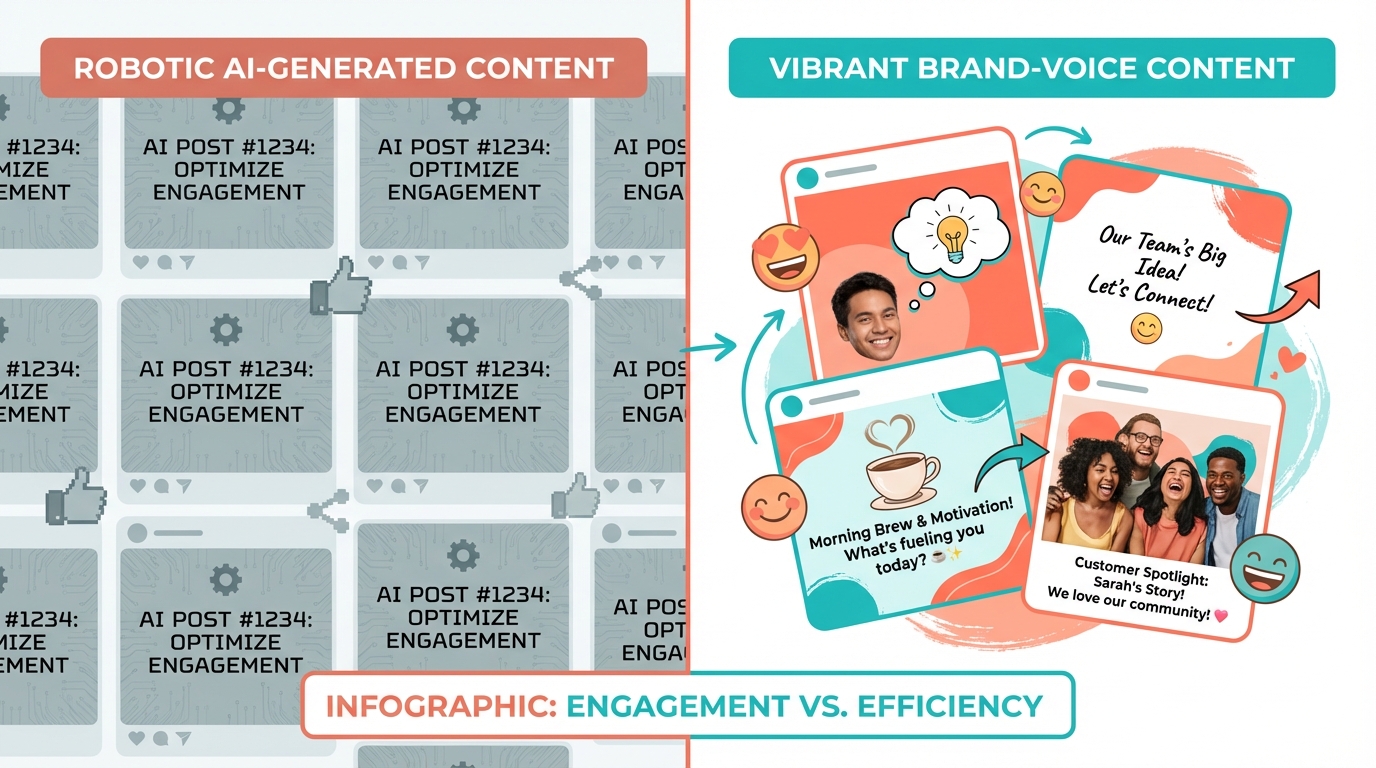
This is the central tension of AI social media content in 2026, and it’s worth examining carefully because it’s where most teams are losing ground without realizing it.
AI tools are excellent at generating acceptable content. They reliably produce grammatically correct, reasonably on-topic, appropriately formatted posts. That acceptability is also a trap. Because acceptable content is, by definition, average content — and average content on social media disappears into the feed without leaving a trace.
What the Data Shows About Brand Voice Erosion
A 2026 survey of marketing teams found that 30.6% cite maintaining a consistent and distinctive brand voice as their top challenge with AI content tools. Even more telling: 61.1% express concern about originality and plagiarism-adjacent outputs — situations where AI-generated content is technically unique but structurally and tonally identical to what dozens of competitor brands are generating from the same prompts.
This phenomenon — sometimes called “content homogenization” — is measurable. When multiple brands in the same vertical run similar prompts through the same AI tools, they get similar outputs. On a crowded social feed, that sameness reads as noise. Audiences stop registering the posts as coming from a distinct brand. They just become more content to scroll past.
“AI slop” — low-effort, indistinguishable AI-generated content — was named the Macquarie Dictionary’s word of the year for 2025, reflecting how widely audiences and commentators have recognized this pattern. In 2026, the term has moved from internet slang into mainstream marketing vocabulary.
What a Functional Brand Voice Document Looks Like
The antidote to brand voice erosion is a voice document that actually gives the AI specific, usable guidance — not platitudes like “professional but approachable” that could describe virtually any business.
A functional brand voice document for AI input includes:
- Tone descriptors with examples: “We write like a knowledgeable friend, not a corporate spokesperson. Example: ‘Here’s what most accountants won’t tell you’ — not ‘Our expertise delivers value.'”
- Forbidden phrases: Any jargon, buzzwords, or competitor language that should never appear in your content.
- Sentence structure preferences: Short punchy sentences vs. longer analytical ones. First person vs. third person. Active vs. passive voice.
- Emotional register by platform: More formal for LinkedIn, more casual and conversational for Instagram and TikTok.
- 10–20 example posts that represent your brand at its best. These serve as reference anchors for the model.
- Anti-examples: Posts that look like your brand but aren’t — important for drawing a clear line.
Platforms like Jasper, Writer, and Acrolinx offer real-time brand voice scoring — flagging generated content that deviates from documented guidelines before it reaches a human reviewer. For teams publishing at volume, this layer of automated quality control is worth the cost of the tool itself.
The Training-and-Feedback Loop That Keeps Voice Consistent
Brand voice isn’t a one-time configuration. It needs ongoing calibration. The best-performing teams in 2026 treat their AI content tools like a new team member: they actively feed in examples of what worked and what didn’t, they update the guidelines when the brand evolves, and they conduct periodic voice audits — running a sample of recent AI-generated posts through a human reviewer specifically checking for voice consistency.
That process sounds labor-intensive, but it typically requires one dedicated review session per month. The return on that investment — in content that audiences actually recognize and respond to — more than justifies the time.
Platform-by-Platform Strategy: What AI Tools Should (and Shouldn’t) Do on Each Channel
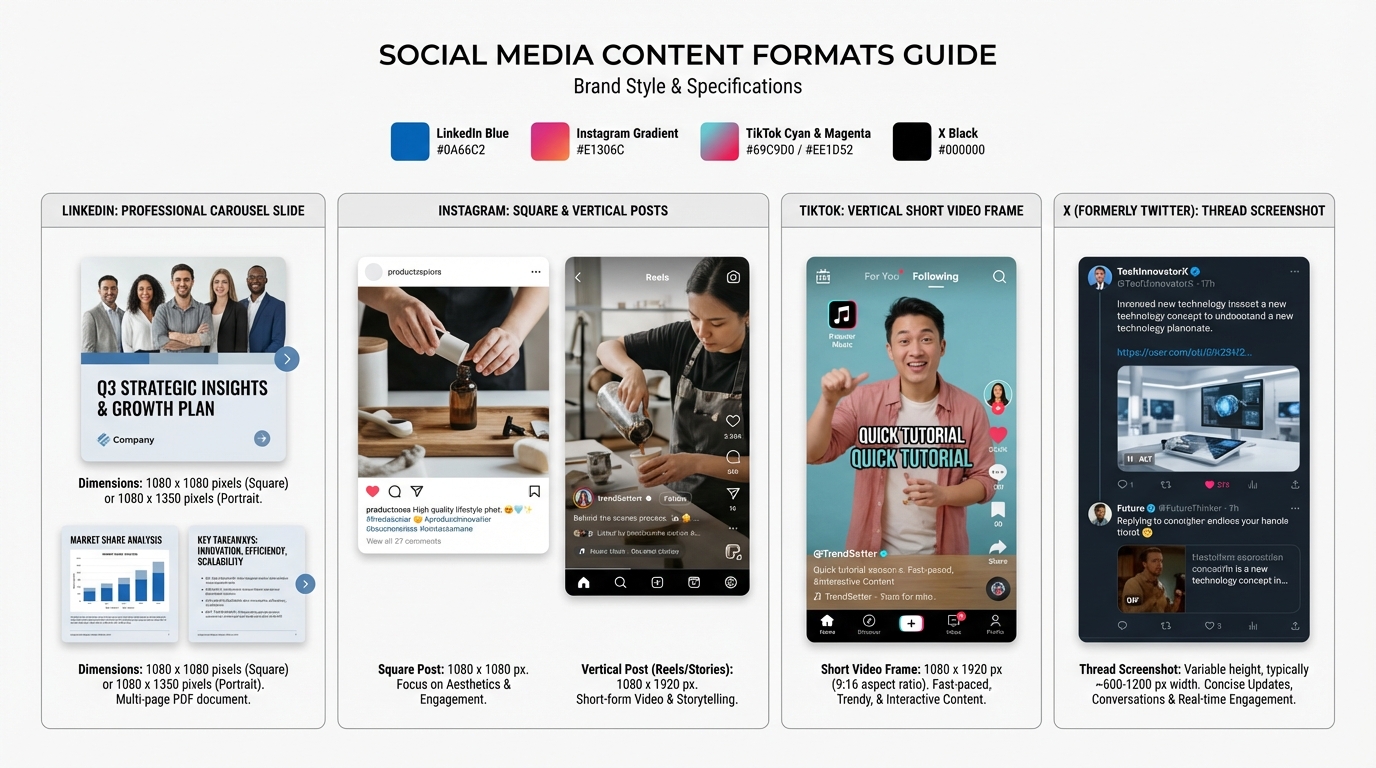
One of the most common AI content mistakes is treating all platforms the same — generating a post and then cross-posting identical copy across LinkedIn, Instagram, TikTok, and X simultaneously. Not only does this ignore the distinct audience expectations and algorithm behaviors of each platform, it also signals to platform algorithms that the content is low-effort. Here’s how to think about AI content strategy channel by channel.
LinkedIn: Where Context and Credibility Win
LinkedIn’s algorithm in 2026 heavily rewards content that generates comments — particularly substantive, multi-sentence comments that spark follow-up discussion. This means AI-generated LinkedIn content needs to be structured specifically to invite response. The most effective formats are:
- Contrarian takes: Posts that challenge a commonly held assumption in your industry. AI can draft these, but the core insight needs to come from a human with genuine experience — not from a prompt asking the model to “write a controversial LinkedIn post.”
- Carousels: Multi-slide educational sequences that deliver genuine value. Tools like Supergrow and PostNitro automate carousel generation from blog posts or URLs, and these formats consistently generate 3–5x higher engagement than single-image posts on LinkedIn.
- Personal narrative with business insight: The “I used to believe X until Y happened and I learned Z” structure. AI can template this, but the actual story must be real and specific — authenticity is detectable and rewarded.
What AI should not do on LinkedIn: write first-person “thought leadership” posts from a CEO or founder that don’t reflect that person’s actual voice and views. Audiences on LinkedIn have developed finely tuned detectors for ghostwritten AI content, and getting caught — either through inconsistency or through direct detection — damages credibility significantly.
Instagram: Visual-First, Caption-Second
Instagram in 2026 is fundamentally a visual discovery platform, with Reels dominating reach and the algorithm deprioritizing static image posts without significant engagement. AI’s most valuable role here is in visual ideation and caption optimization, not in generating content wholesale.
Practical AI applications for Instagram include:
- Hook generation for Reels scripts: The first 3 seconds of a Reel determine whether someone watches or scrolls. AI is excellent at generating multiple hook variations for A/B testing — e.g., question hooks vs. statement hooks vs. shocking stat hooks.
- Hashtag research and clustering: Tools like Flick use AI to analyze hashtag performance data and suggest optimal tag sets based on your account size and niche, replacing the manual research process entirely.
- Caption variants: Generating 5–10 caption variations for the same visual so you can test which framing gets the highest save rate.
- Alt text for accessibility: AI can automatically generate descriptive alt text for every image — something many brands skip and that search engines and screen readers both value.
TikTok: Speed, Authenticity, and the Algorithm’s Appetite
TikTok’s recommendation algorithm is the most opaque and the most powerful content distribution engine currently operating in social media. It determines reach based on completion rate (how much of your video people watch), replay rate, and share behavior — not on follower count. This makes TikTok uniquely meritocratic, and it also makes generic AI-generated scripts particularly dangerous here.
TikTok audiences skew young, are extremely adept at recognizing performative or inauthentic content, and will rapidly exit videos that feel scripted or corporate. AI works well for:
- Script outlines: Providing a structural skeleton (hook → problem → insight → CTA) that a human then delivers in their own voice.
- Trend adaptation: Identifying trending sounds and formats and generating adaptation ideas specific to your niche.
- Caption and on-screen text: Generating punchy overlay text that reinforces the spoken message.
What doesn’t work on TikTok: fully scripted, AI-generated voiceover content with generic stock visuals. The platform’s audience can spot this format immediately, and completion rates drop sharply.
X (formerly Twitter): Concision and Timing
X rewards speed and relevance. The most successful AI application on X is real-time trend monitoring combined with rapid content adaptation — using AI to identify breaking discussions in your industry and generate response posts or threads within minutes. Tools like Hypefury and FeedHive automate this process.
Thread generation is another strong use case: AI can turn a long-form article or report into a 10-tweet thread in under two minutes, including formatting, numbered structure, and a clear call to action at the end. The key is reviewing the thread for voice before posting — AI tends to make X threads more formal than the platform’s culture typically rewards.
The Content Atomization Flywheel: Getting 30+ Posts from One Asset
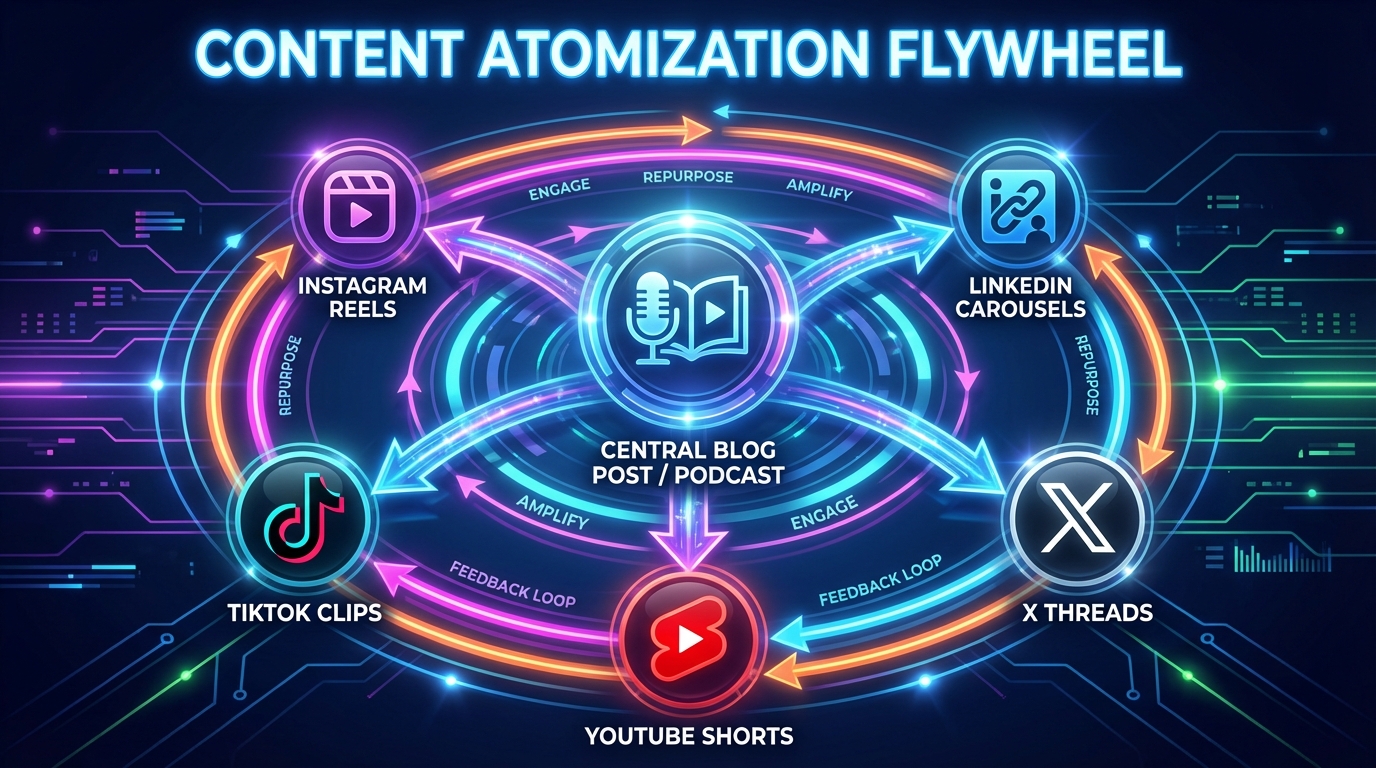
The highest-ROI application of AI social media content tools in 2026 isn’t using them to generate content from scratch. It’s using them to systematically extract maximum value from content you’ve already created. This approach — often called content atomization — turns a single pillar asset into a sustained stream of platform-native posts, and AI makes the process fast enough to be practical at scale.
What “Content Atomization” Actually Means
The term comes from physics: splitting a large unit into its component atoms. In content marketing terms, you start with one substantial “pillar” asset — a long-form blog post, a podcast episode, a webinar recording, a research report, or a video interview — and systematically break it into smaller, self-contained pieces formatted for specific platforms.
The output from one well-executed atomization session can include:
- 3–5 LinkedIn posts (one per major insight in the original piece)
- 1–2 LinkedIn carousels (step-by-step breakdowns of key frameworks)
- 5–7 Instagram captions with visual prompts
- 2–3 Instagram Reels script outlines
- 3–5 TikTok concept scripts
- 1 X thread (10–12 tweets)
- Multiple quote graphics with pull-quotes from the original content
- Email newsletter snippet
Brands running consistent atomization workflows report boosting their content output by 300% while reducing their weekly production time by 15+ hours. The approach has a compounding quality too: the more you do it, the more your various channels begin to reinforce each other, with audiences who discover you on TikTok migrating to LinkedIn or your email list.
The AI Atomization Workflow Step-by-Step
The practical workflow for AI-assisted atomization runs as follows:
- Select your pillar asset. Choose the highest-value piece of long-form content from the past month — ideally something that performed well or covers a topic your audience frequently asks about. Evergreen content atomizes better than news-driven pieces.
- Extract the “atoms.” Prompt your AI tool to identify the discrete insights, data points, frameworks, counter-intuitive claims, and actionable tips within the piece. Ask it to produce a list of 15–20 potential “atoms” — standalone ideas that can live independently from the original context.
- Assign atoms to formats and platforms. Statistical claims work well as LinkedIn posts. Step-by-step frameworks become carousels. Counter-intuitive insights make strong TikTok hooks. Quotes and visual comparisons become Instagram graphics.
- Generate platform-specific drafts. Run each atom through your AI tool with platform-specific instructions: tone, length, format, CTA. Use your brand voice document as a system prompt.
- Human review and voice editing. Assign a team member to review all generated drafts for voice consistency, factual accuracy, and platform fit. This stage typically takes 2–3 hours for a full atomization run — compared to 12–15 hours if everything was being written from scratch.
- Schedule and distribute. Load approved content into your scheduling tool. Spread posts over 2–4 weeks rather than publishing everything immediately, which maintains steady feed presence without overwhelming your audience.
Tools Built for Atomization
Several tools are specifically designed for this workflow. Lately AI connects directly to your existing long-form content (blog RSS feeds, YouTube channels, podcast RSS) and automatically generates social post variants for every new piece you publish. It learns from your historical engagement data to prioritize the variants most likely to perform. Repurpose.io handles media repurposing — automatically clipping podcast audio into short video segments, adding captions, and resizing for platform specs. For teams managing significant content volume, these automation layers can reduce human involvement in the distribution process by 60–70%.
AI Social Media Tools Compared: What to Use and When in 2026
The AI social media tools market has fragmented into specialized niches, and the “best” tool depends entirely on your specific workflow needs. Here’s a practical breakdown of the leading options as of 2026, organized by primary use case.
Full-Suite Social Management with AI Built In
Hootsuite with OwlyWriter AI remains the strongest option for larger teams managing multiple brands or accounts at scale. OwlyWriter generates platform-optimized captions from topics, URLs, or past high-performing posts. The AI Content Calendar analyzes your audience’s activity patterns across time zones and platforms and suggests optimal scheduling windows. Starting price is approximately $99/month for professional tiers.
Sprout Social leads for teams where sentiment analysis and social listening are critical. Its AI surfaces trending conversations in your industry and surfaces engagement patterns across audience segments. Particularly strong for enterprise accounts managing community at high volume. Pricing starts around $249/month.
Budget-Friendly Multi-Channel Tools
Buffer offers the most accessible entry point: a free tier covering three channels, with paid plans starting at $5/month per channel. Its AI Assistant adapts a single post’s tone and structure for each connected platform automatically — writing a LinkedIn version as one style and an Instagram version as another from the same core content. For small businesses managing their own social presence, it’s an excellent starting point.
Predis.ai specializes in visual content generation alongside text, making it particularly useful for Instagram and TikTok workflows. It generates complete post packages — caption plus visual — from a topic or product description, which reduces the separate image creation step for teams without design resources.
Specialized Platform-Native Tools
Supergrow is purpose-built for LinkedIn and excels there. It handles AI drafting, branded carousel creation, scheduling, and even automated engagement comment suggestions — the kind of LinkedIn-specific workflow features that general-purpose tools don’t prioritize. For B2B brands where LinkedIn is the primary channel, it’s worth the focused investment.
Flick is the equivalent for Instagram and TikTok — strong on hashtag research, caption generation, and Reels concept ideation specifically tuned to those platforms’ engagement patterns.
Repurposing-First Tools
Lately AI is purpose-built for the atomization workflow described above, with automated content generation from RSS feeds and learning algorithms that improve post selection based on your historical performance data. Descript and Repurpose.io handle the video and audio repurposing side — clipping, captioning, and reformatting long-form media into short-form platform-ready content automatically.
Building a Human-in-the-Loop Workflow That Actually Scales

The data is clear: AI-assisted posts that undergo moderate to extensive human editing outperform both pure AI content and fully manual content. The challenge is designing a workflow where that human editing step is efficient enough to preserve the speed benefits of AI, without becoming a bottleneck that eliminates them.
The Four Roles in a Scaled AI Content Workflow
In a functional AI-assisted social media operation, four distinct roles need to be covered — whether by four people or by one person wearing four hats:
- The Strategist: Responsible for defining and updating the content strategy, the brand voice document, the topic calendar, and the performance criteria. This role cannot be delegated to AI — it requires human judgment about business goals, competitive positioning, and audience psychology.
- The Prompter: The person who translates strategy into effective AI prompts. This is a more skill-intensive role than it appears. The quality of AI output correlates directly with the quality of the prompt, and developing a library of high-performance prompt templates is a significant competitive asset.
- The Editor: Reviews all AI-generated drafts for voice consistency, factual accuracy, platform fit, and brand alignment. This is where the 78.4% of marketers who report doing “moderate to extensive editing” are spending their time. For a well-configured workflow, this role should be reviewing, not rewriting — if the editor is consistently rewriting from scratch, the prompting layer needs to be improved.
- The Analyst: Monitors performance data, identifies what’s working and why, and feeds that insight back into the strategy and prompting layers. Without this role, the workflow optimizes for volume but never improves quality.
Building Your Prompt Template Library
The most valuable asset a social media team can build with AI tools isn’t a content calendar — it’s a prompt library. A well-developed prompt library contains:
- Platform-specific post templates with embedded brand voice instructions, forbidden phrases, length constraints, and CTA options built into the prompt itself.
- Content type templates for each recurring format: thought leadership, product announcement, customer story, data insight, industry news reaction, etc.
- Negative examples baked into the prompt: “Do not use phrases like ‘excited to announce’ or ‘we’re thrilled to share.’ Do not open with the company name. Do not use hashtags in the body copy.”
- Performance feedback loops: Prompts that include examples of your top-performing posts from the last 90 days as reference anchors.
Teams that invest time building this library typically see the quality of their AI output improve dramatically — and the editing time required per post drop from 15–20 minutes to 3–5 minutes as the prompts get sharper.
Review Cadence and Governance
For teams managing high-volume AI content production, a clear governance cadence prevents quality drift. Best practice in 2026 looks like this:
- Weekly: Editor reviews all scheduled content for the coming week, approving or flagging for revision.
- Monthly: Brand voice audit — a human reviewer reads 20–30 recent posts and assesses voice consistency on a simple 1–5 scale. Any consistent patterns of drift (e.g., AI is repeatedly generating overly formal copy, or using certain phrases too frequently) trigger a prompt update.
- Quarterly: Full strategy review — the Strategist and Analyst review aggregate performance data and update the content strategy, topic mix, and platform prioritization for the next quarter.
Measuring What Matters: ROI, Engagement, and the Vanity Metric Problem
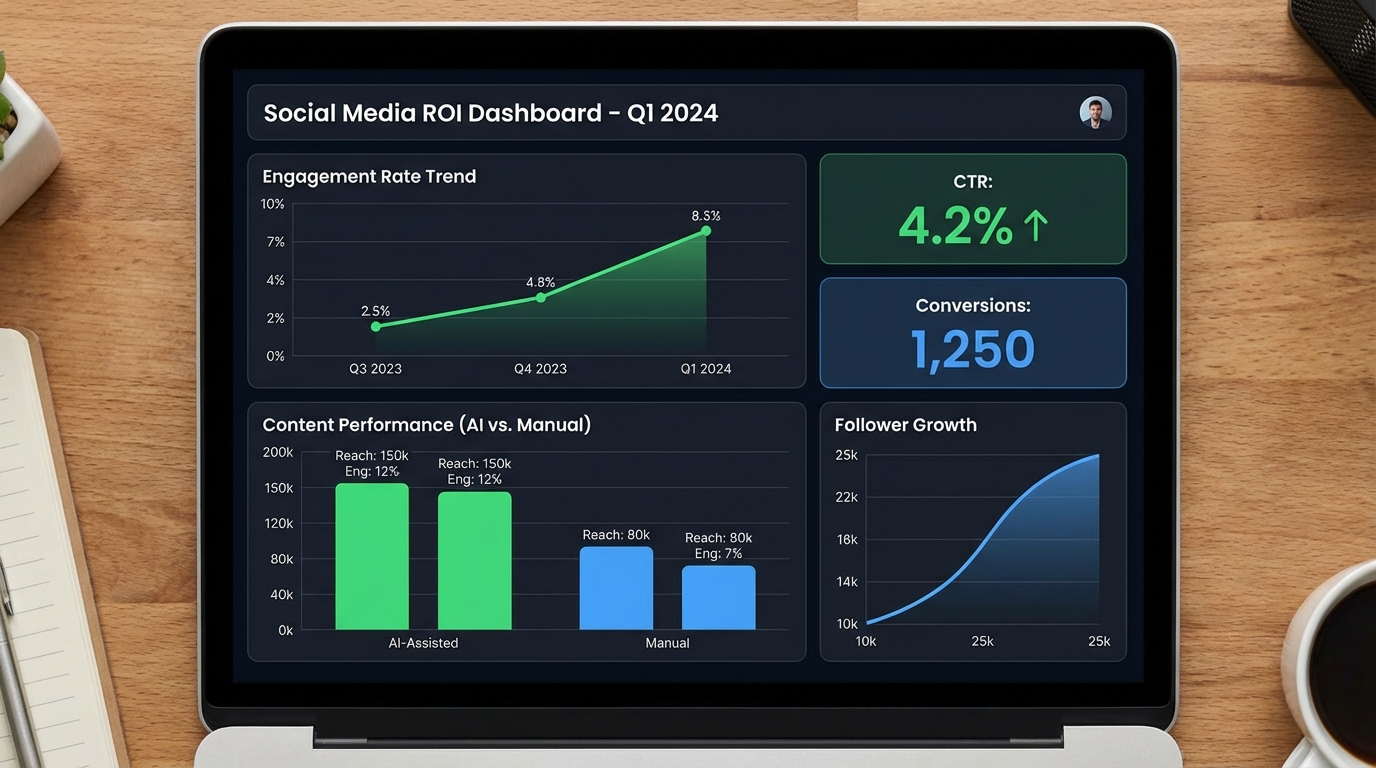
The ROI numbers for AI-assisted social media content are genuinely impressive when measured correctly. Average marketing ROI across channels runs at 3.7x for teams using AI-integrated workflows. Social media specifically shows a 34% engagement lift. Click-through rates on AI-optimized content run 47% higher than non-optimized baseline content. Campaign development time drops by 73%.
But these are aggregate figures, and individual results vary enormously based on how well the AI workflow is configured, how much human editing is applied, and — critically — what metrics you’re tracking.
Deep Engagement vs. Surface Metrics
This is the most important measurement distinction in AI social media content in 2026. Surface metrics — likes, impressions, reach — are easy to inflate with AI-generated volume. They’re also becoming increasingly irrelevant as platform algorithms and brand managers alike recognize their susceptibility to gaming.
Deep engagement metrics — comments (especially multi-sentence comments), saves (the “I want to return to this” signal), shares and reposts, DM conversations initiated by content, profile visits and follows triggered by a specific post — are much harder to inflate artificially and much more predictive of business outcomes.
The uncomfortable finding from 2026 research is that pure AI content, without meaningful human editing, generates higher volumes of surface engagement and lower rates of deep engagement. Audiences respond to AI-generated content with passive behavior (scrolling past, occasionally double-tapping) but not with the active behavior (commenting, sharing, DMing) that indicates genuine interest and intent.
The Metrics Framework That Works
For teams using AI content generators, the measurement framework should include:
- Deep engagement rate: (Comments + Saves + Shares) ÷ Reach. Track this separately from your overall engagement rate to isolate quality signals.
- Content velocity vs. engagement quality correlation: Are you publishing more but getting less deep engagement per post? This indicates an over-rotation toward volume at the expense of quality.
- Click-through rate by content type: Which formats (carousels, Reels, static posts, threads) are driving actual traffic from social to owned channels?
- Downstream conversion attribution: Social media is valuable for awareness and consideration; measuring only social metrics misses whether any of that attention converts to leads, sales, or subscribers.
- Share of voice: Are you gaining or losing ground in your niche’s conversation relative to competitors? AI tools that include social listening can track this automatically.
A/B Testing at AI Speed
One genuine advantage that AI content tools provide for measurement is the ability to run systematic A/B tests at a pace that would be impossible with manual content creation. You can generate five variations of the same core message — each with a different hook, different emotional angle, or different CTA — and post them across the week to identify which performs best. Then use that learning to inform the next generation of content.
Teams that implement this “generate, test, learn, iterate” loop consistently outperform those that simply generate and publish, because the former approach compounds knowledge over time while the latter generates volume without insight.
Algorithm Realities: What Social Platforms Actually Reward in 2026
Understanding how platform algorithms behave in 2026 is essential context for evaluating where AI content tools help and where they might work against you. Algorithms have evolved significantly, and the signals they prioritize have shifted in ways that directly affect AI content strategy.
The Authentication Trend Across Platforms
Every major social platform — Meta, TikTok, LinkedIn, X — has moved toward prioritizing signals of authentic human engagement over raw volume metrics. This is partly a response to the flood of AI-generated content, partly a business imperative (advertiser CPMs depend on genuine human attention, not bot engagement), and partly a function of more sophisticated detection capabilities.
Meta’s systems now use semantic similarity analysis and behavioral biometric patterns to assess content authenticity. TikTok’s recommendation engine weights completion rate and replay rate — metrics that audiences naturally generate more for content they find genuinely interesting. LinkedIn’s algorithm in 2026 explicitly deprioritizes content that appears to be generated without a distinct point of view.
Importantly: this doesn’t mean AI-assisted content performs worse. It means lazy AI content performs worse. Content that has been meaningfully edited for voice, specificity, and genuine insight doesn’t trigger these signals — because it doesn’t resemble the generic patterns that platform AI systems are trained to down-rank.
The Content Labeling Question
Several platforms have implemented or are testing AI content disclosure requirements. TikTok already requires disclosure for AI-generated visuals and synthetic media. Instagram has implemented similar requirements for AI-generated images used in ads. LinkedIn has not yet mandated disclosure for AI-assisted text but has stated that undisclosed synthetic media violates its professional standards policies.
The practical implication: the brands that will face the least friction from evolving disclosure requirements are those that are already using AI as an assistance and acceleration tool rather than a wholesale content replacement. If a human writes the core insight, structures the argument, and edits the final copy — with AI handling formatting, variants, and scheduling — that’s categorically different from letting AI generate and auto-publish without meaningful human involvement.
C2PA Watermarking and Detection
The Content Authenticity Initiative (CAI) and its technical standard C2PA (Coalition for Content Provenance and Authenticity) have gained significant traction among major platforms and media tools in 2026. Adobe’s AI tools embed C2PA metadata into all generated images. Major platforms are developing the infrastructure to read these signals.
While C2PA compliance isn’t yet universally enforced, it represents the direction of travel for content provenance standards online. Brands building AI content workflows today should understand that the provenance of their content will become increasingly readable to platforms, advertisers, and sophisticated audiences over the next few years.
A Real-World Case Study: What Proper AI Workflow Looks Like at Scale
The following case study illustrates what the numbers can look like when an AI social media content workflow is built correctly — with voice training, human editorial oversight, and measurement discipline — rather than assembled hastily around a content volume target.
The Setup: A 3-Person Team, 5 Platforms, 6 Months
A direct-to-consumer skincare brand with a three-person marketing team decided to rebuild their social media operation around AI tools in mid-2025. Before the transition, they were publishing 15 posts per week across five platforms, spending 40 hours on content creation, and seeing inconsistent brand messaging as each team member defaulted to their own stylistic preferences.
Their tool stack after implementation: Lately AI for content atomization and scheduling, Canva AI for visual generation, and Buffer for multi-channel distribution and analytics. Before deploying any of the tools, they spent two weeks building a comprehensive brand voice document — including 20 example posts at various quality levels, a list of forbidden phrases, emotional register guidelines for each platform, and clear visual identity specifications for Canva templates.
The Results After Six Months
| Metric | Before AI | After AI | Change |
|---|---|---|---|
| Weekly posts published | 15 | 85 | +467% |
| Content creation hours/week | 40 hours | 12 hours | -70% |
| Engagement rate (deep) | Baseline | +340% | 3.4x improvement |
| Follower growth | Baseline | +156% | 2.6x faster |
| Social-attributed revenue (monthly) | $45,000 | $189,000 | +320% |
The Key Differentiator
What distinguished this team’s approach from the majority of AI social media implementations wasn’t the tools they chose — it was the discipline they applied before and during deployment. The two weeks spent building the voice document before touching an AI tool were the most valuable investment of the entire project. The monthly voice audits kept quality from drifting as post volume scaled up. The dedicated editor role (one person spending approximately 12 hours per week reviewing and approving content) ensured that every post that went live represented the brand accurately.
The team lead described their philosophy simply: “We treat AI as our content production department, not our creative director. The creative direction still comes from us.”
The Practitioner’s Checklist: Building Your AI Social Media Content System
Across everything covered in this guide, the difference between AI social media content strategies that perform and those that quietly dilute a brand comes down to a set of specific, actionable decisions. Here is the complete checklist for building a system that generates both volume and quality.
Before You Deploy Any Tool
- Write a real brand voice document. Not a mood board or a list of adjectives. Actual example posts, forbidden phrases, tone descriptors with illustrations, and platform-specific emotional registers. This document is the foundation of every AI interaction.
- Define your content objectives by platform. What does success look like on LinkedIn specifically? On Instagram specifically? Align these objectives to business goals (awareness, leads, retention) not vanity metrics (followers, likes).
- Audit your existing content for performance patterns. Identify your 10 highest-performing posts from the past year. What format, topic, tone, and structure do they share? Feed these into your AI tool as reference anchors.
- Choose tools based on your primary workflow need. Don’t buy five tools because they’re all rated highly. Identify your highest-leverage need — atomization? scheduling? image generation? analytics? — and deploy one strong tool there first.
Setting Up Your Workflow
- Assign the four workflow roles (Strategist, Prompter, Editor, Analyst) clearly — even if one person covers multiple roles.
- Build a prompt template library before entering full production. Start with five to eight templates covering your most common content types and platforms.
- Configure your AI tool with your voice document as a persistent system prompt or brand guidelines upload, depending on the tool’s capability.
- Set up a review queue — all AI-generated content should pass through a human editor before scheduling, with a clear feedback channel back to the Prompter to improve future output.
In Ongoing Operations
- Run a monthly voice audit. Review 20–30 recent posts specifically for brand voice consistency. Update your prompts and voice document when drift patterns appear.
- Track deep engagement metrics separately from surface metrics. If deep engagement is declining as volume increases, you’re over-rotating toward quantity.
- Conduct quarterly strategy reviews to update topic mix, platform prioritization, and content format distribution based on performance data.
- Maintain a learning log. Document what prompt structures produce the best output, which content types are consistently underperforming, and what editorial interventions most frequently improve AI drafts. This institutional knowledge is what separates a mature AI content operation from one that stays permanently in the experimental phase.
The brands winning on social media with AI in 2026 aren’t the ones generating the most content. They’re the ones generating the most intentional content — with AI handling the production load and humans maintaining the intelligence, judgment, and voice that make audiences pay attention.
AI social media content generators are genuinely powerful tools. They have the capacity to change the economics of content production for teams of every size — reducing costs, accelerating velocity, and enabling levels of multi-platform presence that would be impractical with purely human resources. But that capacity only converts into competitive advantage when the tools are configured with care, operated with discipline, and measured against the right outcomes.
Volume is easy. Volume with quality, consistency, and measurable business impact is what requires a real system — and what separates the brands that are getting genuine returns from AI from the majority that are generating content no one remembers.