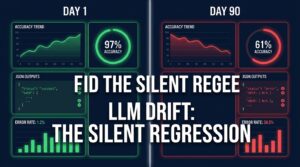

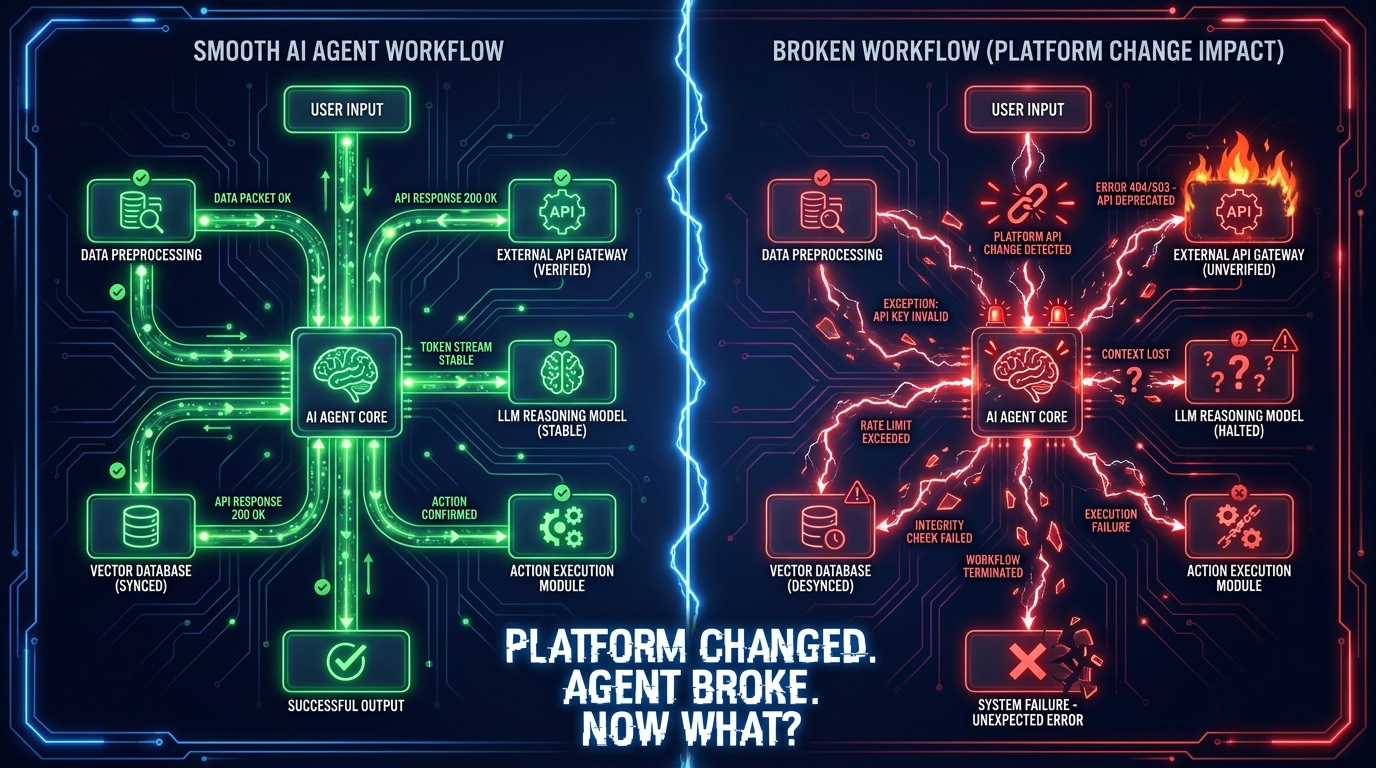

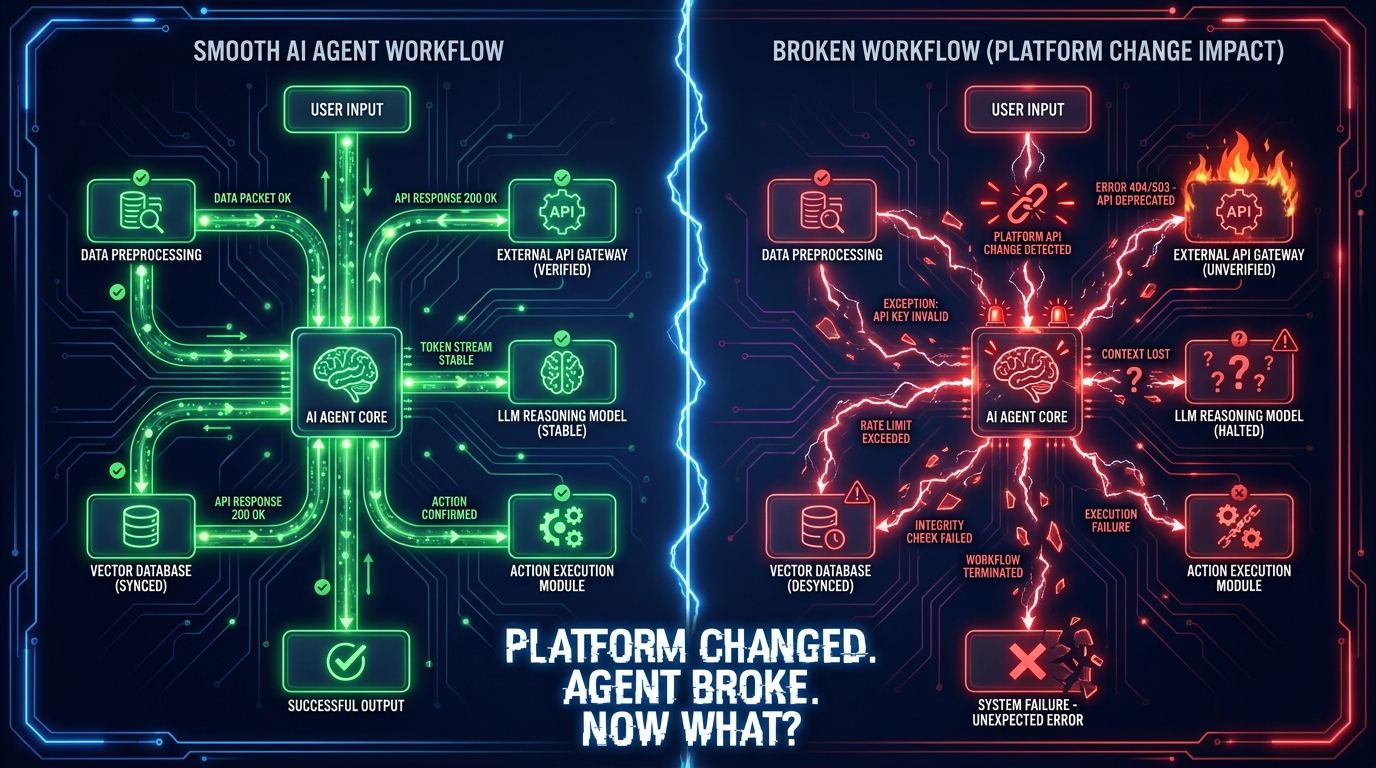
Your AI agent was working fine on Monday. By Wednesday, after your vendor pushed a platform update, it’s failing silently on 30% of requests. Nobody set off an alarm. The dashboard looks normal. The first sign of trouble is a customer complaint — or worse, a downstream process that’s been writing garbage to your database for 48 hours.
This is not a model failure. The weights didn’t change. The intelligence didn’t disappear. What changed was the scaffolding around the model — the tools it calls, the schemas it expects, the endpoints it depends on — and the agent had no idea any of it happened.
Retraining after a platform update is one of the most misunderstood problems in applied AI. Most teams assume the fix is technical: update the prompt, patch the API call, maybe fine-tune. But the real issue is operational: how do you adapt an agent without halting the workflows that depend on it? How do you know when a prompt change is enough, and when you actually need to retrain? How do you migrate from one platform to another without a hard cutover that takes everything offline?
This article works through all of it — not at the level of theory, but at the level of what actually happens in production in 2026, including a real-world anatomy of the OpenAI Assistants API sunset, the emerging science of two-speed agent updates, and the specific architecture patterns that keep ops running while the underlying platform evolves under you.
Why Platform Updates Break Agents — And Why It’s Rarely the Model’s Fault
There’s a persistent misconception that when an AI agent starts behaving badly after an update, the model itself has degraded. In practice, that almost never happens. Foundation model weights don’t change without an explicit version bump, and even then, behavioral regressions in base capabilities are relatively rare. What does change — constantly, and often without adequate notice — is everything around the model.
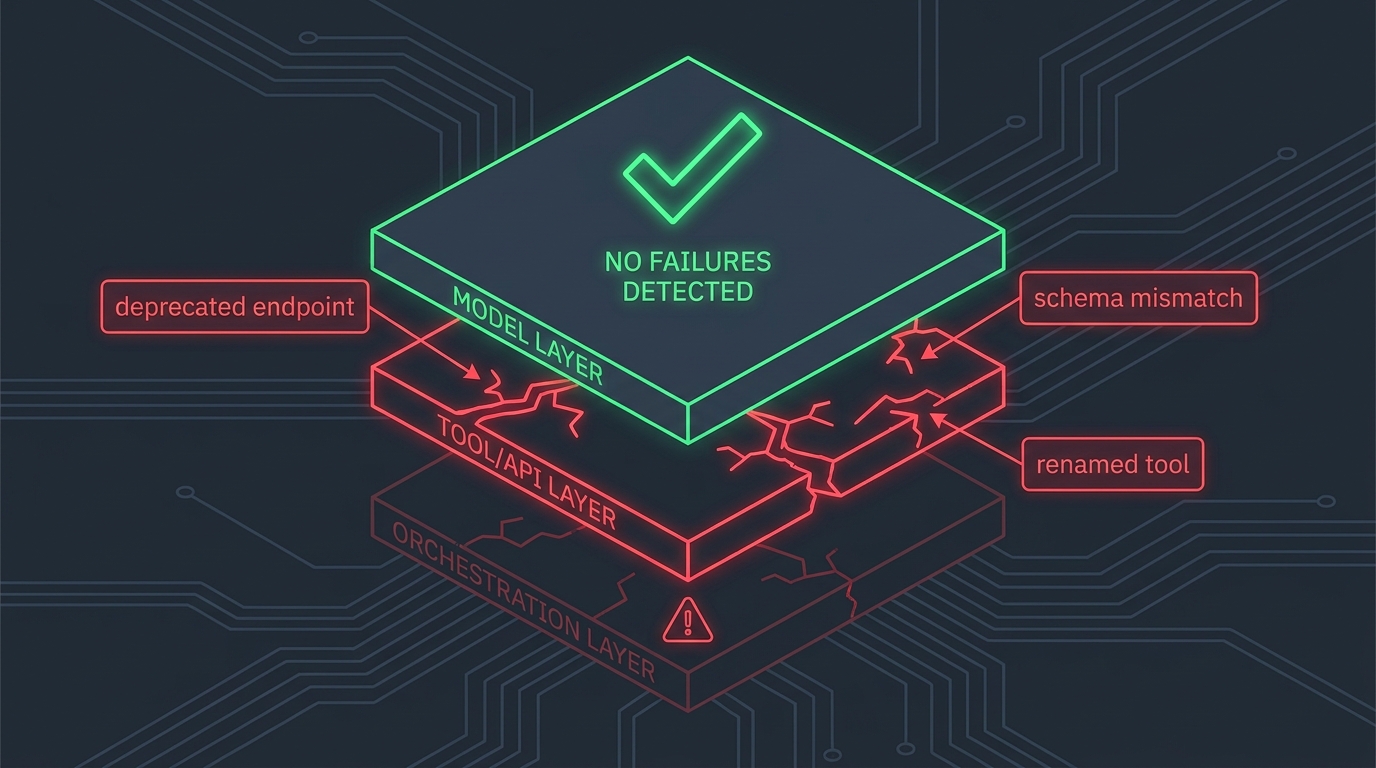
Think of a production AI agent as a three-layer system. The model sits in the middle, receiving inputs and generating outputs. Above it are the prompts, context, and instructions that shape its behavior. Below it are the tools it calls: APIs, retrieval systems, databases, external services, function-calling schemas. When a platform updates, it nearly always hits the bottom layer — the tools — and the effects ripple upward.
The Anatomy of a Tool-Layer Break
Consider what happens when an API you depend on changes a single field name in its response schema. If your agent was trained to parse a response where the key customer_id appears at a specific path, and the API now returns customerId in camelCase, the downstream tool call fails silently. The agent receives a None or empty string, misinterprets it as valid output, and continues — now working with corrupt data.
These micro-breaks are the most dangerous kind. They don’t crash. They don’t raise exceptions. They degrade behavior in ways that look like normal variance until enough downstream signals accumulate to reveal the pattern. By that point, the contamination window can be hours or days wide.
The Prompt-Layer Confusion Problem
Platform updates can also break agents at the prompt layer, even when no one touches the prompt text. If your vendor updates the underlying model version powering their API — say, switching from one fine-tuned checkpoint to another — instruction-following behavior can shift measurably. An agent that reliably formatted its output as JSON might start returning Markdown. An agent that maintained a particular persona might subtly shift tone. These changes don’t appear in changelogs. They appear in your eval metrics, if you’re watching them.
The practical takeaway: treat every vendor platform update as a potential breaking change, even when the announcement says “non-breaking.” The correct response is not panic — it’s a structured evaluation run against your golden dataset before the update propagates fully to production.
The Three-Layer Failure Stack: Model, Tool, and Orchestration Drift
To fix an agent that breaks during a platform update, you need to know which layer broke. Teams that skip this diagnosis jump straight to retraining — which is expensive, slow, and often solves the wrong problem. A clear mental model of where failures live saves enormous amounts of time and money.
Layer 1: Model Drift
This is the layer most teams worry about first and should actually worry about last. Genuine model-layer drift occurs when the underlying model changes its reasoning, its instruction-following behavior, or its output format in ways that weren’t present before the update. It’s real, but it’s also the most detectable: you’ll see it show up in task completion rates, output-format consistency scores, and trajectory evaluations.
Model drift typically warrants a prompt update first, a system-prompt restructure second, and fine-tuning only if both fail to restore performance. Full retraining on new model weights is almost never the first-line response to a behavioral change.
Layer 2: Tool and API Drift
This is where most production breaks actually live. Tool drift happens when any of the following change: endpoint URLs or base paths, authentication methods, request schema (parameter names, types, required fields), response schema (key names, nesting, data types), rate limits or timeout behavior, error response formats, or tool availability itself (deprecation). A single renamed parameter is enough to break an agent’s tool-calling loop.
The fix for tool drift is almost never retraining. It’s an adapter update — a thin translation layer that maps the old expected interface to the new actual interface. If your tool abstraction layer is well-designed, this fix takes minutes, not hours, and it doesn’t require touching model weights at all.
Layer 3: Orchestration Drift
This is the most complex failure mode and the least often discussed. Orchestration drift occurs when the framework or runtime managing your agent’s workflow changes its behavior: state handling changes, how multi-turn context is managed changes, how tool calls are sequenced or retried changes, or how handoffs between agents are handled changes. These breaks often look like intermittent failures or edge-case degradations rather than consistent crashes, making them hard to pin down.
LangGraph’s recent addition of StateSchema as a library-agnostic state definition layer is a direct response to this problem — giving teams a way to define agent state in portable Standard JSON Schema so that orchestration framework updates don’t require rewriting core logic. The principle generalizes: the more your agent state is tied to a specific framework’s object model, the more vulnerable you are to orchestration drift.
The OpenAI Assistants API Sunset: A Real-World Anatomy of Forced Migration
No recent event has stress-tested more enterprise AI operations than the OpenAI Assistants API sunset. It’s worth studying in detail — not because it’s unique, but because it’s the most public and cleanest example of exactly the kind of platform migration that teams are going to face repeatedly as the AI infrastructure market matures.
What Actually Happened
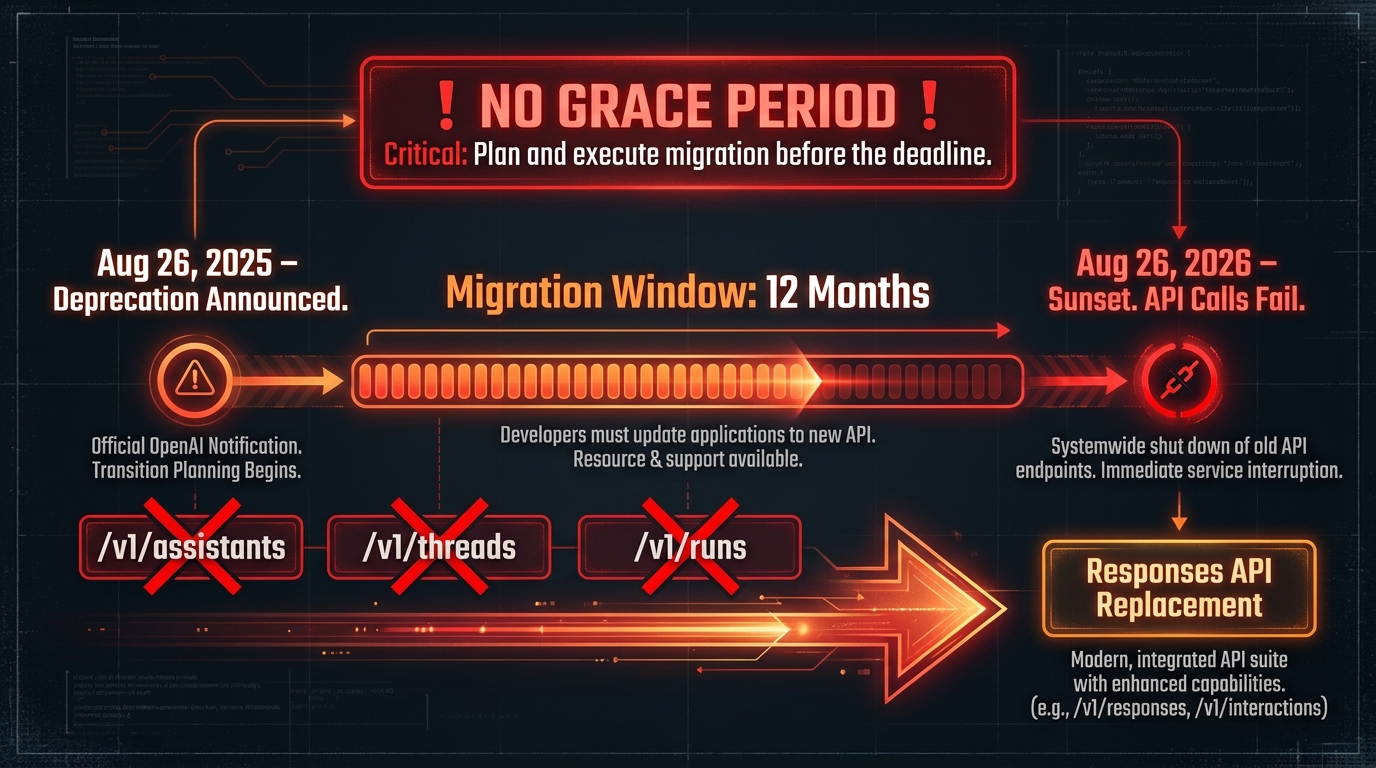
On August 26, 2025, OpenAI announced the deprecation of the Assistants API. On August 26, 2026 — exactly one year later — the API was sunset. No grace period. No degraded mode. Applications using /v1/assistants, /v1/threads, or /v1/runs started receiving hard failures at the API call level the moment the cutoff passed.
The replacement stack is the Responses API for stateless or short-context interactions, and the Conversations API for stateful, multi-turn workflows. On paper, this sounds manageable. In practice, it wasn’t a drop-in substitution — it was a fundamental rearchitecting of how state, tool loops, streaming, retrieval, and governance were handled.
Where Teams Got Caught
The teams that suffered most weren’t the ones that didn’t know the sunset was coming. They were the ones that knew and underestimated the scope of the rework. The Assistants API managed thread state automatically. The Responses API doesn’t — state management becomes the application’s responsibility. Teams that had offloaded thread management to OpenAI had to build that layer themselves, or adopt a new orchestration framework to handle it.
Retrieval was similarly restructured. File Search in the old Assistants model worked differently from the retrieval patterns supported in the Responses API. Production systems that had ingested hundreds or thousands of documents into Assistants-managed vector stores had to re-architect their retrieval pipeline from scratch.
The Lessons That Transfer
The Assistants API migration crystallized three rules that apply to any forced platform migration:
- Never offload state management to a vendor abstraction you don’t control. When the vendor changes their object model, you inherit all of the rework. Externalize your state layer into infrastructure you own.
- A 12-month deprecation window is shorter than it looks. Enterprise teams that received the August 2025 notice didn’t start serious migration work until Q1 2026 in many cases, leaving 2-3 months of sprint work jammed into a window that should have been 6-8 months of steady migration.
- Test against the new API in shadow mode before cutting over. Teams that ran the old Assistants flow and the new Responses flow in parallel for 60+ days caught edge cases in multi-turn behavior, streaming timeout handling, and error format differences that would have caused silent production failures at cutover.
Minimize Before You Retrain: The Intervention Hierarchy
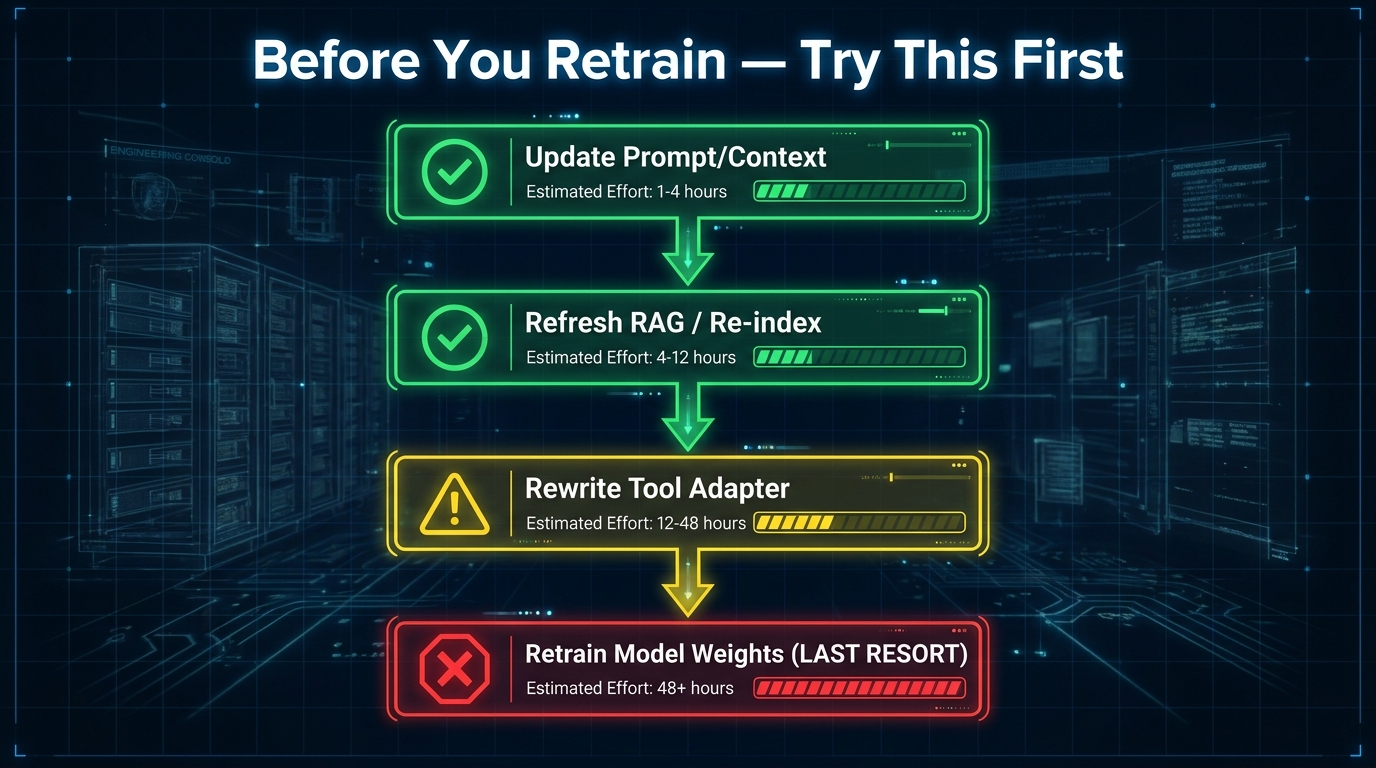
One of the most expensive mistakes in AI operations is treating every platform update as a retraining event. Full model retraining — collecting new data, running training jobs, validating outputs, deploying — is a multi-week cycle that consumes engineering hours, GPU compute, and evaluation effort. It should be the last resort, not the first response.
The correct approach is a strict intervention hierarchy: start with the lowest-cost fix that could plausibly solve the problem, validate whether it worked, then escalate only if it didn’t.
Step 1: Prompt and Context Update (Hours, Near-Zero Cost)
When a platform update changes model behavior at the output or instruction-following level, a prompt update is almost always the right first move. This means revising the system prompt to accommodate the new behavior, adding explicit format instructions, or restructuring few-shot examples to demonstrate the desired output pattern. The cost is nearly zero — no training compute, no data collection, and changes can be shipped in minutes.
The catch is that prompt updates have limits. If the behavioral change is fundamental enough that no amount of instruction can steer the model back to the correct output distribution, you need to escalate. A good test: if your revised prompt produces correct outputs on 90%+ of your golden dataset, the problem is solved at this layer. If you’re stuck at 70-80%, escalate.
Step 2: Retrieval Refresh and Re-indexing (Hours to Days, Moderate Cost)
When a platform update changes the knowledge, data, or retrieval behavior that your agent depends on, the fix is often a retrieval refresh rather than a model update. Re-index your vector store with updated documents. Refresh your embedding indexes to reflect changes in data schema or vocabulary. Update RAG retrieval parameters to accommodate new context window sizes or retrieval limits.
This is especially relevant when a platform update changes what data your agent can access, or when vendor-managed knowledge bases (like the ones in the old Assistants API) need to be reconstructed under a new retrieval architecture. The key distinction is that you’re updating what the agent knows, not how it reasons.
Step 3: Tool Adapter Rewrite (Days, Low-to-Moderate Cost)
When a platform update changes a tool’s API, schema, or interface, the fix is a targeted adapter rewrite. This is the level most teams reach after an API deprecation or endpoint change. A well-architected agent won’t need its model weights touched at all — the adapter handles the translation between the agent’s expected interface and the new actual interface, and the model continues working with its original tool-calling logic.
The effort here scales with how tightly coupled the original tool integration was. If tools were abstracted behind a common schema layer, adapter rewrites are isolated and fast. If tool calls were hardcoded throughout the agent’s logic, you’re facing a more significant refactoring exercise — and a clear sign that the architecture needs attention before the next update cycle hits.
Step 4: Model Retraining (Weeks, High Cost — Last Resort)
Retraining becomes appropriate when: performance regressions persist after prompt updates, retrieval refreshes, and adapter rewrites; when the platform update has fundamentally changed the distribution of inputs the agent sees; or when tool and schema changes are severe enough that the agent’s learned behavior is now systematically misaligned with how it’s expected to act. The trigger for retraining should be evidence-based — sustained KPI decline across a full evaluation cycle, not a single bad day of metrics.
MetaClaw and the Two-Speed Update Pattern
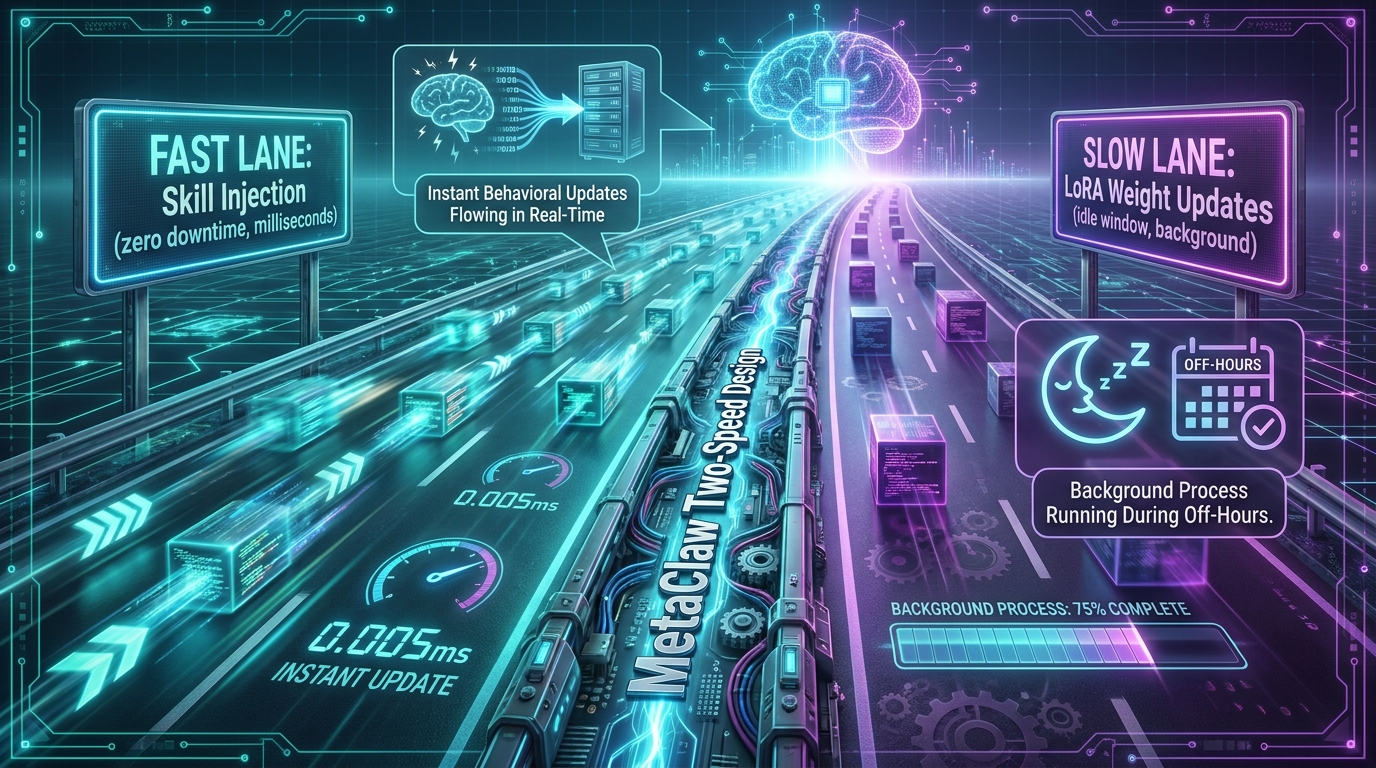
Until recently, “retraining without downtime” was treated as a contradiction in terms. You took the agent offline, ran the training job, validated the new model, and redeployed. The window where the agent wasn’t serving was an accepted cost. The MetaClaw framework, published in early 2026 by researchers from UNC, CMU, UC Santa Cruz, and UC Berkeley, proposes a different architecture — one that separates the fast and slow components of adaptation into two independent tracks.
The Fast Lane: Skill Injection
When an agent encounters a failure — a tool call that returns an unexpected format, a task it handles incorrectly, a user correction that reveals a behavioral gap — MetaClaw converts that failure trace into a reusable skill. The skill encodes what went wrong and what the correct behavior should be, and it’s injected at inference time on the next call. No model weights change. No training job runs. The fix is available immediately, at the speed of a context update.
In benchmark testing, skill-driven adaptation produced up to 32% relative accuracy improvement from a starting baseline, demonstrating that a surprisingly large proportion of agent behavioral failures can be corrected at the skill level without touching weights at all. For post-platform-update scenarios, this means the first-line response to a tool failure or output regression doesn’t have to wait for a retraining cycle.
The Slow Lane: Opportunistic Weight Updates
For corrections that go deeper than skill injection can address — fundamental reasoning patterns, long-horizon task planning, domain-specific knowledge that needs to be encoded in weights — MetaClaw runs LoRA-based fine-tuning in the background. The key mechanism is the Opportunistic Meta-Learning Scheduler (OMLS), which watches for user inactivity signals (keyboard and mouse inactivity, calendar gaps, sleep hours) and schedules training to run only during safe idle windows.
If a user returns to activity mid-training, the job pauses gracefully and resumes at the next idle window. The base model stays frozen throughout. Only the small LoRA adapter weights change, and the adapter is hot-swapped into serving once validation passes. The production agent never goes offline.
What This Means for Platform Update Recovery
The two-speed design is particularly valuable in platform-update scenarios because different aspects of the update require different adaptation speeds. Tool schema changes and output format issues can be addressed via skill injection immediately. Deeper behavioral shifts that require weight updates can be handled via scheduled LoRA fine-tuning in the background, without interrupting the service. The result is a continuous adaptation loop rather than a discrete retrain-and-redeploy cycle.
Building a Shadow-Run Migration Architecture
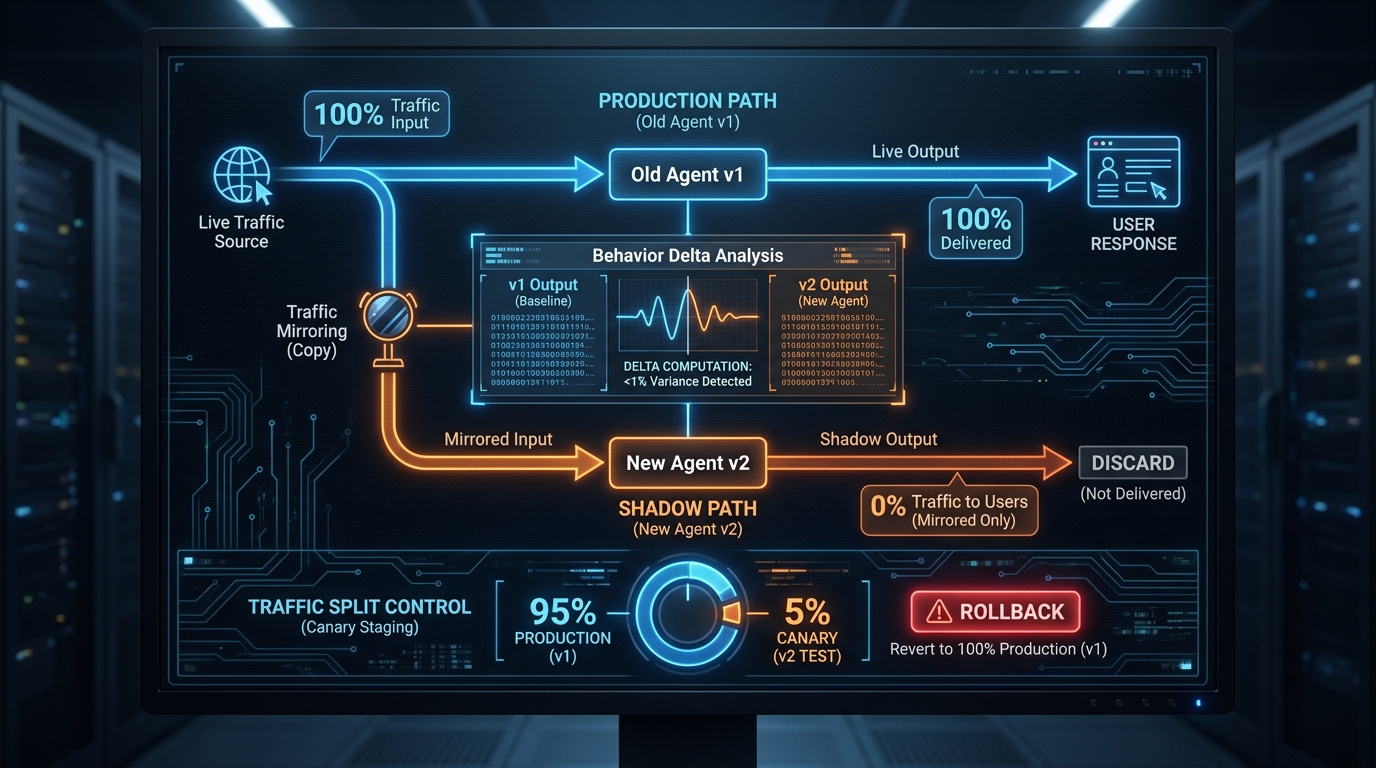
When a platform update is significant enough to require a full migration — new API, new orchestration framework, new model version — the safest approach is not a big-bang cutover. It’s a shadow run: a parallel deployment where the old system continues handling 100% of production traffic while the new system receives mirrored copies of every input and processes them in the background, without delivering its outputs to users.
The Shadow Phase
During the shadow phase, you’re not validating whether the new system works in theory — you’re validating whether it works on the actual distribution of inputs your production agents receive. That distinction matters enormously. Golden datasets catch the cases you thought to test for. Shadow traffic catches the cases you didn’t think of: rare multi-turn conversation patterns, edge-case tool inputs, unusual user phrasing, API response edge cases that only appear at production volume.
The comparison you’re running during this phase is a behavior delta analysis. For each mirrored input, you compare the old system’s output against the new system’s output across several dimensions: task completion rate, output format consistency, tool call accuracy, latency distribution, and error rate. You’re looking for systematic differences, not identical outputs. Some behavioral divergence is expected and acceptable — the question is whether the new system’s behavior is better, equivalent, or worse.
Externalizing State Before You Cut Over
One of the most important pre-migration steps is externalizing agent state into infrastructure you control, independent of either platform. This means storing conversation history, user context, task progress, and session data in your own database or cache layer — not in the vendor’s managed thread or session object.
When state lives in platform-managed objects (like OpenAI’s threads, or a vendor’s built-in session store), a platform migration becomes a state migration simultaneously, which doubles the complexity and the risk. When state lives in external infrastructure, the new agent simply reads from the same store the old agent was writing to. The cutover is cleaner, rollback is simpler, and the risk surface is smaller.
The Canary Cutover
After a successful shadow phase, the transition to the new system should be gradual rather than instantaneous. Start by routing 1-5% of live traffic to the new system, with the old system as an immediate fallback if the new system’s metrics fall outside acceptable thresholds. Expand the percentage incrementally — 5%, 10%, 25%, 50%, 100% — with a minimum validation period at each stage.
Recent evidence suggests that feature flags combined with canary deployments can reduce deployment-related incidents by up to 72%, and cut mean time to recovery (MTTR) from hours to under 30 seconds when something does go wrong. The rollback path is a flag flip, not a redeployment — which means you can halt a bad migration in seconds, not minutes.
Continuous Evaluation as the Operational Control Layer
The single most important shift in AI agent operations in 2026 is the movement of evaluation from a post-hoc checkpoint to a continuous real-time control layer. In 2024, teams ran eval suites before deployment and called it done. In 2026, teams run evals before deployment, during shadow validation, during canary rollout, and continuously against a sampled slice of production traffic — indefinitely.
This shift matters for platform-update resilience because it means you detect drift as it happens, not after it’s caused damage. A continuous eval system watching your agent’s task completion rate, tool-call accuracy, and output groundedness will show you a regression within hours of a platform update propagating. Without continuous monitoring, you might not notice for days.
What to Measure Continuously
The most consistently recommended metrics for continuous agent monitoring in 2026 are:
- Task completion rate: Does the agent finish the end task correctly, end-to-end? This is your headline metric and the one most sensitive to platform breaks.
- Tool-call accuracy: Is the agent calling the right tool, with the right arguments, in the right sequence? Tool-call errors are often the first signal of API or schema drift.
- Step efficiency: How many steps does the agent take to complete a task? An increase in step count can indicate the agent is retrying failed tool calls or working around unexpected behavior.
- Human intervention rate: How often is the agent’s output being overridden, corrected, or escalated by a human? This is a lagging indicator but one of the most reliable signals of real-world quality degradation.
- Latency and cost: Unexpected increases in either can indicate the agent is making additional API calls it shouldn’t be, retrying failed operations, or processing larger-than-expected context windows.
- Failure type distribution: Which types of failures are occurring? A shift in the failure distribution after a platform update is a strong signal of exactly which layer broke.
The Eval Stack in Practice
The most commonly cited production eval stacks in 2026 combine offline trajectory evaluations (using tools like DeepEval, promptfoo, or Braintrust for CI/CD gating), real-time trace capture (OpenTelemetry-style instrumentation sending traces to Arize Phoenix, LangSmith, or MLflow), and drift detection running on rolling windows of sampled production traffic. LLM-as-judge scoring is increasingly standard for evaluating output quality at scale — human review of every output isn’t economically viable, but LLM reviewers running against 5-10% of traffic plus anomaly-flagged traces provides enough signal to catch most regressions quickly.
LoRA Adapters and Hot-Swappable Retraining in Production
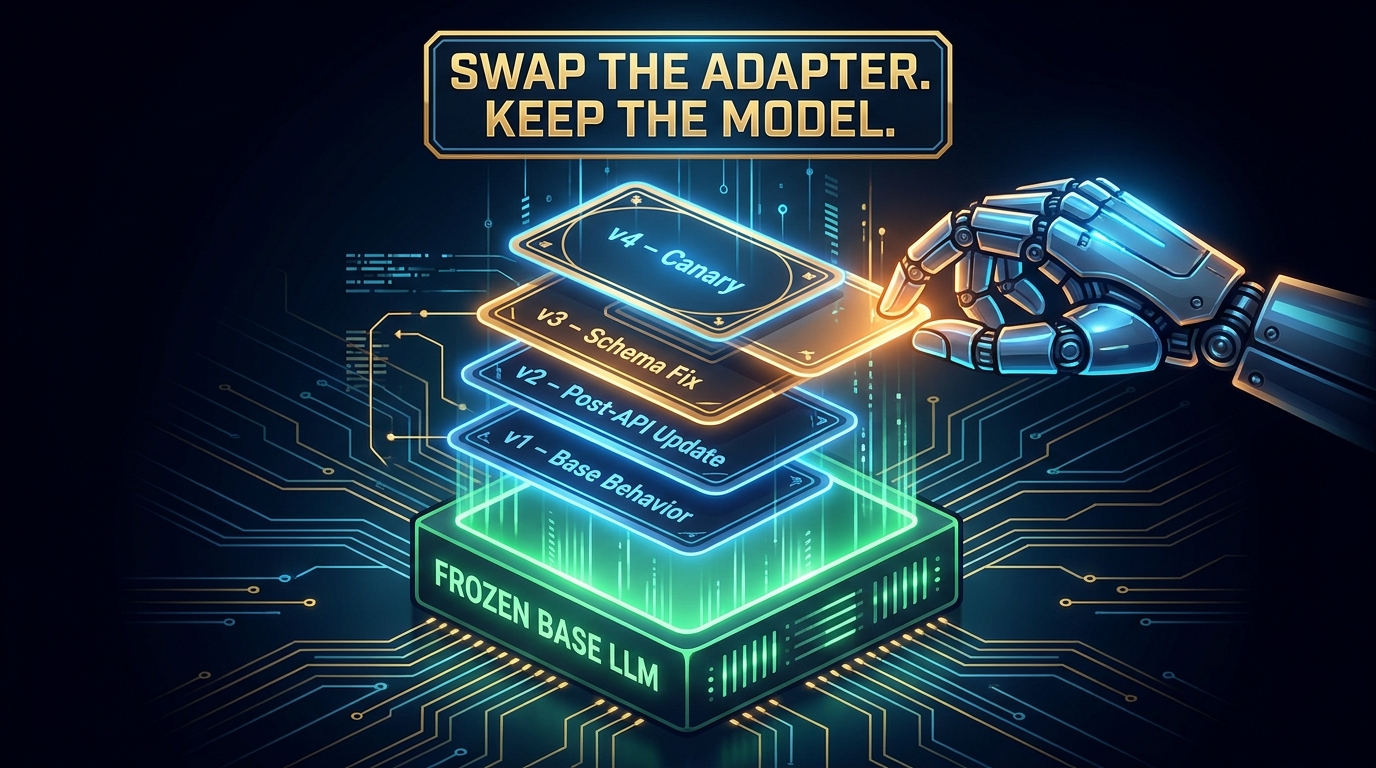
When you’ve exhausted the lower-intervention options and determine that model weights actually need to change, the question shifts from whether to retrain to how to retrain without interrupting service. In 2026, the standard production answer is LoRA (Low-Rank Adaptation) fine-tuning with hot-swappable adapters.
Why LoRA Is the Default Production Choice
LoRA works by freezing the base model’s weights entirely and training small, low-rank update matrices that are applied at inference time. In practice, LoRA adapters update only 0.1-1% of the total model parameters, which means training jobs are dramatically faster and cheaper than full fine-tuning. A LoRA fine-tune that might take hours can replace a full fine-tune that would take days, on a fraction of the GPU compute.
More importantly for production operations, LoRA adapters are separately versioned artifacts that can be loaded, unloaded, and swapped without changing or reloading the base model. This means you can run a canary validation of a new adapter — routing 5% of traffic through the base model plus new adapter, and 95% through the base model plus current adapter — and roll back in seconds if the new adapter causes regressions. The base model never goes offline.
The Production Retraining Cycle
The recommended cycle for production LoRA retraining after a platform update looks like this:
- Collect failure traces: During and after the platform update, log every failure, correction, and low-confidence output. These become your training signal.
- Build correction pairs: For each failure trace, construct an input-output pair that demonstrates the correct behavior under the new platform conditions. This is your fine-tuning dataset.
- Train a new adapter: Run a LoRA or QLoRA fine-tune on the correction pairs, keeping the base model frozen. Use QLoRA (quantized LoRA) if GPU memory is a constraint.
- Validate against a held-out set: Before deploying, validate the new adapter against a held-out golden dataset that covers both the new failure scenarios and the existing capabilities you need to preserve. Watch for catastrophic forgetting — cases where the new adapter fixes the platform-update issues but degrades performance on previously-working tasks.
- Canary deploy the adapter: Route a small percentage of production traffic through the new adapter and monitor the full eval stack. Expand only when metrics are stable.
- Version and archive: Keep the previous adapter version available for instant rollback. Build adapter versioning into your deployment infrastructure the same way you’d version any other production artifact.
Feature Flags, Canary Releases, and Instant Rollback for AI Agents
The most robust operational infrastructure for managing AI agent updates borrows heavily from modern software release engineering: feature flags as the behavioral control plane, canary releases as the traffic validation mechanism, and kill switches as the instant-rollback mechanism when things go wrong. Applied to AI agents, this pattern deserves some adaptation for the specific ways AI systems fail.
Feature Flags for Agent Behavior
A feature flag in software engineering gates a code path. For AI agents, a feature flag gates a behavioral configuration: which prompt version is active, which tool adapter is in use, which model version or adapter is serving requests, which retrieval index is being queried. The key insight is that you can update any of these independently, and you can roll back any of them independently.
The recommended starting structure for AI agent feature flags is a hierarchy of control: an agent-wide kill switch that can instantly route all traffic back to the previous configuration, per-tool flags that can disable or redirect individual tool calls, and per-capability flags that can enable or disable specific agent behaviors (like using a new retrieval method, or enabling multi-step reasoning). This granularity means that when a platform update breaks a specific tool integration, you can disable that tool’s new adapter and fall back to the old one without affecting any other part of the agent’s behavior.
The Canary Metrics That Actually Matter
When running a canary release for an agent update, the metrics you watch should be AI-specific, not just infrastructure metrics. Latency P95 and error rates are necessary but not sufficient — an AI agent can pass both while producing systematically wrong outputs. The canary validation gate should require:
- Task completion rate within 2% of baseline (or better)
- Tool-call accuracy within 5% of baseline
- LLM-as-judge output quality score at or above baseline
- Human intervention rate not significantly increased
- No new failure mode categories appearing in trace analysis
If the canary cohort fails any of these gates, the flag flips back automatically. No engineer needs to be paged at 2 AM to trigger a rollback. The system handles it, and the on-call team gets a notification about what triggered the rollback so the issue can be investigated during business hours.
Provider-Agnostic Tool Schemas: Your Insurance Against Future Lock-In
Everything discussed so far addresses how to recover cleanly when a platform update happens. But the best operational strategy is to reduce how much any single platform update can break in the first place. The mechanism for this is provider-agnostic tool schema design — a layer of abstraction between your agent’s tool-calling logic and the specific API or service implementing each tool.
What Provider-Agnostic Schemas Actually Look Like
A provider-agnostic tool schema defines a tool’s interface in terms your agent understands, independent of how any particular vendor implements it. Your agent calls search_knowledge_base(query: str, top_k: int) against a stable schema definition. Behind that definition, a thin adapter layer translates the call to whatever the actual retrieval service’s API expects. When the retrieval service updates its API, you update the adapter. The agent, and the schema it calls against, remains unchanged.
LangChain’s tool calling architecture already supports this pattern, defining tool interfaces in a provider-agnostic format with thin adapters per model provider. LangGraph’s recent addition of Standard JSON Schema support for graph state definitions extends this pattern to the orchestration layer — state schemas can now be defined in portable JSON Schema and validated against any compliant schema library, reducing framework lock-in at the state management level.
The Contract-First Design Principle
The underlying principle is what software engineers call contract-first design: define the contract (the schema, the interface, the expected behavior) before implementing either side of it. When your agent is built against a contract rather than an implementation, platform changes on the implementation side don’t reach through to the agent. They stop at the adapter layer.
This has significant implications for how you evaluate and test agents too. A contract-first agent can be tested against mock implementations of each tool — you don’t need live API connections to validate tool-calling logic. When a real API updates, you update the adapter, test the adapter against the new API, and verify that the agent’s behavior against the contract is unchanged. The agent’s eval suite doesn’t need to change at all.
Vendor Diversification as an Operational Strategy
Provider-agnostic schemas also enable something more strategic: the ability to run multiple vendors for the same capability and route between them based on availability, cost, or performance. If your primary LLM provider has an outage or pushes an update that degrades performance, a provider-agnostic layer lets you reroute to a secondary provider instantly, without any changes to your agent logic. The OpenAI Assistants API sunset would have been significantly less disruptive for teams that had already abstracted their LLM calls behind a provider-neutral interface.
Turning Update Resilience Into an Engineering Discipline
Everything in this article points toward the same conclusion: operational continuity during platform updates is not a checklist you run once. It’s an engineering discipline that needs to be designed into your agent architecture from day one, maintained continuously, and tested regularly against realistic update scenarios.
The Resilience Checklist for Production Agent Teams
Here’s what “designed for update resilience” actually looks like in practice:
- State is externalized. No critical agent state lives in vendor-managed objects you don’t control.
- Tools are abstracted. Every tool call goes through a provider-agnostic schema with a thin adapter layer.
- Evals run continuously. A rolling evaluation process monitors task completion, tool accuracy, and output quality on sampled production traffic at all times.
- A golden dataset exists and is maintained. You have a curated set of representative inputs and expected outputs that can immediately detect regressions after any change.
- Shadow infrastructure is always ready. Your deployment architecture can spin up a parallel shadow instance within hours when a major platform update is announced.
- Feature flags control all behavioral configuration. Every prompt version, adapter, tool, and model version is gated by a flag that can be flipped instantly.
- Adapter versions are maintained. Previous tool adapters and LoRA adapters are archived and can be re-deployed without rebuilding from scratch.
- Retraining triggers are defined in advance. Your team knows exactly which metric thresholds will trigger a retraining event, and those thresholds are monitored automatically.
The Retraining Decision Framework
When a platform update hits and your evals start showing regressions, work through the intervention hierarchy in order:
- Run your golden dataset eval immediately to identify which task categories are affected.
- Check tool-call traces first — is this a tool/API layer failure? If so, update the adapter.
- If tool calls are clean, check output format and reasoning — is this a prompt-layer issue? Update the system prompt and re-eval.
- If prompt updates don’t restore performance, check retrieval — is outdated or misstructured knowledge causing the regression? Re-index and re-eval.
- If all three fail to restore KPIs within acceptable thresholds, schedule LoRA fine-tuning on the correction dataset, validate with canary, deploy.
The Competitive Advantage Hidden in Operational Discipline
There’s a business case embedded in all of this beyond just keeping the lights on. Teams that have built genuine update resilience into their agent architecture deploy changes faster, break production less often, and recover from vendor-side disruptions in hours rather than weeks. The Assistants API sunset gave every enterprise AI team a 12-month warning and still caught many of them scrambling at the deadline.
The teams that navigated it cleanly were the ones that had already externalized their state, abstracted their tool calls, and built continuous eval systems. Not because they predicted this particular event, but because they had built for the general case: platforms will change, and our agents need to keep running anyway.
In a market where AI-powered operations are increasingly a competitive differentiator, the ability to absorb vendor disruptions without operational downtime is worth investing in — not as a cost center, but as the infrastructure that makes everything else reliable enough to depend on.
The Bottom Line
Retraining after a platform update is rarely the right first move, and it’s almost never the only move. The teams that keep ops running through platform disruptions are the ones that understand which layer of their agent stack actually broke, apply the lowest-cost intervention that plausibly fixes it, validate continuously, and escalate deliberately only when the evidence demands it.
Build the shadow infrastructure. Externalize your state. Abstract your tool schemas. Run continuous evals. When a platform updates — and it will — you won’t be scrambling. You’ll be watching your monitoring dashboard, noting the anomaly, patching the adapter, and moving on before anyone outside your team even noticed there was a problem.
That’s not resilience by luck. That’s resilience by design.