




Before you even think about recruiting your first affiliate, you need a solid game plan. This isn't just busywork; it's about setting clear, measurable goals that define what a "win" actually looks like for your business, whether you're a DTC brand pushing for revenue or a TikTok Shop seller trying to get a new product off the ground. Getting this right from the start is what separates a profitable program from a money pit.
Building Your Affiliate Program Foundation
Jumping straight into affiliate recruitment without a plan is like setting sail without a map. Sure, you'll be moving, but you'll have no idea if you're actually getting closer to your destination. A strong foundation ensures every partner you bring on, every commission you pay, and every campaign you launch is pulling in the same direction—toward your core business objectives. This is how you build a scalable engine for growth, not just another marketing expense.
The first move isn't finding partners; it's defining your destination. Vague goals like "increase sales" just won't cut it. You need specific, measurable targets that directly impact the health of your business.
Defining Your Program's Core Objectives
Your affiliate program has to be a direct extension of your bigger business strategy. Are you trying to find brand new customers? Push up your average order value (AOV)? Or maybe break into a totally new market? Your affiliate goals need to lock in with these priorities.
Here are a few real-world examples of what solid objectives look like:
- For a DTC supplements brand: Achieve a 15% lift in revenue from new customers within six months. The target affiliate AOV needs to hit $75 or higher.
- For an Amazon FBA seller: Drive 5,000 qualified clicks to a specific ASIN, shooting for a 5% conversion rate from that affiliate traffic by the end of Q3.
- For a new TikTok Shop: Nail down 1,000 sales on a new product line in the first 90 days, sourced exclusively from TikTok Shop affiliates.
See the difference? These goals are powerful because they’re specific, measurable, and have a deadline. They give you a clear yardstick to measure everything against.
Establishing Performance Benchmarks
Once you know what you’re aiming for, you need to decide how you'll keep score. This means establishing the key performance indicators (KPIs) that tell you if you're on the right track. These metrics are what turn your goals into a real-time dashboard, letting you monitor the program's health and make smart, data-driven tweaks.
Your affiliate program isn't just another marketing channel; it's a performance-based ecosystem. Success hinges on tracking the right metrics from the start. Vague goals lead to wasted ad spend and unmotivated partners.
At a minimum, you should be tracking these essential benchmarks:
- Conversion Rate (CVR): What percentage of clicks are turning into actual sales?
- Average Order Value (AOV): How much is the typical customer spending per order?
- Customer Acquisition Cost (CAC): What’s it costing you to get a new customer through the affiliate channel?
- Return on Ad Spend (ROAS): For every dollar you pay out in commissions, how much revenue are you getting back?
Practical Example: Let's say you set a goal to acquire new customers. You'll track CVR and CAC very closely. If you see an affiliate sending tons of traffic (clicks) but their CVR is near zero, their audience might not be the right fit. Conversely, if another affiliate has a high CVR and a low CAC, you know their audience is your sweet spot, and you should invest more in that relationship.
Setting realistic targets for these KPIs is absolutely crucial. For a deeper dive that covers everything from commission structures to recruitment tactics, check out this a complete guide to starting an affiliate program. Nailing this groundwork ensures your affiliate marketing isn't just more noise but a calculated strategy for real business growth.
Choosing the Right Affiliate Platform and Network
Once you’ve nailed down your goals, the next big decision is picking the technology to run your program. This isn't just about tracking clicks. It's the central nervous system for managing your partners, handling payouts, and seeing what’s actually working. The right platform can be a massive force multiplier, but the wrong one will just give you headaches and hold you back.
Generally, you're looking at two main paths: using self-hosted software or joining an established affiliate network. Each has its pros and cons, and the best fit really depends on your business, your team's tech skills, and where you sell your products.
Self-Hosted Software vs. Affiliate Networks
Self-hosted platforms, like Post Affiliate Pro, put you in the driver's seat. You get total control. You install the software on your own servers, manage everything directly, and usually pay a flat fee. This can save you a ton of money in the long run since you're not paying network override fees on every single sale.
The catch? You’re on your own for recruitment. There’s no built-in marketplace of partners waiting to join your program. You have to find, vet, and onboard every single affiliate yourself.
On the flip side, affiliate networks like ShareASale, CJ Affiliate, or Impact are like a bustling marketplace. They come with thousands of publishers, bloggers, and creators who are already looking for brands to promote. This can seriously fast-track your recruitment and get you off the ground quickly.
The trade-off here is the cost. Networks typically hit you with a setup fee, a monthly minimum, and a percentage of every commission you pay out. So, while you get access to partners faster, it comes at a price. For newcomers figuring out how to start affiliate marketing, a network is often the quickest way to get those first few partners in the door.
This decision tree can help you visualize which path makes the most sense based on what you're trying to achieve right now.
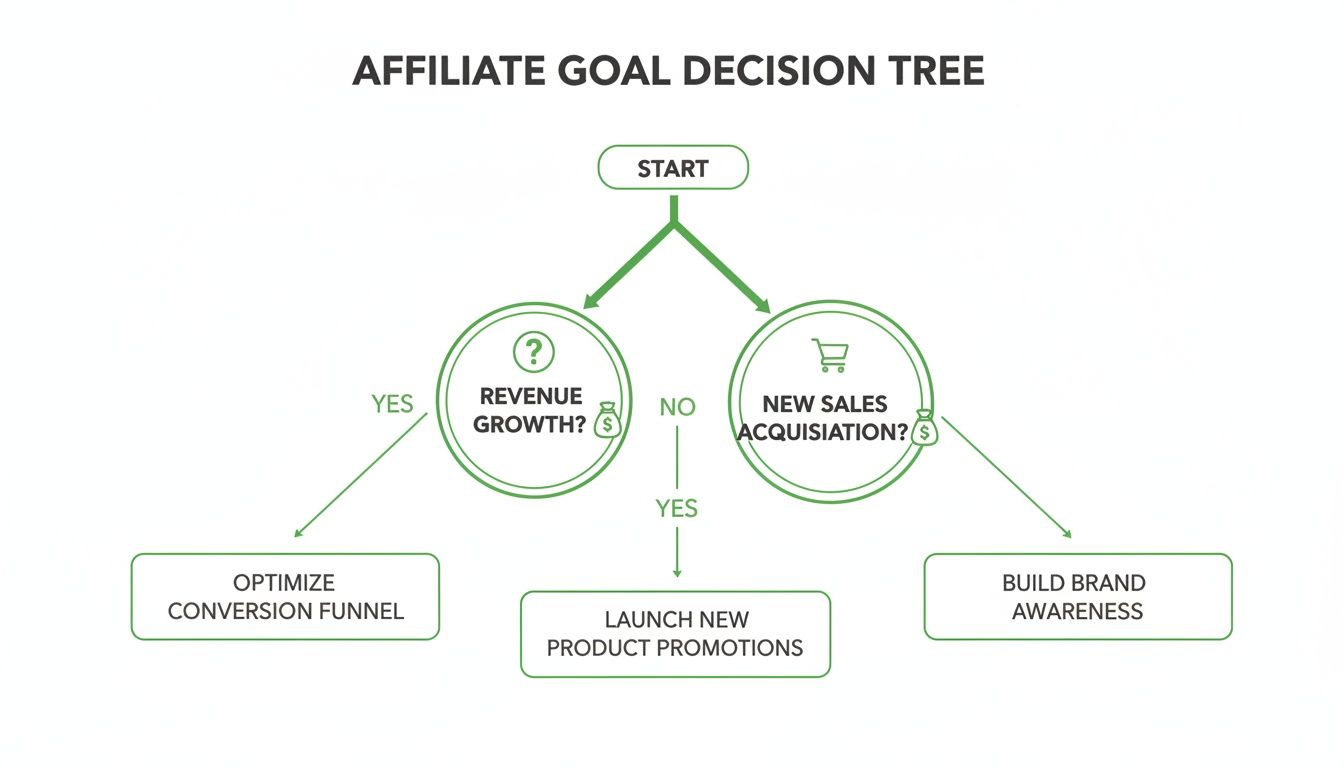
It’s a simple way to see if your goals—whether it’s immediate sales or finding new customers—line up better with the broad reach of a network or the controlled environment of a self-hosted solution.
Practical Considerations for Ecommerce Brands
For anyone selling on their own DTC site, Amazon, or TikTok Shop, the choice is more than just about cost. Your sales channels have unique technical needs, and your platform has to keep up.
Here’s what I always tell clients to look for:
- Painless Integration: Does the platform connect easily with your store, like a one-click app for Shopify or BigCommerce? Can it track sales accurately right out of the box without needing a developer to write custom code?
- Amazon Compliance: If you're an Amazon seller, does the platform play nice with Amazon Attribution? This is a deal-breaker. It’s the only way to accurately track sales from external traffic and make sure you're paying commissions on verified Amazon sales.
- TikTok Shop Tracking: For TikTok sellers, attribution gets even trickier. You need a platform that understands social commerce tracking. Many brands are also looking into how to become a TikTok Shop affiliate partner (https://zonflip.com/become-a-tiktok-shop-affiliate-partner-the-ultimate-guide/) to use the platform's native tools, and your software needs to complement that, not compete with it.
Here’s a practical workflow example: A Shopify store owner chooses ShareASale.
Step 1: They sign up for ShareASale and pay the setup fee.
Step 2: They install the ShareASale tracking app from the Shopify App Store.
Step 3: The app automatically places the necessary tracking pixel on their checkout page.
Step 4: They set their program terms (commission, cookie life) inside their ShareASale dashboard.
Step 5: The program goes live in the ShareASale marketplace, and they can start approving affiliate applications. The entire technical setup is done in under an hour without writing code.
To help you compare your options, here's a quick breakdown of some of the top players and what they offer.
Affiliate Platform Comparison for Ecommerce Brands
| Platform Type | Best For | Typical Commission/Fees | Key Features |
|---|---|---|---|
| Network (Impact) | Brands of all sizes, especially those needing strong attribution for influencers and diverse partners. | Setup fee, monthly SaaS fee, and commission override (typically 3% of payout). | Marketplace of 200,000+ partners, advanced tracking (including Amazon Attribution), robust reporting, contract management. |
| Network (ShareASale) | Small to medium-sized DTC businesses looking for a large pool of traditional affiliates (bloggers, coupon sites). | Setup fee (around $650), monthly minimum, and 20% transaction fee on affiliate payouts. | User-friendly interface, large publisher base, reliable tracking, good for physical products. |
| SaaS/Hybrid (Refersion) | Shopify and BigCommerce stores wanting a more direct, app-based affiliate management system. | Monthly subscription ($99 – $500+). No network fees. | Deep ecommerce platform integrations, automated commission payments, customizable dashboards. |
| Self-Hosted (Post Affiliate Pro) | Tech-savvy brands on a budget who want maximum control and are willing to handle their own recruitment. | One-time license or monthly fee ($97 – $477). No network fees. | Highly customizable, multiple tracking methods, no commission overrides, requires self-management. |
Ultimately, the platform you choose needs to fit your budget, your team's comfort level with technology, and—most importantly—the channels where you actually make your money. Getting this right from the start is the foundation for building a program that can actually scale.
Designing a Compelling Commission Structure
Let's get one thing straight: your compensation model isn't just a budget line item. It's the very engine that powers your entire affiliate program. This is your number one tool for pulling in top-tier partners and getting them genuinely excited to push your products. When you get this right, you align their goals with yours, creating a powerful partnership that fuels growth for everyone involved.

This step is absolutely critical, as it directly impacts how attractive—and profitable—your program will be. The numbers don't lie. Affiliate marketing is responsible for a massive 16% of all e-commerce sales across the globe. For brands that nail their strategy, affiliates can drive 15-20% of total revenue. With affiliate spending in the US projected to hit $15.8 billion by 2028, this is a channel you can't afford to get wrong. You can dig into more of this data by checking out the full research from the Performance Marketing Association.
Moving Beyond Flat-Rate Commissions
Look, a simple flat-rate percentage is easy to set up, but it rarely inspires your best partners to go the extra mile. The most successful programs I've seen use tiered structures to reward high performance and give affiliates a reason to push harder. It creates a clear roadmap for growth, showing them that more effort directly translates to more money in their pocket.
A tiered model essentially gamifies the process. It's a powerful psychological hook that keeps your top performers locked in and gives newcomers a clear goal to shoot for.
Practical Example: A Tiered Structure in Action
Imagine a DTC skincare brand sets up their program like this:
- Bronze Tier (Default): 10% commission on all sales. This is where everyone starts.
- Silver Tier (>$5,000 in monthly sales): The commission bumps up to 12%. This is a great incentive for consistent, mid-level partners.
- Gold Tier (>$10,000 in monthly sales): The commission jumps to a very attractive 15%, plus they throw in a one-time $250 bonus. This is the elite tier designed to keep your superstars happy and loyal.
This kind of setup does more than just incentivize sales volume; it builds loyalty. Your best affiliates see a real, tangible benefit to prioritizing your brand over the dozens of others they could be promoting.
The Strategic Importance of Cookie Duration
The cookie duration, or attribution window, is another piece of the puzzle you can't overlook. This is simply the length of time an affiliate gets credit for a sale after someone clicks their link. A super short window—like 24 hours—can be a huge turn-off, especially for content creators whose audience might take a few days to think before buying.
A longer cookie duration, say 30, 60, or even 90 days, is way more appealing. It shows affiliates you respect the customer's journey and value the role their content plays in that decision-making process. Think about a blogger who writes a detailed product review. A longer window ensures they get paid even if the reader comes back a week later to make the purchase.
Equipping Your Affiliates for Success
A competitive commission is only half the battle. To really get your partners firing on all cylinders, you have to give them a solid toolkit of creative assets. Making it dead simple for them to promote your products is just as important as how much you pay them.
Your creative library should be a one-stop shop for everything an affiliate could possibly need. Here are the absolute must-haves:
- High-Converting Banners: Give them a variety of ad sizes and slick designs that work everywhere, from blog sidebars to Instagram stories.
- Pre-Written Email Swipes: Craft some killer email copy that affiliates can easily tweak for their own newsletters. Make sure to include punchy subject lines and clear calls-to-action.
- Unique Coupon Codes: Personalized discount codes are a proven way to boost conversions. They also make tracking incredibly straightforward for both you and the affiliate.
- Dynamic Product Feed: For your more advanced partners, a real-time product feed is a game-changer. It lets them integrate your products seamlessly into their sites, ensuring pricing and availability are always up-to-date.
By pairing a compelling, tiered commission structure with a supportive toolkit, you're building an affiliate program that doesn't just attract great talent—it nurtures it for long-term, profitable growth.
Finding and Recruiting High-Impact Affiliates
Once you’ve got the technical bits of your program sorted, the real fun begins: finding the right partners to shout about your brand. The best affiliates aren’t just sitting in a network directory waiting for you. They’re out there creating content, building genuine communities, and earning trust. Your job is to find them where they are and show them why your brand is the perfect next step for their audience.

This isn’t a passive game. In today's market, 81% of advertisers and 84% of publishers are already using affiliate programs. The space is crowded, especially when you consider that platforms like Amazon Associates command a massive 46.11% market share, making it a fierce battleground. If you want a deeper dive into the numbers, these affiliate marketing industry statistics and trends paint a clear picture. Success here comes from building a squad of true brand advocates, not just a spreadsheet of publishers.
Looking Beyond the Obvious for Partners
Don't get hypnotized by huge follower counts. Your ideal affiliate often isn't the biggest name in the game. In fact, some of the most powerful partners are micro-influencers or niche content creators who have a smaller but incredibly engaged and relevant audience—the exact people you want to reach.
Here is a step-by-step workflow for finding potential affiliates:
- Define Your Ideal Affiliate Persona: Who are they? A tech reviewer on YouTube? A mom blogger? A TikTok fitness coach? Be specific.
- Brainstorm Search Terms: Think like your customer. What would they search for on Google, YouTube, or social media?
- Execute the Search:
- TikTok and Instagram Hashtag Hunts: You have to go deeper than the generic tags. If you sell sustainable yoga mats, searching
#yogais a waste of time. Instead, try digging into community-focused hashtags like#yogajourneyor#mindfulmovement. Look for creators who consistently post quality content and have real conversations in their comments. - Competitor Analysis (The Smart Way): Forget just looking at who promotes your direct rivals. Think about complementary products. Selling high-end coffee beans? See which creators are reviewing espresso machines or talking about artisanal mugs. Tools like Ahrefs or Semrush are great for seeing which blogs and sites link to these adjacent brands.
- Niche Blog and YouTube Searches: Get specific with your search terms on Google and YouTube. Instead of a broad query like "skincare reviews," search for "best vitamin C serum for sensitive skin." The creators who show up for these long-tail keywords have carved out real authority with a specific audience.
- TikTok and Instagram Hashtag Hunts: You have to go deeper than the generic tags. If you sell sustainable yoga mats, searching
- Build a Prospect List: Use a simple spreadsheet to track the creator's name, platform link, contact info (email if possible), and a note about why they're a good fit.
Crafting Outreach That Actually Gets a Response
Okay, you’ve got a list of potential partners. Now what? The biggest mistake you can make is sending a generic, copy-paste email. It’s the fastest way to get your message deleted. Your outreach has to show you’ve actually paid attention and believe a partnership is a win-win.
Your outreach email is your first impression. Make it count by proving you know who they are and what their audience cares about. Mention a specific post, video, or article you enjoyed. This small touch shows you're not just another brand spamming their inbox.
Here’s a simple, effective template you can adapt:
Subject: Collaboration Idea: [Your Brand] x [Their Blog/Channel Name]
"Hi [Creator's Name],
My name is [Your Name], and I'm the [Your Title] at [Your Brand]. I've been following your [blog/channel/profile] for a while and loved your recent post on [mention a specific piece of content]. The way you explained [specific topic] was incredibly helpful.
Because your audience is so passionate about [their niche, e.g., sustainable living], I thought our [your product] might be a perfect fit for them. We created it specifically for [your target audience, e.g., people who want eco-friendly home goods without sacrificing quality].
I'd love to send you one to try out, no strings attached. If you like it, we could discuss joining our affiliate program, where we offer a [X%] commission and a [X-day] cookie window.
Let me know if you're interested!
Best,
[Your Name]"
Vetting Potential Affiliates
Not everyone who says "yes" is the right fit. Before you bring someone into your program, you need to do a little due diligence to make sure their values—and their audience—are aligned with your brand. Look past the vanity metrics and focus on what really matters.
Here's a quick vetting checklist:
- Engagement Rate: This is a quick health check. Add up the likes and comments on their last 5-10 posts, divide by the number of posts, and then divide by their follower count. A healthy engagement rate (anything above 3-5%) on platforms like Instagram or TikTok usually points to an active, real audience.
- Content Quality and Brand Alignment: Does their whole vibe—visuals, tone, video quality—feel like it belongs next to your brand? Take a look at other brands they've promoted. Do they align with your own values?
- Audience Authenticity: Use a free tool to do a quick check for fake followers or bots. But also, just use your eyes. Read the comments on their posts. Are people having real conversations, or is it just a wall of fire emojis and "Great post!"? Genuine engagement is easy to spot, and it's a huge green flag.
Scaling and Automating Your Affiliate Operations
Getting your affiliate program launched is a great first step, but the real challenge? That comes when things start to take off.
As your sales volume ramps up, all those manual tasks you could once handle in an afternoon suddenly become massive bottlenecks. Scaling effectively means evolving from a hands-on manager to the architect of a smart, automated system. This is especially true for brands trying to sync inventory with Amazon FBA or a third-party logistics (3PL) provider.
Without a rock-solid operational workflow, a wildly successful affiliate program can actually create chaos behind the scenes. You have to think bigger than just tracking sales and cutting checks. The entire journey after the click—from fulfillment to handling returns—needs to be locked in.
Synchronizing Your Operations
For any e-commerce brand, but especially one using FBA or a 3PL, getting your operations in sync is everything.
Imagine this: one of your star affiliates is driving a ton of traffic to a new product, but when customers land on the page, they see "out of stock." It’s a lost sale for you and a major credibility hit for your affiliate.
You have to build a direct line of communication between your affiliate platform and your inventory management system to stop this from ever happening.
- Real-Time Inventory Sync: Use APIs or built-in integrations to connect your 3PL or FBA inventory levels directly to your affiliate platform. This lets you automatically hit pause on campaigns for out-of-stock items, which means no more wasted ad spend and no more frustrated shoppers.
- Affiliate Product Feeds: Give your top partners a dynamic product feed. This is a live-updated file that ensures they always have the latest info on what’s in stock, current pricing, and any new products you’ve just launched. They can promote your catalog with total confidence.
Managing Returns and Chargebacks
Returns are just a part of doing business online, but they can turn into an accounting nightmare for your affiliate program if you don't have a plan. Paying out a commission on a sale that gets refunded a week later is a direct hit to your profit margin. You need a clear, automated process to handle this.
This process is typically called commission clawback, and it needs to be spelled out crystal clear in your affiliate agreement. Your platform should be set up to automatically reverse a commission if the order is returned within your standard window (say, 30 or 60 days). It’s simple: you only pay for real, completed sales.
Practical Workflow for Returns:
- A customer returns a product purchased through an affiliate link.
- Your e-commerce platform (e.g., Shopify) processes the refund.
- Your affiliate software, integrated with your store, receives a notification of the refund.
- The software automatically identifies the original affiliate credited with the sale.
- The commission for that sale is reversed or "clawed back" from the affiliate's pending payouts. This all happens automatically in the background.
Leaning on Automation for Efficiency
Once your program grows to dozens or even hundreds of affiliates, trying to manage everything by hand is a recipe for disaster. This is where automation tools become your best friend, freeing you up to focus on high-level strategy and building relationships instead of getting buried in admin work.
Modern affiliate platforms come loaded with automation features designed to do the heavy lifting. You can build workflows that take care of the most tedious parts of managing a program.
Key Automation Workflows:
- Performance-Based Communication: Set up triggers to automatically send an encouraging email to an affiliate who's driving clicks but hasn't closed a sale yet. Or, send an automatic "You're crushing it!" message when they hit a new sales milestone.
- Fraud Detection: Good platforms have systems that automatically flag sketchy activity—like a crazy number of clicks from one IP address or sales where the shipping and IP geolocations don't match. This protects you from paying out bogus commissions.
- Scheduled Payouts: Put your payments on autopilot. Set up a system to automatically process and send affiliate payouts on a consistent schedule (like net-30). This builds massive trust and keeps your partners happy and motivated.
By putting these systems in place, you can build a program that runs like a well-oiled machine, no matter how big it gets. The next level is using tech for more than just efficiency—it's about intelligence. You can explore how AI automation services analyze top-performing affiliate content to pull out actionable insights, creating a powerful feedback loop that can inform everything from your PPC campaigns to your social media creative.
Measuring Success and Ensuring Compliance
A growing affiliate program is awesome, but real success isn't just about watching the revenue roll in. A truly profitable program is also a compliant one. This is non-negotiable.
You have to navigate the rules set by the Federal Trade Commission (FTC) and specific platforms like Amazon or TikTok Shop. Getting this wrong can torpedo your program, leading to anything from lost commissions to a full-blown account suspension.
Don't worry, this isn't about memorizing complex legal jargon. It all boils down to one word: transparency. The core principle of FTC guidelines is that any "material connection" between an endorser (your affiliate) and a seller (you) has to be clearly disclosed.
In plain English, their audience needs to know they might earn money if someone clicks their link and buys something.
Mastering Affiliate Disclosures
You can't just leave it up to your affiliates to figure this out. To protect your brand and your partners, you need to provide crystal-clear guidance on how to stay compliant. Give them ready-to-use disclosure language they can copy, paste, and adapt.
Here are a few solid examples you can provide:
- For Blog Posts: A simple statement right at the top of the article works best. Something like, "This post may contain affiliate links. If you make a purchase, I may earn a small commission at no extra cost to you."
- For YouTube Videos: The disclosure needs to be both verbal (mentioned out loud in the video) and written in the description box. For example, "The links in the description are affiliate links, which means I may earn a commission if you click and buy."
- For Social Captions (Instagram/TikTok): Use unambiguous hashtags like #ad, #sponsored, or #affiliate. The key is to make sure they appear before the "read more" cutoff so they're immediately visible.
Beyond the FTC, the platforms you sell on have their own unique rules. Amazon Associates, for instance, requires very specific language: "As an Amazon Associate I earn from qualifying purchases." For TikTok Shop, the rules can change quickly, so it's critical to stay on top of their terms. You can get a good handle on this by reviewing a guide to navigating the TikTok Shop Partner Center terms of service.
Tracking the Metrics That Matter
Once you've got your compliance framework locked down, you can shift your focus to measuring what's actually working. Raw sales numbers are a decent start, but they don't paint the full picture. To really understand your program's health and ROI, you need to dig into specific Key Performance Indicators (KPIs).
Think of these KPIs as the vital signs of your program. They turn a mountain of raw data into actionable insights that tell you exactly where to focus your energy.
Your dashboard shouldn't just be a report card; it should be a roadmap. The right KPIs tell you not only what’s working now, but where your next big growth opportunity lies.
Building a Simple Performance Dashboard
You don't need fancy, expensive software to get started. Honestly, a simple spreadsheet can work wonders in the beginning. Your goal is to create a dashboard that gives you a clean, at-a-glance view of how things are going.
Here are the absolute essential KPIs to include:
- Conversion Rate (CVR): This is the percentage of clicks that turn into a sale. A consistently low CVR could mean there's a disconnect between your affiliate's content and your product page experience.
- Average Order Value (AOV): How much is the typical customer spending when they come from an affiliate? If one partner’s AOV is $120 while the program average is $75, you know they're attracting high-value buyers.
- New-to-Brand Customers: What percentage of sales from affiliates are from first-time buyers? This is a crucial metric that proves your program is actually expanding your customer base, not just giving commissions for sales you might have gotten anyway.
- Top Affiliate Performance: Keep a running list of your top 10 affiliates sorted by revenue, clicks, and conversion rate. This immediately shows you who your stars are and who deserves more of your attention and resources.
Practical Example: A monthly check-in workflow might look like this:
- Week 1: Pull the data for the previous month for all key KPIs.
- Week 2: Identify the top 5 performing affiliates and send them a personalized "thank you" email, perhaps with a small bonus or early access to a new product.
- Week 3: Analyze the bottom 5 performers. Is their traffic low? Is their conversion rate poor? Reach out to see if they need different creative assets or have questions.
- Week 4: Review overall program health against your initial goals and plan for the next month.
Frequently Asked Questions About Affiliate Marketing
Getting your first affiliate program off the ground always brings up a ton of questions. Let's tackle the most common ones I hear from brands and sellers who are just starting out.
How Much Does It Cost to Start a Program?
This is a real "how long is a piece of string?" question, but I can give you some solid goalposts. Your main fixed cost will be the affiliate platform itself. You can find basic software starting around $50 per month, while the big, full-service networks can run into the thousands.
Then, of course, you have the commissions you'll pay out to partners, which usually fall in the 5% to 20% range per sale.
For a smaller brand just dipping its toes in, a realistic starting budget is probably $500 to $1,000 per month. That's before you account for the actual commissions on sales you make.
How Long Until I See Real Results?
I need to be upfront here: affiliate marketing is a long game. It's a growth channel you cultivate, not a switch you flip for instant sales. You should be prepared for it to take 3 to 6 months before you see meaningful, consistent results.
The first few months are all about the groundwork—setting up your tech, finding those first amazing partners, and getting them excited with great creative. You'll likely see a trickle of sales early on, but the real, scalable revenue starts building after that first quarter. That’s when your relationships with affiliates start to mature and they really hit their stride.
Can I Run an Affiliate Program if I Only Sell on Amazon?
You absolutely can. The simplest way in is through the Amazon Associates program, which gives you the basic tools to create unique tracking links for your partners.
But if you want more control and much better data, the real pro move is to use Amazon Attribution. This tool is a game-changer because it lets you see exactly how traffic from your external marketing efforts—like from other affiliate networks or direct deals with influencers—is performing. It gives you the confidence that you're only paying commissions on verified sales that you drove, not just cannibalizing Amazon's own traffic.
If you want a deeper dive into the fundamentals, this is a fantastic resource: What Is Affiliate Marketing? Your Complete Beginner's Guide.
Ready to stop guessing and start growing? ZonFlip offers end-to-end management for your Amazon and TikTok Shop channels, from PPC and listing optimization to building a high-performing affiliate program that drives real revenue. https://www.zonflip.com
Article created using Outrank