


Your product detail page is the single most important asset you have on Amazon. Full stop. It's the foundation for everything else, the one place where you can directly drive higher conversion rates by nailing your title, images, bullets, and description. This "Conversion First" philosophy is the critical first step to unlocking real, sustainable sales velocity.
Master Your Product Listings to Win the Sale
Before you spend a single dollar on ads, your product listing has to be perfect. Think of it as your digital storefront and your best salesperson, working for you 24/7. An unoptimized listing is a leaky bucket—pouring traffic into it is just a waste of money and a massive missed opportunity. The goal is to build a page so compelling it turns casual browsers into buyers.
Considering third-party sellers now account for over 60% of all sales on the platform, getting this right is how you stand out. Sellers who invest in professional-level photography often see conversion rates jump by 20-30%. Why? Because customers rely entirely on visuals. In fact, Amazon's own data shows that listings with 7+ images convert 25% better than those with fewer.
We’ve seen it firsthand: a well-executed listing overhaul can take a product from single-digit daily sales to dozens. Simply A/B testing titles and weaving in top-ranking keywords can boost organic visibility by 40% or more.
Uncover What Your Customers Really Want
This all starts with deep keyword research. This isn't just about finding high-volume search terms; it's about getting inside your customer's head to understand their intent. Use your favorite keyword tool to dig for long-tail keywords—those longer, super-specific phrases shoppers type when they're much closer to buying.
Here's a practical workflow for this:
- Seed Keywords: Start with 2-3 broad terms for your product (e.g., "yoga mat").
- Use a Tool: Plug these into a keyword research tool (like Helium 10 or Jungle Scout) to generate a long list of related terms.
- Filter for Intent: Look for long-tail keywords that signal a specific need. A shopper searching for "running shoes" is just window shopping. But someone searching for "lightweight trail running shoes for wide feet" knows exactly what they need.
- Prioritize: Group keywords by relevance and search volume. Your primary keywords go in the title, secondary keywords in the bullet points, and the rest in your backend search terms.
Winning that customer means strategically placing those precise terms in your title, bullet points, and backend search fields. This is how you make sure your product shows up for the most qualified, highest-intent buyers. For a complete walkthrough, check out our in-depth guide on how to optimize Amazon product listings.
From Dull Features to Compelling Benefits
Here’s a secret that will change how you write copy forever: Shoppers don’t buy features; they buy solutions. They buy better versions of themselves. Your job is to translate every feature into a tangible, desirable benefit.
Feature: Waterproof fabric.
Benefit: Keeps your gear bone-dry through any downpour, so you can adventure with total confidence.
Feature: 10,000 mAh battery.
Benefit: Power through a full weekend of travel without ever hunting for an outlet.
Practical Example: Let's say you sell a kitchen knife.
- Dull Feature: Full-tang German steel blade.
- Compelling Benefit: Slice through tough vegetables effortlessly with a perfectly balanced, professional-grade blade that stays sharp for years.
A benefit-driven approach connects with the customer's emotions. It makes your product feel less like a commodity and more like the perfect solution. It answers the one question every shopper is silently asking: "What's in it for me?"
This entire process can be broken down into a simple, repeatable workflow.
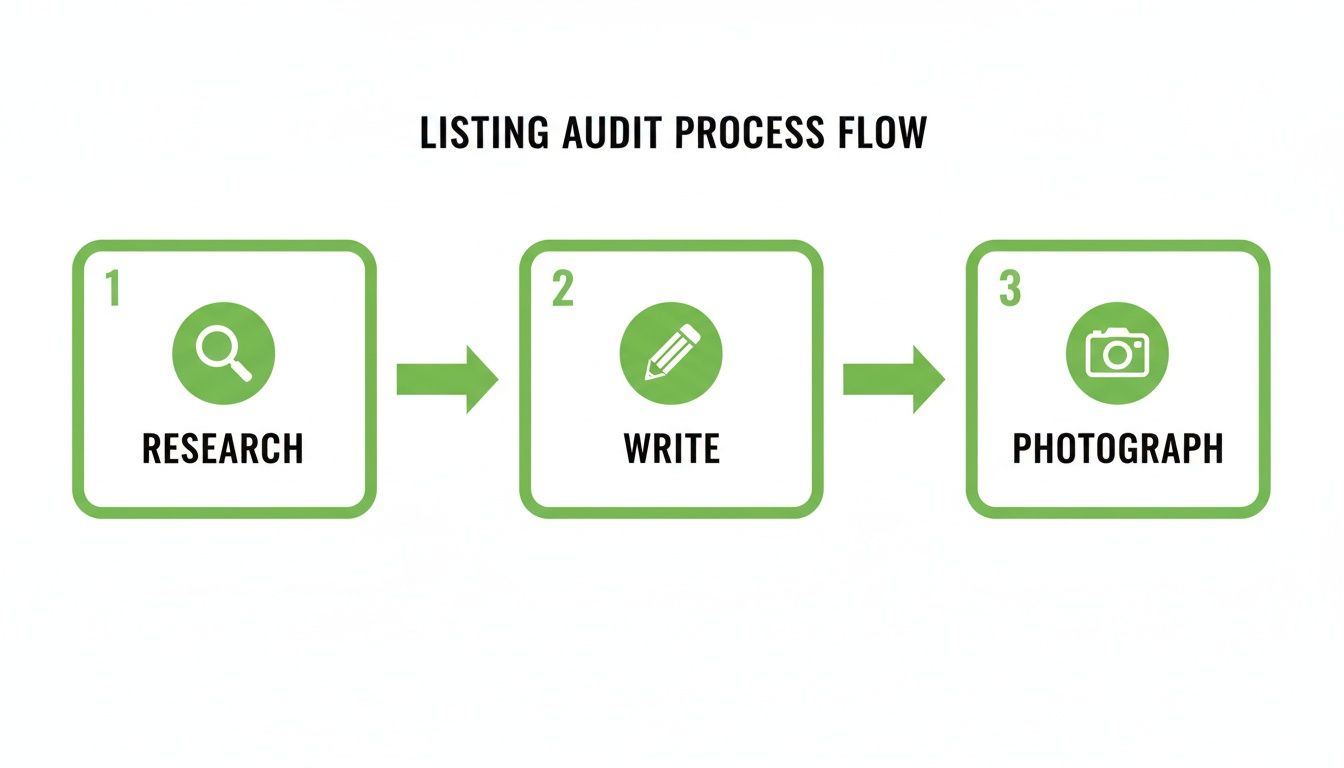
This simple workflow—Research, Write, Photograph—is your roadmap. It ensures every piece of your listing works together to attract shoppers and close the sale.
To help you get started, here's a quick checklist covering the essentials of a high-converting listing.
Essential Amazon Listing Optimization Checklist
This table breaks down the core components you need to audit on your own product detail page.
| Listing Component | Optimization Tactic | Impact on Sales |
|---|---|---|
| Product Title | Include brand, main keyword, key benefit, quantity, and size/color. Front-load the most important keywords. | Dramatically improves click-through rate (CTR) from search results and boosts keyword rank. |
| Product Images (7+) | Use high-res images: main on white, infographics with benefits, lifestyle shots in use, and a comparison chart. | The #1 driver of conversion. Builds trust and helps shoppers visualize owning the product. |
| Bullet Points (5) | Write benefit-driven copy. Start each bullet with a capitalized benefit, followed by the feature that enables it. | Answers key customer questions quickly, reduces hesitation, and increases "Add to Cart." |
| A+ Content / Description | Use modules to tell your brand story, showcase unique features with rich media, and overcome common objections. | Increases conversion rates by an average of 5-10% by providing a premium brand experience. |
| Product Video | Create a short (under 60s) video demonstrating the product, showing its quality, and answering common questions. | A massive conversion booster. It’s the closest you can get to an in-person demo. |
| Backend Search Terms | Fill with relevant long-tail keywords, synonyms, and common misspellings that aren't used in your visible listing copy. | Increases organic visibility for a wider range of search queries without cluttering the listing. |
Use this checklist as your starting point. Going through each component methodically is the fastest way to plug the leaks in your conversion funnel.
The Anatomy of a Perfect Image Stack
Your images are, without a doubt, the most critical part of your listing. Shoppers can’t touch or feel your product, so your photos have to do all the heavy lifting. A complete "image stack" tells a visual story and preemptively answers customer questions.
Here’s the formula for a winning set of images:
- The Main Image: This is your hero shot. It must be on a pure white background and follow all of Amazon's technical rules. Make it crystal clear, high-resolution, and perfectly lit to show your product at its best.
- Infographics: Use 2-3 images to call out key features and turn them into benefits with simple text overlays. Show dimensions, highlight premium materials, or explain a unique function visually.
- Lifestyle Photos: Show your product being used by your ideal customer in a real-world setting. This is crucial for creating an emotional connection—it helps shoppers see themselves using and loving your product. Selling a yoga mat? Show someone in a serene yoga pose, not just the mat rolled up.
- Comparison Chart: Create a simple graphic that stacks your product up against competitors or other models in your own lineup. This makes the buying decision incredibly easy by clearly highlighting why yours is the superior choice.
- Product Video: A short, punchy video is your ultimate conversion weapon. It can demonstrate the product in action, tackle common questions before they’re even asked, and build a level of trust that photos alone can't achieve. This almost always leads to a big jump in add-to-carts.
Drive Profitable Traffic with Smart Amazon PPC Campaigns
Once your product listing is dialed in and ready to convert, it's time to open the traffic floodgates. But hold on. Just flipping the switch on Amazon ads isn't a strategy; it's a good way to burn through cash. A smart Amazon PPC (Pay-Per-Click) approach is about building a scalable engine that pulls in targeted shoppers, uncovers what they're actually searching for, and delivers a solid return.
This isn't just about getting clicks. It’s about getting the right clicks that turn into sales. Those sales then boost your organic ranking, creating a powerful flywheel where your ad spend directly fuels your organic growth. That's how you start to really dominate a niche.
The Tiered Campaign Structure: A Practical Workflow
One of the biggest mistakes I see is sellers dumping a bunch of keywords into a single manual campaign and just hoping for the best. That’s a recipe for wasted spend and messy, unusable data. A much better way is to use a tiered structure that systematically finds and scales the keywords that actually make you money.
It all starts with an Automatic "Discovery" Campaign. Think of this as your research lab. You set a modest daily budget and let Amazon's algorithm do the heavy lifting, showing your ad for a wide range of search terms it thinks are relevant. Your only job here is to sit back and collect data.
After a week or two, it's time to dig into your Search Term Report. This report is pure gold—it shows you the exact phrases customers typed right before they clicked your ad.
Your workflow should look something like this:
- Spot the Winners: Find the search terms that actually led to sales. These are your proven converters.
- Graduate the Keywords: Move these winning search terms into a brand new, separate Manual "Performance" Campaign. In this campaign, you can set precise bids and control your spend with confidence because you already know these keywords work.
- Find the Bleeders: Now, look for the search terms that got clicks but zero sales. These are the irrelevant terms that are just draining your ad budget.
- Add Negative Keywords: Take those non-converting terms and add them as negative exact match keywords in your original Automatic campaign. This move alone can cut your wasted spend by 10-15% almost instantly by telling Amazon to stop showing your ad for those searches.
This rinse-and-repeat process is the absolute core of continuous PPC optimization. The auto campaign discovers, and the manual campaign scales.
From Unprofitable to Profitable: A Real-World Scenario
Let's say a brand is selling premium yoga mats. They launch an auto campaign and, to their horror, find their initial ACoS (Advertising Cost of Sale) is a sky-high 50%. Totally unsustainable.
Using the tiered workflow, they dive into their search term report. They quickly see they're getting expensive clicks from terms like "cheap foam mat" and "kids play mat"—completely irrelevant for their high-end product. They immediately add "cheap," "foam," and "kids" as negative phrase keywords.
At the same time, they spot consistent sales coming from "non-slip cork yoga mat" and "eco friendly yoga mat for hot yoga." They pull these winners out and put them into a new manual campaign with aggressive bids to capture as much of that high-intent traffic as possible. Within a month, by systematically cutting waste and doubling down on what works, they slash their ACoS from 50% down to a very healthy 25%.
This isn't a one-time fix; it's an ongoing process of refinement. Smart PPC management is about making hundreds of small, data-driven adjustments that compound into massive improvements in profitability.
Expanding Your Reach Across the Funnel
Once you have a profitable Sponsored Products engine humming along, you can start layering in other ad types to build a true full-funnel presence.
- Sponsored Brands: These are the banner ads you see at the top of search results. They’re perfect for building brand awareness. You can feature a few products and send shoppers to your Amazon Storefront to tell a more complete brand story.
- Sponsored Display: These ads are your secret weapon for retargeting. They let you follow shoppers who checked out your product but didn't buy, showing up on other Amazon pages and even other websites to remind them to come back and finish the purchase.
Mastering PPC is a true game-changer. Amid Amazon's relentless growth, well-managed campaigns can slash ACoS by 30-50%, often turning $1 spent into $4-$8 in revenue. For a deeper dive on how to control your spend, our guide on understanding Amazon advertising costs is a must-read. To expand your knowledge even further, check out this excellent practical guide to Advertising On Amazon.
Protect Your Momentum with Smart Inventory Management
Great listings and killer PPC campaigns build momentum. Poor inventory management kills it instantly.
All the traffic in the world means nothing if a customer lands on your page only to see that dreaded "Currently unavailable" message. This is where the operational backbone of your business—your inventory and pricing strategy—becomes the make-or-break factor for sustained growth.
Going out of stock is one of the most destructive things that can happen to your Amazon sales. It doesn’t just pause your revenue; it completely erases the sales velocity you worked so hard to build. When that happens, your organic keyword rankings plummet. Getting that momentum back is a slow, expensive, and frustrating climb.
Decoding Your Inventory Health
To stay in stock consistently, you have to get obsessed with two critical Amazon metrics that basically dictate your inventory health and directly impact your visibility.
Inventory Performance Index (IPI) Score: Think of this as Amazon’s scorecard for how well you manage your FBA inventory, on a scale of 0-1000. If your score drops below the required threshold, you can get hit with storage limits and higher fees. Amazon is looking at your sell-through rate, stranded inventory, and in-stock rates to calculate this.
Sell-Through Rate: This metric is pretty straightforward: it’s the units you've sold and shipped over the past 90 days divided by the average number of units you had on hand during that same period. A high sell-through rate signals to Amazon that your products are in demand, which helps your IPI score and can even give your organic rank a nice little boost.
Honestly, effectively managing these two numbers is non-negotiable for any seller who's serious about scaling their sales.
A Practical Method for Demand Forecasting
Predicting how much inventory you'll need isn't about gazing into a crystal ball. It's a blend of solid data analysis and strategic planning. I’ve found a simple yet effective forecasting method involves layering three key data points.
- Analyze Historical Sales Data: First, pull your sales velocity from the last 30, 60, and 90 days. This helps you establish a baseline daily sales average and see your recent trend.
- Factor in Seasonality: Next, look at your sales data from this exact time last year. If you sold 50% more units last November than you did in October, it’s a safe bet to plan for a similar spike this year.
- Account for Promotions: This one trips people up all the time. If you’re planning a big PPC push or a lightning deal for Prime Day, you have to forecast the sales lift and order extra inventory way in advance to cover that surge.
Simple Forecasting Example:
- 30-Day Average Sales: 10 units/day.
- Last Year's November Spike: +50%.
- Planned Black Friday Deal: Expected +100% lift for 4 days.
Your baseline order for November would be (10 units/day * 1.5 seasonality) * 30 days = 450 units. Add an extra (10 units * 4 days) = 40 units for the promotion. Your total order should be around 490 units to be safe.
Staying in stock is a proactive game, not a reactive one. You have to be checking your inventory levels against your forecast constantly. This lets you place reorders long before you hit dangerously low stock levels, protecting your sales rank and your revenue.
Dynamic Pricing Strategies to Maximize Profit
Your pricing should never be "set it and forget it." A dynamic pricing strategy lets you adapt to market shifts, competitor moves, and your own business goals. While automated repricing tools can be powerful, they are definitely not a one-size-fits-all solution.
Using a repricer to constantly undercut competitors for the Buy Box can quickly become a race to the bottom, completely gutting your profit margins and devaluing your brand. These tools work best for highly competitive, commoditized products where a few pennies can make or break a sale.
For private label or branded products where you have more control, a manual, strategic approach is often far better. It allows you to hold your price firm to protect your brand's perceived value while using targeted promotions to hit specific goals.
Let's walk through a real-world scenario. Imagine a brand selling a popular grilling tool wants to maximize sales for the upcoming 4th of July holiday.
- Four Weeks Out: They run a targeted sale, dropping the price by 15% for just one week. This creates a surge in sales, boosting their Best Seller Rank (BSR) and cranking up their organic visibility right as holiday shopping starts to ramp up.
- Two Weeks Out: With a much healthier BSR, they return the price to its normal, profitable level. Now, as the peak demand hits, they’re capturing maximum profit from all the extra organic traffic they generated.
This kind of strategic price pulsing achieves a specific goal—in this case, improved ranking—without permanently sacrificing margin. It’s a much smarter way to balance visibility with profitability.
Go Beyond Amazon: Drive External Traffic & Tap Into Social Commerce
Relying only on Amazon for your traffic is like building your dream house on rented land. It works for a while, but you never truly own it. The real path to long-term, sustainable brand growth is creating your own ecosystem, pulling in high-intent customers from different places, and owning that relationship. This is the leap from being just another Amazon seller to becoming a genuine, defensible brand.
Expanding your reach means you're not just waiting for customers to find you on Amazon. Instead, you're strategically driving traffic from outside sources and opening up powerful new sales channels, especially social commerce platforms like TikTok Shop. When you control where your traffic comes from, you control the customer's journey—a massive advantage in a crowded market.
Tapping into the Power of TikTok Shop
Social commerce isn't some fleeting trend; it’s a seismic shift in how people find and buy things. Platforms like TikTok have exploded into massive product discovery engines. With the introduction of TikTok Shop, the gap between a user seeing something cool and buying it has virtually disappeared.
Adding TikTok Shop to your sales strategy creates a powerful "halo effect" for your Amazon presence. A video that goes viral can rack up sales directly on TikTok, sure. But it also sends a tidal wave of excited, brand-aware shoppers straight to Amazon, searching for your brand by name. That surge in branded search is pure gold for Amazon's A9 algorithm and can give your organic rankings a serious boost.
By meeting customers where they’re already scrolling and entertained, you give them multiple ways to buy. This diversification doesn't just lift your total sales; it makes your business far more resilient by reducing your dependency on a single platform.
Jumping onto a new channel can feel like a big step, but it's essential for building a brand that can last. If you're looking to streamline this kind of expansion, getting a handle on multi-channel e-commerce management is the key to making sure it’s a smooth and profitable move.
Below is a quick comparison to help you weigh the strategic differences between an Amazon-only focus and a broader, multi-channel approach.
Amazon Growth vs. Emerging Channel Opportunities
| Strategy Focus | Primary Activities | Key Benefits | Potential Risks |
|---|---|---|---|
| Amazon-Only | PPC optimization, listing improvements, A+ Content, review management. | Deep platform expertise, access to high-intent Prime buyers, streamlined FBA logistics. | High competition, algorithm dependency, limited customer data, rising ad costs. |
| Multi-Channel | External traffic campaigns, social commerce (TikTok Shop), influencer marketing, content creation. | Diversified revenue, direct customer relationships, brand building, lower traffic costs. | Increased operational complexity, requires new marketing skills, inventory syncing challenges. |
As you can see, while focusing on Amazon has its merits, a multi-channel strategy opens up new avenues for growth and builds a more robust business foundation.
A Real-World Playbook for an Influencer Campaign
Let's make this tangible. Imagine you sell a sleek, quiet coffee grinder. You can launch an influencer campaign that fuels sales on both TikTok Shop and Amazon, letting you capture customers wherever they feel most comfortable checking out.
Here’s a simple, effective workflow:
- Find the Right Creator: Don't just look for massive follower counts. Find an influencer in the "home cafe" or "coffee lifestyle" niche whose audience is a perfect match for your ideal customer. Engagement rate is what really matters.
- Create Authentic Content: Work with them to produce a short, engaging video—not a stuffy, corporate ad. Think "my morning coffee routine," where your grinder is the star because of its quiet motor and perfect, consistent grind.
- Use a Smart Link: In their bio, instead of linking directly to Amazon or TikTok, the influencer uses a link that goes to a clean, simple landing page.
- Give Them a Choice: This landing page has just two big, clear buttons: "Buy on TikTok Shop" and "Buy on Amazon." This small step empowers the shopper to choose their preferred checkout, which can dramatically increase your overall conversion rate.
This approach respects the customer's preference while maximizing your sales from a single piece of content. You get the impulse buyer on TikTok and the loyal Prime shopper on Amazon. It's a win-win.
Using AI to Manage Multi-Channel Growth
Juggling multiple sales channels—each with its own inventory, marketing campaigns, and customer service needs—can get chaotic fast. This is where AI-powered tools stop being a "nice-to-have" and become absolutely essential for scaling efficiently.
AI tools can analyze sales data from both Amazon and TikTok to spot cross-promotional opportunities or predict your inventory needs with shocking accuracy. For instance, an AI could flag that a product going viral on TikTok is about to cause a sales spike on Amazon, giving you a heads-up to crank up your ad spend and check FBA stock before you sell out.
Expanding to channels like TikTok Shop, powered by smart AI, doesn't just accelerate your sales; it protects your hard-earned margins. Industry data suggests that brands that go multi-channel can see a 20-30% lift in total sales. This is amplified even further by smart operations; using a 3PL for FBA prep, for example, can cut fulfillment costs by 15-25%. AI can even run predictive inventory models that slash stockouts by up to 40%—a crucial advantage for keeping your sales momentum going strong on any platform. For a deeper dive, check out the latest trends shaping Amazon's growth and see how they align with a multi-channel strategy.
Build Lasting Brand Value with Reviews and Retention
Getting that first sale is just the starting line. The real, sustainable growth happens after the buy button is clicked. It’s all about trust, social proof, and turning one-time buyers into repeat customers.
This is where your post-purchase experience becomes your most valuable asset. Mastering this phase means you're building a real brand, not just moving units. You're creating loyal fans who not only buy again but also become your biggest advocates through glowing reviews—the ultimate social proof that directly boosts your conversion rates.
The Right Way to Ask for Product Reviews
Positive reviews are the lifeblood of an Amazon listing. They're a massive signal to both the algorithm and shoppers that your product is worth buying. But let's be honest, navigating Amazon's communication policies can feel like walking a tightrope.
Luckily, Amazon gives us a powerful—and 100% compliant—tool to get the job done.
The "Request a Review" button in Seller Central is your best friend here. It sends a standardized, pre-approved email asking for both a product review and seller feedback. Because the request comes directly from Amazon, it carries a ton of trust and is incredibly effective.
To put this on autopilot:
- Use Automation Tools: Plenty of third-party services can automatically "press" this button for every eligible order. They operate within the approved 5 to 30-day window after delivery, so you never miss a chance.
- Time it Perfectly: Think about when your customer will be happiest. For a nutritional supplement, you might wait 2-3 weeks for them to feel the effects. For a new coffee maker, maybe you send the request the weekend after it arrives, right after they’ve had a chance to brew a few cups.
Product inserts are another great, compliant option. Just design a small, professional card to pop into your packaging. The key is that it cannot offer incentives or explicitly ask for a positive review.
Key Takeaway: A good insert builds a brand connection. Use a QR code to offer a warranty registration, a digital user guide, or a direct link to customer support. A fantastic post-purchase experience is what naturally encourages those five-star reviews.
Reframe Returns as a Retention Opportunity
Nobody loves getting a return notification. But treating it as just a lost sale is a huge missed opportunity. The way you handle returns says everything about your brand and can be a surprisingly powerful tool for customer retention.
Think about it: a clunky, slow returns process leaves a sour taste and guarantees that customer will never buy from you again.
On the flip side, a seamless, customer-first approach can turn a disappointed buyer into a loyal advocate. When someone knows they can buy from you completely risk-free, they're not only more likely to make that initial purchase but also to come back for more.
Imagine a customer receives a damaged item. Instead of a frustrating back-and-forth, your customer service team immediately sends a replacement with a short, handwritten apology note. That small gesture flips a negative experience into a memorable, positive one. You haven't just solved a problem; you've earned a customer for life.
Build a Community with Brand Registry Tools
If you want to move from being just another seller to a brand people follow, you need to build a community. For sellers enrolled in Amazon Brand Registry, Amazon gives you the tools to do exactly that.
Amazon Posts is a perfect example. It's essentially a social media feed for your brand right on Amazon. You can create content that shows up on your product pages and in a shoppable feed, letting you:
- Showcase Lifestyle Content: Share images of your products being used in real-world scenarios.
- Announce New Products: Generate buzz and excitement for upcoming launches.
- Tell Your Brand Story: Connect with customers by sharing your mission and what makes you different.
By consistently putting out engaging content, you build a following and stay top-of-mind. This deepens the customer connection, turning one-time buyers into a loyal community that actively supports your growth.
Common Questions About Boosting Your Amazon Sales
When you're deep in the trenches of managing an Amazon business, a lot of questions come up. Here are some straight-shooting answers to the ones I hear most often from sellers looking to scale.
How Long Does It Really Take to See Better Sales?
This is the big one, right? While every product is its own beast, you can usually spot early positive signs within 1-2 weeks of a solid listing optimization. That's when you'll see metrics like your click-through rates and session counts start to climb as Amazon’s A9 algorithm picks up on your changes.
But for real, sustained sales growth? You need to give it 30-90 days. That's the timeframe it takes for that initial traffic bump to translate into a solid sales history and, crucially, customer reviews. This creates a powerful flywheel effect that boosts your organic rank. A one-off fix might give you a short-term spike, but consistent, ongoing tweaks are what build a lasting sales machine.
What’s a Realistic Starting Budget for Amazon PPC?
For a brand-new product, your starting PPC budget is all about your category's competitiveness. A good baseline to aim for is somewhere between $30-$50 per day for the first 2-4 weeks.
The goal here isn't to turn a profit right away—it's to buy data. That budget is your investment in gathering enough click and conversion information to figure out what actually works. After that initial discovery phase, you can get smarter, shifting your budget based on your target ACoS (Advertising Cost of Sale) and doubling down on the keywords that are proven winners. For a more detailed look at this process, check out this proven framework for increasing sales on Amazon.
Should I Use FBA or FBM?
For nearly every seller focused on growing sales quickly, FBA (Fulfillment by Amazon) is the clear winner. That little Prime badge is a massive conversion booster. Shoppers trust Amazon's fast, reliable shipping, plain and simple. On top of that, FBA products get a heavy preference from the algorithm when it comes to winning the Buy Box.
FBM (Fulfillment by Merchant) gives you more control, which has its place. But if you’re trying to build momentum, the sheer sales velocity and conversion lift from FBA is almost impossible to beat.
Expert Tip: Consider a hybrid strategy. Use FBA for your top-selling products to maximize their velocity and visibility. For slower-moving items or anything oversized and clunky, use FBM to keep storage fees in check. It's a great way to balance aggressive growth with smart cost management.
Can Driving External Traffic Actually Hurt My Amazon Ranking?
Oh, absolutely. If you don't do it right, it can be a disaster for your conversion rate. Blasting a low-quality, untargeted link from a generic social media giveaway to your product page is a great way to tank your numbers. Amazon’s algorithm sees tons of visitors but almost no sales, concludes your product is irrelevant, and pushes your organic rank down.
The key is to send high-intent traffic only. This means running highly targeted ads, working with influencers who have a genuine connection to your niche, or even using an intermediary landing page to warm up the traffic first. You want to pre-qualify people so that only those who are genuinely ready to buy are clicking through to your Amazon listing. This protects your conversion rate and can even give it a nice boost.
Ready to stop guessing and start growing? The experts at ZonFlip provide end-to-end account management to turn your Amazon store into a profitable, scalable brand. Schedule your free consultation today!