


Getting started with AI in your ecommerce brand doesn't require a massive, budget-busting overhaul. The trick is to start small. Pinpoint your most repetitive, time-sucking tasks and find one AI tool that solves that single problem.
I call this the 'First Profit, Then Progress' philosophy. It's all about getting a quick, measurable win before you even think about scaling up.
Your AI Implementation Starting Point
Jumping into AI can feel like you're about to boil the ocean. But the right approach makes it manageable and, more importantly, profitable from the get-go. The goal isn't to reinvent your entire business overnight. It's about making smart, tactical changes that deliver an immediate payoff and build momentum for bigger projects down the road.
Take a hard look at your daily grind. Where are the bottlenecks? Think about writing product descriptions, managing ad campaigns, or answering the same customer questions over and over.
Where are you and your team burning hours on tasks that aren't about creative strategy or growth? Those are your golden tickets for a first AI implementation.
Pinpoint Your Biggest Opportunities
First things first: you need a quick, practical audit of your operations. This isn't some complex technical analysis. It’s just an honest look at where your time and money are going.
- Customer Service: Are you drowning in tickets asking the same five questions about shipping times or return policies? A simple AI chatbot is a no-brainer here. Practical Example: An online apparel store constantly gets asked "What's your return policy?" and "Where is my order?". Implementing a chatbot trained on your FAQ page can answer these 24/7, reducing ticket volume by 30% in the first month.
- Content Creation: Does writing killer product descriptions for hundreds of SKUs feel like a marathon? An AI content generator can spit out solid first drafts in minutes, not days. Practical Example: A home goods brand with 200 new products can use a tool like Jasper or Copy.ai. You feed it a product name ("Rustic Oak Coffee Table") and key features ("solid wood, hand-finished, easy assembly"). It generates five unique descriptions in 60 seconds, which your team can then refine.
- Advertising: Do you spend half your day tweaking PPC bids and staring at performance dashboards? AI-powered ad management tools were built to automate exactly that. Practical Example: A brand selling on Amazon PPC can use a tool that automatically analyzes performance data every hour. It might notice that bids for "organic dog food" convert best between 7-9 PM and will automatically increase bids during that window, then lower them overnight to save budget.
This process is really straightforward. You audit your workflows, find the right tool for the job, and implement it.
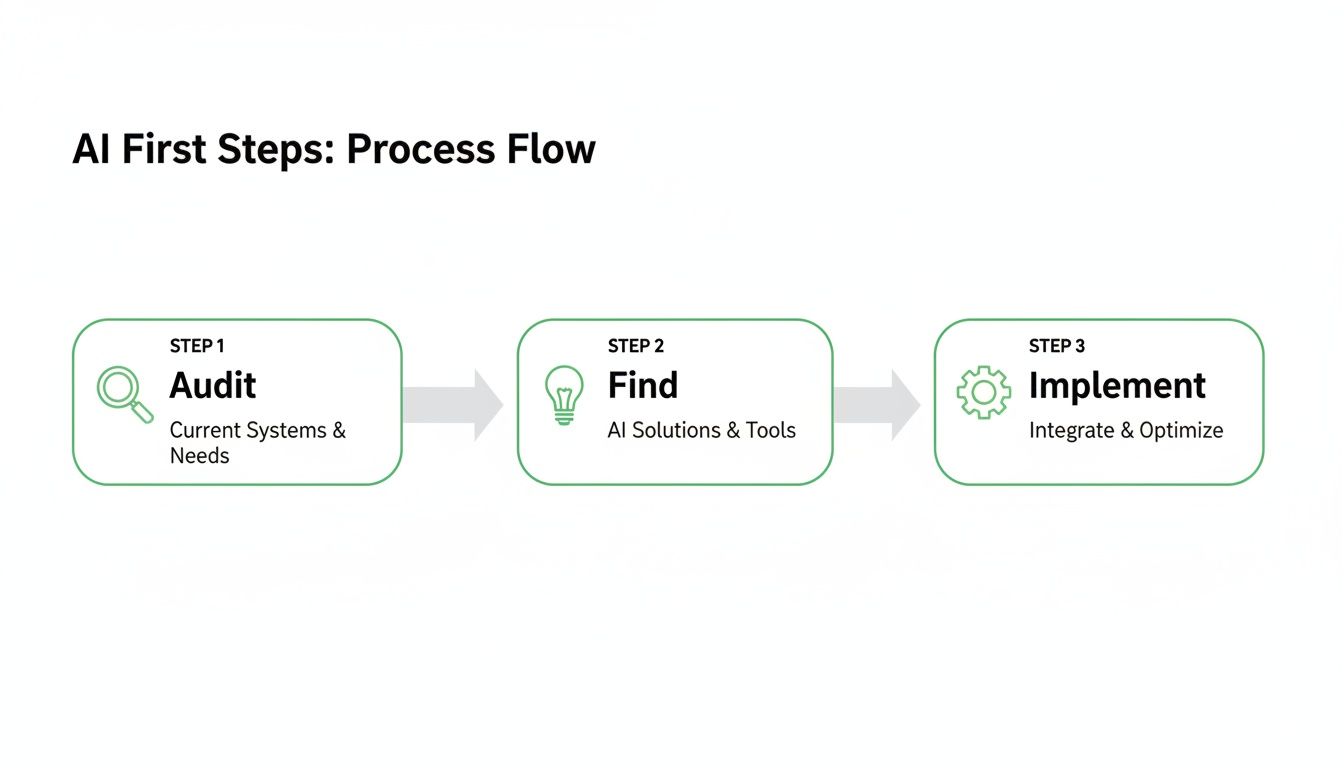
This visual really hammers home the core strategy: start with a clear audit to find a high-impact problem, then find a specific tool and implement it for a fast win.
Assess Your Data Readiness
Let's be clear: AI tools run on data. Before picking a solution, you need a basic handle on what information it needs to actually work. A product recommendation engine, for instance, needs your sales history and customer browsing data. An inventory forecasting tool is useless without historical sales data and current stock levels.
The good news is you don't need perfect, massive datasets to start. Many modern AI platforms are designed to work with the data you already have in your Shopify, Amazon, or other ecommerce platforms. The key is knowing what data you have and ensuring it's accessible.
For a bird's-eye view of the strategies behind integrating AI into your online business, check out this a comprehensive guide to AI e-commerce transformation. It provides some great context for mapping out your long-term plan.
Ultimately, finding the right starting point is all about grabbing the low-hanging fruit where AI can boost your bottom line, fast. If you need a hand spotting those opportunities, looking into professional AI automation services can give you a clear roadmap and really speed things up for maximum ROI.
Automating Product Discovery and Listing Optimization

Think of your product listings as your digital storefront. AI is the tireless, data-driven salesperson you put on the floor. It’s time to move beyond guesswork and start building pages that not only rank but actually connect with your audience, turning those casual clicks into loyal customers. The real goal here is to make every single element of your product page work harder for you.
For anyone selling on hyper-competitive marketplaces like Amazon or TikTok Shop, a well-optimized listing isn't just a nice-to-have; it's a matter of survival. This is exactly where AI tools give you a serious edge, automating the soul-crushing parts of research and content creation so you can get back to big-picture strategy.
Crafting Compelling Content with AI
Remember the last time you sat down to write a product description from scratch? The keyword research, the competitor deep dives, the struggle to be creative—it’s a slog. Now, picture an assistant that does all that groundwork for you in seconds. That’s the reality of weaving AI into your content workflow.
Modern AI tools don't just find keywords; they understand context and search intent. They can tear through top-ranking competitor listings to spot the keyword gaps you can exploit, suggesting long-tail phrases that your most motivated buyers are plugging into the search bar.
Here’s a simple, practical workflow you can start using today:
- Feed the AI your product: Just give it a basic product name, a few key features, and who you're trying to sell to. Example: Product: "Aero-Dry Running Shorts," Features: "moisture-wicking fabric, zip pocket, reflective strips," Audience: "serious marathon runners."
- Define the output: Ask for five title variations, a set of five bullet points that scream benefits (not just features), and a 200-word description. Example Prompt: "Generate 5 Amazon titles and 5 bullet points for these shorts. Focus on benefits like staying dry during long runs and safety for night running."
- Refine and edit: The AI gives you a solid first draft. Your job is to inject your brand's unique voice, add a personal touch, and triple-check everything for accuracy. Example Edit: The AI writes "Shorts have reflective strips." You change it to "Stay Seen, Stay Safe: Strategically placed reflective strips keep you visible on those early morning and late-night runs."
This simple process turns what used to be hours of tedious work into a few minutes of strategic editing. For a deeper look at all the moving parts, both manual and automated, our guide on Amazon listing optimization is a fantastic next step.
My biggest piece of advice: treat AI as a collaborator, not a replacement. Let it handle the repetitive, data-heavy lifting. That frees you up to do what you do best—tell your brand’s story.
The results speak for themselves. The top 34% of Amazon sellers are already using AI this way to boost their sales. Since 2019, AI adoption among U.S. ecommerce companies has shot up by a staggering 270%, with 80% of online retailers now using AI in some capacity. It’s clear which way the wind is blowing.
AI-Driven Image Selection and Optimization
Let's be honest: your product photos are probably the most important part of your listing. The good news is AI can help here, too. By analyzing millions of ecommerce images, AI models can now predict which of your photos will perform the best, identifying the subtle patterns that lead to higher click-through rates.
This means AI can literally score your product photos based on things like lighting, angle, and composition, predicting which "hero" image will grab the most eyeballs in a crowded search result.
Think about how you can apply this:
- Automated A/B Testing: Instead of manually split-testing your main image, an AI tool can analyze your entire photo library and suggest the top three candidates that are most likely to convert. Practical Example: You upload 10 photos of your new handbag. The AI analyzes them against top-selling handbag images in your category and predicts that a lifestyle shot of a model carrying the bag will outperform a simple studio photo by 15%, suggesting it as your main image.
- Competitor Visual Analysis: AI can scrape your competitors' listings and show you exactly what types of images (lifestyle shots, infographics, studio photos) are winning in your niche.
- Background Removal & Enhancement: Simple AI tools can instantly remove backgrounds to create clean, professional-looking photos—a task that used to require a graphic designer and a few hours in Photoshop. Practical Example: Tools like PhotoRoom or Canva's background remover can take a photo of your product on a messy desk and, in one click, place it on a pure white background required by marketplaces like Amazon.
By automating these parts of your listing optimization, you're not just saving a ton of time. You're building a data-driven system that constantly improves your visibility and conversion rates, turning those underperforming products into your next bestsellers.
Driving Sales with AI-Powered Personalization

Let's be honest, generic marketing blasts are a waste of everyone's time. Today’s shoppers don't just like a personalized experience—they expect it. This is where AI becomes your secret weapon for creating unique customer journeys that boost conversions and, most importantly, your average order value (AOV).
The core idea is to make every single customer feel like you've built the store just for them. By crunching data on browsing habits, past purchases, and even how they move around your site, AI builds a deep understanding of each shopper. This insight fuels the engine that suggests the perfect product at the perfect moment.
Deploying Smart Recommendation Engines
The quickest win for personalization is a smart recommendation engine. I'm not talking about those basic "related products" widgets you see everywhere. Modern AI tools are dynamic, learning and adjusting in real-time with every click a user makes.
Think about it: a customer just bought a high-end coffee grinder. The AI knows they appreciate quality, so it won’t show them budget coffee beans. Instead, it might suggest premium single-origin beans, a specialized grinder brush, or even a sleek espresso machine—all logical next steps that naturally increase the cart size.
Here's how this plays out in the real world:
- "Frequently Bought Together" Bundles: The AI digs through your sales data to find products that are almost always bought in the same transaction. It then packages them as a convenient one-click bundle, maybe with a small incentive to seal the deal. Practical Example: A camera store's AI finds that customers buying a specific DSLR camera body almost always buy a 50mm lens and a spare battery. It automatically creates a "Starter Kit" bundle on the product page with a 10% discount.
- "You Might Also Like" Carousels: Based on the product a customer is currently looking at, the AI populates a carousel with items that are stylistically similar or were purchased by other shoppers with the same taste.
- Post-Purchase Upsells: The journey doesn't end at checkout. If a customer buys new running shoes, the AI can trigger an email a week later offering moisture-wicking socks or energy gels. It's timely and incredibly relevant.
Don't underestimate these touches. AI-driven recommendations can pump up AOV by as much as 22% and conversion rates by 15%. On competitive marketplaces like Amazon or TikTok Shop, that's a massive advantage. You can dig deeper into the numbers by exploring the research on AI's impact in ecommerce.
Automating Personalized Campaigns
Personalization isn't just for your website. AI is also a beast when it comes to automating email and SMS campaigns that fire off based on specific customer actions. This ensures your communication always hits the mark.
Stop sending the same discount code to your entire list. With AI, you can craft hyper-targeted campaigns that feel less like a promotion and more like a one-on-one conversation. This is where the magic of AI segmentation really comes to life, automatically grouping customers based on complex behaviors that would be a nightmare to track manually.
Building Hyper-Precise Audience Segments
Forget the old-school segments like "new customers" vs. "repeat buyers." AI lets you create dynamic groups that constantly update based on what people are doing right now.
Here are a few examples of segments you can build with AI:
- High-Intent Abandoned Carts: The system flags shoppers who added high-value items to their cart but bailed. It can then automatically send an email with a unique, time-sensitive discount to nudge them over the finish line.
- Potential VIP Customers: An AI can spot customers making multiple purchases in a short period. It can automatically move them into an "Early Access" group that gets a first look at new arrivals. Practical Example: A customer buys twice in 30 days. The AI flags them, adds them to a "Rising Star" segment, and sends an automated email: "We've noticed you love our stuff! Here's early access to our new collection."
- Brand Affinity Groups: By analyzing purchase history, the AI can group customers who only buy a specific brand or from one product category. When you launch something new in that niche, you have a pre-built audience of your most passionate fans ready to go. Practical Example: A beauty store's AI identifies a segment of customers who have only ever purchased vegan skincare products. When a new vegan moisturizer launches, this segment is the first to receive the announcement.
This level of granular targeting is key to turning one-time buyers into loyal brand advocates. It's the same principle that powers the most profitable ad campaigns, a concept we break down in our guide to effective Amazon advertising strategies. When you apply these AI-driven audience insights to your ad spend, your ROI can improve dramatically.
Enhancing Customer Experience with AI Chatbots

In a crowded market, standout customer service can be your secret weapon. Using AI-powered chatbots gives your customers instant, 24/7 support, which not only keeps them happy but also frees up your team for the trickier problems.
This isn't about replacing your support staff. Think of chatbots as the first line of defense, handling the barrage of simple, repetitive questions that eat up your team's time and energy.
Starting with the Basics: Answering Common Questions
The quickest win with a chatbot is teaching it to answer your most frequently asked questions. Just think about the queries that flood your inbox every single day—that's the perfect training material for your new AI assistant.
Here’s a simple workflow to get started:
- Dig into your data: Pull records from your helpdesk or email to find the top 5-10 questions you get. These are almost always about shipping status, return policies, or basic product info.
- Build a knowledge base: Write down clear, simple answers for each question. This is the script your chatbot will follow to give accurate responses. Example Answer: For "What is your return policy?", write: "You can return any unused item within 30 days for a full refund. Just visit our returns portal at [link] to get started!"
- Pick a platform: Choose a user-friendly chatbot tool that plays nice with your ecommerce platform, like Shopify or BigCommerce. Plenty of them are no-code.
- Launch and learn: Get the bot live on your site and watch its conversations. The logs will show you what it's good at and where it’s fumbling, so you can tweak its answers over time.
This approach delivers immediate results, cutting down your ticket volume and giving customers the instant answers they’ve come to expect.
Chatbots and virtual agents are changing the game in ecommerce. In fact, 31% of retailers now use them to slash response times and have seen sales jump by as much as 67%. Purchases wrap up 47% faster with AI helping out, smoothing the path for shoppers on Amazon or TikTok Shop.
Moving to More Advanced Use Cases
Once your chatbot has mastered the basics, it's time to let it do more than just answer questions. You can evolve it from a simple Q&A bot into a tool that actively drives sales and makes your operations smoother.
The next step is to program your bot to handle more interactive, complex tasks that guide customers along their buying journey.
Consider adding these more advanced workflows:
- Guided Shopping Assistant: The chatbot can act like a personal shopper, asking clarifying questions to find the right product. For a skincare brand, it might ask, "Are you looking for a product for oily, dry, or combination skin?" before making a suggestion.
- Abandoned Cart Recovery: When a customer is about to bail with items still in their cart, the chatbot can pop up with a helpful nudge. Something like, "Hey, looks like you left something behind. Can I answer any questions or offer a small discount to help you check out?"
- Automated Returns Processing: Instead of a clunky form, the bot can handle returns through a simple conversation. It can ask for the order number, the reason for the return, and then automatically generate a shipping label. Example Workflow: 1. Customer types "I want to return an item." 2. Bot asks for the order number. 3. Bot pulls up the order details and asks the customer to confirm the item. 4. Bot provides a link to a printable, pre-paid return label. The entire process takes 90 seconds.
By rolling out these advanced features, you create a much more dynamic and helpful shopping experience. For a deeper dive, this guide on AI chatbots for ecommerce is a great resource. Building an efficient customer service engine like this not only builds trust but also cuts down your operational overhead.
Building Your AI Tech Stack and Measuring Success
Choosing the right tools and knowing how to track your results are the two sides of a successful AI strategy. One without the other is a recipe for wasted time and money. The goal isn’t to collect a bunch of shiny new toys; it’s to build a purpose-driven toolkit that solves your specific problems—and then prove its worth with hard data.
Implementing AI isn't about chasing trends. Think of it as a strategic investment that has to deliver a clear, measurable return. That means picking tools that solve a real need right now, fit your budget, and have a system in place to measure their direct impact on your bottom line from day one.
Choosing the Right Tools for Your Brand
Your AI tech stack probably won't be a single, all-in-one platform. It's much more likely to be a smart mix of different solutions. The real key is to match the tool directly to the task you identified back in your initial audit.
Here’s a quick breakdown of the types of tools you’ll run into:
- Specialized Point Solutions: These tools do one thing, and they do it incredibly well. Think of an AI-powered ad management tool like Albert.ai for PPC automation or a dedicated chatbot platform like Chatfuel. They're often the fastest way to get a win because they solve a very focused problem.
- Integrated Platform Features: Many of the big platforms you’re already using—like Shopify or HubSpot—are rolling out their own AI features. These can handle things like product recommendations or email automation right out of the box, making them a fantastic, low-effort starting point.
- Custom AI Automation Builders: For more complex challenges, tools like Gumloop let you build your own AI workflows that connect different apps and data sources. This gives you ultimate flexibility, but be prepared for a steeper learning curve.
When you're looking at any new tool, make integration your top priority. If a new AI solution can’t talk to your ecommerce platform, your ESP, and your other core tools, it’s going to create more manual work than it saves. This is absolutely non-negotiable for building a stack that can grow with you.
Comparing AI Tooling Options for Ecommerce Brands
Selecting the right AI tools often comes down to your brand's current stage and specific needs. Emerging brands might prioritize quick wins and ease of use, while established brands may need more power and customization.
| Tool Category | Primary Function | Ideal for Emerging Brands | Ideal for Established Brands |
|---|---|---|---|
| Specialized Point Solutions | Excels at a single, focused task (e.g., ad automation, chatbots). | Yes. Great for solving one major pain point quickly and seeing immediate ROI. | Yes. Perfect for plugging a specific gap in an existing tech stack with a best-in-class tool. |
| Integrated Platform Features | Built-in AI within existing platforms (e.g., Shopify Magic). | Absolutely. The easiest entry point to AI with zero integration headaches. | Yes. Leverages existing data and workflows, but may lack advanced capabilities. |
| Custom AI Automation Builders | Creates bespoke workflows connecting multiple apps and data sources. | No. Generally too complex and requires significant technical resources. | Yes. Offers maximum flexibility to solve unique, complex operational challenges. |
Ultimately, the best tech stack is a hybrid one that evolves as your business grows, combining the simplicity of integrated features with the power of specialized solutions where they're needed most.
Defining Your Key Performance Indicators
You can't improve what you don't measure. It’s a cliché for a reason. Before you even roll out a new AI tool, you have to decide exactly how you'll know if it's working. These Key Performance Indicators (KPIs) must be tied directly to the business problem you're trying to fix.
Forget vague goals like "improve marketing." They’re useless. You need specific, quantifiable metrics that prove the AI is actually making a difference.
Here are some real-world examples of KPIs for common AI projects:
- For AI-powered personalization:
- Conversion Rate Uplift: What's the percentage increase in conversions for shoppers who see AI recommendations versus those who don't? Practical Example: Use A/B testing where 50% of visitors see AI recommendations and 50% don't. After a month, if the AI group's conversion rate is 3.5% and the control group's is 3.0%, you have a clear uplift.
- Average Order Value (AOV): Is the AI actually getting people to add more to their cart through smart upsells and cross-sells?
- For AI chatbots:
- Reduction in Customer Service Tickets: Track the percentage drop in routine, repetitive questions that hit your human support team's inbox. Practical Example: Before launch, you average 100 tickets a day about order status. After launch, you average 40. That's a 60% reduction.
- First-Contact Resolution Rate: What percentage of issues does the bot solve on its own, without escalating to a human? This is a huge one for efficiency.
- For AI ad management:
- Return on Ad Spend (ROAS): The ultimate measure. Is the AI making your ad dollars work harder?
- Cost Per Acquisition (CPA): How efficiently is the AI bringing in new customers compared to your manual efforts?
Tracking these numbers isn't just about making pretty reports. It's about making smart decisions. If that AI tool for listing optimization isn't boosting your organic traffic or conversion rate after 90 days, it might be time to pull the plug. This data-first approach ensures your AI strategy is consistently profitable and turns technology from an expense into a measurable growth driver.
Your Top Questions About AI in Ecommerce, Answered
Jumping into AI for your store can feel like a big leap, and it's totally normal to have questions. Everyone wonders about the cost, the skills you need, and frankly, where on earth to even begin. Let's clear up some of the most common questions we hear from brands so you can get started with confidence.
What’s the First Step to Implement AI in an Ecommerce Business?
Forget massive, complicated overhauls. Your best first step is a simple operational audit.
Just ask yourself: what’s the single most repetitive, time-sucking task we do every day? Maybe it’s answering the same five customer service questions over and over. Or maybe it's staring at a blank page trying to write the first draft of a product description.
Once you’ve nailed that down, find a specific AI tool designed to solve that one problem. This strategy gets you a quick, tangible win and a clear ROI, which makes it way easier to get buy-in for bigger projects later on. You're building momentum and proving the concept without a huge upfront risk.
Adopt a "First Profit, Then Progress" mindset. Your goal should be a small, measurable victory that saves you time or money within the first 30-60 days. That initial success story becomes the bedrock of your entire AI strategy.
Do I Need a Data Scientist to Use AI Tools for My Store?
Nope, not anymore. This is probably one of the biggest myths holding brands back. The vast majority of modern AI tools built for ecommerce are designed for people like you—business owners and marketers—not data scientists.
Think about platforms for listing optimization, email marketing, or customer service chatbots. They almost always have user-friendly, no-code interfaces. Getting started is usually as simple as connecting your store data through a basic integration and clicking through a setup wizard. All the heavy lifting with the data happens in the background, letting you focus on the results.
How Much Does It Cost to Implement AI in Ecommerce?
The cost of getting started with AI is more flexible than ever, but it really depends on your goals.
- Specialized Tools: You can find incredibly powerful, focused solutions for as little as $20-$50 per month. This could be a basic chatbot for your site, a content generator for product descriptions, or an AI-powered image editing tool.
- Integrated Platforms: For more comprehensive platforms that handle advertising, inventory, and personalization, you might be looking at several hundred to thousands of dollars a month.
The trick is to start small. Pick a tool that solves a clear pain point and offers pricing that can grow with your business. Don't go all-in on a massive, expensive system until you’ve seen the value firsthand with a more affordable tool.
Can AI Help a Small Brand Compete with Larger Retailers?
Absolutely. This is where AI truly shines—it's a massive equalizer. It automates the kind of work that used to require huge teams and enterprise-level budgets, putting that power directly into your hands.
Think about the immediate advantages:
- 24/7 Customer Support: A small brand can deploy an AI chatbot to offer instant help around the clock. Suddenly, you're offering a level of service that was once exclusive to corporations with giant call centers.
- Sophisticated Optimization: AI can create perfectly optimized product listings and run personalized marketing campaigns that are just as effective as those from major retailers.
- Operational Efficiency: You get to operate with the lean efficiency of a much larger company. This frees up your most valuable resource—your time—to focus on building your brand, developing new products, and thinking strategically.
By tapping into these capabilities, even a small brand can deliver a polished, responsive customer experience that levels the playing field and lets you compete on a much bigger stage.
Ready to stop guessing and start growing? At ZonFlip, we help ecommerce brands implement practical AI solutions that drive real results on Amazon and TikTok Shop. Discover how our end-to-end management can help you sell more and work less.