



Staring at rising FBA fees and shrinking margins? You're not alone. The smartest Amazon sellers I know aren't ditching FBA entirely—that would be crazy. Instead, they're getting strategic.
They're using a hybrid model: leveraging a 3PL for affordable storage and FBA prep while keeping their fastest-moving products primed and ready to ship with FBA. It's the best of both worlds.
Why Smart Amazon Sellers Are Moving Beyond FBA
The secret to scaling profitably on Amazon has changed. The old debate was "FBA vs. 3PL." The new, winning strategy is "FBA and 3PL." This powerful combo protects your profits without you having to give up that all-important Prime badge.
The logic is simple: use each service for what it does best. FBA is still the undisputed king of fast fulfillment and getting your products in front of Prime members, which is a massive conversion driver.
But let's be honest, FBA's storage fees—especially those dreaded long-term storage fees—can absolutely demolish your margins. This is particularly true for seasonal goods or anything that doesn't fly off the shelves. That's where a good 3PL becomes your secret weapon.
The Hybrid Model in Action
Picture a brand selling Christmas ornaments. From January to September, their inventory just sits in an FBA warehouse, racking up insane storage fees every single month. By the time the holiday rush starts, a huge chunk of their potential profit is already gone.
Now, let's see how they flip the script with a hybrid approach. Here's a practical workflow:
- Step 1: Bulk Shipment to 3PL (July): They ship a 40-foot container of 10,000 ornaments from their manufacturer directly to their 3PL partner in the US. The 3PL unloads, inspects, and stores the inventory for a low monthly pallet fee.
- Step 2: Just-in-Time FBA Prep (October): They log into their 3PL's portal and create an FBA work order for 2,500 units. The 3PL team picks the units, applies FNSKU labels, and prepares them for an FBA inbound shipment.
- Step 3: Lean FBA Inventory (November): They monitor their sales velocity in Seller Central. Seeing a strong start to the season, they create another work order for 3,000 units to be sent to FBA, ensuring they stay in stock without over-committing inventory. This keeps their FBA stock levels just right—enough to meet demand but low enough to avoid long-term fees.
One seasonal brand I worked with cut their storage costs by a staggering 40% using this exact method. They only sent inventory to Amazon when they knew it would sell, saving thousands. It's about playing offense with your costs, not defense.
This shift is all about taking advantage of what modern Third Party Logistics business storage can do. It’s not just about pinching pennies; it’s about wrestling back control over your supply chain. (If you're still new to the basics, our guide on how to sell on Amazon FBA is a great starting point).
And this trend is only getting bigger. In Q3 2025, independent sellers accounted for a massive 62% of all units sold on Amazon, a huge leap from just 45% in 2015. With the marketplace getting more crowded, sellers using a hybrid model are reporting up to 20% lower logistics costs. That's a serious competitive edge.
This guide will walk you through exactly how to find the right partner to build your own profitable hybrid strategy.
Defining Your Needs Before You Start Your Search

Before you even think about Googling "best 3PL for Amazon sellers," you need to get brutally honest about what your business actually needs. Let’s be real: the "best" 3PL is a myth. The right 3PL is the one that lines up perfectly with your specific products, sales velocity, and growth plans.
Jumping into discovery calls without a clear list of requirements is like grocery shopping while you're starving—you’ll end up with a lot of expensive stuff you don’t need. A detailed self-audit is the foundation of a successful search. It gives you the power to ask sharp questions and instantly disqualify partners who aren't a good fit.
This isn't just about finding a warehouse; it's about finding a strategic partner that can handle your unique operational chaos.
Auditing Your FBA Prep and Inbound Complexity
Start by looking at the nitty-gritty work required to get your products from their arrival state to being "FBA-ready." This is often where a 3PL provides its most immediate value, especially for tasks that are too time-consuming or complex to manage in-house.
Don't just think about today. What's on your product roadmap for the next 12-18 months? Are you planning to launch bundles, multi-packs, or subscription boxes?
Here are the critical services to map out:
- FNSKU Labeling: The most basic prep service. Example: You import 5,000 units of garlic presses. The 3PL needs to unbox them from master cartons, apply an FNSKU label to each individual product box, and then repack them for shipment to FBA.
- Poly Bagging & Suffocation Warnings: This is non-negotiable for many product categories. A good 3PL will have this process down to a science, ensuring you stay compliant with Amazon's ever-changing rules.
- Kitting and Bundling: This is where specialized 3PLs really shine. If you sell a skincare gift set with three different products, FBA can't assemble that for you. A 3PL can create brand-new, high-value SKUs by bundling your existing inventory.
- Inspection and Quality Control: Do your products just need a quick visual check, or a more detailed, unit-by-unit inspection when they land from your supplier? Defining this upfront prevents massive headaches later.
The goal is to create a detailed service checklist. This becomes your scorecard when evaluating potential partners. A 3PL that's great at simple labeling might not have the skilled labor or dedicated space for complex kitting projects.
To help you get started, here's a simple checklist to organize your thoughts and define exactly what you're looking for.
3PL Service Needs Assessment Checklist
Use this checklist to define the exact services your Amazon business requires from a 3PL partner.
| Service Area | Specific Requirement Example | My Business Need (High/Medium/Low) |
|---|---|---|
| Inbound Processing | Receiving containers, palletizing floor-loaded goods, initial inventory count. | |
| FNSKU Labeling | Applying Amazon-specific barcodes to thousands of individual units per month. | |
| Poly Bagging | Bagging items with openings >5 inches, including suffocation warnings. | |
| Kitting & Bundling | Assembling a 3-pack of shampoo, conditioner, and lotion into a single retail-ready box. | |
| Quality Control | Detailed inspection of 10% of units from each shipment for manufacturing defects. | |
| Storage (Standard) | Storing standard-sized, stackable cartons on 40×48 pallets. | |
| Storage (Specialized) | Climate-controlled (e.g., 60-75°F) storage for cosmetics or supplements. | |
| Returns Processing | Inspecting customer returns, grading condition (sellable, damaged), and re-labeling if needed. | |
| Multi-Channel Fulfillment | Integrating with a Shopify store to pick, pack, and ship DTC orders. | |
| Cross-Border Logistics | Handling customs paperwork for shipping inventory into Canadian FBA centers. |
Going through this exercise ensures you're not just shopping on price, but on the precise capabilities that will actually help your business scale.
Analyzing Your Storage and Inventory Profile
Storage is more than just square footage; it's about the type of storage and how it matches your inventory. FBA’s one-size-fits-all model punishes sellers with bulky, slow-moving, or specialized products. This is your chance to find a more cost-effective and suitable home for your bulk inventory.
Think about the physical nature of your products. Are they small and stackable, or large and awkwardly shaped? This directly impacts your storage costs. A 3PL typically charges by the pallet or cubic foot, so understanding your inventory density is key to forecasting your monthly bill.
Key Storage Considerations:
- Oversized vs. Standard: Practical Example: You sell ergonomic office chairs. Storing 50 of these at an FBA warehouse could cost over $1,000 per month. A 3PL specializing in oversized goods might store them for $200-$300, a dramatic saving.
- Climate Control: For products like cosmetics, supplements, or gourmet foods, temperature and humidity control are essential to prevent spoilage and protect your investment.
- Hazardous Materials (Hazmat): Selling items with lithium-ion batteries or certain chemicals? You'll need a 3PL with proper certifications and handling protocols, something most standard warehouses won't touch.
While a whopping 82% of Amazon's sellers use FBA to get that Prime badge, the smartest scaling brands use a hybrid model. They store bulk inventory at a cost-effective 3PL and drip-feed it into FBA, avoiding hefty fees and diversifying their risk.
Planning for Multi-Channel and International Growth
Choosing the right 3PL today means looking beyond Amazon itself. Your logistics partner should be an asset, not an obstacle, to your expansion plans. Are you already selling on your own Shopify store, TikTok Shop, or other marketplaces?
Your 3PL must have the tech to integrate with these platforms, pulling orders and syncing inventory levels in real-time. This prevents the nightmare of overselling and creates a seamless customer experience across all your channels.
Example Workflow for Multi-Channel:
- A customer places an order on your Shopify website.
- The order is automatically pushed from Shopify to the 3PL's software via an API integration.
- The 3PL's warehouse team receives the order, picks the items, packs them in your custom-branded box, and ships it via FedEx.
- The tracking number is automatically sent back to Shopify, which then notifies the customer their order has shipped.
And if international expansion is on your radar, your 3PL’s location and capabilities become even more critical. For sellers eying the Canadian market, for example, you absolutely need to understand the Non-Resident Importer Canada program. A partner with cross-border expertise can save you from a world of customs and compliance pain.
Decoding 3PL Pricing Models and Hidden Fees
Trying to make sense of a 3PL pricing quote can feel like you’re solving a puzzle with half the pieces missing. The main numbers might look great, but the true cost is almost always tucked away in the details. To find the best 3PL for your Amazon business without getting a nasty surprise on your first invoice, you have to understand their cost structures and, just as importantly, the hidden fees.
Unlike Amazon’s FBA fees—which are relatively straightforward (if not a little painful)—3PL pricing is all over the map. Most quotes are built around a handful of core services, but how each one is calculated can vary dramatically from one provider to the next. Getting fluent in their language is your best defense against unexpected bills.
You'll pretty much always see charges for receiving inventory, storing it, and fulfilling orders. But just comparing those line items side-by-side isn’t nearly enough. You’ve got to dig into the "how" and "when" behind each charge to get a real picture of your costs.
Breaking Down the Core 3PL Charges
Let's pull apart the main fees you’ll find on any quote. These are the foundation of your monthly bill, and even small differences here can easily stack up to thousands of dollars over the year.
- Receiving Fees: This is what they charge to unload your inventory, count it, and get it into their warehouse management system (WMS). Example: A 3PL might charge a flat $40 per pallet received, or an hourly rate of $50/hr for a floor-loaded container that needs to be manually unloaded and palletized.
- Storage Fees: Think of this as the monthly rent for your inventory's space. It's almost always significantly cheaper than FBA storage and is typically billed per pallet or per cubic foot. A key question to ask: do they bill for the space you’ve reserved or only the space you’re actually using?
- Pick and Pack Fees: This is the cost to actually fulfill a customer's order. It's often a combination of a per-order fee (covering the box and the labor for grabbing the first item) and a smaller per-item fee for every additional item in that same order.
- FBA Prep Fees: This covers all the little Amazon-specific tasks like slapping on FNSKU labels, poly bagging items, or building kits. These are almost always charged on a per-unit basis.
For instance, a quote might list a $1.50 pick fee for the first item and $0.40 for each additional item. If a customer orders three of your products, your fulfillment cost would be $1.50 + ($0.40 x 2) = $2.30, plus whatever the shipping cost is.
The Real-World Cost Analysis: 3PL vs. FBA
The true financial power of a 3PL really shines when you're dealing with slower-moving inventory that would otherwise get crushed by FBA's long-term storage fees.
Let’s run a quick comparison.
Imagine you have 1,000 units of a standard-size product that takes about 90 days to sell through. Each unit is 0.5 cubic feet.
Scenario 1: FBA Storage
- Monthly Storage Cost (first 90 days): 1,000 units * 0.5 cu ft * ~$0.87/cu ft = $435 per month
- Total for 3 months: $1,305
- And that's before the long-term storage fees kick in after 180 days, which would send this cost soaring.
Scenario 2: 3PL Storage
- Let's say your 1,000 units fit nicely on two standard pallets.
- Monthly Pallet Storage Cost: 2 pallets * ~$25/pallet = $50 per month
- Total for 3 months: $150
In this simple storage showdown, using a 3PL saves you $1,155 over just 90 days. That figure doesn't even factor in the other services you might pay the 3PL for, but it paints a clear picture of the huge savings potential on storage alone.
Uncovering the Hidden Fees in the Fine Print
This is precisely where so many sellers get burned. The initial quote looks fantastic, but a whole menu of "ancillary" charges can easily inflate your bill by 15-25% or more if you aren't paying attention. You have to ask about these things upfront.
Common Hidden 3PL Costs to Watch For:
- Account Setup Fees: A one-time charge just for getting you into their system.
- Integration Fees: The cost to connect their WMS to your Amazon Seller Central account, Shopify store, or other platforms.
- Minimum Monthly Spend: This is a big one. Many 3PLs require you to spend a minimum amount each month (say, $500), regardless of your actual activity. If you have a slow month, you pay the difference.
- Work Order Fees: Charges for any special projects outside of the norm, like running a quality control check or doing a full inventory cycle count.
- Account Management Fees: Some 3PLs charge a flat monthly fee for giving you access to a dedicated account manager.
Never sign a contract without getting a "Total Landed Cost" estimate for a typical month. Give them your average order volume, storage needs, and inbound shipment frequency, and ask for a complete projection. This one step will save you from almost all future billing headaches.
Getting a crystal-clear picture of every single potential cost is the most important part of this entire evaluation. A super-cheap pick-and-pack fee means nothing if you're getting nickel-and-dimed on a dozen other hidden charges. A transparent partner who gives you a full cost breakdown is always the smarter long-term choice, even if their base rates look a bit higher at first. This financial clarity is what separates the good partners from the bad when you’re looking for the best 3PL for Amazon sellers.
Checking Out Their Tech Stack and How Much You Can Really See
Think of a modern 3PL less like a warehouse and more like a technology partner who happens to have a warehouse. Their software is either going to be the central nervous system for your entire operation or a daily source of headaches and expensive mistakes. When you're looking for the right 3PL for your Amazon brand, their tech stack isn't just a "nice-to-have"—it's the bedrock of your ability to scale without pulling your hair out.
The absolute non-negotiable here is a seamless link between their Warehouse Management System (WMS) and all your sales channels. This connection is the digital handshake that automates the flow of orders, keeps your inventory levels in sync, and spits out the data you need to make smart moves. Without it, you're back in the dark ages, manually exporting spreadsheets and shooting off emails. That's a surefire recipe for overselling and total operational chaos.
What to Demand from Their Client Portal
The client portal is your eyes and ears inside the warehouse. It needs to be more than a static spreadsheet showing you an inventory count; it must give you a live, real-time view and direct control over your products. It's your remote command center.
When you're getting a demo of a potential partner's software, don't be shy. You need to see these mission-critical features in action:
- Live Inventory Visibility: Can you see, at a glance, exactly what's on the shelf, what just came in the receiving door, what's already reserved for orders, and what’s available to sell? This needs to be crystal clear for every single SKU, anytime you look.
- Automated FBA Shipment Creation: Practical Step-by-Step: 1) You select the SKU and quantity you want to send to FBA inside the 3PL portal. 2) The software communicates with Amazon's API to create the shipment plan. 3) The 3PL prints the FBA box and pallet labels directly from their system. 4) You approve the shipment, and it's sent out—all without logging into Seller Central.
- Multi-Channel Order Hub: Can you see and manage all your orders—from Amazon, Shopify, and TikTok Shop—in one clean interface? This unified view is absolutely essential once you start growing.
- Real Reporting and Analytics: You have to be able to pull reports on receiving times, order accuracy, how long inventory has been sitting (aging), and how fast orders are getting out the door. This data is the only way to truly hold your partner accountable.
Picture this: One of your TikToks goes viral on a Friday night. With a clunky tech setup, you're stuck sending frantic emails to a warehouse manager, praying they check their inbox over the weekend. With a great tech stack, you log into the portal, see your available inventory instantly, and create a fulfillment order to restock FBA in about three minutes. That’s the kind of control you should be demanding.
The Real Power of a Seamless Connection
True operational transparency comes from deep, reliable integrations. This isn't just about connecting things; it's about the 3PL’s WMS talking flawlessly with Amazon Seller Central, your ecommerce store, and any other tool in your arsenal. This two-way street for data prevents stockouts, kills manual data entry, and makes sure that the second a customer clicks "buy," the fulfillment process is already in motion.
A great question to ask is how they handle integrations. Do they have a simple, pre-built connector, or do they offer an open API for more custom work? An API gives you a ton more flexibility to build out custom workflows as your business gets more complex.
The global 3PL market is expected to rocket to $1.4 trillion by 2025, and it's this demand for sophisticated, tech-first solutions that's fueling the growth. It’s no shock that while many Amazon sellers keep using FBA for the Prime badge, 22% now run a hybrid model. They're balancing FBA's massive reach with a 3PL's flexibility and, often, far superior tech. You can see more on how brands are navigating this on Speedcommerce.com.
At the end of the day, a 3PL’s technology is a direct reflection of how much they care about efficiency, accuracy, and transparency. Don't let yourself get stuck with a clunky, outdated system. The best 3PLs out there are investing heavily in their tech, giving you the tools you need to actually manage your business, not just a place to keep your boxes.
How to Vet and Onboard Your Ideal 3PL Partner
You’ve done the legwork, defined what your Amazon business needs, and whittled down your list of potential 3PLs. Now for the most important part: the final vetting and onboarding. This is where the rubber meets the road. You’re moving past the sales pitches and into a decision that will shape your brand's profitability and customer happiness for years to come.
Getting this right is so much more than just comparing a few price sheets. It’s about doing your homework, asking the tough questions, and making sure the partner you choose can actually walk the walk. This is your chance to spot the red flags before you're locked into a contract.
Your Due Diligence Checklist
Before you even think about signing a contract, you have to verify that a 3PL can actually do what they say they can do. A slick website and a smooth-talking sales rep are one thing; consistent, reliable operations are another entirely.
Here is a practical workflow for this stage:
- Request References: Get a list of 2-3 current clients. Ask specifically for one that sells in a similar category to you.
- Conduct Reference Calls: Call them and ask targeted questions: "What was your onboarding experience like?", "How does their team handle shipping errors?", and "On a scale of 1-10, how would you rate their communication?".
- Review the SLA: Get their Service Level Agreement in writing. Look for hard numbers. For example, does it say "inbound shipments will be received within 48 hours of dock appointment"? Vague SLAs are a red flag.
- Verify Insurance: Ask for their Certificate of Insurance (COI). Confirm it's active and the coverage amount is enough to protect the value of your inventory.
Think of this as your best defense against future headaches. It’s so much better to find a potential problem now than three months into a partnership that’s costing you time, money, and your sanity. If you need a refresher on what best-in-class service looks like, check out our deep dive on 3PL storage and prep.
Spotting the Critical Red Flags
During your final calls and warehouse tours (even the virtual ones), keep your radar up for warning signs that could signal trouble down the line. Some 3PLs look great on paper but crumble under a little scrutiny.
Keep an eye out for these deal-breakers:
- Confusing or Vague Pricing: If you can't get a straight, simple answer on how you’ll be billed, run. If their quote is riddled with confusing line items and potential surcharges, it’s a bad sign. Transparency in pricing is a direct reflection of how they'll operate as a partner.
- Clunky, Outdated Software: Does their client portal look like it was built in 2005? That’s a huge problem. A clunky tech stack means more manual work for you, a higher risk of inventory errors, and zero real-time visibility into your own business.
- Slow or Unclear Communication: Pay close attention to how they communicate during the sales process. If they're slow to respond or give you vague answers when they're trying to win your business, I promise you it will only get worse once you're a client.
A 3PL's technology is the central nervous system of their operation. It's not a "nice-to-have"—it's everything. This chart breaks down what you should be looking for.
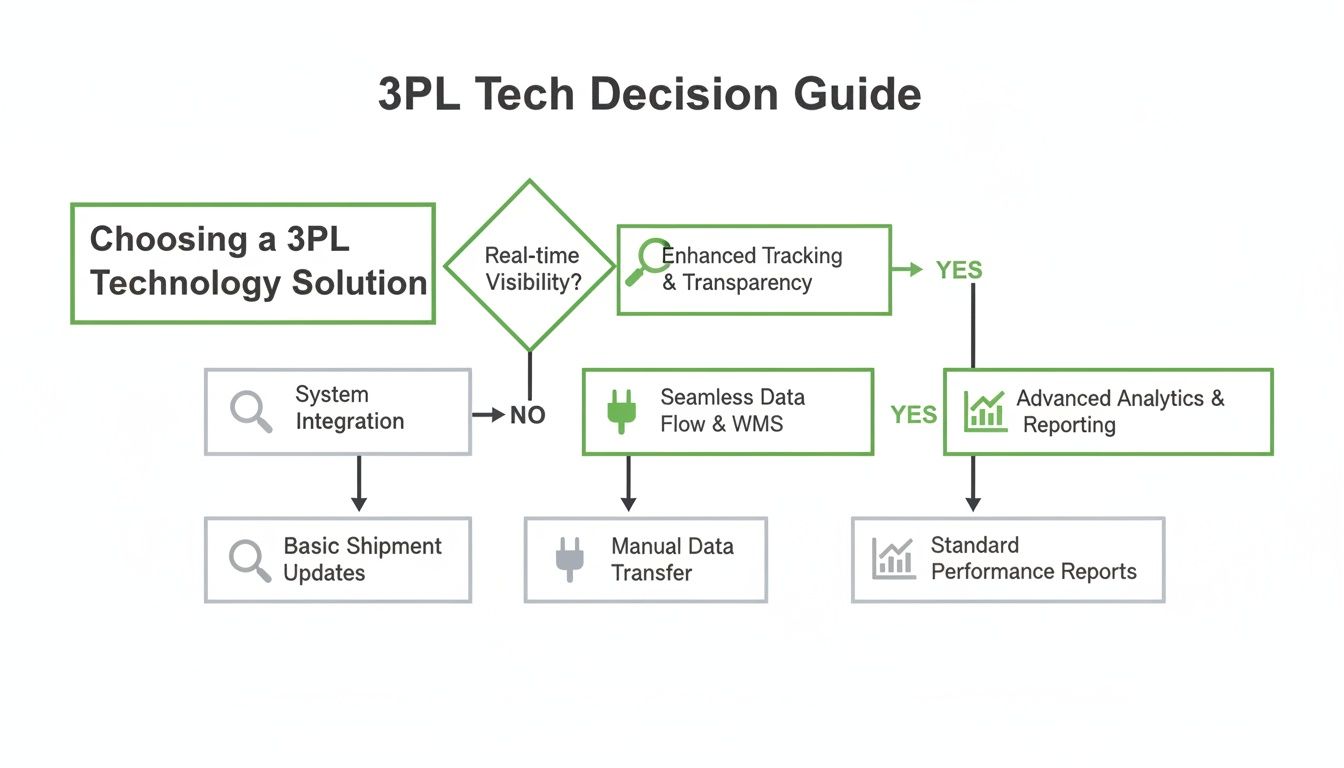
The bottom line is that a modern tech stack isn't a luxury. It's the only way to get the real-time control and data you need to run a competitive e-commerce brand today.
Smart Negotiation and a Smooth Onboarding
Okay, you've done your due diligence and picked a winner. The last piece of the puzzle is negotiating a solid agreement and kicking off a seamless onboarding process. And remember, most terms in a standard 3PL contract are up for discussion.
Don't be afraid to ask for what you want. You can often negotiate things like waiving the initial setup fee, getting a lower monthly minimum for the first 90 days, or even a small discount on your highest-volume task, like FNSKU labeling.
A great partnership starts with a great launch. Any 3PL worth its salt will have a structured, documented onboarding plan. This should include a dedicated onboarding manager, clear timelines for integrating your systems, and a step-by-step process for your first inbound shipment. If their plan is just, "Cool, send us your stuff," that’s your final red flag.
To help you keep track of all these moving parts, we put together a simple comparison template. Use this to lay out the details side-by-side and make your final decision with confidence.
3PL Vendor Comparison Template
| Evaluation Criteria | 3PL Partner A | 3PL Partner B | 3PL Partner C |
|---|---|---|---|
| Pricing Model | |||
| Receiving/Prep SLA | |||
| Tech/Portal Quality | |||
| Client References | |||
| Communication | |||
| Insurance Verified? | |||
| Red Flags Noted? |
By following this playbook, you’re not just picking a vendor. You’re choosing a foundational partner who will be right there with you as you scale your brand on Amazon and beyond.
Common Questions About Choosing a 3PL for Amazon
Jumping into the world of third-party logistics can feel overwhelming, and it's natural to have a lot of questions. Getting straight answers is the only way you'll feel confident enough to pick a partner that’s a genuine fit for your brand.
Here are some of the most common questions we hear from sellers who are right where you are now.
How Much Should I Expect to Pay for a 3PL?
There’s no magic number here. Your final cost is a direct reflection of your products, sales volume, and the specific services you need. That said, almost every quote you get will break down into a few core charges.
- Receiving: Unloading and checking in your inventory typically costs $5-$15 per pallet.
- Storage: This is a big one. Expect to pay around $15-$30 per pallet per month, which is a massive savings compared to what FBA charges.
- FBA Prep: Think FNSKU labeling or poly bagging. These services usually run between $0.50-$2.00 per unit.
The goal isn't just to find the cheapest option out there. The right partner delivers the most value and operational muscle for the price. Always push for a detailed quote based on your actual business data so you can do a true apples-to-apples comparison against your current FBA spend.
When Is the Right Time to Move to a Hybrid 3PL Model?
Honestly, the biggest trigger is usually financial pain. When you see FBA's long-term storage fees start to really eat into your profits, it’s time to make a move. If your inventory sits for more than a couple of months, a 3PL is almost always the smarter financial play.
But there are other clear signals, too:
- You're expanding beyond Amazon. Practical Example: You've just launched a Shopify store and are getting 5-10 orders per day. FBA can fulfill these (Multi-Channel Fulfillment), but it's expensive and comes in Amazon-branded boxes. A 3PL can ship these orders more cheaply and use your own custom packaging.
- You need custom work done. FBA is not built for complex kitting or bundling. If you want to create value-added product bundles to stand out, a 3PL is non-negotiable.
- You sell bulky or oversized items. For large products, FBA’s fees can be absolutely crippling.
The simplest sign? If you’re spending more time managing logistics than you are growing your brand, it’s time to find a 3PL partner.
What Is the Difference Between a 3PL and a Prep Center?
This is a critical distinction that trips a lot of sellers up. A prep center has one job: get your inventory ready for Amazon according to their strict rules and ship it to FBA. They are specialists in a very narrow task.
A full-service 3PL, on the other hand, is your entire logistics department. Yes, they do FBA prep, but that's just the tip of the iceberg. They also handle:
- Cost-effective, long-term storage.
- Direct-to-consumer (DTC) fulfillment for your website and other channels.
- Comprehensive returns processing (a huge headache you no longer have to manage).
- Robust inventory management software.
If all you need is basic prep, a dedicated prep center might work. But if you're looking for a partner to manage your entire supply chain, a 3PL is what you need. For a deeper dive, check out our complete guide to 3PL warehouse FAQs.
Can a 3PL Help with Seller Fulfilled Prime?
Yes, but you have to be careful here. Many modern 3PLs are fully capable of handling the intense demands of Seller Fulfilled Prime (SFP), but you absolutely must verify this. SFP has incredibly strict requirements for shipping speed and on-time delivery that not every warehouse can hit consistently.
When you're vetting a potential partner for SFP, ask them for their specific performance metrics, their on-time shipping rates, and their track record with the program. Using a qualified 3PL for SFP can be a brilliant way to keep the Prime badge without locking up all your inventory in Amazon’s network.
Ready to stop wrestling with logistics and start focusing on growth? At ZonFlip, we provide end-to-end Amazon account management, including strategic 3PL and FBA prep solutions that protect your margins and accelerate your sales. Let us handle the operational complexities so you can get back to building your brand. Learn more about our A-to-Z services at https://www.zonflip.com.