



Your Amazon pricing strategy is one of the most powerful levers you have for winning sales and protecting your hard-earned profit. It's so much more than just a race to the bottom; a smart strategy is a careful balancing act. You have to weigh factors like your fulfillment method, seller performance, and even how much stock you have on hand to capture the Amazon Buy Box. This is how you build a sustainable business in one of the world's most competitive marketplaces.
Why Smart Pricing Is Your Greatest Amazon Advantage

Welcome to the Amazon arena, a place where your pricing decisions pretty much dictate your success. Too many sellers fall into the trap of thinking the lowest price always wins. While price is obviously a huge piece of the puzzle, the real goal is to price smarter, not just lower. A well-crafted pricing strategy is the single greatest advantage you can have for driving growth and—most importantly—defending your profit margins.
At the heart of it all is the Amazon Buy Box, that prime piece of digital real estate where over 80% of all sales happen. Winning the Buy Box means your offer becomes the default choice for anyone who clicks "Add to Cart" or "Buy Now." For any seller, it's the ultimate prize.
Understanding the Buy Box Algorithm
Amazon's algorithm for awarding the Buy Box is a beast. It’s a complex calculation designed from the ground up to give the customer the best possible experience, and it looks at a whole lot more than just the sticker price.
Here are the key factors it chews on to decide a winner:
- Fulfillment Method: Using Fulfillment by Amazon (FBA) gives sellers a massive leg up. Amazon trusts its own logistics, and that promise of fast, reliable shipping carries a lot of weight.
- Seller Performance Metrics: Your account health is constantly under a microscope. Things like your order defect rate, cancellation rate, and late shipment rate all play a big role.
- Inventory Levels: You have to have the product to sell the product. If you run out of stock, you lose the Buy Box instantly. Consistency is crucial.
- Price: Of course, price matters. Your total price (product cost + shipping) has to be competitive, but it isn't the only thing the algorithm sees.
A truly effective Amazon pricing strategy isn't about being the cheapest. It's about becoming the most ‘Buy Box eligible’ seller, which often means finding the highest possible price at which you can still win and hold that coveted spot. This is the foundation of a 'Profit-First' mindset.
Your Roadmap to a Winning Strategy
The Amazon marketplace is always in motion. Just look at the data—a recent analysis of best-selling products showed that 53% of them actually saw price increases over a single year, thanks to inflation and supply chain headaches. This is exactly why a "set it and forget it" pricing model is a recipe for disaster.
Customers are getting savvier, too. Around 73% of shoppers now check an item's price history before they commit to buying. You can dig into more insights on these pricing trends to see why a dynamic approach isn't just a good idea; it's essential.
In this guide, we’re going to walk through the full spectrum of amazon pricing strategies to help you find the perfect fit for your business. We'll start with the foundational manual methods and build our way up to advanced, AI-powered repricing that automates decisions to squeeze every last drop of profit from your sales.
Choosing the Right Amazon Pricing Strategy
Picking the right pricing model is one of the first, and most important, decisions you’ll make for your Amazon business. This choice lays the groundwork for how you compete, protect your margins, and ultimately, grow your brand. There’s no silver bullet here; the best strategy depends entirely on what you sell, who you’re up against, and what you’re trying to achieve.
Let's walk through the four foundational Amazon pricing strategies every seller needs in their toolkit. Think of them as different tools for different jobs. Once you understand how each one works, you can make a smart, calculated decision that fits your brand perfectly.
A Comparison of Core Amazon Pricing Strategies
To get a clearer picture, let's break down these four core strategies. The table below compares each approach, highlighting where it shines, its inherent trade-offs, and the type of seller who will benefit most from using it.
| Strategy Type | Best For | Pros | Cons |
|---|---|---|---|
| Manual Pricing | Sellers with small, unique catalogs (fewer than 20-30 SKUs). | Absolute control over every price point; no software costs. | Extremely time-consuming; impossible to scale effectively. |
| Rule-Based Pricing | Resellers in competitive markets with predictable price fluctuations. | Automated and consistent; protects margins with set price floors. | Can lead to a "race to the bottom" if rules are too simple. |
| Dynamic Pricing | Sellers with large catalogs in fast-moving, competitive categories. | Maximizes Buy Box ownership and profit by adapting to market data. | Requires sophisticated software; less direct control. |
| Value-Based Pricing | Established brands with a strong reputation and unique value proposition. | High-profit margins; builds brand equity and customer loyalty. | Requires significant investment in branding and marketing. |
Understanding these distinctions is the first step. Now, let's dive deeper into what each of these looks like in the real world.
Manual Pricing: The Hands-On Approach
Manual pricing is exactly what it sounds like: you set and adjust every single price by hand. This gives you the ultimate level of control, making it a great place to start if you have a small, manageable number of products.
Practical Example: You sell unique, handcrafted leather wallets. With only five different styles (SKUs) and no direct competitors selling your exact designs, you can log in to Seller Central each morning. You might check similar wallet listings, note that a competitor's price has crept up, and decide to raise your price by $2 to test the market's response. You are in complete control of every change.
When to Use Manual Pricing:
- You have a small catalog (fewer than 20-30 SKUs).
- Your products are unique, custom-made, or face very little direct competition.
- You want total control and are willing to put in the time to check prices every day.
The beauty of this method is you’ll never accidentally price an item way too low. Its biggest weakness? It just doesn't scale. Once your business grows, manually tracking dozens or hundreds of listings becomes a full-time job you can’t win.
Rule-Based Pricing: Setting Your Competitive Logic
Rule-based pricing is your first step into automation. You use a repricing tool to create simple "if-this-then-that" rules that automatically adjust your prices based on what your competitors do. It’s perfect for sellers in crowded, predictable markets where the main goal is to react quickly to keep up.
Practical Example: You sell a popular brand of phone cases where ten other FBA sellers are on the same listing. You can set up a rule in your repricing software like: "Stay $0.01 below the lowest FBA competitor, but never go below my floor price of $12.50." Now, if a competitor drops their price to $14.00, your software automatically adjusts your price to $13.99. The system does the work 24/7, keeping you competitive.
Key Takeaway: The power of rule-based pricing is its consistency. You set your floor price to protect profits and your ceiling price to maximize revenue, then let the software operate within those guardrails. It’s a reliable way to compete without starting a dreaded "race to the bottom."
Dynamic Pricing: The Market-Driven Model
Dynamic pricing is a much smarter, more advanced form of automation. Think of it like how airlines or Uber price their services. Prices don’t just react to competitors; they shift based on a whole host of real-time market data—demand, inventory levels, sales velocity, even the time of day.
Practical Example: Your dynamic repricer notices a key competitor for a popular toy is about to sell out (their stock level has dropped to just 5 units). A simple rule-based repricer would keep your price low to compete. But a dynamic system predicts they will be out of stock within hours. Instead of dropping your price, it proactively raises it by 5%, anticipating that you'll soon be the only FBA seller and can capture sales at a higher margin. This is predictive, not just reactive. Figuring out if selling on Amazon is still worth it often hinges on adopting these kinds of efficient, modern strategies.
Value-Based Pricing: Selling the Brand, Not Just the Product
Finally, value-based pricing flips the entire script. Instead of letting the competition call the shots, you set your price based on the perceived value of your product and your brand. This is a strategy for established, premium brands that have built a rock-solid reputation.
Practical Example: You sell high-end, organic skincare with over 2,000 five-star reviews, beautiful packaging, and detailed A+ Content. A generic lotion sells for $9.99. Instead of competing on price, you set your price at $29.99. The price communicates quality, brand trust, and the value of your organic ingredients. Customers are willing to pay more because they perceive your product as a premium solution, not a commodity. To truly master this approach, it helps to have a solid grasp of a complete product pricing strategy beyond just the Amazon ecosystem.
To pull off value-based pricing, you need:
- A strong, recognizable brand.
- Stellar product reviews and a high seller feedback score.
- Top-notch product listings with amazing images and persuasive copy.
- A unique value proposition that clearly sets you apart from everyone else.
Each of these four strategies has its place. Choosing the right one comes down to an honest look at your products, your brand's maturity, and how much time you can realistically spend managing your prices.
How to Build a Dynamic Repricing Workflow
Moving from a manual setup to a dynamic repricing workflow is where the serious sellers really pull away from the pack. This isn't just about reacting to price changes anymore; it's about building a proactive, profit-driven system. Creating this workflow isn't as simple as installing some software—it’s about defining the logic that will steer your business, even when you’re not at the wheel.
The whole point is to create an automated process that fiercely protects your profits while aggressively chasing the Buy Box. It’s all about setting smart boundaries and then letting the tech handle the tiny, moment-to-moment adjustments with machine precision. This is how you put one of the most powerful Amazon pricing strategies into action.
Step 1: Define Your Price Floor and Ceiling
Before you even think about software, you have to establish your non-negotiables. This is, without a doubt, the most critical step in protecting your margins and avoiding that infamous "race to the bottom."
Your Floor Price (Min Price): This is your break-even point. To calculate it, you must account for every cost.
- Workflow Example for Floor Price:
- Cost of Goods: $10.00
- Amazon Referral Fee (15%): $3.75 (on a $25 sale price)
- FBA Fulfillment Fee: $5.50
- Inbound Shipping (per unit): $0.50
- Advertising Cost (ACOS buffer): $1.00
- Total Costs: $20.75
- Your Minimum Price (Floor): $20.75
- Workflow Example for Floor Price:
Your Ceiling Price (Max Price): This is the highest price the market will realistically bear. A good starting point is looking at the Manufacturer's Suggested Retail Price (MSRP) or the highest price your top competitor has successfully sold at in the last 90 days.
Think of these as the guardrails on your pricing highway. They ensure that no matter what your repricer does—whether it's matching a competitor or reacting to a market swing—every single sale stays profitable. That’s the core of a 'Profit-First' repricing mindset.
Step 2: Select a Repricing Tool and Connect It
With your profit boundaries locked in, it's time to pick the engine that will power your workflow. Repricing tools run the gamut from simple, rule-based platforms to sophisticated AI-driven systems. As you build out your dynamic workflow, it's worth looking into more advanced technologies. You can get a sense of what's possible by exploring the latest in AI Workflow Automation Tools to understand the bigger picture of automation.
Once you’ve found a tool that fits your budget and goals, the next step is connecting it to your Amazon Seller Central account through the MWS (Marketplace Web Service) API. This connection gives the software secure access to your listing data, allowing it to monitor competitor prices and make adjustments for you.
The diagram below shows how pricing strategies mature, moving from basic manual changes to complex, dynamic workflows.
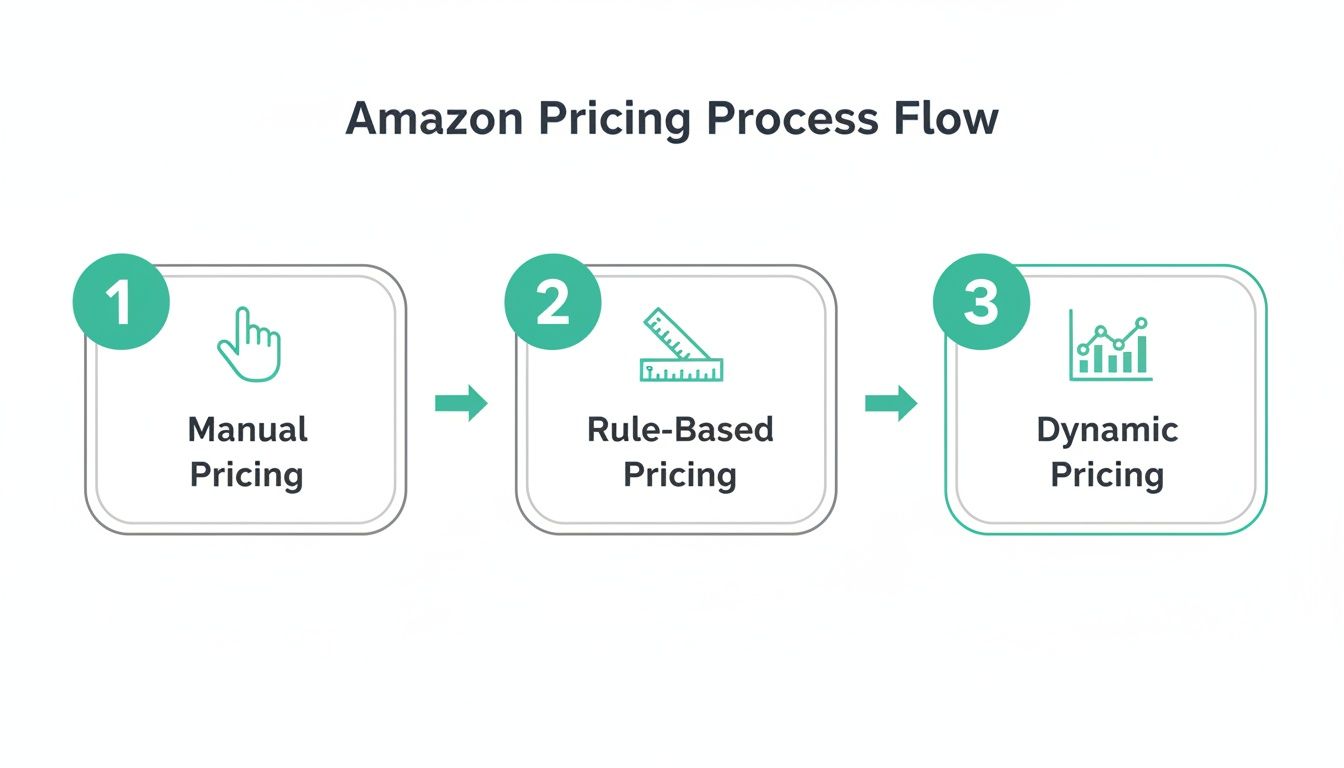
This flow really highlights the evolution from direct seller control to the kind of sophisticated, data-driven automation that makes a dynamic approach so effective.
Step 3: Create Intelligent, Layered Rules
This is where your strategy truly comes to life. Forget about a single, crude rule like "price $0.01 below the lowest." Instead, you'll build a series of layered, conditional rules that give you a real competitive edge. The best repricers today allow for incredible nuance, letting you target specific types of competitors and react to different market scenarios.
Here's a look at what building intelligent rules inside a tool can look like.
The screenshot shows how you can create rules to compete differently against FBA sellers, FBM sellers, or even Amazon itself.
Let’s walk through a practical workflow with a few smart rules:
Primary Rule: Set the repricer to match the Buy Box price whenever the current winner is another FBA seller with a feedback rating of 95% or higher. This keeps you competitive with top-tier sellers without giving away margin unnecessarily.
Conditional Rule 1 (Aggressive): If a key FBA competitor goes out of stock, immediately increase your price by 3% or up to your ceiling, whichever is lower. This rule is designed to capitalize on moments when the competition thins out, maximizing profit on every sale.
Conditional Rule 2 (Defensive): If a new FBM seller with a feedback rating below 90% jumps on the listing below your price, do not engage. Hold your price firm. The Buy Box algorithm heavily favors your FBA offer, so there's no need to get into a price war with a less eligible competitor.
This layered approach is a world away from simple undercutting. Amazon's own dynamic pricing strategy is rumored to adjust prices as often as every 10 minutes across its catalog, using algorithms that chew on millions of data points. Brands that implement this kind of structured, intelligent rule-making can cut down on pointless price changes by 28%, which has a huge impact on margin stability.
By building a workflow with a solid foundation (your floor and ceiling prices) and smart, conditional logic, you create an automated system that is constantly working to win the Buy Box at the highest profitable price possible. That, right there, is dynamic pricing in action.
Aligning Pricing With Your PPC and SEO Goals
On Amazon, your price, your ads, and your organic rank aren't just related—they’re three gears in the same machine. A lot of sellers get this wrong. They treat them like separate tasks, tweaking a price here and adjusting a bid there, completely missing the bigger picture.
The truth is, top sellers know that a change to one gear instantly spins the others. They build their entire growth strategy around this powerful connection.
Your pricing has a direct, immediate impact on how well your Pay-Per-Click (PPC) campaigns perform. It’s simple, really. A lower, more competitive price almost always leads to a higher conversion rate. When a shopper clicks your ad and sees an offer they can't refuse, they're far more likely to buy. This spike in conversions is exactly how you improve your Advertising Cost of Sale (ACoS), one of the most vital metrics for any Amazon advertiser.
A better conversion rate means you're getting more sales for the same ad spend, which directly lowers your ACoS. This makes your entire advertising budget more efficient and, ultimately, more profitable.
Nowhere is this interplay more critical than during a product launch. A launch that strategically aligns pricing and ads from day one can create an unstoppable momentum that sets your product up for long-term success.
A Unified Workflow for Product Launches
Think of a new product launch not as a single event, but as a three-stage rocket. You can't just set a price, flip on your ads, and hope for the best. Each stage needs to build on the last, using pricing and PPC as the fuel to climb Amazon's search rankings.
Here’s a practical, step-by-step workflow that works:
Stage 1: Penetration Pricing for Initial Traction (Weeks 1-2)
- Action: Set your price 15-20% below your target long-term price. For a product you want to sell at $25, launch it at $19.99.
- Goal: Drive initial sales and get early reviews. Run aggressive PPC campaigns targeting core keywords to maximize visibility and clicks.
Stage 2: Fueling the A9 Algorithm with Sales Velocity (Weeks 3-4)
- Action: As sales and reviews come in, keep the price low. Monitor your organic keyword ranking.
- Goal: The sales surge signals to Amazon's A9 algorithm that your product is relevant and popular, boosting your organic rank for targeted keywords.
Stage 3: Strategic Price Increases for Profitability (Week 5 onwards)
- Action: Once you have 10+ reviews and a solid page-one organic rank, begin raising your price incrementally. Increase it by $1-$2 every few days.
- Goal: Find the sweet spot where sales velocity remains strong while maximizing your profit margin. Your new social proof (reviews) and organic visibility now justify the higher price.
Connecting the Dots for Sustainable Growth
This integrated approach makes sure your marketing dollars and your pricing moves are working together, not fighting each other. The money you pour into PPC during the launch isn't just buying clicks; it's building the foundation for your future organic visibility.
As your organic rank climbs, your dependency on paid ads can shrink, which directly boosts your overall profitability. To really get into the weeds of optimizing your ad spend, you can check out our complete guide to managing your Amazon advertising cost.
This method turns pricing from a simple, reactive chore into a proactive tool for growth. It’s a perfect example of how the most effective Amazon pricing strategies go way beyond just matching competitors and instead look at the entire business ecosystem. By aligning price, ads, and SEO, you create a flywheel that builds its own momentum, protects your margins, and secures your product’s spot at the top.
Using AI Repricing Tools to Maximize Your Profit

Rule-based repricers are handy for automating simple "if this, then that" commands, but they're limited. They only ever do exactly what you tell them. AI-powered repricing tools are the next step in smart Amazon pricing strategies, shifting from reactive rules to predictive, intelligent decision-making.
In other words, they don't just follow your commands; they think for you.
This advanced software crunches massive amounts of data—competitor stock levels, historical sales velocity, subtle market trends, you name it. The objective isn't just to win the Buy Box anymore. It’s to win it at the absolute highest price the market will bear.
The AI Advantage Over Simple Rules
The real difference-maker here is intelligence. A simple rule-based tool sees a competitor drop their price by a penny and immediately follows suit. It's a knee-jerk reaction.
An AI repricer sees that same price drop but pauses to ask why. It digs into the data to figure out if that competitor is a serial undercutter who's about to run out of stock anyway.
Instead of jumping into a profit-killing race to the bottom, the AI might just hold your price steady. It’s smart enough to predict that the competitor will be gone in a few hours, letting you swoop in and capture the Buy Box later at a much healthier margin.
AI repricers are built to spot and act on profitable windows of opportunity that a human—or a basic rules engine—would completely miss. They see the competitive landscape as a complex, interconnected system, not just a series of isolated price changes.
Key Features to Look for in AI Repricers
When you're looking at AI tools like Aura or BQool, a few features are absolutely essential for protecting your bottom line while pushing sales. These capabilities are what truly separate a smart AI from a simple automation script. You can explore the bigger picture of how to implement AI in eCommerce brands to see how this fits into a wider strategy.
Keep an eye out for these must-have functions:
- Profit Protection: This goes way beyond a simple floor price. A good AI tool calculates your true profitability in real-time, baking in all Amazon fees, ad spend, and your cost of goods to make smarter pricing moves.
- Predictive Analytics: The software has to be able to forecast what your competitors will do next. Does a certain seller always restock on Tuesdays? Do they slash prices every day at 2 PM? The AI learns these patterns and uses them to your advantage.
- Buy Box Optimization: The goal isn't just winning the Buy Box. A true AI's core job is to find the perfect price point that holds the Buy Box while squeezing every last bit of profit out of each sale.
A Practical Example of AI in Action
Let's say you sell a popular kitchen gadget. Your main FBA competitor has a habit of dropping their price by $1.00 every Friday afternoon, probably to clear out some inventory before the weekend.
Here’s how different tools would handle it:
- A Rule-Based Repricer: It sees the price drop to $24.99 and immediately follows, setting your price to $24.98. You've just lost $1.00 in profit on every sale for the entire weekend.
- An AI Repricer: It analyzes the competitor's historical data and sees this pattern. It also checks their current stock levels and predicts they'll be sold out by Saturday evening. Instead of dropping its price, the AI holds firm at $25.99. It might lose the Buy Box for a few hours on Friday, but once that competitor stocks out, it recaptures the position at the original, higher price for the rest of the weekend.
The result? You just earned significantly more profit on all your weekend sales.
This is the kind of strategic patience that AI brings to the table. It transforms your pricing from a reactive tactic into a calculated, long-term strategy that puts profit first.
Common Questions About Amazon Pricing
Jumping into the world of Amazon pricing can feel like a moving target. Just when you think you’ve got it all sorted, a new question pops up. This section cuts through the noise to tackle some of the most common—and critical—questions sellers have. I'll give you direct, practical answers that build on what we've already covered, so you can handle real-world pricing puzzles with confidence.
How Often Should I Change My Prices on Amazon?
There’s no magic number here. The right frequency for price changes comes down to one thing: your competitive landscape. Let's look at the two most common scenarios.
If you’re selling a product with a dozen other sellers on the same listing, you're in a high-velocity environment. An automated repricer adjusting your price multiple times an hour isn't just an advantage; it's a necessity to stay in the Buy Box rotation. The market for these items moves at lightning speed, and trying to keep up manually is a losing game.
On the flip side, if you're a private label brand and the only seller on your listing, you have more breathing room. A weekly or even monthly price review is often plenty. Here, your adjustments are driven by sales velocity, inventory levels, and PPC performance—not what Joe down the street is doing. The one golden rule? Never "set it and forget it."
Key Takeaway: The more cutthroat your listing is, the more often your prices need to adapt. This is precisely what AI-powered tools are built for—making thousands of tiny, data-driven micro-adjustments to nail that sweet spot between profit and sales.
Will a Lower Price Guarantee the Buy Box?
Nope. Not even close. Believing that the lowest price is an automatic ticket to the Buy Box is one of the most persistent myths on Amazon. While price is a huge piece of the puzzle, the algorithm is smart. It’s built to reward the best overall customer experience, and that involves a lot more than just the price tag.
Amazon’s algorithm is constantly crunching the numbers on several other key factors:
- Fulfillment Method: Fulfillment by Amazon (FBA) almost always gets the nod over Fulfilled by Merchant (FBM). Why? Because Amazon trusts its own logistics to deliver a fast, reliable experience.
- Shipping Speed: This goes hand-in-hand with fulfillment. The faster you can get the product to the customer, the better your chances.
- Seller Feedback Score: A high positive feedback rating is your reputation on the line. It tells Amazon you’re a trustworthy seller who doesn’t mess around.
- Inventory Availability: You can't sell what you don't have. Keeping your product in stock is non-negotiable for winning the Buy Box.
Think of it this way: an FBA seller with a 99% positive feedback rating will almost always hold the Buy Box, even at a higher price, over an FBM seller with an 88% rating. A winning strategy isn't about being the cheapest; it's about becoming the most ‘Buy Box eligible’ seller on the listing.
What Is a Race to the Bottom and How Do I Avoid It?
A "race to the bottom" is a profit-killing downward spiral that haunts many sellers. It’s what happens when poorly configured repricers get stuck in a loop, each one undercutting the other by a penny. This continues until everyone is selling at their absolute minimum price, effectively torching their margins.
Getting out of—or better yet, completely avoiding—this mess requires a defensive, profit-first mindset. It boils down to two critical steps.
- Set a Non-Negotiable Floor Price: This is your line in the sand. Before you turn on any automation, you absolutely must calculate the lowest price you can sell at and still make a profit, after every last fee and cost. This is your safety net.
- Use Intelligent Repricing Rules: Ditch the simplistic "price below the lowest" rule. It's a recipe for disaster. Instead, use smarter logic like "match the Buy Box price" or "price above a seller with a lower feedback rating."
Your best defense is an AI-powered tool that knows when to go on the offensive by raising prices. For example, a smart AI repricer can see a competitor is about to run out of stock. Instead of dropping your price, it will hold steady, knowing it can capture the Buy Box at a much healthier margin as soon as that competitor is gone.
How Does My Pricing Strategy Affect Brand Perception?
Your price is more than just a number; it’s a signal. It instantly tells customers what your brand is all about—quality, value, or a bargain-bin find. If you’re consistently the cheapest option, you’re slowly eroding your brand’s value, making it nearly impossible to ever justify a premium price later on.
This is especially critical for private label brands working to build a loyal customer base. A value-based pricing strategy is your best friend here. Your price should be a reflection of your product's superior features, killer branding, and glowing social proof (reviews). That’s how you build long-term brand equity, where customers associate your name with quality, not just a good deal.
Even when you’re using a dynamic repricer, your floor and ceiling prices are your brand’s guardians. Avoid constant, deep discounts unless you’re running a strategic, short-term promotion for something like a product launch. Don’t forget, many shoppers truly believe that a higher price means better quality—especially when your A+ Content and professional images back it up.
Navigating the complexities of Amazon pricing strategies requires a partner who understands how to protect profit while pushing for growth. At ZonFlip, we provide end-to-end account management, from PPC optimization to AI-driven repricing, to ensure your business thrives. Discover how our "First Profit, Then Progress" philosophy can transform your Amazon sales by visiting us at https://www.zonflip.com.