


Imagine your online store suddenly opening its doors in over 20 countries. Literally overnight, millions of new customers who have never heard of your brand can suddenly find and buy your products. That’s the real power behind Amazon Global Selling, a program that essentially acts as your passport to international ecommerce. It lets you list and sell products on Amazon's marketplaces across North America, Europe, and Asia, all from a single, unified account.
What Is Amazon Global Selling and Why It Matters
At its core, Amazon Global Selling is a suite of tools and services built to take the headache out of cross-border commerce. Instead of you having to figure out the mind-numbing complexities of international expansion from scratch, Amazon provides the entire infrastructure to get you in front of a worldwide audience.
This isn't just about throwing your listings up on another country's website. It's a genuine growth strategy for scaling your brand far beyond your home market.
Think of it as a launch kit for going global. Amazon gives you the unified account management, international fulfillment options, and even built-in currency converters. All these pieces work together to make a huge move like global expansion feel less like a monumental risk and more like the next logical step for your business.
The Opportunity for Growth
The biggest win here is obvious: tapping into massive, underserved revenue streams. Your home market might be getting crowded, with competitors popping up every other week. International marketplaces, however, can offer a fresh start with hungry customers. By diversifying where your sales come from, you're no longer totally dependent on one country's economy, and you get to extend the life of your best-selling products.
The numbers don't lie. Amazon's international marketplaces are booming, with sales hitting a staggering $142.91 billion, a 9% jump year-over-year. This kind of growth shows that the platform is no longer just an American giant; it's a true global commerce hub. You can discover more insights about Amazon's international sales performance and what it means for sellers like you.
The program effectively bulldozes the traditional barriers to entry—like logistics, legal red tape, and customer acquisition—that once made selling internationally a pipe dream for most brands.
Amazon Global Selling turns the complex idea of selling globally into an achievable goal by providing the infrastructure, logistics, and customer reach that would otherwise take years and significant capital to build independently.
Key Advantages for Your Brand
Jumping into new markets with Amazon Global Selling gives you a few powerful advantages that can seriously set your brand apart.
- Access to Millions of New Customers: You're not starting from zero. You get instant access to established markets with millions of Prime shoppers who are already logged in and ready to buy.
- Simplified Logistics: This is a big one. With programs like Fulfillment by Amazon (FBA) Export and Pan-European FBA, Amazon can handle all the heavy lifting—storing, picking, packing, and shipping your international orders. You sell, they ship.
- Brand Building on a Global Stage: Getting a foothold in multiple countries does wonders for your brand's credibility. It builds recognition and lays the groundwork for a truly sustainable, long-term business.
Ultimately, this program is way more than just another sales channel. It’s a strategic pathway to transforming your local business into a brand known around the world.
So, you’re ready to take your brand global on Amazon. Awesome. But where on earth do you start?
It’s tempting to immediately jump into the biggest, most obvious markets like the UK or Germany. Resist that urge. The smartest move isn't about targeting the largest pond; it's about finding the pond where you're the biggest fish. Your goal is to find a country where your products just click—where the competition is manageable and customers are already looking for exactly what you sell.
This isn't about gut feelings or throwing a dart at a map. It’s about doing your homework upfront to avoid costly missteps and to build the kind of momentum that fuels future growth.
Let Data Drive, Not Assumptions
Your first job is to swap out assumptions for actual, hard data. Let's say you sell high-end kitchen gadgets in the US. The easy assumption is to launch in the UK first because, you know, same language. But what if the data tells a different story?
Maybe your research shows that German shoppers have a serious appetite for premium kitchenware, and your specific niche is wide open over there. Suddenly, Germany looks a lot more profitable, doesn't it? This is the kind of hidden opportunity you're looking to uncover.
Here's a simple, practical workflow to approach your research:
- Identify Top Performers: Pull up your sales reports and identify your top 5-10 best-selling ASINs in your home market. These are your proven winners and have the highest probability of success abroad.
- Use Amazon's Internal Tools: Log in to Seller Central and navigate to the "Marketplace Product Guidance" tool. This feature analyzes your catalog and suggests which of your products are seeing demand in other countries based on Amazon's own data.
- Conduct Keyword Research: Use a third-party tool to check search volume for your main keywords on different Amazon marketplaces. For example, search for "air fryer" on Amazon.de, Amazon.co.uk, and Amazon.fr. You're looking for high search volume with a reasonable number of competitors.
- Analyze the Competition: Go to your shortlisted marketplaces and search for your product category. Who are the top sellers? Are their listings high-quality? Read their negative reviews to identify market gaps. For instance, if customers on Amazon.de complain that all current air fryers are too small, and you sell an extra-large model, you've found a clear opening.
A data-driven approach to choosing your first market is how you score an early win. It gives you a profitable foothold and the confidence to keep expanding your Amazon Global Selling empire.
Don't Forget the Practical & Regulatory Hurdles
Finding a hungry market is only half the battle. You also have to deal with the real-world logistics and legal stuff. Ignoring these practical details can get your listings suspended or saddle you with surprise costs that kill your profit margins.
Before you commit, size up each potential market on these critical factors:
- Language and Culture: Can you properly translate and localize your listings? And what about customer service? A literal translation of an American idiom can fall completely flat or, worse, be confusing. You need to speak your new customer's language, both literally and culturally.
- Compliance and Red Tape: This one is absolutely non-negotiable. Selling supplements in the EU involves a completely different set of rules than in the UK post-Brexit. Electronics need specific certifications, like the CE marking in Europe, which are different from US standards. Get this wrong, and you're done before you start.
- Fulfillment and Logistics: How easy is it to actually get your inventory into the country and into an FBA warehouse? You need to map out shipping costs, import duties, and whether you'll need to register for VAT (Value Added Tax) right away.
Here’s a practical example:
Imagine you sell organic skincare products. Your research shows strong demand in both France and Australia. But digging deeper, you find that Australia's import rules for organic goods are far simpler for a US seller than France's, which are tangled up in complex EU cosmetic directives requiring a local "Responsible Person."
Even though France is a huge market, Australia is the smarter first move. It has a much lower barrier to entry. You can get your products live, start generating revenue, and learn the international selling ropes in a less complicated environment. Then, you can use that experience to tackle a more complex region like the EU. It’s about being strategic, not just ambitious.
Your Step-By-Step Account Setup Guide
Jumping into Amazon Global Selling can feel like a massive undertaking, but setting up your account is actually pretty straightforward if you know what you’re doing. The real secret is getting everything lined up before you start. A little prep work here saves you from a world of headaches and delays down the road.
Let's walk through exactly what you need to do to get your global storefront open for business.
Your first big decision is how you want to structure your accounts. Amazon gives you two main ways to go about it, and your choice really depends on how you plan to expand.
- Unified Accounts: This is your best bet for regional domination. Think of these as bundled accounts. The North American Unified Account, for instance, lets you manage the US, Canada, and Mexico all from one dashboard. The European version does the same for the UK, Germany, France, Italy, and Spain. For most sellers, this is the most efficient and common starting point.
- Linked Global Accounts: This option is for sellers who already have separate, standalone accounts—maybe one in North America and another in Japan. You can link them to see all your sales data and manage inventory from one place, but they still operate as separate entities.
For almost everyone starting out, the Unified Account is the way to go. It keeps things simple and often combines your monthly subscription fees into one.
The Document Checklist That Will Save Your Sanity
Amazon's verification process is notoriously tough—and for good reason. They're trying to keep the marketplace safe. This means your documentation has to be perfect. Any little mismatch in names, an expired ID, or a blurry scan is a surefire way to get your application flagged or outright rejected.
The golden rule for Amazon verification is absolute consistency. The name and address on your ID, bank statement, and business license must be identical. I mean, exactly the same. A simple difference like "St." versus "Street" can get you stuck in a loop with Seller Support.
Here’s what you absolutely must have ready:
- Proof of Identity: Your passport is the gold standard here. Make sure it's valid and not even close to expiring. A government-issued photo ID can also work.
- Business Registration Documents: You need to prove your business is legit. This could be your Articles of Incorporation, LLC registration, or a standard business license.
- Bank Account Statement: Grab a recent statement, typically from the last 90 days. It needs to clearly show your business name and address, and the account must be in a country Amazon’s payment system supports.
- Internationally Chargeable Credit Card: This is for your monthly professional seller fee and any ad spend. It has to be a real credit card, not a debit or prepaid card.
A Practical Setup Example
Let’s make this concrete. Imagine you're a US-based LLC ready to take on Europe with the Pan-European FBA program.
Here is the step-by-step workflow you should follow:
- Gather Your Documents:
- Scan your personal US passport for identity verification.
- Scan your LLC registration paperwork from your home state.
- Download a recent PDF of your business bank statement, ensuring it shows the LLC’s name and registered address.
- Have your business credit card ready (the one enabled for international charges).
- Start Registration: Go to the Amazon Global Selling page for Europe and click "Register."
- Fill Out Information: Carefully enter your business details. This is where you double-check that the name "John Doe LLC" and address "123 Main Street" match exactly across all documents.
- Upload and Submit: When prompted, upload your scanned documents. Review everything one last time before hitting submit.
By having all this ready to go—and triple-checking every detail—you turn a bureaucratic nightmare into a simple box-checking exercise. This kind of preparation isn't just about getting approved; it's the first step in building a solid foundation for your global Amazon business.
3. Mastering Global Logistics and Fulfillment
How you get your products into the hands of international customers is the engine of your global business. It's not just about shipping; it's about strategy. Get it right, and you've built a profitable, scalable machine. Get it wrong, and your international expansion can stall before it even gets off the ground.
At the core, you have two main paths: Fulfillment by Amazon (FBA) and Fulfillment by Merchant (FBM).
Think of FBA as handing the keys to your international warehouse over to Amazon. You ship your products in bulk to an Amazon fulfillment center in your target country, and they take it from there. They handle the storage, picking, packing, shipping, and even customer service in the local language.
FBM, on the other hand, puts you firmly in the driver's seat. You store the inventory and are responsible for shipping every single order directly to your international customer. This gives you ultimate control but piles on the logistical complexity.
This flowchart breaks down the account structures that are the foundation for these fulfillment decisions.
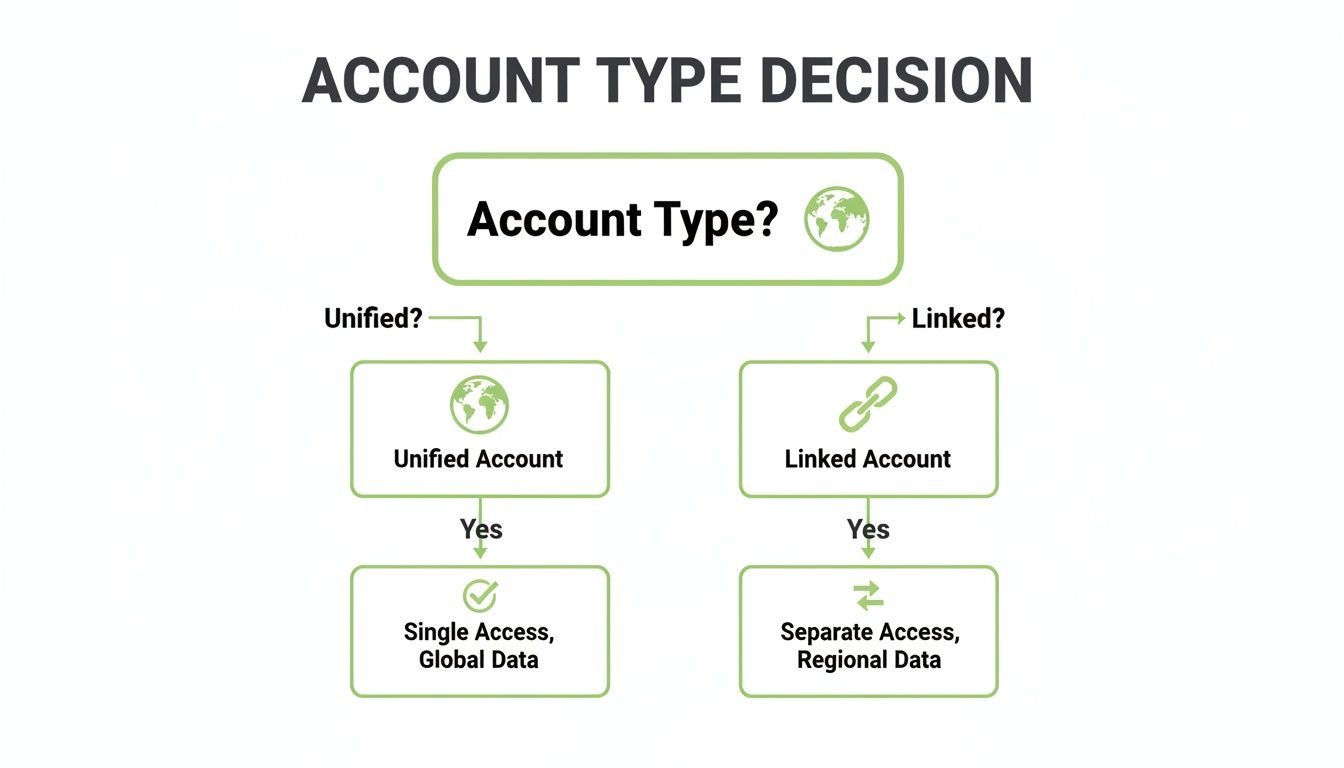
Whether you choose a unified or linked account will directly influence how you manage inventory and fulfillment across different regions.
FBA Export: Your Low-Risk Starting Point
For sellers just dipping a toe into international waters, FBA Export is a godsend. It's a simple program that lets international customers buy your products directly from your home marketplace (like Amazon.com). The best part? You don't have to ship a single box overseas or get tangled up in foreign taxes.
Practical Example: You sell yoga mats on Amazon.com and enroll them in FBA Export. A customer in Brazil finds your listing and places an order. Amazon automatically calculates the import fees, collects them from the customer at checkout, and ships the yoga mat directly from your US-based FBA inventory to the customer in Brazil. You did nothing extra and just made an international sale.
Pan-European FBA: Your EU Power Play
Once you've seen some promising signs and are ready to go all-in, programs like Pan-European FBA become incredibly powerful. This is the move for sellers serious about cracking the massive EU market. You ship your inventory to a single Amazon fulfillment center in an EU country, and Amazon strategically spreads it across warehouses on the continent based on where they predict customers will buy.
This means buyers in Germany, France, Italy, and Spain get the fast, Prime-eligible shipping they expect. You only pay the local FBA fee for that marketplace, not the painful cross-border fulfillment fees. It’s a genuine game-changer. Just look at the scale: independent sellers have shipped over 80 billion units using FBA. It's a proven, reliable system.
Pan-European FBA is like setting up an entire continental distribution network with a single shipment. It closes the distance between you and millions of European customers, making your products feel local.
Comparison of Global Fulfillment Methods
Choosing the right fulfillment method depends entirely on your business goals, risk tolerance, and operational capacity. This table breaks down the key differences to help you decide which path makes the most sense for your brand as you expand globally.
| Fulfillment Method | Best For | Prime Eligibility | Logistical Complexity | Cost Structure |
|---|---|---|---|---|
| FBA | Sellers who want to outsource logistics and offer fast, Prime shipping. | Yes | Low | FBA fees, storage fees, and inbound shipping costs. |
| FBM | Sellers with existing logistics or those wanting full control over stock. | No (unless SFP) | High | You control all costs: storage, packing, and international shipping rates. |
| FBA Export | New international sellers testing demand with zero upfront investment. | Yes | Very Low | Standard FBA fees; Amazon handles export costs charged to the customer. |
| Pan-Regional FBA | Serious sellers scaling across an entire region like the EU or North America. | Yes | Medium | Local FBA fees (no cross-border fees), inbound shipping to one country, and program fees. |
Each of these options offers a different balance of control, cost, and convenience. Starting with FBA Export to validate demand and then graduating to a regional FBA program is a common and highly effective strategy for sustainable growth.
The Hidden Role of a 3PL Partner
As you scale, the complexity of international logistics grows exponentially. This is where a great third-party logistics (3PL) partner becomes your most valuable asset. They are your boots on the ground, handling the crucial tasks you can't manage from thousands of miles away.
Here’s a practical workflow for using a 3PL for FBA prep:
- Ship in Bulk: You send a large, consolidated shipment from your manufacturer directly to your 3PL's warehouse in the destination country (e.g., Germany).
- Inspect and Prep: The 3PL inspects the units for damage, applies the correct FNSKU labels, poly-bags items if needed, and ensures everything meets Amazon's strict FBA prep requirements.
- Create FBA Shipment: In Seller Central, you create an FBA shipment plan, assigning the 3PL's address as the "ship from" location.
- Forward to FBA: The 3PL schedules the final delivery and sends your perfectly prepped inventory to the designated Amazon fulfillment center. This process prevents costly rejections and delays at Amazon's warehouse.
To get a clearer picture of how outsourcing can streamline your operations, understanding what is 3PL logistics is a great first step. A smart 3PL paired with a reliable freight forwarder is the secret sauce behind almost every smoothly run global operation.
Navigating International Taxes and Compliance
For a lot of sellers, the mere mention of international taxes and customs paperwork is enough to stop an expansion plan in its tracks. It all sounds impossibly complicated, I get it. But here’s the thing: it’s entirely manageable once you break it down into smaller pieces.
Ignoring this stuff simply isn't an option. Mistakes here can get your inventory seized, your account suspended, or land you with some pretty hefty fines.
Think of each country as its own private club. To get in, you have to pay the entry fees (import duties) and follow the house rules (taxes and regulations). It’s just a matter of learning the local rules of the road.
Understanding Key Tax Concepts
The most common tax you'll run into is Value Added Tax, or VAT. It’s basically a consumption tax that gets added at each step of the supply chain, from the factory floor all the way to the final sale.
It's the European equivalent of sales tax in the US, but the collection process is different. In most EU countries and the UK, you’ll need a VAT number just to store your inventory there.
Practical Example: If you plan to use Pan-European FBA and store inventory in Germany, you must register for a German VAT number before your first shipment arrives. Without it, your inventory cannot be stored in a German fulfillment center.
Here's a quick rundown of the taxes you'll see:
- VAT (Value Added Tax): This is the standard in the UK and the European Union. Rates can be wildly different from one country to the next.
- GST (Goods and Services Tax): The same concept as VAT, just with a different name. You'll find it in countries like Canada and Australia.
- Import Duties: These are totally separate taxes that customs collects when your goods physically arrive in a country. The amount is based on what your product is and how much it’s worth.
Shipping Terms and Why They Matter
When you're sending a big shipment to an international FBA warehouse, you have to choose your shipping terms. The choice you make is critical.
DDP (Delivered Duty Paid): This is the only way to ship to Amazon FBA. As the seller, you are responsible for paying all transportation costs, including all import duties and taxes, before your products get to the fulfillment center. This ensures your shipment sails through customs and gets checked in.
DDU (Delivered Duty Unpaid): With DDU, the recipient (Amazon) would get hit with a bill for customs fees upon arrival. Amazon will always reject these shipments. Don't even consider it.
For FBA sellers, choosing DDP is non-negotiable. It’s the only way to guarantee your inventory clears customs smoothly and becomes available for sale without any drama.
Product Compliance Across Borders
Beyond taxes, you’ve got to tackle product compliance, which can be a minefield. The rules that work for your product in the US might not cut it in Germany or Japan.
Practical Example: You sell a popular children's toy in the US. To sell it in the UK and EU, you must ensure it meets the EN 71 safety standard and has a visible CE marking on the product and packaging. This proves it has been tested and is safe for children according to European law. Without these certifications, your shipment would be rejected at the border.
Some product categories might be restricted or require special approval in different marketplaces. If you want to dive deeper, you might find our guide on navigating Amazon's gated and ungated categories helpful.
If you don't meet these local standards, your listings can get shut down or, even worse, your products could be destroyed at the border. Always do your homework on the specific rules for your product category in your target country before you ship a single item. Investing in a consultation with a compliance expert is a smart move that can save you from very expensive mistakes.
Localizing Your Listings for Global Customers
If you think running your US product titles through Google Translate is enough to succeed internationally, I've got bad news for you. It's a surefire way to fail. The real secret to cracking Amazon Global Selling is localization—it's the art of adapting your entire message so it truly clicks with the local culture, how they search, and what makes them buy.
This is so much more than just swapping words. You need to put on your local marketer hat and understand what really drives a shopper in Italy versus one in Japan. If you skip this, you’re basically just shouting at people in a language they don't connect with. They might hear the noise, but the message won't land.
To really make a dent in international markets, you have to get the nuances right, and that often means mastering document translation to ensure every word feels natural and culturally on-point.
Thinking Beyond Translation
Let's get practical. Imagine you're selling a high-tech drip coffee maker in the US. Your marketing is all about speed and convenience: "Brews a full pot in 5 minutes!" and a "massive 12-cup carafe!"
Now, try selling that in Italy. That entire angle is wrong. You need a complete rethink.
- Keywords: Nobody in Italy is searching for a "drip coffee maker." Espresso is king. The keyword you actually need is something like "macchina da caffè americano" (American coffee machine).
- Title: Forget speed. Italians value quality, authenticity, and design. A title like "Artisan Slow-Drip Coffee Maker for an Authentic Americano" will crush "Fast 12-Cup Coffee Brewer."
- Bullet Points: The benefits have to be reframed. Instead of bragging about the big carafe, you’d highlight features that appeal to a sophisticated coffee culture—like adjustable water temperature for perfect extraction or a sleek design that looks like a piece of art on their kitchen counter.
This is what localization is all about. It’s showing the local customer that you get them. That’s how you build trust and, ultimately, make sales. If you want to go deeper on this, we've got a whole guide on how to optimize Amazon product listings.
Applying Localization to Your PPC Campaigns
Your ad strategy needs the exact same localized treatment. Just translating your US keywords and running the same PPC campaigns in every country is like setting your ad budget on fire.
Here’s what a smart, localized PPC workflow actually looks like:
- Local Keyword Research: Use a PPC tool set to the target marketplace (e.g., Amazon.de) to find high-volume, relevant German keywords. The direct translation of your English keyword might have zero search volume.
- Campaign Isolation: Create entirely new Sponsored Products and Sponsored Brands campaigns for each country. Do not simply copy your US campaigns.
- Ad Copy Adaptation: Write new ad headlines in the local language that reflect cultural nuances. For example, an ad in Germany might focus on durability and engineering ("Langlebigkeit und Präzision"), while a French ad might highlight style ("Design élégant").
- Bid and Budget Management: Monitor the cost-per-click (CPC) and advertising cost of sale (ACoS) separately for each marketplace. A profitable bid in the US could be unsustainable in the hyper-competitive UK market. Adjust bids and budgets based on local performance.
Localized Customer Service Builds Trust
Finally, localization has to extend all the way to how you talk to your customers. Offering support in their native language isn't a "nice to have"—it's a must.
Answering a German customer’s question in fluent German versus a choppy, machine-translated response can be the difference between a glowing 5-star review and a negative feedback bomb that wrecks your account health.
Think about it: over 60% of all Amazon purchases happen on mobile, and 70% of product searches start right on the platform. A positive, localized interaction can be the final nudge that secures the sale and turns a one-time buyer into a loyal fan.
Common Questions About Amazon Global Selling
Even the most buttoned-up expansion plan can leave you with a few lingering questions. It’s totally normal. Venturing into Amazon Global Selling is a big move, so let's tackle some of the most common queries we hear from sellers just like you.
Can I Sell on Amazon From a Different Country?
Yes, absolutely. Amazon’s entire platform is built to support sellers from all over the world. You can set up a Seller Central account from an approved country and start listing on any of its international marketplaces, as long as you can pass the verification and compliance checks for that specific region.
Practical Example: A brand based in Australia can open a North American Unified Account. This single account lets them sell in the U.S., Canada, and Mexico without ever setting foot there. They’ll just need to provide standard business verification documents, like proof of identity from their Australian passport, their Australian business registration, and a valid bank account that can accept payments from Amazon.
Which Country Is Best to Start Selling In?
There's no single "best" country—it really boils down to your product and your brand. The U.S. is the biggest prize, but it’s also the most crowded and competitive field.
For sellers dipping their toes into international waters for the first time, sticking to English-speaking markets is often the smoothest entry point.
- Canada: It’s culturally very similar to the U.S., and programs like North America Remote Fulfillment (NARF) make the logistics much simpler.
- United Kingdom: A huge, mature e-commerce market that’s very receptive to new products. Just be prepared for separate VAT and customs processes now that it's post-Brexit.
- Germany: This is the heavyweight champion of European e-commerce. The opportunity is massive, but it's not for the faint of heart. You'll need flawless listing localization and a solid strategy to stand out in a fiercely competitive space.
The smartest play? Don't try to conquer the world all at once. Pick one or two markets where you see clear product demand and the regulatory hurdles are manageable. Get some solid wins on the board before you expand your empire.
Do I Need Amazon FBA to Sell Overseas?
Technically, no, you don't have to use Fulfillment by Amazon (FBA). But honestly? It’s highly recommended. Using FBA is what gets you that coveted Prime badge, and in most markets, being Prime-eligible is a massive sales driver. It also takes the logistical nightmare of local storage, shipping, and customer service off your plate.
You could go the Fulfillment by Merchant (FBM) route and ship orders directly to international customers yourself. But this path is riddled with challenges. You’re looking at much slower delivery times, unhappy customers, and the headache of managing cross-border returns and customer service on your own. FBA is built to handle all of that, making it the go-to choice for virtually any seller serious about international growth.
Expanding your brand globally is a huge undertaking, but it’s not a journey you have to take alone. Here at ZonFlip, we live and breathe this stuff. We provide complete account management and strategic guidance to help you cut through the complexity of Amazon Global Selling, from day-one setup to long-term, profitable growth. Learn how we can accelerate your international success at ZonFlip.