



In the simplest terms, Amazon FBA prep services are partners who specialize in getting your products ready for Amazon's warehouses. They handle the packaging, labeling, and all the little details required before your inventory can be sent off.
This ensures your products meet every one of Amazon's strict requirements, which is crucial for avoiding costly rejections and frustrating delays.
The Backstage Crew of Your FBA Business
Think of your Amazon business like a big stage production. You’re the director, focused on the big picture—sourcing amazing products, writing killer listings, and marketing your brand to the world.
While you're managing everything in the spotlight, an Amazon FBA prep service is your expert backstage crew. They handle all the critical, behind-the-scenes details that make the show run smoothly. Just like a play can’t go on without perfect lighting and flawless set changes, your products won't reach customers if they don't meet Amazon's rigid standards.
A single mistake—a missing label, the wrong poly bag, or not enough bubble wrap—can bring your entire operation to a screeching halt.
Why Compliance Is Not Optional
Amazon’s fulfillment network is an incredibly efficient machine, fine-tuned for speed. To keep it that way, they enforce non-negotiable rules for every single item that enters their warehouses. Failing to follow these rules isn't a minor hiccup; it comes with real financial consequences.
You could be looking at:
- Unplanned Prep Fees: Amazon will gladly fix your mistakes for you—at a premium rate that eats directly into your profits.
- Shipment Rejection: An entire shipment can be turned away and sent back, which means you've wasted money on shipping and are now facing major sales downtime.
- Inventory Delays: Incorrectly prepped products can sit in a corner for weeks waiting to be checked in, killing your sales velocity and tanking your product rankings.
- Account Penalties: Repeatedly failing to comply can damage your account health and may even lead to selling restrictions.
Basically, every product has to arrive at the fulfillment center perfectly "shelf-ready," according to Amazon's playbook. This is exactly where a prep service becomes your most valuable player.
A reliable prep partner is like a compliance insurance policy for your business. They are experts in Amazon's ever-changing rulebook, making sure your inventory flows smoothly from your supplier to the fulfillment center without any costly interruptions.
A Practical Analogy: The Pit Crew
Imagine you're a professional race car driver. Your job is to drive, strategize, and win the race. You don't hop out mid-race to change your own tires or refuel the car—that would be impossibly slow and you'd lose instantly. Instead, you rely on a specialized pit crew that executes those tasks with blinding speed and precision.
Handling your own FBA prep is like trying to be the driver and the pit crew. Sure, it's possible, but it pulls your focus away from what really matters: growing your business.
Outsourcing to an FBA prep service is like having that expert pit crew. They handle the complex, time-consuming tasks flawlessly, so you can stay focused on winning the e-commerce race. To get a clearer picture of what these services entail, you can explore providers offering comprehensive Amazon FBA Prep services that cover everything from labeling to bundling. This turns a potential operational bottleneck into a streamlined, scalable part of your business.
What an FBA Prep Partner Actually Does
Alright, let's get past the theory and into the nitty-gritty. What are you really paying for when you hire an FBA prep service? Think of them as your hands-on operations team, the crew that handles all the tedious-but-critical tasks needed to get your inventory compliant with Amazon’s notoriously strict rules.
This isn't just about sticking products in a box. It’s a precise, rule-based process. Every single action they take—from applying a label to adding a piece of bubble wrap—directly protects your inventory, your account health, and ultimately, your profits.
FNSKU Labeling and Inventory Accuracy
The single most important task is applying the FNSKU (Fulfillment Network Stock Keeping Unit) label. This is Amazon's internal tracking barcode. It's the unique fingerprint that links a specific unit of your product directly to your seller account. No FNSKU, no sale.
Why is this so critical? It prevents inventory commingling. That's when your high-quality products get thrown into a giant bin with identical items from other sellers. If a customer orders from your listing but Amazon ships them a cheap counterfeit from another seller's stock, your account takes the hit for the bad review. Proper labeling is your only defense.
A professional prep partner has this down to a science. Here’s a typical workflow:
- You Generate Labels: In your Seller Central account, you create an FBA shipment plan. At the end of the process, you download the FNSKU labels as a PDF file.
- You Send the PDF: You email this PDF file directly to your prep service's operations team or upload it to their client portal.
- They Receive Inventory: Your products arrive from your supplier at their warehouse.
- They Verify and Prep: Their team physically matches each product to the FNSKU, covers any existing manufacturer barcodes (like a UPC), and applies the new FNSKU label flat and smooth on every unit.
It sounds simple, but getting this wrong causes a world of pain. A good prep center ensures your brand's reputation stays yours and every unit is properly tracked.
Protective Packaging: Poly Bagging and Bubble Wrapping
Amazon isn't just a marketplace; it's a logistics beast. They have very specific rules designed to protect items and keep customers safe. A prep service knows these rules inside and out.
Practical Example: Poly Bagging a Baby Bib
A baby bib is considered apparel and also falls into the "items for small children" category. It must be protected from dust and dirt.
- The Task: Place each bib into a clear poly bag.
- The Compliance Rule: Because the bag's opening is wider than 5 inches, a suffocation warning label must be clearly visible.
- The Prep Service's Role: They use pre-labeled bags or have rolls of suffocation warning stickers on hand, applying one to each bag, ensuring full compliance. They do this for hundreds of units in the time it would take you to do a dozen.
Practical Example: Bubble Wrapping a Ceramic Bowl
A ceramic bowl is fragile and requires protection.
- The Task: Protect the bowl so it can survive a drop from 3 feet onto a hard surface.
- The Compliance Rule: Amazon requires fragile items to be individually bubble-wrapped before being placed in a shipping box.
- The Prep Service's Role: They wrap the bowl securely in bubble wrap, tape it shut, and then apply the FNSKU label on the outside of the bubble wrap. This prevents it from breaking during transit or inside the warehouse.
A great prep partner is your first line of defense. They ensure every item is packaged not just to be compliant, but to actually survive the rough-and-tumble world of an FBA warehouse. This means fewer damaged goods, fewer angry customers, and more money in your pocket.
Bundling and Kitting for Higher Value
Want to increase your average order value? Selling a "shampoo and conditioner set" or a "3-pack of sponges" is a fantastic way to do it. These bundles are great for customers, but they create a logistical headache you probably don't want to deal with.
A prep service makes this easy. Here's the workflow for creating a "BBQ Master" bundle containing a bottle of BBQ sauce, a grilling spatula, and a meat thermometer:
- Gather Components: The prep team pulls one of each item from your bulk inventory.
- Conceal Barcodes: They cover or remove the individual UPC barcodes on the sauce bottle, spatula package, and thermometer box. This is critical to prevent Amazon from scanning them as separate items.
- Package as a Single Unit: The items are neatly arranged and shrink-wrapped together to create one solid, retail-ready unit.
- Apply New Labels: They apply the unique FNSKU for the "BBQ Master" bundle to the outside of the shrink wrap.
- Add a Warning Sticker: A bright sticker reading "Sold as a Set – Do Not Separate" is added to prevent warehouse staff from breaking the bundle apart.
Trying to manage this on your living room floor is a recipe for chaos. For an experienced prep partner, it's just another Tuesday. This flow is what makes outsourcing so powerful.
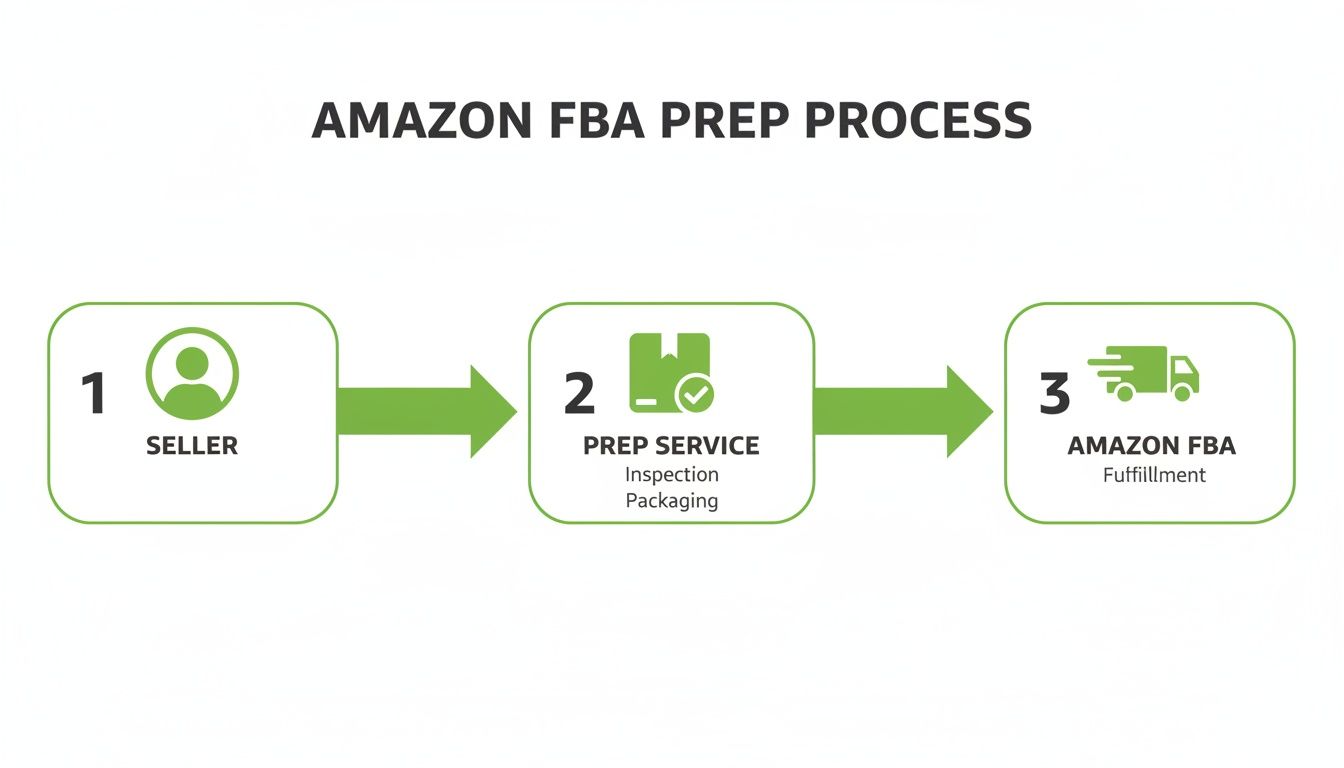
As you can see, the prep service acts as the critical bridge, taking the bulk inventory from your supplier and transforming it into perfectly compliant shipments ready for Amazon.
Comparing In-House Prep vs Outsourced FBA Prep Services
So, should you do all this yourself or pay someone else? It really boils down to a trade-off between control, cost, and your most valuable asset: time. Now that Amazon has axed its own in-house prep programs, this decision is more important than ever for sellers.
This move is pushing more sellers toward third-party logistics (3PL) providers. Industry data shows prep costs typically run between $0.25 to $1.50 per unit, and you can often get volume discounts of up to 30%. For the 200,000 to 300,000 sellers who relied on Amazon's service, switching to a dedicated provider like ZonFlip can mean big savings and much better service. If you're curious about this shift, Fulfill.com has a great breakdown on how the shutdown is creating new opportunities.
To make it simple, here’s a side-by-side look at what you’re really choosing between.
| Factor | In-House Prep | Outsourced Prep Service |
|---|---|---|
| Time Investment | High. You're spending hours on manual labor instead of growing your business. | Low. You get your time back to focus on sourcing, marketing, and strategy. |
| Upfront Costs | Moderate. You have to buy printers, labels, poly bags, boxes, and tape. | Low. You pay a simple per-unit fee. No need to buy or store supplies. |
| Risk of Errors | High. One mistake can get a whole shipment rejected, costing you time and money. | Low. The pros know Amazon's rules and have quality control systems to prevent mistakes. |
| Scalability | Limited. Your growth is capped by how much space and time you have. | High. They can easily handle huge volumes and holiday rushes without breaking a sweat. |
Ultimately, outsourcing your prep work isn't just about offloading tasks. It’s about buying back your time, reducing your risk, and building a scalable foundation that allows your business to grow without being limited by your own bandwidth.
Navigating Amazon's Strict Compliance Rules
Ignoring Amazon’s FBA rules isn't just a minor slip-up; it's a direct threat to your profitability. The entire FBA logistics network is built on a foundation of absolute precision. Any inventory that deviates from these exact standards can grind the gears of that machine to a halt, and your products right along with it.
This is where the real value of professional amazon fba prep services becomes incredibly clear—they're your first and best line of defense against costly, momentum-killing errors.
The consequences for non-compliance are no joke. They can quickly stack up, turning what should have been a profitable product into a financial black hole. Even one tiny mistake can set off a chain reaction of negative outcomes that stalls your business.
The High Cost of Simple Mistakes
Let’s walk through a common scenario. Imagine you’ve just sent a shipment of 500 units to Amazon. To save a few bucks, you decided to handle the prep work yourself. But in the rush, you forgot to cover the original manufacturer barcodes on about 20% of the items.
Here is the step-by-step breakdown of what happens next:
- Arrival and Scanning: Your boxes arrive at the Amazon Fulfillment Center. An employee begins scanning items. The scanner picks up both the manufacturer's UPC and your FNSKU on the first non-compliant unit.
- System Flag: The system immediately flags a "conflict." All items with that FNSKU in your shipment are now considered problematic.
- Shipment Quarantined: Your entire shipment is pulled from the fast-moving check-in line and moved to a problem-solving area. It will sit there until a specialist can address it, which can take days or even weeks during busy periods.
- Problem Resolution (and Fees): Amazon notifies you of the issue. You have two choices: have them fix it or have the shipment sent back. If you have them fix it, they will charge you an "unplanned prep service" fee for each of the 100 affected units—often double what a prep center would charge.
- Financial and Ranking Impact: You've paid extra fees, your inventory is checked in weeks late, you've lost sales, and your Best Seller Rank (BSR) has plummeted due to being out of stock.
These aren't just hypotheticals. Countless sellers have learned these lessons the hard way, watching their hard-earned profits vanish because of a completely preventable compliance issue.
Key Pillars of FBA Compliance
Staying on Amazon’s good side really boils down to a few core pillars that any good prep partner has mastered. They get that Amazon’s rules aren’t arbitrary; they’re designed for maximum efficiency and safety inside their massive fulfillment centers.
A great prep partner ensures these pillars are rock-solid every time:
- Packaging Integrity: This covers everything from using the right type of poly bags (with proper suffocation warnings) to making sure your cartons are sealed correctly. For instance, Amazon demands that boxes not bulge and be sealed with strong packing tape. A prep service uses a professional H-taping method to ensure every box is secure.
- Flawless Labeling: Every single unit needs a perfectly placed FNSKU label that completely covers any other scannable barcodes. If you're selling bundles, a "Sold as a Set" or "This is a Set, Do Not Separate" label is non-negotiable to stop warehouse workers from breaking them apart. There is zero room for error here.
- Accurate Shipment Plans: The items and quantities you declare in your Seller Central shipping plan must be a perfect match for what's actually in the boxes. Example: If your plan says Box 1 contains 24 units of SKU-A, but it actually contains 23 units of SKU-A and 1 unit of SKU-B, the entire box will be flagged for investigation, delaying the check-in of all 24 units.
With 82% of active Amazon sellers using FBA, the platform's decision to discontinue its own prep services on January 1, 2026, makes third-party compliance experts more vital than ever. This shift means the vast majority of sellers will need to lean on external amazon fba prep services to meet the strict standards required for Prime eligibility. You can learn more about how many sellers depend on FBA on redstagfulfillment.com.
A Cautionary Tale: We know a seller who had their entire Q4 shipment of a best-selling gift item rejected in late October. The reason? The FNSKU labels were printed with cheap, low-quality ink that Amazon's scanners couldn't read. By the time the inventory was sent back, re-labeled, and shipped again, the peak holiday shopping window was slammed shut. An entire season of profit was wiped out over a simple ink issue.
This story drives home a crucial truth: a reliable prep partner is so much more than a service you pay for. They are your business's compliance insurance policy, protecting your revenue and making sure your products get to your customers without a hitch.
How to Choose the Right FBA Prep Partner
Picking the right partner for your Amazon FBA prep services is hands-down one of the most important operational decisions you'll make for your brand. This isn’t about just finding the cheapest quote—it’s about handing over a crucial piece of your business to a team that needs to get it right, every single time.
Get this right, and your partner becomes a force multiplier, smoothing out your entire supply chain. Get it wrong, and you’re looking at a constant headache of costly mistakes, shipping delays, and logistical nightmares that can sink your account health.
Not all prep centers are built the same. You've got everything from small-time garage operations to massive, sophisticated logistics hubs. The goal is to find the one that fits your business like a glove, ensuring your inventory flows from your supplier to Amazon’s warehouses without a single hiccup.

Core Evaluation Criteria for Your Shortlist
Before you even think about sending out that first email, you need a solid checklist. These criteria will help you quickly weed out the pretenders and focus your energy on the providers who can actually help you scale.
You should be laser-focused on four key areas:
- Strategic Location: Where are they physically located? A warehouse in a sales-tax-free state like Montana or Delaware is a nice perk, but what’s more important is their proximity to major shipping lanes. Example: A prep center in the Midwest (like Illinois or Ohio) can often reach most US FBA centers within 2-3 days via ground shipping, saving you time and money compared to a coastal location.
- Guaranteed Turnaround Times: Ask for their Service Level Agreement (SLA) upfront. A professional operation will commit, in writing, to getting your inventory received, prepped, and shipped out within a specific window—usually 24-72 hours. If all you get is a vague promise like "we're pretty fast," that’s a huge red flag.
- Transparent Pricing: You need a price list that’s crystal clear and easy to understand. Look for itemized costs for core services like labeling, poly bagging, and bundling. Example: A good price sheet will explicitly state "FNSKU Labeling: $0.30/unit" and "Bubble Wrap (Standard Size): $0.50/unit," with no hidden fees for receiving or basic supplies.
- Product Category Experience: Have they worked with your type of product before? Prepping fragile glassware is a world away from prepping t-shirts. Practical Example: If you sell supplements, ask if they have experience handling expiration dates and lot tracking, which are non-negotiable requirements for that category.
Essential Questions to Ask Potential Partners
Once you've narrowed it down to a few contenders, it's interview time. The answers to these questions will tell you everything you need to know about their processes, professionalism, and reliability. Don't hold back—a truly great partner will welcome your diligence.
-
What is your procedure for handling damaged or incorrect inventory?
- Good Answer: "We have a standard workflow. Damaged units are photographed and moved to a quarantine area. You're notified within 2 hours via our portal with the photos and details. We then await your instructions to either dispose of the items, hold them, or arrange a return to your supplier."
- Bad Answer: "Oh, that hardly ever happens. We'll just set it aside somewhere."
-
What systems do you use to guarantee labeling accuracy?
- Good Answer: "We use a scan-and-verify system. We first scan the manufacturer's barcode on the product, then we scan the FNSKU label we're about to apply. The system confirms a match before we proceed. This eliminates human error."
- Bad Answer: "Our team is very careful and they always double-check their work."
-
Can you share case studies or connect me with current clients?
- A confident, well-run service will have no issue providing testimonials or references. A total lack of social proof is a massive warning sign.
These questions cut through the sales pitch and get right to the heart of their operational competence. How they answer tells you everything. Getting these operational details nailed down is a core part of our complete Amazon account management, because we know it directly impacts your bottom line and your account's standing with Amazon.
Onboarding Your New Prep Partner: A Step-by-Step Workflow
After you’ve done your homework and picked a winner, it’s time to get them onboarded. A smooth start is the foundation for a great long-term relationship.
Here's how it usually works:
- Sign the Agreement and Set Up Your Account: First, you'll sign their service agreement. Then they'll get you set up in their software portal, which is where you'll manage shipments and communicate with their team.
- Initial Strategy Call: This is key. You'll meet with your dedicated account manager to walk them through your products and specific prep needs. Always provide clear, written instructions for every single SKU. Example: For your "Blue Widget," you might specify: "Must be placed in a 6×9 poly bag with suffocation warning. FNSKU label applied to the top right corner of the bag."
- Send Your First Test Shipment: Start small. Seriously. Send just one carton or a small batch of a single product. This is a low-risk way to see their process, communication, and turnaround time in action before you go all-in.
- Review the Outcome: Once that test shipment is successfully checked in at an Amazon FC, take a step back and review the whole process. Was it smooth? Was the communication clear? If you're happy with how it went, you're ready to start sending them larger shipments.
By following this careful vetting and onboarding process, you can confidently choose an Amazon FBA prep services partner that will become a true asset to your business, not a liability.
Integrating Prep with Full-Service Logistics
Basic Amazon FBA prep services can get the job done, but if you're serious about scaling your brand, you need a partner who thinks bigger. The real magic happens when you move beyond simple bagging and labeling and embrace a fully integrated logistics solution. This is what we call a ‘concierge’ service—a seamless blend of prep, warehousing, and returns management rolled into one smooth workflow.
It's all built on a "First Profit, Then Progress" philosophy. The goal isn't just to get your inventory ready for Amazon; it's to actively protect your margins at every single turn. By bringing all these services under one roof, you gain a massive advantage that slashes unnecessary costs and logistical headaches.
Beyond Prep: A Unified Workflow
Think of an integrated logistics partner as your central command center. Instead of the old, clunky process—shipping from supplier to prep center, then from prep center to Amazon—you just ship everything to one place. That's it. This single hub handles the entire lifecycle of your inventory.
A Practical Workflow Example:
- Inbound Shipment: Your supplier in China ships a pallet of 2,000 units directly to your logistics partner's warehouse.
- Storage: The partner stores the 2,000 units in their facility at a lower rate than Amazon's storage fees.
- Replenishment Trigger: You see your FBA inventory is running low. You create an FBA shipment plan in Seller Central for just 300 units.
- Prep & Ship: You notify your partner. They pull 300 units from your bulk storage, prep them according to FBA standards, and ship them to Amazon's designated fulfillment center.
- Repeat: You repeat this "just-in-time" replenishment process as needed, keeping your FBA storage fees low and your IPI score high.
This approach pays off in a few huge ways:
- Slash Amazon Storage Fees: You can keep your bulk inventory at your partner's warehouse, which is almost always cheaper than Amazon's FBA storage. From there, you just drip-feed smaller, just-in-time shipments to Amazon, dodging those dreaded long-term storage fees and boosting your IPI score.
- Wipe Out Shipping Errors: When one team manages everything from start to finish, the risk of miscommunication between different vendors vanishes. The same people who receive your goods are the ones who prep and ship them, which means airtight consistency.
- Master Your Returns: Instead of having returns pile up at your home or office, you can route them straight to your logistics partner. They'll inspect everything, re-prep the units that are still sellable, and get them back into your inventory in a flash.
The Power of Technology and Visibility
Today's best logistics partners don't just move boxes; they provide data. A top-notch tech stack, often supercharged with AI, gives you a live, bird's-eye view of your entire operation. From a single dashboard, you can check inventory levels, track the status of prep jobs, and watch every inbound and outbound shipment.
This kind of visibility is a game-changer. It empowers you to make smarter calls on inventory replenishment, sales forecasting, and managing your cash flow. For sellers running larger operations, investing in tools like automated pallet wrapping machines can be a huge step up in efficiency and security.
A true concierge service gives you more than just labor; it delivers clarity. By centralizing your operations, you turn a messy, multi-step headache into a single, elegant system built for sustainable growth.
This integrated model is more important than ever. Amazon is officially ending its own FBA prep services on January 1, 2026, which is a massive shift for the over 1.1 million active Amazon sellers in the US. Suddenly, hundreds of thousands of sellers who relied on Amazon for things like labeling and bundling will need to find reliable third-party partners to pick up the slack.
A Case Study in Growth
Let me paint a picture. Imagine a brand selling home decor, run by a solo entrepreneur out of their garage. As sales took off, they were drowning in bubble wrap and boxes, spending 20 hours a week just on packing. Their house was overflowing with inventory, and they had zero time to focus on marketing or developing new products.
They finally made the switch to an integrated Amazon FBA prep services provider, and the difference was night and day. All their inventory went straight from the manufacturer to the partner's warehouse. From there, the partner handled everything: receiving, quality checks, FBA prep, and sending perfectly timed replenishments to Amazon. They even managed all the customer returns.
The results were staggering. Within six months, the brand’s sales doubled simply because the owner was free to work on the business, not in it. Their storage costs fell by 30%, and good-as-new returns were back in stock in a matter of days, not weeks. That's the power of a holistic approach to 3PL storage and prep, which turns your supply chain from a money pit into your biggest competitive edge.
Common Questions About FBA Prep Services
Even after deciding that outsourcing your FBA prep is the right move, you probably have a few practical questions about how it all works day-to-day. That's completely normal. Getting clear on these details is the final step before you can move forward with confidence and build a solid relationship with a new partner.
This section tackles the most common questions we hear from sellers. The answers are direct, actionable, and designed to demystify the process of working with a professional prep provider.
What Is the Average Cost of FBA Prep Services?
Understanding the cost is obviously critical for protecting your margins. While every prep center has its own pricing, most fall within a predictable range for standard tasks.
For simple jobs, like slapping an FNSKU label on a ready-to-go product, you’re typically looking at $0.25 to $0.50 per unit. For more involved work—think creating multi-item bundles, carefully bubble wrapping fragile items, or poly-bagging apparel with suffocation warnings—the price usually lands between $0.75 and $2.00 per unit.
Here's a key benefit for growing brands: most professional prep centers offer volume discounts. As your shipment sizes grow, your per-unit cost drops, directly rewarding your success with better margins. Always ask for a detailed, itemized quote so you can see every potential fee, including any receiving or short-term storage costs.
How Do I Ship Inventory to My Prep Center?
The logistics are surprisingly simple and plug right into the workflow you already use in Seller Central. You’ll continue to create your FBA shipping plans on Amazon just like you always have.
The only real change is setting the 'Ship From' address to your prep center's location instead of your own.
Here's the step-by-step workflow:
- Create Shipment in Seller Central: Start your "Send to Amazon" workflow as usual.
- Set 'Ship From' Address: When prompted for the pickup location, enter your prep center's address. They will provide this to you during onboarding.
- Complete the Plan: Finalize the shipment plan, including box contents and dimensions (your prep center will provide this info once they've packed the boxes).
- Download Labels: Download the PDF files for both the FNSKU item labels and the final carton shipping labels (e.g., UPS labels).
- Send to Prep Center: Email these PDFs to your prep partner. They will print and apply all labels correctly before the carrier arrives for pickup.
Can a Prep Service Handle My FBA Returns?
Yes, and honestly, this is one of the most valuable services a great partner can offer. Managing FBA returns is a massive operational headache that drains time and eats into your profits. A prep center that handles returns can make this entire problem disappear.
You simply direct all your FBA removal orders straight to the prep center’s address. From there, their team will execute a clear workflow:
- Receive and Unbox: They receive the removal order boxes from Amazon and unbox the returned items.
- Inspect and Grade: They inspect each unit based on your predefined criteria (e.g., "Is the seal broken?", "Is the packaging damaged?"). They grade each item as "Sellable as New," "Damaged," or "Customer Damaged."
- Report and Process: They update their system, which you can see in your portal, with a report and photos. Sellable units are re-prepped (new bag, new label) and added back to your available inventory. Damaged units are quarantined awaiting your instructions for disposal or liquidation.
- Restock Quickly: This process gets good inventory back into circulation fast, minimizing your losses.
When Should I Stop Doing FBA Prep Myself?
Knowing when to switch from DIY to outsourcing is a major milestone for any growing Amazon seller. It’s less about hitting a magic number and more about realizing your time is better spent on other things.
The tipping point usually arrives when prepping inventory starts stealing the hours you should be dedicating to high-value, growth-focused activities. If any of these sound familiar, it’s probably time to start looking for a professional amazon fba prep services provider:
- You’re spending more than a few hours every week labeling, bagging, and taping up boxes.
- Your monthly order volume is consistently hitting 200-300 units or more.
- Your products need complex prep, like building multi-packs or handling fragile goods.
- You're literally running out of space in your garage, office, or living room to store inventory and packing supplies.
The investment almost always pays for itself through reclaimed time, fewer costly errors, and the freedom to scale your business without being the bottleneck. For a deeper dive into logistics, you can find more answers by exploring our 3PL warehouse FAQs.
Ready to reclaim your time and scale your Amazon business without the logistical headaches? ZonFlip offers concierge FBA prep, 3PL storage, and returns management designed to protect your profits and fuel your growth. https://www.zonflip.com