

If you think of your standard Amazon Sponsored Ads as a well-placed kiosk inside the world's biggest shopping mall, you're on the right track. It’s fantastic for grabbing shoppers who are already in the store, credit card in hand.
Amazon DSP (Demand-Side Platform) is a whole different ballgame. Forget the kiosk—now you own billboards on every highway leading into town.
What Is Amazon DSP and Why It Matters for Your Brand

At its core, DSP is a powerful tool that lets you tap into Amazon's treasure trove of first-party shopping data—what people search for, what they actually buy, and what they watch on Prime Video. You can use that intel to find your perfect audience wherever they hang out online, whether that's on other websites, in mobile apps, or even streaming on Fire TV and Twitch.
The big idea behind Amazon DSP advertising is to stop just fulfilling demand and start actively creating it.
Shifting from Reactive to Proactive Advertising
For direct-to-consumer (DTC) brands, this change in mindset is everything. Your search ads are absolutely essential for snagging those bottom-of-funnel sales, but DSP is what builds the top and middle of your funnel. It’s how you introduce your brand to people who are a perfect fit but just haven’t heard of you yet.
Here’s a practical example. Let’s say you sell high-end, ergonomic office chairs:
- Sponsored Ads would target someone on Amazon.com typing in "ergonomic office chair." Simple and effective.
- Amazon DSP would show your video ad to someone who just bought a new laptop, reads articles online about setting up a home office, and watches business shows on Prime Video.
See the difference? This proactive approach lets you get in front of customers and shape their purchase decisions long before a competitor ever enters the picture. You're not waiting for the shopper to find you; you're finding them first.
Amazon DSP is less about winning the final click and more about winning the customer's consideration throughout their entire buying journey. It's the key to building brand equity at scale.
The Growing Importance in the Ad Ecosystem
The platform's influence is impossible to ignore. Amazon's total ad revenue exploded from $46.91 billion in 2023 to a projected $56.22 billion in 2024, and DSP is a huge piece of that pie. This growth cements Amazon's spot as the third-largest digital ad platform globally, commanding a massive 11% of all digital ad spending.
When it down to it, Amazon DSP is the engine for sustainable, long-term brand growth. It gives you the power to:
- Build brand awareness with new, high-intent audiences. Example: A new snack brand could use DSP to show video ads during cooking shows on Fire TV to people who frequently buy organic groceries.
- Bring back past customers and website visitors for repeat purchases. Example: A skincare brand could retarget customers who bought vitamin C serum 90 days ago with an ad for a new moisturizer, encouraging a repeat purchase.
- Stay top-of-mind by showing up across all their digital touchpoints. Example: A luggage brand could show display ads on travel blogs to shoppers who recently viewed their carry-on suitcase on Amazon.
By adding DSP to your strategy, you build a complete advertising flywheel that doesn't just drive today's sales but also creates tomorrow's loyal fans. You can see how this strategy works in the real world by checking out these successful Amazon DSP case studies.
Amazon DSP vs. Sponsored Ads: A Strategic Comparison
It’s easy to get tangled up trying to compare Amazon DSP and Sponsored Ads feature-for-feature. The real difference isn’t in the tech, it’s in the strategy.
Think of it like fishing. Sponsored Ads are your spear, and Amazon DSP is your giant net. Both are incredibly effective tools for catching fish, but you'd never use them in the same way or for the same reason.
Sponsored Ads are all about precision. They’re built to capture existing demand—targeting shoppers who are already on Amazon, actively searching for products like yours with a clear intent to buy. This is a reactive approach, perfect for winning the sale right at that critical moment of decision.
Amazon DSP, on the other hand, is your net. It’s designed to be proactive. Instead of waiting for shoppers to come to you, you go out and find them across their entire digital journey, both on and off Amazon. This strategy is all about creating new demand and influencing customers long before they even think about searching for your product.
Capturing Demand vs. Creating It
Let's make this tangible. Imagine your DTC brand sells high-end, non-toxic cookware.
Your Sponsored Ads Strategy: This is your spear in action. You'd target a shopper who is literally typing "cast iron skillet" or "PFOA-free frying pan" into the Amazon search bar. You’re meeting an immediate, expressed need right at the point of sale. It's a classic bottom-of-funnel tactic that’s absolutely essential for driving conversions. If you want to dive deeper into the nuts and bolts, check out our complete guide on how Amazon Sponsored Ads work.
Your Amazon DSP Advertising Strategy: This is where you cast your net wide. You'd show a gorgeous video ad of that same skillet to someone who regularly reads foodie blogs, streams cooking shows on Fire TV, and has a history of buying gourmet ingredients on Amazon. This person isn't actively looking for a skillet today, but all their behaviors signal they are your ideal customer. You're building awareness and planting a seed for a future purchase.
This proactive approach lets you tell your brand’s story and highlight what makes you different, shaping a shopper’s preference before your competitors even get a shot.
Sponsored Ads help you win the search. Amazon DSP makes sure your brand is the one people search for in the first place.
Amazon DSP vs. Sponsored Ads At a Glance
The strategic differences run deep, impacting everything from targeting capabilities and campaign goals to the very ad space you can buy. Sponsored Ads operate within the familiar confines of the Amazon marketplace. DSP, however, opens up a much bigger world of premium ad placements across the web.
This table really crystallizes the core differences and helps clarify when to use which tool.
| Feature | Amazon DSP | Amazon Sponsored Ads (PPC) |
|---|---|---|
| Primary Goal | Create new demand (proactive, brand building) | Capture existing demand (reactive, sales-driven) |
| Audience Reach | On and Off Amazon (websites, apps, CTV) | Primarily On Amazon (search results, product pages) |
| Targeting Basis | Behavior, lifestyle, demographics, lookalikes | Keywords and product/category targeting (ASINs) |
| Funnel Stage | Top and middle (awareness, consideration) | Bottom (purchase, conversion) |
| Creative Formats | Display, video, audio, interactive ads | Sponsored Products, Brands, Display (image-based) |
| Measurement Focus | Reach, brand lift, new-to-brand customers, DPVR | ACOS, ROAS, conversion rate, clicks |
At the end of the day, the most sophisticated brands don't choose one over the other—they make them work together.
The playbook is simple: Use Amazon DSP advertising to fill the top of your marketing funnel with new, highly-qualified audiences. Then, use your Sponsored Ads campaigns to capture that interest when those shoppers finally land on Amazon, ready to pull out their wallets. This creates a powerful, full-funnel strategy that drives both immediate sales and long-term, sustainable brand growth.
Mastering Advanced Targeting and Premium Ad Placements
The real magic of Amazon DSP happens when you dive into its two most powerful features: incredibly precise audience targeting and access to ad placements far beyond Amazon.com. This is where you graduate from casting a wide net to performing marketing surgery, finding your exact customer and putting your brand right in front of them in high-impact settings.
Think of it this way: Sponsored Ads are like setting up a booth inside a single, massive department store. Amazon DSP is like getting an all-access pass to place billboards, run TV commercials, and set up pop-up shops wherever your ideal customers hang out, whether that’s on niche blogs, popular apps, or their favorite streaming services.
Unlocking Granular Audience Targeting
Amazon's platform is sitting on a goldmine of first-party data—real, anonymous information on what people are actually buying, browsing, and watching. This lets you build incredibly specific audiences that go way beyond simple demographics.
Let's say you sell premium, sustainable pet food. With DSP, you can find your perfect customer in a few different, powerful ways:
- In-Market Audiences: You can target shoppers who are actively looking for "grain-free dog food" or browsing competitor ASINs. For example, create an audience of users who have viewed the product detail pages of three major competitors in the last 14 days. These folks are at the bottom of the funnel and ready to buy.
- Lifestyle Audiences: Go broader and reach people whose habits align with your brand. You could target "Dog Owners," sure, but you could also layer on "Organic Shoppers" or "Health & Wellness Enthusiasts." A practical example would be targeting users who have purchased organic produce from Whole Foods on Amazon in the past 90 days. This helps you find people who share your brand values.
- Lookalike Audiences: This one is a game-changer for DTC brands. You can upload a list of your best customers, and Amazon will create a brand-new audience of people who share similar shopping and viewing habits. For instance, if your past buyers frequently purchase high-end pet toys, Amazon will find new users with similar purchasing patterns. It’s like cloning your most loyal buyers.
- Retargeting Audiences: Don't let warm leads go cold. Re-engage shoppers who visited your product page, added your food to their cart but didn’t check out, or even watched your brand video on Fire TV. A specific workflow: Create a retargeting pixel for your DTC website and show ads to users who visited the "Shop" page but didn't complete a purchase within the last 7 days.
By mixing and matching these segments, you can build a campaign that feels like it’s speaking directly to an individual, which massively improves your ad spend efficiency.
The goal isn't just to reach more people; it's to reach more of the right people. Amazon DSP's targeting makes that possible by turning anonymous web users into defined, addressable audiences.
Expanding Your Reach to Premium Inventory
While Sponsored Ads keep you within Amazon's walls, DSP knocks those walls down entirely. This platform gives you access to a huge network of ad placements across the web, from top-tier publisher websites and mobile apps to the most valuable digital real estate out there: streaming TV and audio.
This massive reach means your ad shows up in places that make sense. Your sustainable pet food ad could pop up on a popular pet care blog, inside a mobile game, or as a commercial break during a show on a major streaming service.
Amazon has been aggressively expanding this premium inventory through some major partnerships. This push is completely changing how brands can access top-tier digital media. For instance, Amazon's deals with giants like Netflix, Roku, and Disney are opening the door to programmatic ad buys on platforms like Disney+, ESPN, and Hulu. Add in their audio expansions with SiriusXM, Spotify, and iHeart, and you can now connect with huge, dedicated audiences across both video and audio. You can read more about Amazon's growing ad inventory partnerships and see what it means for your brand.
For an established company, this kind of inventory is how you build a competitive moat and become a household name. But for a growing DTC brand, it’s a secret weapon for finding niche audiences before your competitors even know they exist, letting you punch way above your weight.
Building Your First DSP Campaign Step by Step
Alright, let's move from theory to practice. This is where the real potential of Amazon DSP advertising starts to click. Launching your first campaign isn’t about just flipping a switch; it’s about architecting a smart, full-funnel experience that guides a customer from "who are you?" all the way to "take my money."
First things first, you have to know what you're trying to achieve. Are you aiming to get your new sustainable cookware line in front of eco-conscious shoppers who have never heard of you (prospecting)? Or are you trying to nudge someone who looked at your product page yesterday to finally complete their purchase (retargeting)? Each goal demands a totally different setup, creative, and way of measuring success.
Structuring a Full-Funnel Campaign
A killer DSP strategy never bets on a single ad. Instead, it layers different campaigns to hit every stage of the customer journey. You're creating new demand and capturing existing interest at the same time. This simple flow shows how you can go from broad audience ideas to specific ad placements to be in the right place at the right time.
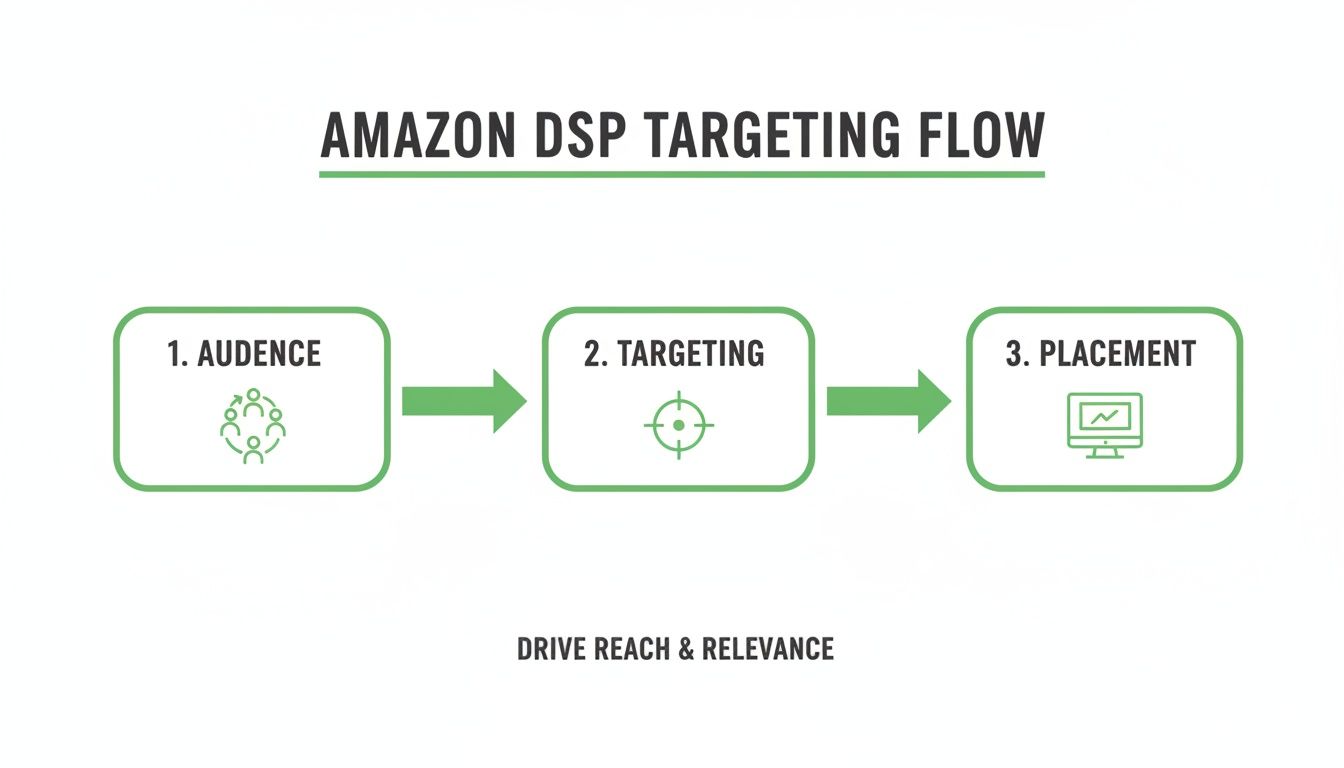
This visual breaks down the logic: define who you want to talk to, use Amazon's data to find them, and then pick the ad spots where they're most likely to see you.
Let's walk through a real-world example. Imagine you're selling a premium, portable coffee maker.
Step-by-Step Full-Funnel Workflow
Top of Funnel (Awareness): The mission here is pure introduction. You'd launch a video ad campaign showing your slick coffee maker being used on a camping trip or during a hectic morning commute. The audience? A broad but relevant Lifestyle segment like "Coffee Enthusiasts" or "Outdoor Adventurers." Your ads would pop up on places like Fire TV and popular lifestyle blogs.
Middle of Funnel (Consideration): Okay, now you're talking to people who watched your video but never made it to your product page. They get a different ad—a clean, static display ad that highlights the coffee maker's best features, like its compact size or speedy brew time. This ad might follow them to tech review sites or show up when they're browsing for "espresso machines." You're just staying on their radar.
Bottom of Funnel (Conversion): This is the final push. You're targeting shoppers who went to your product detail page or even added your coffee maker to their cart but got distracted. They'll see a Responsive eCommerce Creative with a bold "Shop Now" button, complete with your star rating and a direct link to buy. It’s designed to close the deal.
Choosing Creative Formats and Measuring True Impact
The actual ads you run are everything. Amazon DSP gives you a few powerful options, and each has its place in the funnel.
- Video Ads: Unbeatable for telling a story and building brand affinity at the top of the funnel. Example: A 15-second video showing your coffee maker in action on a mountain peak.
- Static Image Ads: Great for mid-funnel reminders and calling out specific product benefits. Example: A banner ad on a tech blog that reads "5-Minute Brew Time. Unbeatable Taste."
- Responsive eCommerce Creatives (RECs): These are your conversion workhorses. They automatically pull in your product image, title, and star rating from your Amazon listing, making them perfect for bottom-funnel campaigns. Example: An ad shown to a cart abandoner featuring the exact product they left behind, with a prominent "Buy Now" button.
Measuring success also requires a mindset shift. While Sponsored Ads live and die by Advertising Cost of Sale (ACOS), DSP provides much richer metrics that show the complete picture of your brand's health.
The true value of DSP is often found in its “halo effect”—the overall brand lift it creates. You need to look beyond direct sales attribution to understand its full impact on your business.
Key performance indicators to watch are Detail Page View Rate (DPVR), which tracks how many people checked out your product after seeing an ad, and new-to-brand data, which tells you how many sales came from brand-new customers. These metrics prove your upper-funnel budget is actually working.
When brands get this right, the results are huge. One pet brand's DSP campaign, for example, drove 18% of its sales from this brand-wide lift, helping to boost their overall revenue by a massive 45.73% year-over-year. Learn more about how precise targeting drives brand growth.
How to Access Amazon DSP and Set Your Budget
For a long time, getting started with Amazon DSP felt like trying to get into an exclusive club. The price of admission was steep—often a minimum ad spend of $35,000 to $50,000 just to walk through the door.
That reality kept a lot of ambitious DTC brands on the sidelines, making DSP a tool mostly for the big, enterprise-level players. Thankfully, things have changed. The access points have evolved, creating new pathways for brands of all sizes to tap into its power.
Today, there are two main ways you can run Amazon DSP advertising campaigns.
Two Paths to DSP Access
Figuring out your options is the first step toward building a real-world strategy. Each route comes with its own set of rules, benefits, and trade-offs.
Amazon Managed-Service: This is the traditional, white-glove option. You work directly with an Amazon advertising team that handles everything for you—building, managing, and optimizing your campaigns. It’s completely hands-off but usually still requires a pretty significant monthly ad spend.
Self-Service Platform: This route gives you the keys to the DSP console, letting you or your team take full control over every campaign detail. While this offers maximum control, it comes with a serious learning curve and was historically just as hard to access without meeting those high spending thresholds.
For many growing DTC brands, neither of these options was the perfect fit. The managed service was too pricey, and getting direct self-service access was often a non-starter.
The rise of specialized agency partners has become the key that unlocks the self-service door for brands that don't meet Amazon's direct spending requirements, making DSP a truly accessible growth lever.
Working with an Agency Partner
For most up-and-coming brands, partnering with an expert agency like ZonFlip has become the most effective way in. An agency essentially gives you a "seat" at their self-service DSP table, letting you bypass the massive minimum spend requirements.
This model truly offers the best of both worlds. You get your hands on the powerful self-service platform without the huge financial roadblock, and you get expert guidance to sidestep costly rookie mistakes. This approach makes it possible to launch smart test campaigns and scale your investment when the time is right.
How to Set Your DSP Budget
Your budget should be a direct reflection of your business goals, not a number plucked from thin air. A one-size-fits-all approach just doesn't work here. A key objective when setting your budget should be figuring out how to reduce customer acquisition cost and get new customers in the door efficiently.
Here’s a practical framework for thinking about your investment:
1. The Test Campaign (Budgets: $5,000 – $10,000/month)
This is your starting line, perfect for brands new to DSP or launching a new product. The goal isn't immediate profit—it's data. You’re testing audiences, creatives, and messaging to see what sticks before you pour more fuel on the fire. Example Workflow: Allocate 70% of the budget to retargeting website visitors and past purchasers to secure low-hanging fruit. Use the remaining 30% to test two different "In-Market" audiences to see which one drives a higher Detail Page View Rate (DPVR).
2. The Growth Campaign (Budgets: $10,000 – $25,000/month)
Once you have some solid initial data, you can shift into growth mode. This budget allows you to run prospecting and retargeting campaigns at the same time, building a proper funnel to drive consistent results and bring in new-to-brand customers. If you want to dive deeper into budgeting, you can learn more about Amazon advertising cost in our detailed guide.
3. The Market Dominance Campaign (Budgets: $25,000+/month)
This is for established brands ready to become a category leader. At this level, you’re on the offensive. This kind of investment supports an always-on, full-funnel strategy designed to build a competitive moat, capture serious market share, and cement your brand’s presence on and off Amazon.
Your Action Plan for Launching Amazon DSP

Alright, moving from theory to real-world results is the final, and most important, step. Amazon DSP isn't just some enterprise-level toy anymore; it’s a non-negotiable growth engine for any DTC brand that’s serious about scaling.
To get you off the ground, we’ve put together a simple, three-step framework. Think of it less like a checklist and more like a strategic launchpad to make sure your first dollar spent on DSP starts working for you from day one.
1. Audit Your Current Funnel
Before you even think about spending money, take a good, hard look at your current marketing funnel. Where are the leaks? Maybe your Sponsored Ads are crushing it at the bottom of the funnel, but you have zero brand awareness. Or maybe you get tons of traffic, but you're not doing anything to bring back people who leave.
A practical step here is to analyze your Amazon Brand Analytics data. Look at your "Repeat Purchase Behavior" report. If your percentage of repeat customers is low, a DSP retargeting campaign could be your highest-impact starting point. Conversely, if your "Market Basket Analysis" shows customers buying your product alongside competitors, a conquesting campaign could be in order.
2. Define Your Primary Campaign Goal
Once you know where you need help, lock in a single, clear goal for your first campaign. Don't try to boil the ocean. Are you trying to:
- Build Brand Awareness by getting in front of entirely new audiences who’ve never heard of you? Example Goal: Achieve 1 million impressions among the "Eco-Friendly Shoppers" lifestyle segment in the first month.
- Drive Consideration by educating shoppers who’ve shown a flicker of interest in your category? Example Goal: Increase the Detail Page View Rate (DPVR) by 25% for audiences who have viewed competitor products.
- Boost Conversions by hitting those cart abandoners with a can't-miss offer? Example Goal: Generate 100 purchases from an audience of users who added your product to their cart in the last 14 days.
Picking just one main objective sharpens your focus. It dictates your strategy, your creative, and your budget, which makes measuring and optimizing that first campaign infinitely easier. You can always layer on more goals later once you’ve found your footing.
Your action plan is the bridge between understanding Amazon DSP and using it to achieve real business outcomes. Start small, be specific, and focus on one clear objective to build momentum.
3. Partner with an Expert
Let’s be honest—the DSP platform is powerful, but it's also complex. Teaming up with an experienced crew like ZonFlip is the fastest way to get up to speed while dodging the expensive mistakes most beginners make. A solid partner helps you navigate campaign setup, audience targeting, and creative best practices from the jump.
As you put your plan together, always keep efficiency in mind. For some extra ideas on this, check out this great resource on automating your workflows in retail media. Follow this framework, and you’ll be set up to launch with confidence.
Frequently Asked Questions About Amazon DSP
Even with a solid game plan, jumping into a beast of a platform like Amazon DSP is going to bring up some questions. Here are the straight-up answers to the most common things we hear from brands, so you can get the clarity you need to make your next move.
What Is the Minimum Budget for Amazon DSP?
Let's clear this one up right away. While Amazon's direct managed service used to come with a hefty price tag—often $35,000 to $50,000 just to get in the door—that barrier is pretty much gone. The game has totally changed, especially for ambitious DTC brands.
Now, with the self-service platform (especially when you work with an agency partner), you can launch powerful test campaigns with budgets that don't make your CFO sweat. We often see brands start with a focused investment of $5,000 to $10,000 per month. This cracks the door wide open for emerging brands to get their feet wet with Amazon DSP advertising, collect real performance data, and then scale up intelligently.
Can I Use Amazon DSP If I Don't Sell on Amazon?
Yes, absolutely. This is probably the biggest myth we have to bust, and it's a game-changer when brands finally get it. While DSP offers incredible closed-loop reporting for brands selling on Amazon, it’s also an insanely powerful tool for driving traffic straight to your own DTC website.
For example, a mattress company that only sells from their own website can use Amazon DSP to target "In-Market" audiences who are actively searching for mattresses on Amazon.com. They can then serve video and display ads that click through directly to their brand's site, effectively using Amazon's shopping data to fuel their own sales funnel.
You don't have to sell on Amazon to benefit from its data. DSP lets you use Amazon’s unparalleled shopper insights to grow your brand on your own terms, on your own turf.
How Long Does It Take to See Results from Amazon DSP?
This is a marathon, not a sprint. Unlike Sponsored Ads, which can drive sales in a few hours by capturing people already looking to buy, Amazon DSP advertising is a long-term play. It's about building your brand and creating new demand, not just capturing what's already there.
You’ll need to give it about 30 to 60 days for the platform's algorithms to gather enough data to really start working their magic and optimizing performance. This is especially true for those top-of-funnel campaigns designed to build awareness.
While you might see an immediate lift in website traffic or brand impressions, the real payoff—sales, brand recall, and new-to-brand customer growth—is best measured over a full quarter. Success here comes from consistent tweaking and a strategic, long-view approach.
What Kind of Ad Placements Can I Access with DSP?
The real power of DSP is that your reach extends way beyond Amazon.com. You’re not just buying ads on product pages; you’re gaining access to a massive network of high-quality placements. They fall into two main buckets:
- Amazon Owned & Operated: This is the premium stuff. Think placements on sites like IMDb, streaming services like Freevee and Prime Video, live broadcasts on Twitch, and even on devices like Fire TV and Echo. Example: A movie studio promoting a new film could run a video trailer on IMDb's homepage.
- Third-Party Publisher Network: Through Amazon’s partnerships and ad exchanges, you can also place ads on thousands of other top-tier websites, mobile apps, and connected TV (CTV) services all over the internet. You can truly follow your audience wherever they go online. Example: A baby brand could run display ads on a popular parenting blog or within a weather app.
Ready to stop asking questions and start building a real growth strategy? The team at ZonFlip lives and breathes this stuff. We help DTC brands cut through the complexity of Amazon DSP and turn its powerful features into profitable results. Let’s talk about how we can build your action plan today.