


Winning on Amazon isn't about outspending your competitors; it's about out-thinking them. The secret sauce to profitable Amazon advertising strategies is a simple but powerful philosophy: lock in your profit first, then pour gas on what's working. This isn't just about running ads—it's about building a repeatable system that ties every single campaign back to a concrete business goal.
Your Framework for Profitable Amazon Ads
Jumping into Amazon's ad platform without a map is a surefire way to get lost. With so many ad types and targeting options, it’s easy to burn through your budget with nothing to show for it. The trick is to stop thinking in terms of individual campaigns and start building a strategic framework.
This framework creates a clear line of sight from your business goals to your ad spend. It answers the why before the what. Are you launching a new product? Defending your brand against copycats? Liquidating old inventory? Each goal demands a completely different approach.
Practical Example:
- Goal: Liquidate an older model of a Bluetooth speaker.
- Ad Type: Sponsored Products.
- Targeting: Target the product detail pages (ASINs) of the new speaker model with a compelling offer like "Great Value" or "Classic Model – 50% Off". This captures buyers who might be price-sensitive.
The whole system is a simple, top-down hierarchy: define the goal, pick the right ad type, and then dial in your targeting.
This flowchart breaks down the process visually, showing how a clear objective should guide every decision you make.
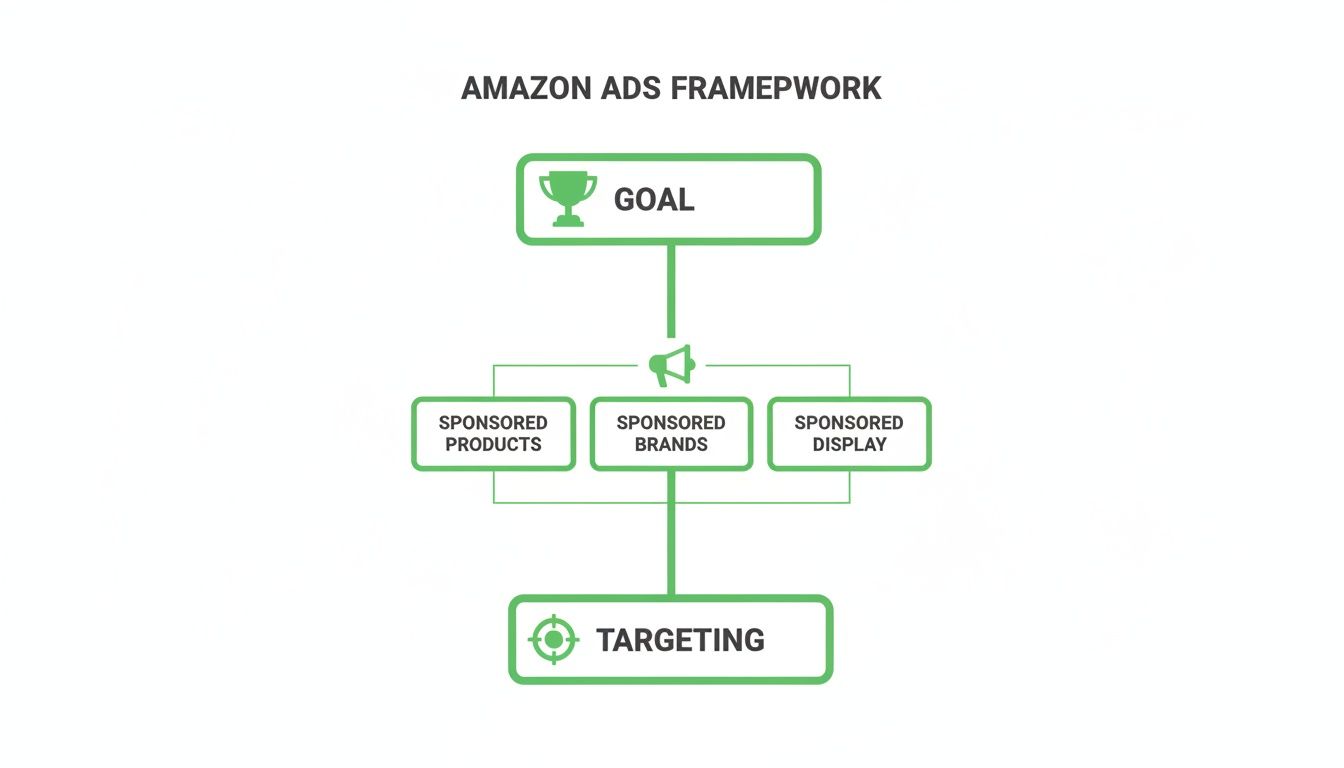
As you can see, the goal is the foundation. Get that right, and the ad type and targeting choices almost make themselves.
Why a Strategic Framework Matters
Without a plan, managing your ads feels like playing whack-a-mole. You're constantly tweaking bids and reacting to daily performance swings, never quite sure what's actually moving the needle for your business. A framework stops the chaos. It transforms your ad spend from a confusing expense into a predictable, measurable investment.
And let's be real, the stakes have never been higher. Amazon's advertising machine recently raked in $56.2 billion globally, a staggering 20% jump year-over-year. As more sellers pile in, the competition gets fiercer. With the average CPC now at $1.12, just "trying things" is a recipe for disaster.
A solid framework makes tough decisions easy. For a brand-new product launch, your primary goal is generating awareness and that crucial initial sales velocity. That immediately points you toward Sponsored Products campaigns with broad match or category targeting.
On the other hand, for a mature, best-selling product, your goal might be to defend your turf. This means you'll lean on branded keyword campaigns and Sponsored Display ads to retarget past purchasers. Juggling these different objectives is impossible without a system, which is a cornerstone of effective Amazon account management.
The most effective advertisers don't just run ads; they build systems. They create a repeatable process that links a specific business objective to a specific campaign type and a specific set of KPIs, allowing them to scale profitably.
To bring this to life, you need to understand the tools in your toolbox. Let’s dive into the different Amazon ad types and when to deploy each one.
Choosing the Right Amazon Ad Type for Your Goal
Not all Amazon ads are created equal. Each format is engineered to achieve a different outcome, from driving impulse buys to building long-term brand loyalty. Picking the right one for your specific goal is the first major step in executing a successful strategy.
This table breaks down the main ad types and aligns them with common business objectives.
| Ad Type | Primary Goal | Funnel Stage | Targeting Capabilities | Best For |
|---|---|---|---|---|
| Sponsored Products | Drive immediate sales and conversions | Bottom of Funnel (BOF) | Keywords, ASINs, Categories | Boosting visibility for specific products in search results and driving high-intent traffic. |
| Sponsored Brands | Build brand awareness and drive consideration | Top/Middle of Funnel (TOF/MOF) | Keywords, ASINs, Categories | Showcasing a collection of products, promoting your brand store, and capturing top-of-search real estate. |
| Sponsored Display | Retarget interested shoppers and expand reach | Full Funnel | Audiences (views, purchases), Product/Category Targeting | Re-engaging shoppers on and off Amazon, cross-selling/up-selling, and building audience lists. |
| Amazon DSP | Generate broad awareness and reach new audiences | Top of Funnel (TOF) | Advanced Audiences (lifestyle, in-market), Lookalike Audiences | Reaching potential customers across the web and Amazon-owned properties, often for larger brands with bigger budgets. |
Think of this table as your strategic cheat sheet. By matching your immediate business need—whether it's raw sales volume, brand recognition, or audience growth—to the right ad format, you're already miles ahead of the competition. This alignment is the core of an efficient, profitable advertising engine.
Mastering the Core Amazon Ad Types
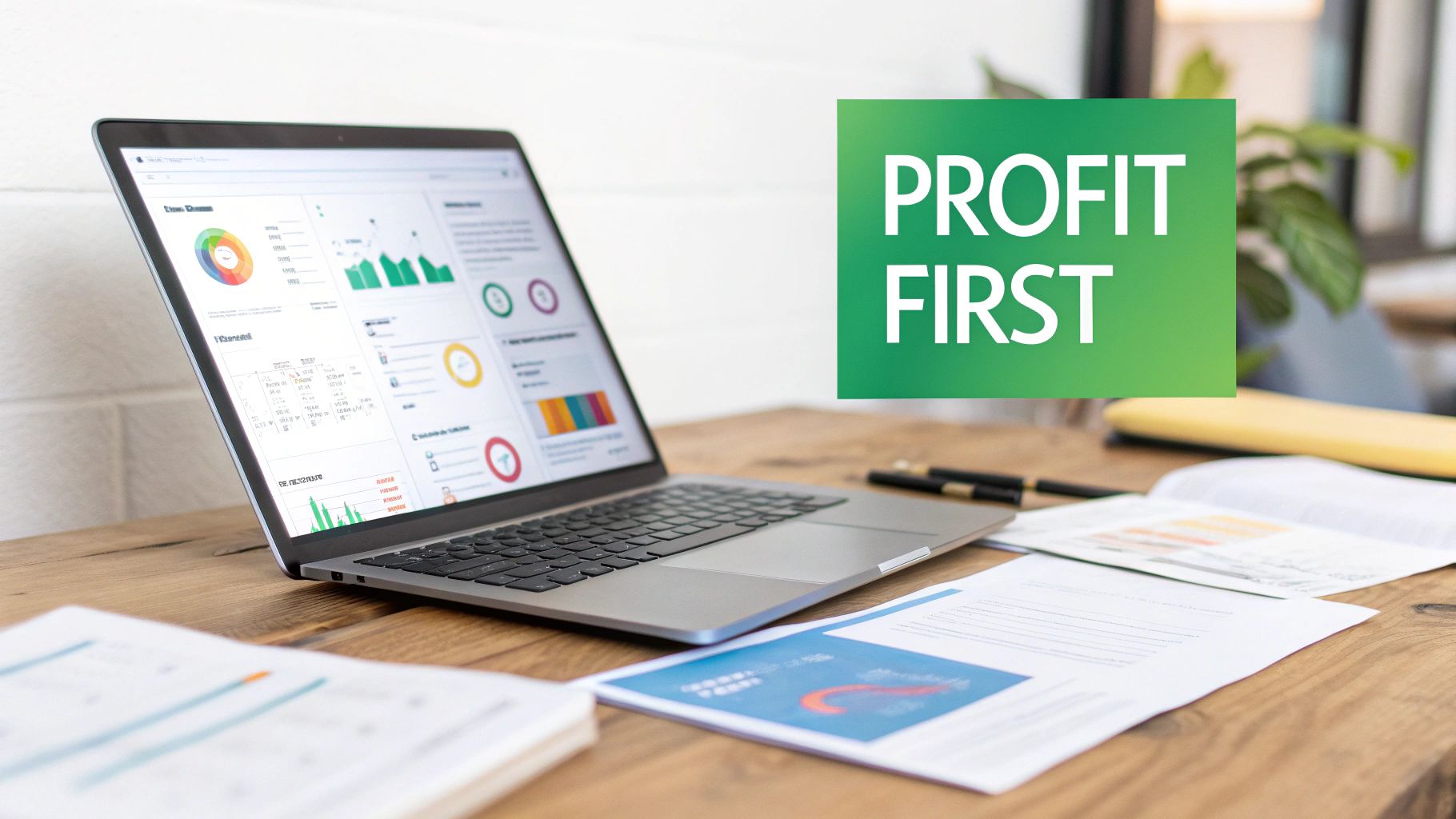
To really nail your Amazon advertising strategies, you have to stop thinking about ad types as just menu options. Think of them as specialized tools in a workshop, each designed for a very specific job.
This isn't about just flipping a switch and hoping for the best. It’s about knowing which tool to grab to achieve a specific outcome, whether you're launching a brand-new product or just defending your turf from hungry competitors.
Sponsored Products: The Workhorse of Sales
Sponsored Products are the foot soldiers of your Amazon ad army. These are the ads you see sprinkled directly within search results and on product detail pages, catching shoppers right at that critical moment they're ready to pull out their wallets.
Their mission is brutally simple: drive sales for specific products.
They are absolute beasts for two main plays:
- Aggressive Discovery: When you're launching something new, you need eyeballs—fast. Use automatic campaigns and broad-match keyword targeting to let Amazon's algorithm do the heavy lifting, sniffing out new and relevant search terms you might have missed. It’s like casting a wide net to see how real customers are actually looking for products like yours.
- Defensive Branding: For your tried-and-true best-sellers, you need to play defense. Create campaigns that bid on your own brand and product names. This is non-negotiable. It stops competitors from setting up camp on your listings and poaching sales from customers who were looking for you.
There's a reason Sponsored Products are the undisputed workhorse—they raked in 68% of total ad revenue in a recent quarter. This isn't surprising when you see their high average conversion rates of 9-11%. They tap directly into the high-intent mindset of Amazon shoppers, where over 70% of all product searches begin. To really get into the nuts and bolts, check out our guide on how Amazon Sponsored Ads work: https://zonflip.com/how-amazon-sponsored-ads-work-a-complete-guide/
Sponsored Brands: The Storyteller for Brand Building
While Sponsored Products are all about the individual item, Sponsored Brands are about telling your brand's bigger story. These ads get prime real estate at the top of search results, showing off a collection of your products, a custom headline, and your brand logo.
The goal here isn't just a single sale; it's about building a connection and boosting that all-important customer lifetime value.
A killer Sponsored Brands strategy blends different formats to create a seamless brand experience:
- Sponsored Brands Video: This format is an absolute game-changer for grabbing attention. A quick, punchy video can show your product in action, hammer home its benefits, and forge an emotional connection that a static image just can't match.
- Custom Storefronts: Don't just send traffic to a product page—drive it to your dedicated Amazon Storefront. Think of it as your own mini-website inside Amazon, where you can curate collections, tell your brand's origin story, and cross-sell your entire catalog without a single competitor ad in sight.
Practical Example: A new organic snack brand wants to get in front of health-conscious shoppers. They run a Sponsored Brands Video ad targeting "healthy office snacks." The video is slick, showing their products in a cool, modern office. Clicks lead to their custom Storefront, neatly organized by dietary needs (gluten-free, vegan), nudging shoppers to buy a bundle and come back for more.
Sponsored Display: The Retargeting Expert
Sponsored Display ads are your secret weapon for bringing shoppers back into the fold and extending your reach way beyond Amazon's search results. These ads can pop up on competitor product pages, the Amazon home page, and even on third-party websites and apps.
Their main job? Re-engage shoppers who showed interest but didn't buy.
Mastering Amazon Pay Per Click (PPC) advertising is fundamental, and retargeting with Sponsored Display is a key piece of that puzzle.
The real power here is in retargeting. You can build audiences based on specific actions, creating hyper-relevant campaigns that feel less like ads and more like helpful reminders.
A Simple Retargeting Workflow:
- Pinpoint the Audience: In your Ad Console, create a new Sponsored Display campaign. Select "Audiences" as your targeting strategy. Choose to target "Views" and select shoppers who viewed your product in the last 30 days but did not purchase.
- Design a Compelling Creative: Your product image will be used automatically. Focus on a strong headline. Instead of just your product name, try something like "Still Thinking It Over? Get 10% Off Today."
- Set Bids and Watch: Launch the campaign with a modest daily budget using a "Cost-per-click" bidding strategy. Monitor your conversion rate and ROAS in the campaign dashboard, adjusting bids up or down weekly to stay profitable. This straightforward playbook plugs leaks in your funnel and keeps your brand top-of-mind.
Building Your First High-Performance Campaign
Jumping into Amazon advertising without a clear plan is like trying to build IKEA furniture without the instructions; you'll probably end up with a wobbly, expensive mess. A high-performance campaign isn't built on luck. It’s built on a methodical, repeatable process that bakes profitability and control right into its DNA from day one.
The goal here is to create a structure that not only works today but is also built to scale tomorrow. This means we're moving beyond the generic "set it and forget it" auto campaigns and embracing a much more deliberate, data-driven approach. Your blueprint needs to be all about precision, efficiency, and a relentless feedback loop.
Architecting a Logical Campaign Structure
Think of your campaign structure as the foundation of your entire advertising operation. If it's a mess, you'll never be able to allocate your budget properly, figure out what's actually working, or scale up your winners. The best structures are all about control and clarity.
One of the most effective ways to achieve this is by using Single-Keyword Ad Groups (SKAGs). It sounds technical, but the concept is simple.
- What is a SKAG? Instead of cramming dozens of keywords into one ad group, you create a dedicated ad group for every single keyword.
- Why does it work? This gives you surgical control. You can set a specific bid for each keyword, watch its performance in isolation, and write ad copy that's a perfect match for the search term. If "organic dog treats" is your hero keyword, it gets its own stage, its own spotlight, and its own budget.
Practical Example: Imagine you sell a yoga mat. Instead of one ad group with ["yoga mat", "eco friendly yoga mat", "non slip yoga mat"], you create three separate ad groups. The ad group for "eco friendly yoga mat" can have ad copy that highlights the mat's sustainable materials, making it hyper-relevant to the shopper's search.
This fine-grained approach stops your best keywords from being dragged down by weaker ones and makes sure every penny of your ad spend has a clear purpose.
Mastering Advanced Keyword Research
Great campaigns run on great keywords. Sure, Amazon’s keyword suggestions are a decent starting point, but the top sellers on the platform are digging much, much deeper to find the terms that are already proven to convert.
This is where your competition becomes your greatest asset.
Don't reinvent the wheel; learn from your competitors' ad spend. By uncovering the keywords they consistently pour money into, you're tapping into a pre-validated list of search terms that drive sales in your niche.
A killer technique for this is the Reverse ASIN Lookup. Here’s a quick workflow:
- Identify Top Competitors: Search for your main keyword on Amazon. Copy the ASINs (the unique product identifier in the URL and product details) of the top three organically ranked, non-ad listings.
- Use a Third-Party Tool: Log into a tool like Helium 10 or Jungle Scout. Paste a competitor's ASIN into their reverse ASIN tool (often called "Cerebro" or "Keyword Scout").
- Analyze the Keyword Data: The tool will spit back a goldmine of keywords that are driving traffic and sales to that listing. Filter for keywords with high search volume and high relevance to your product. Repeat for the other competitor ASINs and compile a master list.
This method hands you a battle-tested list of keywords to fuel your first campaigns, slashing your learning curve dramatically.
Setting Bids and Budgets Without the Guesswork
One of the biggest mistakes new advertisers make is fumbling their bids and budgets. They either bid too low and get zero impressions or bid too high and torch their entire budget by lunchtime. The key is to start smart and let the data be your guide.
For your starting bids, look at Amazon's suggested bid, but then set yours just a little bit below it. This keeps you from overpaying for clicks right out of the gate while still being competitive enough to get the data flowing.
As for budgets, a small daily budget of $10-$20 per campaign is usually more than enough to get the insights you need. Remember, the goal in the first week or two isn't to make a million dollars—it's to collect data. You're paying for information on which keywords actually lead to a sale. Getting a handle on different keyword match types is crucial here, as it lets you control exactly who sees your ads and fine-tune performance from the very beginning.
Before you hit that "launch" button, it pays to be methodical. Running through a quick checklist can be the difference between a profitable start and a costly false start. It ensures you haven't overlooked any small detail that could derail your efforts.
Campaign Launch Checklist for Profitability
| Phase | Action Item | Key Consideration |
|---|---|---|
| Preparation | Finalize Product Listing | Is your title, imagery, and A+ content fully optimized for conversion? |
| Preparation | Define Campaign Goals | What is the primary objective? (e.g., profitability, brand awareness, launch velocity) |
| Structure | Set Up Campaign Naming | Use a clear, consistent naming convention (e.g., Product_Type_Targeting_Date). |
| Targeting | Finalize Keyword List | Have you completed reverse ASIN lookups and competitor analysis? |
| Targeting | Add Negative Keywords | Add known irrelevant terms (e.g., competitor brand names, wrong product types) upfront. |
| Bidding | Set Initial Bids | Start slightly below Amazon's suggested bid to test the waters. |
| Budgeting | Set Daily Budget | Allocate a modest budget ($10-$20/campaign) for the initial data collection phase. |
| Launch | Double-Check All Settings | Review targeting, match types, bids, and budgets one last time before activating. |
This checklist acts as your final pre-flight inspection. By ticking these boxes, you're setting yourself up to launch with confidence, knowing that the foundational elements are firmly in place.
Creating a Data-Driven Optimization Loop
The real secret to long-term Amazon PPC success is a continuous cycle of optimization. Your campaigns are never "done." Think of them as living, breathing things that need constant attention and refinement based on what real shoppers are searching for. The engine for this process is Amazon's Search Term Report.
This report is pure gold. It shows you the exact search queries customers typed into Amazon before clicking your ad. Your job is to turn this raw data into profitable action.
The Harvest and Prune Workflow:
- Harvest Converting Keywords: Once a week, download your Search Term Report. Sort by "Orders" to find search terms that generated one or more sales. If you find one, copy that exact term. Go into a manual campaign, create a new ad group, and add that term as an exact match keyword. Now, you can control its bid with absolute precision.
- Prune Wasted Spend: Now sort the same report by "Spend" and look for irrelevant terms that have clicks but zero sales. If a search term for "iPhone 15 case" shows up in your "Samsung Galaxy case" campaign, copy "iPhone 15". Go to your original campaign settings, navigate to "Negative Keywords," and add "iPhone 15" as a negative phrase match. This tells Amazon to stop showing your ad for those queries, instantly plugging leaks in your ad budget.
This simple yet incredibly powerful loop ensures your campaigns get sharper, more targeted, and more efficient over time. It’s the true backbone of a high-performance advertising machine.
Advanced Strategies for Scaling Your Ad Spend
Alright, your initial campaigns are humming along and turning a profit. Awesome. But now the real fun begins. The game shifts from simply finding what works to squeezing every last drop of performance out of it.
Scaling your ad spend isn't about just cranking up the budget and hoping for the best—that’s a recipe for burning cash. It’s a calculated push to grab more market share without tanking your Return on Ad Spend (ROAS). This is where the pros separate themselves, using top-tier amazon advertising strategies to grow smarter, not just bigger.
This next phase is all about graduating from basic campaign tweaks to more dynamic, responsive tactics. You’ll start to really get a feel for Amazon's more powerful bidding tools and adopt a full-funnel view that turns first-time buyers into loyal fans.
Tapping Into Dynamic Bidding and Placements
Amazon's bidding options are your secret weapon for automating and optimizing your ad spend on the fly. Instead of setting a bid and forgetting it, dynamic bidding lets Amazon’s algorithm do the heavy lifting, adjusting your bids based on how likely a shopper is to convert.
Here’s the breakdown:
- Down Only: Think of this as your safety net. Amazon will only ever lower your bid for clicks that look less likely to convert, protecting your budget from window shoppers. It’s a conservative, safe way to play.
- Up and Down: This is where you get aggressive. Amazon can juice your bid by up to 100% for those prime spots at the top of search results and up to 50% for other placements. It's the perfect setting for campaigns where being #1 is everything for driving sales and visibility.
On top of that, you can use placement bid adjustments to tell Amazon you’re willing to pay a premium for the best real estate on the page. For instance, you can tack on a 50% bid increase just for "Top of Search" spots. This is how you ensure your flagship products own the most valuable ad slots.
The Ad Spend Flywheel: Turning Clicks into Rank
One of the most powerful concepts for scaling on Amazon is what I call the "Ad Spend Flywheel." It’s a beautiful, self-reinforcing cycle where your ad spend directly fuels your organic rank, and that improved rank makes your ads even more efficient.
It’s a simple, elegant process:
- Paid Clicks Drive Sales: Your ads bring in consistent sales from ready-to-buy shoppers.
- Sales Velocity Boosts Organic Rank: Amazon's algorithm sees this constant stream of sales as a huge thumbs-up. It thinks, "Hey, people love this product!" and starts bumping it up the organic rankings.
- Higher Organic Rank Reduces Ad Dependency: As you climb the organic ladder, you start getting more "free" sales, which drives down your Total Advertising Cost of Sale (TACOS).
The flywheel transforms your ad spend from a daily expense into a long-term investment in your product's organic health. Every dollar you spend today isn't just buying one sale; it's buying you better organic visibility for countless sales tomorrow.
Actionable Scaling Playbooks
Theory is great, but let's get into the weeds. Here are two of my favorite, battle-tested playbooks for breaking through growth plateaus and scaling your ad spend without blowing up your ACoS.
The Search Term Isolation Method
This is all about giving your all-star keywords the VIP treatment.
- Find a Winner: Dig through your search term reports in your automatic or broad match campaigns. Find that one golden search term that’s driving a ton of sales at a great ACoS. Let's say it's "bamboo cutting board for kitchen".
- Isolate and Escalate: Create a brand new manual campaign named "[Product] – Exact – Bamboo Cutting Board". In it, create one ad group with the single keyword "bamboo cutting board for kitchen" in exact match. This gives you 100% control over its bid and budget.
- Add as a Negative: This step is crucial. Go back to your original discovery campaign and add that same term as a negative exact match. This stops your campaigns from bidding against each other and funnels all traffic for that proven term into your new, hyper-focused campaign.
The ACoS Plateau Breaker
Stuck? Use this playbook when a good campaign has hit a ceiling and you can’t increase the budget without your ACoS going through the roof.
- Analyze Placement Data: Jump into your campaign's "Placements" tab. Find out which placement—"Top of Search," "Rest of Search," or "Product Pages"—is giving you the best bang for your buck.
- Apply a Bid Multiplier: Let's say "Top of Search" converts 2x better than the others. Go into your placement settings and apply a +25% to +50% bid modifier to that specific placement.
- Gradually Increase Budget: Now, with that modifier in place, start slowly bumping up the daily budget by 15-20% every few days. The modifier will help ensure that new spend is directed straight to your most profitable ad real estate.
Scaling the right way is all about knowing your numbers inside and out. Understanding benchmarks, like what is the average amazon ppc cost, gives you the context you need to measure your own performance as you grow. These advanced strategies are your ticket to pushing past those early wins and building a truly dominant brand on Amazon.
The Next Wave: AI and External Traffic in Amazon Advertising
The old way of running Amazon ads—manually tweaking campaigns and reacting to last week's data—is quickly becoming obsolete. The game is changing, and two massive forces are driving that shift: artificial intelligence and a smarter approach to driving external traffic from social media. Getting a handle on these isn't just about staying current; it's about building a real, sustainable advantage.
This isn't some far-off, futuristic idea. We're talking about tools and workflows you can put into practice today. The goal is to graduate from being a simple "campaign manager" to becoming the architect of an intelligent, multi-channel advertising machine that fuels real growth for your brand.
Putting AI to Work for Smarter PPC
Let's be honest, nobody enjoys spending hours buried in search term reports, squinting at spreadsheets to find a winning keyword. This is where AI completely changes the game. AI-powered advertising tools can crunch massive datasets in the blink of an eye, spotting trends and even predicting performance shifts before they happen. It’s like having a team of data scientists on call 24/7.
But this goes way beyond just tweaking your bids up or down. Modern AI systems can look at hourly conversion rates, profitability right down to the individual SKU, and seasonal buying patterns. They use that intel to shift your budget in real-time, making sure every single ad dollar is working as hard as it possibly can. It’s a proactive strategy that lets you jump on opportunities and cut wasted spend before it ever becomes a problem.
AI doesn't replace the strategist; it supercharges them. By handing off the tedious, soul-crushing tasks, it frees you up to focus on what really matters: big-picture strategy, creative direction, and building a brand people love.
So, how does this actually work in practice? Let's walk through a simple, real-world example.
An AI-Driven Budget Optimization Workflow
Imagine you’re selling coffee beans with a bunch of campaigns for different roasts and keywords. An AI tool can step in and automate the entire process of moving your budget to where it will make you the most money.
- Connecting the Data: First, the AI tool plugs directly into your Amazon Ads account. It starts pulling in all the critical data—clicks, sales, ACoS, you name it—for every campaign and keyword. Crucially, it also factors in your actual product profit margins.
- Spotting the Winners: The system instantly analyzes the numbers and finds your star performers. It might see your "dark roast espresso" campaign humming along at a sweet 15% ACoS, while the "light roast breakfast blend" is struggling at a painful 40%.
- Getting an Actionable Tip: Instead of just showing you a dashboard, the tool gives you a clear recommendation: "Move $20 per day from the 'light roast' campaign and put it into the 'dark roast' campaign."
- One-Click Action: You see the logic, and with a single click, you approve the change. The AI handles the rest, automatically adjusting the budgets in your Amazon account. No manual entry, no spreadsheets, just smarter spending.
This kind of workflow transforms a complex analysis into a simple, daily action, helping you make better decisions, faster.
Tapping into High-Intent Traffic from TikTok
While getting your on-Amazon ads dialed in is essential, the real growth frontier is driving traffic to Amazon. Platforms like TikTok are no longer just for entertainment; they are massive product discovery engines. Smart brands are building a direct pipeline of fired-up, ready-to-buy customers straight from their "For You" page to their Amazon listing.
The magic here isn't just about running an ad; it's about harnessing social proof. When someone sees a product they love in a TikTok video, their impulse to buy is already sky-high. Sending that "warm" traffic directly to your Amazon page means you're catching them at the peak of their interest, which can do wonders for your conversion rate.
This teamwork between social media and Amazon creates a powerful flywheel effect. A higher conversion rate on your listing sends a strong signal to Amazon's A9 algorithm that your product is a winner, which often leads to better organic rankings. So, that external traffic doesn't just ring the register today—it boosts your overall visibility on Amazon, helping you build a more powerful and resilient brand.
Measuring Success and Proving Your ROI
Running ads without keeping score is like flying a plane with your eyes shut. If you want to get your Amazon advertising strategies right, you have to measure what's actually growing your business, not just what looks pretty on a report. This means looking past the obvious numbers to see your real return on investment (ROI).
Too many sellers get hung up on one metric: ACoS (Advertising Cost of Sale). It’s a useful starting point, but it only tells you half the story. ACoS measures your ad spend against the sales that come directly from those ads, but it completely misses the massive "halo effect" your ads have on organic sales.
Why TACOS Is the Metric That Actually Matters
To see the whole picture, you need to be tracking TACOS (Total Advertising Cost of Sale). This is the KPI that serious sellers live and die by. Why? Because it measures your ad spend against your total revenue—both paid and organic. That one change in perspective shows you the true health of your entire Amazon business.
A falling TACOS is a beautiful thing. It means your ads aren't just getting you sales today; they're also boosting your organic rank and visibility. This creates a powerful flywheel effect where, over time, you become less and less reliant on paid ads to make sales.
A low ACoS with a high, flat TACOS is a major red flag. It’s a classic sign that your ads are just stealing sales you would have gotten for free, meaning you're spending money without actually growing the pie.
Building a Simple Performance Dashboard
You don't need some fancy, expensive software to track what matters. A basic spreadsheet is more than enough to get started. The goal is simple: watch how your key numbers change over time so you can make smarter calls on when to push the gas and when to hit the brakes.
Here’s a dead-simple framework for your dashboard:
- Total Revenue: Your top-line sales number.
- Ad Spend: How much you’re putting into your campaigns.
- Ad Sales: The revenue your ads brought in directly.
- ACoS: Just divide your Ad Spend by your Ad Sales.
- TACOS: Now divide that same Ad Spend by your Total Revenue.
Update this once a week. You'll quickly see the real impact your advertising has on your entire business. This data gives you the confidence to kill the campaigns that are bleeding you dry and to go all-in on the ones that are genuinely moving the needle. It's how you prove every single dollar you spend is worth it.
Frequently Asked Questions About Amazon Ads
Even the most well-thought-out plan runs into roadblocks. When you're in the trenches refining your Amazon advertising strategies, questions are going to pop up. Getting clear, no-nonsense answers can save you a ton of time, money, and headaches.
This section tackles the most common questions we hear from sellers every day. Think of it as a quick guide to making smarter decisions, setting the right expectations, and getting better results from your campaigns.
How Much Should I Spend on Amazon Ads When Starting Out?
There’s no magic number here, but a great rule of thumb is to earmark about 10% of your total revenue for advertising. It’s a solid, sustainable baseline that fuels consistent growth without breaking the bank.
But if you're launching a brand-new product? You need to get aggressive. Plan to invest much more heavily—think 15-25%—for the first 90 days. The goal isn't immediate profit; it's about buying crucial performance data and gaining traction. Start with a test budget you’re comfortable with, chase a low ACoS, and then scale up once you identify your winning keywords.
What Is a Good ACoS for My Campaigns?
A "good" ACoS (Advertising Cost of Sale) is completely tied to your product's specific profit margin. It is not a one-size-fits-all metric. The only benchmark that truly matters is your break-even point.
To find your break-even ACoS, just subtract all your costs (product sourcing, Amazon fees, etc.) from your sale price. If your profit margin is 30%, then an ACoS of 30% means you’re breaking even on every ad-driven sale. A profitable campaign simply needs an ACoS below that number.
How Long Until an Amazon PPC Campaign Is Profitable?
Patience is the name of the game with new campaigns. It generally takes about 2-4 weeks for a fresh campaign to collect enough data for you to make any meaningful first optimizations. You can't judge performance after just a couple of days.
Hitting real, sustainable profitability often takes longer, usually somewhere between 1-3 months. Treat that first month as an investment in data. You're learning which search terms actually convert and, just as importantly, which ones are burning through your cash and need to be added as negative keywords. Consistent, data-driven tweaks are what turn a campaign from a cost center into a profit machine.
Ready to implement profitable Amazon advertising strategies without all the guesswork? The team at ZonFlip specializes in end-to-end account management, turning your data into dollars with our "First Profit, Then Progress" philosophy. Let us build your profitable growth plan.