



Think of Amazon account management services as your brand’s dedicated mission control for the world's biggest marketplace. These are specialized agencies or teams that take the controls, handling the incredibly complex, day-to-day operations of your Amazon store. They manage everything from your advertising and logistics to the nitty-gritty of compliance, freeing you up to focus on your brand and products.
Understanding Your Amazon Mission Control
Trying to run a successful Amazon store by yourself is a lot like trying to pilot a commercial jet while also managing the ground crew, engineering, and air traffic control. It's a one-person show where you're not just the product developer, but also the marketer, the customer service rep, and the expert on Amazon's ever-changing rulebook. It's an overwhelming gig that almost always leads to burnout, missed opportunities, or expensive mistakes.
An Amazon account management service steps in as your professional flight crew. Instead of you juggling dozens of different tasks, they grab the controls and manage the entire operation. This isn't just about outsourcing a few to-do items; it’s a genuine partnership where seasoned experts manage your Amazon presence from top-level strategy all the way down to daily execution. Their goal is simple: make sure your brand doesn't just fly, it soars.
What Does Full-Service Management Mean?
Let’s be clear: true account management is a world away from just hiring a freelancer for a single task. It’s a coordinated, multi-disciplinary effort designed to drive real growth and protect your brand on the platform.
A cornerstone of what these teams do is help brands create an Amazon storefront, which acts as a branded mini-website right inside the marketplace. But that's just scratching the surface. A full-service partner integrates several key functions into one cohesive strategy:
- Strategic Planning: They start by defining your brand’s goals on Amazon and then map out a clear, actionable path to get you there. For example, a new brand might have a goal of hitting $50k in monthly revenue within 6 months. The plan would detail the required ad spend, the number of product reviews needed, and the specific keywords to target to achieve that goal.
- Operational Execution: This is the day-to-day grind. They handle everything from listing products and managing ad campaigns to keeping a close eye on your account health. A practical example is creating a weekly workflow: Monday for PPC review, Tuesday for inventory checks, Wednesday for listing optimization, and so on.
- Performance Analytics: Your agency tracks the key metrics that matter, delivers easy-to-understand reports, and tweaks the strategy based on what the real-time data is telling them. For instance, they might notice your conversion rate drops after 8 PM and adjust your ad bids accordingly to save money.
The modern Amazon ecosystem is too complex for a single person to manage effectively. Success requires a team of specialists, each focused on a critical area of the business, working in unison.
The sheer complexity of Amazon today has completely changed the game. Industry experts agree that a successful account now needs a dedicated listing team, a PPC team, a design team, an account health division, and backend optimization specialists all working together. It’s simply not a one-person job anymore.
The Pillars of Full-Service Amazon Management
Think of top-tier Amazon account management services as a high-performance machine with several critical, interconnected parts. It’s not about tackling tasks in a silo; it's about integrated functions working together to boost your visibility, crank up conversions, and drive real profit. Trying to grow on Amazon without one of these pillars is like trying to build a house with a shaky foundation—it just won't hold up.
At a high level, you’re looking at three core areas: advertising management, creative and listing optimization, and the nitty-gritty of logistics and compliance. Each one demands a completely different skill set and a deep, practical understanding of Amazon’s notoriously complex ecosystem. A true full-service agency brings in specialists for each, ensuring every part of your business gets expert attention.
This diagram shows how these teams typically orbit the brand they serve.
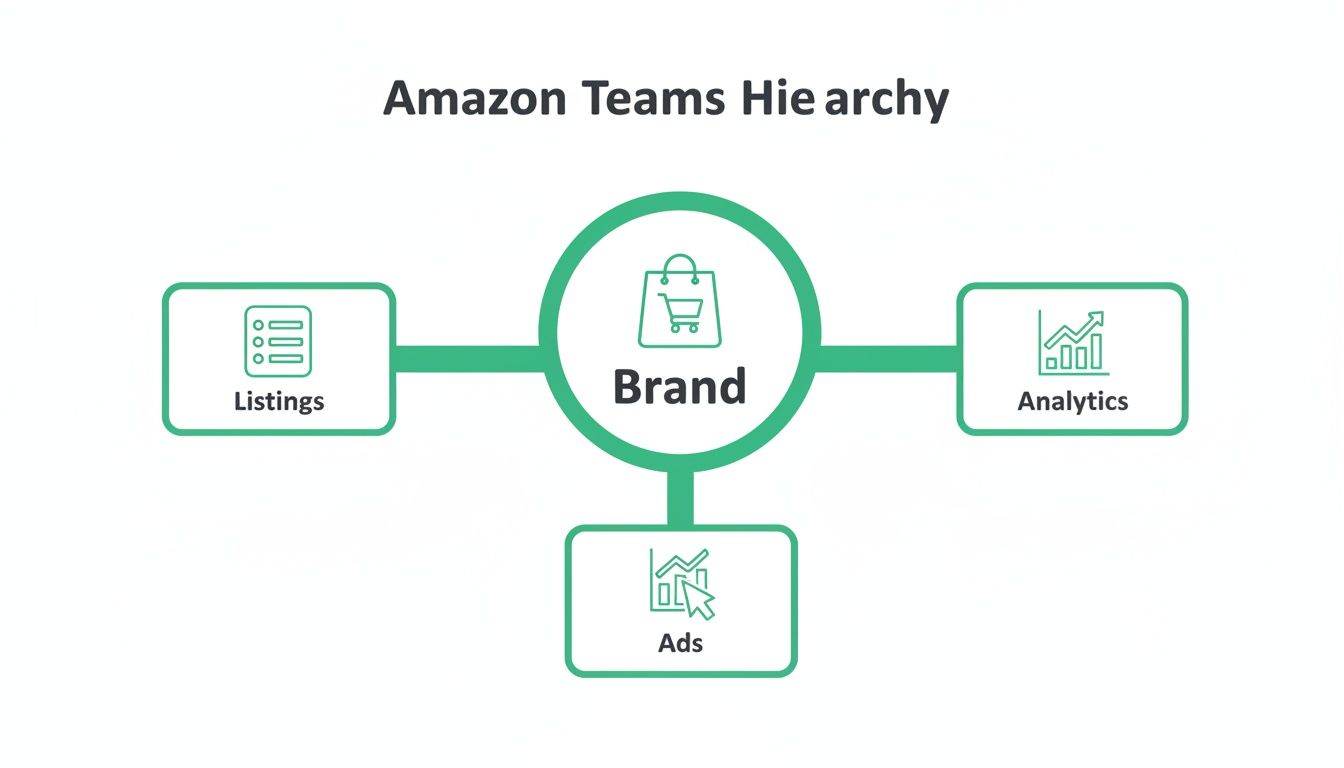
As you can see, the brand sits at the center, with dedicated teams for listings, ads, and analytics all working in lockstep. Let's break down what these pillars actually look like in the real world.
Breakdown of Full-Service Amazon Management
To get a clearer picture, let's unpack what a full-service team actually does. The table below breaks down the key activities, goals, and metrics for each core component of Amazon management. It’s a roadmap for turning specialized tasks into measurable business growth.
| Service Component | Key Activities | Primary Objective | Example KPI |
|---|---|---|---|
| PPC Advertising | Keyword research, campaign structuring, bid management, A/B testing ad copy, negative keyword harvesting. | Maximize Return on Ad Spend (ROAS) and drive qualified traffic. | Total Advertising Cost of Sale (TACOS), Conversion Rate. |
| Listing Optimization | Keyword-infused copywriting, benefit-driven bullet points, professional photography/videography, A+ Content design. | Increase organic ranking and improve the shopper conversion rate. | Unit Session Percentage (Conversion Rate), Organic Rank. |
| Logistics & Compliance | FBA prep (labeling, packaging), shipment creation, inventory forecasting, account health monitoring. | Ensure seamless fulfillment and protect the account from suspension. | In-Stock Rate, Account Health Rating (AHR). |
Each piece is crucial. Strong ads fall flat without a converting listing, and a great listing is useless if your product is out of stock or your account gets shut down. Now, let’s dig a bit deeper into each pillar.
Pillar 1: Strategic PPC Advertising
Let’s be clear: effective Amazon Pay-Per-Click (PPC) is not about "boosting" a product. It's a data-driven science that demands constant tinkering and analysis. A real management agency doesn’t just "set and forget" a budget. They run a continuous cycle of research, testing, and optimization to squeeze every last drop of value from your ad spend.
Imagine you're launching a new high-end coffee grinder. A dedicated PPC team's playbook would look something like this:
Deep Keyword Research: The process kicks off by unearthing hundreds of relevant keywords. This isn't just the obvious stuff. It includes broad terms ("coffee grinder"), super-specific long-tail phrases ("burr coffee grinder for espresso"), competitor brand names ("Breville grinder"), and even terms for complementary products ("espresso machine accessories").
Smart Campaign Structure: They would never dump all those keywords into one massive campaign. Instead, they build a sophisticated structure with multiple campaigns (Sponsored Products, Sponsored Brands, Sponsored Display) and segment them into ad groups based on keyword type—one for broad match, another for exact match, and a separate one just for targeting competitors.
A/B Testing Ad Copy: For a Sponsored Brands campaign, they might test two different headlines. One could be focused on the benefit ("Perfect Grind, Every Time") while the other highlights a feature ("Adjustable Conical Burr Grinder"). They watch the click-through rates (CTR) like a hawk to see which message actually connects with shoppers.
Constant Bid Management: The team is always in the account, monitoring performance. If a keyword like "cheap coffee grinder" is eating budget with clicks but generating zero sales, it gets added to the negative keywords list. On the flip side, if "espresso burr grinder" is converting like crazy, they'll strategically increase the bid to own that traffic.
This methodical approach ensures your ad dollars are spent wisely, driving shoppers who are actually ready to buy. For a deeper dive, check out our guide on how to improve Amazon sales.
Pillar 2: Compelling Listing and Content Optimization
A brilliant ad campaign is completely wasted if it sends shoppers to a lackluster product page. Your product detail page is your 24/7 digital salesperson, and it has to be persuasive, informative, and perfectly tuned for both human shoppers and Amazon's A9 search algorithm.
This is where the creative and copywriting experts come in. Their job is to elevate a basic listing into a high-octane conversion asset.
A product listing is more than a technical file; it's the final handshake with your customer. It must build trust, answer questions before they're asked, and create a desire for the product.
Let's stick with our coffee grinder. The optimization process would involve:
- Keyword-Rich Copy: Weaving the most valuable keywords naturally into the title, bullet points, and description to climb the organic search rankings. A practical example would be changing a title from "Great Coffee Grinder" to "Conical Burr Coffee Grinder for Espresso & Drip Coffee – Stainless Steel, 30 Grind Settings."
- Benefit-Oriented Bullets: They don't just list features like "Stainless steel burrs." They translate that into a customer solution: "Durable stainless steel burrs deliver a consistent grind for richer, more flavorful coffee."
- A+ Content Creation: This is where a brand story comes to life. The team designs stunning, visually engaging modules for the A+ Content section—think lifestyle photos of the grinder in a stylish kitchen, charts comparing it to competitors, and graphics that explain key features like grind settings. This level of visual storytelling can increase conversion rates by up to 10%.
Pillar 3: Flawless Logistics and Compliance
The final pillar is often overlooked but is arguably the most critical: operations. If you can't get your products to Amazon's warehouses correctly or keep your account in good standing, nothing else matters. These are non-negotiable.
An agency's logistics team takes the entire Fulfillment by Amazon (FBA) headache off your plate. Here’s what a typical FBA prep workflow looks like:
- Inventory Reception: Your products arrive at their warehouse.
- Quality Inspection: They check for any damage that occurred in transit.
- FNSKU Labeling: They apply Amazon's unique barcode to every single unit so it can be tracked properly.
- Packaging and Prep: They poly-bag, bubble-wrap, or otherwise prep items according to Amazon's ever-changing, strict guidelines. For instance, a glass bottle requires bubble wrap, while a plush toy needs a poly bag with a suffocation warning.
- Shipment Creation: They build the shipping plan in Seller Central and get the pallets ready for freight pickup.
At the same time, an account health specialist is your watchdog, monitoring your performance metrics daily. They're looking for policy warnings, negative feedback, and any other red flags. This proactive monitoring has become absolutely essential. Recent industry reports show Amazon Seller account suspensions are on the rise as the company doubles down on automated policy enforcement. This constant vigilance is the difference between a thriving business and a suspended one.
Integrating AI and TikTok Shop for Modern Growth
If you’re standing still on Amazon, you’re already falling behind. The best Amazon account management services today don’t just tweak campaigns inside the marketplace—they build sprawling, multi-channel growth engines that meet customers right where they hang out. This means breaking into new platforms and using powerful tech to work smarter, not just harder.
Two massive forces are reshaping the game right now: the explosion of social commerce, with TikTok Shop leading the charge, and the practical, day-to-day use of Artificial Intelligence (AI). Agencies on the cutting edge are weaving these two together to create a serious competitive advantage, turning everyday Amazon sellers into tech-savvy, multi-platform brands.
This isn't about just bolting on another sales channel. It's about building a cohesive ecosystem where every part feeds the others, creating a cycle of growth.
Tapping into Social Commerce with TikTok Shop
TikTok stopped being just an entertainment app a long time ago. It’s now a massive commercial powerhouse where products go viral and sell out in a matter of hours. By connecting your Amazon business to TikTok Shop, you can ride that huge wave of social proof and direct customer excitement. A modern agency will handle this expansion with a clear, proven workflow.
Here’s how it works in practice:
- Shop Setup and Catalog Sync: First things first, they get your TikTok Shop live and sync it directly with your Amazon product catalog. This critical step keeps your inventory, pricing, and product info perfectly aligned across both platforms, so you never have to worry about overselling.
- Creator Collaboration: Next, the agency finds and vets creators whose audience is a perfect match for your brand. They handle all the outreach, negotiations, and product seeding to get your stuff into the hands of authentic influencers who people actually trust.
- Content Strategy and Promotion: Finally, they collaborate with those creators to dream up engaging content, from unboxing videos to clever "how-to" tutorials. This content doesn't just get views; it drives direct sales through the TikTok Shop, opening up a brand-new and often highly profitable revenue stream.
This strategy turns passive viewers into passionate buyers, all by tapping into the genuine trust that creators have built with their followers. To get a better handle on juggling multiple sales channels, you can check out our deep dive on multichannel ecommerce management.
Using AI for Smarter Amazon Operations
It's not just about adding new channels. Top-tier agencies are also embedding AI into every corner of Amazon management to get more done, faster. AI isn't some far-off sci-fi concept anymore; it's a real-world tool that automates mind-numbingly complex tasks and spots opportunities a human analyst could easily miss.
AI acts as a force multiplier, analyzing vast datasets in real-time to make predictive, data-driven decisions. It moves operations from reactive problem-solving to proactive optimization.
AI tools are being put to work right now to drive real, measurable results. The applications are tangible and have a direct impact on your bottom line.
AI-Driven PPC Bidding: Specialized algorithms keep an eye on your ad campaigns 24/7. They automatically tweak bids based on what competitors are doing, the time of day, and how likely a shopper is to convert, making sure every penny of your ad spend is working as hard as it can. For example, an AI might push bids up during peak evening shopping hours and pull them back in the early morning to perfectly optimize your budget.
Predictive Inventory Forecasting: AI chews through historical sales data, seasonal trends, and market shifts to predict future demand with incredible accuracy. This helps you avoid those killer stockouts that halt your sales momentum and prevents you from overstocking, which racks up painful storage fees. It finally gives a solid answer to the dreaded question: "How much product do I really need for Prime Day?"
Customer Sentiment Analysis: Imagine scanning thousands of customer reviews and questions in just minutes. Advanced AI tools do exactly that. They pinpoint recurring themes, positive shout-outs, and common complaints, delivering priceless insights for product development. For instance, an AI might flag that 20% of negative reviews for one of your products mention a faulty zipper, giving you a clear, data-backed reason to get on the phone with your manufacturer.
By bringing these technologies into the fold, an agency doesn't just manage your Amazon store—it transforms it into a highly efficient, data-informed, and adaptable brand that’s built for modern commerce.
How to Measure Success and Understand Pricing
Bringing on an agency to manage your Amazon account is a big step, and a serious investment. So, how do you actually know if you’re getting your money’s worth? The secret is looking beyond the surface-level sales numbers and digging into the Key Performance Indicators (KPIs) that tell the real story of your brand's health and profitability.
At the same time, you need a crystal-clear understanding of how agencies structure their fees. Getting a handle on their pricing models is just as vital as tracking performance. It ensures the financial side of your partnership makes sense for your brand’s specific growth stage and cash flow. Let's pull back the curtain on both sides of this equation.
Key Metrics That Truly Define Success
A sales chart pointing up is great, but it's not the whole picture. Smart brand owners track a handful of metrics that reveal everything from operational chops and advertising ROI to the overall momentum of their brand on the platform.
Here are a couple of the most important, non-negotiable KPIs:
- Total Advertising Cost of Sale (TACOS): Think of this as the ultimate health check for your brand. It pits your total ad spend against your total revenue—not just sales from ads. A TACOS that’s trending down means your ads are doing their job, creating a ripple effect that lifts your organic sales and builds a sustainable business. For example, a healthy TACOS is often between 8-15%; if yours is 30%, it's a sign that your organic sales aren't growing alongside your ad spend.
- Inventory Performance Index (IPI): This is Amazon's report card on how well you manage your FBA inventory, on a scale of 0 to 1000. If your score dips below 400, you could face storage limits and painful fees. A high IPI score, ideally over 500, is a clear sign your agency is masterfully balancing stock levels and sell-through, dodging the high costs of sitting on too much product.
Tracking the right KPIs shifts your focus from vanity metrics to real, actionable intelligence. It's the difference between knowing you're moving and knowing you're moving in the right direction.
Understanding Agency Pricing Models
When it comes to agency fees, there's no one-size-fits-all solution. The model you land on can have a massive impact on your bottom line and, frankly, on how motivated your agency is to grow your sales. Most agencies use one of three common structures, each with its own set of pros and cons.
For a deeper dive into the advertising piece of the puzzle, check out our guide on understanding your total Amazon advertising cost.
Comparing Agency Pricing Models
To help you figure out what makes the most sense for your brand, we've broken down the most common pricing structures you'll encounter.
| Pricing Model | How It Works | Best For | Potential Drawback |
|---|---|---|---|
| Percentage of Sales | The agency earns a set percentage of your total monthly Amazon sales, typically 2-5%. | Established brands with a solid history of high-volume sales and predictable revenue. | Can get very expensive during your peak season or if you experience a sudden, massive growth spurt. |
| Flat-Rate Retainer | You pay a fixed monthly fee, no matter what your sales look like. | Startups or brands with fluctuating revenue, as it offers a predictable, easy-to-budget cost. | You pay the same fee even in a slow month, and it offers less of a direct financial incentive for the agency. |
| Hybrid Model | This blends a lower flat-rate retainer with a smaller percentage of sales or performance bonuses. | Brands looking for a win-win. It gives the agency a stable base while motivating them with a slice of the upside. | Can be more complex to track and requires hammering out crystal-clear performance targets for bonuses. |
Choosing the right KPIs and a pricing model that fits your business is the foundation of a transparent, results-focused partnership. It gets you and your agency speaking the same language, pulling in the same direction toward one shared goal: sustainable, profitable growth.
Choosing Your Growth Partner: Agency vs. In-house
Deciding whether to hire an agency or build your own team is one of the biggest forks in the road you'll face as an Amazon seller. This isn't just about money; it’s about speed, deep-seated expertise, and what you want your business to look like in a few years. Get it right, and you'll slingshot your growth. Get it wrong, and you're looking at wasted cash and lost momentum.

The stakes have never been higher. The gap between professional operators and casual sellers is turning into a chasm. The data tells the story: over 60% of the top-performing sellers have been in the game since before 2019. In the U.S. alone, independent sellers averaged more than $290,000 in annual sales, and a staggering 55,000+ sellers rocketed past the $1 million mark in 2024.
These numbers prove that professional Amazon account management services aren't a luxury anymore—they're the cost of entry for serious players.
The Reality of Building an In-House Team
On the surface, building an in-house team sounds perfect. You get total control and a group of people who live and breathe your brand. But the reality is a lot messier and a whole lot more expensive than most people think. You aren't just hiring one "Amazon person"; you're building an entire department from the ground up.
Let’s talk real costs. A single, experienced Amazon manager who knows their stuff can easily demand a six-figure salary. But that's just the start. They can't possibly be an expert in everything. Pretty soon, you'll find you also need:
- A dedicated PPC specialist to keep your ad spend from spiraling out of control.
- A logistics coordinator who can navigate the complexities of FBA prep and inventory.
- A graphic designer who can make your A+ Content and storefront pop.
- A copywriter who actually understands Amazon SEO.
All of a sudden, you're looking at a payroll of several hundred thousand dollars, and that’s before you factor in benefits, pricey software subscriptions, and the constant training needed to keep their skills from going stale. It's a massive investment that really only makes sense once you've hit a certain scale.
The Agency Advantage: Immediate Expertise and Systems
Going with an agency is a completely different playbook. Instead of spending months building a team, you plug directly into one that’s already built, trained, and running on proven systems. It’s like getting the keys to an entire Amazon department overnight.
An agency provides immediate leverage. You get a full stack of specialized talent—PPC analysts, SEO copywriters, logistics experts, and strategists—for a fraction of the cost of hiring them individually.
This model lets you tap into a goldmine of experience from managing dozens, if not hundreds, of other accounts. They've already seen what works (and what tanks) across countless categories and can apply those hard-won lessons to your brand from day one. The only catch? You have to be militant about clear communication to make sure they stay locked in on your brand's voice and goals.
As you weigh your options, a crucial first step is figuring out How to Find the Best Full-Service Amazon Agency that fits your brand.
Your Decision-Making Checklist
So, which way do you go? The answer is all about where your brand is right now and where you want it to be. Ask yourself these questions to get some clarity.
- What’s my current revenue and growth trajectory? If you're a startup or doing under $1 million a year, an agency gives you the horsepower you need without the crushing overhead of a full-time team.
- Can I truly afford to hire multiple specialists? Be brutally honest about the total cost of hiring, training, and keeping a top-tier in-house team.
- How fast do I need to move? An agency can start delivering results almost immediately. Building an internal team from scratch can take six months to a year before it's firing on all cylinders.
- Do I have the expertise to even manage an Amazon team? If you don't know what a good ACOS is or how to troubleshoot a shipping plan, you'll have a tough time hiring and managing the right people.
Case Examples: Navigating the Choice
Let’s look at a couple of real-world scenarios to see how this plays out.
Case Study 1: The Startup Scaler
A new DTC brand in the hyper-competitive supplements space had a killer product but zero Amazon experience. Instead of trying to figure it out themselves, they partnered with an agency. The agency built their listings from scratch, launched targeted PPC campaigns, and handled all their initial FBA shipments. In just 18 months, they went from $0 to over $1.5 million in annual sales—a pace that would have been flat-out impossible on their own.Case Study 2: The In-House Transition
An established brand was already doing $10 million a year on Amazon with an agency's help. At that scale, the agency's percentage-of-sales fee was becoming a significant line item. With a solid foundation already built, they made the call to bring management in-house. They hired a seasoned Amazon director to build out a team, using the same proven strategies the agency had established. The move gave them more granular control and ultimately lowered their operational costs as a percentage of revenue.
The takeaway here is pretty clear: the right choice is all about your current stage. Agencies are the perfect accelerator for brands trying to break into seven figures. An in-house team can be a smart long-term play once you've already made it there.
Frequently Asked Questions About Amazon Management
Thinking about bringing in professional help for your Amazon account is a big step, and you probably have a lot of questions. We get it. This last section is all about giving you clear, no-nonsense answers to the most common things brands ask when they're on the fence about hiring an expert partner.
Consider this your final gut-check before making a call. We’ll skip the industry jargon and get right to the practical stuff—cost, timing, and what really separates a decent agency from a great one. Getting these answers should help you move forward feeling confident and fully informed.
How Much Do Amazon Account Management Services Cost?
The investment for Amazon account management can swing quite a bit, and it’s almost always tied to your sales and how much help you actually need. There’s no single price tag, but most services fall into a few common buckets.
For smaller brands or those just needing the basics, you'll often see monthly retainers starting around $2,000. For bigger, more complex brands needing the full A-to-Z treatment, that number can easily top $10,000 a month. How those fees are structured is just as important.
- Percentage of Sales: A lot of agencies charge a percentage of your total sales, usually somewhere between 2% and 5%. This model is great because it means they only make more money when you do.
- Flat-Rate Retainer: Others work on a fixed monthly fee. This makes budgeting a breeze since you always know what to expect, but it might not incentivize explosive growth in the same way.
- Hybrid Model: A popular sweet spot is a hybrid approach. This usually involves a smaller base retainer plus a slice of sales or performance-based bonuses for hitting certain goals.
The most important thing is to stop thinking of it as a cost and start seeing it as an investment. A great agency should generate way more in new sales, better profit margins, and saved time than what they charge in fees.
At the end of the day, you're also paying for peace of mind—protecting your brand from incredibly expensive mistakes like a sudden account suspension or a product launch that falls flat.
When Is the Right Time to Hire an Agency?
Figuring out the perfect moment to pull the trigger on hiring an agency is a classic dilemma. The truth is, it’s not about hitting a certain revenue milestone. It’s about reaching a tipping point in your business.
That tipping point happens when managing Amazon yourself starts to cost you more in lost opportunities than you’d spend on an agency. If you’re constantly putting out fires instead of planning your next big strategic move, that's a huge red flag.
Think about hiring an agency if you're in one of these spots:
- Your Sales Have Stalled: If your revenue has flatlined and you’re out of ideas on how to break through to the next level, an agency can bring in fresh strategies to get things moving again.
- Your Ad Spend Isn't Working: Are you pouring cash into PPC without seeing a clear, profitable return? A specialized team can find the waste, rebuild your campaigns, and make every ad dollar count.
- You're Drowning in Operations: If your days are swallowed up by creating shipping plans, monitoring account health, and dealing with customer service, you've stopped being a brand owner and become an account admin. An agency takes that off your plate so you can get back to building.
More and more, we see proactive brands hiring an agency right from the start. This lets them build on a solid foundation from day one, avoiding all the common—and costly—mistakes that trip up new sellers.
What Should I Look for in an Amazon Management Partner?
Choosing an agency isn't just about hiring a vendor. You’re looking for a genuine strategic partner who will treat your business with the same urgency you do. The right one becomes a true extension of your team.
Look for a few key signs that you've found a quality partner. First off, they should have a portfolio of case studies with real, proven results, ideally with brands in your category. That shows they have hands-on experience, not just textbook knowledge.
Beyond that, you need to dig into how they operate.
- Transparent Communication: How are they going to keep you in the loop? Look for a clear process for reporting and regular strategy calls. You should never be left wondering what’s going on with your account. A good agency might provide a shared dashboard with real-time KPIs and schedule weekly 30-minute check-in calls.
- Deep, Cross-Functional Expertise: A top-tier agency has specialists covering all the critical areas—PPC, Amazon SEO, logistics, and compliance. They should be able to talk fluently and confidently about every piece of the puzzle.
- A Strategic Mindset: In your first conversations, a great partner won't just nod along. They'll ask you tough questions about your business goals, profit margins, and long-term vision. They’re not just there to check off tasks; they’re there to help you build a profitable, lasting brand.
A true partner doesn’t just have a plan to grow your sales—they have a plan to protect your brand from the countless risks that exist on the platform.
Ready to stop juggling and start scaling? The team at ZonFlip provides the A-to-Z Amazon management and strategic guidance your brand needs to thrive. Learn how we can help you sell more and work less.