


Most Black Friday advice for TikTok Shop sellers is about demand: which creators to brief, which offers to run, how to schedule LIVE sessions. Demand is the fun part. Fulfillment is the part that decides whether your account is still in good standing on December 2.
TikTok Shop’s 2026 U.S. Black Friday–Cyber Monday campaign runs November 11–30, with Black Friday on November 27 and Cyber Monday on November 30. TikTok reported more than $500 million in sales across the four-day 2025 BFCM weekend, and livestream sellers grew sales 84% year over year across more than 760,000 sessions. That is the volume your warehouse is being asked to absorb, and the clock on every order starts the moment it lands in “Awaiting Shipment.”
This playbook treats fulfillment as a set of service-level agreements (SLAs) you can plan against. It covers the rules as published, the math behind Late Dispatch Rate, a capacity model, carrier cutoffs, and a day-by-day operating rhythm. One caution up front: TikTok updates policy often, and search summaries of the rules vary in wording. Treat the numbers here as a planning baseline and confirm exact deadlines in Seller Center before the campaign opens.
The Baseline SLAs You Are Actually Measured Against
Before peak adjustments, you need to know the ordinary rules, because the peak rules are modifications of them.
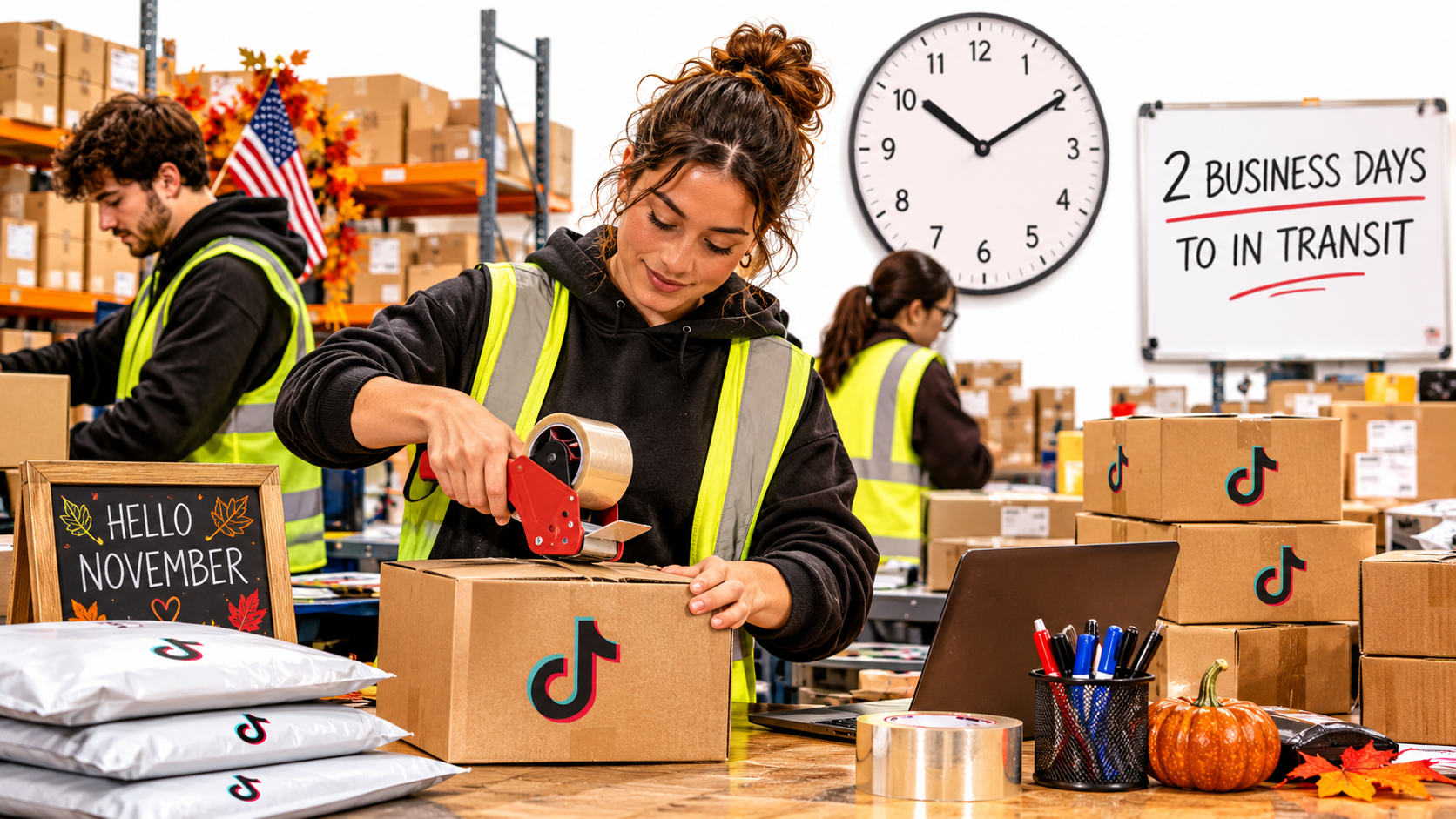
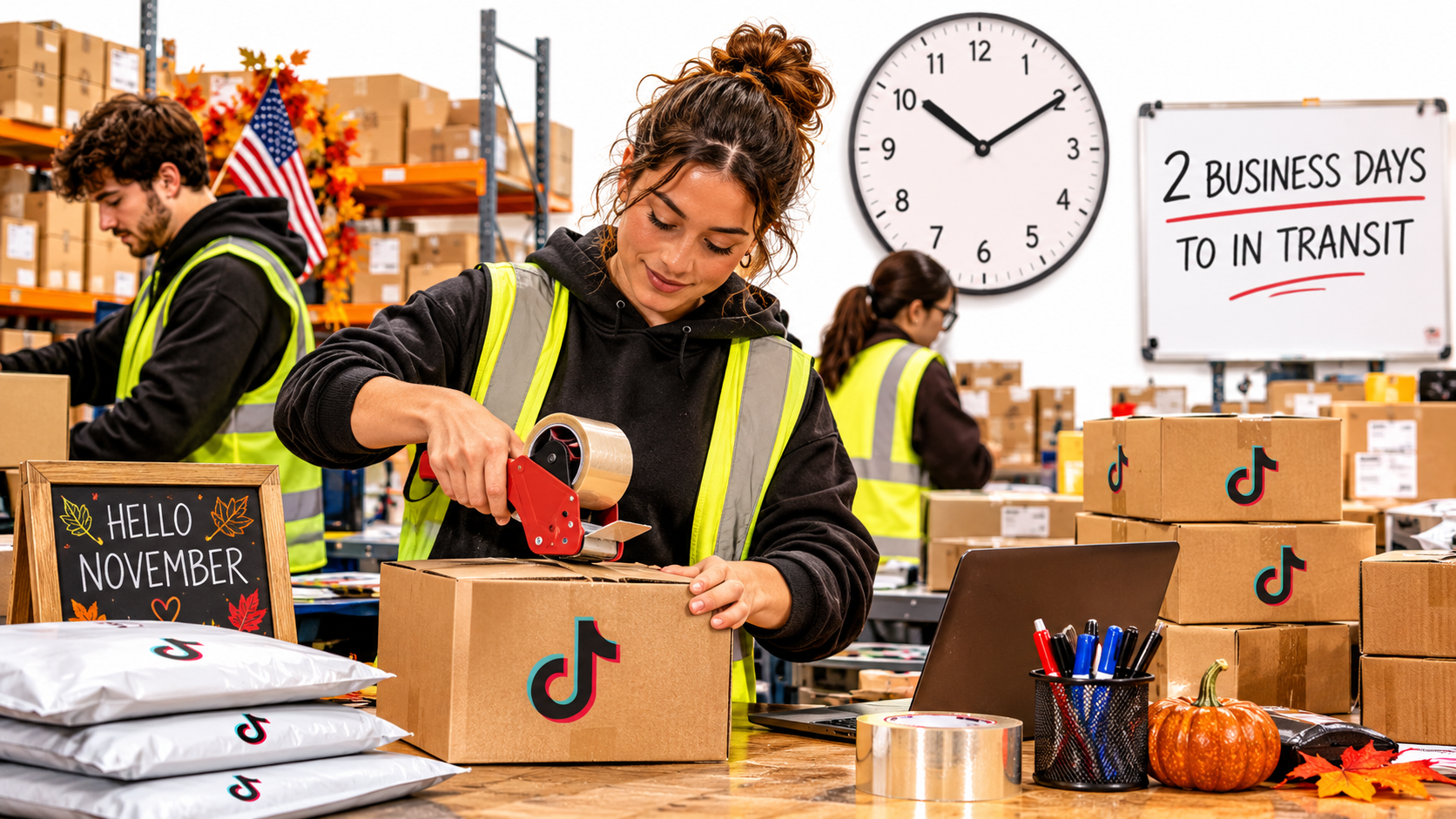
Dispatch: two business days to “In Transit”
For U.S. regular orders, the order must reach “In Transit” status within two business days of “Awaiting Shipment.” Current guidance says this has applied since January 26, 2026. A qualifying dispatch event can come from a carrier scan, a USPS manifest, or an in-app scan, so the label alone is not enough. A printed label sitting on a box does not stop the clock.
Auto-cancellation and delivery
TikTok may auto-cancel orders that lack tracking or an “Awaiting Collection” status after five business days. Delivery is generally expected within six business days. So you have three separate clocks: dispatch, cancellation, and delivery. Each one can hurt you in a different way.
Special order types
- Made-to-order, backorder and custom orders: the handling time you declare on the listing, plus one business day.
- Pre-orders: two business days after the pre-order closes.
- Regular in-stock orders: two business days, no exceptions for “we were busy.”
The practical lesson is that declared handling time is a promise. If you list a product as ships in three days and it ships in four, you are late by the same measure as everyone else.
What Changes During BFCM: The Extended Windows
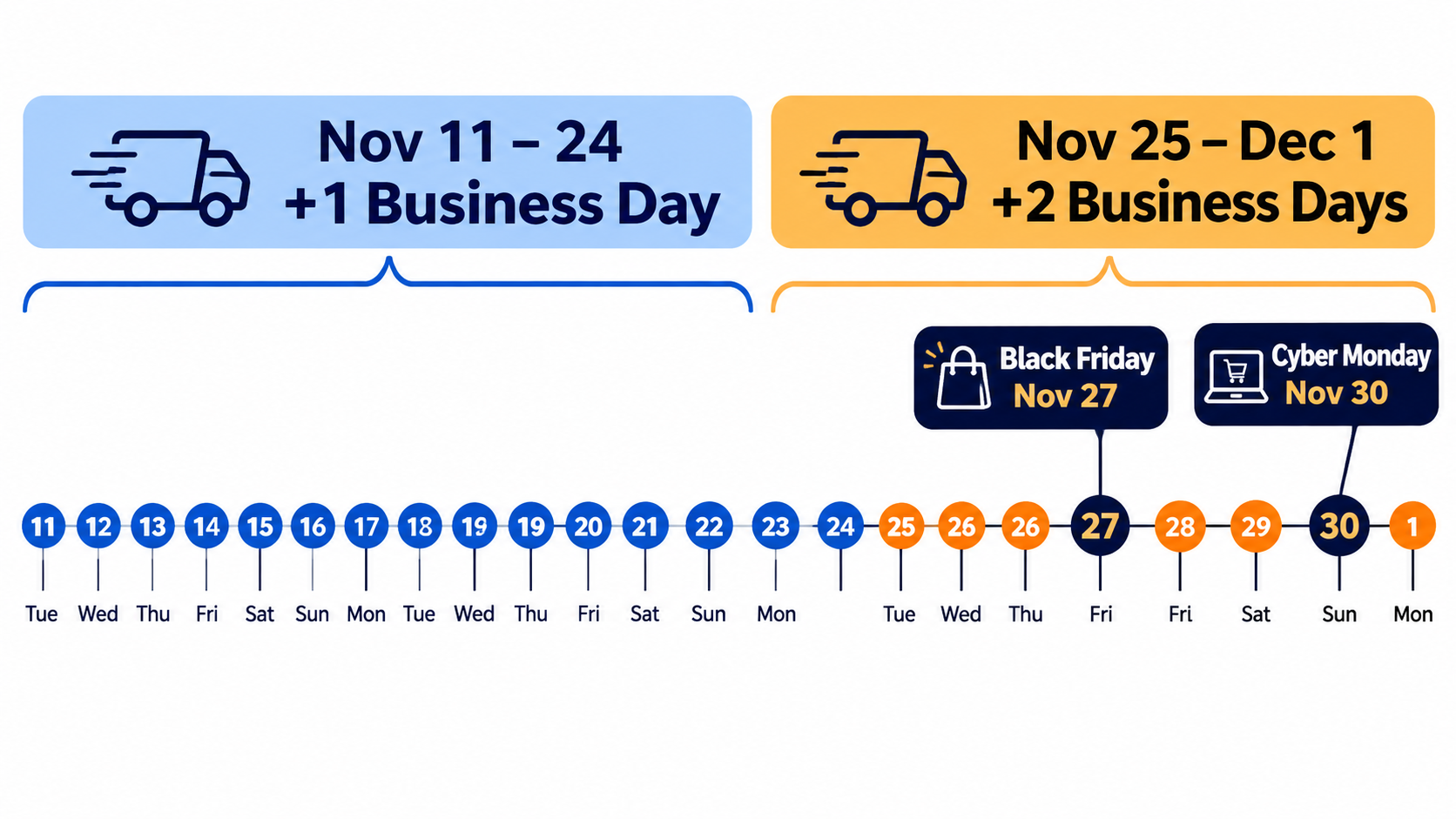
TikTok’s campaign guide offers shipping relief for local-shipping orders during the peak. Orders received November 11–24 get one additional business day on dispatch, auto-cancellation, and deliver-by SLAs. Orders received November 25 through December 1 get two additional business days.
Different summaries of the guide phrase this slightly differently, with some describing it as an added day and others as a one- or two-business-day SLA. That ambiguity matters, because the difference between “two days plus one” and “one day” is the difference between a relaxed week and a failed one. Open the campaign guide in Seller Center and screenshot the exact language for your team.
Why the relief is smaller than it looks
An extra business day sounds generous. In practice, it is consumed immediately by volume. If your order count triples, a one-day extension does not triple your pick-and-pack capacity. It buys you a cushion for a single bad morning, not a sustained surge.
Also note that the longest relief applies to orders received from November 25. That window contains Black Friday, a weekend, and Cyber Monday. Weekends do not count as business days, so Friday-night and weekend orders effectively all land on Monday’s desk. Plan Monday, November 30 as your single most dangerous day for the warehouse.
Late Dispatch Rate: The Math Behind the Threshold
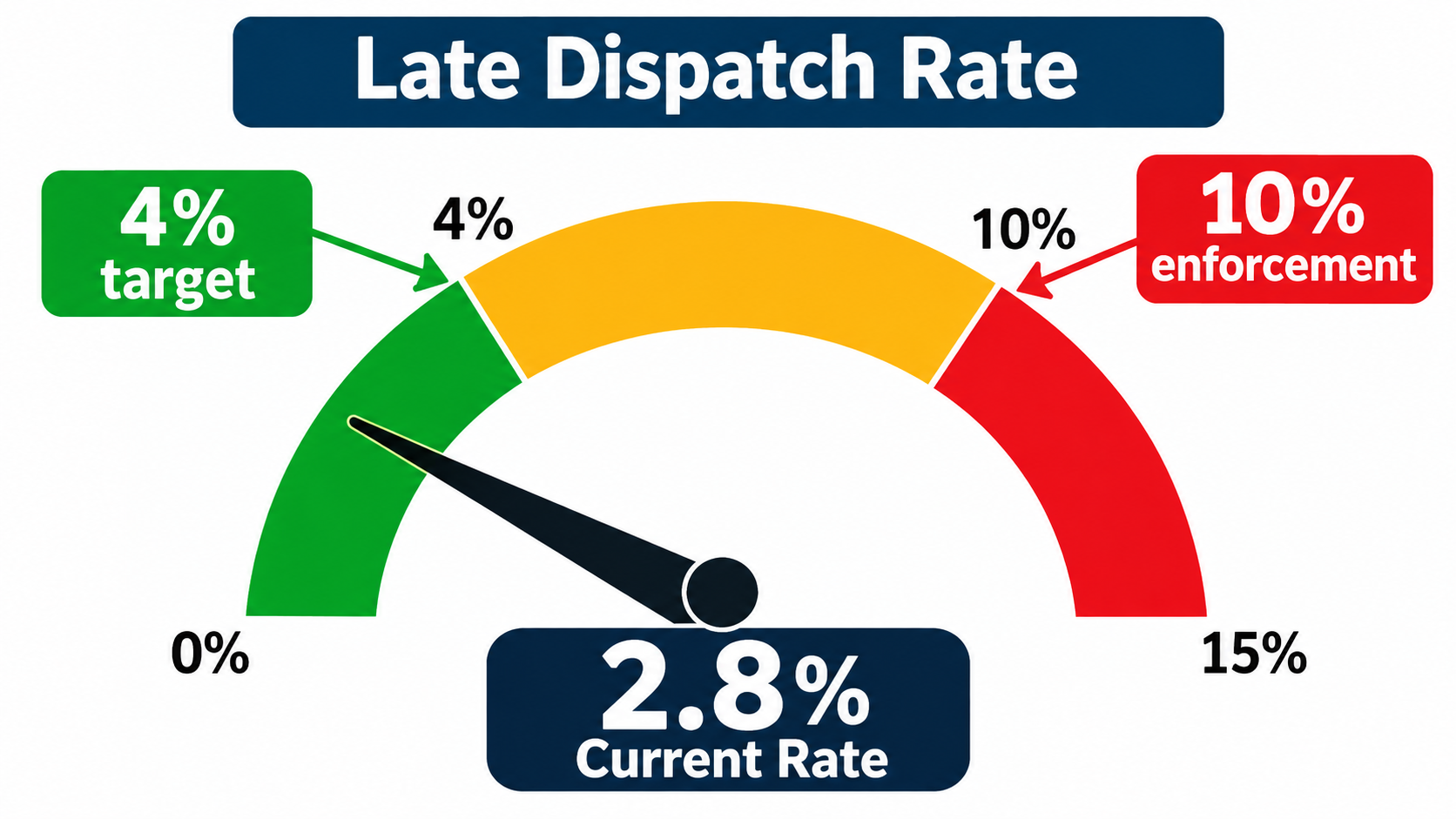
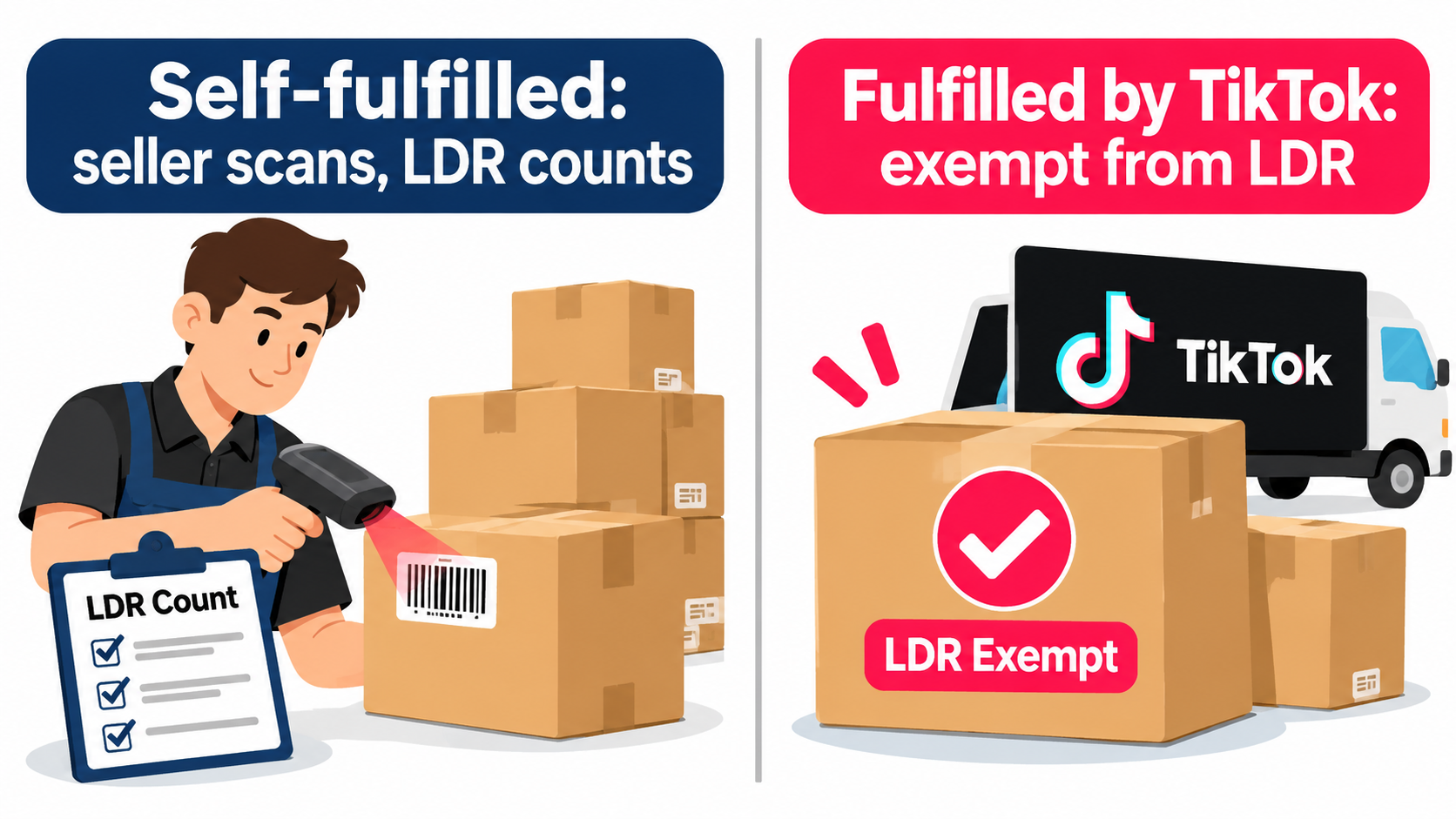
Late Dispatch Rate (LDR) is the metric that translates all of this into account risk. In the U.S., it is calculated as late non-Fulfilled-by-TikTok dispatches divided by all orders due for dispatch, with FBT orders included in the denominator. TikTok Shipping orders count. Fulfilled by TikTok orders are exempt from being counted as late.
TikTok recommends keeping LDR at 4% or below. Enforcement may apply when it exceeds 10%. Possible consequences include account-health deductions, order-volume limits, and extended settlement periods.
The eligibility floor for campaigns
Current campaign guidance also points to a Shop Performance Score of at least 3.5 and a 30-day LDR of 20% or lower to qualify, along with healthy account status and in-stock products. That 20% figure is a participation floor, not a goal. Hitting it means you can enter the campaign, not that you are safe.
A worked example
Suppose you normally ship 200 orders a month and miss 6 of them. Your LDR is 3%. During BFCM you receive 2,000 orders in three weeks. If your operation slips and 12% of them go out late, that is 240 late orders. The 30-day rolling window now blends a normal month with a bad peak, and you can cross the 10% line even though your average month looked fine.
The denominator matters in your favor too. Because FBT orders are included in the denominator, a seller with a large FBT share dilutes their own late self-shipped orders. That is one reason hybrid fulfillment is worth modeling.
The rolling window trap
Because the metric looks back over 30 days, a bad week in late November will still be visible in late December. Sellers often relax after Cyber Monday and then discover the penalty arrives during the slow weeks when they have no volume to dilute it. Keep the same discipline through the first week of December.
Build a Capacity Model Before the Orders Arrive
The reliable way to meet an SLA is to know your throughput limit and to stop selling past it. Most sellers do not know their limit. They find it on the worst day.
Step 1: Measure units per labor hour
Time a normal week. Count how many orders one packer completes per hour, from pick to scan. Separate single-item orders from multi-item orders and bundles, since bundles are common in TikTok Shop promotions and are slower.
Step 2: Convert demand forecasts into labor hours
Take your best forecast and a stress case at two to three times that number. Divide by units per labor hour. The result is the labor you need on the peak day, not the average day. If you cannot staff the stress case, you need either a cap or a partner.
Step 3: Set a daily order ceiling
An order ceiling is your safety valve. You can manage it by limiting inventory exposed to campaign listings, pausing low-margin SKUs, or adjusting LIVE schedules. Selling fewer orders on time is better than selling more and being flagged. A late order also costs you a customer review and a possible cancellation.
Step 4: Plan for the order mix
- Hero products driven by creators will spike unpredictably after a video goes viral.
- LIVE sessions produce bursts of orders in minutes, not smooth hourly flow.
- Bundles and gift sets add pick time.
Carrier Cutoffs and the Business-Day Calendar
Your internal deadline should be earlier than TikTok’s. If TikTok gives you two business days, your internal target should be same day for orders before a cutoff, and next morning at the latest.
Define a daily cutoff
Pick a time, say 2 p.m. local, by which all orders received are guaranteed to be handed to the carrier that day. Orders after cutoff are first in the queue next morning. This is simple, but it gives your team a clear rule and lets you measure against it.
Know what counts as a scan
Because carrier scans, USPS manifests, and in-app scans can qualify as dispatch events, confirm which one your setup produces. A common failure is a carrier pickup that happens at 5 p.m. but whose first scan appears the next day. Test it with a few orders in October and check what status TikTok shows and when.
Holiday and weekend calendar
Carriers have their own surcharges and capacity limits in peak season, and pickups can be skipped or delayed on Thanksgiving. Confirm pickup schedules for Thursday, November 26 and the weekend. If you rely on drop-off, make sure someone has a car and a plan for Saturday and Sunday volume.
Add a second carrier
A single carrier outage or a missed pickup puts every order at risk. Having a second service on account, even at a higher rate, is cheap insurance. It also lets you route heavy parcels to the cheaper option.
FBT, Self-Ship, or 3PL: Choosing a Fulfillment Model
Fulfilled by TikTok
FBT orders are exempt from late-dispatch counting, which removes the most dangerous metric from your plate. The trade-offs are inbound lead times, storage and handling fees, and the need to get inventory into the network early. Inventory that arrives after the campaign starts does not help you. If you want FBT for BFCM, treat inbound shipments as an October project and verify current receiving times with TikTok.
Self-fulfillment
Self-shipping gives you control and the lowest per-unit cost at low volume. It also puts every minute of the SLA on your own team. It works well if your volume is predictable and your team is small enough to coordinate in a single room.
Third-party logistics
A 3PL provides labor flexibility, but it is not automatically compliant. Ask for their written peak-season cutoffs, their order-per-day limits, and their process for syncing tracking back to TikTok Shop. A 3PL that ships on time but uploads tracking a day later will still produce late dispatches in your account.
The hybrid approach
Many sellers do best by sending hero SKUs to FBT and keeping long-tail products in their own warehouse. This lowers risk on the products most likely to go viral, and it dilutes the self-ship late count through the shared denominator.
Inventory Discipline: Do Not Sell What You Cannot Ship
Campaign eligibility assumes products are in stock and ready to ship. Overselling is the single most avoidable cause of cancellations and late shipments.
Reserve safety stock
Set listing quantities below your physical count. A buffer of 5 to 10% handles miscounts, damaged goods, and returns in transit. It is far better to show “sold out” for an hour than to cancel orders later.
Sync inventory across channels
If you sell on Amazon, Shopify, and TikTok Shop, a sale elsewhere can leave your TikTok quantity stale. Use a single inventory source and test the sync frequency. During LIVE sessions, minutes matter.
Handle variants carefully
Variant mix is where inventory errors hide. A popular color can sell out while the listing still shows the parent product as available. Check variant-level quantities before every major creator push.
Use declared handling time honestly
If a product truly needs a longer turnaround, set it as made-to-order or backorder with an honest handling time rather than listing it as regular stock. The rule of handling time plus one business day gives you a defensible SLA instead of a guaranteed miss.
Coordinating With Creators and LIVE Sessions
Fulfillment is rarely connected to the creative calendar, and that is a mistake. Your marketing team can create an order surge that your warehouse learns about only when the queue appears.
Share a campaign calendar with ops
Every LIVE session and creator video should be on a calendar your warehouse manager can see. Include the expected size of the audience and the product being featured. If a large creator is posting on Black Friday, ops should know a week ahead.
Gate the promotion with stock
Before a major push, ops signs off on stock level and labor. If either is short, marketing scales the push down or moves it. This is not about slowing sales. It is about making sure the sale turns into a delivered order.
Prepare for post-LIVE queues
Livestream buyers often check out in a rush once the session ends. Expect a large batch of orders within a short time and plan labor for the hour after, not during.
The BFCM Command Center: A Daily Operating Rhythm
Morning review
- Count of orders in “Awaiting Shipment” by age: today, yesterday, two days old.
- Any order approaching the dispatch deadline gets moved to the front of the queue.
- Check on carrier pickup confirmations for the day.
Midday checkpoint
- Compare orders shipped versus orders received.
- Decide whether to add labor, pause a promotion, or reduce the order ceiling.
End-of-day close
- Confirm all orders before cutoff have a scan.
- Check tracking uploaded and visible in Seller Center.
- Record the day’s on-time percentage.
Metrics to track
- Order age at dispatch, in hours.
- Percent of orders scanned before cutoff.
- Orders at risk of missing the SLA within 24 hours.
- Estimated rolling LDR.
- Cancellation and refund requests.
The most useful number is the third. It is a leading indicator, while LDR itself arrives too late to act on.
Cancellations, Customer Messages, and Damage Control
Even with a strong plan, something will break. A pallet will arrive late, a carrier will miss pickup, or a viral video will outrun your stock. How you respond determines how much damage reaches your metrics.
Cancel early rather than ship late
If you know an order cannot be fulfilled, cancelling proactively is often better than letting it age into an auto-cancellation. Check how seller-initiated cancellations are treated in your metrics in Seller Center, since cancellation rate is its own measure. The goal is to avoid compounding two problems.
Message buyers proactively
Customers tolerate delays far more when told early. A short note explaining the delay and the new expected date reduces refund requests and negative feedback.
Escalate when needed
If a platform issue affects shipping labels or status updates, document it with screenshots and timestamps and contact seller support. Evidence collected during the event is far more useful than a recollection afterwards.
The Post-Peak Month: Returns, Metrics and Lessons
The campaign ends November 30, but the SLA consequences continue. Settlement timing, returns, and the rolling metrics all extend into December.
Keep the standard high through December
Orders received through December 1 still receive the extended window, after which the usual two-day rule returns. Do not cut labor on December 2 without checking your backlog first.
Prepare for returns
Returns usually peak after the holidays. Allocate time for processing them and for restocking, because returned stock that sits unprocessed cannot be resold.
Run a retrospective
Within a week, record what happened: the peak daily order count, your real units per labor hour, the days you came closest to a late dispatch, and the root causes. This becomes next year’s capacity model, and it is far more accurate than any forecast.
Your Pre-Campaign Checklist
- Read the official campaign guide and record the exact SLA wording for November 11–24 and November 25–December 1.
- Confirm your Shop Performance Score and 30-day LDR meet the campaign eligibility floor.
- Measure your units per labor hour and set a daily order ceiling.
- Decide on FBT, self-ship, 3PL, or a hybrid, and complete inbound shipments early.
- Set an internal cutoff earlier than TikTok’s, and test which scan event TikTok recognises.
- Arrange backup carrier and weekend pickup plans.
- Hold back 5 to 10% safety stock and verify variant-level inventory sync.
- Share the creator and LIVE calendar with operations.
- Run the daily command-center routine, tracking the at-risk-orders number.
- Plan the post-peak month with returns and a written retrospective.
Conclusion
BFCM on TikTok Shop rewards sellers who can turn attention into delivered packages. The rules are not mysterious: two business days to dispatch under normal conditions, modest extra time during the campaign, and an LDR that should stay at or under 4% with real consequences above 10%. What separates sellers is whether they planned against those numbers before the first viral video.
Start with the capacity model, because it tells you how much demand you can responsibly accept. Then build the cutoffs, the buffer stock, and the daily rhythm around it. If you do, the extra business days TikTok grants become a margin of safety rather than a crutch, and your account enters 2027 in better shape than it entered November.