



So, is selling on Amazon actually worth it?
The short answer is a hard yes—but with a huge caveat. You have to treat it like a real business, not a side hustle or some get-rich-quick fantasy. Success on Amazon boils down to getting your head around the numbers—profitability, fulfillment, and ad costs—before you even think about listing your first product.
The Brutal Truth About Selling on Amazon
Let’s be honest. The opportunity on Amazon is massive. You get instant access to millions of customers who are ready to buy, backed by a logistics and payment machine that would cost a fortune to build yourself.
But that access comes at a steep price. You're not just paying fees; you're stepping into one of the most competitive marketplaces on the planet. Believing you can just upload a product and watch the sales notifications pop up is the fastest way to burn through your cash.
The hard reality is that for every seller who becomes a millionaire, countless others crash and burn. The difference, almost always, comes down to one thing: preparation.
High Potential Meets High Risk
The numbers don't lie, and they paint a very clear picture of this high-stakes game. The average third-party Amazon seller reportedly pulls in around $290,000 in sales. But that number is wildly misleading, propped up by a handful of massive sellers.
Here's the real breakdown: a shocking 70% of sellers make $60,000 or less per year. Only 11% manage to break the $300,000 yearly mark, and a tiny 2% hit the $100,000-in-a-single-month club. This huge gap between the top players and everyone else is exactly why a rock-solid strategy from day one is non-negotiable. If you want a deeper dive, these Amazon seller statistics are eye-opening.
To figure out if you're ready to jump into the ring, it helps to see the good and the bad side-by-side.
Key Takeaway: Selling on Amazon is not passive income. It’s an active, hands-on business that demands constant attention to your inventory, pricing, ads, and customers just to stay profitable.
Quick Look: Is Selling on Amazon a Fit for Your Business?
This table cuts right to the chase, laying out the fundamental trade-offs. Use it as a quick gut-check to see if the marketplace aligns with your business goals and what you’re willing to put in. We'll get into the nitty-gritty of costs and strategies next.
| Key Advantages | Key Disadvantages |
|---|---|
| Massive Customer Base Tap into over 200 million Prime members actively looking to buy something. | Intense Competition You're up against thousands of sellers, including Amazon's own private label brands. |
| Built-in Trust Customers already trust Amazon's checkout, shipping promises, and easy returns. | High Fees Referral fees, FBA costs, and storage fees can eat into your margins faster than you think. |
| Powerful Fulfillment Network Fulfillment by Amazon (FBA) can handle all your storage, packing, and shipping. | Lack of Brand Control It's tough to build a direct customer relationship or create a unique brand experience. |
| Robust Advertising Platform Get your product in front of shoppers with high buying intent, right on the platform. | Complex Rules & Policies Amazon's terms of service are strict, constantly changing, and can be a minefield. |
Looking at this, you can see it's a balance. The platform offers incredible leverage, but it demands a lot in return. The real question is whether the upside is worth the operational headaches and costs for your specific business.
Calculating Your True Profit on Amazon
It's easy to get excited by big revenue numbers, but seasoned sellers know the real score: revenue is vanity, profit is sanity. To honestly answer "is selling on Amazon worth it?" you have to look past the top-line sales number and figure out what you actually get to keep.
Thinking your profit is just Sale Price - Product Cost is the single biggest trap new sellers fall into. The truth is, Amazon's ecosystem is layered with fees that can chew through a seemingly healthy margin before you know what hit you.
The Key Fees That Impact Your Bottom Line
Before your product ever lands in a customer's hands, Amazon takes its cut. Understanding these deductions isn't just a good idea—it's absolutely essential for building a business that lasts.
Here are the main fees you'll run into right out of the gate:
- Referral Fees: This is Amazon’s commission for using their massive marketplace. It’s a percentage of your total sale price and usually falls between 8% and 15%, depending on your product category. For example, a gourmet food item might have a 15% fee, while a consumer electronics product might be 8%.
- Fulfillment by Amazon (FBA) Fees: If you're using FBA, this fee covers Amazon picking, packing, and shipping your product. The cost is all about your item's size and weight. A small, light item like a phone case will have a much lower FBA fee than a heavy item like a set of dumbbells.
- Monthly Storage Fees: Amazon charges you for the physical space your inventory takes up in their warehouses. This is calculated based on the daily average volume of your products and can jump up significantly during the busy Q4 holiday season. For example, storing a standard-sized product from January to September might cost $0.87 per cubic foot, but this can jump to $2.40 per cubic foot from October to December.
These are just the core fees. You also have to factor in your Landed Cost—the total cost to get one unit of your product from the factory floor into an Amazon fulfillment center. This number includes manufacturing, freight shipping, customs, and any import duties.
Key Takeaway: Your true profit isn't what's left after your product cost. It's what remains after subtracting the landed cost and all of Amazon's associated fees. Ignoring this is a recipe for selling a lot of products while losing money on every single one.
A Practical Example of Amazon Profit Math
Let's walk through the numbers with a hypothetical product. This is how a product that looks great on paper can quickly become a much tighter game once Amazon's fees come into play.
Product Details:
- Sale Price: $30.00
- Landed Cost (manufacturing, shipping, duties): $9.00
Here’s how the profit breaks down, step-by-step:
- Start with the Sale Price: $30.00
- Subtract the Referral Fee: Let's assume a 15% category. That’s
$30.00 * 0.15 =-$4.50. - Subtract the FBA Fulfillment Fee: For a standard-sized, 1-pound item, this is roughly -$5.00.
- Subtract the Landed Cost: This is the -$9.00 it cost you to get the product ready to sell.
- Calculate Net Profit (Before Ads & Storage):
$30.00 - $4.50 - $5.00 - $9.00 =$11.50
Your gross profit margin started at a very healthy 70% (($30 - $9) / $30). But after Amazon's cut, your net profit margin is now just 38% ($11.50 / $30.00). And that's before you've spent a dime on advertising, long-term storage, or returns. To get a better handle on setting your prices, check out our complete guide to Amazon pricing strategies.
This quick workflow illustrates the core components of Amazon profitability, from calculating costs to understanding fulfillment and advertising impacts.
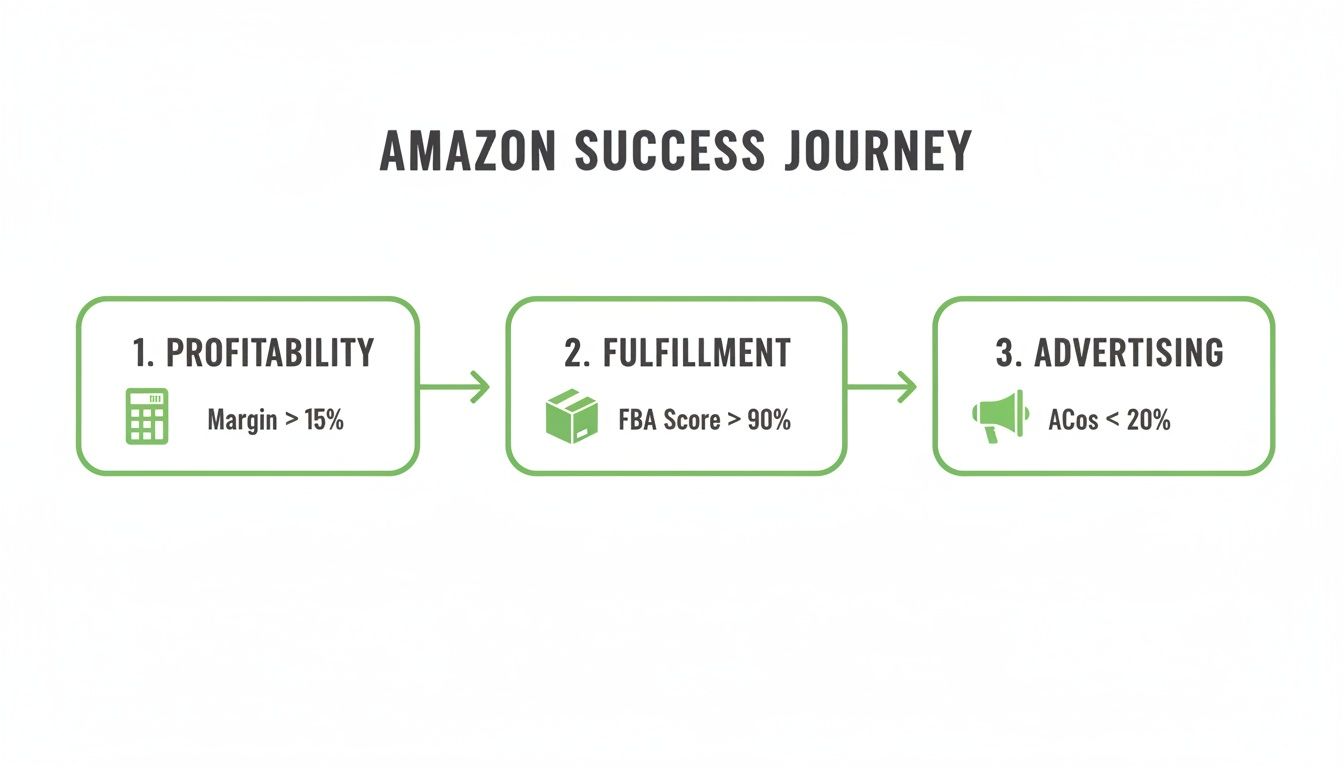
This process shows that winning on Amazon isn't about mastering one thing; it's about the seamless integration of financial planning, logistics, and marketing.
This exercise is why you must calculate your potential profit with ruthless accuracy before you ever invest in inventory. A product that looks like a winner can easily turn into a money pit once it enters the Amazon ecosystem. Armed with this financial clarity, you can now make a much smarter decision about your next move.
Choosing Your Fulfillment Method FBA vs FBM
How you get products into your customers' hands is one of the biggest forks in the road you'll face on Amazon. This decision ripples through everything—your costs, your daily workload, and ultimately, whether this whole venture is worth it. You have two main paths: Fulfillment by Amazon (FBA) and Fulfillment by Merchant (FBM), and they're fundamentally different ways of operating.
Think of it this way: FBA is like leasing a fully serviced pop-up shop in the world's busiest mall. Amazon handles the location (storage), the staff (picking and packing), and the couriers. FBM, on the other hand, is like running your own boutique from a private workshop—you control every single detail, from the branded tissue paper to the shipping carrier.

What Is Fulfillment by Amazon (FBA)
With FBA, you send your inventory in bulk to Amazon’s massive fulfillment centers. Once it’s there, your job is mostly done. Amazon takes over, storing your products, then picking and packing them as orders roll in. They handle all the shipping and even manage customer service and returns.
The crown jewel of FBA is the Amazon Prime badge. That little checkmark is a massive sales driver, signaling trust and promising fast, free shipping to over 200 million Prime members across the globe. It also dramatically boosts your odds of winning the all-important Buy Box.
Of course, this premium service isn’t free. As we touched on earlier, you're paying FBA fulfillment and storage fees. These can add up fast, especially if you're dealing with slow-moving inventory or oversized items.
What Is Fulfillment by Merchant (FBM)
Fulfillment by Merchant is the classic DIY approach. When a customer clicks "buy," the ball is entirely in your court. You're responsible for storing your inventory, picking and packing the order, shipping it out, and handling any customer service inquiries or returns that come your way.
The major upside here is control. You control your inventory levels, your packaging, and your shipping costs. This can lead to much healthier profit margins, particularly if you sell large, heavy, or slow-moving products where FBA fees would eat you alive. But that control comes with a heavy workload—you become the warehouse, shipping department, and customer service team all at once.
The data points overwhelmingly toward FBA as the engine for growth. About 58% of sellers hit profitability within their first year, and for the top earners pulling in over $100,000 annually, a staggering 82% use FBA. It’s the model that unlocks the Prime badge and provides the operational scale needed to truly compete.
FBA vs FBM Which Fulfillment Model Fits Your Business
Picking the right path really boils down to your product, your operational muscle, and your ultimate goals. A brand selling small, lightweight cosmetics is playing a completely different game than a company selling custom-made furniture.
To make the decision clearer, here’s a head-to-head comparison of the factors that matter most.
| Factor | Fulfillment by Amazon (FBA) | Fulfillment by Merchant (FBM) |
|---|---|---|
| Prime Badge | Yes, automatically included, which boosts visibility and sales. | No, unless you qualify for the strict Seller Fulfilled Prime program. |
| Logistics | Hands-off. Amazon handles storage, packing, shipping, and returns. | Hands-on. You are responsible for the entire fulfillment process. |
| Costs | Higher. Includes fulfillment fees and monthly/long-term storage fees. | Potentially lower. You only pay for your own storage and shipping costs. |
| Control | Low. You have limited control over packaging, branding, and inventory access. | High. You have complete control over the entire customer experience. |
| Best For | Fast-moving, standard-sized products where speed and convenience are key. | Oversized, heavy, slow-moving, or customized products. |
Keep in mind, it's not always an either/or choice. Many savvy sellers use a hybrid model, putting their bestsellers on FBA to maximize sales velocity while self-fulfilling niche or bulky items via FBM to protect their margins. For example, a home goods seller might use FBA for their popular coffee mugs but use FBM to ship large, fragile floor lamps directly from their own warehouse to avoid high FBA fees and potential damage.
If you want to dive deeper into getting started, check out our complete guide on how to sell on Amazon FBA.
The Advertising Costs You Cannot Ignore
On Amazon, the old saying "if you build it, they will come" is a recipe for disaster. With millions of sellers all vying for the same eyeballs, hoping your new product will just magically get discovered is like setting up a coffee stand in the middle of the Sahara. It's just not going to happen.
To get anywhere, you have to pay to play. That means budgeting for Amazon Pay-Per-Click (PPC) advertising right from the start.
Think of Amazon's search results page as a bustling city street. The prime real estate at the top, where all the foot traffic is, is reserved for paid ads. Relying on organic ranking alone is like opening your store in a quiet back alley—a few people might stumble upon you, but you’ll miss out on the massive crowd of shoppers walking down the main drag. This makes advertising an essential, non-negotiable part of your launch budget and your ongoing strategy.

Understanding the Key Advertising Metrics
Diving into Amazon PPC means you're going to get hit with a few acronyms. Don't let them intimidate you. They're not just jargon; they're the vital signs of your business's health on the platform, and they directly measure how your ads are performing.
The first and most important metric you need to watch like a hawk is your Advertising Cost of Sale (ACoS).
ACoS tells you what percentage of your sales revenue you're spending on ads. It’s a simple calculation:
(Ad Spend / Ad Sales) * 100. So, if you spend $30 on ads and that generates $100 in sales, your ACoS is 30%.
This number is absolutely critical because you have to stack it up against your profit margin. If your profit margin on a product is 25% but your ACoS is running at 30%, you are actively losing 5% on every single sale driven by that campaign. This is one of the most common pitfalls that bleeds new sellers dry.
Moving Beyond ACoS to See the Bigger Picture
While ACoS is your go-to for checking campaign health, it only tells part of the story. A well-run ad campaign doesn't just ring the register today; it also juices up your product's organic ranking over time, leading to more "free" sales down the road.
This is where a metric called Total Advertising Cost of Sale (TACOS) comes into play. TACOS measures your ad spend against your total sales (both from ads and organic). The formula is (Ad Spend / Total Sales) * 100.
A low and steady TACOS is a beautiful thing. It means your advertising is creating a "flywheel effect"—your paid ads are boosting both your ad-driven and organic sales, making your entire business more profitable and less dependent on advertising over time.
A Practical Example of PPC in Action
Let’s put this into practice. Imagine you're selling a premium coffee grinder for $50. Your pre-ad profit margin is 35%, which is $17.50 per unit. You launch a PPC campaign with a target ACoS of 30%.
- Week 1: You spend $300 on ads and generate $1,000 in ad-driven sales (a 30% ACoS). You also make $200 in organic sales. Your TACOS is 25% (
$300 / $1,200). At this stage, your ads are right on target. - Week 4: After tweaking your campaigns, you spend another $300 but this time generate $1,200 in ad sales (now a 25% ACoS). Even better, your improved sales history has pushed your organic rank up, leading to $800 in organic sales. Your TACOS has now dropped to just 15% (
$300 / $2,000).
This shows how advertising isn't just an expense; it's the engine for growth. Understanding this is everything when it comes to controlling your costs. For a deeper dive into how Amazon's ad system works, including campaign types and core strategies, check out this guide on what Amazon PPC is.
Ultimately, a smart PPC strategy is fundamental to deciding if selling on Amazon is truly worth it for you. Without a realistic ad budget and a solid grasp of these metrics, even the best products can get lost in the noise. For a closer look at managing these expenses, exploring the details of Amazon advertising cost is a crucial next step.
Don't Forget About the Hidden Workload
Making sales and running ads are the exciting parts of selling on Amazon. But once the orders start rolling in, a different reality hits you square in the face: the operational grind. This is the hidden workload that catches so many sellers off guard, quickly turning a promising business into a daily battle against logistical nightmares.
It's easy to underestimate just how much administrative work it takes to keep an Amazon store humming. The dream is to spend your days on big-picture strategy, new product ideas, and clever marketing campaigns. The reality? You're bogged down for hours answering the same customer questions over and over, processing returns, and trying to keep up with Amazon's constantly shifting rules.
This operational drag is a classic growth killer. Instead of digging into your ad data or researching your next bestseller, you're stuck deciding if a returned widget can be resold or if you should just refund a customer for a crushed box.
The Real Price of Amazon's Return Policy
Amazon built its retail empire on a customer-first return policy that is, frankly, legendary. It’s a huge plus for shoppers, but it can be absolutely brutal for sellers. In a lot of categories, a customer can return something for just about any reason, and you, the seller, are the one eating the cost of the refund and often the shipping label.
This stings the most in categories with naturally high return rates. Think apparel, where getting the size right is a gamble, or electronics, where a customer might just get frustrated with the setup. It’s not at all unusual to see a 20% return rate in these niches, a number that can instantly vaporize your profit margin on a huge chunk of your sales.
And the work doesn't stop there. For every single one of those returns, you have to follow a specific workflow:
- Monitor Return Requests: Check your Seller Central dashboard daily for new return authorizations.
- Inspect the Returned Item: Once the item arrives back at Amazon's warehouse (FBA) or your own (FBM), you must assess its condition. Is it still in new, sellable condition, or is it damaged? For example, a returned t-shirt might be unworn and re-sellable, or it could be stained and unsellable.
- Process the Refund: Amazon typically handles this automatically for FBA, but for FBM you must issue the refund promptly to avoid customer complaints.
- Manage Your Inventory: If the item is sellable, it goes back into your active inventory. If not, you must create a removal or disposal order to get it out of Amazon's warehouse to avoid storage fees on unsellable goods.
This cycle becomes a constant, draining tax on your time and money. It's a massive piece of the puzzle when you're trying to answer, "is selling on Amazon really worth it?"
How to Outsource the Grind and Get Your Time Back
Let's paint a picture. Imagine you’re selling 30 units a day—that’s great! But you spend two hours every single morning dealing with five returns and a dozen customer messages. That’s 10 hours a week spent on reactive, low-value tasks instead of proactive work that actually grows your business. A quarter of your work week, gone.
This is where the classic "work smarter, not harder" mantra really comes into play. Handing off these operational headaches to a third-party logistics (3PL) partner or a specialized agency can be the single most important decision you make to scale without burning out. They can take over your returns management, handle all your FBA prep, and even manage customer service, letting you step out of the warehouse manager role and back into the CEO seat.
It might seem strange, but the data shows that the Amazon landscape is actually rewarding operational efficiency. The number of active sellers dropped from 2.4 million in 2021 to just 1.65 million by late 2023. But in that exact same timeframe, the number of sellers earning over a million dollars more than doubled. The lesson is clear: the sellers who survived and truly thrived were the ones who got their operations dialed in. You can learn more about this trend and the growth of top-performing Amazon sellers.
Your Go or No-Go Amazon Launch Checklist
Alright, we've walked through the costs, the fulfillment models, and the sheer amount of work involved. But the big question is still hanging in the air: should you actually do this? Answering "is selling on Amazon worth it?" isn't about some universal truth; it's about an honest look at your own situation.
This checklist is designed to cut right through the noise. Think of it as your final pre-flight check before committing to the launch. Answering these questions with real numbers and a healthy dose of realism will be the difference between a smooth takeoff and a business that sputters out on the runway.
The Financial Green Light Check
First things first, let's talk money. If the numbers don't add up on paper, they'll never work out in the real world. This part is non-negotiable.
- Are my product's net profit margins over 30%? I'm talking about the profit after your landed cost, all of Amazon's fees (referral, FBA, storage), and a buffer for inevitable returns. Anything less than that and you have zero wiggle room for ads, mistakes, or just a bad month. For example, if your product sells for $40 and your total cost per unit (including all fees) is $28, your profit is $12, a 30% margin. That's a green light. If your total cost is $32, your profit is only $8 (a 20% margin), which is a major red flag.
- Do I have a minimum launch budget of $5,000? A truly realistic starting budget for a private label product is somewhere in the $3,500 to $10,000 range. This has to cover your first batch of inventory, professional product photos (don't skimp here!), and a critical budget for PPC ads to get those first crucial sales.
- Can my cash flow handle a second inventory order before I'm profitable? It can easily take 90-120 days to see a real profit. You absolutely must have the cash on hand to reorder inventory before your first batch is gone. Stocking out is the kiss of death for your sales velocity and ranking.
If you answered "no" to any of these, it’s a massive red flag. That’s your sign to go back to the drawing board—either by finding a product with better margins or by securing more capital before you even think about hitting "go."
Your initial investment isn't just for inventory; it's the fuel for your advertising engine. Without a dedicated ad budget, even a great product will remain invisible on Amazon's crowded digital shelves.
The Operational Readiness Check
Next up, let's get real about your ability to handle the day-to-day grind. This is where you need to be brutally honest about your time, your skills, and your temperament.
- Do I have 10-15 hours per week to dedicate to this? Especially in the beginning, you’re the one managing inventory, tweaking listings, poring over PPC campaign data, and dealing with customer service. This isn't a passive income stream; it's an active, time-sucking venture.
- Am I prepared to become an expert in Amazon's rules? Amazon's Terms of Service is a labyrinth, and it changes constantly. One wrong move—even an innocent one—can get your listing suspended or your entire account shut down. Your whole investment is on the line.
- Do I have a clear plan for managing returns and customer questions? Bad customer service is a fast track to negative reviews and a trashed seller reputation, which is incredibly difficult, if not impossible, to fix. A practical step here is creating template responses for common questions (e.g., "Where is my order?", "How do I use the product?") to save time and ensure consistent communication.
Before you pull the trigger, diving into a comprehensive A to Z guide for new product launches on Amazon can be a lifesaver, ensuring you've covered all your legal and procedural bases.
Your Next Steps Based on Your Answers
If you just checked "yes" to all of the questions above, congratulations. You've got a solid foundation for a successful launch. Your next move should be a low-risk test run: start with a small initial inventory order to prove the market wants what you're selling before you go all-in.
But what if you answered "no" to one or more? That's not a failure—it's incredibly valuable insight. It means you’ve just saved yourself a ton of money and heartache. Your time is better spent shoring up your weak spots first. Focus on improving your product margins, building up more capital, or mapping out a solid operational plan before you commit to the Amazon beast.
Common Questions We Hear About Selling on Amazon
Even with a solid plan, a few questions always pop up when brands are on the fence about Amazon. Let's tackle the big ones head-on.
How Much Money Do I Really Need to Start Selling on Amazon?
Look, you could technically throw a product up with a few hundred bucks, but you'd be setting yourself up for failure. A realistic, professional launch for a private label product is going to run you between $3,500 and $10,000.
Here's a sample breakdown for a $5,000 launch budget:
- Inventory (300 units @ $7/unit): $2,100
- Product Photography & Videography: $700
- Amazon Fees & Shipping to FBA: $500
- Launch PPC Advertising Budget: $1,500
- Contingency (unexpected fees, etc.): $200
This budget gives you enough breathing room for your first real inventory order, killer product photography, and—most importantly—an advertising budget to get those first crucial sales.
Can I Sell on Amazon Without Using FBA?
Yep, you absolutely can. Fulfilling orders yourself, known as Fulfillment by Merchant (FBM), is a great option in specific situations. If you already have a warehouse and a slick shipping process, or if you sell bulky items that would cost a fortune in FBA fees, FBM makes a lot of sense. It also gives you total control over how your products are packed and presented.
The major trade-off? You lose the Amazon Prime badge. That little checkmark is a massive driver of sales, and not having it can seriously cut into your volume. A lot of savvy sellers actually use a hybrid model—they use FBM for certain products and let FBA handle their bestsellers to get the best of both worlds.
Is It Too Late to Start Selling on Amazon Because of Competition?
Not at all, but the rules of the game have changed. The days of finding a cheap product, slapping your name on it, and winning on price are long gone. To succeed now, you need a real brand, a product that's genuinely better than the competition, and a smart, well-funded advertising plan.
It's definitely more competitive, but the interesting thing is that revenue per active seller is actually going up. That tells us that brands who come in prepared have a bigger piece of the pie to capture than ever before. The key is showing up on day one looking like you belong there, not like you're just testing the waters.
The single biggest mistake we see new sellers make is getting the math wrong. They underestimate their total costs and launch with paper-thin margins, focusing only on the cost of the goods and the sticker price. They completely forget to account for Amazon's referral fees, FBA fees, advertising spend, and returns.
This is how you end up in a nightmare scenario where you're technically making sales but are actually losing money on every single box that goes out the door. Doing a full profit-and-loss breakdown before you even think about placing an inventory order is the most critical first step you can possibly take.
Ready to stop guessing and start growing? The team at ZonFlip provides the end-to-end management you need to protect your profits and scale your brand on Amazon. Learn how we can manage your Amazon store so you can work less and sell more.